
Every System in the Building, Assessed by People Who Know What to Look For.
A system nobody tracks fails as an emergency purchase. Ten tools record the condition and remaining life of every physical system, so replacements are planned. The Building Systems tools record assets, condition, remaining life, deficiencies and obligations for power, water, envelope, site, elevators and specialty systems. The HVAC & Plant tools run the central plant, choose replacement equipment, price retrofits and size a replacement to the building's real need.
Launching Early 2027 · Join the Early-Access List
Power, Water, Envelope, Site, Elevators and Specialty Systems
Each tool publishes what it finds to the shared Building Systems record, which is how the platform shows whole-building condition and a capital plan without anyone assembling it by hand.
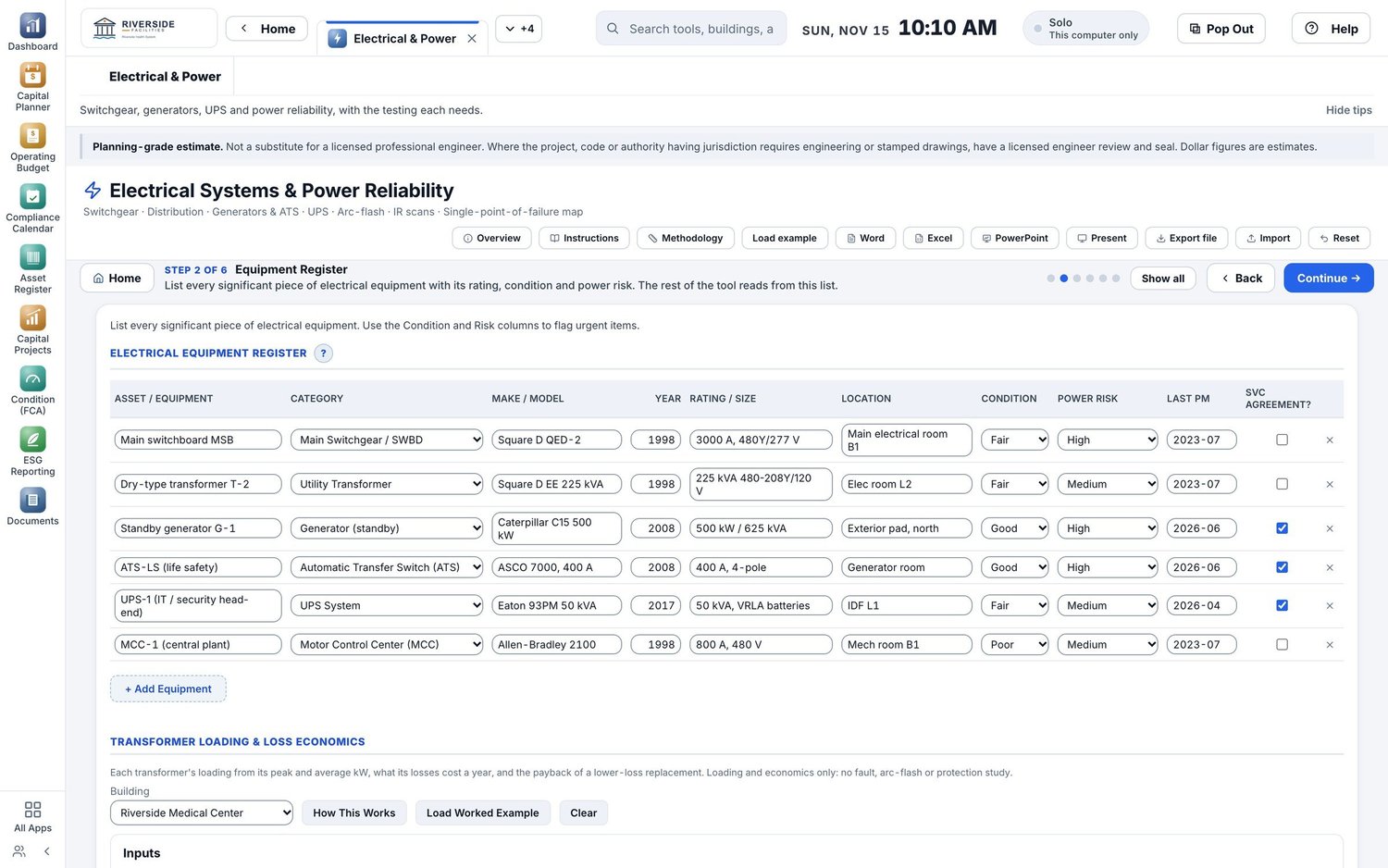
Electrical & Power
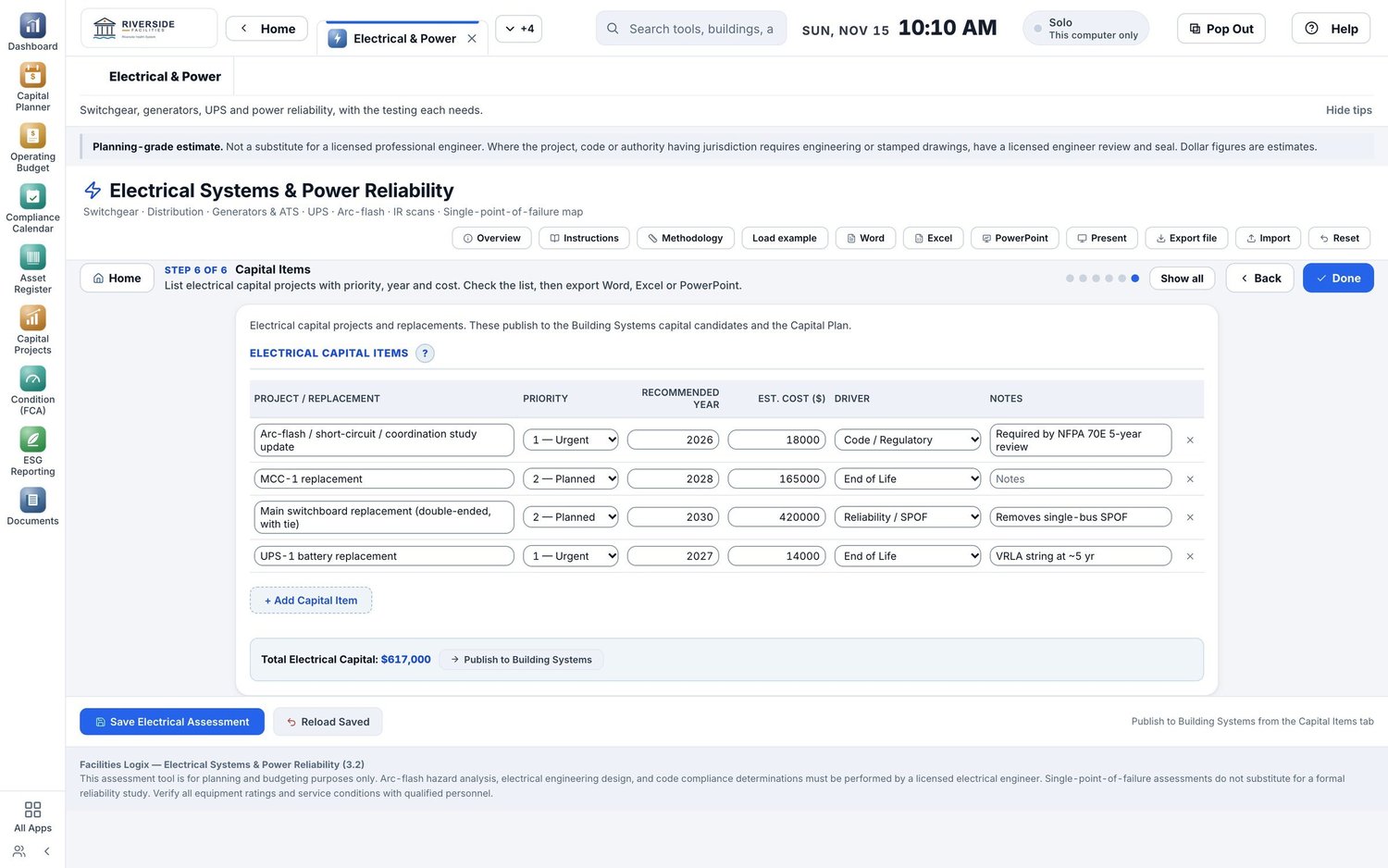
Switchgear, distribution, generators, transfer switches and UPS, with arc-flash and infrared scan records, the testing each needs and a single-point-of-failure map.
Learn MoreShow Less
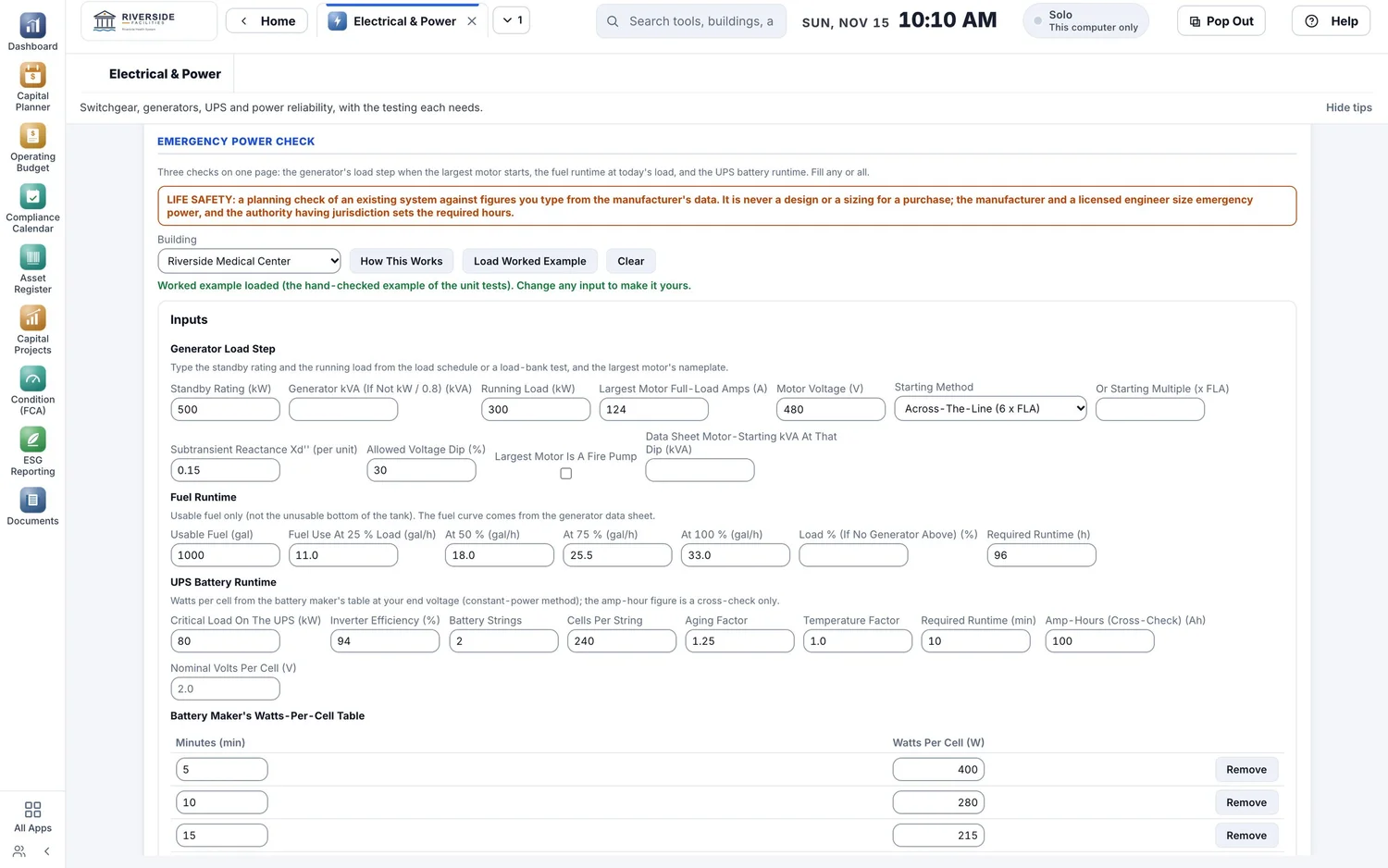
A failed transfer switch or an overloaded transformer turns into an outage and an emergency purchase. Electrical & Power checks the gear you own against figures you type from the maker's data, before it fails.
- Generator load check with a wet-stacking warning below about 30 percent load
- Largest motor's starting kVA and a first estimate of the voltage dip
- Transformer losses priced a year; above 100 percent overloaded, under 40 percent oversized
- Arc-flash study date tracked against the NFPA 70E five-year review
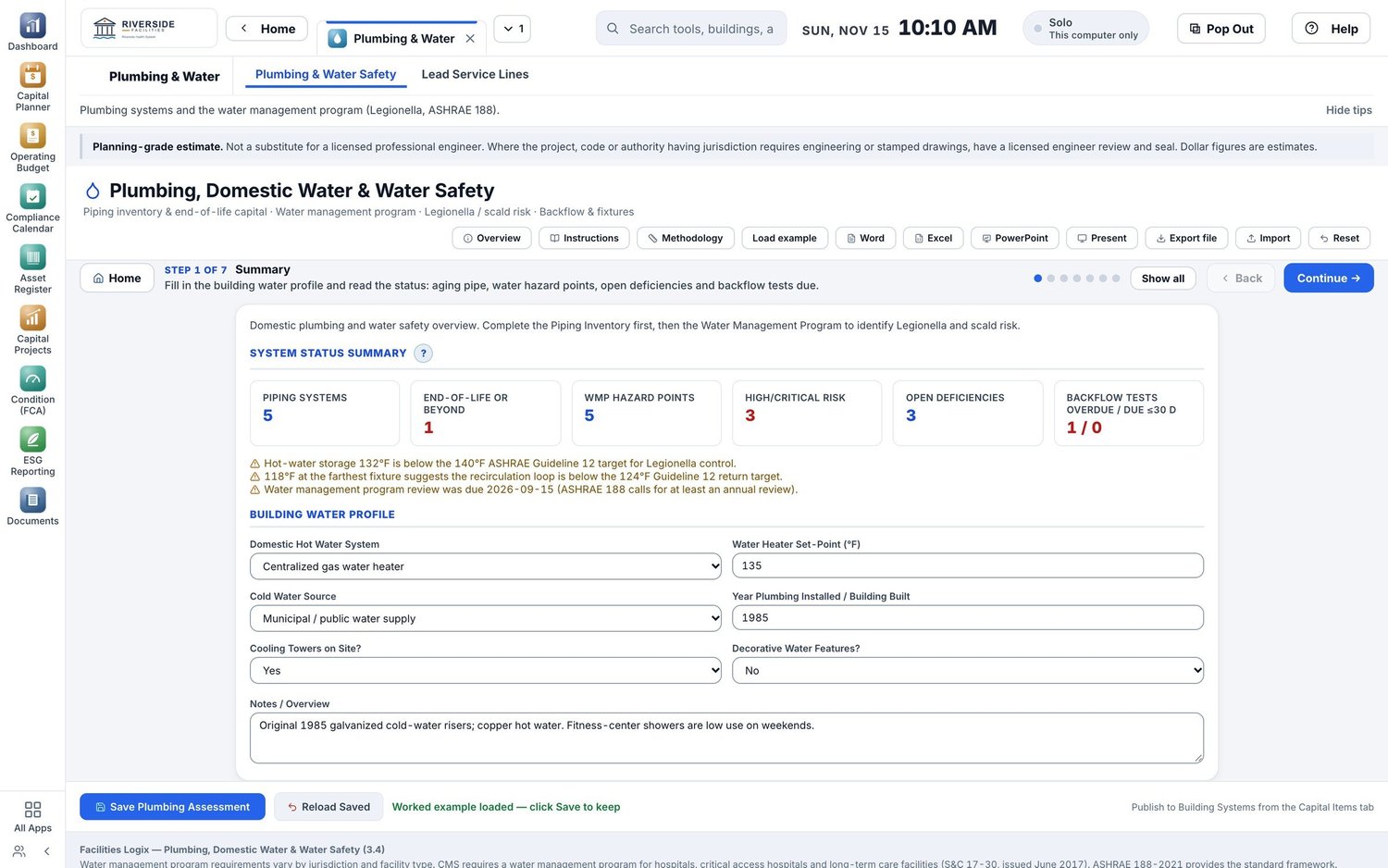
Plumbing & Water
Piping inventory and end-of-life capital, the water management program, Legionella and scald risk, backflow preventer tracking and a lead service line inventory.
Learn More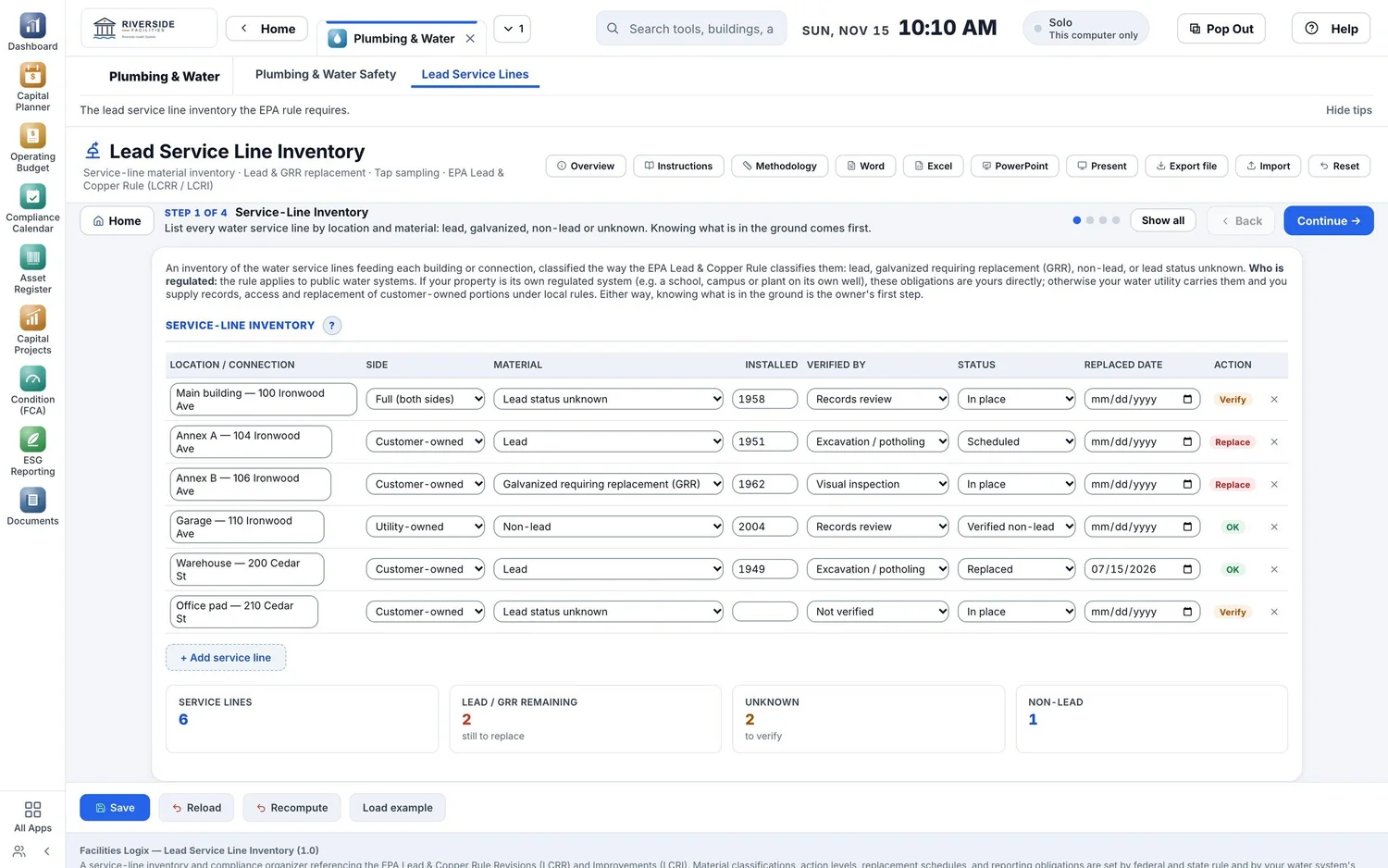
Service-Line Inventory in Lead Service Line Inventory: list every water service line by location and material: lead, galvanized, non-lead or unknown. Knowing what is in the ground comes first.
Envelope & Site
Roof sections, facade, windows and waterproofing with remaining life and deficiencies; pavement condition, drainage, exterior lighting and a site liability register.
Learn MoreShow Less
A roof replaced after it leaks costs the reroof plus the damage beneath it. Envelope & Site tracks remaining life by section, so replacements are budgeted ahead and timed with energy upgrades.
- Roof sections each with their own age, membrane, design life and warranty
- Roof Insulation Upgrade: heat saved, payback and the new R-value against your code minimum
- Active below-grade leaks and expired roof warranties counted on the Summary
- Envelope work carried to Capital Bridge with the reroof
Elevators
A unit register, inspection and permit tracking, service contract review linked to the contract register, and a modernization forecast.
Learn MoreShow Less
An expired elevator certificate can take a unit out of service, and a missed contract notice date can lock in another term at the old price. Elevators tracks both with lead time to act.
- Certificates expired or expiring within 60 days, counted on the Summary
- ASME A17.1 Category 1, 3 and 5 tests tracked by unit
- Contract notice deadlines within 90 days flagged
- Contract value, dates and renewal read from the contract register each time it opens
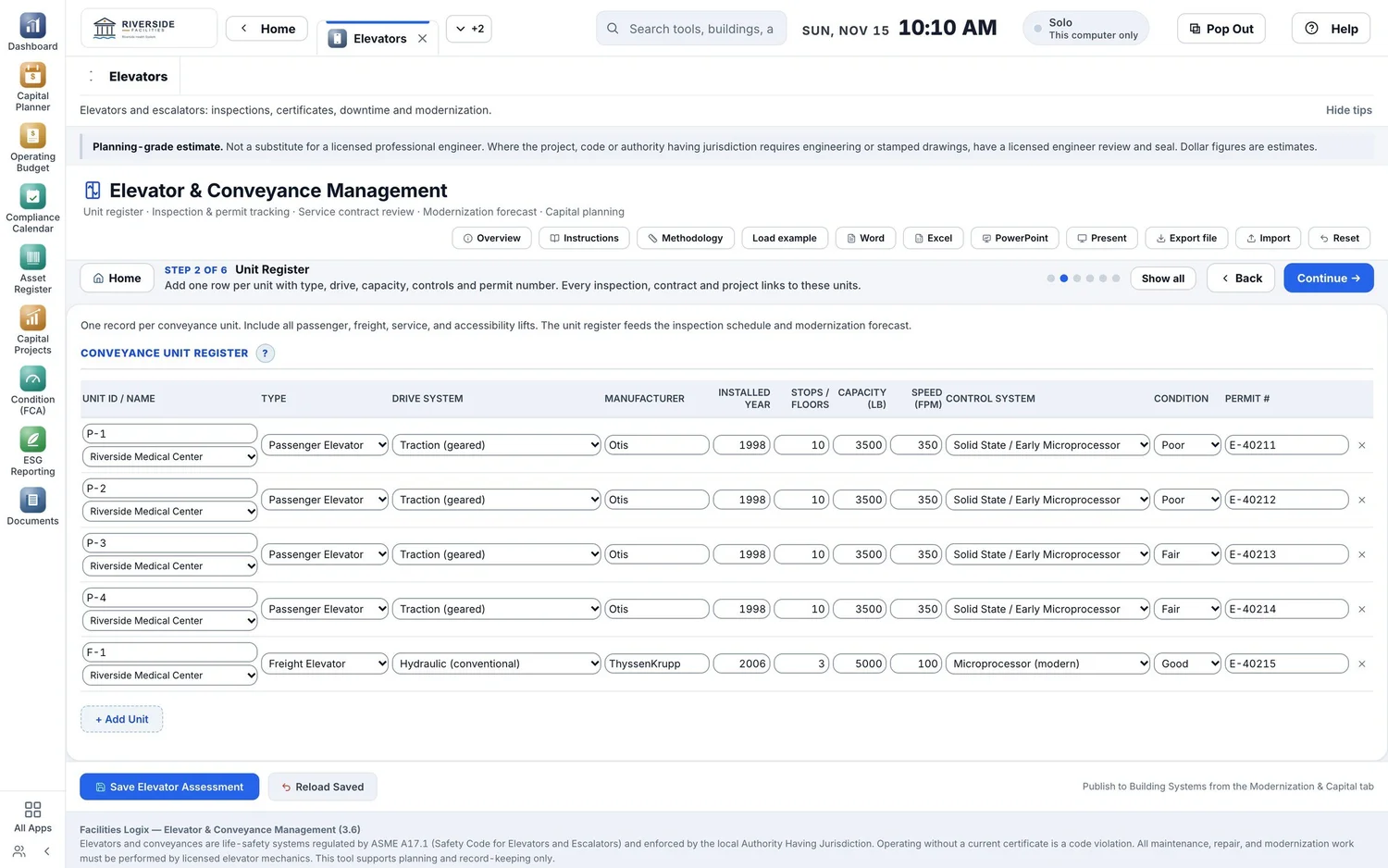
Unit Register in Elevator & Conveyance Management: add one row per unit with type, drive, capacity, controls and permit number. Every inspection, contract and project links to these units.
Specialty Systems
Medical gas and vacuum with verification tracking, laboratory fume hoods and biosafety cabinets, and commercial kitchen equipment, hoods and suppression.
Learn MoreShow Less
Life-critical systems carry the costliest findings when an inspection or survey goes badly. Specialty Systems keeps their records, deficiencies and capital needs in one place.
- Medical gas: sources without an alarm counted, NFPA 99 category per facility
- Outside test results imported; a failed test becomes an open deficiency
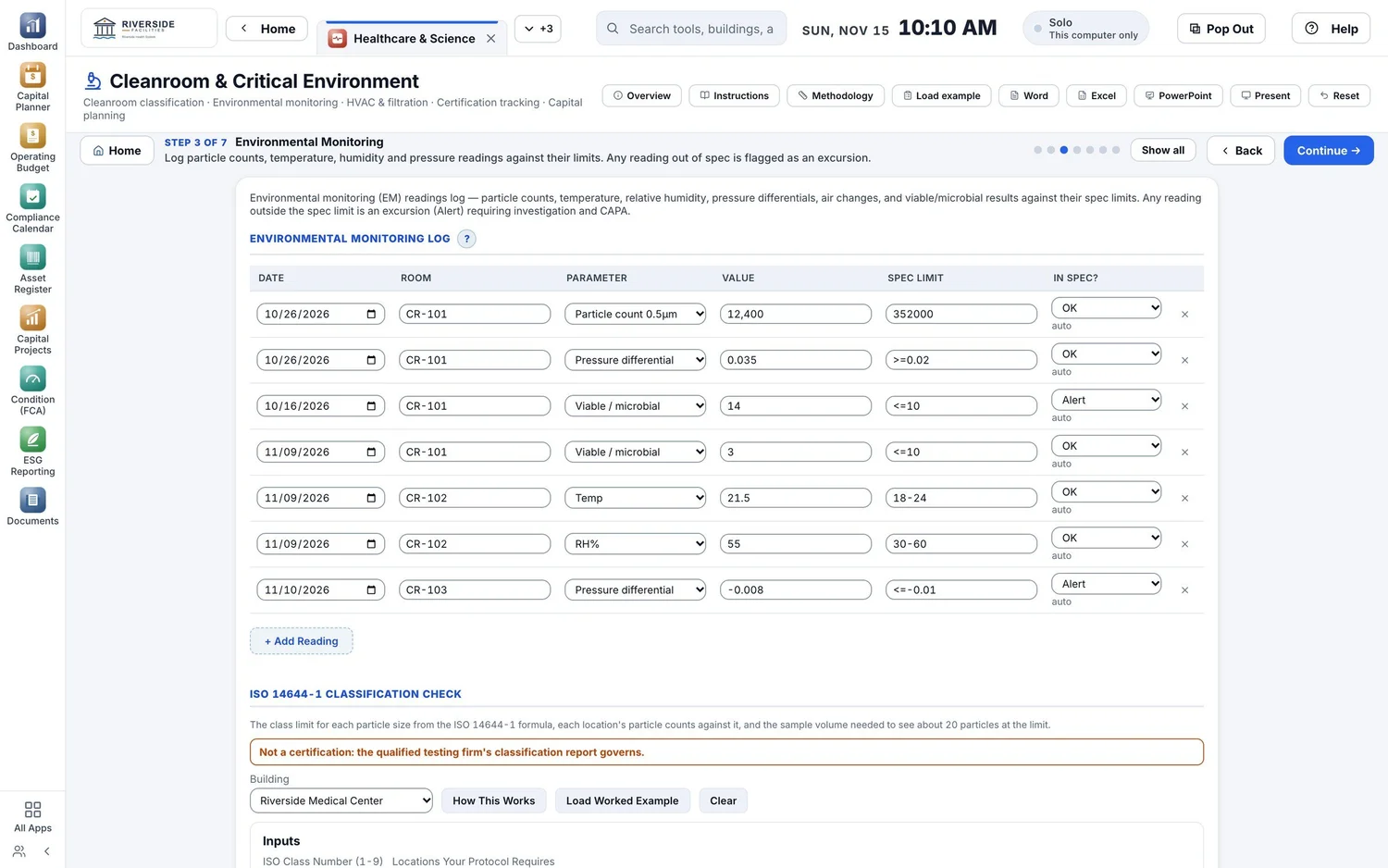
- A Critical-Room Pressure and Air-Change Log, with a work order on each excursion
- Kitchen hoods and suppression tracked against NFPA 96
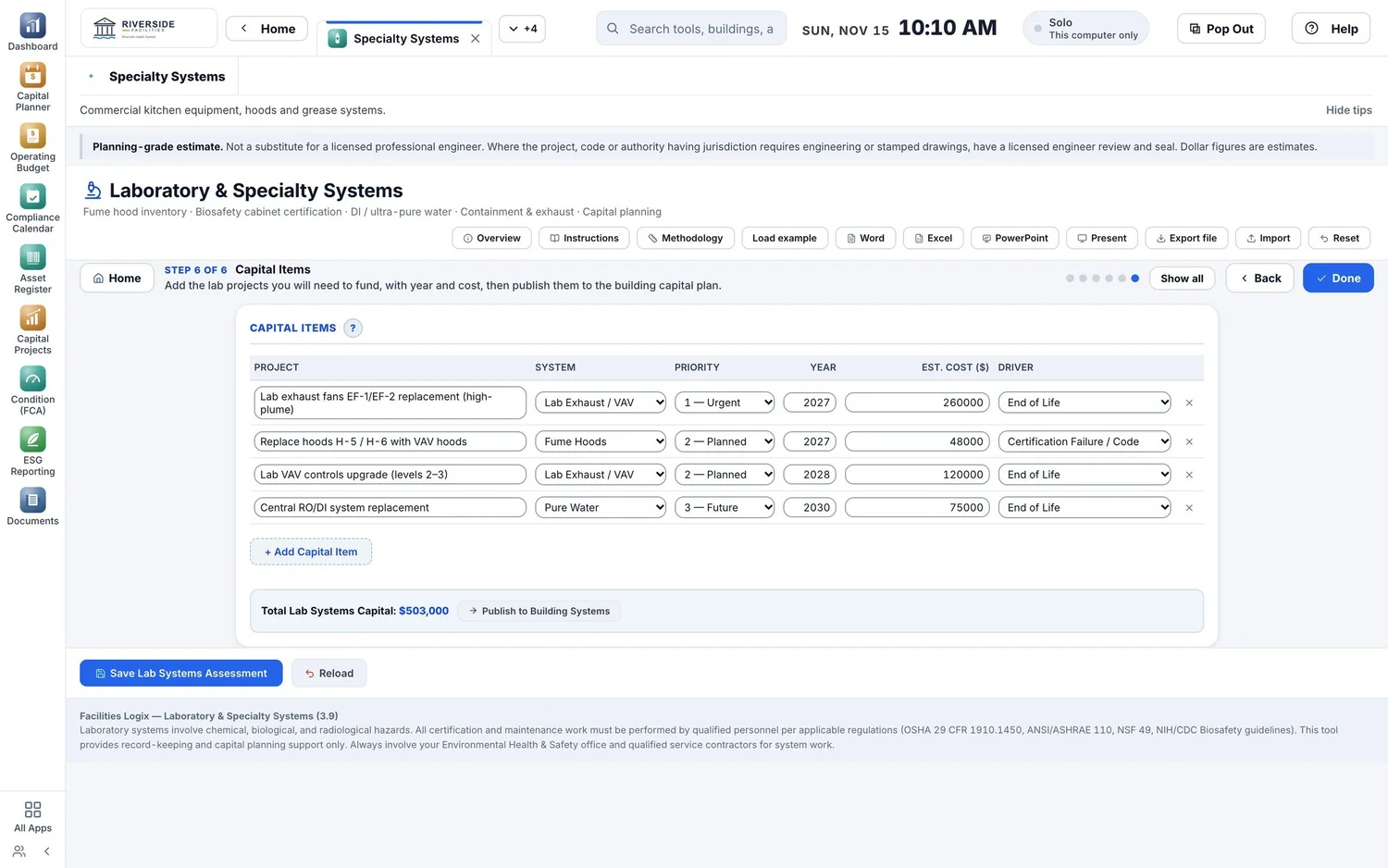
Capital Items in Laboratory & Specialty Systems: add the lab projects you will need to fund, with year and cost, then publish them to the building capital plan.
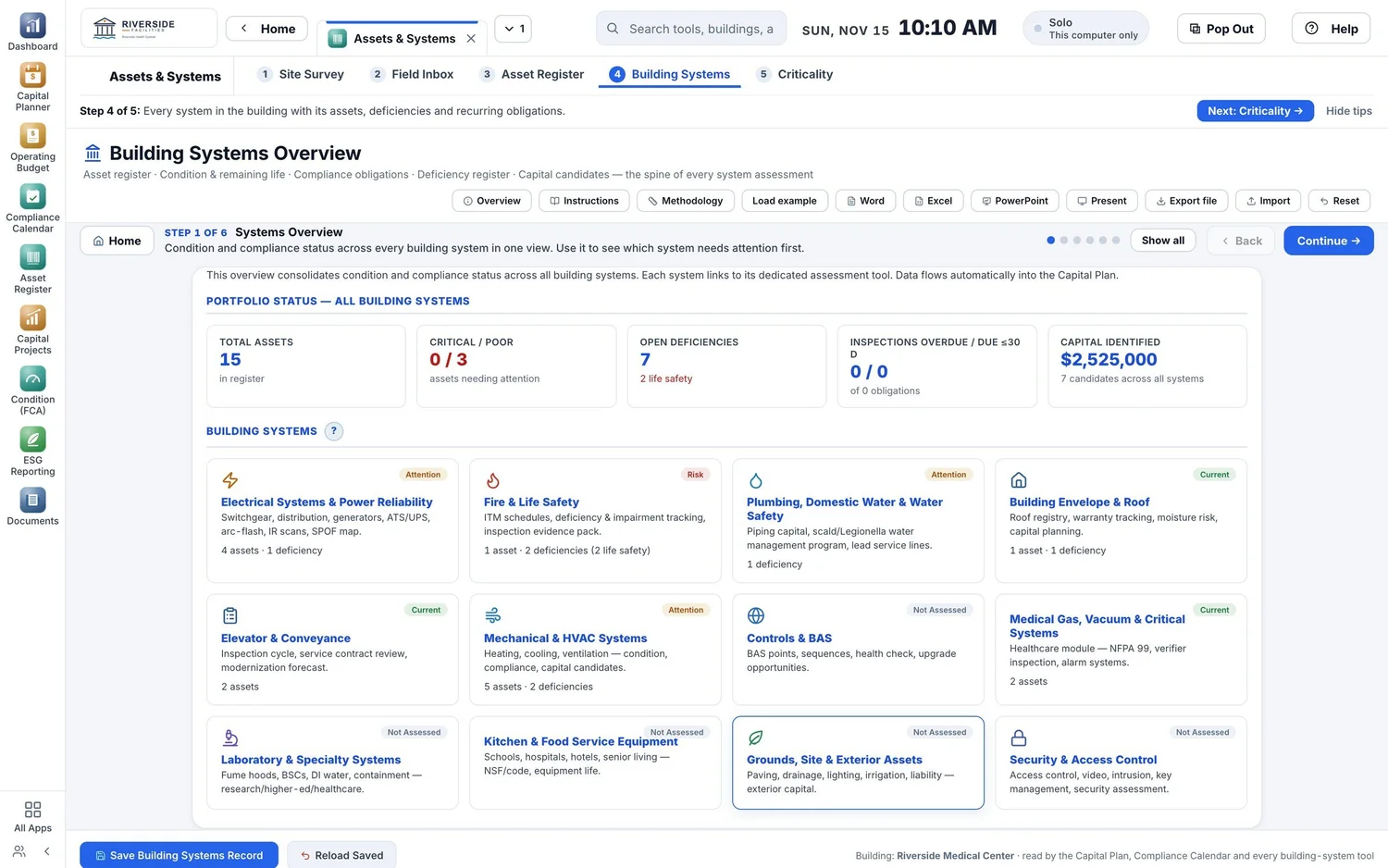
Whole-building condition is hard to see when each system is tracked apart, so every tool feeds one Building Systems record.
Run the Plant, Choose the Replacement, Price the Retrofit
Central Plant
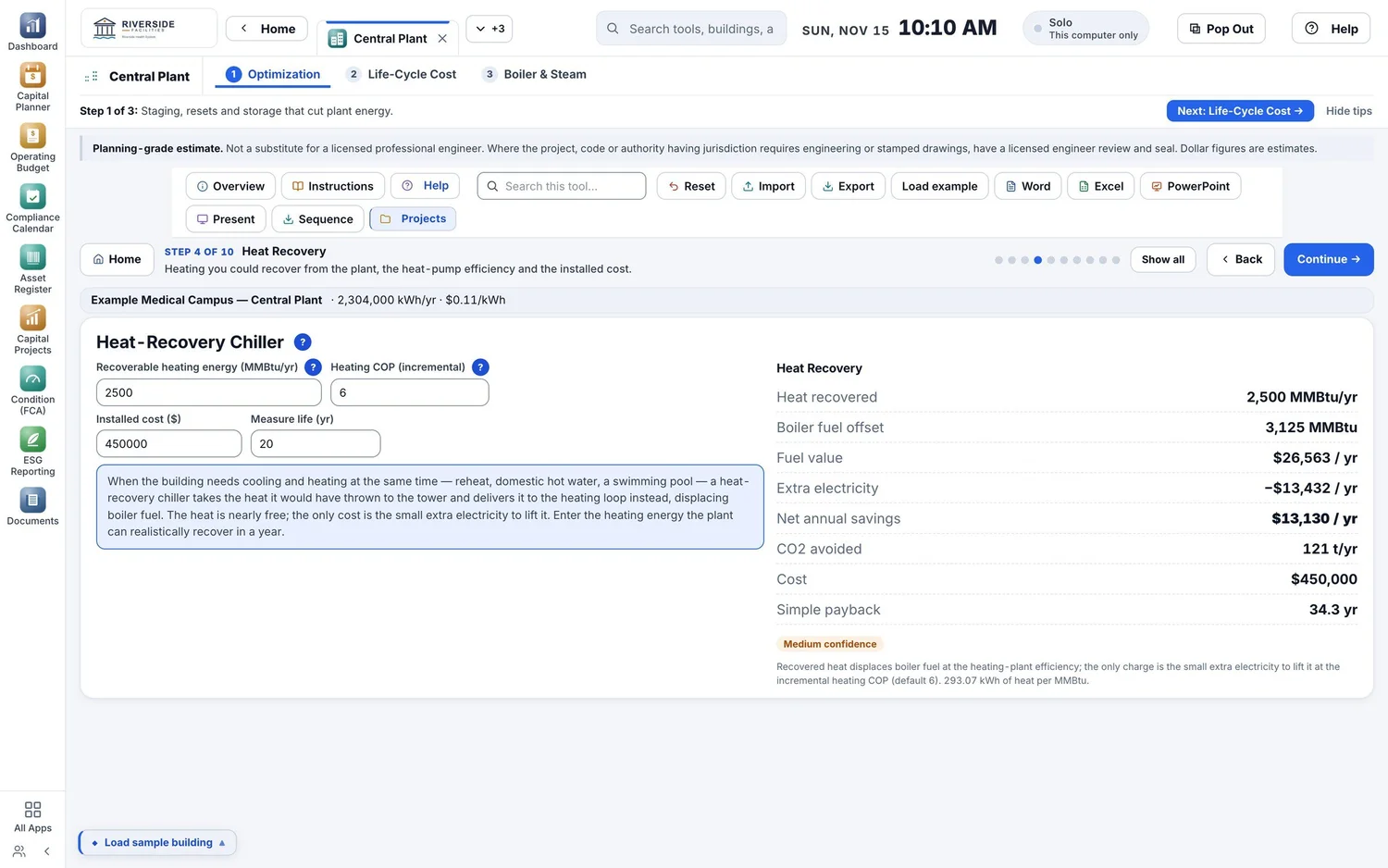
Optimize the plant as a system with staging, resets and heat recovery; compare plant options on life-cycle cost; and find the documented savings in a boiler and steam plant.
Learn MoreShow Less
The largest central plant savings usually come from how the machines run together, often with no capital at all. Central Plant prices those first, then the bigger plant decisions.
- Staging and chilled- and condenser-water resets, the no-capital measures
- Heat-recovery chiller, combined heat and power, and thermal storage, each with dollars and payback
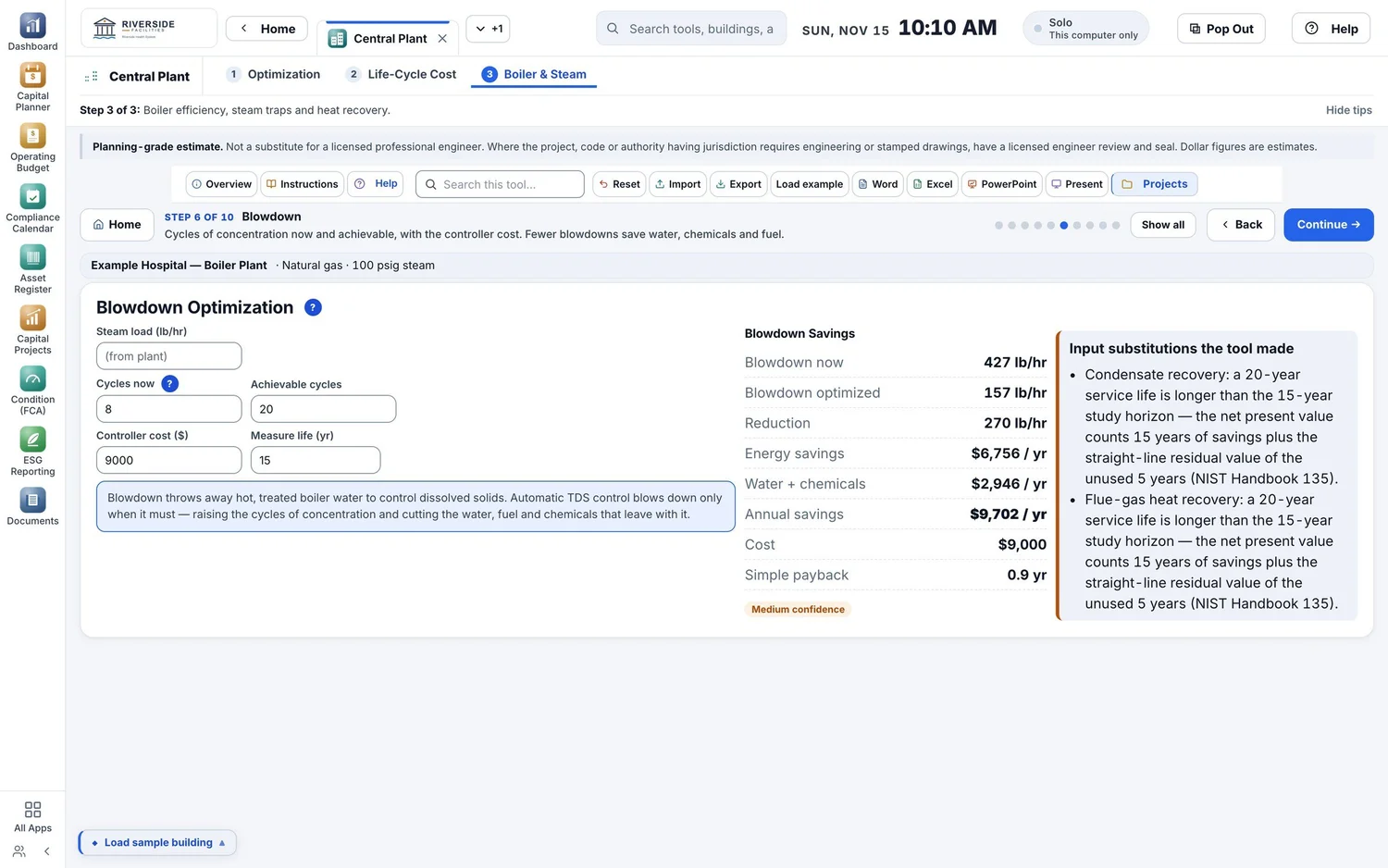
- Six boiler and steam savings: combustion, traps, insulation, condensate, blowdown, flue heat
- A written sequence of operations for the controls contractor
Equipment Selection
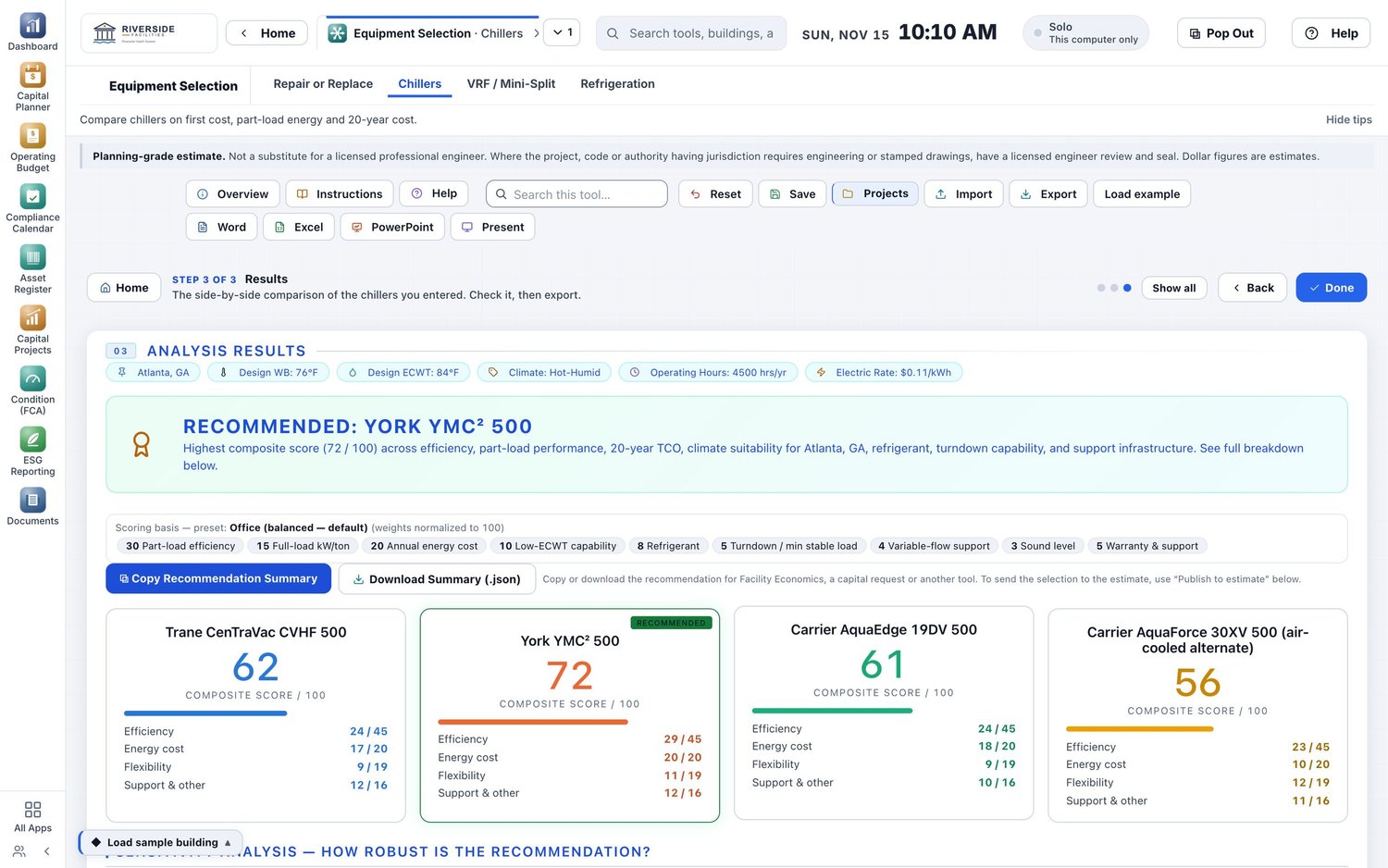
Repair or replace for rooftop, split and heat-pump units with three replacement tiers; chillers ranked on efficiency, first cost and fit; VRF systems; and refrigeration.
Learn MoreShow Less
Repairing a unit that should be replaced, or replacing one that had years left, wastes capital either way. Equipment Selection prices both paths on the same unit and shows when one overtakes the other.
- Five- and ten-year cost of repair and of replacement, with the crossover year
- Payback on the extra cost of replacing
- A one-page decision summary for leadership and the asset file
- Covers rooftop, split, packaged heat-pump, VRF and mini-split units
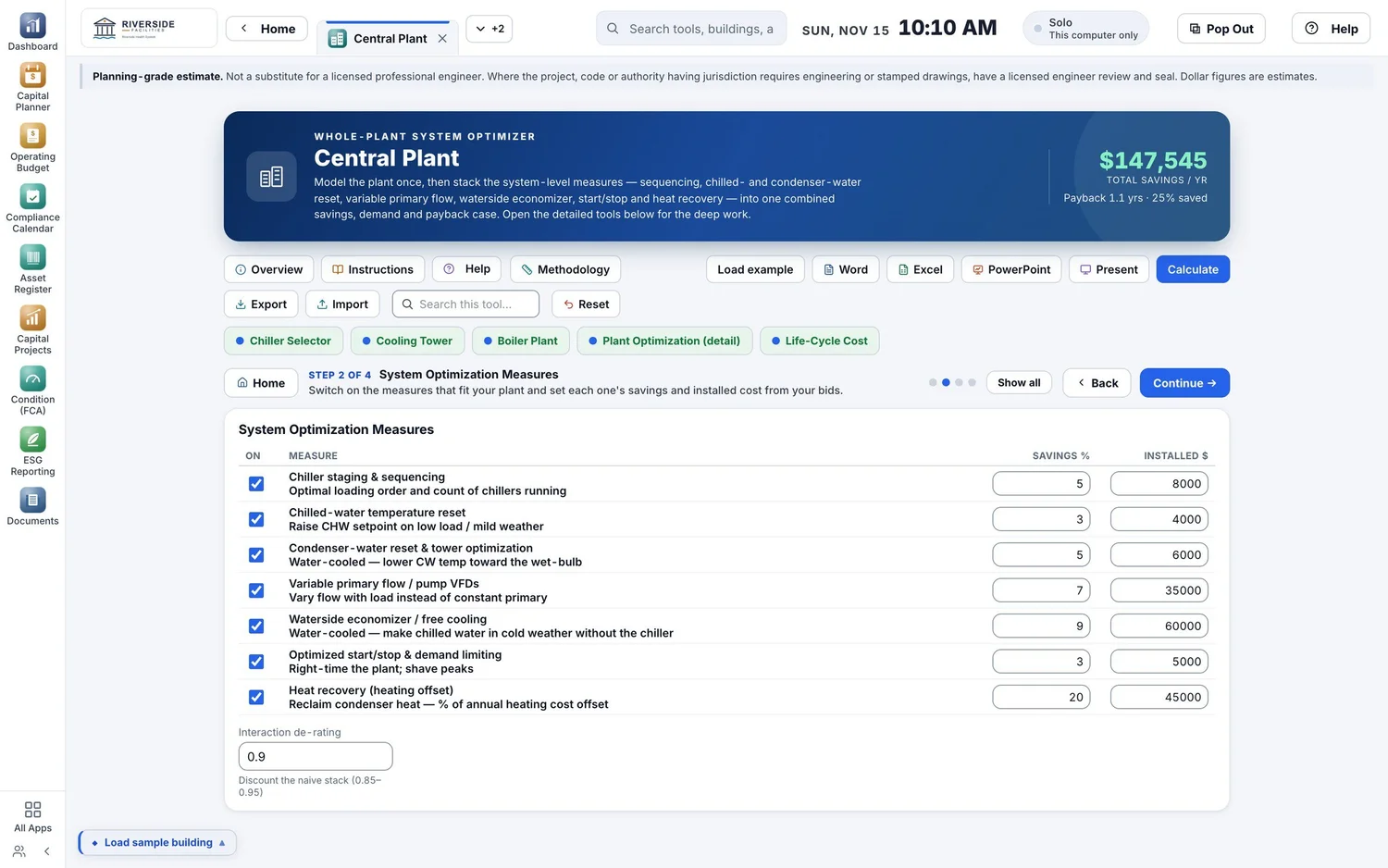
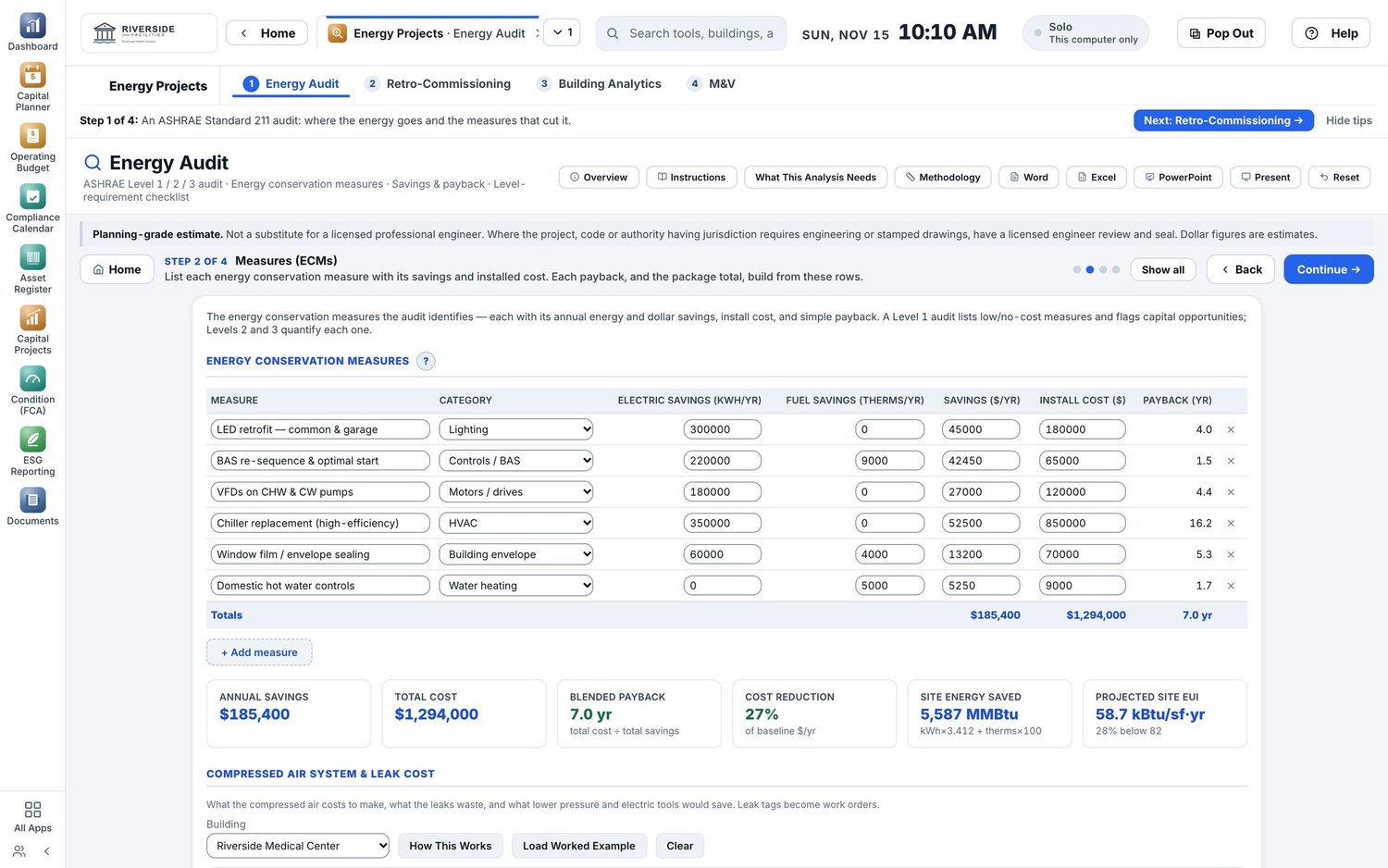
System Optimization Measures in Central Plant: switch on the measures that fit your plant and set each one's savings and installed cost from your bids.
Retrofit Measures
Payback for variable-frequency drives, fan-wall arrays, cooling-tower fan and water treatment, and controls upgrades, with a repair-first path first.
Learn MoreShow Less
Retrofit money goes furthest on measures that pay back fastest. Each retrofit tool works out the savings from your own equipment and rates, with the payback leadership asks for.
- VFD savings from the affinity laws, with BAS trend import and an electrical feasibility screen
- Fan-wall arrays compared with the existing fan, including N+1
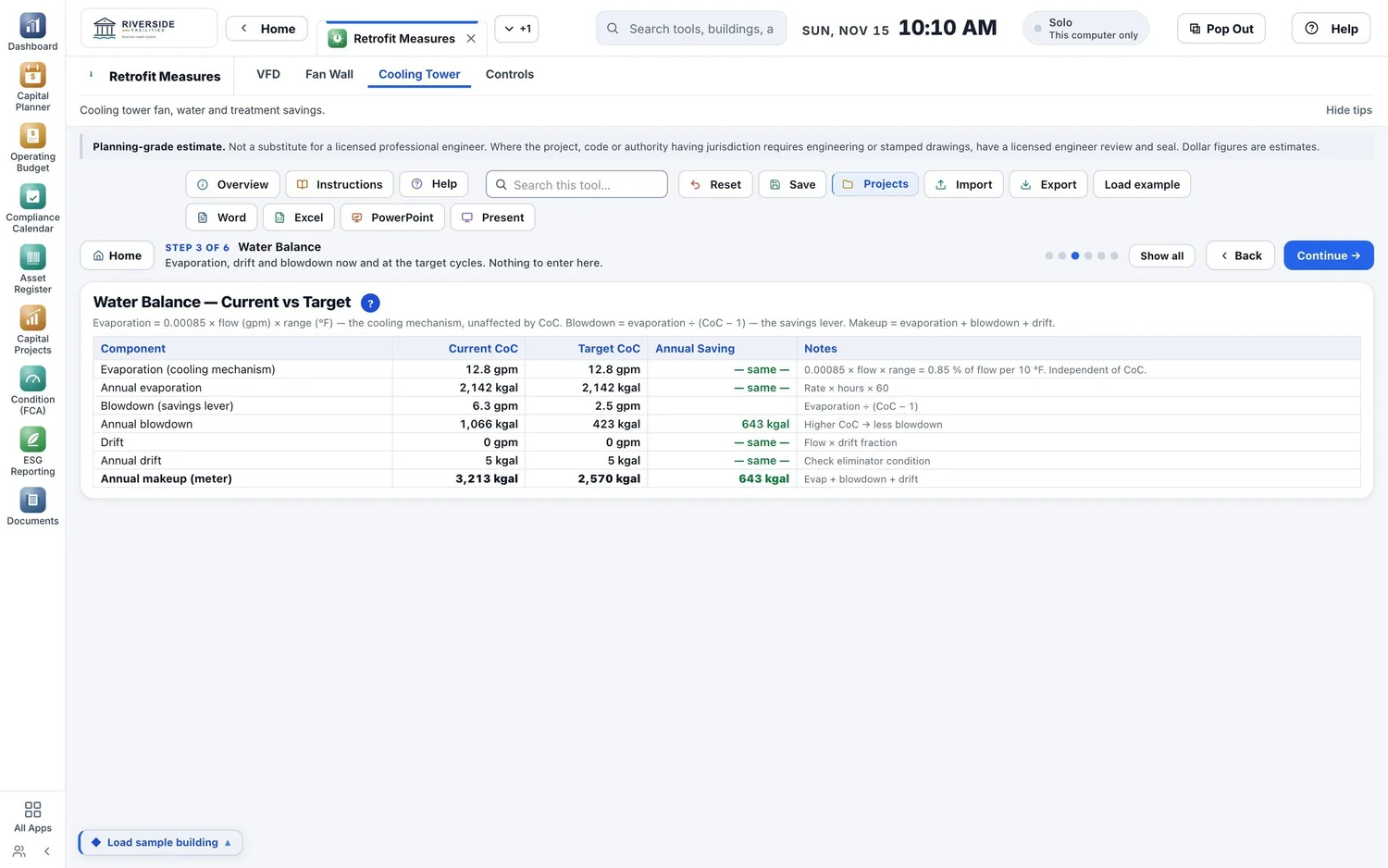
- Cooling-tower log flags a cycles mismatch over 20 percent
- Controls case with a persistence and monitoring-based commissioning step
Air Quality
Outdoor air required by ASHRAE 62.1, the shortfall and the cost to fix it, plus air changes per hour by room for spaces with a required rate.
Learn MoreShow Less
More outdoor air and better filters cost energy, and demand-controlled ventilation saves some back. Air Quality puts the net operating cost beside the compliance gap, so the upgrade is funded on real numbers.
- Current against required outdoor air by the ASHRAE 62.1 Ventilation Rate Procedure
- Fan and conditioning penalty of higher-MERV filters, against DCV savings
- An optional ASHRAE 241 equivalent clean airflow check for higher-risk operation
- Air changes per hour = airflow (cfm) x 60 / room volume
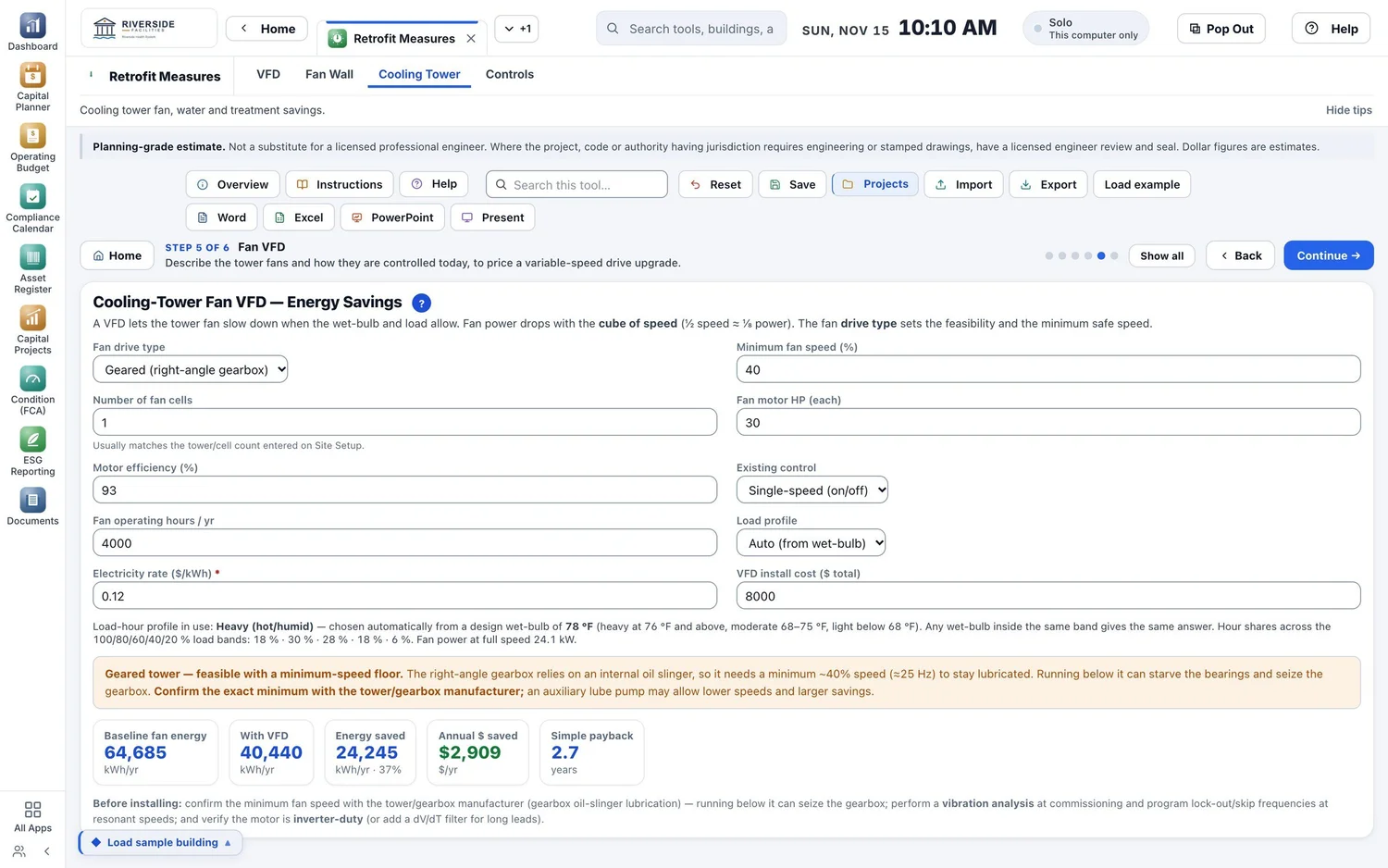
Fan VFD in Cooling-Tower Retrofit: describe the tower fans and how they are controlled today, to price a variable-speed drive upgrade.
Engineering Calcs
Load calculation, duct sizing, pipe and hydronics, airflow and psychrometrics, electrical load and service sizing, plumbing and gas sizing, and quick calculators.
Learn MoreShow Less
Calculations done by hand or by an outside engineer for every screening question cost time and fees. Engineering Calcs answers the planning question in house and shows the working.
- Electrical service sizing with NEC Article 220 demand factors and a keep-or-upgrade answer
- Plumbing by IPC fixture units and the Hunter curve; gas by the longest-run method
- Capital Case tabs turn an upgrade into a budget, payback and NPV
- Motor inventory: replace now, replace on failure, or rewind
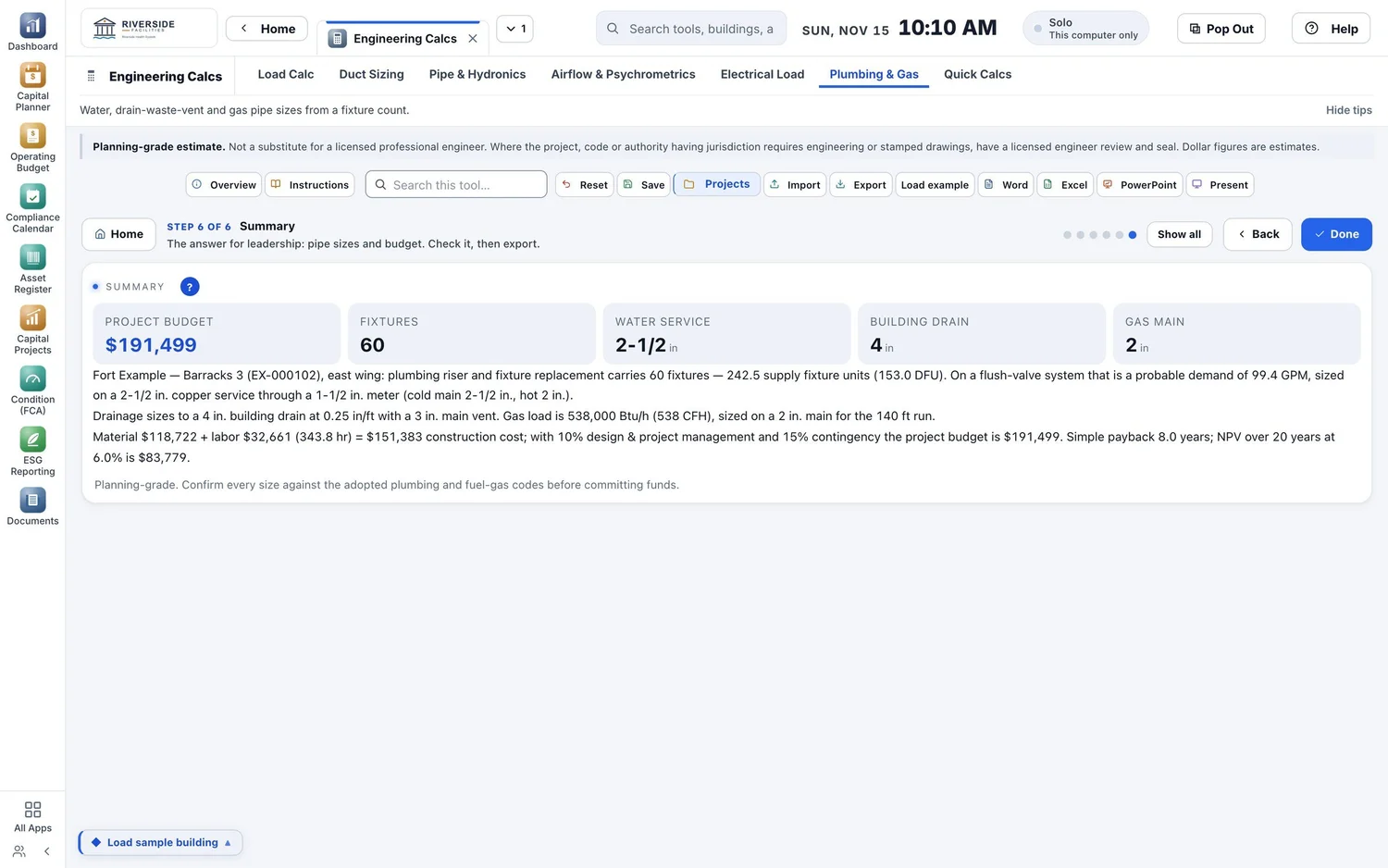
Summary in Plumbing & Gas Sizing: the answer for leadership: pipe sizes and budget. Check it, then export.
Thirteen Planning-Grade Checks, Each with a Report
Each check shows its formula, takes the figures you type from the manufacturer's data and exports to Word, Excel, PowerPoint, PDF and CSV. They are planning checks of existing systems, never a design.
Power and Reliability
- Emergency Power Check: generator load step, fuel runtime and UPS battery runtime
- Emergency Power Readiness Score for every building
- Transformer Loading and Loss Economics
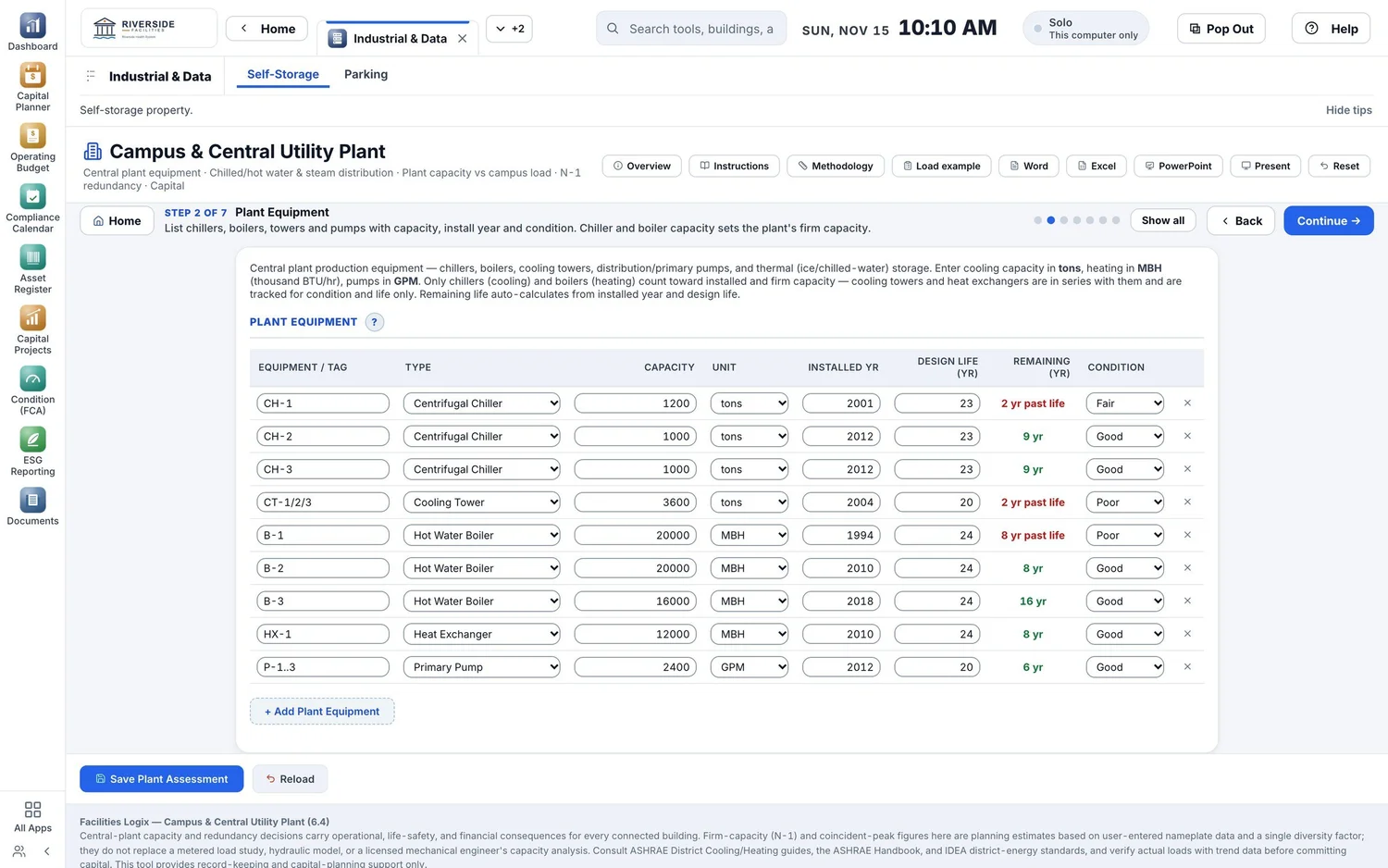
- N-1 Design-Day Capacity Check for chillers, boilers, transformers, pumps and tower cells
- Motor Inventory: Repair vs Replace
Energy
- Compressed Air System and Leak Cost
- Lighting Retrofit Audit, room by room
- Roof Insulation Upgrade at reroofing
- Solar PV and Storage Quick Estimate
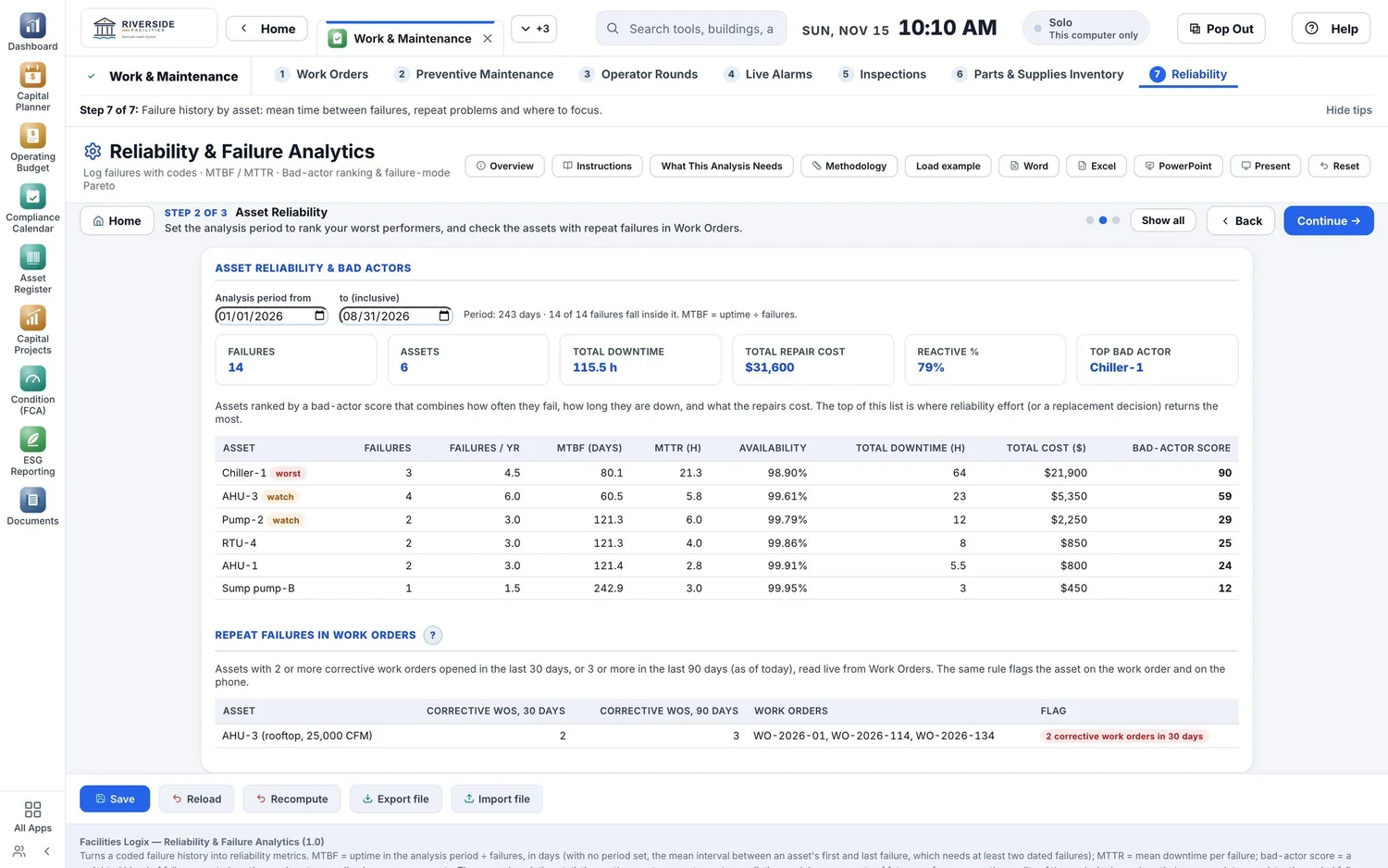
Asset Reliability in Reliability & Failure Analytics: set the analysis period to rank your worst performers, and check the assets with repeat failures in Work Orders.
Critical Environments
- Critical-Room Pressure and Air-Change Log
- Critical Environment Watch
- ISO 14644-1 Cleanroom Classification Check
- Rack Inlet Temperature and Cooling Headroom
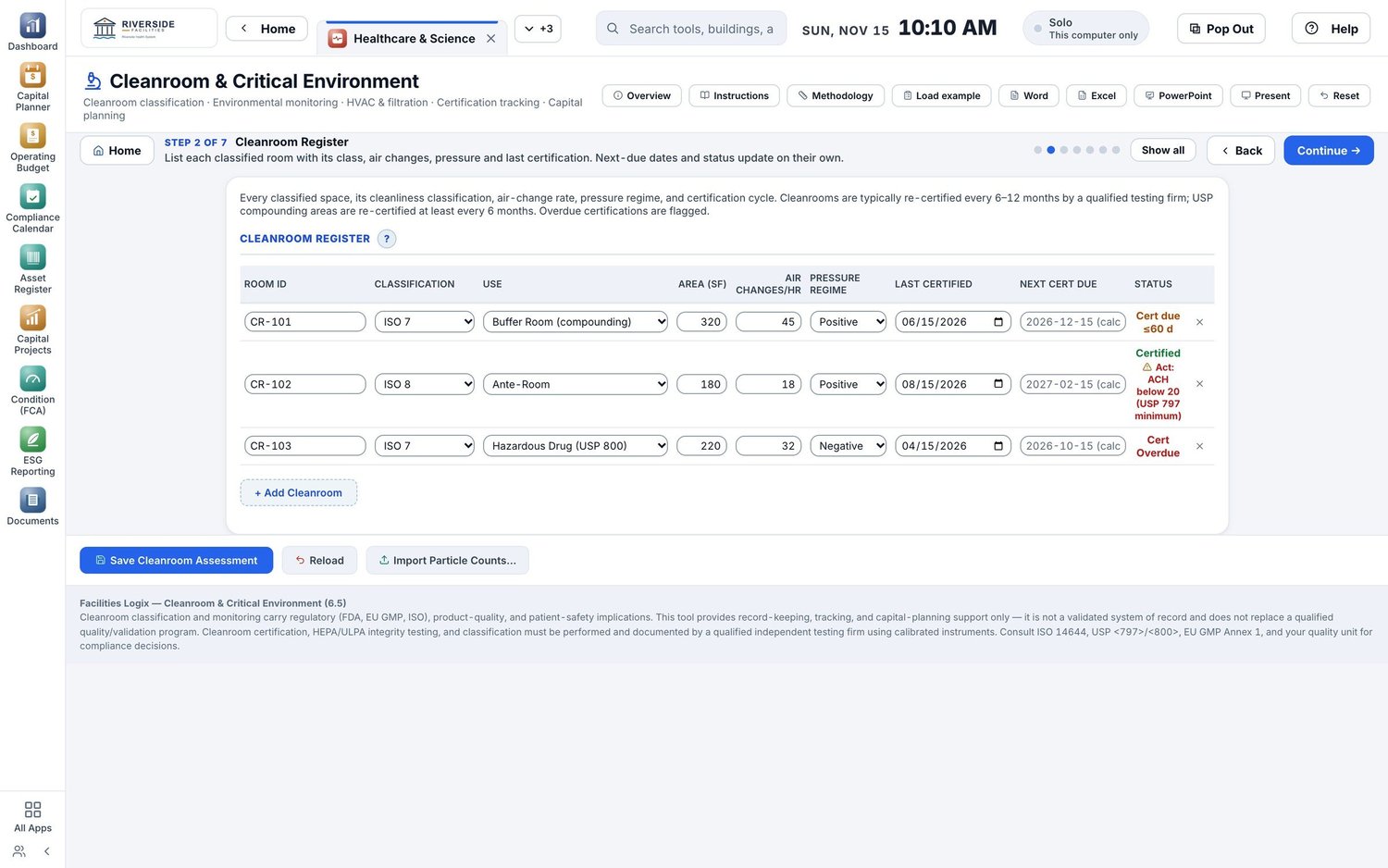
Cleanroom Register in Cleanroom & Critical Environment: list each classified room with its class, air changes, pressure and last certification. Next-due dates and status update on their own.
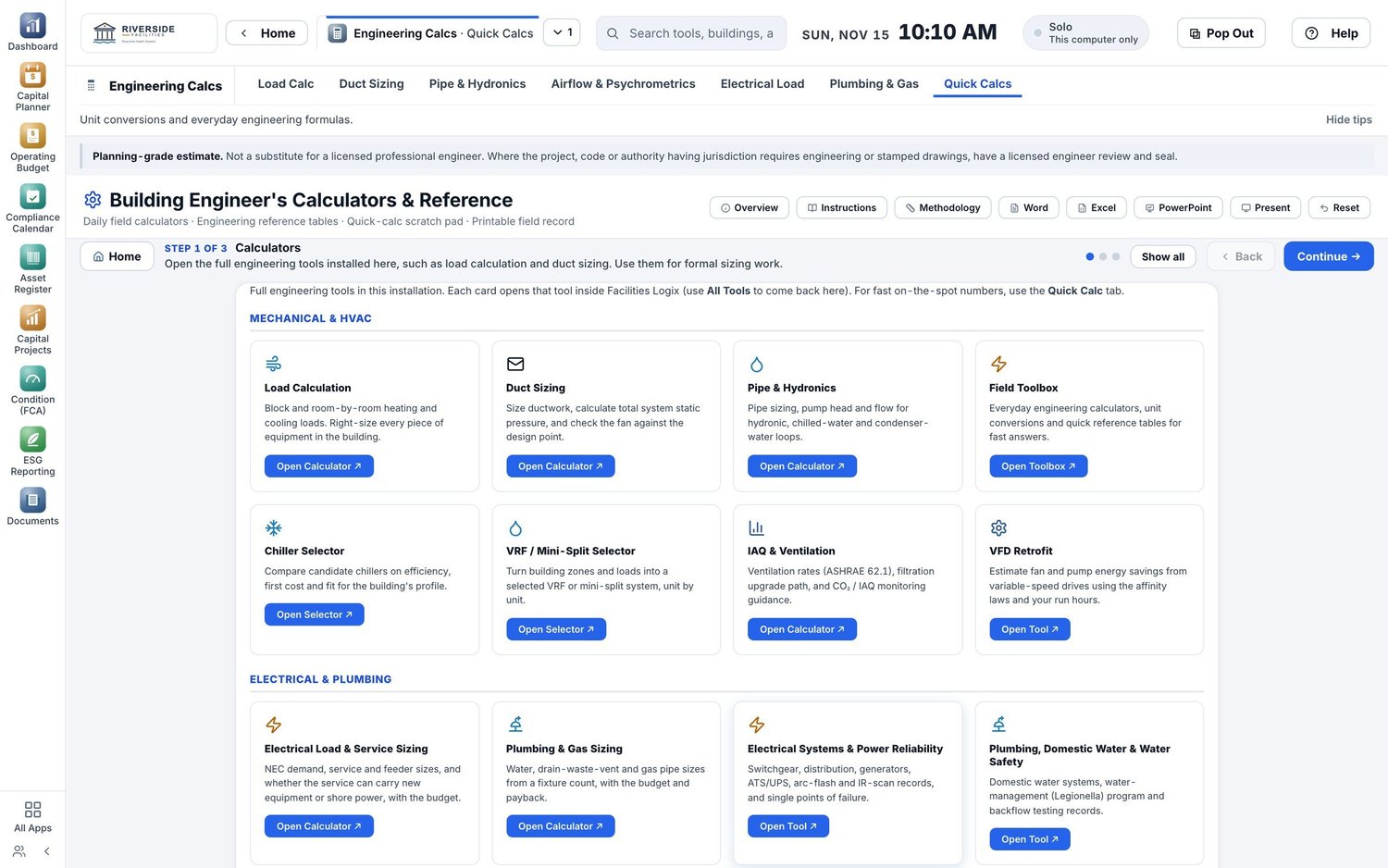
Quick engineering checks done on scrap paper leave no record, so each check shows its formula and exports a report.
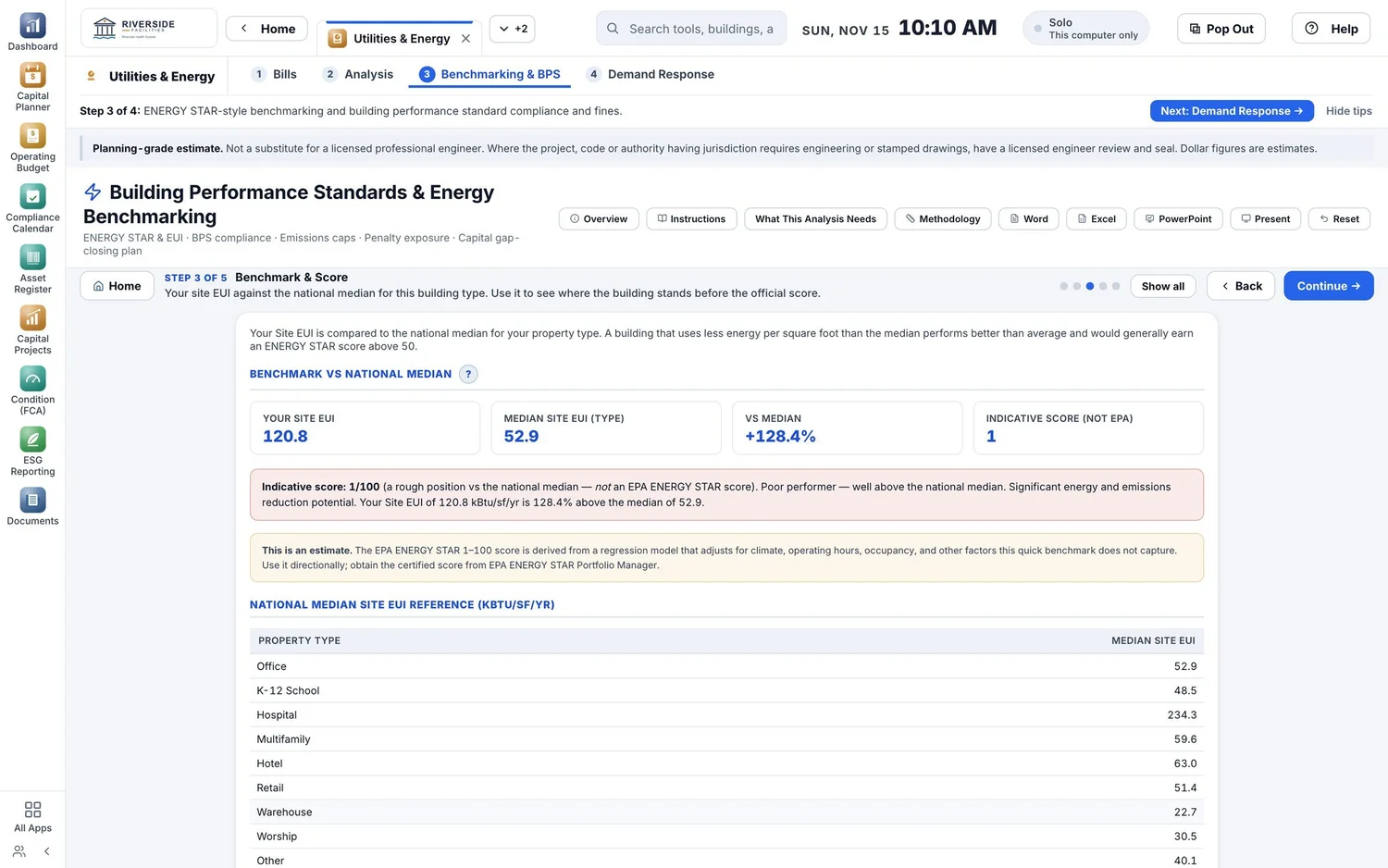
Logs That Support the Program You Already Run
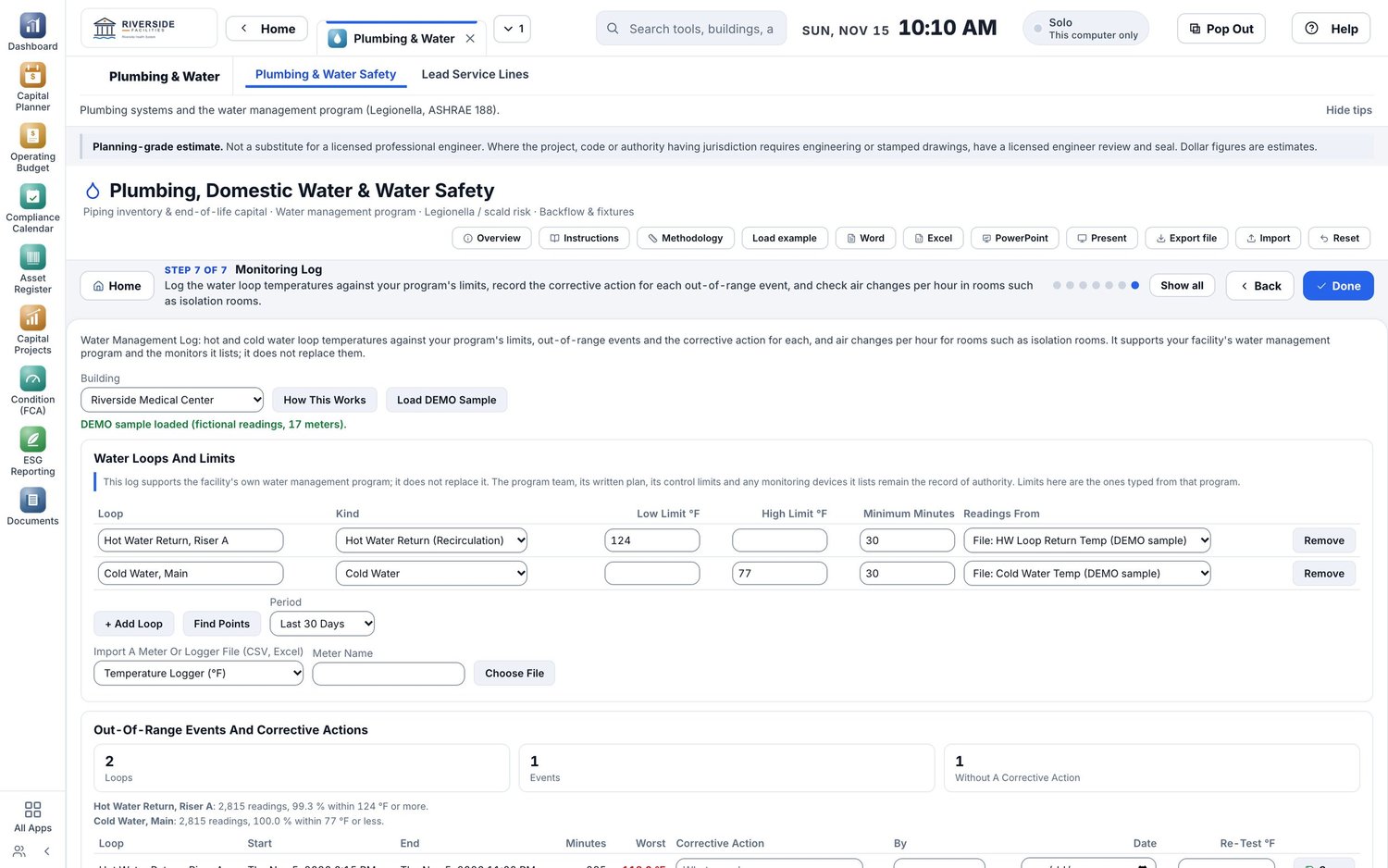
Water Management Log
Record hot and cold water loop temperatures from building automation points or logger files against the limits in your water management program. Each out-of-range event is listed with its corrective action, who, when and the re-test, and gaps in the readings are shown. It supports your program and its monitors; it does not replace them.
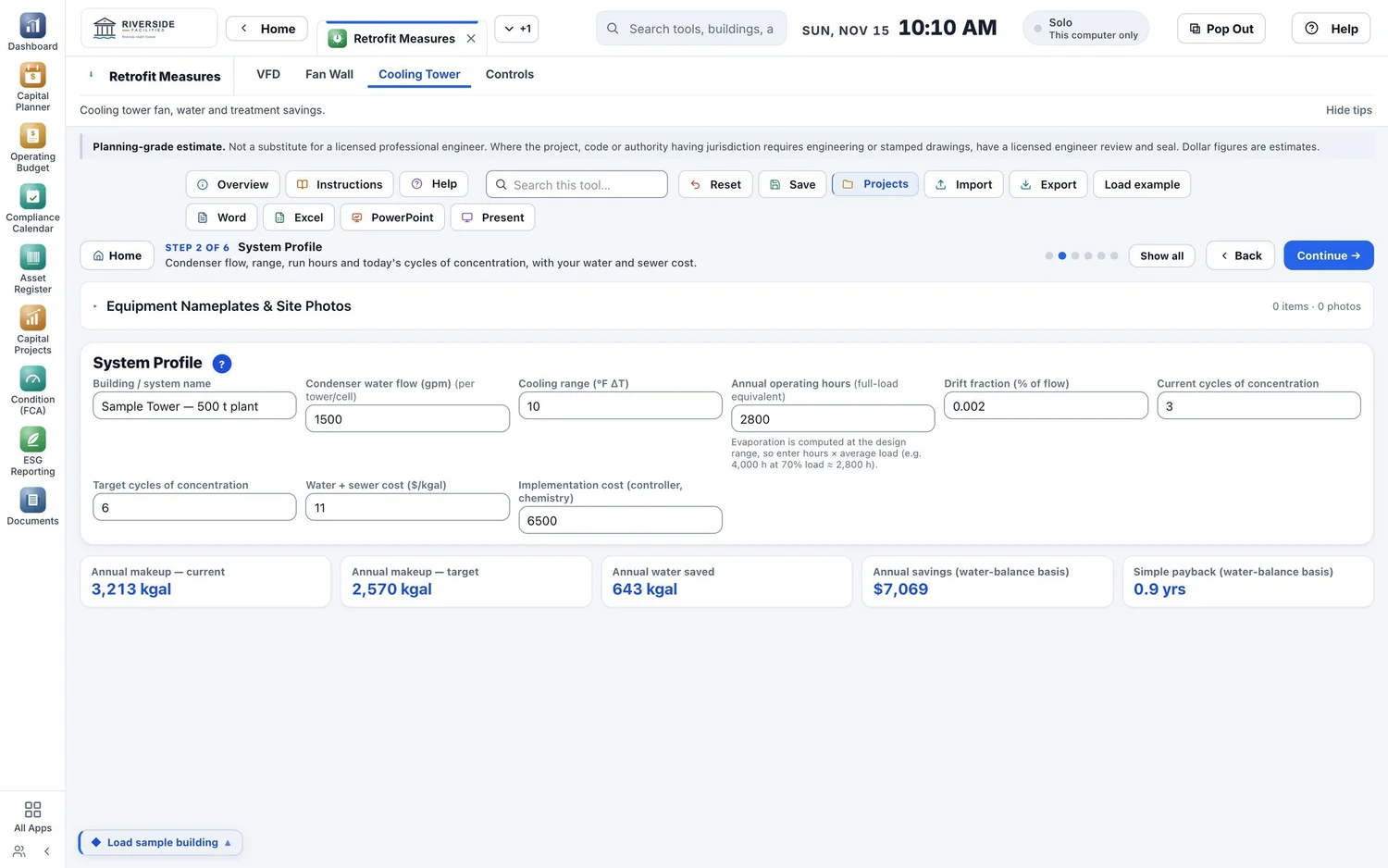
Cooling Tower Operating Log
Log each visit's makeup and blowdown meter readings and conductivity. The tool works out cycles of concentration two ways and flags a large difference, estimates evaporation, and totals water and sewer cost by month. A meter that rolls over is handled, and a reading that goes backward is flagged and left out.
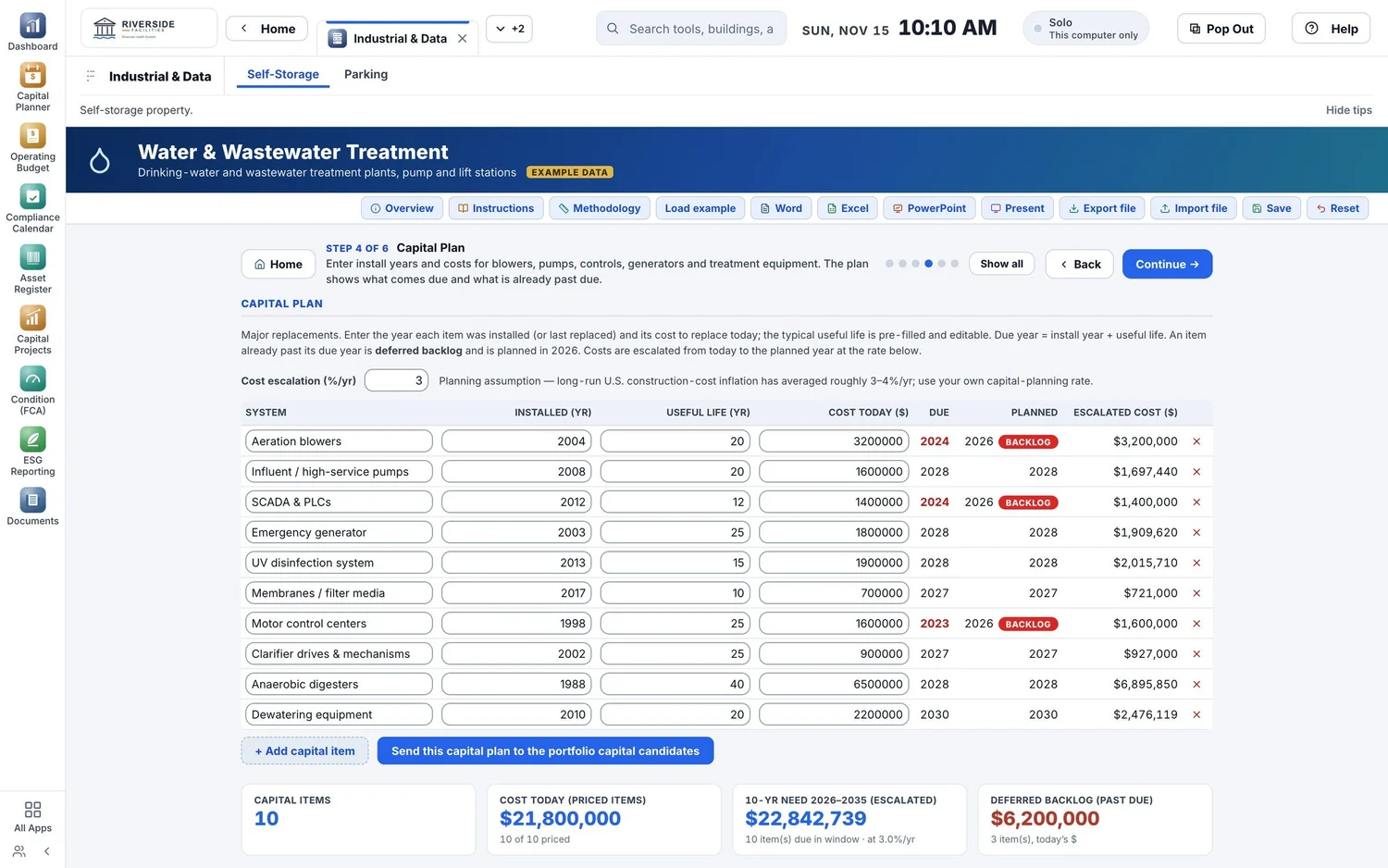
Capital Plan in Water & Wastewater Treatment: enter install years and costs for blowers, pumps, controls, generators and treatment equipment. The plan shows what comes due and what is already past due.
Two Workspaces for the Biggest Decisions
Central Plant Workspace
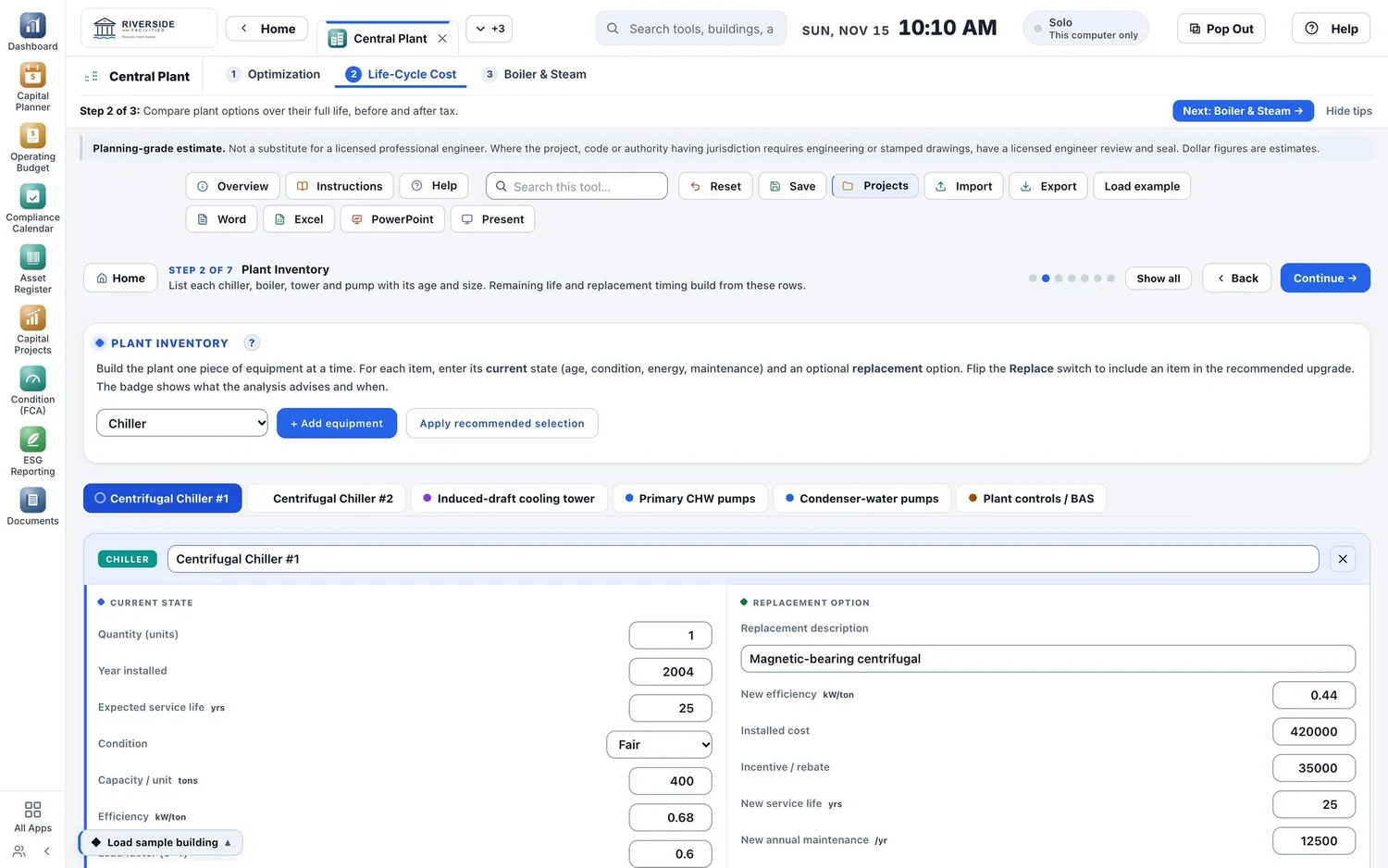
The whole plant in one place: chiller selection, cooling tower and condenser water, boiler and steam, optimization and life-cycle cost, all sharing one building.
Learn MoreShow Less
Plant decisions made one machine at a time can each look right and still cost more together. The workspace keeps the chiller, tower, boiler and life-cycle cost on one building record, so every option is compared on the same facts.
- Reached by typing Central Plant in Search
- Any number of plant options compared on equivalent annual cost against doing nothing
- Boiler and steam savings measured alongside the cooling side
- Each tool keeps its own report in Word, Excel and PowerPoint
Equipment Decision
Repair, replace or convert to a heat pump: one entry of the same unit, scored all three ways, with replacement tiers and the money and carbon case.
Learn MoreShow Less
Comparing repair, replacement and a heat pump from three different sets of inputs invites the wrong answer. Equipment Decision scores one unit all three ways, so the difference is the decision, not the data.
- Repair and replace share one form; the unit is entered once
- Convert adds the fuel and load inputs for the heat-pump case
- Each path keeps its own engine and its own Word or Excel report
- Every figure is firmed against a quote before capital is committed
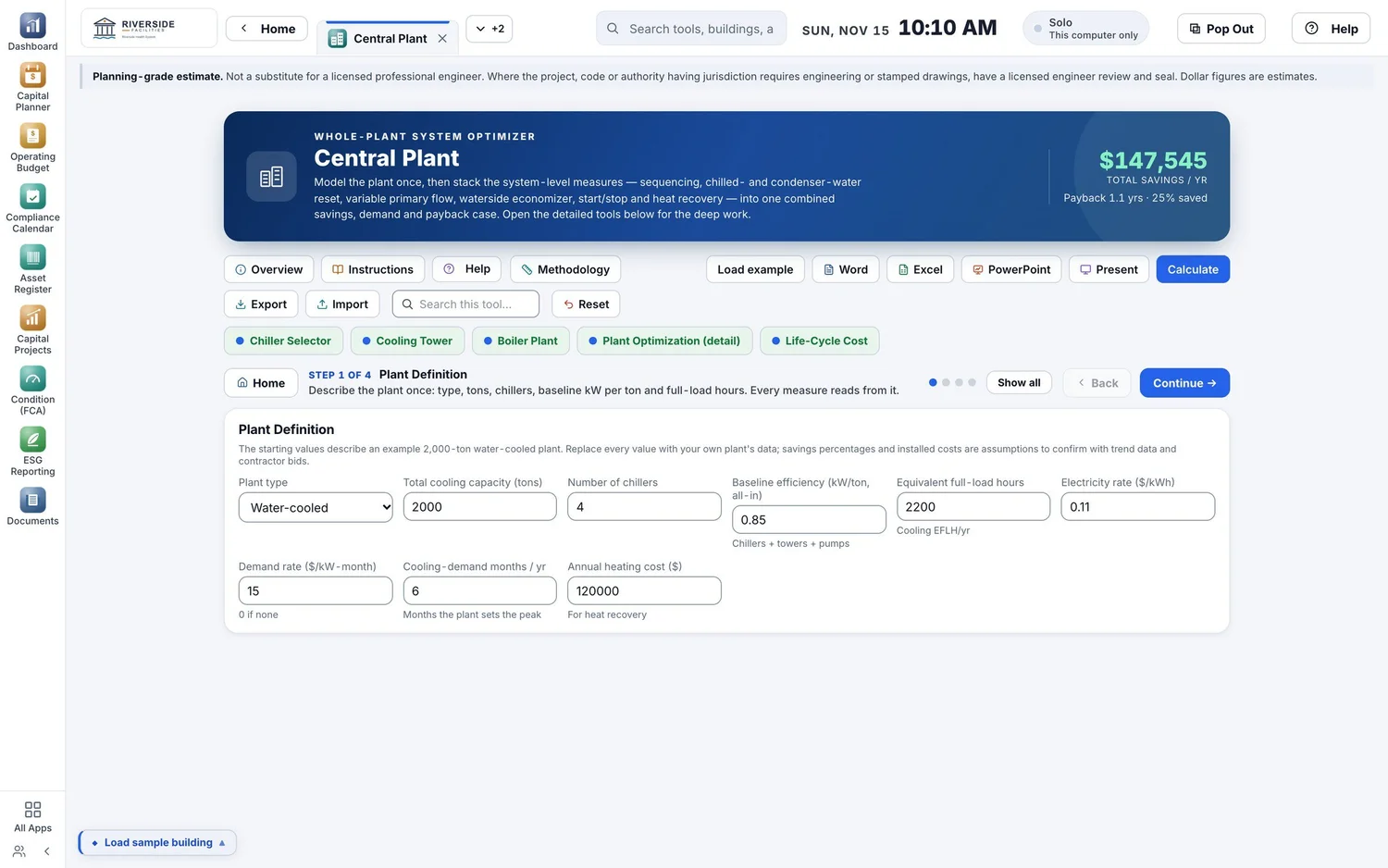
Plant Definition in Central Plant: describe the plant once: type, tons, chillers, baseline kW per ton and full-load hours. Every measure reads from it.
Sized to the Real Need
Load calculation right-sizes a replacement to the building as it is today, not to the nameplate of the unit that failed.
Learn MoreShow Less
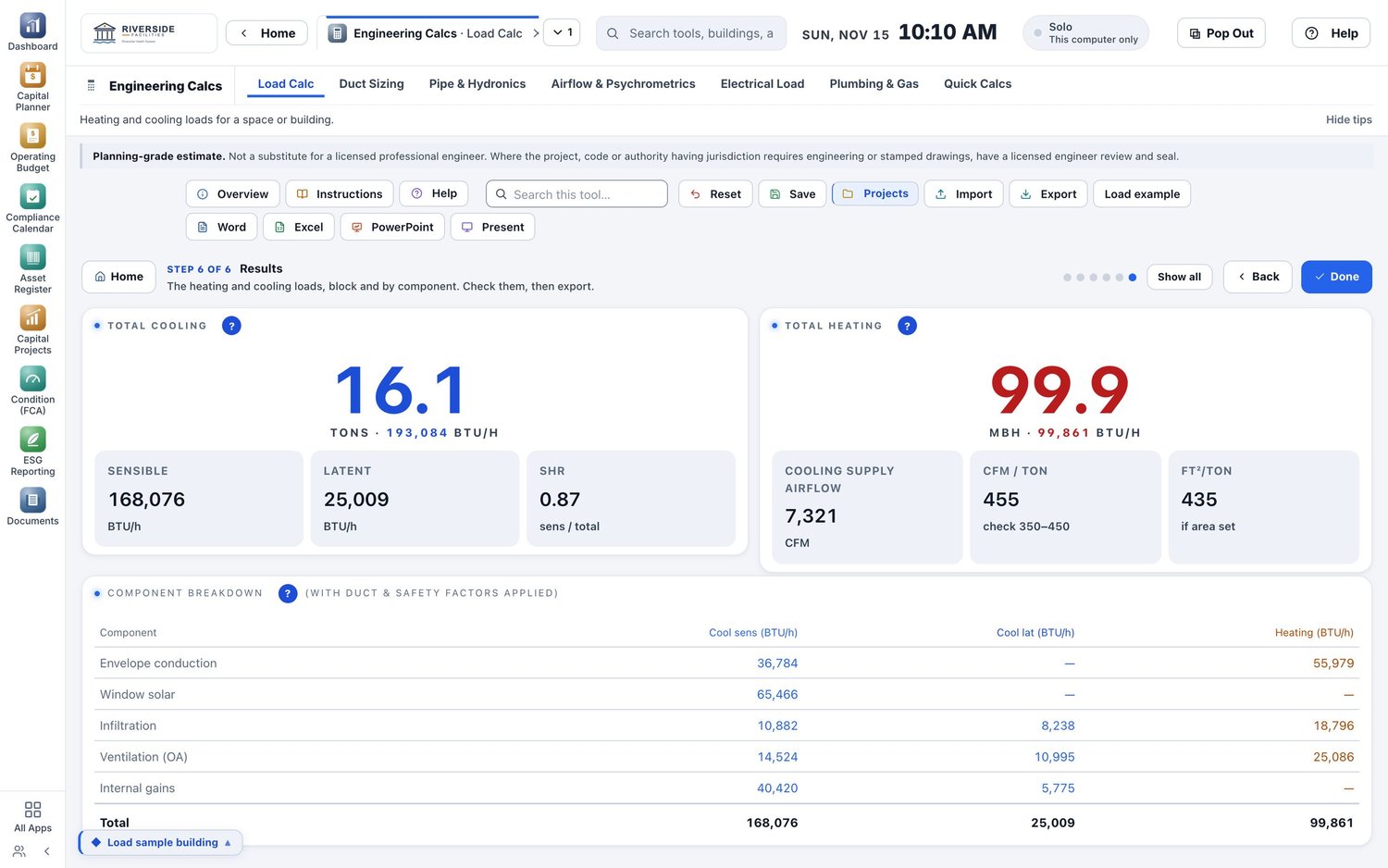
Replacing a failed unit with the same size can mean paying for capacity the building no longer needs. Load Calculation sizes the replacement from the building as it stands.
- Block and room-by-room heating and cooling loads
- Geometry, construction and local design conditions from the ZIP code, offline
- Site Survey details imported, with the source stamped on the exports
- A Methodology with every formula and a worked example you can check by hand
Professional Limits
The tools give analysis and documentation. A licensed engineer's stamp, the manufacturer's selection and the serving utility's confirmation remain where they are required.
Learn MoreShow Less
A planning number used as a design number can commit capital to the wrong equipment. Every calculating tool says where its result stops being reliable, so the organization knows when to bring in the engineer.
- Each Methodology has an Accuracy and Limits section
- Results marked planning-grade where they are screening estimates
- Every report carries its inputs, assumptions and method
- Emergency power checks are never a design or a purchase sizing
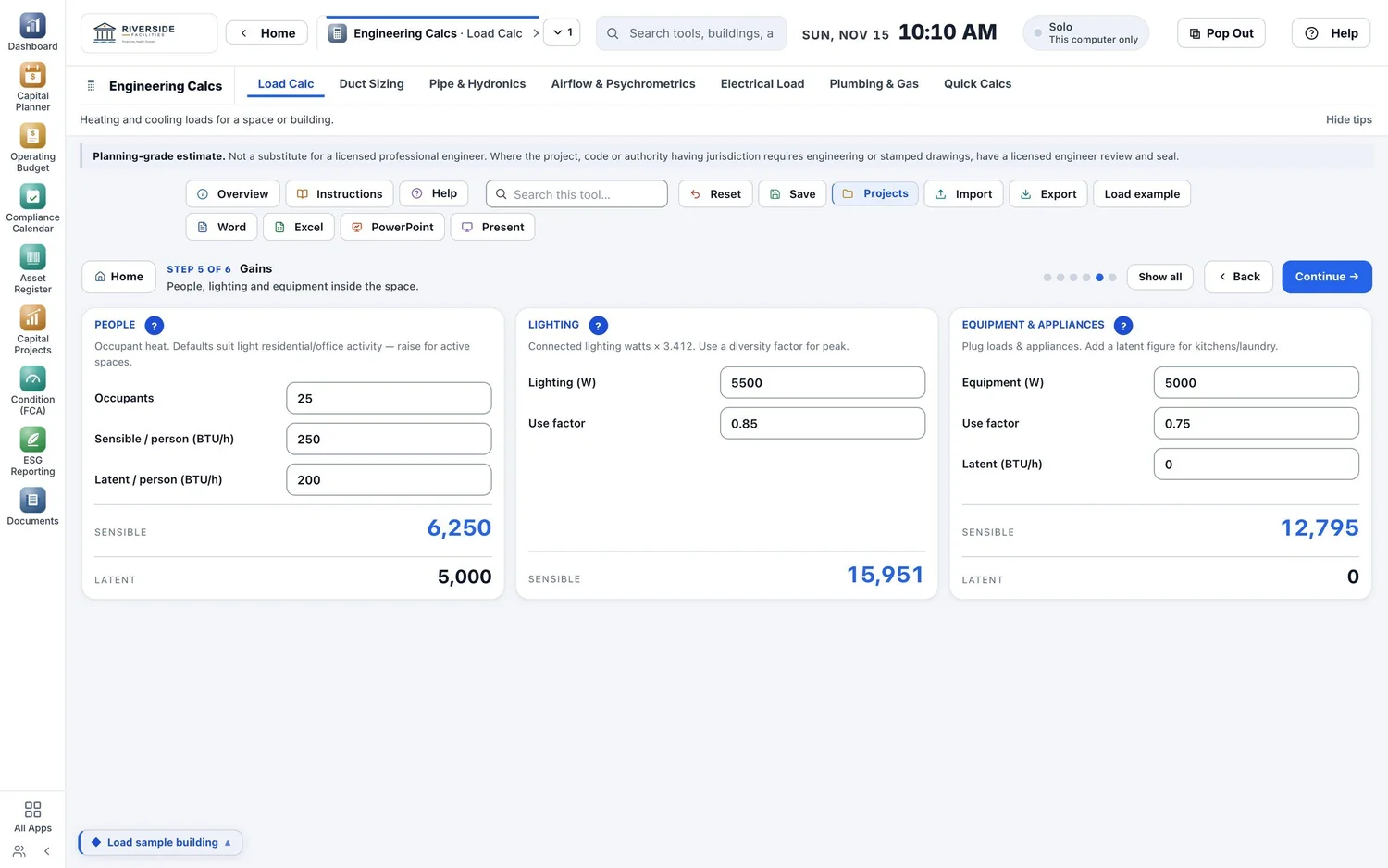
Gains in Load Calculation: people, lighting and equipment inside the space.
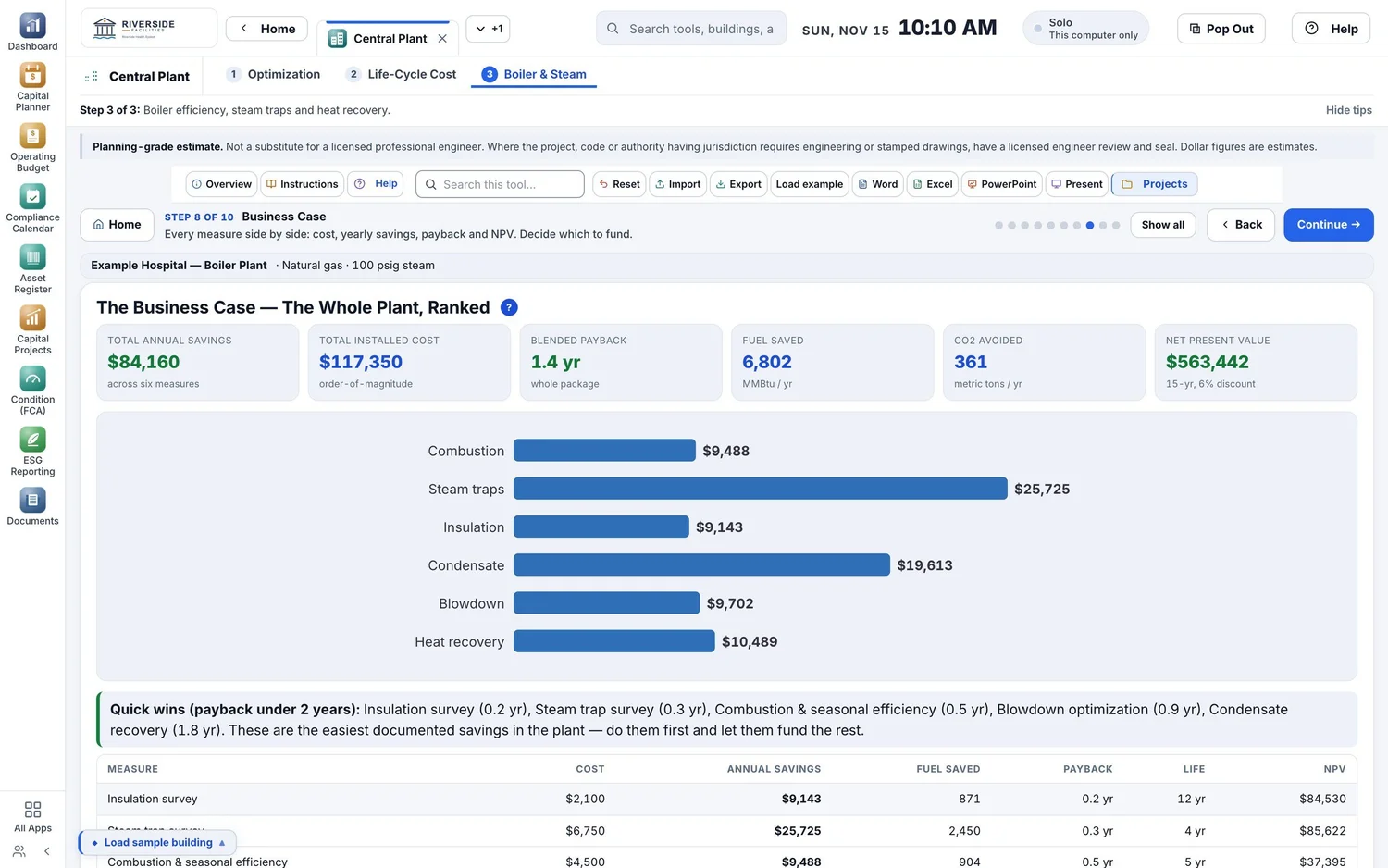
Business Case in Boiler & Steam Plant: every measure side by side: cost, yearly savings, payback and NPV. Decide which to fund.
Engineering Depth Your Whole Team Can Use
Leadership
Replacement decisions that arrive with life-cycle cost and a payback, not just a quote.
Learn MoreShow Less
A quote alone does not tell leadership whether replacing now is cheaper than waiting. These tools bring the decision with its cost over time, so money goes to the replacement that pays.
- A one-page repair-or-replace decision summary for the asset file
- Plant options ranked by equivalent annual cost against doing nothing
- Each report opens with a one-sentence decision and a band of key figures
- Present shows the same report on a meeting-room screen
Management
Condition and remaining life for every system, feeding one capital plan, with the obligations each system carries.
Learn MoreShow Less
A capital plan built from separate spreadsheets misses equipment and double-counts others. The system tools publish to one Building Systems record that the capital plan and the compliance calendar both read.
- Assets, condition, remaining life, deficiencies and obligations in one record
- Deficiencies with a replacement implication become capital candidates
- Elevators, boilers and generators each get their own compliance row per unit
- Condition (FCA) pulls the systems in with one button
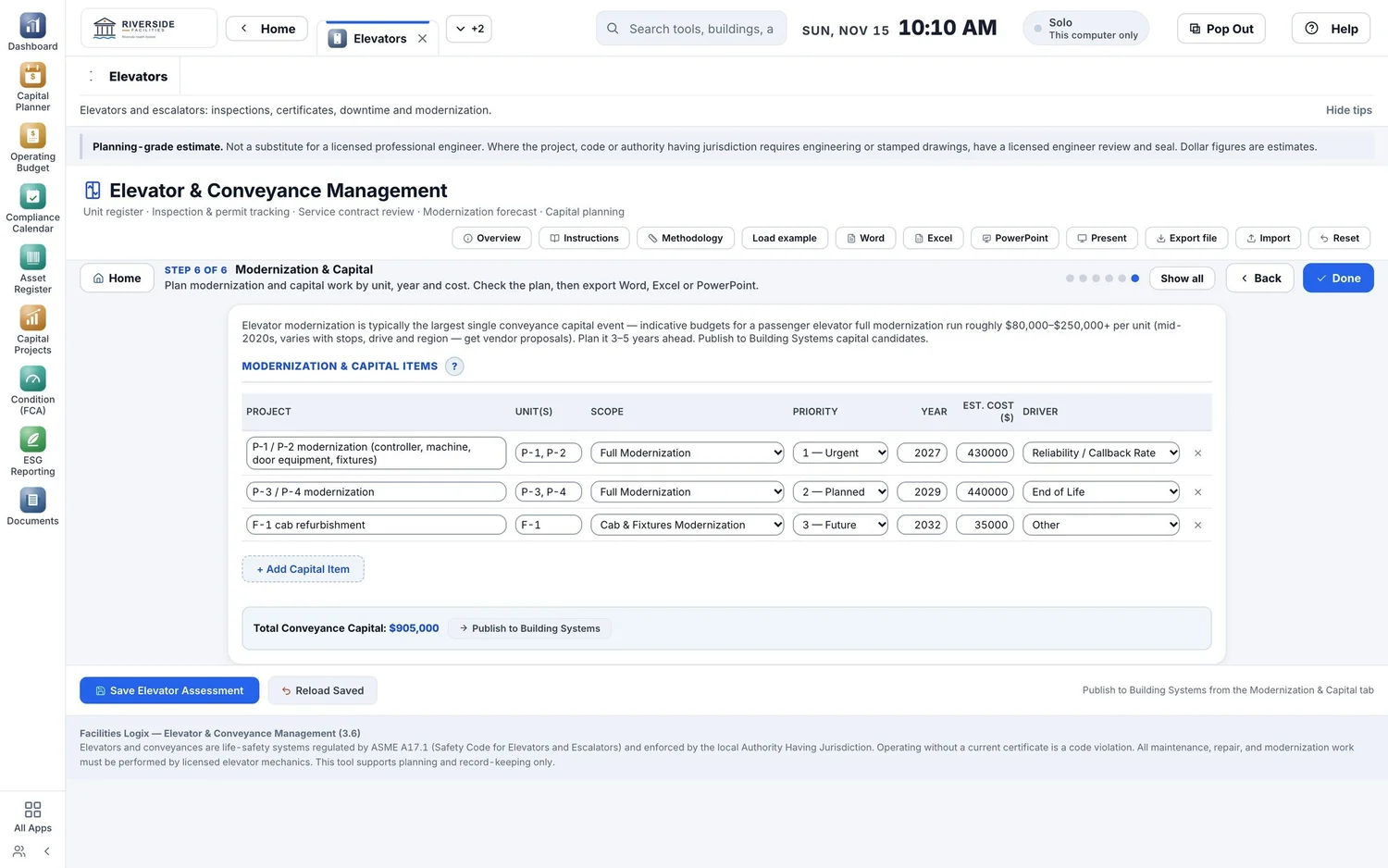
Modernization & Capital in Elevator & Conveyance Management: plan modernization and capital work by unit, year and cost. Check the plan, then export Word, Excel or PowerPoint.
Operations
Everyday calculators, reference tables and a printable field log for the building engineer.
Learn MoreShow Less
Fast answers in the plant room save callbacks and outside calls. The calculators give the building engineer the everyday numbers in one place.
- Quick-calc scratch pad, unit conversions and reference tables
- Desiccant dehumidifier sizing for closed spaces, with a field check from run-time meters
- Duct static pressure and a fan check against the design point
- Pipe sizing with pump head and flow for hydronic loops
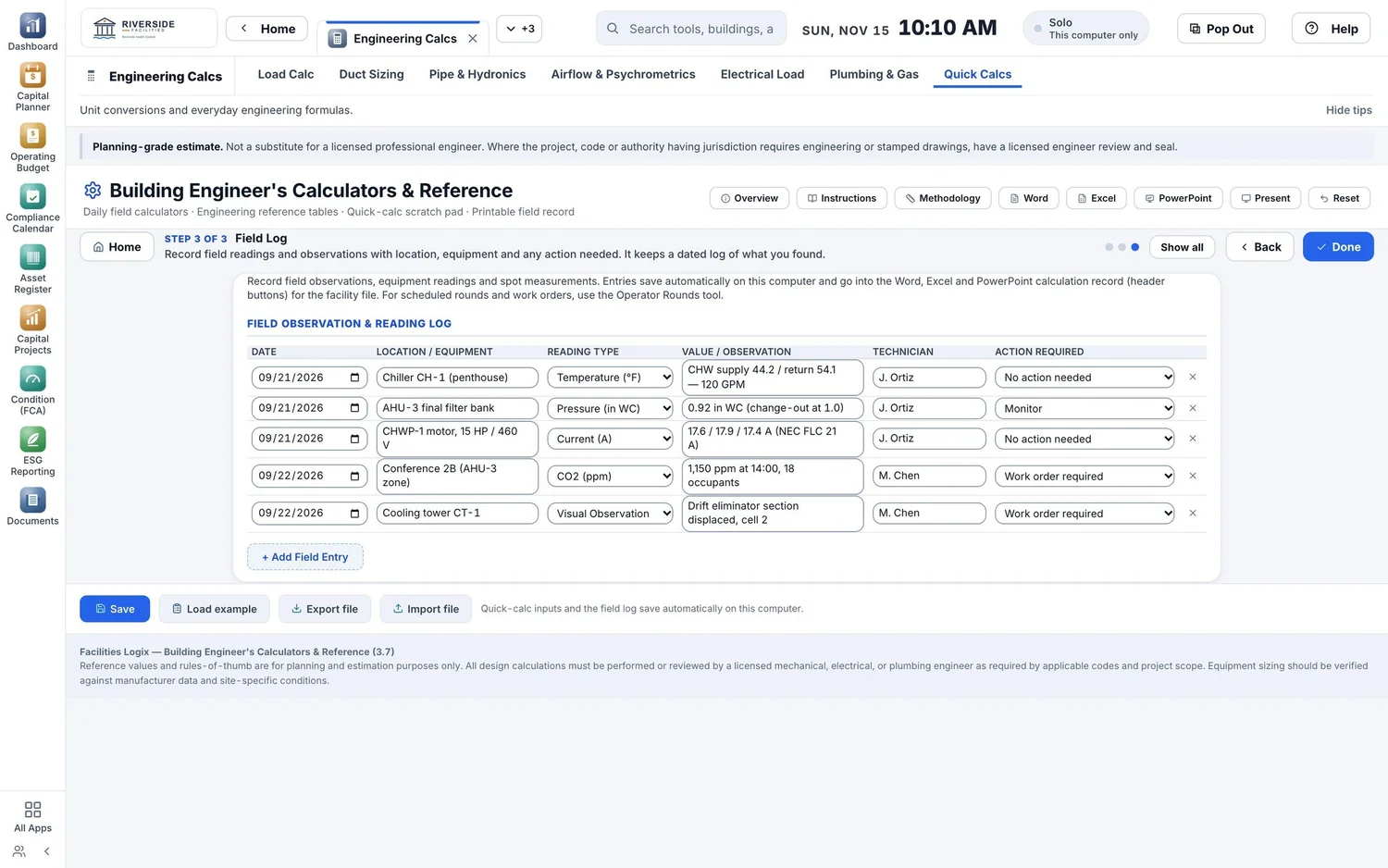
Field Log in Building Engineer's Calculators: record field readings and observations with location, equipment and any action needed. It keeps a dated log of what you found.
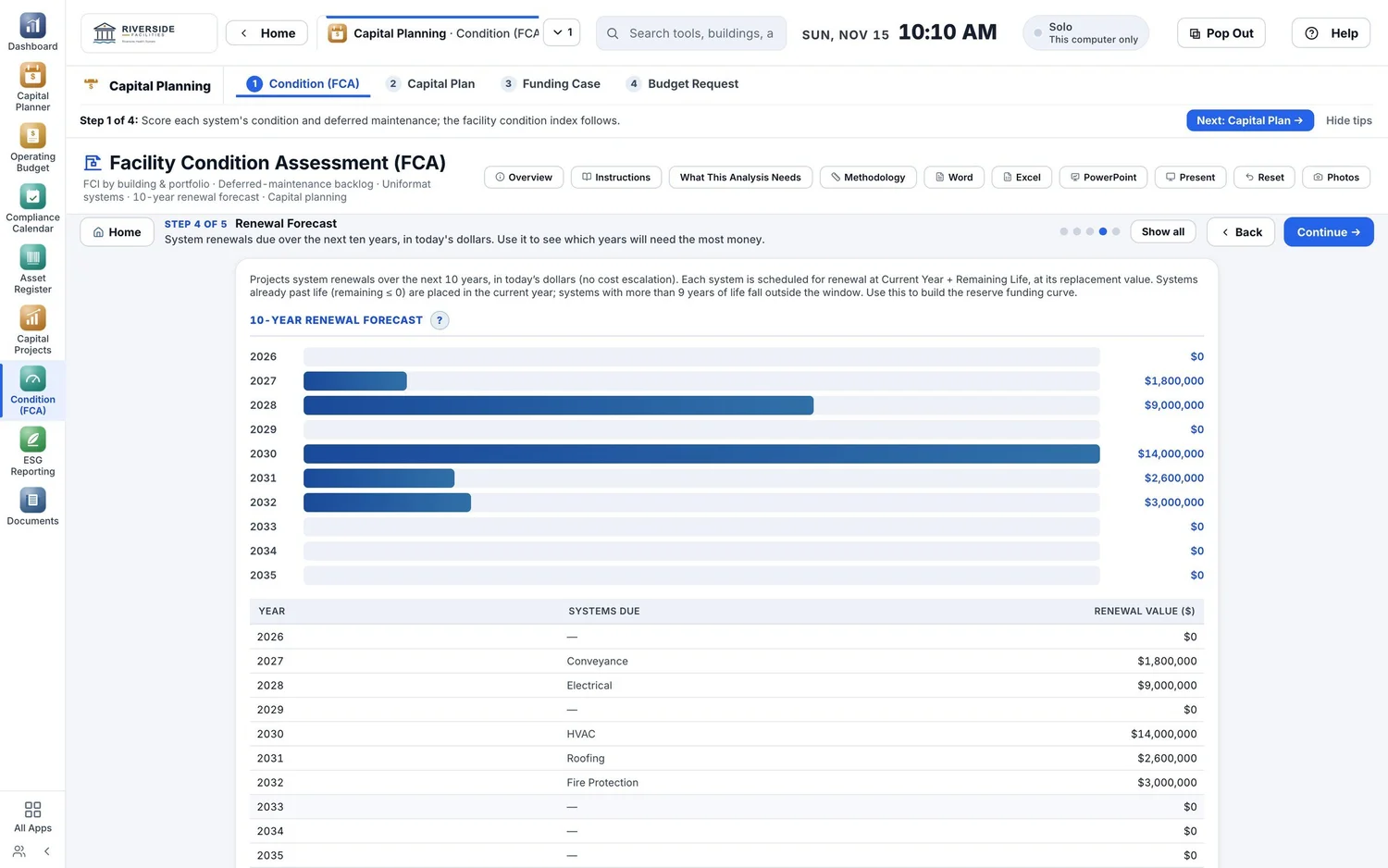
Replacement requests that arrive as a single quote are hard to approve, so the renewal forecast shows the years ahead.
Frequently Asked Questions
Do these tools replace a licensed engineer?
Does the software contain code tables or design values?
How do system findings reach the capital plan?
Be First When Facilities Logix Opens
Stop chasing building records across spreadsheets and binders. Join the list and we will tell you the day downloads open, with setup guides ready.
Launching early 2027 for Facilities Logix. Nothing to buy today, and no sales calls.
