


Containment, Ventilation and the Records Behind Them.
Launching Early 2027 · Join the Early-Access List
Labs are the most ventilation- and safety-intensive buildings in a portfolio: high outdoor air, fume hoods and biosafety cabinets, specialty gases and chemicals, and cold storage a research program cannot afford to lose. Facilities Logix tracks those systems by biosafety level, with the lab-specific compliance, the capital reserve and the energy a lab runs at.
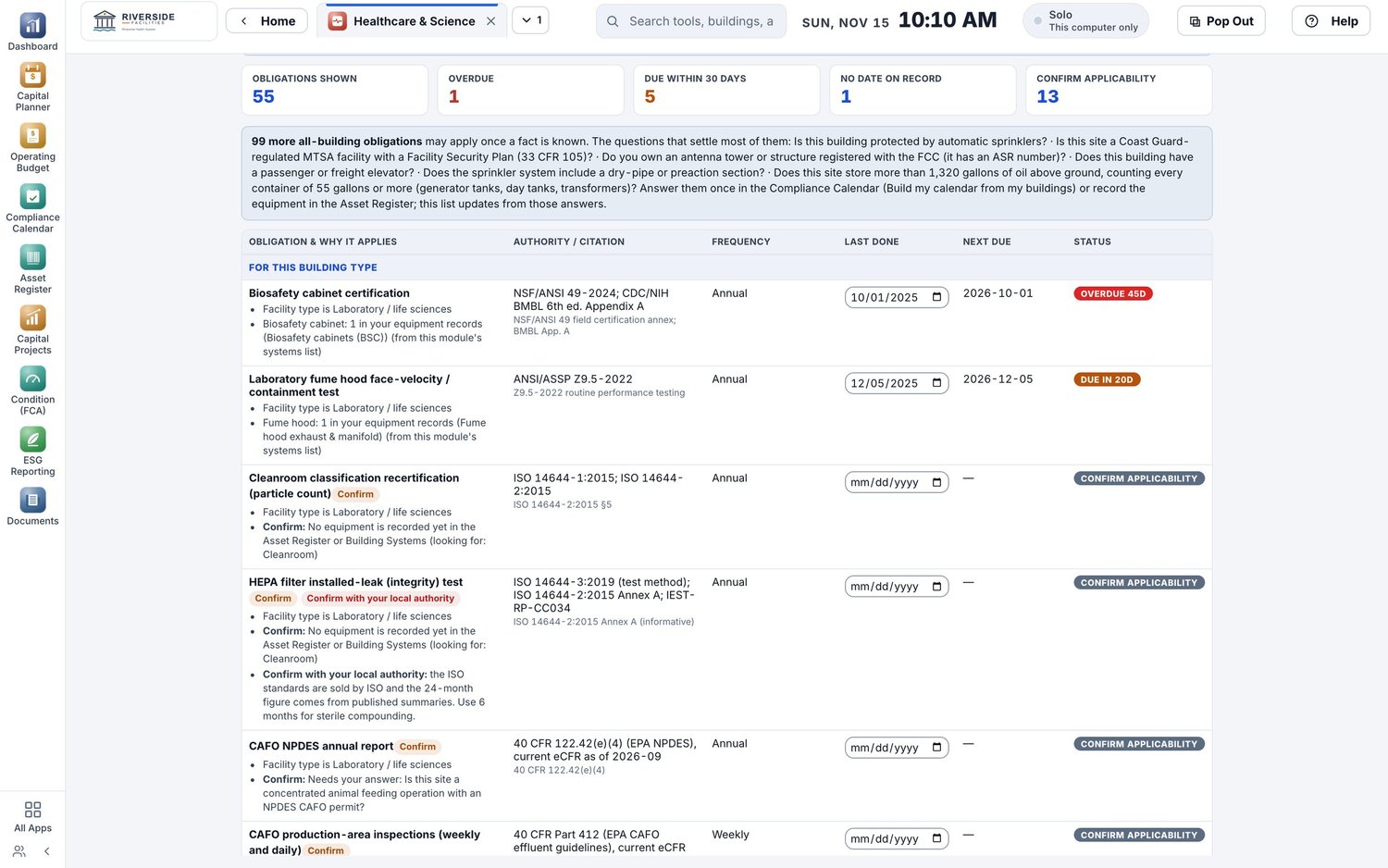
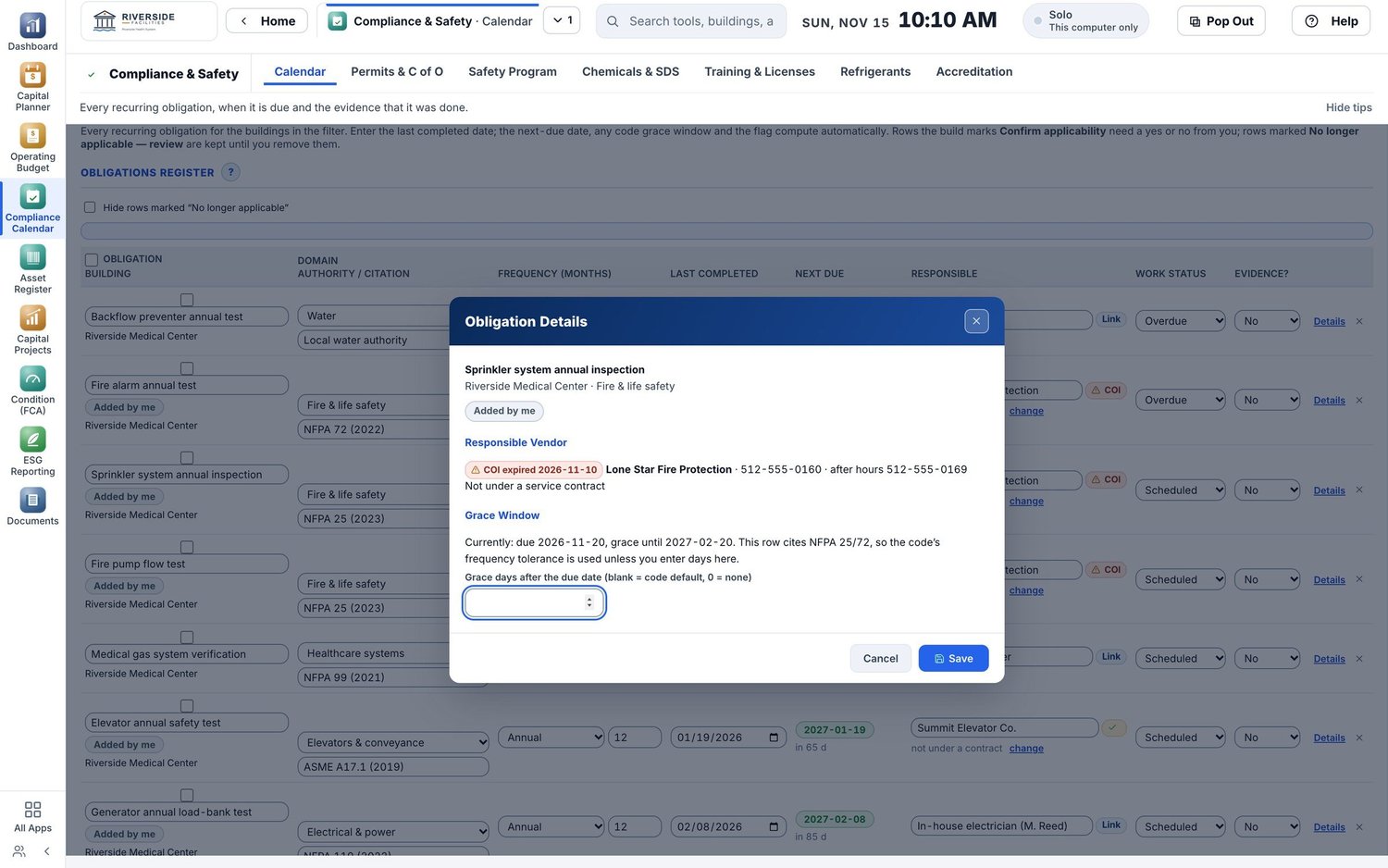
Lab Obligations on the Calendar
Library obligations apply when the building's facts say so (fume hoods, biosafety cabinets, recombinant research, a radioactive materials license, compressed gas storage). Each row carries its authority, citation, frequency and evidence, with the same dates as the Compliance Calendar.
Containment Devices
- Fume hood face velocity and containment: a routine performance test at least annually and whenever the hood or exhaust changes significantly (ANSI/ASSP Z9.5-2022)
- Biosafety cabinet field certification at installation, at least annually, and after relocation, a HEPA filter change or internal repairs (NSF/ANSI 49-2024; Biosafety in Microbiological and Biomedical Laboratories (BMBL), 6th ed., Appendix A)
Biosafety and Radiation Programs
- Institutional Biosafety Committee annual report to the NIH Office of Science Policy, for recombinant or synthetic nucleic acid research (NIH Guidelines)
- Radioactive sealed sources: leak tests at intervals not over 6 months and a semiannual inventory (10 CFR 35.67 for medical use; Agreement State and license conditions otherwise)
- X-ray equipment registration and performance evaluation under the state radiation control program
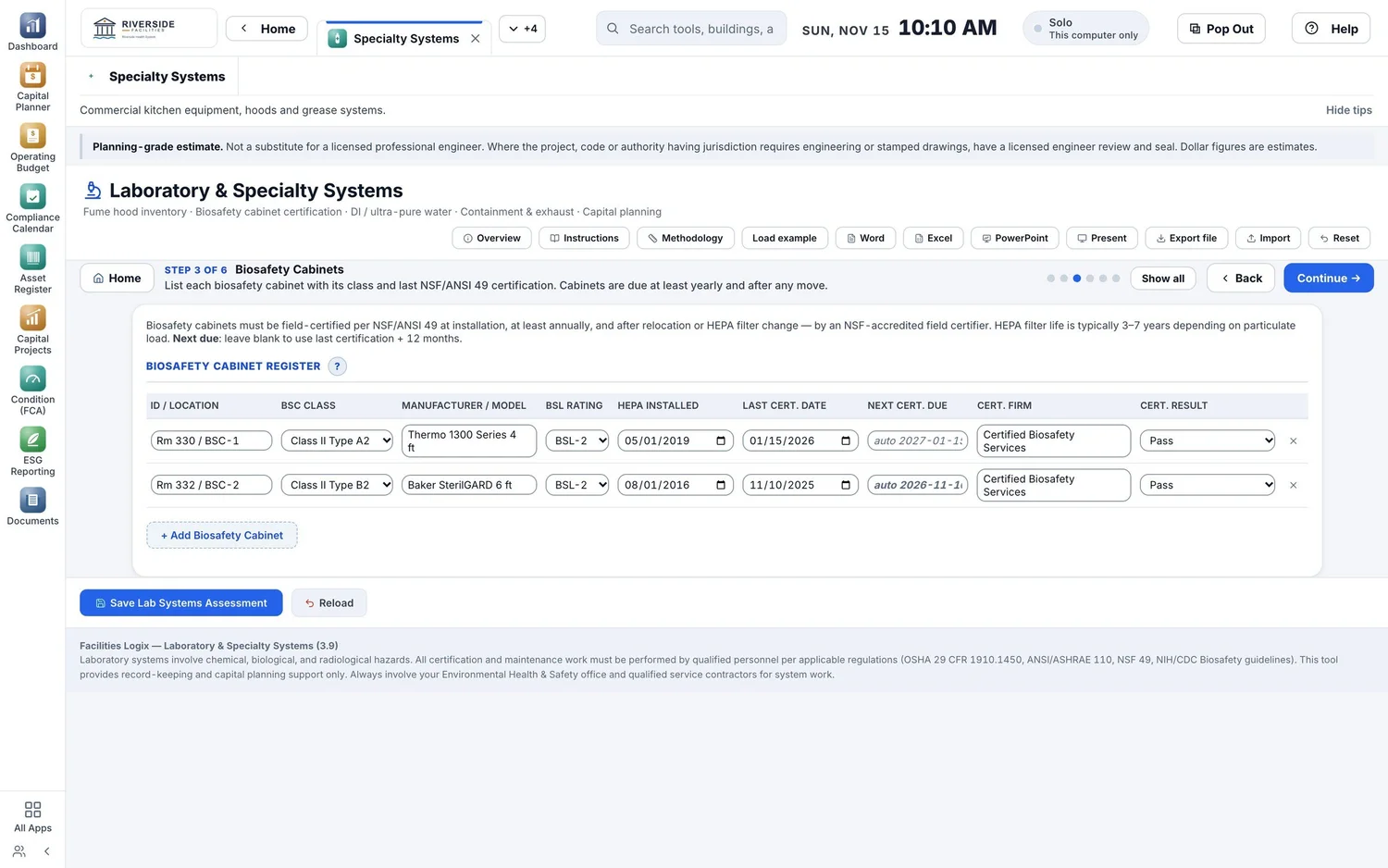
Biosafety Cabinets in Laboratory & Specialty Systems: list each biosafety cabinet with its class and last NSF/ANSI 49 certification. Cabinets are due at least yearly and after any move.
Chemical and Worker Safety
- Chemical hygiene plan reviewed at least annually (OSHA 29 CFR 1910.1450)
- Bloodborne pathogens exposure control plan reviewed at least annually (OSHA 29 CFR 1910.1030)
- Compressed and hazardous gas storage annual self-inspection (NFPA 55), flagged Confirm because the library could not verify it from a primary source
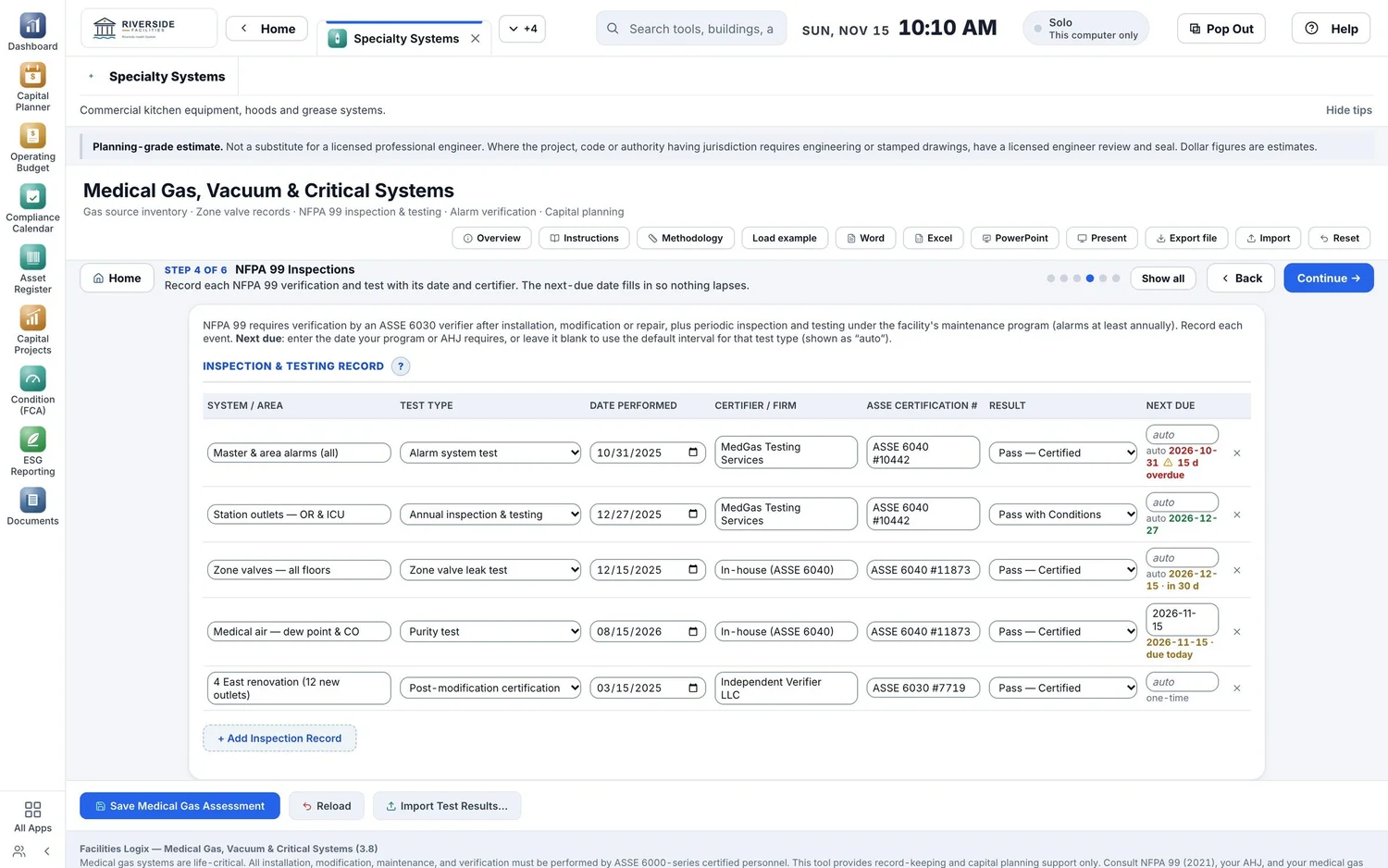
- Medical gas and vacuum, where piped: annual, with verification after any work (NFPA 99)
The Playbook's Own Checklist
- Fume hood face-velocity testing (ANSI/ASSP Z9.5): annual
- Biosafety cabinet certification (NSF/ANSI 49): annual
- Chemical hygiene plan review (29 CFR 1910.1450): annual
- Hazardous waste accumulation-area inspection (EPA 40 CFR 262 / state): weekly
- Eyewash and safety shower activation (ANSI Z358.1): weekly; annual performance check
- Lab ventilation and air-change verification (ASHRAE 62.1): annual
- Compressed and specialty gas systems (NFPA 55 / 99): annual
- Biosafety and Institutional Biosafety Committee program review if BSL-2+ (NIH / CDC / IBC): annual
- Radiation safety program where applicable (NRC / Agreement State), autoclave and pressure-vessel inspection, fire alarm and suppression, backflow: annual; generator test (NFPA 110): monthly
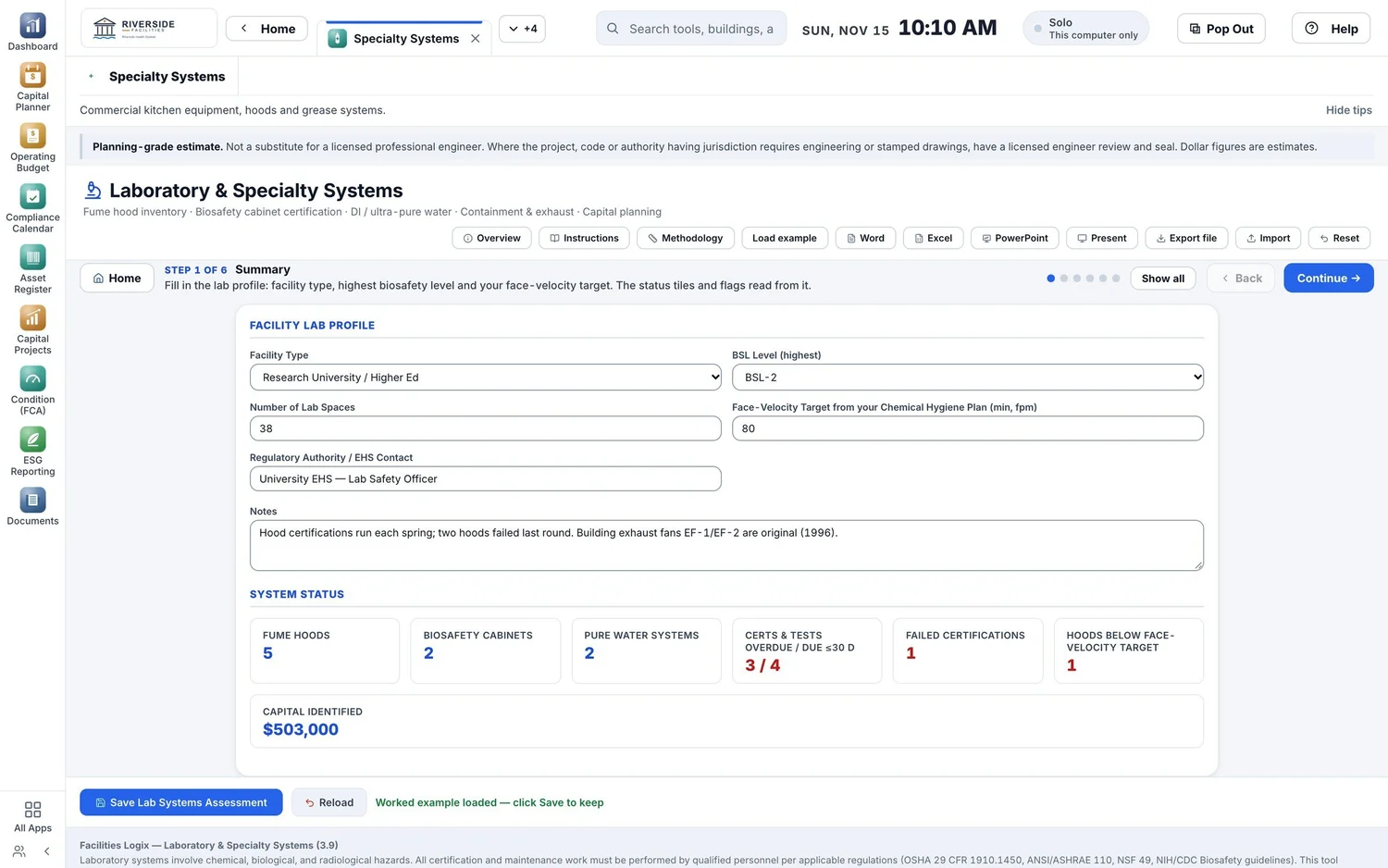
Summary in Laboratory & Specialty Systems: fill in the lab profile: facility type, highest biosafety level and your face-velocity target. The status tiles and flags read from it.
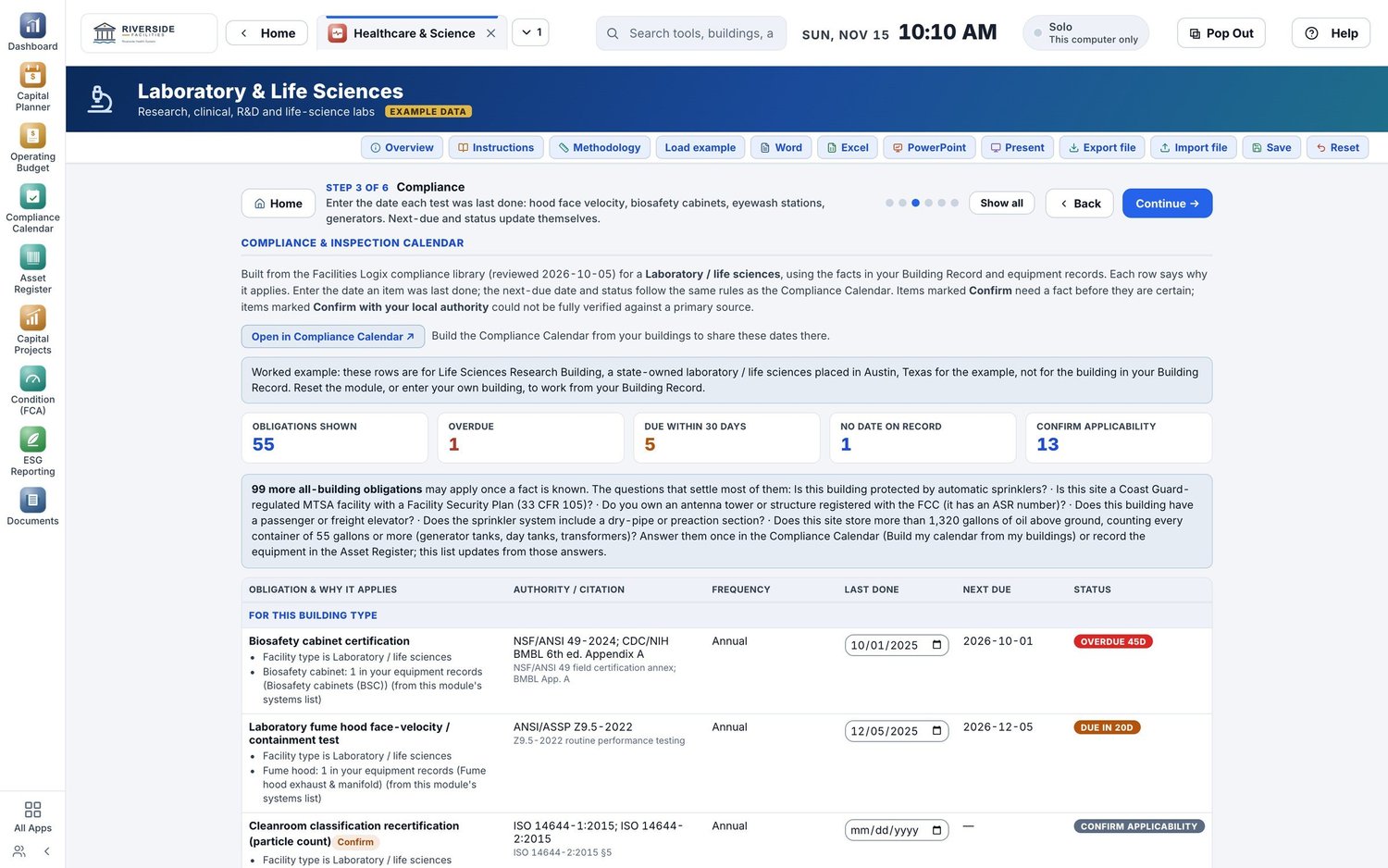
Compliance in Laboratory & Life Sciences: enter the date each test was last done: hood face velocity, biosafety cabinets, eyewash stations, generators. Next-due and status update themselves.
Set the Biosafety Level, Then the Systems
Profile
- Lab type: academic research, clinical or diagnostic, biotech or pharma R&D, chemistry or materials, government or national lab, analytical or QC
- Biosafety level in the playbook: none or BSL-1, BSL-2, BSL-2+ or BSL-3; the Laboratory Systems tool records the highest level from BSL-1 to BSL-4
- Fume hood count, floor area, year built and a year of energy
Systems and Starting PM Cadence
- Lab air handling, often 100 percent outside air at 6 to 12 air changes: quarterly
- Fume hood exhaust and manifold (Z9.5): quarterly
- Biosafety cabinets (NSF/ANSI 49): semiannual
- Ultra-low and cold storage with redundancy: quarterly
- Emergency generator backing freezers and containment: monthly
- Lab and specialty gas, vacuum, compressed air, nitrogen and carbon dioxide (NFPA 55): annual
- DI and RO lab water, autoclaves, cage and glass wash: quarterly
- Chilled water and process cooling: semiannual; chemical storage, fire alarm and suppression, building automation and alarms: annual
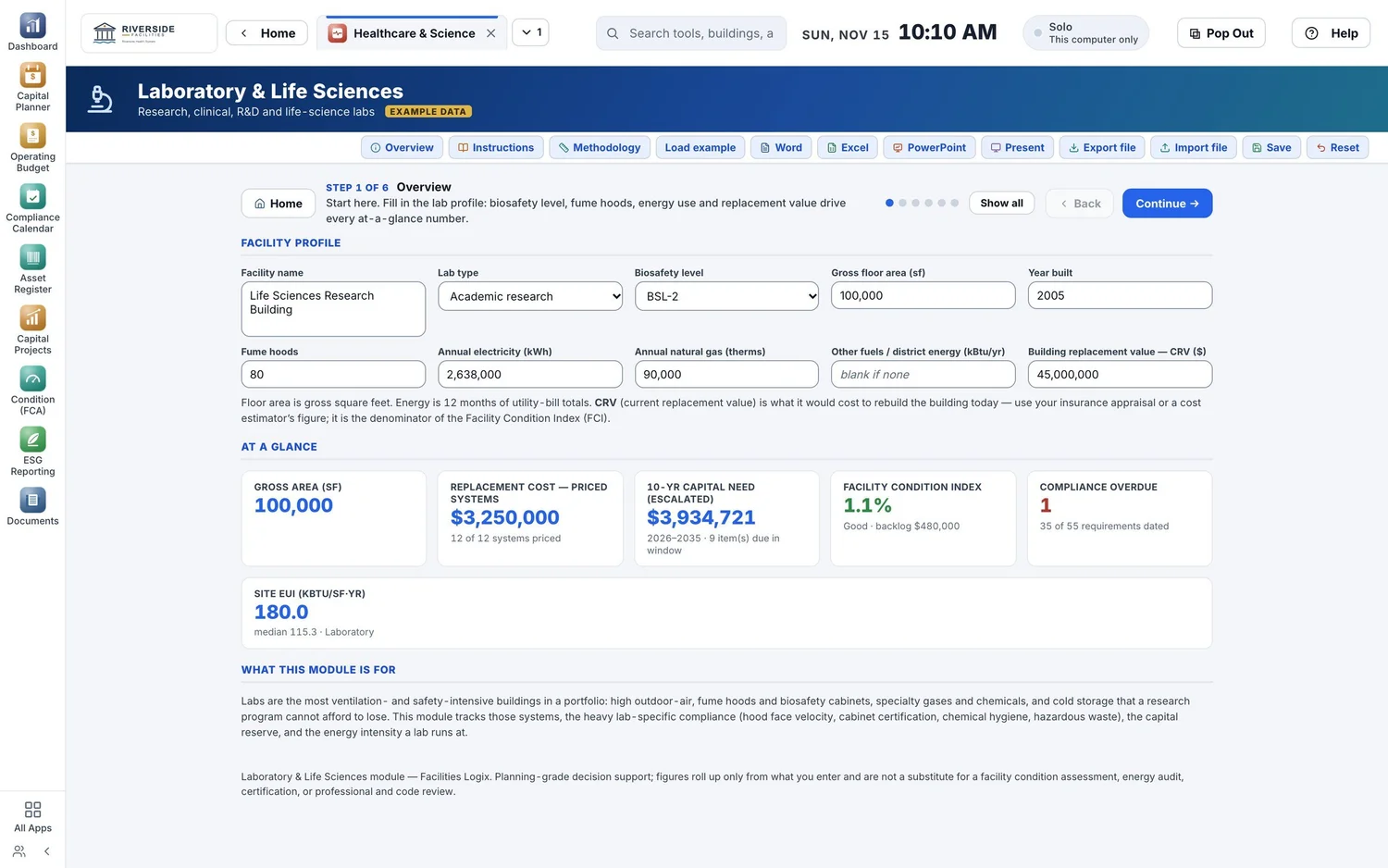
Overview in Laboratory & Life Sciences: start here. Fill in the lab profile: biosafety level, fume hoods, energy use and replacement value drive every at-a-glance number.
Capital Lines
- Lab air handlers and fume hood exhaust (20-year life), chilled water plant (22), generator (25), biosafety cabinet replacement cycle (12), cold-storage fleet (12), controls (15), fire and life safety (18), roof (22), casework and fit-out (15)
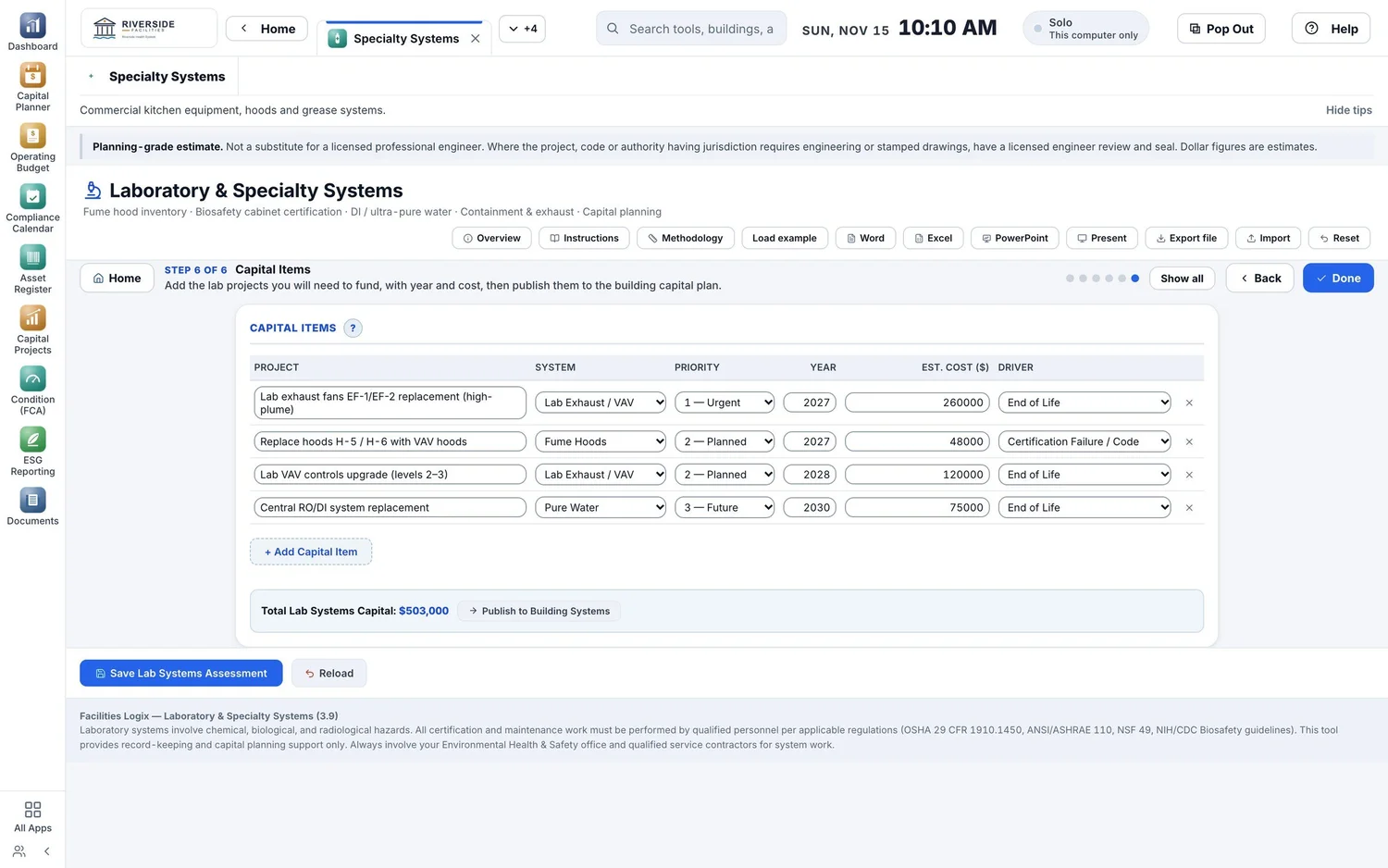
Capital Items in Laboratory & Specialty Systems: add the lab projects you will need to fund, with year and cost, then publish them to the building capital plan.
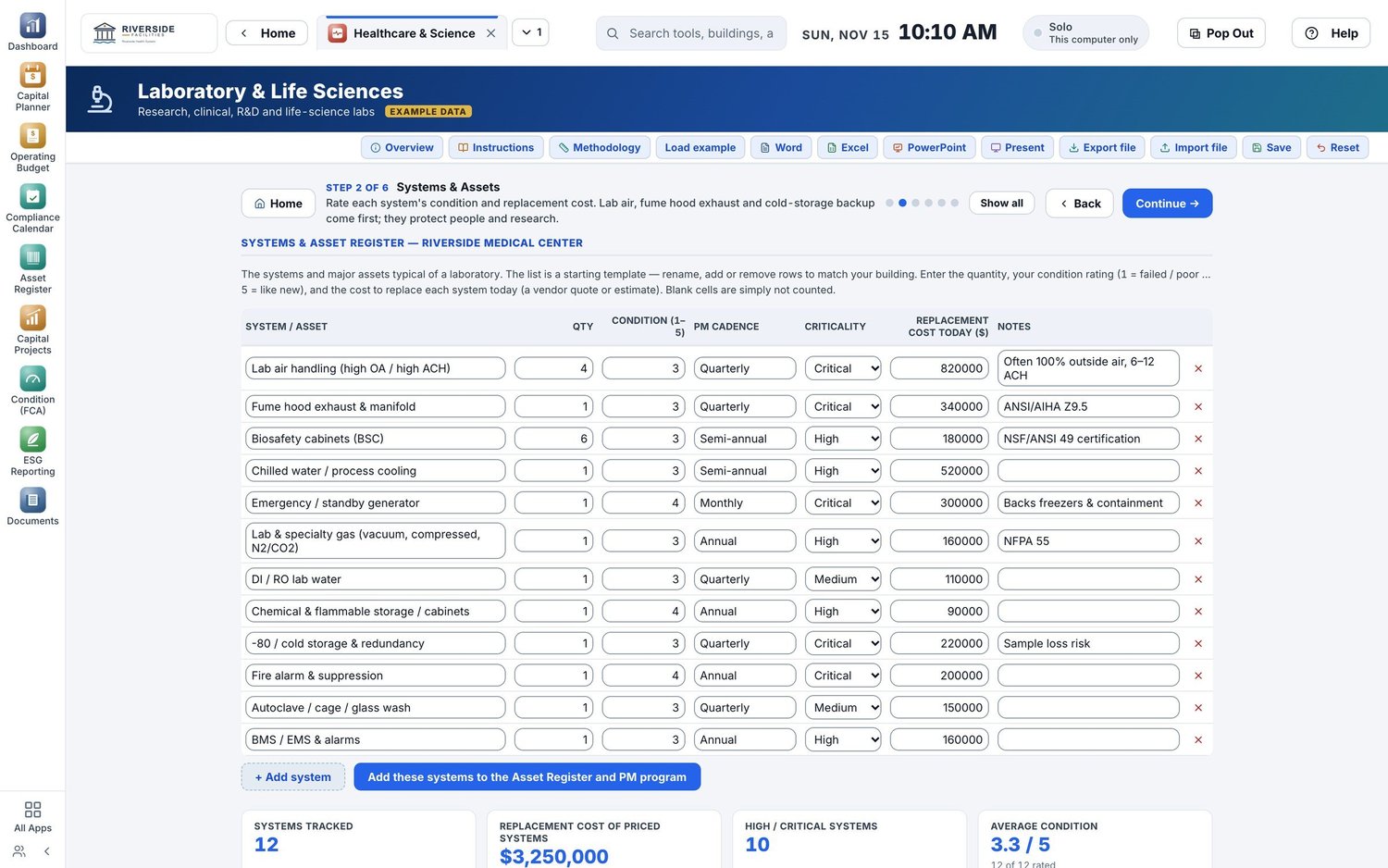
Lab ventilation and containment fail quietly, so the playbook starts with the systems that protect people.
Every Hood, Cabinet and Exhaust Fan
Fume Hood Inventory
Each hood's type, opening, measured face velocity, last certification, result, sash condition and bypass or variable-volume control. Set the face-velocity target from your chemical hygiene plan and the summary counts hoods below it. Next due defaults to 12 months after the last certification; overdue shows red and due within 30 days amber.
Learn MoreShow Less
OSHA can cite a lab whose hoods do not work properly under its chemical hygiene plan, so each hood's record has to hold up. The inventory keeps the proof current.
- Failed or overdue hoods publish to Building Systems as Code / Regulatory deficiencies.
- Each deficiency's title says failed certification or certification overdue.
- An action list collects every overdue and due-soon unit with its last result.
- Planning lives: bench hoods 20 to 25 years, walk-in hoods 20.
Biosafety Cabinet Register
Class (I, II-A2, II-B2, III), biosafety level rating, HEPA install date, last certification, the certification firm and the result, with the next due 12 months out unless you enter another date.
Learn MoreShow Less
A cabinet running out of specification at BSL-2 or above is a regulatory and liability problem, and an expired certification can stop the work inside it. The register shows which cabinets need attention.
- Annual certification by an NSF-accredited field certifier under NSF/ANSI 49.
- A failed certification publishes to Building Systems as a deficiency.
- Due within 30 days shows amber, overdue red.
- Planning lives: Class II-A2 15 to 20 years, Class II-B2 10 to 15.
Pure Water Systems
RO, DI and ultra-pure water systems with capacity, current resistivity or conductivity and the next resin or membrane change, with ASTM D1193 reagent water types in the methodology.
Learn MoreShow Less
Water that drifts below spec can spoil experiments, and a resin or membrane changed too late costs more than one changed on time. The register keeps each system's quality and service in view.
- Type I reagent water is 18 megohm-cm or higher; Type II at least 1; Type III at least 4.
- Each system carries its last PM and condition.
- Planning lives: RO membranes 3 to 5 years, DI resin beds 1 to 3, ultra-pure systems 15 to 20.
- The pure water table appears in each lab report.
Containment and Exhaust
Dedicated lab exhaust fans, variable-volume exhaust controls, chemical storage ventilation and snorkel exhausts, kept apart from general HVAC, ending with the Critical-Room Pressure and Air-Change Log: each containment room's required pressure relationship and air changes, typed from your design basis, with an excursion work order for each failing reading.
Learn MoreShow Less
An exhaust failure in a lab is a worker safety problem first and a costly emergency repair second. Tracking the equipment by itself keeps it from getting lost among general HVAC.
- Each system carries the areas it serves, installed date, last inspection, next due and condition.
- Air changes for a negative room are figured from its exhaust airflow.
- Planning lives: lab exhaust fans 20 years, variable-volume exhaust controls 15.
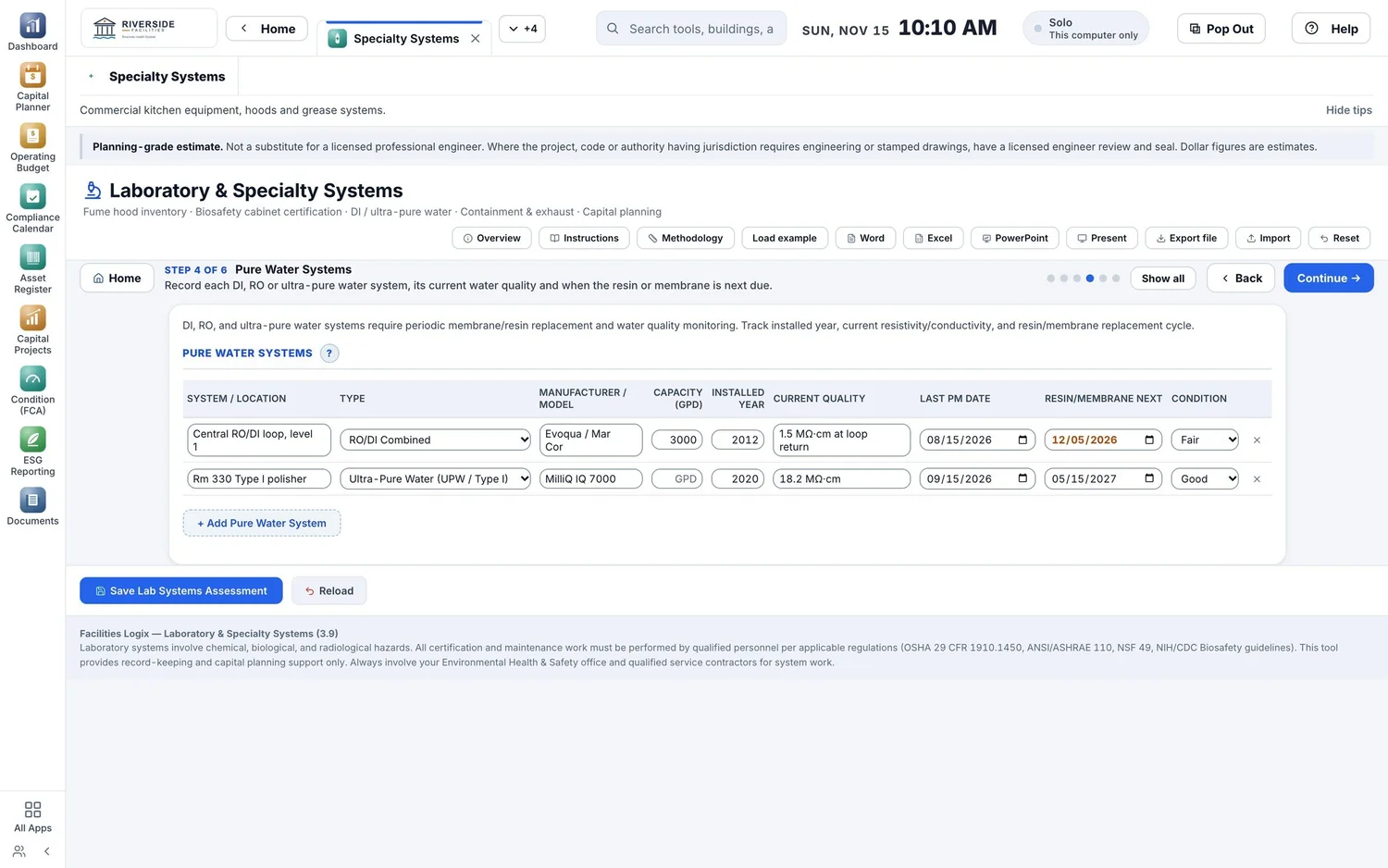
Pure Water Systems in Laboratory & Specialty Systems: record each DI, RO or ultra-pure water system, its current water quality and when the resin or membrane is next due.
Chemicals and SDS
The hazardous chemical inventory, the Safety Data Sheet register, the EPCRA Tier II threshold check and the OSHA hazard communication program checklist.
Learn MoreCritical Environment Watch
Containment rooms in the critical-room log appear as tiles on the Live Alarms screen: red with an open excursion, amber when not read within the days you set, green when the latest reading passes.
Learn MoreShow Less
A containment room that loses negative pressure puts staff and research at risk, and a room nobody has read in weeks is a gap an inspector notices. The tiles show both at a glance.
- Tiles sort worst first.
- A red tile shows how many days the excursion has been open.
- Each tile shows the latest pressure difference, air changes, temperature and humidity.
- Create Work Order on an open excursion uses the same work order as the room log.
- The amber window starts at 31 days; set your own.
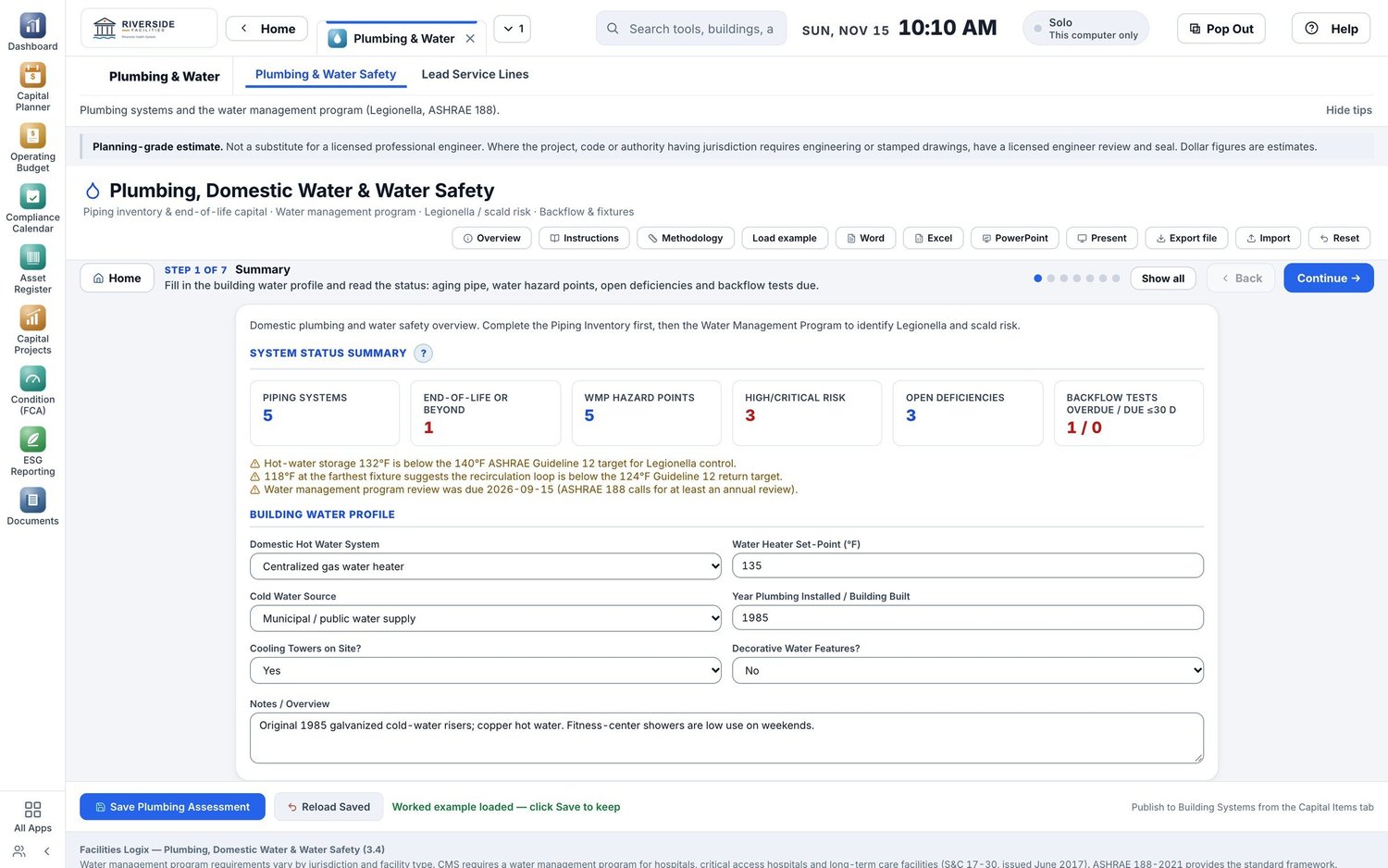
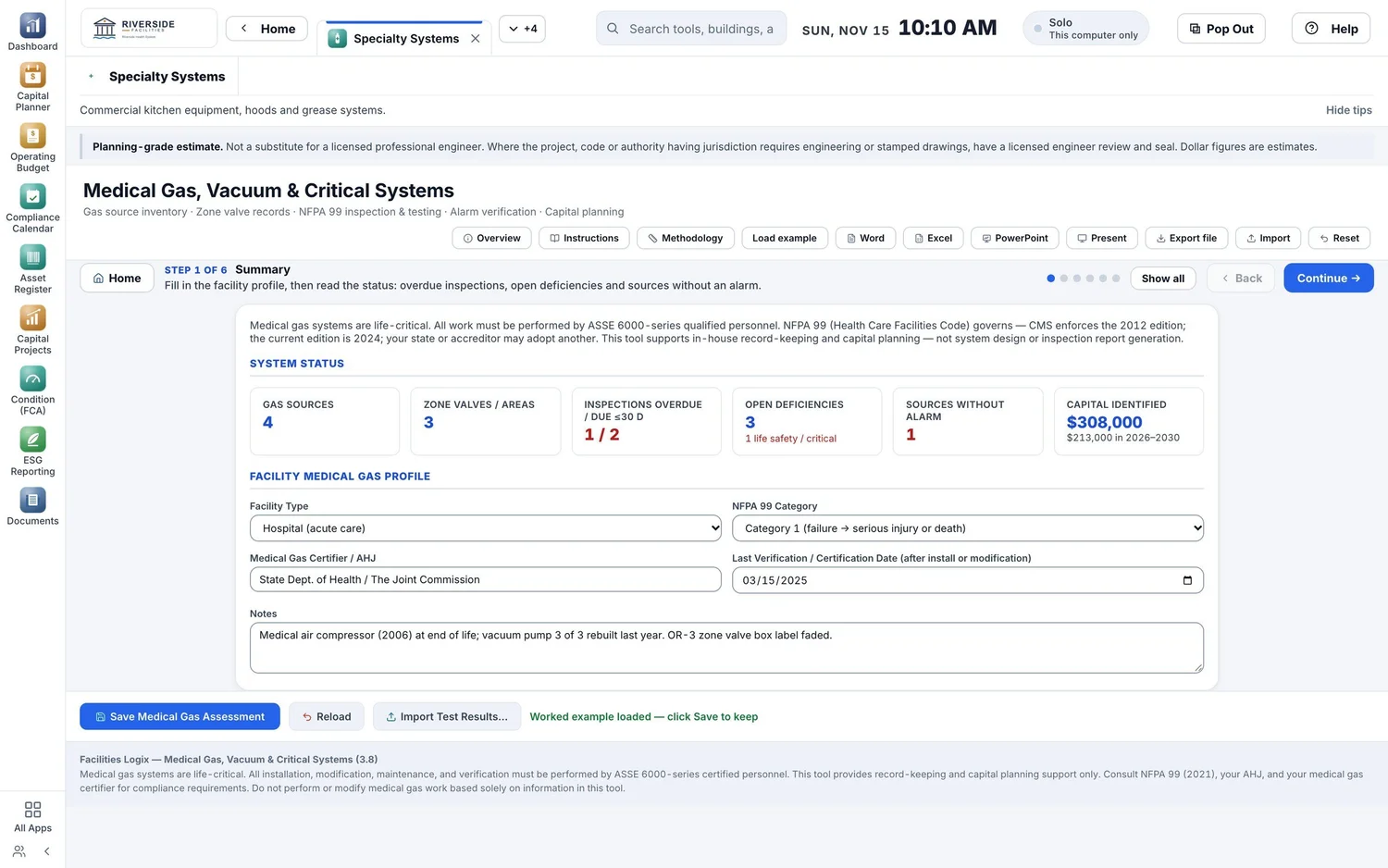
Summary in Plumbing, Domestic Water & Water Safety: fill in the building water profile and read the status: aging pipe, water hazard points, open deficiencies and backflow tests due.
Ready for the Safety Office and the Inspector
Compliance Tab
Enter the date each test was last done: hood face velocity, biosafety cabinets, eyewash stations, generators. Next due and status update themselves.
Learn MoreReports
Word, Excel and PowerPoint reports from the playbook and the Laboratory Systems tool, with lab deficiencies and capital published to the portfolio's building systems roll-up.
Learn MoreShow Less
Lab capital competes with research for money, so the report leads with what is overdue and what has failed. Each report opens with a decision line and the counts behind it.
- The decision line names how many units to repair or replace after failing.
- An action list of overdue and due-soon hoods, cabinets and systems with their last result.
- Tables for hoods, cabinets, pure water and containment and exhaust.
- Capital rows by priority, project, system, budget year and cost in today's dollars.
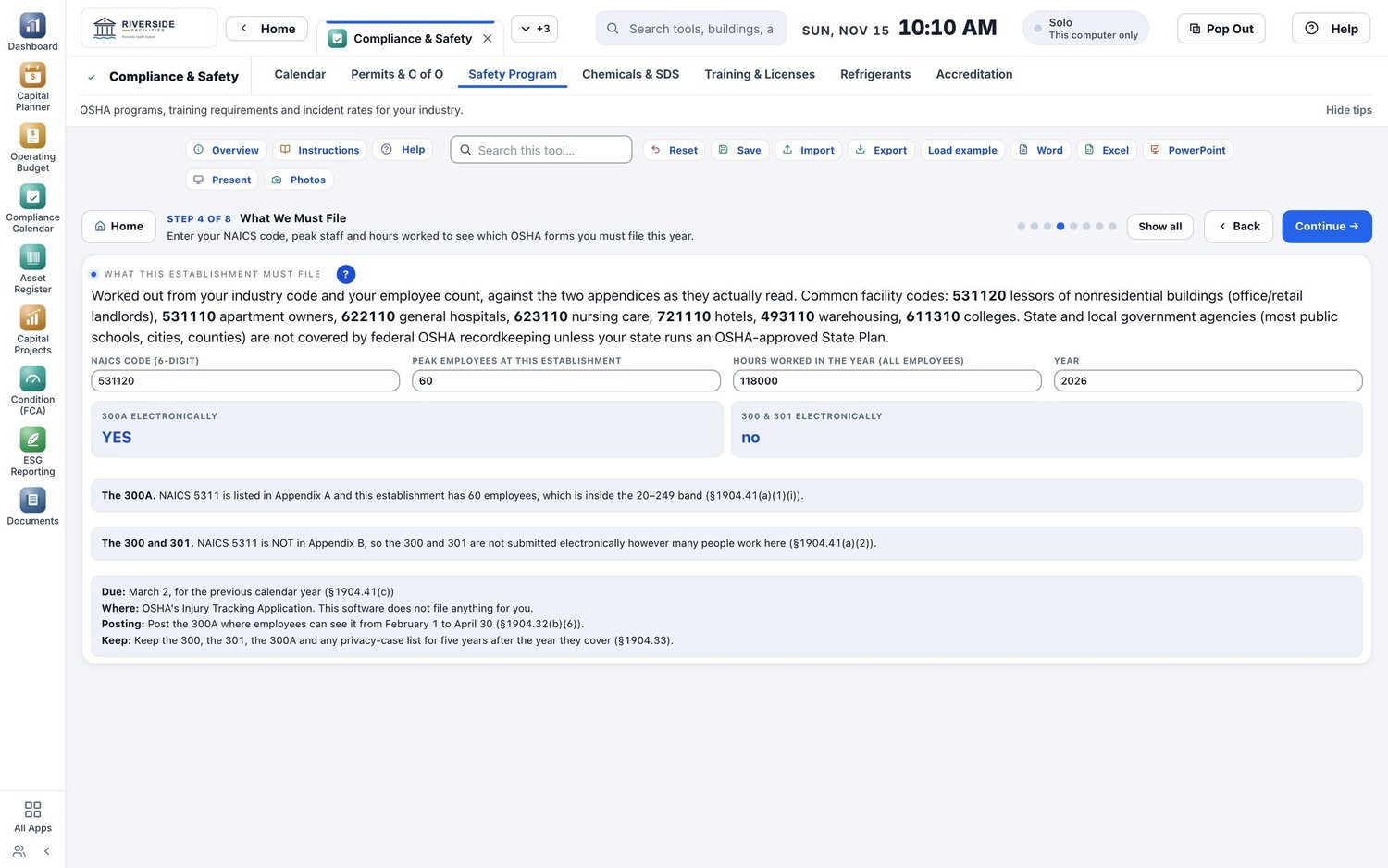
What We Must File in Safety & Compliance: enter your NAICS code, peak staff and hours worked to see which OSHA forms you must file this year.
ENERGY STAR
Laboratories compare with the ENERGY STAR national median (no 1 to 100 score). The energy comes from your bills, and the tab lists the benchmarking laws that apply.
Learn MoreShow Less
Labs are among the most energy-intensive buildings in a portfolio, so a small percentage cut is real money. The tab shows how far this building sits from its peers.
- The national laboratory median is 318.2 kBtu per square foot source, 115.3 site.
- Other property types to pick: Other - Technology/Science, or Office for a mixed building.
- Clinical and diagnostic labs map to Laboratory by default.
- Source energy uses EPA ratios: electricity 2.80, natural gas 1.05.
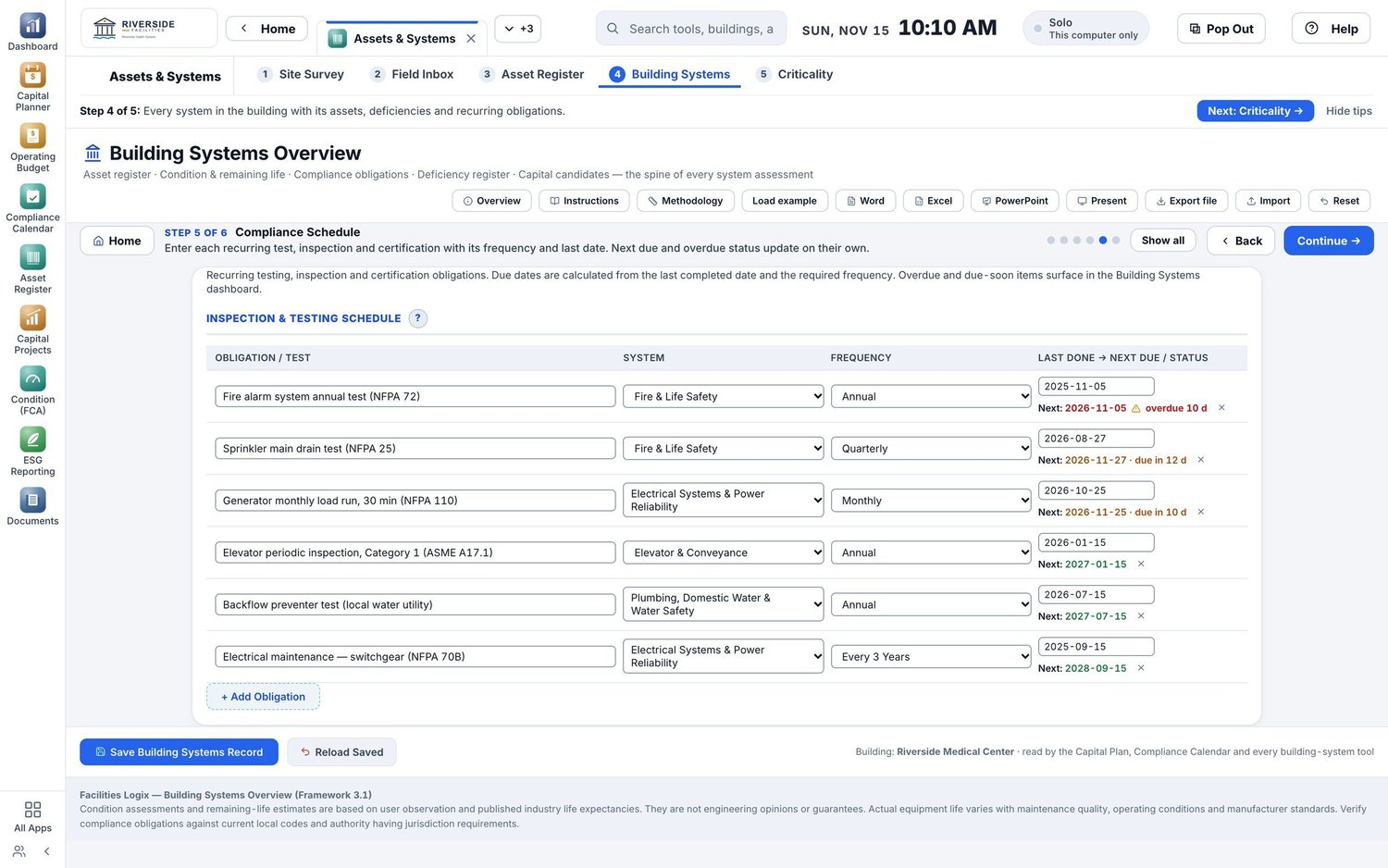
Compliance Schedule in Building Systems Overview: enter each recurring test, inspection and certification with its frequency and last date. Next due and overdue status update on their own.
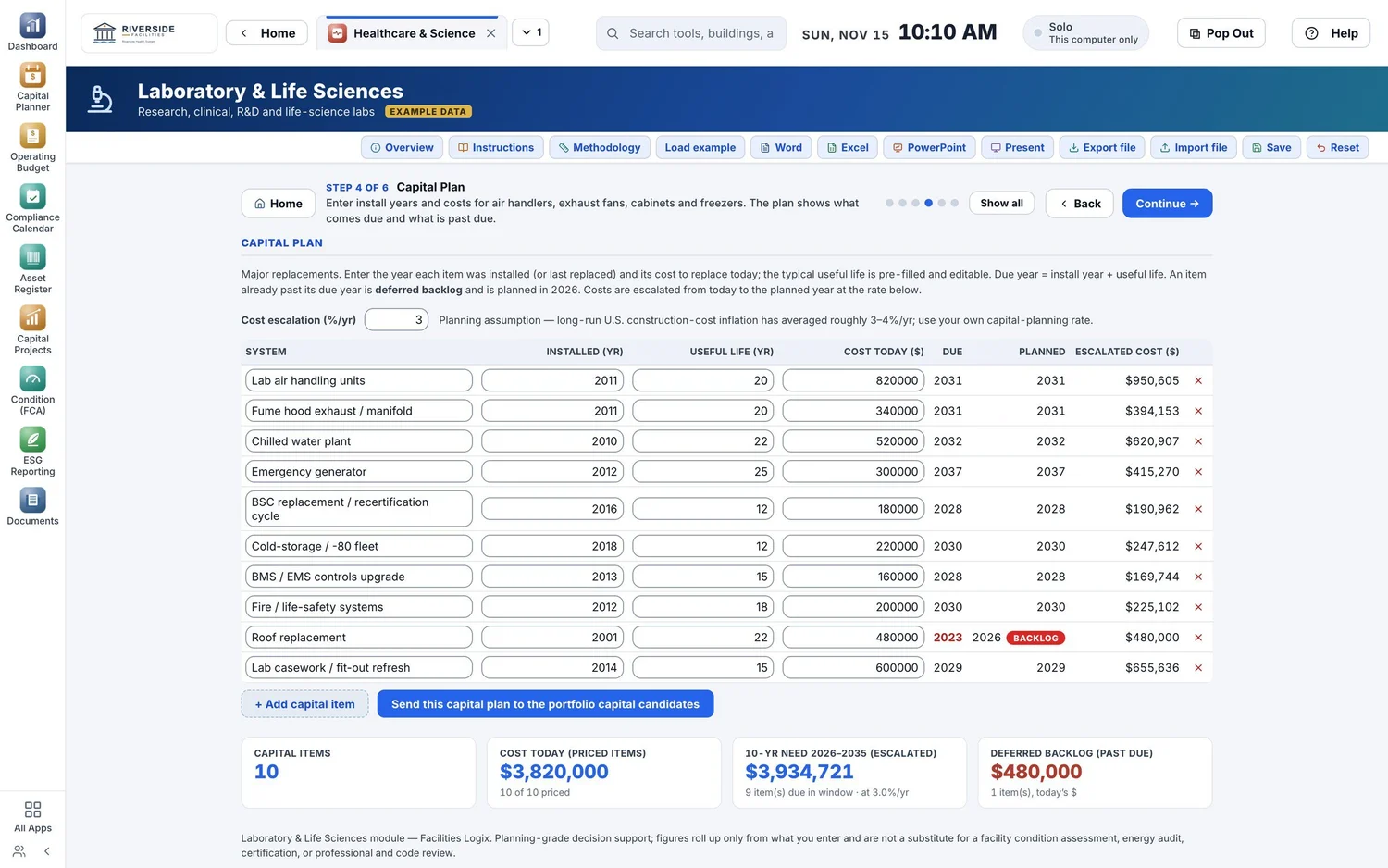
The safety office asks what will need replacing, so the capital plan lists each lab system with its year.
Yardsticks and Summary Numbers
Benchmarks
- Energy use intensity: the ENERGY STAR lab median of about 115 kBtu per square foot, often far higher
- Fume hood face velocity: set by your lab ventilation standard (commonly about 80 to 100 feet per minute), with periodic performance testing under Z9.5
- Cold-storage redundancy: backup power and carbon dioxide backup on critical freezers
- Ventilation: air changes per your hazard assessment; 100 percent outside air is common
Laboratory Systems Summary
- Fume hoods, biosafety cabinets and pure water systems
- Certifications and tests overdue or due within 30 days
- Failed certifications and hoods below the face-velocity target
- Capital identified
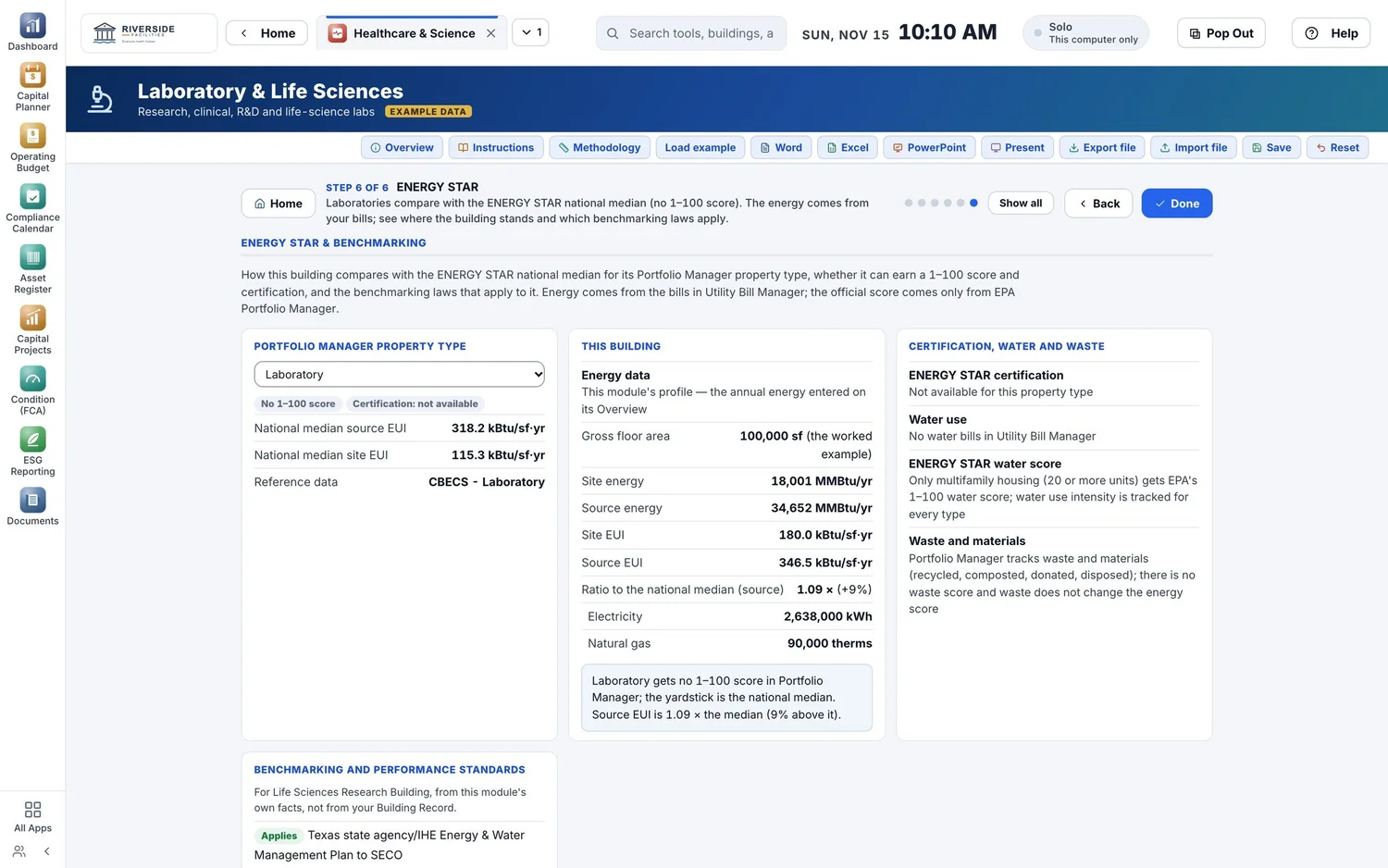
ENERGY STAR in Laboratory & Life Sciences: laboratories compare with the ENERGY STAR national median (no 1–100 score). The energy comes from your bills; see where the building stands and which benchmarking laws apply.
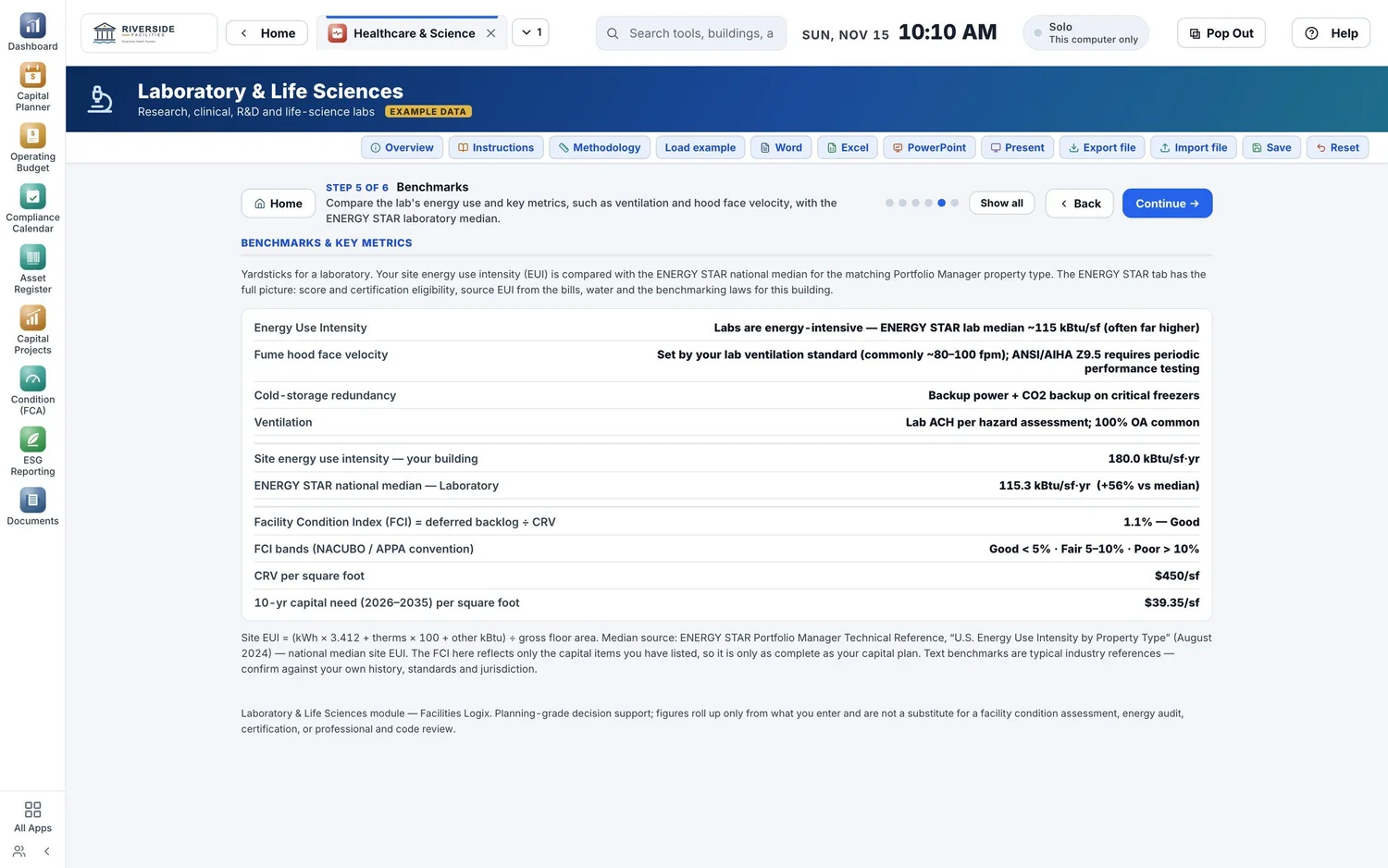
Labs use far more energy than offices, so they are compared with lab yardsticks, not general ones.
Protect People and the Research
No Lapsed Certification Stickers
Every hood and cabinet shows its next due date, so recertification is booked before it lapses.
Learn MoreShow Less
A lapsed sticker can stop work at the hood or cabinet until it is recertified, and rush visits from a certifier cost more. Due dates are calculated so the visit is booked in time.
- Next due is last certification plus 12 months unless you type another date.
- Amber at 30 days gives time to book the certifier.
- One action list covers every hood and cabinet that is overdue or due soon.
- Recertification rows also sit on the portfolio Compliance Calendar.
Containment You Can Show
Room pressure readings, excursions and the work orders that closed them are on record for the biosafety officer and the inspector.
Learn MoreShow Less
An inspection that finds no record of how a pressure problem was fixed can cost a program its standing. Every reading and fix is kept together.
- Each excursion carries its failed values, its work order and its passing re-reading.
- The monthly binder lists every room's pass or fail for the month.
- The binder exports to Word, Excel, PowerPoint, PDF and print.
- Rooms are shared with the Water Management Log and Indoor Air Quality, entered once.
Freezers Funded Before They Fail
The capital plan puts cold storage, exhaust fans and air handlers in front of leadership with their replacement years.
Learn More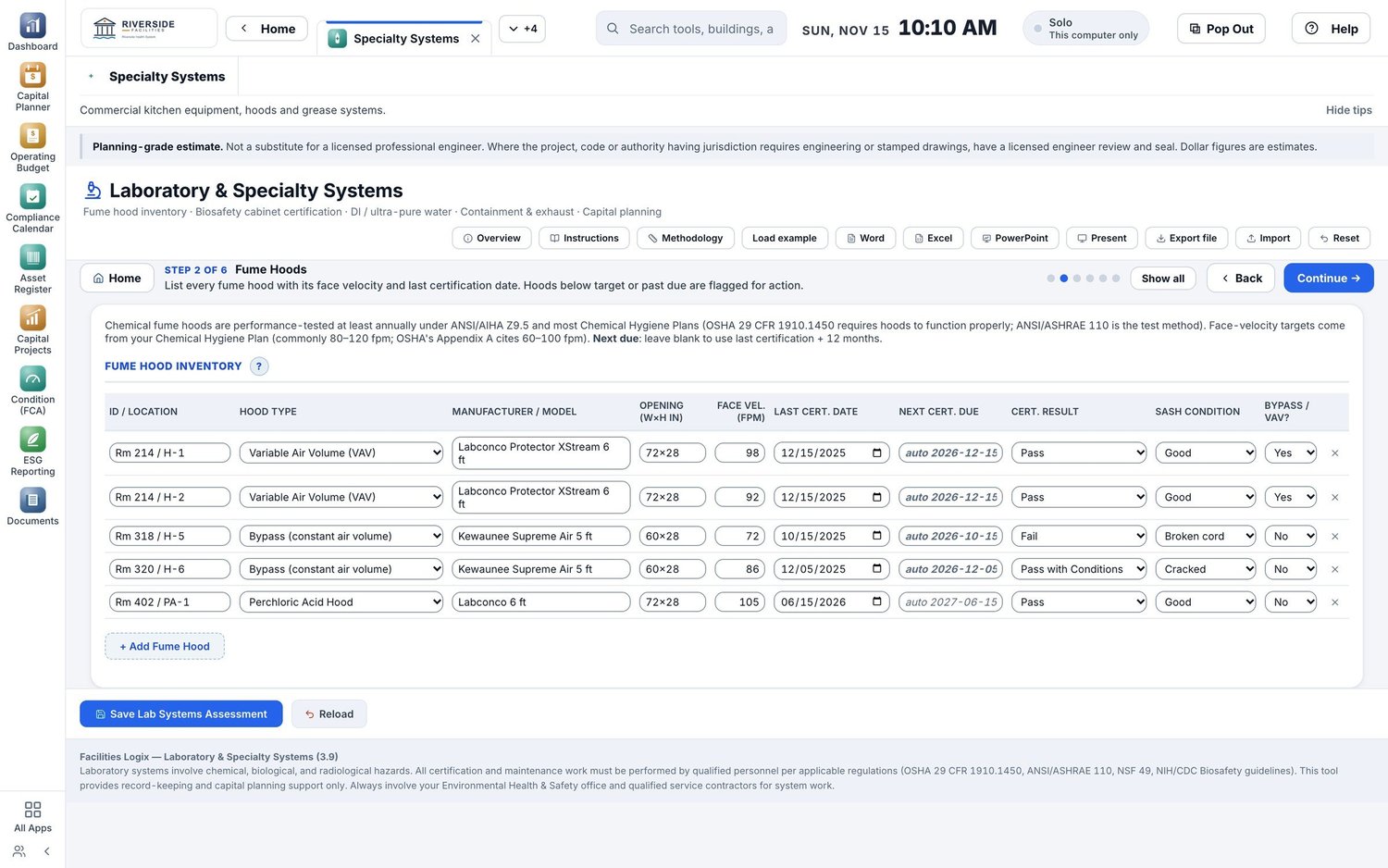
Fume Hoods in Laboratory & Specialty Systems: list every fume hood with its face velocity and last certification date. Hoods below target or past due are flagged for action.
Frequently Asked Questions
Does it set the requirements for my biosafety level?
Does it certify fume hoods or biosafety cabinets?
Can it watch negative-pressure containment rooms?
Be First When Facilities Logix Opens
Stop chasing building records across spreadsheets and binders. Join the list and we will tell you the day downloads open, with setup guides ready.
Launching early 2027 for Facilities Logix. Nothing to buy today, and no sales calls.
