
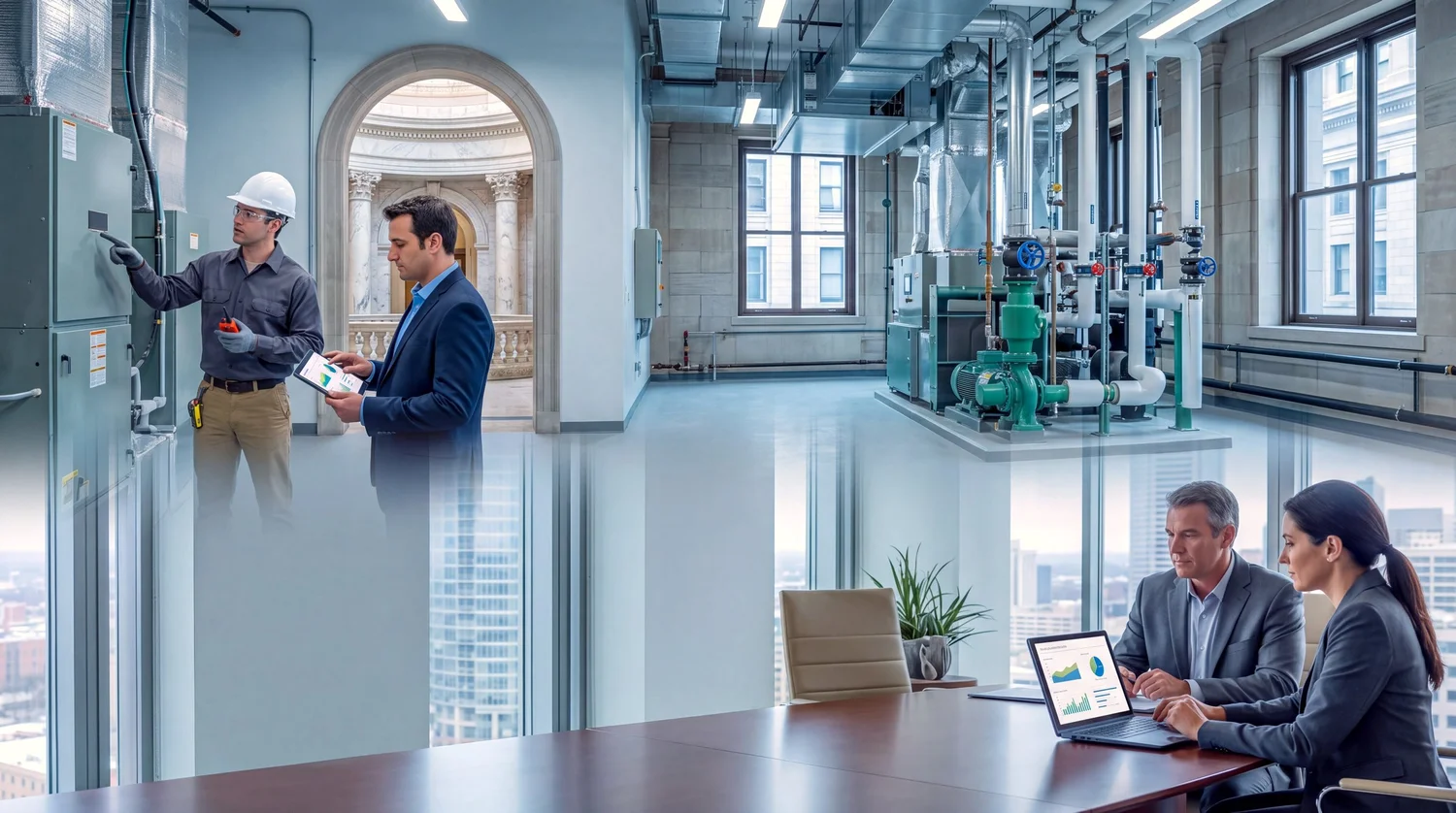

Security Buildings First: Courthouses, Jails and Prisons.
Launching Early 2027 · Join the Early-Access List
A courthouse keeps three circulation paths apart, screens every public entry and protects a record that cannot fail. A jail or prison runs every hour of the year, and in it door control, standby power and life safety are matters of custody and safety. Facilities Logix has a playbook for each, and a federal courthouse type that swaps in the federal design, security and accessibility rules.
Court and Detention Rules, with Their Dates
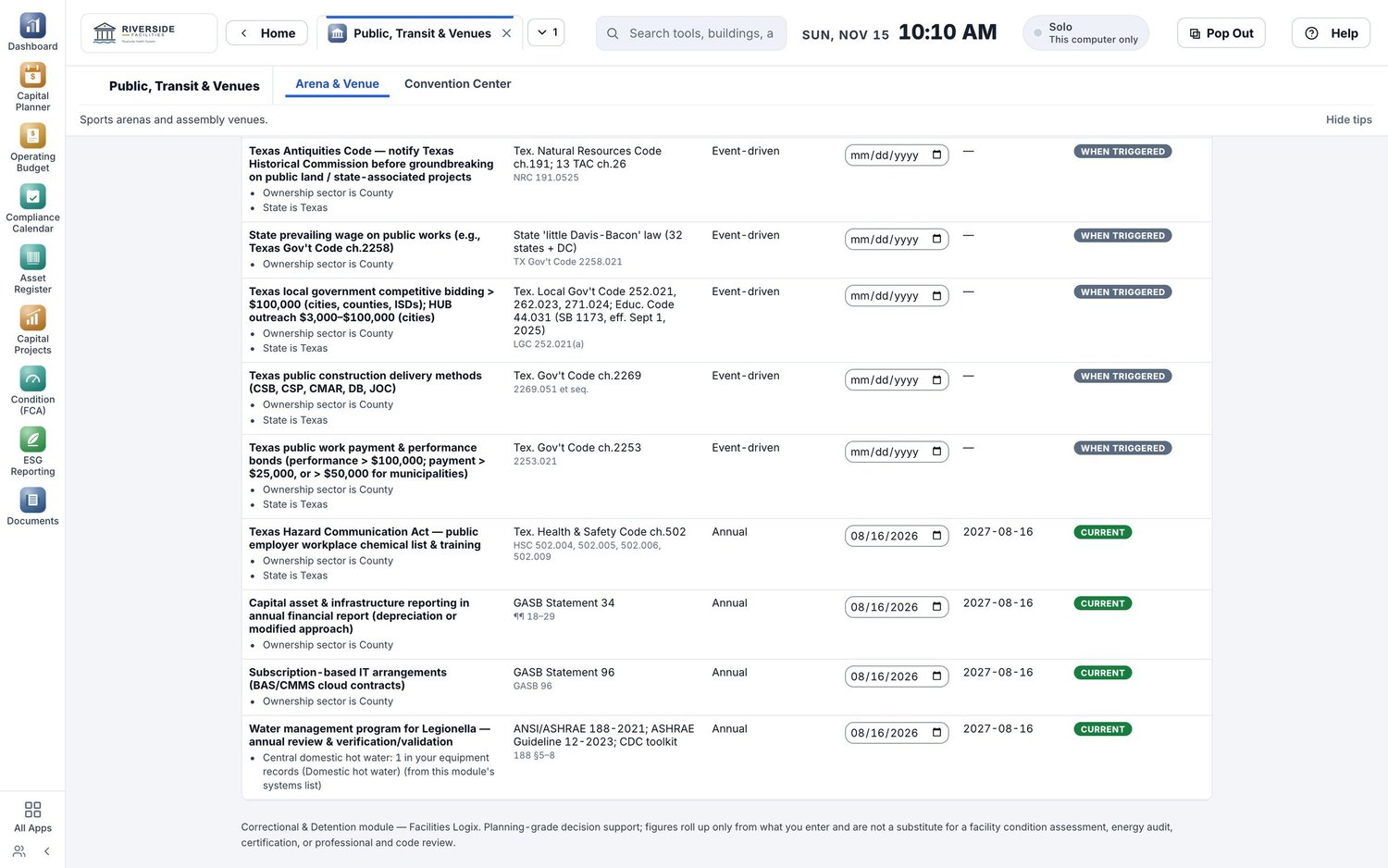
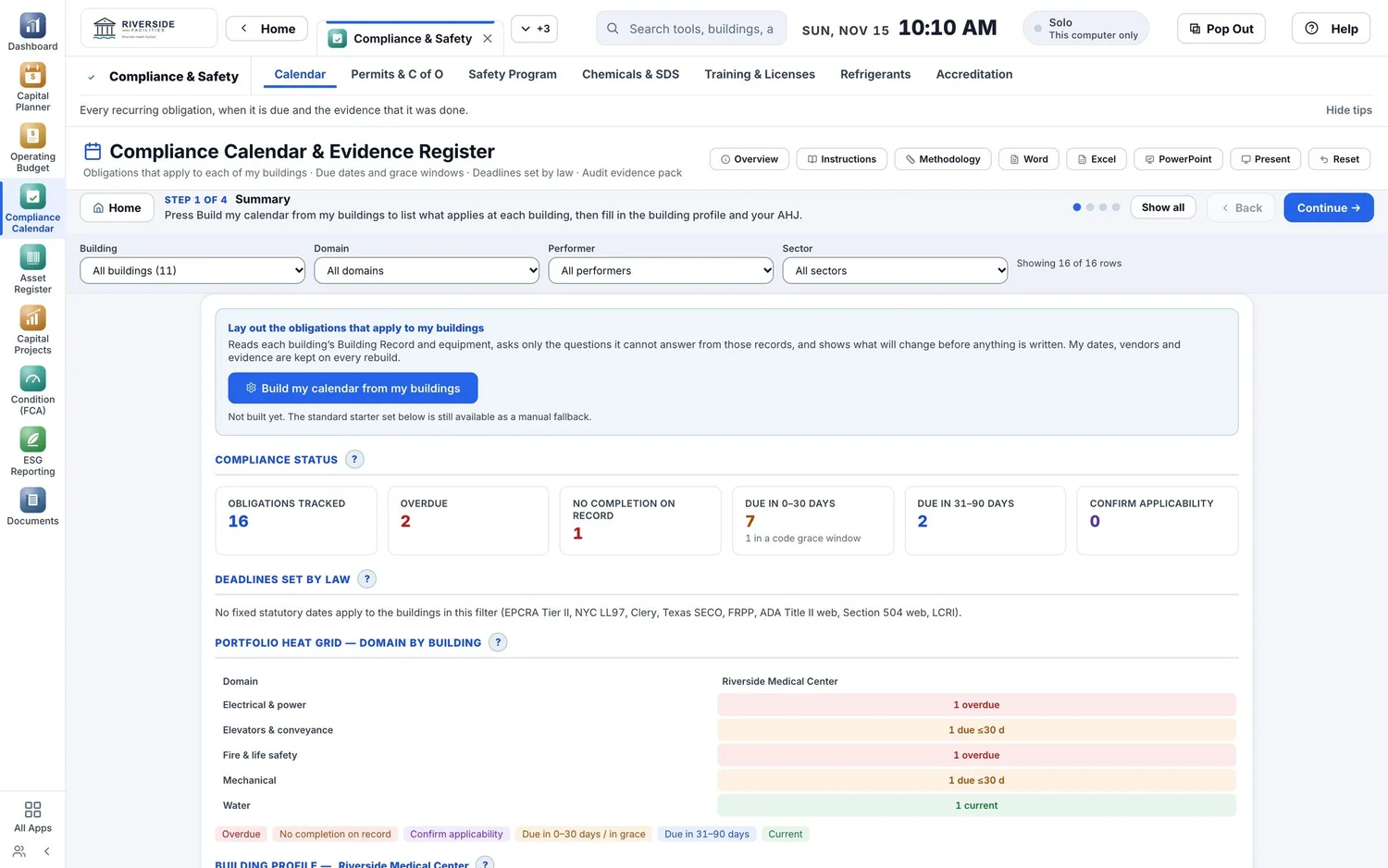
Each playbook's Compliance tab lists the obligations from the compliance library that apply to the building, with the same dates as the Compliance Calendar.
Federal Courthouses
- Set the Type to Federal Courthouse (GSA / U.S. Courts), and the Compliance tab shows the federal rules in place of the state and local ones
- The U.S. Courts Design Guide for new courthouses, annexes, new leased court space and repair and alteration projects that configure court space
- The GSA PBS Core Building Standards and their court specialty-space standards on GSA-owned and lease-construction projects
- The 500-year floodplain review, because a U.S. court is a critical action facility
- The ABA Accessibility Standards (ABAAS) for courthouses and courtrooms
- The security split: the U.S. Marshals Service inside (28 USC 566) and the Federal Protective Service at the perimeter (40 USC 1315)
- The annual court security systems resource request
- The Facility Security Committee's meetings at least twice a year, and its response within 90 days to each Federal Protective Service recommendation
- Where GSA owns the courthouse, GSA's own duties appear under GSA
State, County and Municipal Courts
- ADA Title II for public entities: the self-evaluation, and the transition plan for structural changes where there are 50 or more employees
- Business-occupancy egress drills where the building holds more than 500 occupants
- Detention drills each shift where the courthouse holds people in custody
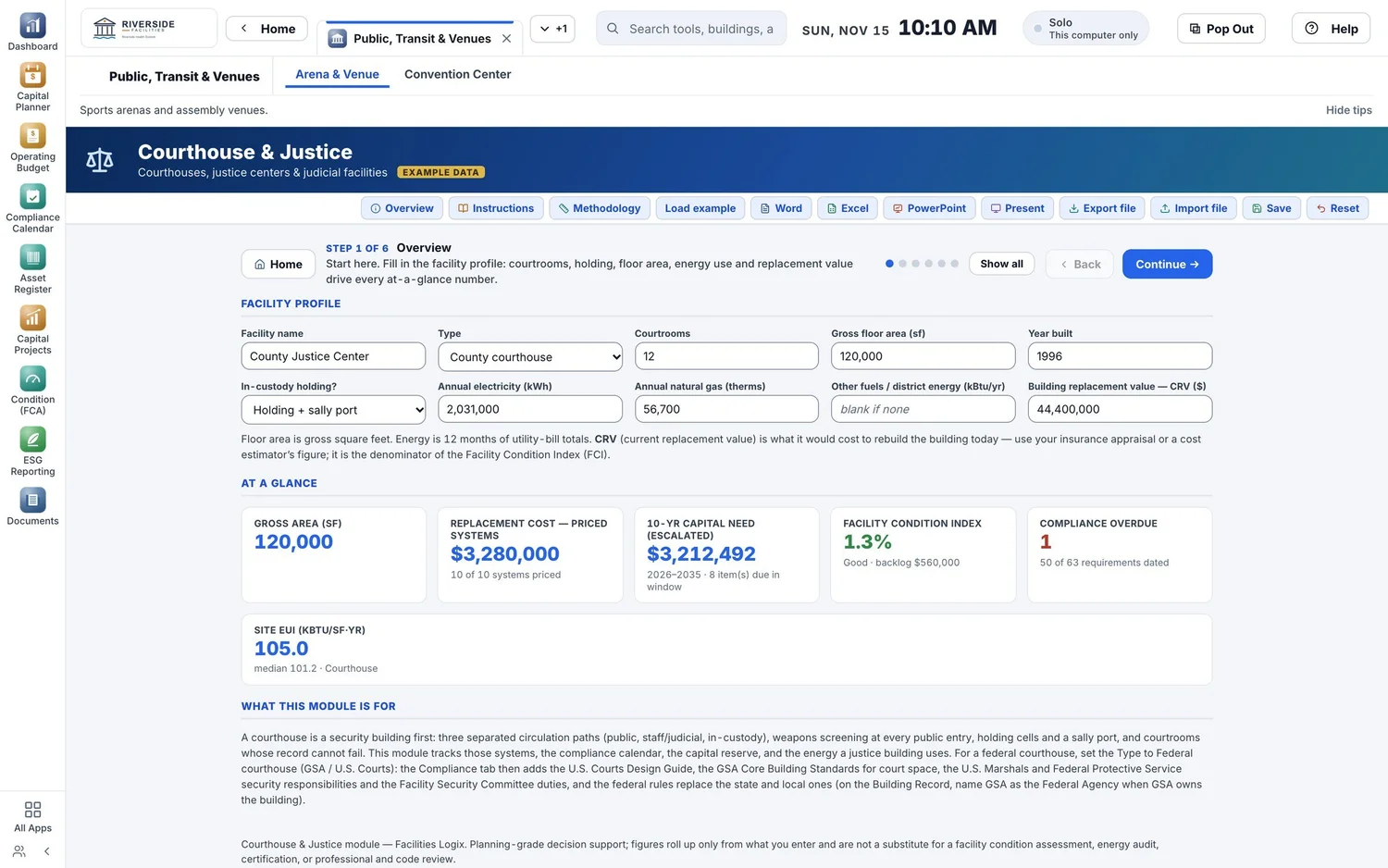
Overview in Courthouse & Justice: start here. Fill in the facility profile: courtrooms, holding, floor area, energy use and replacement value drive every at-a-glance number.
Correctional and Detention Facilities
- Fire drills for detention and correctional occupancies quarterly on each shift, with a written evacuation plan (IFC Group I-3, NFPA 101 Chapters 22 and 23)
- Prison Rape Elimination Act (PREA) audit: every facility at least once in each 3-year audit cycle (28 CFR 115.401)
- Voluntary American Correctional Association (ACA) or National Commission on Correctional Health Care (NCCHC) accreditation, with reaccreditation about every 3 years
- In Texas, the Commission on Jail Standards' annual, mostly unannounced jail inspection
- Bloodborne pathogens exposure control plan reviewed every year where the OSHA standard covers the facility
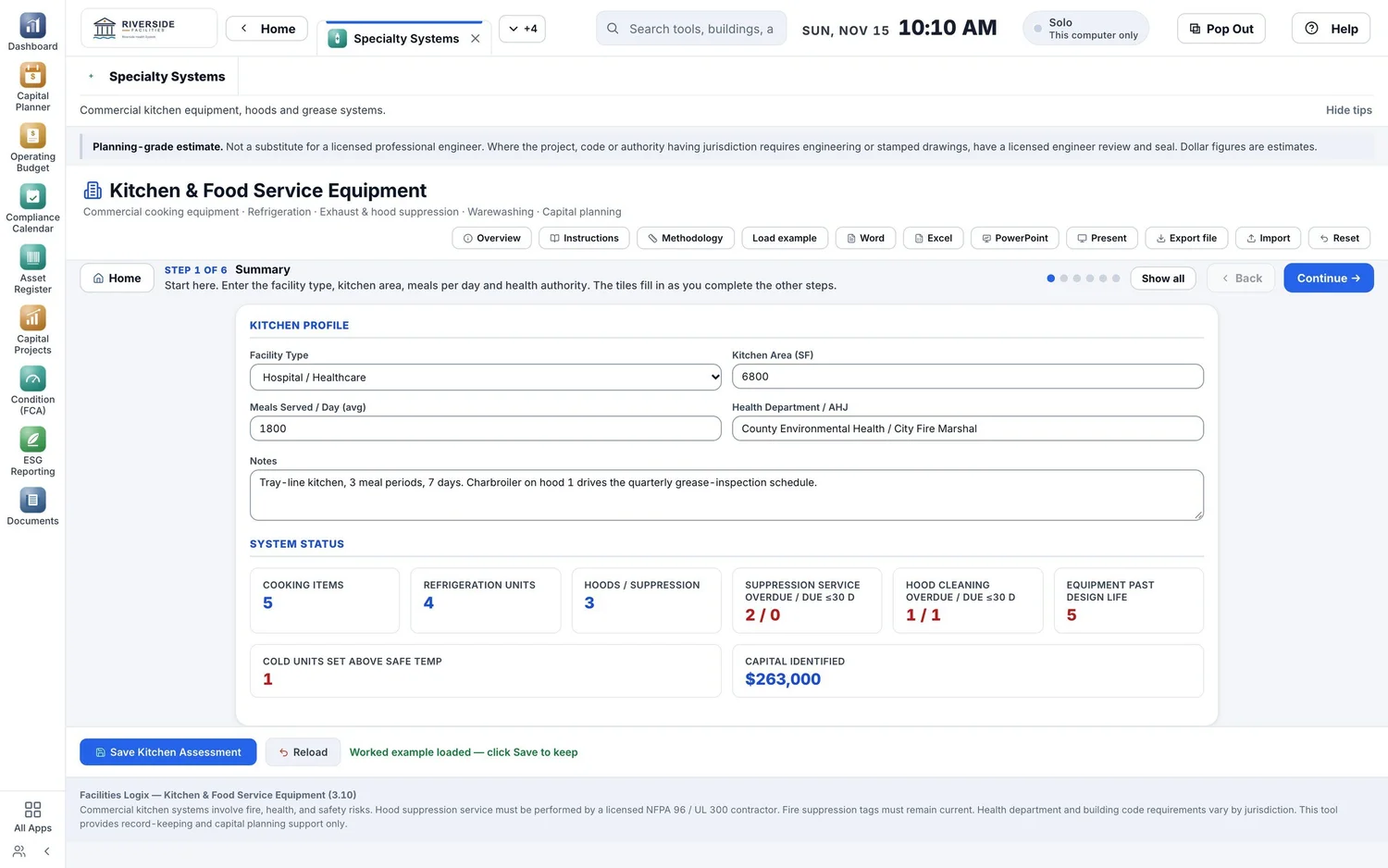
- Commercial kitchen rows: a food protection manager on staff and the health inspection
Systems Every Building Has
- Generator weekly inspection and monthly load test (NFPA 110), fire alarm testing (NFPA 72), sprinkler testing (NFPA 25) and elevator inspections
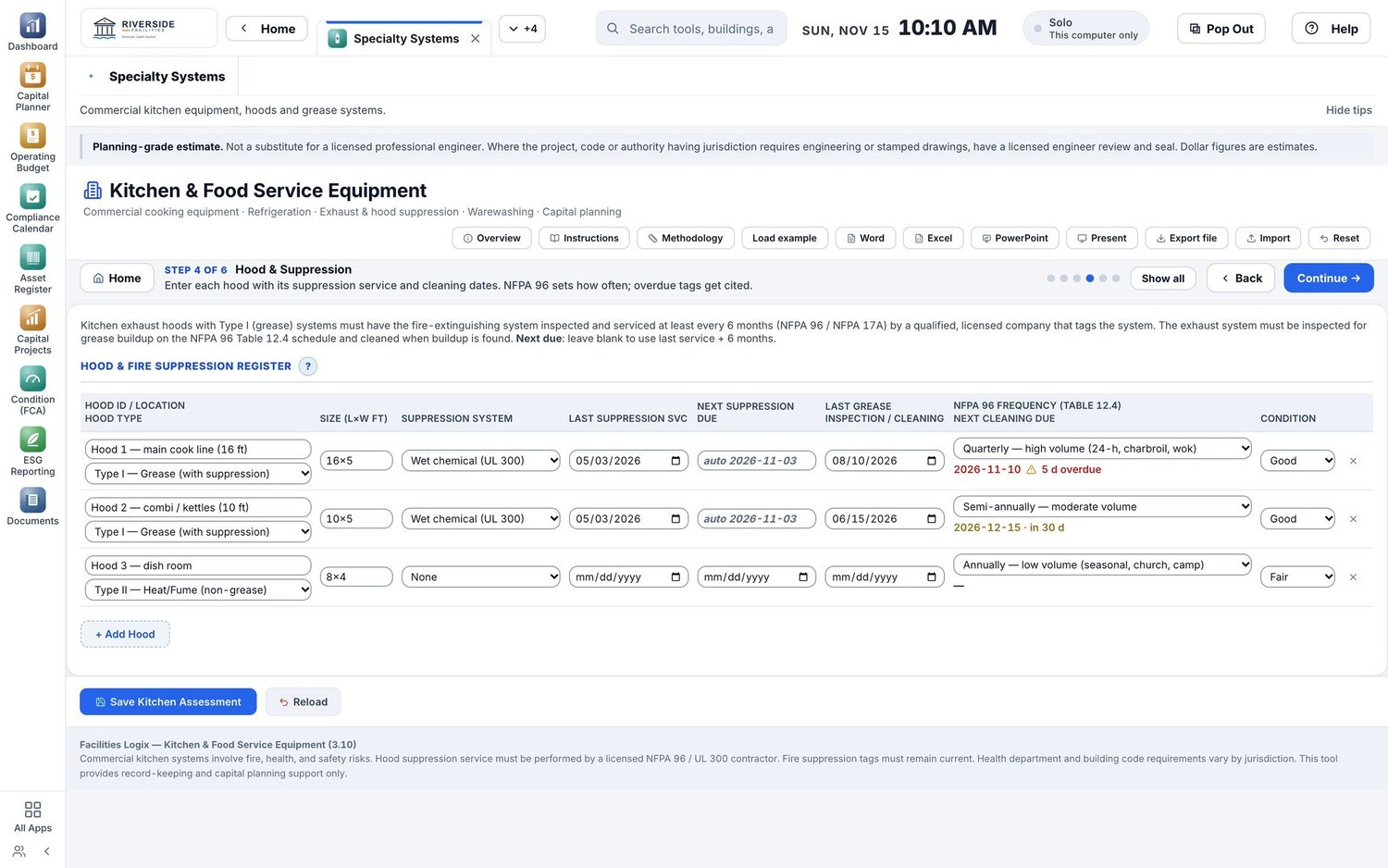
- Kitchen hood suppression service and exhaust cleaning where a kitchen is on record
- Each appears only when your equipment records show the equipment
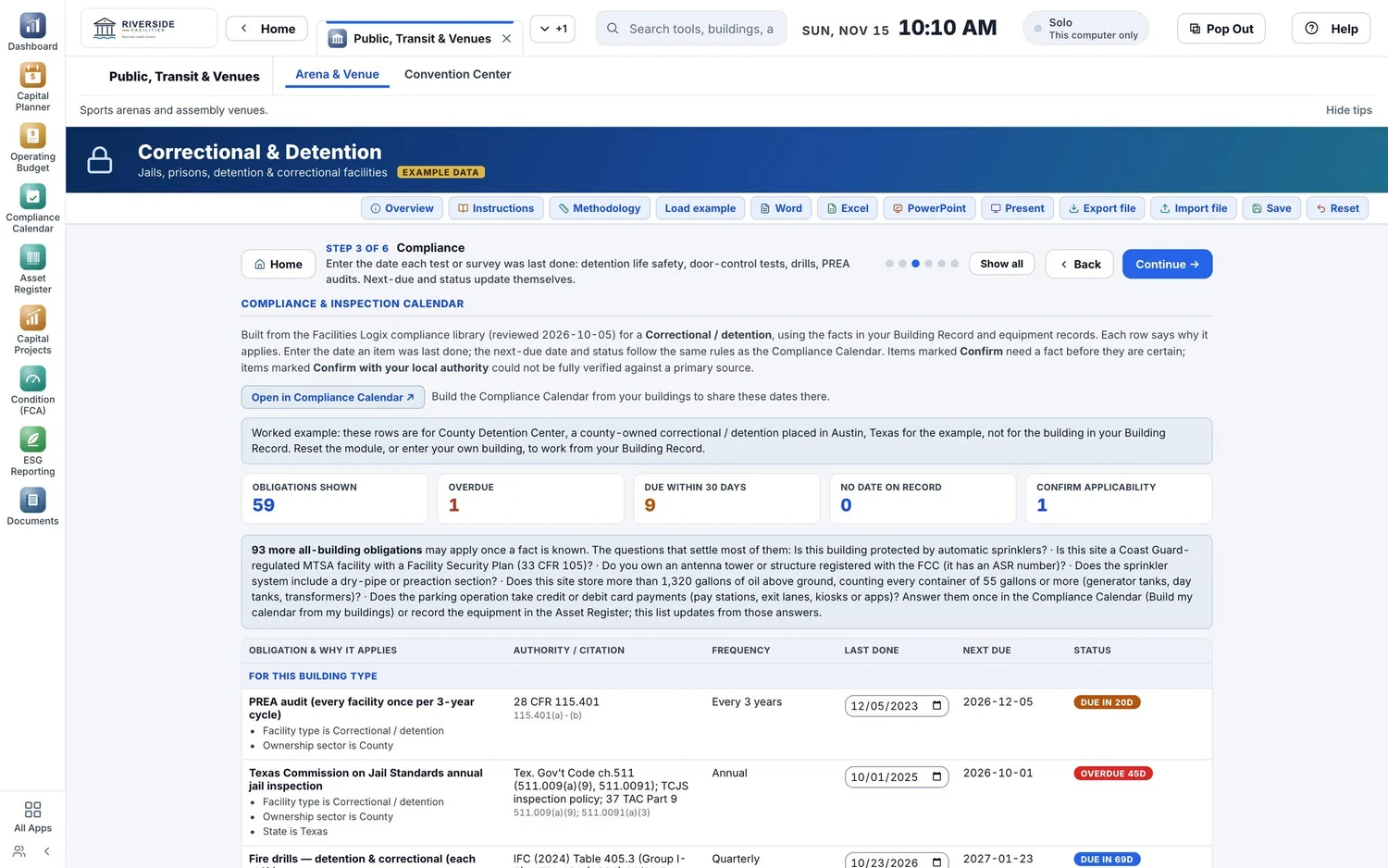
Compliance in Correctional & Detention: enter the date each test or survey was last done: detention life safety, door-control tests, drills, PREA audits. Next-due and status update themselves.
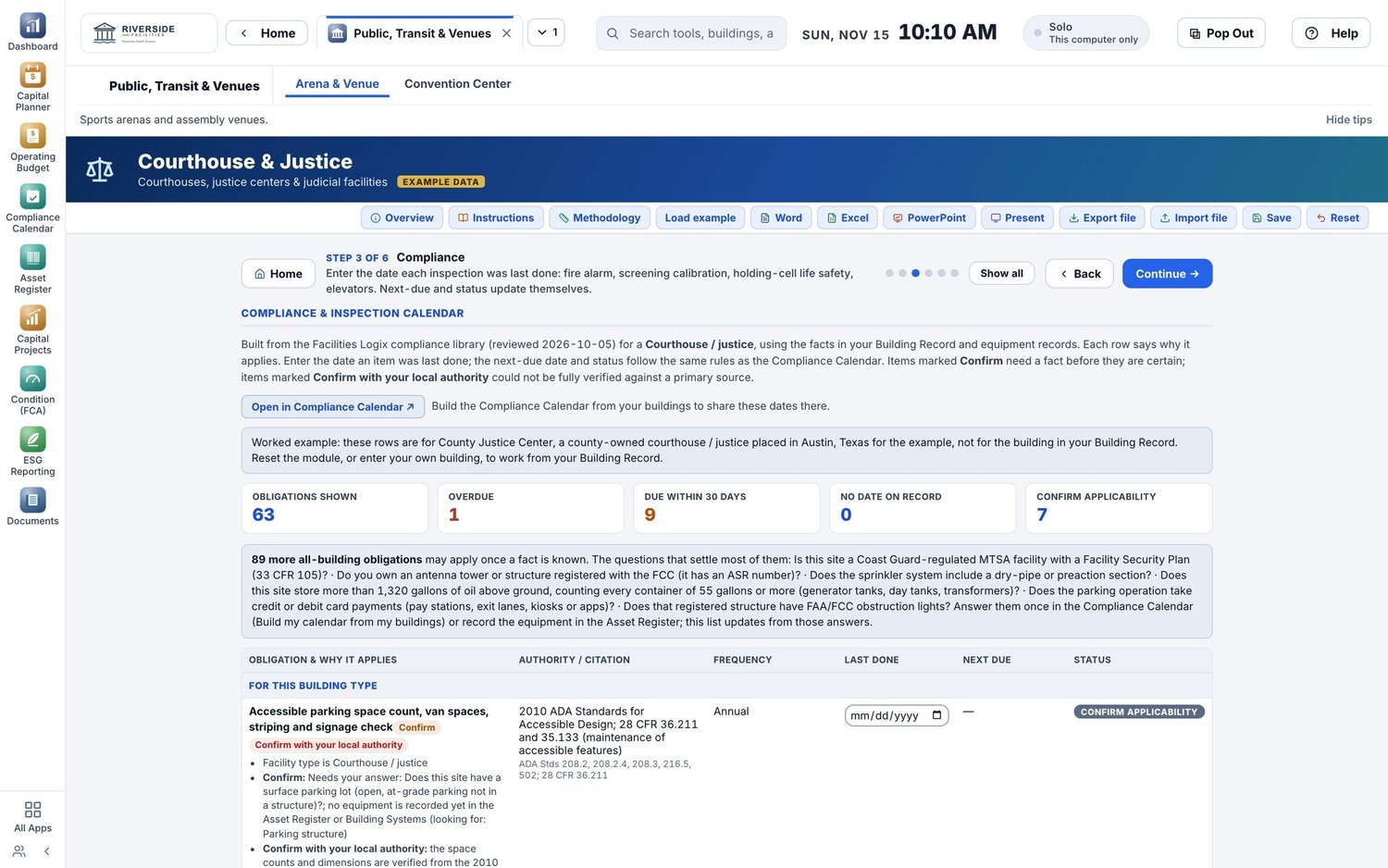
Court and detention rules come from many authorities, so each obligation is listed with its citation and next date.
Two Playbooks, One for Each Kind of Justice Building
Courthouse Systems
- Security screening with magnetometers and X-ray at every public entry, quarterly, Critical
- Access control and secure circulation keeping public, judicial and detainee paths apart, quarterly, Critical
- Holding cells and sally port, quarterly
- Courtroom AV and recording, semiannual, because the record cannot fail
- HVAC, emergency generator (monthly, Critical), fire alarm and sprinkler, public, secure and service elevators, data and records systems, roofing and envelope
Courthouse Profile
- Type: county courthouse, state court, federal courthouse (GSA / U.S. Courts), municipal court, or justice center with courts and detention
- In-custody holding: none, holding cells, or holding cells with a sally port
- Capital lines for screening equipment, access control, courtroom AV, HVAC, elevators, generator, roof and fire and life safety systems
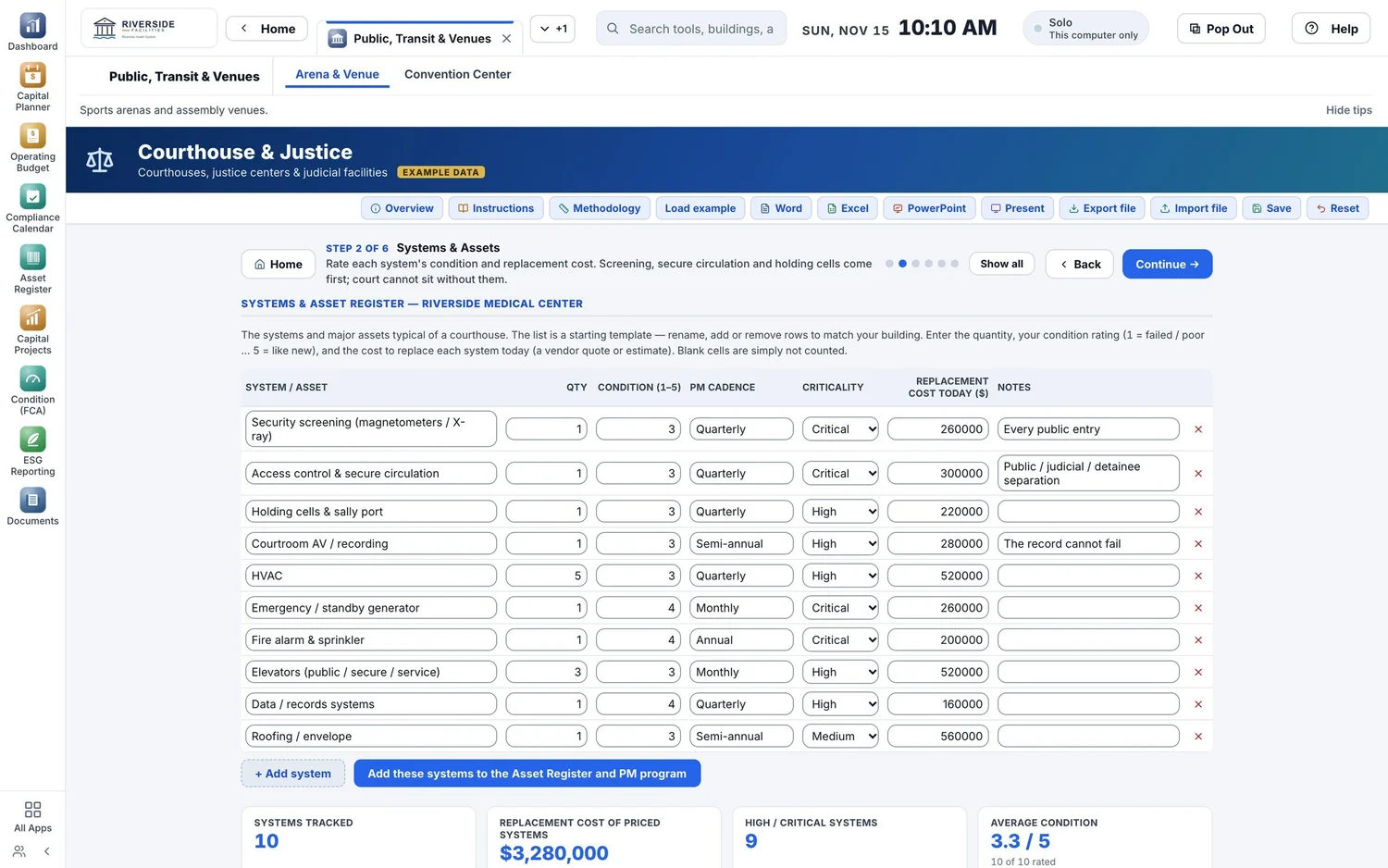
Systems & Assets in Courthouse & Justice: rate each system's condition and replacement cost. Screening, secure circulation and holding cells come first; court cannot sit without them.
Correctional Systems
- Security electronics (locks, CCTV, intercom) and central control or PLC door control, quarterly, Critical
- Perimeter security with fence and detection, quarterly, Critical
- Emergency and standby generator, monthly, Critical, for life safety and security
- Detention-rated fire alarm and suppression, annual, Critical
- Secure 24/7 HVAC, commercial kitchen and hood, commercial laundry, domestic hot water, medical and infirmary systems, secure plumbing fixtures and elevators
Correctional Profile
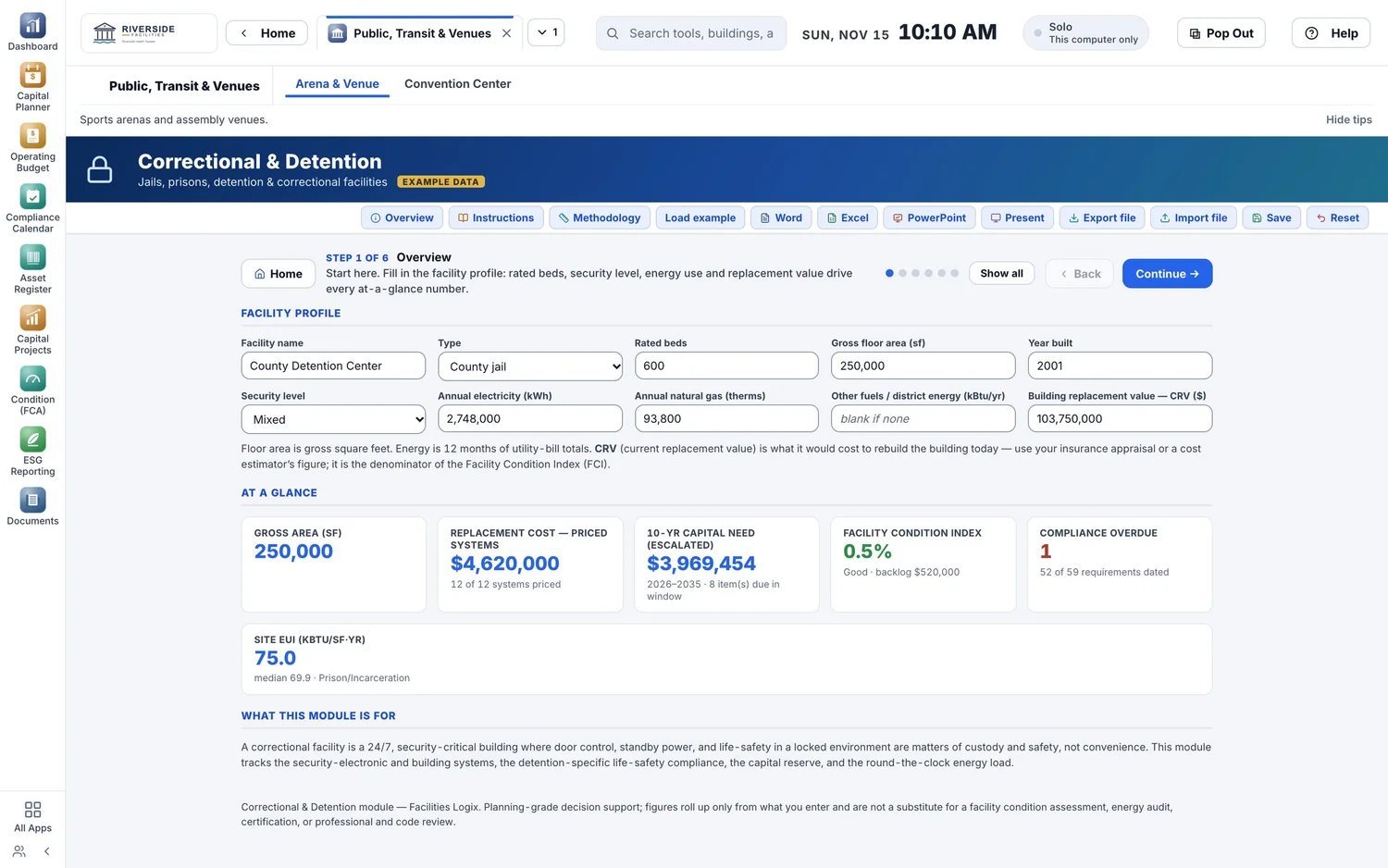
- Type: county jail, state prison, federal facility, detention center, juvenile facility or work-release and minimum
- Security level: minimum, medium, maximum or mixed
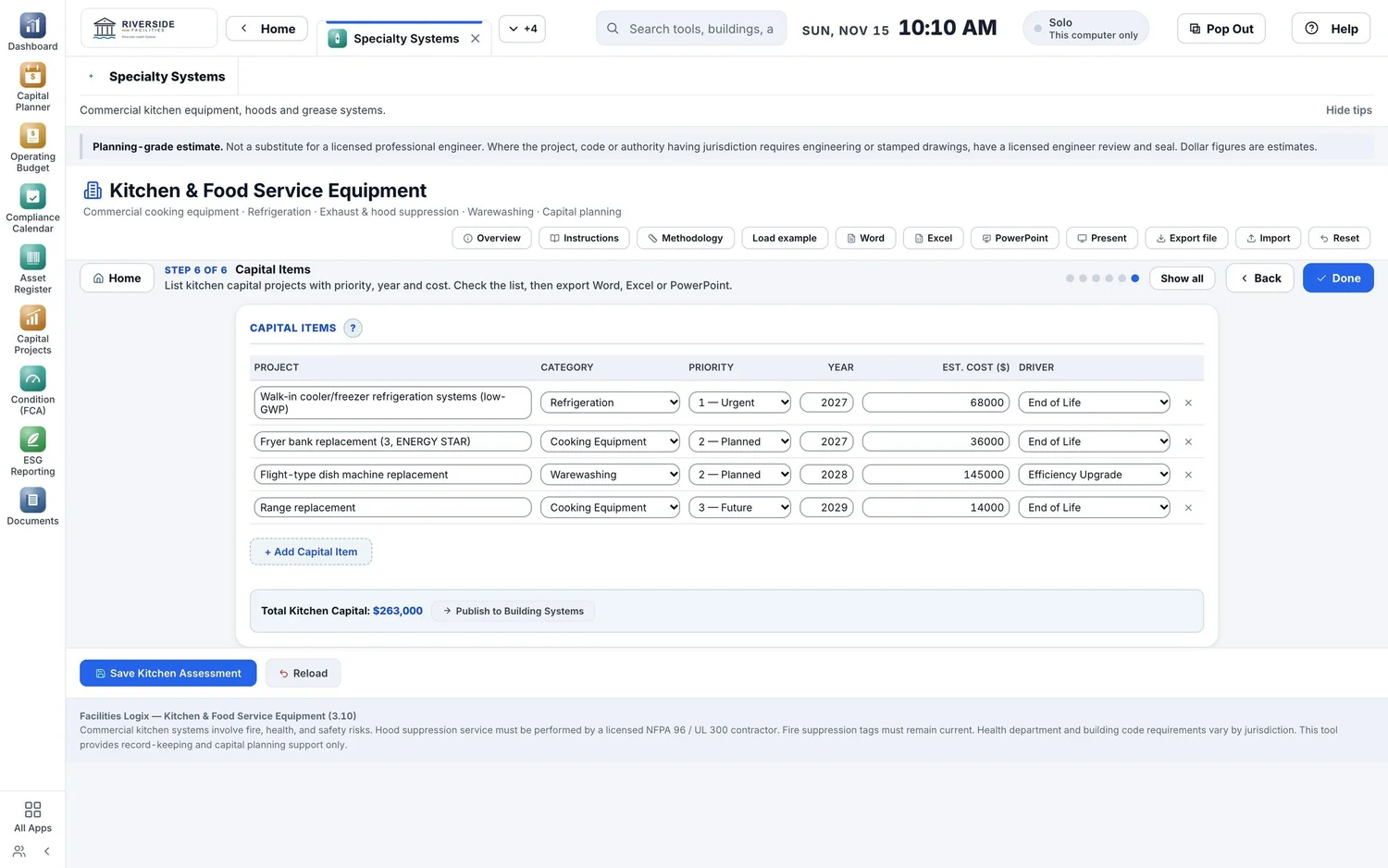
- Capital lines for security electronics and locking, central door control, HVAC, generators, perimeter security, kitchen equipment, fire and life safety, roof and elevators
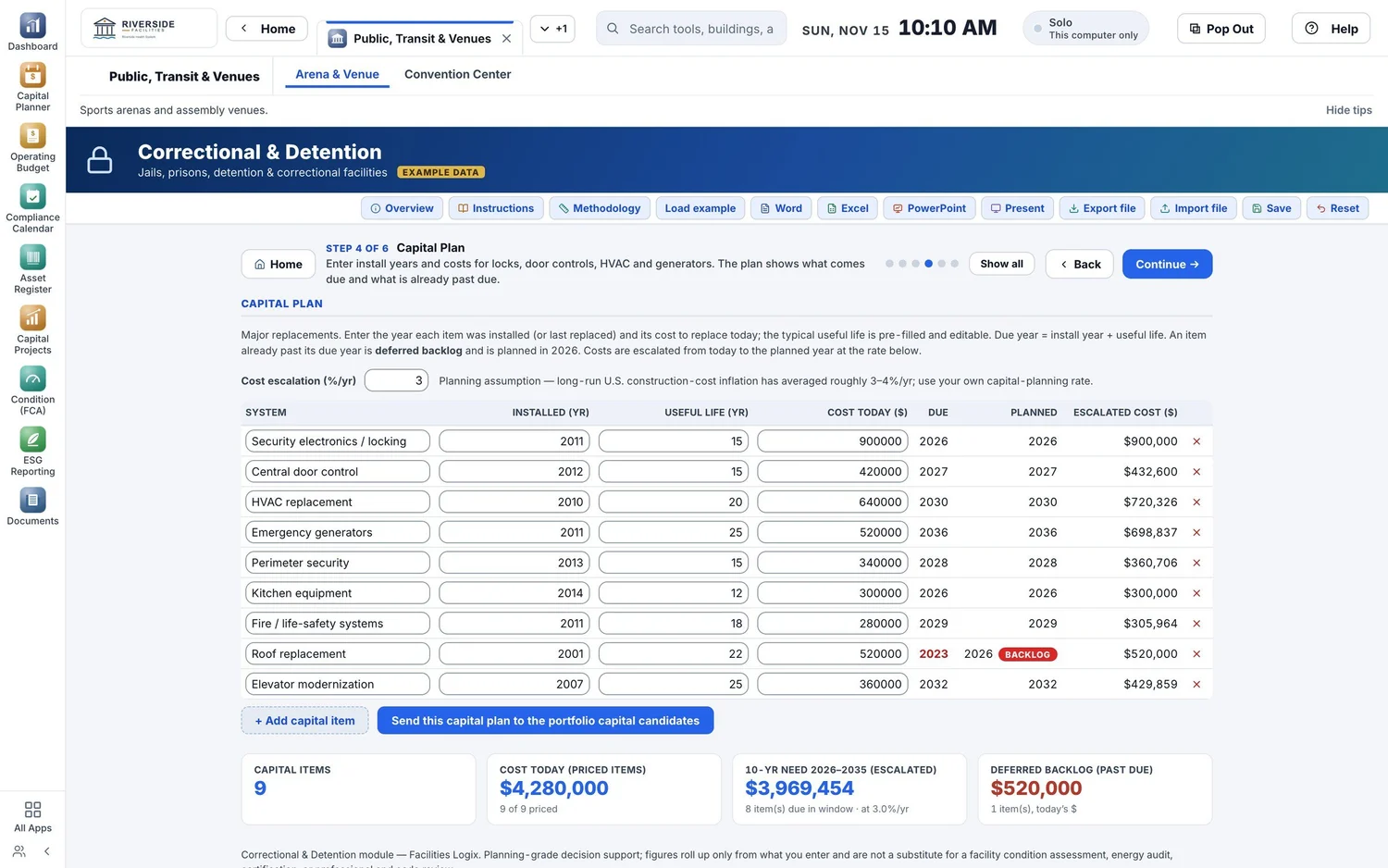
Capital Plan in Correctional & Detention: enter install years and costs for locks, door controls, HVAC and generators. The plan shows what comes due and what is already past due.
A Starting List Your Team Shapes
Systems with PM Cadence
Each system starts with its PM cadence and criticality. Quantities, condition and dates start blank, and your team adds, removes and renames to fit the building.
Learn MoreShow Less
Maintenance hours go furthest on the systems whose failure stops court or breaks custody, so every starting row carries a criticality rating beside its PM interval. Rate condition and enter replacement cost, and the backlog and capital plan follow from it.
- Courthouse: 10 starting systems, from screening and secure circulation to courtroom AV and the envelope
- Correctional: 12 starting systems, including PLC door control, perimeter detection and commercial laundry
- Intervals run from monthly (generators, elevators) to annual (detention-rated fire alarm)
- Critical, High and Medium ratings put scarce PM time where the risk is highest
Compliance Tab
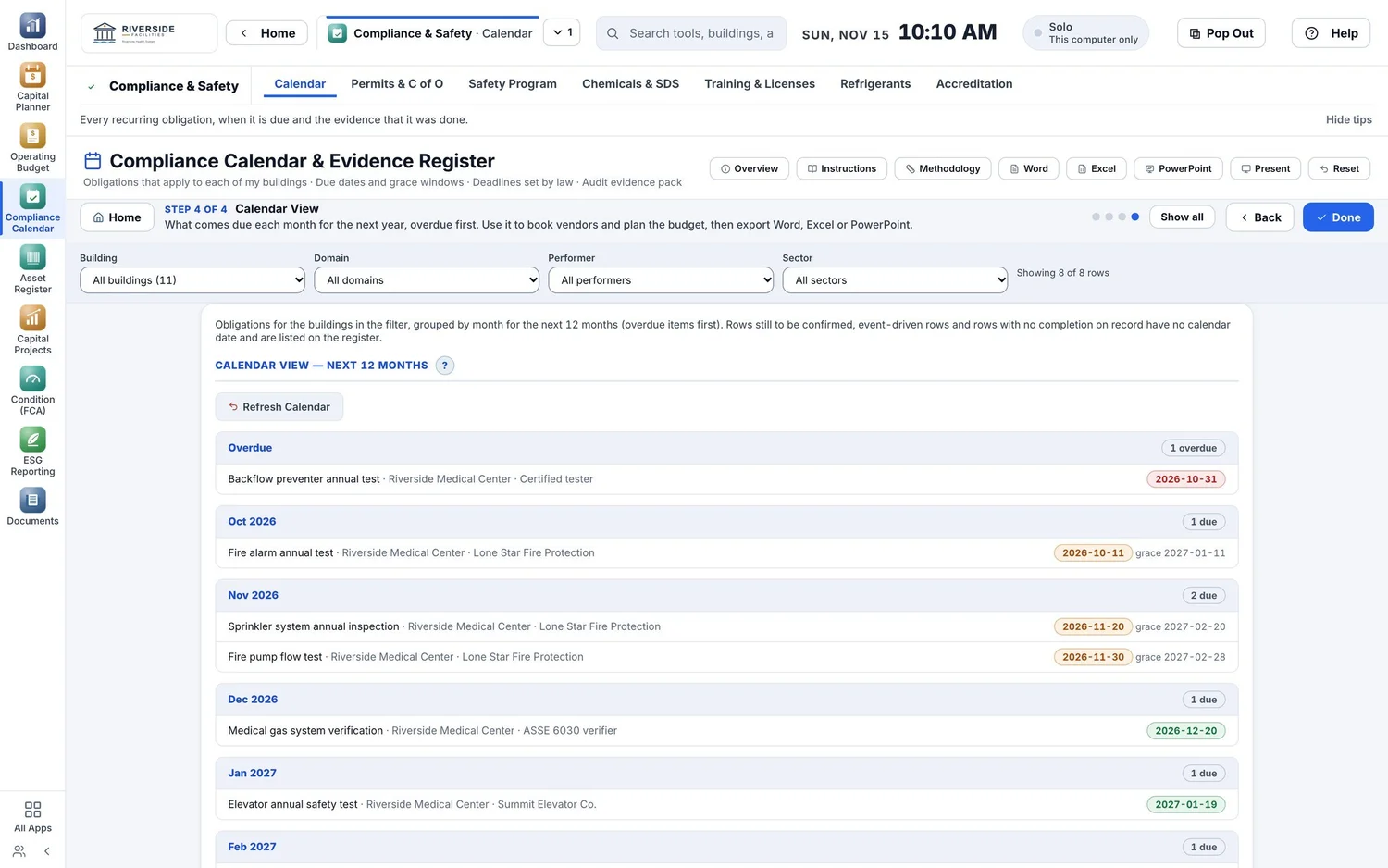
Enter the date each obligation was last done. The next due date, the grace window and the status come from the same rules as the Compliance Calendar, so the two never disagree.
Learn More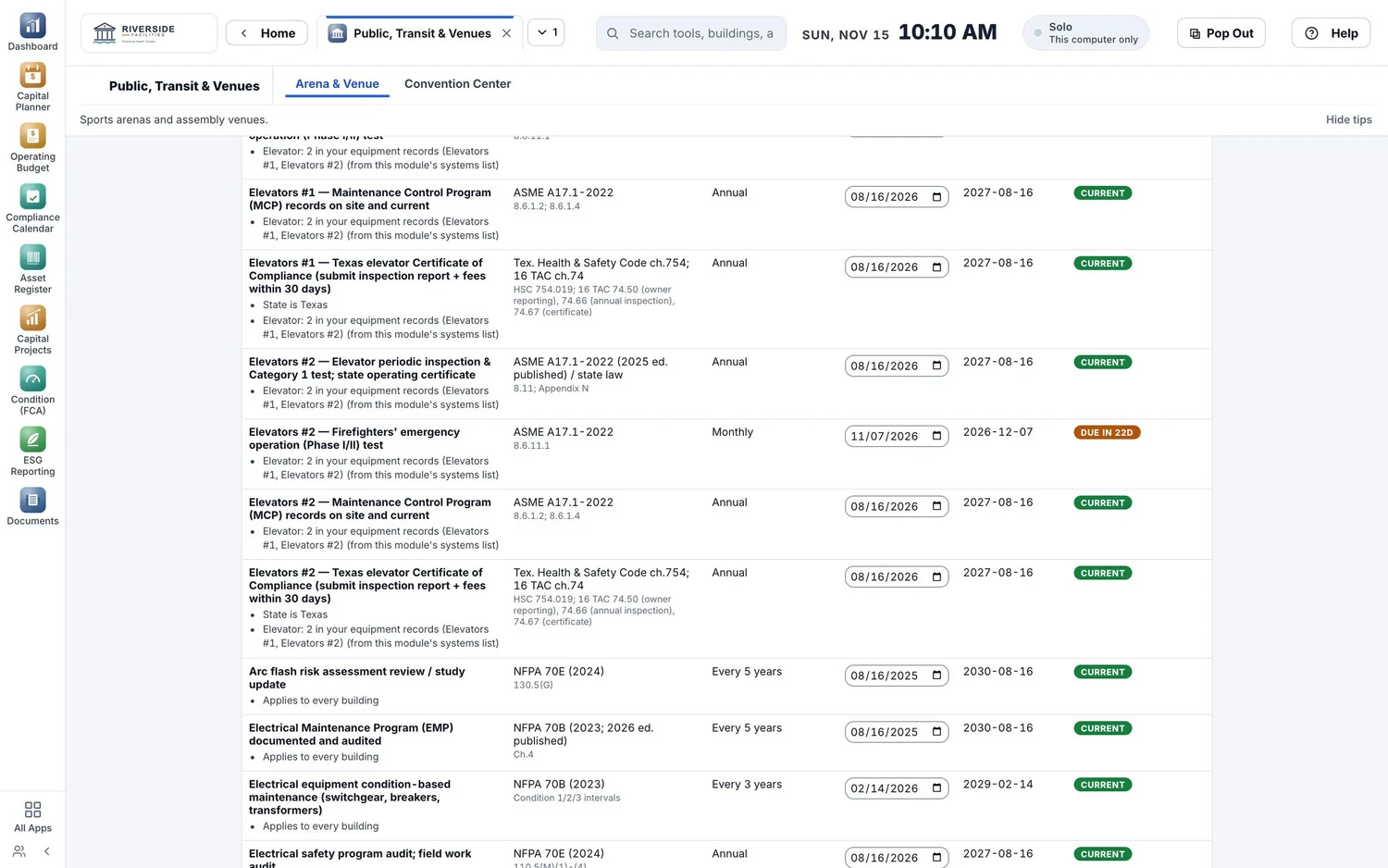
Compliance in Correctional & Detention: enter the date each test or survey was last done: detention life safety, door-control tests, drills, PREA audits. Next-due and status update themselves.
Field Rounds and Work Orders
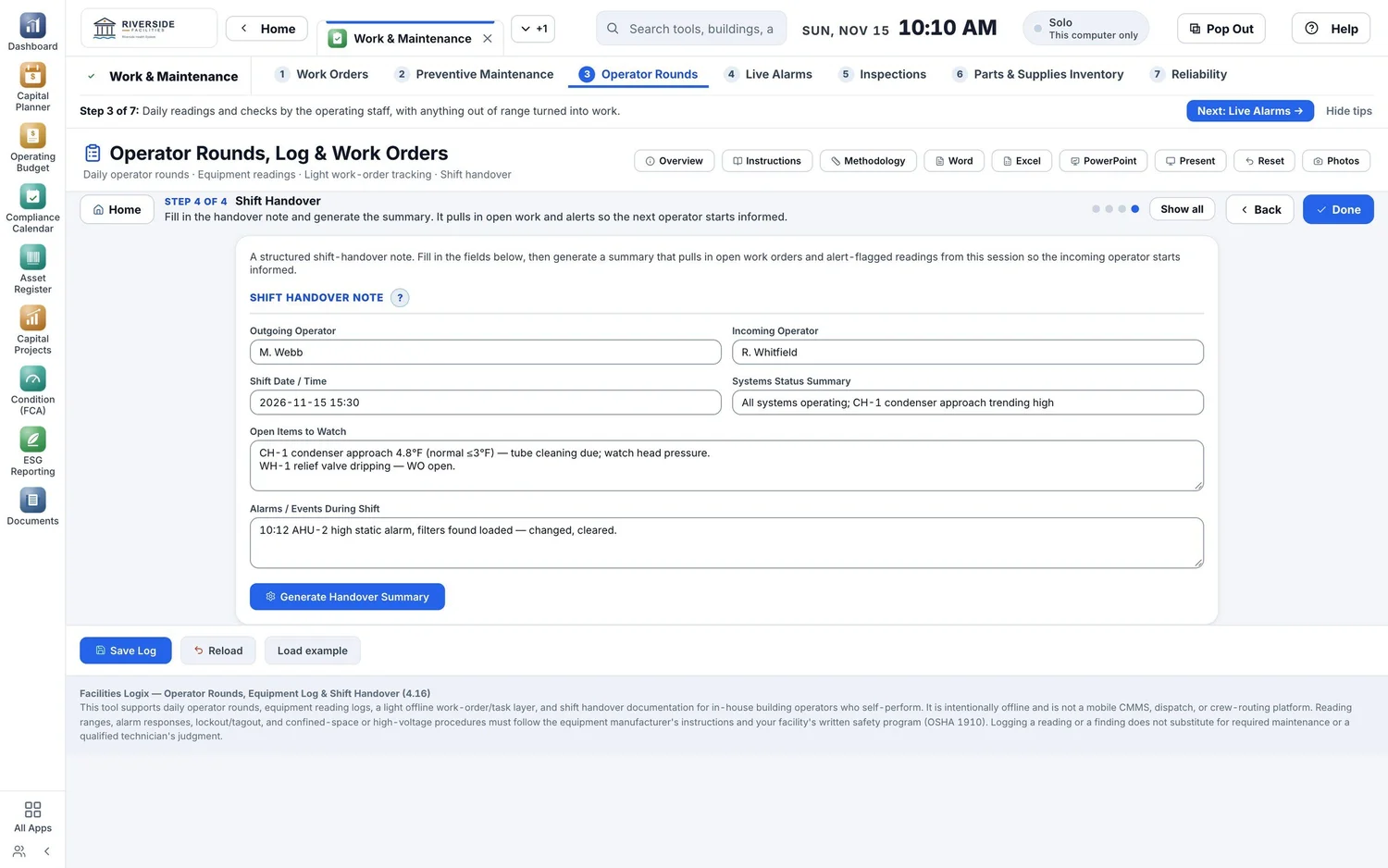
The same work orders and Field rounds every building uses reach the screening lanes, door control panels and generators.
Learn More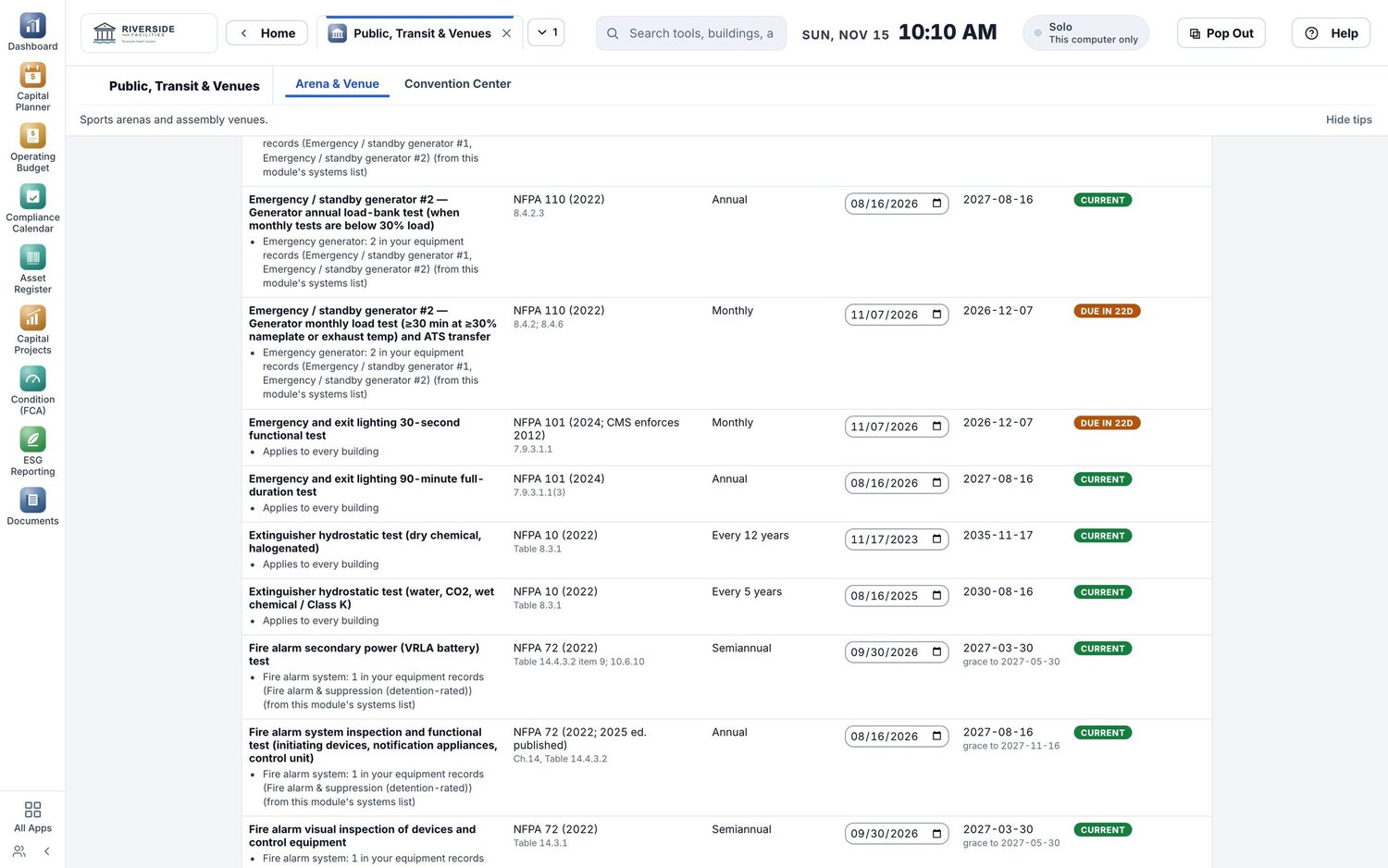
Compliance in Correctional & Detention: enter the date each test or survey was last done: detention life safety, door-control tests, drills, PREA audits. Next-due and status update themselves.
Compliance in Correctional & Detention: enter the date each test or survey was last done: detention life safety, door-control tests, drills, PREA audits. Next-due and status update themselves.
Ready for the Audit and the Judges' Questions
Word, Excel, PowerPoint and Present
Systems, obligations with their status, the capital reserve and the benchmarks in one report.
Learn MoreShow Less
A courthouse or jail budget request is easier to approve when the cost of waiting is on the page. The report opens with a decision summary and key figures, then shows the escalated capital need by year and the deferred backlog by system, all from the building's own numbers.
- Charts: capital need by year, deferred backlog by system and compliance status
- Sections: systems register, capital plan, compliance calendar and benchmarks
- Escalation and FCI formulas printed in the methodology for finance staff
- Output from the worked example carries a SAMPLE watermark
ENERGY STAR
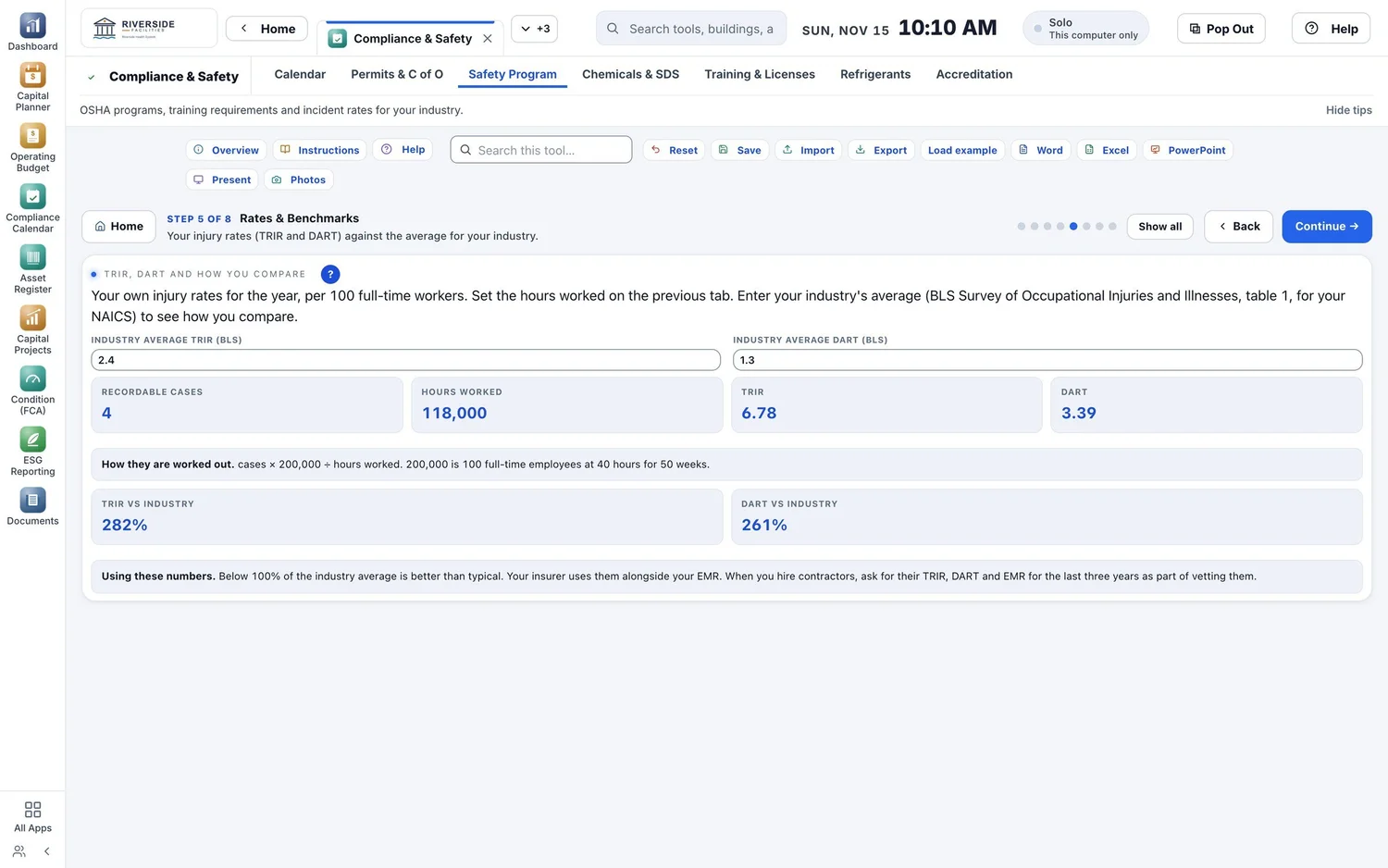
Courthouses compare with the ENERGY STAR courthouse median (about 101 kBtu/sf site) and prisons with the prison median (about 70 kBtu/sf site), using energy from your bills.
Learn MoreShow Less
A justice building runs long hours, so energy is a budget line worth watching. The tab turns your utility bills into site and source EUI and shows how far each building sits from its national median, so efficiency money goes where the gap is largest.
- Courthouse: 1-100 score and certification available in Portfolio Manager; source median 211.4 kBtu/sf
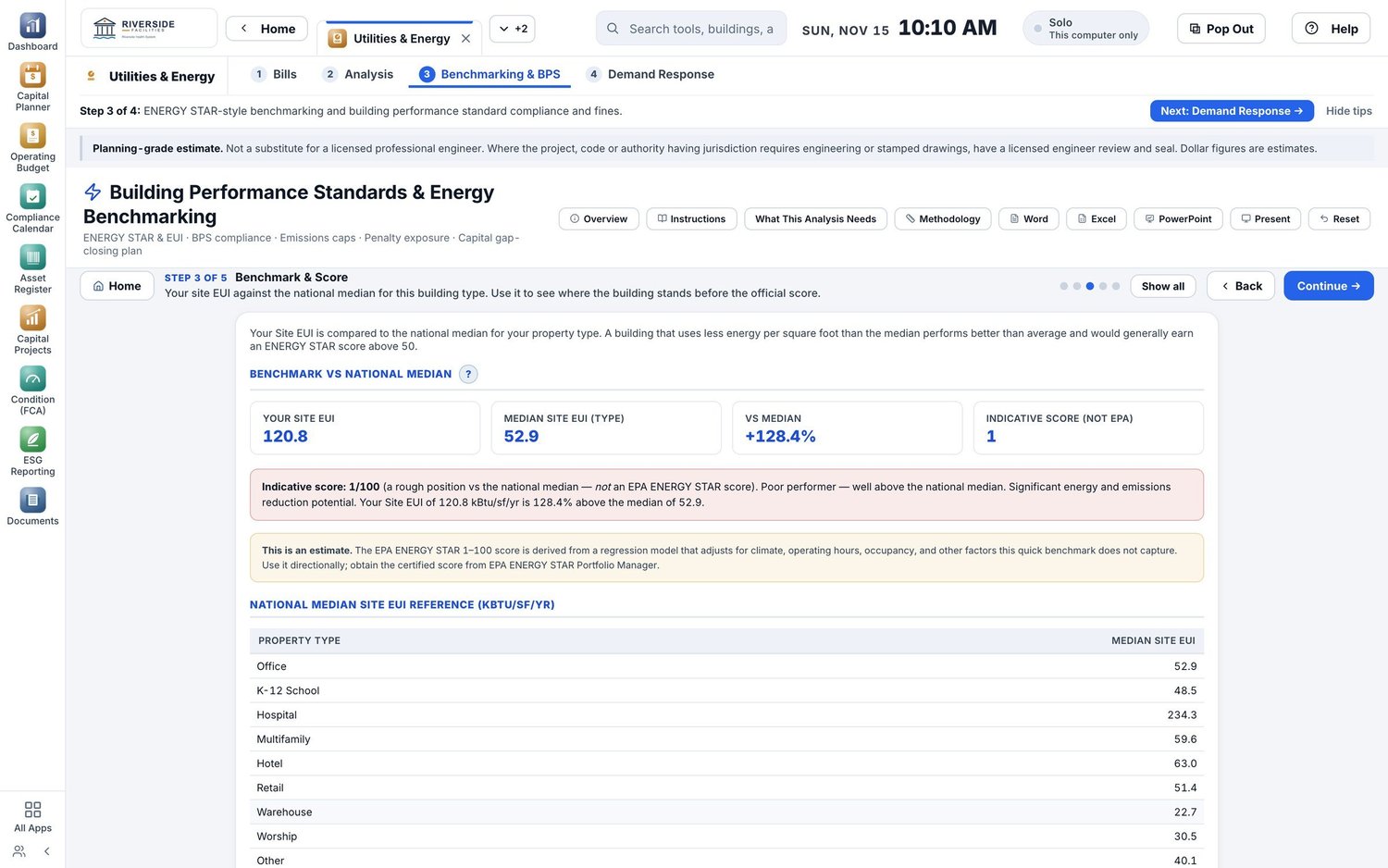
- Prison/Incarceration: no score or certification; source median 156.4 kBtu/sf
- A justice center with courts and detention compares as a Courthouse
- Benchmarking and performance-standard laws that reach the building are listed
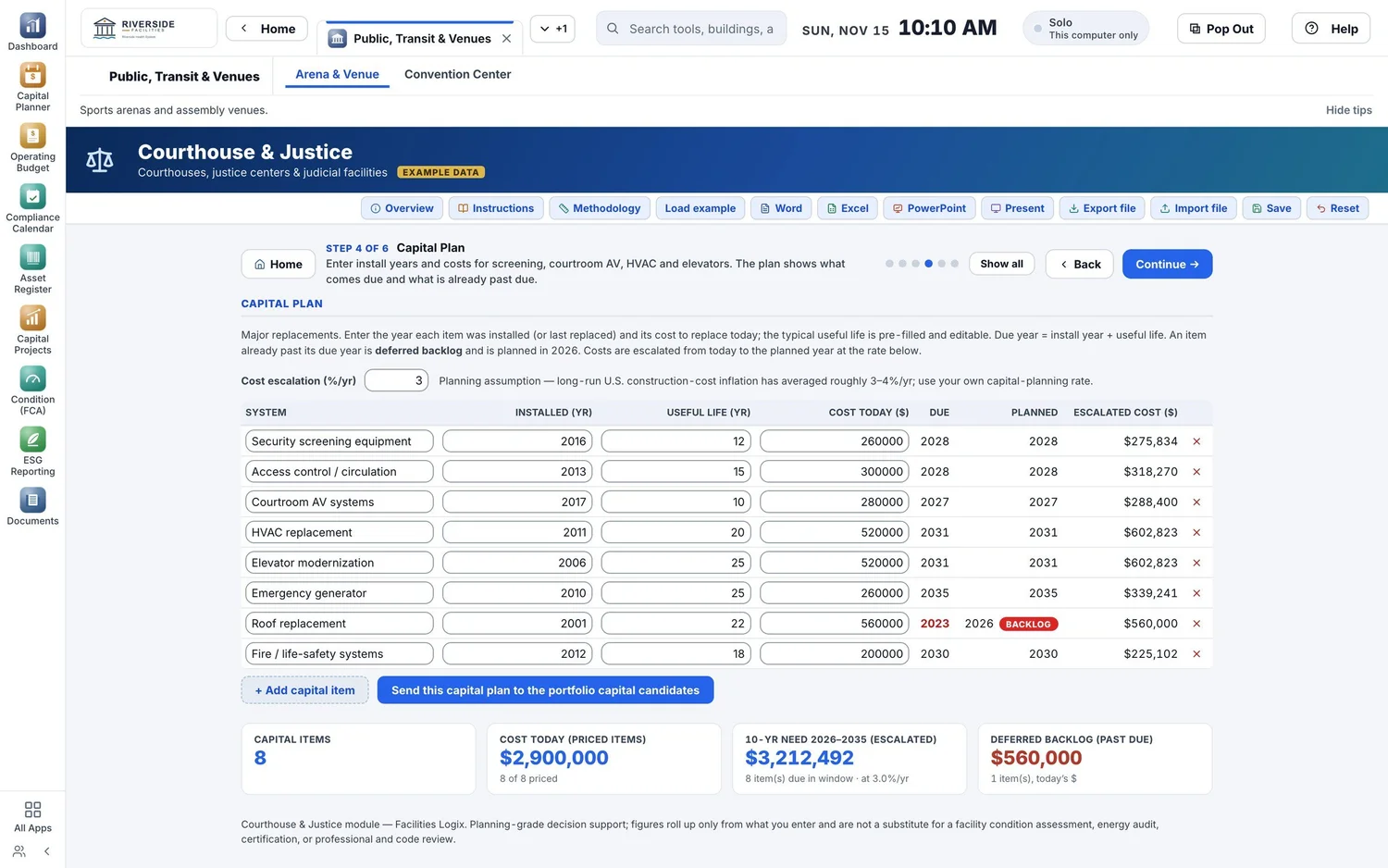
Capital Plan in Courthouse & Justice: enter install years and costs for screening, courtroom AV, HVAC and elevators. The plan shows what comes due and what is already past due.
Capital Reserve
Install years and design lives show which screening, door control, generator and roof lines come due and which are past due.
Learn More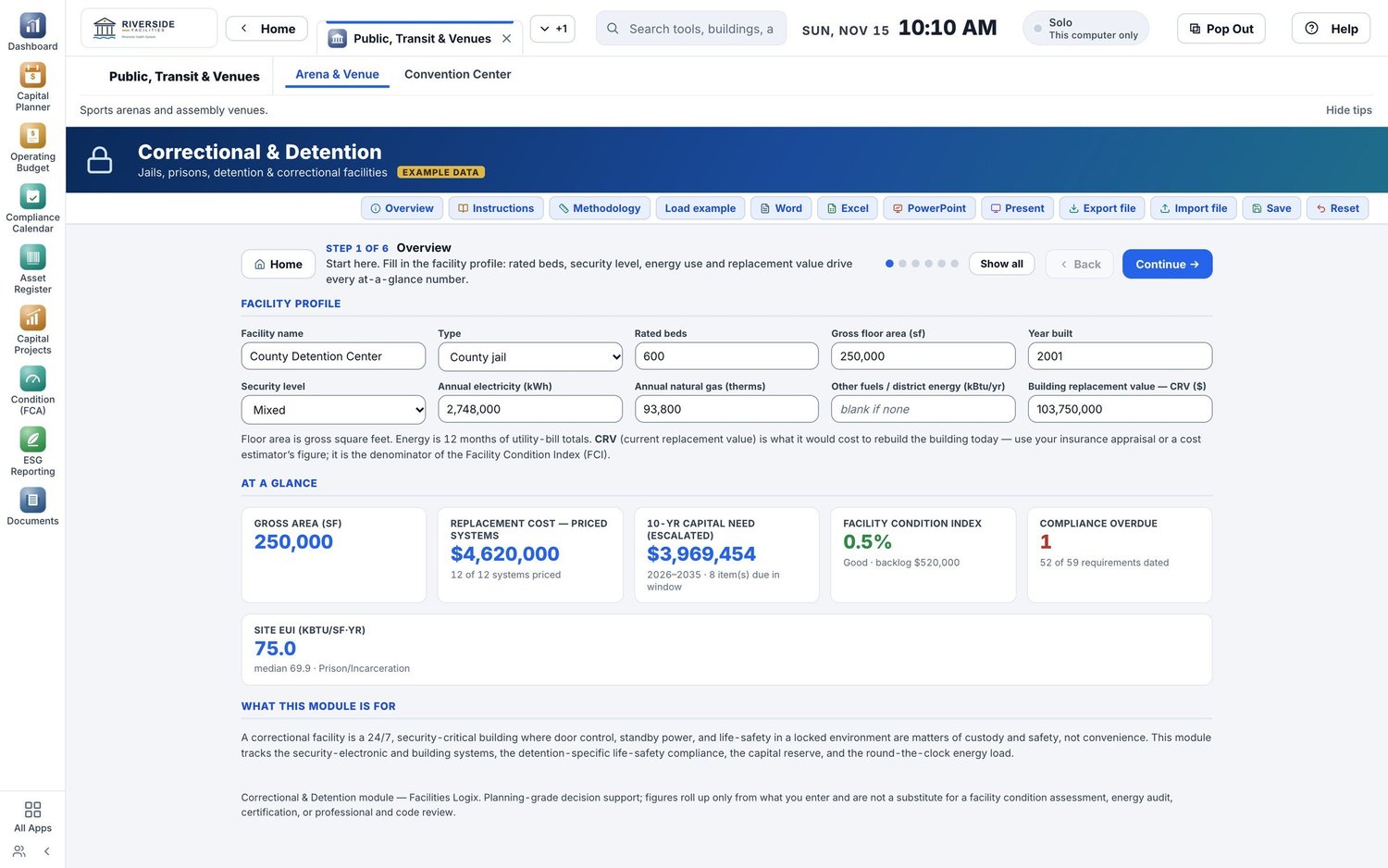
Overview in Correctional & Detention: start here. Fill in the facility profile: rated beds, security level, energy use and replacement value drive every at-a-glance number.
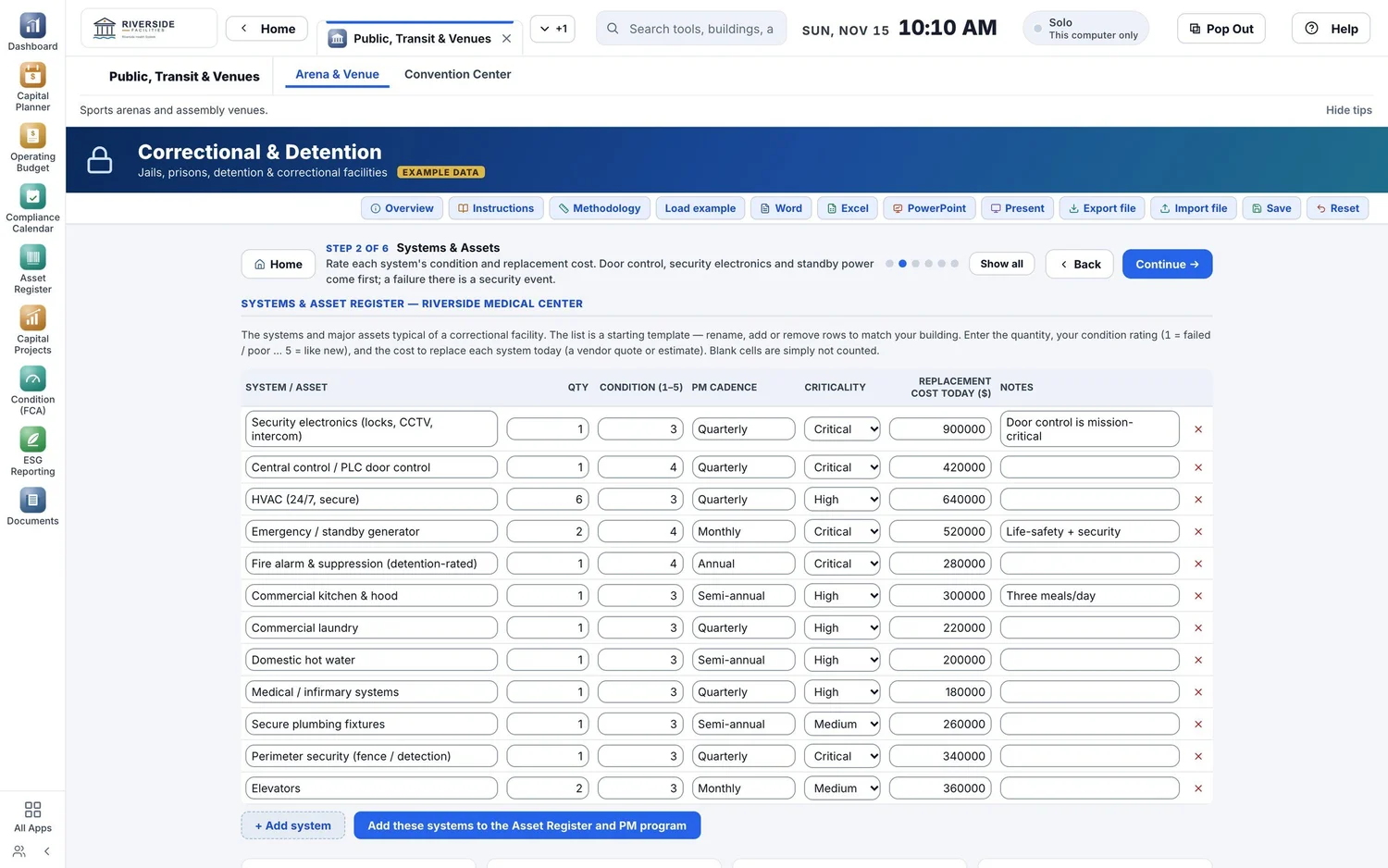
Systems & Assets in Correctional & Detention: rate each system's condition and replacement cost. Door control, security electronics and standby power come first; a failure there is a security event.
The Benchmarks for Each Playbook
Courthouses
- Energy use intensity against the courthouse median
- Three-way secure circulation: public, judicial and staff, and in-custody paths kept separate
- Screening uptime: every public entry screened, with equipment calibrated and maintained
- Record integrity: courtroom AV and recording redundancy protects the legal record
Correctional Facilities
- Energy use intensity for a 24/7 operation against the prison median
- Door-control reliability, with no single point of failure
- Standby power: redundant generators on life safety and security branches
- Detention life safety: the special egress provisions of the NFPA 101 detention occupancy
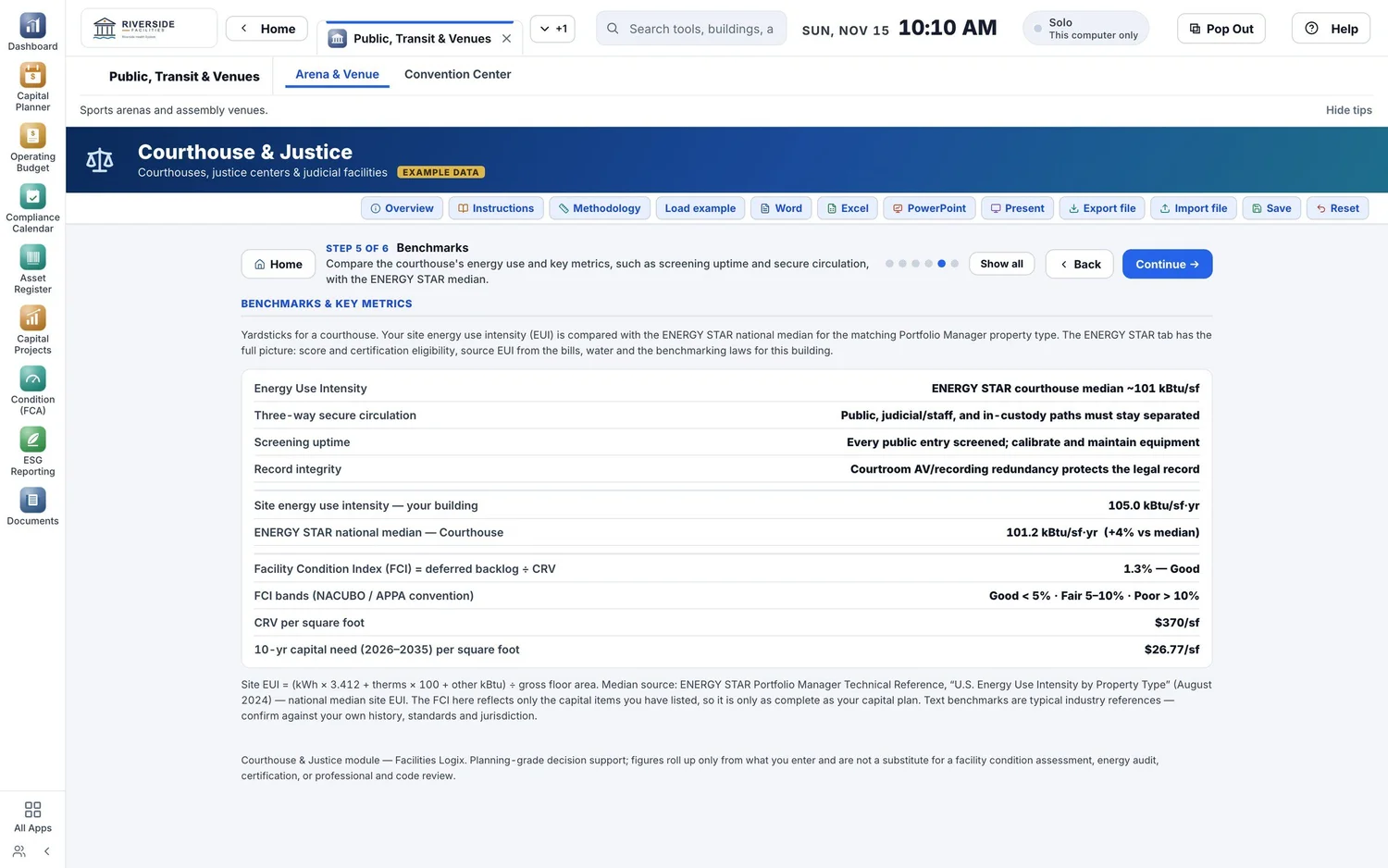
Benchmarks in Courthouse & Justice: compare the courthouse's energy use and key metrics, such as screening uptime and secure circulation, with the ENERGY STAR median.
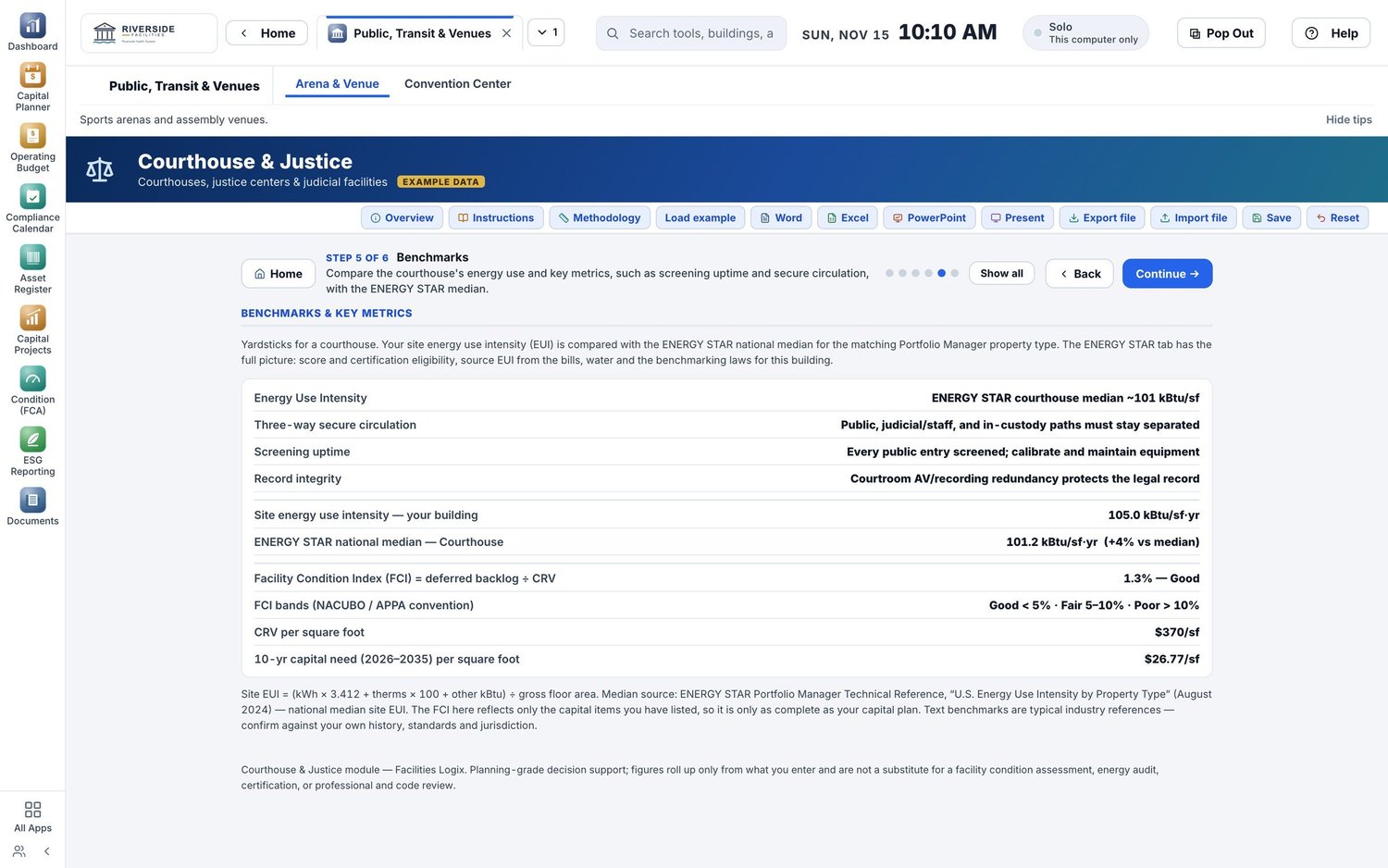
A courthouse is hard to compare with an office, so the playbook carries benchmarks written for courts.
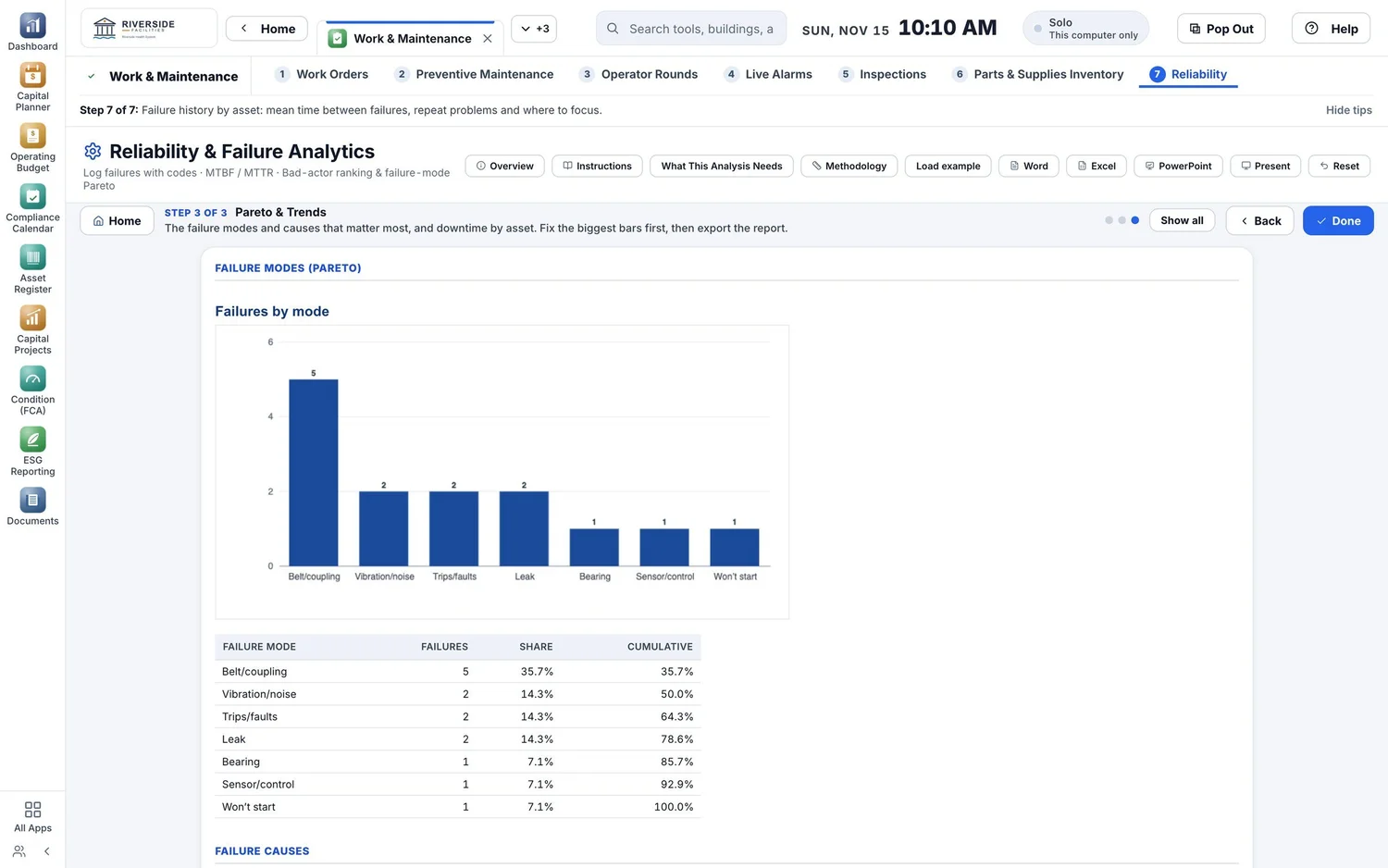
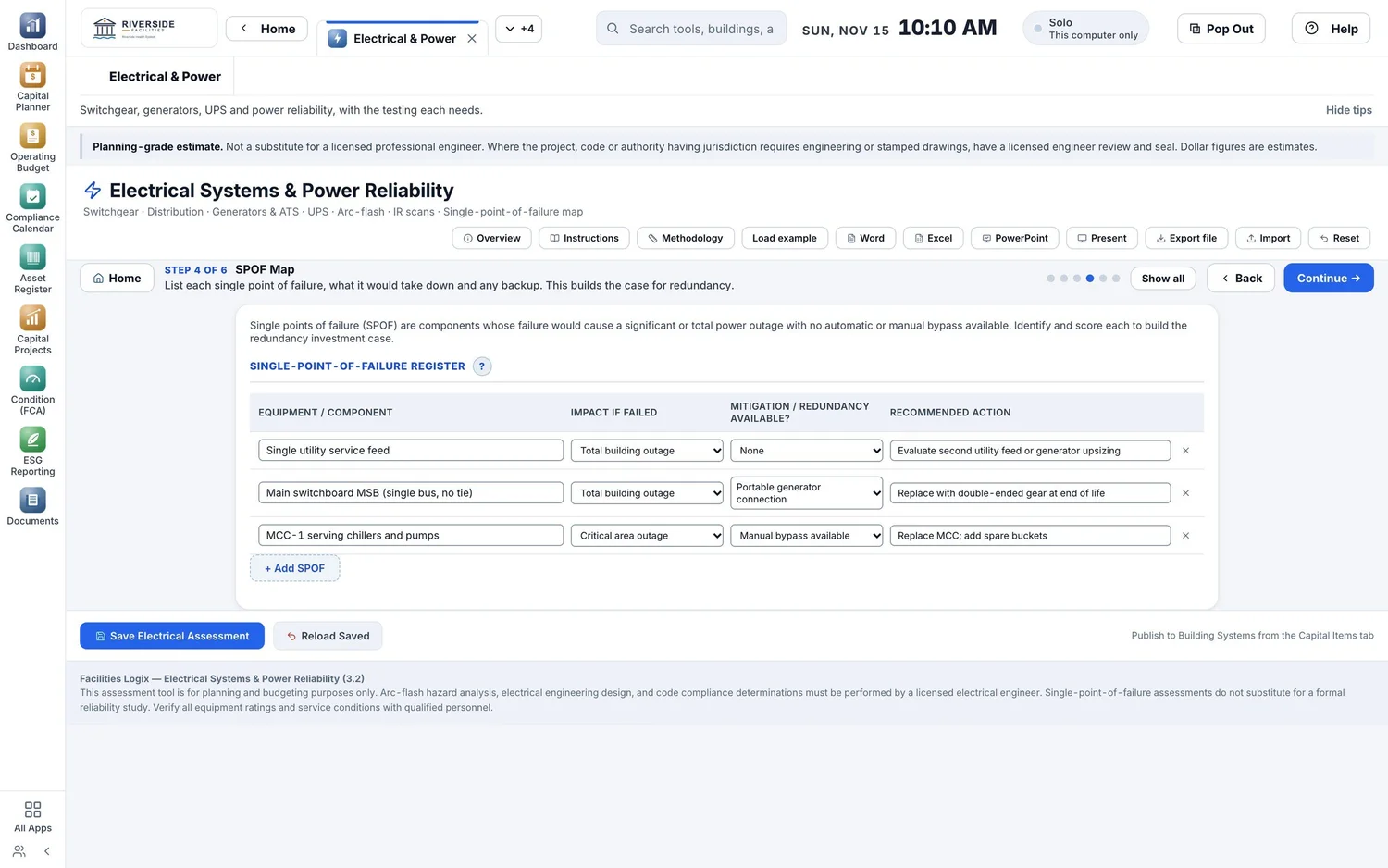
Security Systems That Do Not Lapse
Audit Readiness
PREA, accreditation and state jail inspection dates sit with their evidence, so an audit starts from records, not a search.
Learn MoreShow Less
A failed audit or inspection brings corrective work under a deadline and, in Texas, a reinspection. Each audit row carries its cycle, its citation and the evidence the auditor expects, so the file is built before the auditor arrives.
- PREA: once per 3-year cycle; the audit reviews the most recent 12 months of records (28 CFR 115.401)
- ACA: reaccreditation every 3 years, with a monitoring visit 12-18 months after each audit
- NCCHC: an Annual Maintenance Report each year between surveys
- Texas jail inspections: no more than 14 months apart, nearly all unannounced
Drills on Every Shift
Quarterly drills on each shift are easy to miss on the night shift. Each one has its own date and status.
Learn MoreShow Less
A missed night-shift drill is a citation waiting to happen, and it leaves staff unpracticed for evacuating a locked building. The detention drill row follows IFC Table 405.3 and NFPA 101 22/23.7.1, and its next date runs from the last drill entered.
- Due every 3 months, on each shift, for employees
- Turned on by a correctional facility type or an I-3 (detention) occupancy on the Building Record
- The expected evidence is named on the row: the drill log
- NFPA 101 also requires a written evacuation plan and staff drilled in their duties
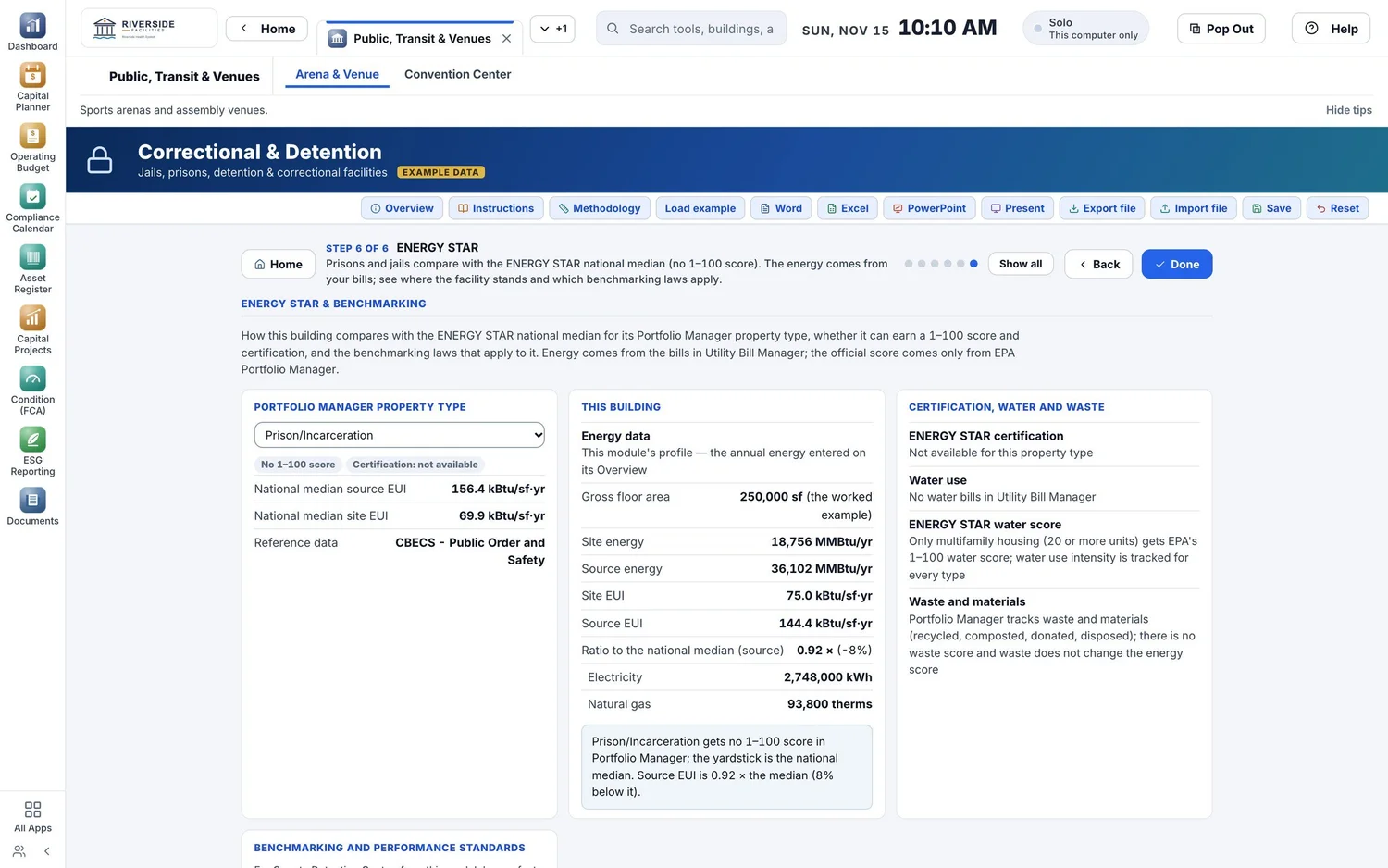
ENERGY STAR in Correctional & Detention: prisons and jails compare with the ENERGY STAR national median (no 1–100 score). The energy comes from your bills; see where the facility stands and which benchmarking laws apply.
The Right Federal Rules
A federal courthouse gets the federal design, security and accessibility rules automatically, without anyone sorting state rules from federal ones by hand.
Learn MoreFailures Seen Before They Matter
Door control, screening and standby power are tracked first, with their PM and capital lines in view.
Learn MoreShow Less
A door-control or generator failure in a locked building is a custody and safety emergency, and an emergency replacement costs more than a budgeted one. The capital plan compares each system's install year and design life with today, so the replacement is funded before it fails.
- Starting design lives: screening equipment 12 years, door control 15, generators 25
- Items past their due year roll into the deferred backlog at today's cost
- The 10-year need is escalated at your rate to each target year
- Monthly NFPA 110 generator tests and quarterly door-control tests sit on the calendar
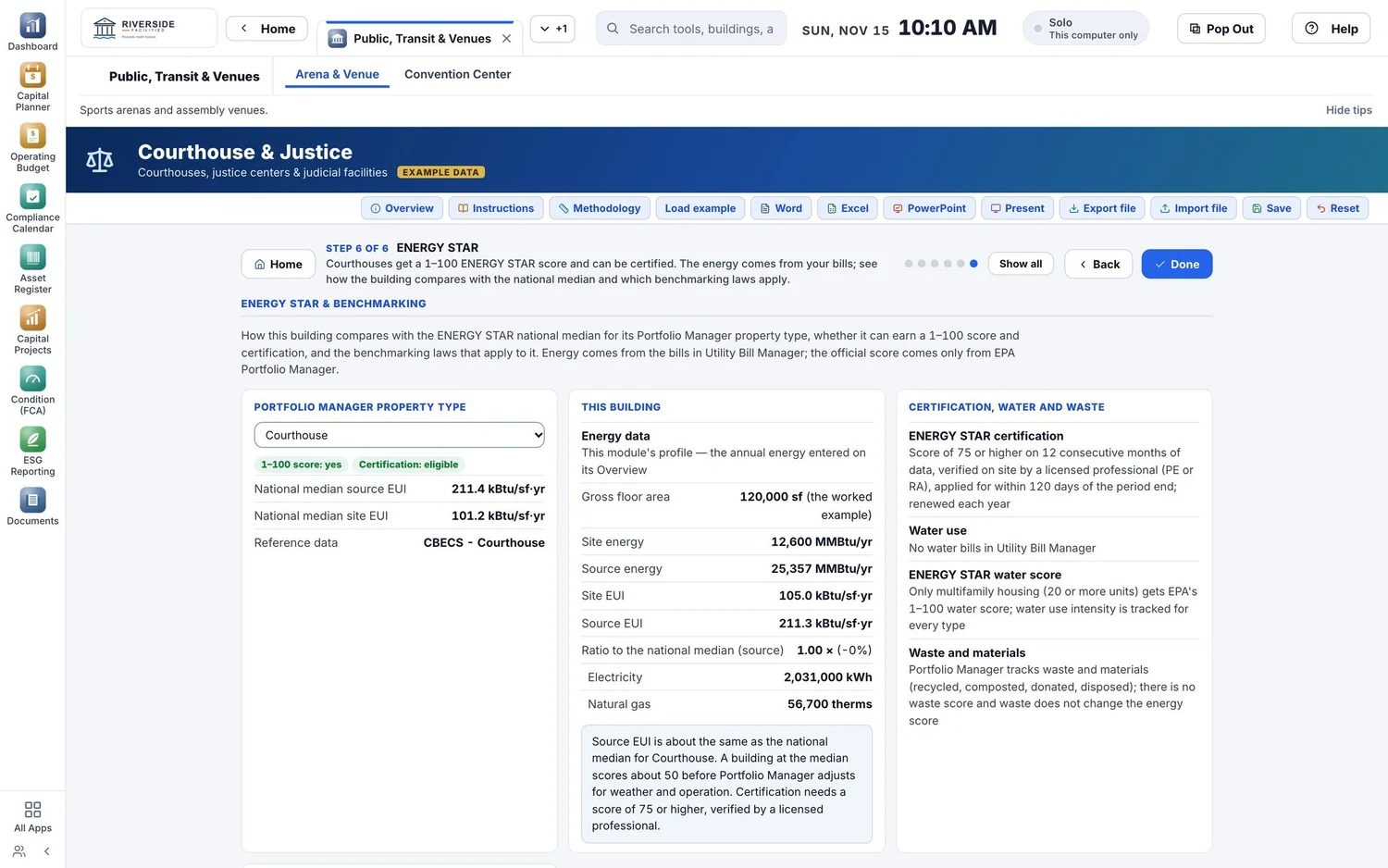
ENERGY STAR in Courthouse & Justice: courthouses get a 1–100 ENERGY STAR score and can be certified. The energy comes from your bills; see how the building compares with the national median and which benchmarking laws apply.
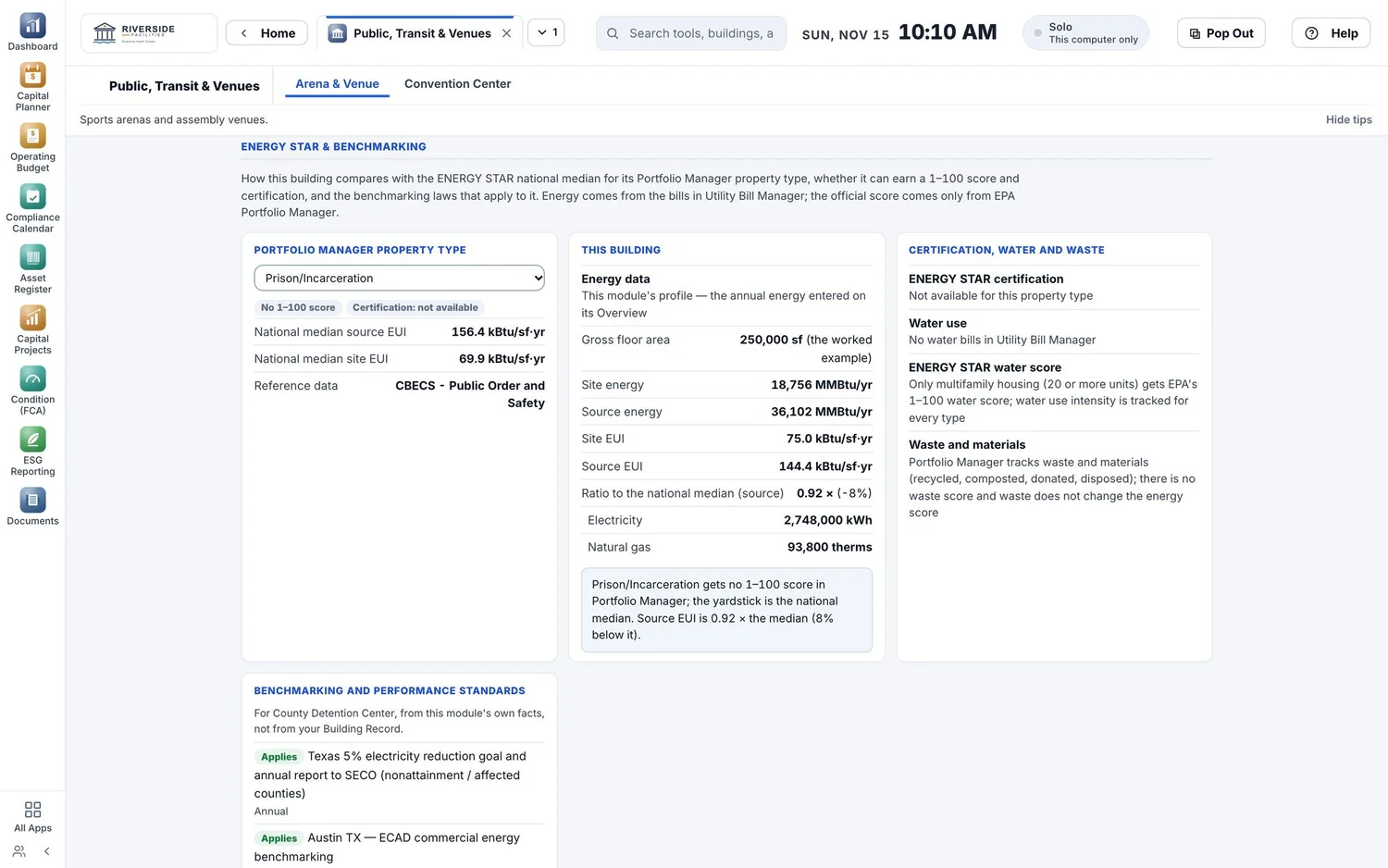
ENERGY STAR in Correctional & Detention: prisons and jails compare with the ENERGY STAR national median (no 1–100 score). The energy comes from your bills; see where the facility stands and which benchmarking laws apply.
Frequently Asked Questions
How does a federal courthouse differ from a county courthouse?
Does it run our PREA or accreditation audit?
Is a justice center with a jail one building or two?
Be First When Facilities Logix Opens
Stop chasing building records across spreadsheets and binders. Join the list and we will tell you the day downloads open, with setup guides ready.
Launching early 2027 for Facilities Logix. Nothing to buy today, and no sales calls.
