


Whatever Your Service Calls It, It Is an Installation.
Launching Early 2027 · Join the Early-Access List
A base, post, fort, camp, station or yard answers to the rules of its service and its agency. Facilities Logix's military playbook keeps the real property inventory, condition, mission dependency, security and capital for sustainment, restoration and modernization (SRM) in one place. Yes or No answers about what the installation has decide which Department of Defense (DoD), Coast Guard, National Guard and federal rows apply. Federal buildings of any agency also get the Federal Real Property Profile (FRPP) fields and the federal-wide rules that bind them.
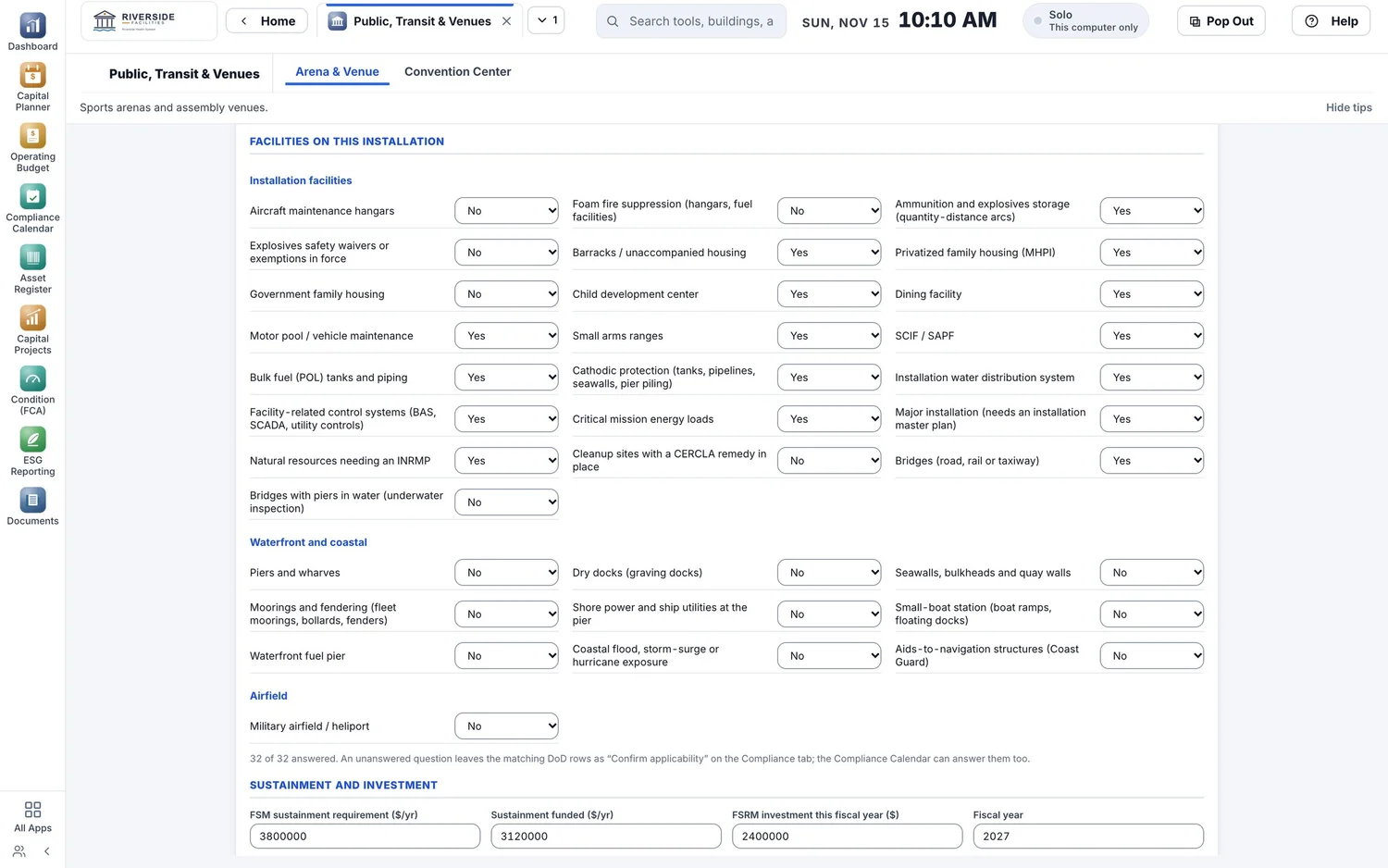
The DoD Rows Your Answers Turn On
For a building whose Building Record names a DoD component (the National Guard and NSA, NGA, NRO and DIA included), the Compliance tab applies the Unified Facilities Criteria (UFC) set. For other agencies the UFC rows are marked Confirm. Each row below appears only when the matching facility is answered Yes.
Explosives Safety (DESR 6055.09)
- Lightning protection on ammunition and explosives facilities: a visual inspection at most every 12 months and an electrical test at most every 24 months
- A Department of Defense Explosives Safety Board site plan before building inside quantity-distance arcs
- Explosives safety waivers reviewed at least every 2 years
Design Criteria When a Project Is Planned
- UFC 1-200-01, 3-600-01, 3-401-01, 3-410-01, 3-501-01, 3-575-01 and 4-010-06
- Hangars (UFC 4-211-01), magazines (4-420-01), small arms ranges (4-179-02), barracks (4-721-01) and vehicle wash facilities (4-214-03)
- The SCIF construction security plan approved before contract award, and antiterrorism standards for new, renovated and leased buildings (UFC 4-010-01)
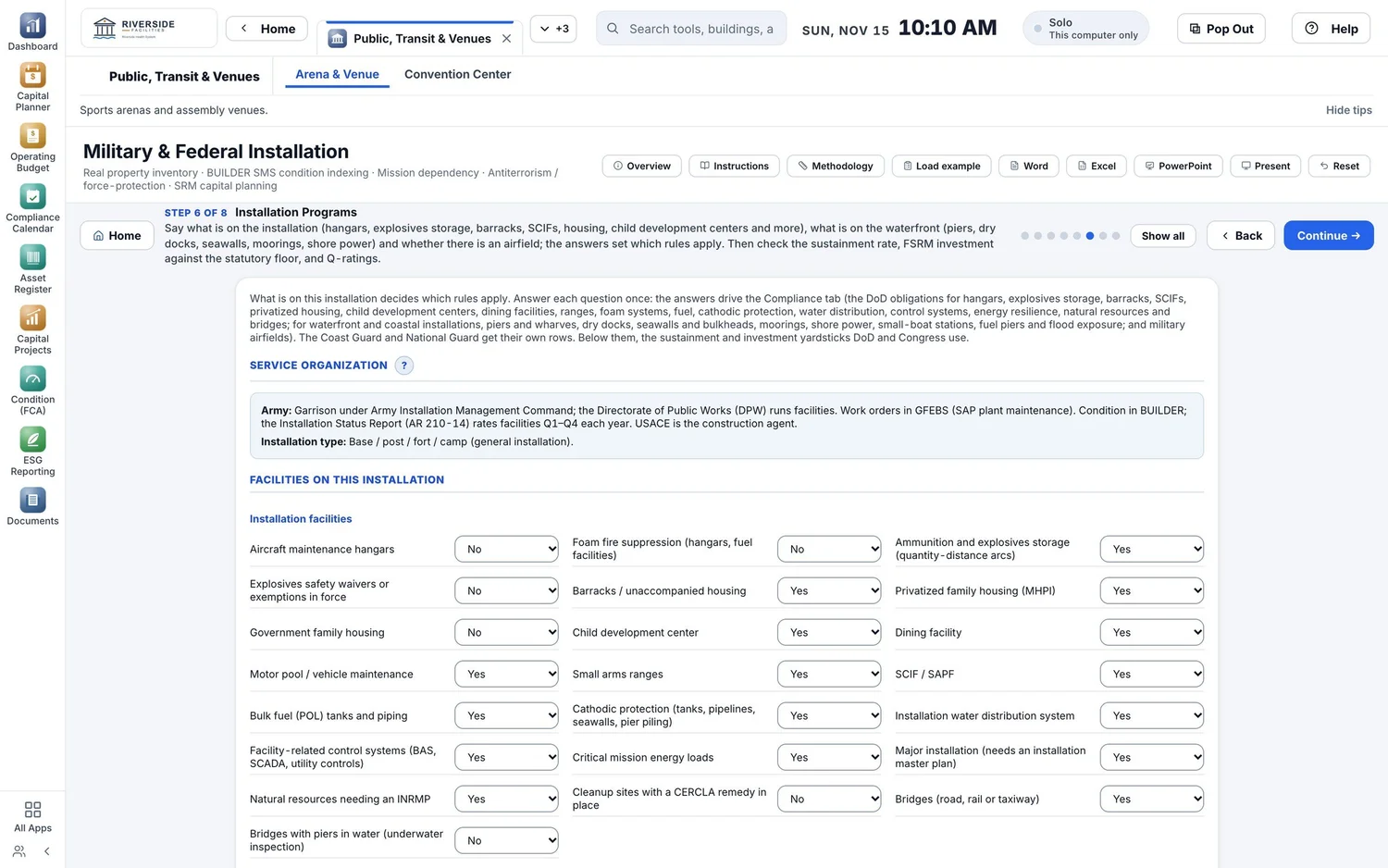
Installation Programs in Military & Federal Installation: say what is on the installation (hangars, explosives storage, barracks, SCIFs, housing, child development centers and more), what is on the waterfront (piers, dry docks, seawalls, moorings, shore power) and whether there is an airfield; the answers set which rules apply. Then check the sustainment rate, FSRM investment against the statutory floor, and Q-ratings.
Control Systems and Energy
- Facility-related control systems (UFC 4-010-06, DoDI 8510.01): authority to operate renewed within 3 years and assessed every year. The rows note that DoD announced the Cybersecurity Risk Management Construct and tell you to confirm the approach with your Authorizing Official
- Energy resilience for critical missions (10 USC 2920) and black start exercises when the installation is scheduled
- Backup power testing and the annual critical energy review (DoDI 4170.11), flagged Confirm
Environment and Planning
- Integrated Natural Resources Management Plan (INRMP) review at least every 5 years (Sikes Act)
- CERCLA five-year reviews of remedies that leave contamination in place
- The end of fluorinated foam (AFFF) use on October 1, 2026, and foam system testing without releasing foam
- The installation master plan at least every 10 years for a major installation (10 USC 2864)
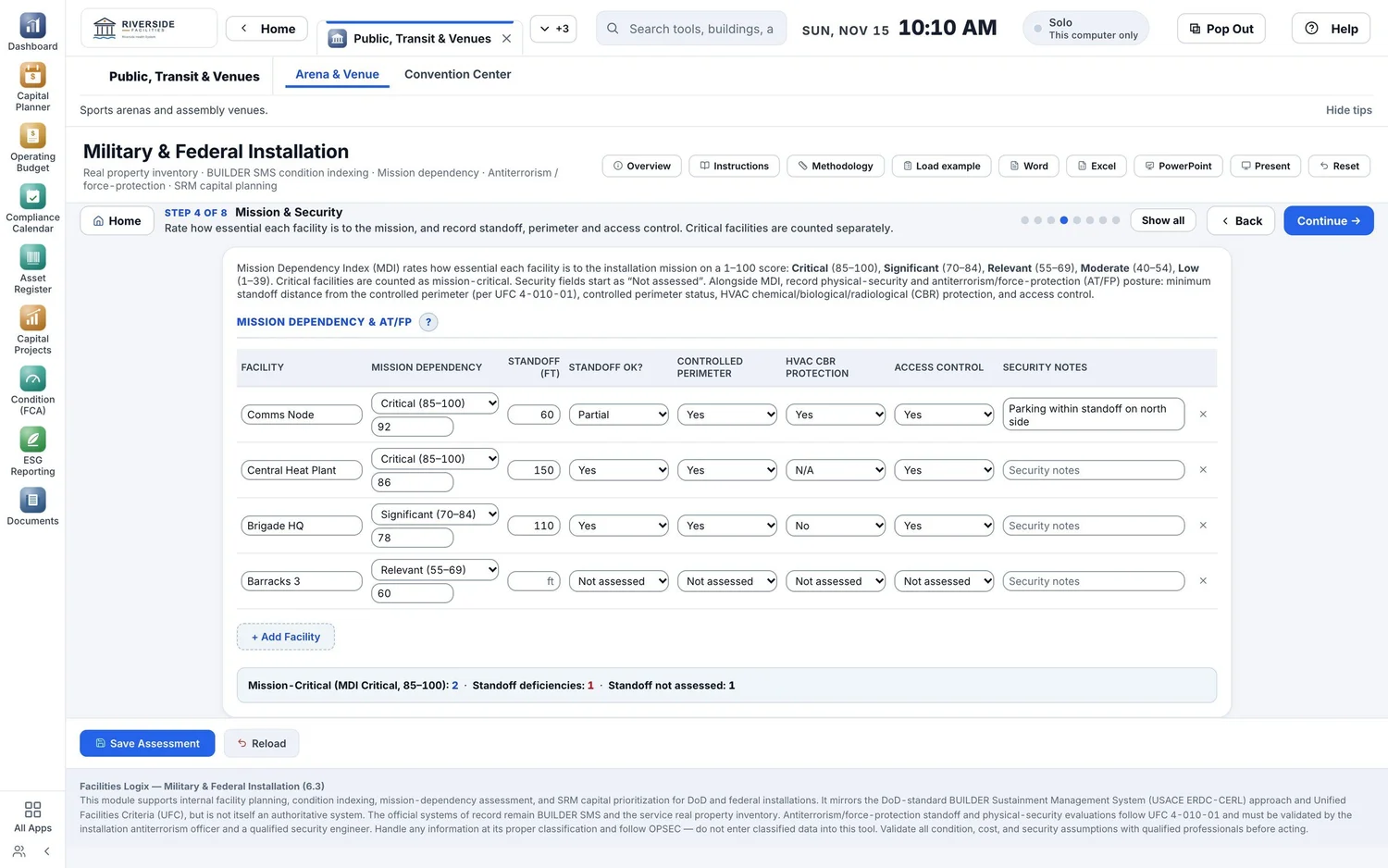
Mission & Security in Military & Federal Installation: rate how essential each facility is to the mission, and record standoff, perimeter and access control. Critical facilities are counted separately.
People and Housing
- Child development centers inspected 4 times a year, unannounced (10 USC 1794), with monthly child care food sanitation inspections
- Dining facility food sanitation inspections quarterly
- Privatized housing tenant protections (10 USC 2890-2892a): unit inspections at turnover, the annual mold and pest plan review, maintenance history at lease and work order rules
- Barracks repair need at or below 20% of replacement cost (10 USC 2856b), and window fall prevention in family housing
Utilities, Pavement and Bridges
- Cathodic protection: impressed-current checks within 60 days, an annual survey and a close-interval survey every 5 years
- Fuel tanks under API 653 (formal external inspection every 5 years) and fuel piping under API 570, with monthly and annual tank visuals
- Hydrants inspected and flushed every year, and the distribution system flow tested at least every 5 years
- Air Force pavement surveys every 5 years and a yearly visual airfield inspection; Army pavement inspections never more than 3 years apart (AR 420-1); the pavement management plan every year
- Installation bridges every 24 months, and underwater every 60 months (UFC 3-310-08)
- Condition assessments on a 5-year cycle, flagged Confirm
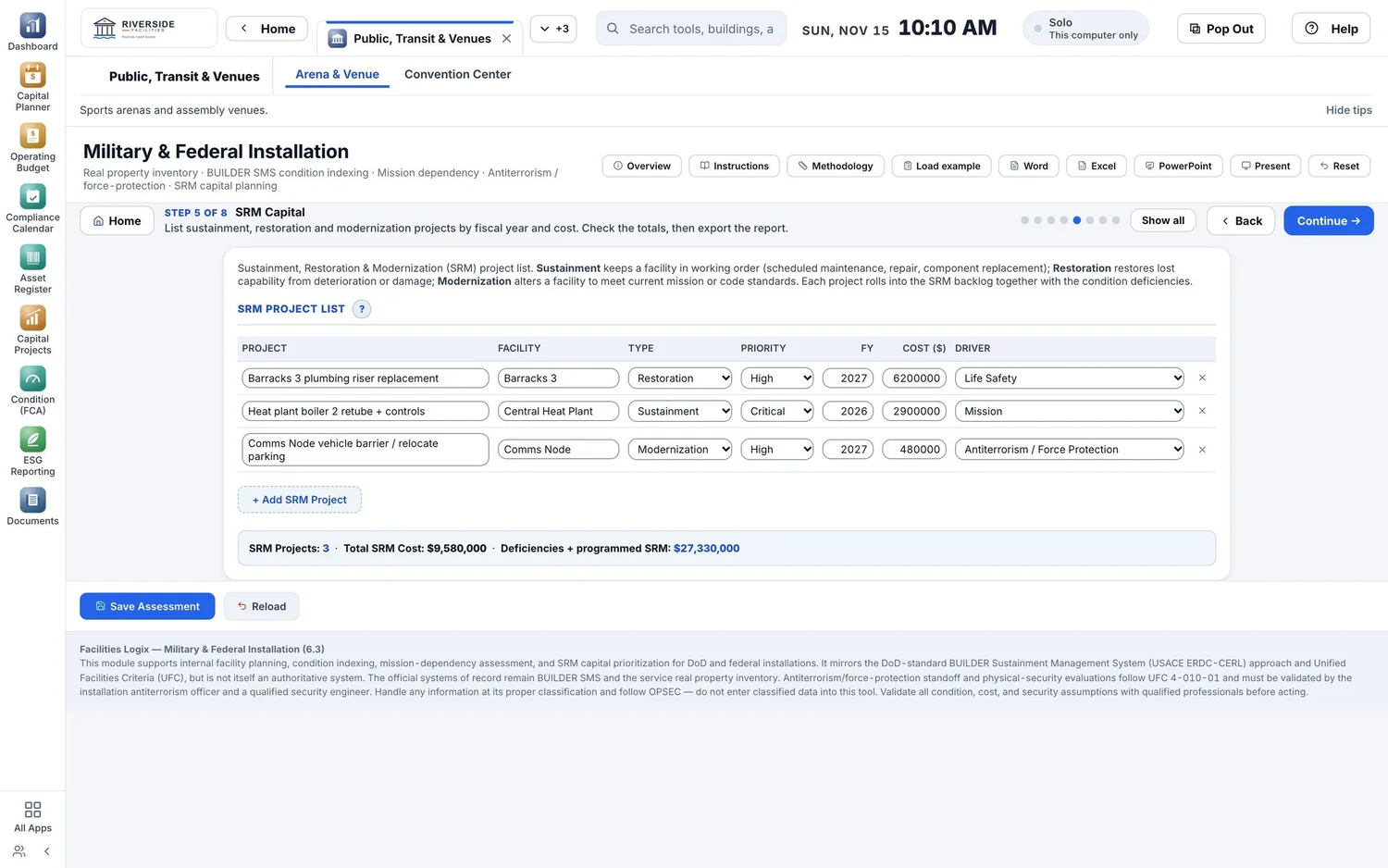
SRM Capital in Military & Federal Installation: list sustainment, restoration and modernization projects by fiscal year and cost. Check the totals, then export the report.
Emergency Management (DoDI 6055.17)
- The all-hazard emergency management plan, hurricanes and storm surge included, updated every year
- The hazard and risk assessment every year, the exercise program every year and mass warning and notification exercised twice a year
Waterfront and Dry Docks
- Piers, wharves, seawalls and bulkheads inspected above water every year and underwater every 6 years (timber every 3 years); fenders and coatings every year (UFM 4-150-07)
- Mooring hardware Level 1 every year, Level 2 every 4 to 6 years and pull tests every 12 to 18 years (UFM 4-150-08); fleet mooring buoys every year
- Dry docks (MIL-STD-1625E): certification per the NAVSEA certificate, a program audit every 3 years, structures every 2 years, mechanical and electrical every year, a hydrographic survey and fire protection flow test every 5 years, an annual flooding drill and caisson surveys every 5 years
- Shore power cables tested every year and breakers every 2 years (UFC 4-150-02)
- Coastal flood: a flood vulnerability assessment and the design flood elevation for projects in a flood hazard area (UFC 3-201-01)
Military Airfields
- Airfield criteria waivers (UFC 3-260-01) reviewed every year for the Army and Air Force
- Airfield lighting (UFC 3-535-01) and marking (UFC 3-260-04) criteria on projects
- The Navy and Marine Corps pavement survey cycle is flagged Confirm with your facilities engineering command
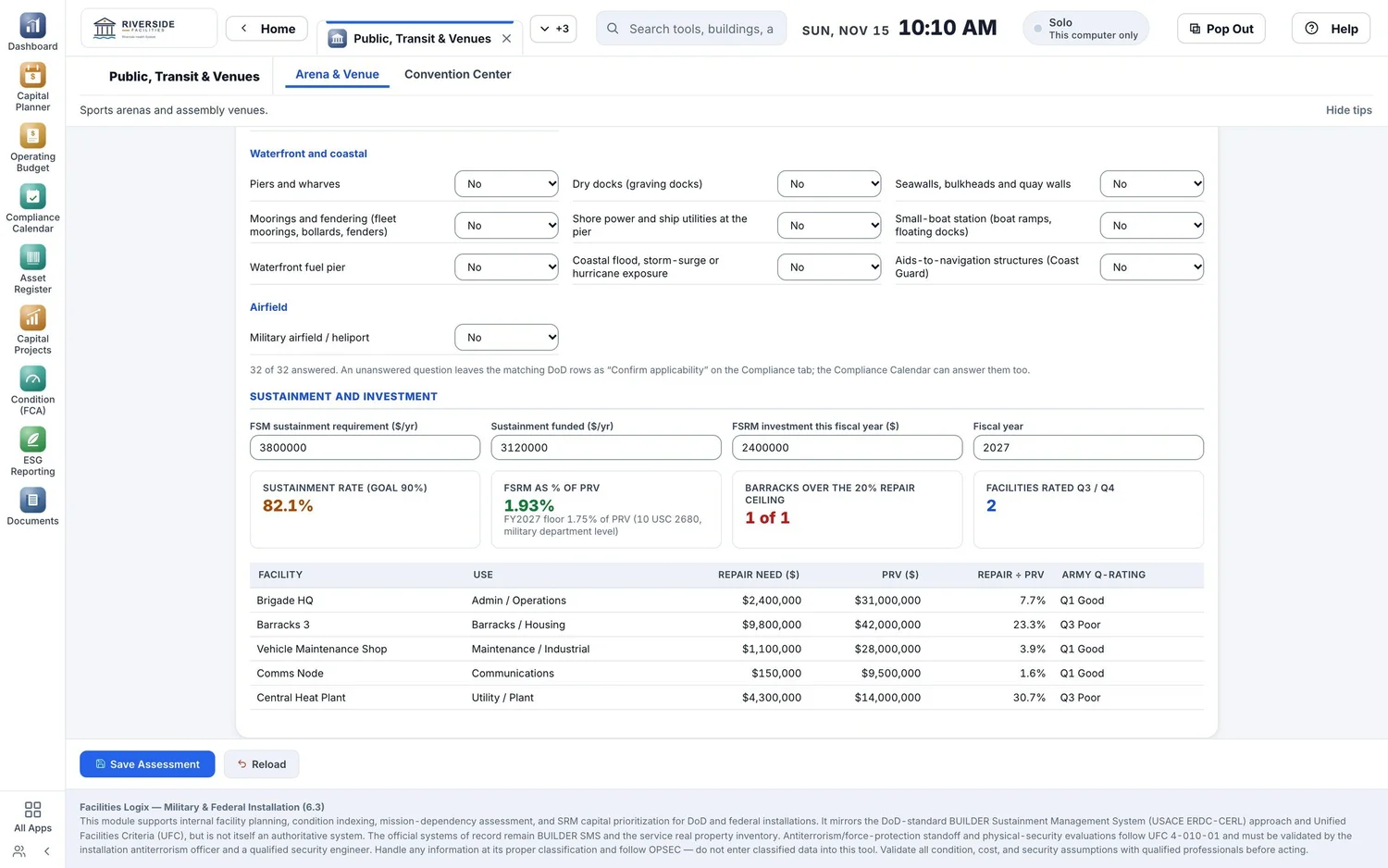
Sustainment and Investment in Military & Federal Installation: FSRM spending against the floor, barracks repair need and an Army Q-rating for each facility.

Installations carry rules from many authorities, so each obligation explains why it applies to this building.
The Right Rows for Who Holds the Property
Coast Guard
- With the Federal Agency set to the Coast Guard, the Compliance tab adds its shore facility rules: a condition assessment of each unit every 3 years, piers and load-bearing structures every 2 years, weight-handling equipment load tests every year and major aids-to-navigation structures every 5 years
- The annual real property inventory, annual quarters inspections and the code basis (latest IBC, with NFPA 101 and NFPA 70)
- The Coast Guard manual recommends the UFC but does not require it, so the DoD rows stay Confirm. Several Coast Guard manuals are no longer on the public directives list, so those rows say what to confirm
National Guard
- Pick Army or Air National Guard as the branch
- A state-owned armory or readiness center gets the Guard rows only: the Installation Status Report every year, real property inventory reporting in March and September, the annual environmental compliance assessment and antiterrorism standards on federally funded work
- Which UFC the cooperative agreement invokes is flagged Confirm
- Federal Guard property also gets the DoD rows, and an Air Guard base follows the Air Force publications
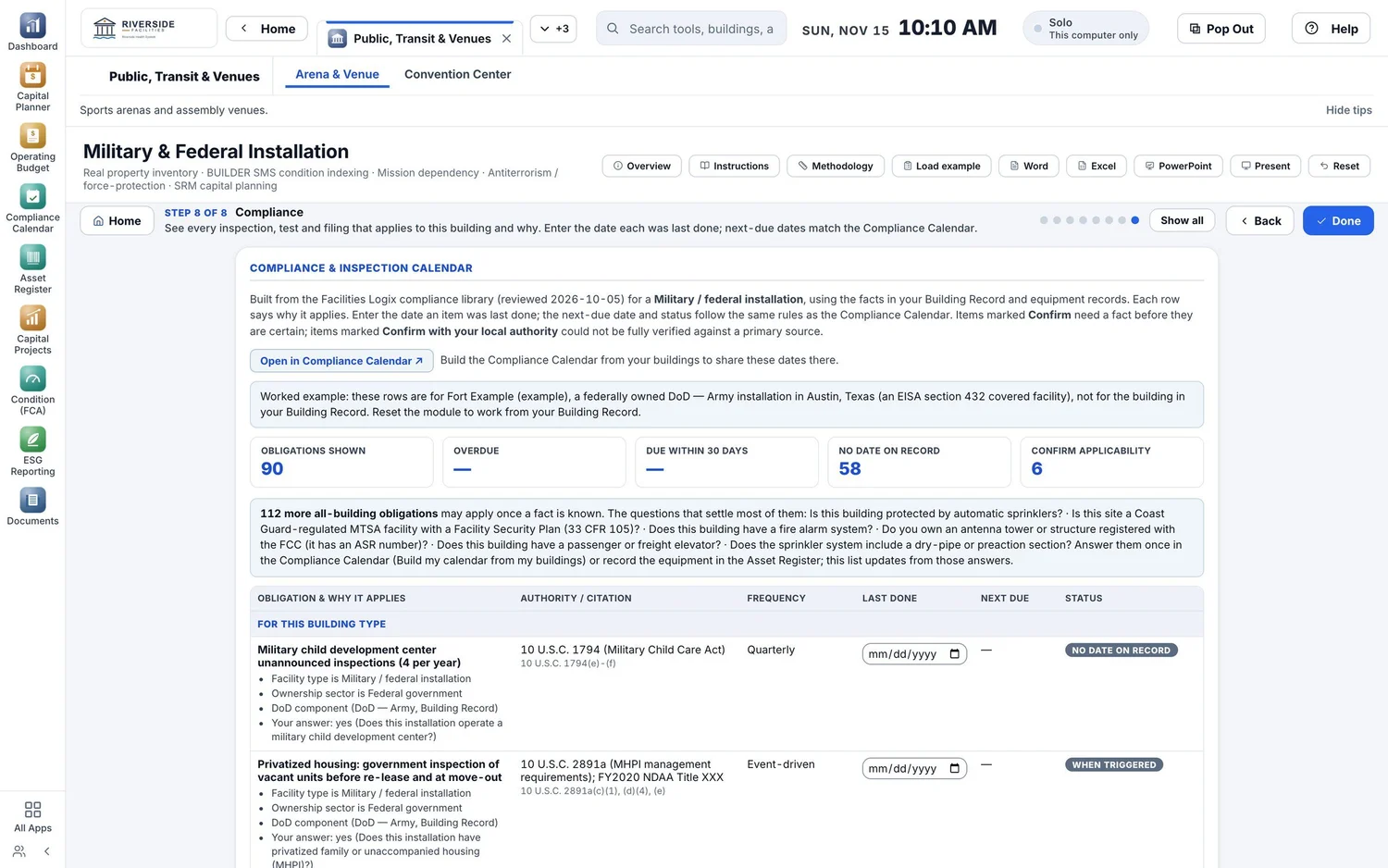
Compliance in Military & Federal Installation: see every inspection, test and filing that applies to this building and why. Enter the date each was last done; next-due dates match the Compliance Calendar.
Federal Waterfront Outside DoD
- A MARAD reserve fleet site or another civilian agency gets federal rows in place of the DoD ones
- Piers and wharves: a surface inspection every year and a complete inspection every 3 years (timber) or 6 years (concrete and steel)
- Fleet moorings underwater every 3 years, synthetic mooring lines every 6 months and chain and wire rope by years in service, plus Type IV storm moorings for ships that cannot leave
- Pier fire water supplies (NFPA 307) and dry dock access and guarding (29 CFR 1915.75)
- Shore power ground-fault protection and routine seawall inspection are marked Provisional, and class surveys of a floating dock are flagged Confirm
Every Federal Building
- Workplace safety under 29 CFR 1960: an annual inspection of every workplace and the annual program report
- Interagency Security Committee (ISC) facility security assessments: every 3 years at security levels III to V, every 5 years at levels I and II
- EISA §432 energy and water evaluations every 4 years for covered facilities, with benchmarking and follow-up
- Accessibility under the ABA standards (ABAAS) and Section 508
- The FRPP submission by December 15 and certification by January 31
- The Postal Service, the legislative branch and the courts follow their own rules, and where the law turns on the entity the row says Confirm
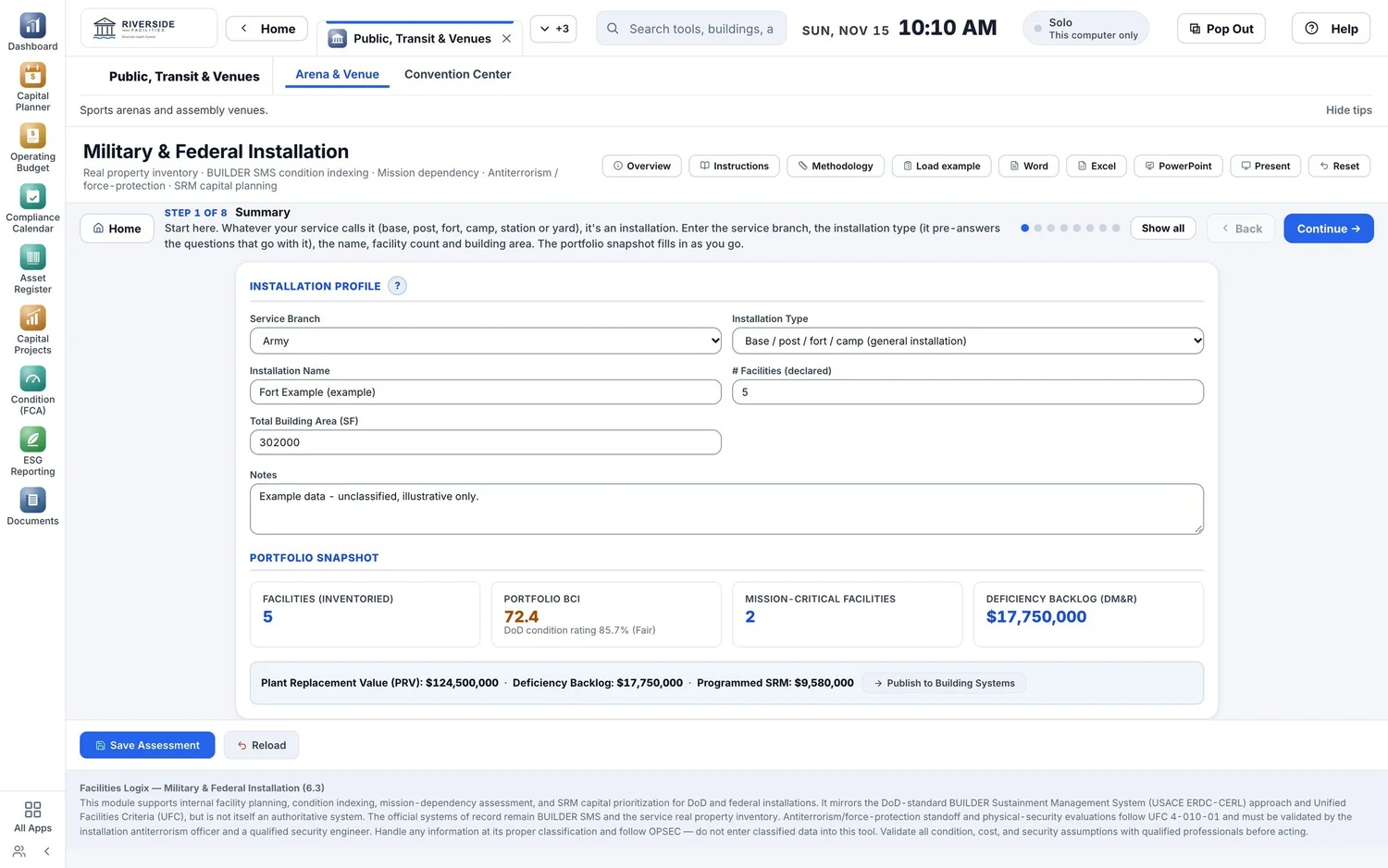
Summary in Military & Federal Installation: start here. Whatever your service calls it (base, post, fort, camp, station or yard), it's an installation. Enter the service branch, the installation type (it pre-answers the questions that go with it), the name, facility count and building area. The portfolio snapshot fills in as you go.
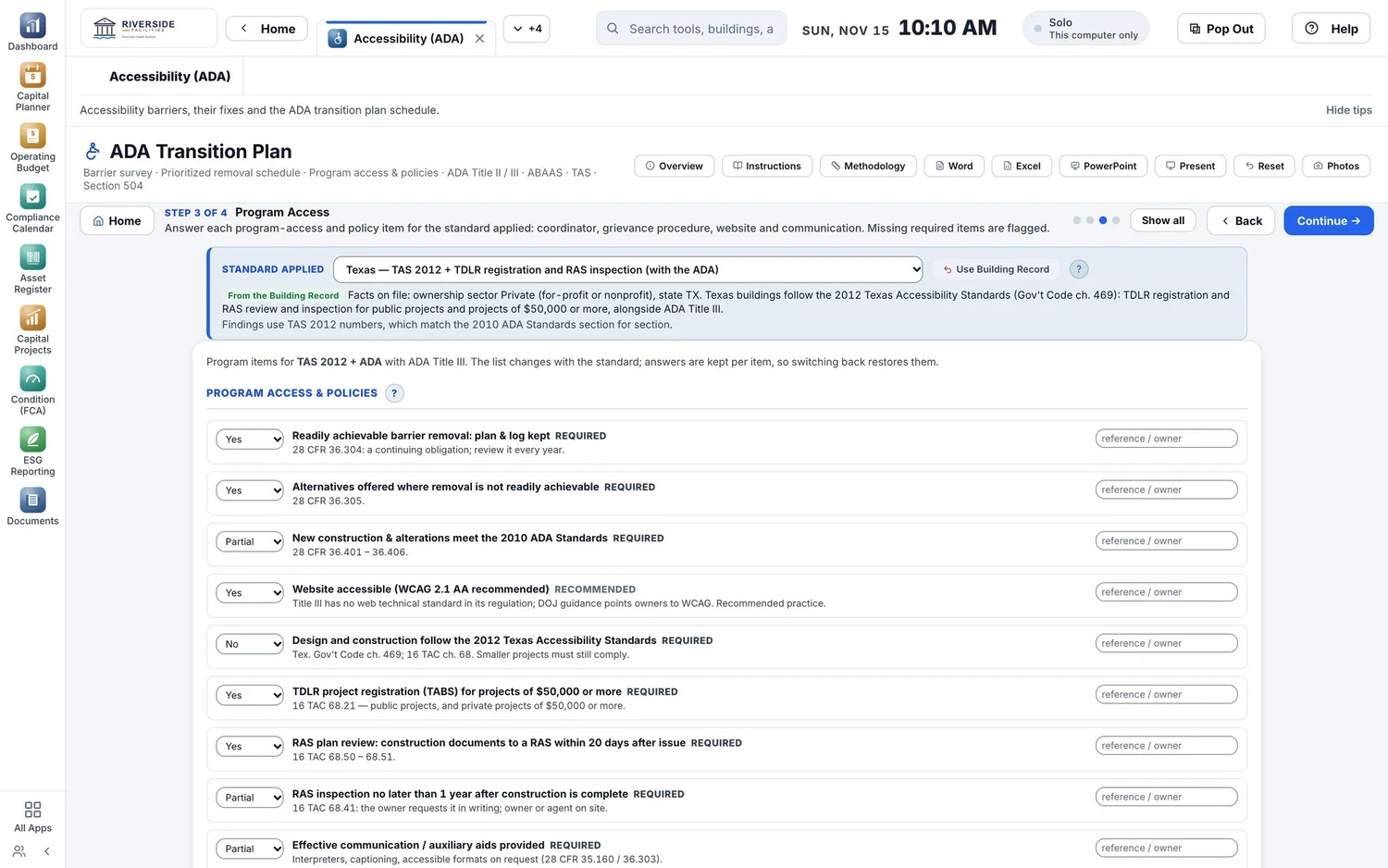
Program Access in ADA Transition Plan: answer each program-access and policy item for the standard applied: coordinator, grievance procedure, website and communication. Missing required items are flagged.
Eight Steps, from the Installation Profile to Compliance
Installation Type
Base, post, fort or camp, air base, naval station, naval shipyard, reserve fleet site, port or ammunition port, depot or arsenal, training center or range, Reserve or Guard center, Coast Guard sector or station, medical center campus or federal civilian campus. The type pre-answers its questions, only where a question is blank and never over your own answer, and marks each one from type.
Learn MoreShow Less
Setup time is staff time, and a wrong answer can hide a rule or add one that costs money. The type fills only blank questions with the answers that usually go with it, and marks each pre-answer so it can be checked.
- A shipyard pre-answers piers and wharves, dry docks, seawalls, shore power and the fuel pier
- A reserve fleet site suggests Federal Civilian with the MARAD agency
- Shipyards and fleet sites list the ships berthed there, linked to Ships and Vessels
- Naval stations, air bases, ports and Coast Guard stations pre-answer their own questions
Real Property Inventory
Each facility with its real property unique identifier (RPUID), category code, use, year built, area and plant replacement value. Every rollup starts here.
Learn MoreShow Less
Plant replacement value is the weight behind every portfolio number, so a missing PRV skews where sustainment money goes. The inventory is the one list the condition, mission and funding math reads.
- Condition rows typed with the inventory name inherit its PRV as their weight
- Total PRV is the base for FSRM investment as a percent of value
- Each facility publishes as a Real Property asset with RPUID, CATCODE, use, area and PRV
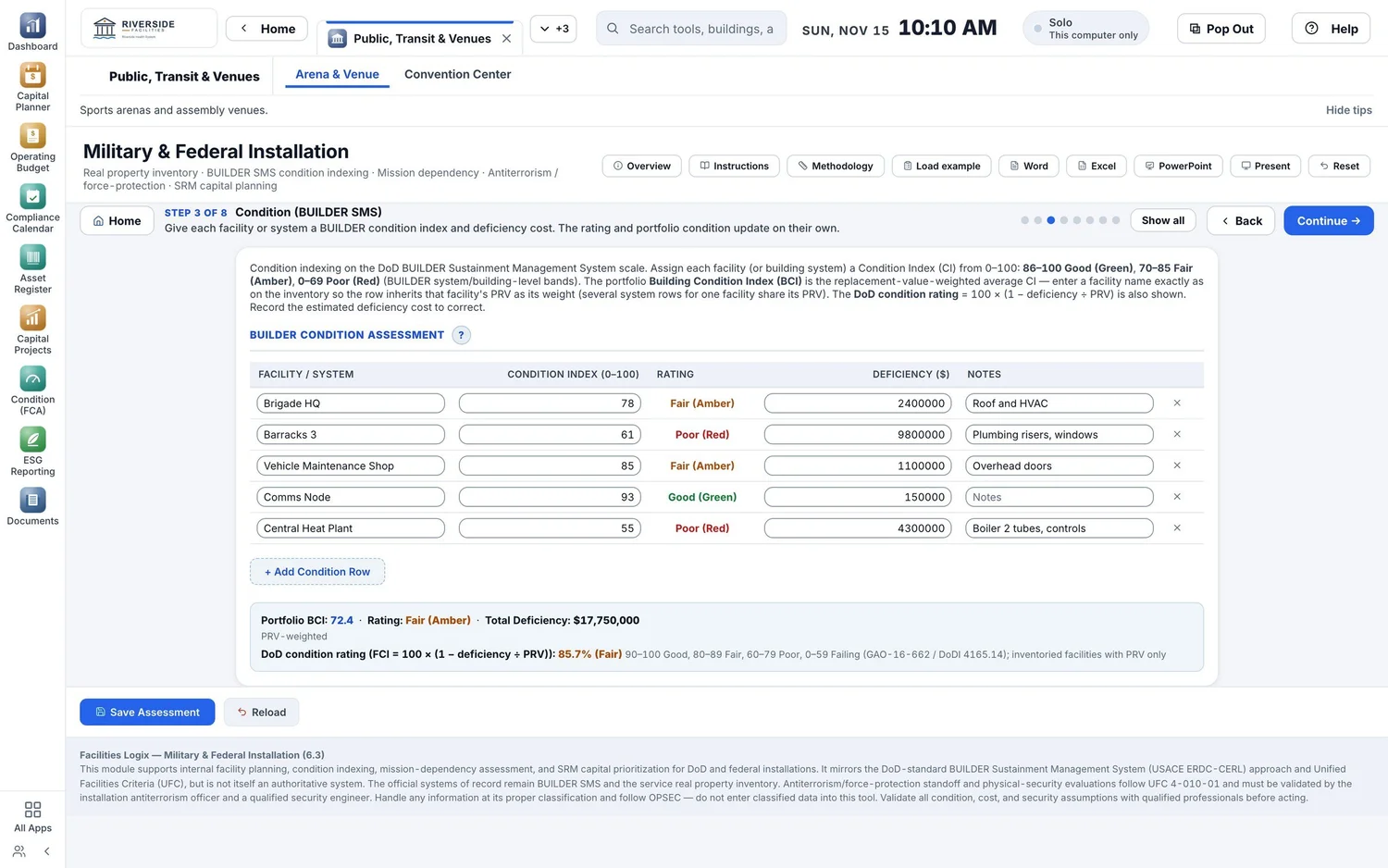
Condition (BUILDER SMS) in Military & Federal Installation: give each facility or system a BUILDER condition index and deficiency cost. The rating and portfolio condition update on their own.
Condition
BUILDER-style condition indexing: a 0-100 condition index and deficiency cost for each facility or system, with Good, Fair and Poor bands and a replacement-value-weighted building condition index for the portfolio.
Learn MoreShow Less
Deferred repairs grow into restoration projects, so knowing which facilities are slipping protects SRM money. Each condition row is rated from its index, and the portfolio rolls up by value.
- Good at 85.5 and above, Fair 69.5-85.5, Poor below 69.5 (BUILDER SMS bands)
- DoD condition rating: 100 x (1 - deficiency / PRV), Good to Failing (GAO-16-662, DoDI 4165.14)
- A row below 69.5 publishes as a capital deficiency; others as maintenance
- Rows not matched to an inventoried facility are left out of the weighting
Mission and Security
A mission dependency score or band for each facility, with standoff distance, whether standoff is met (UFC 4-010-01), controlled perimeter, HVAC protection against chemical, biological and radiological threats, and access control.
Learn MoreShow Less
Sustainment money spent on a facility the mission can do without, while a critical one degrades, is money in the wrong place. Mission dependency ranks the facilities, and the security fields record the antiterrorism posture beside it.
- MDI bands: Critical 85-100, Significant 70-84, Relevant 55-69, Moderate 40-54, Low 1-39
- Enter the score and the band sets itself, or pick the band
- Critical facilities are counted and put first in prioritization
- A standoff shortfall publishes to Building Systems as a Life Safety deficiency
SRM Capital
Sustainment, restoration and modernization projects by fiscal year with priority and driver, rolled together with the condition deficiencies into the backlog.
Learn MoreInstallation Programs
Yes or No for hangars, foam suppression, explosives storage and waivers, barracks, privatized and government family housing, child development centers, dining facilities, motor pools, small arms ranges, SCIFs, bulk fuel, cathodic protection, water distribution, control systems, critical energy loads, master planning, natural resources, cleanup remedies and bridges, then the waterfront and airfield questions.
Learn MoreShow Less
Sustainment funded short of the requirement shows up later as costly restoration. After the Yes or No answers, the tab works out the funding figures leadership is measured on.
- Sustainment rate: funded divided by the Facilities Sustainment Model requirement, against the OSD goal of 90%
- FSRM investment as a percent of PRV against the 10 USC 2680 floor, 1.75% in FY2027 rising to 4%
- Army Q-ratings: repair need divided by replacement value, Q1 through Q4
- Barracks repair need held at or below 20% of replacement cost (10 USC 2856b)
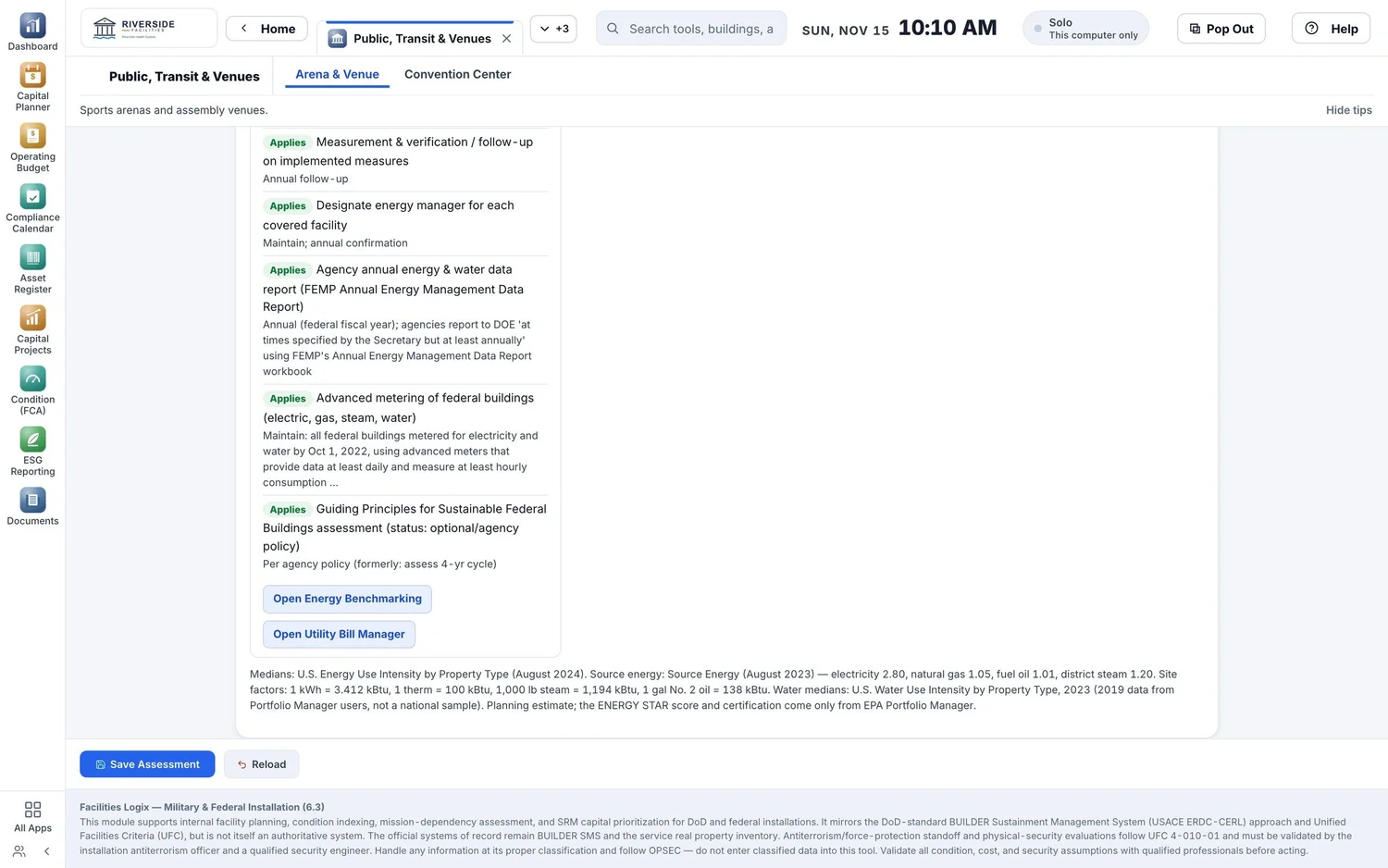
ENERGY STAR in Military & Federal Installation: pick the Portfolio Manager property type for the building chosen in Facilities Logix (barracks get a 1–100 score). The energy comes from the bills; see how it compares with the national median and which federal benchmarking rules apply.
Ships at This Site
For a shipyard or reserve fleet site, the ships whose berth names the installation are listed with a link to Ships and Vessels.
Learn MoreFederal Real Property
Every FY 2026 FRPP Data Dictionary element an agency reports for a building, each shown only when the dictionary's rule applies. Still Needed Before Reporting lists every blank or rejected value, and the FRPP data sheet exports every federal building in dictionary column order with the Code Key.
Learn MoreShow Less
Late or rejected FRPP data means rework against the December 15 deadline. Each element is checked as you enter it, so errors surface before the data goes to the agency.
- Agency and using-organization codes must be 4 digits; latitude and longitude must be in range
- Replacement value must be at least the asset's square feet
- Lease start must come before lease expiration
- Condition Index rated Excellent at 95 and up, Good 90-94.99, Fair 70-89.99, Poor below 70
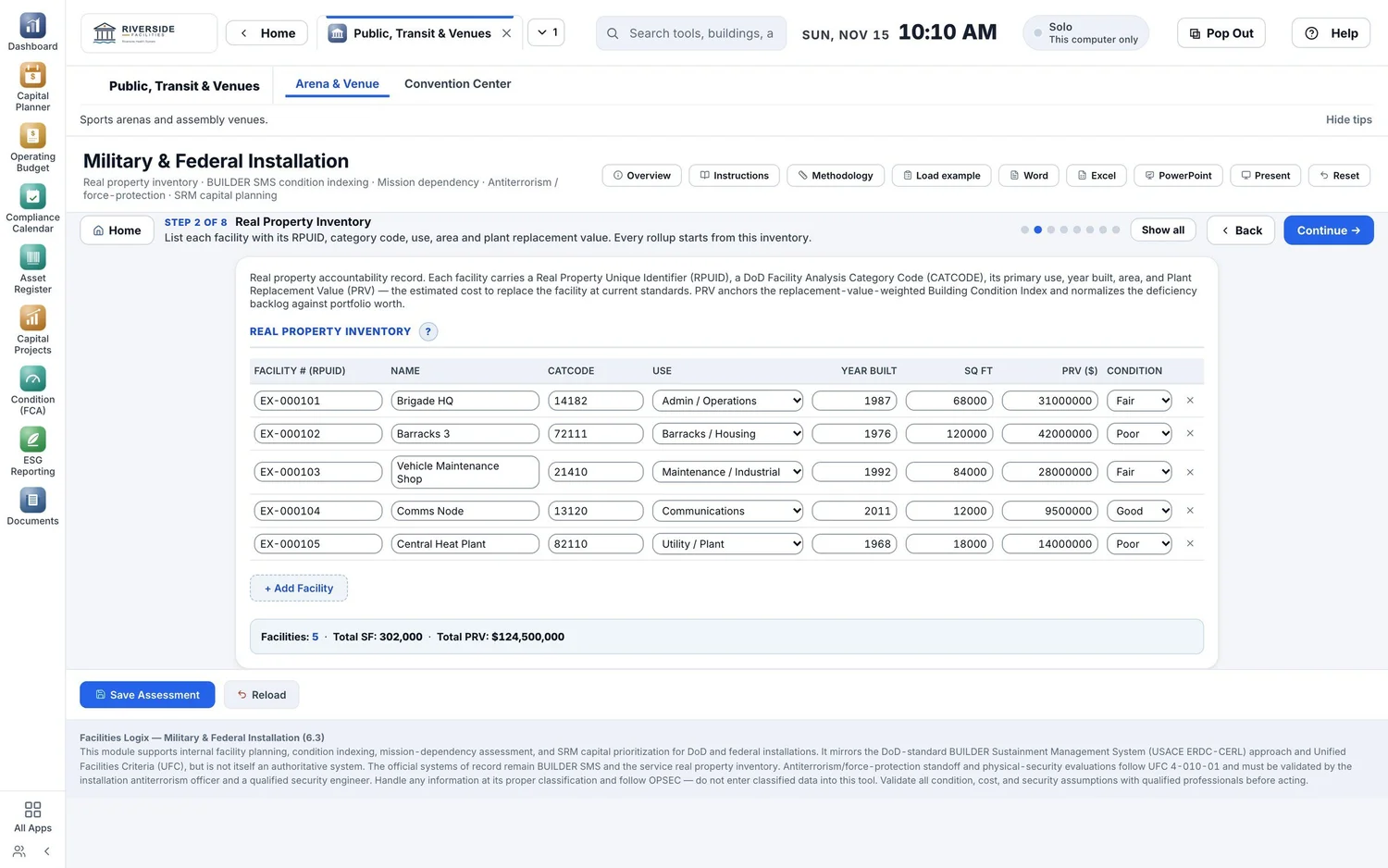
Installations keep property data in several systems, so the real property inventory holds each facility in one place.
Ready for the Data Call
Compliance Tab
Every inspection, test and filing that applies to the building and why, with its citation, frequency and next due date shared with the Compliance Calendar.
Learn MoreWord, Excel, PowerPoint and Present
The installation type, inventory, condition, mission and security, SRM capital and the obligations go into the reports and the Present view.
Learn MoreShow Less
Budget requests compete for the same SRM dollars, and the one with clear numbers is easier to defend. The report opens with a decision summary and four key figures, then the installation's own charts and tables.
- Charts: condition index by facility, and programmed SRM by fiscal year
- Tables for inventory, mission dependency and AT/FP, programs and funding, and SRM projects
- A separate compliance report counts obligations and overdue items
- Calculation methods printed for reviewers

Report pages for Military Installations: charts and tables built from the facility's own records, ready to present.
FRPP Data Sheet
An Excel workbook in dictionary column order with the December 15 data and January 31 certification dates. Use Facility Condition Assessment Values fills replacement value and repair needs. Nothing is uploaded.
Learn MoreShow Less
Keying FRPP data from scattered records costs analyst hours every year. The data sheet pulls values already in Facilities Logix and says where each one came from.
- A Filled From column names every value taken from another tool
- Replacement value and repair needs come from the condition assessment's CRV and deferred maintenance
- Amber needed cells mark required elements not yet entered
- Deadline rows show days left, then Due within 30 days, then Past due date
ENERGY STAR
The building against the national median for its Portfolio Manager property type. Barracks get a 1-100 score but are not eligible for ENERGY STAR certification.
Learn MoreShow Less
Energy cut at one building frees operating money for another. The tab shows each building's gap to the median for the Portfolio Manager type you pick, so efficiency projects go to the worst buildings first.
- Types include office, barracks, repair shop, warehouse, food service, gym, child care, hospital, data center and lab
- Barracks source median 107.5 kBtu/sf
- Data centers compare by power usage effectiveness instead of square feet
- Offices and non-refrigerated warehouses can earn certification
Guiding Principles and EISA
A Guiding Principles tab for sustainable federal buildings, and the EISA §432 tracker with a worksheet laid out for the federal tracking system.
Learn MoreShow Less
Life-cycle cost-effective EISA measures must be put in place within 2 years of the evaluation, so tracking them turns evaluations into real savings. The tracker and the Guiding Principles tab keep both on a 4-year rhythm.
- Each measure: cost, LCC net savings, kWh, gas and water saved, life and funding
- Next evaluation due 48 months after the last; implement-by date 24 months after it
- Guiding Principles met when every applicable core criterion and at least 9 others are met
- Notes that EO 14057 was revoked; whether to assess is your agency's call
The Measures Installation Leadership Uses
Condition and Mission
- Portfolio building condition index, weighted by plant replacement value
- DoD condition rating: 1 minus deficiencies over replacement value, banded Good, Fair, Poor and Failing
- Mission-critical facilities (mission dependency 85-100), standoff deficiencies and standoff not assessed
- Deficiency backlog and programmed SRM
Funding Yardsticks
- Sustainment rate: sustainment funded divided by the Facilities Sustainment Model requirement, against the OSD goal of 90%
- FSRM investment as a share of plant replacement value against the 10 USC 2680 floor: 1.75% FY2027, 2.5% FY2028, 3.25% FY2029 and 4% from FY2030
- Barracks over the 20% ceiling
- Army Q-rating for each facility: Q1 at or below 10%, Q2 at or below 20%, Q3 at or below 40%, Q4 over 40%
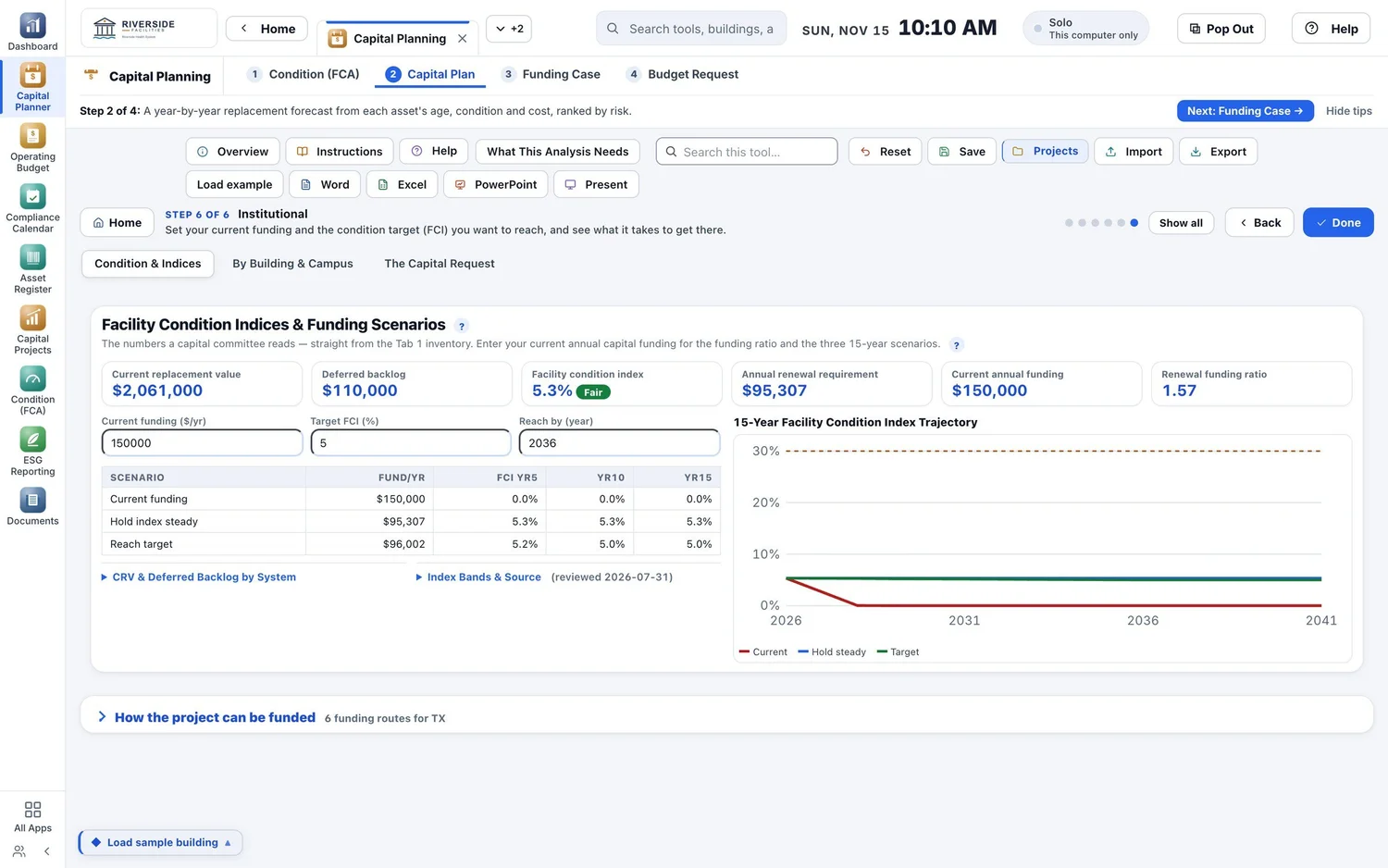
One Picture of the Installation
The Right Rules, Not All of Them
Answers about what the installation actually has decide which rows appear, so teams work the inspections that apply and are not buried in the ones that do not.
Learn MoreShow Less
Every inspection that does not apply is contractor money and staff time spent for nothing. Rows appear only when the matching facility is answered Yes, and the Building Record decides which federal rule set applies.
- DoD components get the UFC set; other agencies see those rows marked Confirm
- Non-DoD waterfront sites get federal rows such as UFC 4-159-03 pier inspections and NFPA 307
- A state-owned armory gets only the National Guard rows that reach it
- Coast Guard shore facility rows for DHS, U.S. Coast Guard
Money Where the Mission Is
Condition, mission dependency and SRM capital side by side show where limited sustainment dollars protect the facilities the mission cannot do without.
Learn MoreShow Less
Sustainment dollars are limited, and spending them by condition alone can fund a low-mission building ahead of a critical one. Condition, mission dependency and the SRM list sit side by side, so priority follows both.
- SRM projects carry type, priority, fiscal year, cost and driver
- Backlog: programmed SRM plus the deficiency cost from condition
- A note warns the two can double-count work that fixes a listed deficiency
- Critical and High SRM projects publish as Urgent capital
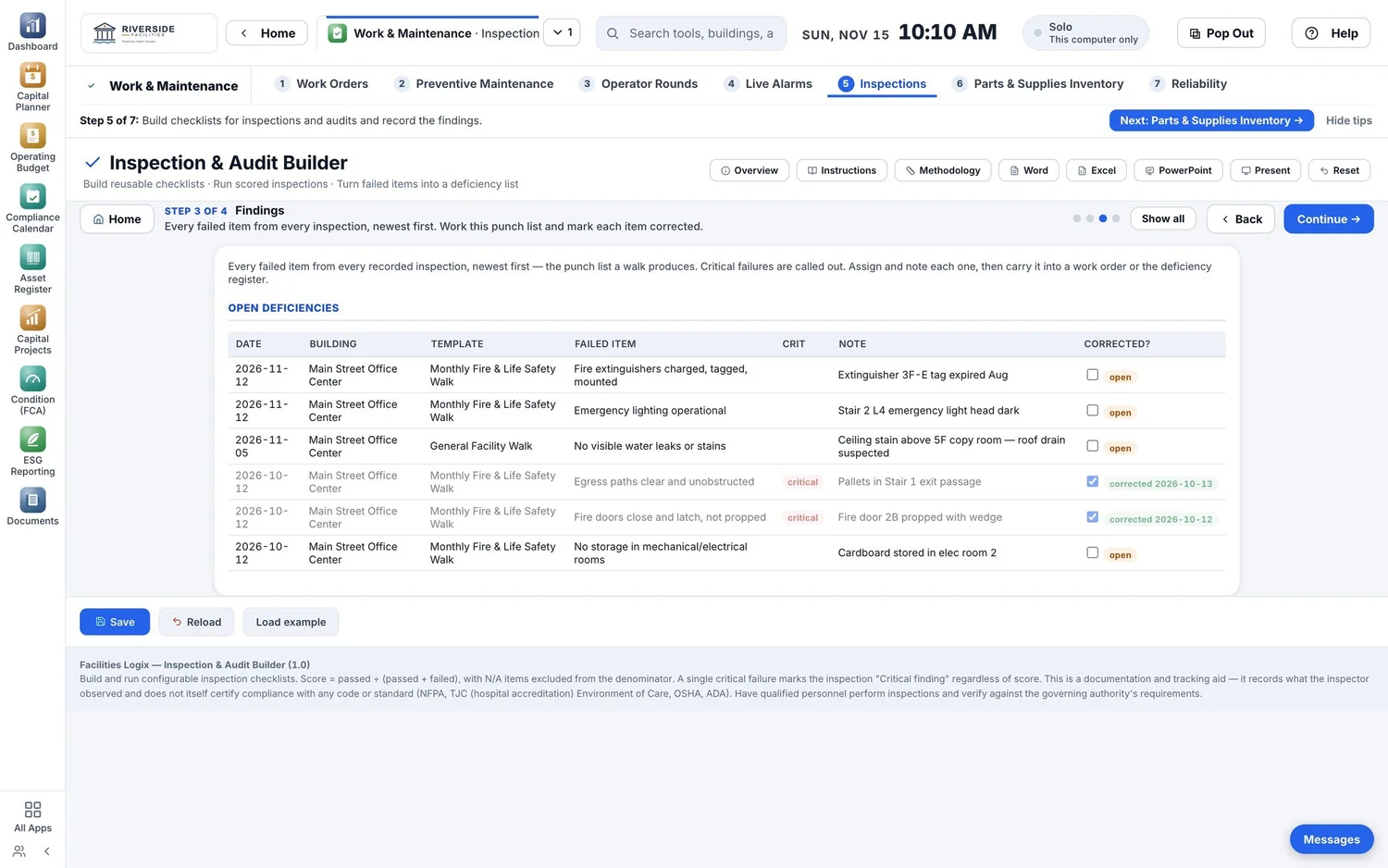
Findings in Inspection & Audit Builder: every failed item from every inspection, newest first. Work this punch list and mark each item corrected.
Reporting Without Retyping
The FRPP fields, the data sheet and the EISA worksheet come from the records you already keep, with every blank listed before reporting.
Learn MoreShow Less
Every value typed twice is analyst time spent and a chance for two copies to disagree. FRPP fields, the data sheet and the EISA worksheet read the records the team already keeps.
- FRPP replacement value and repair needs from the Facility Condition Assessment
- EISA worksheet in FEMP Compliance Tracking System column order, ready to paste
- Still Needed Before Reporting lists blank elements and failed value checks
- Nothing is uploaded; the agency keys or pastes the data itself
Planning, Not the System of Record
The playbook supports internal planning. Your service's official systems of record still govern, and classified information is never entered.
Learn MoreShow Less
Testing a priority list or budget scenario costs nothing in a planning tool and leaves the official record untouched. The playbook is built for that work and says so on screen.
- BUILDER SMS and the service real property records remain the systems of record
- No classified information is entered; follow OPSEC
- The FRPP workbook is a record to key from, not a submission
- An installation's FSRM share is a planning yardstick, not the statutory test
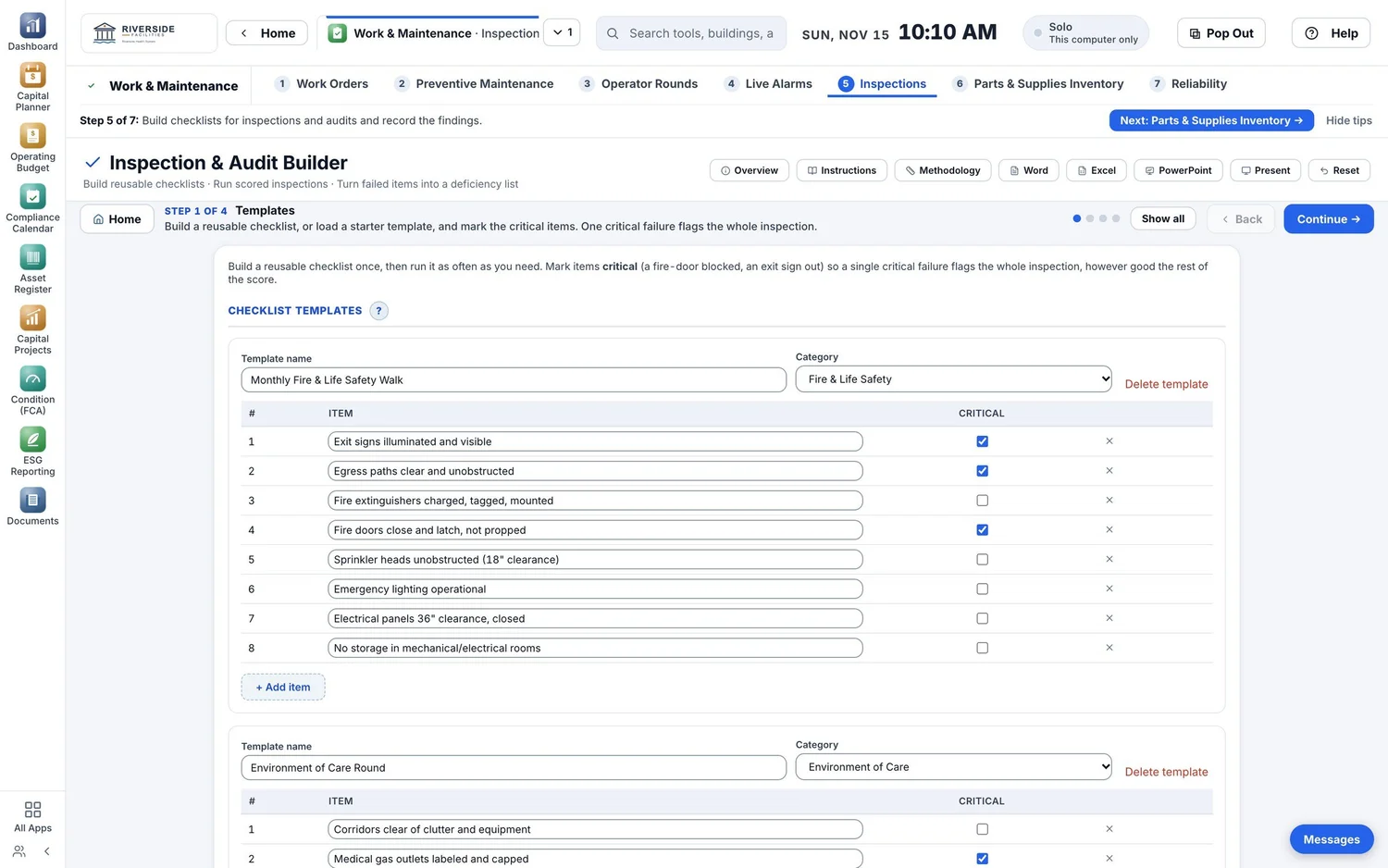
Templates in Inspection & Audit Builder: build a reusable checklist, or load a starter template, and mark the critical items. One critical failure flags the whole inspection.
Frequently Asked Questions
Does it replace our service's official real property and condition systems?
Should classified information be entered?
How does it handle an agency that is not DoD?
Are ships part of the real property inventory?
Be First When Facilities Logix Opens
Stop chasing building records across spreadsheets and binders. Join the list and we will tell you the day downloads open, with setup guides ready.
Launching early 2027 for Facilities Logix. Nothing to buy today, and no sales calls.
