
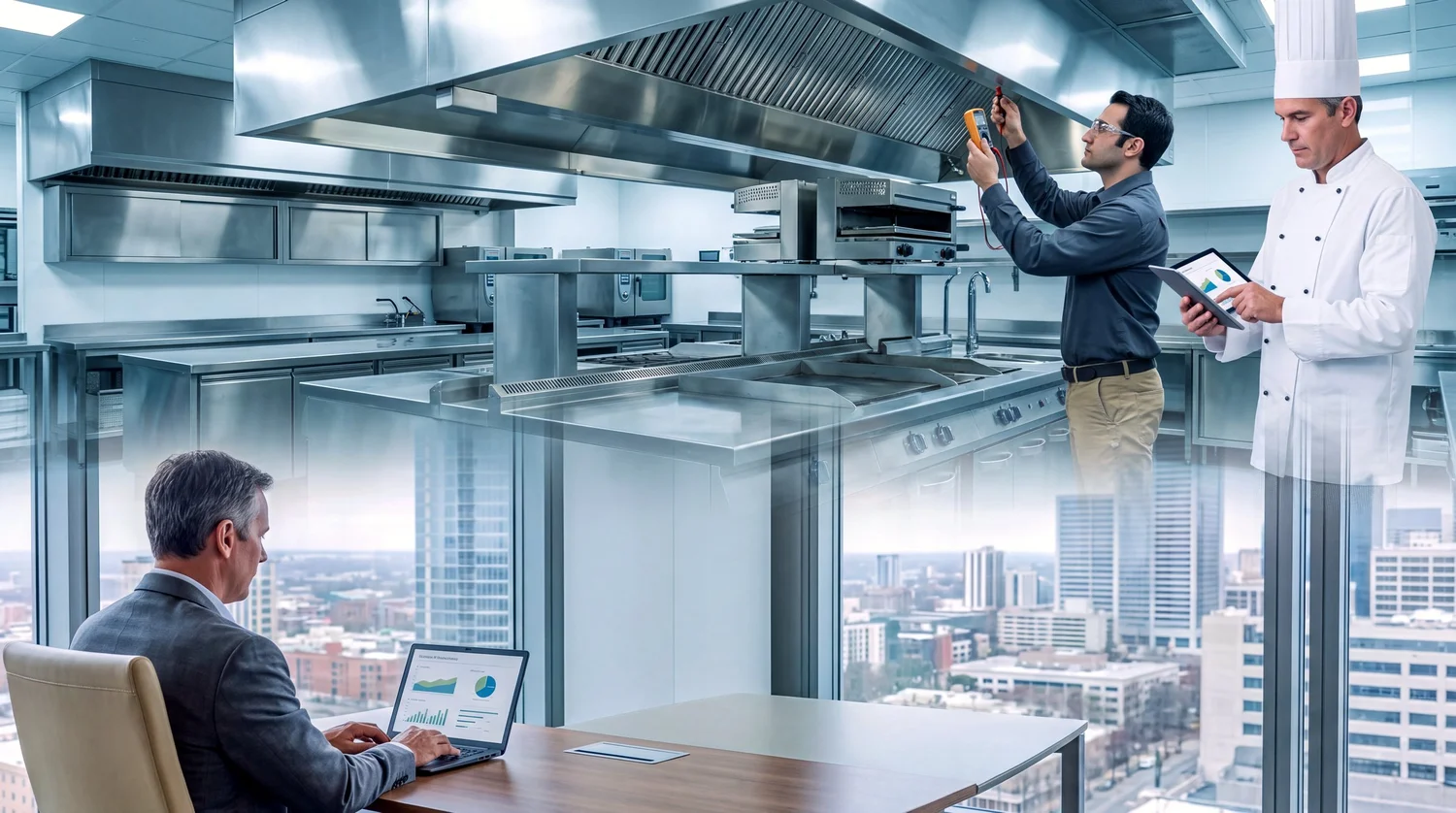

Guest-Ready Every Hour, Inspection-Ready Every Day.
Launching Early 2027 · Join the Early-Access List
Hotels, casinos and restaurants run long hours on kitchens, refrigeration, hot water, pools and life-safety systems, and a failed health inspection or an expired hood tag can close a venue. Facilities Logix has a playbook for each: hotels and resorts, casinos and gaming, and restaurants and food service. Each one starts with the systems and their PM cadence, a capital plan, benchmarks for its type and a Compliance tab that carries the fire, health, pool and gaming obligations that apply, with citation, frequency and next due date shared with the Compliance Calendar.
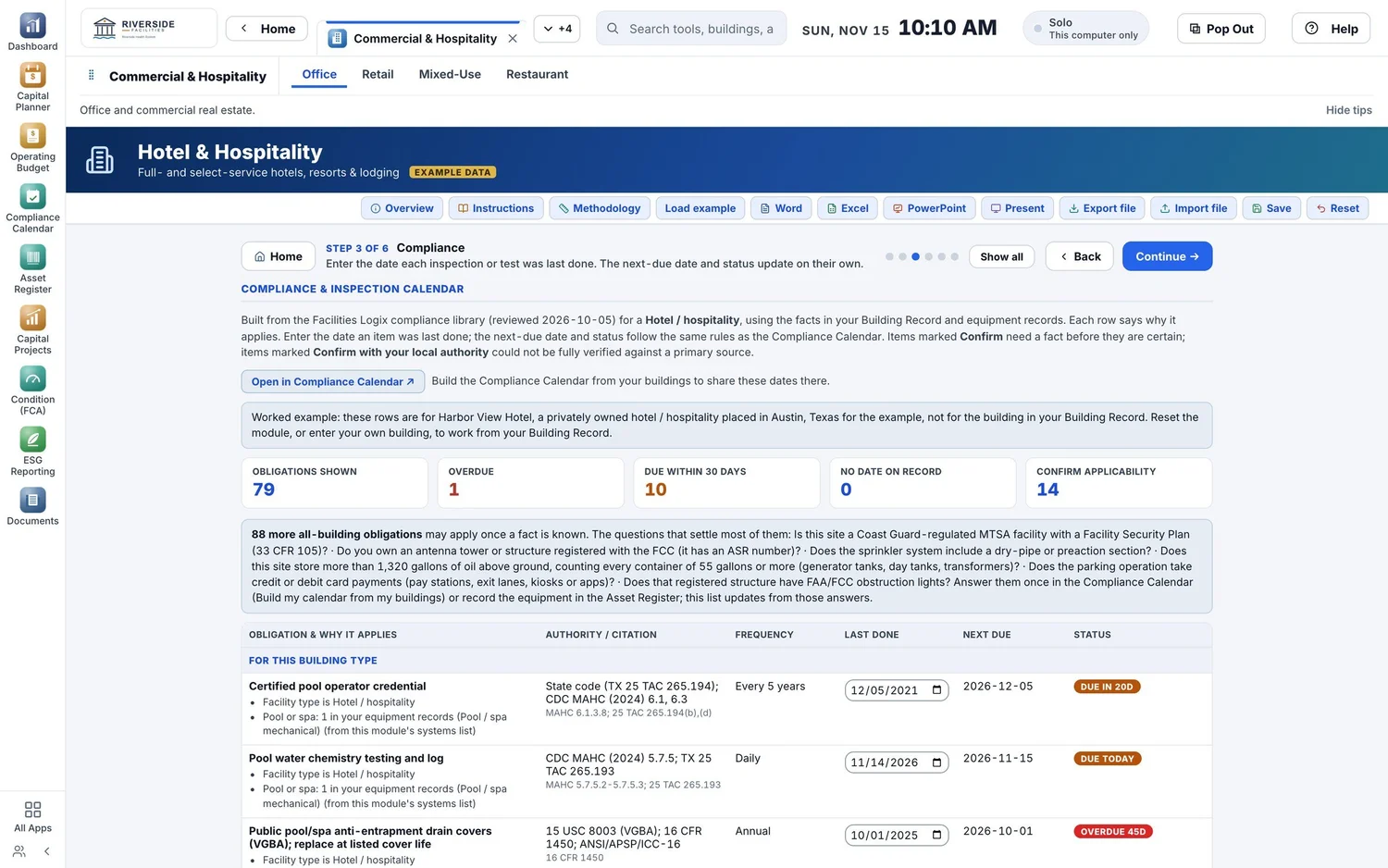
Fire, Food, Water, Pools and Gaming Rules
Rows apply when the property's facts call for them, such as a commercial kitchen, a pool, a grease interceptor or an assembly occupancy. Rows marked Confirm are ones your team checks with the local authority.
Hotels: Fire Drills and Federal Lodging Rules
- Employee fire drills quarterly on each shift for hotels (IFC Group R-1), with NFPA 101 requiring hotel staff to be instructed and drilled
- Hotel and Motel Fire Safety Act: hard-wired smoke detectors in each guest room and automatic sprinklers above three stories, to stay on the FEMA list for federal travel
- Smoke and CO alarms tested every year, smoke alarms replaced 10 years from manufacture and CO alarms at end of life (NFPA 72)
Commercial Kitchens (NFPA 96 and NFPA 17A)
- Exhaust inspected for grease buildup monthly for solid fuel, quarterly for high volume (24-hour cooking, charbroiling, wok), every six months for moderate volume and yearly for low volume, and cleaned when buildup is found
- Hood fire-suppression system serviced every six months
- Grease interceptor pump-out on the local ordinance's schedule; marked Confirm
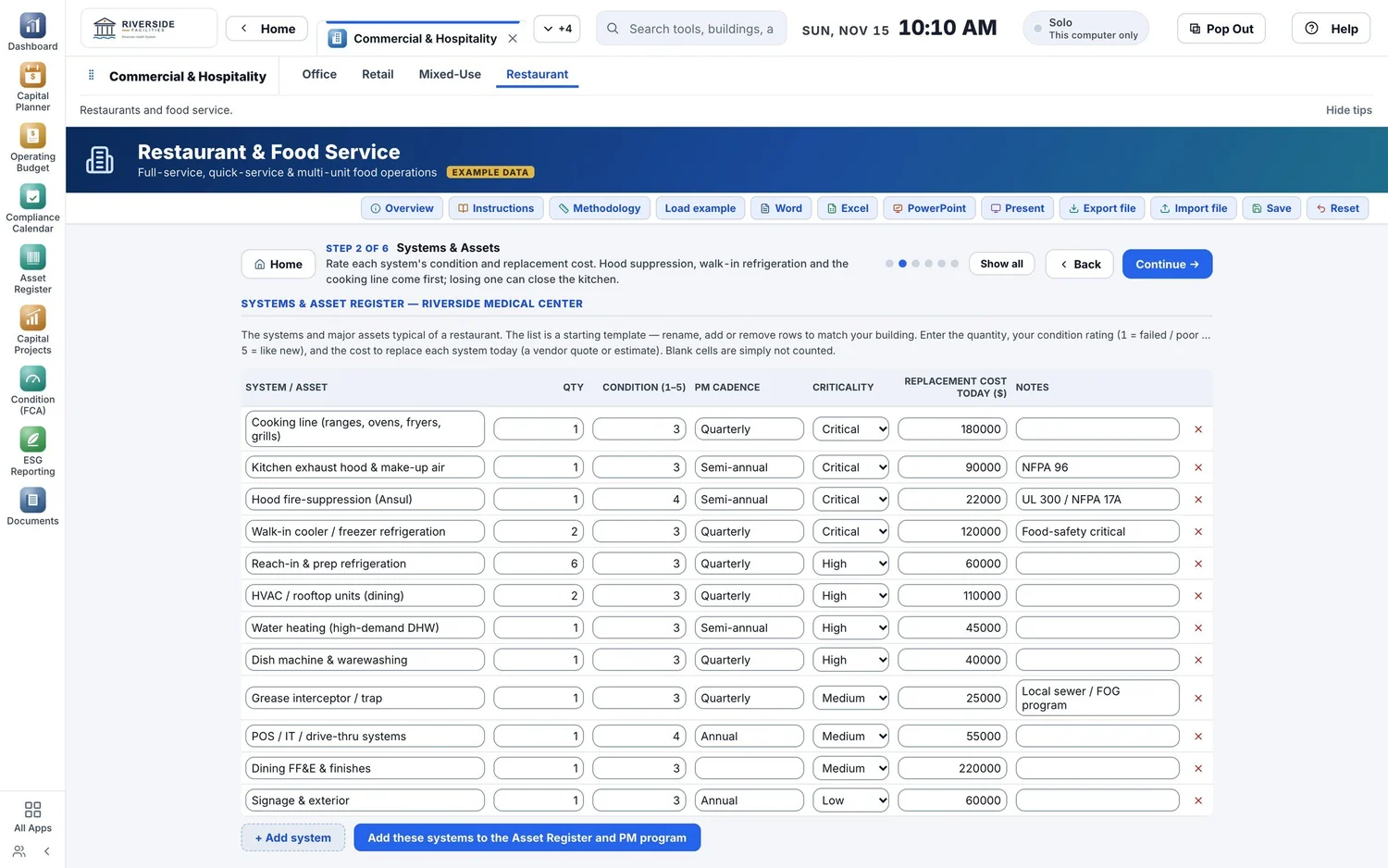
Systems & Assets in Restaurant & Food Service: rate each system's condition and replacement cost. Hood suppression, walk-in refrigeration and the cooking line come first; losing one can close the kitchen.
Food Safety (FDA Food Code)
- The health authority's inspection at least once every 6 months under the model code, unless a risk-based schedule allows longer; the permit renews on the local cycle
- A food protection manager on staff with a certificate from an accredited program, renewed at least every 5 years
Pools and Spas
- Water chemistry tested before opening, then every 2 hours on manual feed or every 4 on an automated controller (CDC Model Aquatic Health Code)
- Anti-entrapment drain covers verified yearly and replaced at cover expiration (Virginia Graeme Baker Act)
- A trained pool operator credential kept current; the operating permit is set locally and marked Confirm
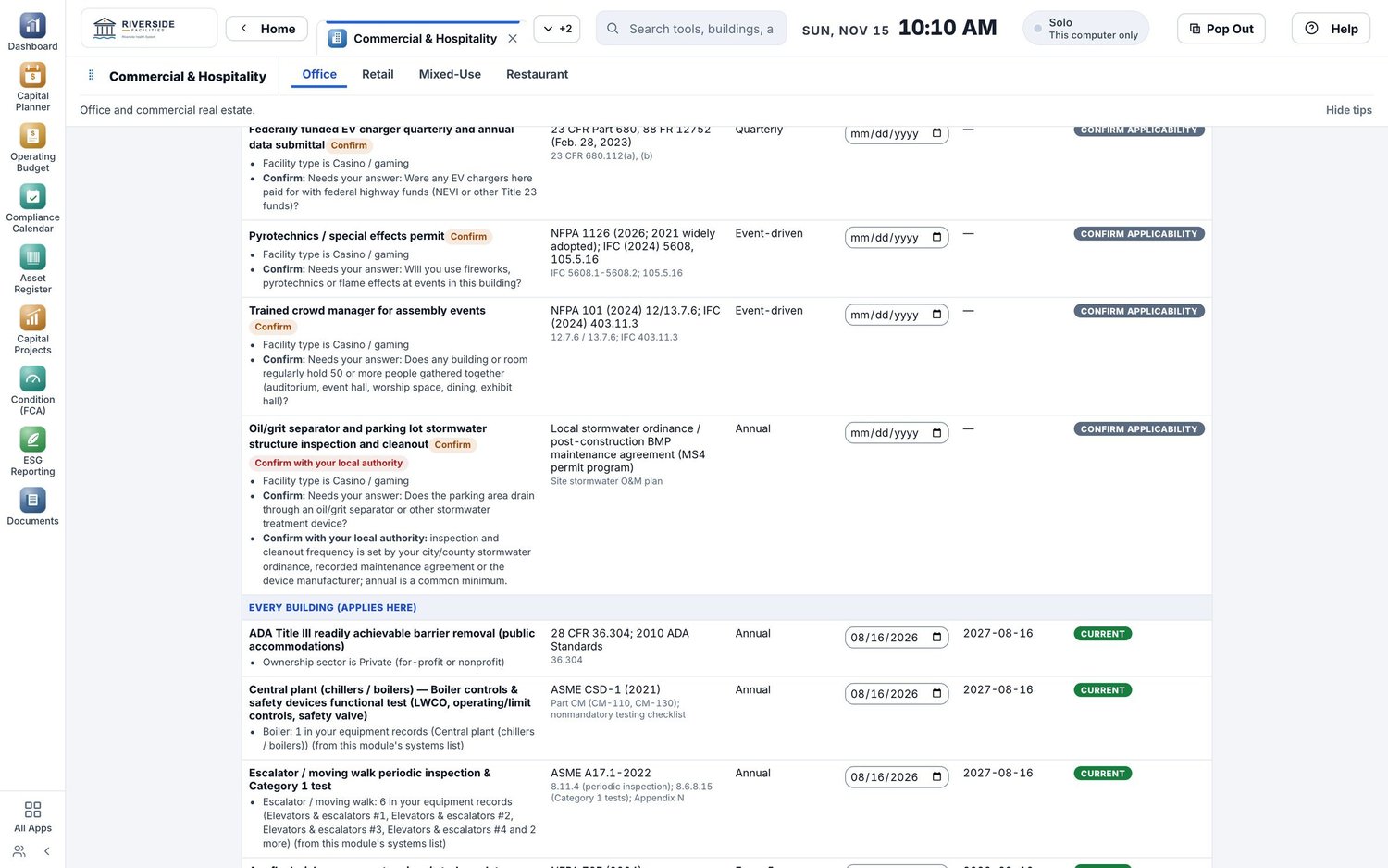
Compliance in Casino & Gaming: enter the date each inspection was last done: fire alarm, sprinklers, hood cleaning, surveillance for the regulator. Next-due and status update themselves.
Water Safety and Refrigerants
- The Legionella water management program reviewed yearly and on change (ASHRAE 188), with cooling tower rows where the property has one
- Backflow assemblies tested at least yearly where they protect against a health hazard
- Refrigerant leak rate worked out at each addition, and technicians holding the right EPA Section 608 certification type
Casinos: Gaming Surveillance and Controls
- Tribal gaming: an independent accountant's agreed-upon procedures review of the minimum internal controls each year, sent to the National Indian Gaming Commission within 120 days of fiscal year end (25 CFR 543), with surveillance controls continuous
- Commercial casinos follow their state gaming commission's rules
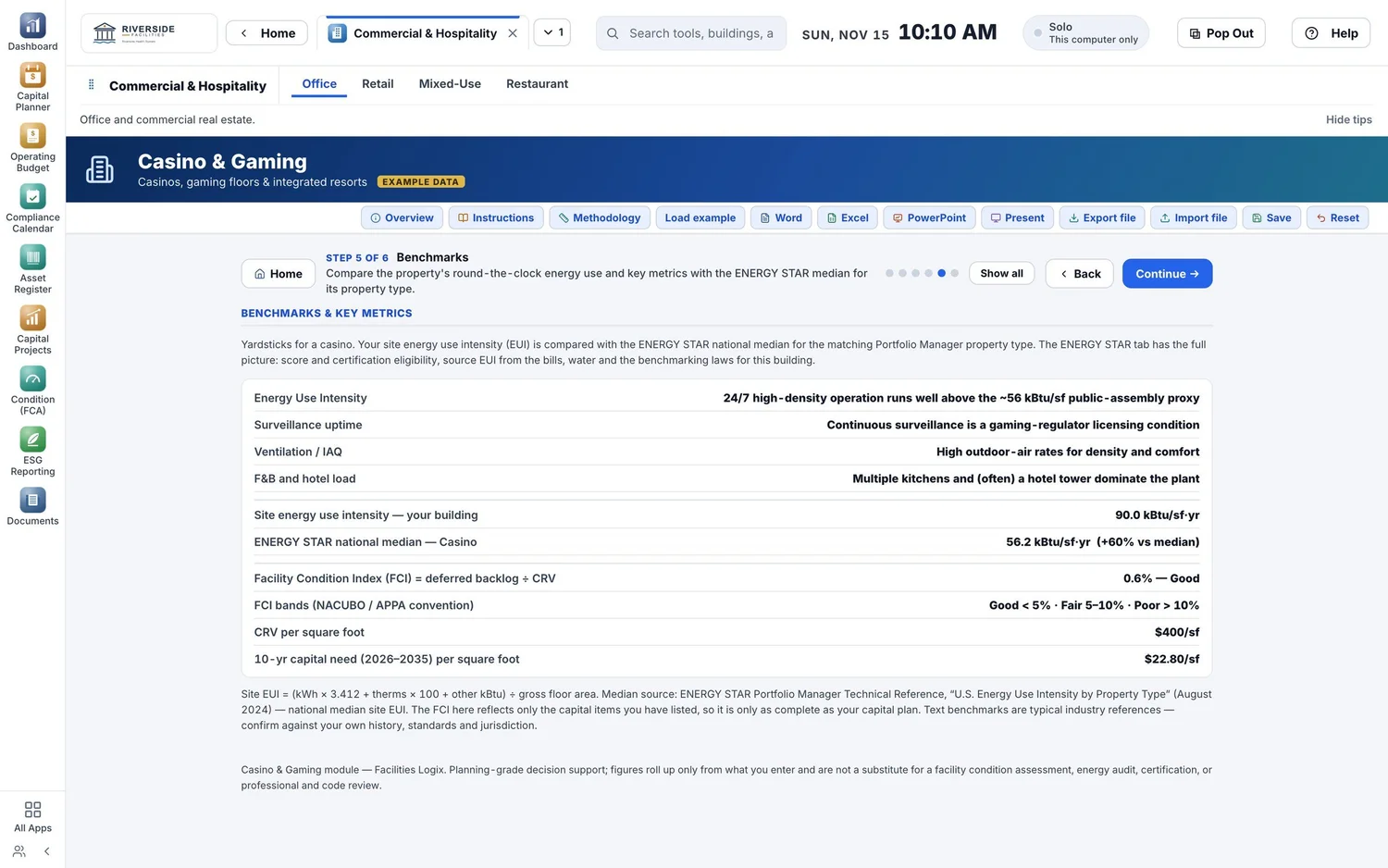
Benchmarks in Casino & Gaming: compare the property's round-the-clock energy use and key metrics with the ENERGY STAR median for its property type.
Assembly and Events
- A trained crowd manager for assembly occupancies, plus one per 250 occupants above 250 (NFPA 101)
- Permits for tents and temporary structures over 400 square feet, and for pyrotechnic special effects, per event (IFC)
Resorts
- Ski lifts and aerial tramways: an annual state inspection and registration where the state has a tramway program; marked Confirm
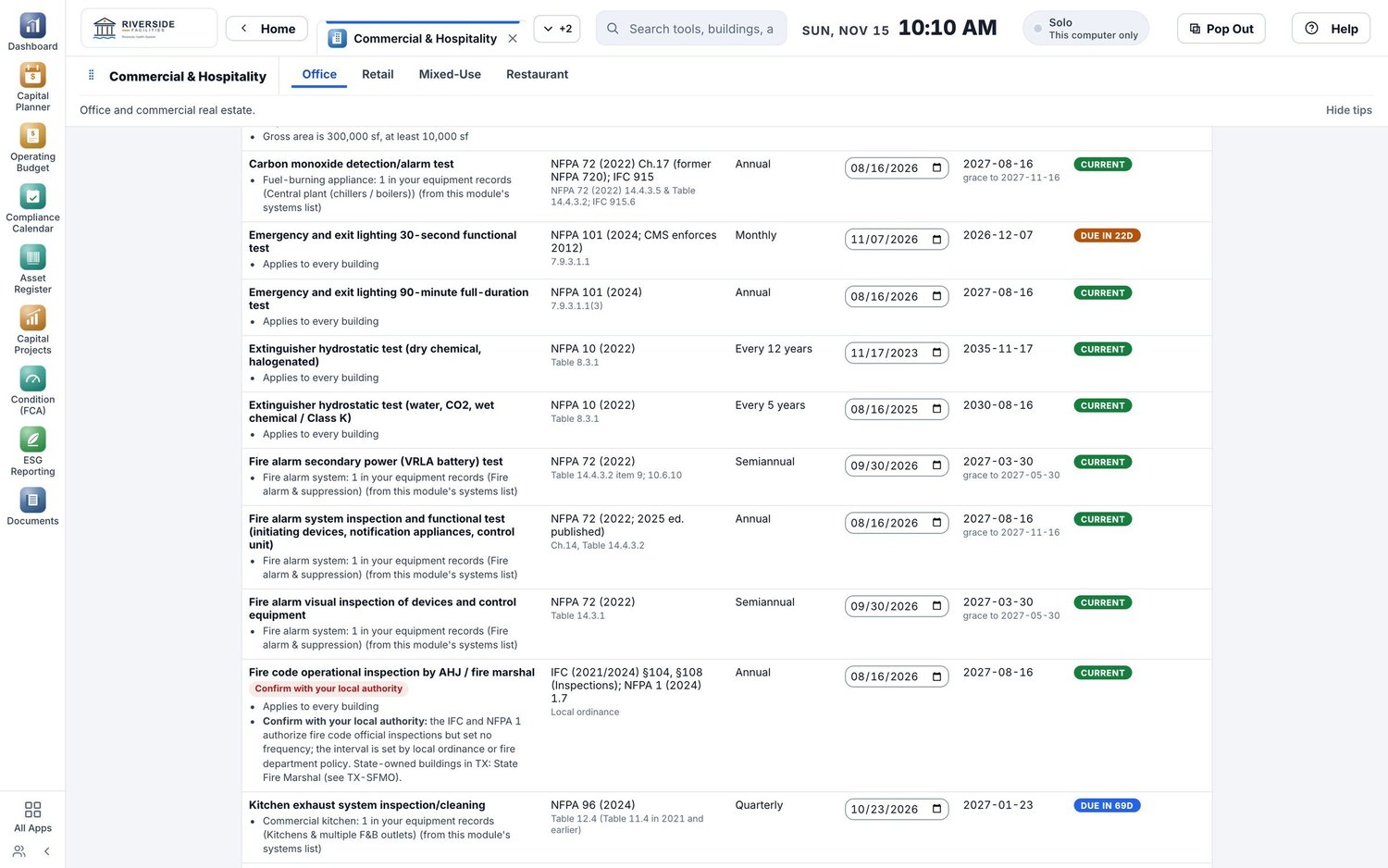
Compliance in Casino & Gaming: enter the date each inspection was last done: fire alarm, sprinklers, hood cleaning, surveillance for the regulator. Next-due and status update themselves.
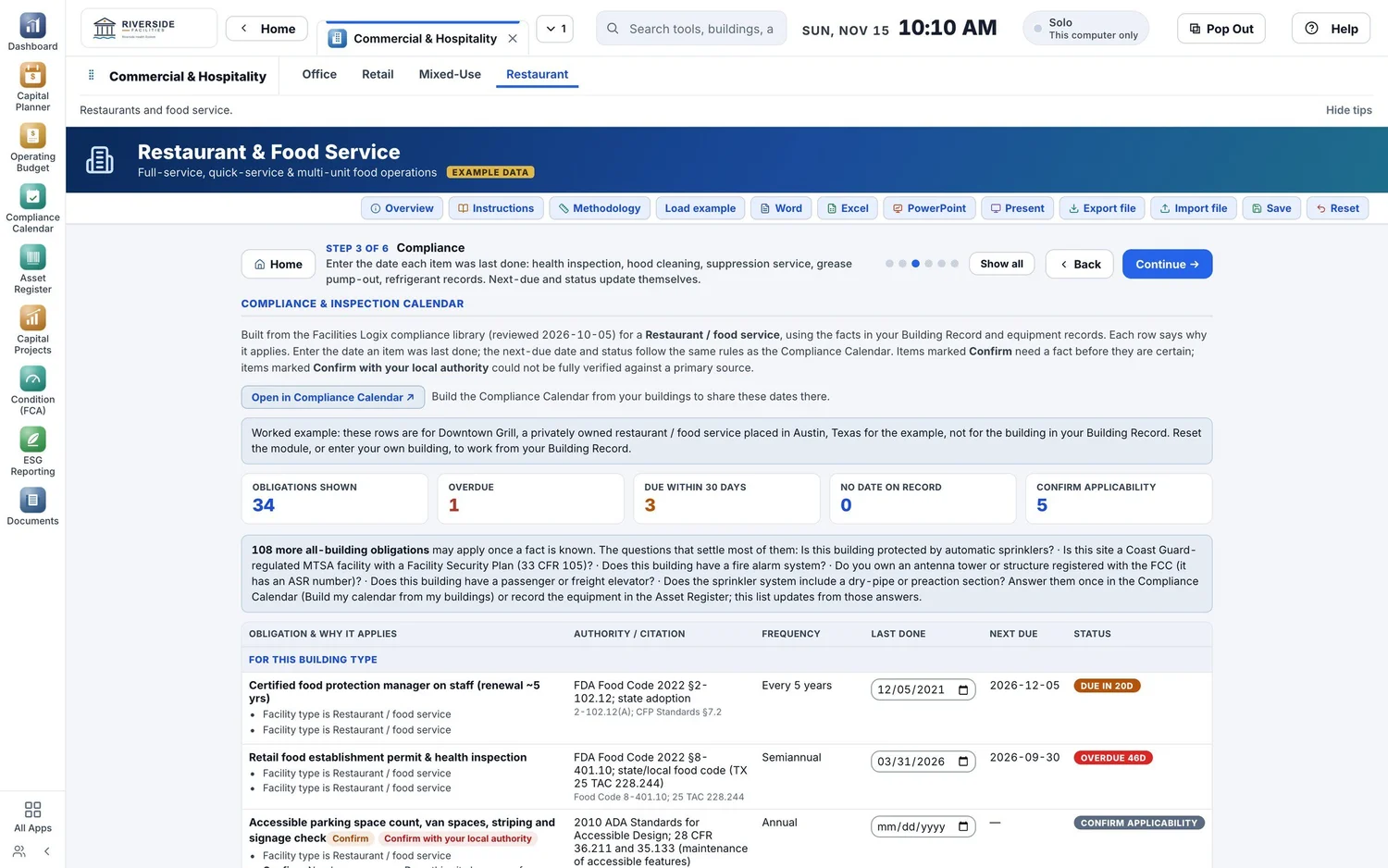
Food, fire and gaming rules depend on what the property has, so only the rows that apply are shown.
Three Playbooks, Each with Its Own Starting List
Hotels and Resorts
- Service levels: full-service, select-service, limited-service, resort, extended-stay and boutique
- Profile: guest rooms (keys), floor area, year built or last renovated, brand or flag, a year of energy
- Guestroom PTAC, VTAC or fan-coil units (every six months), central plant and domestic hot water (every six months; hot water is guest-critical), kitchen hood and suppression (every six months), laundry (quarterly), pool and spa mechanical (weekly), elevators (monthly), fire alarm and sprinklers (annual), generator and egress lighting (monthly), guestroom locks (annual), roofing (every six months), FF&E on the brand PIP cycle, building automation (annual)
Casinos and Gaming
- Types: casino, casino and hotel, integrated resort, tribal gaming, racino
- Profile: gaming floor area, gross floor area, year built, food and beverage outlets, a year of energy
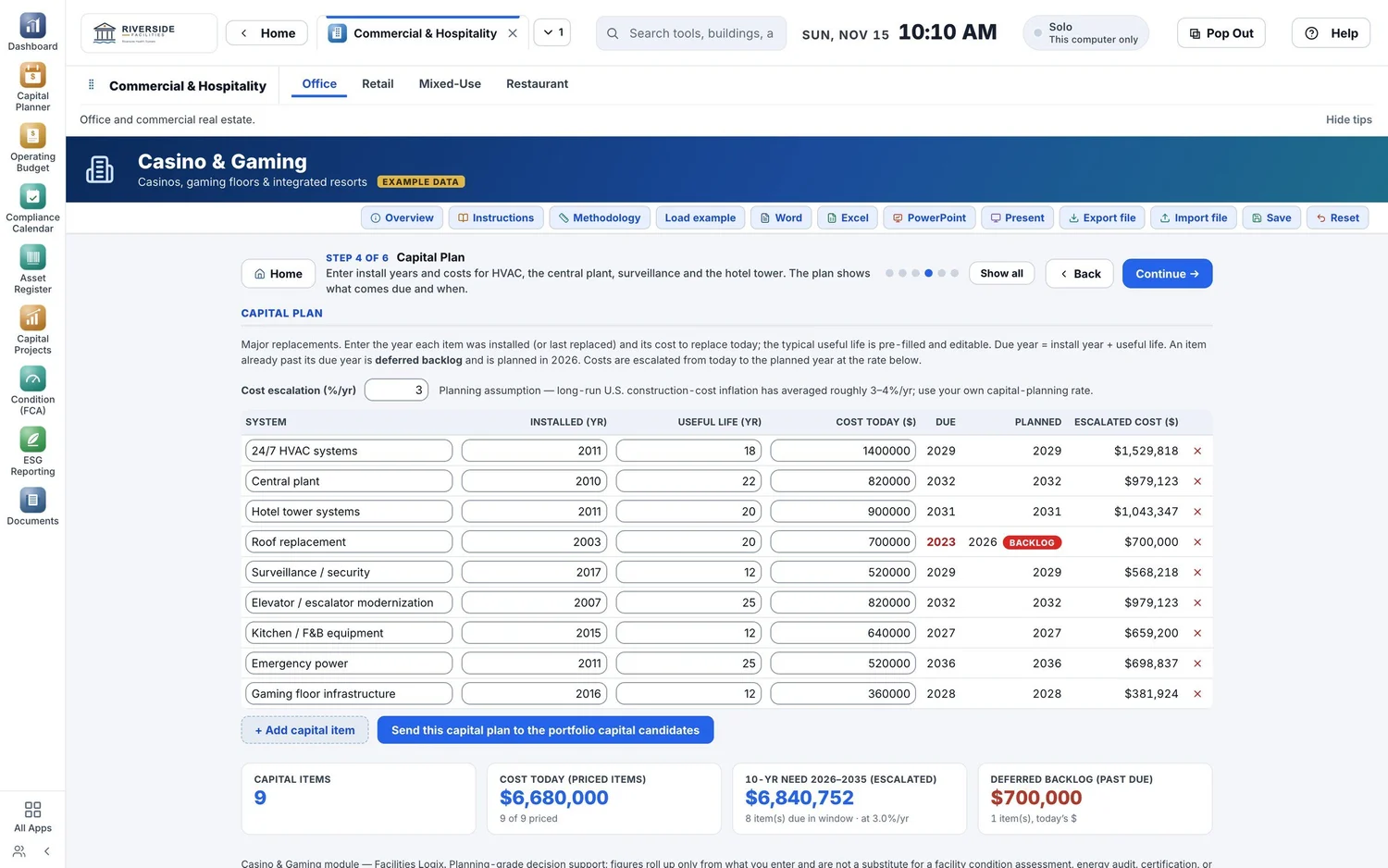
- 24/7 high-ventilation HVAC (quarterly), central plant (every six months), surveillance and security (quarterly, a gaming-regulator requirement), gaming floor power and data (quarterly), kitchens and F&B outlets (every six months), standby power (monthly), fire alarm and suppression (annual), elevators and escalators (monthly), hot water and the hotel tower (every six months)
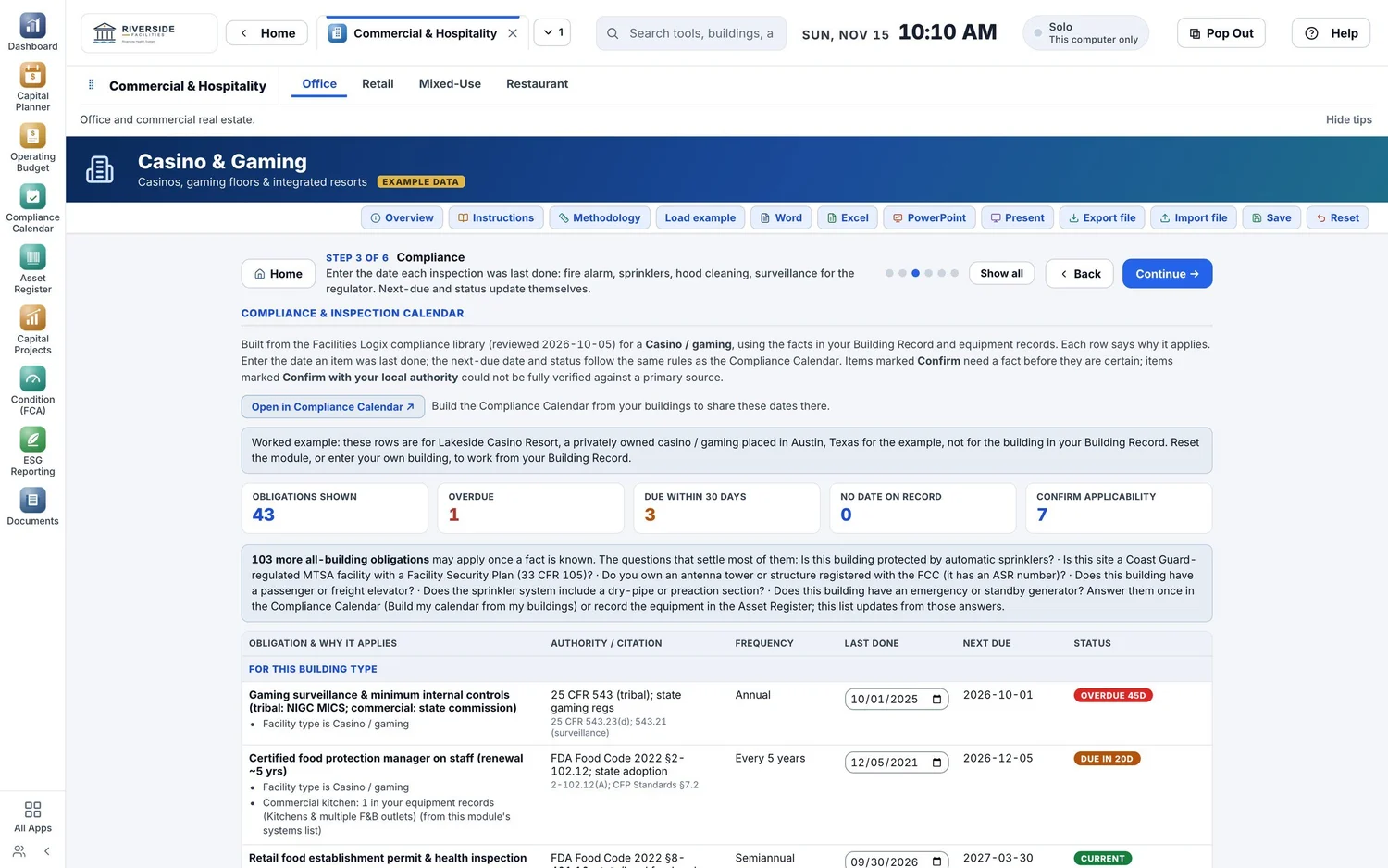
Compliance in Casino & Gaming: enter the date each inspection was last done: fire alarm, sprinklers, hood cleaning, surveillance for the regulator. Next-due and status update themselves.
Restaurants and Food Service
- Service types: full-service, quick-service, fast-casual, cafeteria or institutional, bar or nightclub, ghost or commissary kitchen
- Profile: seats, floor area, last remodel, units in the portfolio, a year of energy
- Cooking line (quarterly), exhaust hood and make-up air (every six months), hood suppression (every six months), walk-ins and reach-ins (quarterly, food-safety critical), dining HVAC (quarterly), high-demand water heating (every six months), dish machine (quarterly), grease interceptor (quarterly), POS and drive-through systems (annual)
Every Row Is Yours
- Rename, add or remove systems to match the property, then rate condition 1-5 and enter replacement cost
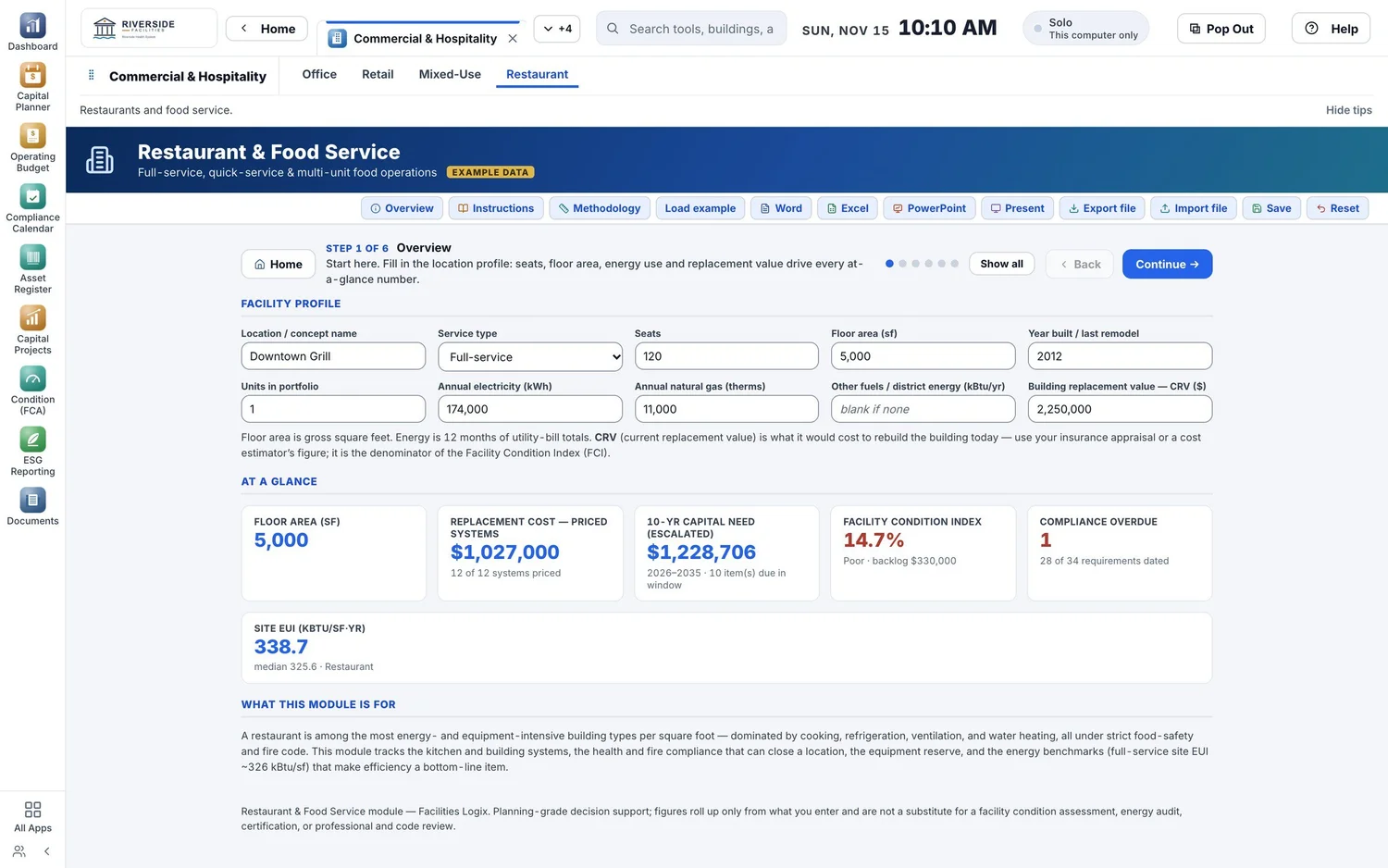
Overview in Restaurant & Food Service: start here. Fill in the location profile: seats, floor area, energy use and replacement value drive every at-a-glance number.
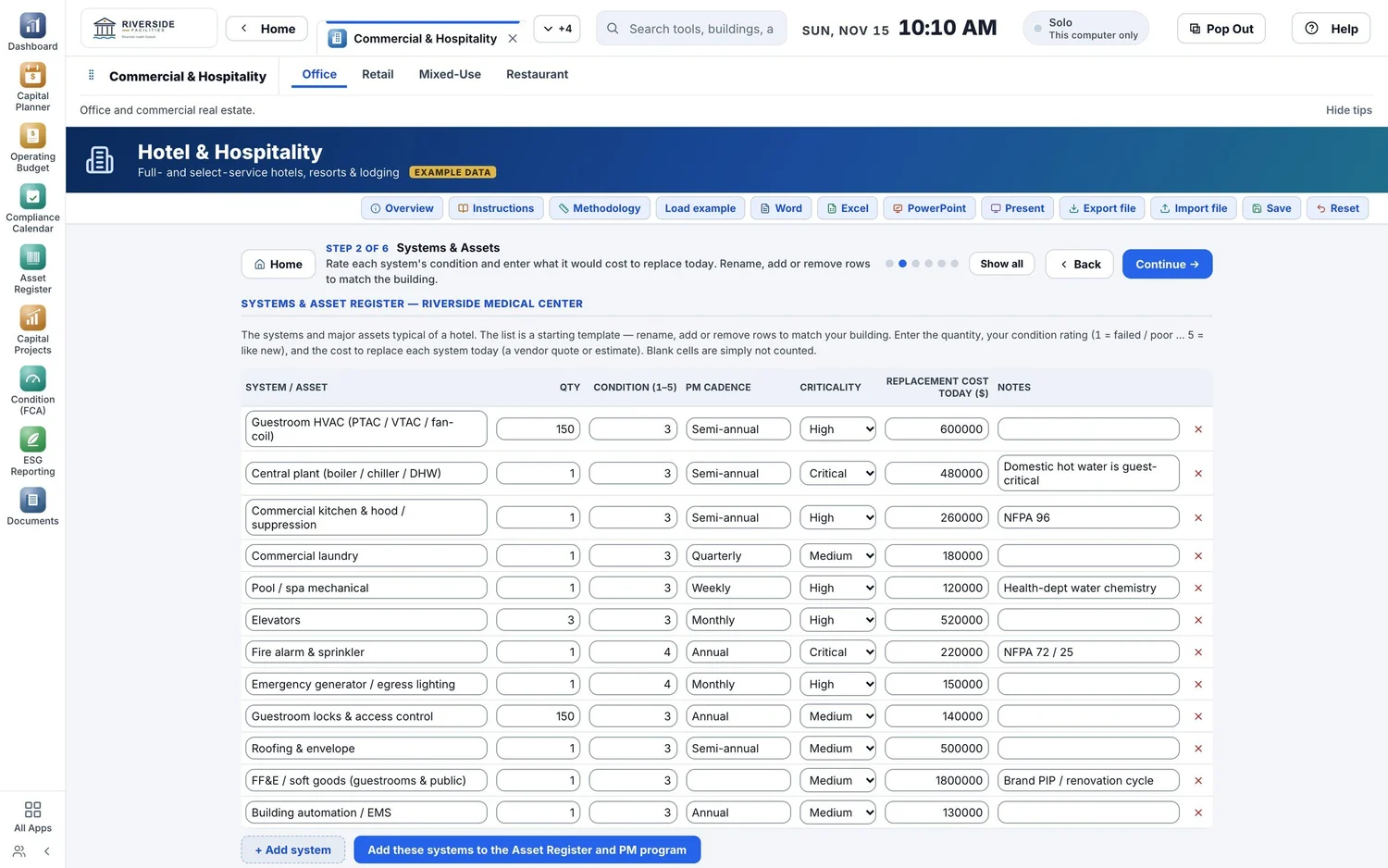
Systems & Assets in Hotel & Hospitality: rate each system's condition and enter what it would cost to replace today. Rename, add or remove rows to match the building.
The Kitchen, the Pool Deck and the Back of House
Kitchen and Food Service Equipment Tool
- Cooking equipment with energy source, install year, condition and remaining life
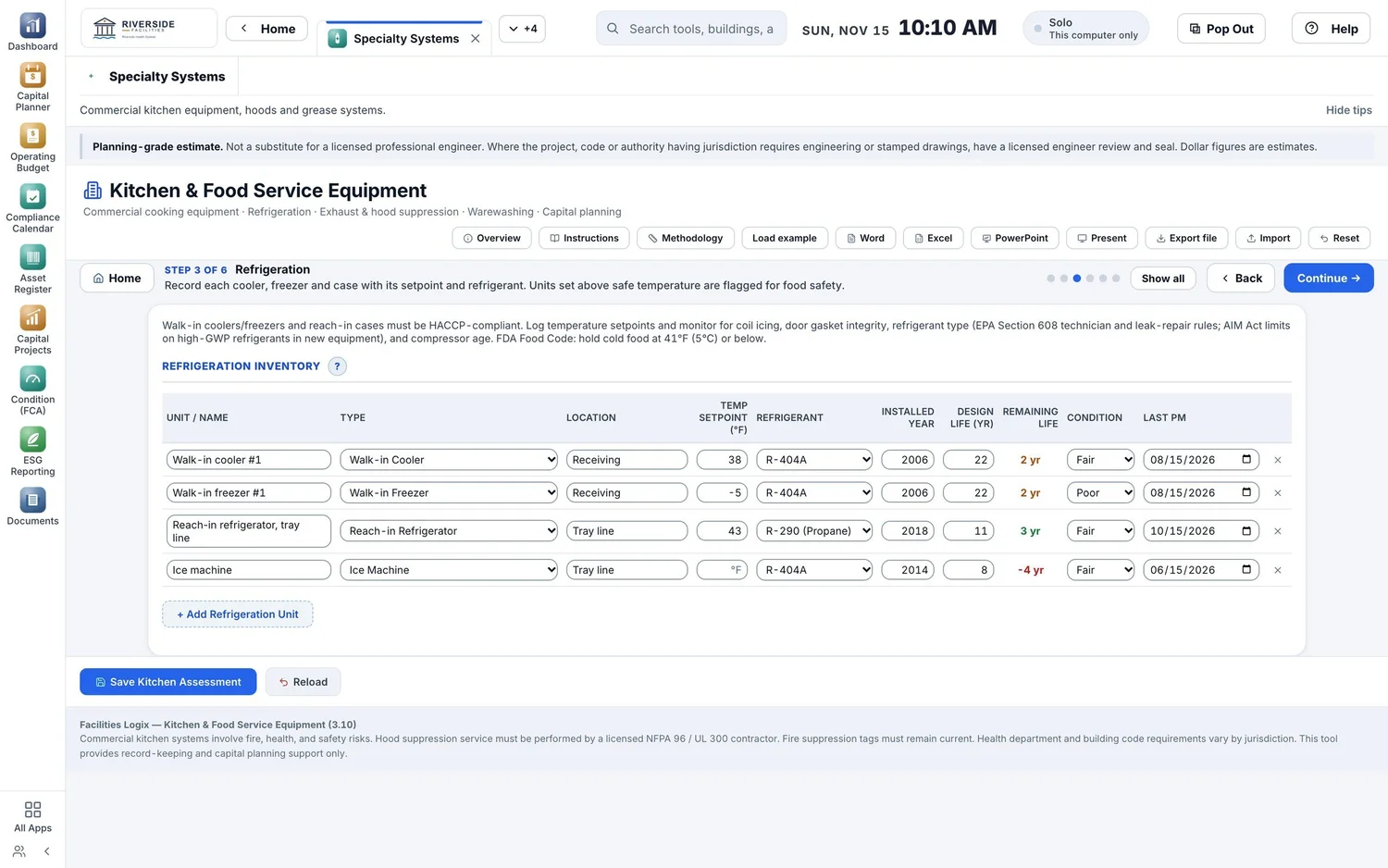
- Coolers, freezers and cases with setpoint and refrigerant; coolers set above 41 °F and freezers above 0 °F flagged
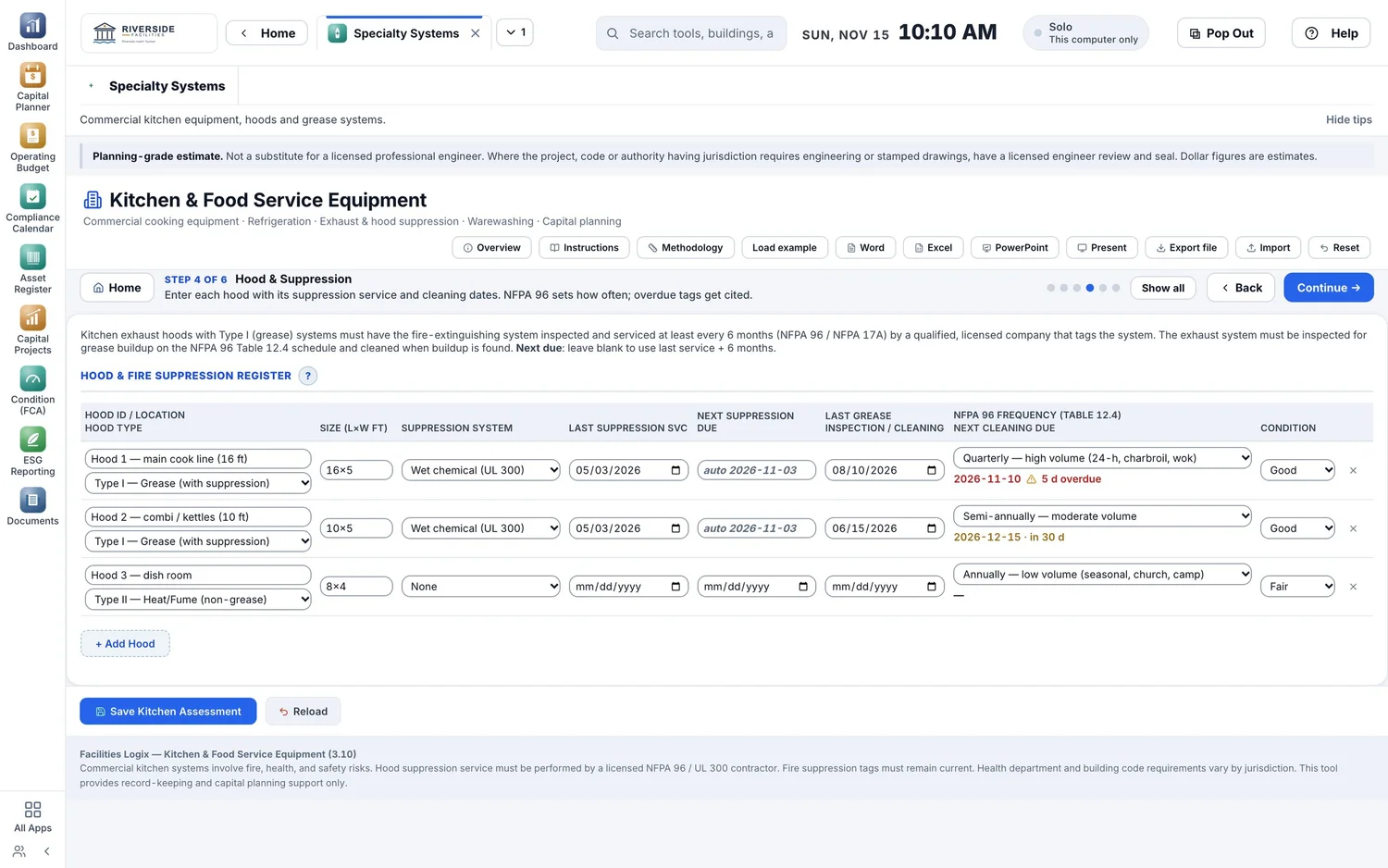
- Each hood with its suppression service and cleaning dates; next suppression service is the last plus 6 months, and the next grease inspection follows the NFPA 96 interval you select
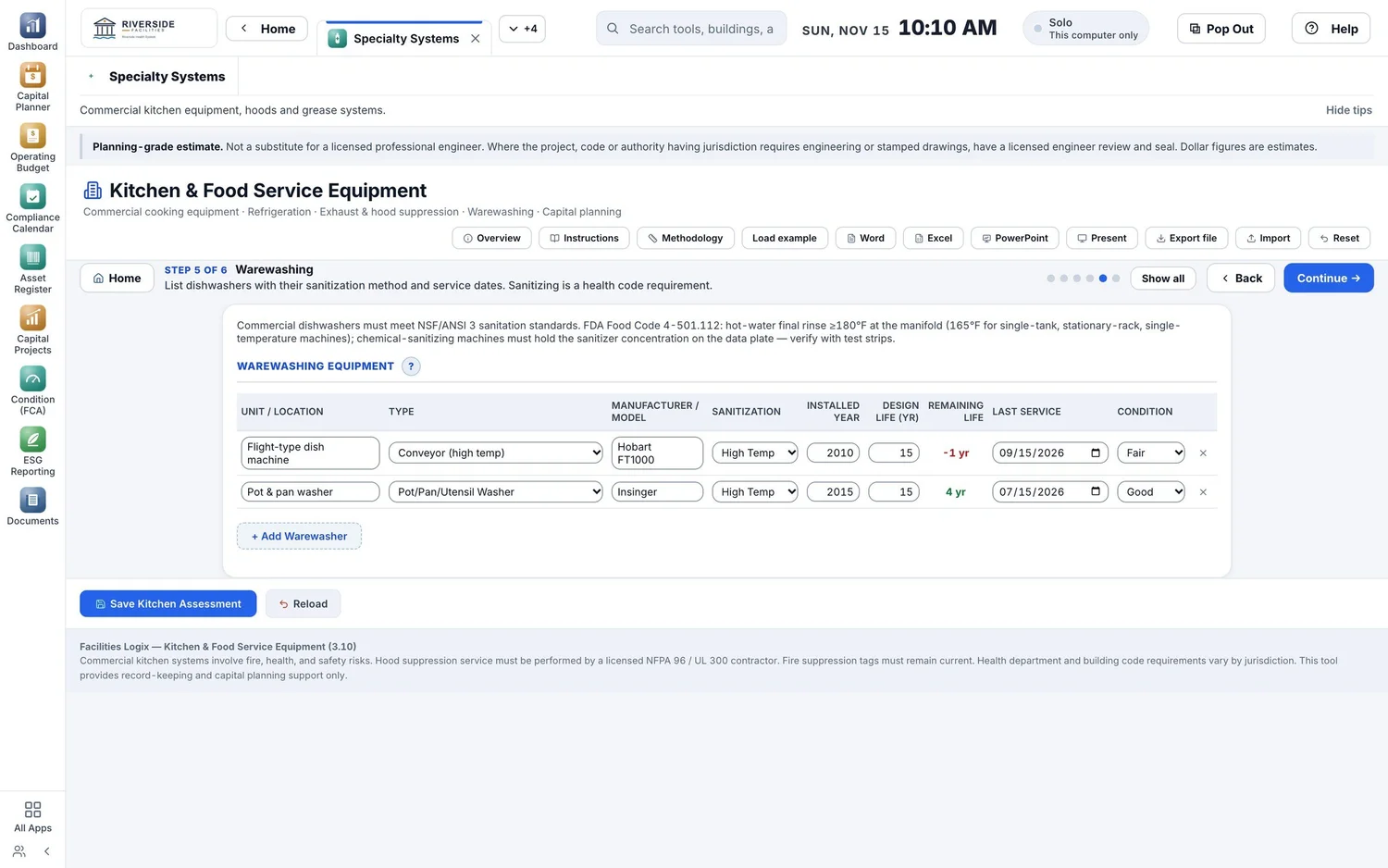
- Dish machines with sanitizing method: a hot-water final rinse of 180 °F at the manifold (165 °F for single-tank, stationary-rack, single-temperature machines) or the chemical concentration on the data plate
Live Monitoring
- Walk-in cooler (FDA Food Code), pool and natatorium, domestic hot water (ASHRAE Guideline 12), boiler, chiller and generator templates with starting limits you set
- An out-of-limit reading becomes a numbered work order with the readings and a trend chart
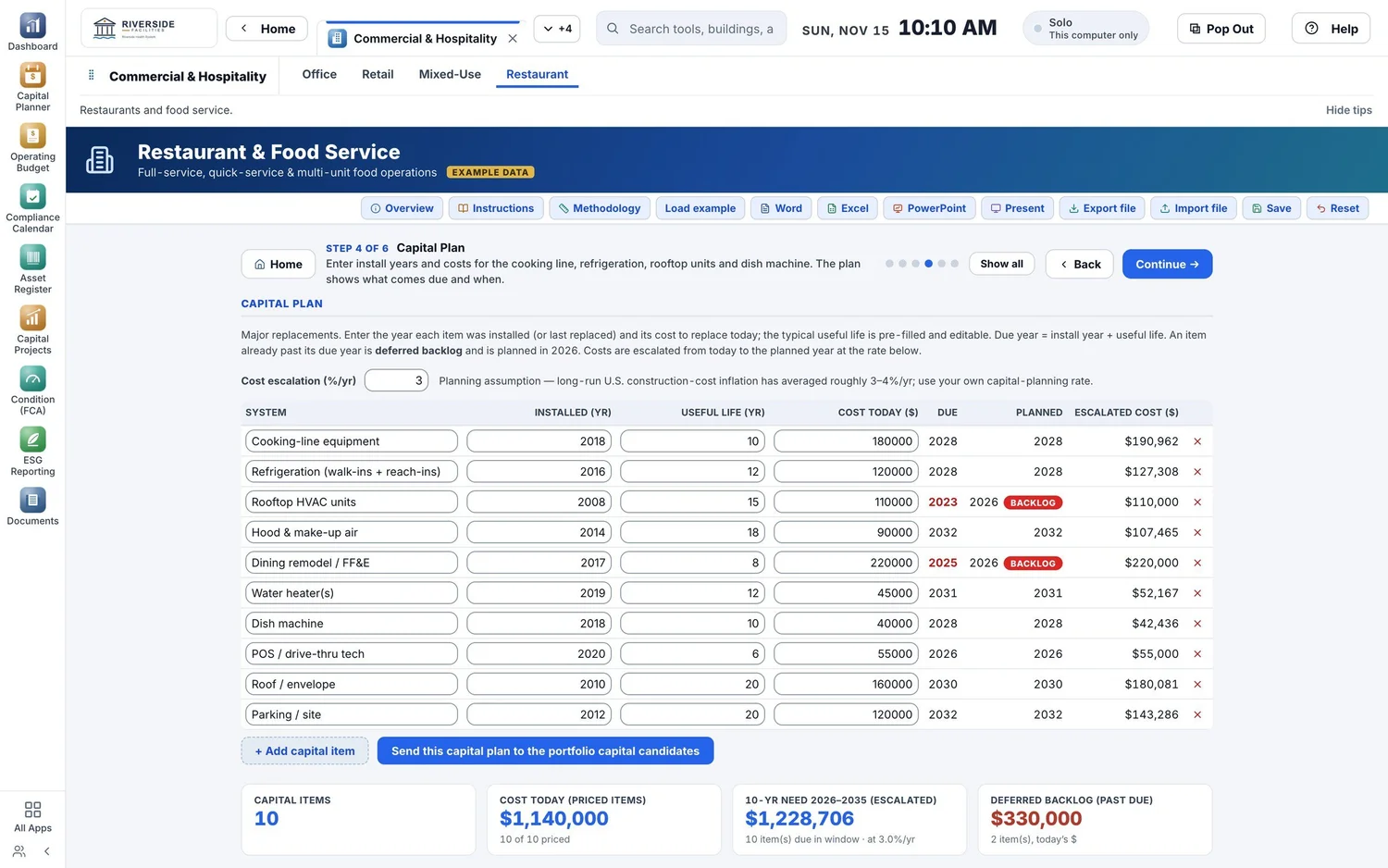
Capital Plan in Restaurant & Food Service: enter install years and costs for the cooking line, refrigeration, rooftop units and dish machine. The plan shows what comes due and when.
Compliance Dates
- Enter the date each obligation was last done; the next due date and status match the Compliance Calendar
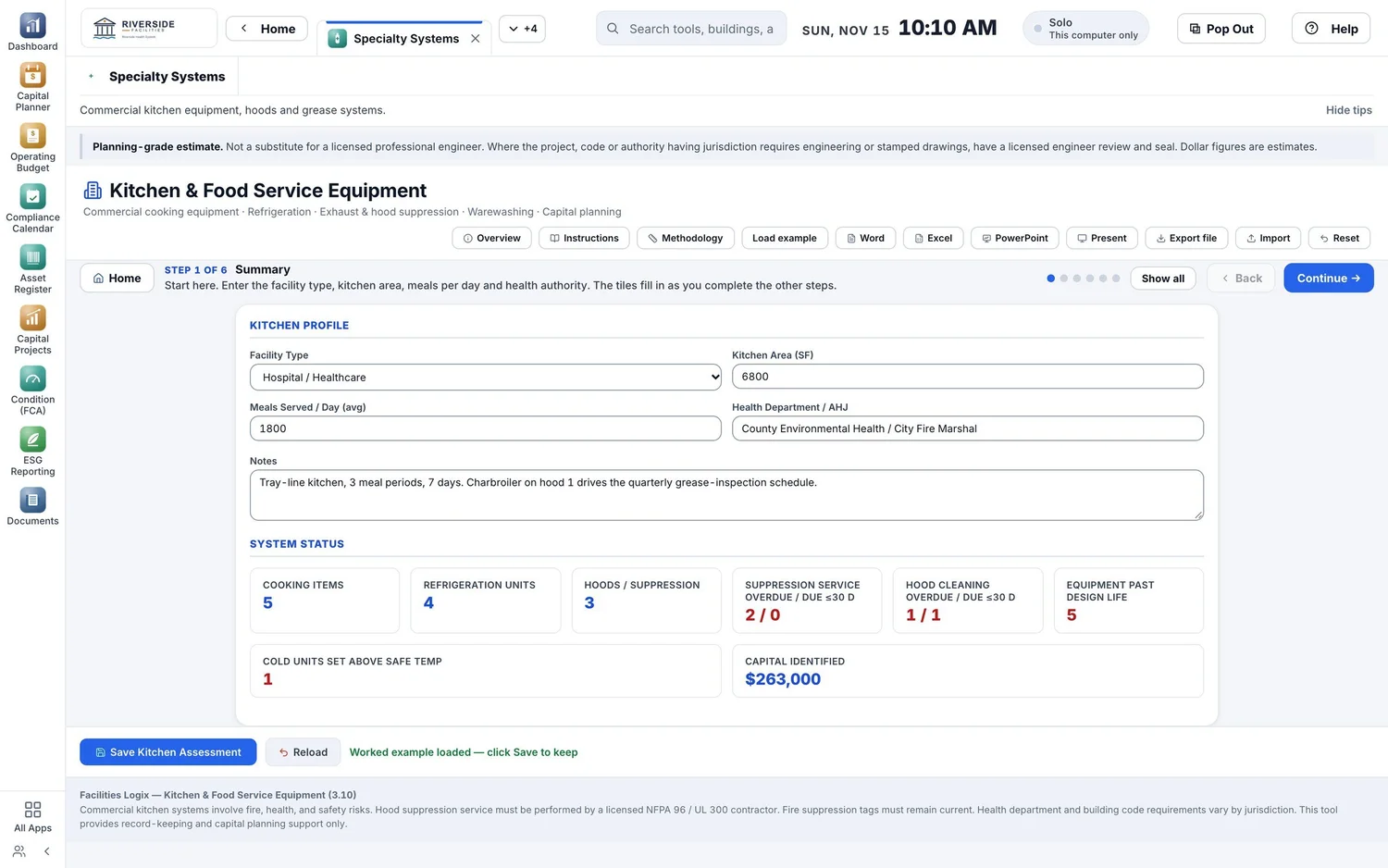
Summary in Kitchen & Food Service Equipment: start here. Enter the facility type, kitchen area, meals per day and health authority. The tiles fill in as you complete the other steps.
Ready for the Health Inspector, the Fire Marshal and the Brand
Capital Plans by Type
Hotels: guestroom soft goods and case goods, PTAC replacement, central plant, roof, elevator modernization, kitchen, pool and life safety. Casinos: 24/7 HVAC, central plant, hotel tower, surveillance, elevators, emergency power and gaming floor infrastructure. Restaurants: cooking line, refrigeration, rooftop units, hood and make-up air, dining remodel, water heaters and dish machine.
Learn MoreENERGY STAR Tab
Hotels get a 1-100 ENERGY STAR score and can earn ENERGY STAR certification. Restaurants compare with their national median, by type: full-service, fast food, bar or nightclub, or food service. Casinos are entered as other entertainment or public assembly and compared with its median.
Learn MoreShow Less
Energy is a cost a property can control. The comparison shows which property is overspending before the next budget is set.
- Hotel median: 63.0 kBtu per square foot site, 146.7 source; water 52.02 gallons per square foot
- Hotel certification: score of 75 or higher on 12 months, verified on site by a PE or RA
- Ghost or commissary kitchens compare as food service; bars as bar or nightclub
- Benchmarking and performance-standard laws that apply, with projected fines
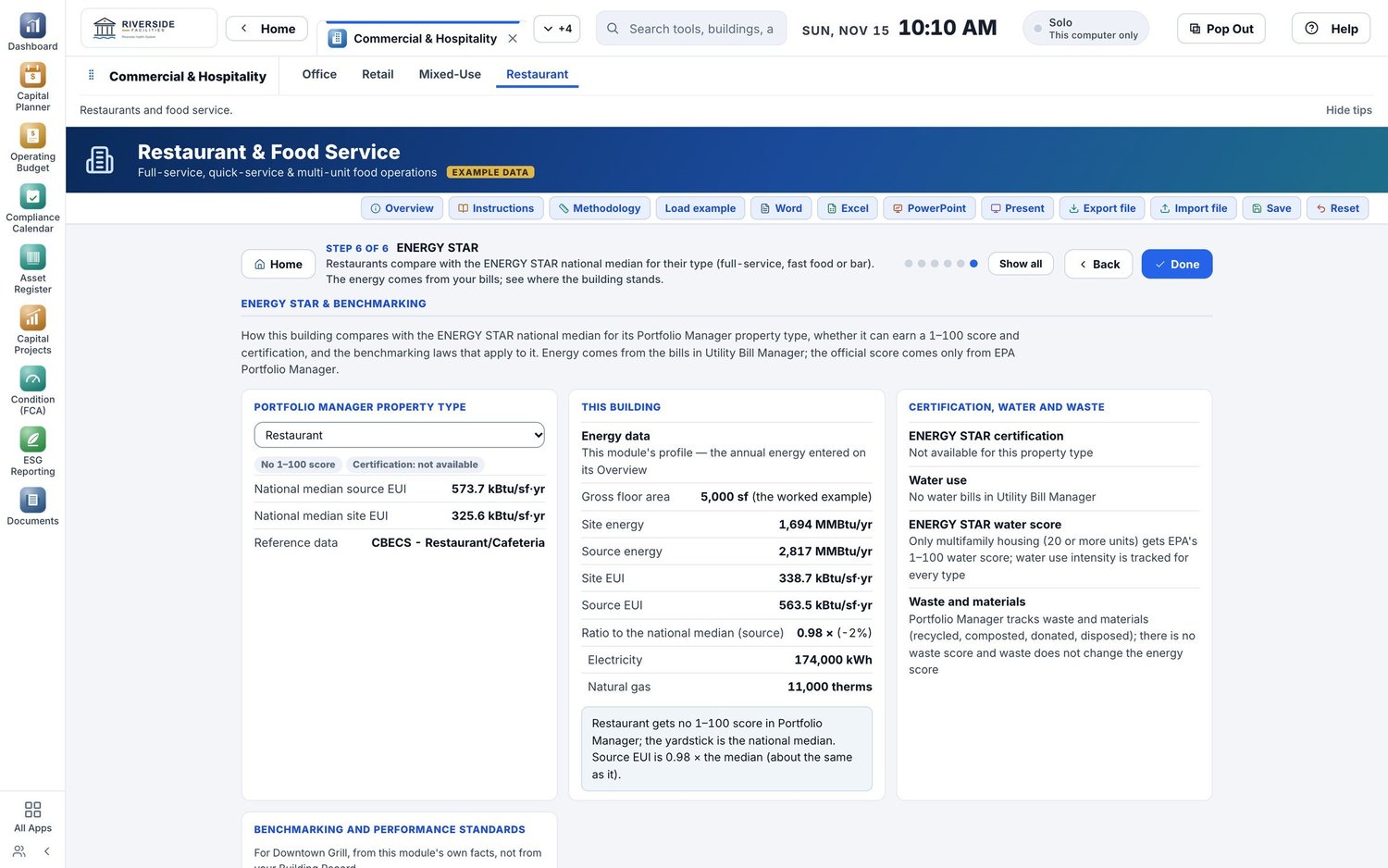
ENERGY STAR in Restaurant & Food Service: restaurants compare with the ENERGY STAR national median for their type (full-service, fast food or bar). The energy comes from your bills; see where the building stands.
Word, Excel, PowerPoint and Present
Each playbook exports to Word, Excel and PowerPoint, or shows full screen with Present; the kitchen tool exports to Word, Excel and PowerPoint.
Learn MoreShow Less
Owners and asset managers fund what they can see. One document ties renovation money to the condition and overdue items behind it.
- Summary: 10-year capital need escalated, deferred backlog and Facility Condition Index
- Charts of capital need by year, backlog by system and compliance status
- Kitchen report: share of design life used per item, and kitchen capital by budget year
- Present shows the same pages as the Word report, one at a time
Compliance Tab
Every obligation that applies, why it applies, its citation, frequency, last done, next due and status.
Learn More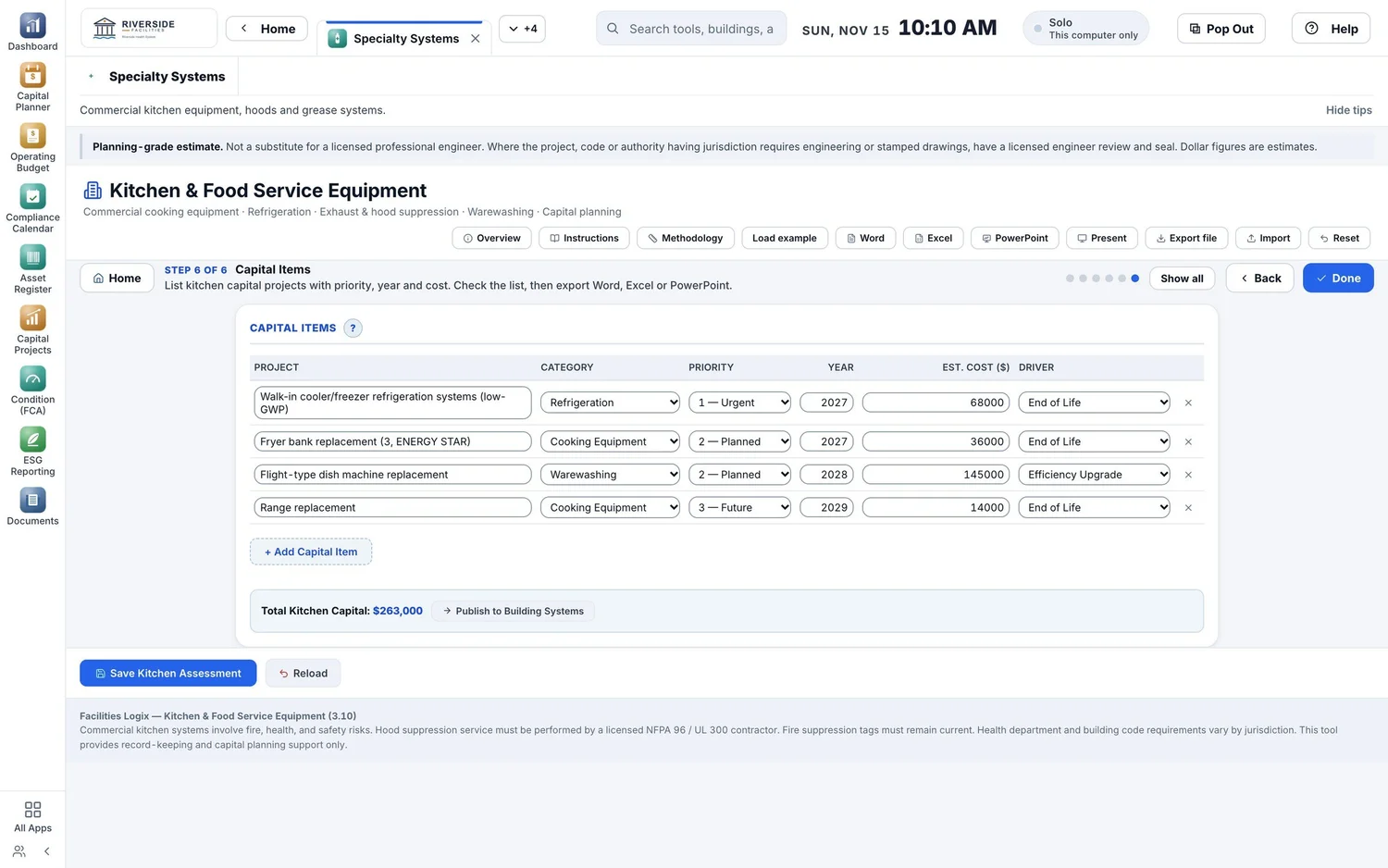
Capital Items in Kitchen & Food Service Equipment: list kitchen capital projects with priority, year and cost. Check the list, then export Word, Excel or PowerPoint.
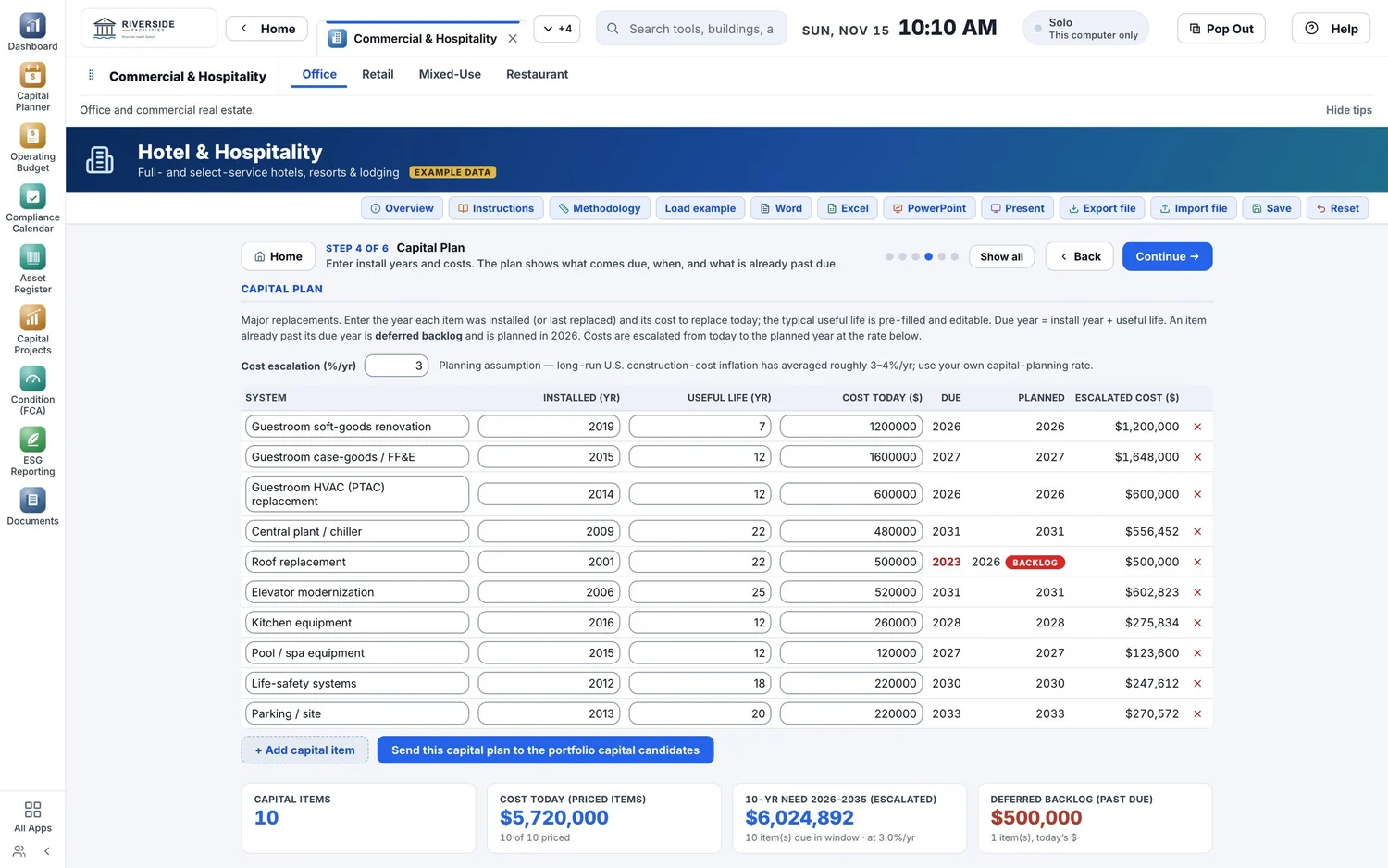
Capital Plan in Hotel & Hospitality: enter install years and costs. The plan shows what comes due, when, and what is already past due.
Benchmarks Written for Hospitality
Hotels
- Reserve for replacement: the FF&E reserve percent you enter, shown beside an industry reference range of 3-5 percent of total revenue
- Energy cost per occupied room-night and per available room
- Renovation cycle: soft goods about 5-7 years, case goods about 10-14
- Guest-impacting downtime of elevators, hot water and HVAC
Casinos
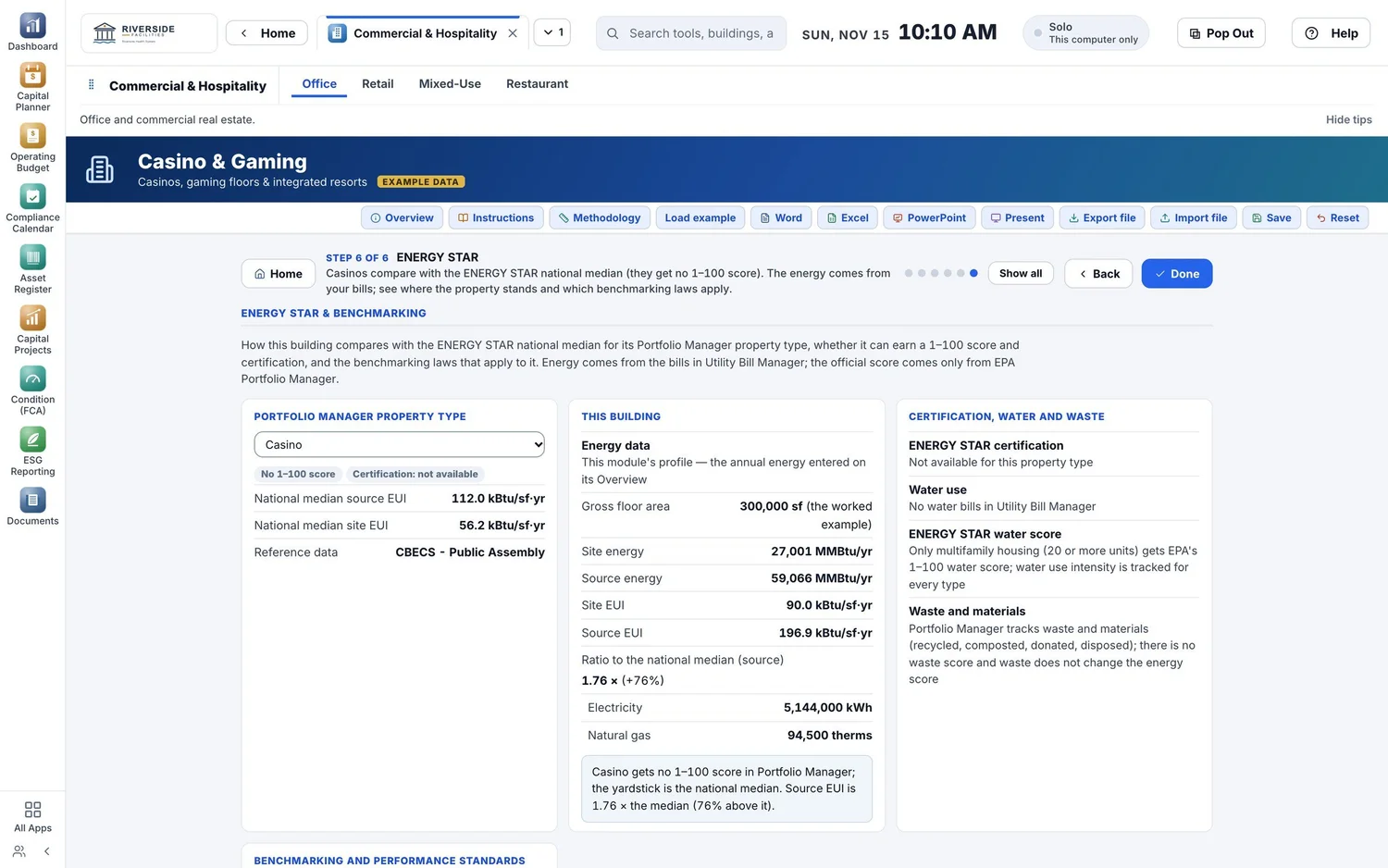
- Energy use well above the roughly 56 kBtu per square foot public-assembly median, from round-the-clock high-density operation
- Surveillance uptime, a gaming-regulator licensing condition
- High outdoor-air rates and the plant load from kitchens and a hotel tower
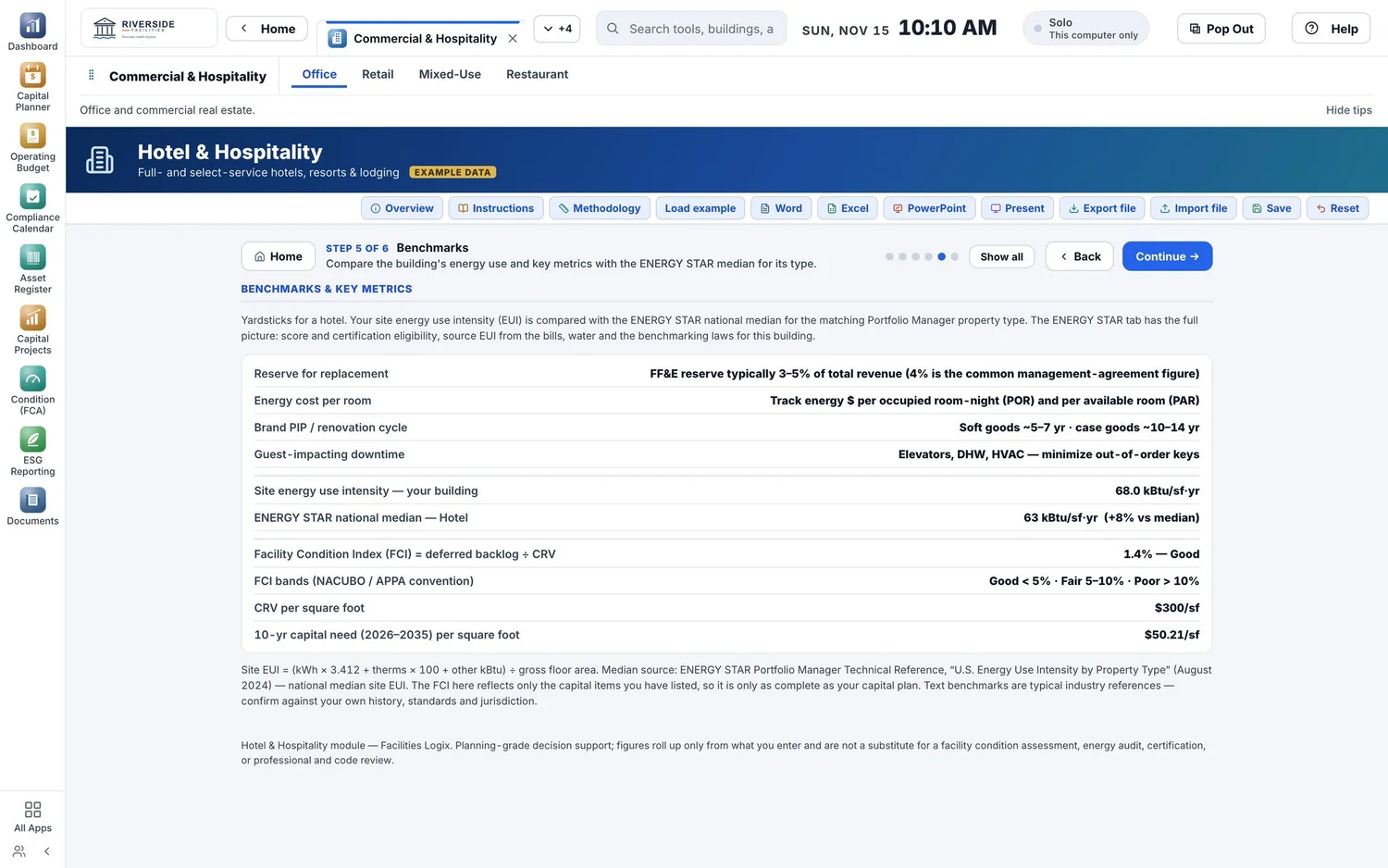
Benchmarks in Hotel & Hospitality: compare the building's energy use and key metrics with the ENERGY STAR median for its type.
Restaurants
- Energy intensity among the highest of any type: medians of about 326 kBtu per square foot for full-service and 403 for fast food
- Refrigeration uptime, since food lost from a failed walk-in can exceed the repair
- Cooking and refrigeration on 8-12 year replacement cycles
- Health-inspection readiness, with corrective items tracked
Every Playbook
- Average condition, deferred backlog, Facility Condition Index and the 10-year capital need
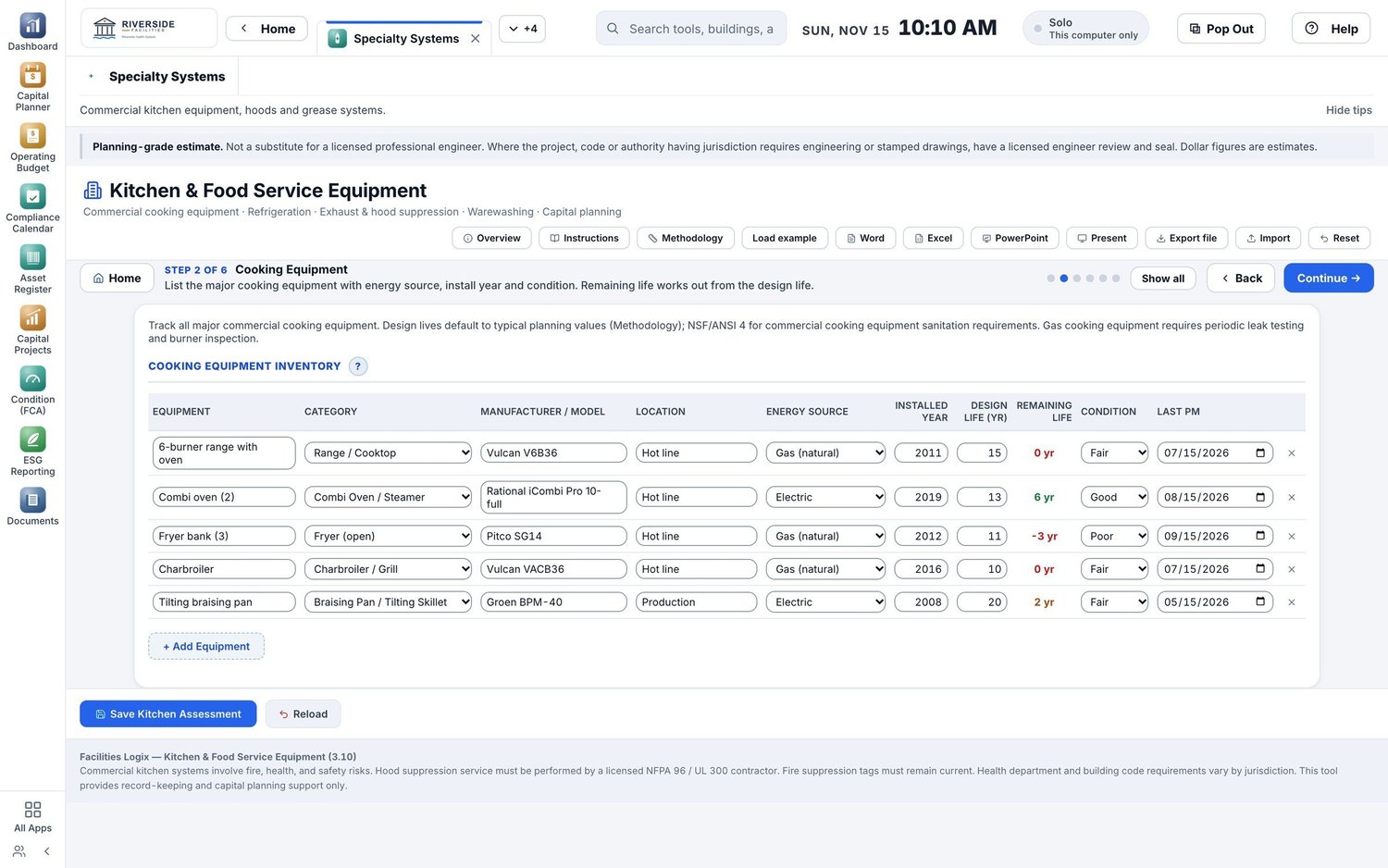
Cooking Equipment in Kitchen & Food Service Equipment: list the major cooking equipment with energy source, install year and condition. Remaining life works out from the design life.
Keep the Doors Open and the Rooms Sellable
No Expired Tags
Hood suppression and grease inspection dates are worked out from the last service, so a lapse is visible before a fire inspector finds it.
Learn MoreShow Less
An expired hood tag can shut a kitchen until it is serviced, and a grease fire costs far more than cleaning on time.
- The kitchen report lists every hood with last and next service and next cleaning, overdue marked
- Hood fire suppression rated Critical, with a semi-annual PM, in the restaurant playbook
- Class K extinguisher service on its own annual row (NFPA 10)
- Starting checklists set hood cleaning quarterly for casinos and restaurants; all editable
Inspection Readiness
Health inspections, pool logs, drills and gaming controls each carry a date, which keeps a missed one from becoming a closure or a finding.
Learn MoreShow Less
A failed health inspection or lapsed pool permit stops revenue from an outlet or amenity until it is cleared. Each row says what proof to keep.
- Evidence named per row: permit and inspection report, chemistry log, drill log
- Casinos: the surveillance plan and the accountant's agreed-upon procedures report
- Each row can link the responsible vendor and its service contract
- Rows marked Confirm say exactly what to check with the local authority
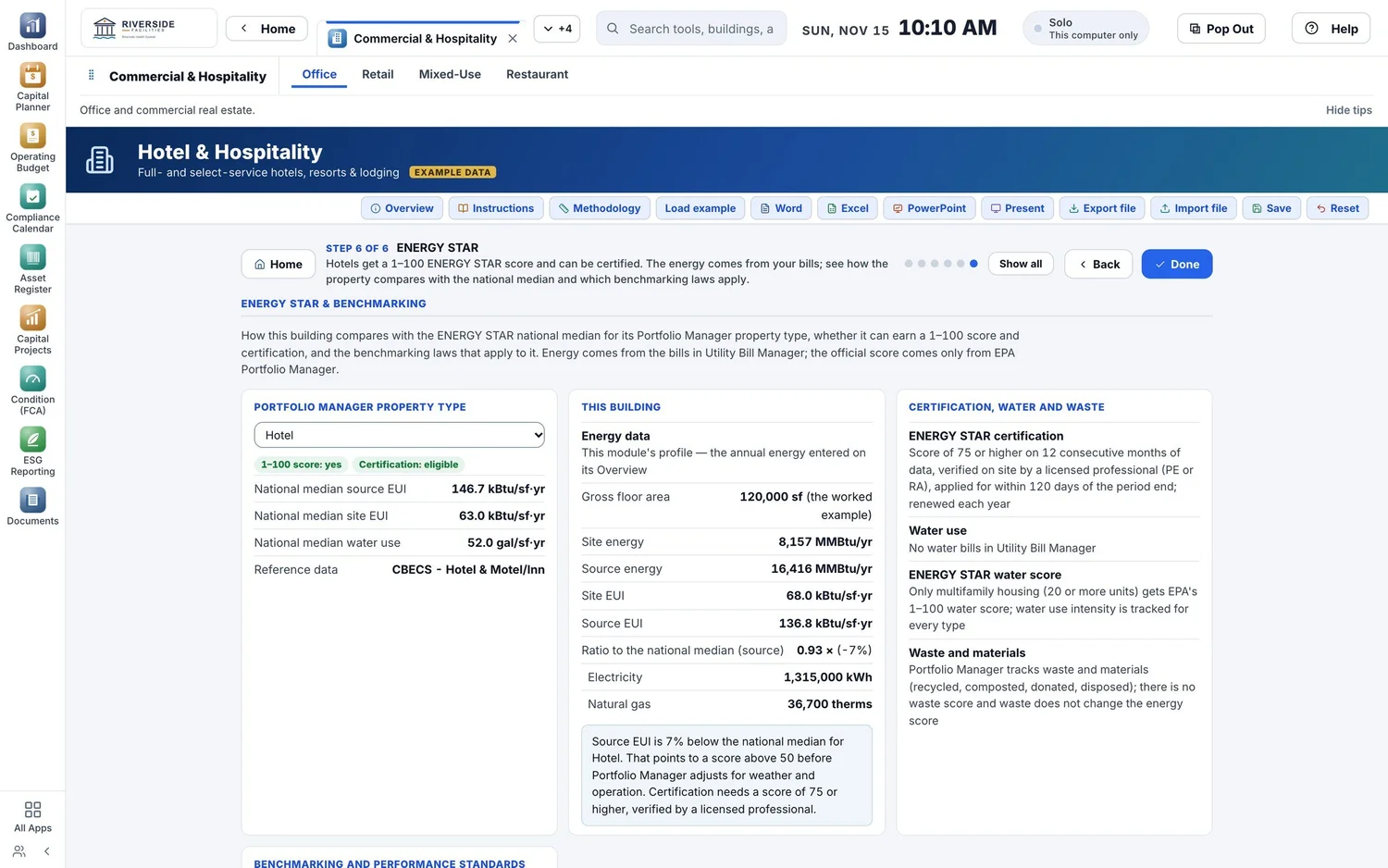
ENERGY STAR in Hotel & Hospitality: hotels get a 1–100 ENERGY STAR score and can be certified. The energy comes from your bills; see how the property compares with the national median and which benchmarking laws apply.
Fewer Out-of-Order Rooms
Tracking PTACs, hot water and elevators as guest-critical systems points maintenance at what costs revenue.
Learn MoreShow Less
A room that cannot be sold loses revenue every night it is down, so maintenance goes first to the systems that take rooms off the market.
- Domestic hot water rated Critical; guestroom PTACs and elevators rated High
- Guestroom PTAC replacement starts with a 12-year life; elevators modernize at 25
- Publishing schedules each unit's semi-annual PM task in the PM program
- Average condition counts only the systems your team has rated
A Renovation Plan Built from Records
Soft goods, case goods and plant equipment on their own cycles show the next renovation coming, across every property.
Learn MoreShow Less
Renovation is the largest check a hotel writes. Dating each cycle shows the year the cash is needed, so reserve money is not spent early or late.
- Starting lives: soft goods 7 years, case goods 12, central plant 22, roof 22
- Costs escalate from today to the year it is due, at your rate
- Items already past due count as deferred backlog, put in this year
- Send the plan to portfolio capital candidates to compare properties
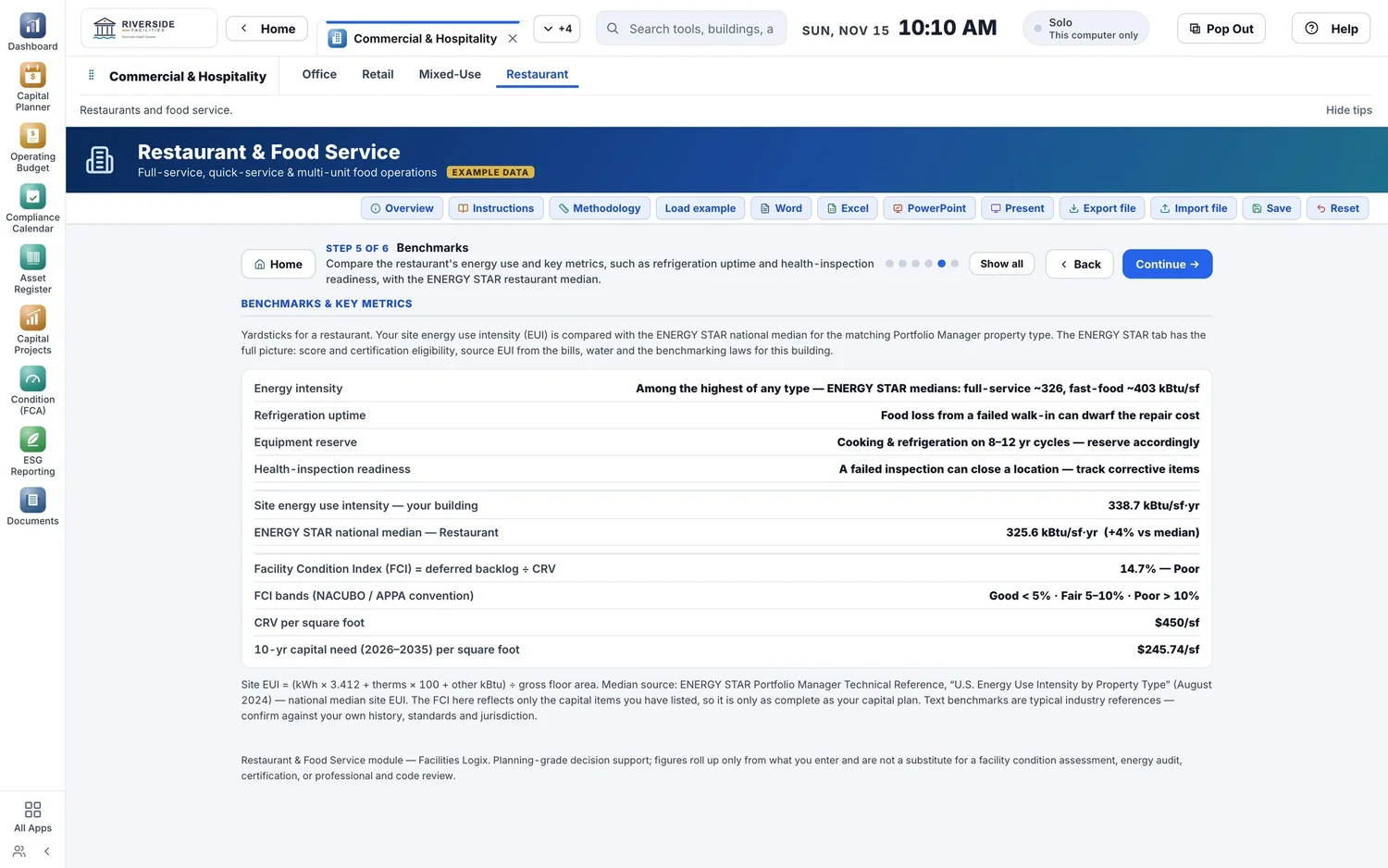
Benchmarks in Restaurant & Food Service: compare the restaurant's energy use and key metrics, such as refrigeration uptime and health-inspection readiness, with the ENERGY STAR restaurant median.
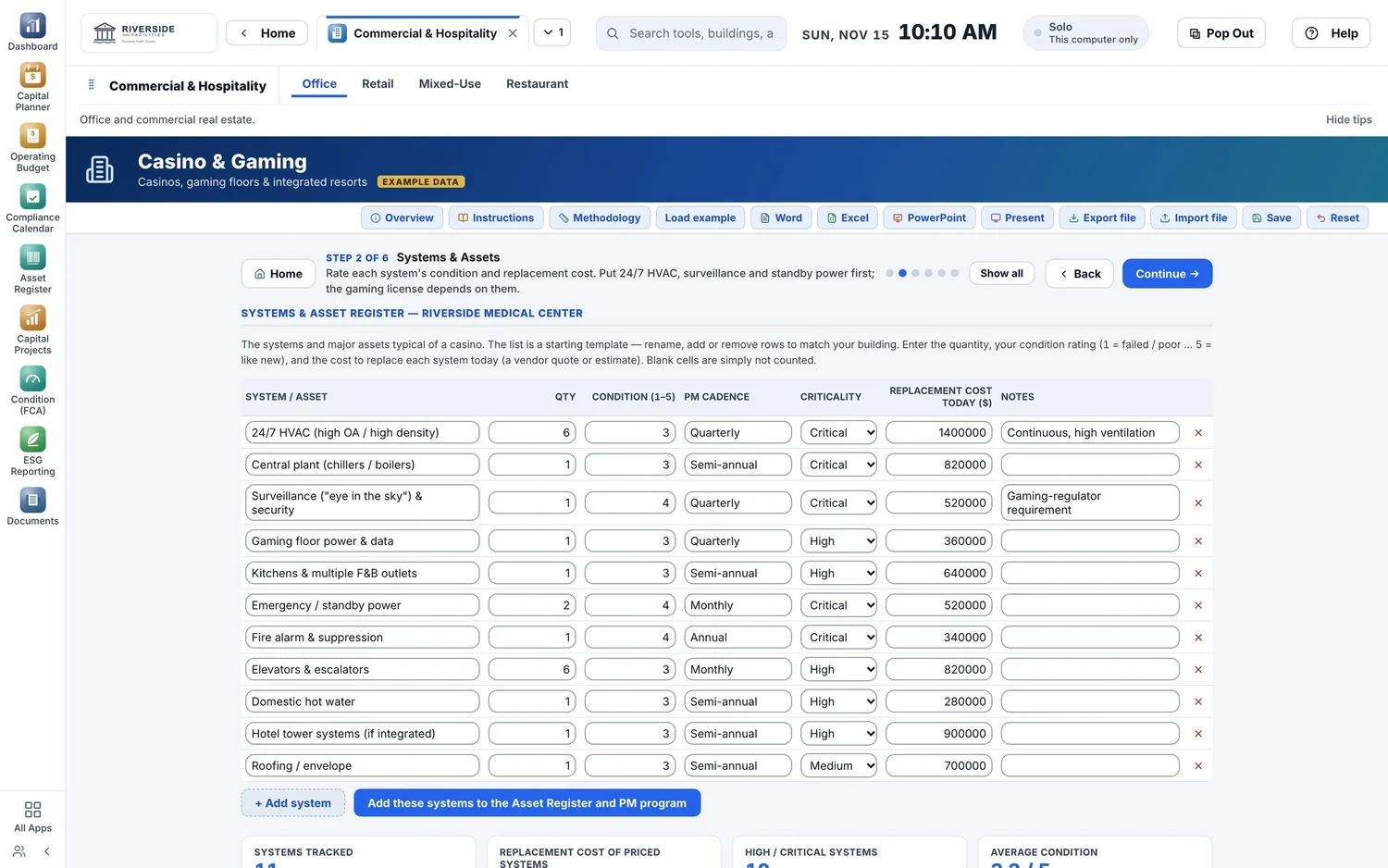
Equipment downtime on the casino floor costs revenue every hour, so critical systems are tracked with their cadence.
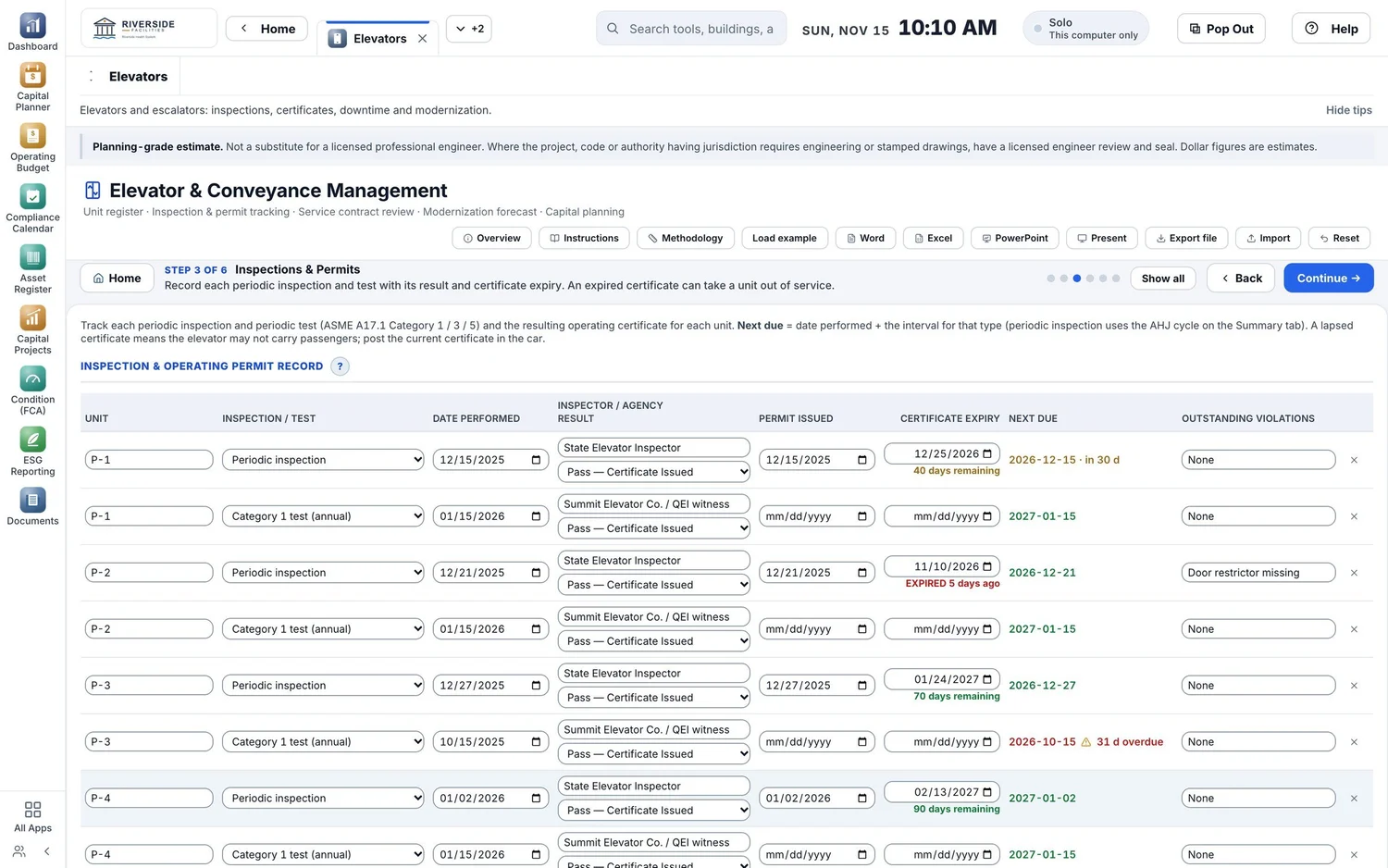
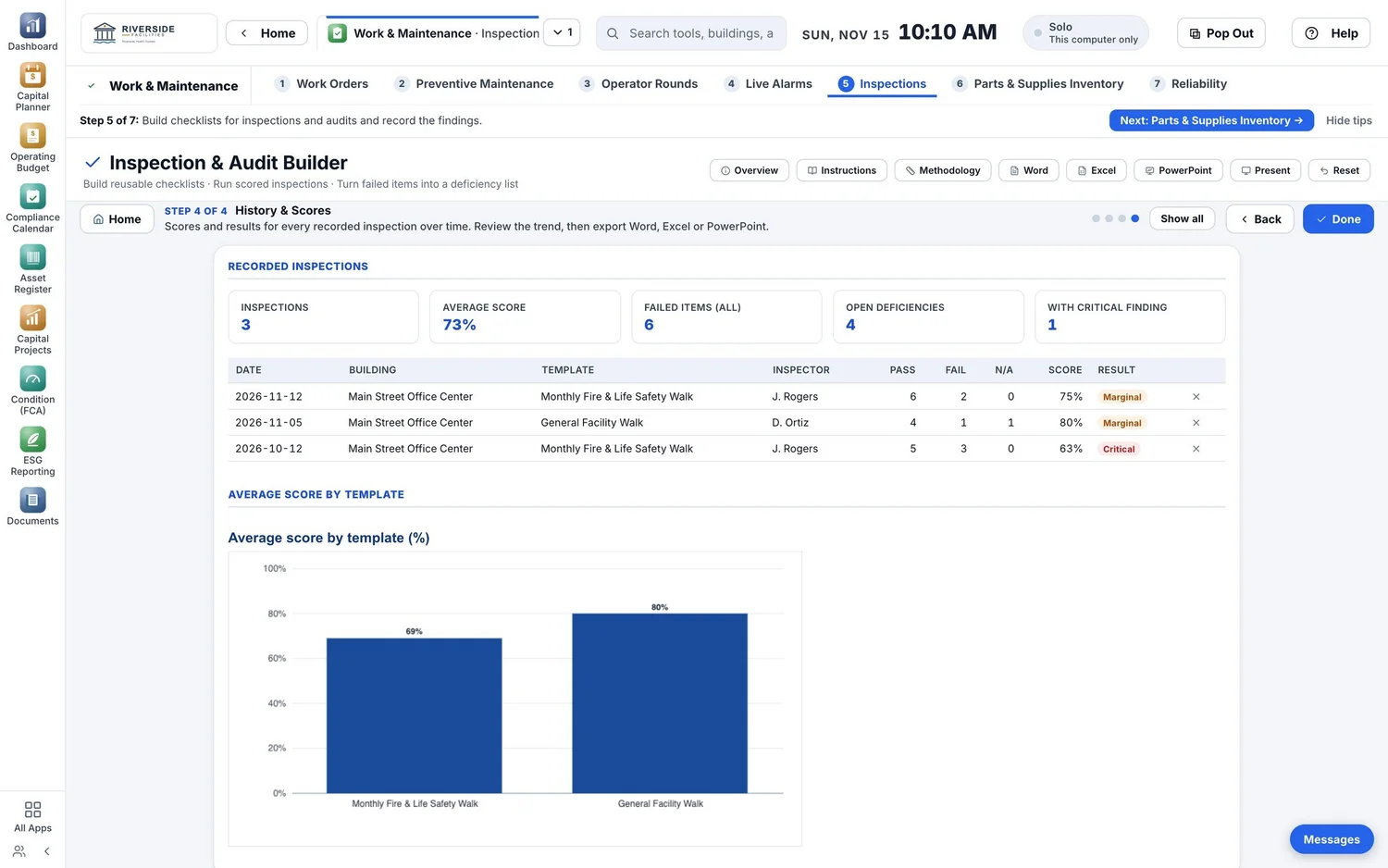
Frequently Asked Questions
Is there a separate playbook for hotels, casinos and restaurants?
How does it know how often our hood needs cleaning?
Does Facilities Logix replace the health department or the gaming regulator's review?
Why are the pool permit and grease interceptor rows marked Confirm?
Be First When Facilities Logix Opens
Stop chasing building records across spreadsheets and binders. Join the list and we will tell you the day downloads open, with setup guides ready.
Launching early 2027 for Facilities Logix. Nothing to buy today, and no sales calls.
