


The Hospital's Environment of Care, Tracked Rule by Rule.
Launching Early 2027 · Join the Early-Access List
A hospital is surveyed on its building as much as on its care. Facilities Logix brings together the Environment of Care plans, the critical systems, the utility management plan, room-by-room pressure and air changes, medical gas, water safety and a survey-readiness workspace for The Joint Commission, the Centers for Medicare & Medicaid Services (CMS) and DNV. Every date sits in the same compliance calendar as the rest of your portfolio.
The Obligations a Hospital Answers For
Each obligation comes from the compliance library with its authority, citation, frequency and the evidence a surveyor expects. A row that depends on a fact (CMS participation, Joint Commission accreditation, piped medical gas, fire and smoke dampers, x-ray equipment) applies when your Building Record says so; an unanswered fact keeps the row as Confirm Applicability rather than guessing.
Accreditation and CMS Surveys
- The Joint Commission: the unannounced full resurvey, no later than 36 months after the prior accreditation's effective date, with the Physical Environment (PE), National Performance Goals (NPG) and Emergency Management (EM) chapters of the Accreditation 360 manual effective January 1, 2026
- CMS Conditions of Participation (42 CFR 482.41): the Life Safety Code (National Fire Protection Association (NFPA) 101, 2012) and the Health Care Facilities Code (NFPA 99, 2012) as CMS adopts them, on the survey cycle (accreditor within 36 months, plus state validation surveys); evidence is the survey reports and plans of correction
- Emergency preparedness (42 CFR 482.15): program review at least every 2 years, and two exercises a year for inpatient providers, one full-scale or functional and one more of any listed type
- The CMS water management program for Legionella (CMS QSO-17-30, 42 CFR 482.42): annual review, with the program, risk assessment and test results as evidence
- Utility systems inventory with risk ranking and maintenance intervals (The Joint Commission PE.04.01.01 and NPG.11.03.01; CMS S&C 14-07 for alternate equipment management)
- Infection control risk assessment (ICRA) and Interim Life Safety Measures (ILSM) for each construction project, under the FGI Guidelines, NFPA 101 and The Joint Commission PE.03.02.01
Life Safety and Emergency Power
- Health care fire drills quarterly on each shift (at least 12 a year for three shifts), at unexpected times, including fire alarm signal transmission (NFPA 101, 18/19.7.1.6)
- Fire and smoke damper tests one year after installation, then every 6 years in hospitals (NFPA 80 and NFPA 105, through the 2012 Life Safety Code)
- Emergency generator weekly inspection, monthly load test of at least 30 minutes with transfer switch operation, an annual load-bank test when monthly tests run light, and the 4-hour test every 36 months for Level 1 systems (NFPA 110)
- Fire alarm inspection and testing (NFPA 72) and sprinkler, fire pump and standpipe inspection and testing (NFPA 25) on their own frequencies
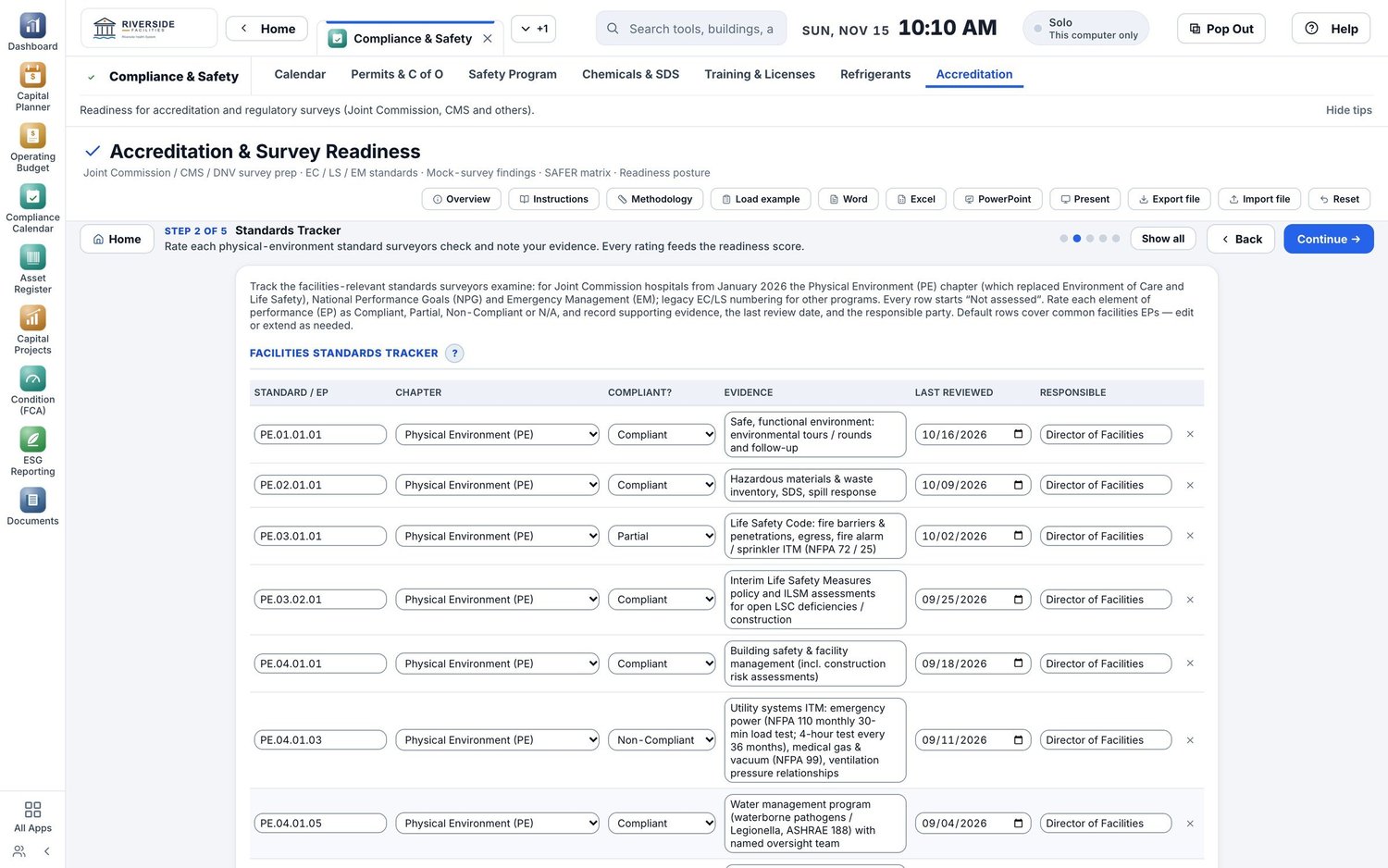
Standards Tracker in Accreditation & Survey Readiness: rate each physical-environment standard surveyors check and note your evidence. Every rating feeds the readiness score.
Critical Utilities
- Medical gas and vacuum inspection, testing and maintenance (NFPA 99, 5.1.14): annual under a risk-based program, plus verification after any work
- Critical-area ventilation and pressure relationships (ASHRAE/ASHE 170; The Joint Commission PE.04.01.01 EP 3): the library says plainly that no code fixes the interval; your utility program sets it, and annual test and balance is common practice
- The water management program for Legionella (ANSI/ASHRAE 188 and ASHRAE Guideline 12): annual review and control-limit monitoring at the frequency your program sets
Clinical Support Rules, Where They Apply
- Sterile compounding rooms (USP General Chapter 797): certification before first use, at least every 6 months and after any change
- Radiation-producing machines: state registration and equipment performance evaluation (for example Texas, by a licensed medical physicist at intervals not over one year; other states per state rule)
- Radioactive sealed sources (10 CFR 35.67): leak tests at intervals not over 6 months and a semiannual inventory
- Fume hoods (ANSI/ASSP Z9.5) and biosafety cabinets (NSF/ANSI 49) in hospital labs: at least annually
- Controlled substances (Drug Enforcement Administration, 21 CFR 1304.11 and 1301.13): inventory every 2 years and registration renewal every 36 months
- Bloodborne pathogens exposure control plan (OSHA 29 CFR 1910.1030) and chemical hygiene plan (29 CFR 1910.1450): reviewed at least annually
- Section 504 web and mobile accessibility for recipients of Department of Health and Human Services funds (45 CFR 84): WCAG 2.1 Level AA from May 11, 2027 for 15 or more employees
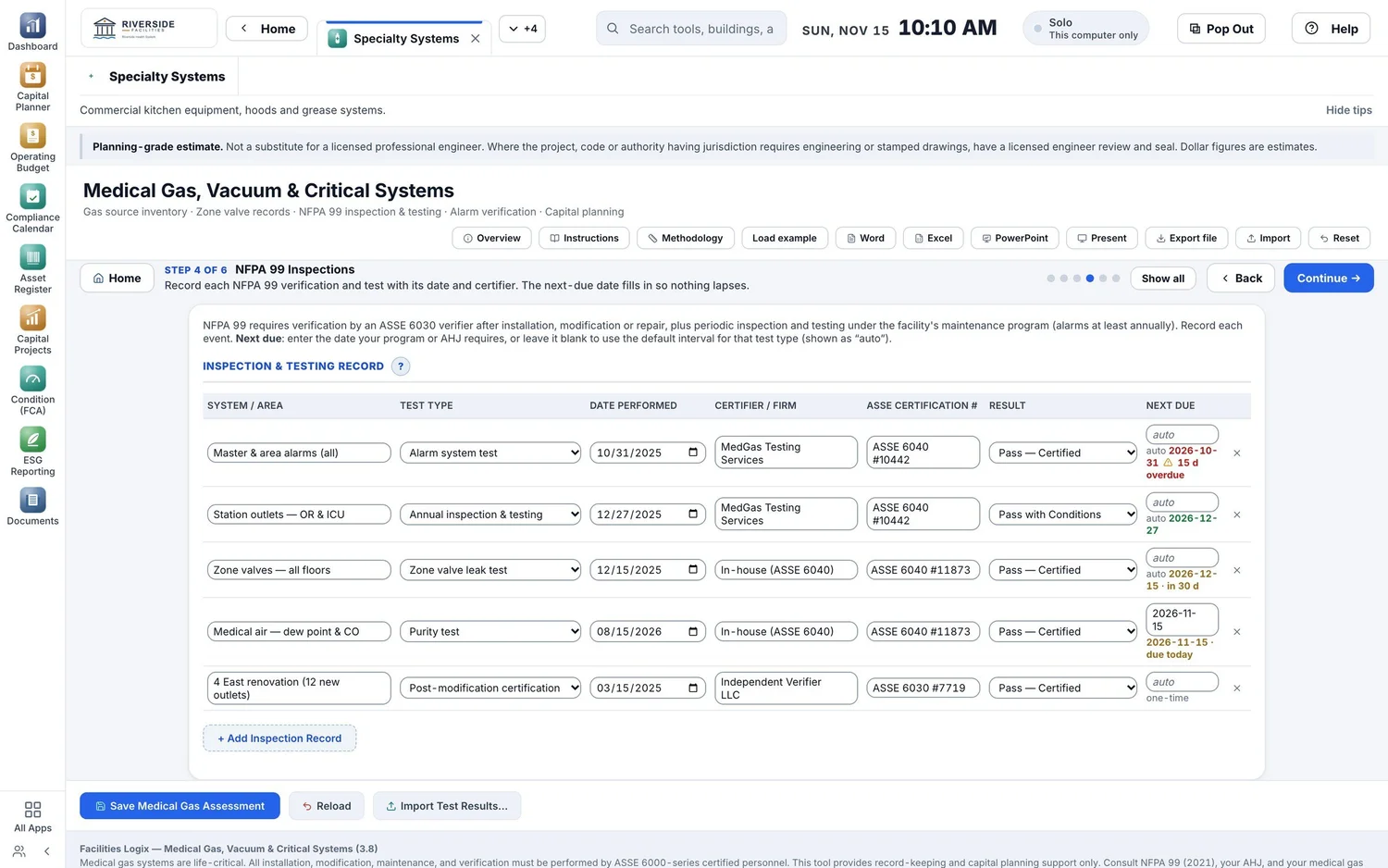
NFPA 99 Inspections in Medical Gas, Vacuum & Critical Systems: record each NFPA 99 verification and test with its date and certifier. The next-due date fills in so nothing lapses.
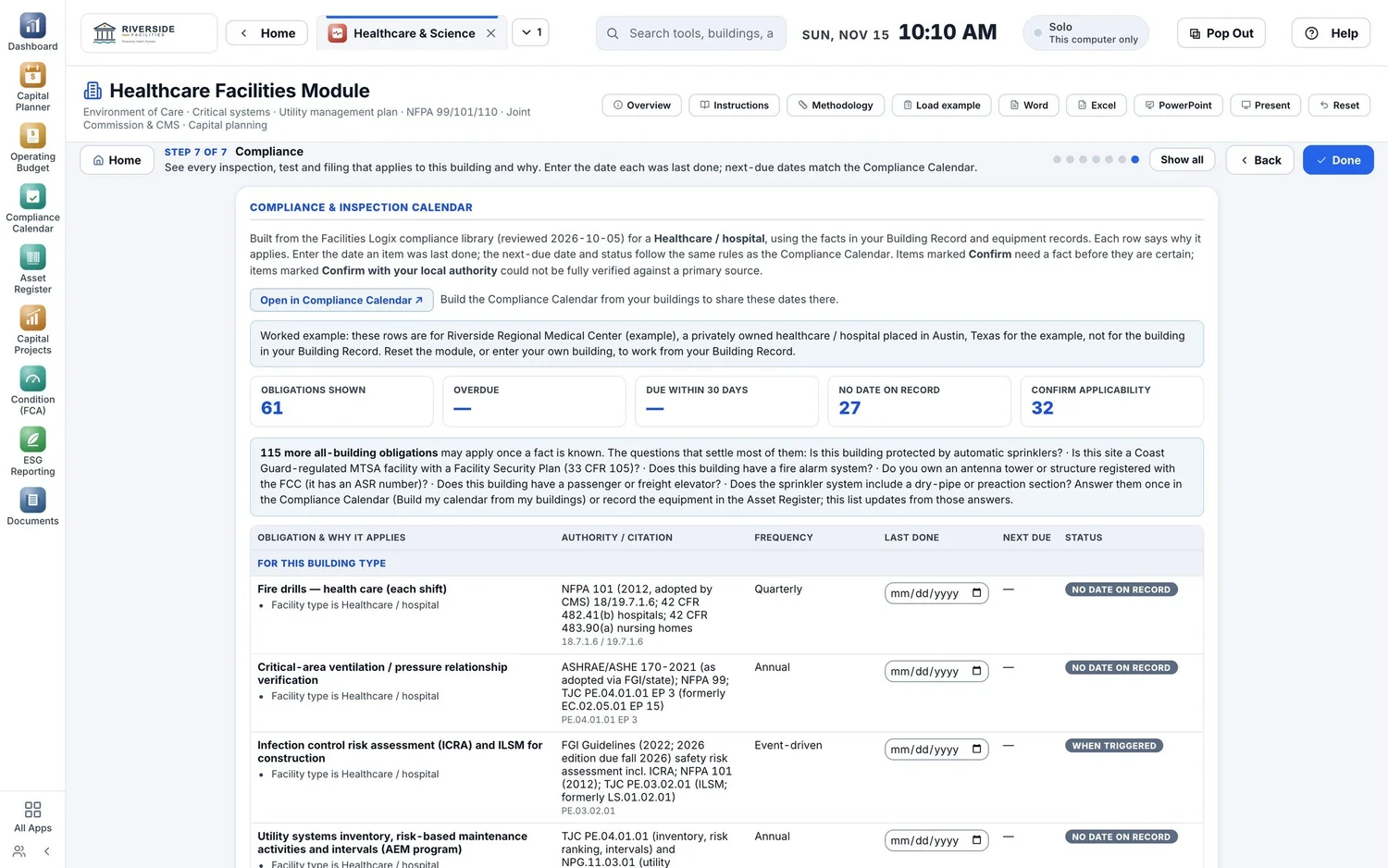
Hospitals answer to many accreditors, so each obligation lists its authority, citation and the evidence a surveyor expects.
Starting Lists Built for a Hospital
One click loads each standard list. Dates start blank and every row is yours to edit.
Facility Profile
Acute care, critical access, ambulatory surgery, outpatient clinic, behavioral health, long-term care, rehabilitation hospital or other; staffed and licensed beds; and the accreditor: The Joint Commission, DNV, HFAP, CIHQ, or a state or CMS direct survey.
Learn MoreShow Less
A conditional accreditation or a CMS Condition-level deficiency can put a hospital's Medicare participation at risk, so the profile sets the frame for everything else. The accreditor you pick is named in each report's recommendation.
- Reports summarize EOC areas, critical systems and utility systems tracked for your accreditor.
- The recommendation tells you what to bring current before the next survey.
- Capital rows can be tagged Accreditation / Survey, CMS Conditions of Participation or Life Safety.
- The ENERGY STAR tab defaults to General Medical & Surgical Hospital.
Seven Environment of Care Plans
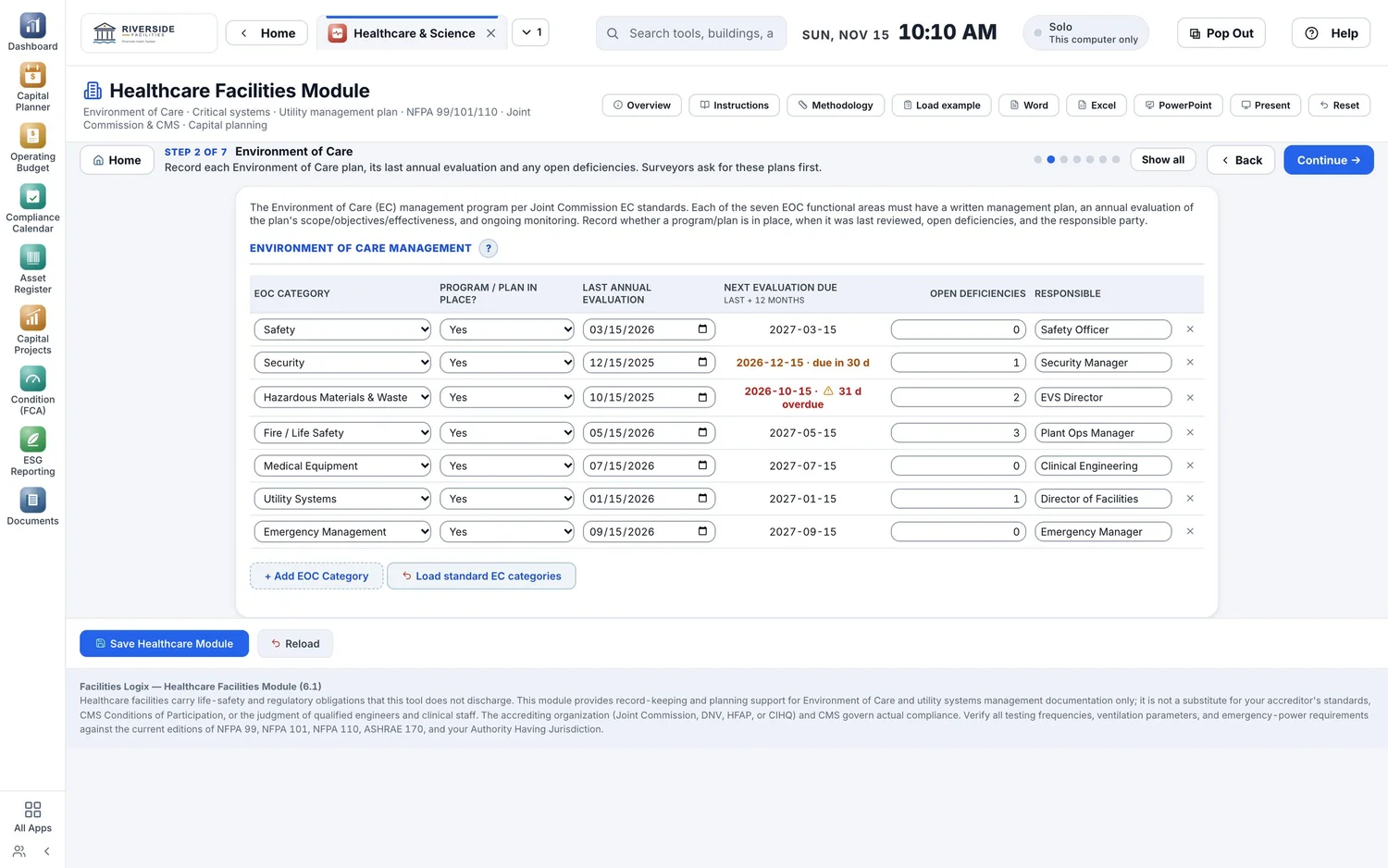
Safety, security, hazardous materials and waste, fire and life safety, medical equipment, utility systems and emergency management, each with plan in place, last annual evaluation, next evaluation (12 months later), open deficiencies and the responsible person.
Learn MoreShow Less
A management plan whose annual evaluation lapses is an easy survey finding, so each plan's date is watched and its open deficiencies are counted where leadership sees them.
- The annual evaluation covers each plan's objectives, scope, performance and effectiveness.
- Open deficiencies from all seven plans add up on the summary.
- Plans with open deficiencies publish to Building Systems as Code / Regulatory items.
- DNV, HFAP and CIHQ cover equivalent ground under their own structure.
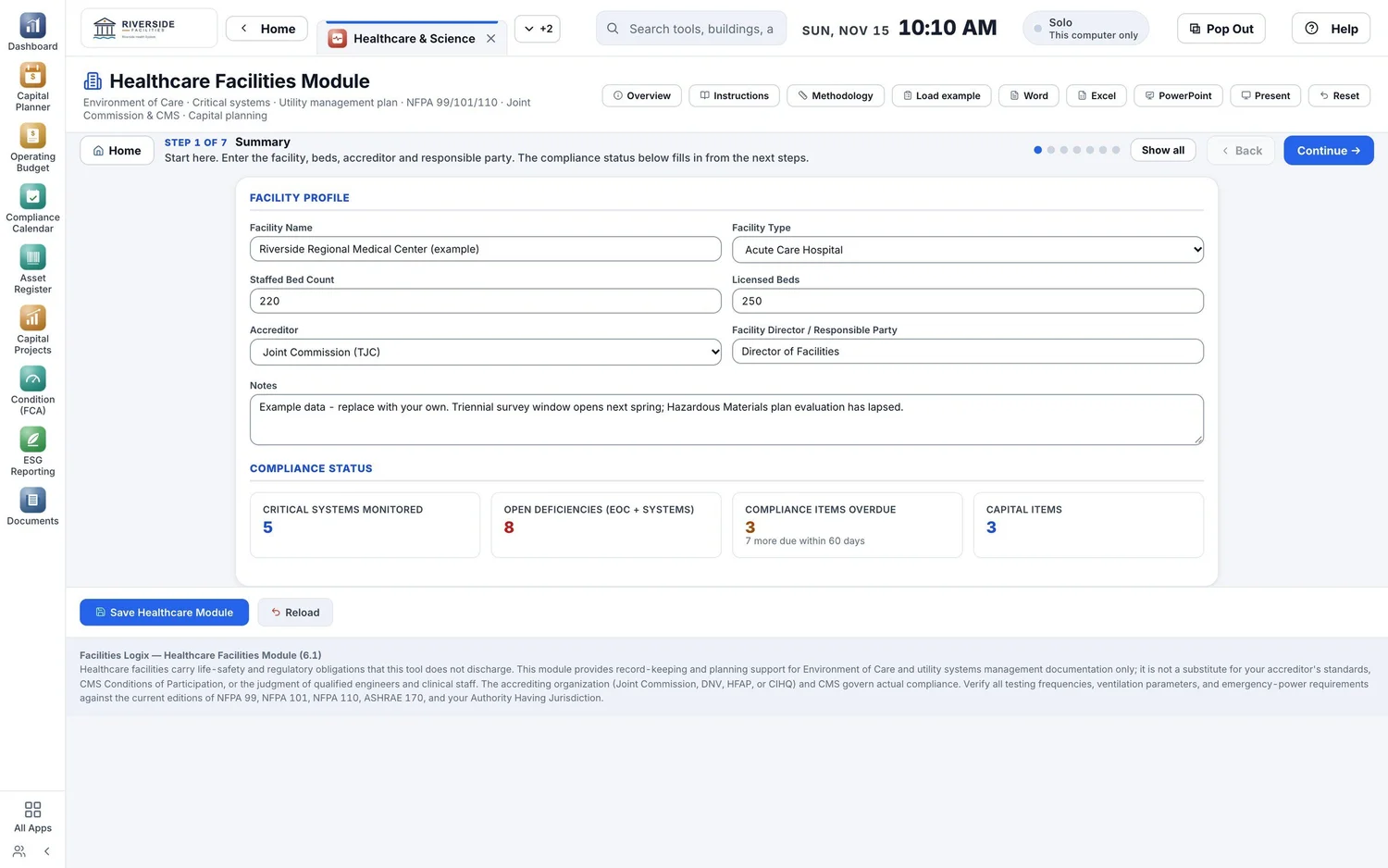
Summary in Healthcare Facilities: start here. Enter the facility, beds, accreditor and responsible party. The compliance status below fills in from the next steps.
Critical Systems Register
Normal power; the life safety, critical and equipment branches of emergency power; generators and transfer switches; medical gas; medical and surgical vacuum and waste anesthetic gas disposal; pressure relationships and operating room air changes; domestic water and Legionella; nurse call; and fire alarm, each with status, last test, redundancy and next due.
Learn MoreShow Less
Emergency power, medical gas and room pressure are conditions of licensure and reimbursement, so a failure costs more than a repair. The register makes the weak points visible.
- Status reads Operational, Operational (Monitor), Deficiency, Out of Service or Not Tested.
- Redundancy ranges from N+1 to single with none, flagging single points of failure.
- Any system in Deficiency or Out of Service counts as an open deficiency.
- Life safety and critical branches must restore power within 10 seconds, per the methodology.
Utility Management Plan
Eleven utility systems with editable starting intervals (no labor hours or costs): emergency power monthly, fire pump weekly, domestic hot water monthly, air handling, steam and sterilization, chilled water and controls quarterly, medical gas, normal power and nurse call annually. Each row flags the critical utilities list and holds an interruption or contingency plan.
Learn MoreShow Less
When a critical utility fails, the cost shows up in cancelled procedures and patient risk, so each one needs a written plan B. The plan follows the critical utilities list surveyors ask for.
- Next PM is calculated from the last PM and its interval.
- Critical utilities support life support, infection control, environmental support or equipment support.
- Contingency examples include backup vacuum, portable oxygen and an emergency water plan.
- Elevators and building controls are inventoried but start off the critical list.
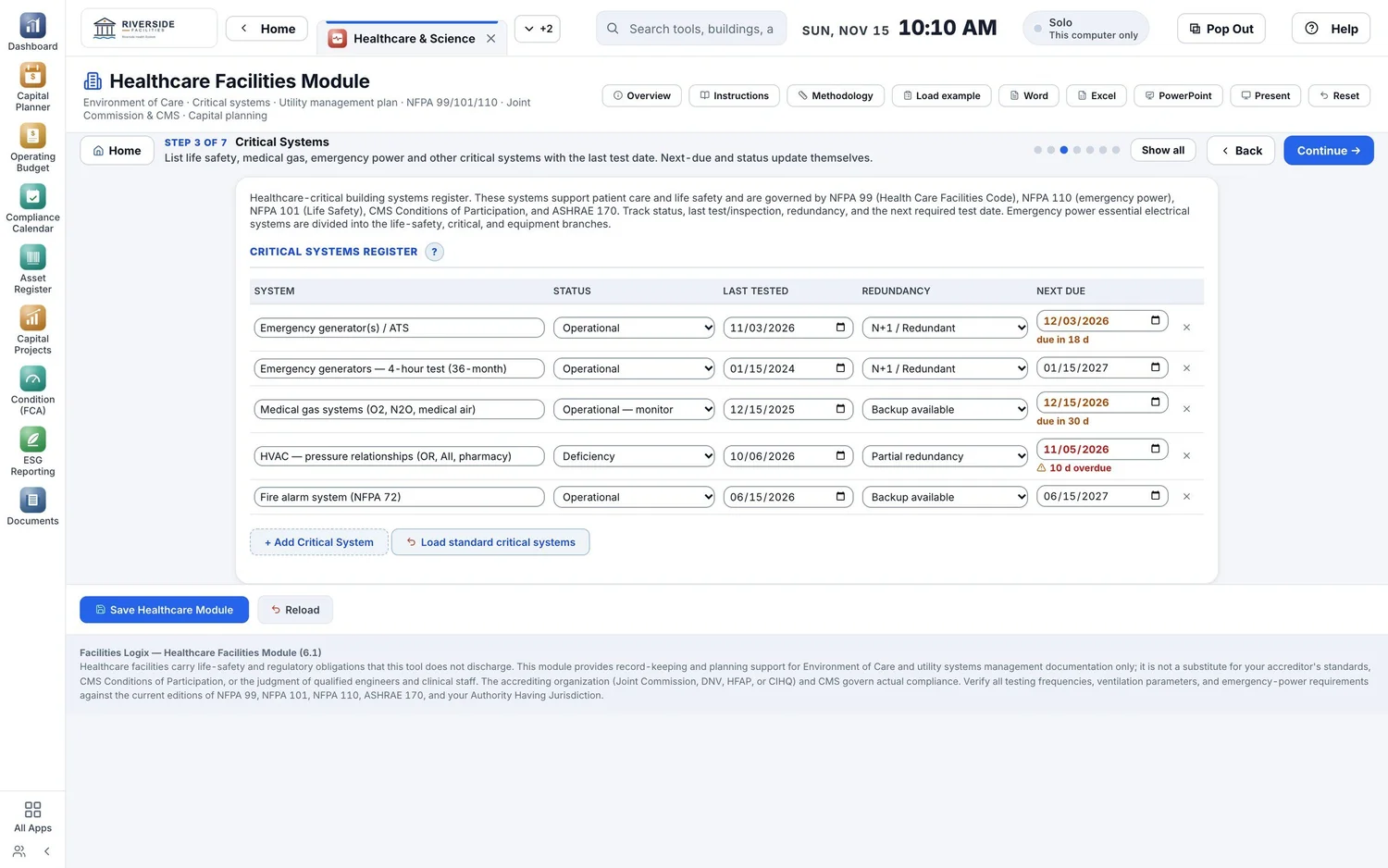
Critical Systems in Healthcare Facilities: list life safety, medical gas, emergency power and other critical systems with the last test date. Next-due and status update themselves.
Medical Gas and Vacuum
Gas sources from bulk oxygen to vacuum pumps and waste anesthetic gas blowers, the zone valve and outlet register, the NFPA 99 risk category of the facility, and an inspection record with the tester's ASSE 6000-series qualification number.
Learn MoreShow Less
Medical gas records are among the first things CMS and The Joint Commission ask for, and gaps become findings. The tool keeps every source, test and certifier on file.
- Covers oxygen, nitrous oxide, nitrogen, carbon dioxide, medical and instrument air, vacuum and WAGD.
- ASSE tiers: 6010 installer, 6020 inspector, 6030 verifier, 6040 maintenance personnel.
- Most acute care hospitals are Category 1; surgery centers may be 1 or 2.
- Planning lives: compressors and vacuum pumps 15 to 20 years, alarm panels 10 to 15.
Water Safety
The water management program's hazard points with risk levels and control measures, a scald risk rating for mixing valves, piping end-of-life and backflow preventers.
Learn More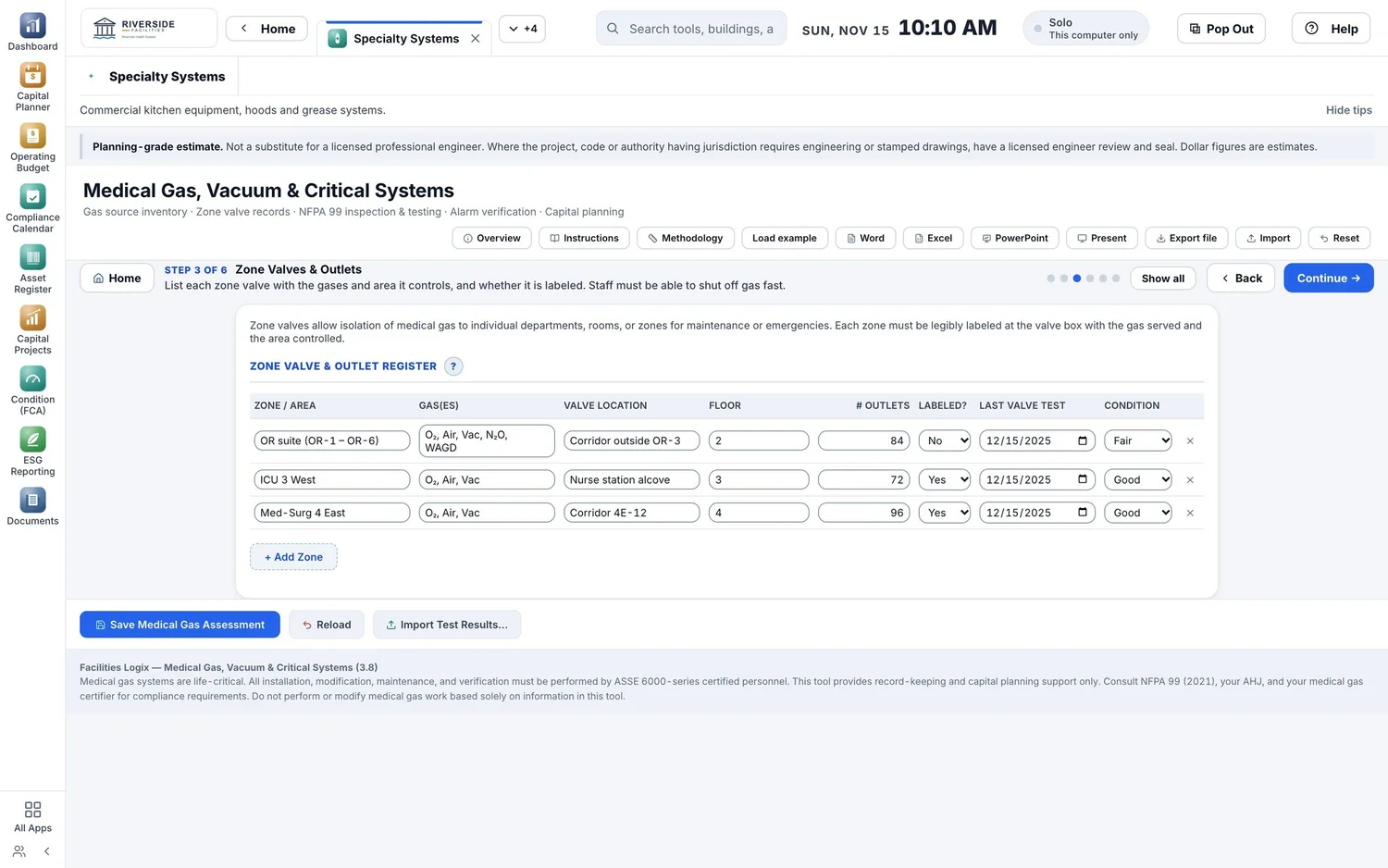
Zone Valves & Outlets in Medical Gas, Vacuum & Critical Systems: list each zone valve with the gases and area it controls, and whether it is labeled. Staff must be able to shut off gas fast.
Capital Plan
Capital lines by category (emergency power, medical gas, ventilation, fire and life safety, water, nurse call, electrical, envelope) and by driver, including accreditation, the Conditions of Participation, infection control and code upgrades, published to the portfolio's building systems roll-up.
Learn More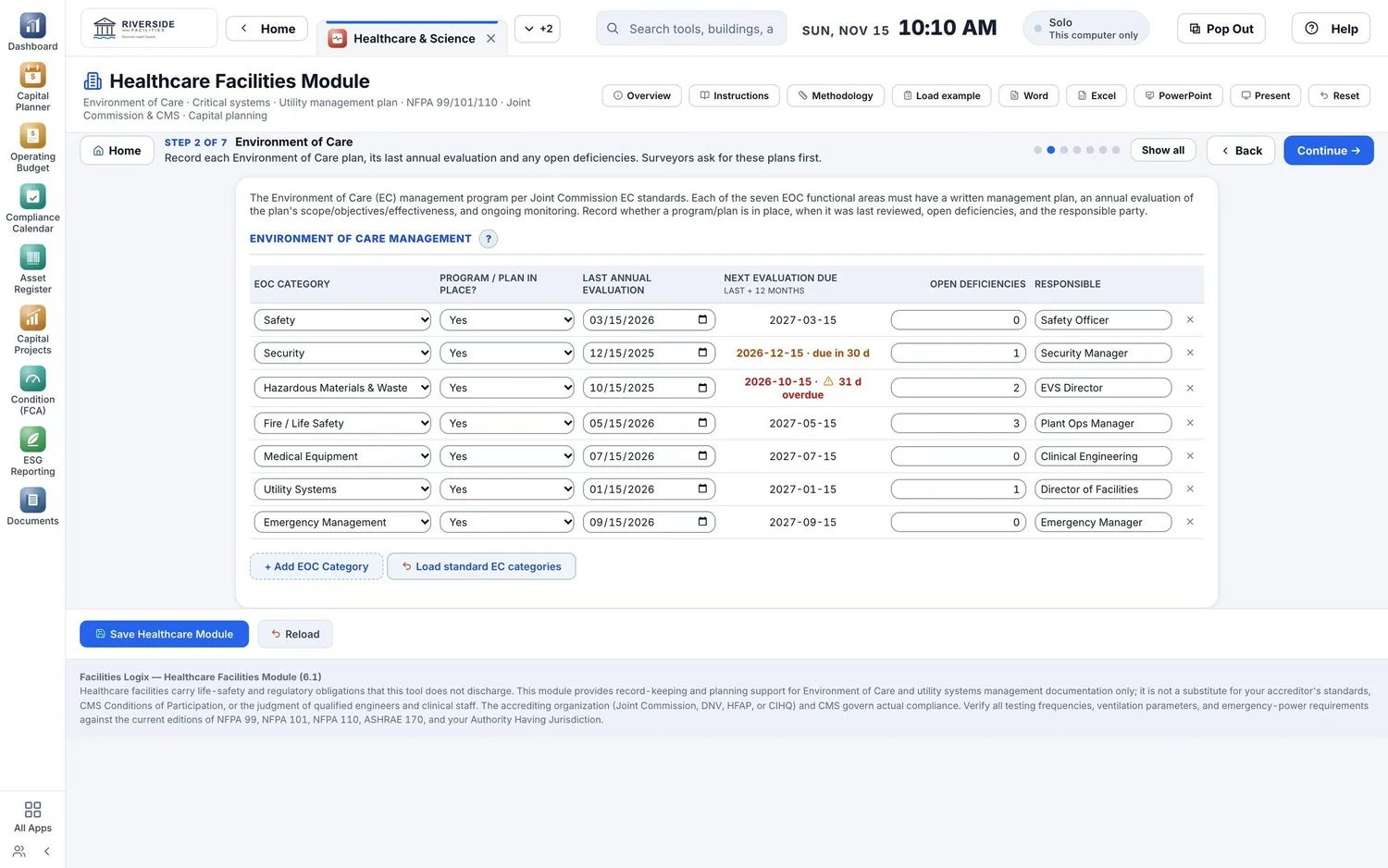
Environment of Care in Healthcare Facilities: record each Environment of Care plan, its last annual evaluation and any open deficiencies. Surveyors ask for these plans first.
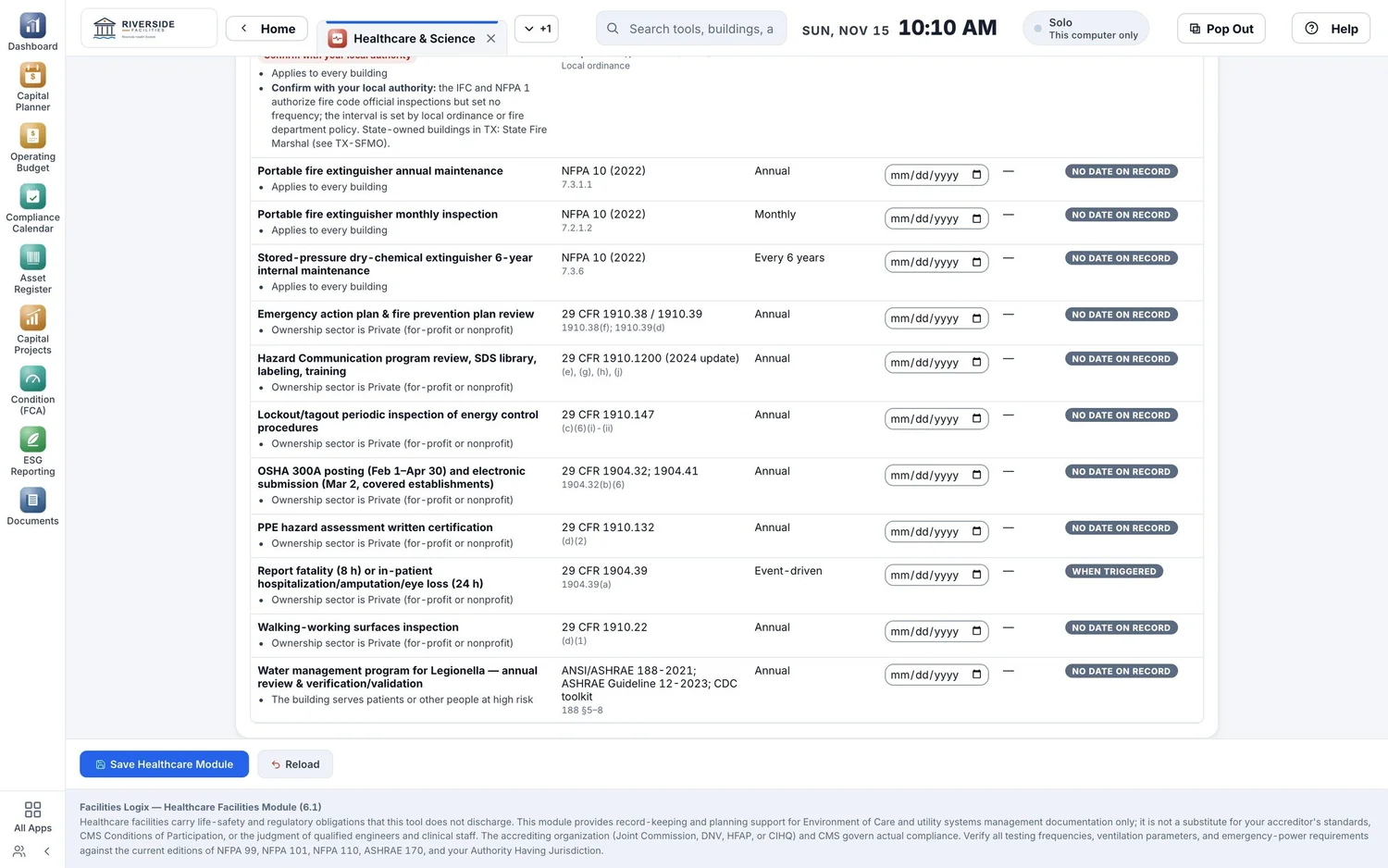
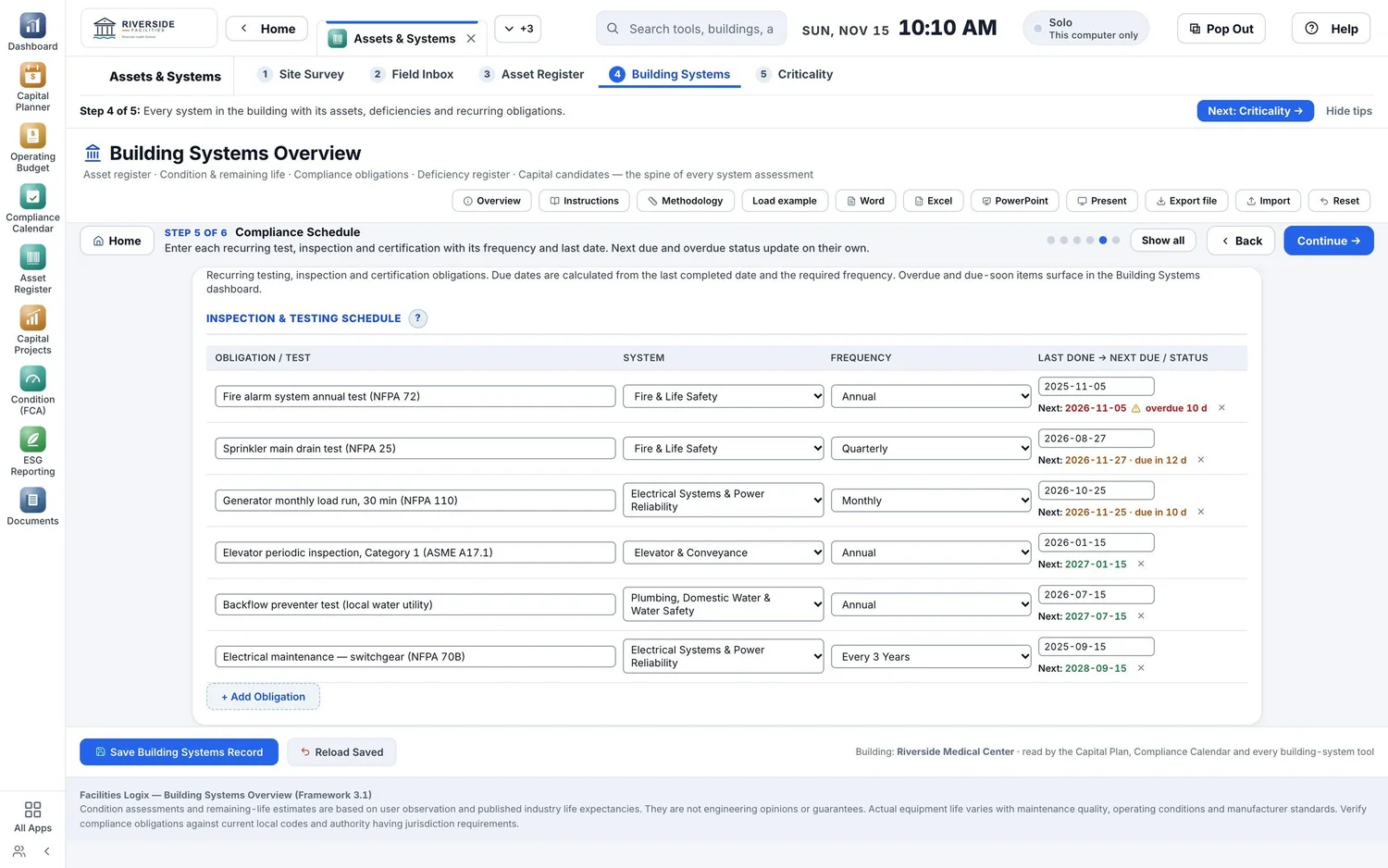
Compliance in Healthcare Facilities: see every inspection, test and filing that applies to this building and why. Enter the date each was last done; next-due dates match the Compliance Calendar.
The Records a Surveyor Asks For
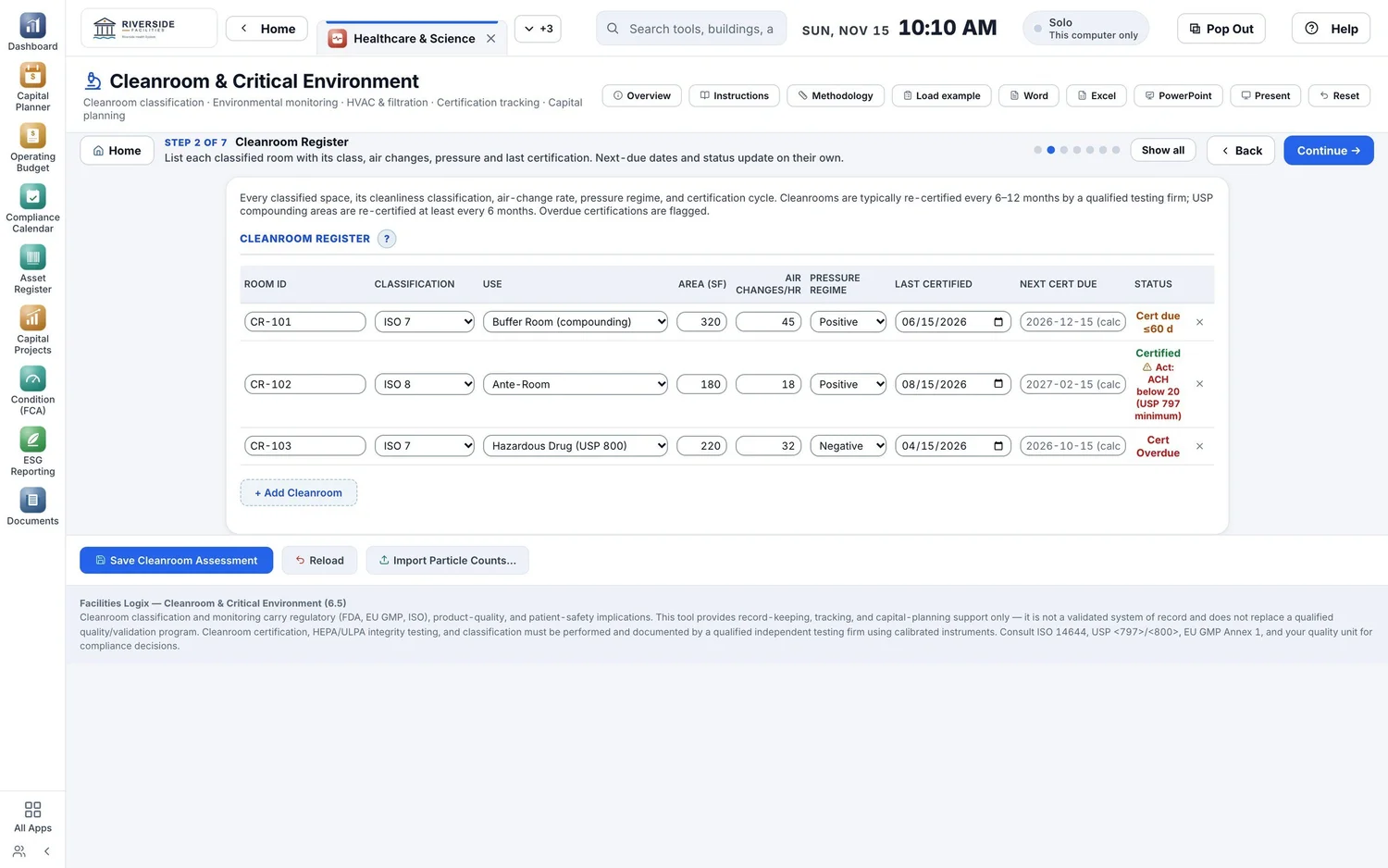
Critical-Room Pressure and Air-Change Log
- Isolation and protective environment rooms, operating rooms, sterile processing, compounding pharmacy rooms, labs and cleanrooms
- Each room's required pressure relationship, minimum pressure difference, minimum total and outdoor air changes, typed from your own design basis; Facilities Logix ships no such table
- Each reading's pressure difference and supply, exhaust and outdoor airflow; air changes figured from exhaust for a negative room and from supply for a positive or neutral one
- Pass or fail by room and month, and an Excursion Log where each failing reading can create a work order that the room's next passing reading closes
Air Changes per Hour by Room
- Isolation rooms, operating rooms and other spaces with a required rate, each room's airflow against the value in your program (ASHRAE 170)
- The same rooms as the Water Management Log, so a room is entered once
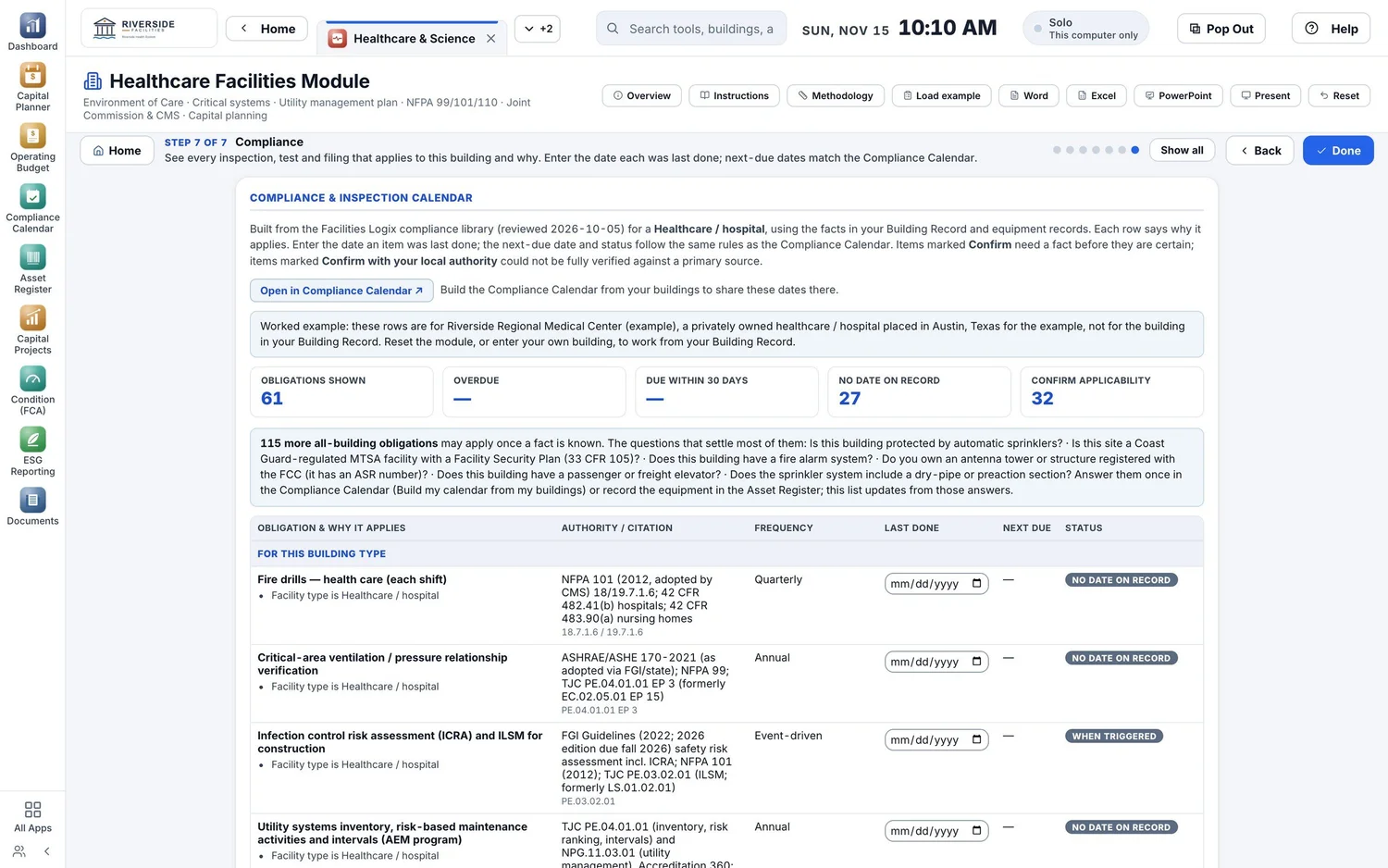
Compliance in Healthcare Facilities: see every inspection, test and filing that applies to this building and why. Enter the date each was last done; next-due dates match the Compliance Calendar.
Water Management Log
- Hot and cold water loop temperatures from building automation points or logger files, against the limits in your program
- Each out-of-range event with its corrective action, who, when and the re-test, and any gaps in the readings
Medical Gas Testing
- Annual inspection and testing, alarm tests, zone valve leak tests, pressure and purity tests, and new-installation and post-modification verification
- Next due is the date you enter, or 12 months after the test for the recurring ones; overdue shows red and due within 30 days amber
- A failed test, a pass with conditions or a deficiency becomes an open deficiency
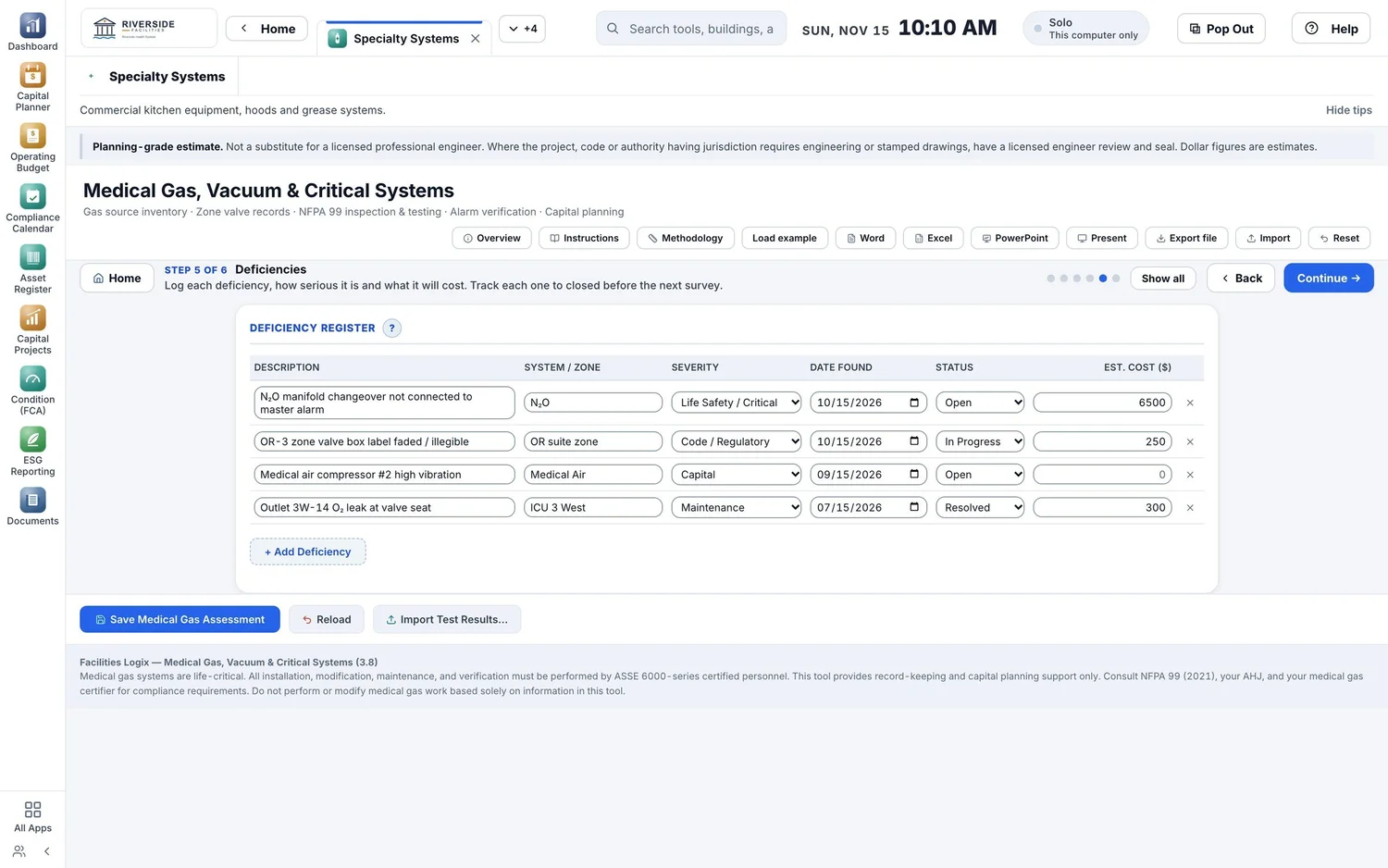
Deficiencies in Medical Gas, Vacuum & Critical Systems: log each deficiency, how serious it is and what it will cost. Track each one to closed before the next survey.
Critical Environment Watch
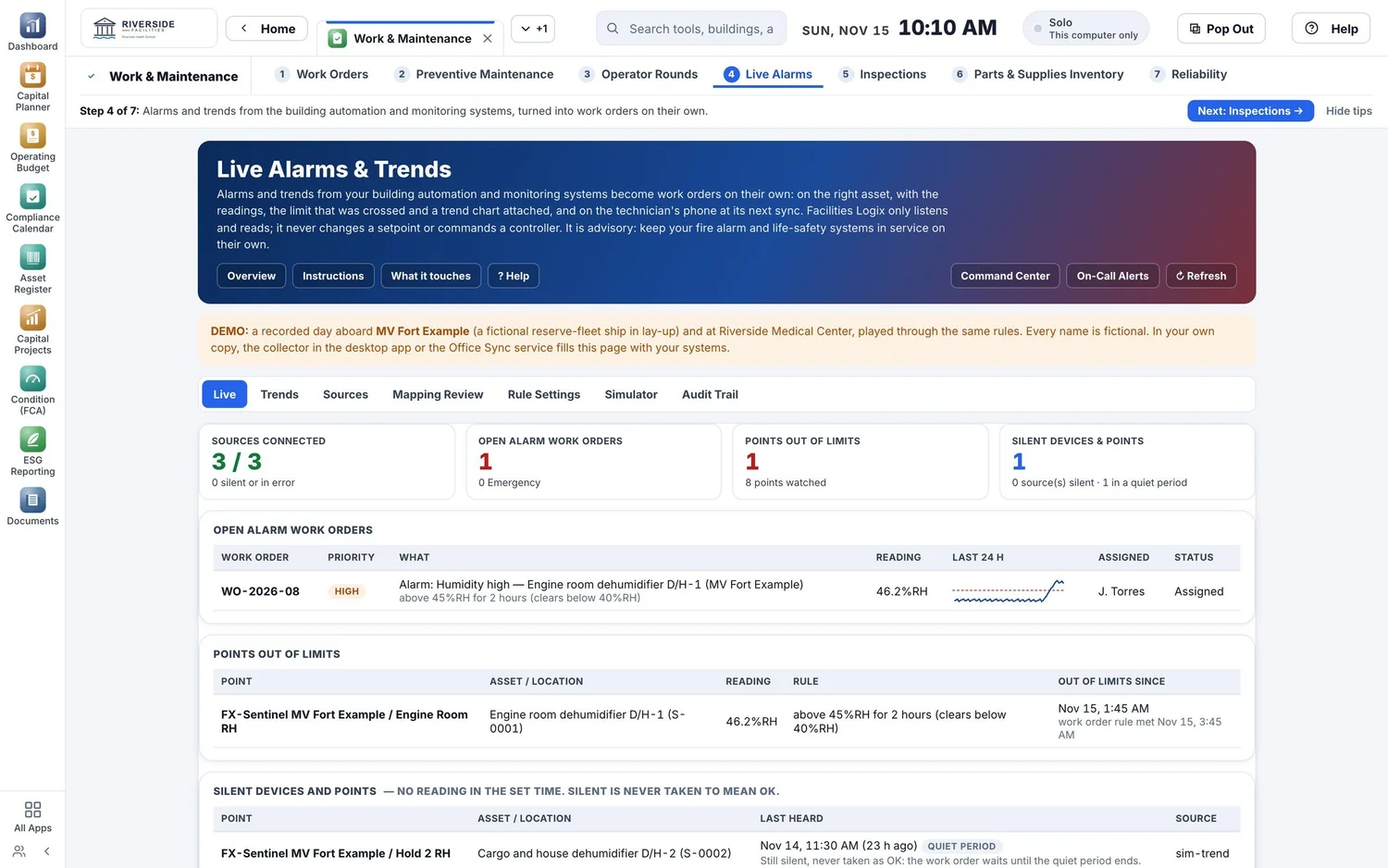
- Every critical room as a tile on the Live Alarms screen, worst first: red while an excursion is open, amber when not read within the days you set (31 to start), green when the latest reading passes
- Starting limits for operating rooms and clean rooms (ASHRAE 170), pharmacy and vaccine refrigerators and freezers (CDC Vaccine Storage and Handling Toolkit), generators (NFPA 110) and domestic hot water (ASHRAE Guideline 12), each editable per point
- Advisory only: it never changes a setpoint, and the room monitor of record governs
Environment of Care Rounds
- Reusable inspection checklists for fire and life safety, the environment of care and facility walks, scored pass, fail or not applicable, with failures rolled into a deficiency list
Continuous Survey Readiness
Standards Tracker
Rows for the facilities elements of performance in the Physical Environment chapter (safe environment, hazardous materials, the Life Safety Code, ILSM, building safety, utility systems, water management, imaging safety), plus NPG utility systems and EM continuity. Legacy EC and LS numbering remains for programs still on it. Every row starts Not Assessed, so the tool never presumes compliance.
Learn MoreShow Less
A readiness score that counts unrated items as passing gives leadership false comfort, and the bill comes at survey time. Ratings are honest by design.
- Each element is rated Compliant, Partial, Non-Compliant or N/A, with evidence and a reviewer.
- Default rows run PE.01.01.01 through PE.05.01.01 plus NPG utilities and EM continuity.
- Restore Default EPs brings back the starting rows after edits.
- Non-compliant elements publish to the deficiency register for work orders and capital.
Mock Survey Findings and the SAFER Matrix
Each tracer or mock-survey finding is scored by likelihood of harm and scope. High likelihood at any scope, and moderate likelihood with a pattern or widespread scope, are banded High, the cells where The Joint Commission expects leadership involvement and a preventive analysis. Each finding carries a corrective action, a responsible person, a due date and a status.
Learn MoreShow Less
High-risk findings are the ones that need leadership involvement and a preventive analysis, so spotting them early keeps corrective money on the right problems.
- The risk band computes as soon as likelihood and scope are chosen.
- Moderate likelihood with limited scope, or low likelihood with a pattern or widespread scope, bands Moderate.
- Low likelihood with limited scope bands Low.
- Immediate threats sit outside the grid: escalate at once.
- Reports count open high-risk findings and corrective actions already past due.
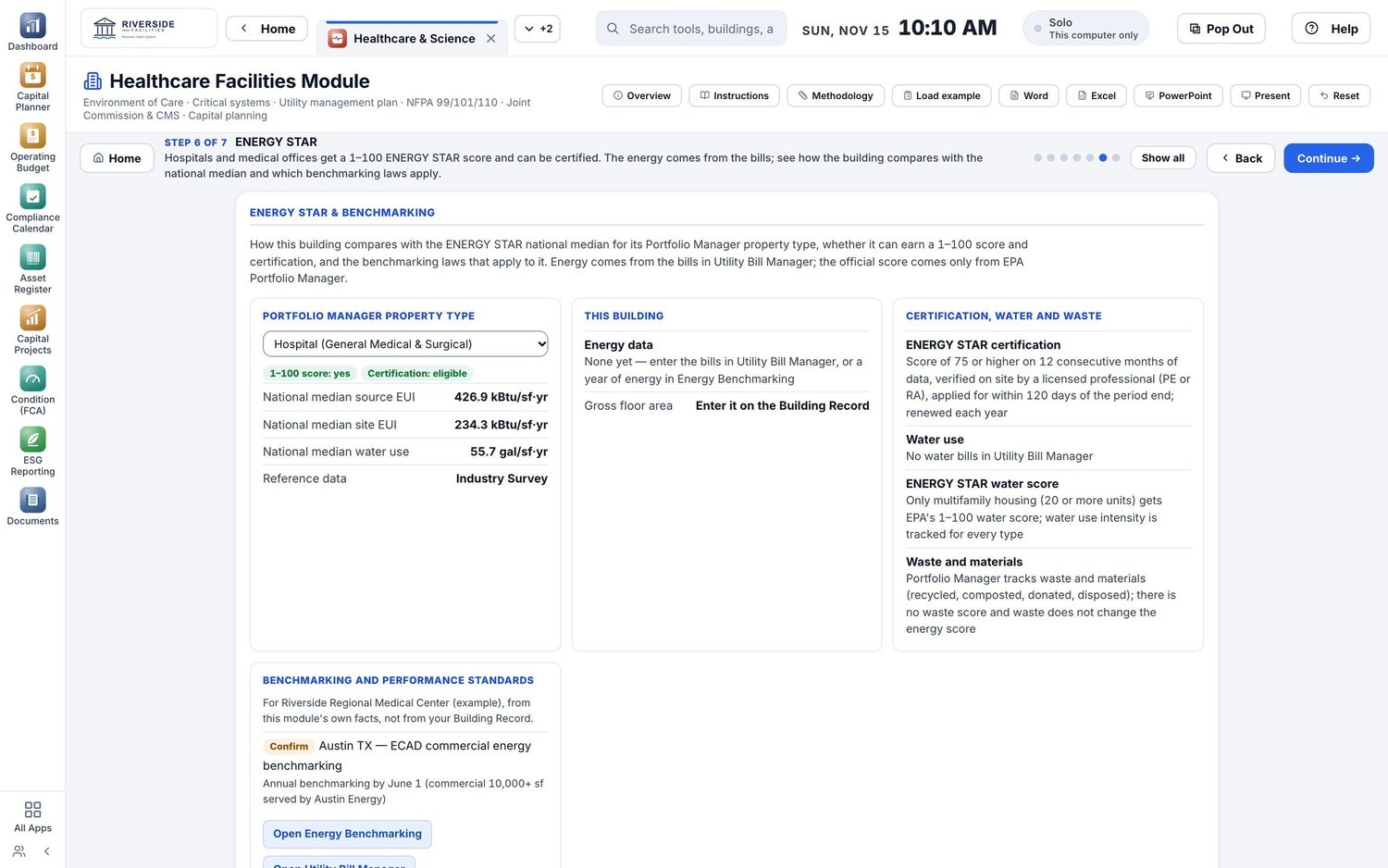
ENERGY STAR in Healthcare Facilities: hospitals and medical offices get a 1–100 ENERGY STAR score and can be certified. The energy comes from the bills; see how the building compares with the national median and which benchmarking laws apply.
Readiness Score
Compliant plus half of partial, divided by the elements rated. Posture reads Ready, Minor Gaps, Significant Gaps or Not Ready, and stays Incomplete until every element is rated. This is the tool's own self-assessment convention; no accreditor publishes a readiness percentage.
Learn MoreShow Less
Knowing the gap before the surveyor does lets the budget go to the elements most likely to be cited. The posture also counts open high-risk findings.
- Ready: 90% or more and no open high-risk findings.
- Minor Gaps: 75% or more and no more than one.
- Significant Gaps: 55% or more and no more than two.
- N/A and unrated elements are left out of the percentage.
- The report names the non-compliant elements to fix before the next survey window.
Survey Binder
One row per element in standard order, with its frequency, status, evidence, responsible person and last review. Attach files to each row, then download the binder as a ZIP (index, read-me and an evidence folder per element) or the index as a Word report.
Learn MoreShow Less
Weeks of staff time spent assembling evidence before a survey is a real cost. The binder is built from rows you already keep.
- Status codes read C, NC, NA or IOU; Partial counts as NC.
- Rows run in standard order: chapter, then each number.
- Any stored file whose title names the element also goes into its folder.
- The ZIP's index is a spreadsheet the team can sort and filter.
Your Accreditor's List Governs
No accreditor's text ships with Facilities Logix. Import your accreditor's current document list from a spreadsheet, matched by element, so next year's list updates the same rows. A medical gas verifier's test results import the same way, with the report PDF kept beside them.
Learn MoreShow Less
Rekeying a document list every year wastes staff hours and lets old requirements linger. Importing keeps the rows current without starting over.
- The import reads element, frequency, status, document, responsible person and last review.
- An imported IOU status stays IOU.
- The verifier's results land in the medical gas inspection list, matched by system, test and date.
- A failed result or a deficiency goes straight to the deficiency list.
- A result word the tool cannot place is refused and named, never read as a pass.
Reports for Leadership
Word, Excel and PowerPoint reports from each tool, a monthly critical-room binder, gaps published to the deficiency register, and an ENERGY STAR tab: hospitals get a 1 to 100 score and are eligible for certification, with energy taken from your bills.
Learn MoreShow Less
A board approves capital faster when risk, cost and the energy bill sit in one report. Each tool's report opens with a recommendation, not a data dump.
- Healthcare: compliance items overdue and due within 60 days, open deficiencies and the capital total.
- Survey readiness: percentage, posture and open high-risk findings.
- Hospitals compare with a national median of 426.9 kBtu per square foot source energy.
- Water use is compared with a median of 55.7 gallons per square foot.
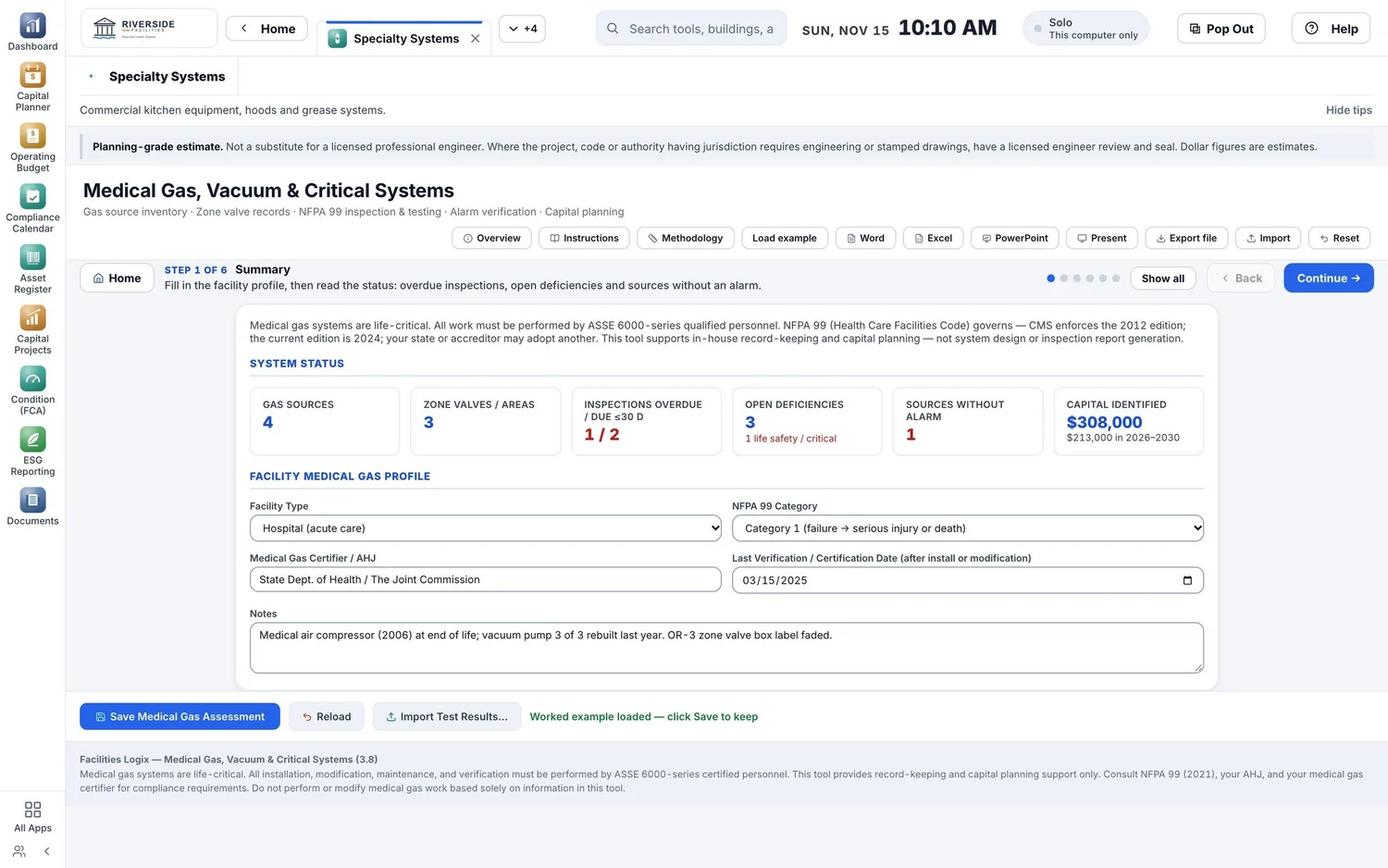
Summary in Medical Gas, Vacuum & Critical Systems: fill in the facility profile, then read the status: overdue inspections, open deficiencies and sources without an alarm.
The Numbers on the Summary Tabs
Healthcare Module
- Critical systems monitored
- Open deficiencies across the Environment of Care and systems
- Compliance items overdue
- Capital items
Survey Readiness
- Standards tracked
- Open findings and high-risk findings
- Readiness percentage and posture
- Corrective actions past due
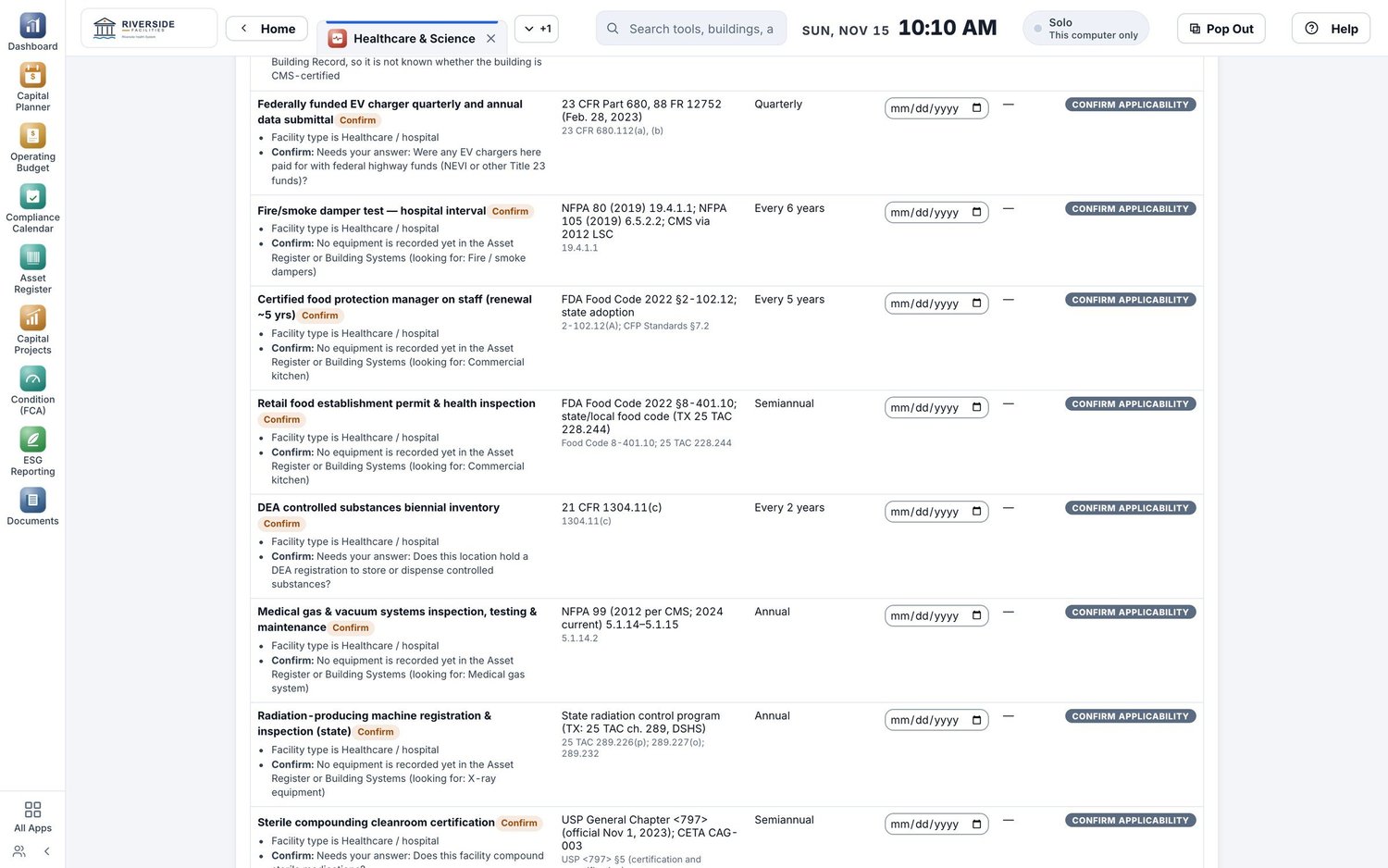
Compliance in Healthcare Facilities: see every inspection, test and filing that applies to this building and why. Enter the date each was last done; next-due dates match the Compliance Calendar.
Medical Gas
- Gas sources and zone valves
- Inspections overdue or due within 30 days
- Open deficiencies
- Sources without an alarm connected
- Capital identified
Critical Rooms
- Pass or fail by room and month
- Open excursions and the days each has been open
- Latest pressure difference, air changes, temperature and humidity per room
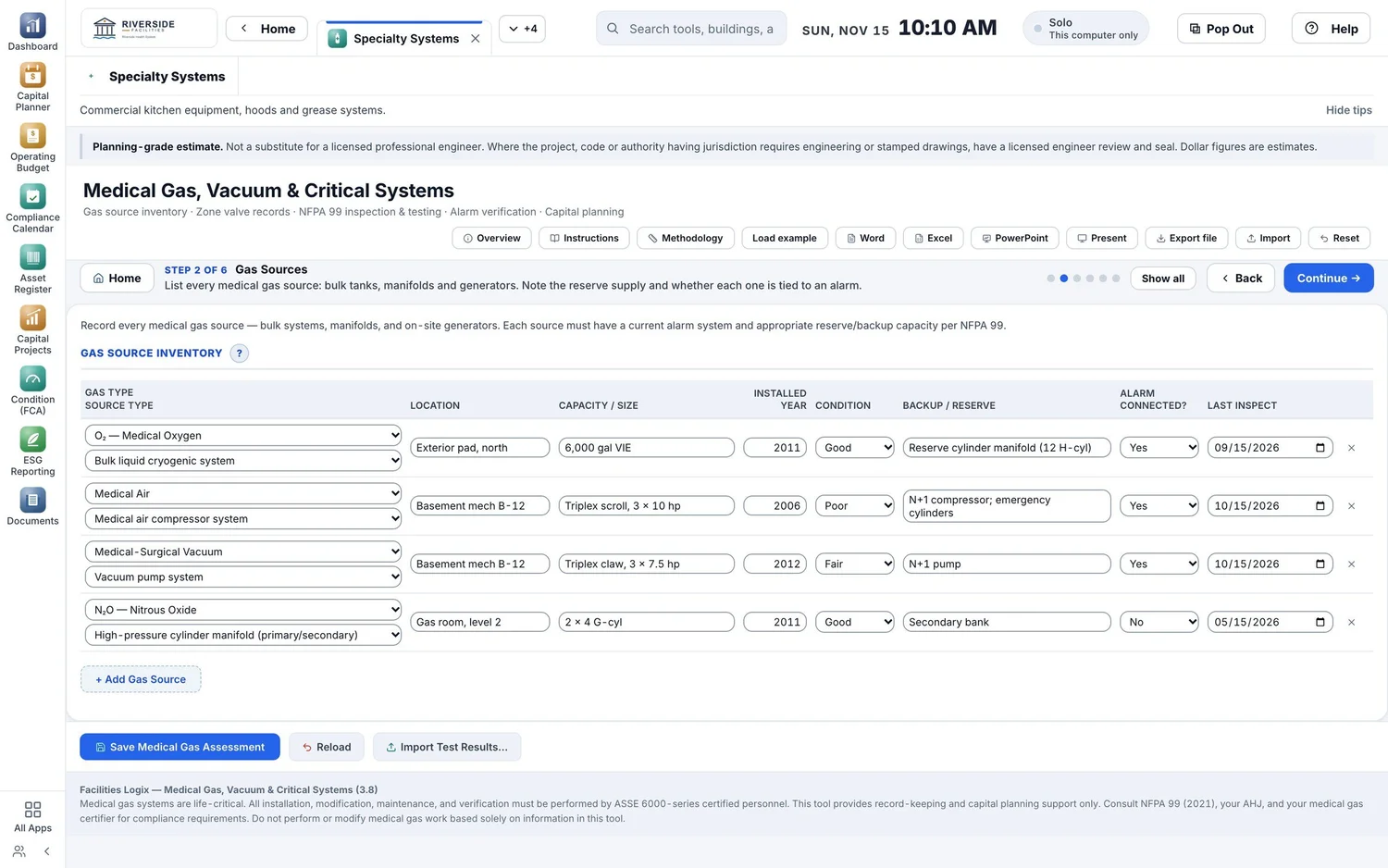
Gas Sources in Medical Gas, Vacuum & Critical Systems: list every medical gas source: bulk tanks, manifolds and generators. Note the reserve supply and whether each one is tied to an alarm.
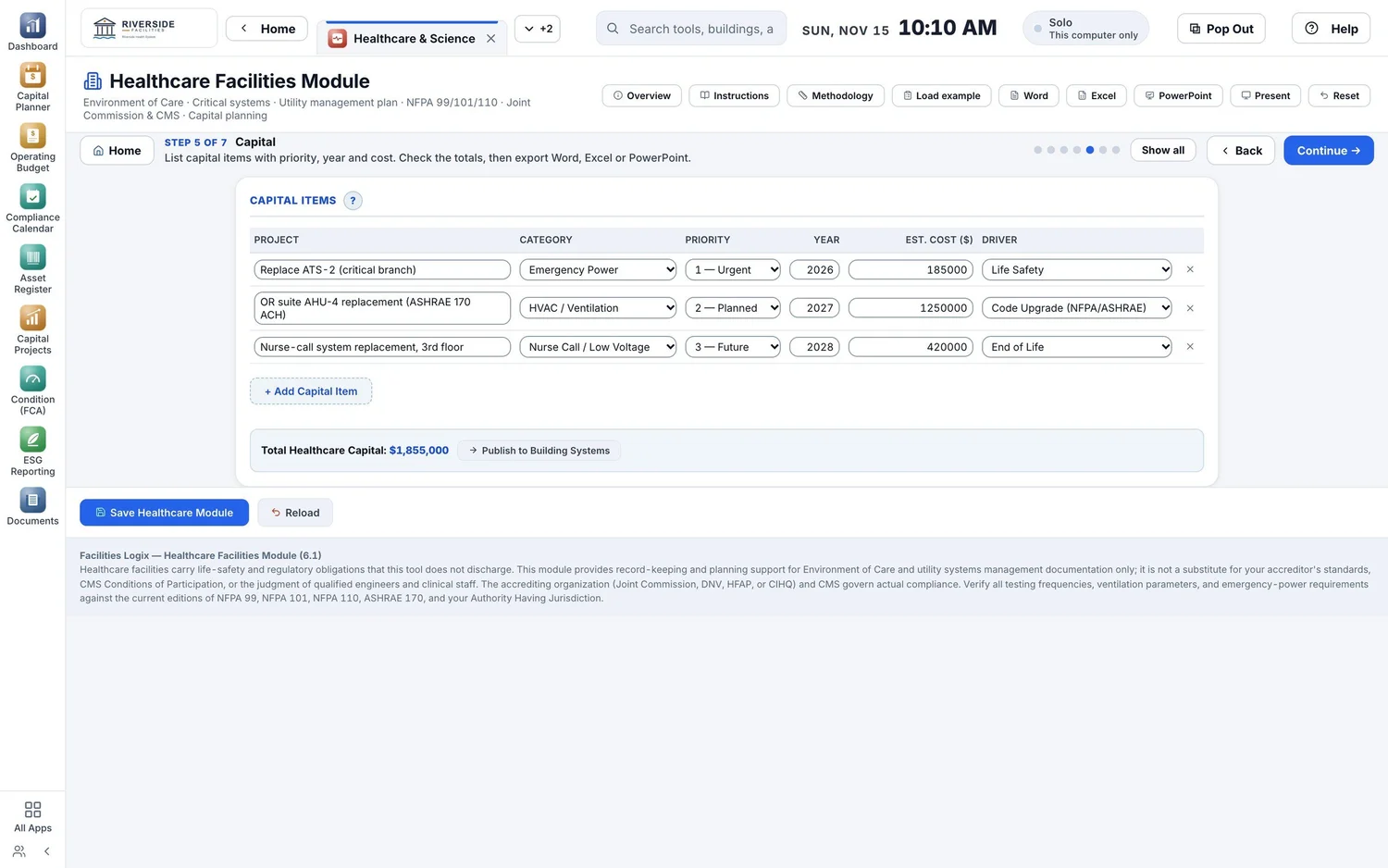
Capital in Healthcare Facilities: list capital items with priority, year and cost. Check the totals, then export Word, Excel or PowerPoint.
Ready on Any Day, Not Just Survey Week
No Binder Scramble
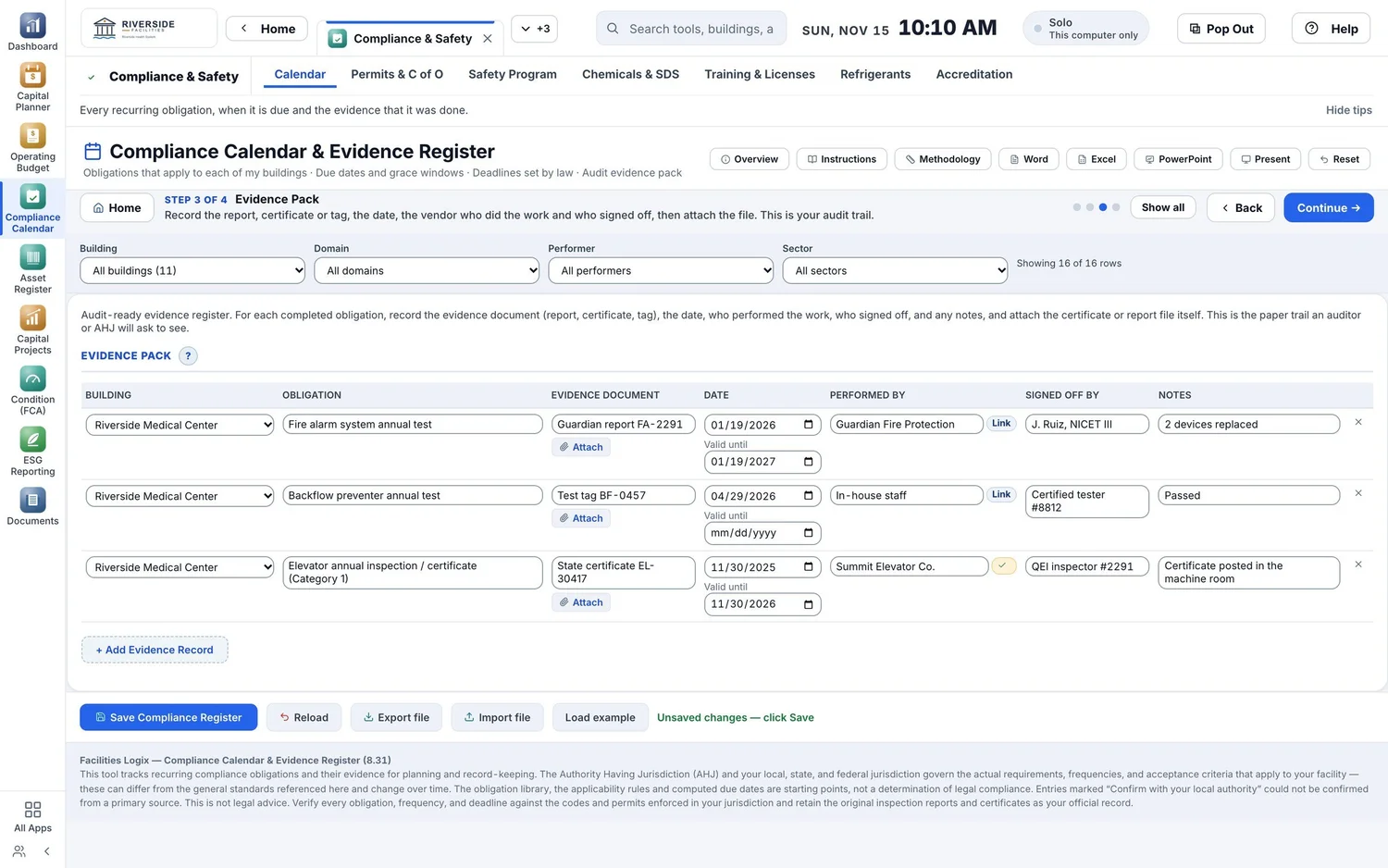
Evidence is attached as the work is done, so the survey binder is a download, not a month of gathering.
Learn MoreShow Less
Every hour a manager spends hunting for test reports before a survey is an hour taken from the building. Evidence files sit on the row they prove.
- Attach test records, inspection reports and drawings to each element of performance.
- Files are added from the binder's Evidence Files, and its counts refresh when you close it.
- The binder sorts every attached file into a folder per element.
- Outside testing reports imported as PDFs are kept beside their results.
Dates That Do Not Slip
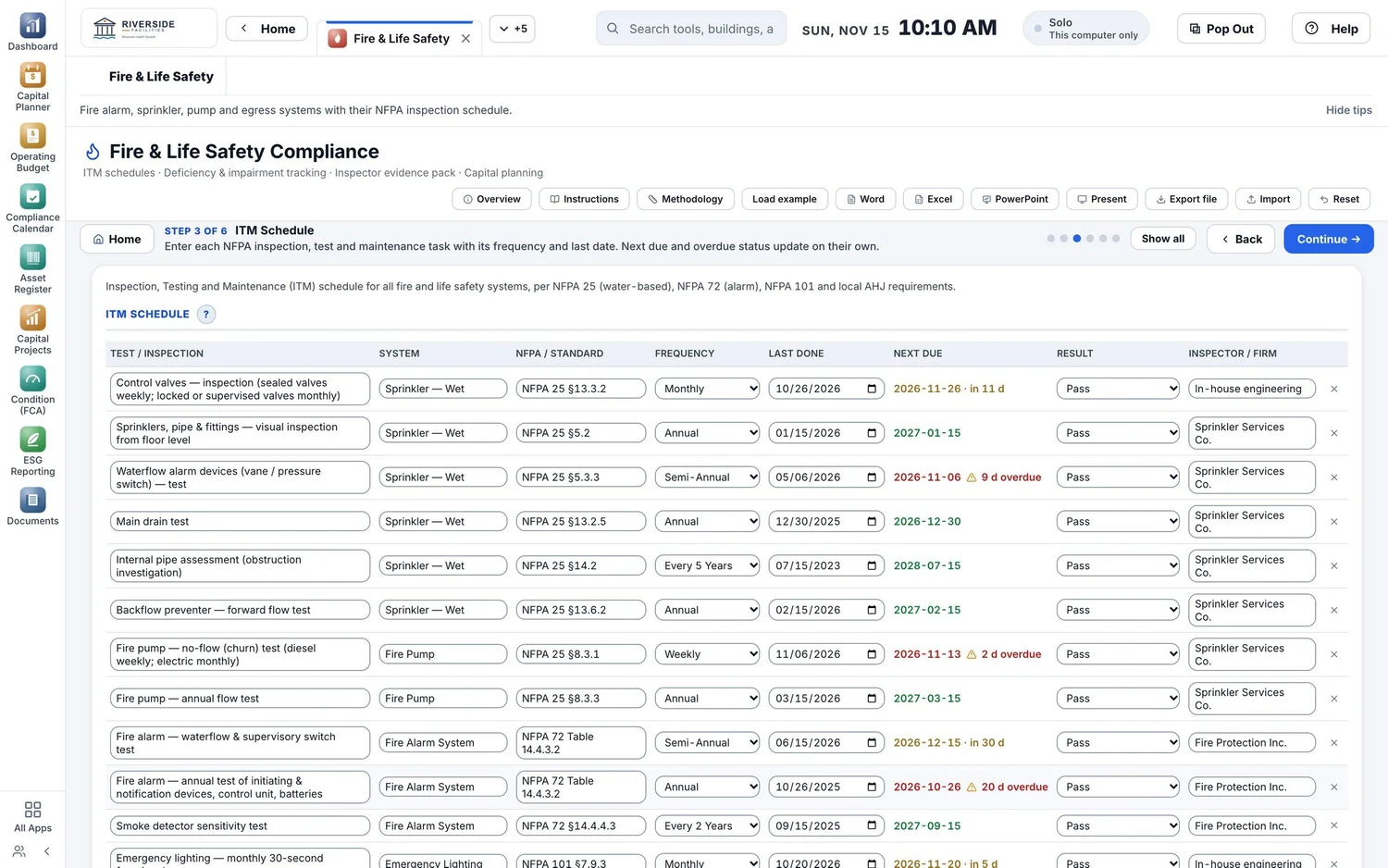
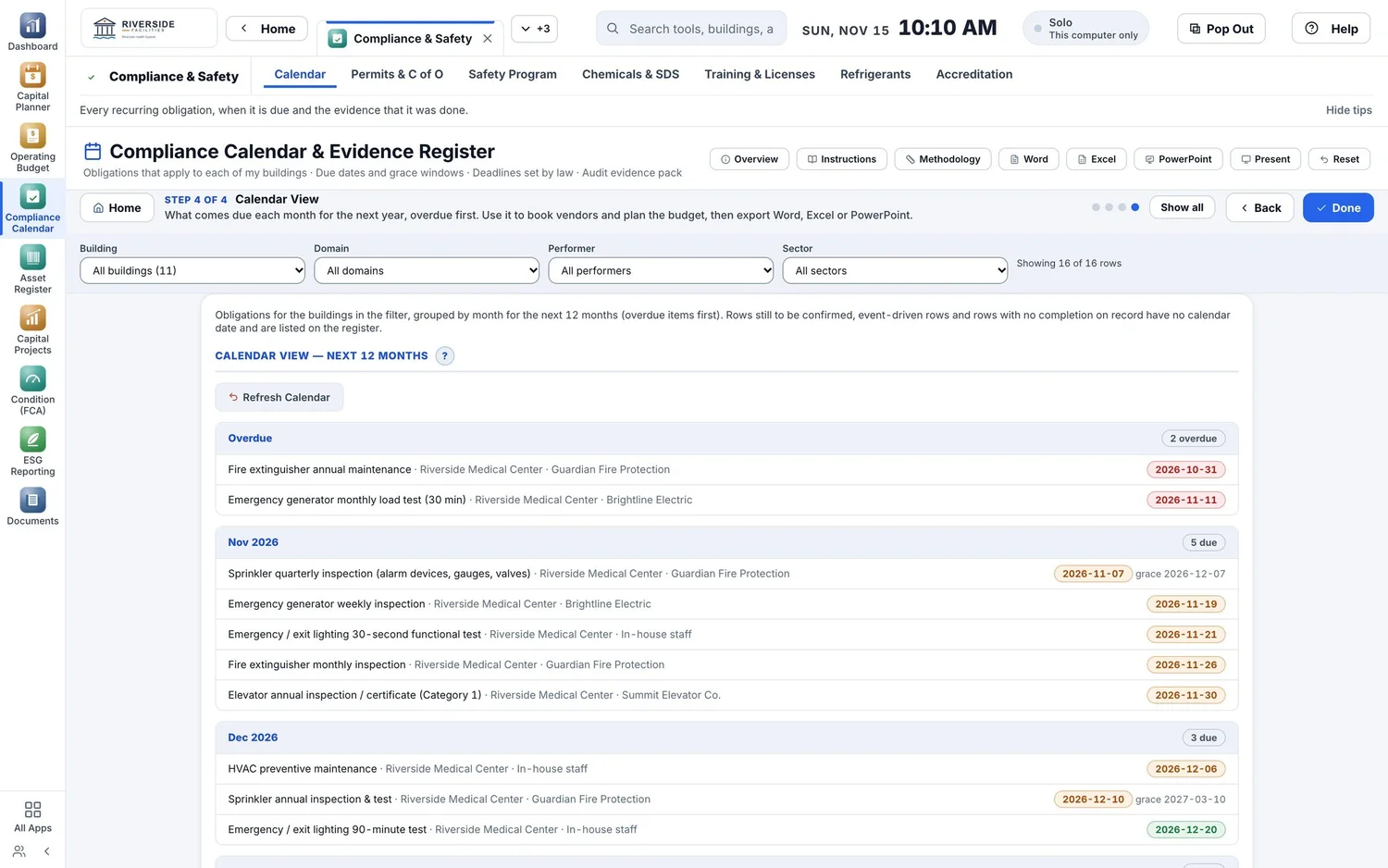
Drills, damper cycles, generator tests, medical gas tests and plan reviews come due on one calendar, which helps keep a missed date from becoming a finding.
Learn MoreShow Less
A missed test turns into a finding and a plan of correction that costs staff time to close. The dates come from work already logged.
- EOC evaluations, critical-system tests and utility PMs all feed one overdue count.
- Blank next-due dates are calculated: evaluations at 12 months, utility PMs by their interval.
- Items due within 60 days are counted beside the overdue ones.
- Due dates are local calendar days, so an item due today never shows overdue the night before.
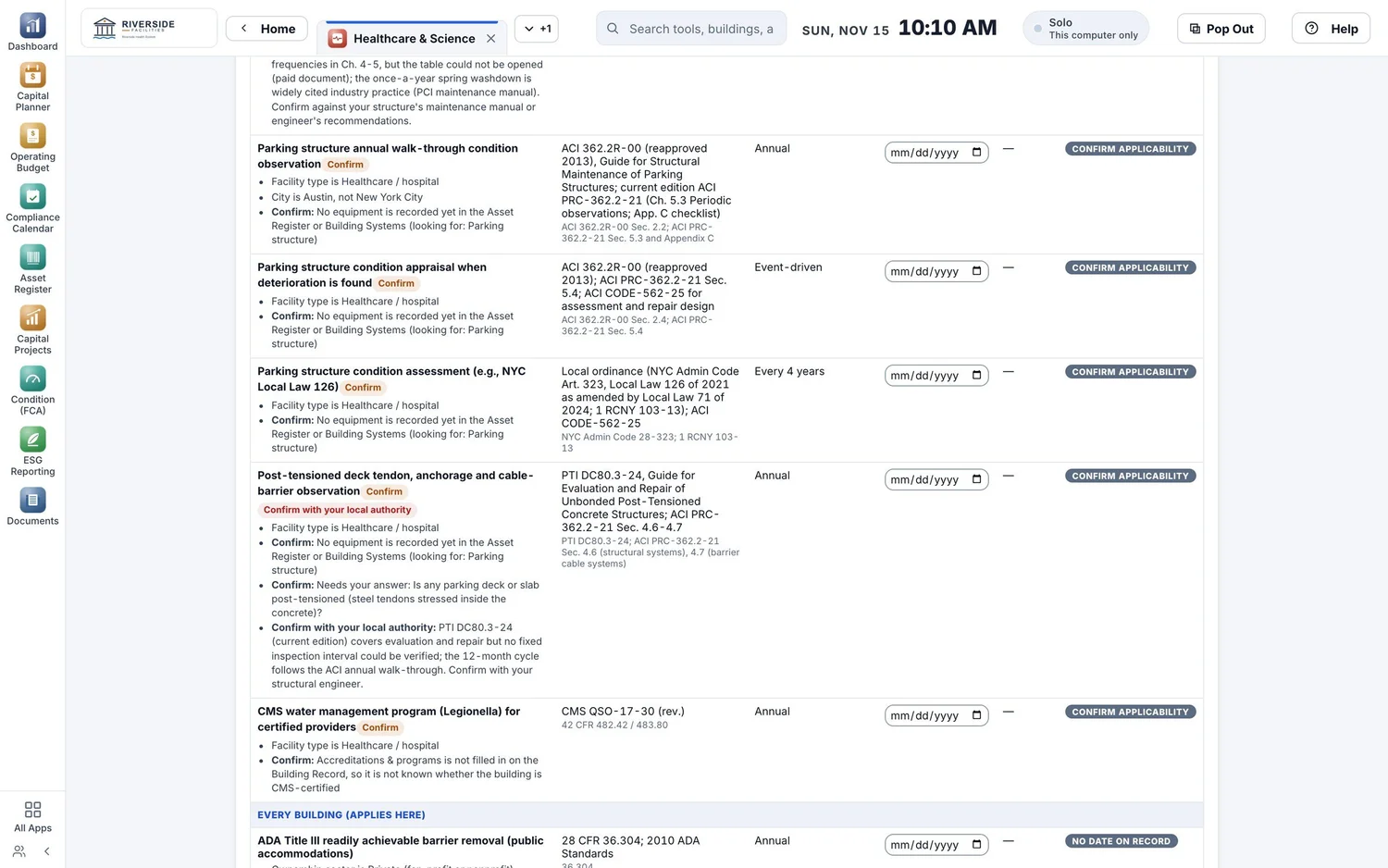
Compliance in Healthcare Facilities: see every inspection, test and filing that applies to this building and why. Enter the date each was last done; next-due dates match the Compliance Calendar.
Drift Caught Early
A room that loses its pressure relationship becomes a work order and stays red until a passing reading closes it.
Learn MoreShow Less
A room that loses pressure is an infection risk, and a pressure problem found by a surveyor costs more than one found by the team. Each excursion is tied to its fix.
- The work order lists what failed and points to balancing, doors, filters or controls.
- A room with a building automation airflow point adds its latest hour as a reading.
- The work order notes that the TAB report and infection prevention risk assessment govern.
- The monthly binder pairs each excursion with its re-reading.
One Picture for Leadership
Readiness, high-risk findings and the capital that fixes them in one report, so corrective action goes where it matters most.
Learn MoreShow Less
Capital requests tied to survey risk get approved; ones that are not get deferred. The reports connect the two in plain sentences.
- The readiness recommendation names the non-compliant elements to fix before the survey window.
- Corrective actions already past due are counted.
- The healthcare report totals the capital plan beside open deficiencies.
- Each capital item carries a priority from 1, urgent, to 3, future.
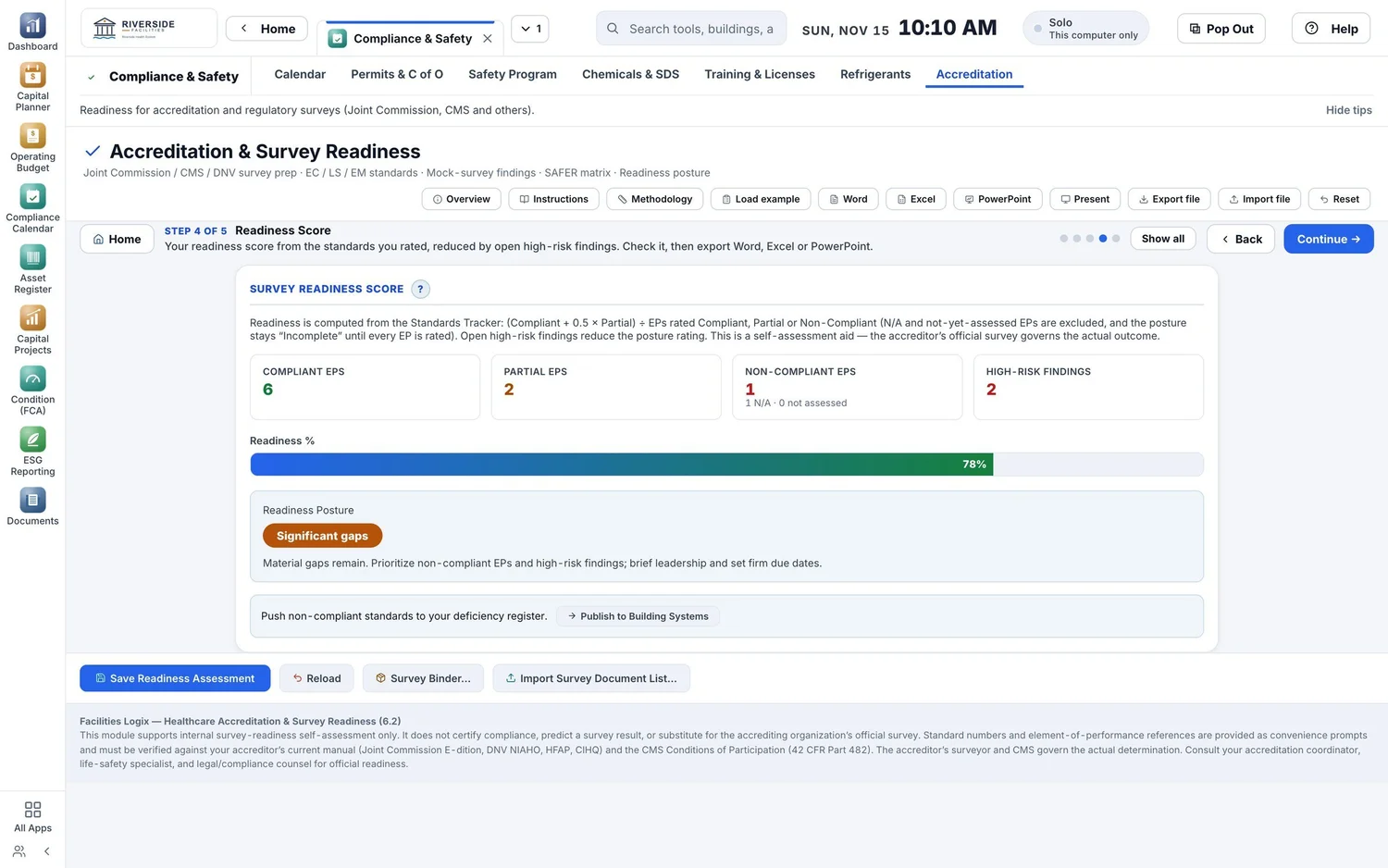
Survey week brings a scramble for evidence, so a readiness score shows where the hospital stands on any day.
Frequently Asked Questions
Does Facilities Logix include The Joint Commission's standards text?
Which accreditors does it work with?
Does it decide whether we are compliant?
Does it ship required pressure or air-change values?
Can a medical gas verifier's results be loaded without retyping?
Be First When Facilities Logix Opens
Stop chasing building records across spreadsheets and binders. Join the list and we will tell you the day downloads open, with setup guides ready.
Launching early 2027 for Facilities Logix. Nothing to buy today, and no sales calls.
