
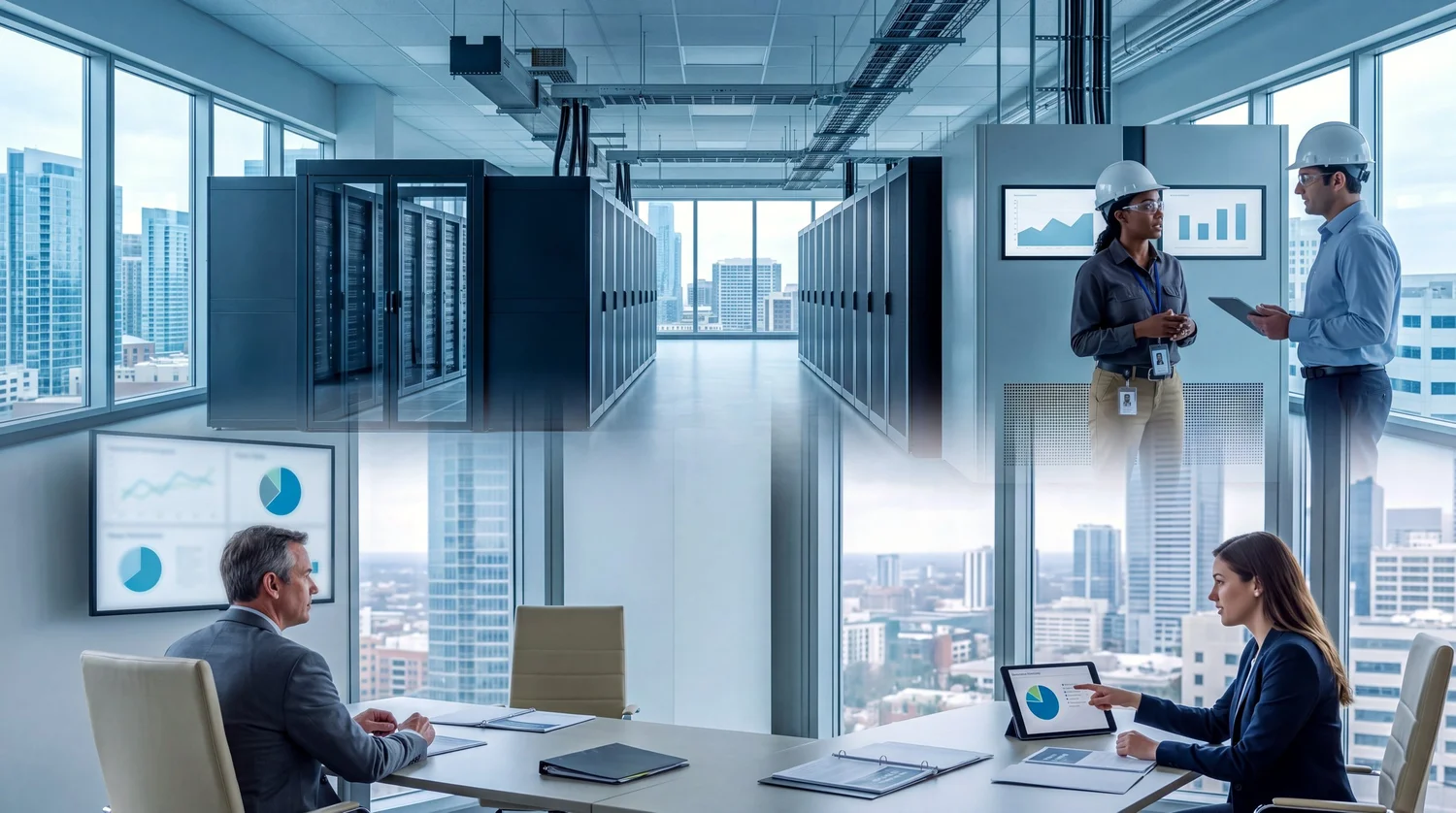
In a data hall, a production plant, a cold store or a treatment works, the building's utilities are the operation. Seven playbooks add capacity, redundancy, production impact and the inspections particular to industrial and utility facilities, on top of the asset, maintenance, monitoring and capital tools in Facilities Logix.
Pick Your Facility Type
Each facility type has its own page: the rules it answers to, the assets and systems it runs, real screens and answers to common questions.
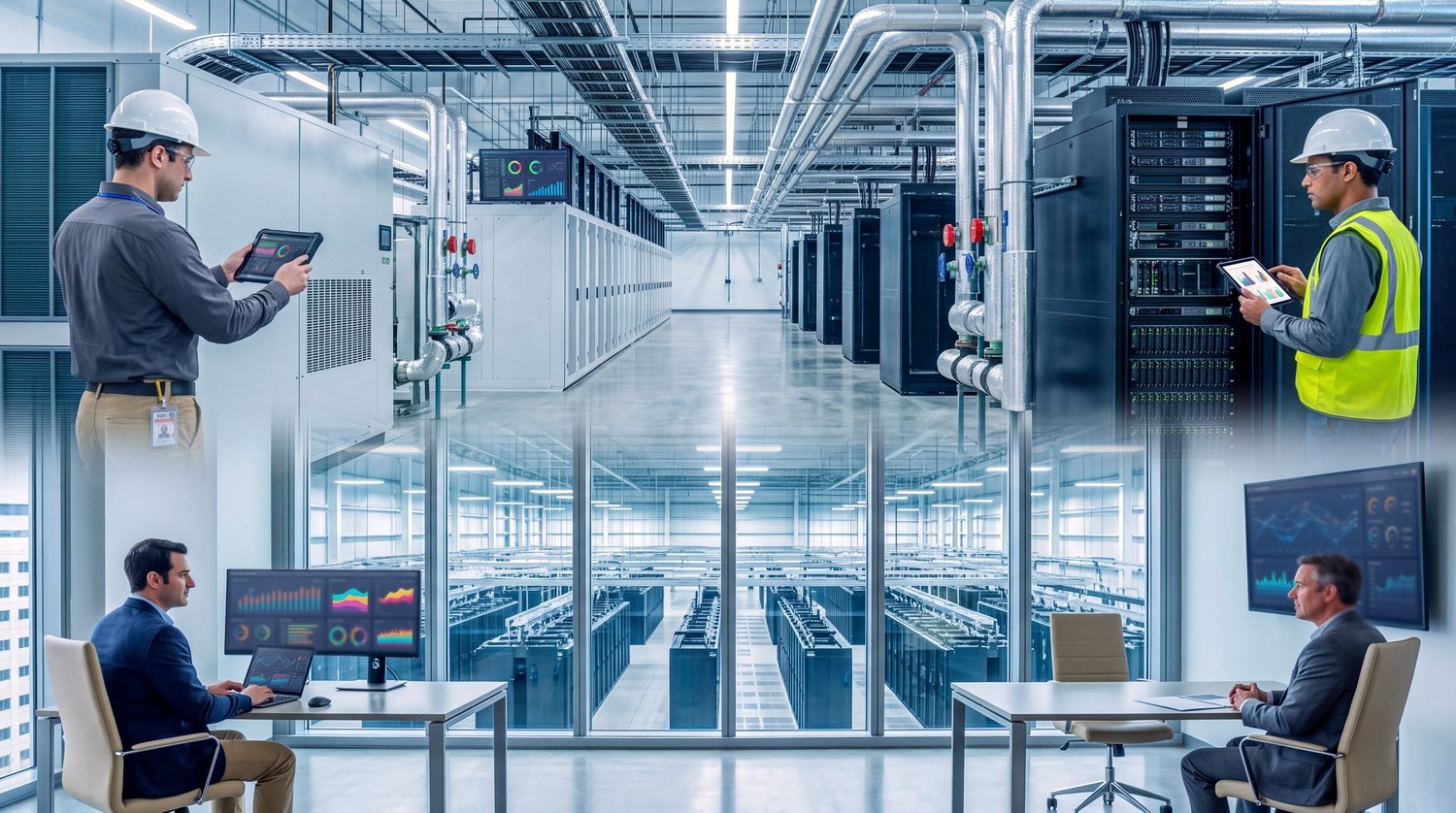
Data Centers and Tower Sites
Usable power and cooling against load, a redundancy tier self-check, PUE from meters, rack inlet temperatures and FCC tower duties, tracked in one place.
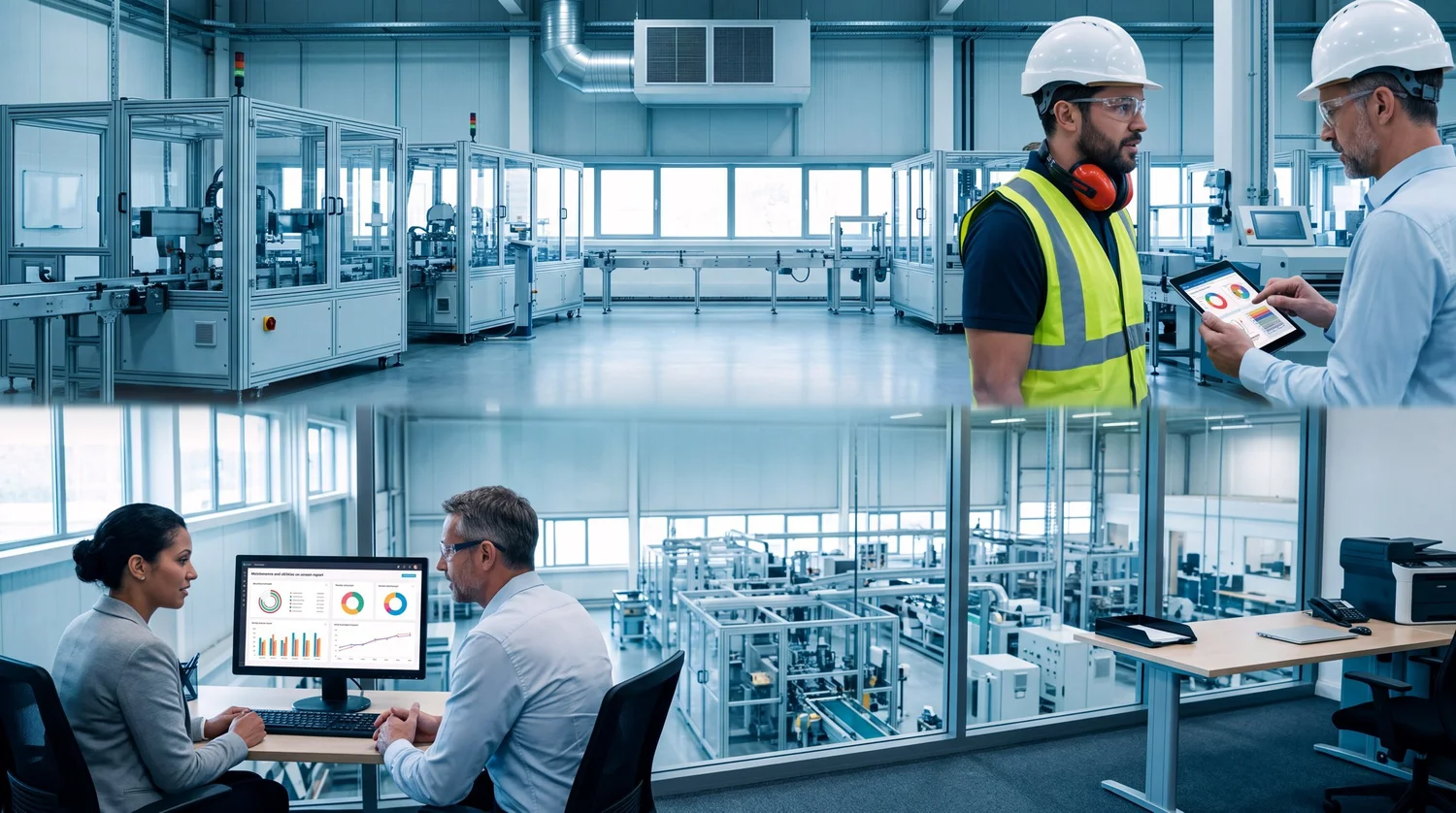
Manufacturing Plants
Plant utilities treated as production assets: downtime cost per failure, MTBF and availability, the redundancy business case, and the EPA and OSHA plant rules.
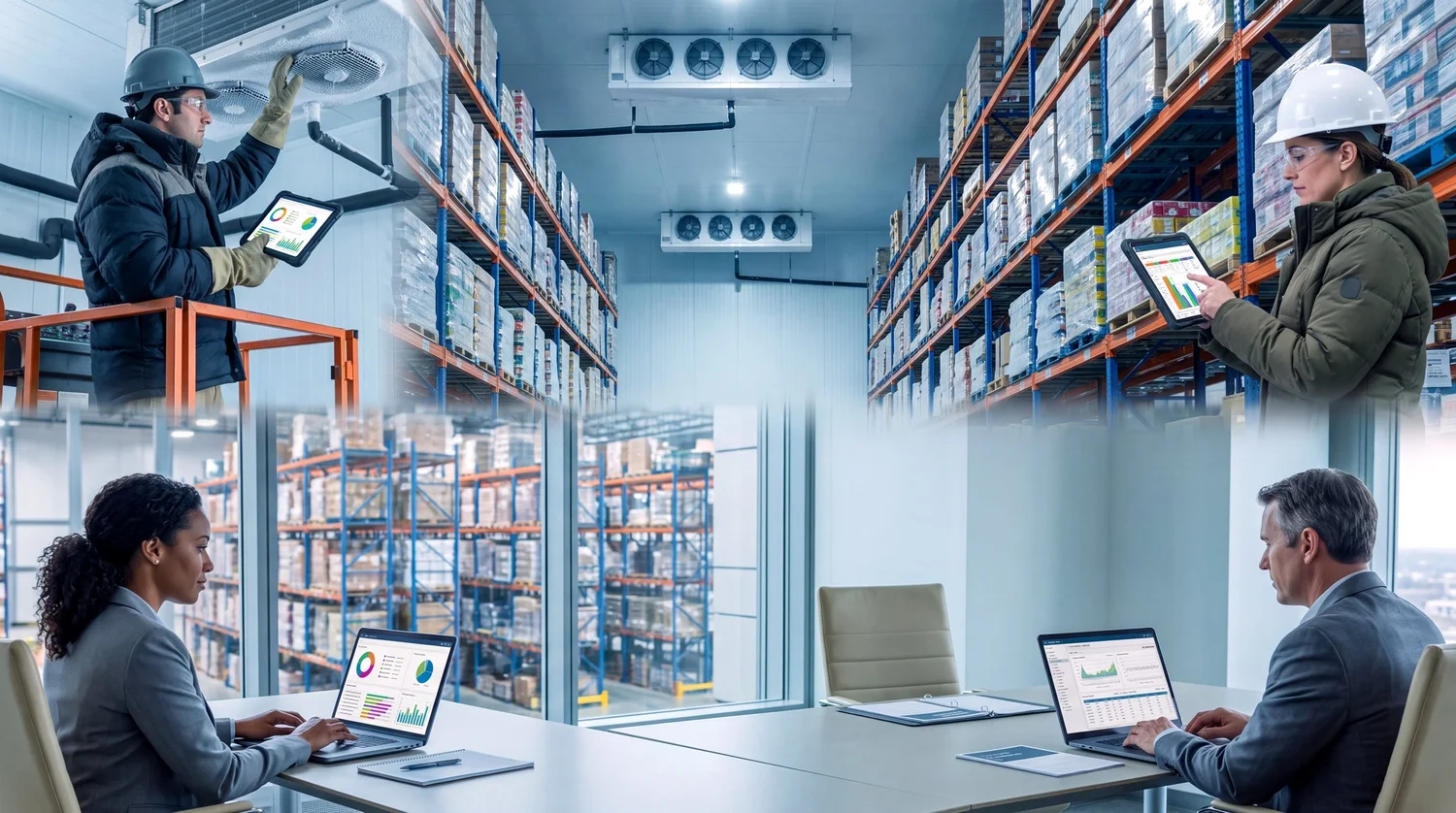
Warehouses and Cold Storage
Docks and lift trucks, rack inspections, cooler and freezer excursions, sprinkler design, ammonia and HFC refrigeration rules and high-piled storage permits.
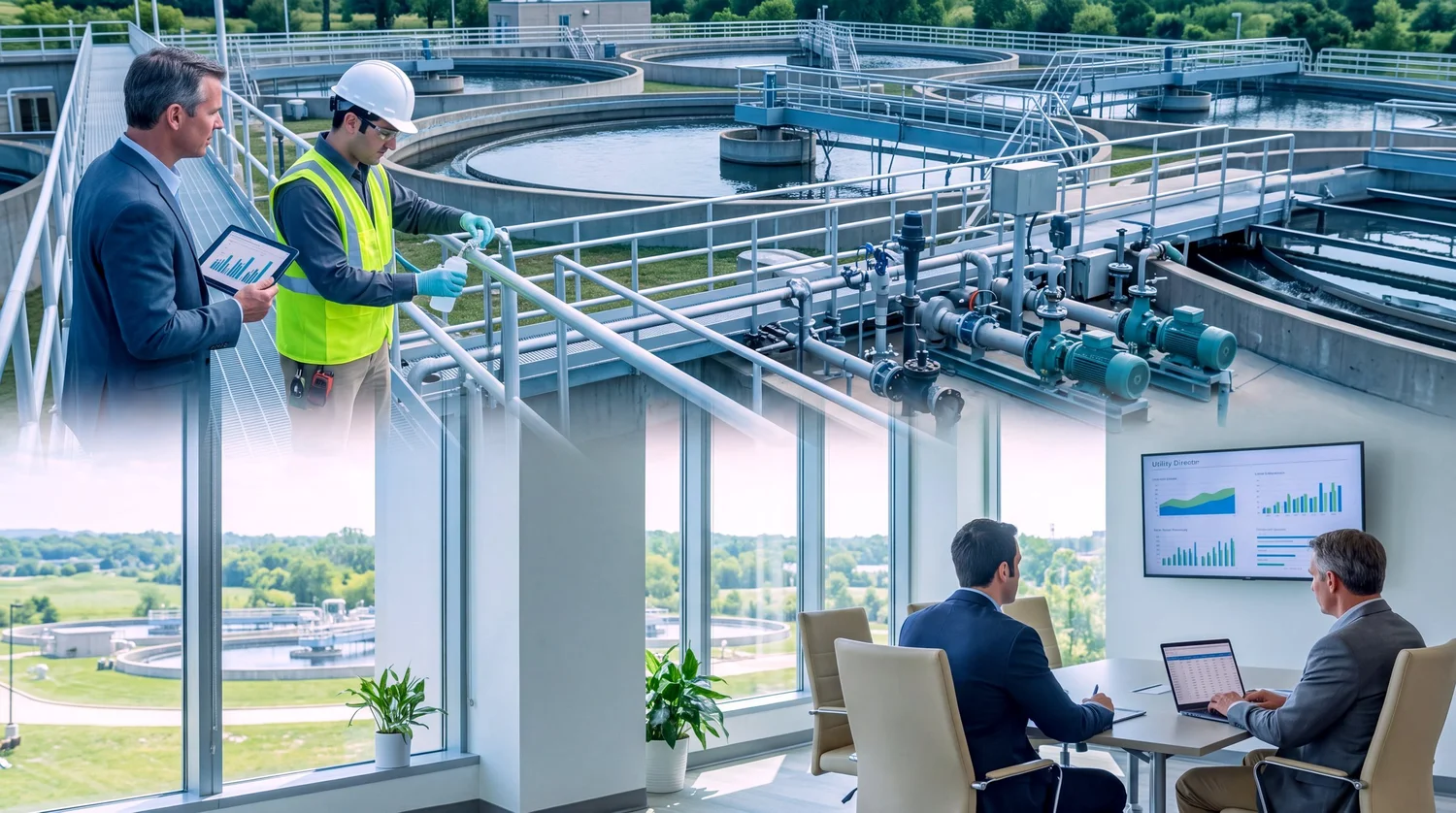
Water and Wastewater
Treatment plants, reclamation, pump and lift stations: AWIA, NPDES reports, biosolids, chlorine RMP exercises, sanitary surveys and the plant's capital plan.
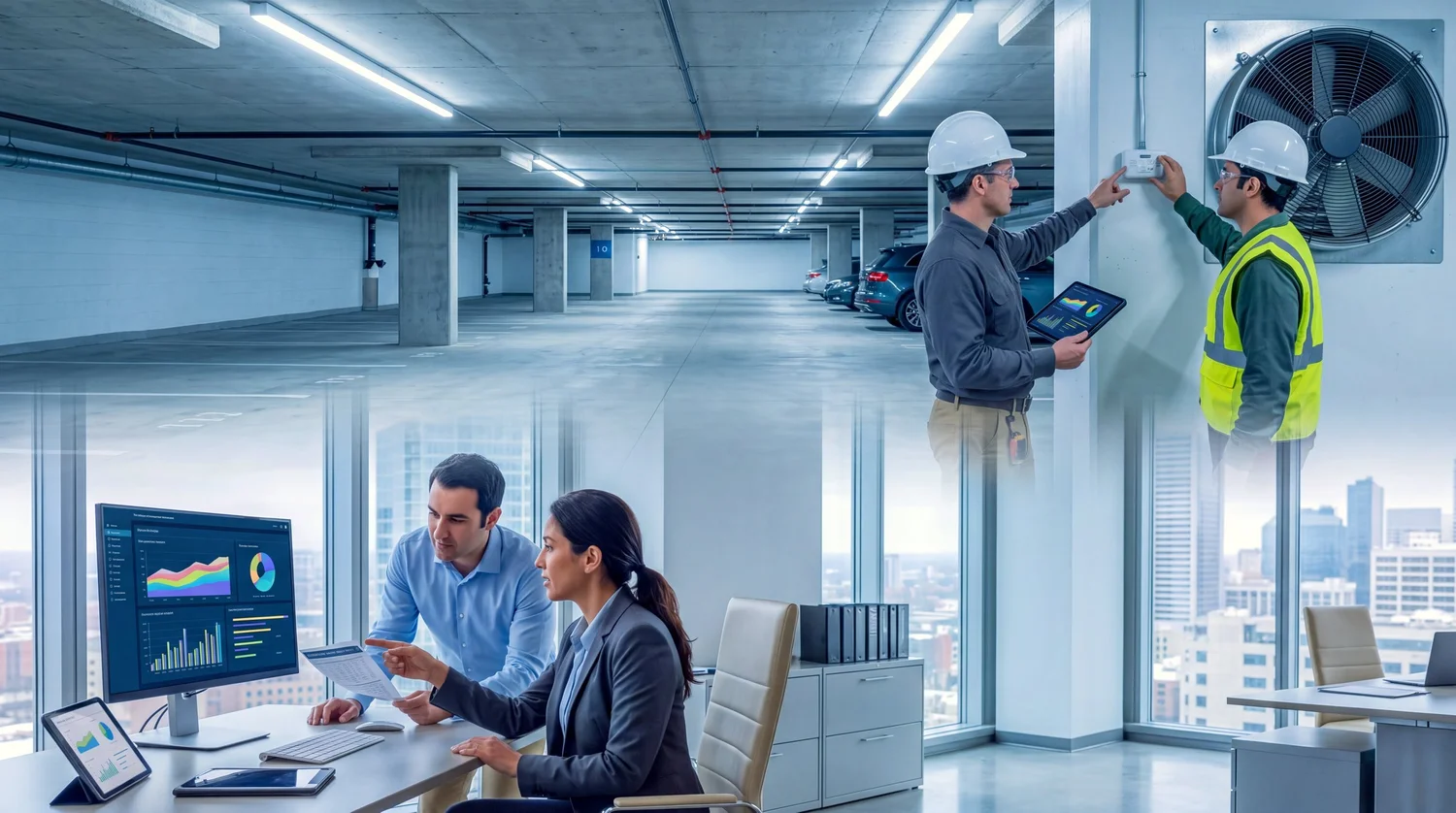
Parking, EV Charging and Self-Storage
Garages, decks and surface lots: structural condition assessments, NYC Local Law 126, Florida milestones, CO ventilation, ADA spaces, PCI scans and EV uptime.
From the Data Hall to the Parking Deck
Facilities Logix is configured for the kinds of buildings your organization runs. A portfolio that spans many markets gets every playbook it needs.
Data Center
Power and cooling capacity, redundancy and efficiency for enterprise, colocation and edge data centers, plus telecom shelters and broadcast tower sites.
Learn MoreManufacturing
Plant utilities, the production-downtime cost of a utility failure, reliability tracking and the redundancy investment case.
Learn More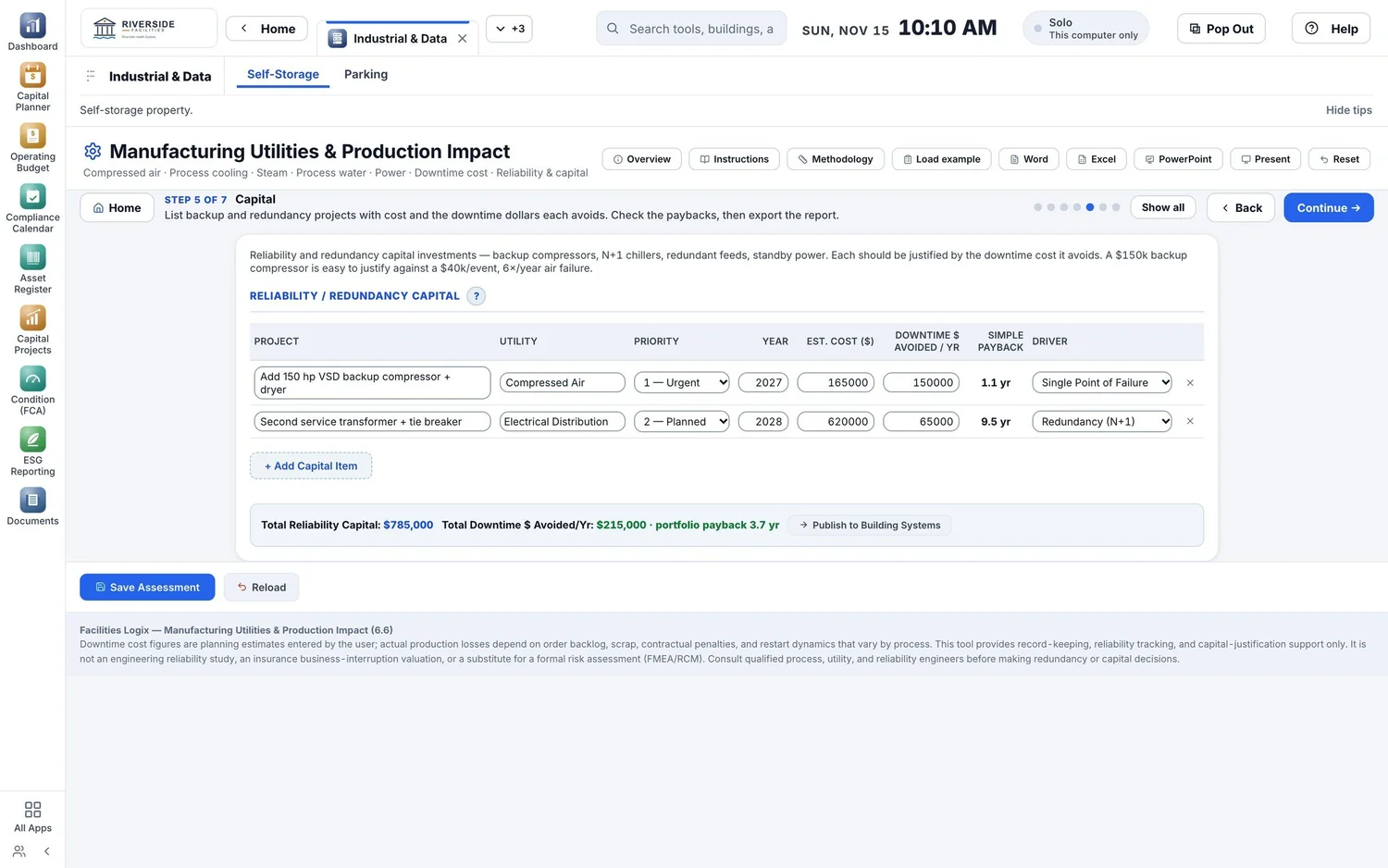
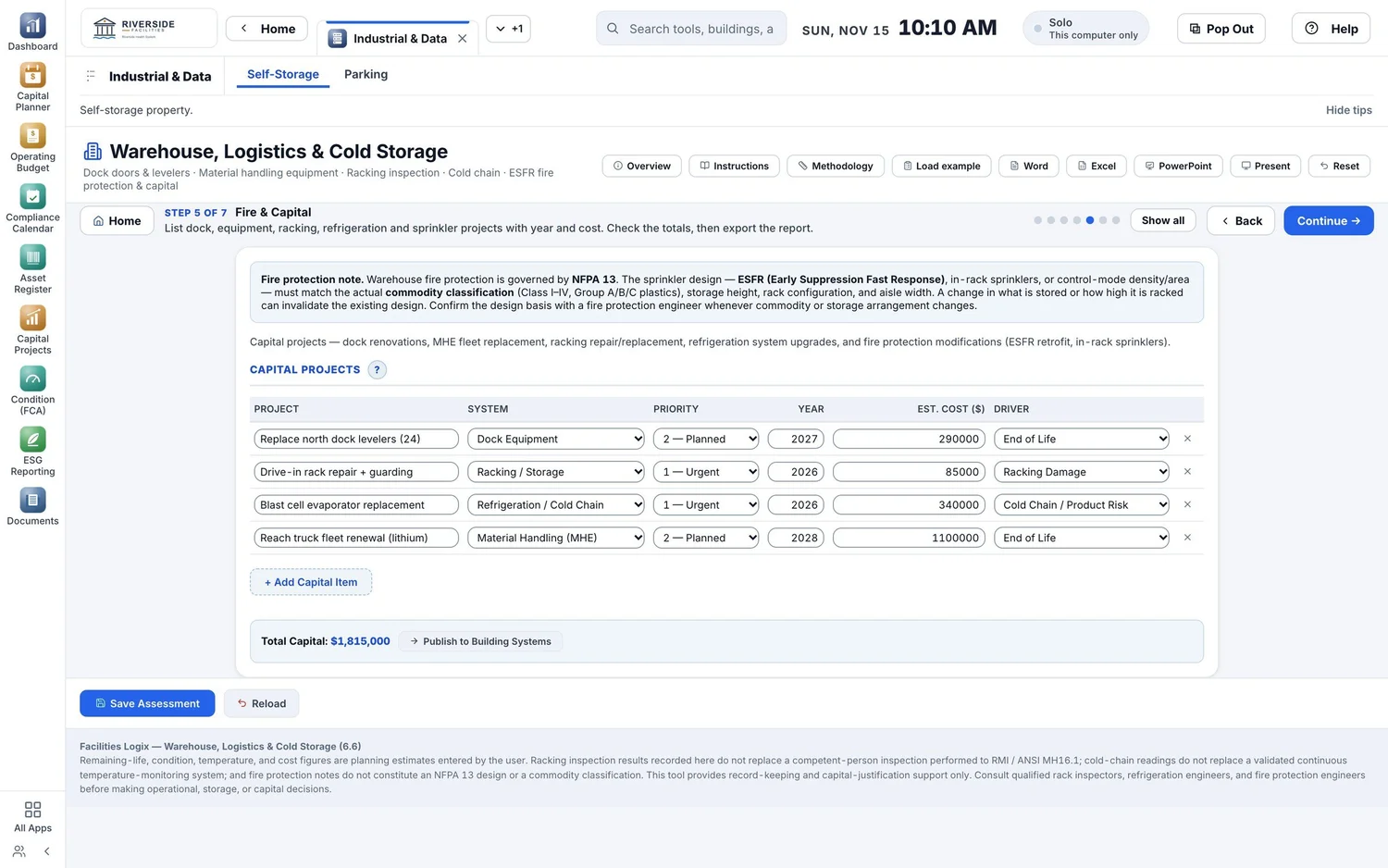
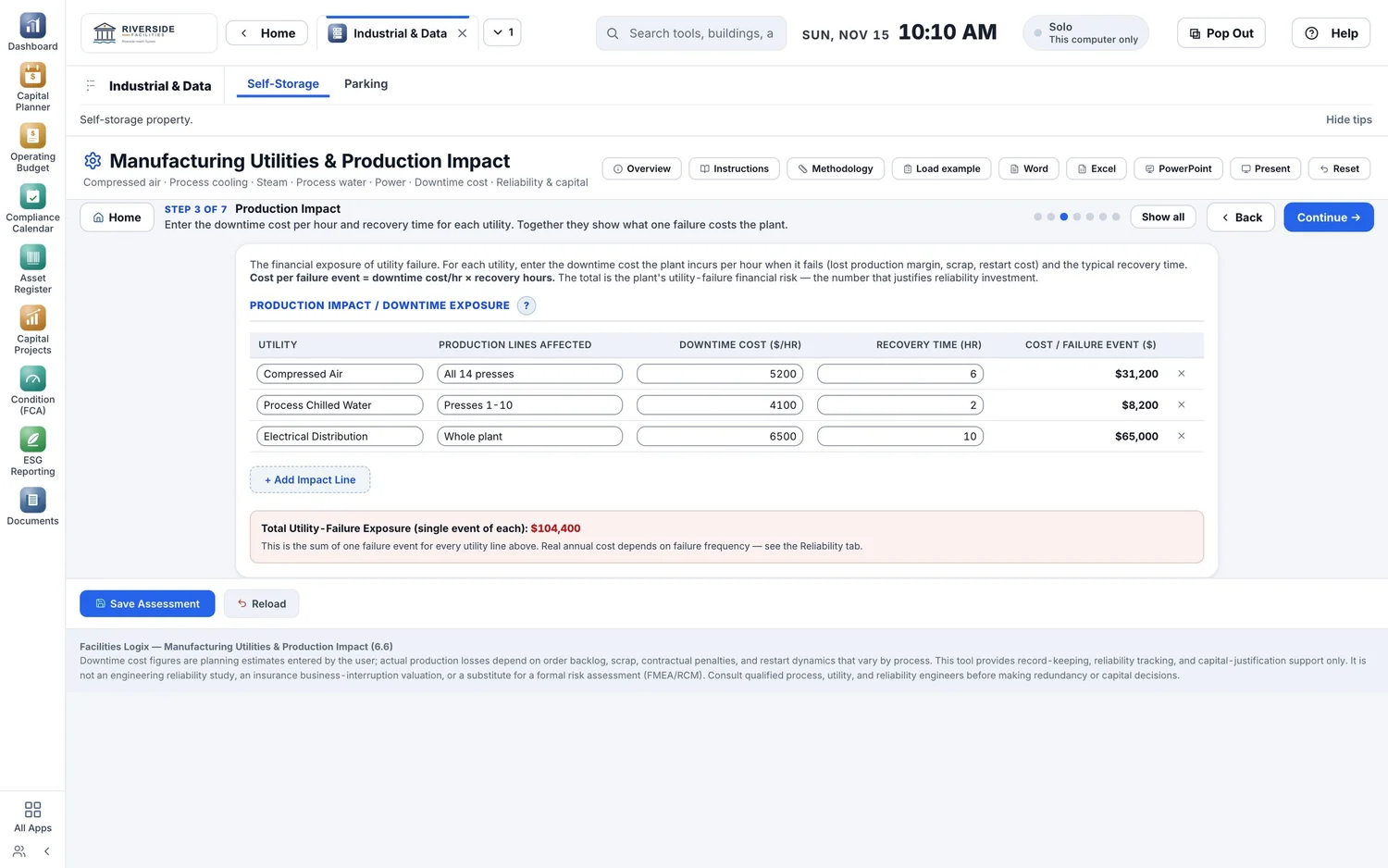
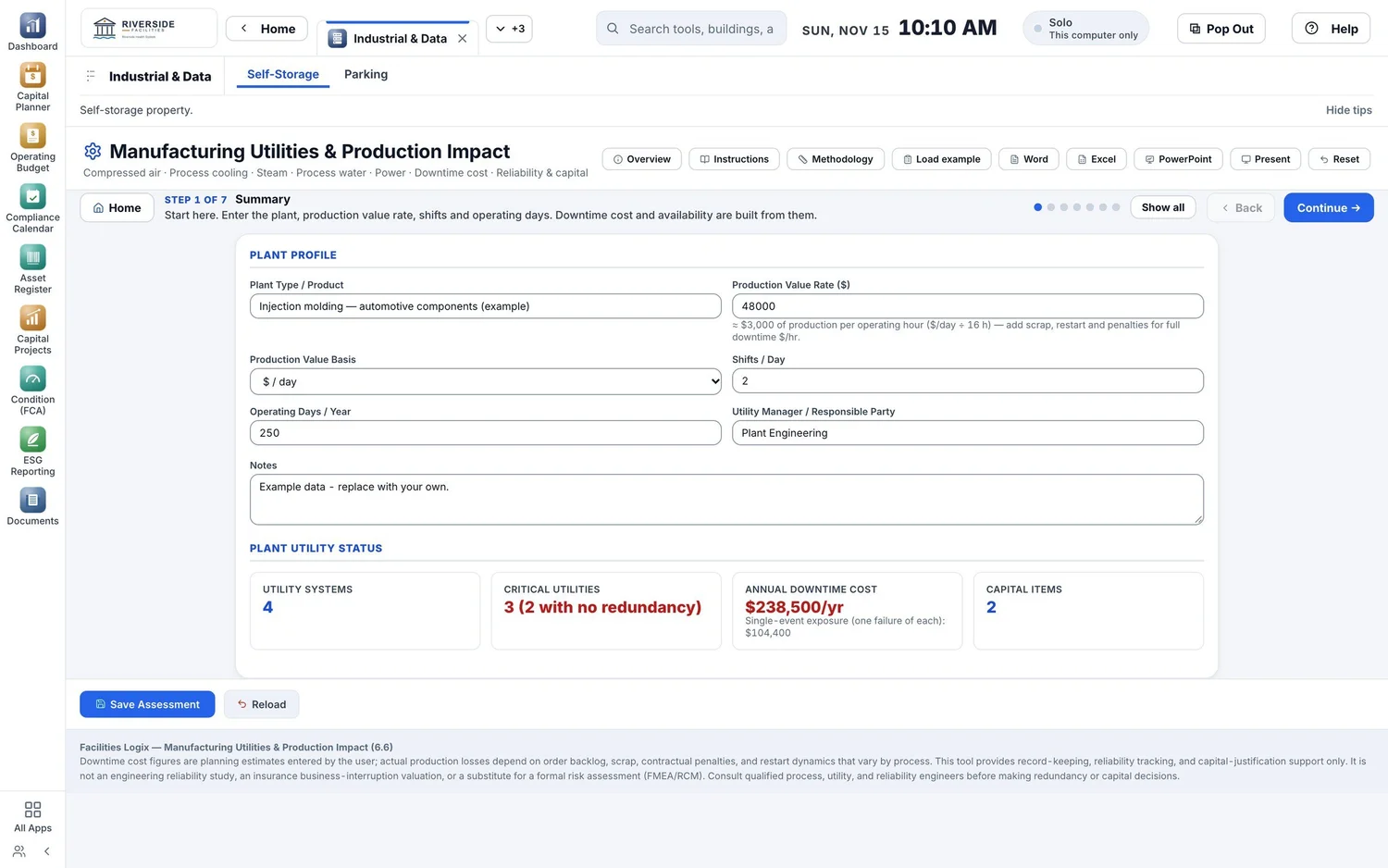
Capital in Manufacturing Utilities & Production Impact: list backup and redundancy projects with cost and the downtime dollars each avoids. Check the paybacks, then export the report.
Warehouse
Dock and material-handling equipment, racking inspection, cold-chain monitoring and fire protection capital for warehouses, logistics and cold storage.
Learn MoreCentral Utility Plant
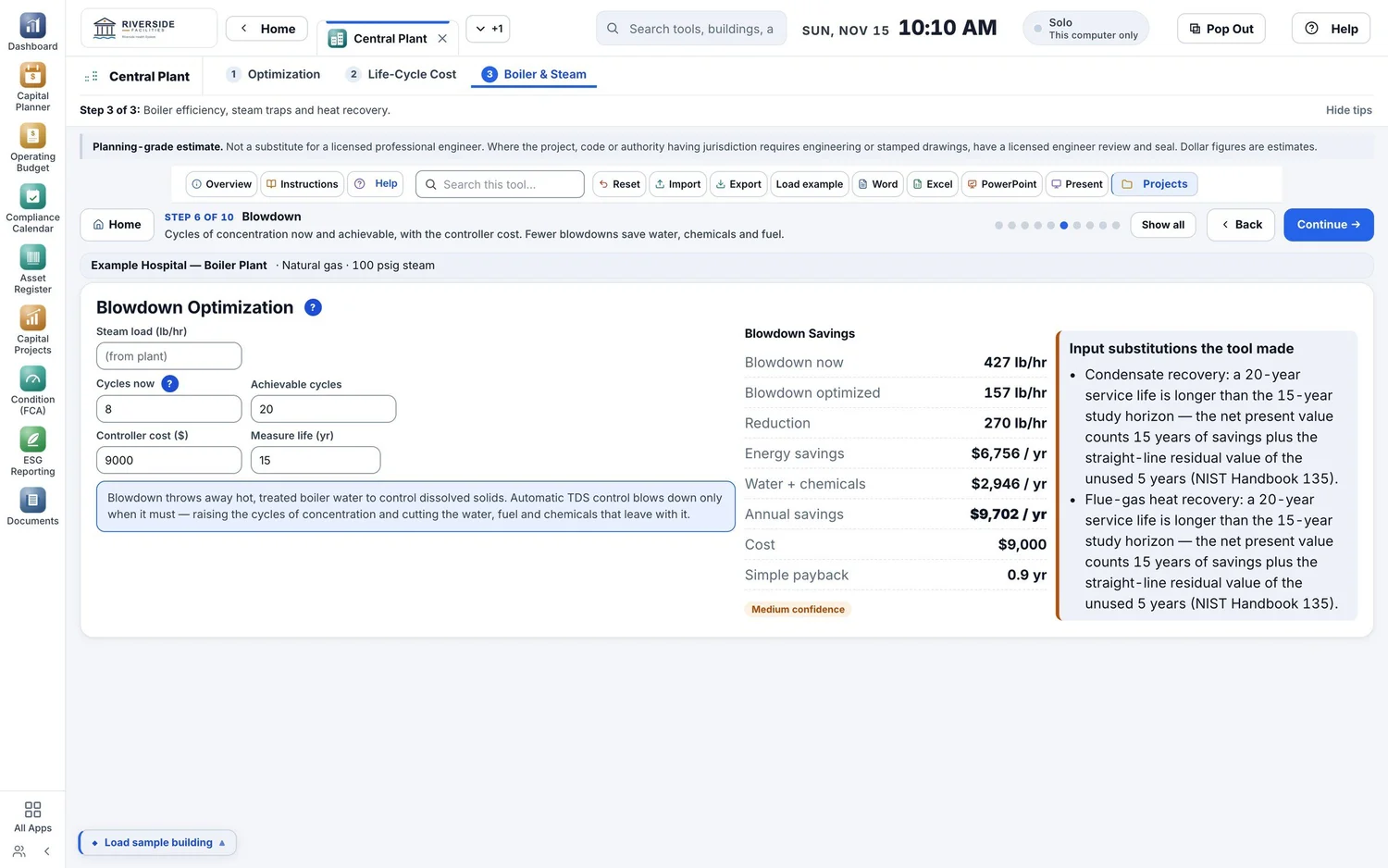
Central plant equipment, the distribution loop, the buildings served and firm capacity with the largest unit out against campus peak. Substations are covered as a type.
Learn More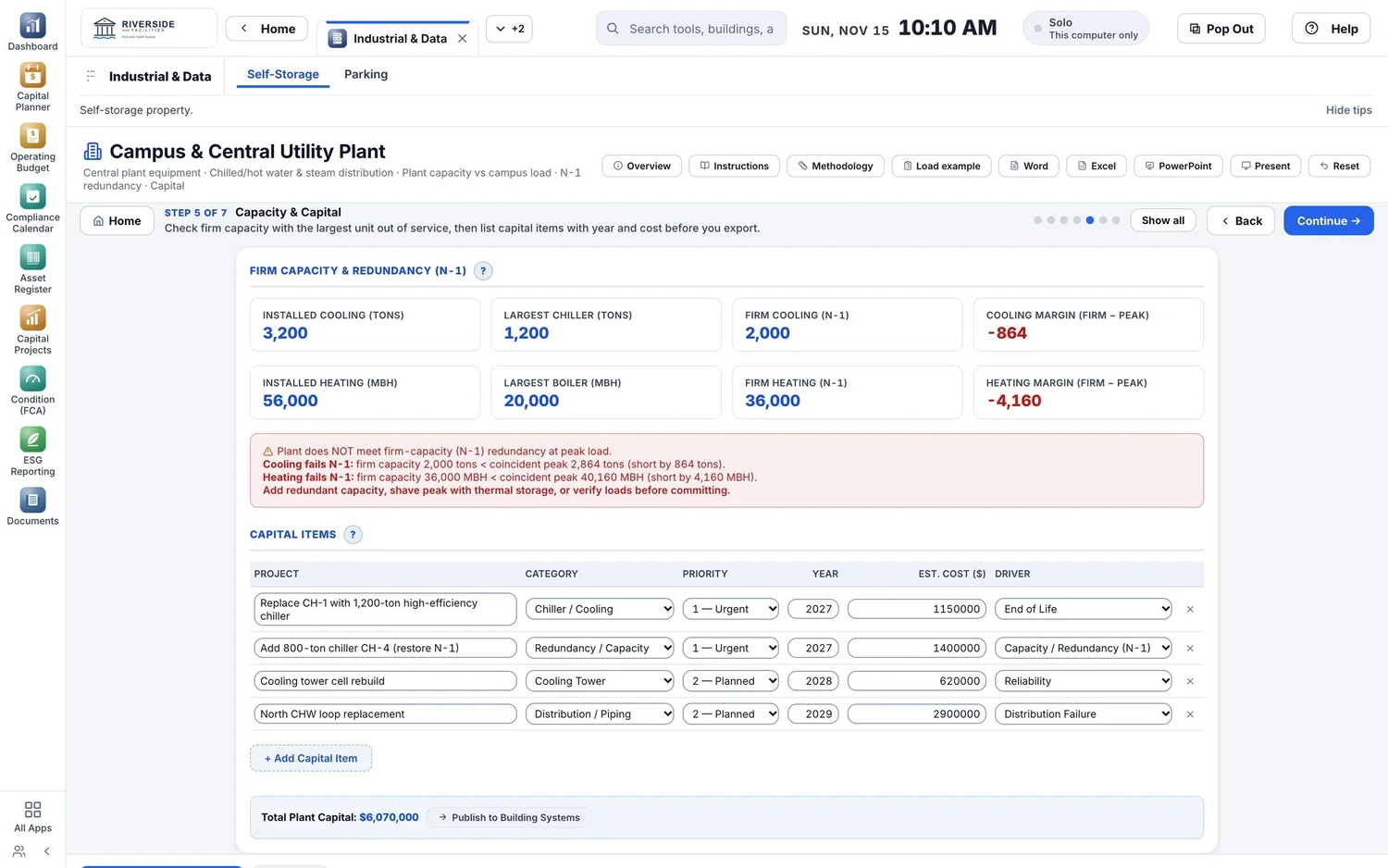
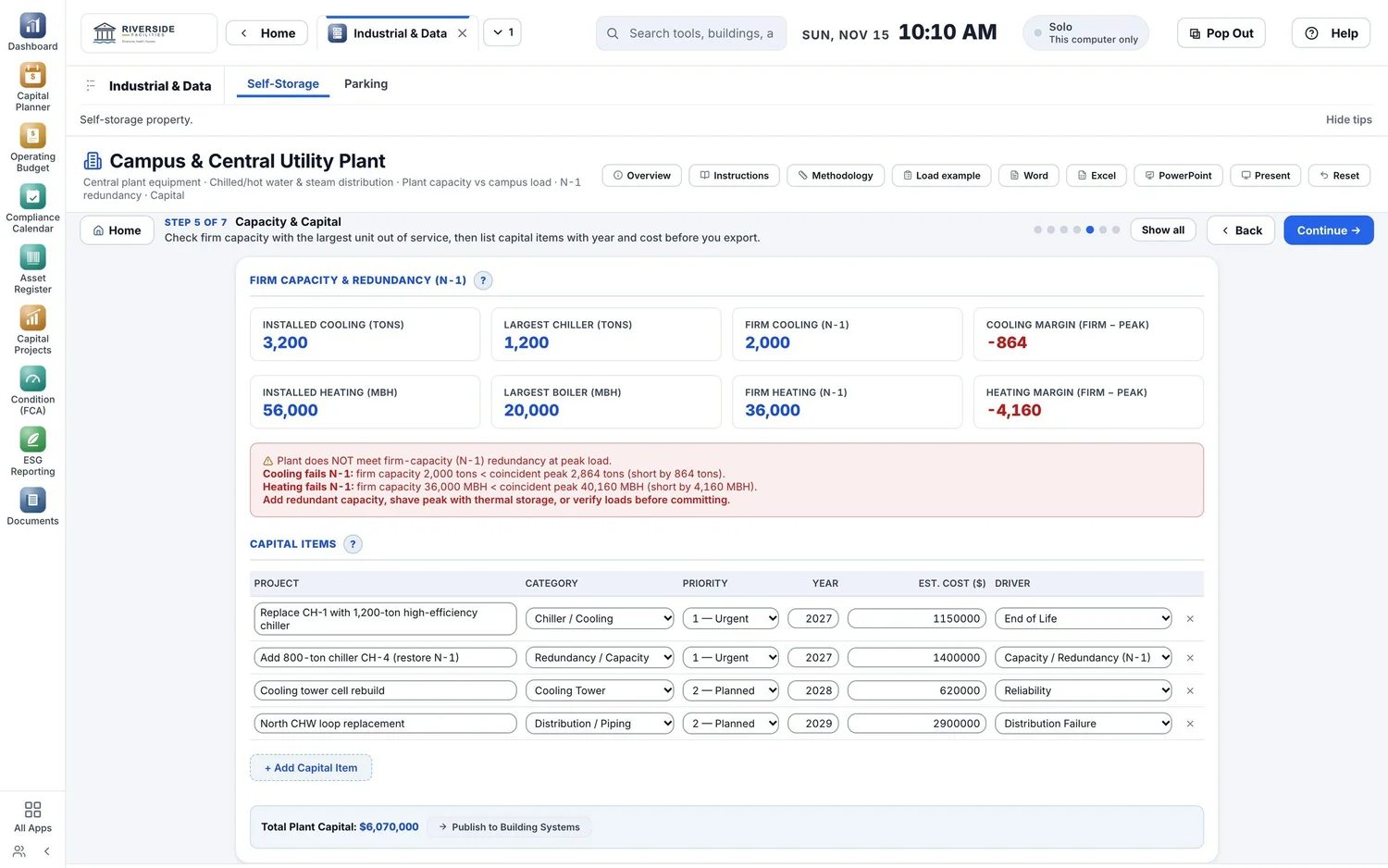
Capacity & Capital in Campus & Central Utility Plant: check firm capacity with the largest unit out of service, then list capital items with year and cost before you export.
Water & Wastewater
Drinking-water and wastewater treatment plants, water reclamation, and pump and lift stations.
Learn MoreSelf-Storage
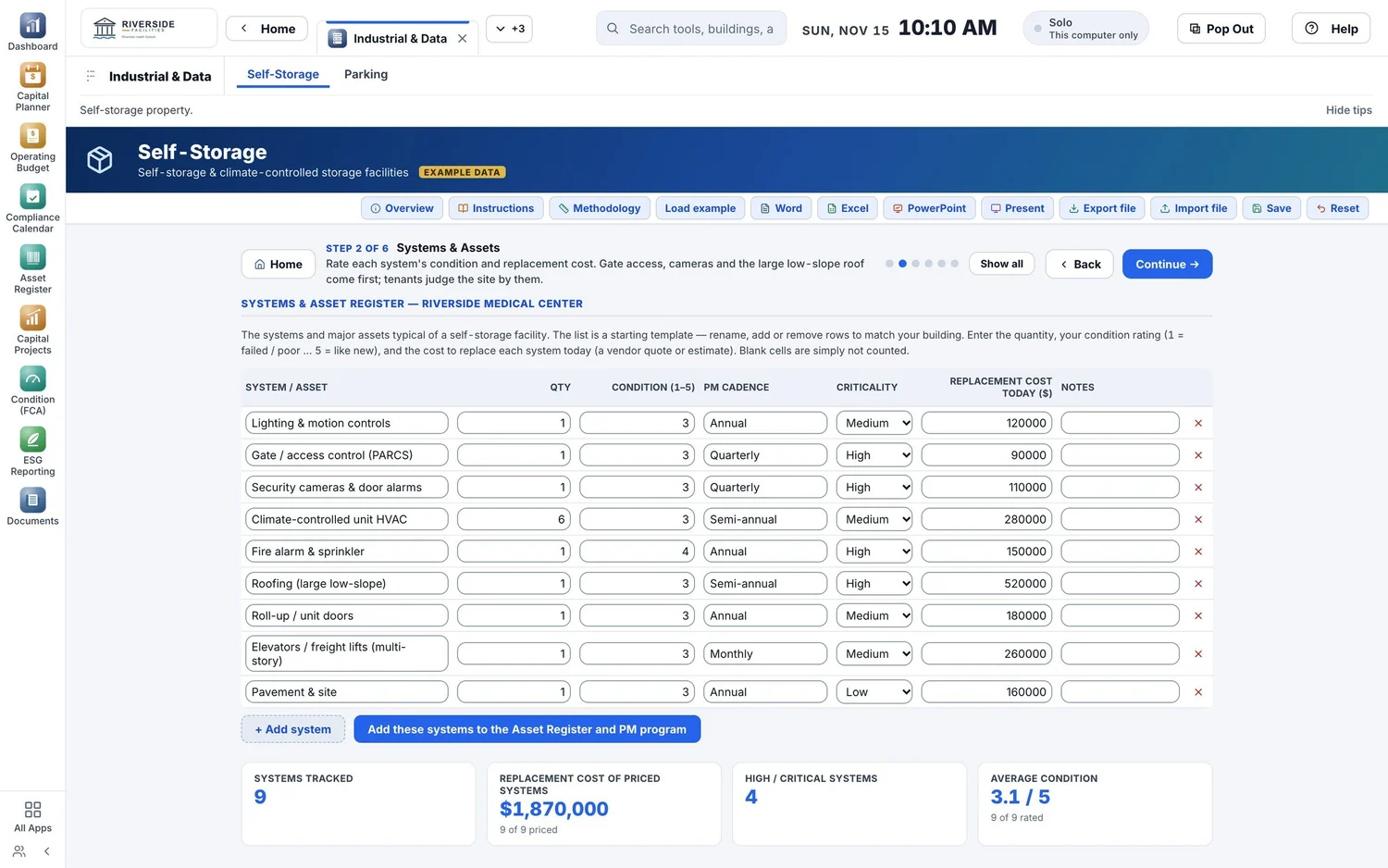
Gate and access security, climate-control HVAC, large low-slope roofs, fire protection and a light compliance load.
Learn More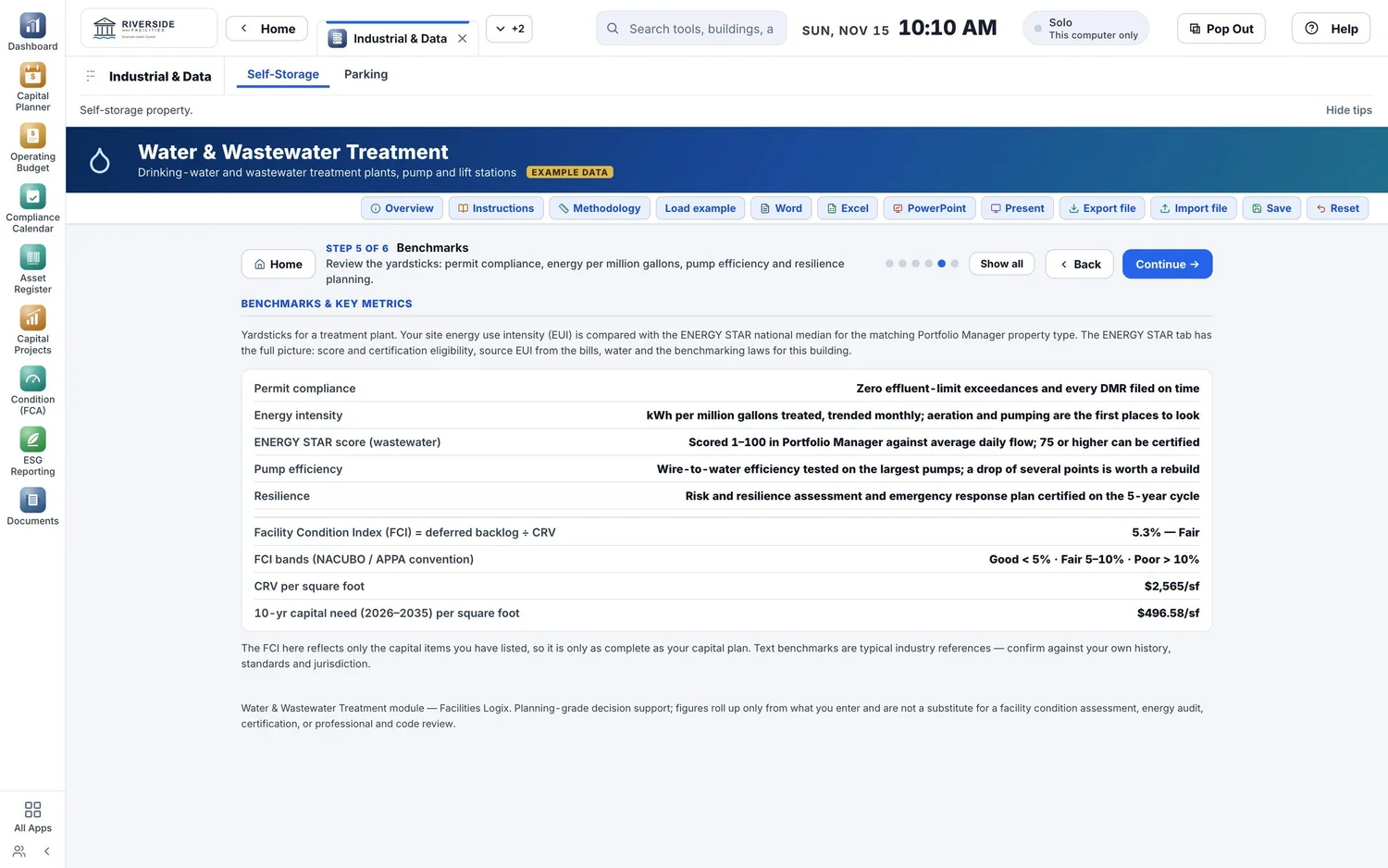
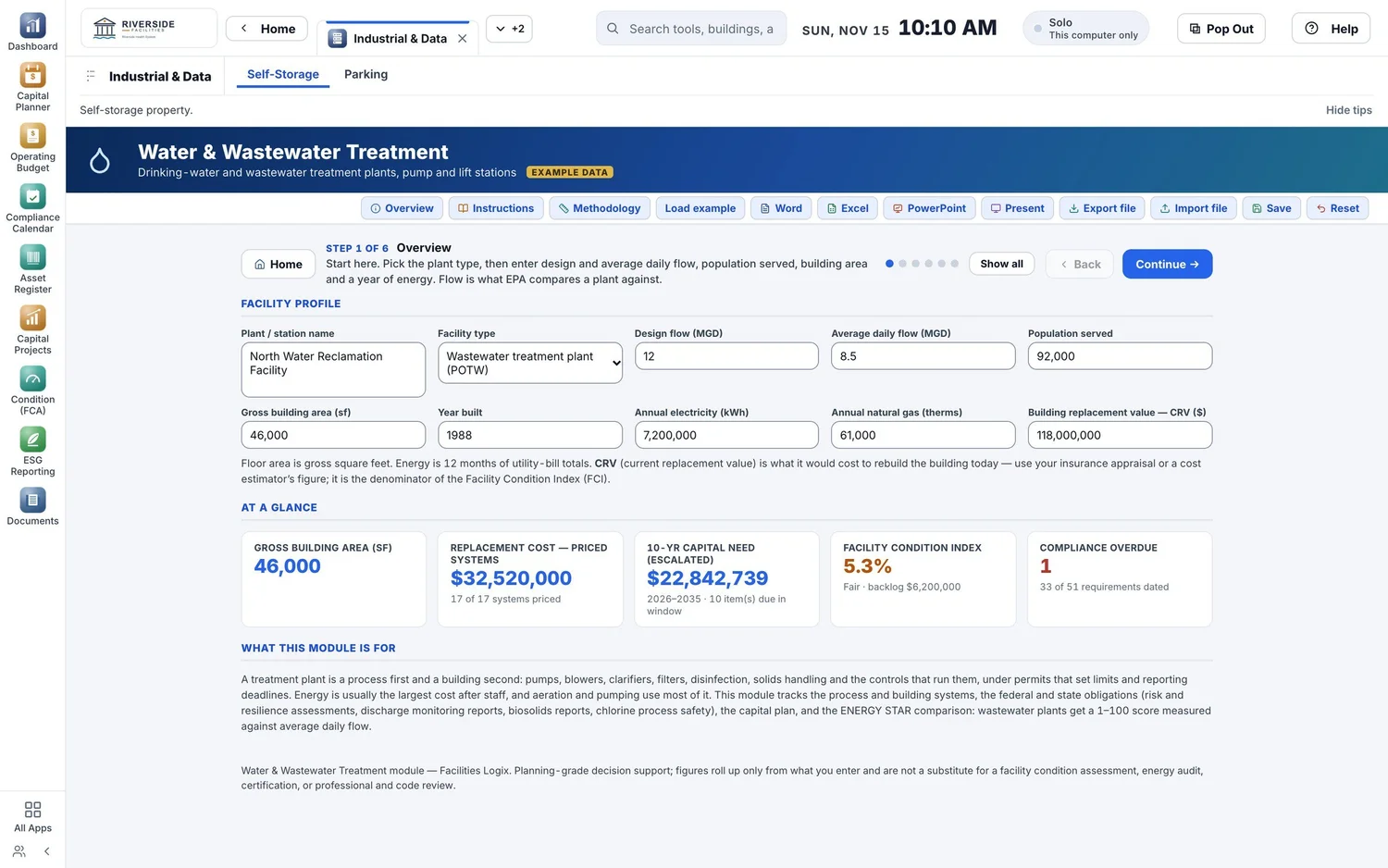
Benchmarks in Water & Wastewater Treatment: review the yardsticks: permit compliance, energy per million gallons, pump efficiency and resilience planning.
Parking
Garages, decks and surface lots: structural inspection, ventilation, coatings and joints, payment and access systems, EV charging and life safety.
Learn More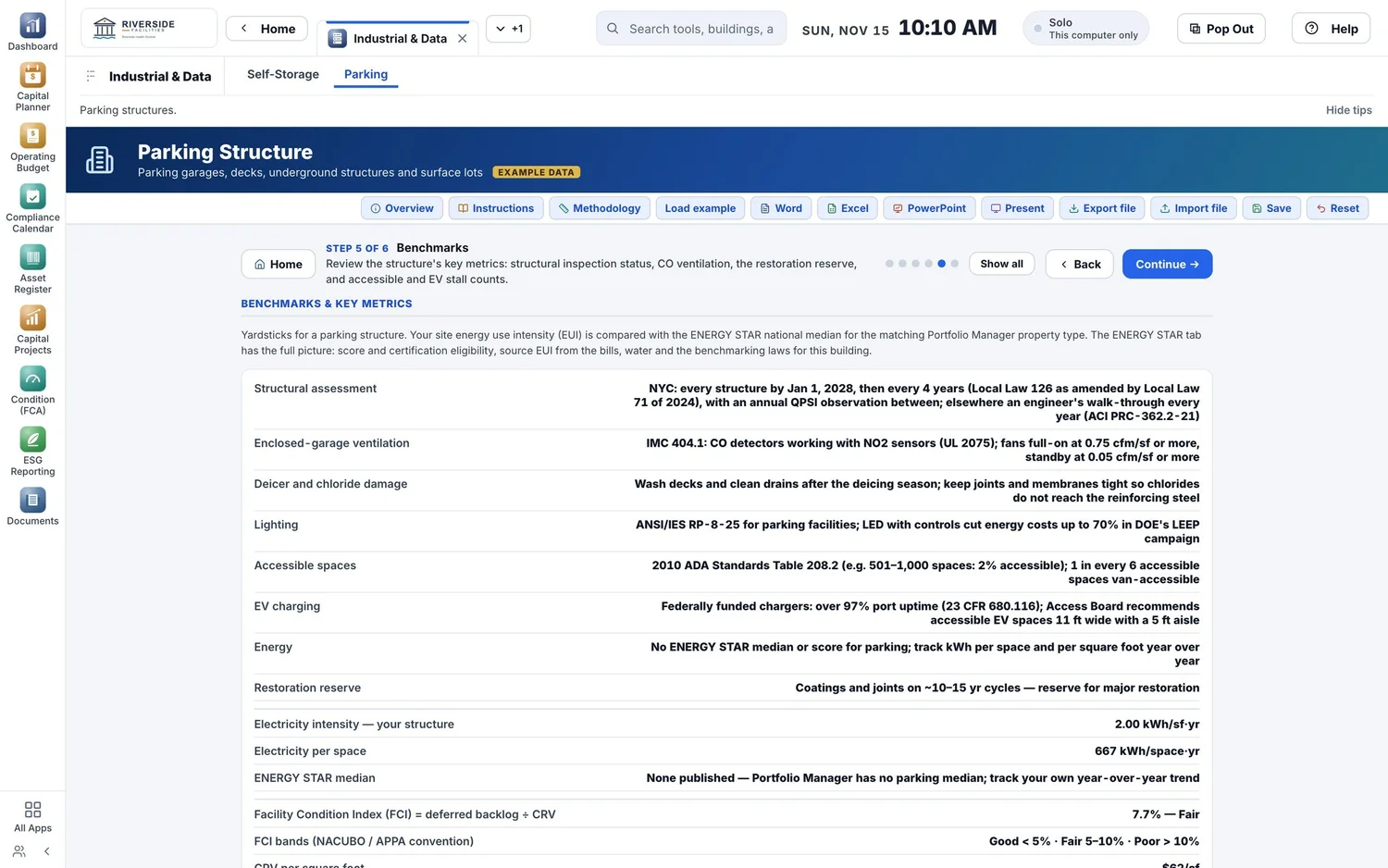
Benchmarks in Parking Structure: review the structure's key metrics: structural inspection status, CO ventilation, the restoration reserve, and accessible and EV stall counts.
Industrial sites track throughput systems a general tool ignores, so each site type opens its own playbook.
Capacity, Redundancy and Efficiency from Your Own Meters
In the Data Hall
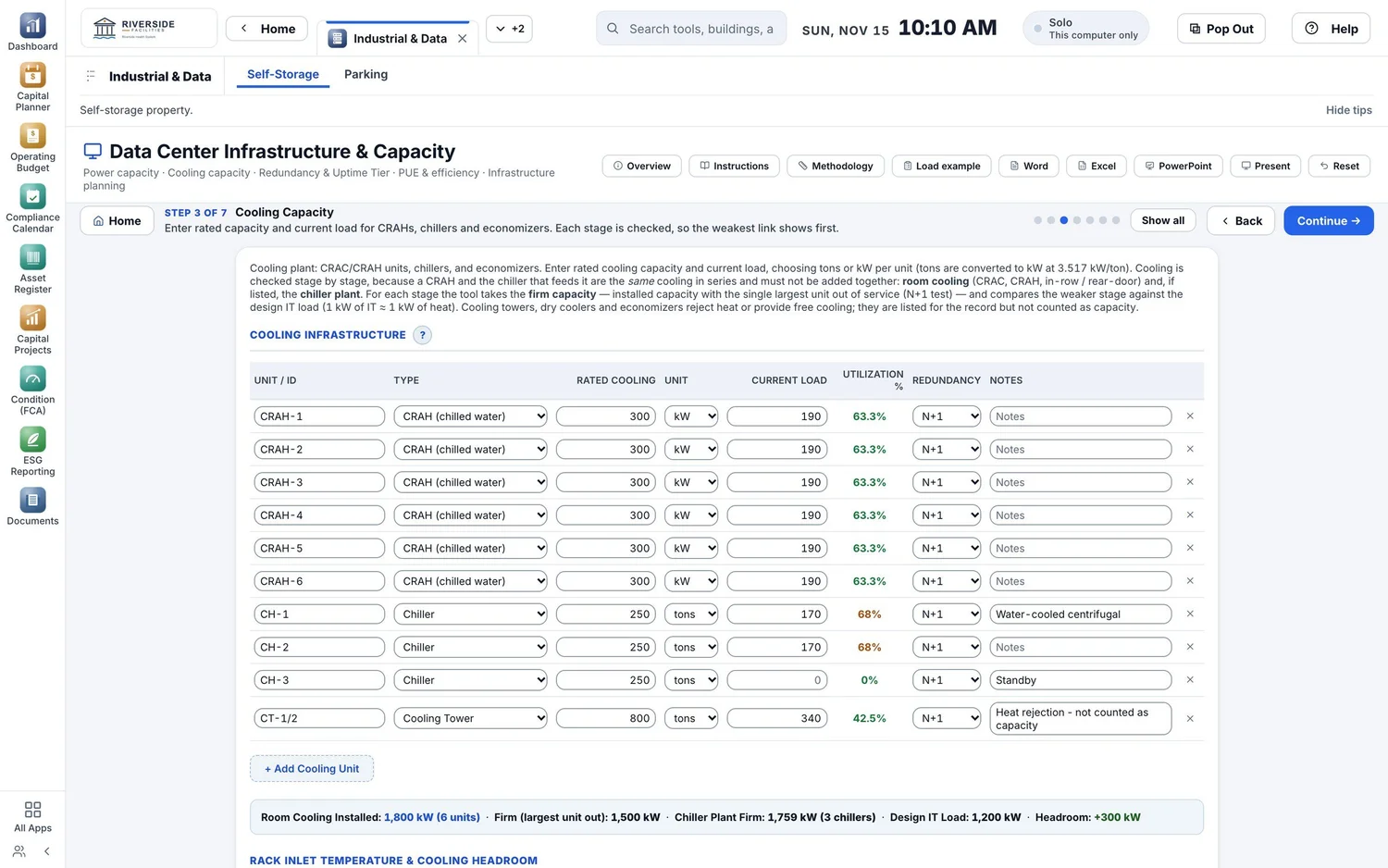
- Power and cooling capacity against load, and the redundancy level of each system
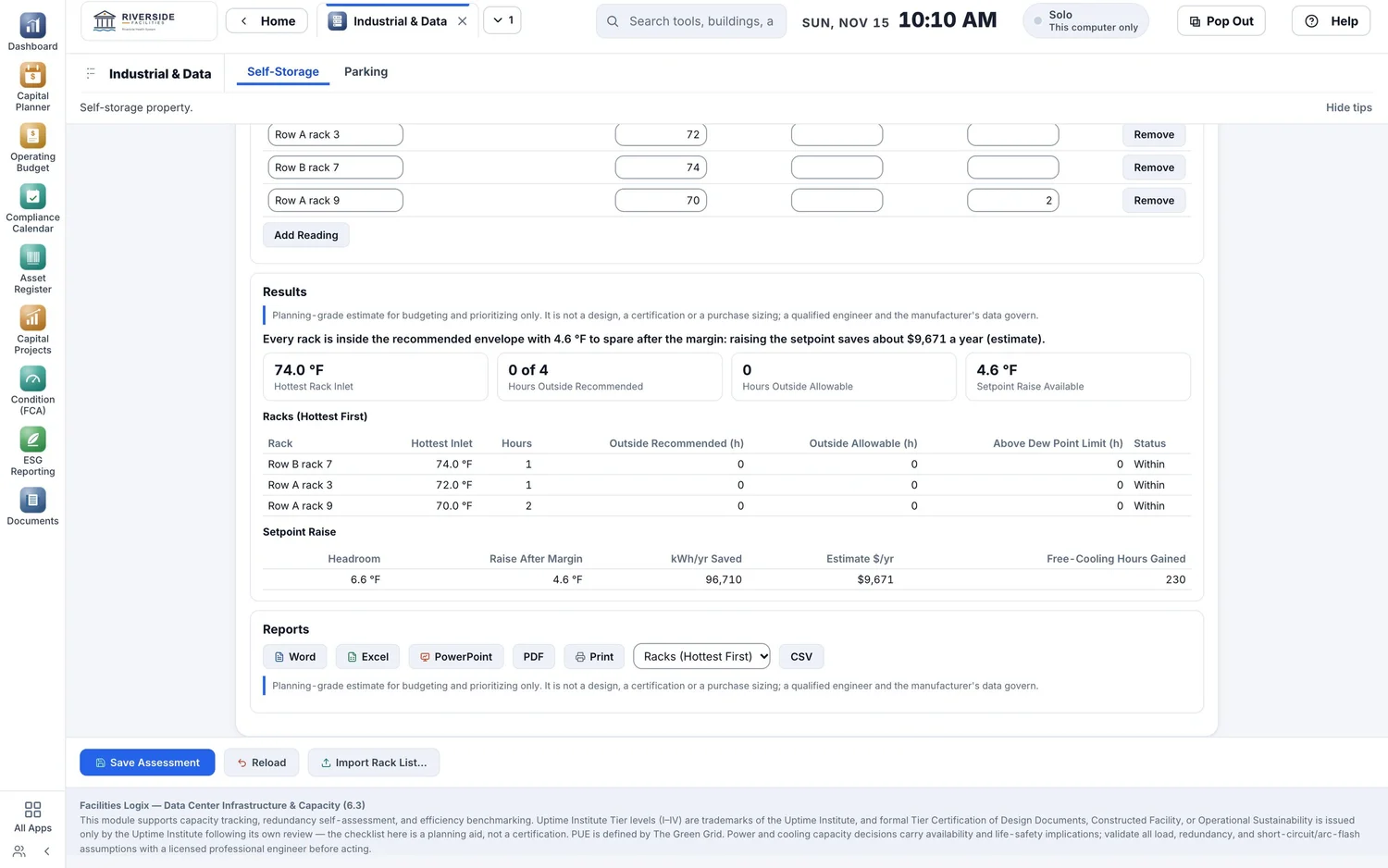
- Rack Inlet Temperature and Cooling Headroom: readings against the recommended and allowable ranges you follow, hot spots ranked and the saving from a setpoint raise
- PUE by Zone From Meters: energy-based efficiency per data hall from interval meters, with shared overhead apportioned
- A rack and device list imported from a spreadsheet or a management program's export: devices, rack units used and kilowatts per rack
Tower and Shelter Sites
- Four questions decide the rows: who holds the tower, whether it is registered, whether obstruction lights are assigned and whether it is painted
- Tower maintenance and condition assessment on its recommended cycle
- Obstruction lights observed daily or watched by an automatic alarm, with outage reporting and record keeping
- The shelter's generator, batteries and fire alarm from its equipment records, as in any building
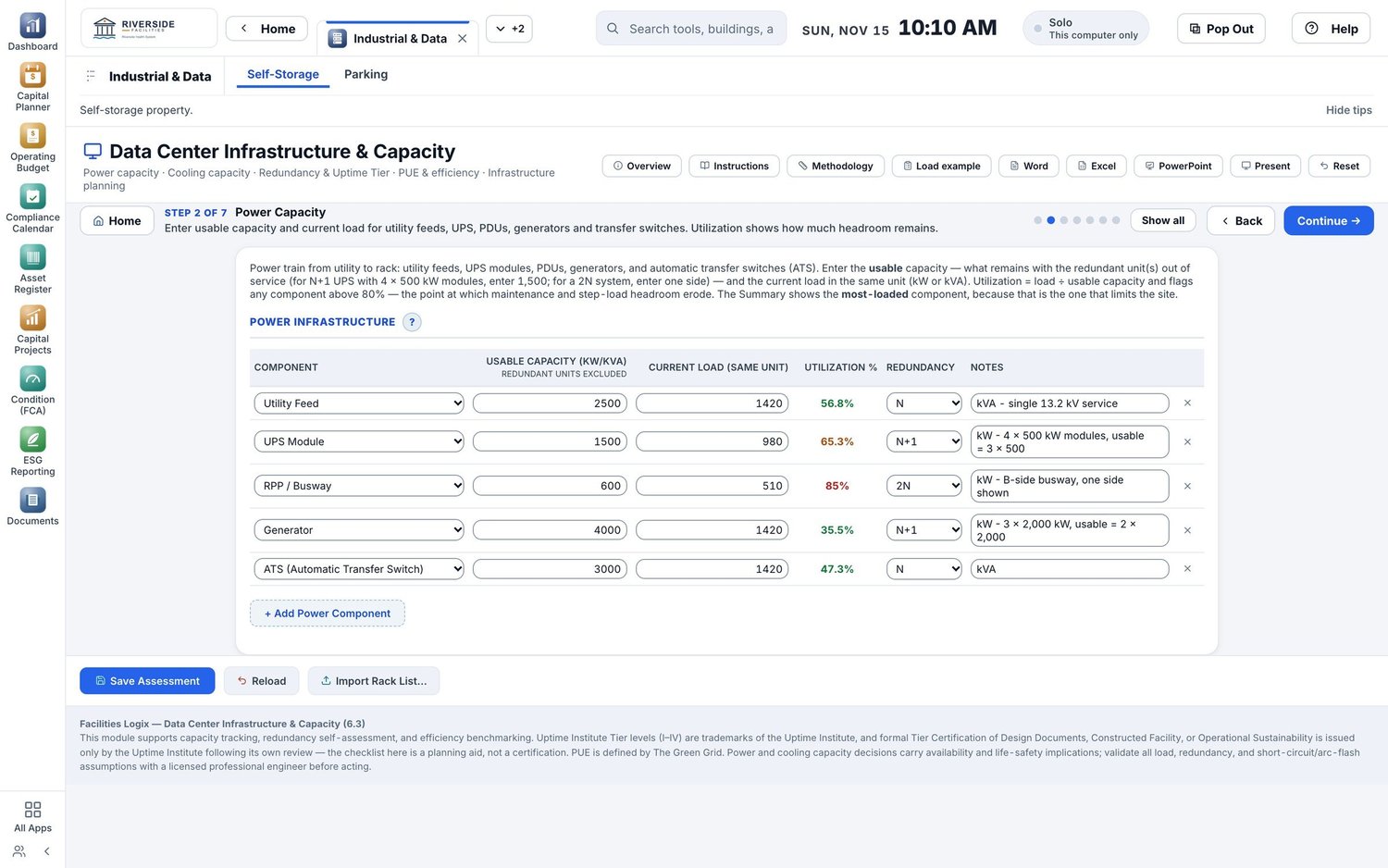
Power Capacity in Data Center Infrastructure & Capacity: enter usable capacity and current load for utility feeds, UPS, PDUs, generators and transfer switches. Utilization shows how much headroom remains.
Monitoring
- Starting limits for data rooms, UPS, generators and transfer switches
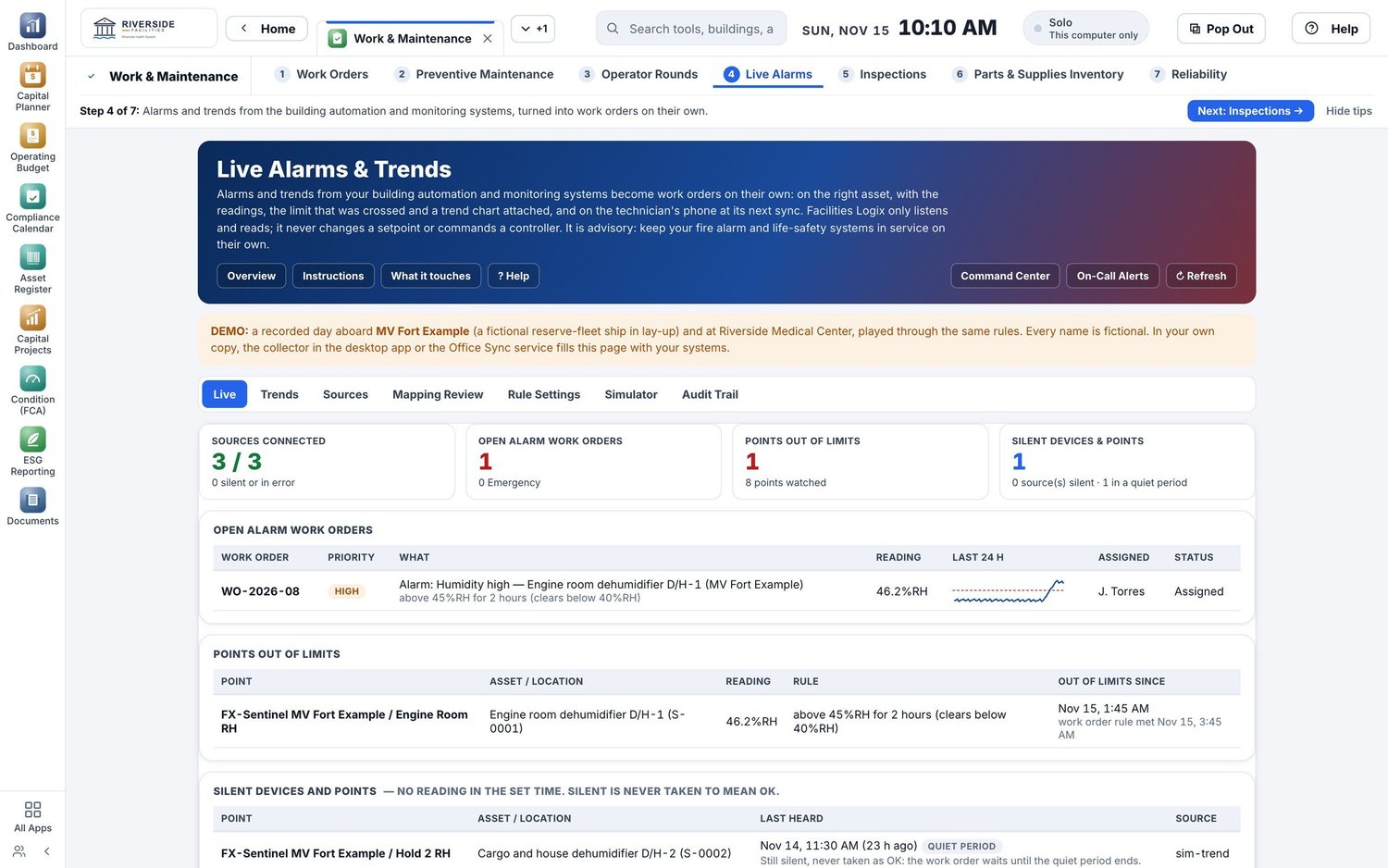
- A device that stops reporting becomes a work order; silence is never taken to mean OK
- Emergency power checks for generator load, fuel runtime and battery runtime
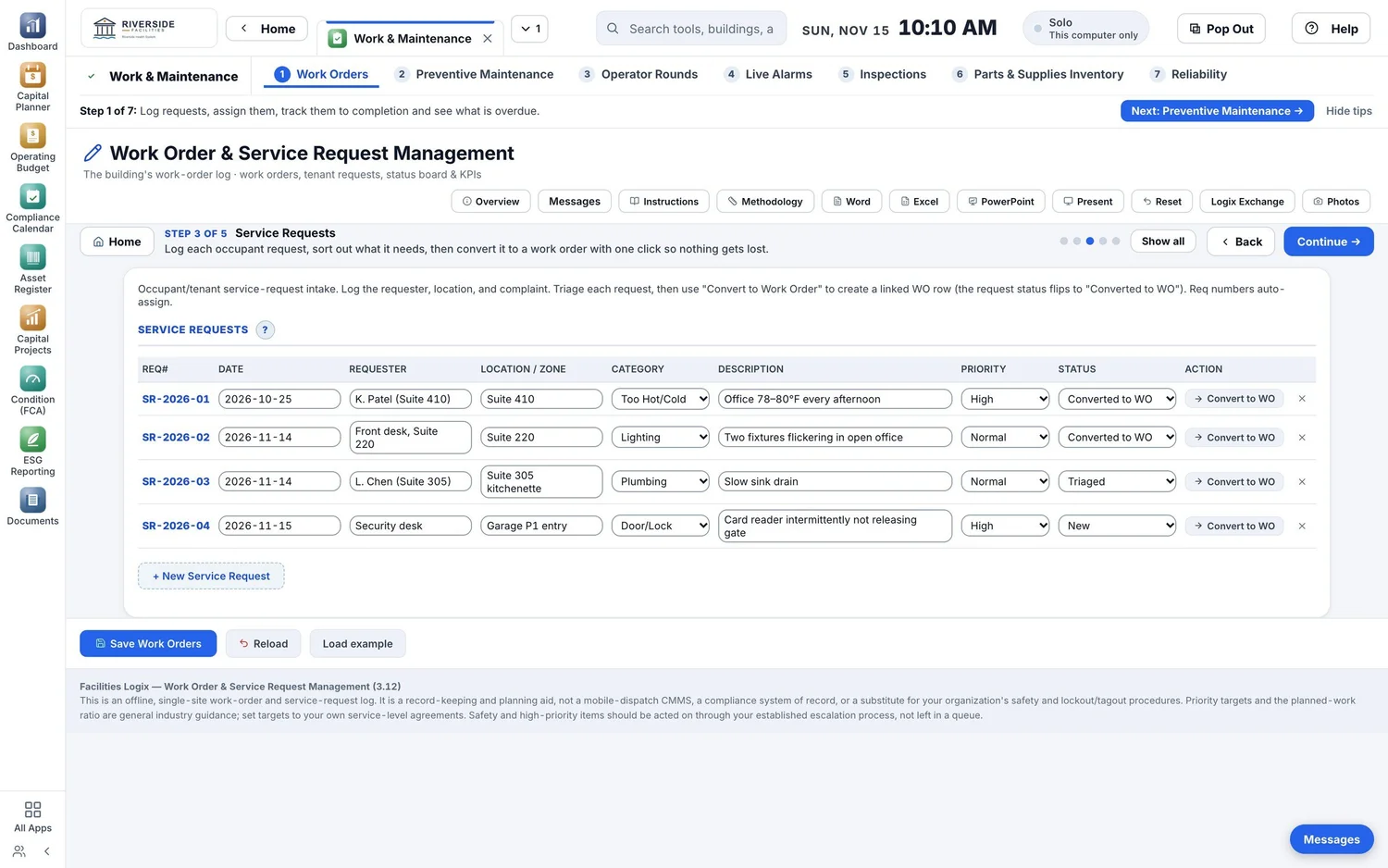
Service Requests in Work Order & Service Requests: log each occupant request, sort out what it needs, then convert it to a work order with one click so nothing gets lost.
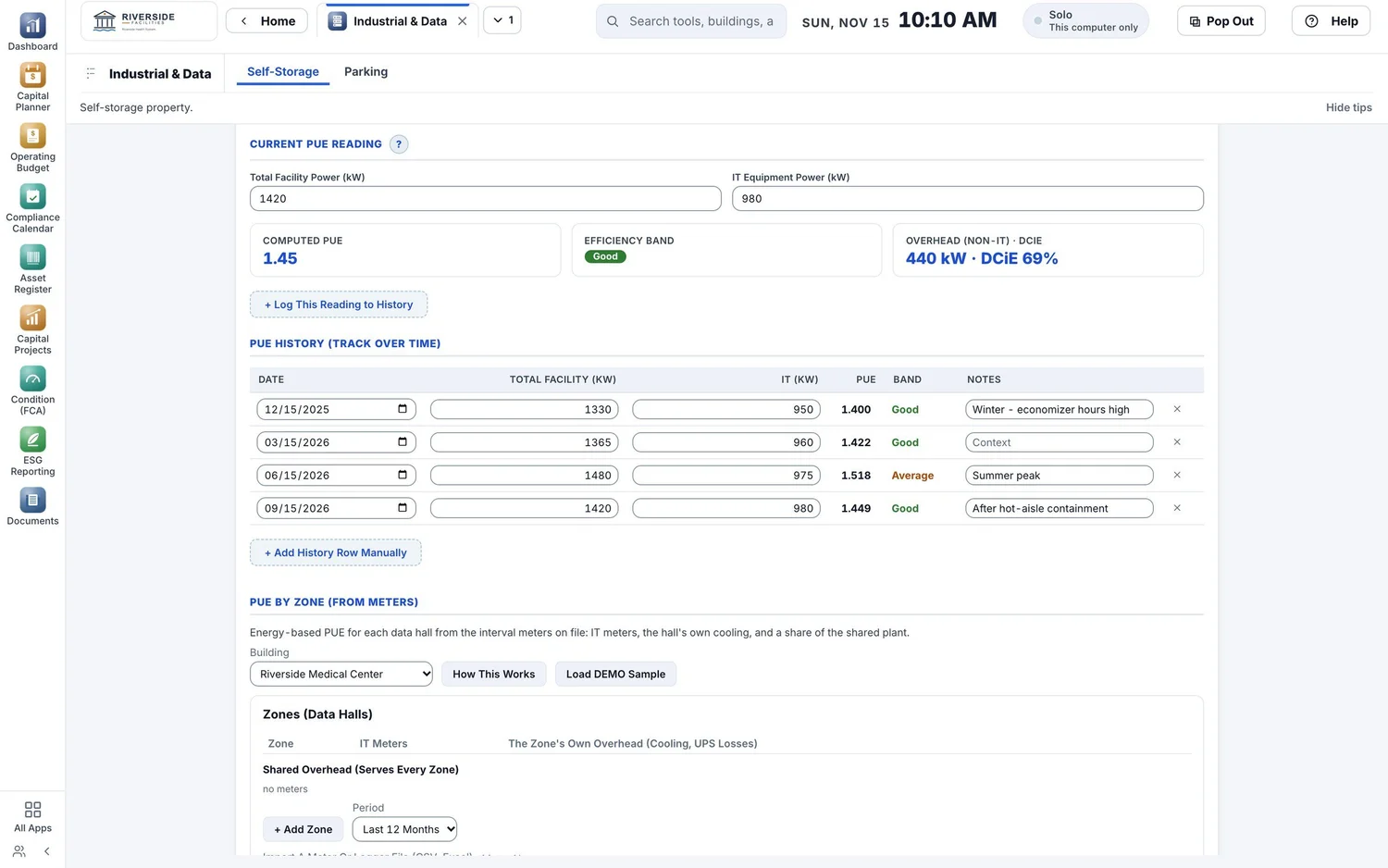
Efficiency claims without metered data do not hold up, so PUE is computed from your own readings with its history.
Put a Dollar Figure on a Utility Failure
Manufacturing
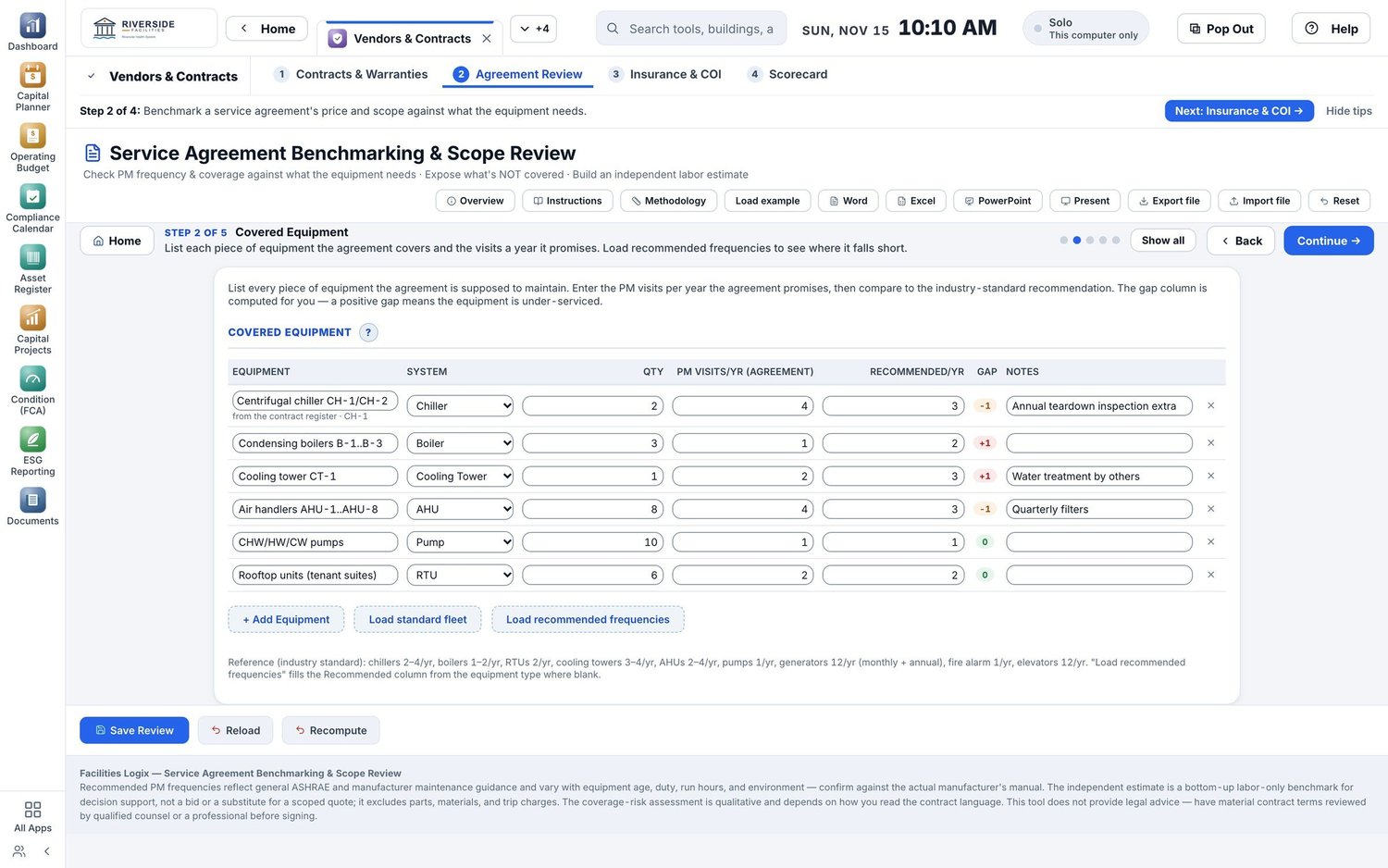
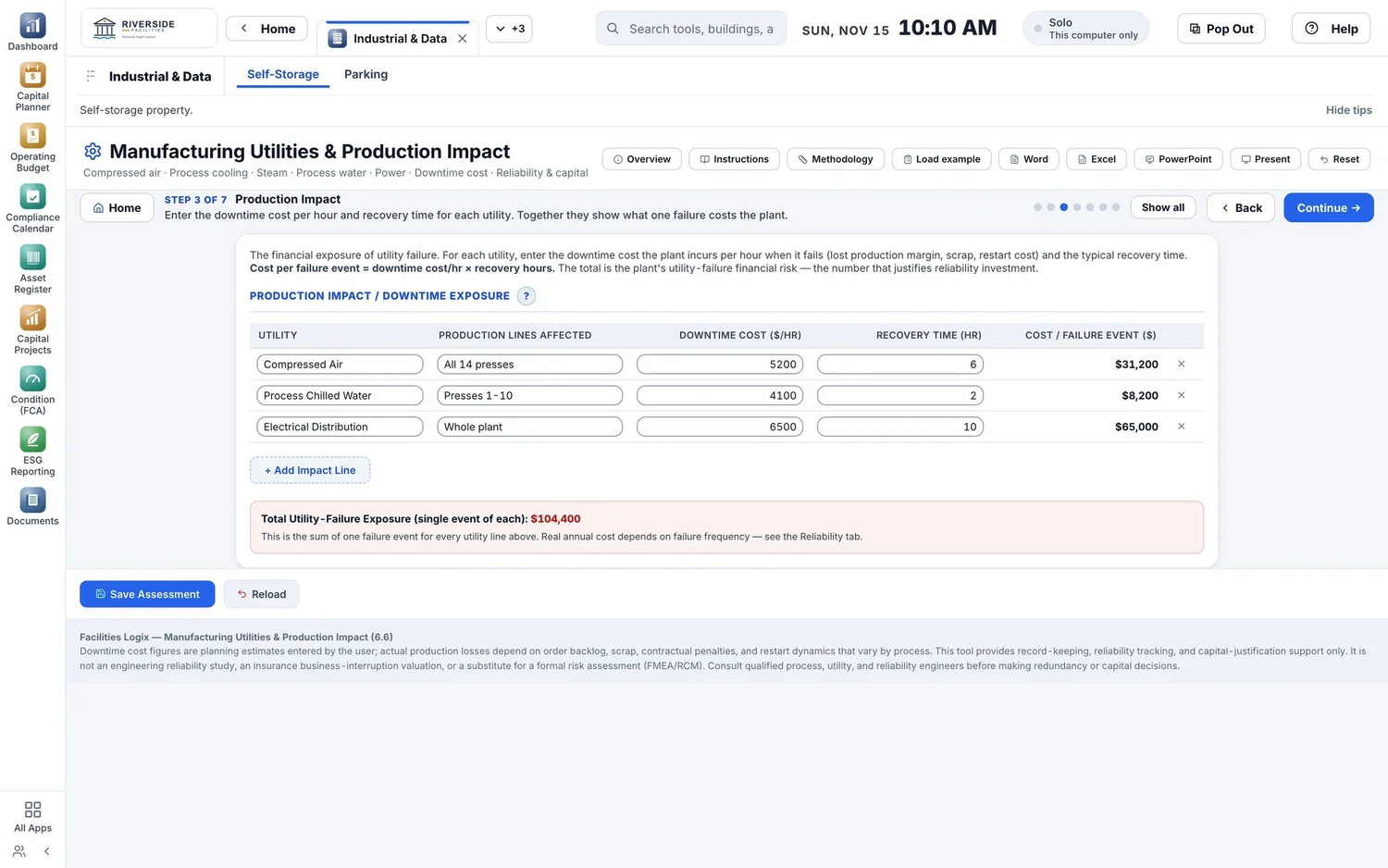
List the plant utilities that production depends on and the cost of an hour of downtime for each line. The playbook ties reliability tracking to that cost and builds the redundancy investment case in terms a plant manager recognizes. Compressed air leak costing, a motor repair-or-replace inventory and transformer loading checks find savings in the utilities themselves.
Warehouse and Cold Storage
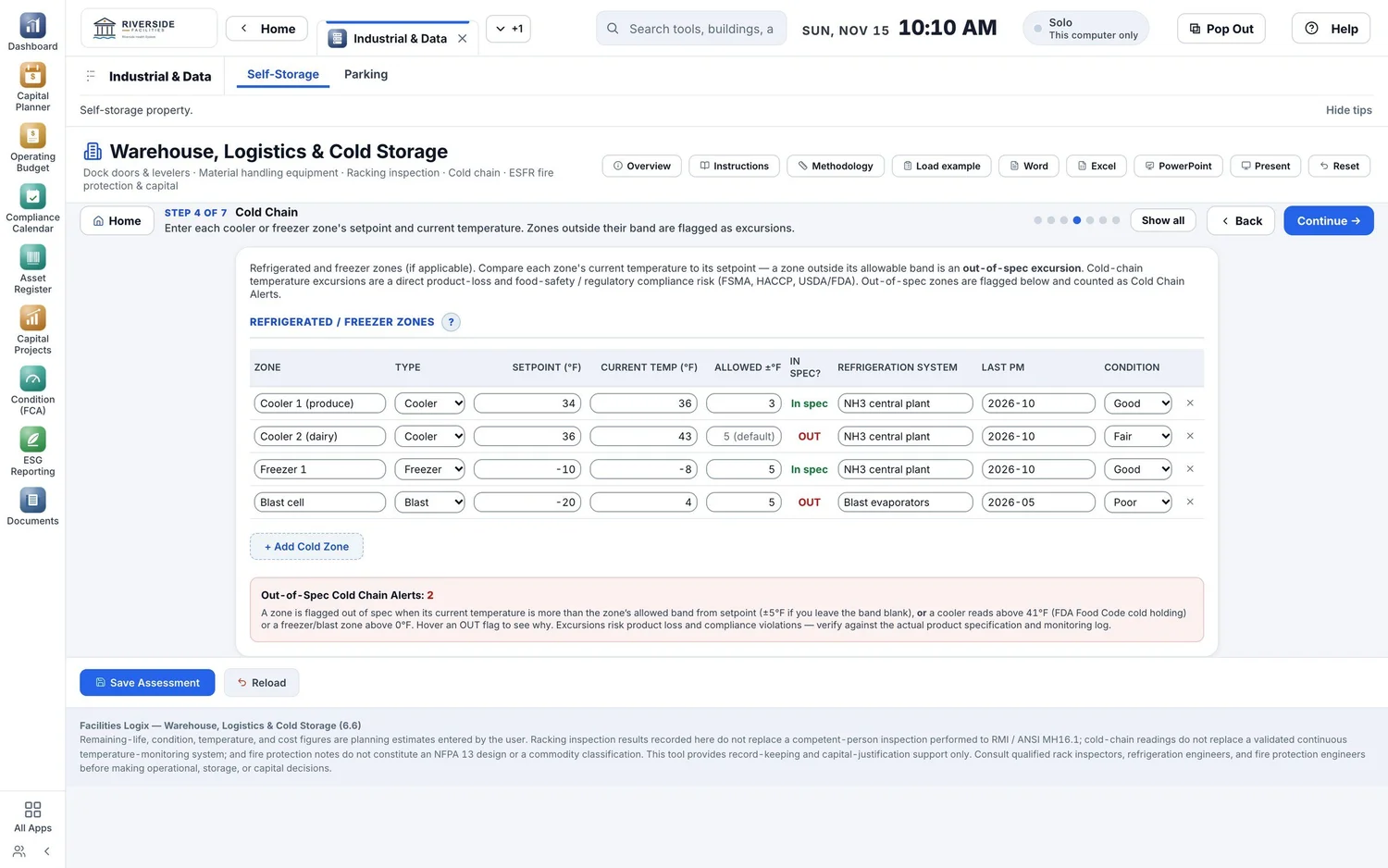
Track dock and material-handling equipment, schedule racking inspections and watch the cold chain. Walk-in and cold-room monitoring turns a temperature excursion into a work order with the trend attached, refrigerant compliance tracks leak rates and repair deadlines, and fire protection capital is planned alongside everything else.
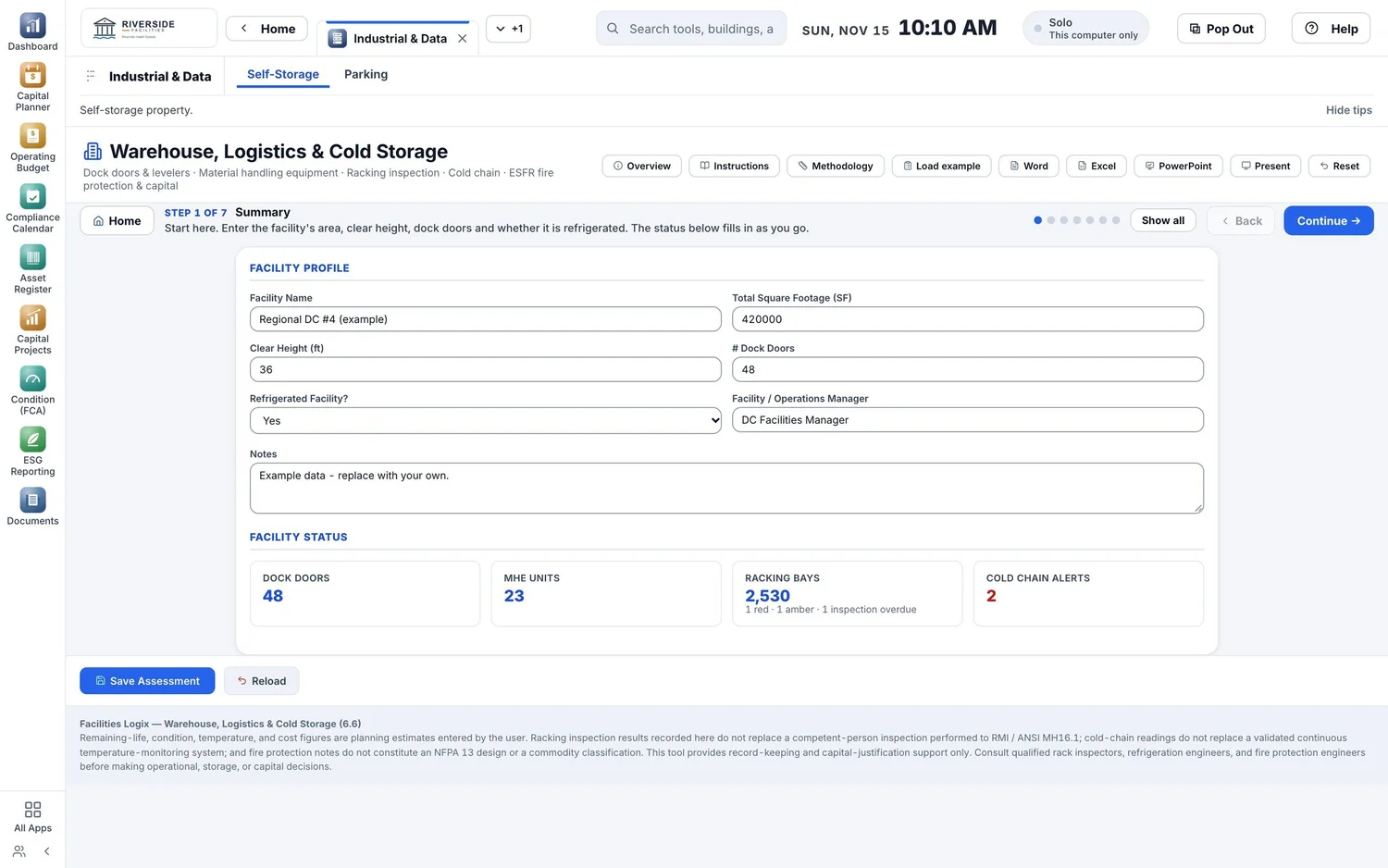
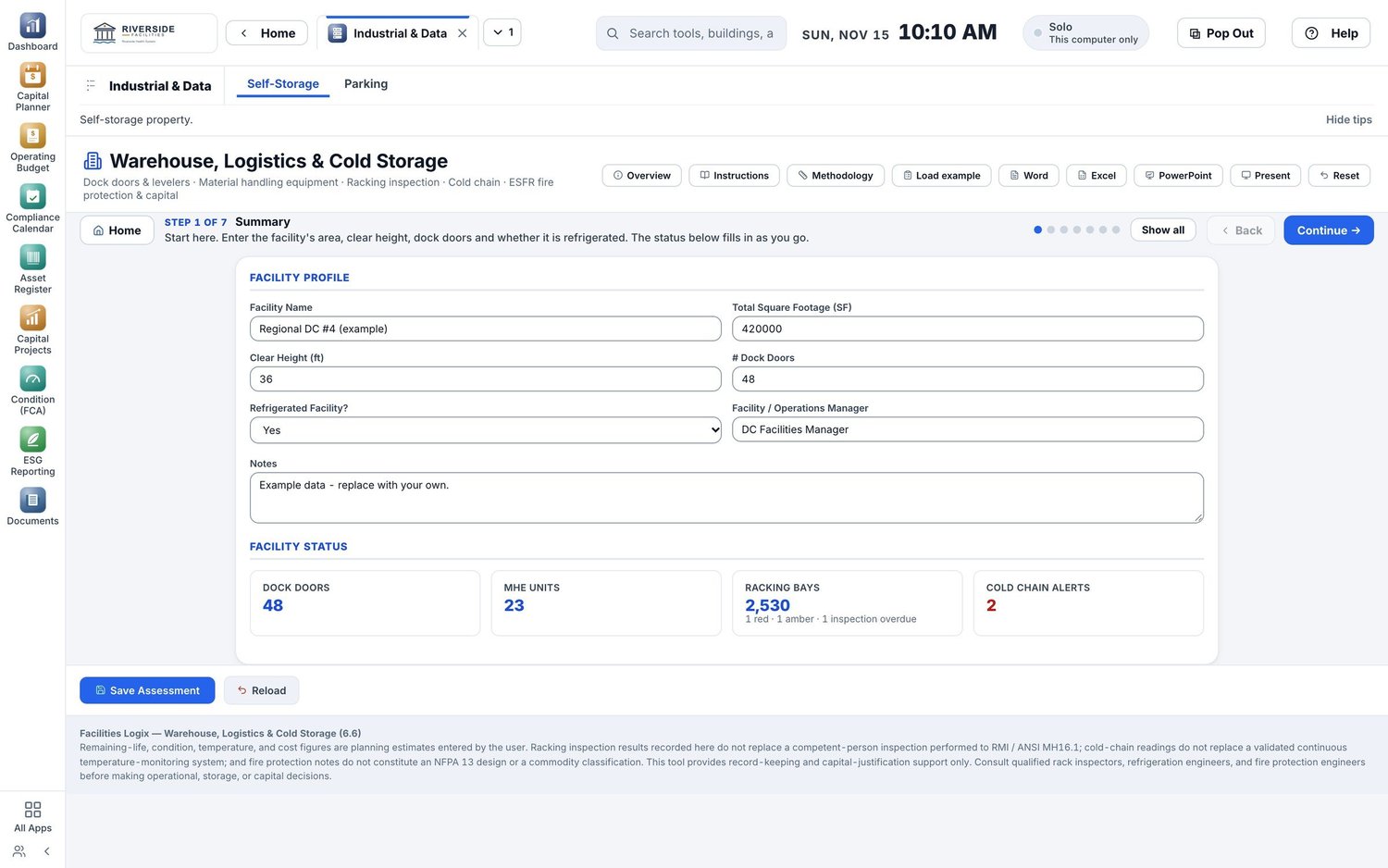
Summary in Warehouse, Logistics & Cold Storage: start here. Enter the facility's area, clear height, dock doors and whether it is refrigerated. The status below fills in as you go.
Plants That Serve a Campus or a Community
Central Utility Plants
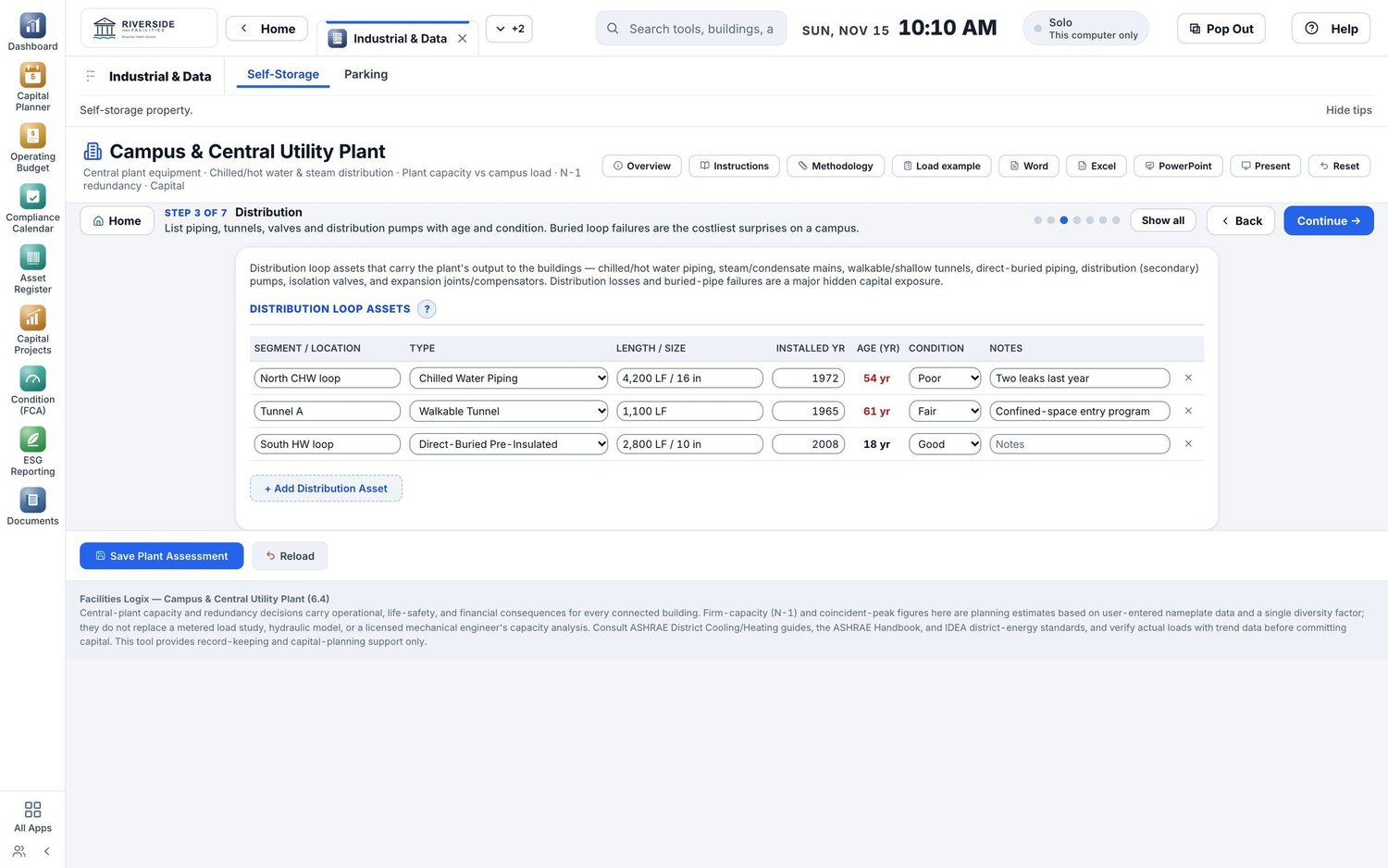
- Chillers, boilers, towers, pumps and distribution, with the buildings each loop serves
- Firm capacity with the largest unit out against campus peak
- Plant optimization, life-cycle cost and boiler and steam savings from the HVAC & Plant tools
- A substation recorded as its own type of plant
Water and Wastewater Compliance
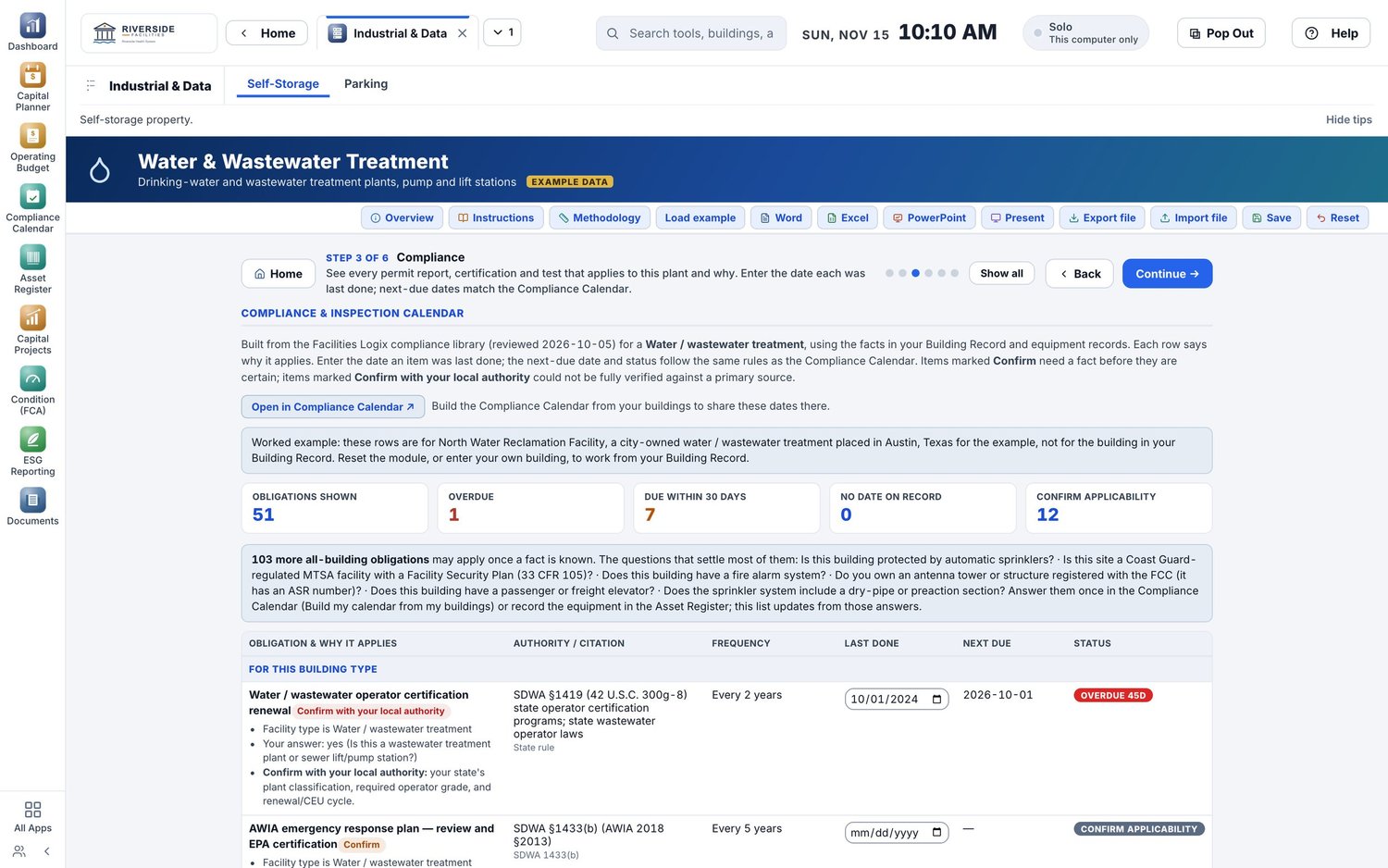
- The risk and resilience assessment and emergency response plan, recertified every five years for systems above the population threshold
- The state sanitary survey on its cycle for community systems
- Discharge monitoring reports, noncompliance reports and permit renewal ahead of expiry
- The annual biosolids report, the pretreatment program report and the laboratory quality study
- Chlorine risk management exercises, operator certification, confined space, gas detection and generators
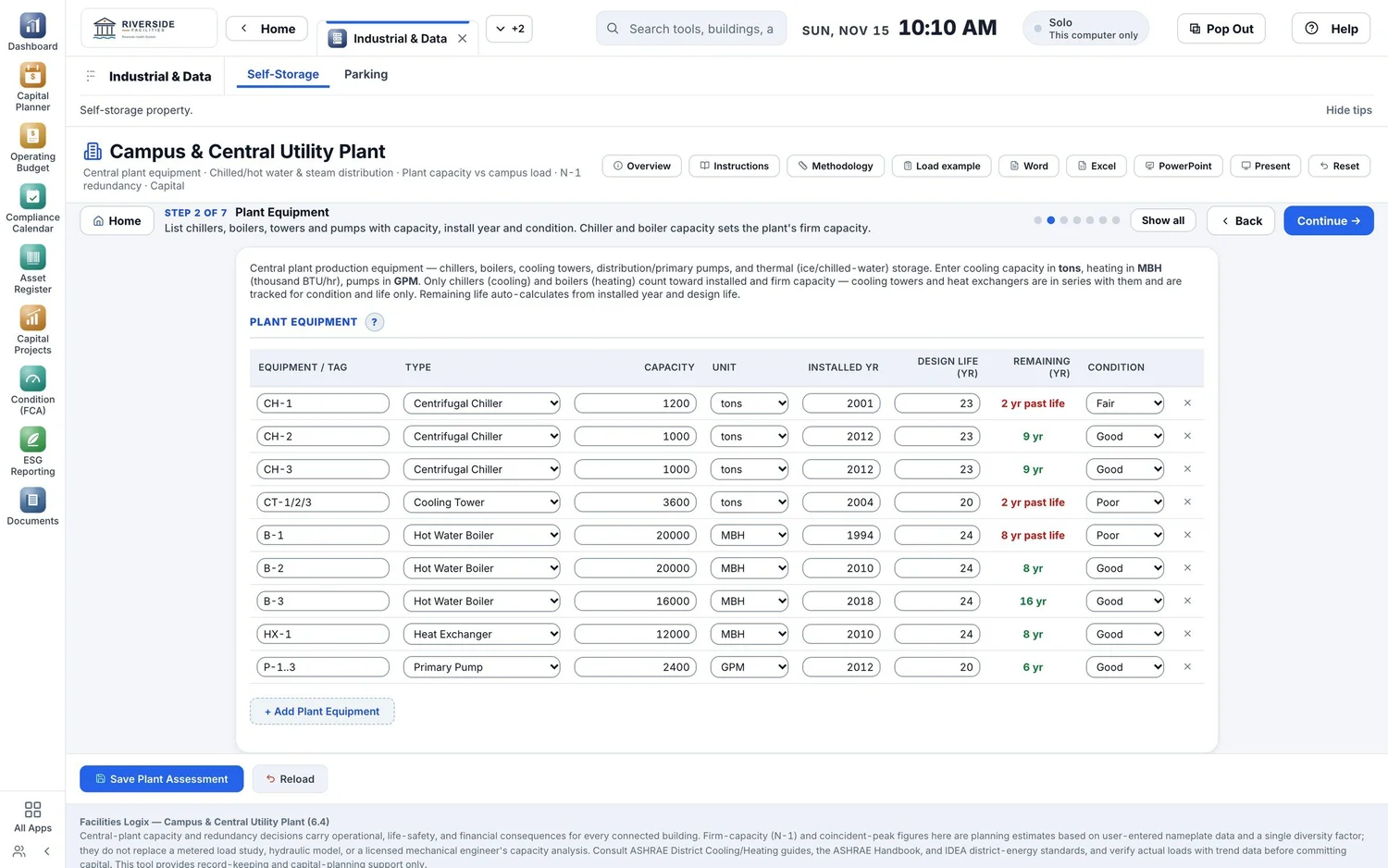
Plant Equipment in Campus & Central Utility Plant: list chillers, boilers, towers and pumps with capacity, install year and condition. Chiller and boiler capacity sets the plant's firm capacity.
Light Staffing, Real Obligations
Parking Structures
- Pick the type, then answer four questions: post-tensioned decks, deicing salts, pay stations that take cards and EV chargers
- An engineer's annual walk-through, deck washdown after the deicing season, and joint, sealant and membrane inspection
- Periodic condition assessments where local law requires them, such as New York City, and milestone inspections in Florida
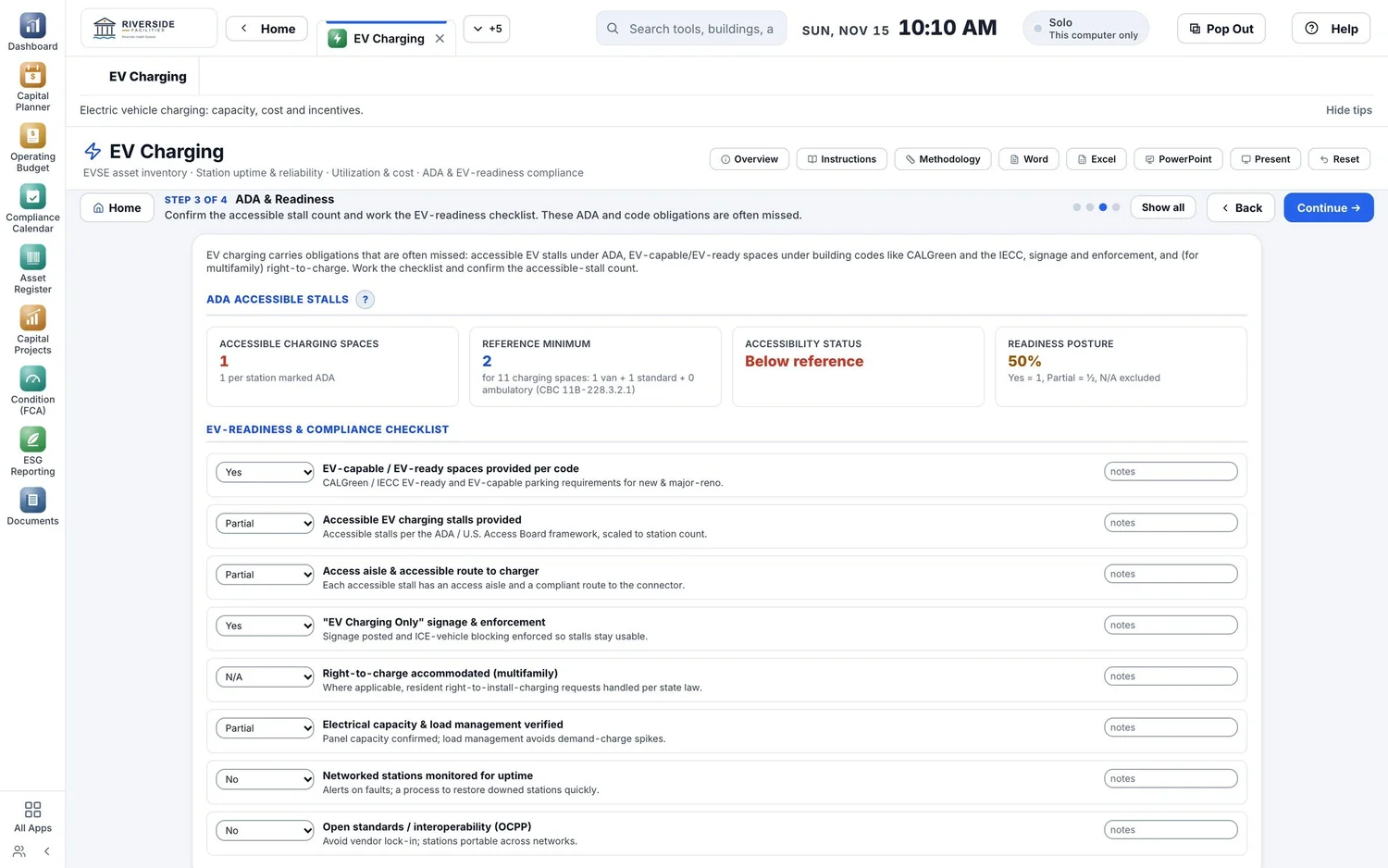
- Gas detection calibration in enclosed garages, accessible space counts, card-security scans for networked pay stations and uptime reporting for federally funded chargers
- A surface lot does not get the structural inspections
Self-Storage
- Gate and access control systems
- Climate-control HVAC and large low-slope roofs with remaining life
- Fire protection inspection and testing
- A short compliance calendar that still never gets missed
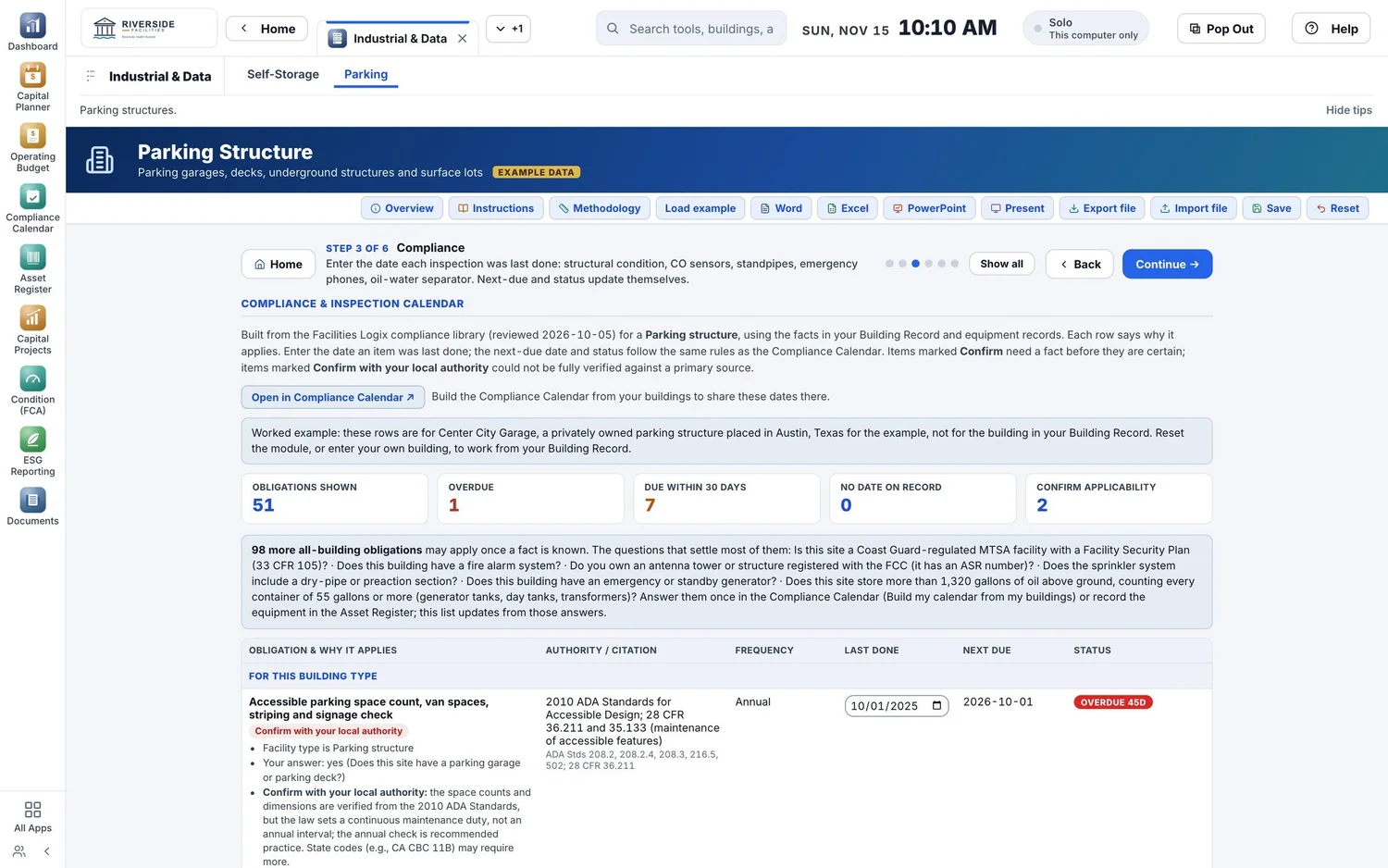
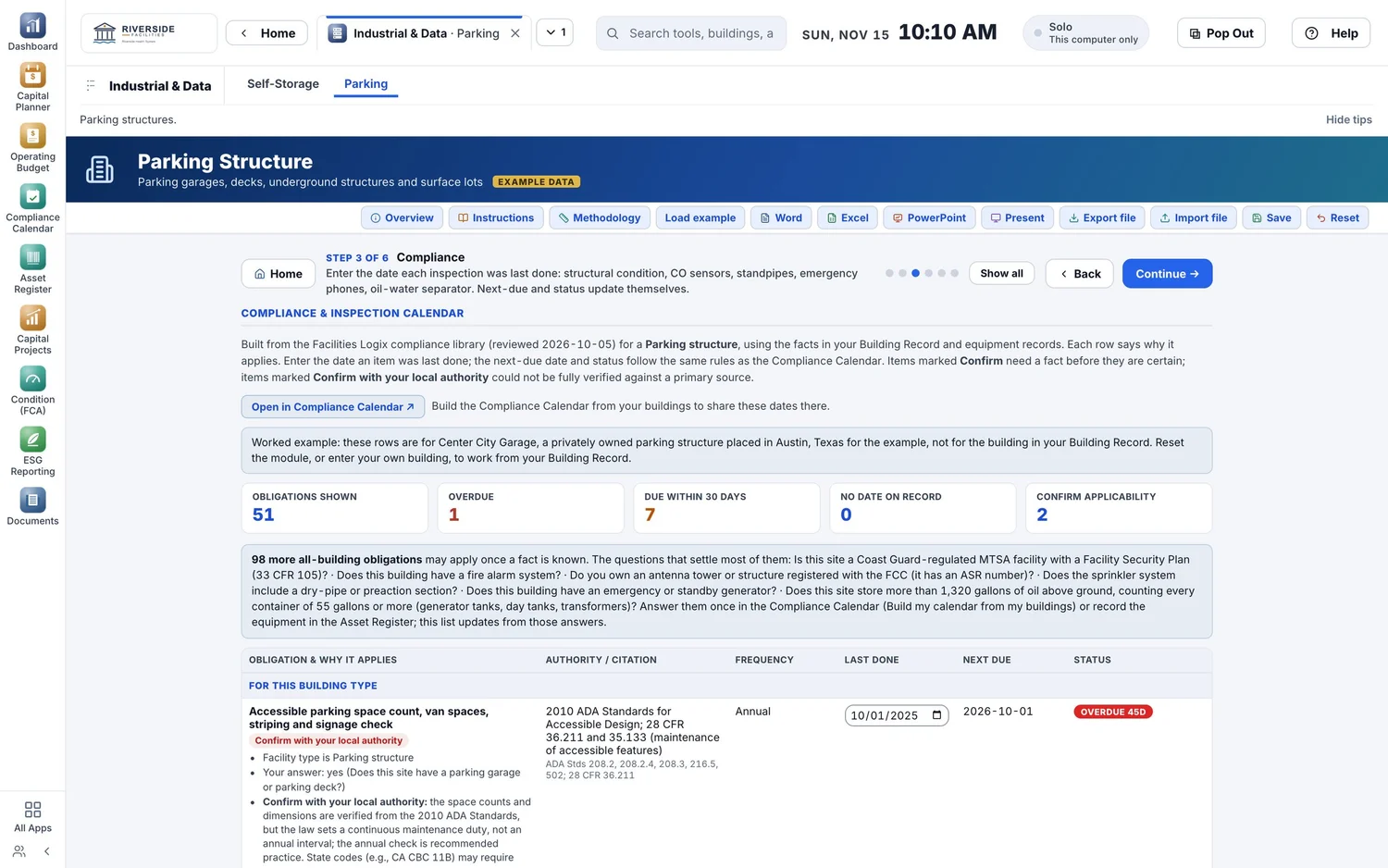
Compliance in Parking Structure: enter the date each inspection was last done: structural condition, CO sensors, standpipes, emergency phones, oil-water separator. Next-due and status update themselves.
Measured the Way Your Industry Measures
Energy Benchmarks
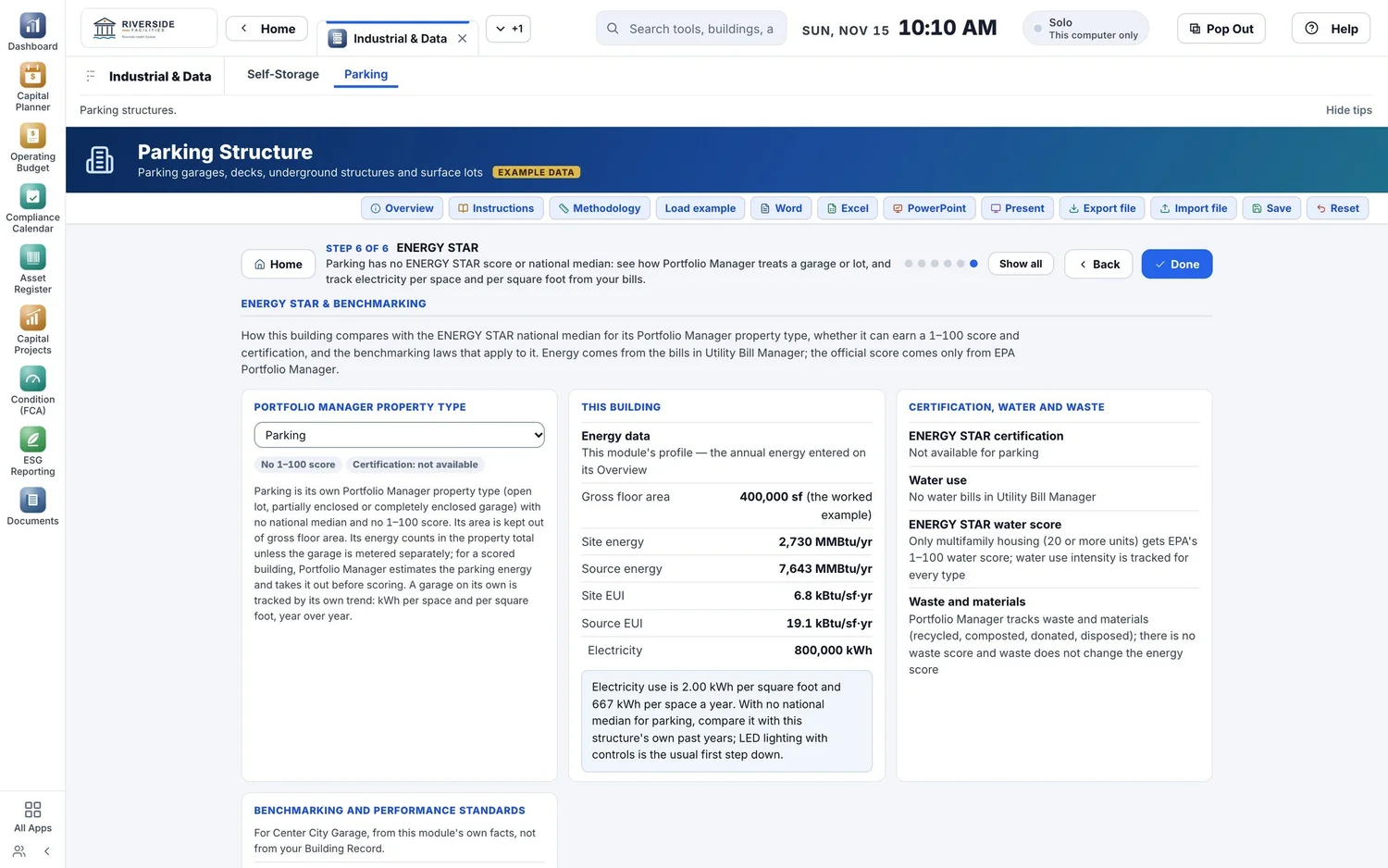
Data centers are compared by power usage effectiveness. Wastewater plants are scored against average daily flow, and drinking-water plants compare with their median. Parking has no score; electricity per square foot and per space come from the bills.
Learn MoreReliability
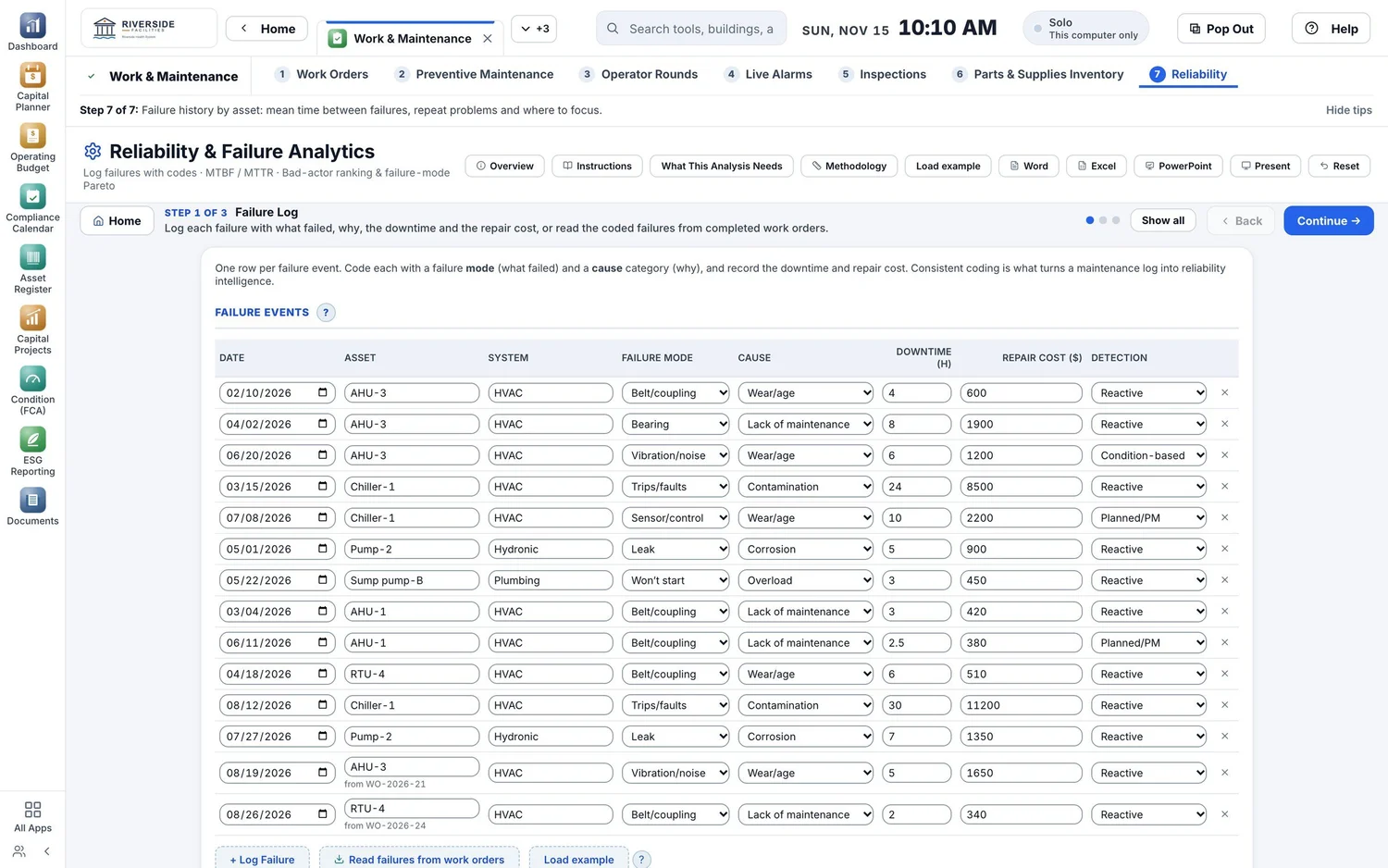
Mean time between failures, bad actors and repeat failures from coded work orders.
Learn More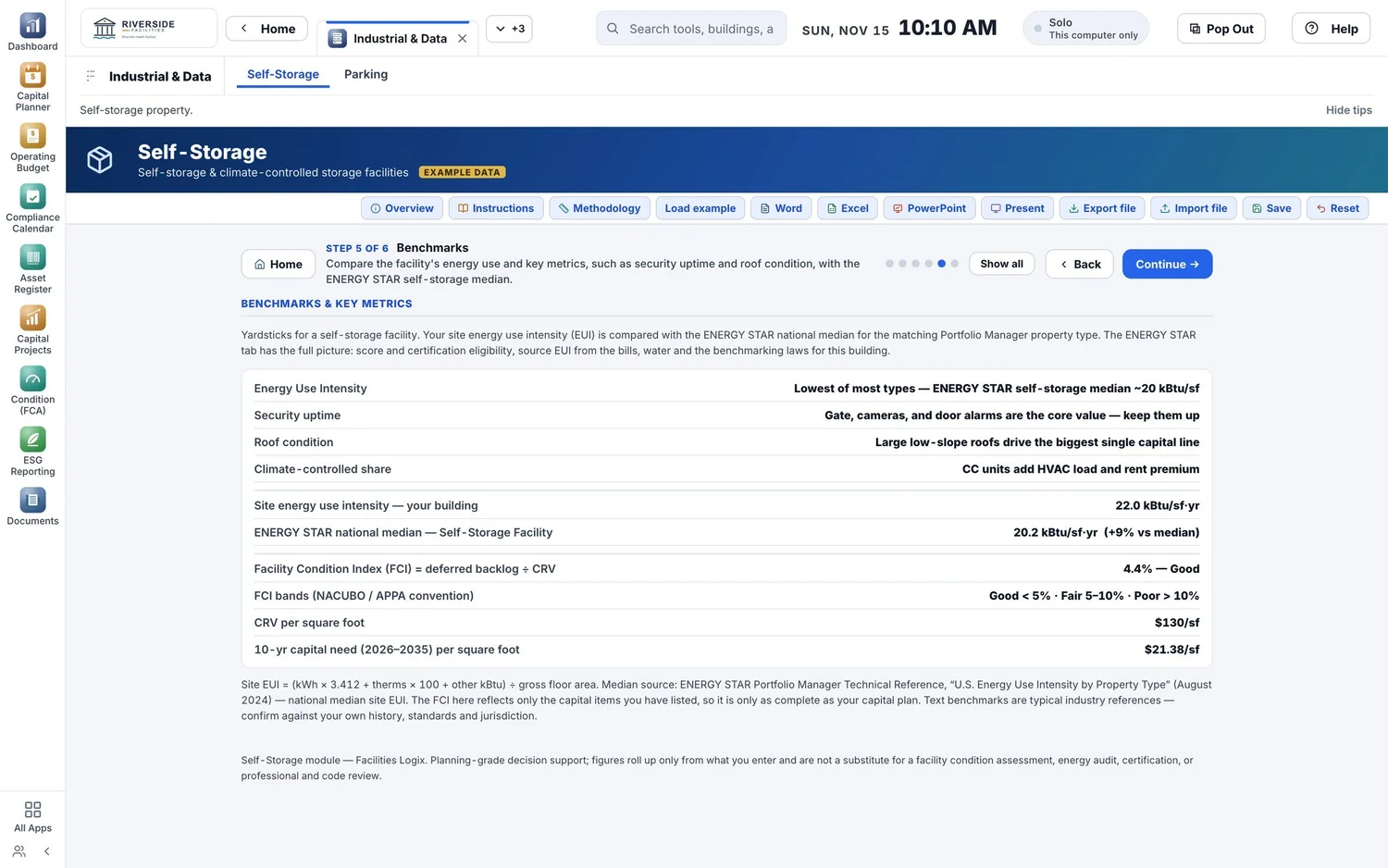
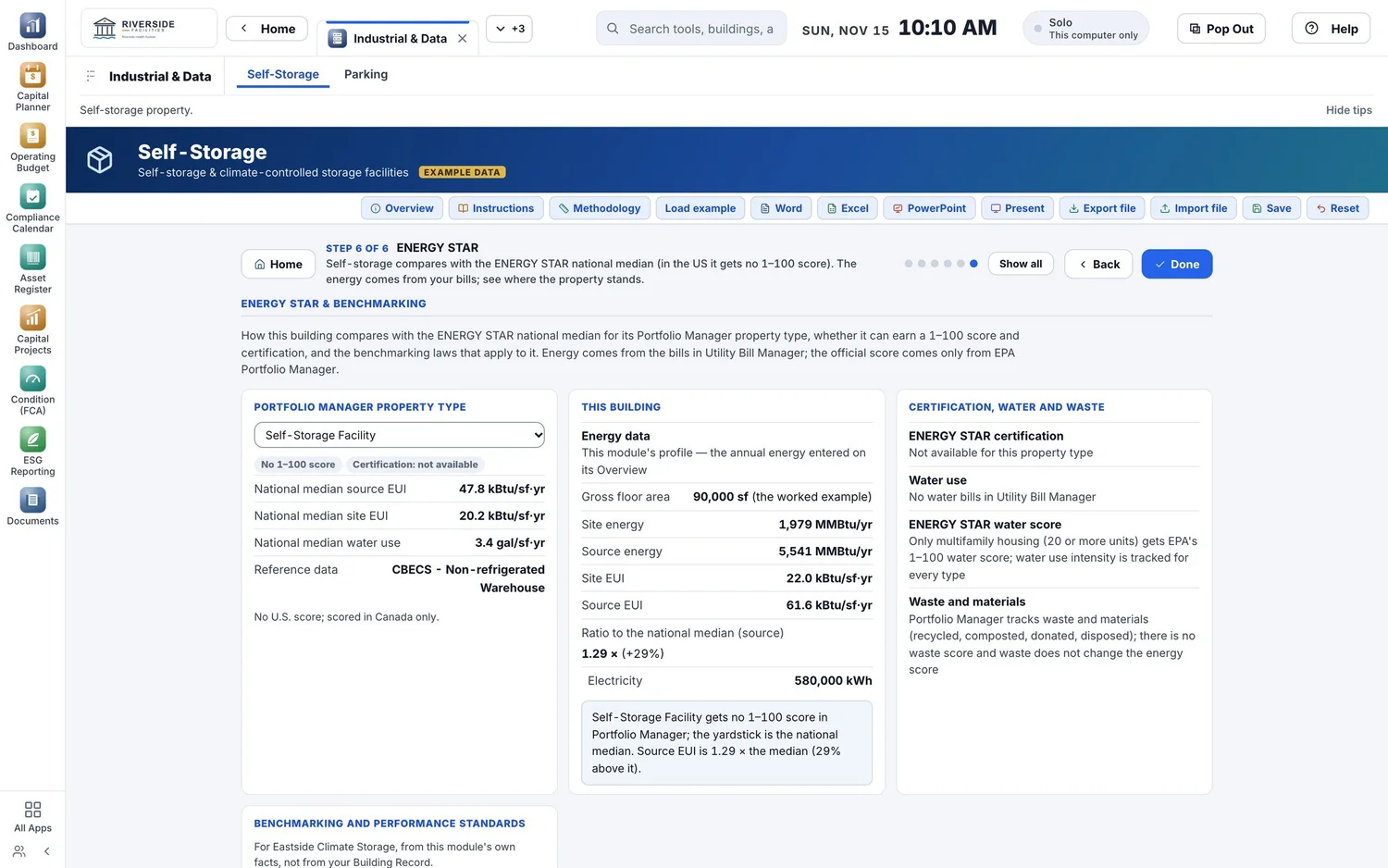
Benchmarks in Self-Storage: compare the facility's energy use and key metrics, such as security uptime and roof condition, with the ENERGY STAR self-storage median.
Criticality
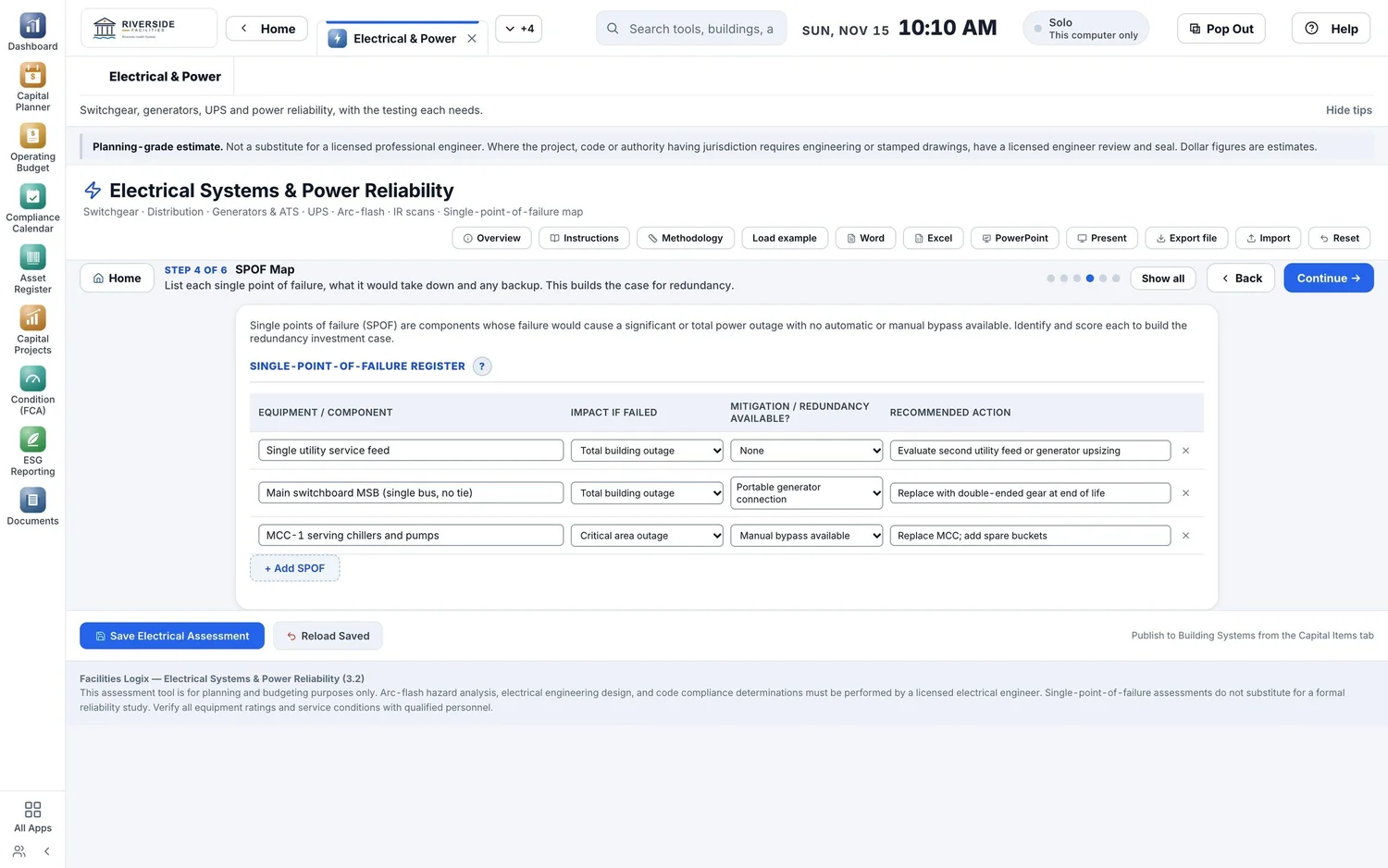
Single points of failure, design-day capacity with the largest unit out and a redundancy case.
Learn More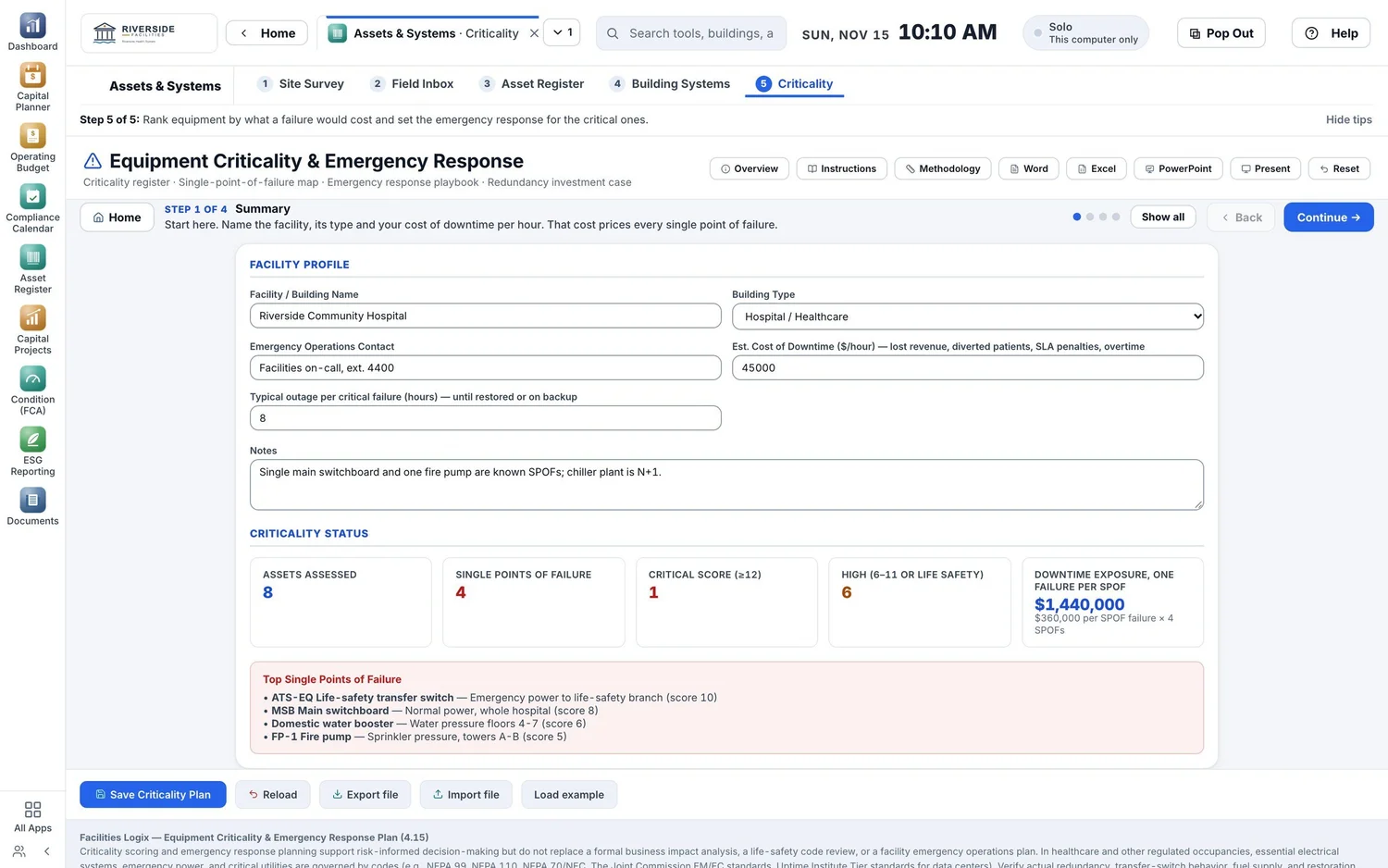
Summary in Equipment Criticality & Emergency Response: start here. Name the facility, its type and your cost of downtime per hour. That cost prices every single point of failure.
Parts and Critical Spares
Spares tied to the assets they serve, with reorder points from real usage.
Learn More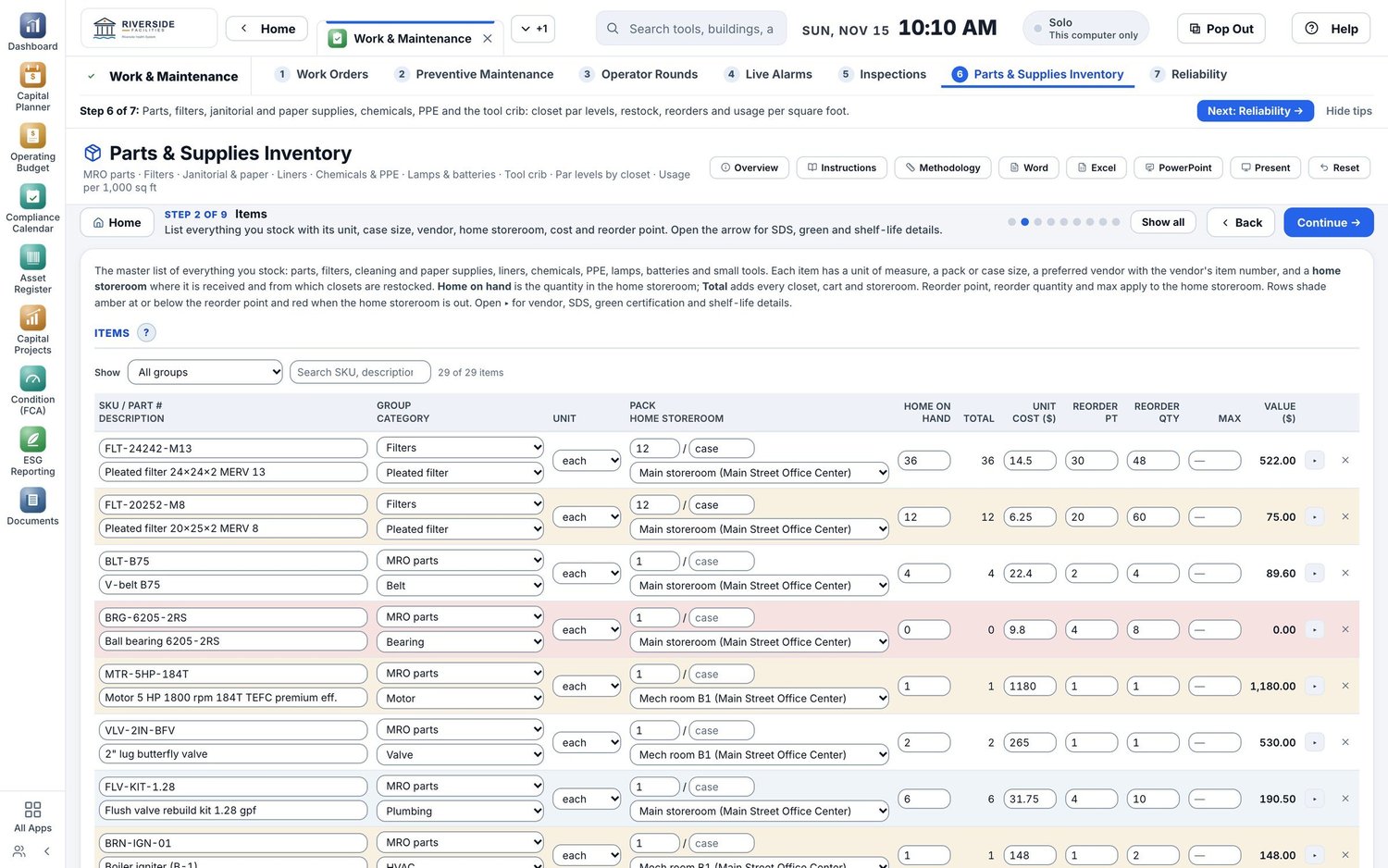
Items in Parts & Supplies Inventory: list everything you stock with its unit, case size, vendor, home storeroom, cost and reorder point. Open the arrow for SDS, green and shelf-life details.
Frequently Asked Questions
Is the rack power figure a measured load?
Does Facilities Logix control plant equipment?
Do the parking inspection rules cover our city?
Be First When Facilities Logix Opens
Stop chasing building records across spreadsheets and binders. Join the list and we will tell you the day downloads open, with setup guides ready.
Launching early 2027 for Facilities Logix. Nothing to buy today, and no sales calls.
