
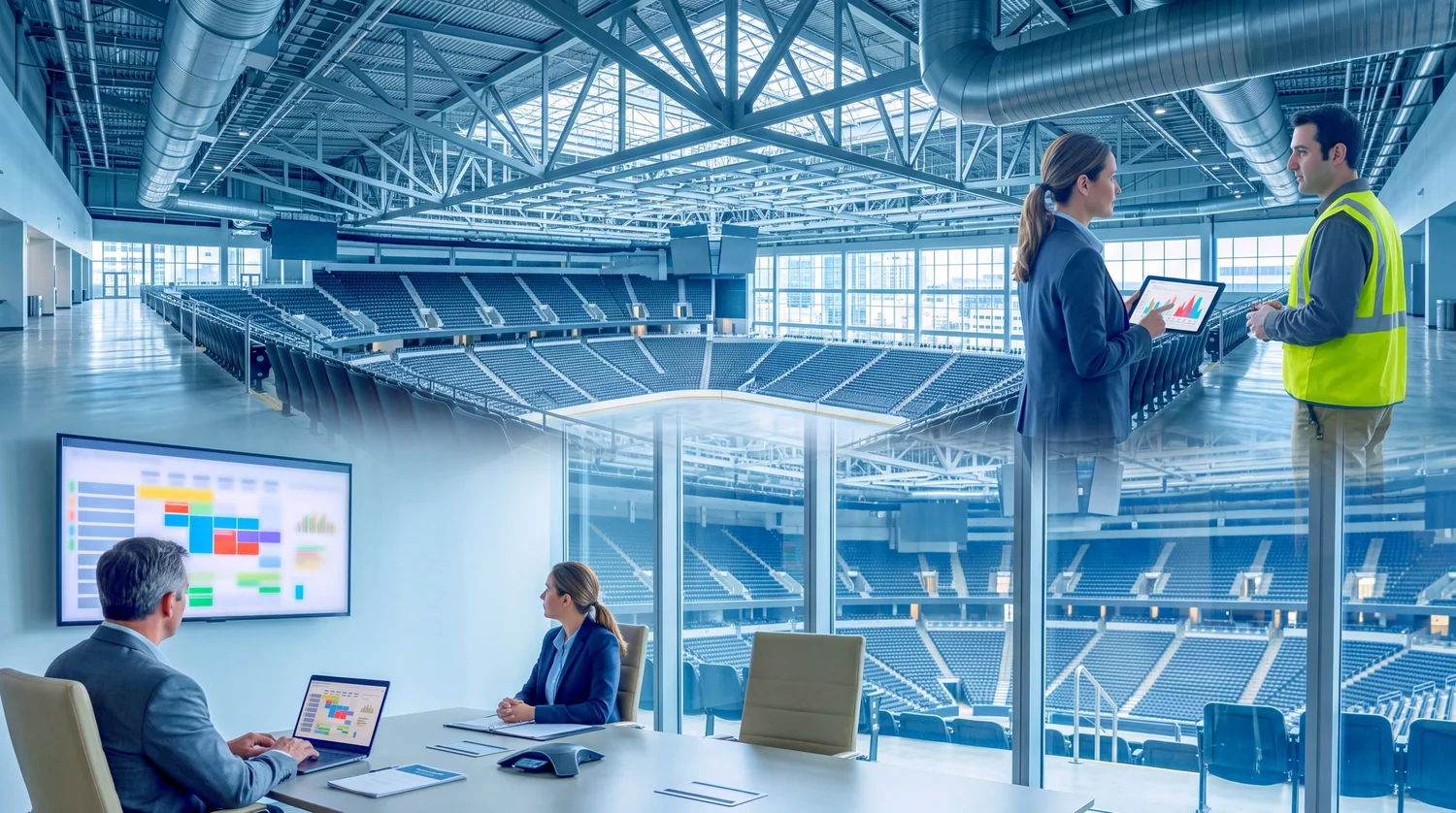

A venue's risk arrives in bursts: thousands of people for a few hours, then a changeover for the next event. A system that passed its annual inspection can still be unready for tonight. The Arena & Venue playbook adds a per-event readiness check to the assembly life-safety register, and the Convention Center playbook covers exhibit halls, floor-box utilities and constant move-in and move-out.
Assembly Life Safety and Event Permits
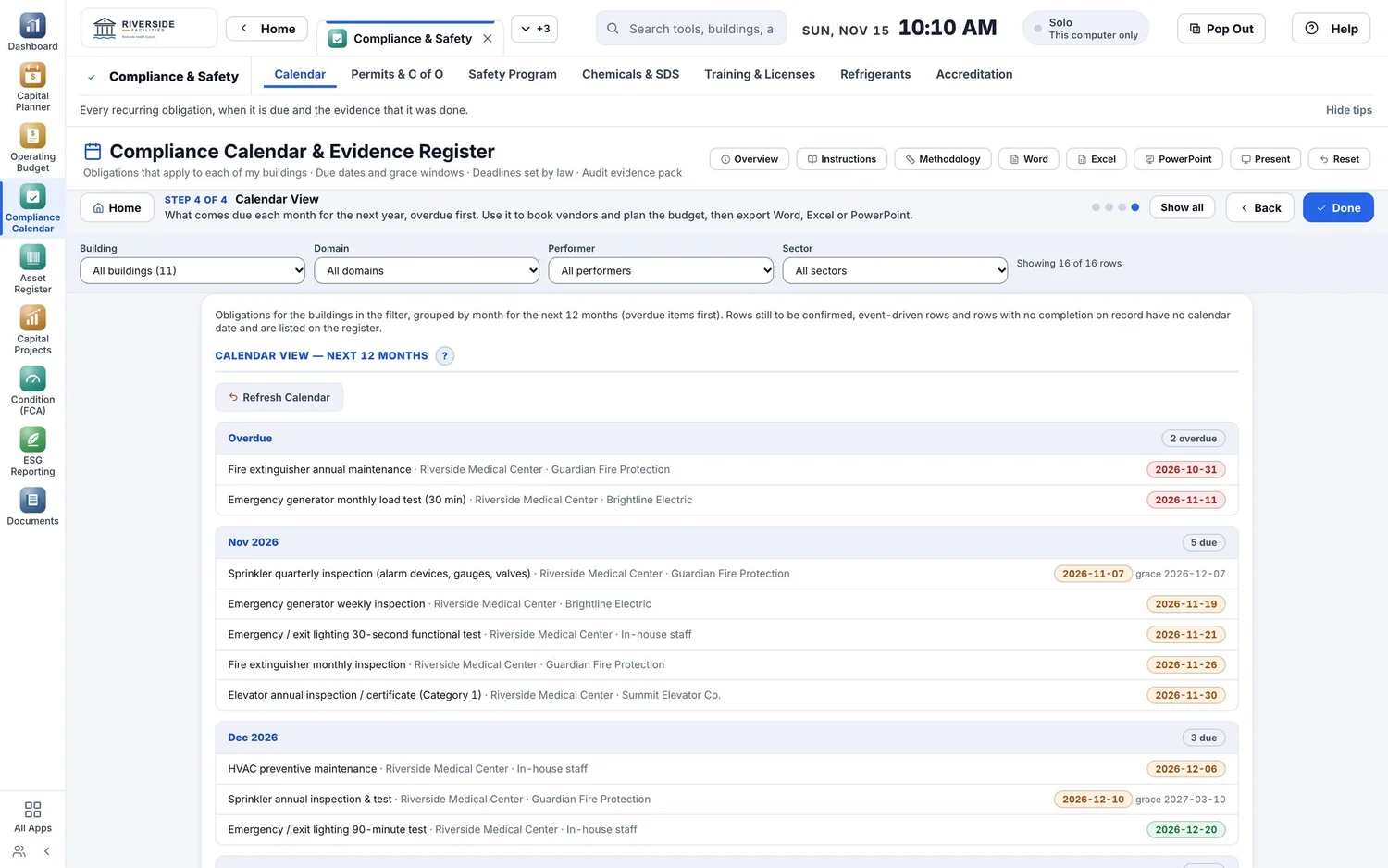
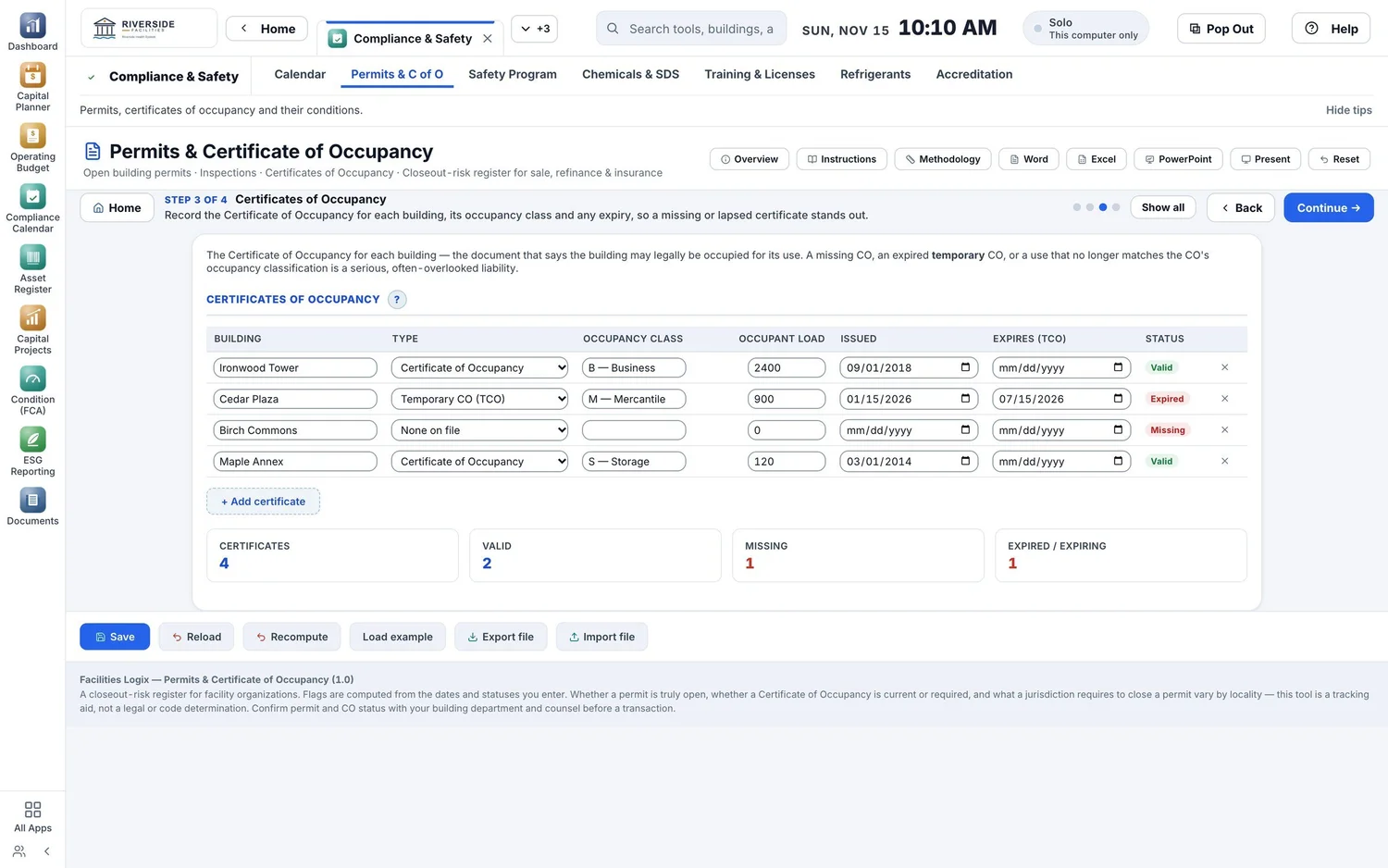
Each playbook's Compliance tab lists the library obligations that apply to the building, why, the citation, frequency and next due date, matching the Compliance Calendar.
Crowds and Seating
- Trained crowd managers for every event or operating period (NFPA 101 and the International Fire Code): at least one, plus one per 250 occupants above 250; under the IFC, gatherings over 500 (outdoor over 1,000) need at least two
- Bleacher, grandstand and telescopic seating inspected at least once a year by a qualified person under ICC 300, with folding and telescopic seating also checked against the manufacturer's instructions
- Stage rigging under ANSI E1.47: Level 1 inspection every year and Level 2 at least every 5 years and after changes
- A life safety evaluation for assembly occupancies over 6,000 people (NFPA 101); the library marks this row Confirm, to check with your fire authority
Per-Event Permits
- Pyrotechnic special effects: an operational permit for each use under the IFC, with NFPA 1126 for audiences close to the effects
- Tents, temporary special event structures and air-supported structures over 400 square feet: operational and construction permits under the IFC
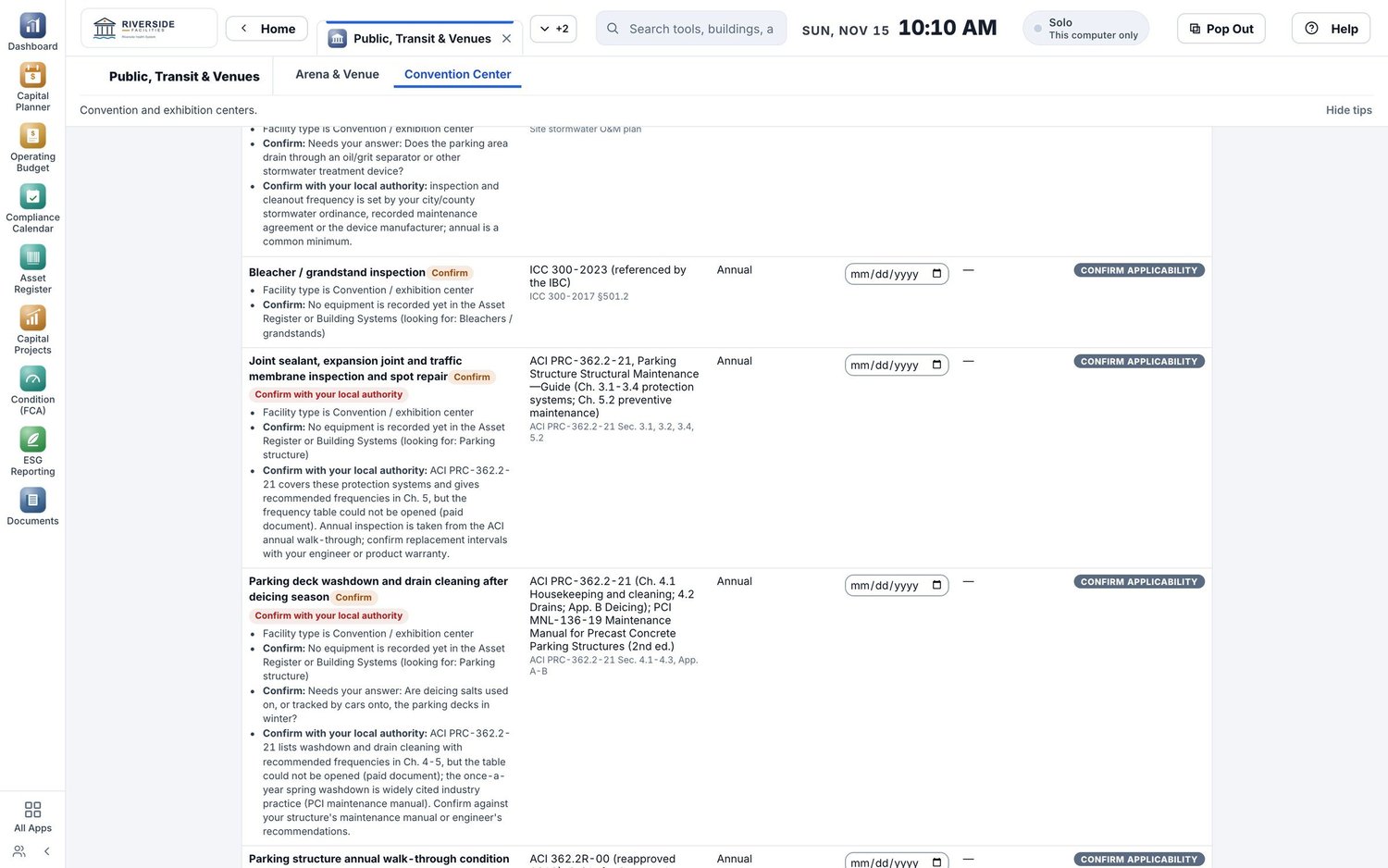
Compliance in Convention & Exhibition: enter the date each inspection was last done: fire alarm, sprinklers, rigging loads, crowd-safety plan. Next-due dates and status update themselves.
Food Service, Ice and Plant
- Concessions and catering: a food protection manager credential renewed at most every 5 years, and the retail food permit and health inspection (FDA Food Code, at least every 6 months unless the health authority uses a risk-based schedule)
- Ammonia refrigeration for an ice plant under IIAR 6: annual inspections, with an independent inspector every fifth year
- Indoor ice with combustion resurfacers: Minnesota carbon monoxide and nitrogen dioxide tests at least twice a week, Massachusetts sampling at least three times a week
- Emergency generators under NFPA 110: weekly inspection and a monthly load test
Every-Building Rows
- Fire alarm, sprinkler, fire pump, extinguisher and emergency lighting inspections from the library, as in every building
- Elevator and escalator inspections, backflow tests and kitchen hood rows where the building has them
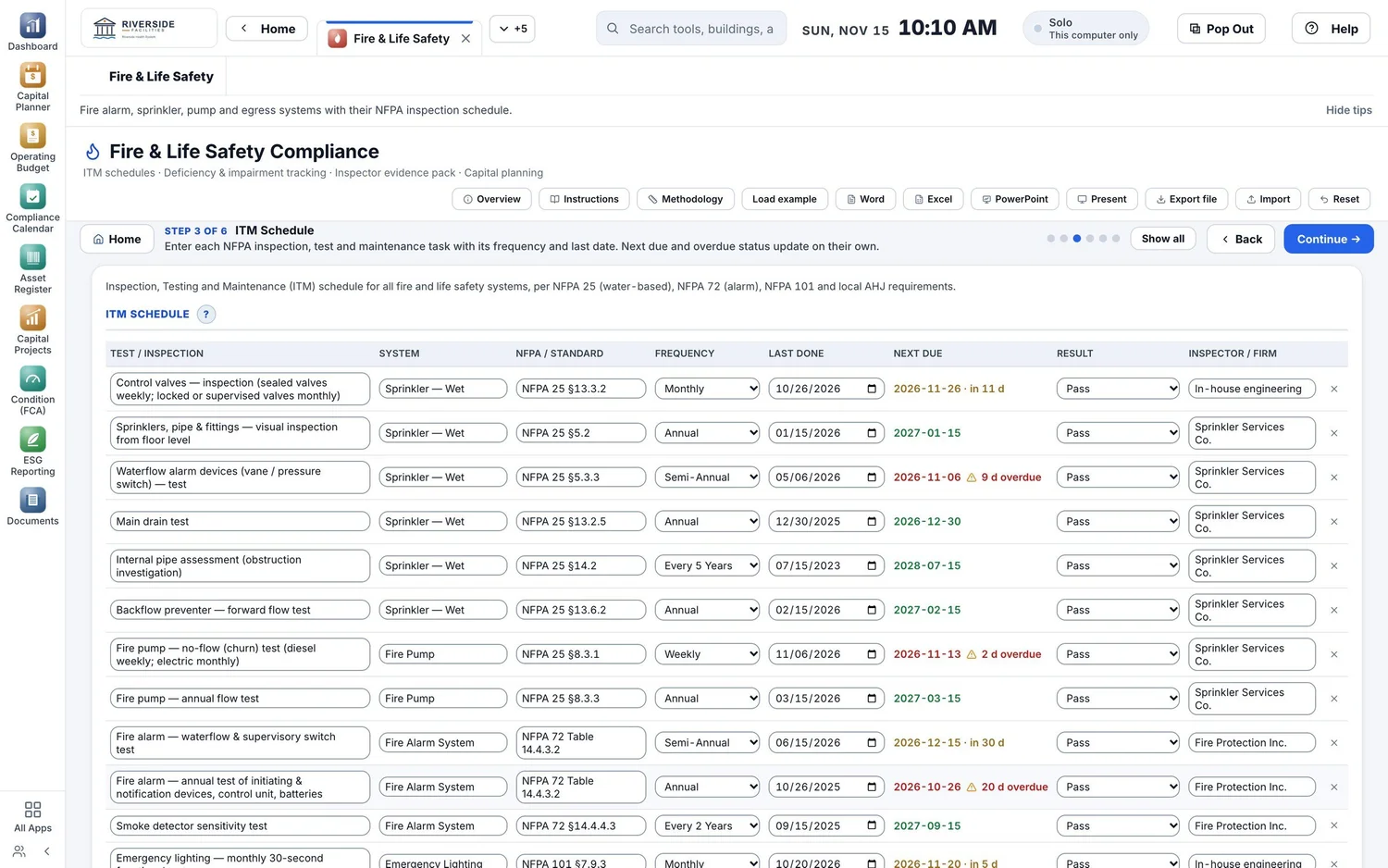
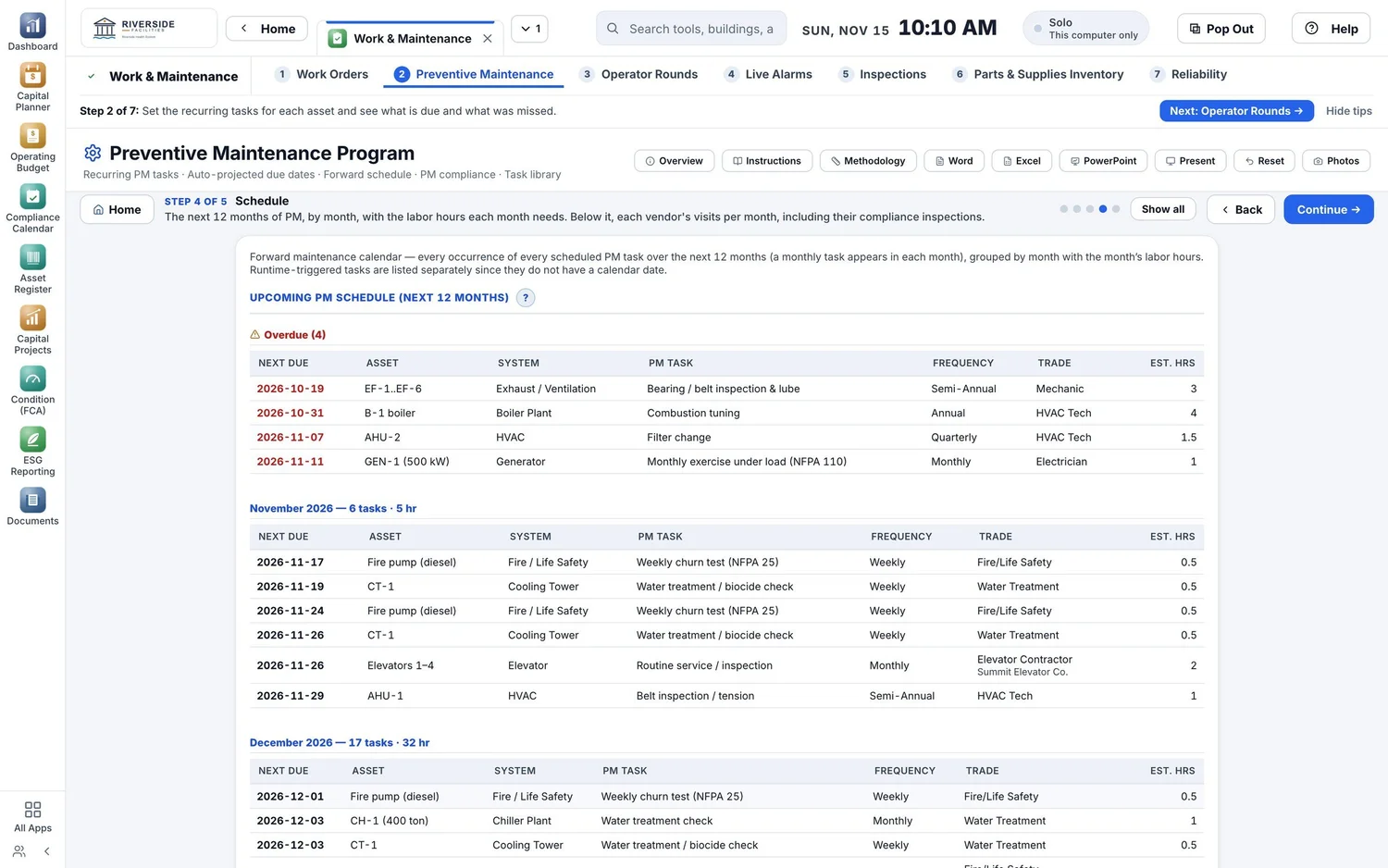
ITM Schedule in Fire & Life Safety Compliance: enter each NFPA inspection, test and maintenance task with its frequency and last date. Next due and overdue status update on their own.
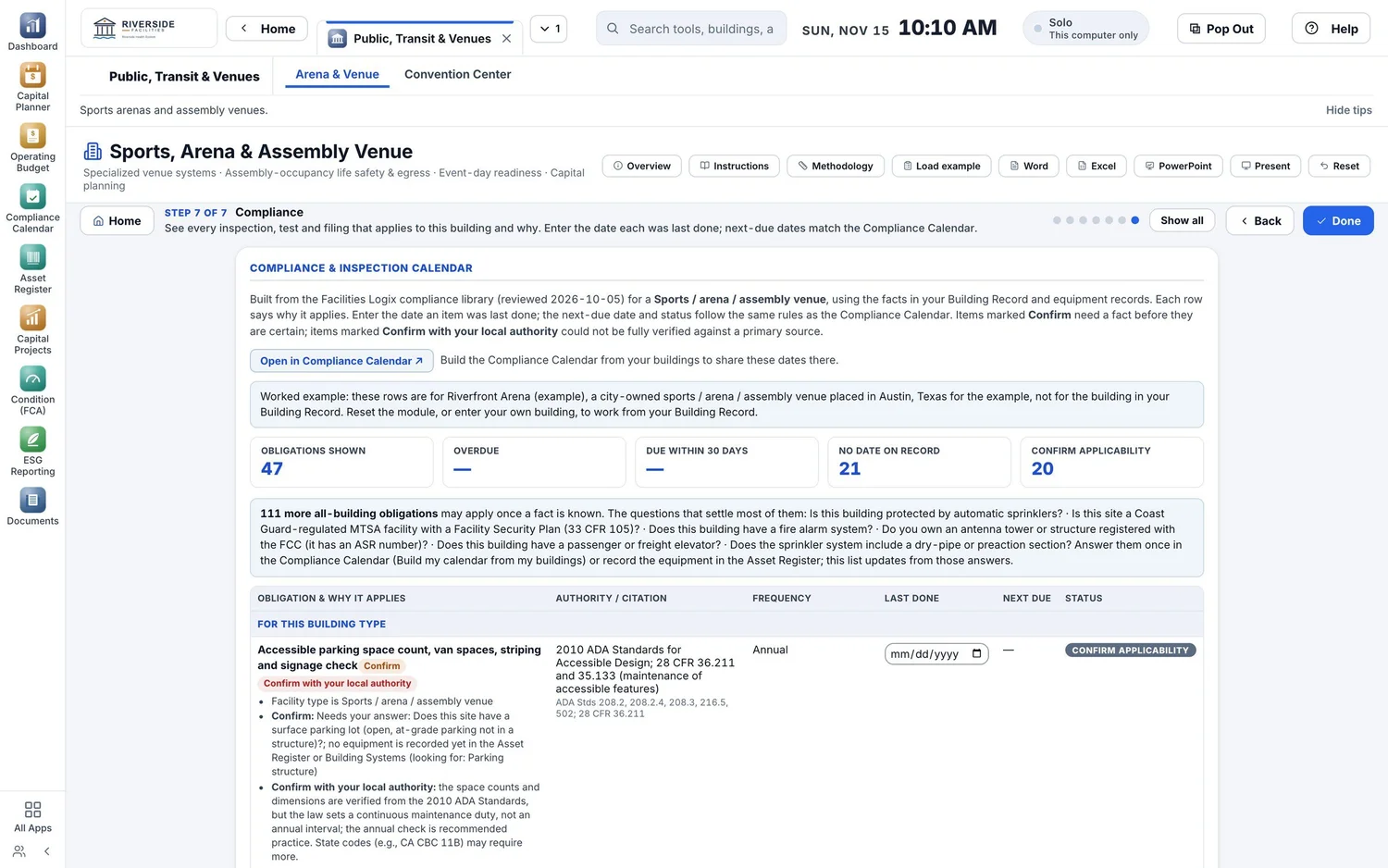
Assembly and event permits carry their own dates, so the obligations for each venue are listed.
The Systems That Fail on Event Day
Arena and Venue
- Venue types: arena, stadium, convention center, theater and amphitheater, with seating or occupant capacity and events per year
- Venue systems: natural and synthetic turf, ice plant and ice sheet, scoreboard and video board, sound and PA, concessions and food service, escalators and elevators, retractable roof, retractable or telescopic seating, field and sports lighting, and ribbon or LED displays
- Each system's install year and design life, with remaining life calculated, and a condition from Good to Critical
- Publish to Building Systems rolls venue assets, life-safety deficiencies and capital into the shared Facilities Logix data
Convention and Exhibition
- Types: convention center, exhibition hall, expo or fairgrounds, and conference center, with exhibit space, floor area and loading docks
- Monthly: emergency and standby power, and elevators and escalators
- Quarterly: large-span HVAC for variable event loads, exhibit-hall floor-box utilities (power, water, data and compressed air), loading docks and levelers, and AV, broadcast and networking
- Semi-annual: kitchen, concessions and catering, and large-span roofing
- Annual: rigging and structural systems, and fire alarm and suppression for large assembly
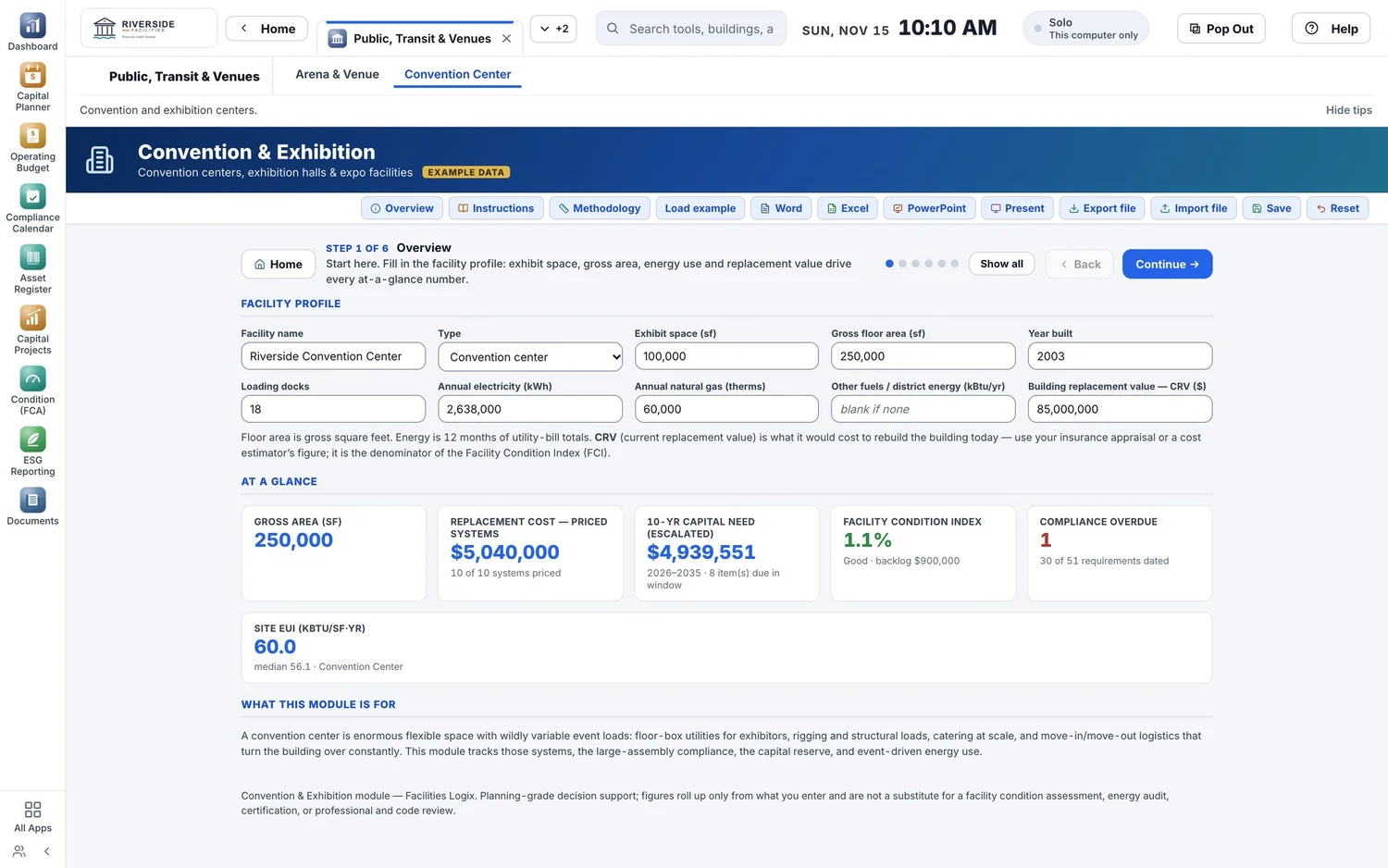
Overview in Convention & Exhibition: start here. Fill in the facility profile: exhibit space, gross area, energy use and replacement value drive every at-a-glance number.
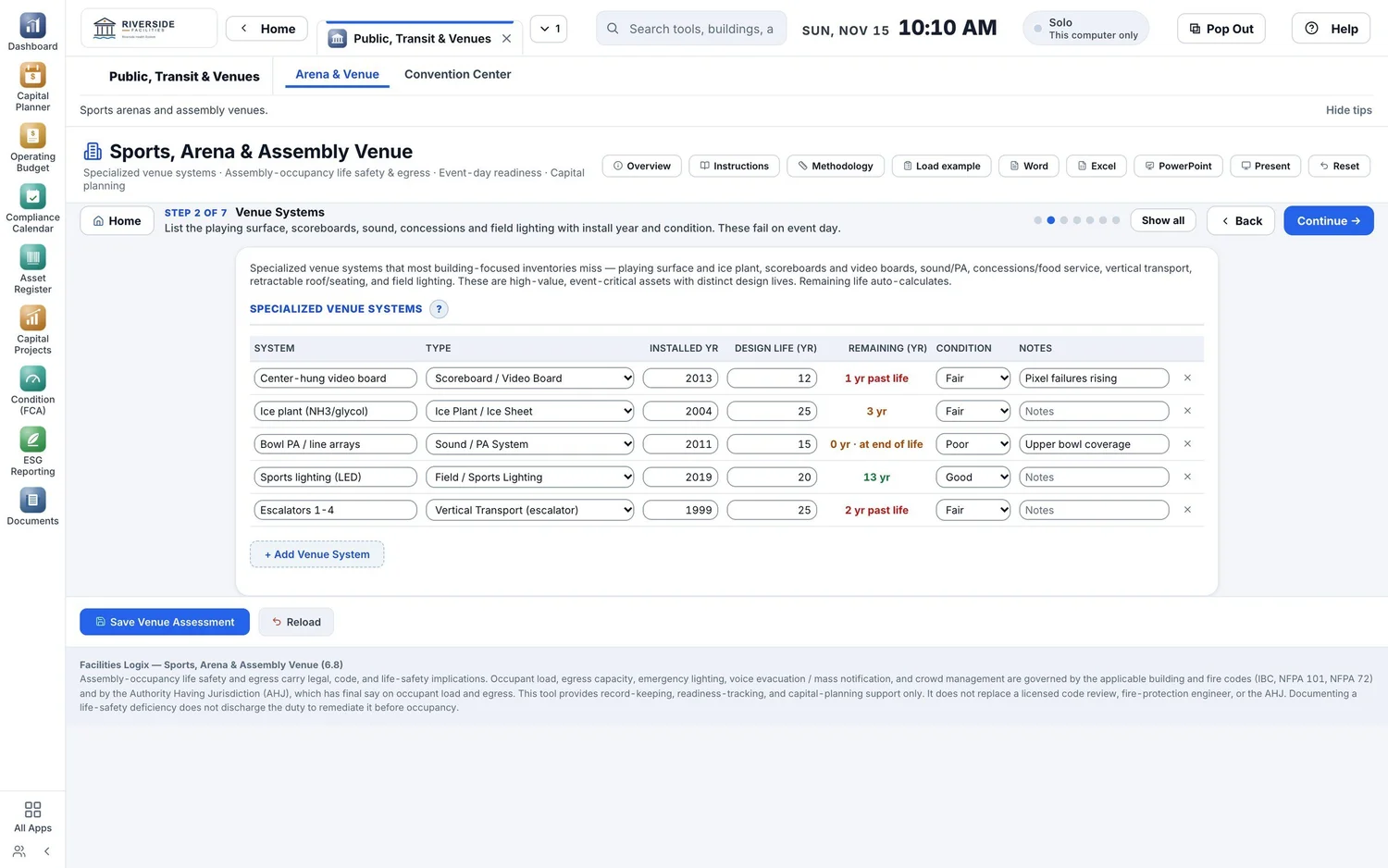
Systems that fail on event day cannot wait, so each venue system shows its condition and remaining life.
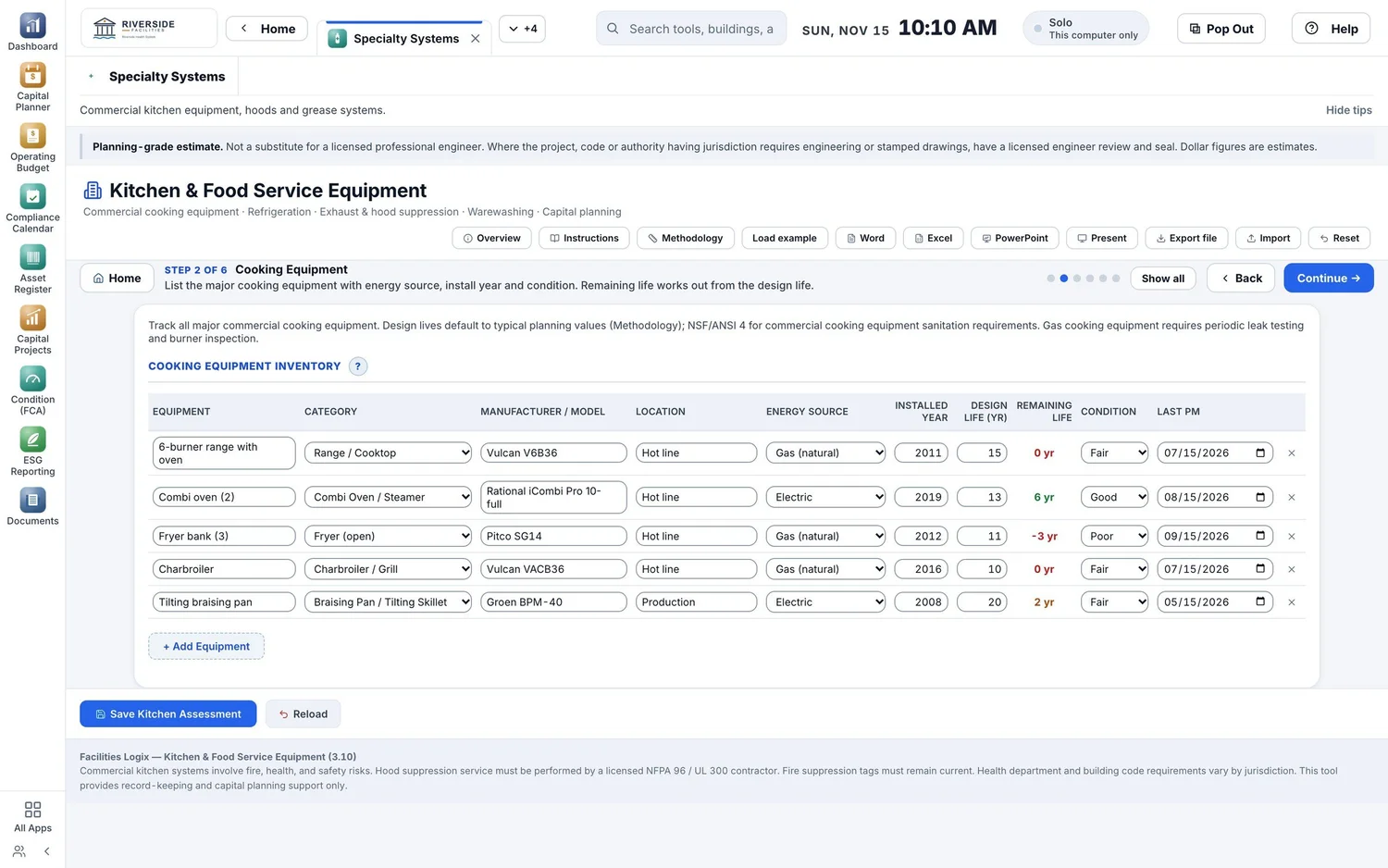
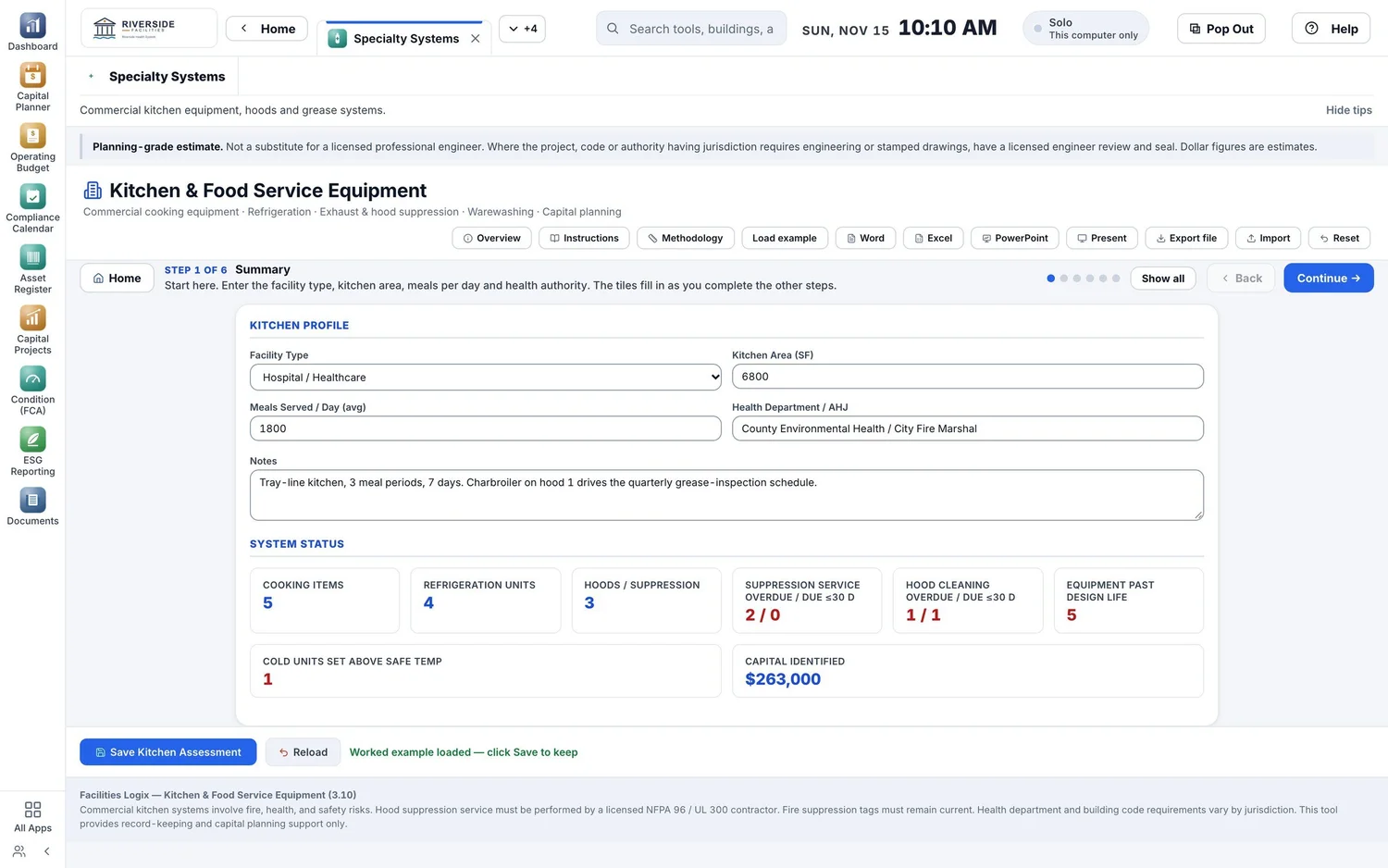
A Readiness Check for Every Event
Assembly Life-Safety Register
- Load the standard assembly items: occupant load calculation, egress capacity, 90-minute emergency and egress lighting, voice evacuation and mass notification (NFPA 72), the crowd management plan, and the fire command center
- Each item carries its requirement, a status (compliant, non-compliant, needs review) and the date last verified
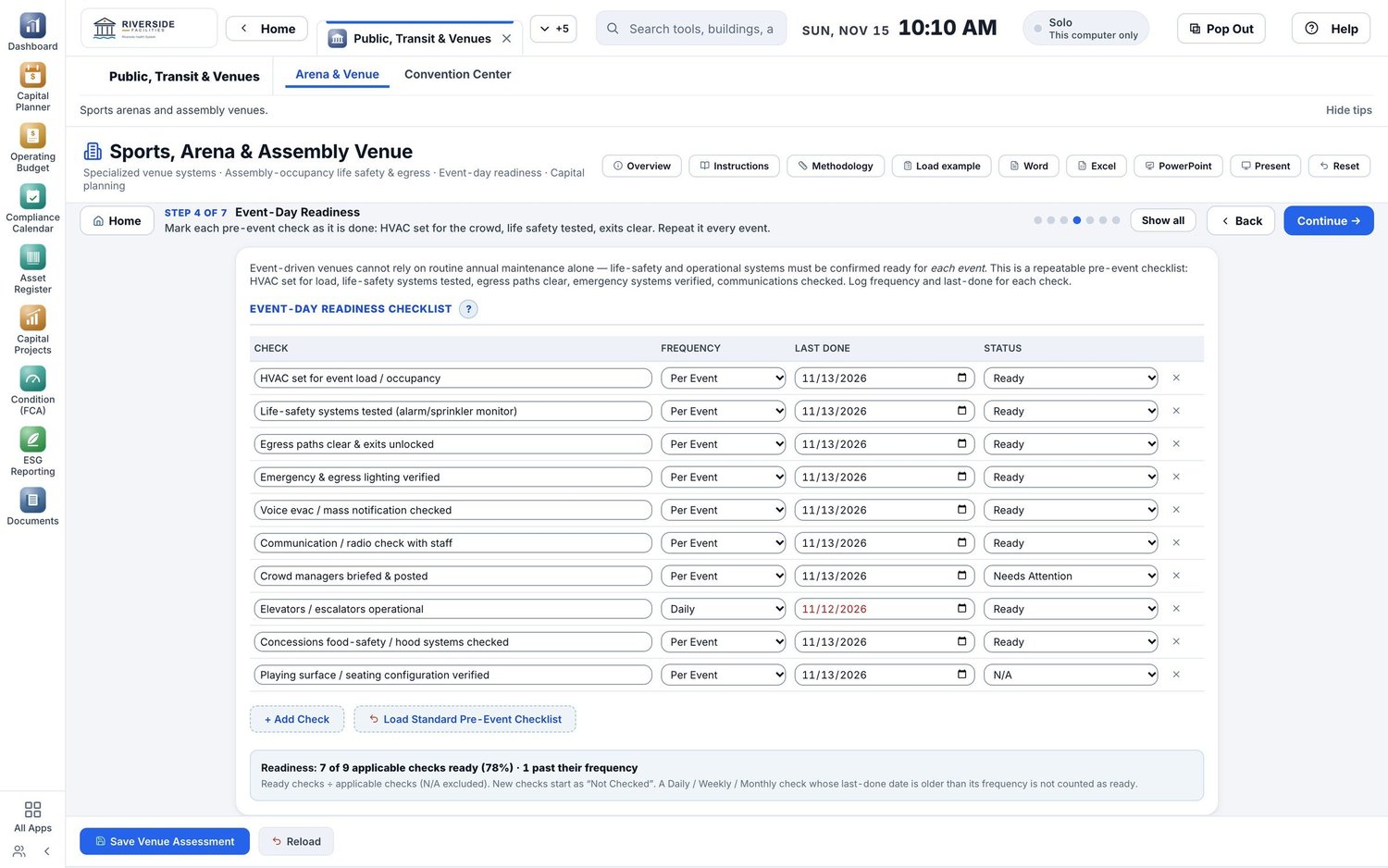
Event-Day Readiness Checklist
- HVAC set for the event load
- Life-safety systems tested (alarm and sprinkler monitoring)
- Egress paths clear and exits unlocked
- Emergency and egress lighting verified
- Voice evacuation and mass notification checked
- Radio check with staff
- Crowd managers briefed and posted
- Concessions food safety and hood systems checked
- Playing surface and seating configuration verified
- Elevators and escalators running (daily)
- Each check is set per event, daily, weekly or monthly, with last done and a status of ready, not ready or needs attention
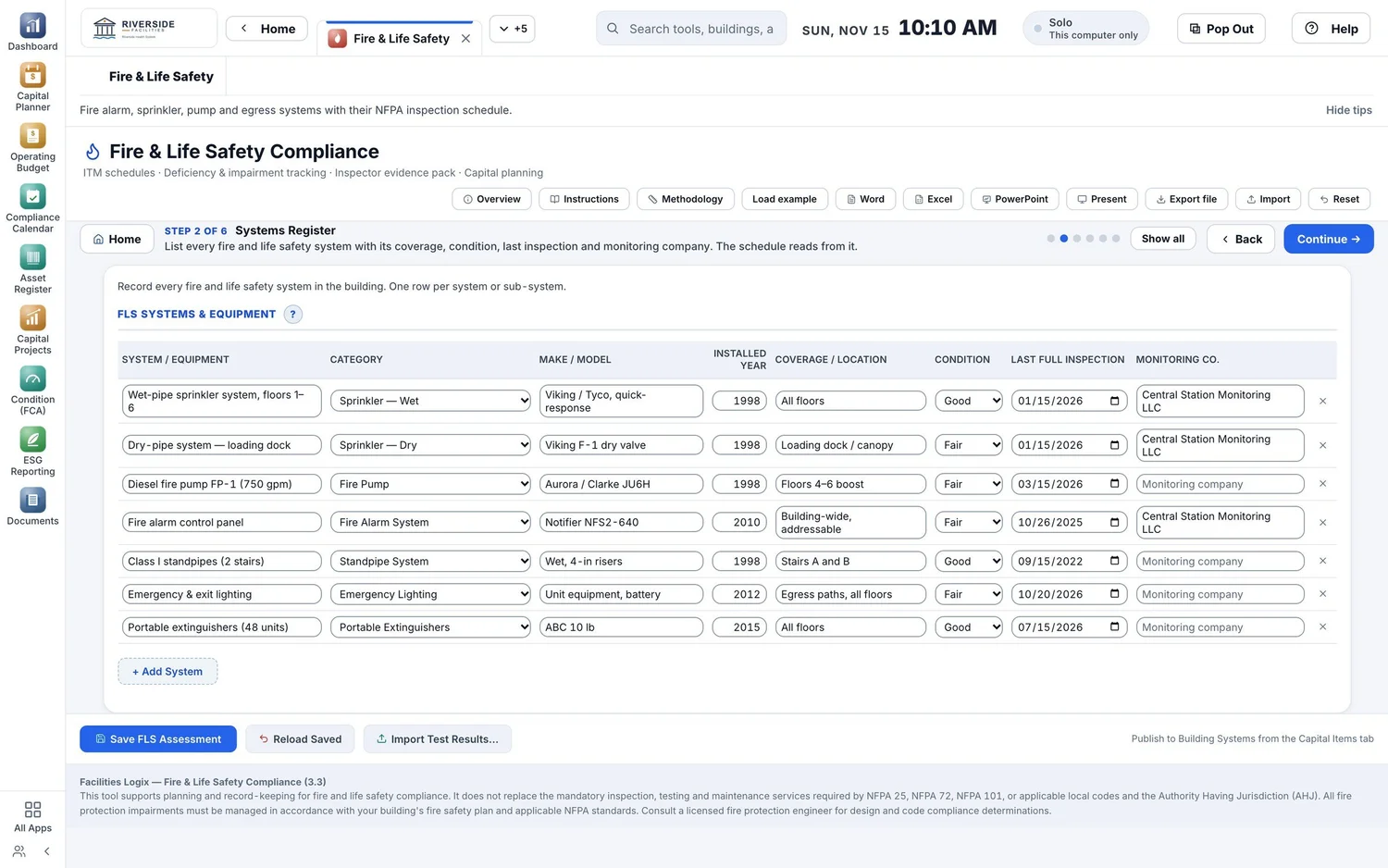
Systems Register in Fire & Life Safety Compliance: list every fire and life safety system with its coverage, condition, last inspection and monitoring company. The schedule reads from it.
Convention Center Starting Checklist
- Emergency generator test (NFPA 110): monthly
- Kitchen hood and grease duct cleaning (NFPA 96): semi-annual
- Fire alarm (NFPA 72), sprinkler and suppression (NFPA 25), large-assembly egress and occupant load (IBC and NFPA 101), rigging and structural load inspection, elevators and escalators (ASME A17.1), ADA accessibility, the crowd management and event safety plan, and backflow: annual
- A row for temporary structure and pyrotechnics permits, which the library treats as per event
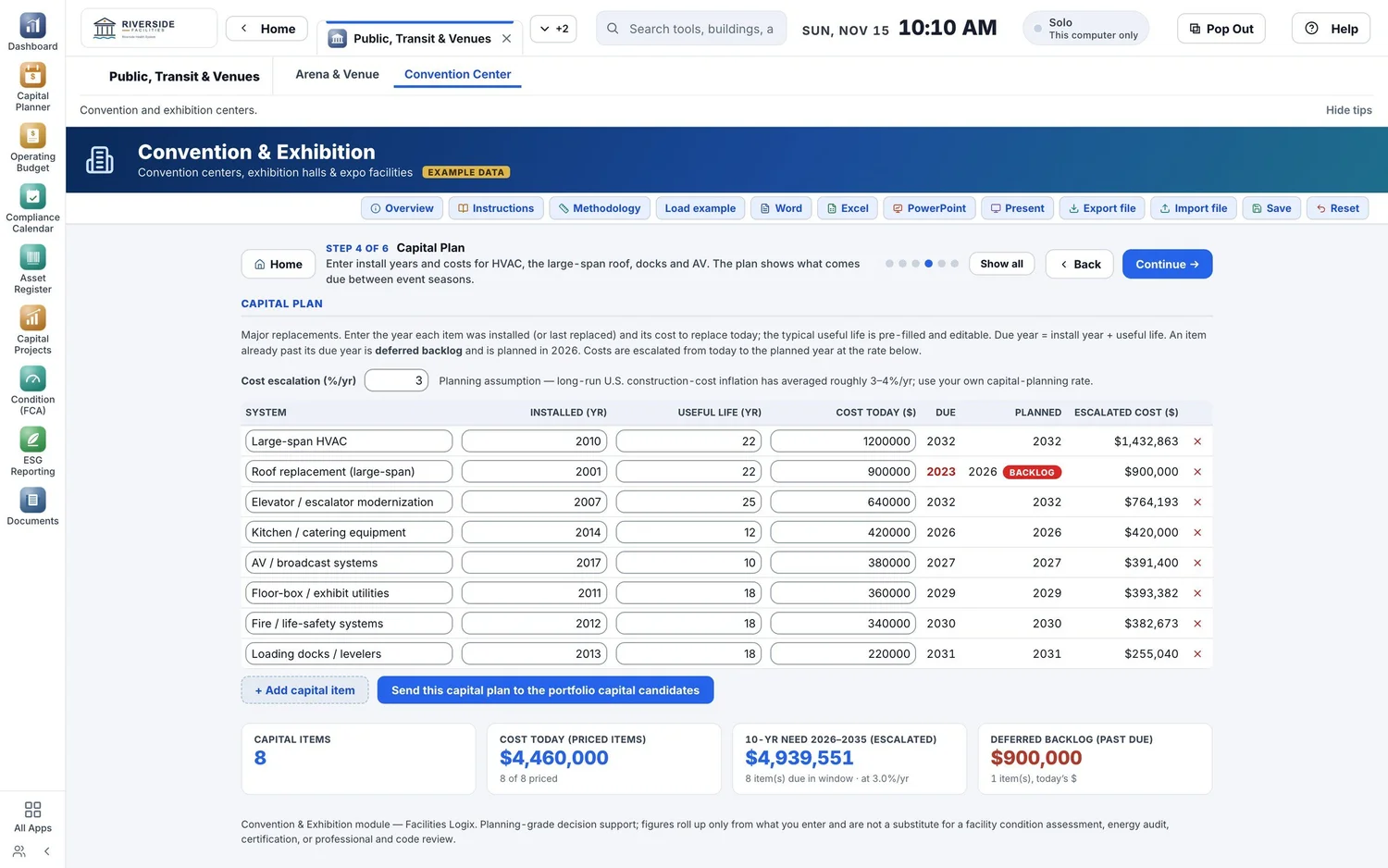
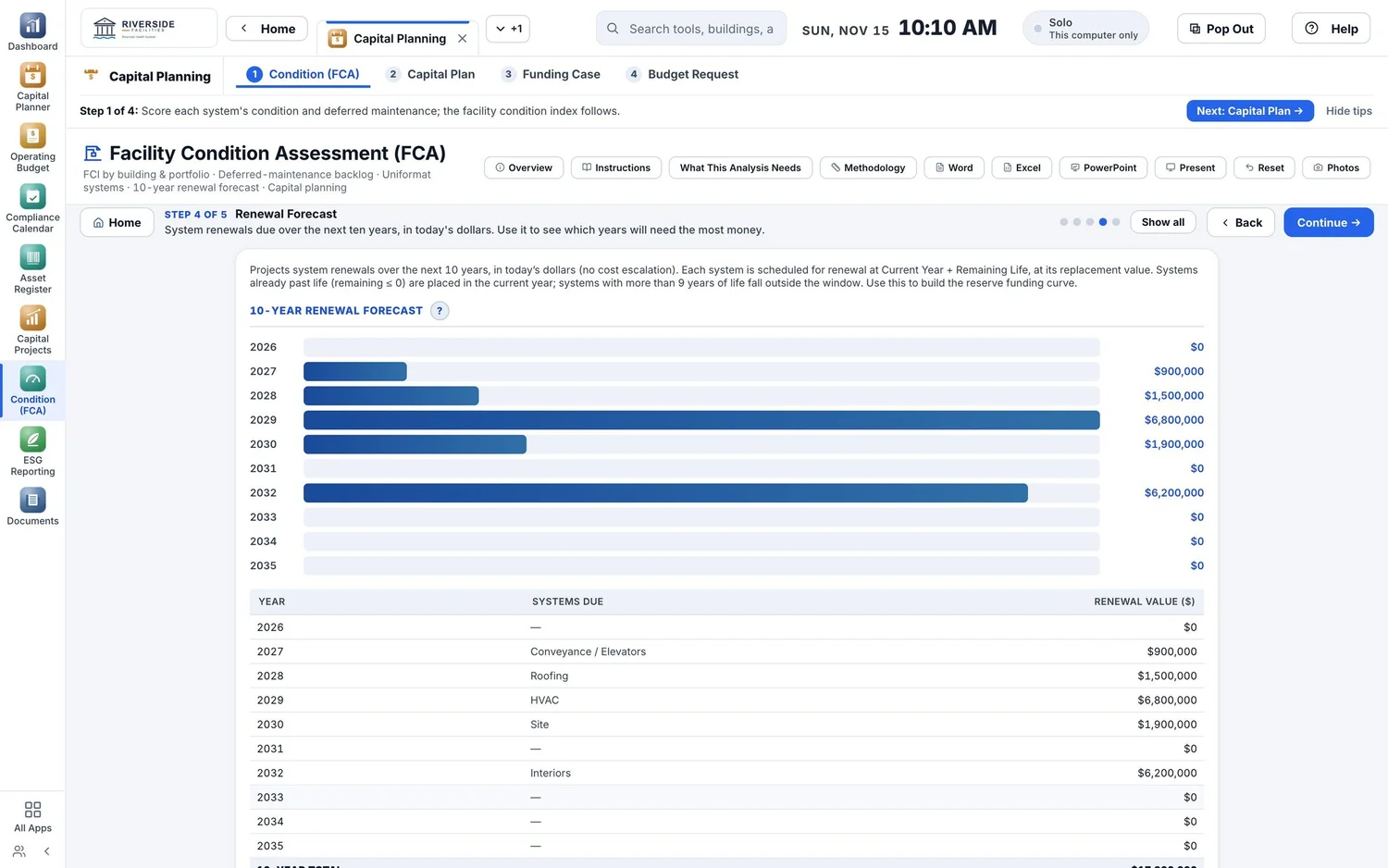
Capital Plan in Convention & Exhibition: enter install years and costs for HVAC, the large-span roof, docks and AV. The plan shows what comes due between event seasons.
Ready for the Fire Marshal and the Next Booking
Egress Capacity Check
Enter the occupant load and exit widths. The screening check uses 0.2 inch per person for level exits and ramps and 0.3 inch for stairs (NFPA 101 Table 7.3.3.1 and IBC 1005.3), tests that the main entrance can take half the occupant load, and gives the crowd managers needed at one per 250, minimum one. The fire authority has the final say.
Learn MoreShow Less
Finding an egress shortfall on paper costs nothing; finding it with the fire marshal on event night can cost the event.
- The result reads adequate with persons to spare, or short by a number of persons
- Occupant load defaults to the venue capacity when left blank
- A shortfall publishes to Building Systems as a Life Safety deficiency
- The briefing advises limiting the posted occupant load until it is fixed
Compliance Tab
Every inspection, test and permit that applies to the venue and why, with next due dates shared with the Compliance Calendar.
Learn More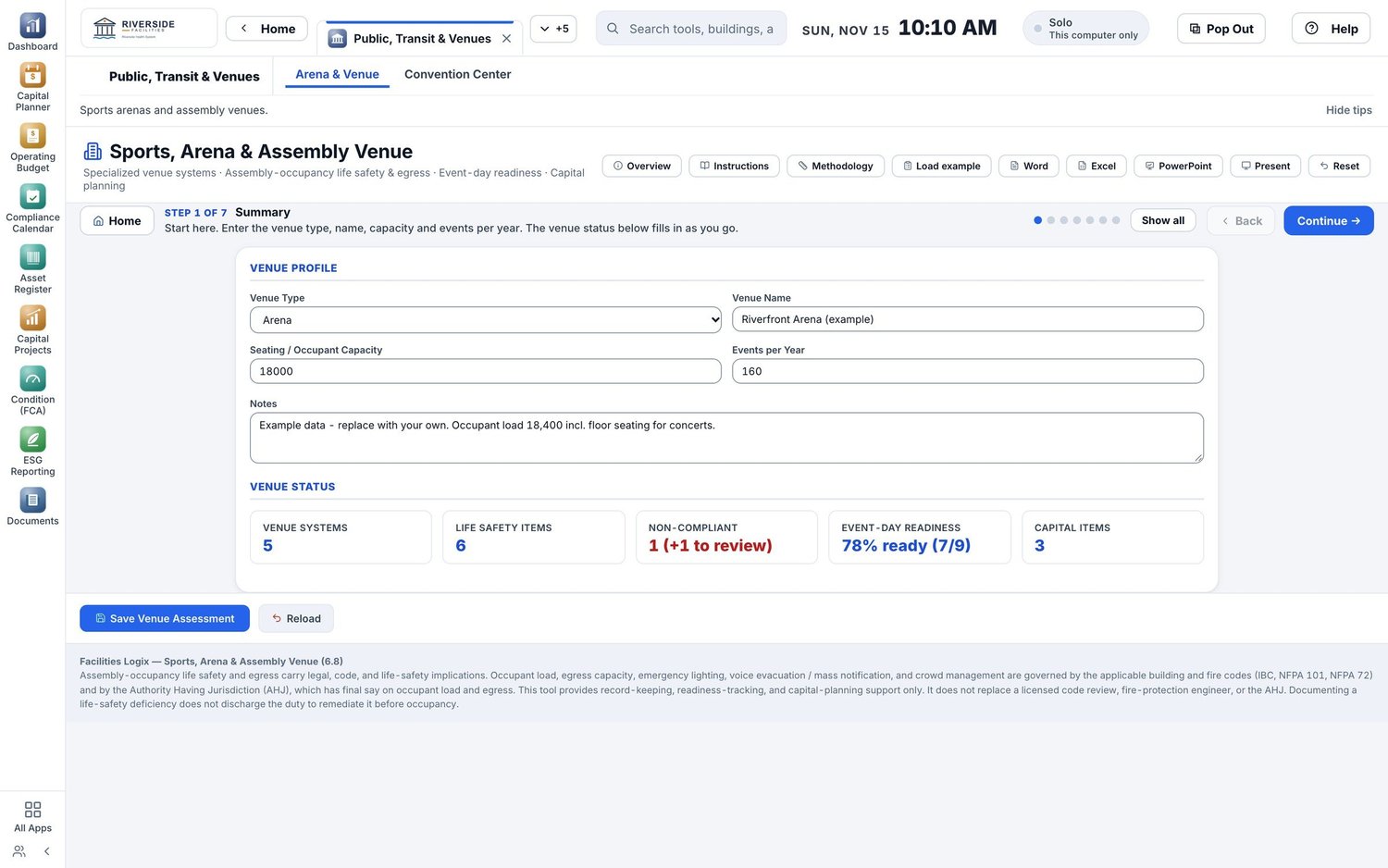
Summary in Sports, Arena & Assembly Venue: start here. Enter the venue type, name, capacity and events per year. The venue status below fills in as you go.
Reports
Word, Excel and PowerPoint reports, and Present mode for leadership and the venue's board.
Learn MoreShow Less
Leadership funds the fix when the briefing shows exactly what stands between the venue and its next event.
- Opens with what to fix: egress, non-compliant items and pre-event checks not ready
- Egress chart compares exits and the main exit with the load and half the load
- Life-safety status chart and readiness table, with stale checks marked
- Venue systems by remaining life; capital by priority and driver
ENERGY STAR Tab
Arenas, stadiums and convention centers compare with their ENERGY STAR national median from their own bills. Portfolio Manager gives these types no 1-100 score.
Learn MoreShow Less
Lighting, ice plants and large-span HVAC drive venue bills; the median shows whether the building runs high between events.
- Arena and stadium median: 56.2 kBtu per square foot site, 112.0 source
- Convention center median: 56.1 site, 109.6 source
- Ice plants are energy-intensive and refrigerant-regulated, with a 25-year starting life
- LED field lighting is a capital driver for efficiency
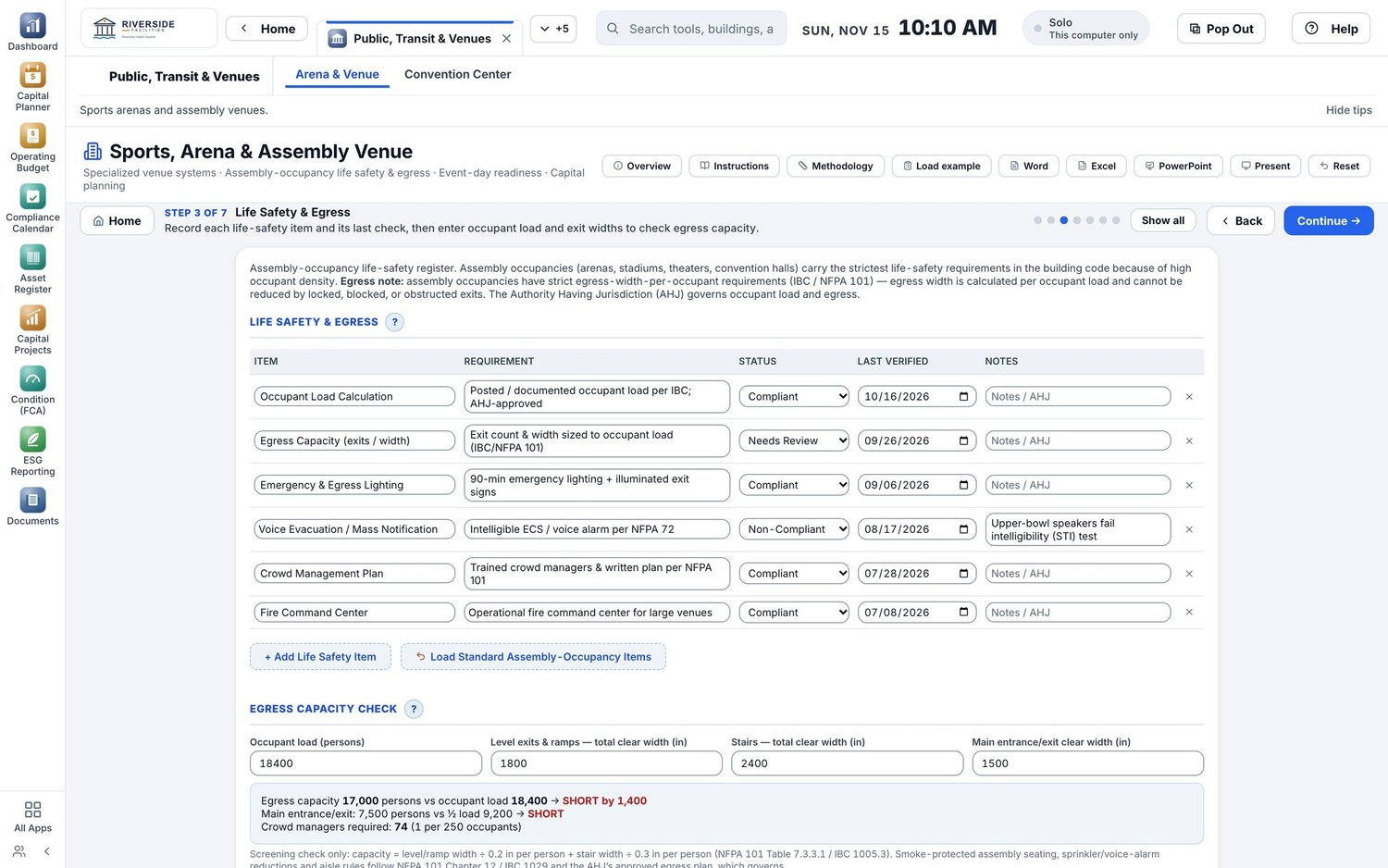
Life Safety & Egress in Sports, Arena & Assembly Venue: record each life-safety item and its last check, then enter occupant load and exit widths to check egress capacity.
Readiness, Capacity and Throughput
Arena and Venue
- Remaining life of every venue system
- Life-safety items not compliant or due for review
- Event checks ready, not ready or not yet done
- Capital by priority and driver: end of life, life safety and code, egress and occupant load, fan experience, LED efficiency and event revenue
Convention Center
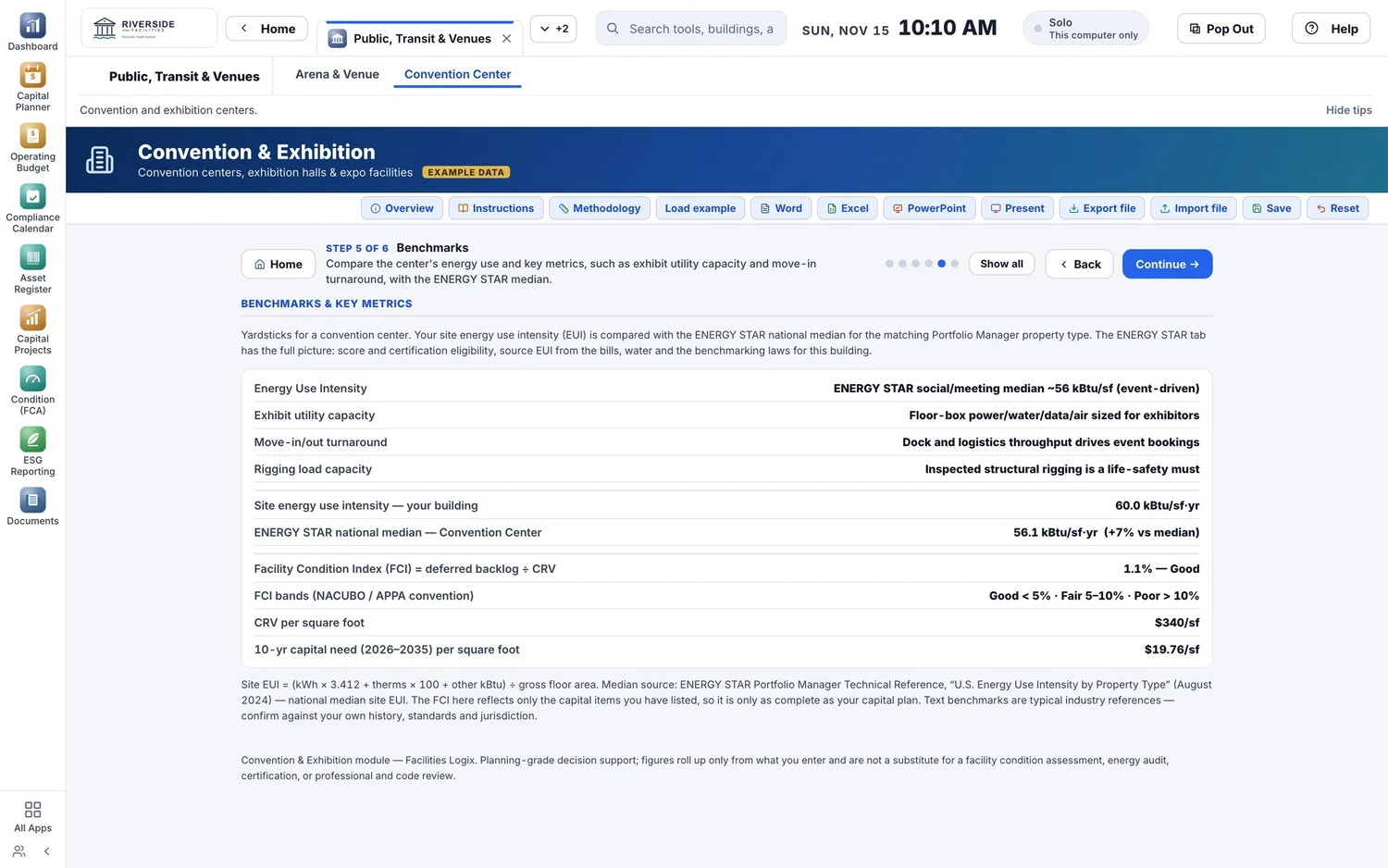
- Energy use intensity against the ENERGY STAR median of about 56 kBtu per square foot, which swings with events
- Exhibit utility capacity: floor-box power, water, data and air sized for exhibitors
- Move-in and move-out turnaround: dock and logistics throughput
- Rigging load capacity, inspected as a life-safety item
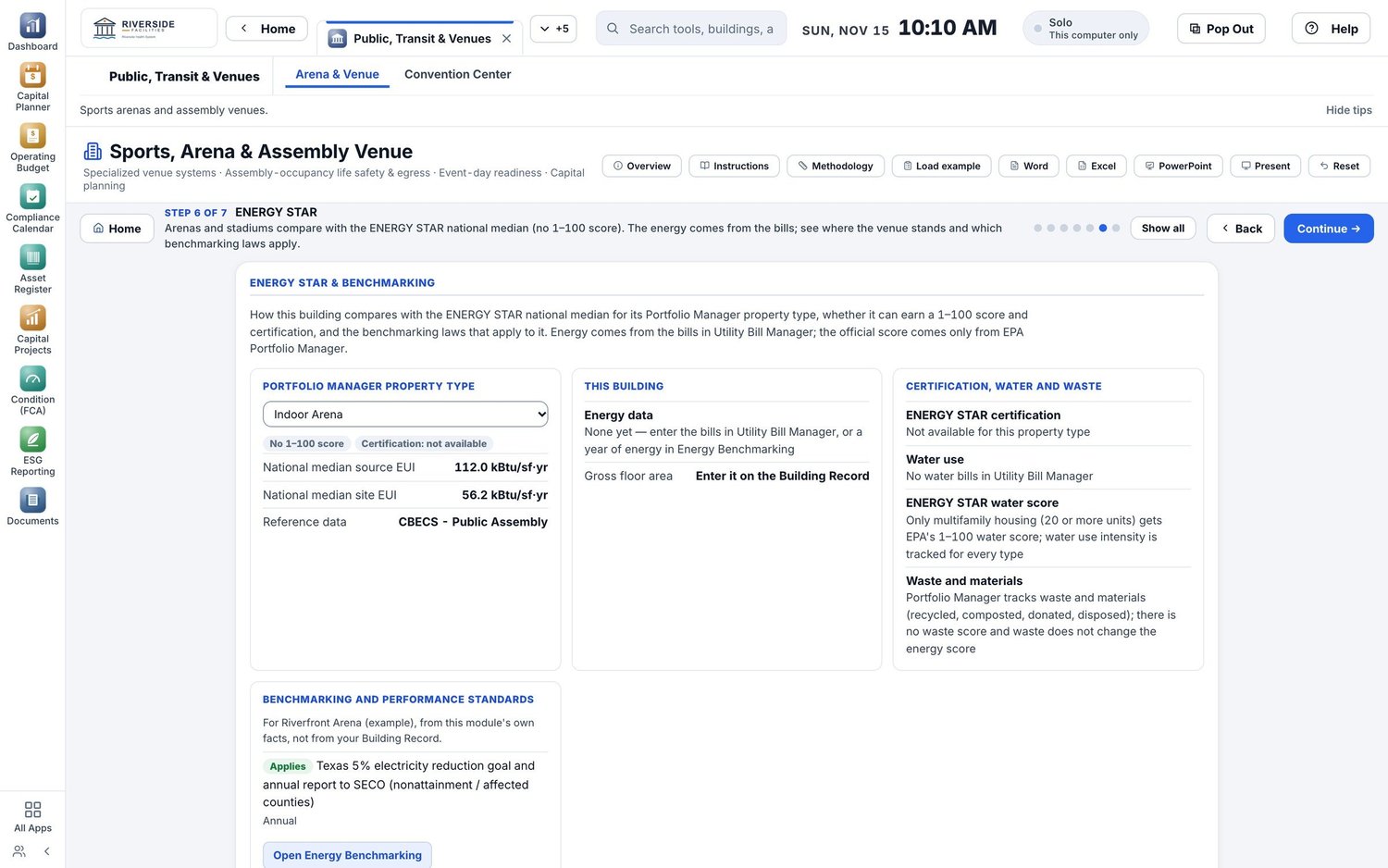
ENERGY STAR in Sports, Arena & Assembly Venue: arenas and stadiums compare with the ENERGY STAR national median (no 1–100 score). The energy comes from the bills; see where the venue stands and which benchmarking laws apply.
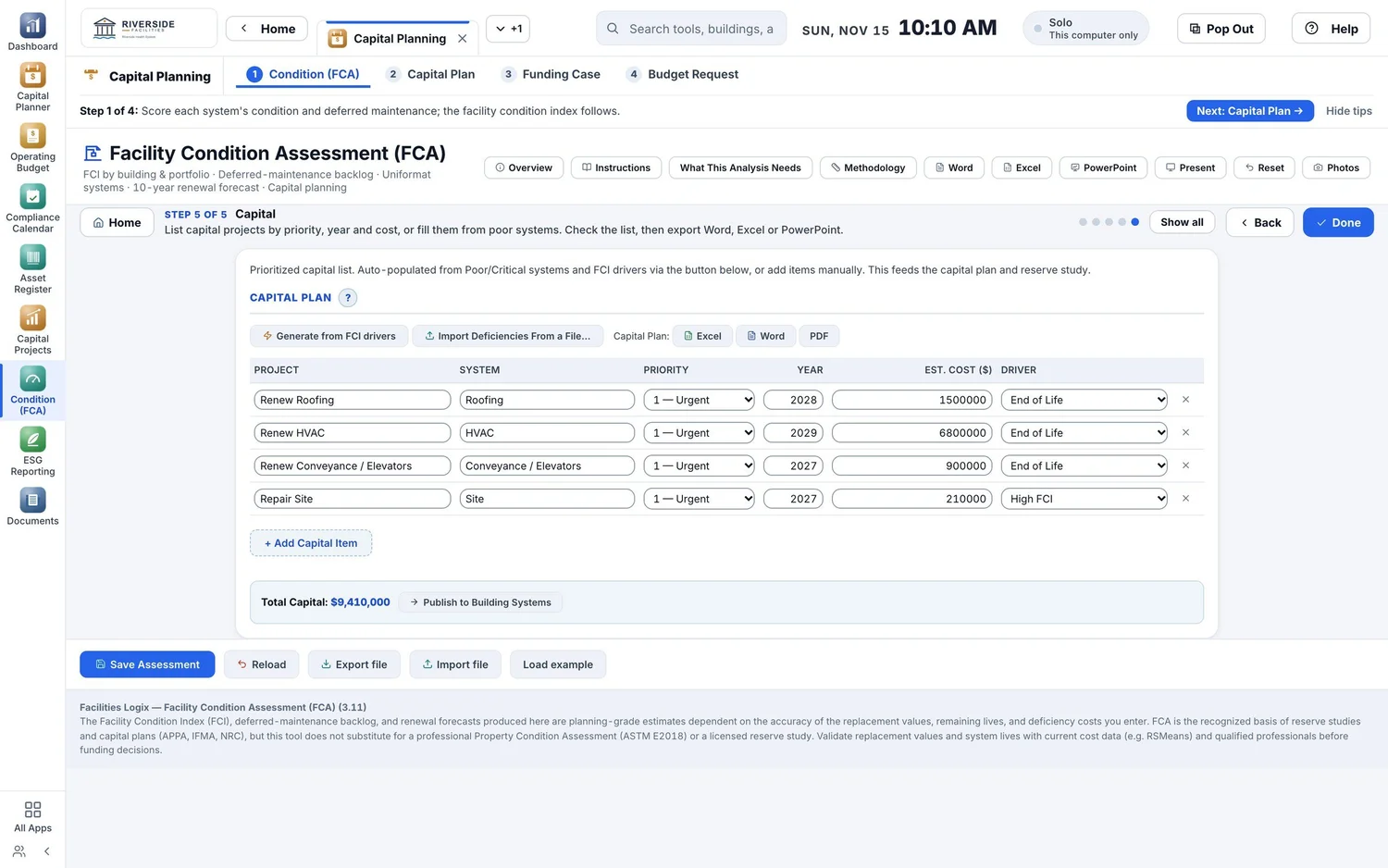
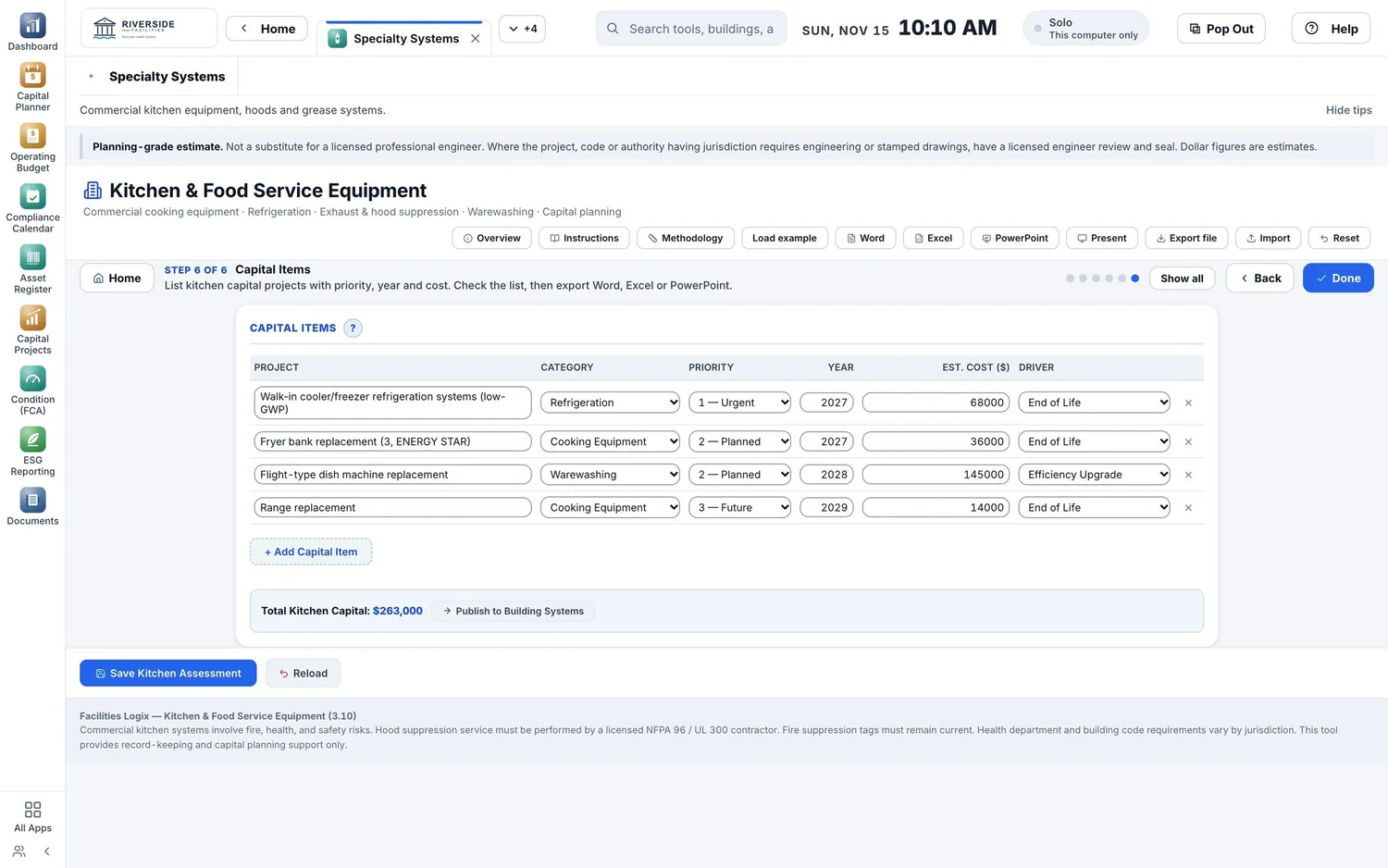
Capital in Facility Condition Assessment (FCA): list capital projects by priority, year and cost, or fill them from poor systems. Check the list, then export Word, Excel or PowerPoint.
Safe for This Crowd, Not Just in General
A Repeatable Pre-Event Routine
The same checklist every event, dated and kept, instead of a clipboard that leaves with the shift.
Learn MoreShow Less
A check missed before doors open can delay or cancel an event. One routine, run the same way, protects the booking.
- Readiness = ready checks ÷ applicable checks, with N/A left out
- A daily, weekly or monthly check older than its frequency does not count as ready
- New checks start as Not Checked
- The standard checklist loads in one click and stays editable
No Lapsed Permits or Inspections
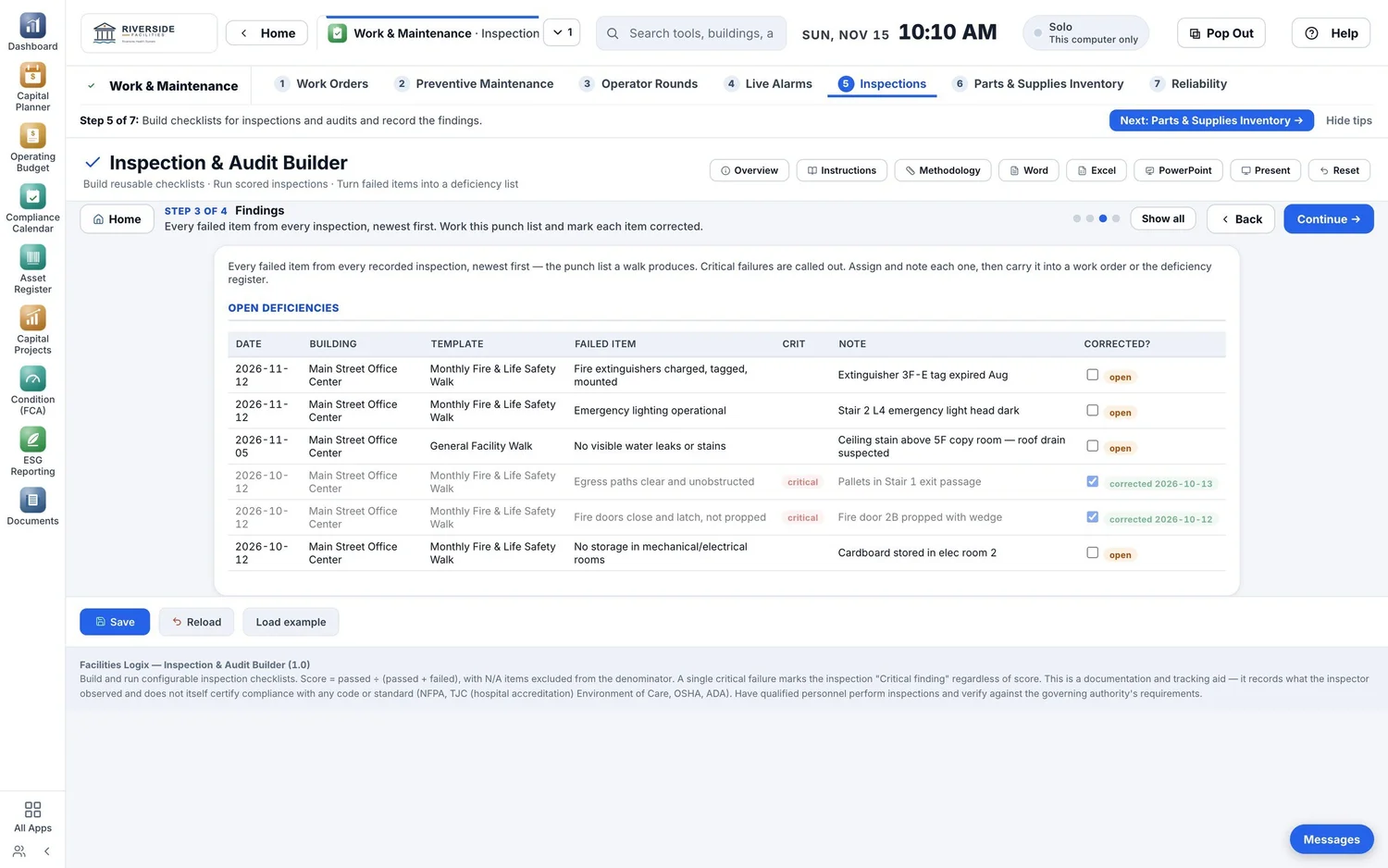
Bleacher, rigging, crowd manager and permit rows show what is due, so a gap shows up before the doors open.
Learn MoreShow Less
A lapsed bleacher tag or missing permit can stop an event at the door. Each row says what proof to have on hand.
- Evidence named: bleacher report and posted tag, rigging report, crowd manager roster and training
- Tent permits keep the flame-resistance certificate
- Per-event permits are event-driven rows, with no fixed next date
- Level 2 rigging inspection also follows any install, alteration or repair
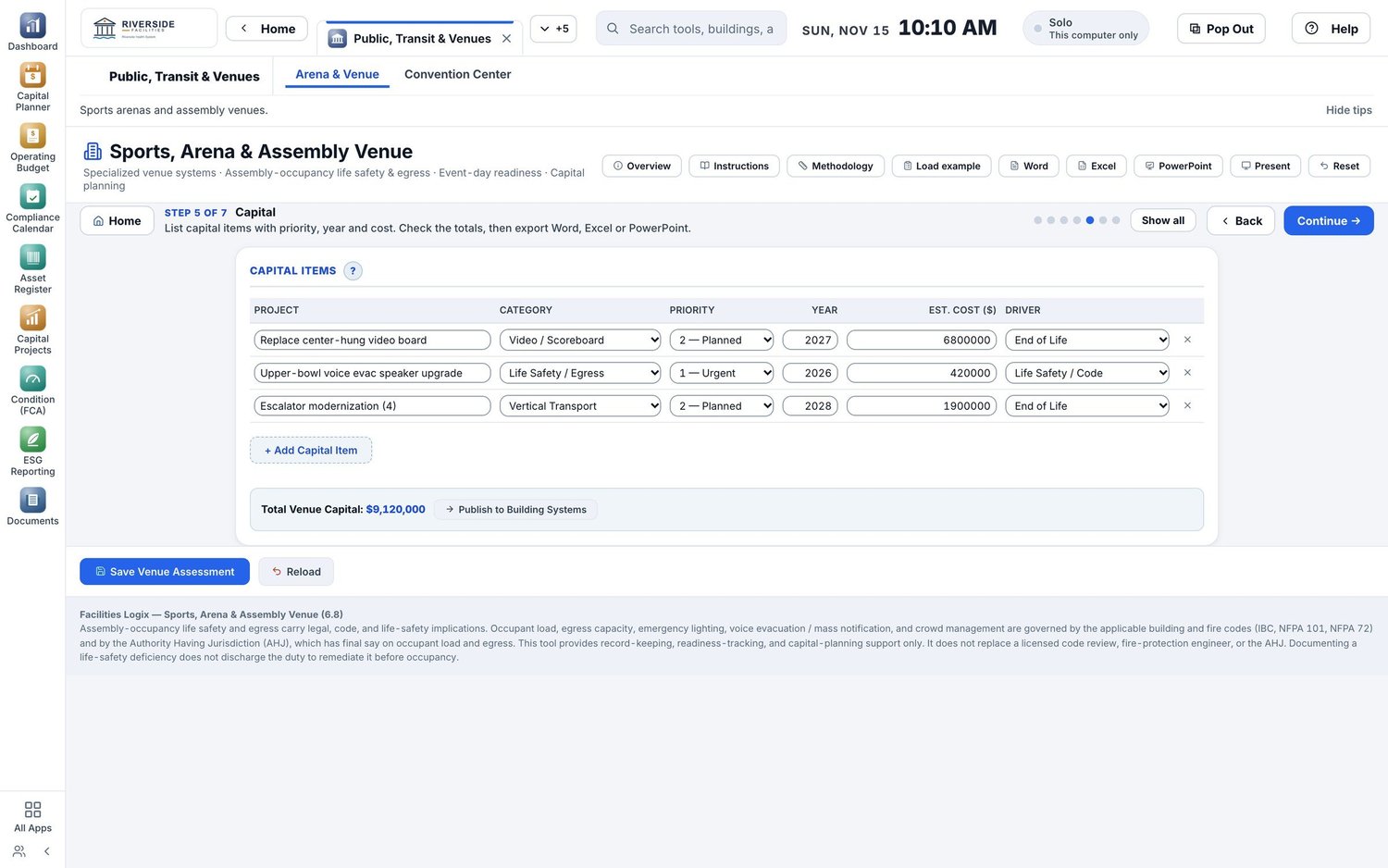
Capital in Sports, Arena & Assembly Venue: list capital items with priority, year and cost. Check the totals, then export Word, Excel or PowerPoint.
Capital Tied to Risk
Systems that fail on event day are ranked by remaining life and driver, so leadership can see what protects the event calendar.
Learn More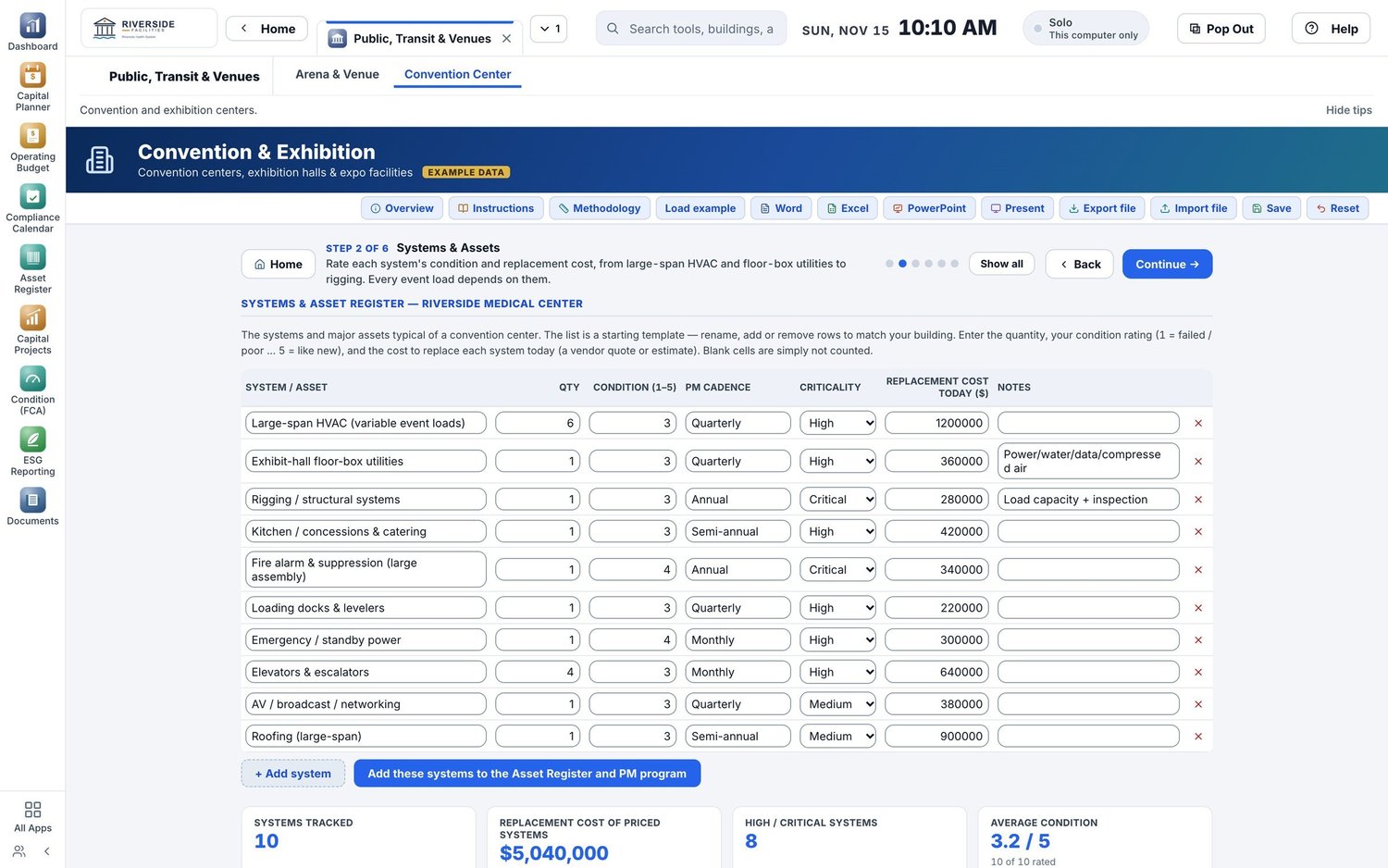
Convention halls host crowds that change every week, so each system is tracked for the next event.
Frequently Asked Questions
Does the egress check replace a code review?
How often is the readiness checklist used?
Is a convention center covered by the venue playbook?
Do large venues get the over-6,000 life safety evaluation?
Be First When Facilities Logix Opens
Stop chasing building records across spreadsheets and binders. Join the list and we will tell you the day downloads open, with setup guides ready.
Launching early 2027 for Facilities Logix. Nothing to buy today, and no sales calls.
