

In a hospital, a clinic, a laboratory or a cleanroom, a pressure relationship or a water temperature is a patient-safety or product-quality matter. Five playbooks add the assets, obligations and benchmarks of clinical and scientific buildings to everything else Facilities Logix does, with the same compliance library and dates as the calendar.
Pick Your Facility Type
Each facility type has its own page: the rules it answers to, the assets and systems it runs, real screens and answers to common questions.
Hospitals
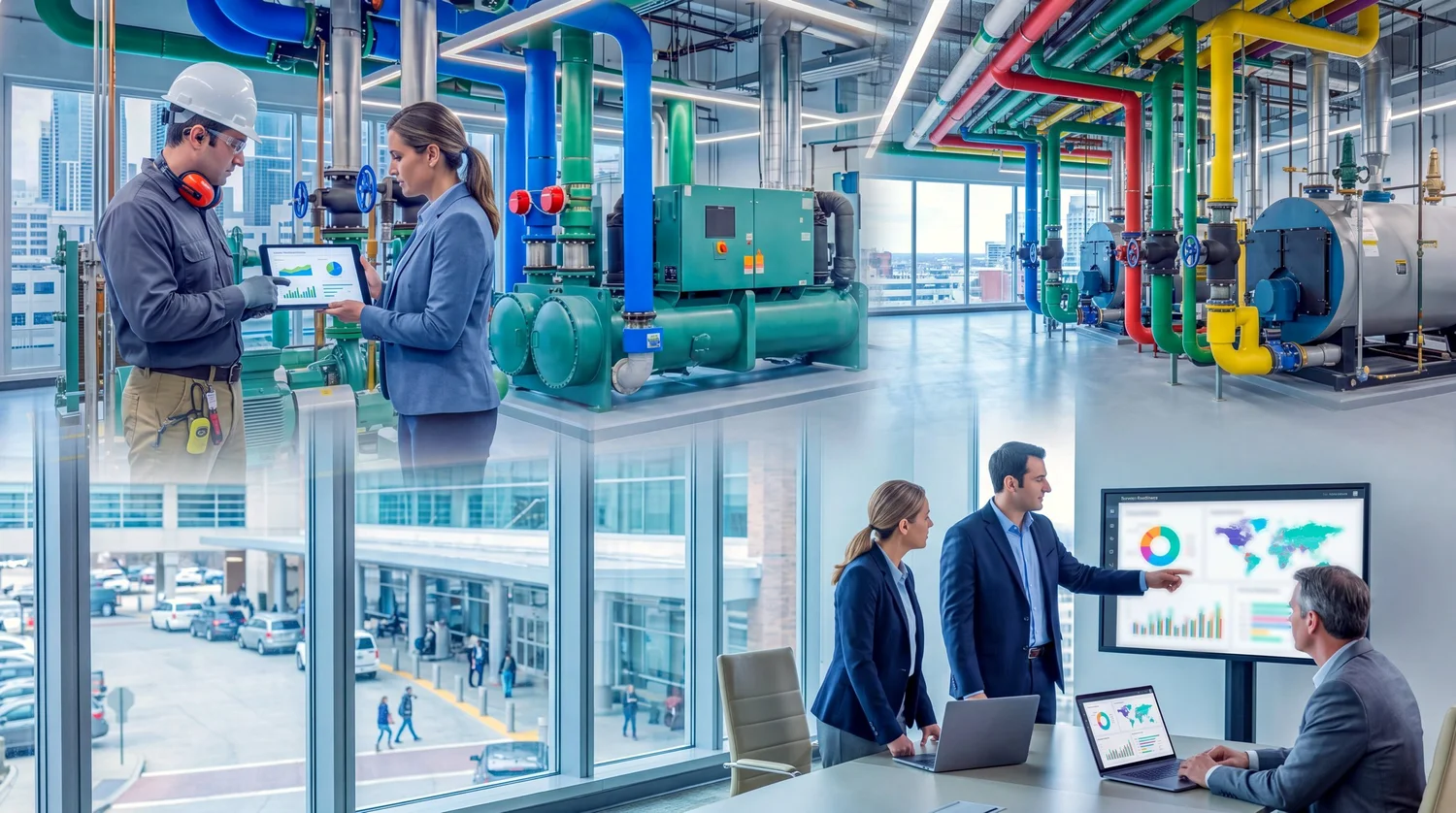
Environment of Care, utility management, critical-room pressure logs, medical gas and The Joint Commission, CMS and DNV survey readiness for hospitals.
Clinics & Outpatient
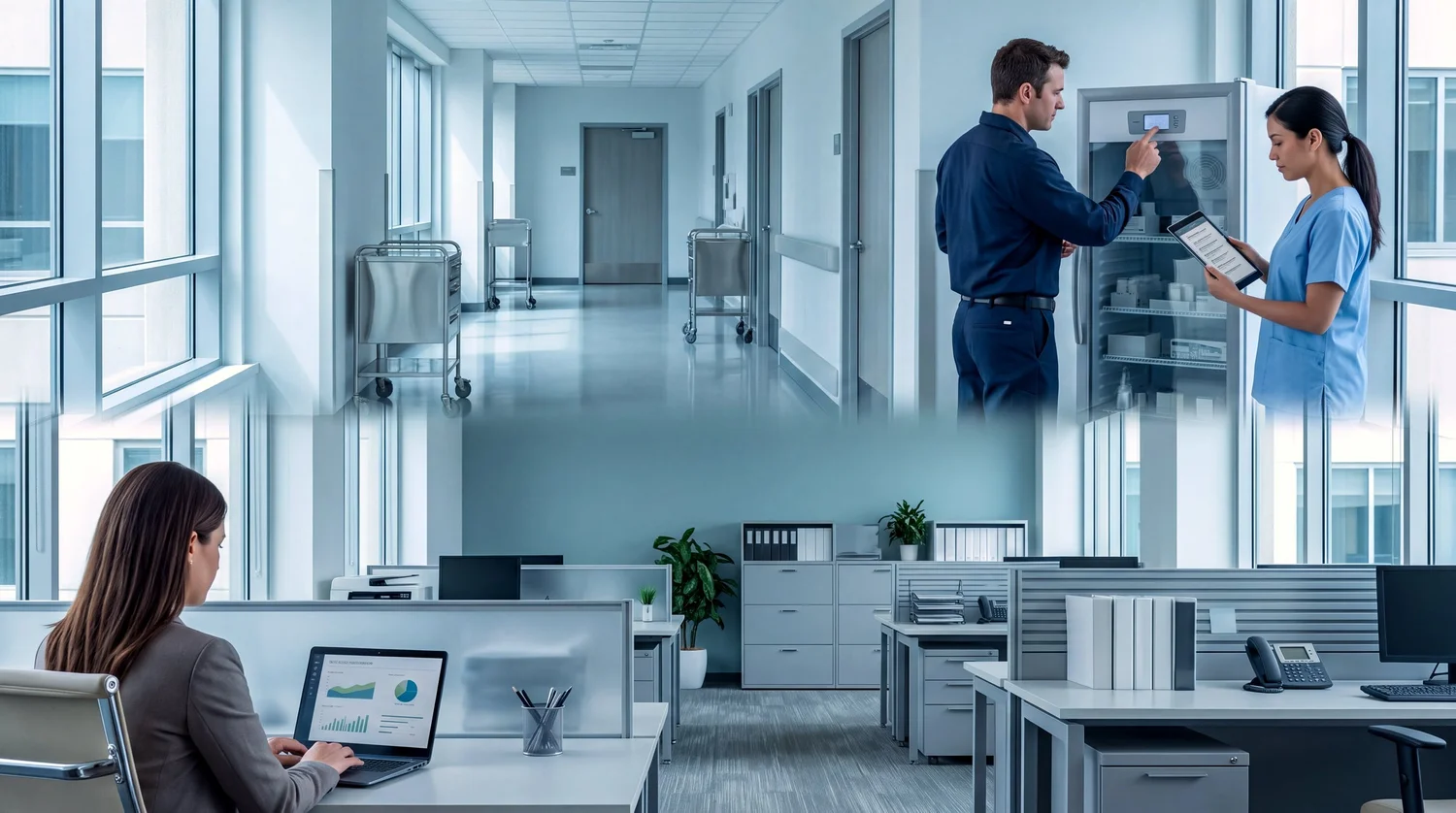
Medical offices, surgery centers, dialysis, urgent care, imaging, dental and veterinary practices: the rules for the type of practice, systems and capital.
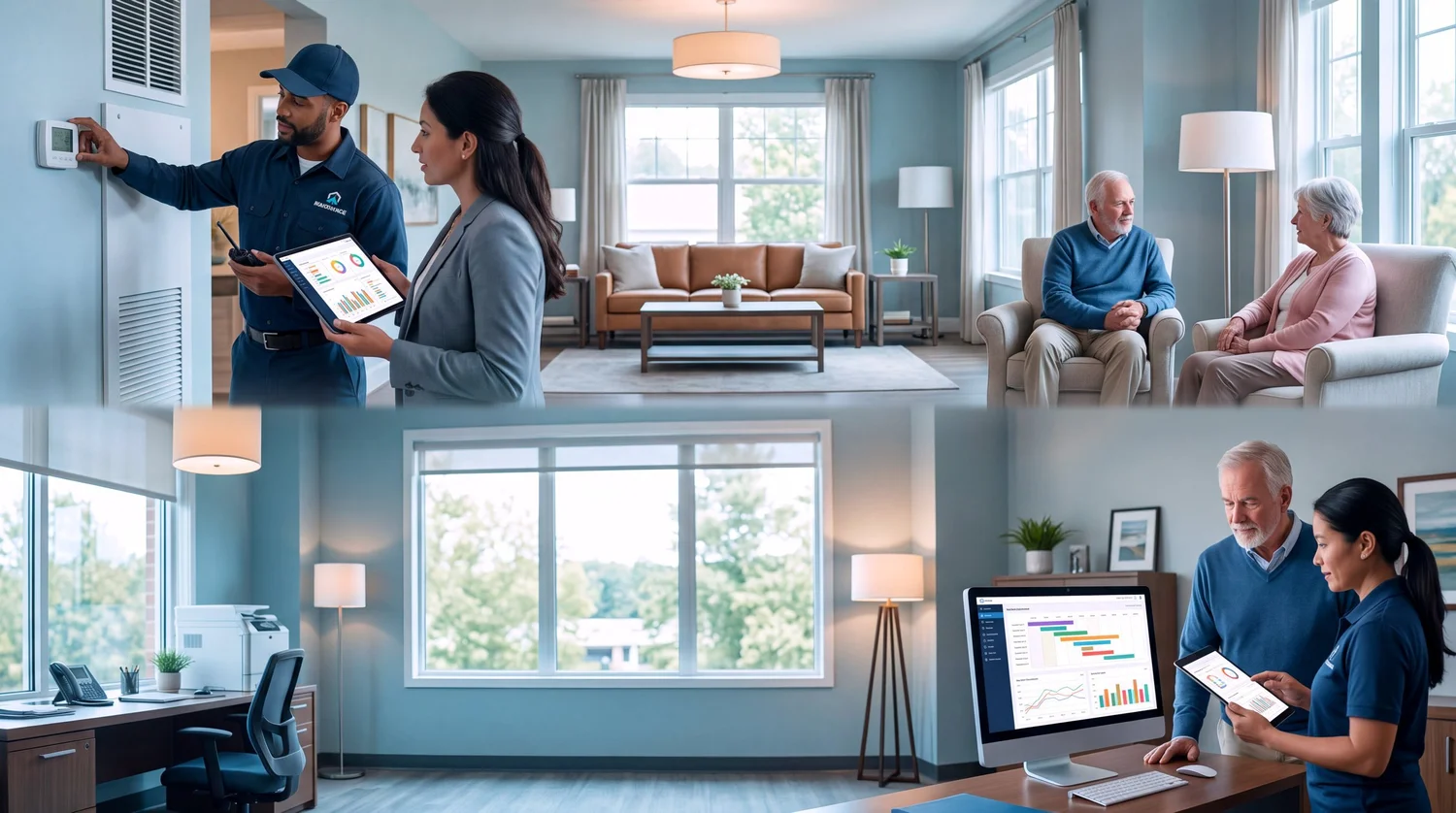
Senior Living
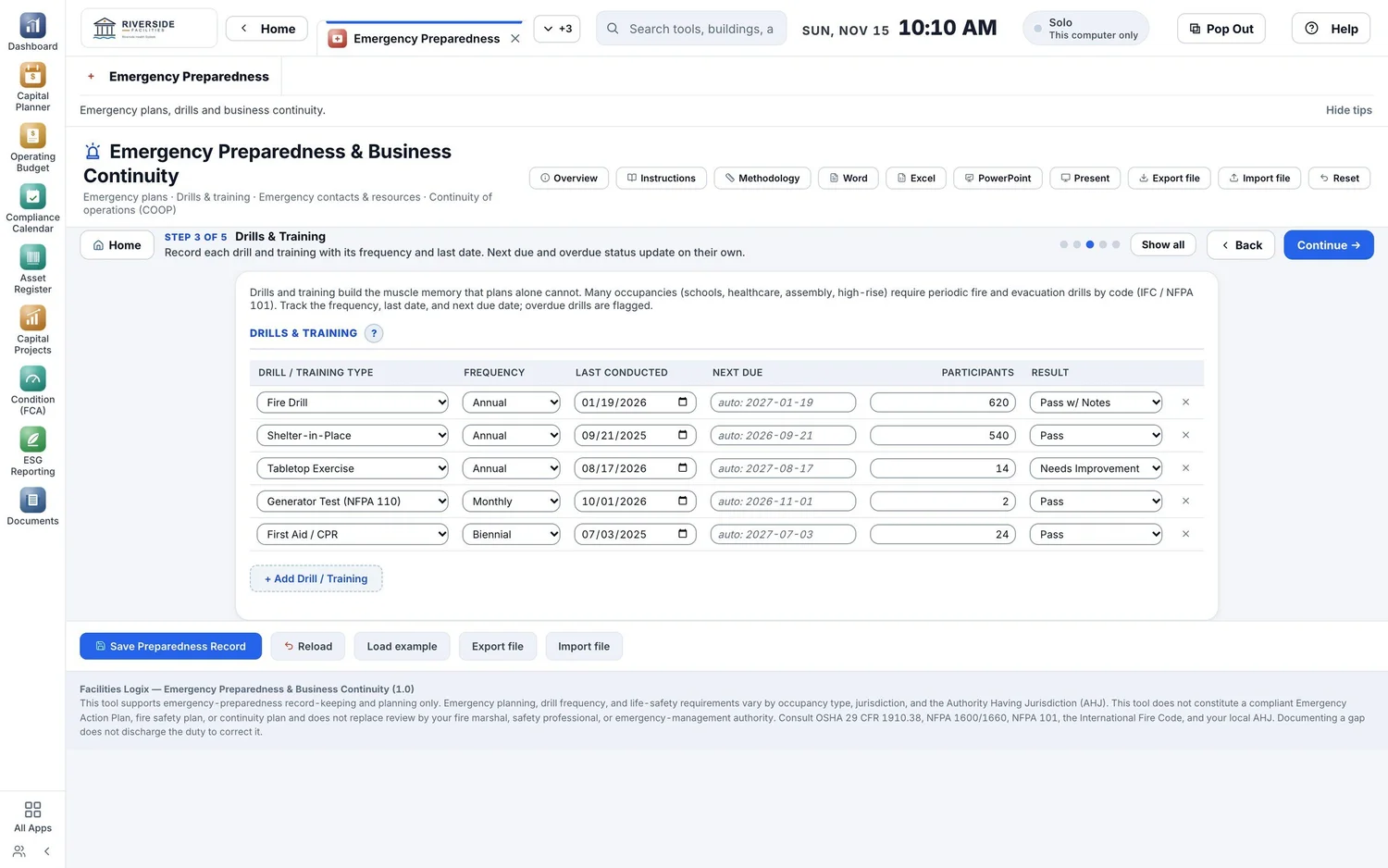
Independent and assisted living, memory care and skilled nursing: life-safety code, drills, standby power, Legionella, licensing and the replacement reserve.
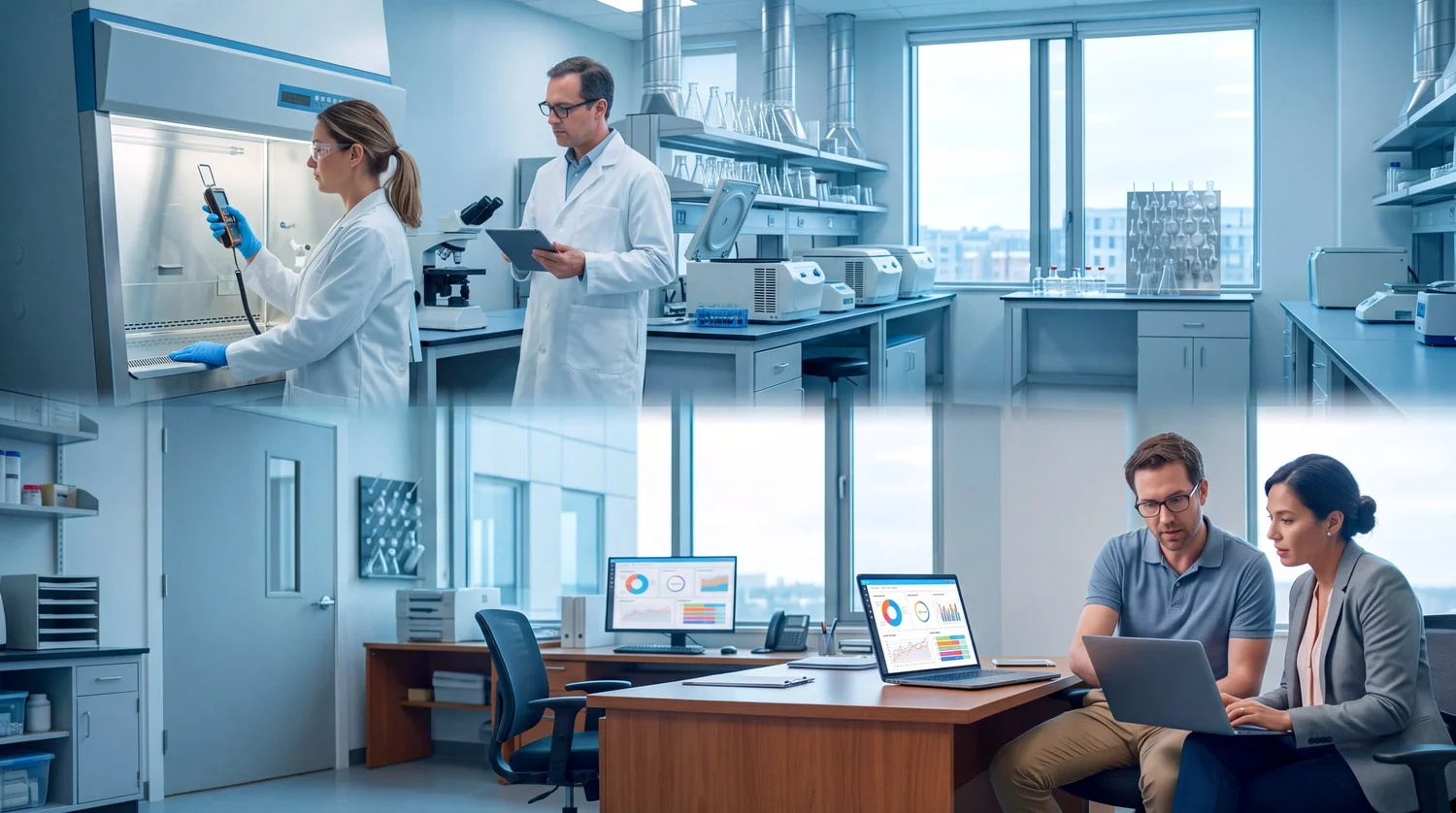
Labs & Biosafety
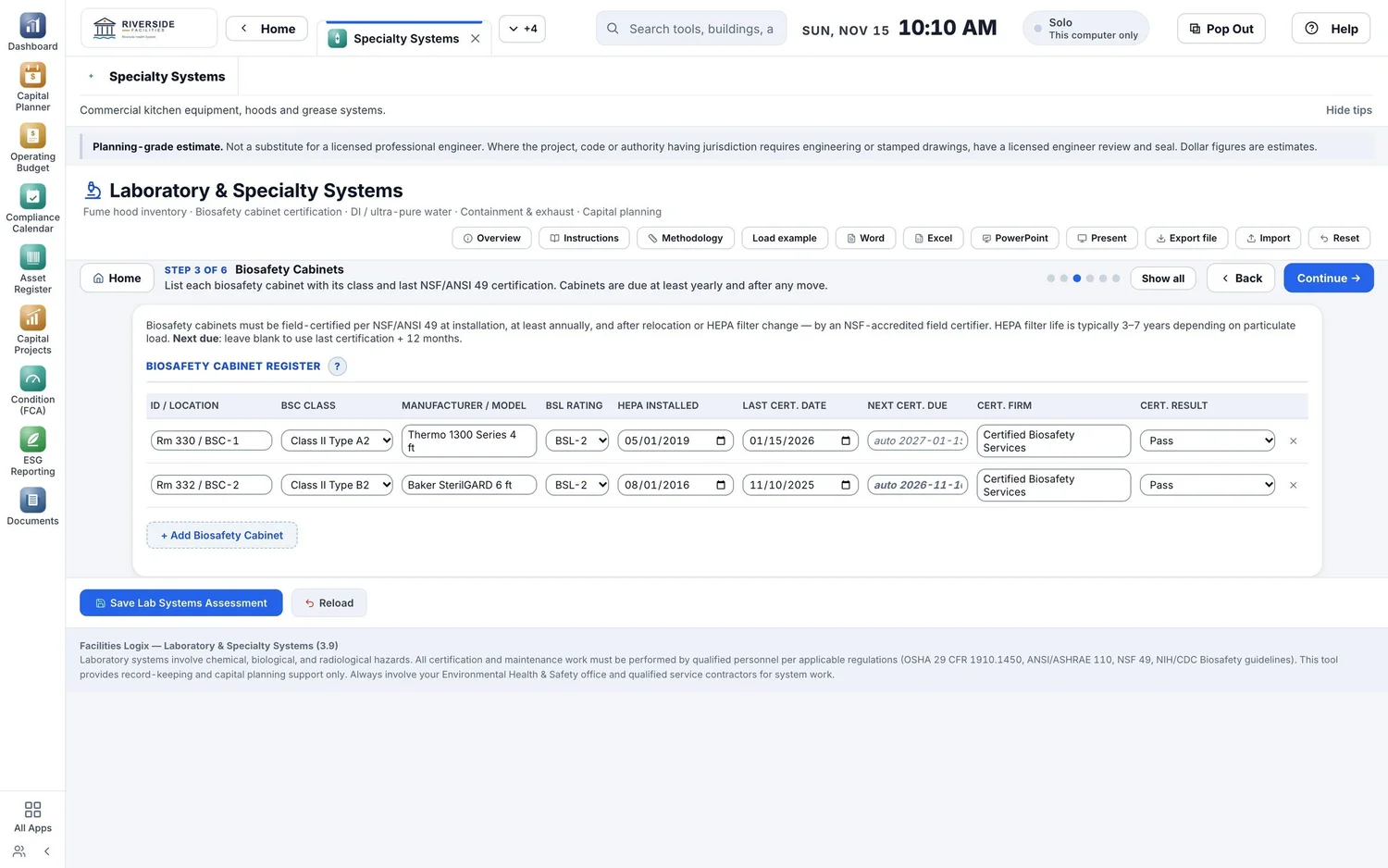
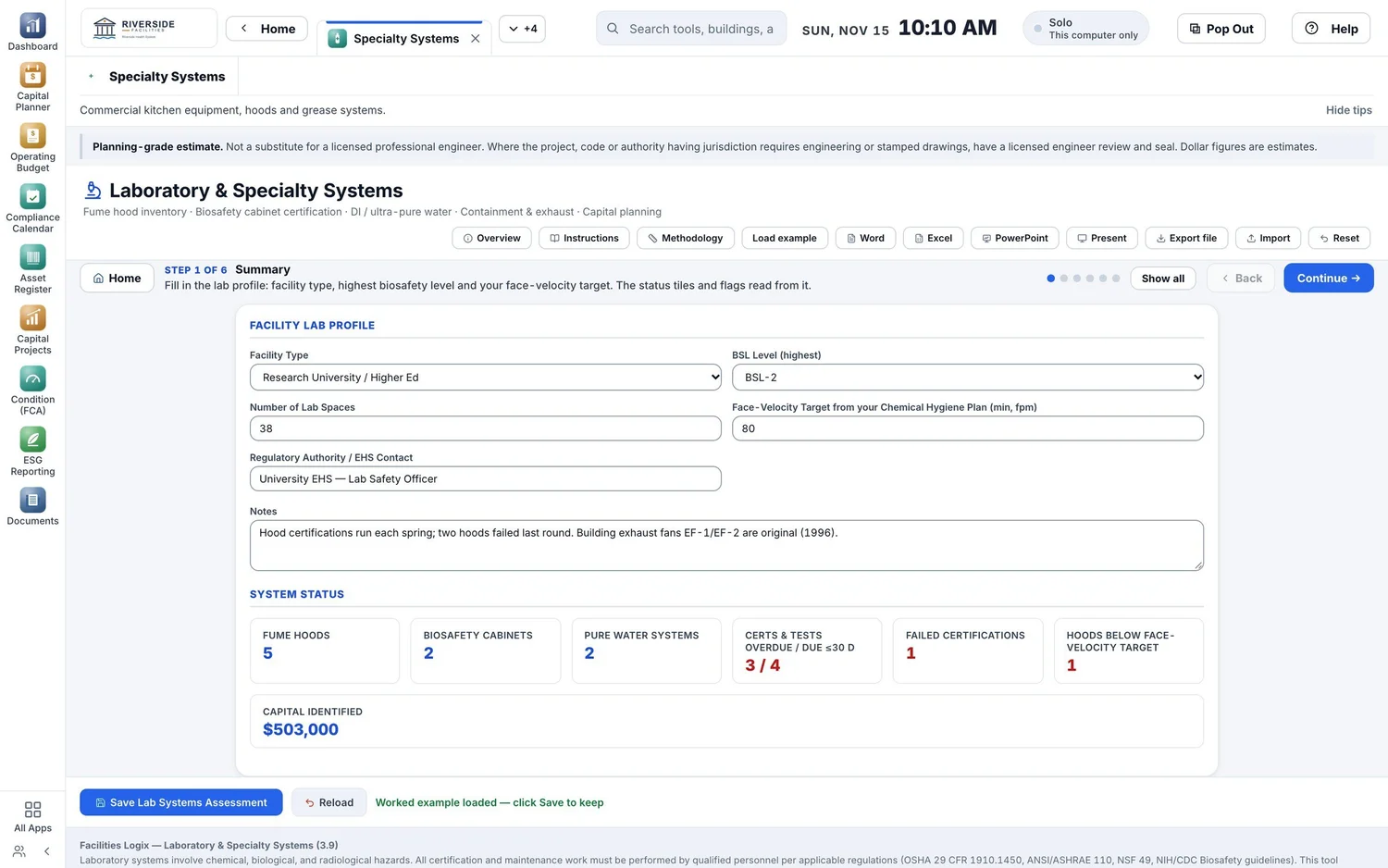
Research, clinical and life-science labs: fume hoods, biosafety cabinets by biosafety level, containment and exhaust, pure water, gases and lab compliance.
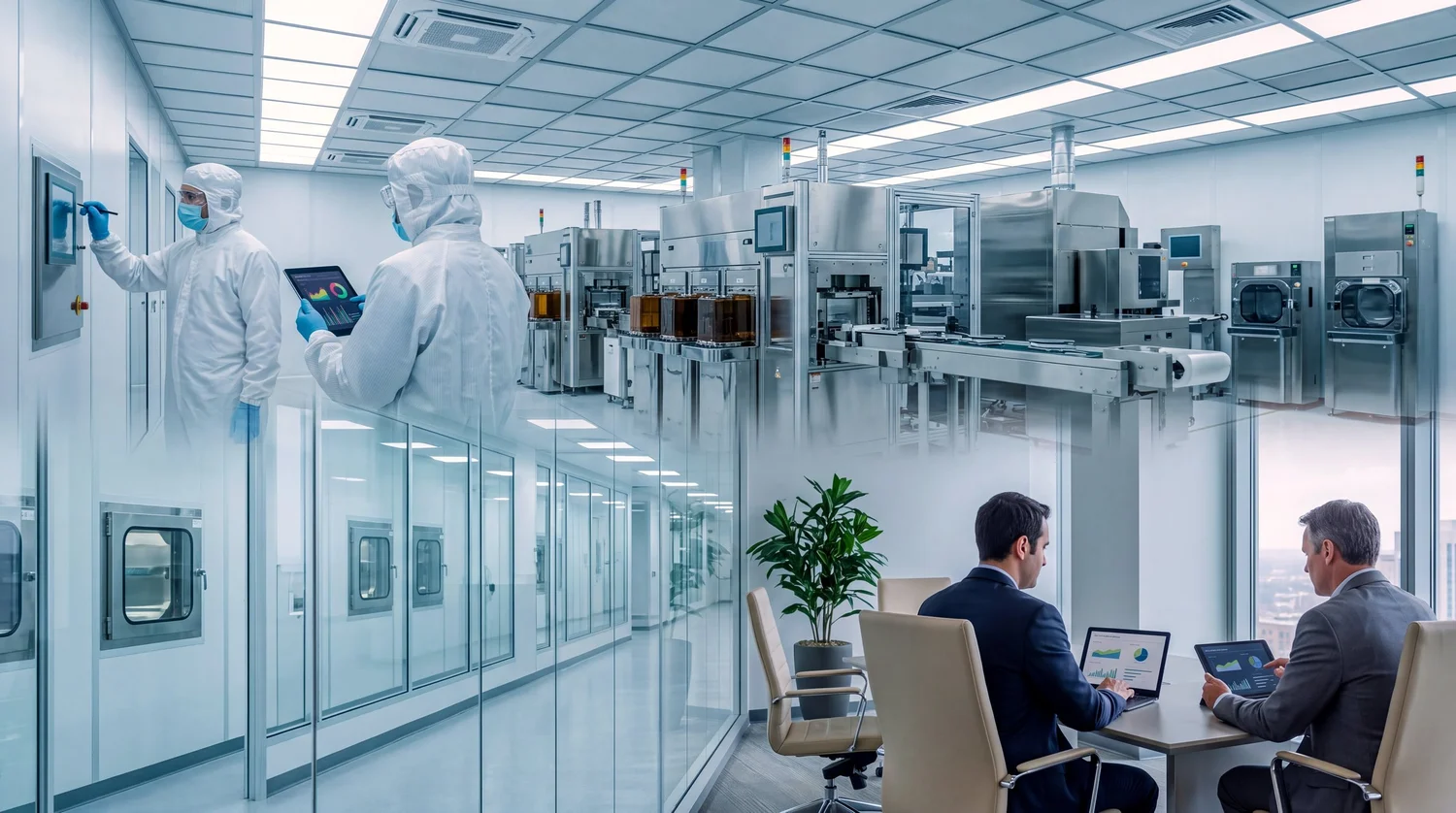
Cleanrooms, Pharma and Biotech
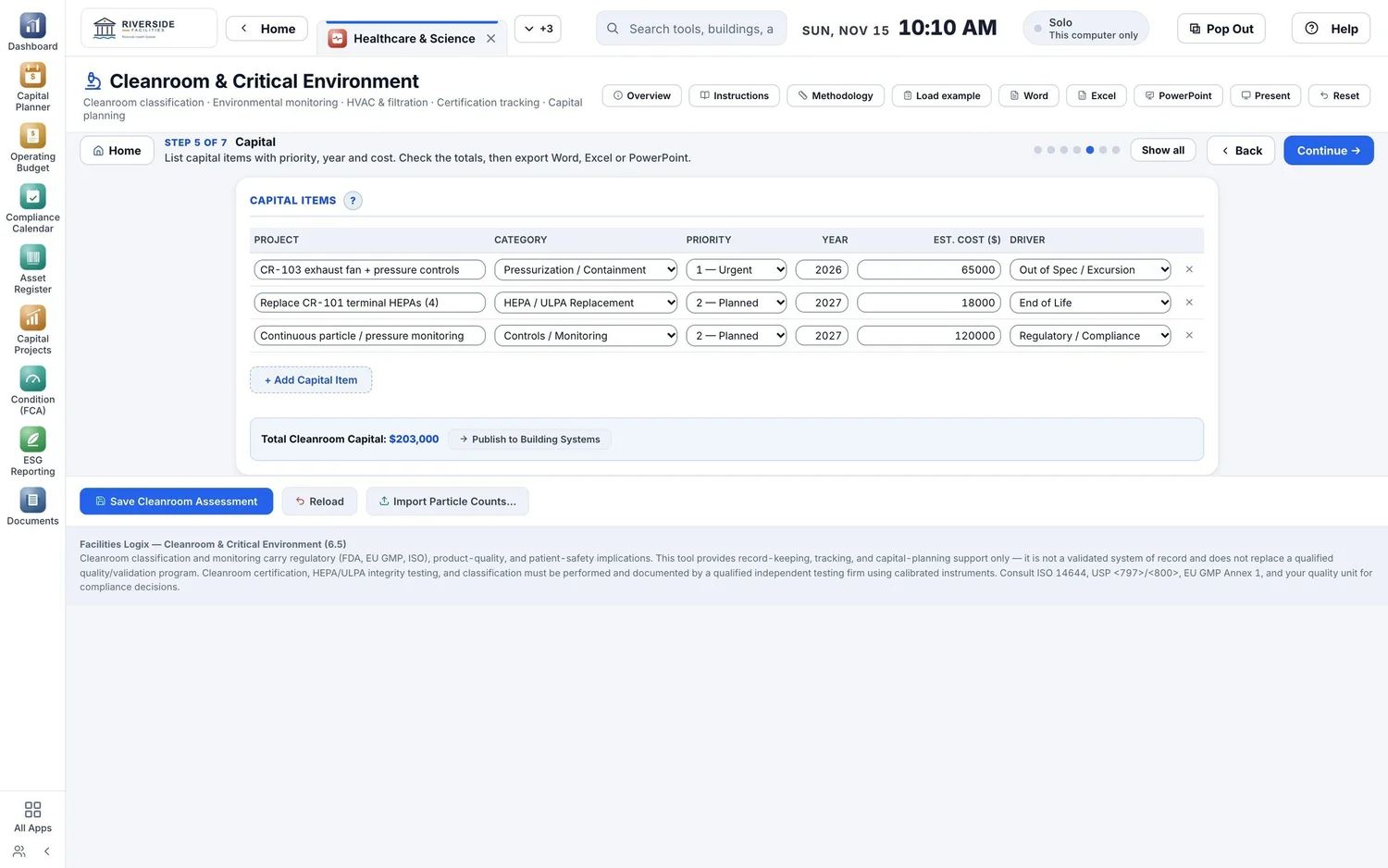
Cleanroom register by class, environmental monitoring, particle count import, HEPA and ULPA filters, recertification dates and the ISO 14644-1 class check.
From the Hospital to the Cleanroom
Facilities Logix is configured for the kinds of buildings your organization runs. A portfolio that spans many markets gets every playbook it needs.
Healthcare
Environment of care, critical systems and the utility management plan for hospitals and clinical facilities.
Learn MoreClinic & Outpatient
Medical office buildings, ambulatory surgery centers, dialysis, urgent care, imaging, dental and veterinary practices. Pick the type of practice and it sets which rules apply.
Learn More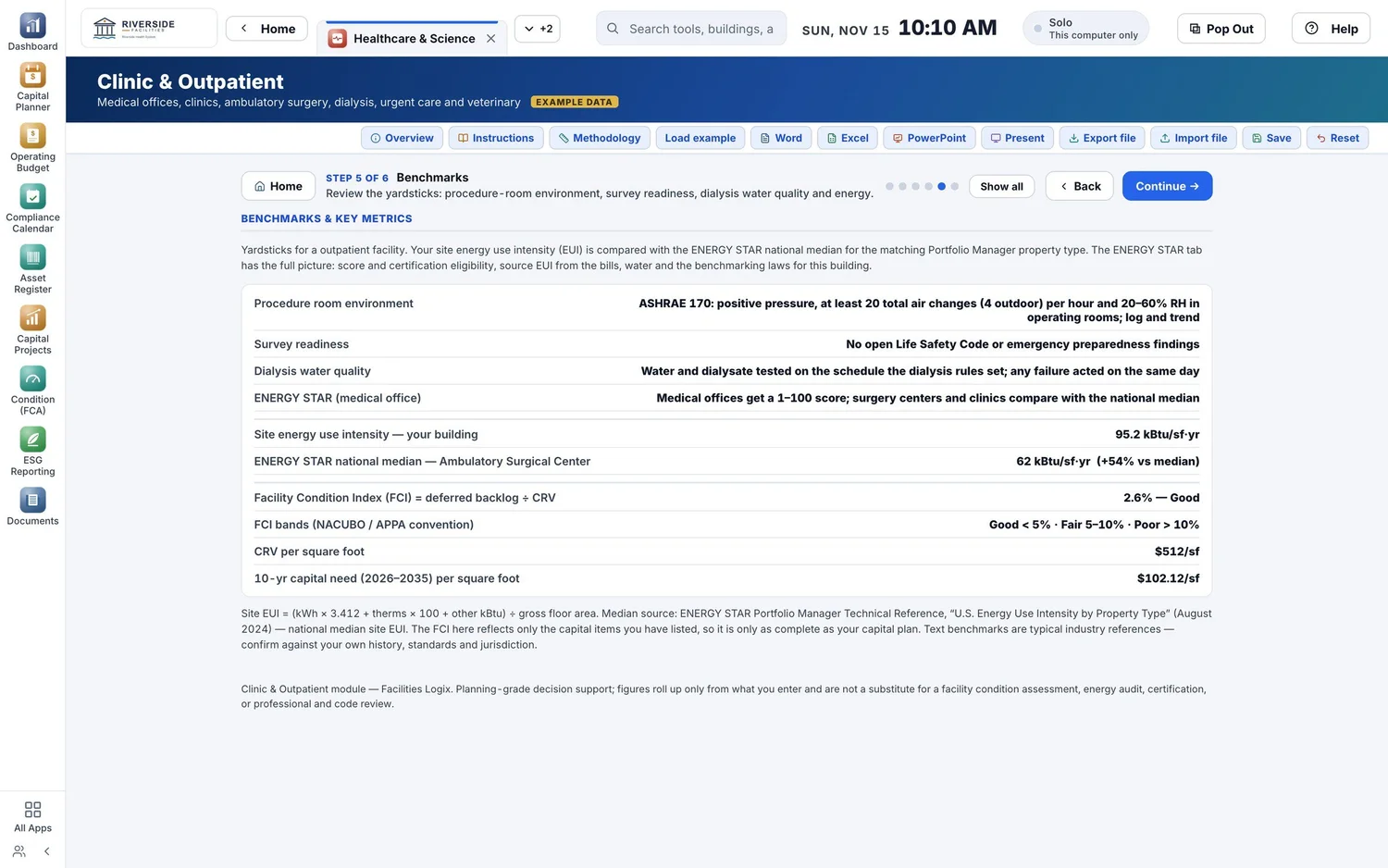
Benchmarks in Clinic & Outpatient: review the yardsticks: procedure-room environment, survey readiness, dialysis water quality and energy.
Senior Living
Independent living, assisted living, memory care and skilled nursing: resident-care systems, the life-safety code, emergency preparedness, Legionella control and licensing.
Learn MoreLaboratory
Research, clinical and R&D laboratories: fume hoods, biosafety cabinets, specialty gas and cold storage, with laboratory ventilation, chemical hygiene and hazardous waste obligations.
Learn MoreCleanroom
Cleanroom classification, environmental monitoring, HEPA and ULPA filtration and certification tracking for critical environments and compounding rooms.
Learn More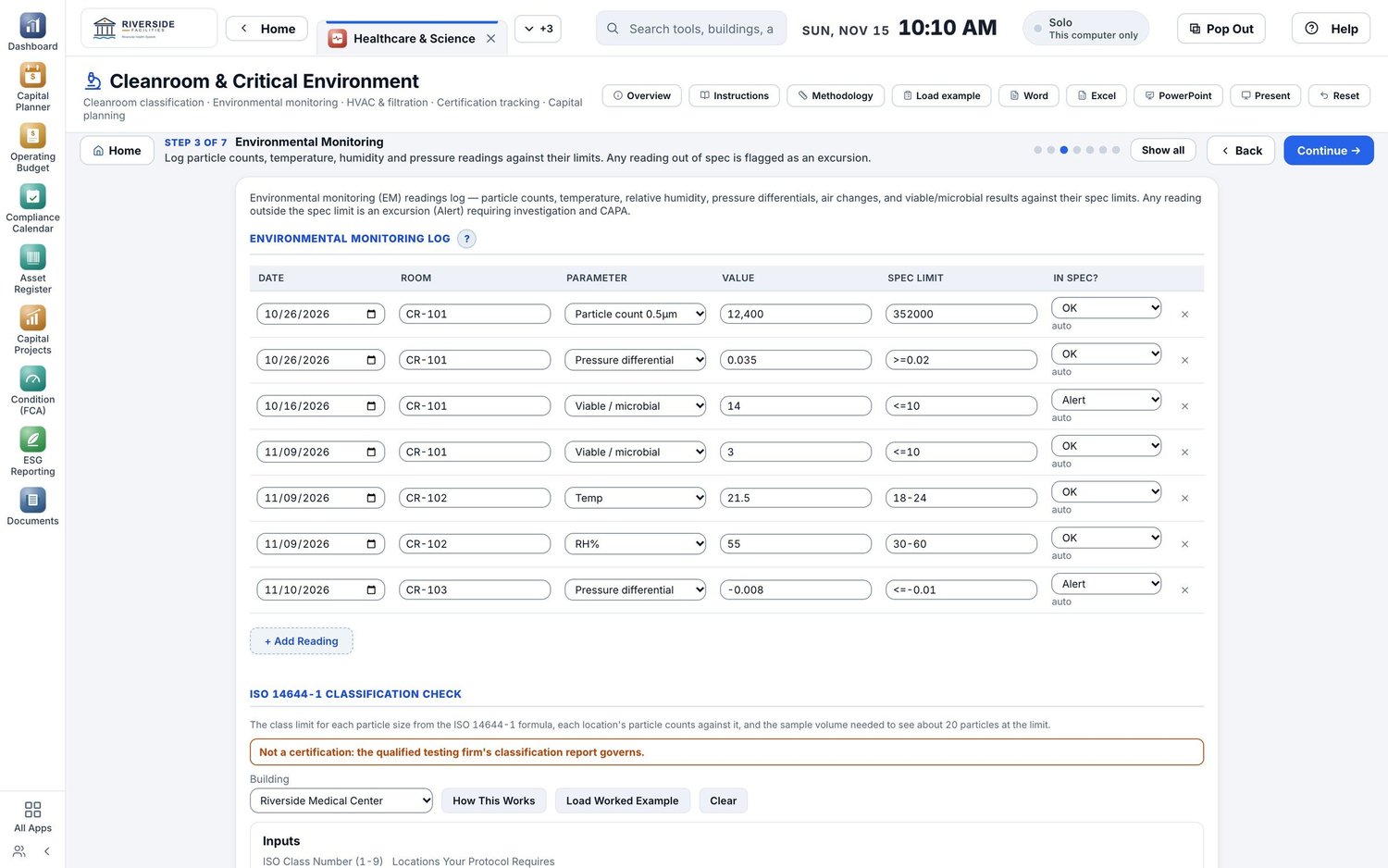
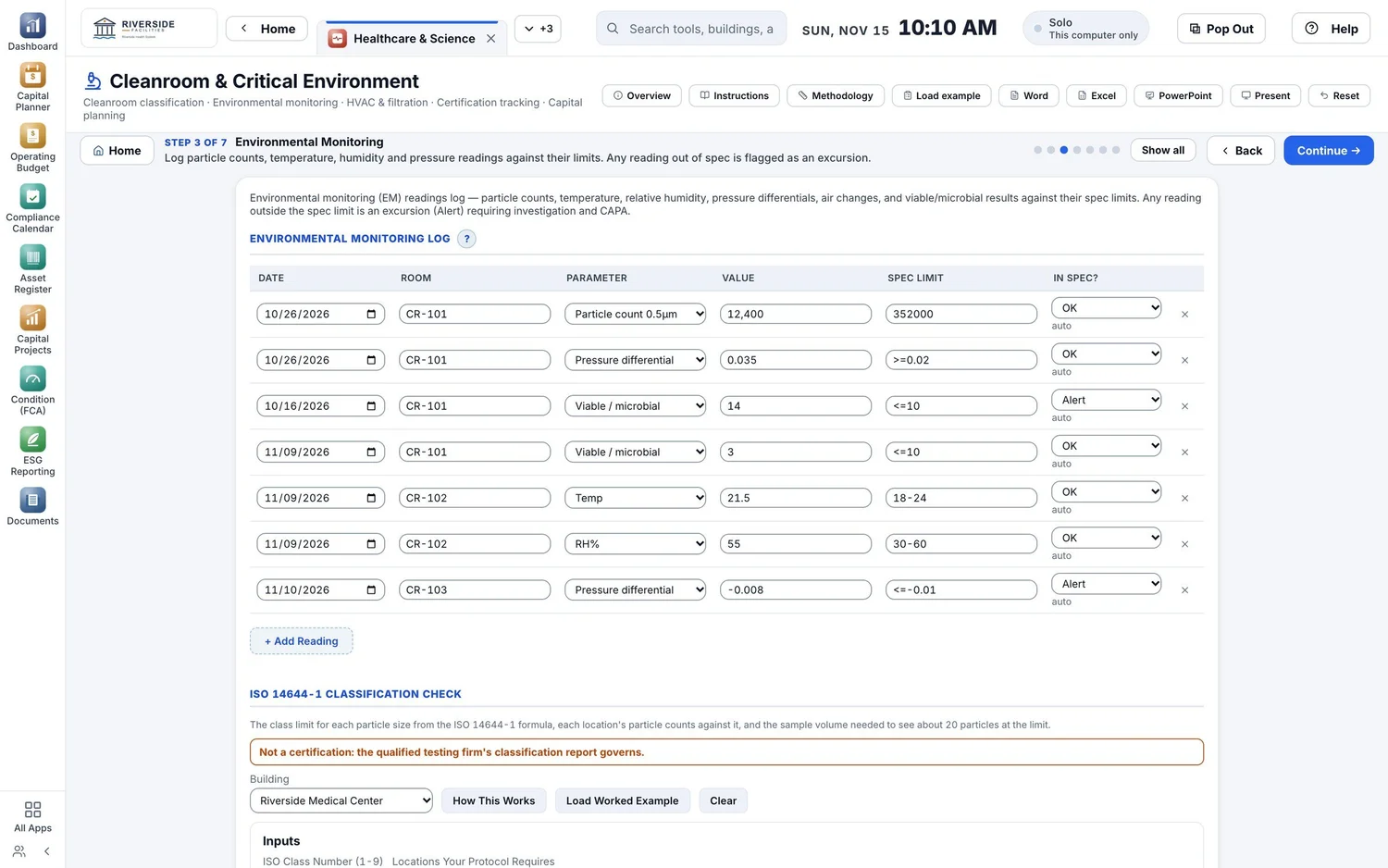
Environmental Monitoring in Cleanroom & Critical Environment: log particle counts, temperature, humidity and pressure readings against their limits. Any reading out of spec is flagged.
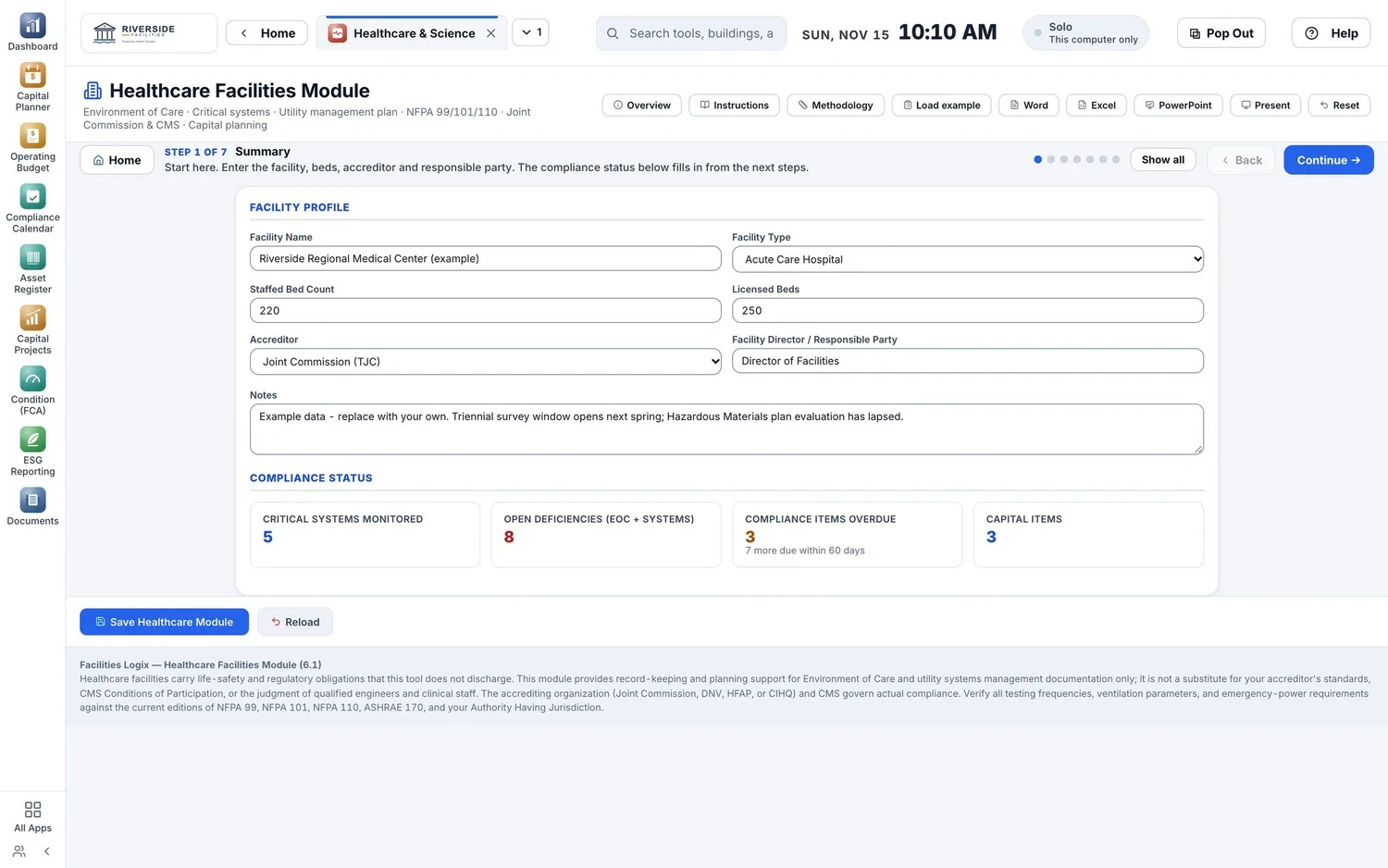
A hospital's duties differ from a lab's or a clinic's, so each building type opens its own playbook.
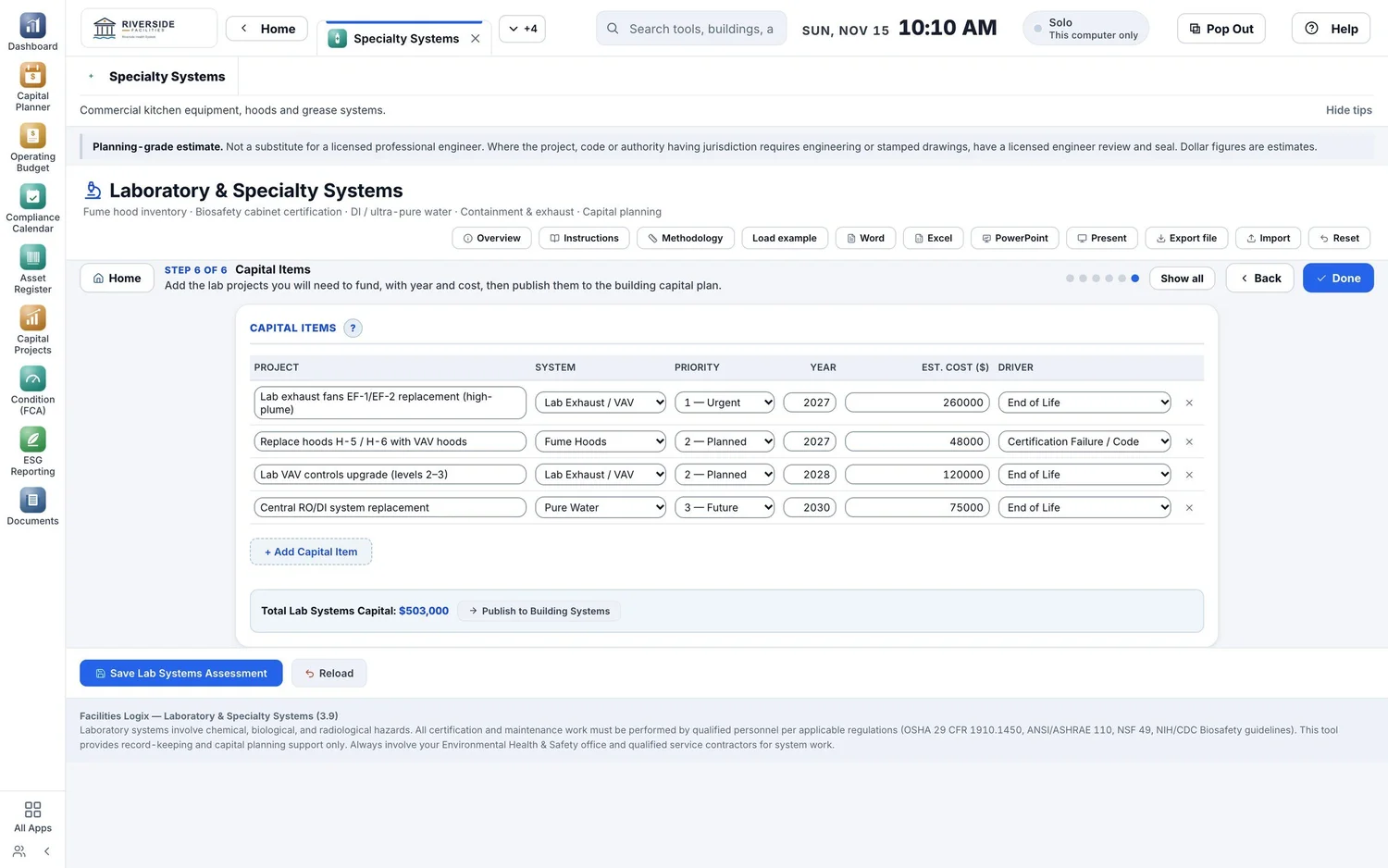
The Utility Management Plan, Room by Room
Critical Rooms
- Air Changes per Hour by Room: isolation rooms, operating rooms and other spaces with a required rate, each room's airflow against the value in your program
- Critical-Room Pressure and Air-Change Log: the required pressure relationship, minimum pressure difference and minimum air changes for each room, typed from your own design basis
- Pass or fail by room and month, and an Excursion Log where each failing reading can create a work order that the next passing reading closes
- The log records and compares; your balancing report, the room monitor of record and the infection prevention risk assessment govern
Life-Critical Systems
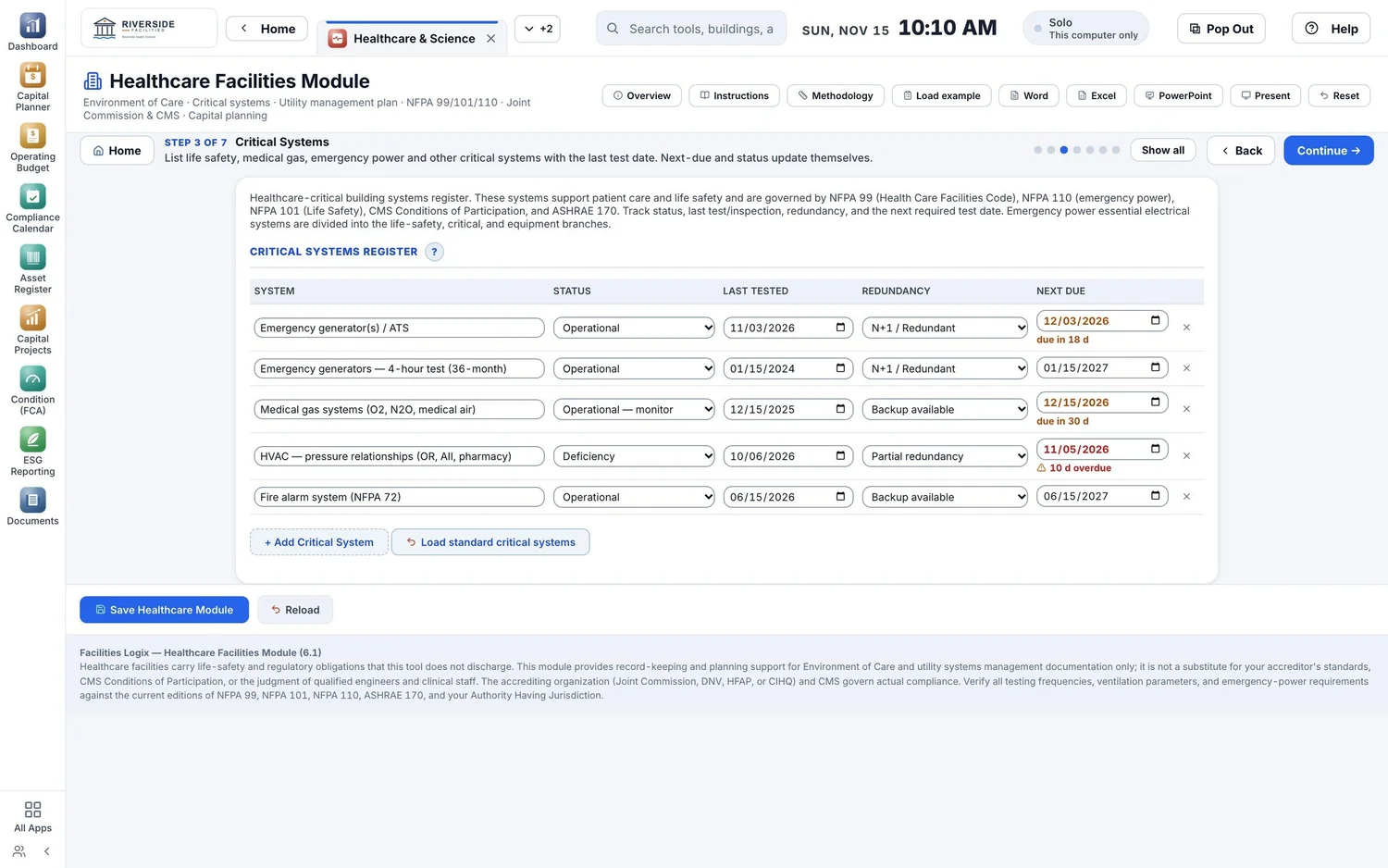
- Medical gas and vacuum: source inventory, zone valve records, inspection tracking and alarm verification, with a verifier's test results imported from a file
- Emergency power: generator, transfer switch and battery testing, and an Emergency Power Readiness Score
- Water safety: the water management program, a monitoring log for loop temperatures and Legionella and scald risk
- Elevators, fire and life safety and kitchens, each with its own inspection schedule
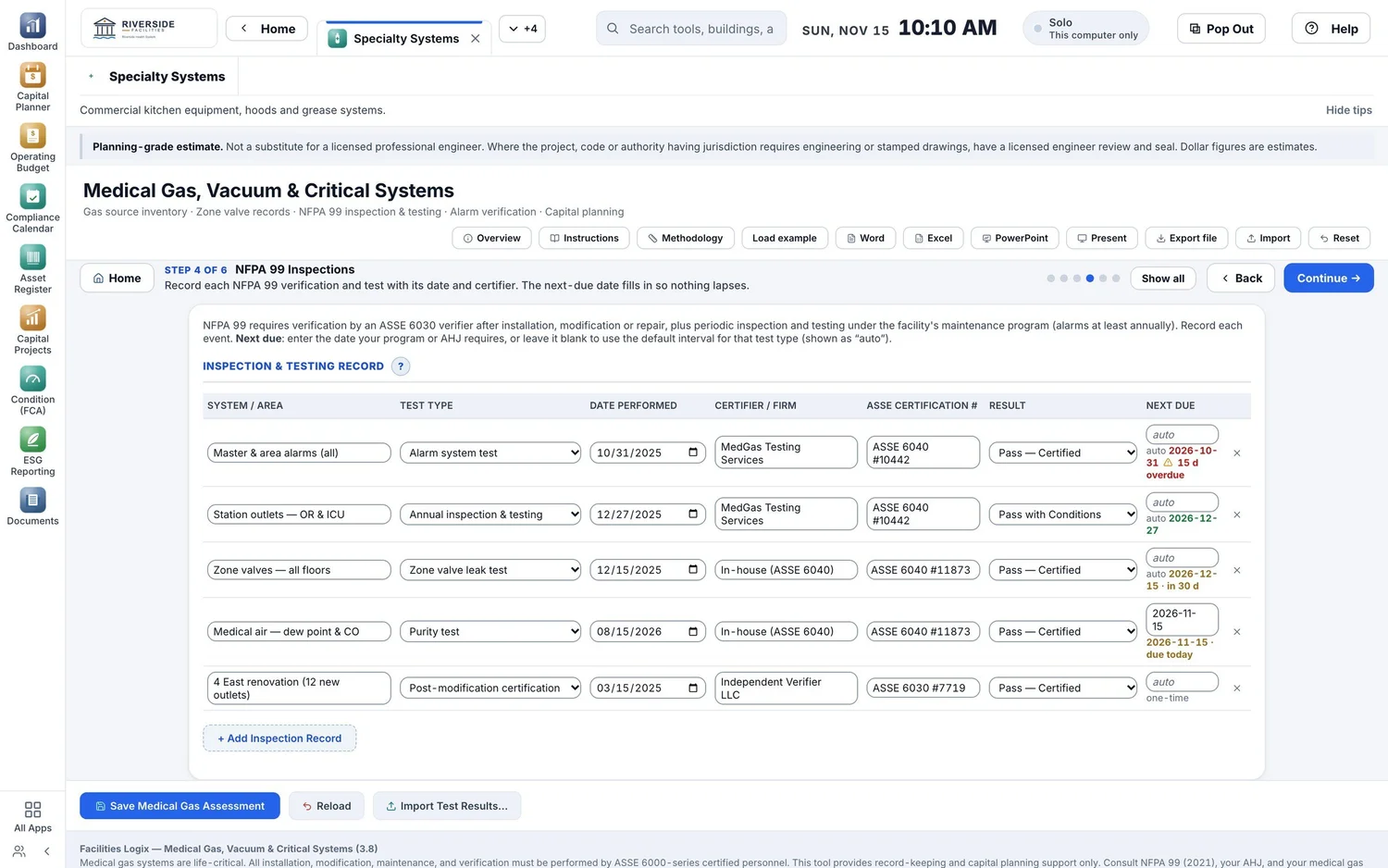
NFPA 99 Inspections in Medical Gas, Vacuum & Critical Systems: record each NFPA 99 verification and test with its date and certifier. The next-due date fills in so nothing lapses.
Survey Readiness
- Track facilities-related standards for the environment of care, life safety and emergency management
- Mock-survey findings and readiness posture
- A survey binder: one row per element with its evidence, exported as an index and a folder of files
- Import your accreditor's current document list so next year's list updates the same rows
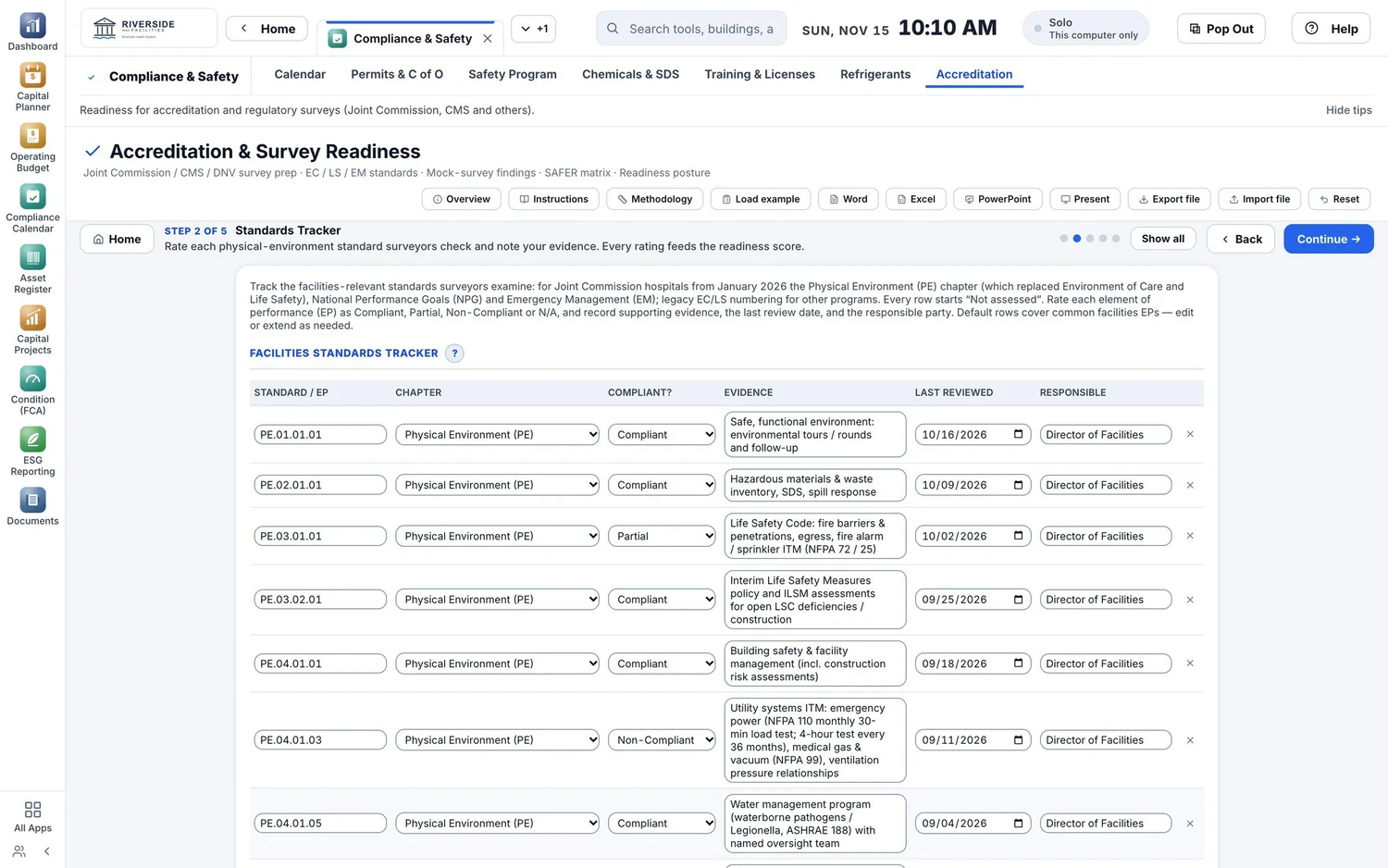
Standards Tracker in Accreditation & Survey Readiness: rate each physical-environment standard surveyors check and note your evidence. Every rating feeds the readiness score.
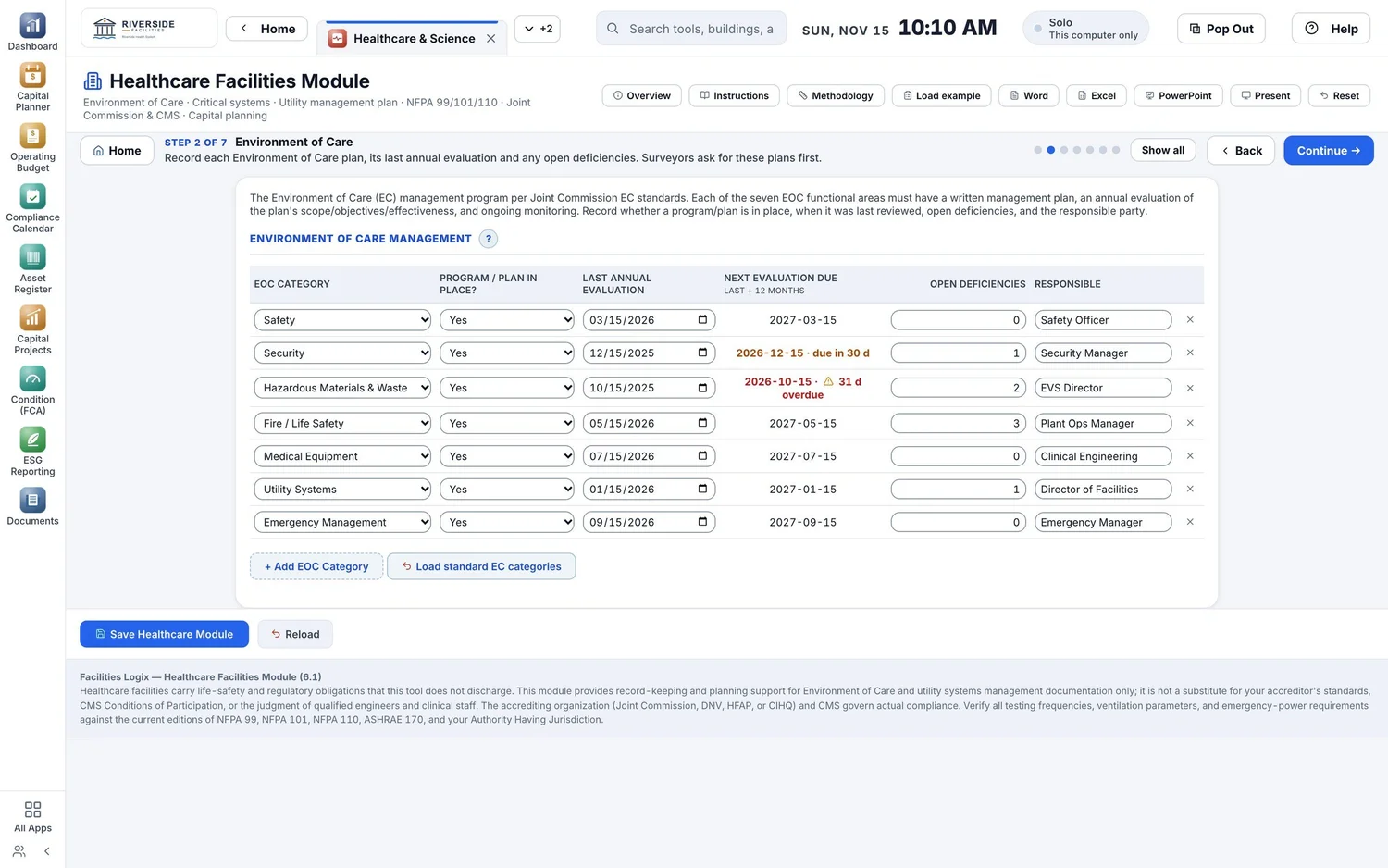
Environment of Care in Healthcare Facilities: record each Environment of Care plan, its last annual evaluation and any open deficiencies. Surveyors ask for these plans first.
The Obligations That Come with the License
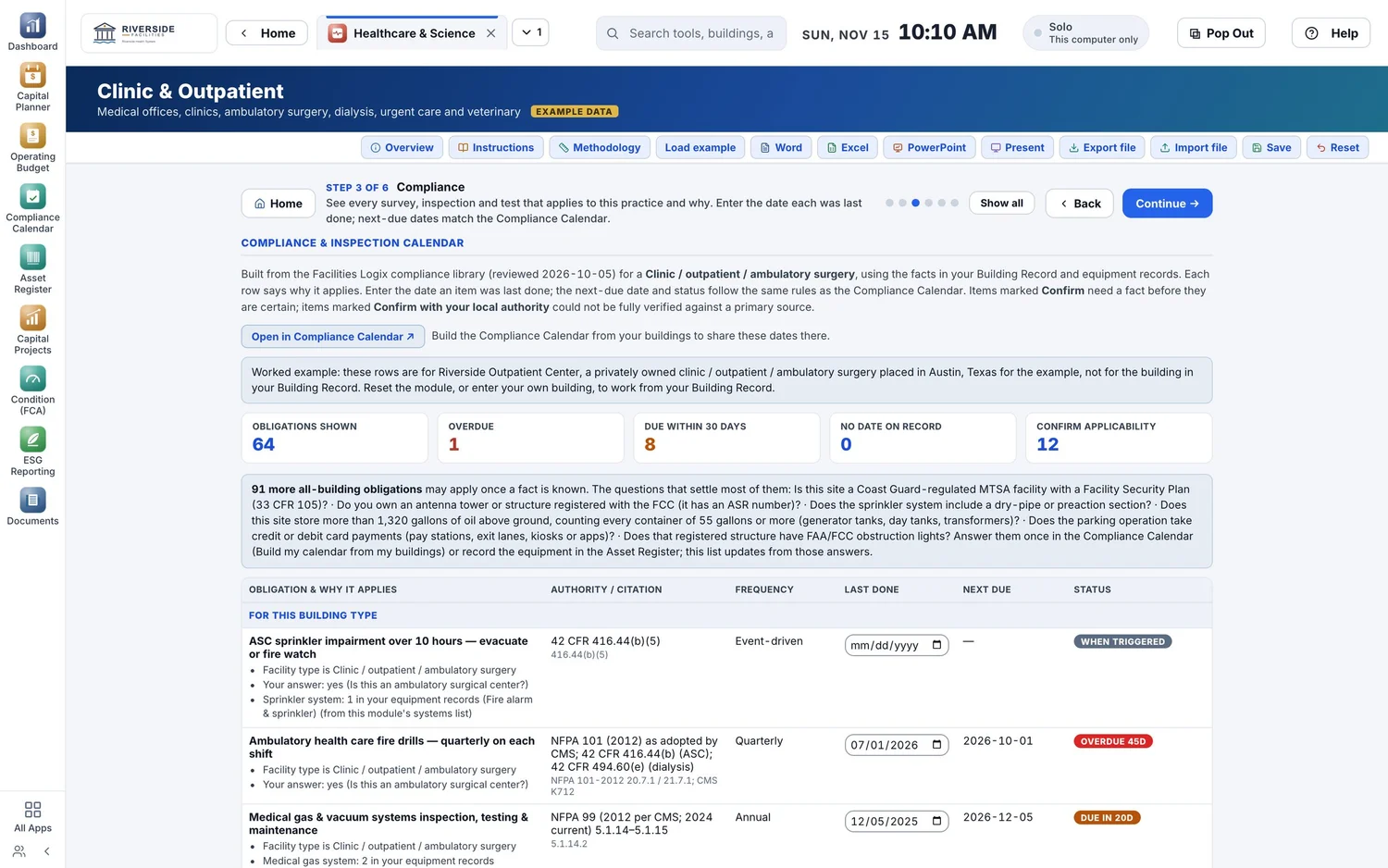
Clinic & Outpatient Compliance, Where It Applies
- Fire drills each shift every quarter for ambulatory health care occupancies
- A surgery center's emergency preparedness plan reviewed every two years and exercised every year, and a fire watch or evacuation when sprinklers are out for more than ten hours
- A dialysis facility's emergency plan, annual exercise, and water and dialysate testing at least quarterly
- Controlled-substance inventory every two years and registration every three
- Accreditation renewal on its cycle, and medical gas, x-ray and sterile compounding rows shared with the hospital playbook
Senior Living
- Resident-care systems tracked alongside the building systems
- Life-safety code and emergency preparedness requirements for care occupancies
- Legionella control through the water management program
- State licensing dates in the same calendar as everything else
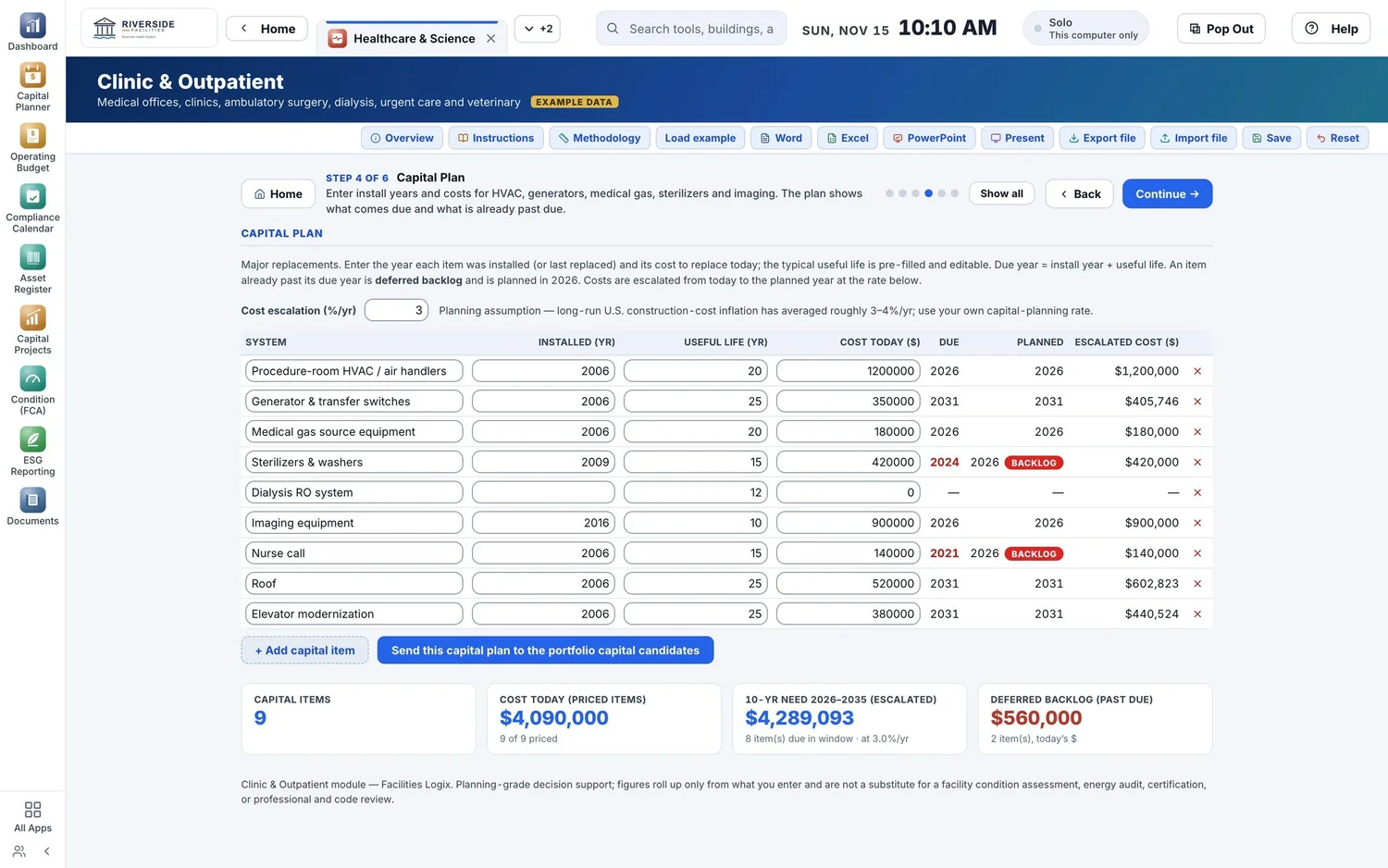
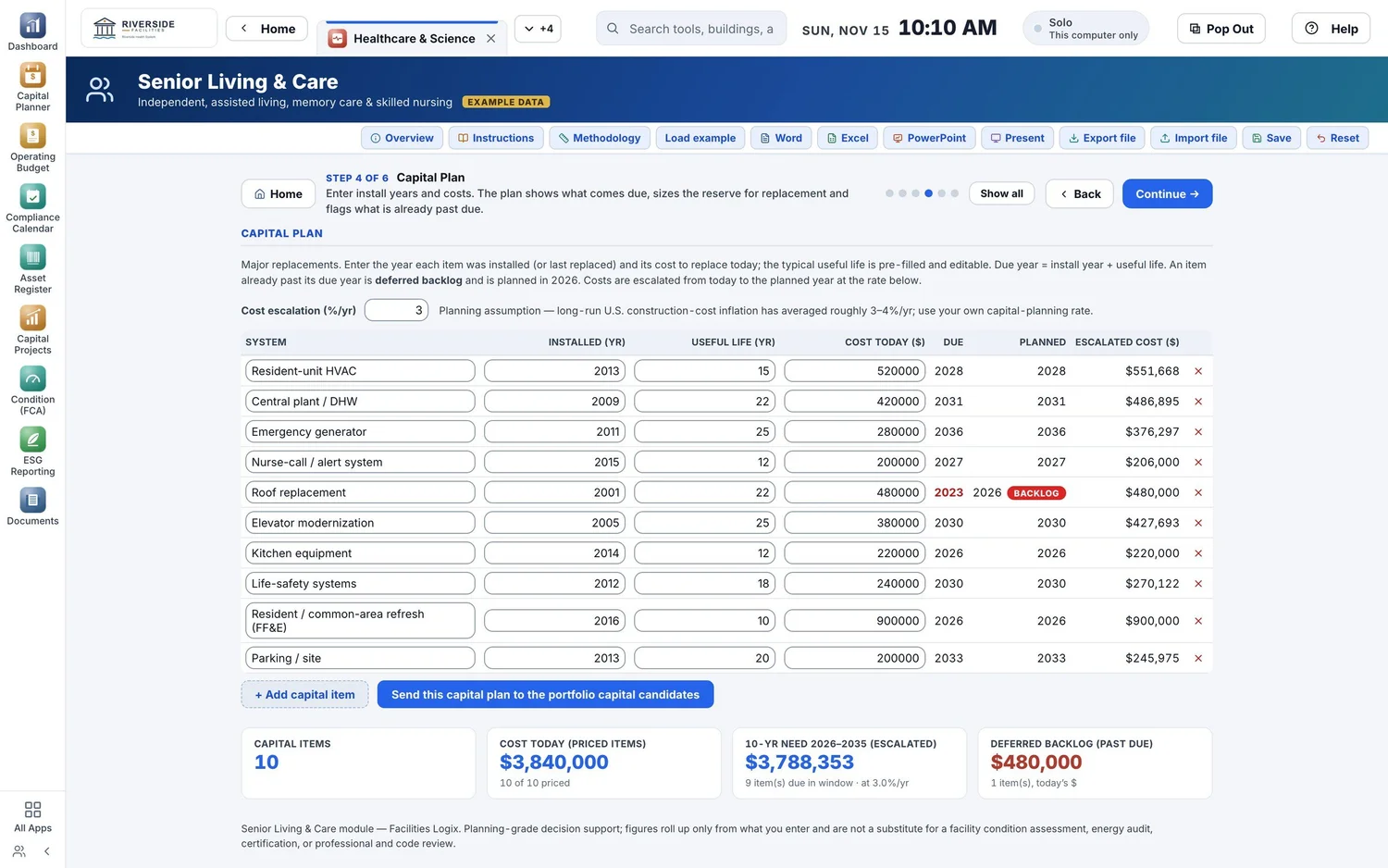
Capital Plan in Clinic & Outpatient: enter install years and costs for HVAC, generators, medical gas, sterilizers and imaging.
Containment, Classification and the Records Behind Them
Laboratories
Track fume hood certification, biosafety cabinet records, pure water systems, lab exhaust and containment, specialty gases and cold storage, with capital planning for each. Containment and exhaust rooms share the critical-room pressure log, so a lab's negative rooms are watched the same way as a hospital's.
Cleanrooms
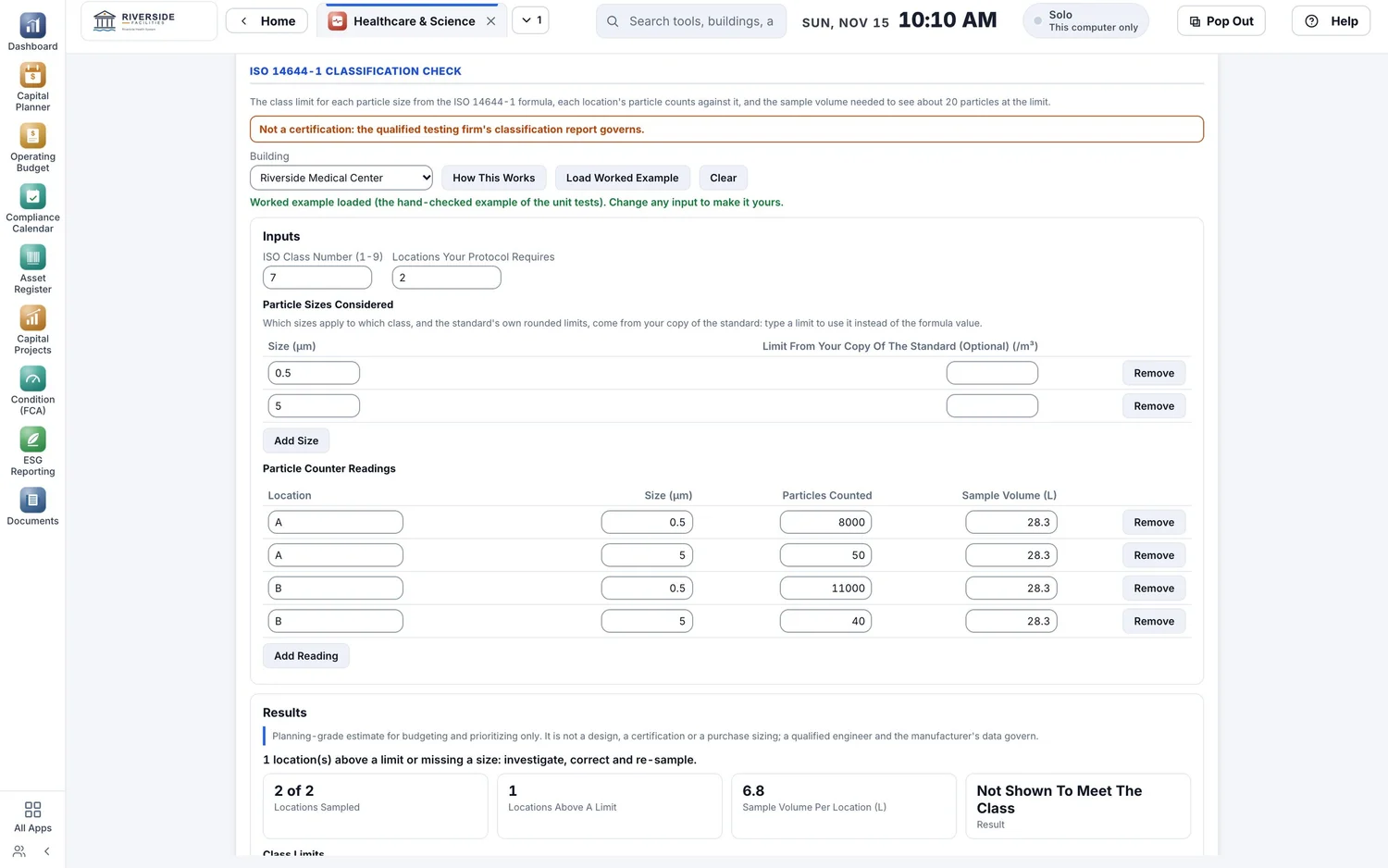
Keep a cleanroom register by class and import a room list with each room's class. Import particle counts from a portable counter or a monitoring system: each location's samples are averaged and judged against its room's class limit, and the preview lists every location over its limit. The ISO 14644-1 classification check computes the limit from the standard's formula. It is planning-grade, not a certification: your certifier's report remains the record.
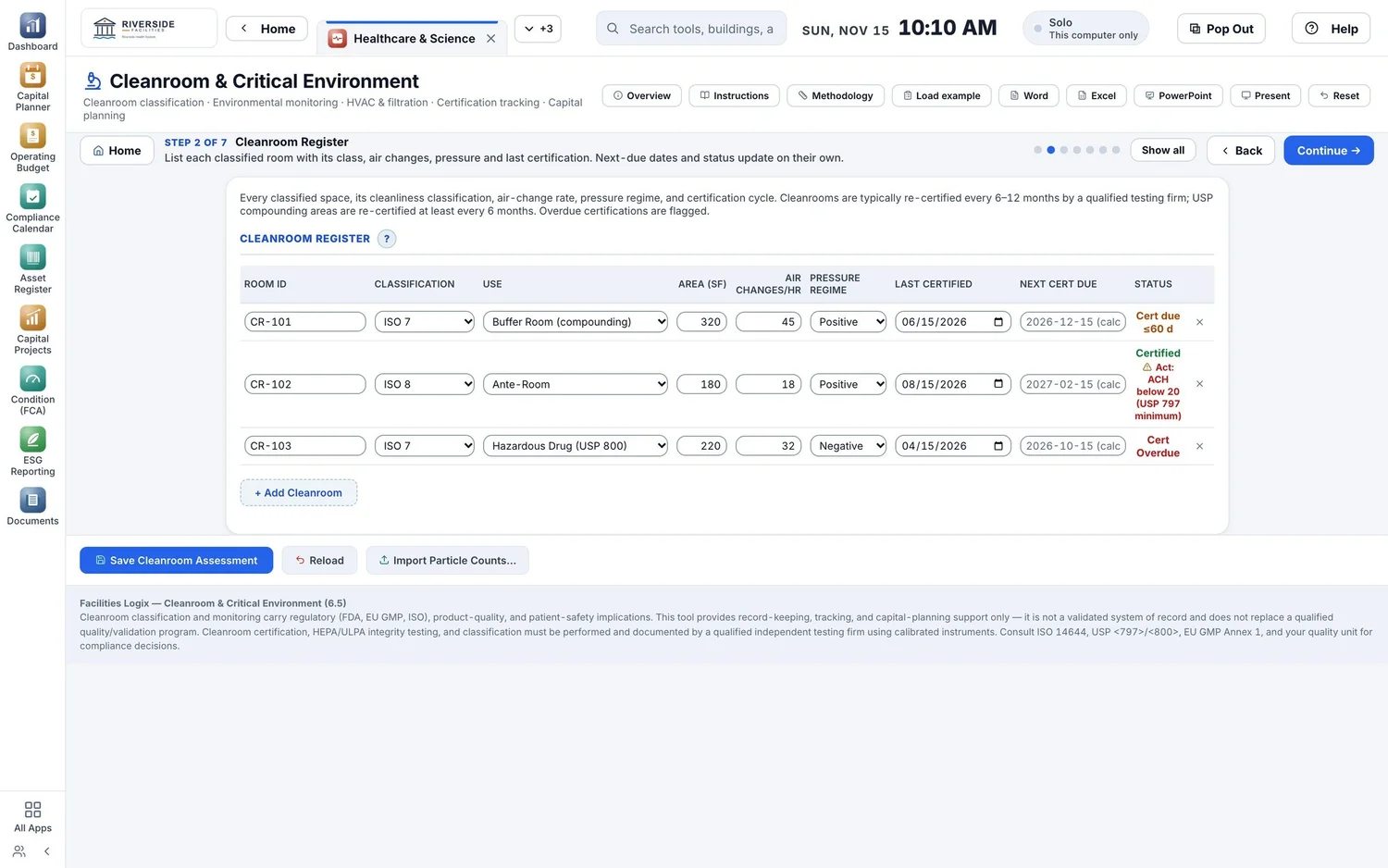
Cleanroom Register in Cleanroom & Critical Environment: list each classified room with its class, air changes, pressure and last certification. Next-due dates and status update on their own.
From a Drifting Room to a Work Order
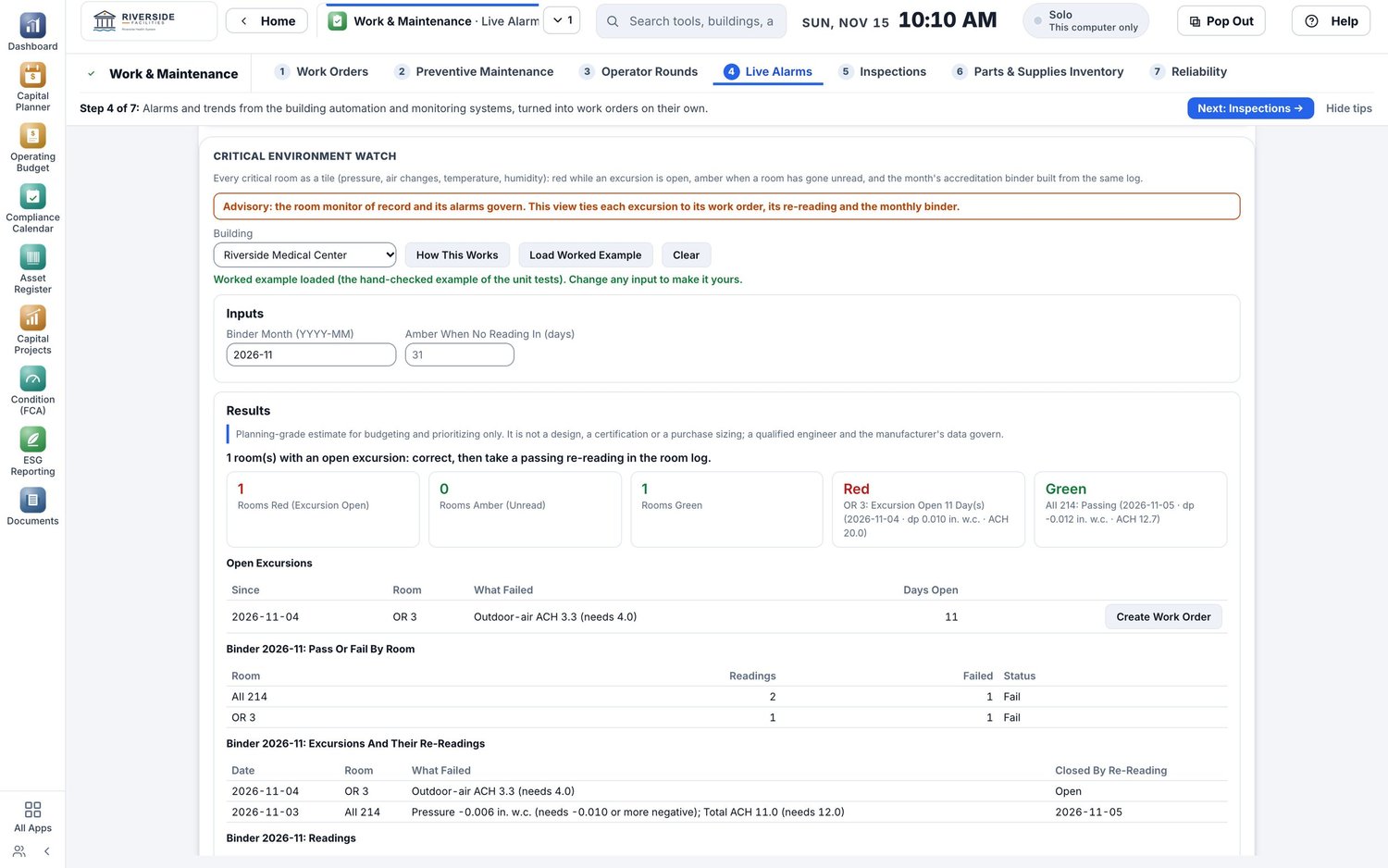
Critical Environment Watch
Every critical room as a tile, worst first: red while an excursion is open, amber when a room has not been read within the days you set, green when the latest reading passes.
Learn MoreMonthly Binder
Every room's pass or fail, each excursion with its re-reading and every reading for the month, exported for the record.
Learn MoreShow Less
A pressure or air-change failure in a critical room is a survey finding and a patient risk. The binder gathers a month of proof in one export.
- Each room shows red while an excursion is open, with the days it has been open
- A tile turns amber when its readings go stale
- Create Work Order on an excursion; the next passing reading closes it
- Room requirements are typed from your own design basis; none are shipped
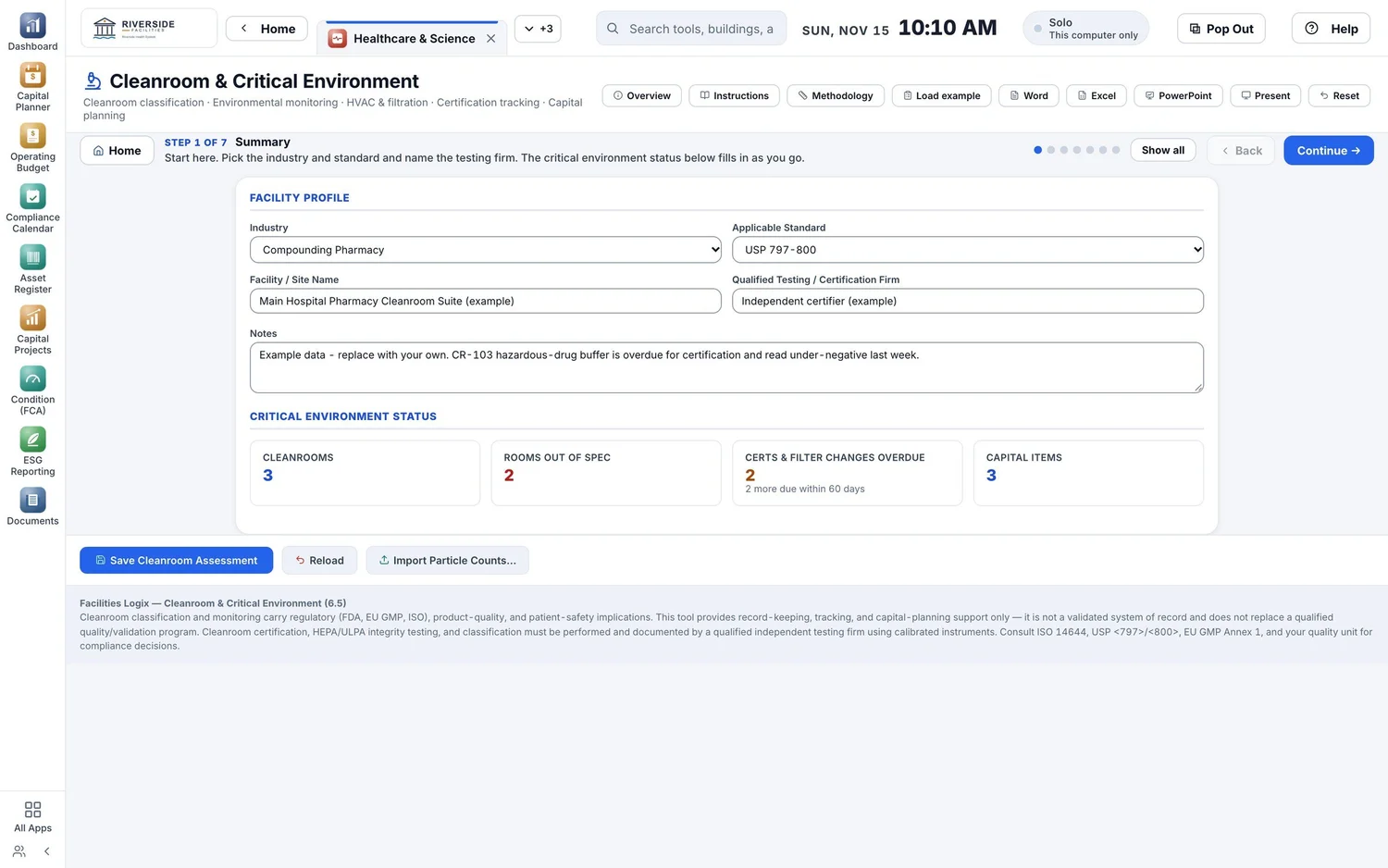
Summary in Cleanroom & Critical Environment: start here. Pick the industry and standard and name the testing firm. The critical environment status below fills in as you go.
Monitoring Templates
Starting limits for operating rooms and clean rooms, pharmacy and vaccine refrigerators and freezers, domestic hot water, generators and transfer switches, each editable per point.
Learn MoreRead-Only and Advisory
Monitoring listens and reads. It never changes a setpoint, and the monitor of record always governs.
Learn More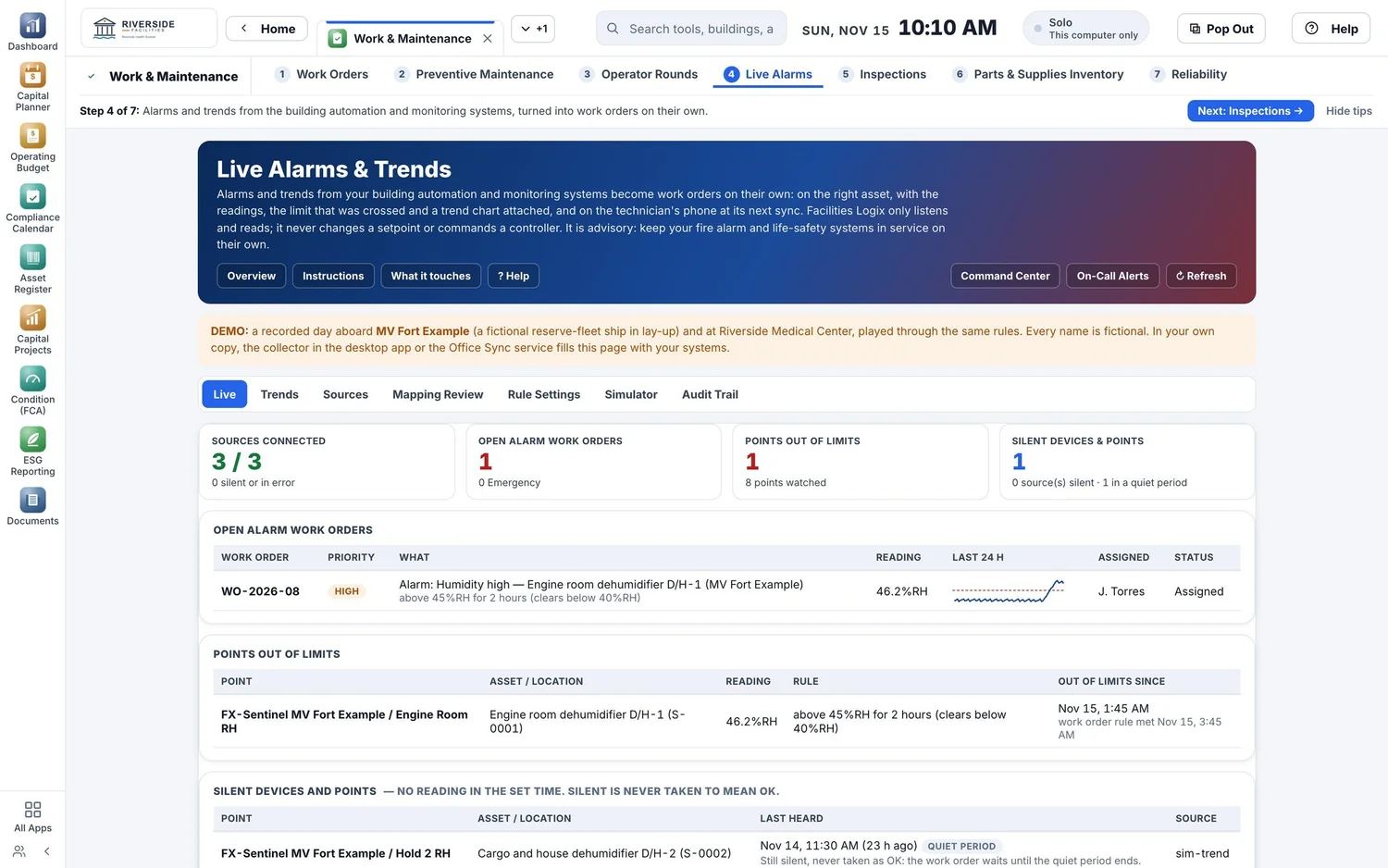
Live Alarms & Trends.
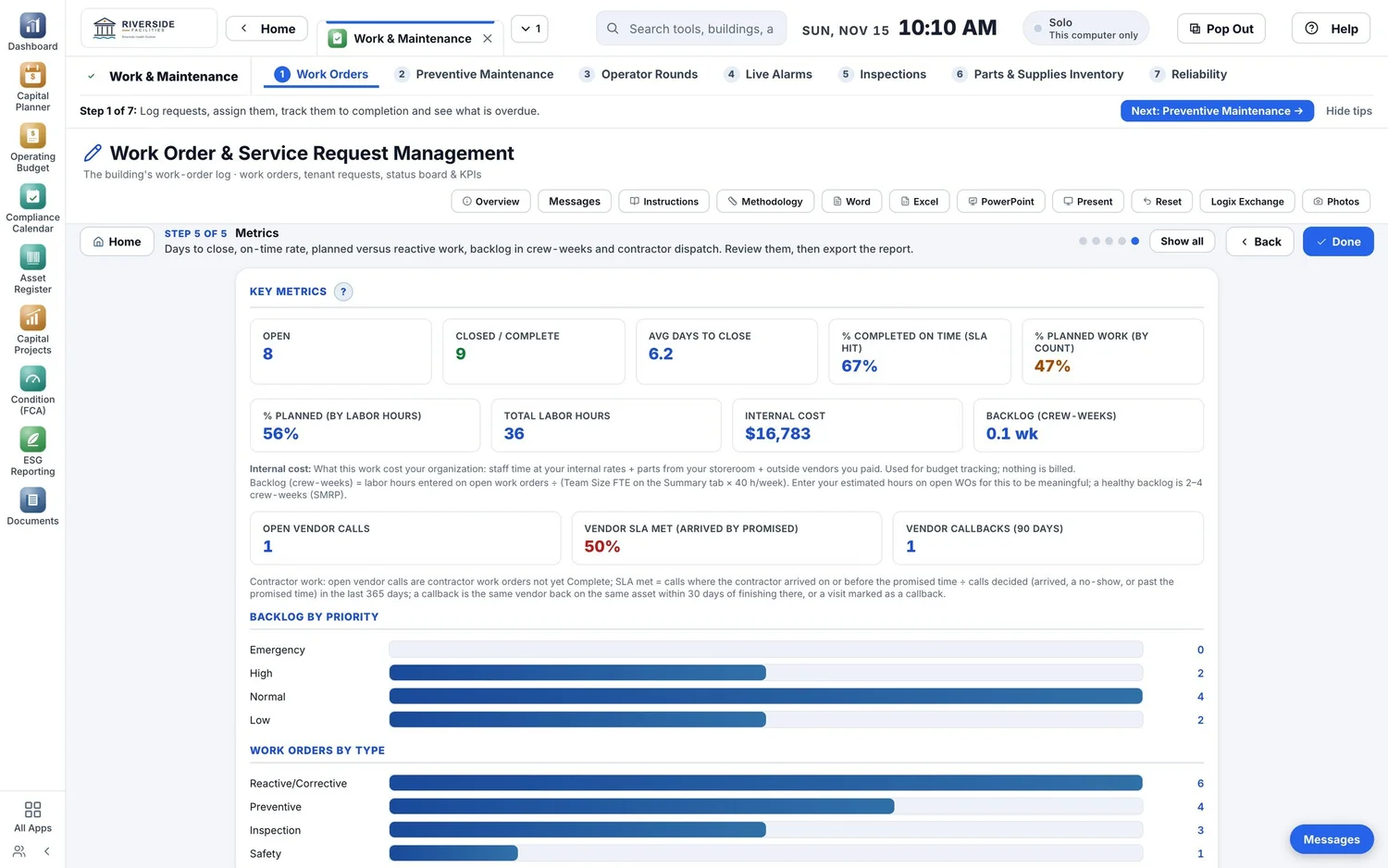
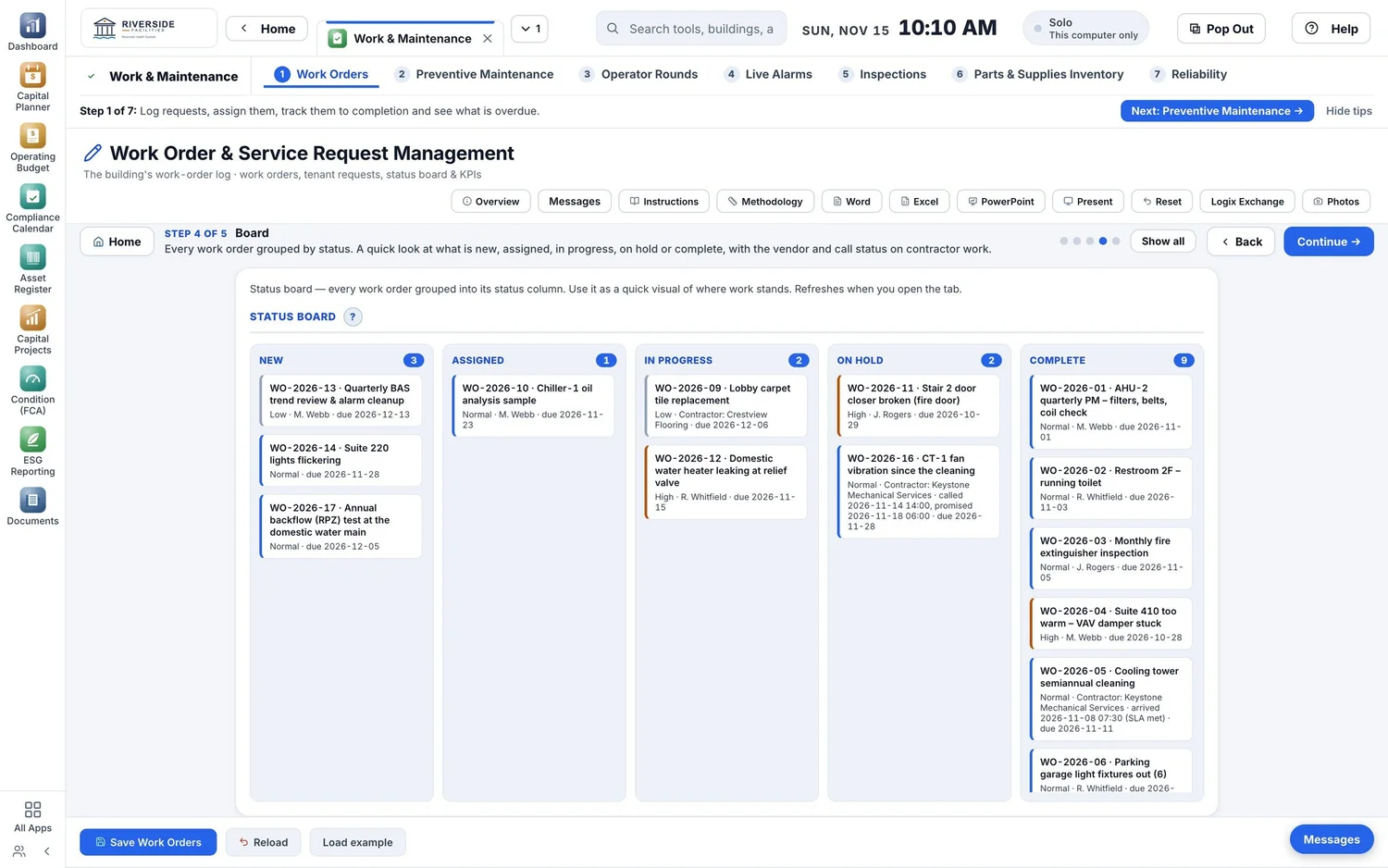
Clinical Detail on Top of a Complete Facilities System
ENERGY STAR Comparison
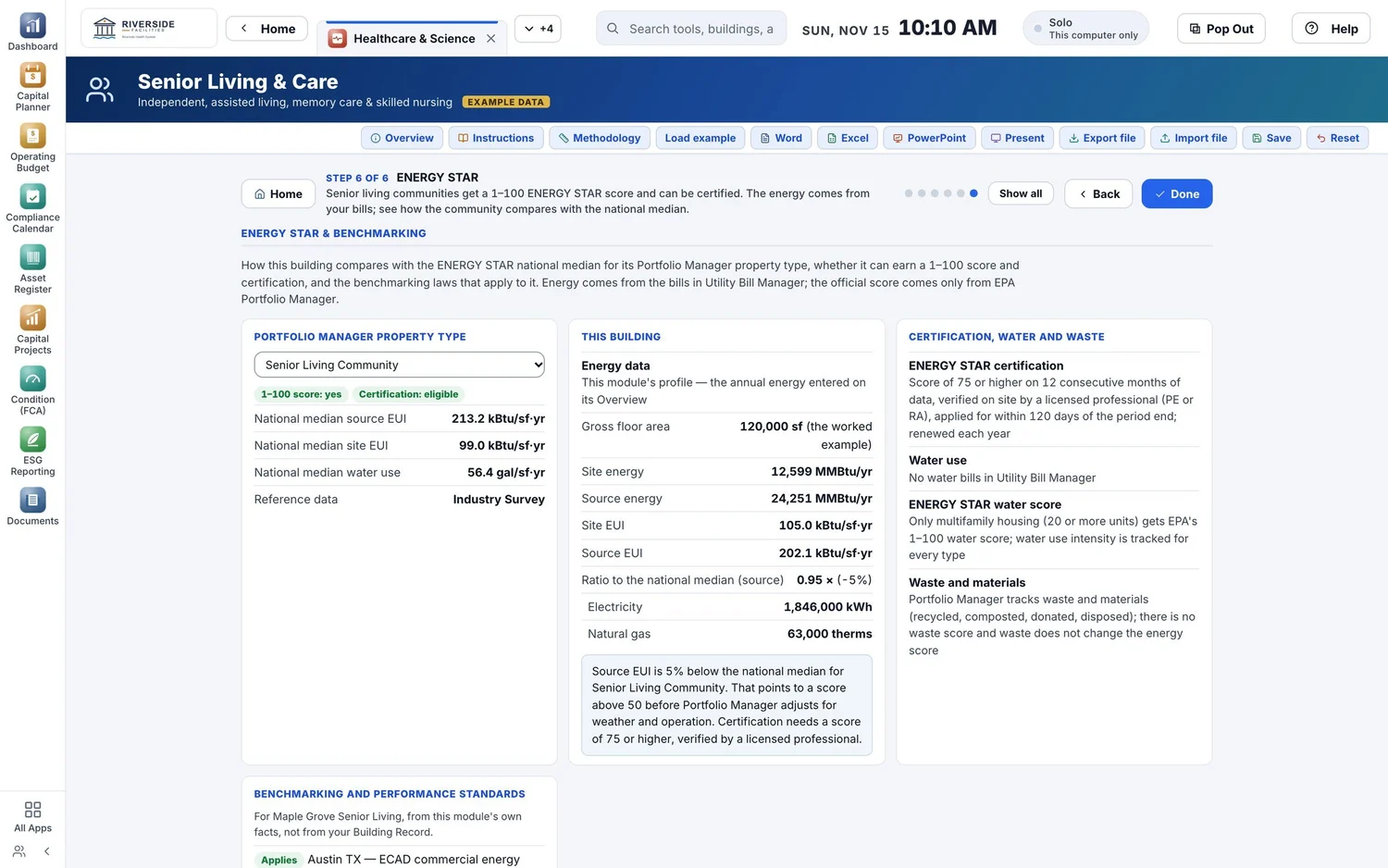
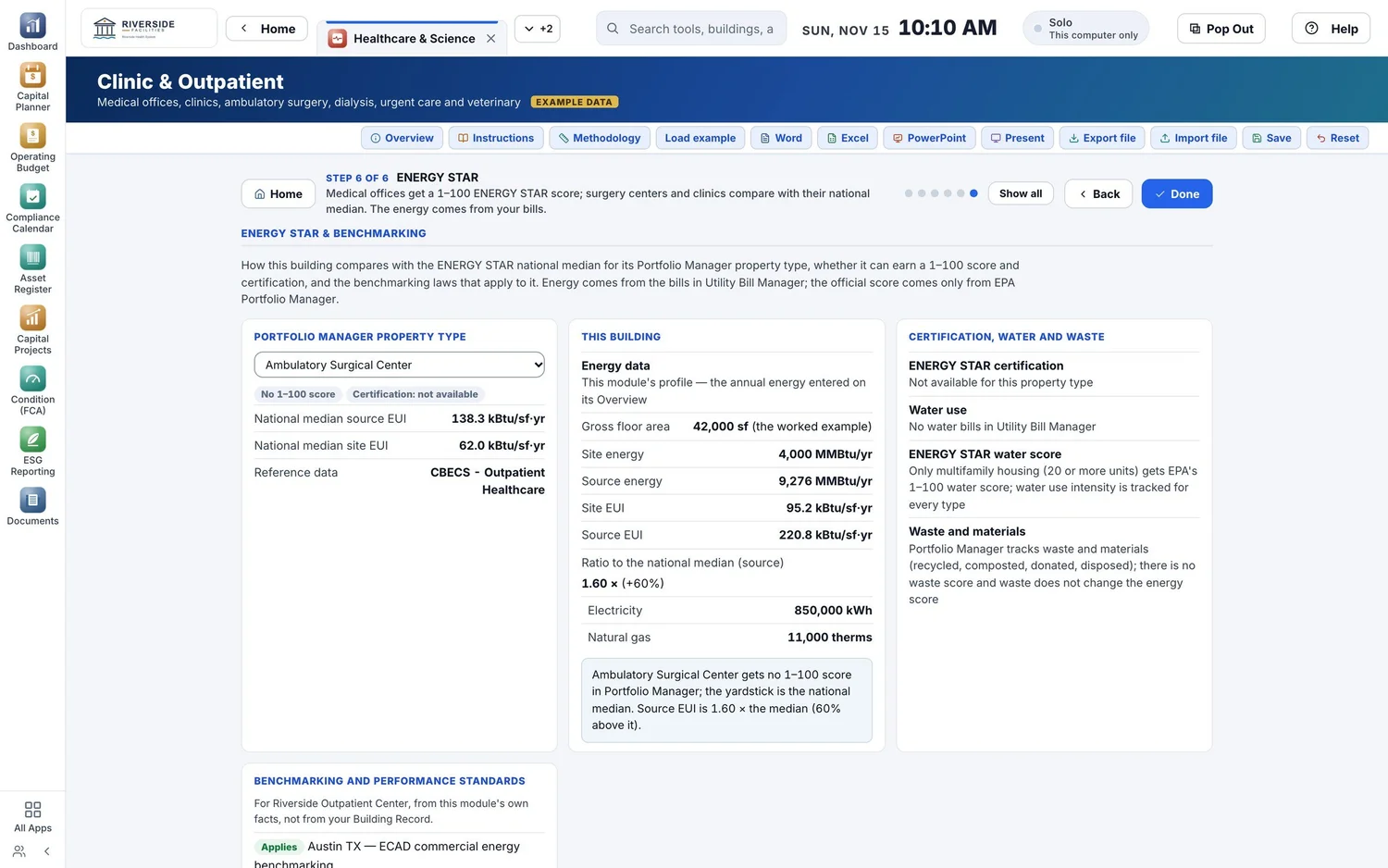
Each playbook compares the building with the national median for its property type from its own bills. Medical offices can receive a score; surgery centers, clinics and veterinary offices compare with their median.
Learn MoreOne Compliance Calendar
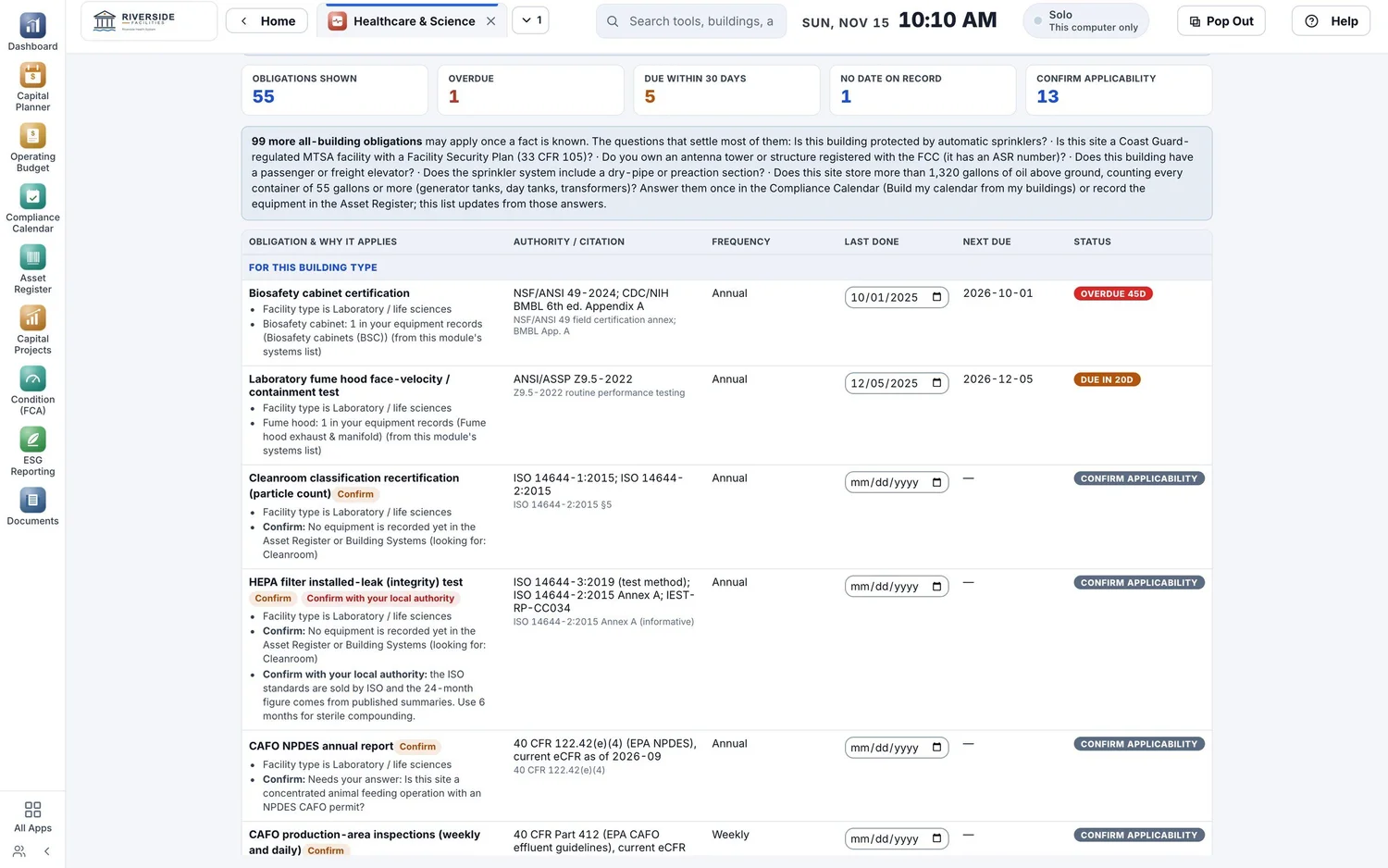
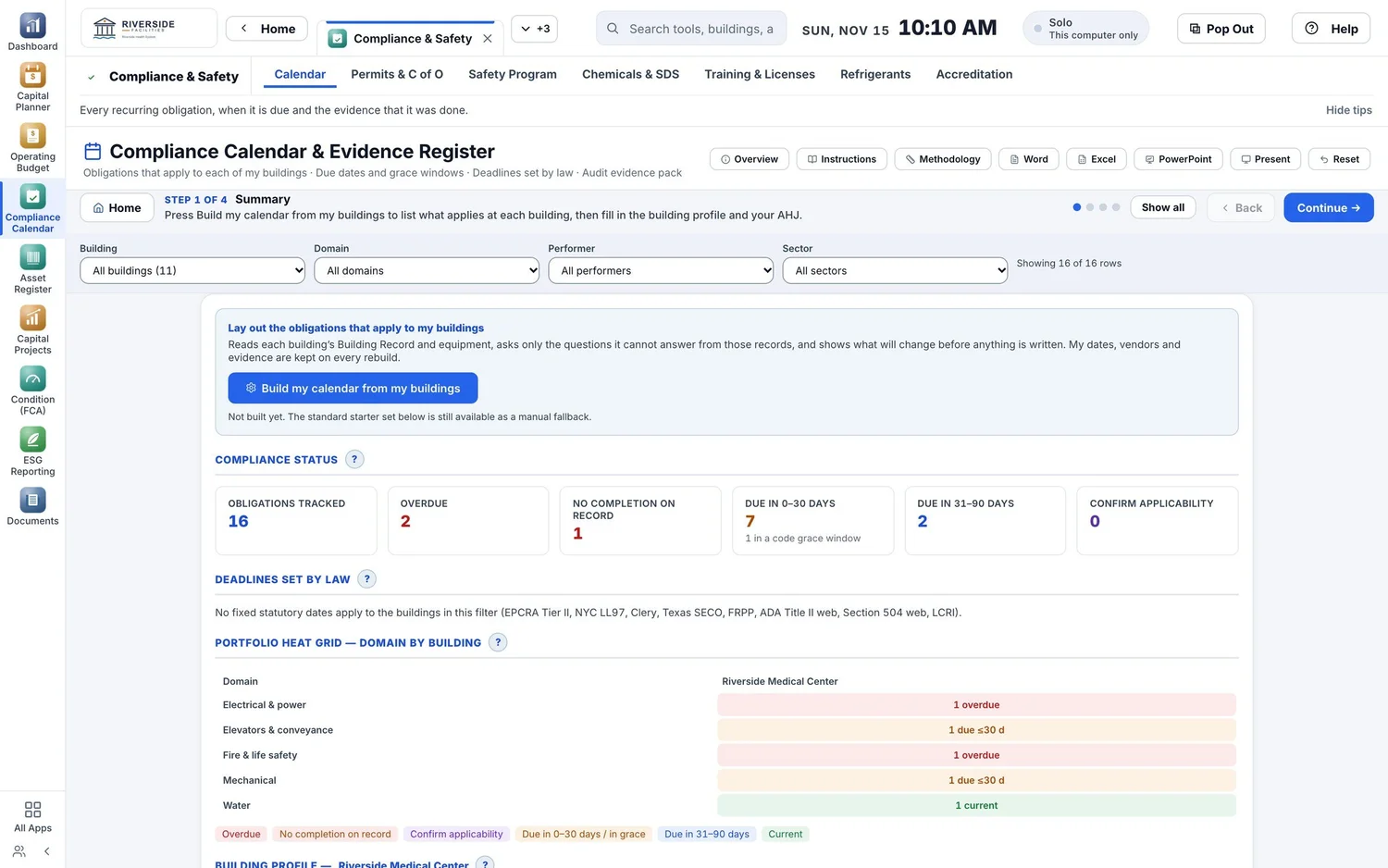
Each playbook's Compliance tab uses the same library and date rules as the calendar, so they never disagree.
Learn More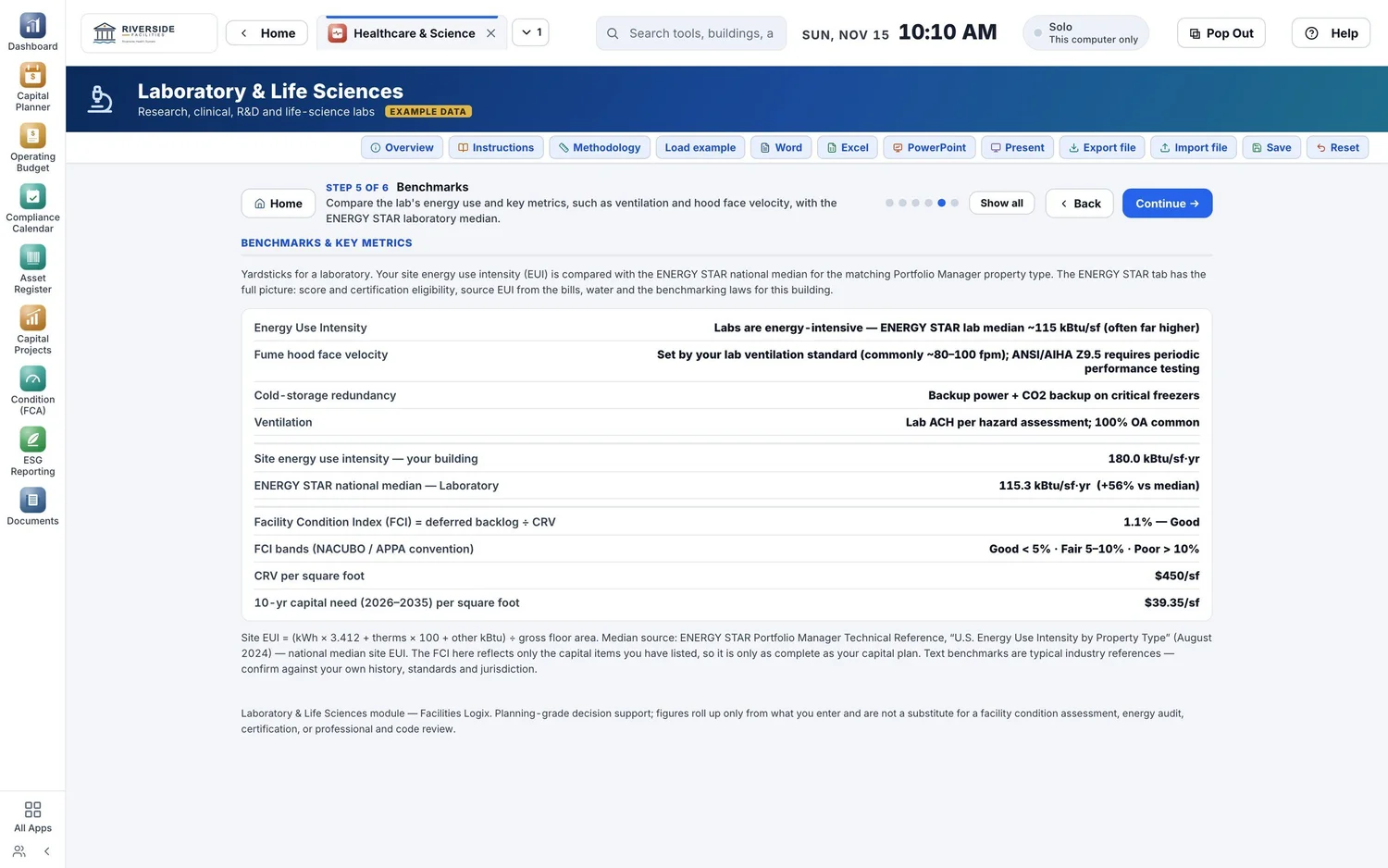
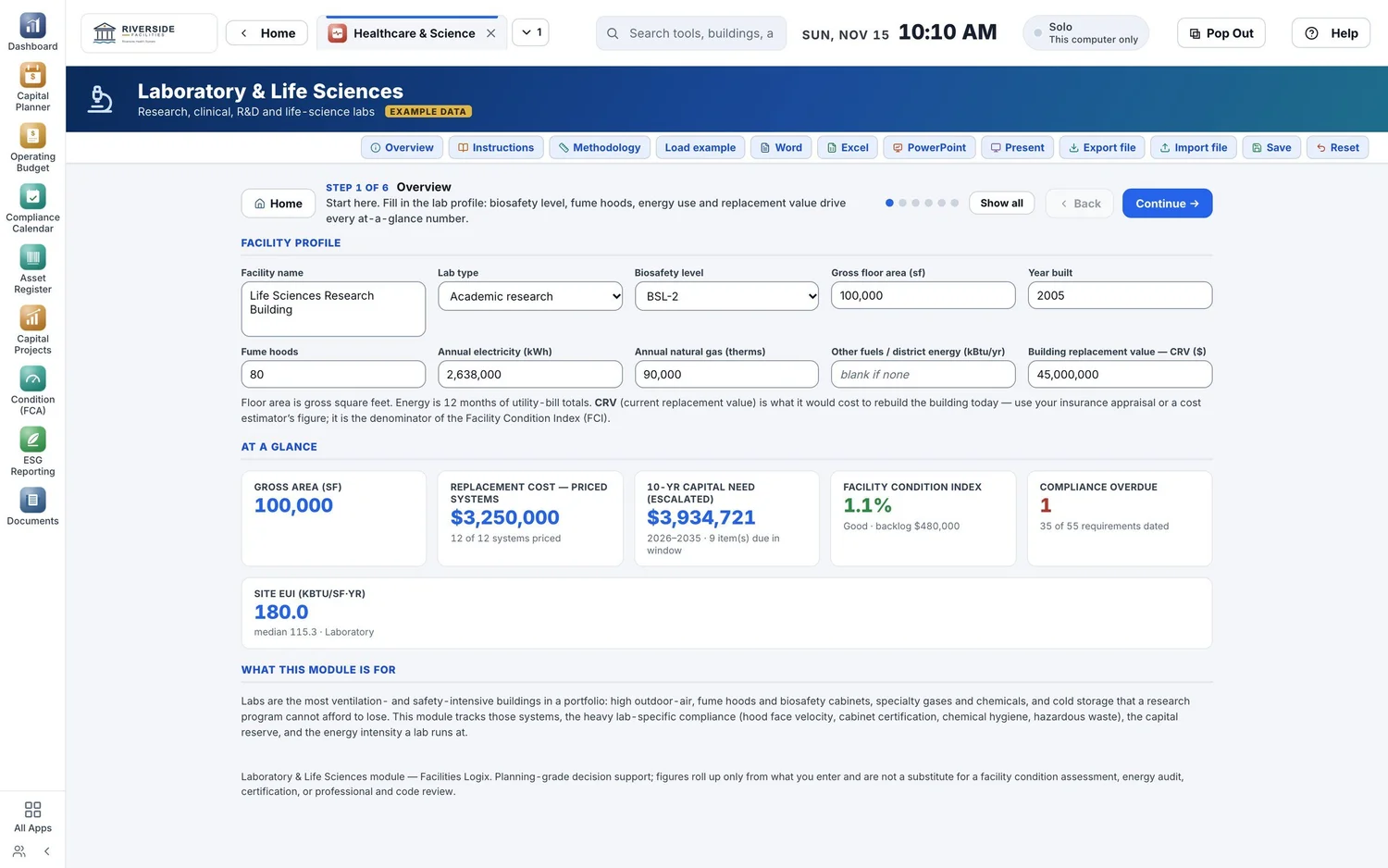
Benchmarks in Laboratory & Life Sciences: compare the lab's energy use and key metrics, such as ventilation and hood face velocity, with the ENERGY STAR laboratory median.
Capital Planning
Critical systems feed the same risk-ranked capital plan and funding case as the rest of the portfolio.
Learn MoreOperations in the Field
Rounds, PM procedures and inspections on phones and tablets, with readings checked against their limits.
Learn More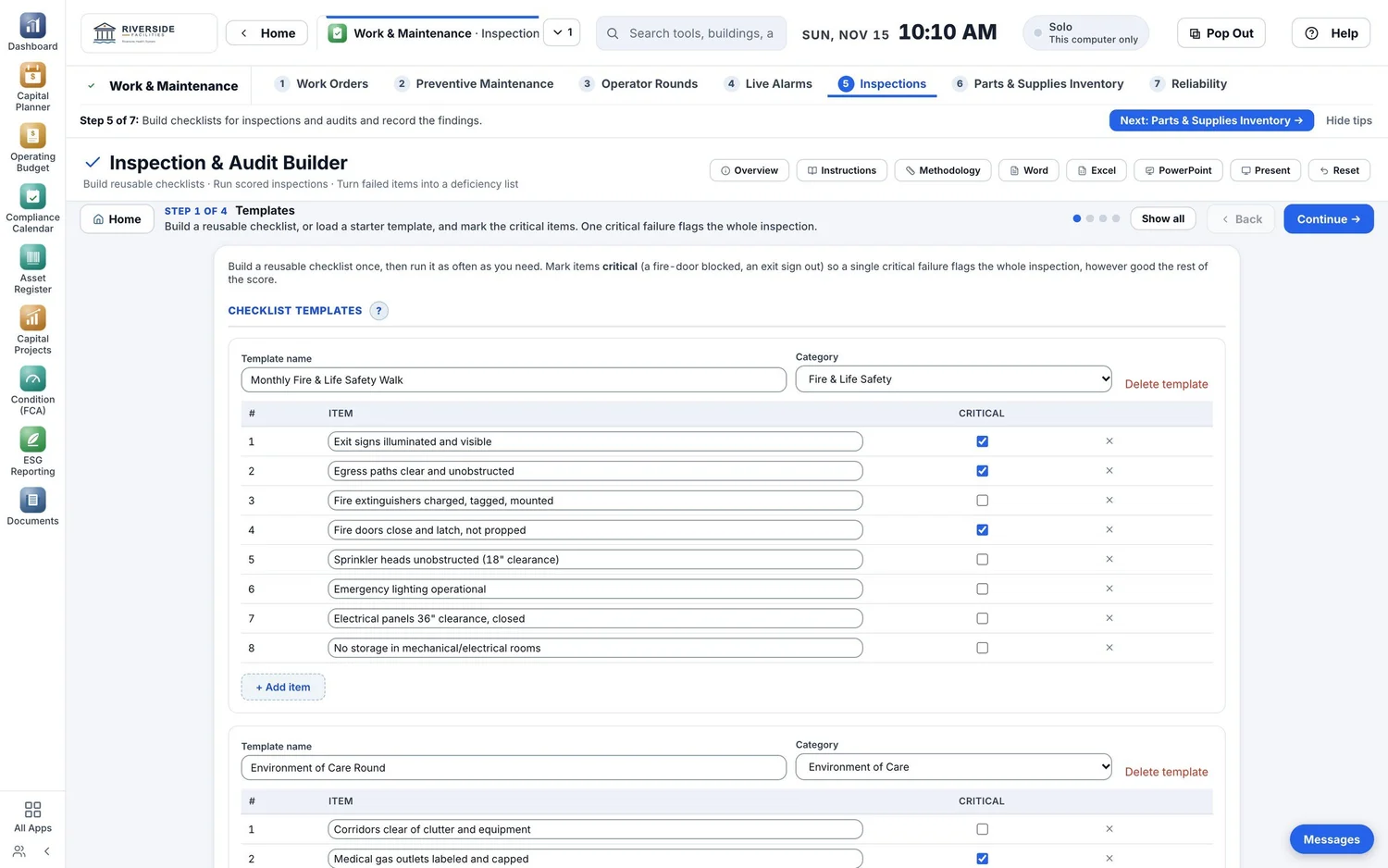
Templates in Inspection & Audit Builder: build a reusable checklist, or load a starter template, and mark the critical items. One critical failure flags the whole inspection.
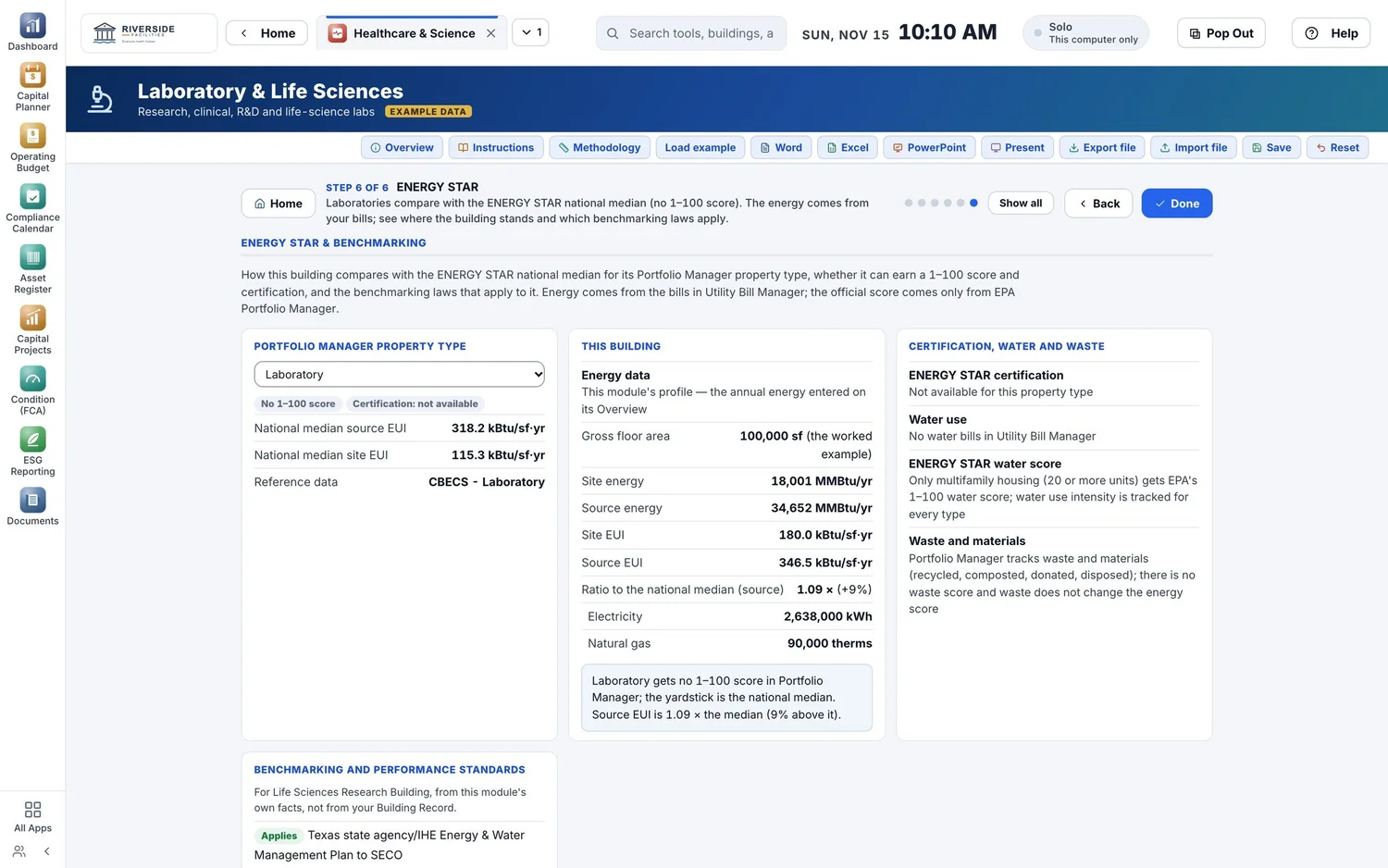
ENERGY STAR in Laboratory & Life Sciences: laboratories compare with the ENERGY STAR national median (no 1–100 score). The energy comes from your bills; see where the building stands and which benchmarking laws apply.
Frequently Asked Questions
Does the software contain required pressure or air-change values?
Is the critical-room log our monitor of record?
Does it include an accreditor's standards text?
Be First When Facilities Logix Opens
Stop chasing building records across spreadsheets and binders. Join the list and we will tell you the day downloads open, with setup guides ready.
Launching early 2027 for Facilities Logix. Nothing to buy today, and no sales calls.
