

Public Buildings Answer to More Rules. Enter the Facts Once.
Launching Early 2027 · Join the Early-Access List
Who owns a building, where it is and whose money pays for it decide which accessibility, workplace safety, purchasing and accounting rules apply. Facilities Logix reads those facts from the Building Record and applies the matching rules in every app that needs them. The government playbook then organizes the systems, compliance calendar, capital plan and benchmarks a municipal, county, state or federal facility team works from.
Rules That Follow from Who Holds the Building
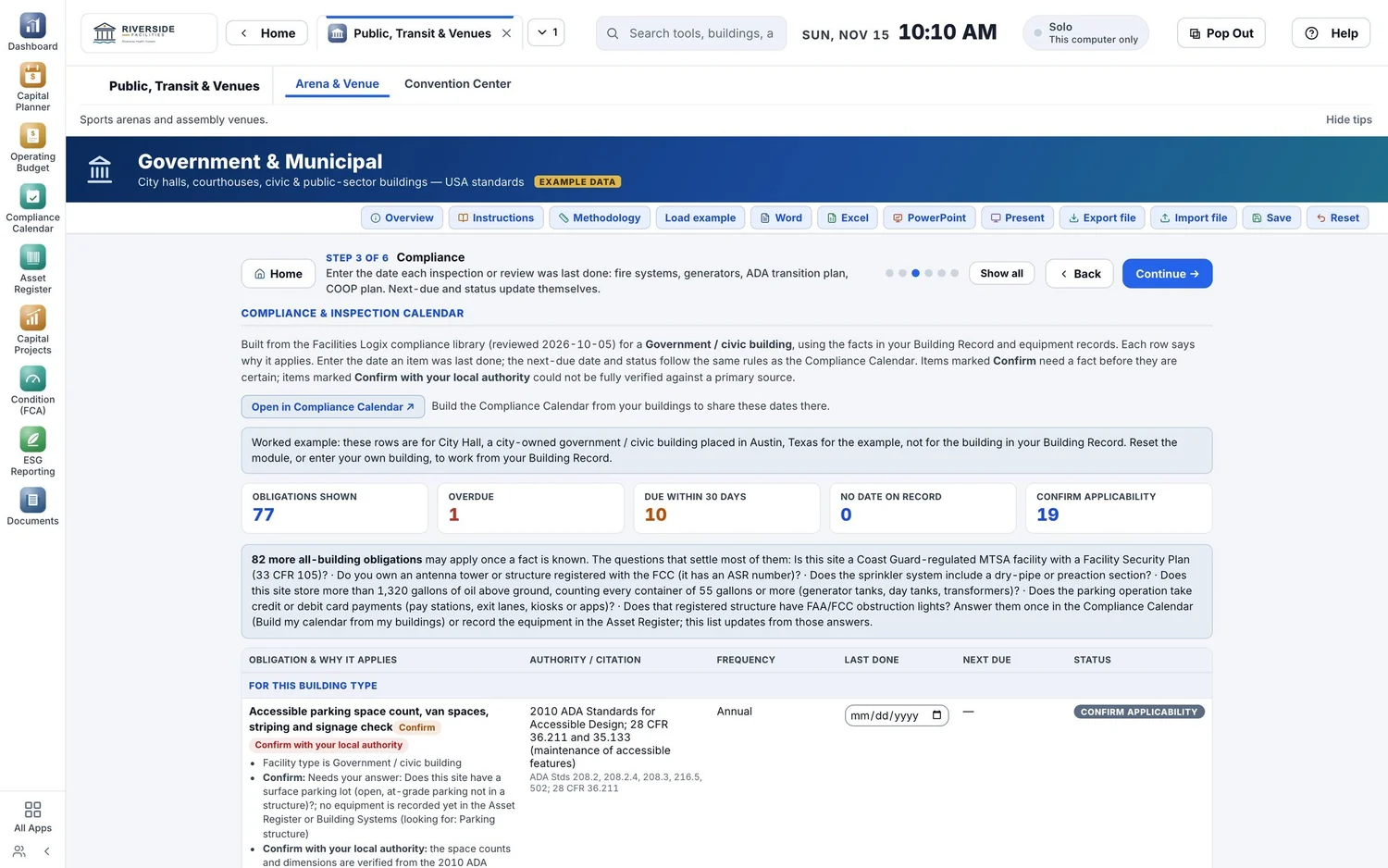
A blank fact is never guessed. Where the answer depends on something the record does not show, the obligation is kept and marked Confirm Applicability, with the fact that would settle it.
State, County and City Buildings
- Accessibility: ADA Title II with the 2010 ADA Standards and the web rule, plus ABAAS for federally funded work
- The ADA Title II self-evaluation, and the transition plan for structural changes where there are 50 or more employees
- The Title II web and mobile accessibility deadline (WCAG 2.1 AA): April 26, 2027 for populations of 50,000 or more, and April 26, 2028 for smaller governments and special districts
- Texas buildings also follow the Texas Accessibility Standards, with registration and inspection for larger projects
- Workplace safety: your OSHA State Plan where it covers public employees, otherwise your state's own public-employee law
- State prevailing wage on public works, per project
Federal Buildings
- Accessibility: the ABA Accessibility Standards (ABAAS) and Section 508, with the annual Section 508 assessment
- Workplace safety under 29 CFR 1960: an annual inspection of every workplace and the annual program report
- EISA §432 energy and water evaluations every 4 years for covered facilities, measures put in place within 2 years, benchmarking each year and follow-up measurement
- The Federal Real Property Profile (FRPP) data by December 15 and the certification by January 31
- Interagency Security Committee assessments every 3 or 5 years by security level
- The Guiding Principles for Sustainable Federal Buildings, optional and set by agency policy
- GSA PBS Core Building Standards on GSA-owned and lease-construction projects, and continuity plan review under the Federal Continuity Directive
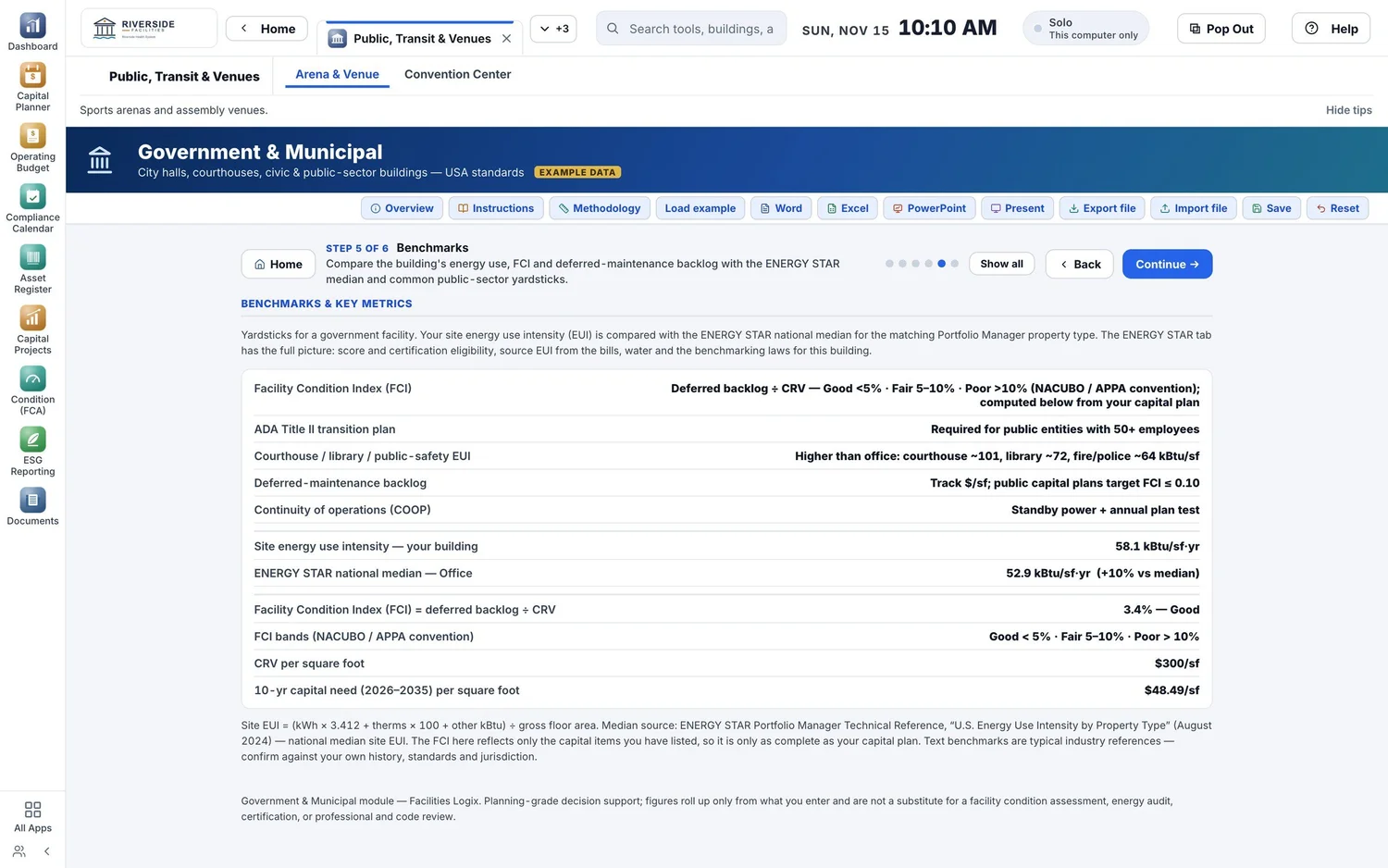
Benchmarks in Government & Municipal: compare the building's energy use, FCI and deferred-maintenance backlog with the ENERGY STAR median and common public-sector yardsticks.
Federal Money on Any Building
- Davis-Bacon prevailing wages and Build America, Buy America on construction
- 2 CFR 200 purchasing on anything bought with federal grant funds
- Section 504, and NEPA review for projects with a federal connection
- Project flags in the RFP and Scope Builder turn each on, with Auto, On and Off and a reason
Systems Every Building Has
- Fire alarm testing (NFPA 72), sprinkler, standpipe and fire pump testing (NFPA 25) and generator tests (NFPA 110)
- Elevator inspections and certificates, backflow tests and egress drills in large business occupancies
- Each appears only when your equipment records show the equipment
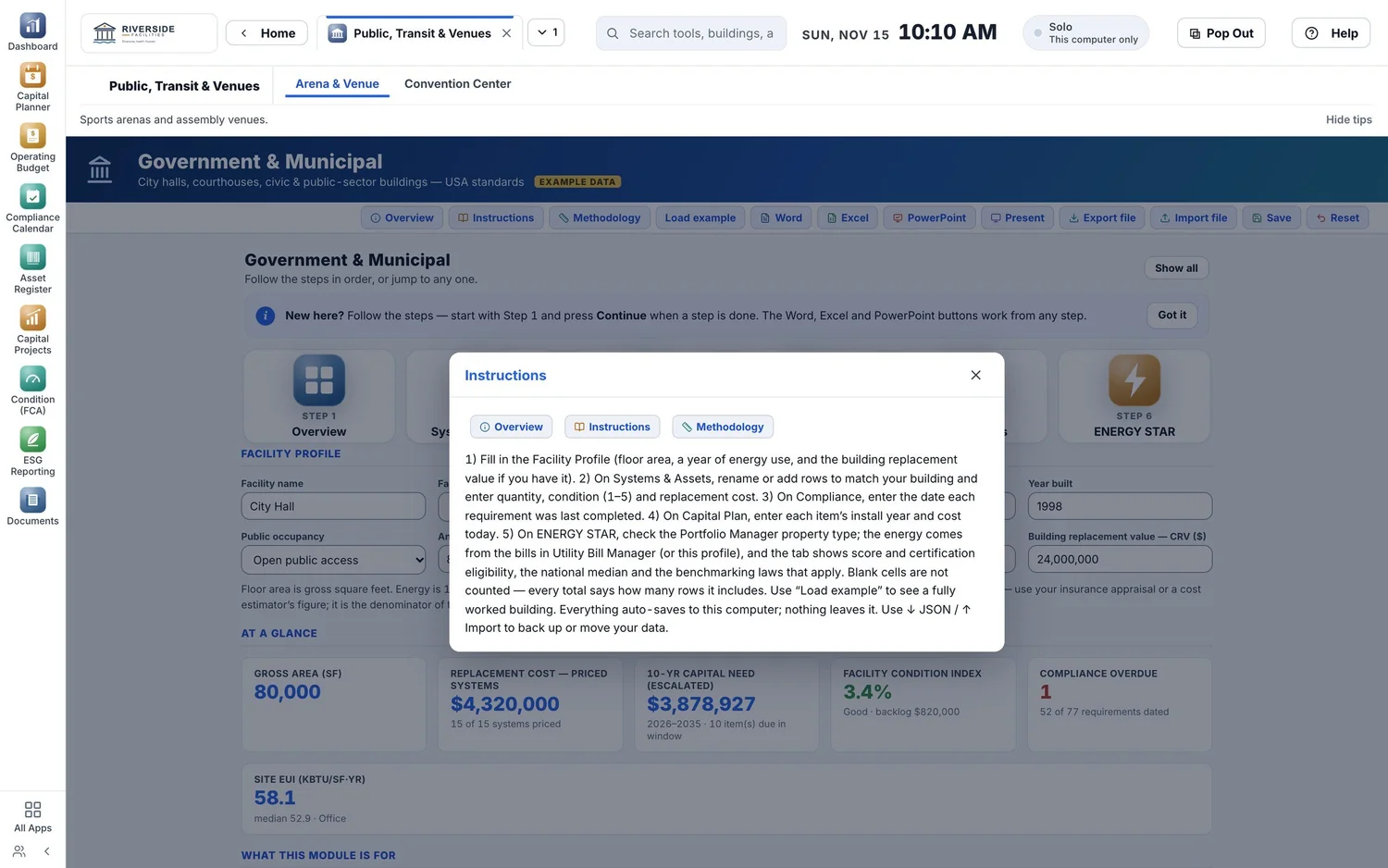
Instructions in Government & Municipal: how to work through it, step by step.
Public-Sector Rules Applied Across the Platform
Public Procurement
Purchasing rules come from the Building Record: federal agency (FAR), federal grant recipient (2 CFR 200), Texas city, county, school district or state agency, or your own state and local thresholds from ordinance. Each purchase order shows the method it needs, holds when the method recorded falls short and flags possible split purchases.
Learn MoreAccessibility Standard
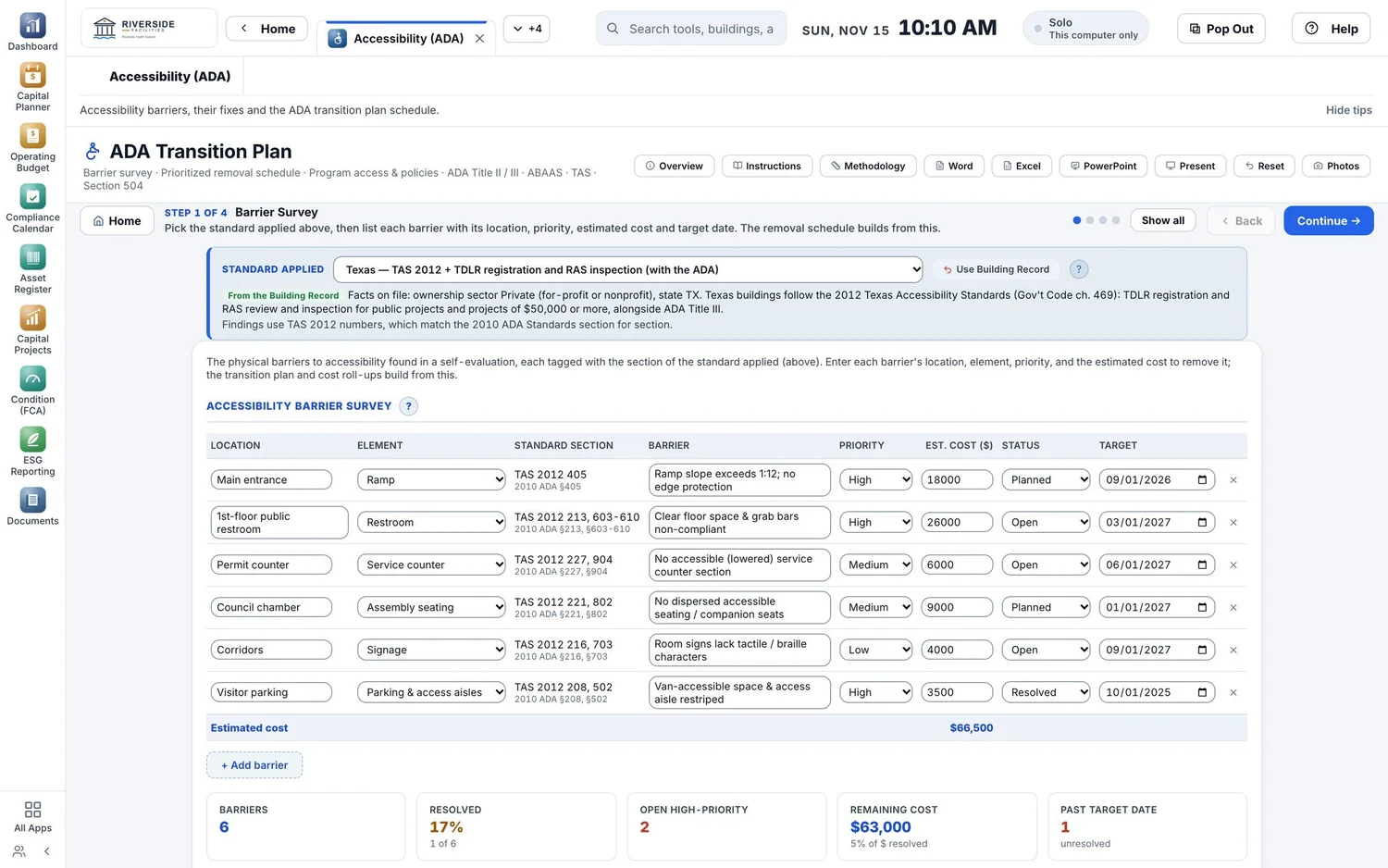
The Accessibility (ADA) app applies ADA Title II, the Texas standards or the federal standards from the Building Record, and the section numbers, plan elements and deadlines change with it.
Learn MoreShow Less
A barrier plan built to the wrong standard has to be redone, and an unscheduled barrier or missing ADA coordinator is a real exposure. The ADA app reads the Building Record to pick the standard, then turns the self-evaluation into a costed, dated removal schedule.
- Federally owned: ABAAS and Section 508; federal lease in a private building: ABAAS plus Title III
- Remaining cost by priority and by target year, the schedule 28 CFR 35.150(d)(3)(iv) asks for
- Unresolved barriers past their target date are flagged
- Section numbers follow the standard: ABAAS F208, TAS 2012 on the 2010 ADA numbers
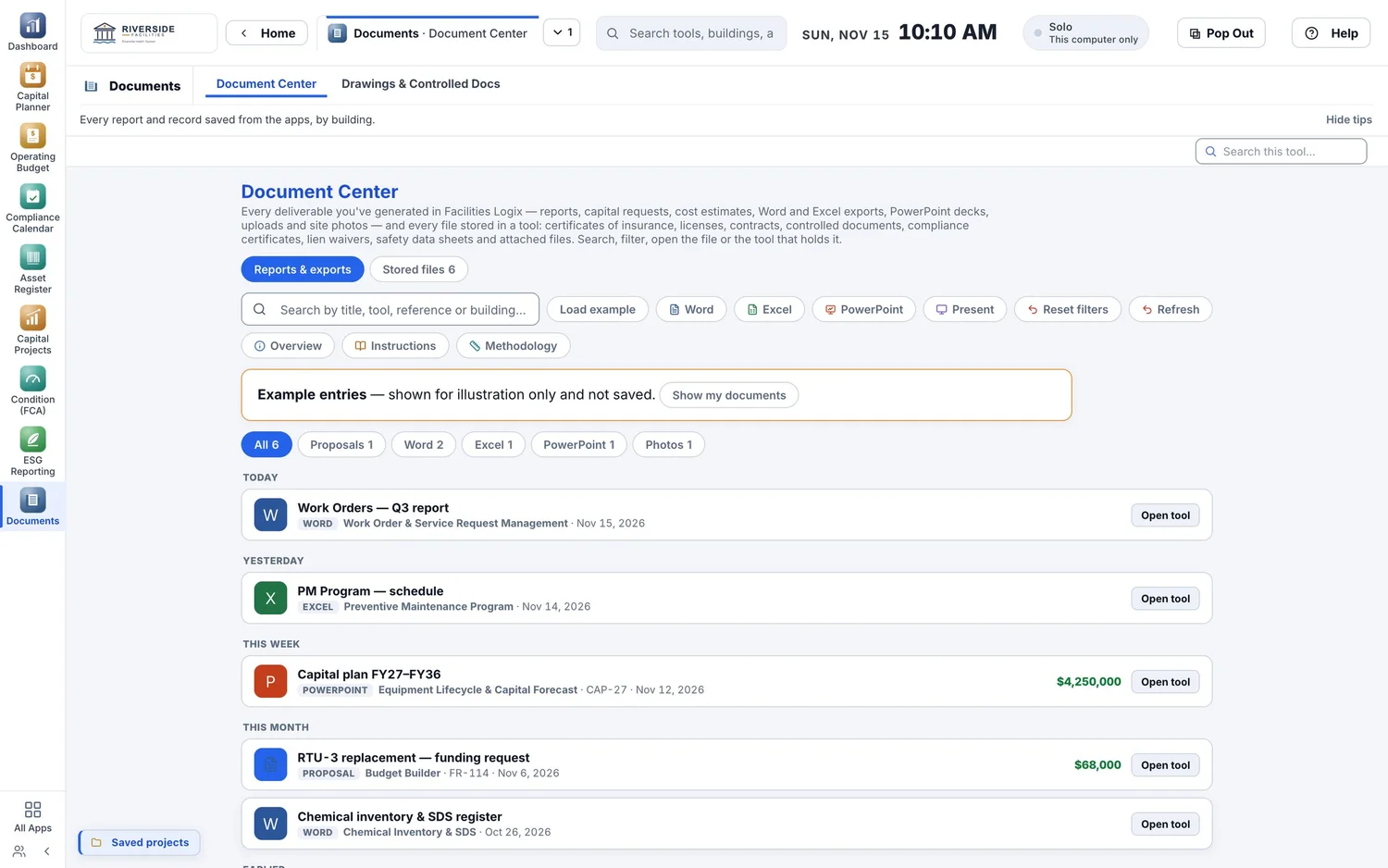
Every report the program makes is kept in one Document Center, grouped by building.
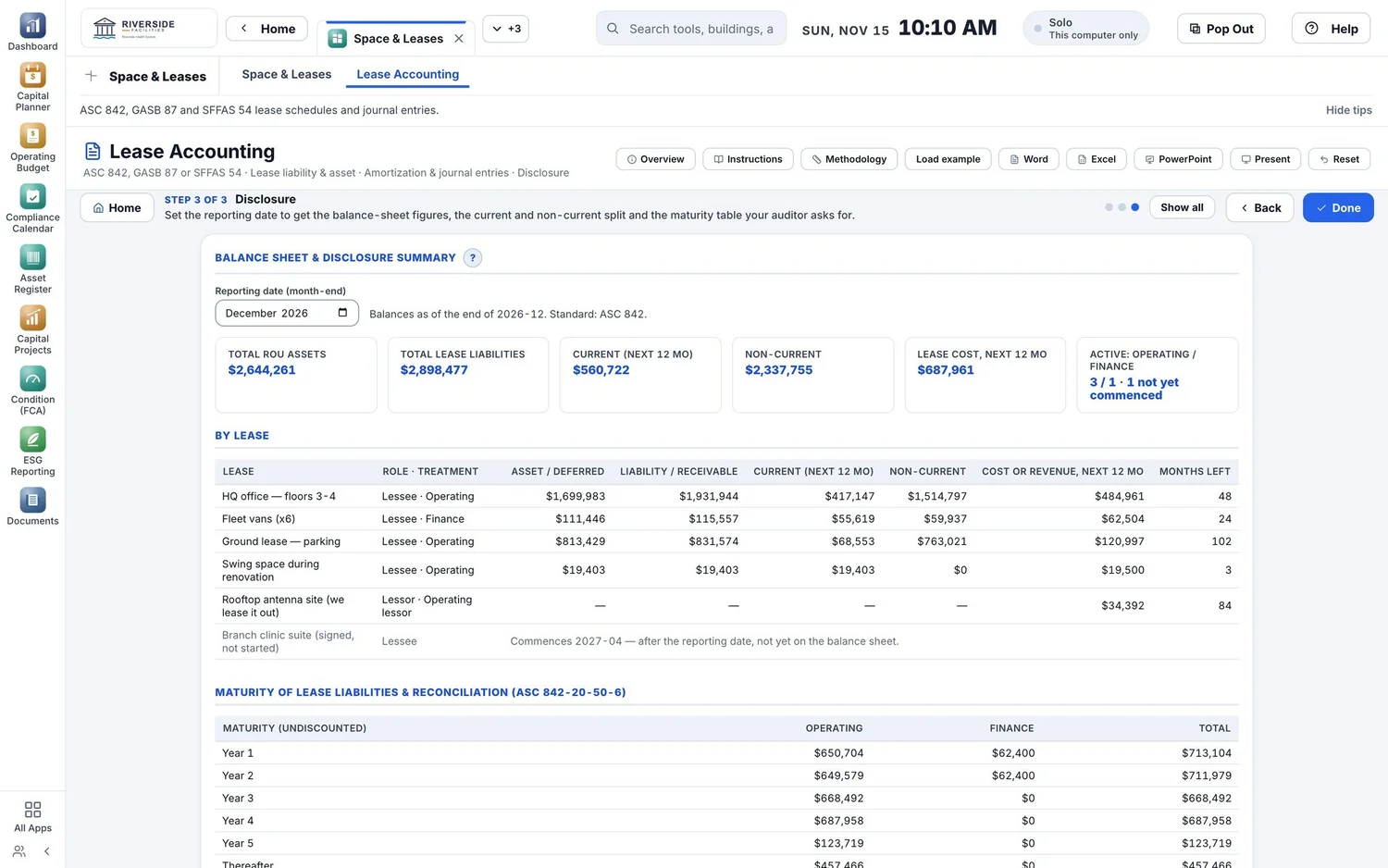
Lease Accounting
GASB 87 for state and local government, SFFAS 54 for federal agencies and ASC 842 for private organizations, each with its own short-term lease rule, schedules and journal entries.
Learn MoreShow Less
Getting a lease on or off the balance sheet wrong becomes an audit finding. The Lease Accounting app takes its standard from the Building Record's ownership sector and measures each lease the way that standard requires.
- Short-term cutoff: 12 months counting every option (GASB 87, ASC 842 election); 24 months under SFFAS 54
- Discount rate: the lessor's rate, else incremental borrowing; federal uses a Treasury rate of similar maturity
- Lessee liability and asset, or lessor receivable and deferred inflow
- Effective-interest schedule that closes to exactly zero, with journal entries and disclosures
GASB 34 Modified Approach
Public organizations that report an infrastructure network under the modified approach record the condition level, the three most recent assessments and five years of estimated versus actual preservation spending, with an assessment more than three years old flagged.
Learn MoreShow Less
The modified approach lets a government skip depreciation on an eligible network only while it can prove the network is held at the level it set. The Facility Condition Assessment app keeps that proof in one place, so the auditor's questions have ready answers.
- Flags fewer than three dated assessments and any assessment below the set level
- Records the condition basis, the scale and the level the government intends to preserve
- The report carries the required supplementary information tables (par. 132-133)
- Buildings stay depreciated: they are not infrastructure under paragraph 19
Federal Agencies
The agency named on the record decides the federal-wide rules. A DoD component turns on the Unified Facilities Criteria, the Coast Guard its shore facility rules and GSA the Core Building Standards. Where the law turns on the entity, the row says Confirm.
Learn MoreShow Less
Applying the wrong federal rule set spends inspection and design money on rules that do not apply, or misses one that does. Facilities Logix sorts the named agency into its part of the federal government, and that group decides which federal-wide rows reach the building.
- Groups: DoD, executive departments, independent agencies, intelligence community, USPS, government corporations, Federal Reserve, Congress, courts
- NSA, NGA, NRO and DIA count as DoD for the Unified Facilities Criteria
- The Coast Guard and the National Guard get their own rows
- A name it does not recognize reads as an executive agency, and the reason says so
Historic and Occupancy Facts
Historic status, the IBC occupancy group and the NFPA 101 occupancy come from the certificate of occupancy and feed the same rules everywhere.
Learn MoreShow Less
One wrong fact on the record can trigger a review you do not need or hide one you do, and either costs project time. Historic status and occupancy are recorded once, so every tool decides the same way.
- Historic status: not historic, National Register listed or eligible, state landmark or local landmark
- Listed, eligible or 50-year-old buildings bring NHPA Section 106 review into federally connected projects
- 26 IBC groups, A-1 through U, and 16 NFPA 101 occupancies
- I-3 turns on detention drills; an assembly group turns on the crowd manager row
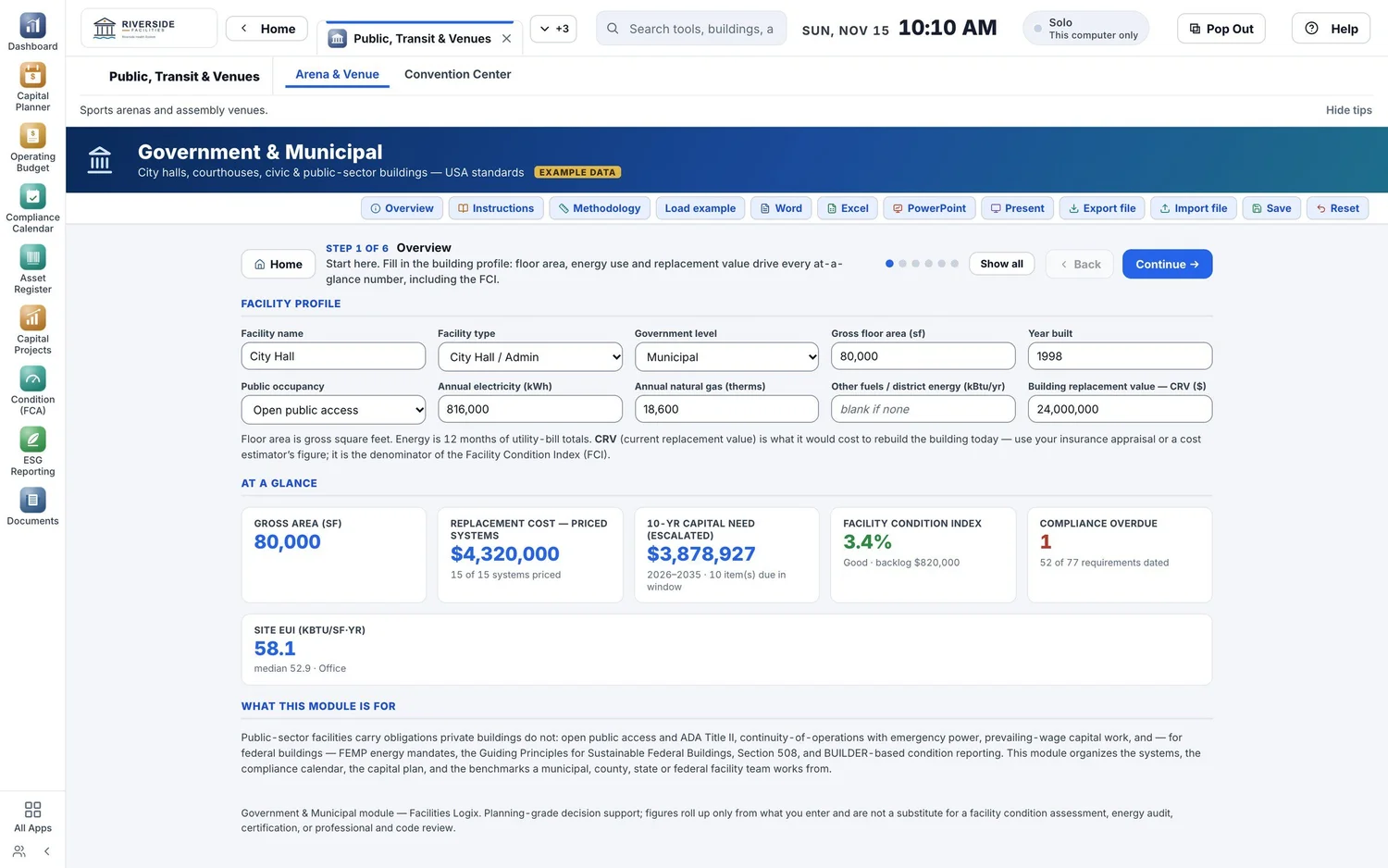
Overview in Government & Municipal: start here. Fill in the building profile: floor area, energy use and replacement value drive every at-a-glance number, including the FCI.
Fifteen Civic Building Systems
Systems with PM Cadence
- Emergency and standby generator for continuity of operations, monthly, Critical (NFPA 110)
- Fire alarm and mass notification (NFPA 72) and sprinkler, standpipe and fire pump (NFPA 25), annual, Critical
- Rooftop and air-handling HVAC quarterly, central boiler and chiller plant semiannual, and building automation annual
- Elevators monthly (ASME A17.1), electrical service and switchgear annual, and IT and data closets with UPS quarterly
- Security, access control and entry screening at courts and secured sites, quarterly
- Plumbing and domestic water, with backflow and an ASHRAE 188 water management plan
- Interior finishes and ADA elements (restrooms, ramps, signage, counters), council chamber and courtroom AV for public meetings, roofing and envelope, and site, parking and exterior lighting
Profile
- Facility type: city hall, county administration, state office, federal building, courthouse, public works yard, public library, community or recreation center, police or public safety, fire station, or transit or DOT facility
- Government level (municipal, county, state or federal) and public occupancy (open public access, limited to staff, or secured and screened)
- Capital lines for rooftop HVAC, the boiler and chiller plant, roof, generator, elevators, fire alarm, security, parking and site, interior and ADA upgrades and building automation
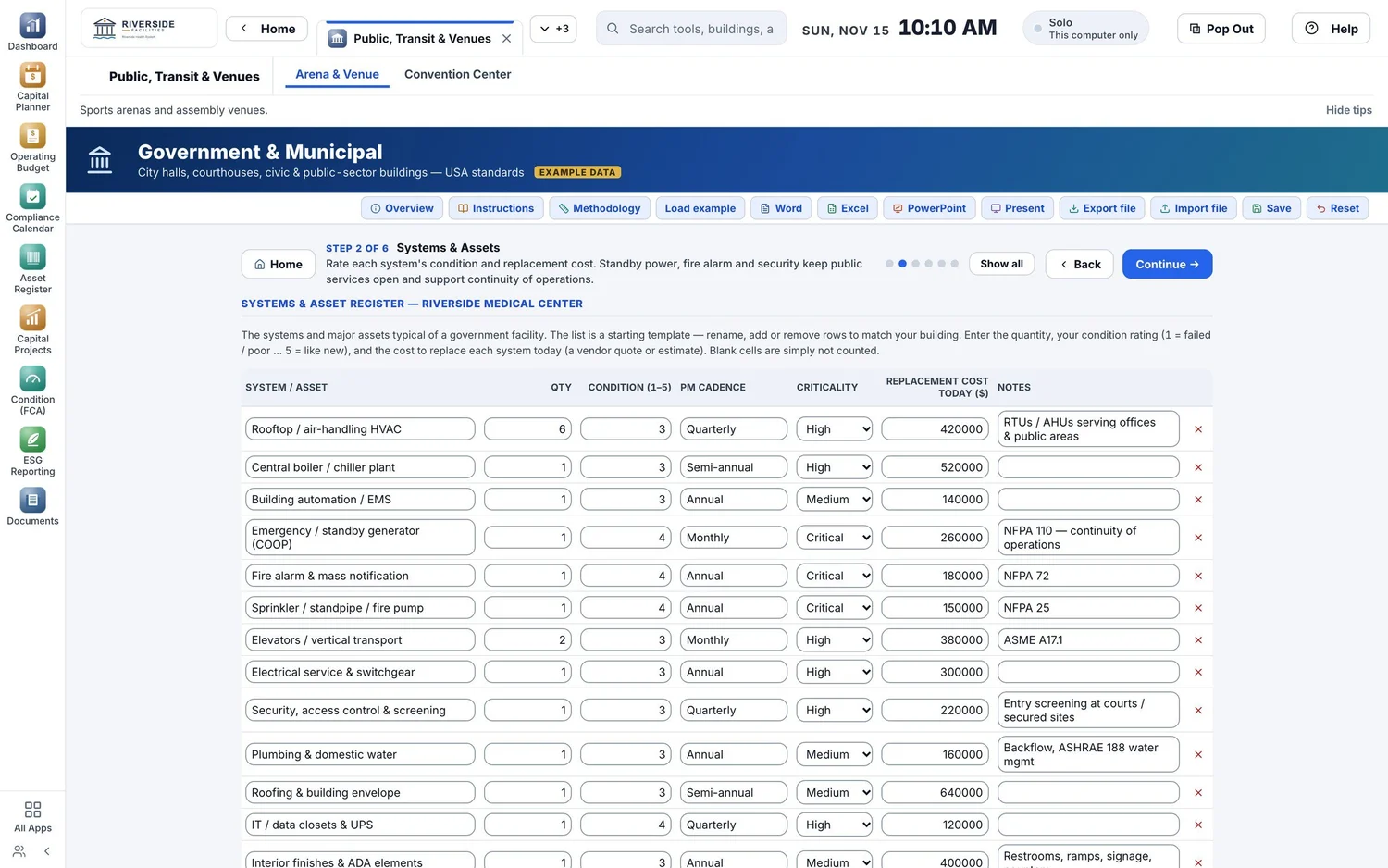
Systems & Assets in Government & Municipal: rate each system's condition and replacement cost. Standby power, fire alarm and security keep public services open and support continuity of operations.
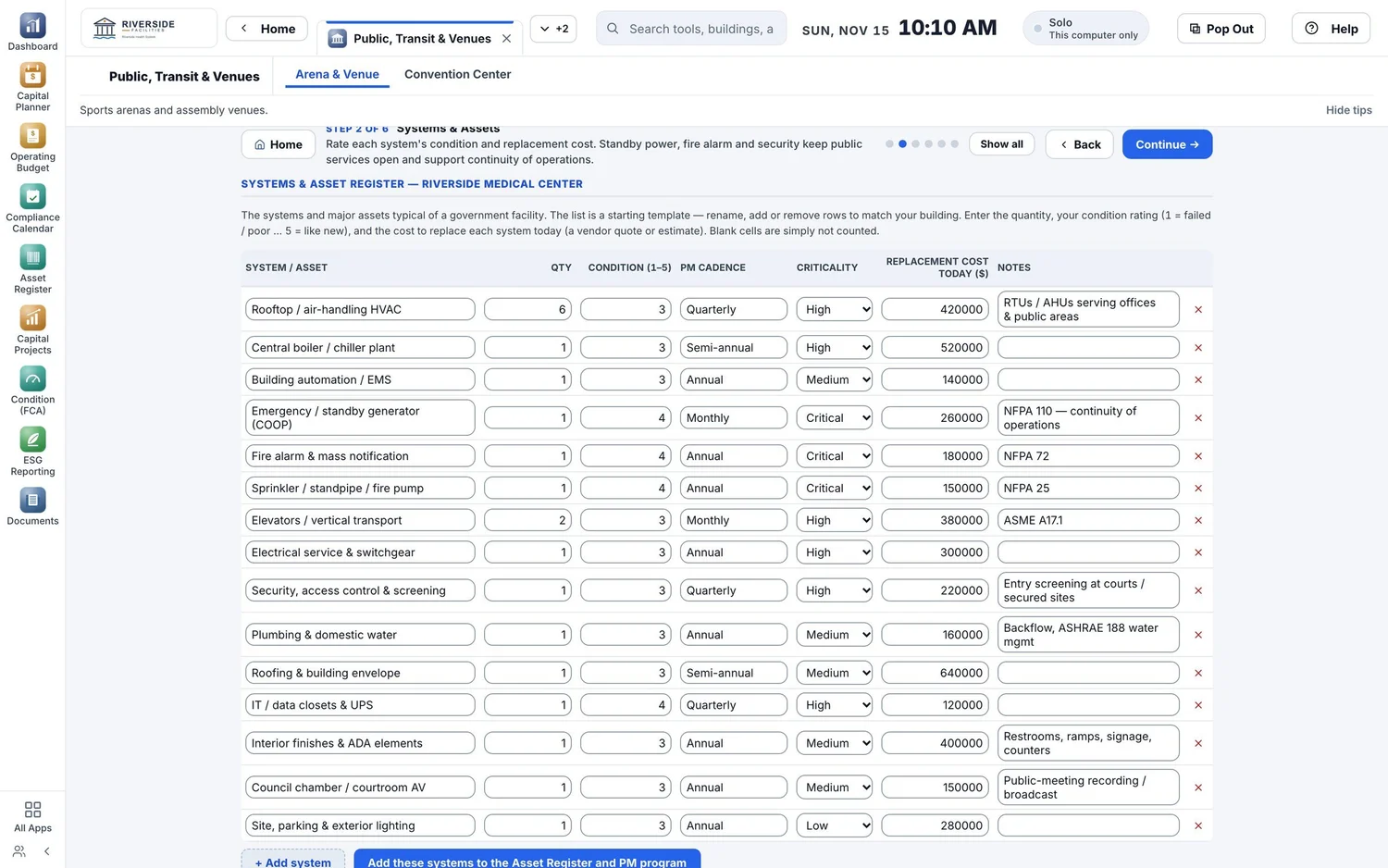
Systems & Assets in Government & Municipal: rate each system's condition and replacement cost. Standby power, fire alarm and security keep public services open and support continuity of operations.
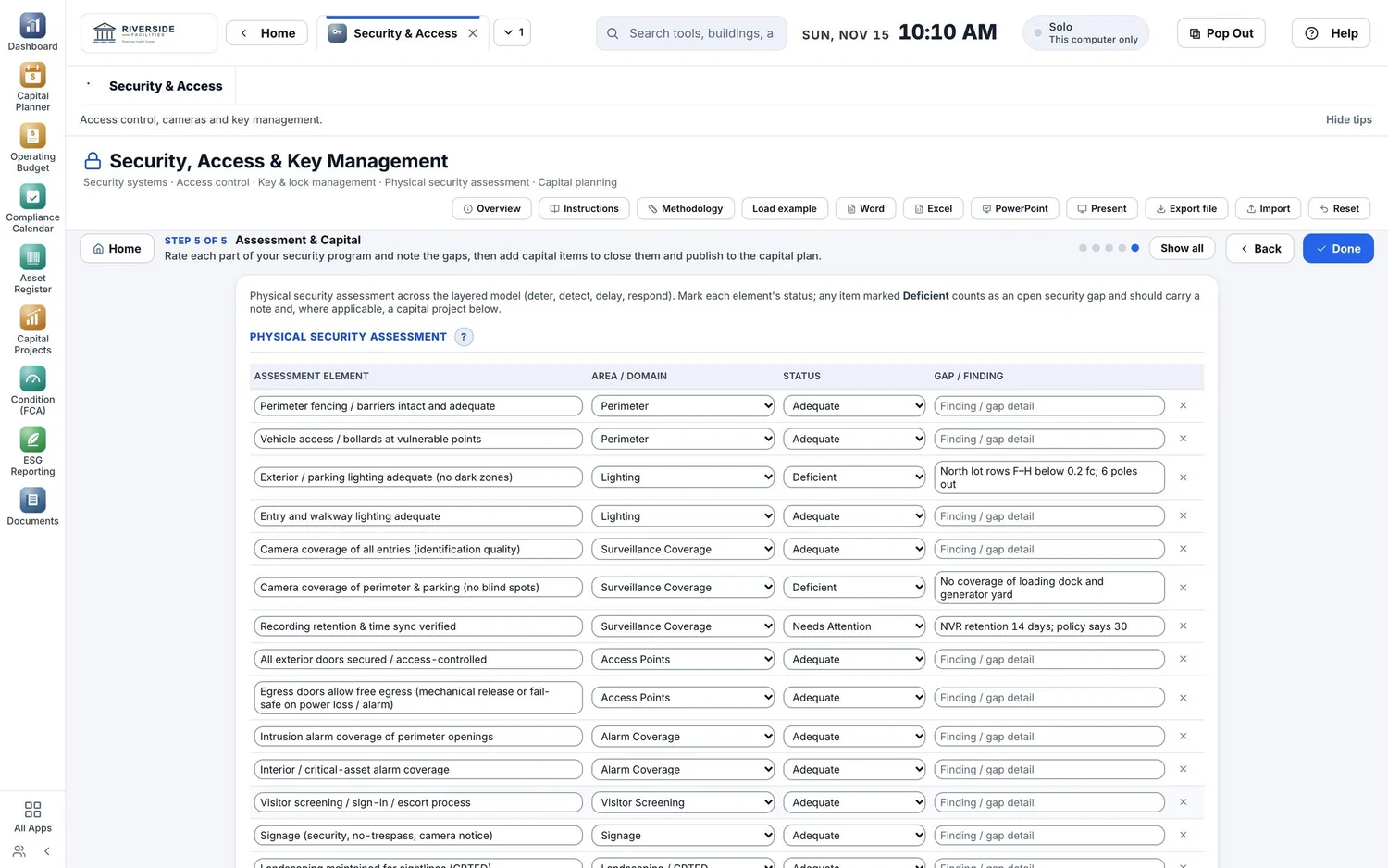
One Calendar for Every Public Building
Compliance Tab
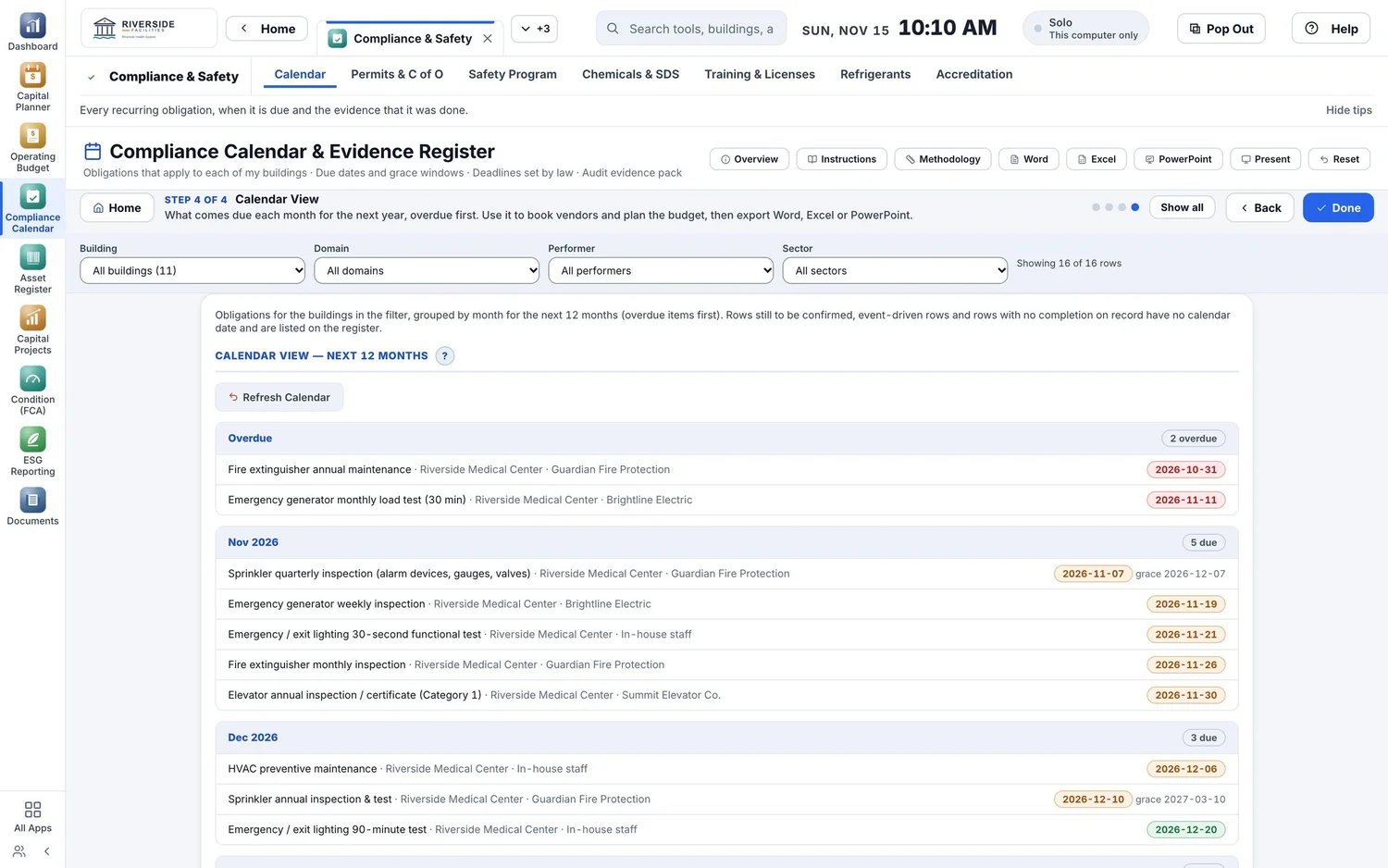
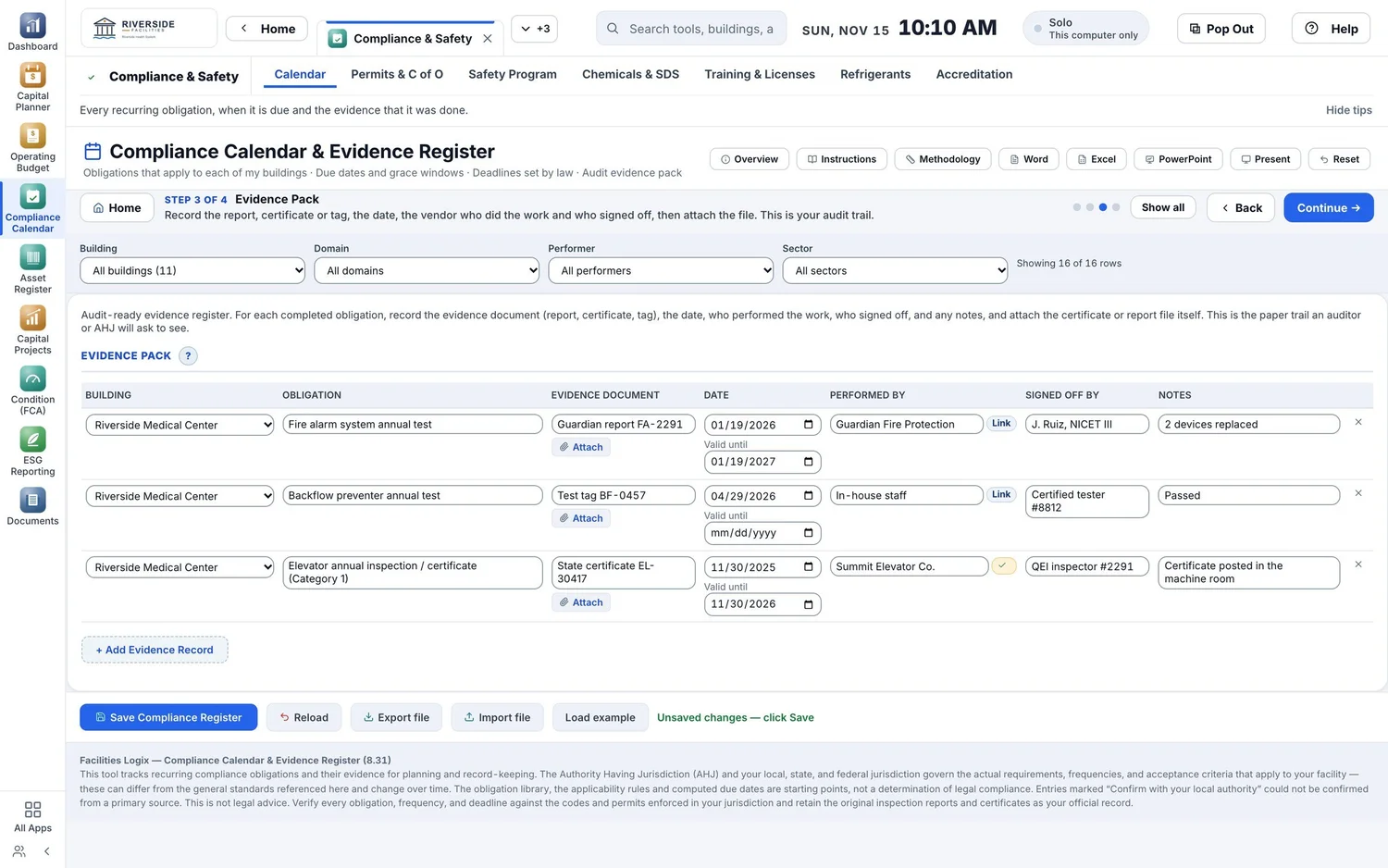
Every obligation that applies to the building and why, with the date last done and the next due date, shared with the Compliance Calendar.
Learn MoreBuild My Calendar
The Compliance Calendar reads the facts from every Building Record, asks only what the records cannot answer, and previews what is new before anything is written.
Learn More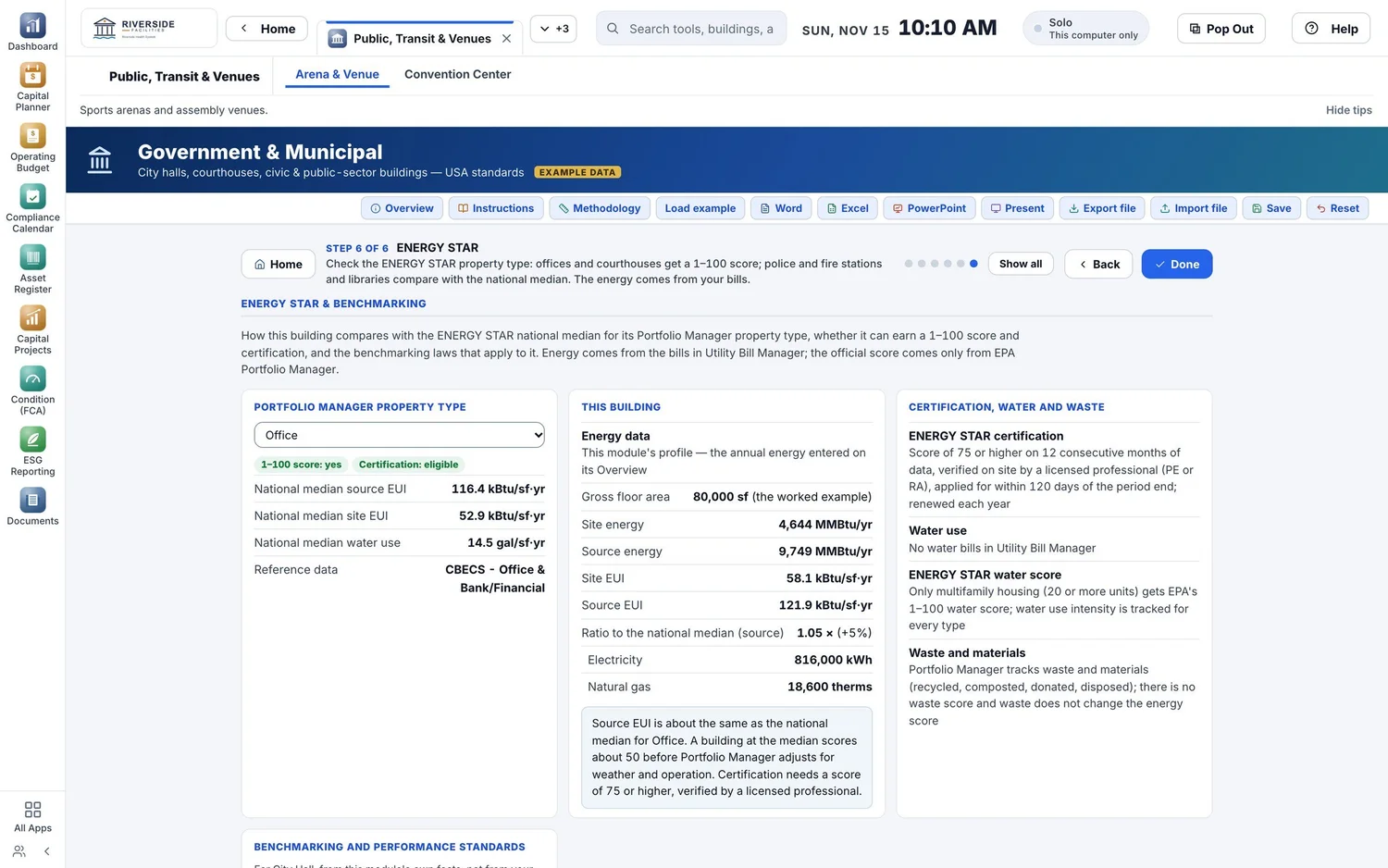
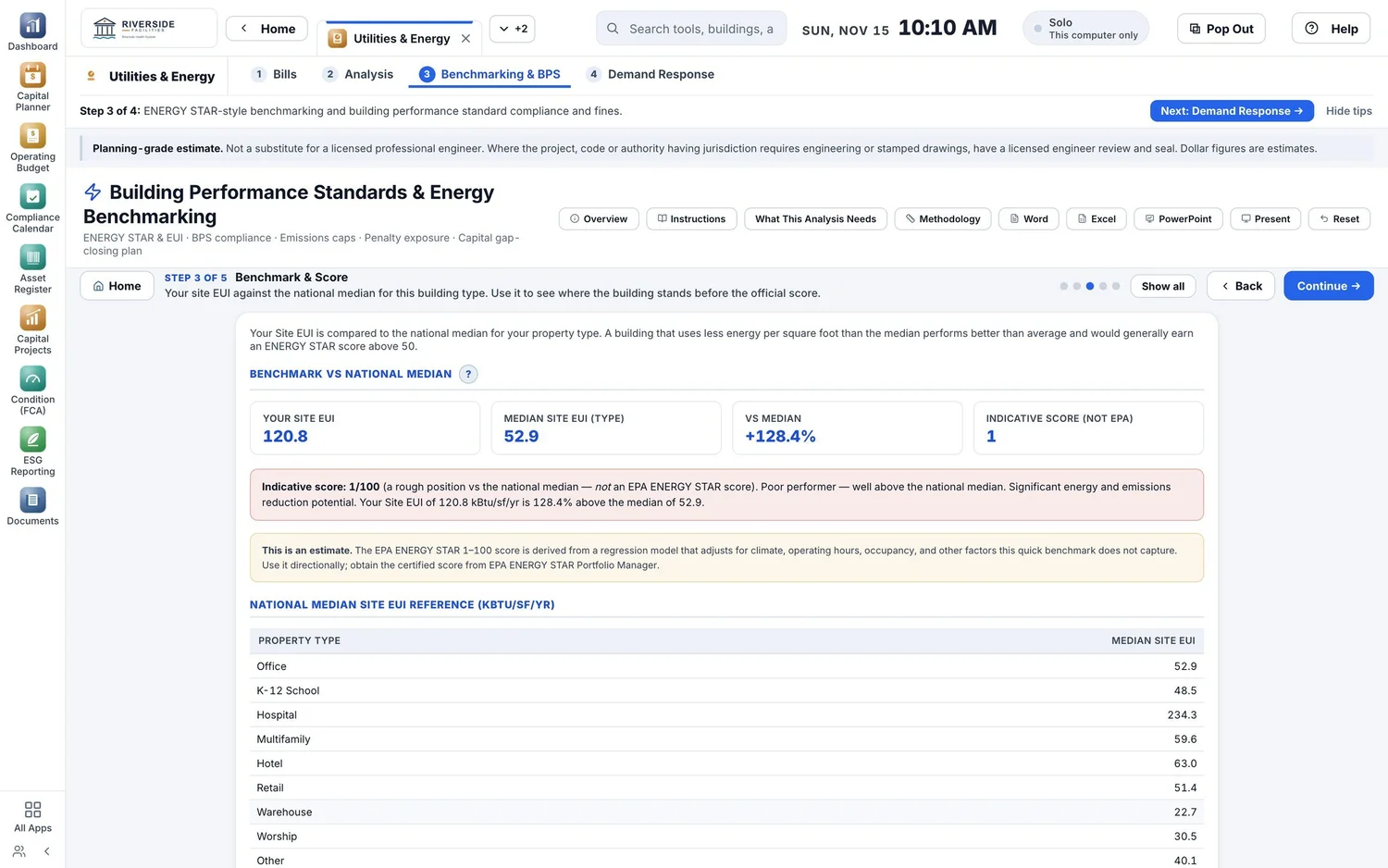
ENERGY STAR in Government & Municipal: check the ENERGY STAR property type: offices and courthouses get a 1–100 score; police and fire stations and libraries compare with the national median. The energy comes from your bills.
AHJ Overrides
When your authority requires a different interval, or no inspection at all, record it with who said so. One organization standard can then be shared across every site.
Learn MoreShow Less
Paying for an inspection your authority does not require, or missing one it wants sooner, both waste money. An override changes the interval or turns the row off, records who said so, and reaches rows already on the Compliance Calendar at once.
- Set it for one building or as the portfolio default
- A building's own override beats the portfolio default, which beats the library
- The row shows an AHJ override tag and the new interval in its reasons
- Remove the override and the row comes back as the library has it
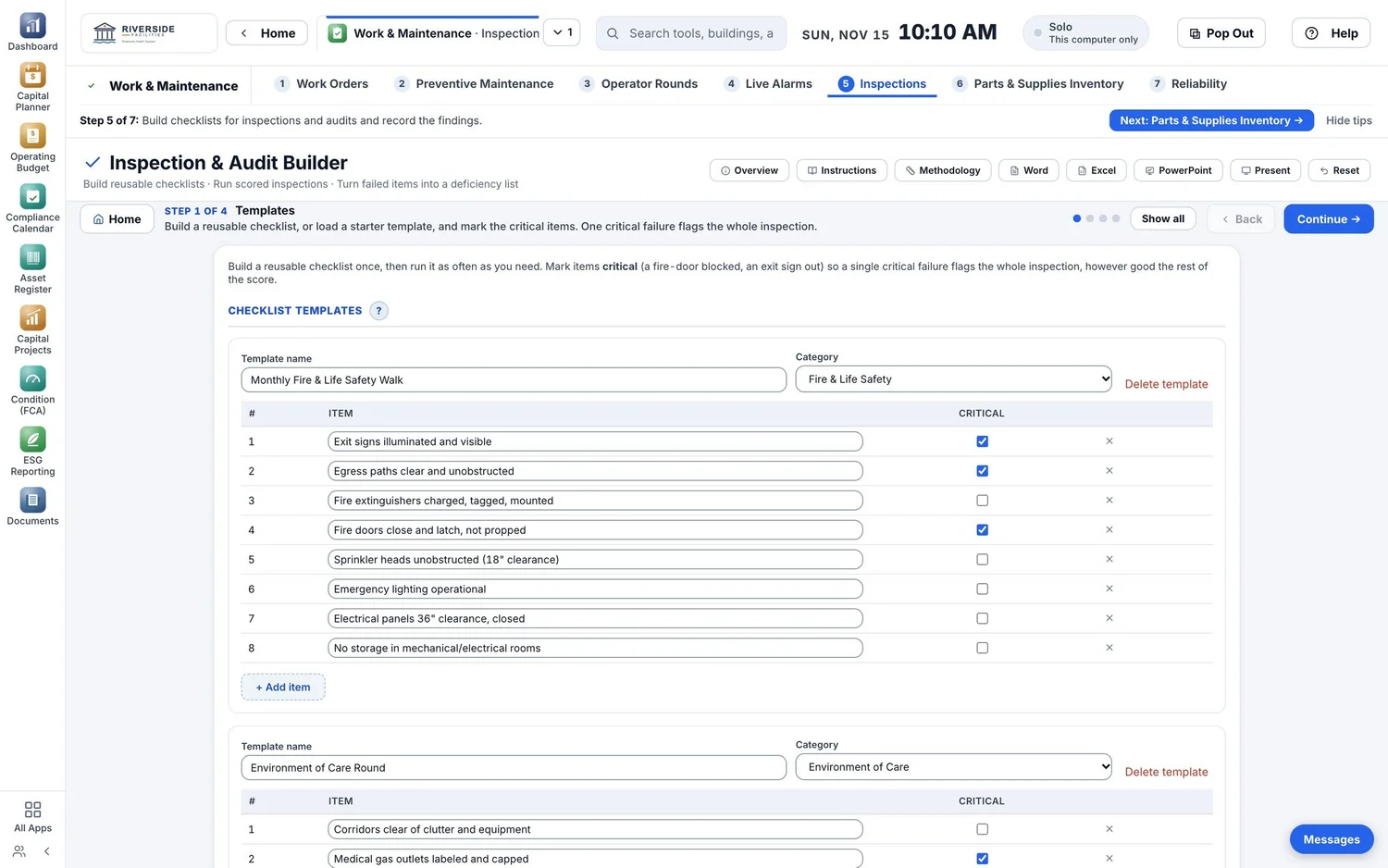
Ready for Council, Auditors and the Public
Word, Excel, PowerPoint and Present
Systems, obligations with their status, the capital plan and the benchmarks in one report.
Learn MoreShow Less
Budget hearings go faster when the deferred backlog and the cost of waiting are on one page. The report leads with a decision summary and key figures, then charts the escalated capital need by year, the backlog by system and compliance status.
- FCI judged against Good under 5%, Fair 5-10% and Poor over 10%
- ADA Title II, COOP and prevailing-wage rows with their due dates
- Systems register, capital plan, compliance calendar and benchmarks sections
- Formulas listed in the methodology so finance staff can check the math
ENERGY STAR
Each facility type compares with its own median: office for city halls, and courthouse, library, police and fire station, meeting hall, repair services and transportation terminal for the other types.
Learn MoreShow Less
Energy is one of the few operating costs a facility team can cut without cutting service. The tab reads your utility bills and shows each building's gap to the right national median, so retrofit money goes where the gap is largest.
- City halls compare as Office: source median 116.4 kBtu/sf, with a 1-100 score and certification
- Courthouses also score and certify; libraries are scored in Canada only
- Public works yards compare as Repair Services, recreation centers as Social/Meeting Hall
- Source energy uses EPA ratios: electricity 2.80, natural gas 1.05
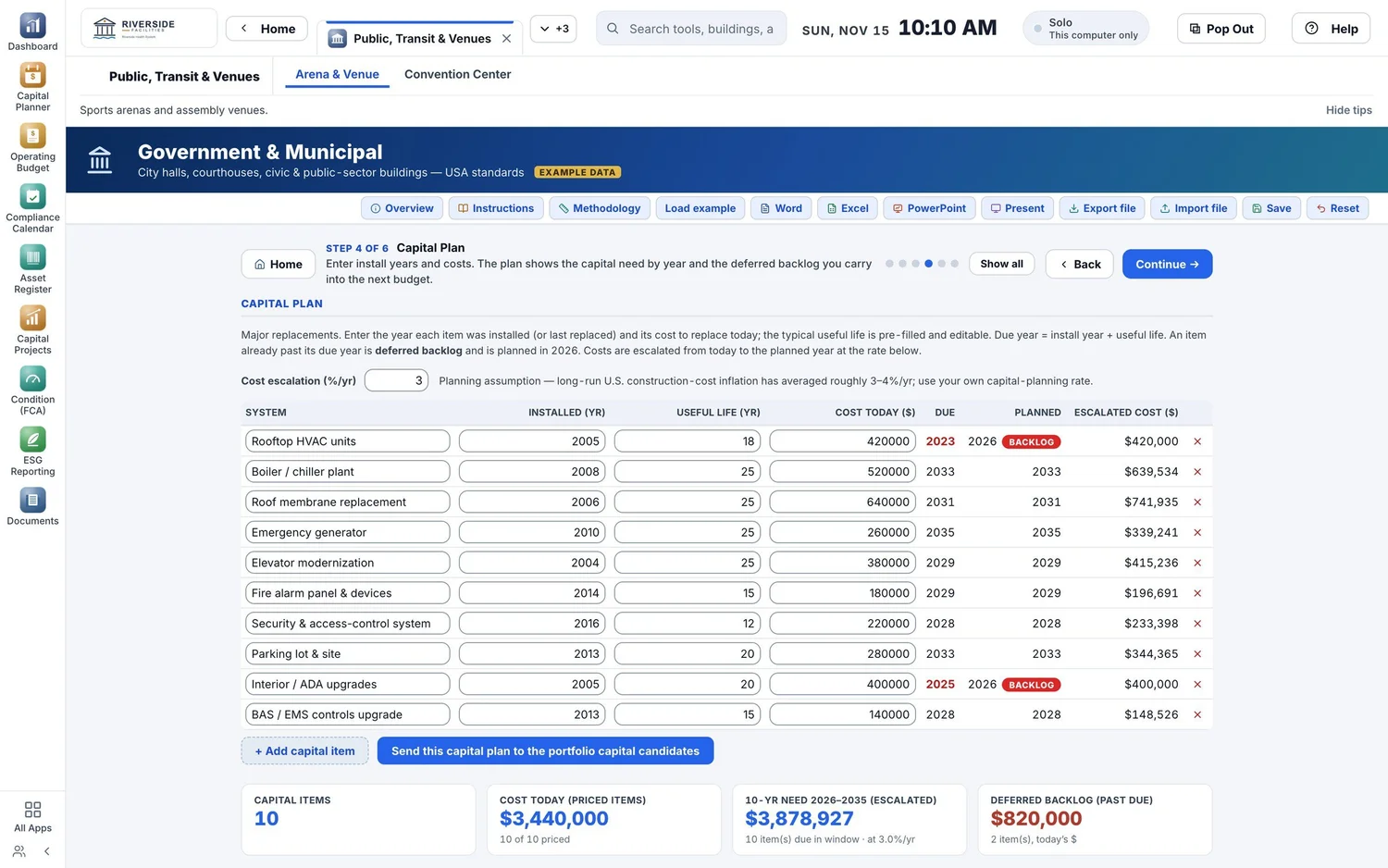
Capital Plan in Government & Municipal: enter install years and costs. The plan shows the capital need by year and the deferred backlog you carry into the next budget.
Benchmarking Laws
Local benchmarking and building performance programs that apply to the building are listed from its city, county, state and floor area.
Learn More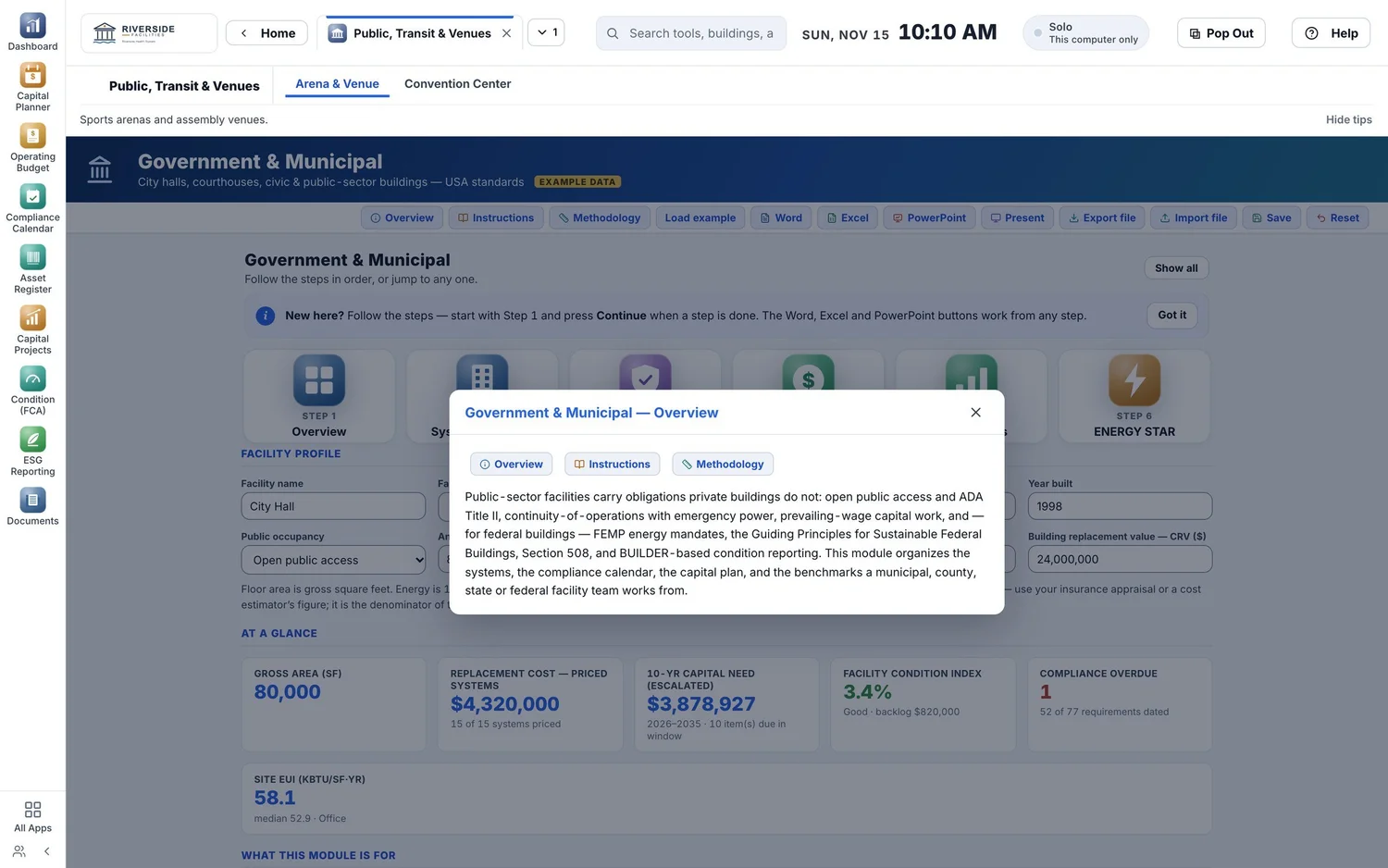
Overview in Government & Municipal: its scope, why it matters and who uses it.
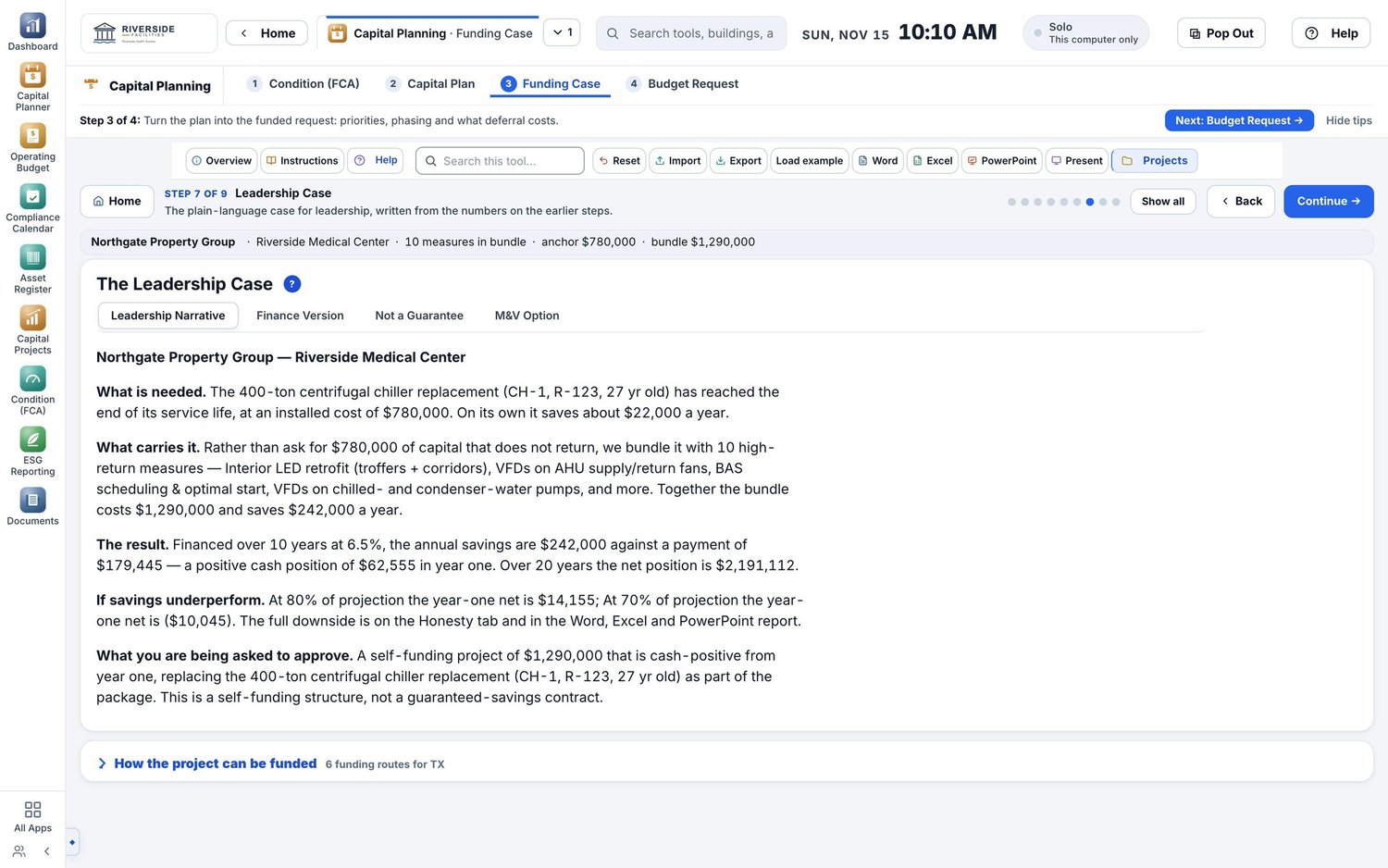
The Leadership Case is written from the numbers, ready to edit and export.
Public-Sector Benchmarks
On the Benchmarks Tab
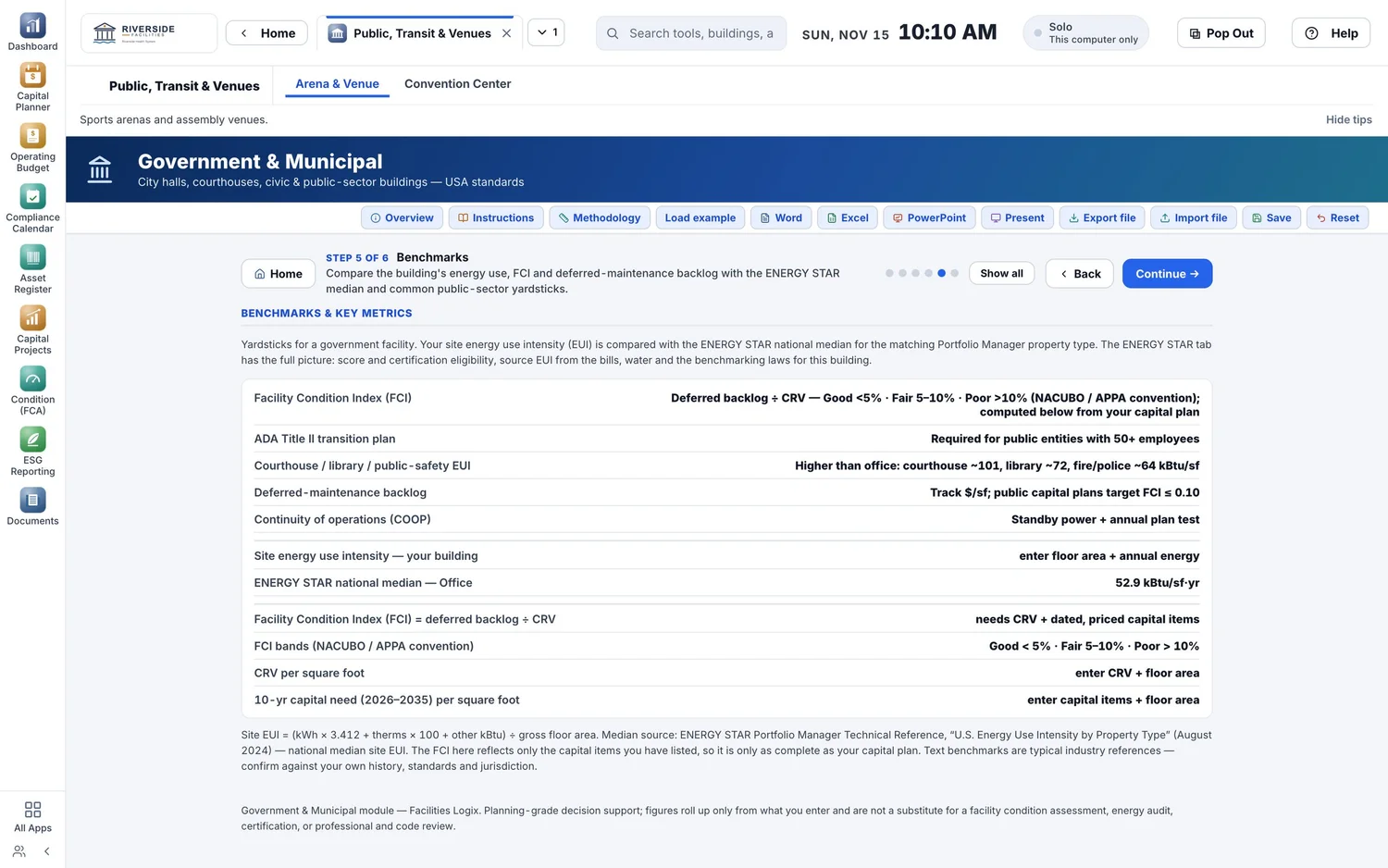
- Facility Condition Index: deferred backlog divided by current replacement value, with Good under 5%, Fair 5-10% and Poor over 10%, worked out from your capital plan
- ADA Title II transition plan, required for public entities with 50 or more employees
- Energy use intensity by type: courthouse about 101, library about 72 and fire or police about 64 kBtu/sf (site), all higher than office
- Deferred maintenance backlog per square foot, against public capital plans that target an FCI of 0.10 or less
- Continuity of operations: standby power and an annual plan test
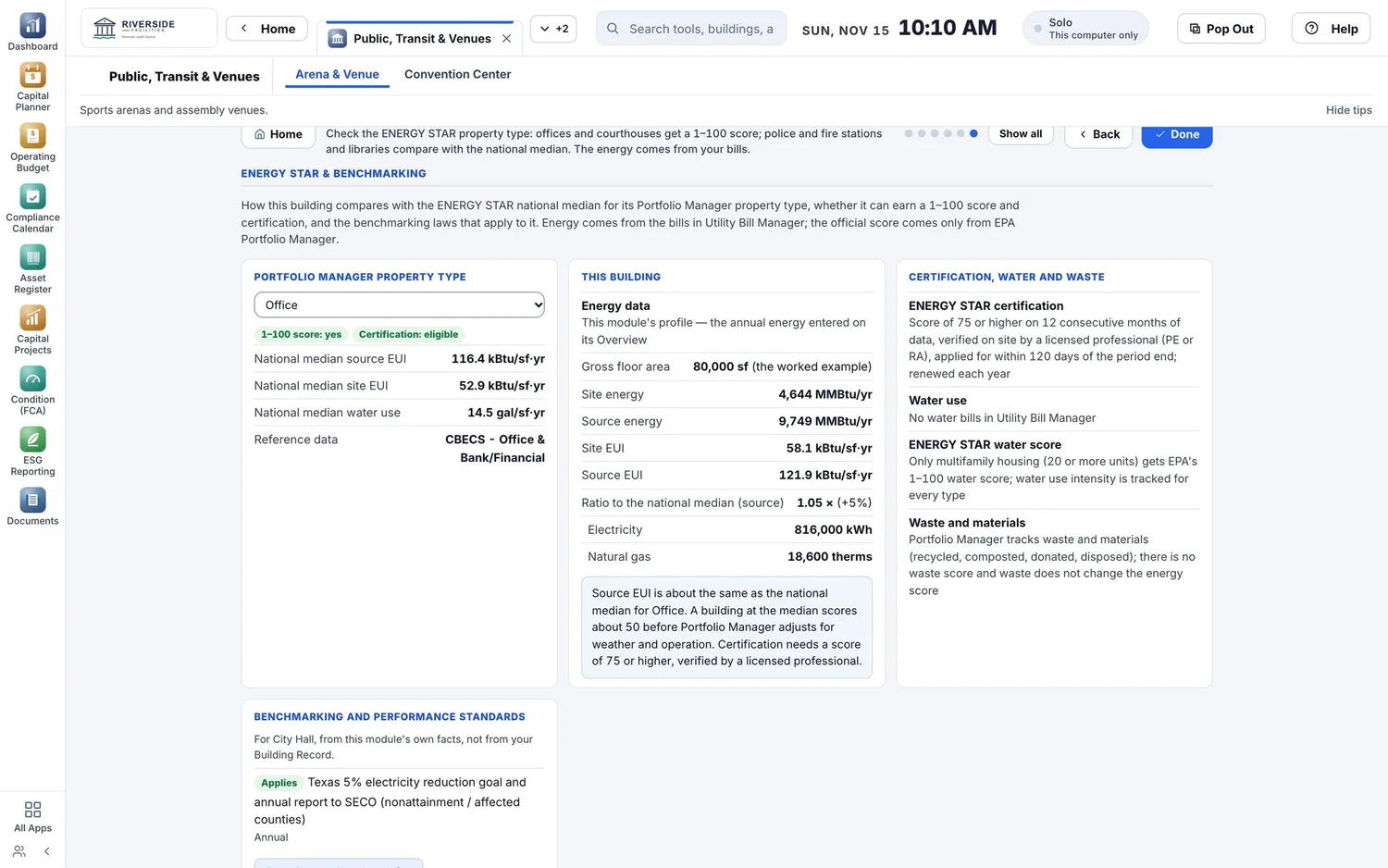
ENERGY STAR in Government & Municipal: check the ENERGY STAR property type: offices and courthouses get a 1–100 score; police and fire stations and libraries compare with the national median. The energy comes from your bills.
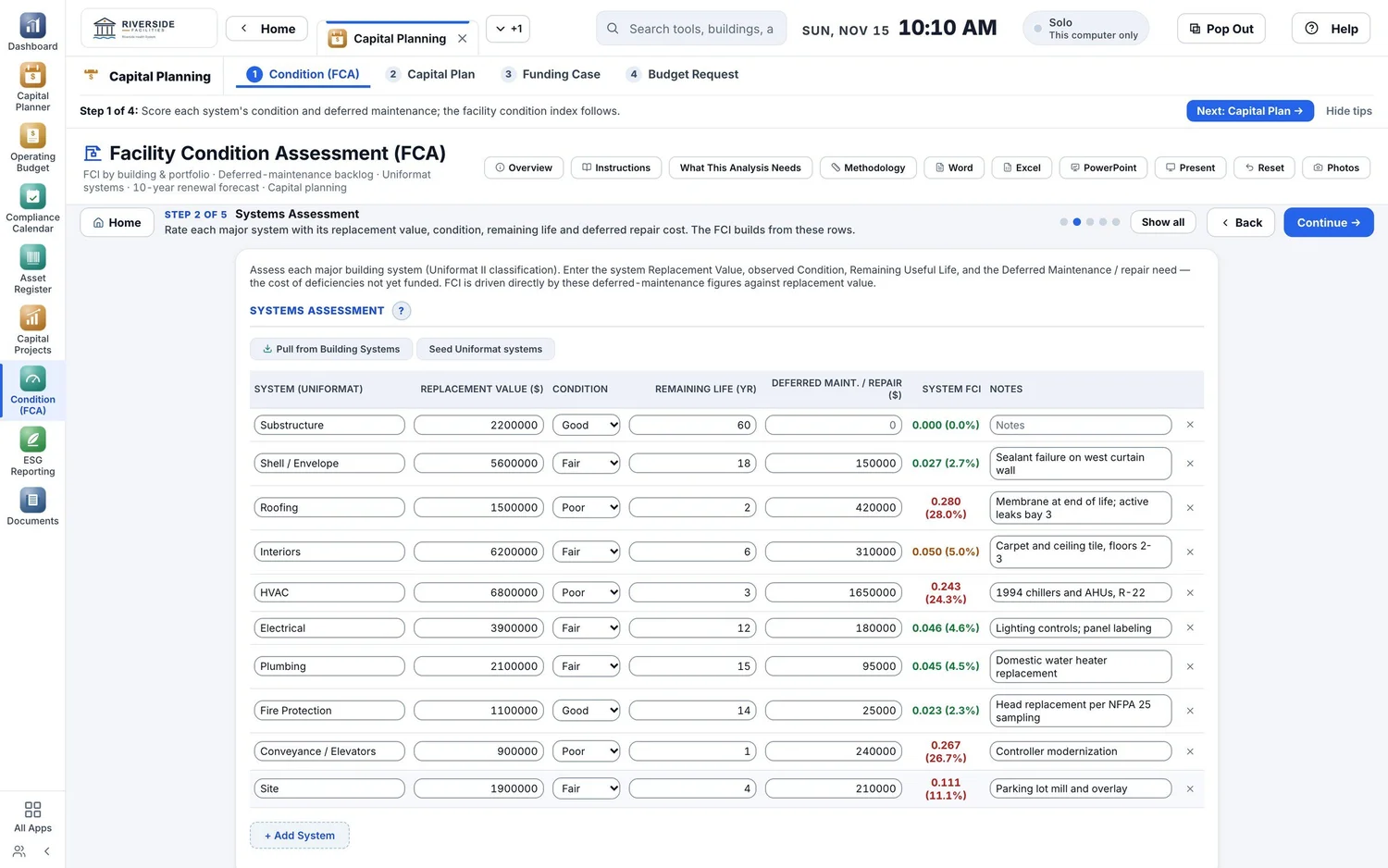
Enter the Facts Once, and Every App Agrees
The Right Rules for Who You Are
A city, a county, a state agency and a federal tenant each get their own accessibility, safety, purchasing and accounting rules without anyone sorting them by hand.
Learn MoreShow Less
Running a city building to federal rules, or federal space to city rules, wastes staff time and leaves real gaps. One reader of the Building Record sets the rules every tool uses, so the ADA app, Purchasing, Safety, Lease Accounting and the Compliance Calendar never disagree.
- Sectors: private, federal, state, county, city, school district, special district and tribal nation
- Workplace safety: OSHA 1910, 29 CFR 1960 for federal, or the state plan
- Purchasing: FAR, 2 CFR 200, the Texas codes or state and local rules
- Accounting: GASB, FASB or FASAB
Purchases That Hold Up
Each purchase order shows the method the amount needs before it is placed, and possible split purchases are flagged, which is what auditors look for.
Learn More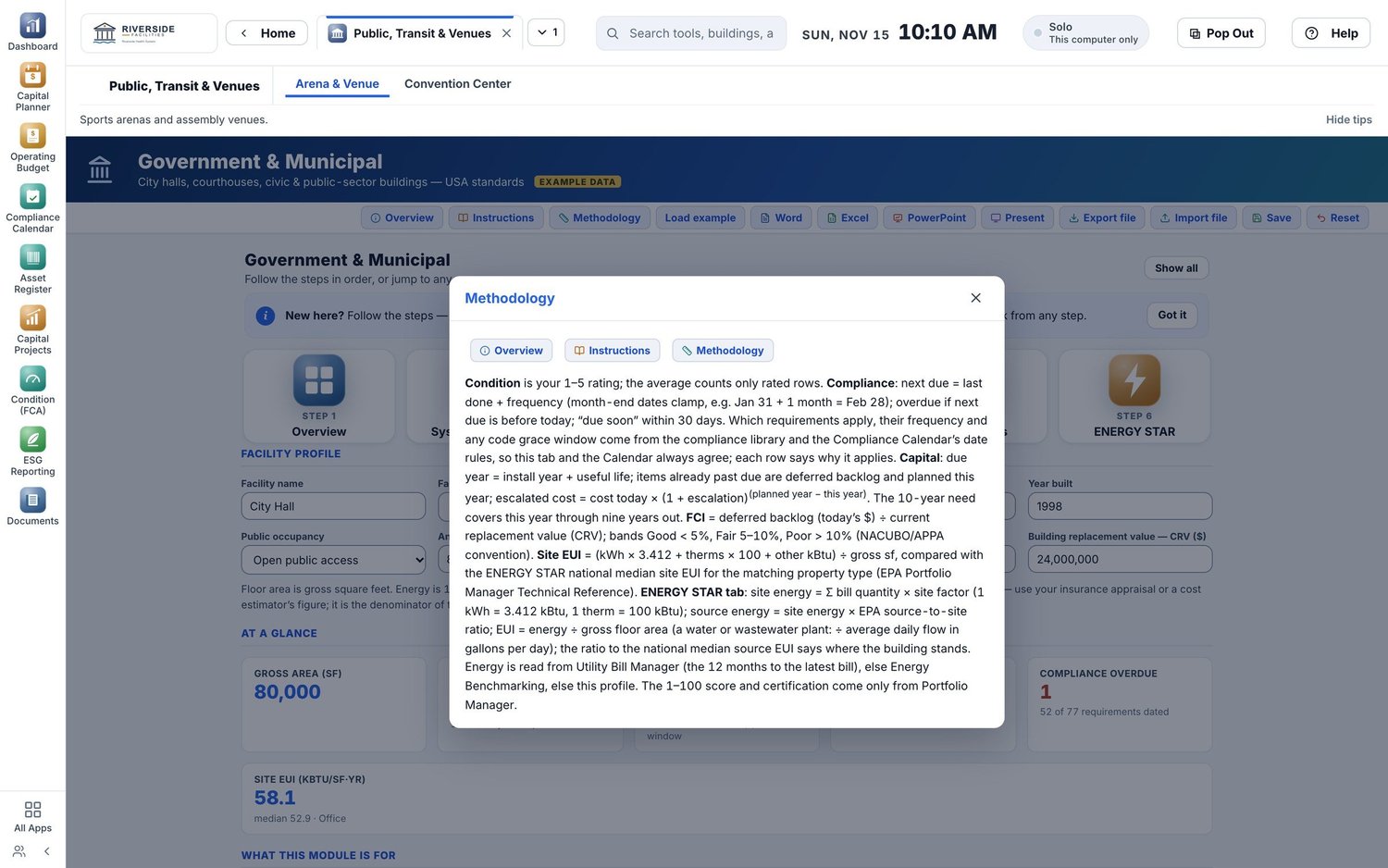
Methodology in Government & Municipal: the formulas and standards behind every number.
Capital Plans Council Can Read
Condition, backlog and the capital plan come from the same records, in reports ready for a budget presentation.
Learn MoreConfirm, Never Guess
Where the law turns on a fact the record does not show, the row says Confirm and names the fact that would settle it.
Learn MoreShow Less
A wrong yes sends money to an inspection that was never required, and a wrong no can mean a missed one. A blank fact stays blank, and every row that depends on it stays on the list marked Confirm.
- The questions that settle the most rows are asked first
- Each answer is given once and shared by the playbooks and the Compliance Calendar
- Counts show how many rows apply, need confirming or do not apply
- Library rows not reviewed in over 365 days are marked stale
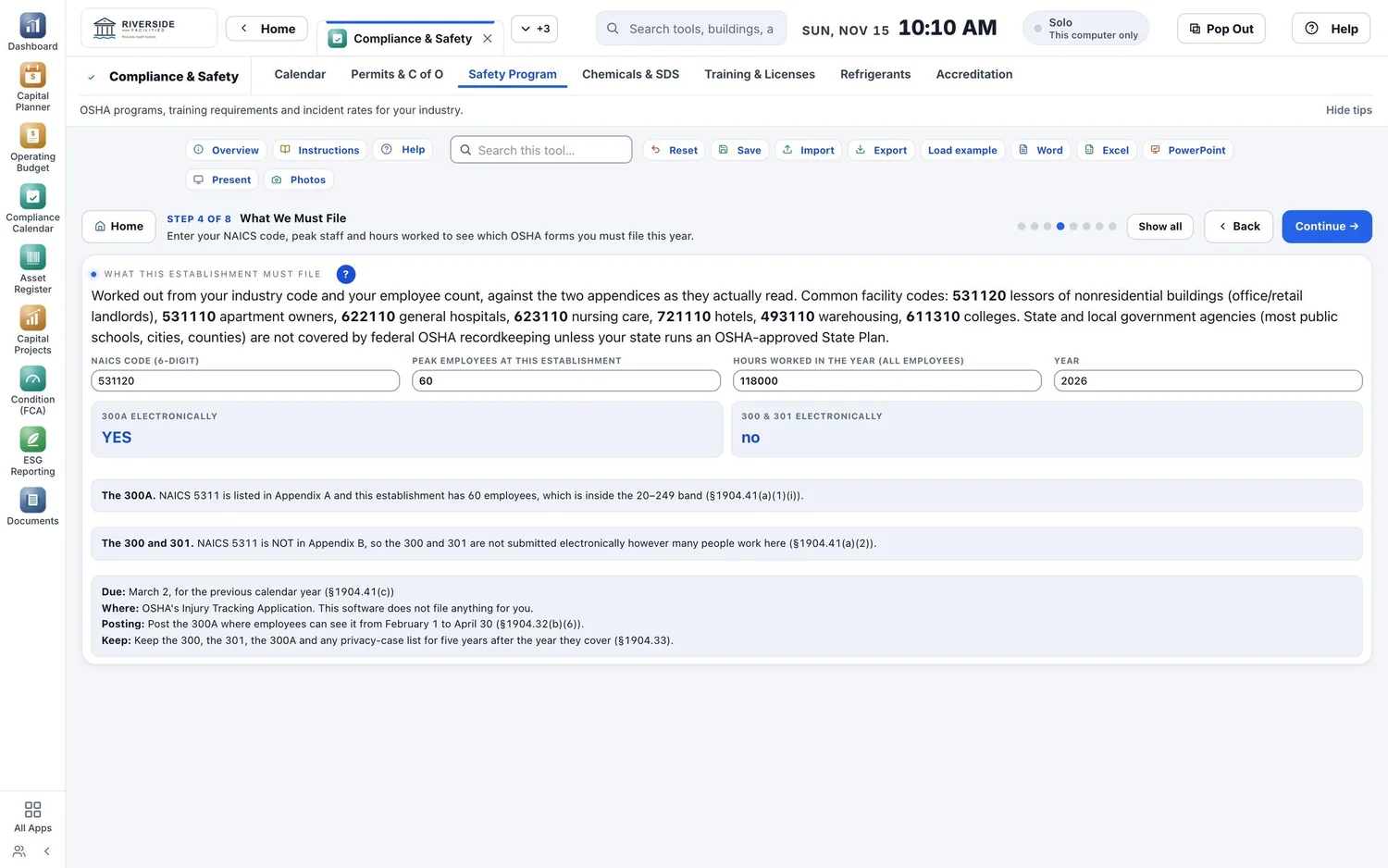
Frequently Asked Questions
Does Facilities Logix decide which laws apply to our buildings?
Can we use our own state's purchasing thresholds?
We are a city with a federal tenant. What applies?
Does it upload our FRPP or federal energy data?
Be First When Facilities Logix Opens
Stop chasing building records across spreadsheets and binders. Join the list and we will tell you the day downloads open, with setup guides ready.
Launching early 2027 for Facilities Logix. Nothing to buy today, and no sales calls.
