


Ships Kept Like Buildings, and Ready When They Are Called.
Launching Early 2027 · Join the Early-Access List
Reserve fleet ships, training ships, cutters, dredges, tugs, barges, yard craft and floating drydocks need the same care as a building, and the cost of a miss is a ship that cannot sail when called. In Facilities Logix, a ship has spaces instead of floors and ship systems instead of building systems. It uses the same work orders, Field rounds and capital plan as every building, and eight steps cover it from lay-up to disposal.
Lay-Up, Coast Guard, Class, Pollution and Disposal
Fifty-one obligations in the compliance library are written for ships. The ship facts (Yes or No) and the readiness status decide which apply, and the Compliance tab shows each rule with the reason it applies. Rules written for buildings, such as fire code, energy laws and elevator and boiler programs, are not applied to a ship.
Lay-Up Under NAVSEA NSTM Chapter 050
- The Readiness and Care of Inactive Ships checks, which MARAD reserve fleets also use for dehumidification
- Humidity inspection at start-up, at the end of weeks 1, 3, 5 and 12, then quarterly, and every 2 weeks while a zone is out of limits
- Dehumidifier operability and elapsed-time meter readings monthly
- Cathodic protection: weekly rectifier log, quarterly hull potential survey, semiannual shorts and opens check, annual meter calibration and a reference electrode every 5 years on automatic systems; aluminum hulls monthly
- Watertight integrity and fire and flooding alarm tests: semiannually for priority ships, yearly for the rest
- Extinguishers kept aboard weighed quarterly, gas-free certification before entering closed spaces, and fire and flooding drills
- A hull condition statement and coating survey at each drydocking, a maximum docking interval for inactive ships under impressed-current protection, and tow preparation
Coast Guard Inspection and Drydock
- Certificate of Inspection: 5 years, with annual and periodic inspections (46 CFR Subchapter I)
- Drydock and internal structure examinations under 46 CFR 91.40-3: two in any 5 years, never more than 3 years apart, and after an underwater survey the next must be a drydocking
- Portable extinguishers looked at monthly and serviced yearly, and fixed CO2 cylinders weighed, with any that lost more than 10% recharged (46 CFR 91.25, Part 147)
- Lifesaving (46 CFR 199): weekly survival craft check with engines run at least 3 minutes, monthly inspection with EPIRB and SART tests, liferaft and hydrostatic release servicing every 12 months, and release gear load tests every 5 years
- The EPIRB yearly test and 5-year shore maintenance are marked Provisional until the primary text is checked
Class, Load Line and Safety Management
- Class surveys: annual (within 3 months of the anniversary), intermediate, special every 5 years with thickness gauging, and the yearly lay-up survey with a reactivation survey before service
- Load line annual survey on a 5-year certificate (46 CFR Part 42)
- International Safety Management (ISM) under 33 CFR Part 96: the Document of Compliance verified yearly, and the Safety Management Certificate's intermediate audit between months 24 and 36
Oil Pollution and Discharges
- Vessel response plan reviewed each year, exercises under 33 CFR 155.1060, and resubmission 6 months before the 5-year approval ends
- Shipboard oil pollution emergency plan on a 5-year approval, ballast water management records and an operable marine sanitation device (33 CFR Part 159)
- Uniform National Discharge Standards for vessels of the Armed Forces (40 CFR Part 1700)
Shipyard Safety and Special Fleets
- Confined spaces tested by a competent person before each entry, and a Marine Chemist certificate before hot work (29 CFR 1915 Subpart B)
- Corps of Engineers floating plant inspected each year in the working mode (EM 385-1-1)
- Navy service craft regular overhaul every 6, 8 or 10 years by craft type (OPNAVINST 4780.6G)
- Floating drydock NAVSEA certification, with structures inspected every 2 years and mechanical and electrical systems yearly (MIL-STD-1625E)
- Heavy-weather (Type III) and permanent (Type IV) moorings for ships that cannot leave in a storm (UFC 4-159-03)
Disposal
- A PCB survey before sale, transfer or scrapping, with PCB items managed under 40 CFR Part 761
- The asbestos and lead survey, hull cleaning before tow and U.S. ship recycling rows are marked Provisional until their primary text is checked
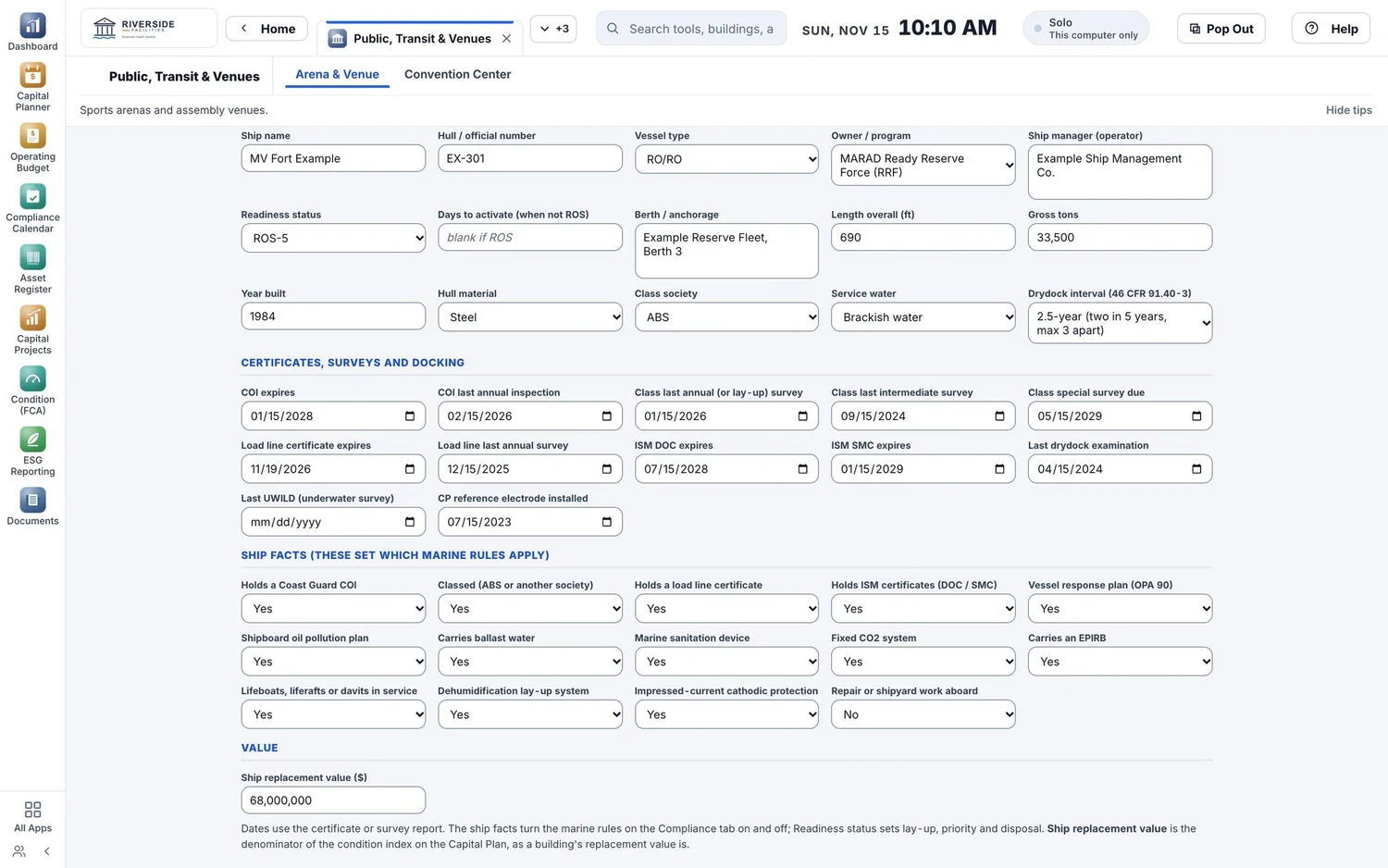
Overview in Ships & Vessels: start here. Pick the ship, then fill in its profile, certificate and survey dates and the ship facts. Readiness status and the facts decide which marine rules apply.
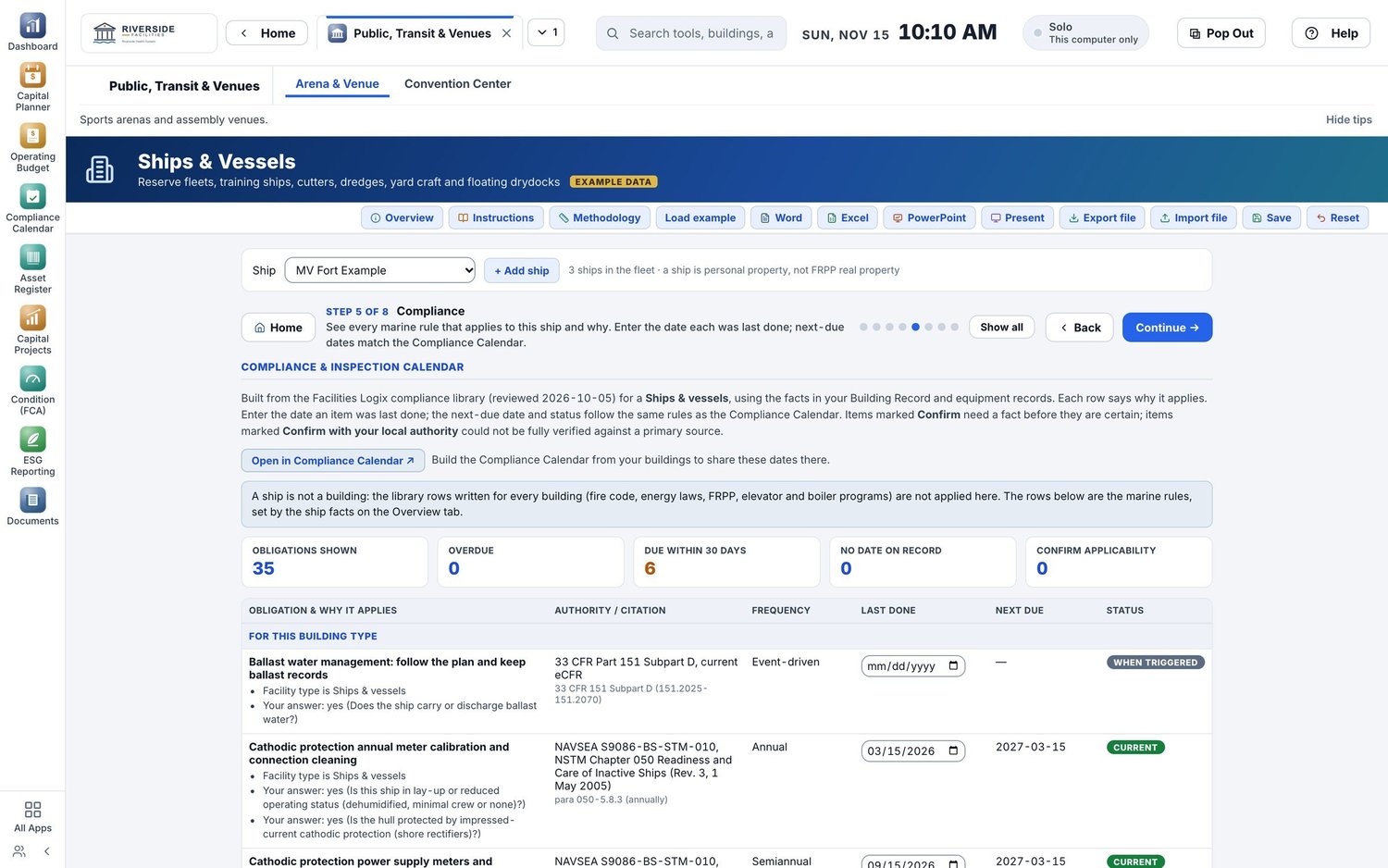
Lay-up, class and pollution rules all carry their own dates, so the obligations that apply to each ship are listed.
A Ship Profile, Its Spaces and Twenty-One Ship Systems
Ship Profile
Hull number, vessel type (RO/RO, crane ship, tanker, training ship, cutter, tug, barge, dredge, floating drydock, yard craft and more), program (MARAD reserve fleet, Ready Reserve Force, Navy inactive ship, Military Sealift Command, Army, Coast Guard, Corps of Engineers, NOAA, state maritime academy, Navy service craft), ship manager, berth, length, gross tons, year built, hull material and class society.
Learn MoreShow Less
A ship is a large asset, so the profile is built to show the condition index a program office funds against. The program and type also switch on the rules a ship owes, so no one pays for surveys it does not need.
- Ship replacement value is the denominator of the condition index
- Navy, Sealift Command and Army programs mark a DoD vessel; Corps programs a floating plant
- Aluminum hulls switch to the aluminum hull potential range
- Drydock interval: 2.5-year, or 5-year for double-hull and unmanned barges
Readiness Status
ROS-4, 5, 10 or 20, retention, non-retention, awaiting disposal or active. The status sets lay-up, priority (ROS ships get the semiannual checks) and disposal, and gives the days to activate.
Learn MoreShow Less
Lay-up money goes furthest when effort matches status. ROS ships keep the tighter checks and cold lay-up ships get the lighter ones, so crew hours go where they count.
- ROS ships keep class annual surveys; cold lay-up gets the yearly lay-up survey instead
- Retention lay-up counts as cold lay-up
- Non-retention and awaiting disposal read Not Kept for Activation
- Active ships drop the lay-up rows
- A ship that is not ROS takes a typed days to activate
Certificates and Surveys
Certificate of Inspection, class annual, intermediate and special surveys, load line, ISM Document of Compliance and Safety Management Certificate, last drydock and underwater survey, each with its date.
Learn MoreShow Less
A lapsed certificate can keep a ship from sailing when called, the failure a reserve fleet exists to prevent. Each date becomes a due item with its rule cited.
- Class annual survey due by 3 months after the anniversary
- COI and load line annual inspections due 12 months after the last
- ISM DOC and SMC expiries cited to 33 CFR 96.330 and 96.340
- A certificate with no date on record shows as a readiness risk
- A lapse inside the activation window is a stop
Spaces Instead of Floors
Engine room, upper machinery room, shaft alley, steering gear room, cargo holds, cabins and passageways, switchboard room and pump room, grouped into dehumidification zones.
Learn MoreShow Less
Moisture damage is found and fixed space by space, so the spaces are where lay-up money is saved. Each space is a location for assets, readings and work.
- Each ship system is filed to its space in the Asset Register
- A space's QR label opens its round points, equipment and open work
- Zones group spaces for the zone average and spread checks
- A space read twice in one day counts once, using the latest reading
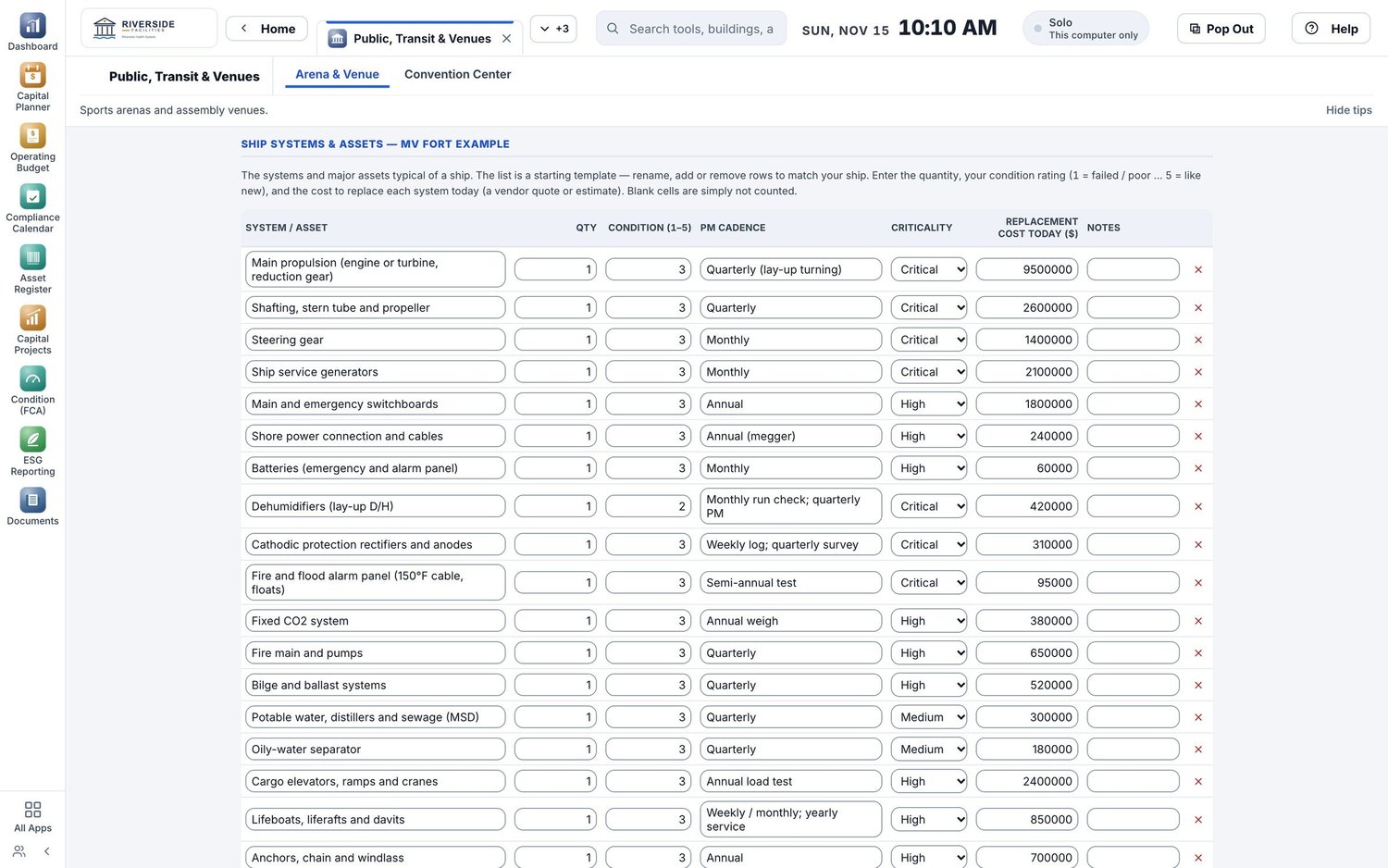
Systems & Assets in Ships & Vessels: rate each ship system: propulsion, steering, generators, shore power, dehumidifiers, cathodic protection, alarm panel, CO2, lifesaving and the rest.
Ship Systems with PM Cadence
Propulsion turned quarterly, shafting, steering gear and generators monthly, switchboards and shore power yearly, batteries, dehumidifiers, cathodic protection, the fire and flood alarm panel, CO2, fire main, bilge and ballast, potable water and sewage, the oily-water separator, cargo elevators and ramps, lifesaving, anchors, mooring lines, hull and coating, and HVAC.
Learn MoreShow Less
Scheduled PM on a laid-up ship costs less than a repair found at activation. One button sends the systems to the Asset Register and PM program, each with its own task wording.
- Main engine and shafting turned on the quarterly lay-up schedule
- Lifesaving gets three tasks: weekly, monthly and the yearly service
- Design lives start the capital plan: batteries 5 years, mooring lines 8, propulsion 30
- Systems with no calendar interval, such as hull coating, are listed to schedule by event
- Edits made in the Asset Register are kept when the systems are sent again
One of Your Buildings
Add a ship and it becomes a building of the type Ships and Vessels, so the Compliance Calendar, Work Orders and the Field app see it. The ship facts are kept on its building record, so a ship added by Import or Team sync gets the same rows without anyone opening the module.
Learn MoreShow Less
Running ships in the same system as buildings saves a second program and a second round of training. The ship's own logs date its compliance rows wherever they are read.
- The Compliance Calendar reads the next drydock and humidity dates from the ship's logs
- Rectifier, meter and alarm test entries count as completions on the calendar
- Work orders use the same WO numbering as Work Orders and the phones
- A ship can start in the module and be added to your buildings later
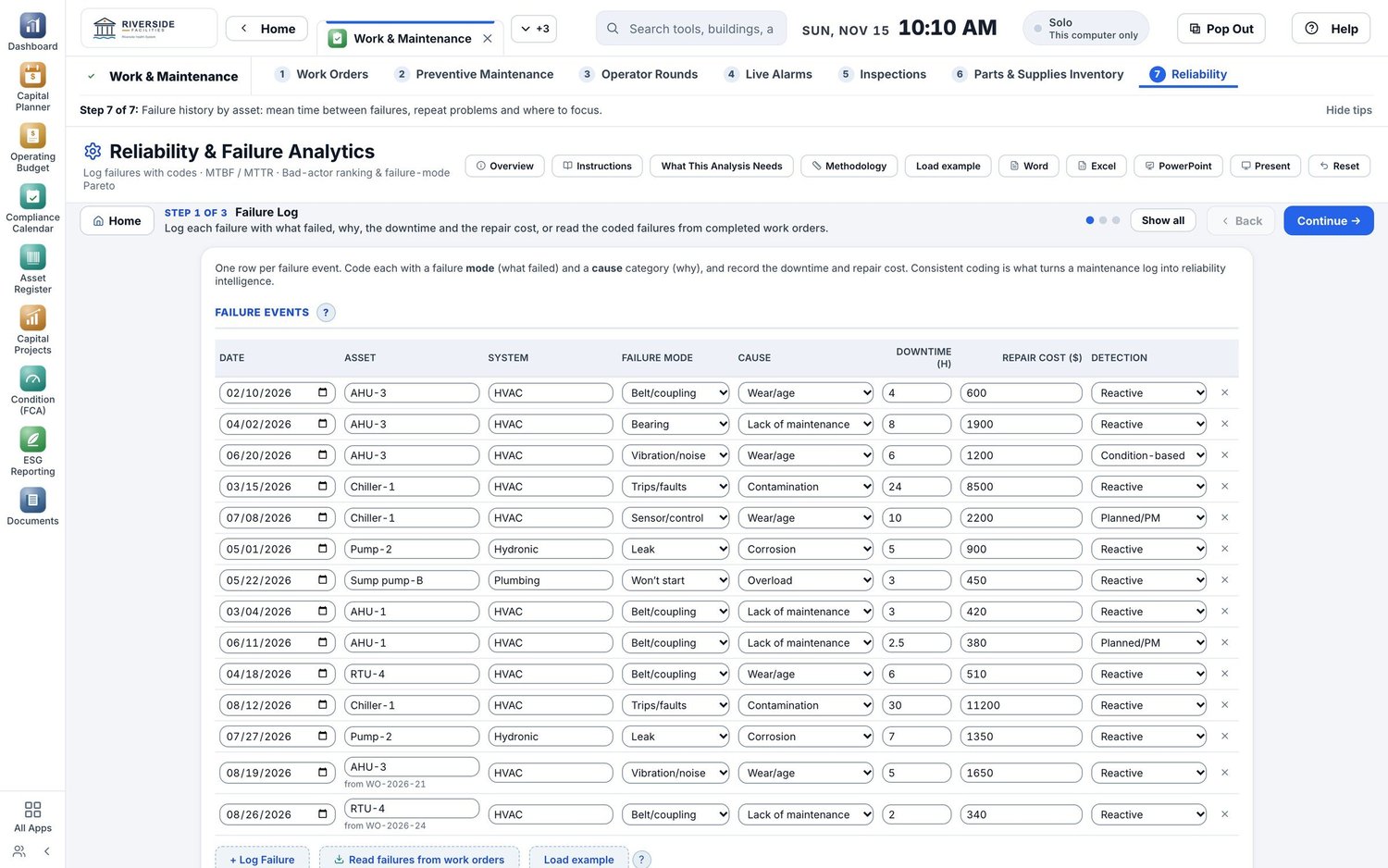
Failure Log in Reliability & Failure Analytics: log each failure with what failed, why, the downtime and the repair cost, or read the coded failures from completed work orders.
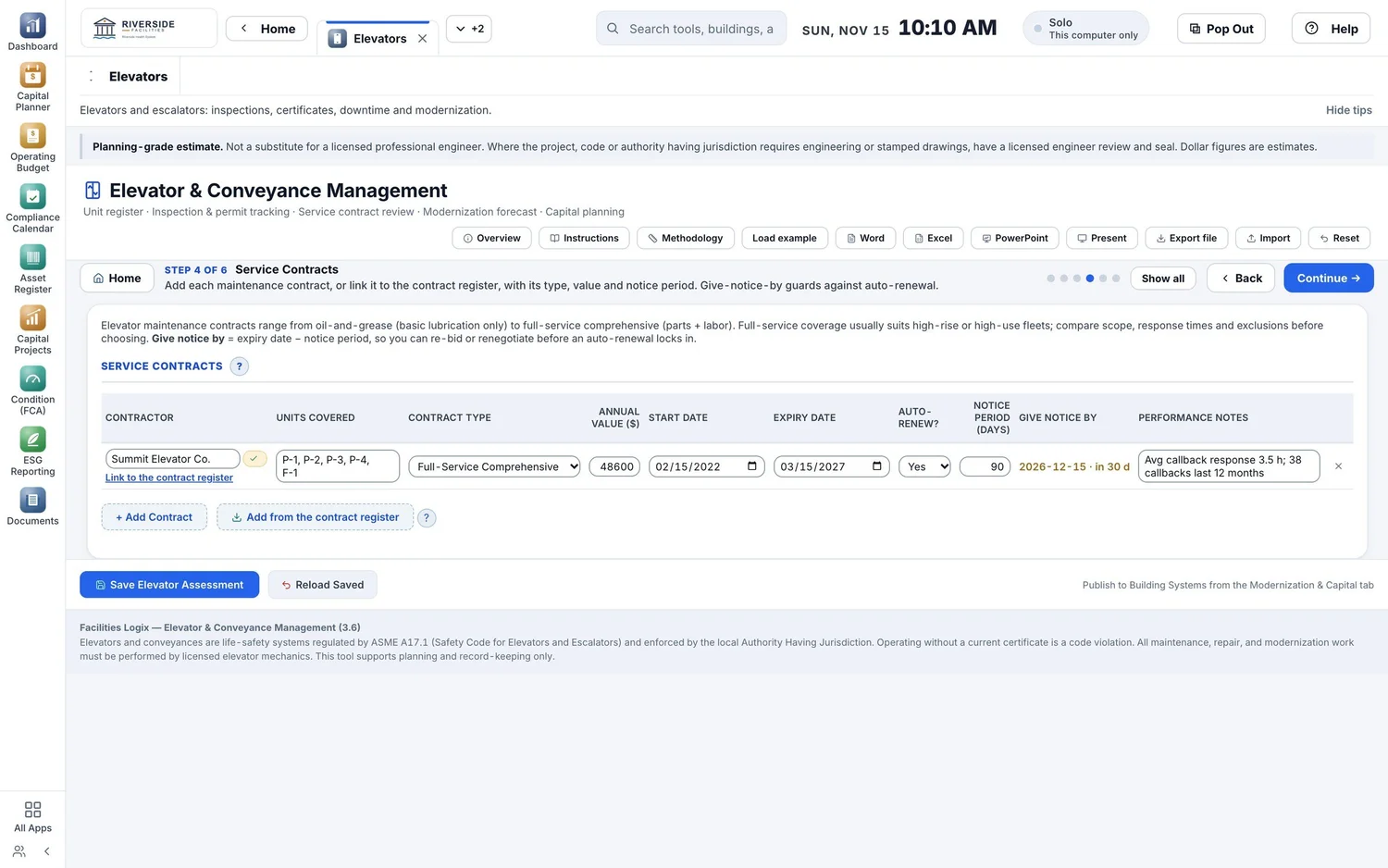
The Lay-Up Tab: What Keeps a Ship from Rotting at the Pier
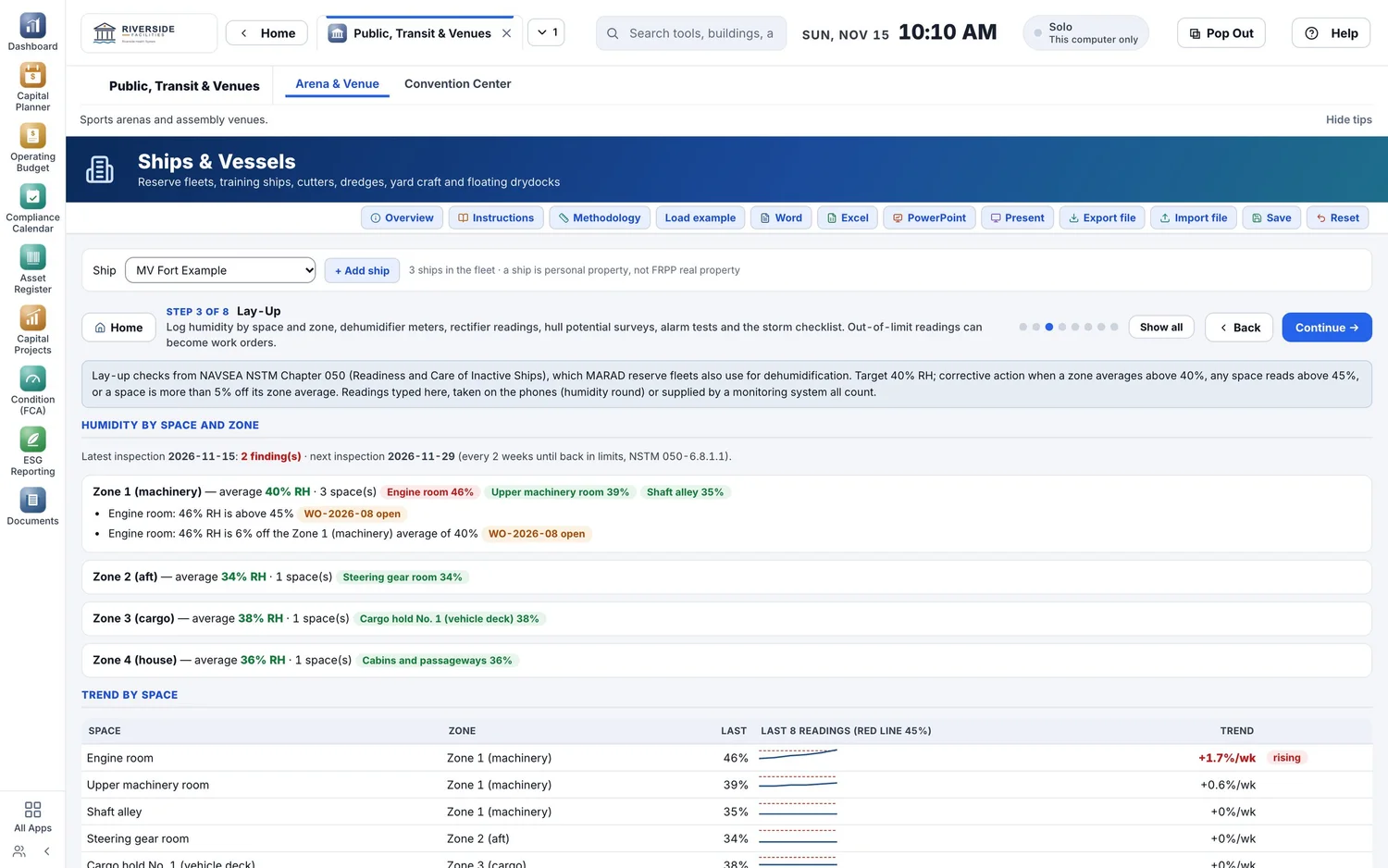
Humidity by Space and Zone
- Log a reading for each space at each inspection, against a 40% RH target
- A zone averaging above 40%, any space above 45% or a space more than 5% off its zone average is a finding, with a Make Work Order button
- Next inspection is quarterly while every zone is in limits, every 2 weeks while one is not
- A trend line and the change per week show a space creeping up before it alarms
Phone Humidity Round and QR Labels
- Set Up the Phone Humidity Round puts one round point per space in the Field app, with Watch above 40% and Alert above 45%
- Print Space Labels gives each space a QR label
- Readings taken in the Field app come back into the humidity log
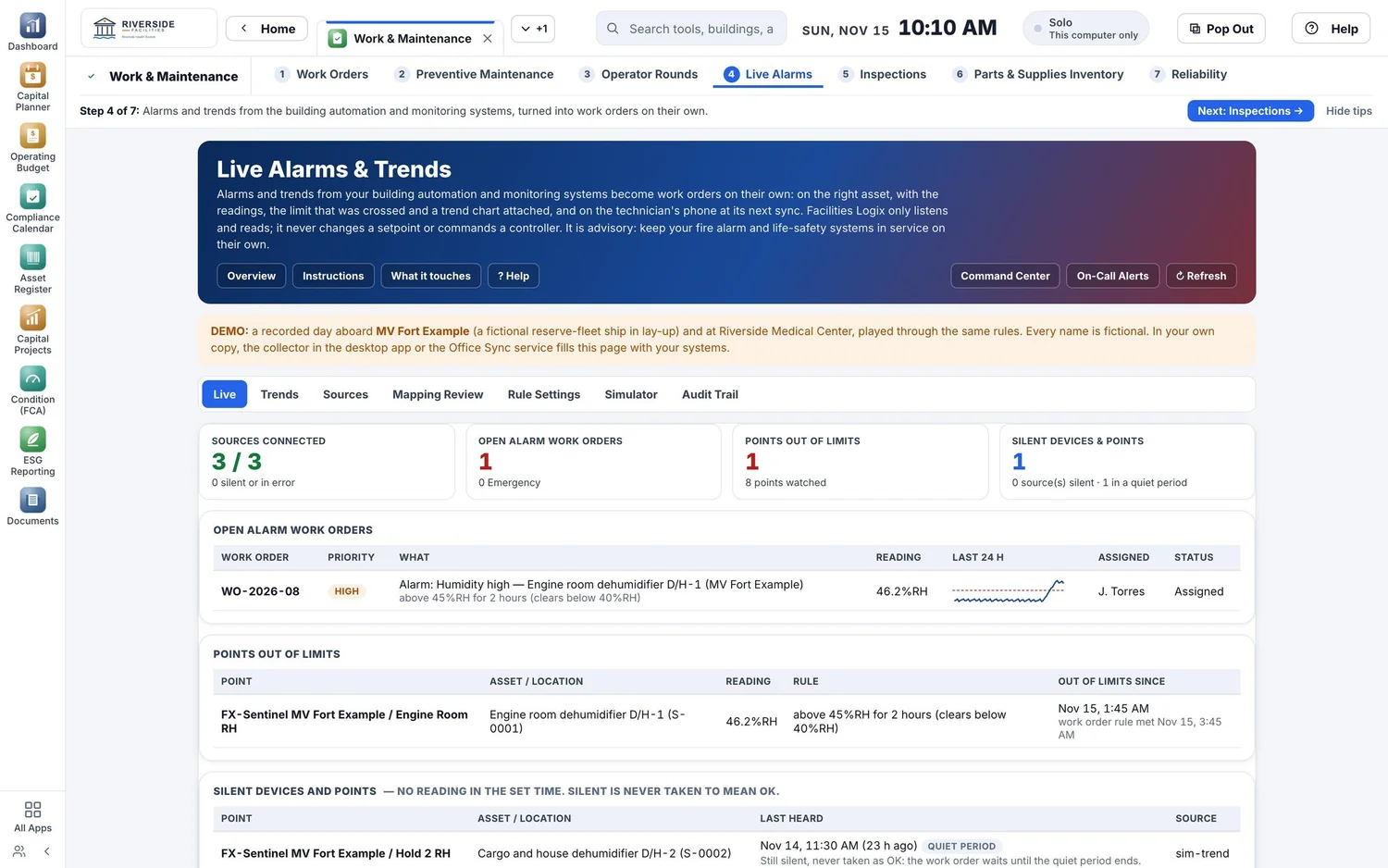
Live Alarms & Trends: sources connected, open alarm work orders and points out of limits on one screen.
Dehumidifier Run Time and Sizing
- Read each machine's elapsed-time meter monthly; running more than 50% of the time is unsatisfactory
- Sizing by zone: volume, leakage assumption, water to remove, dry airflow, the dry-air hose with its 4 in. drops and the 12 in. circulation holes per closed bulkhead, the portable units needed and their run time
- The need is set against the machines the run-time log shows
- Size This Zone opens the Field Toolbox Dehumidifier tab with the ship, zone and volume filled in, and the result comes back to the table. A zone with no sizing shows a dash, never a made-up number
Cathodic Protection
- The weekly rectifier log of output voltage and current
- The quarterly hull potential survey about every 50 ft and at both ends, -0.80 to -1.20 V against silver/silver chloride
- Aluminum hulls monthly, -0.92 to -1.10 V
Fire and Flooding Alarm Tests
- The 150°F heat cable and the flood floats, tested semiannually for priority ships and yearly for the rest
- A failed sensor stays open until it passes a retest
Mooring and Storm Checklist
- Type IV permanent mooring and Type III heavy-weather mooring items (UFC 4-159-03), each with a date

PM Compliance: how many tasks are on time, and which systems are falling behind.
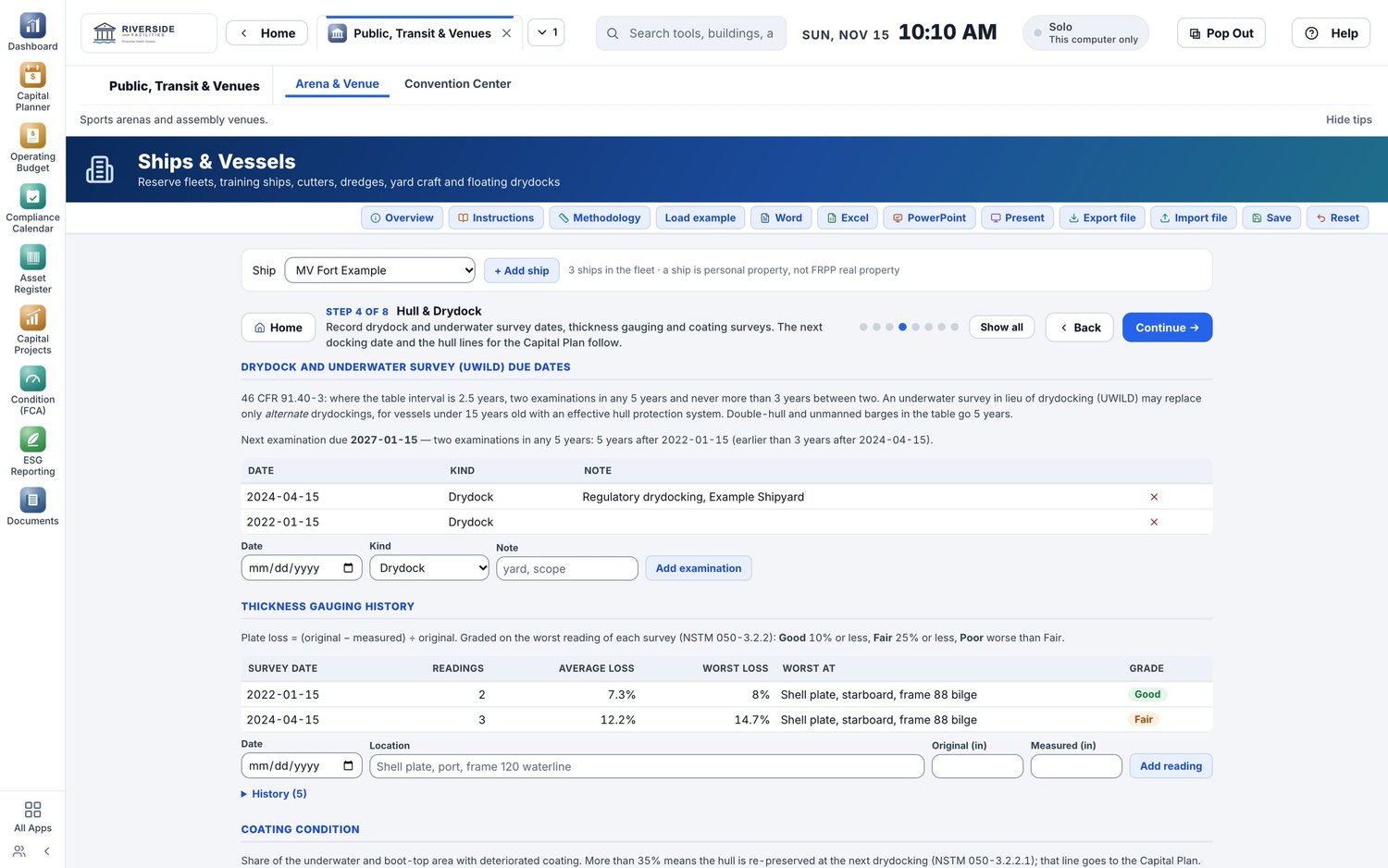
Hull and Drydock
- Drydock and underwater survey dates with the next one due under the 46 CFR 91.40-3 rule
- Thickness gauging graded Good (10% loss or less), Fair (25% or less) or Poor
- Coating surveys, with re-preservation flagged when more than 35% has deteriorated

Renewal Forecast: what comes due in each of the next ten years, so the money is asked for early.
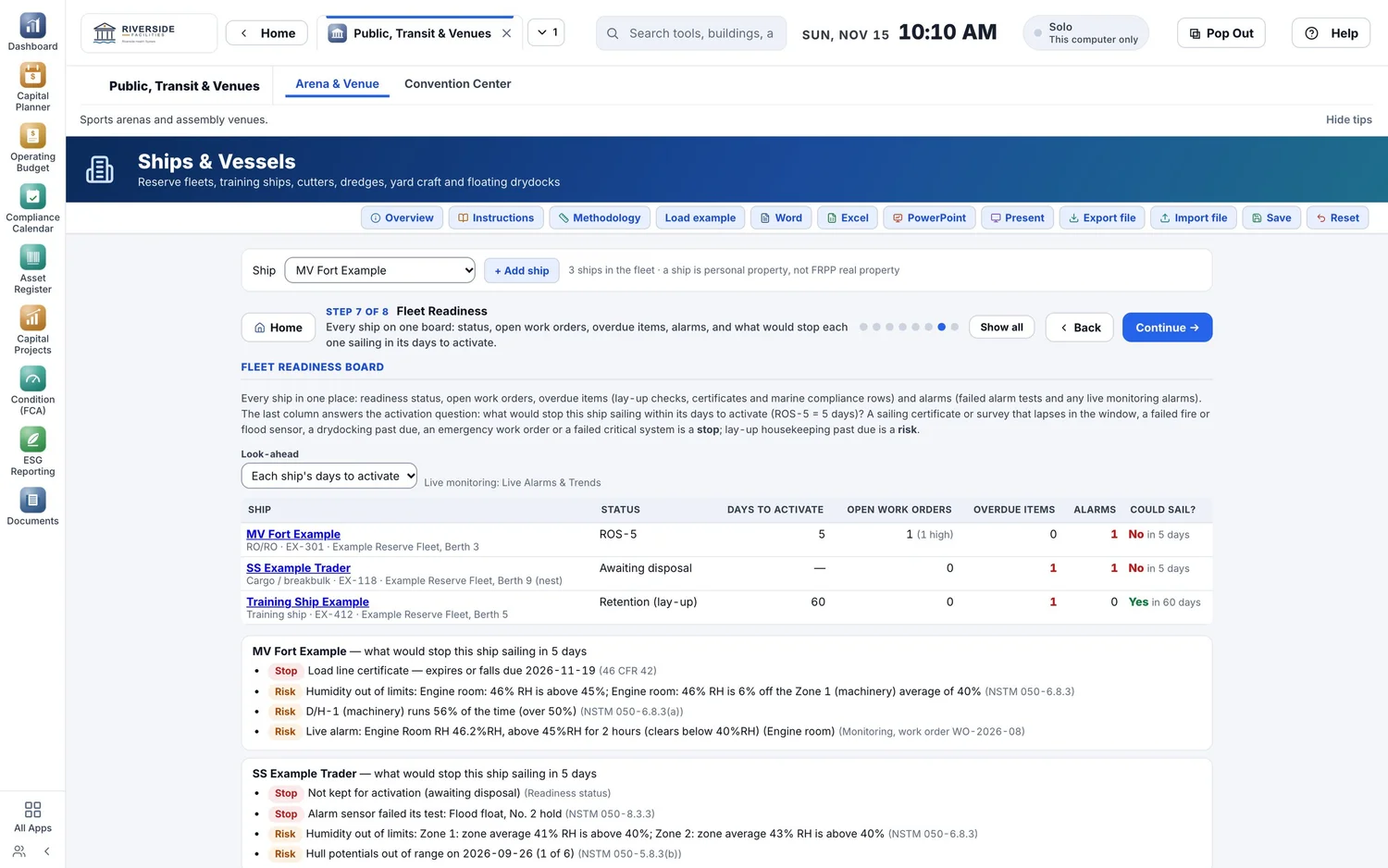
Could It Sail?
Fleet Readiness Board
Every ship on one board: status, days to activate, open work orders, overdue items and alarms, and whether it could sail within its days to activate (ROS-5 means 5 days).
Learn MoreShow Less
A failed activation costs far more than the check that would have caught it. The board lets a manager test any window, not just each ship's own.
- Look ahead 5, 10, 20, 30 or 60 days across the fleet
- Open work orders show how many are high or emergency priority
- Overdue counts include marine compliance rows, never counted twice
- Each ship's stops and risks are listed under the table
- With two or more ships, the Word report adds a fleet readiness table
Stops and Risks
A certificate or survey that lapses in the window, a failed fire or flood sensor, a drydocking past due, an emergency work order or a failed critical system is a stop. Lay-up housekeeping past due is a risk. A connected monitoring system's alarms show here too.
Learn MoreShow Less
Knowing which items truly block sailing tells the program where to spend first. Each item is graded by its effect on the activation, and each names its source.
- A Critical or High system rated failed is a stop
- An emergency work order is a stop; a high-priority one is a risk
- Live fire, flood or power alarms are stops; other alarms are risks
- Humidity out of limits, dehumidifiers over 50% run time and hull potentials out of range are risks
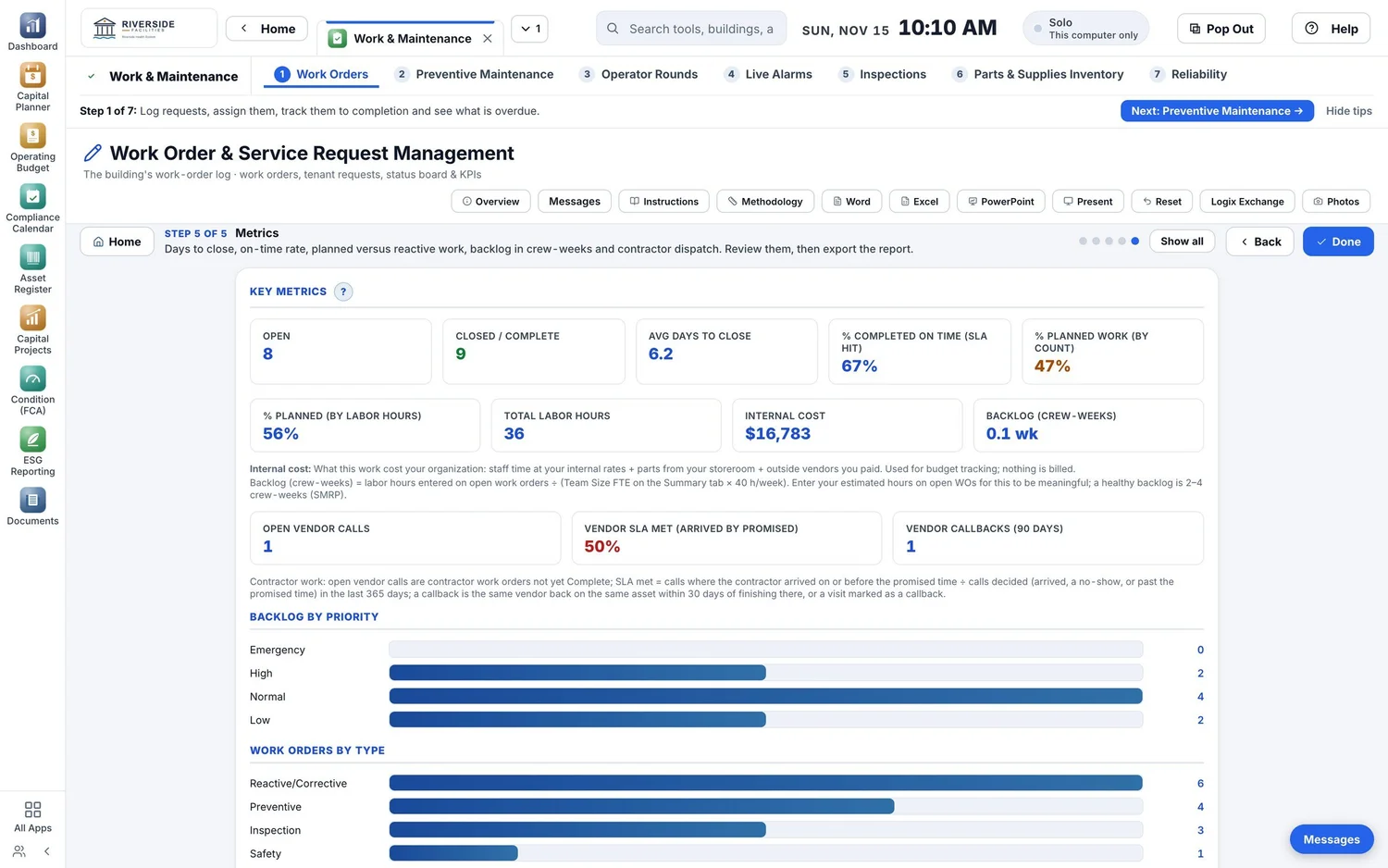
Metrics in Work Order & Service Requests: days to close, on-time rate, planned versus reactive work, backlog in crew-weeks and contractor dispatch. Review them, then export the report.
Compliance Tab
The marine rules that apply to this ship and why. Dates kept on the Lay-Up and Hull tabs and the profile fill the matching rows, and the drydock row uses the same 46 CFR 91.40-3 rule as the Hull tab.
Learn MoreCapital Plan
With a yard estimate for each, the drydocking, re-preservation and steel renewal go to the Capital Plan and fall due with the docking, the way a roof does.
Learn More
The home dashboard: what needs attention, compliance, capital, energy and safety on one screen.
Disposal Tab
For a ship waiting to be scrapped: PCB survey, asbestos and lead survey, hull cleaning before the tow, tow preparation and the U.S. recycling yard, each with a status and date.
Learn MoreShow Less
A ship waiting for scrapping still costs money every month it waits, and a missed survey delays the tow. The tab keeps the five steps moving and counts how many are done.
- Each step moves through Not Started, Scheduled, In Progress, Contract Awarded and Done
- The target tow date sits with the steps
- The PCB survey covers cable, gaskets, paint and felt
- Tow preparation covers fire and flooding precautions and watertight closures (NSTM 050-8.4)
- A ship awaiting disposal drops out of drydock planning
Personal Property, Not Real Property
A ship never shows the federal real property fields and is left out of the real property data sheet. Load Example shows a fictional reserve fleet with three ships.
Learn MoreShow Less
Federal real property reporting takes staff time, and a ship on that sheet would be wrong data. Ships are kept off it automatically, so nobody has to remember to remove them.
- Real property rules never apply to a ship, whatever its owner
- Agencies keep ships in their personal property records instead
- The ship picker labels every ship as personal property
- The example fleet: a ROS-5 RO/RO, a retained training ship and a non-retention trader
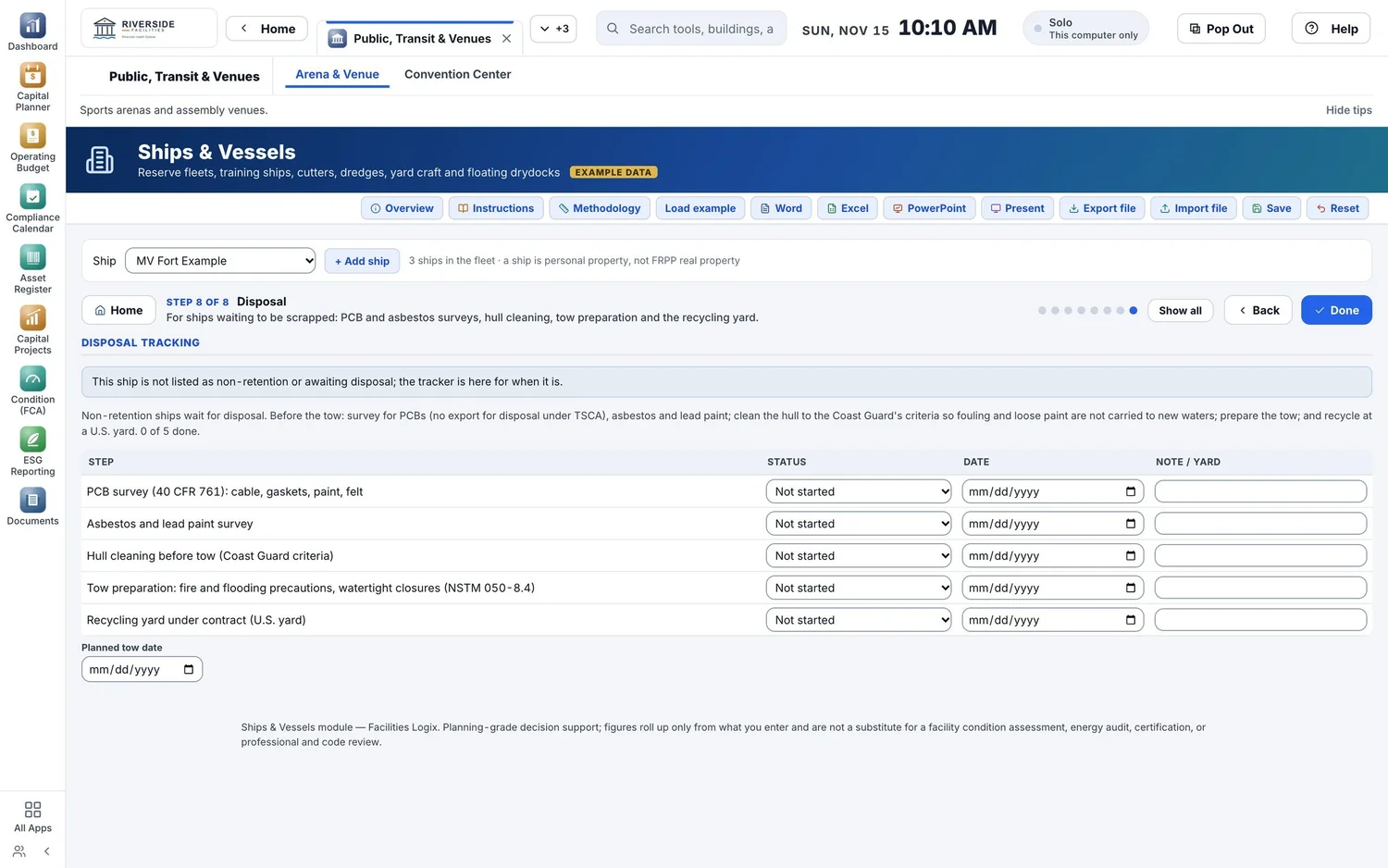
Disposal in Ships & Vessels: for ships waiting to be scrapped: PCB and asbestos surveys, hull cleaning, tow preparation and the recycling yard.
The Numbers a Lay-Up Program Lives By
From the Logs
- Zone averages and individual humidity readings against the 40% and 45% limits, and the change per week for each space
- Dehumidifier duty cycle for each machine, and units needed against units installed for each zone
- Hull potential readings in and out of range
- Days to the next drydock, hull grade and coating loss
- Days to activate, open work orders, overdue items and alarms for every ship
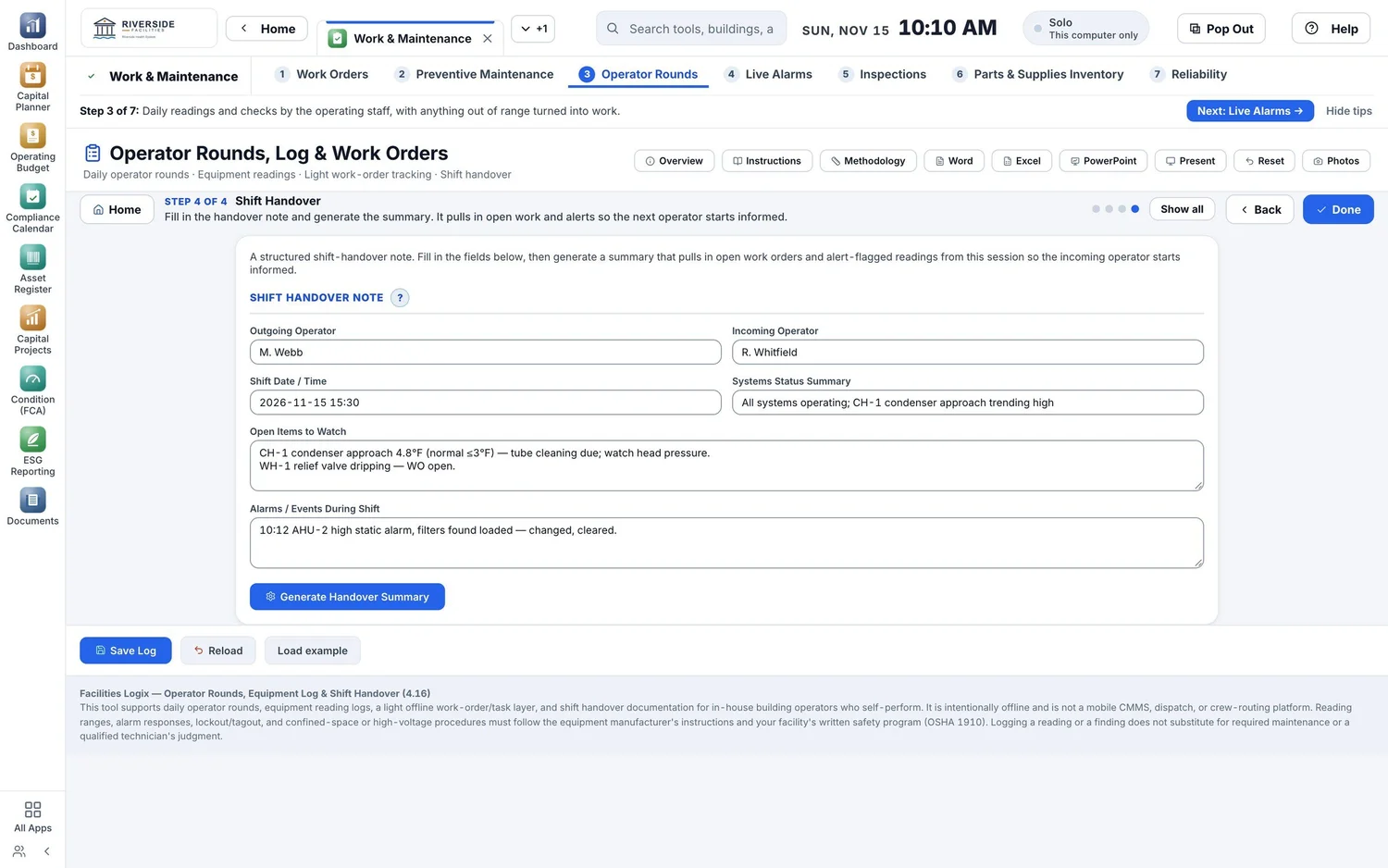
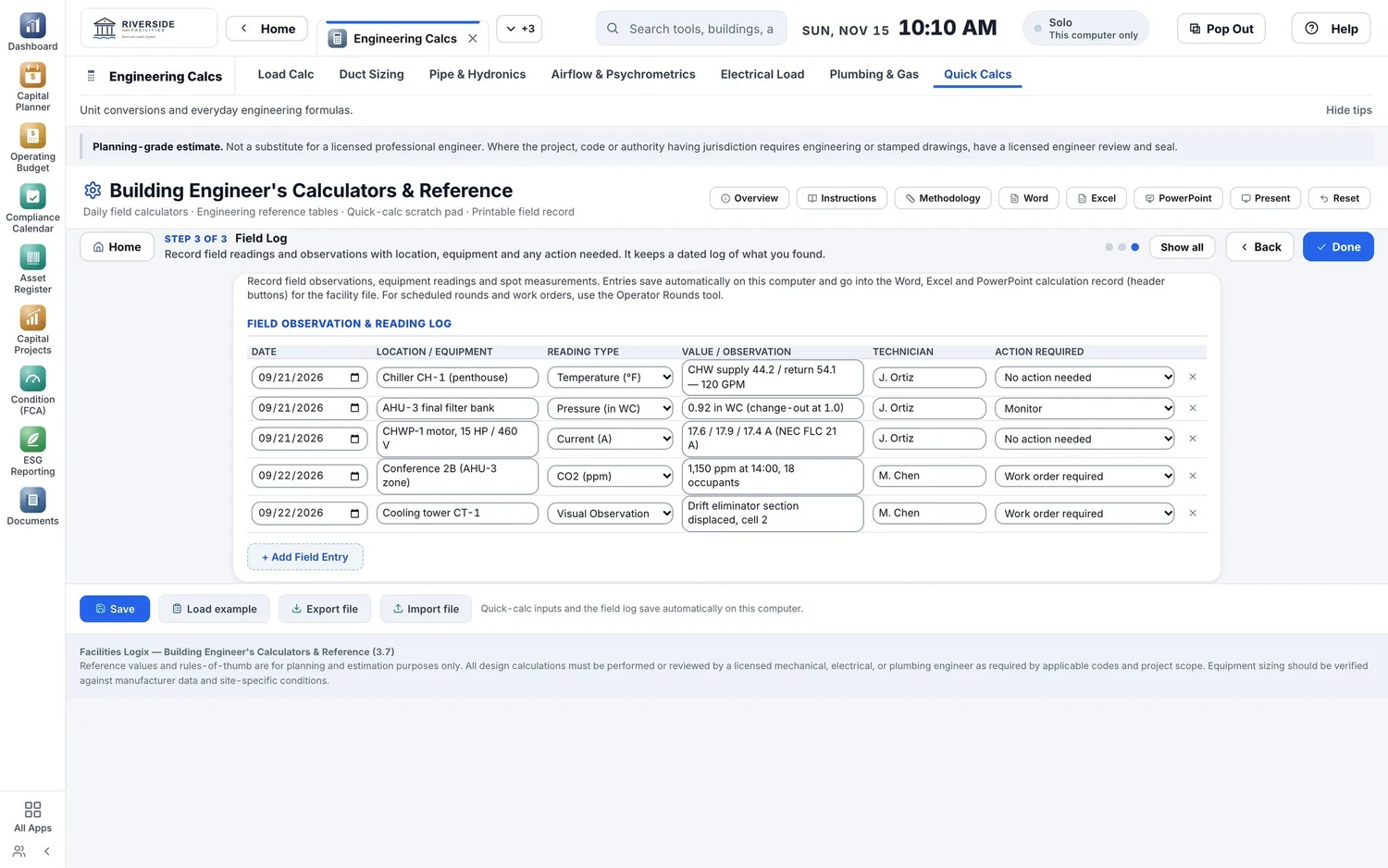
Shift Handover in Operator Rounds, Log & Work Orders: fill in the handover note and generate the summary. It pulls in open work and alerts so the next operator starts informed.
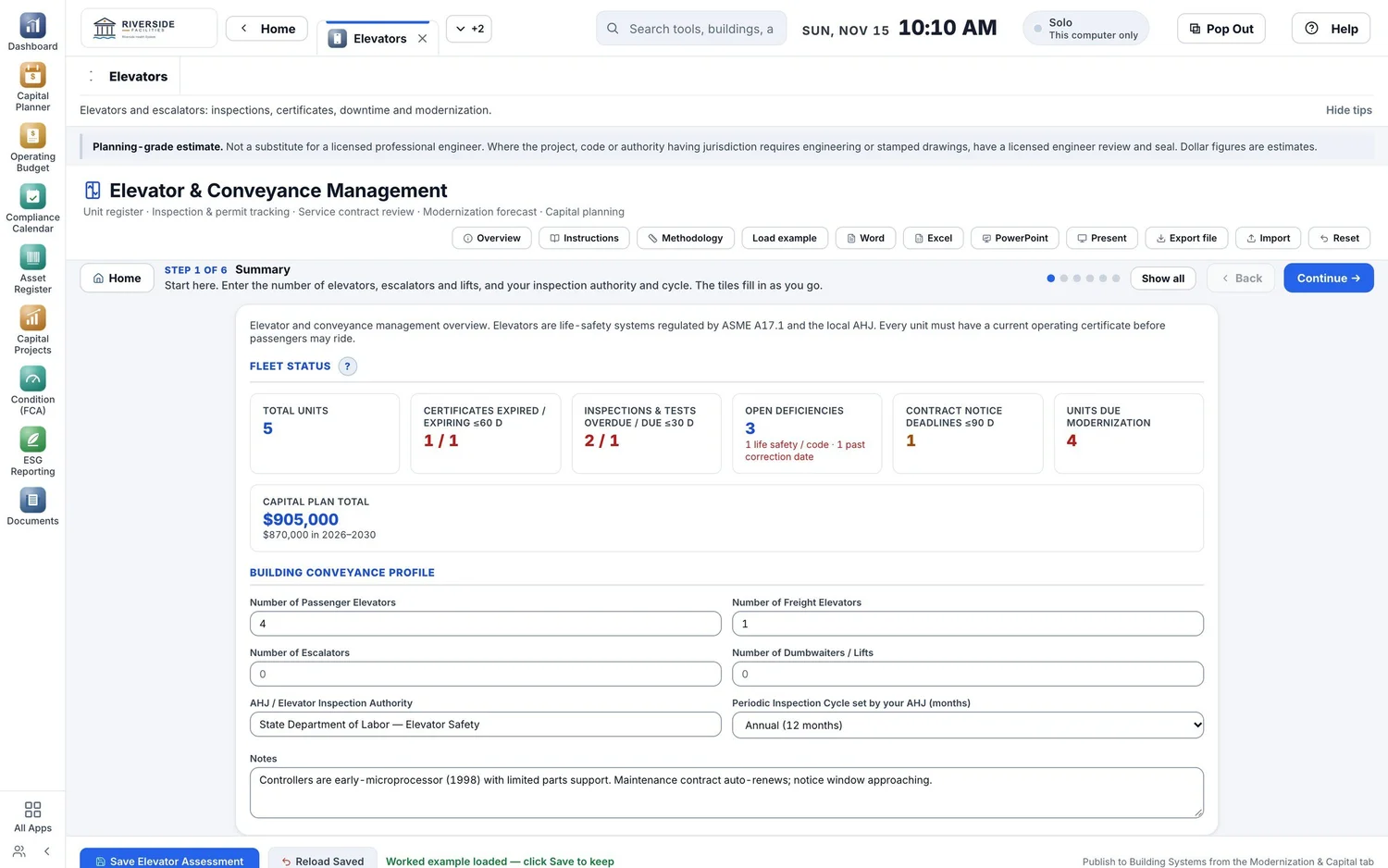
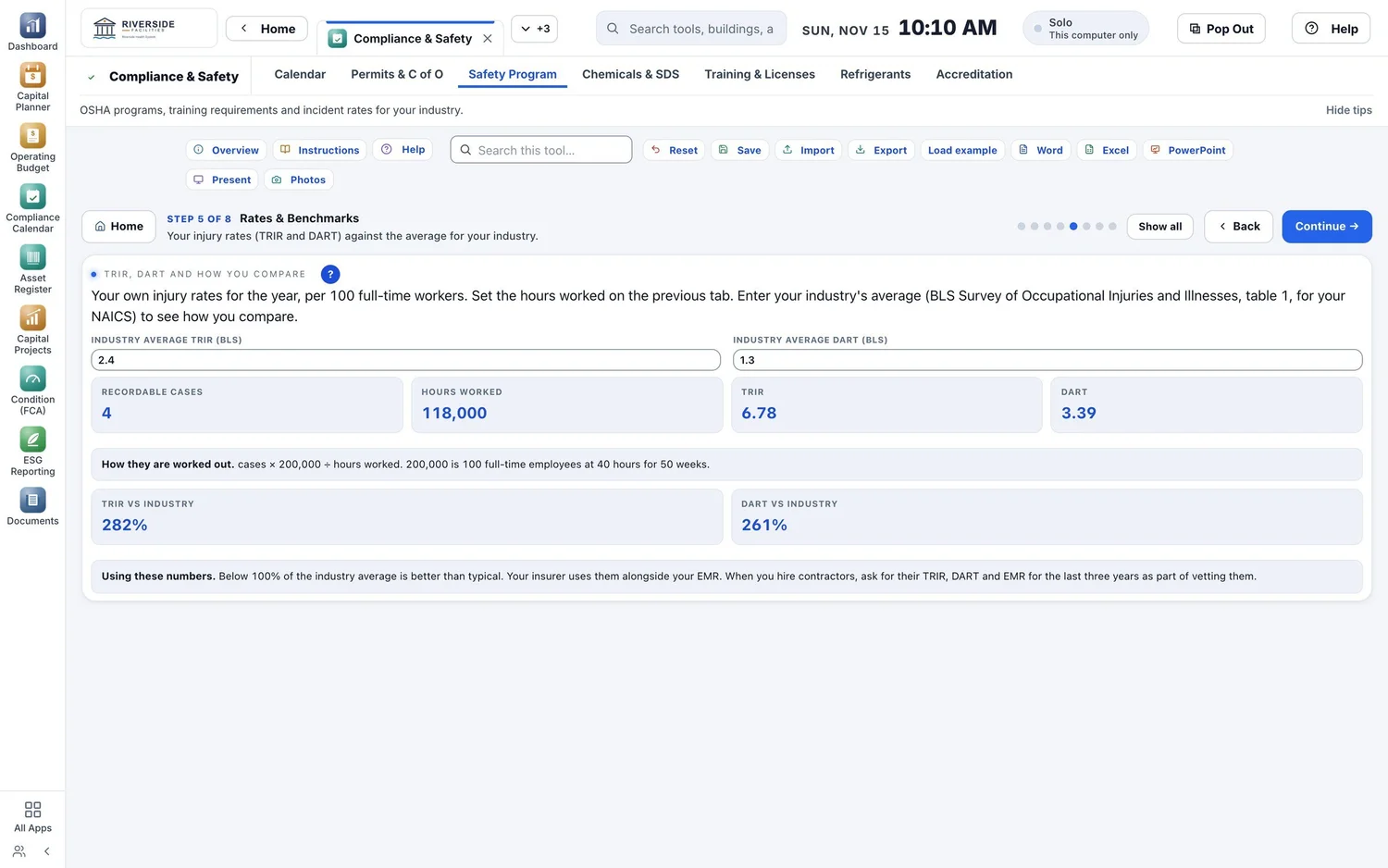
A Fleet You Can Answer For
Moisture Caught Early
A trend line shows a space creeping up before it alarms, and a finding becomes a work order in one step.
Learn MoreShow Less
Moisture in a laid-up ship becomes corrosion, and corrosion becomes steel renewal at the next drydocking. Catching the climb early keeps that line off the capital plan.
- The trend is a least-squares slope of each space's readings, in % RH per week
- A rise of 1% a week or more is flagged
- An out-of-limit zone brings the next inspection in 2 weeks, not a quarter
- The work order takes the next number from the same sequence as Work Orders
Rounds Without Clipboards
The humidity round runs on a phone at each QR-labeled space, and the readings land in the log without retyping.
Learn MoreShow Less
Retyping readings wastes crew hours and invites errors that hide a problem. The phone round records each reading once, and the logs date the compliance rows, so the two never disagree.
- Works with no signal and files the readings when the phone syncs
- Dehumidifier elapsed-time meters are read on the same round
- Fire and flood alarm tests logged Pass or Fail with a photo as evidence
- A space read twice in a day counts once, using the latest reading
An Honest Activation Answer
The readiness board names exactly what would stop each ship sailing in its window, so leadership hears it from the board, not from a failed activation.
Learn MoreShow Less
Money for reactivation repairs is easier to get before a call than after a failed activation. The same stop list goes into the Word report, so the program office has it in writing.
- The report section is titled with the ship's own activation window
- Each item is marked Stop or Risk, with its rule or source
- The summary states how many items would stop the ship sailing
- A clear ship reads Nothing in the Records, said plainly
Dockings Planned Like Roofs
Drydocking, re-preservation and steel renewal appear in the capital plan on the docking date, not as a surprise.
Learn MoreShow Less
Repairs found at drydock break budgets when they were never budgeted. Hull records become capital lines dated to the docking, so the money is requested years ahead.
- After an underwater survey, the next examination must be a drydocking
- Re-preservation is added when more than 35% of the coating has deteriorated
- The steel renewal line names the worst gauging location and its loss
- Lines refresh with every hull entry; a blank cost stays blank
- Costs escalate to the docking year
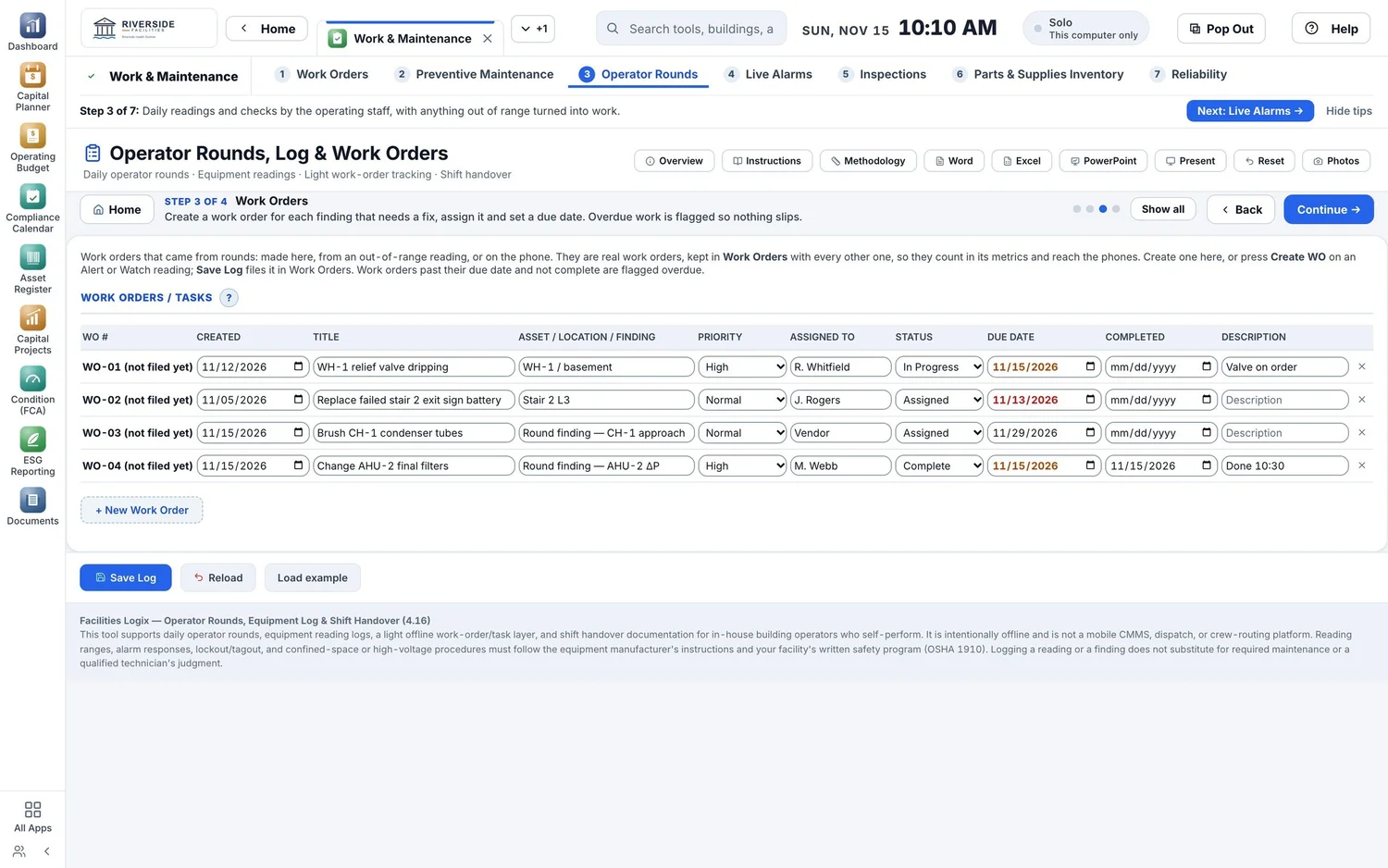
Work Orders in Operator Rounds, Log & Work Orders: create a work order for each finding that needs a fix, assign it and set a due date. Overdue work is flagged so nothing slips.
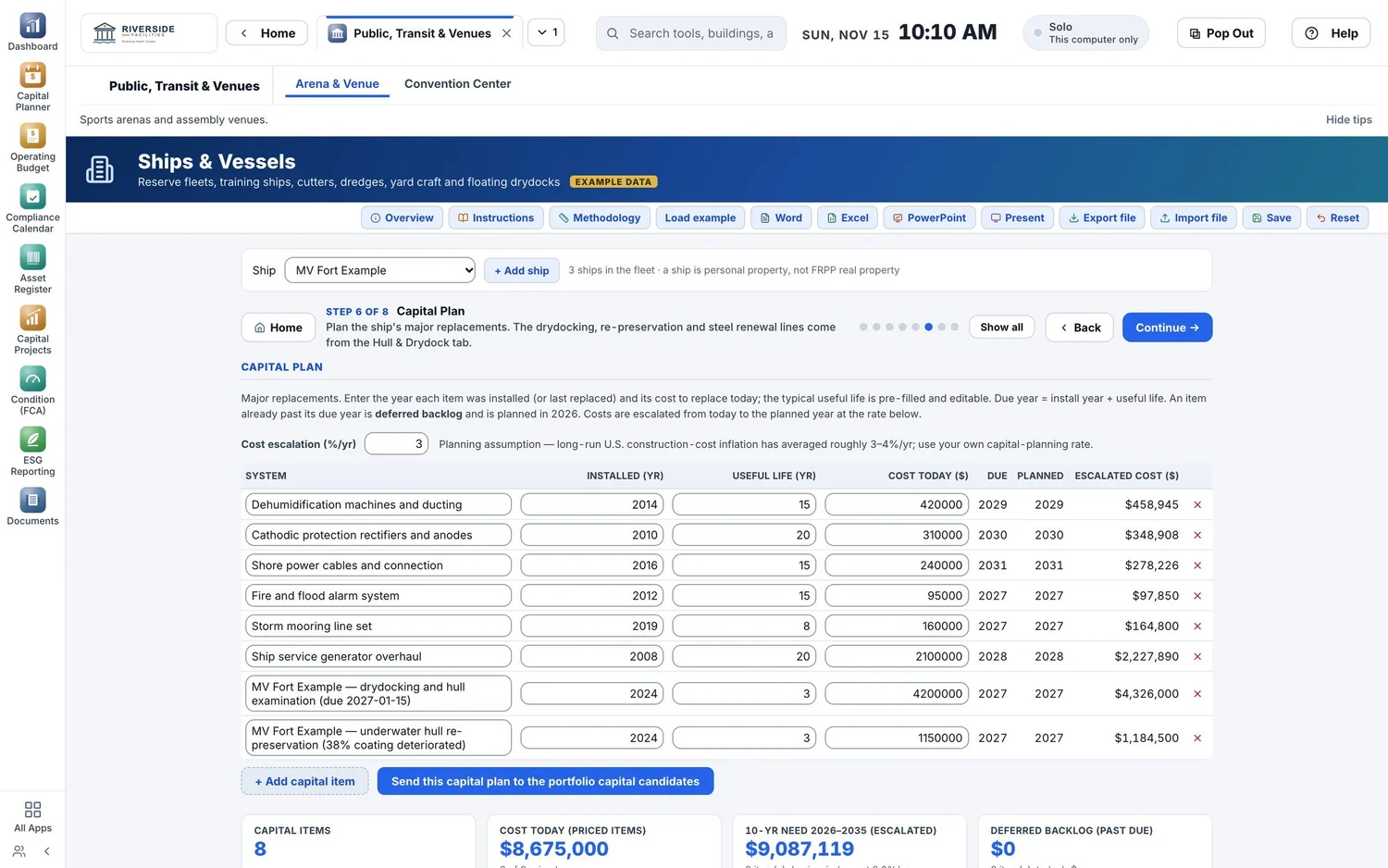
Repairs found at drydock blow the budget, so each ship's capital needs are planned ahead.
Frequently Asked Questions
Why treat a ship like a building?
Where do the lay-up limits come from?
Do building rules apply to our ships?
Can live sensors feed the humidity log?
Are any of the marine rules uncertain?
Be First When Facilities Logix Opens
Stop chasing building records across spreadsheets and binders. Join the list and we will tell you the day downloads open, with setup guides ready.
Launching early 2027 for Facilities Logix. Nothing to buy today, and no sales calls.
