

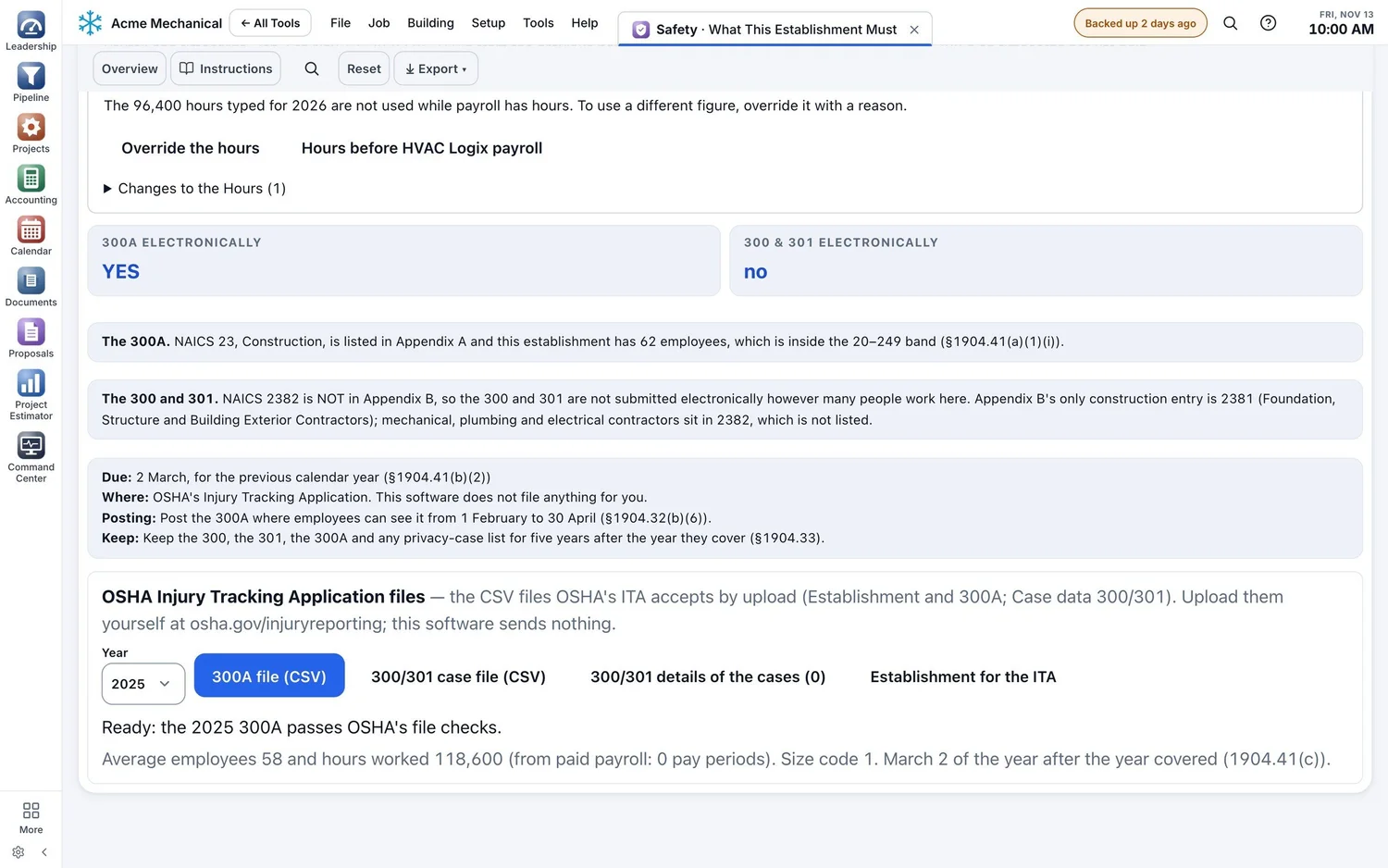
A commercial mechanical contractor answers to the EPA, OSHA, the DOT, state labor departments, city permit offices and every customer's insurance exhibit. HVAC Logix works out the dates, warns the right person and makes the files. A person checks them and sends them. It is a tracker and a library with every rule cited and dated, not legal advice.
The Compliance Calendar
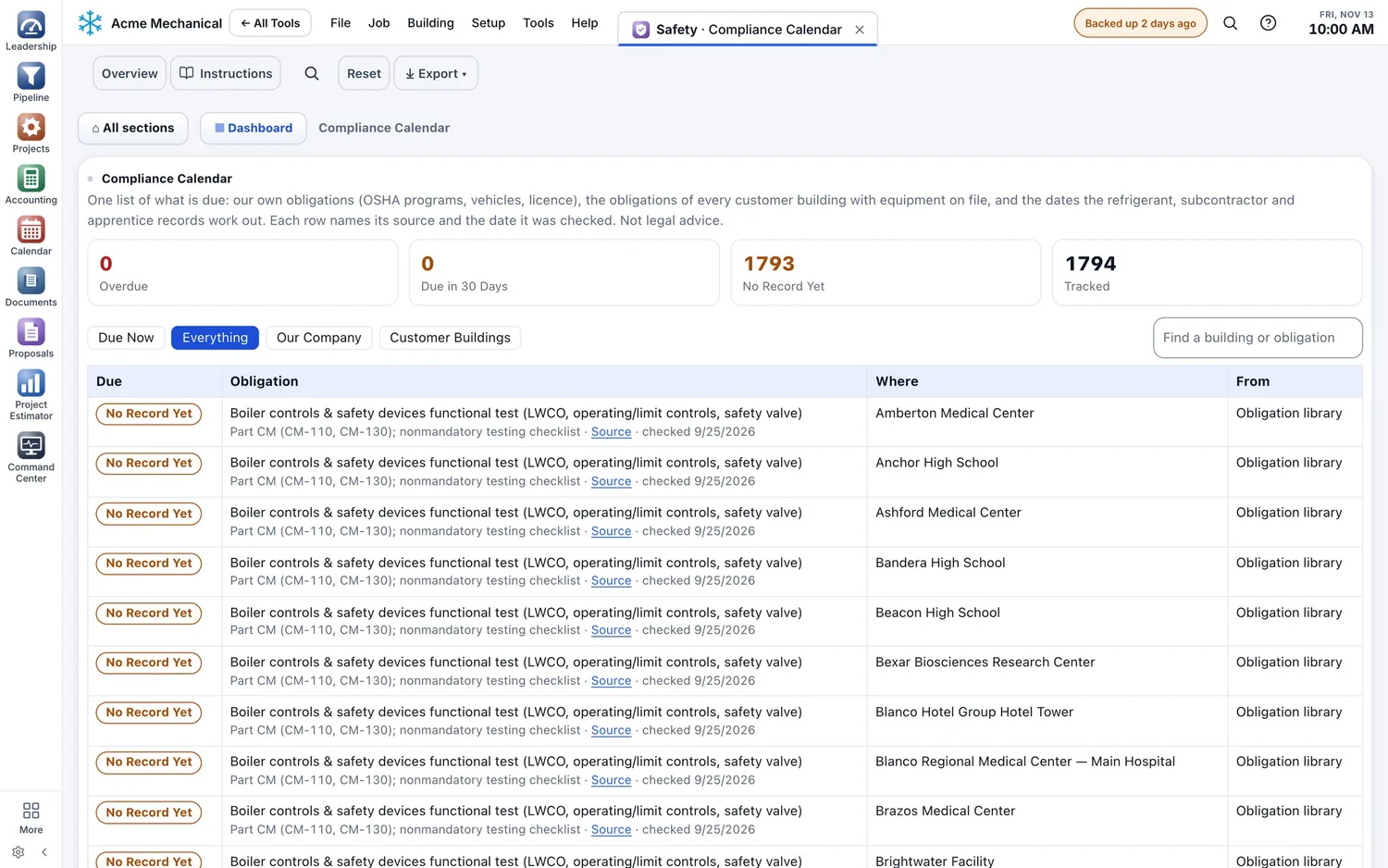
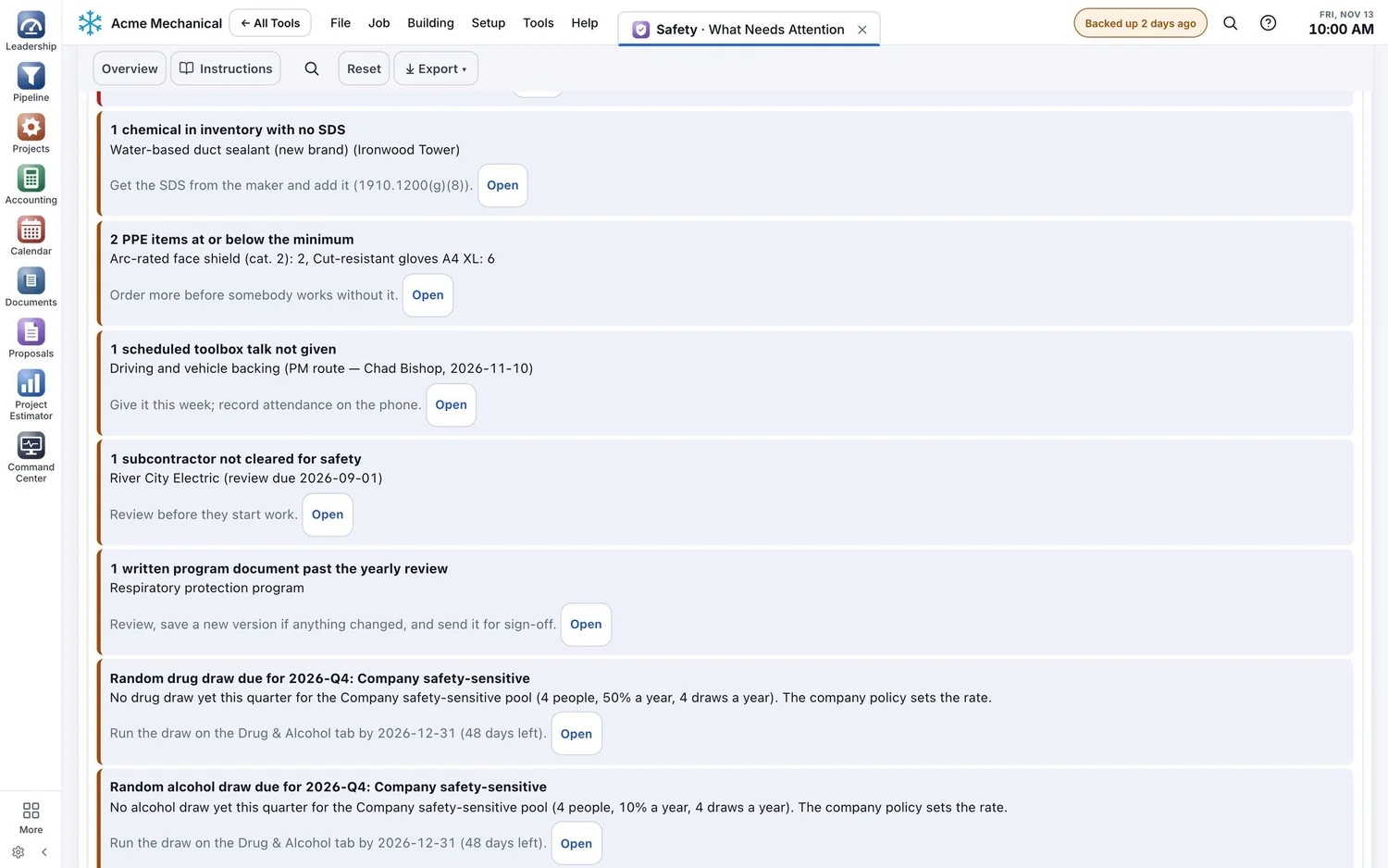
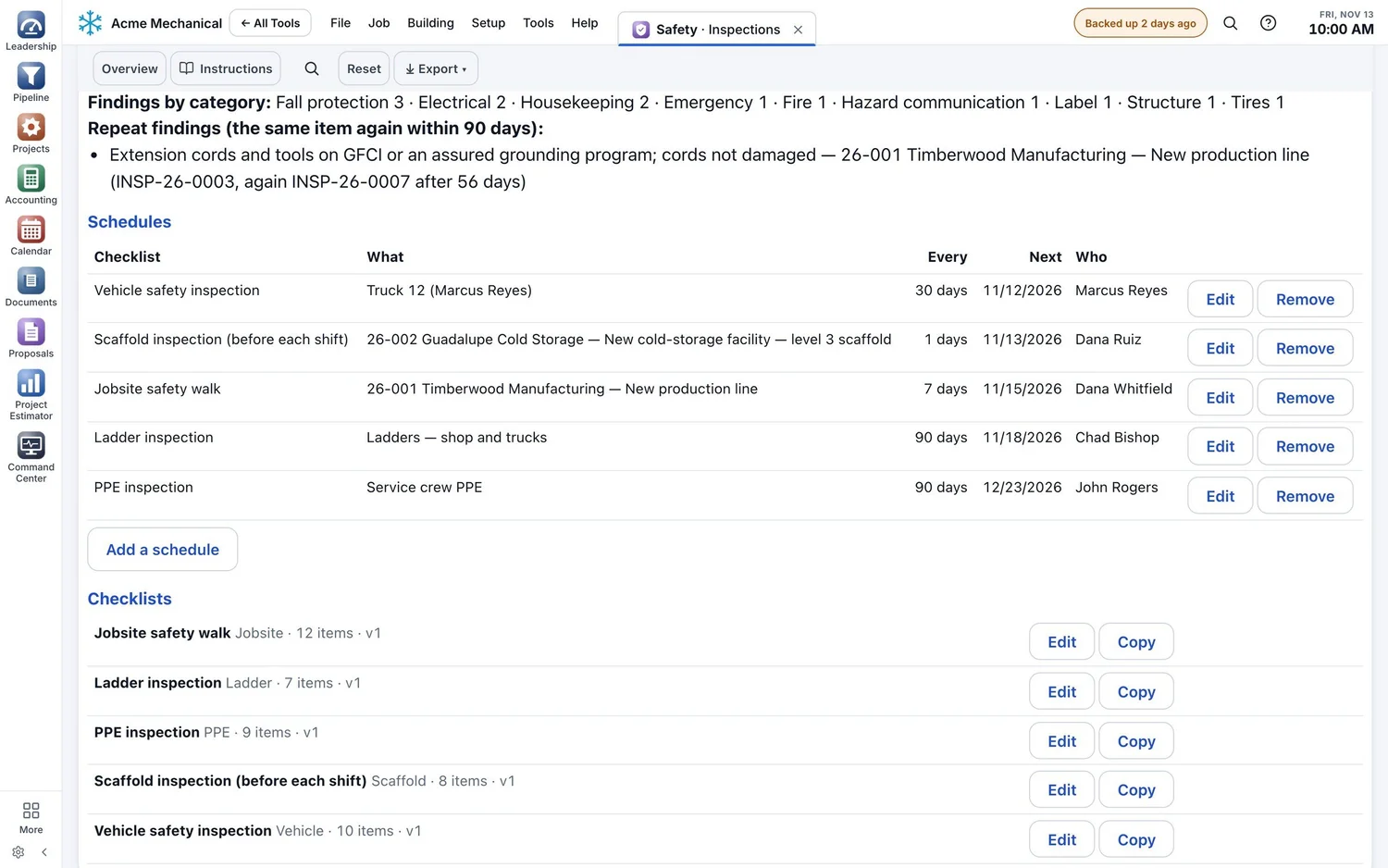
The Compliance Calendar in Safety shows one list of what is due, for your own company and for the customer buildings you care for.
A Library of Obligations
HVAC Logix keeps the obligations a contractor tracks: 105 drawn from a research library of 641, plus 6 of the contractor's own such as vehicle inspections, driver medical cards and the contractor license. Each shows its authority, citation, source link and the date it was checked.
Learn MoreShow Less
A missed inspection or lapsed license can bring a fine or stop a job, for you or for a customer's building. The library keeps the obligations that apply to a contractor in one place.
- The rest of the 641 are a building owner's alone, such as benchmarking laws, drills and elevators, and are left out.
- The contractor's own include silica medical exams and crane operator certification.
- Safety, Compliance Calendar shows one list: your company's obligations and those of every customer building.
- Filter by Due Now, Everything, Our Company or Customer Buildings.
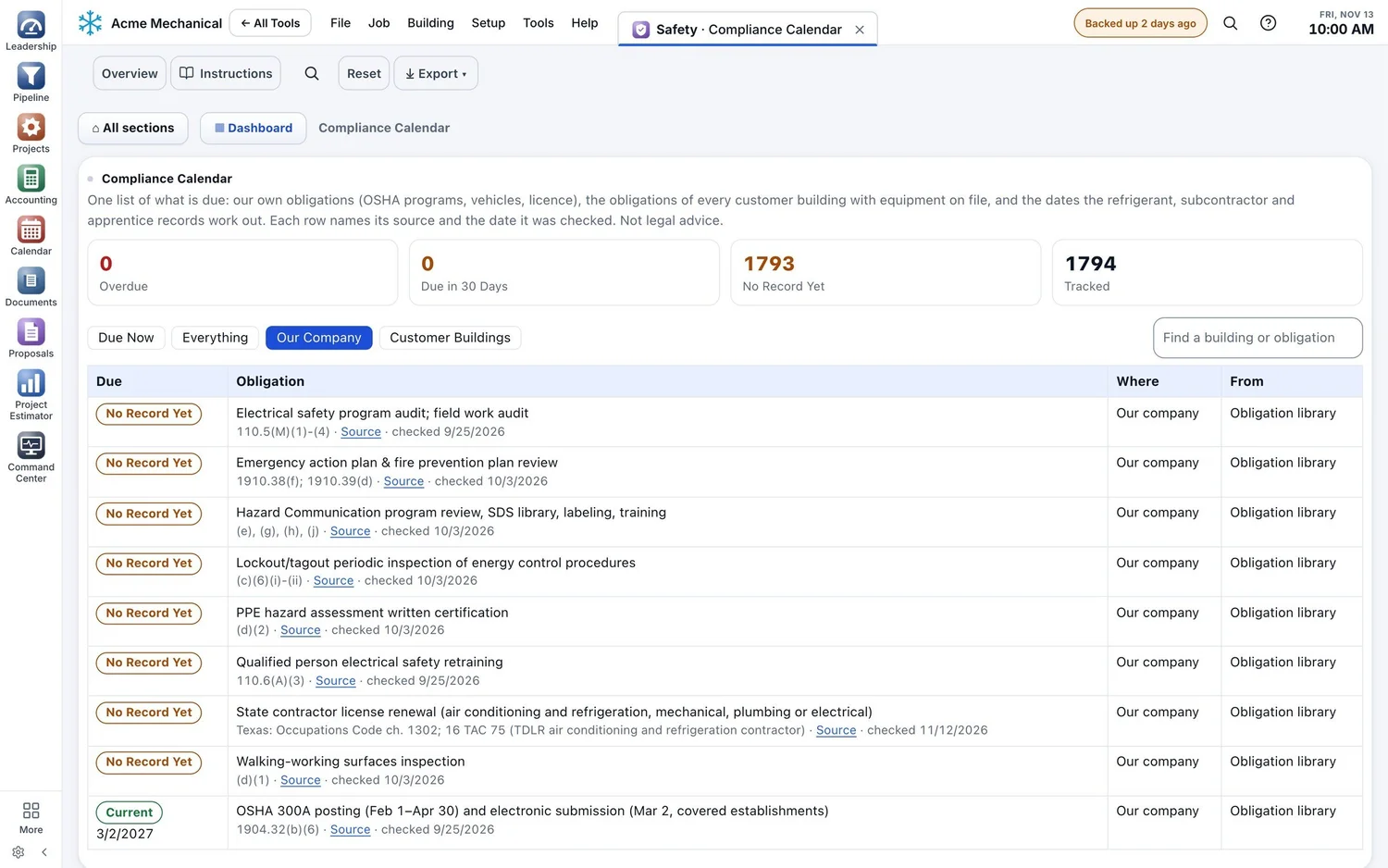
Company obligations slip when nobody owns them, so every one is listed with its rule and due date.
Worked Out per Building
On a building's page, the Compliance Obligations card reads the equipment list, the state and city, and the building type. A boiler on the list in Texas brings the boiler certificate inspection. A backflow assembly brings the annual test.
Learn MoreShow Less
An inspection a customer's building owes is service work you can sell before it is overdue. The card works out what applies from what you already recorded.
- A cooling tower on the list brings its cleaning and the water management program.
- Each obligation shows why it applies to this building.
- Customer buildings with equipment on file appear on the company compliance calendar.
An Unknown Is Never a Yes or a No
What cannot be decided is listed under To Confirm with the question that would settle it. Mark Done records the date the work was done, and the next date follows from the frequency.
Learn MoreShow Less
Guessing that a rule does not apply is how fines happen. Anything uncertain stays visible until someone answers it.
- Mark Done takes the date the work was done, never a future date.
- Inspections that carry a code grace window keep it; an annual test is in its window up to 15 months after the last one.
- Obligations with a date also go on the company calendar.
Deadlines That Cannot Be Snoozed Away
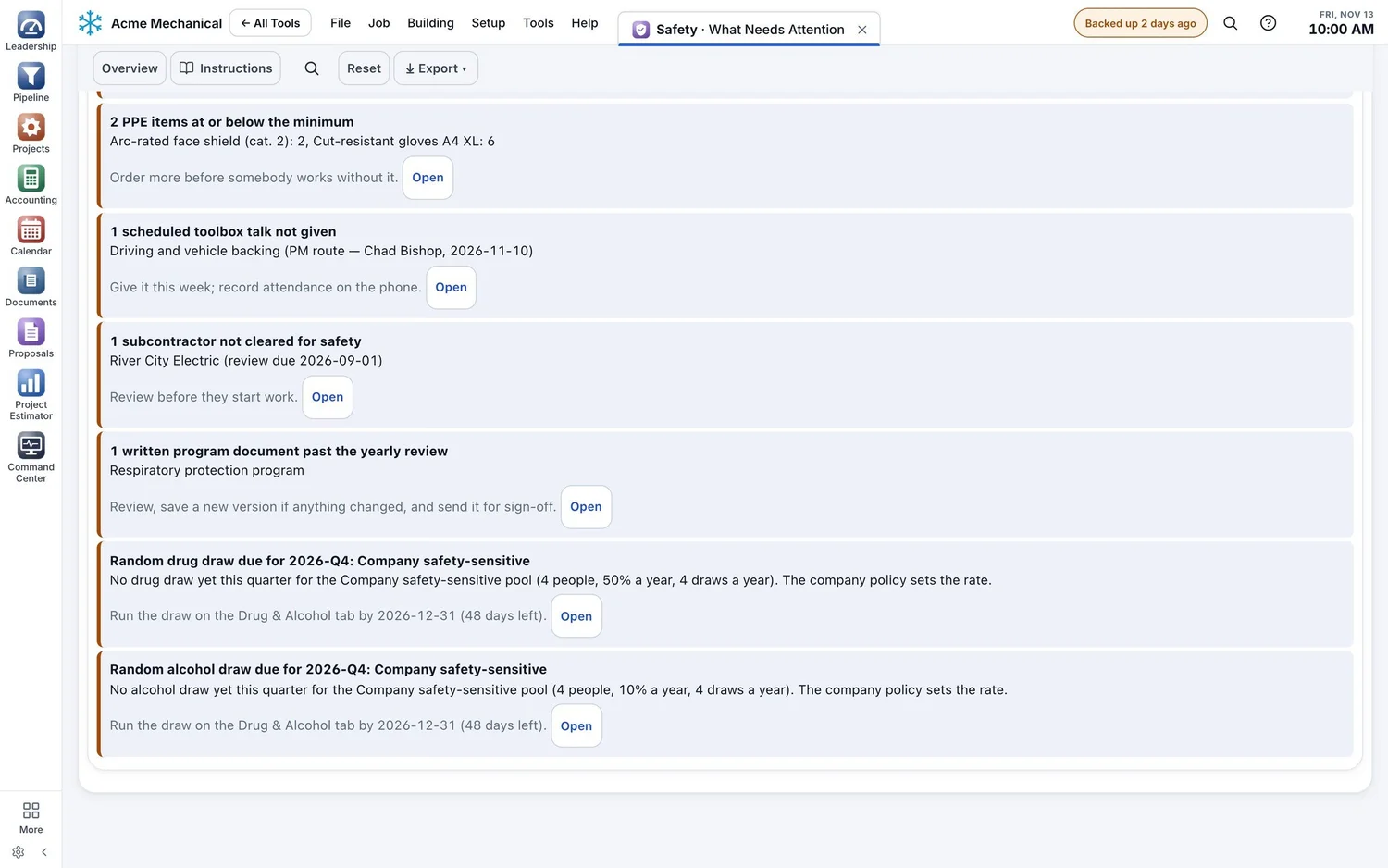
Dated obligations also sit on the company calendar. Legal and financial deadlines cannot be snoozed past their due date, and an item still open can escalate to the person or role you name.
Learn MoreShow Less
A tax deposit or leak repair deadline missed by a snooze can cost a penalty. Deadlines stay in front of the right people until they are done.
- Covers tax returns and deposits, lien deadlines, payroll, insurance certificates, the OSHA reporting clock and refrigerant leak repair.
- The third snooze of the same item asks for a one-line reason.
- An overdue item escalates to the owner's manager, then by group, then to company leadership.
- One person gets at most 10 escalations a day one by one; the rest come together.
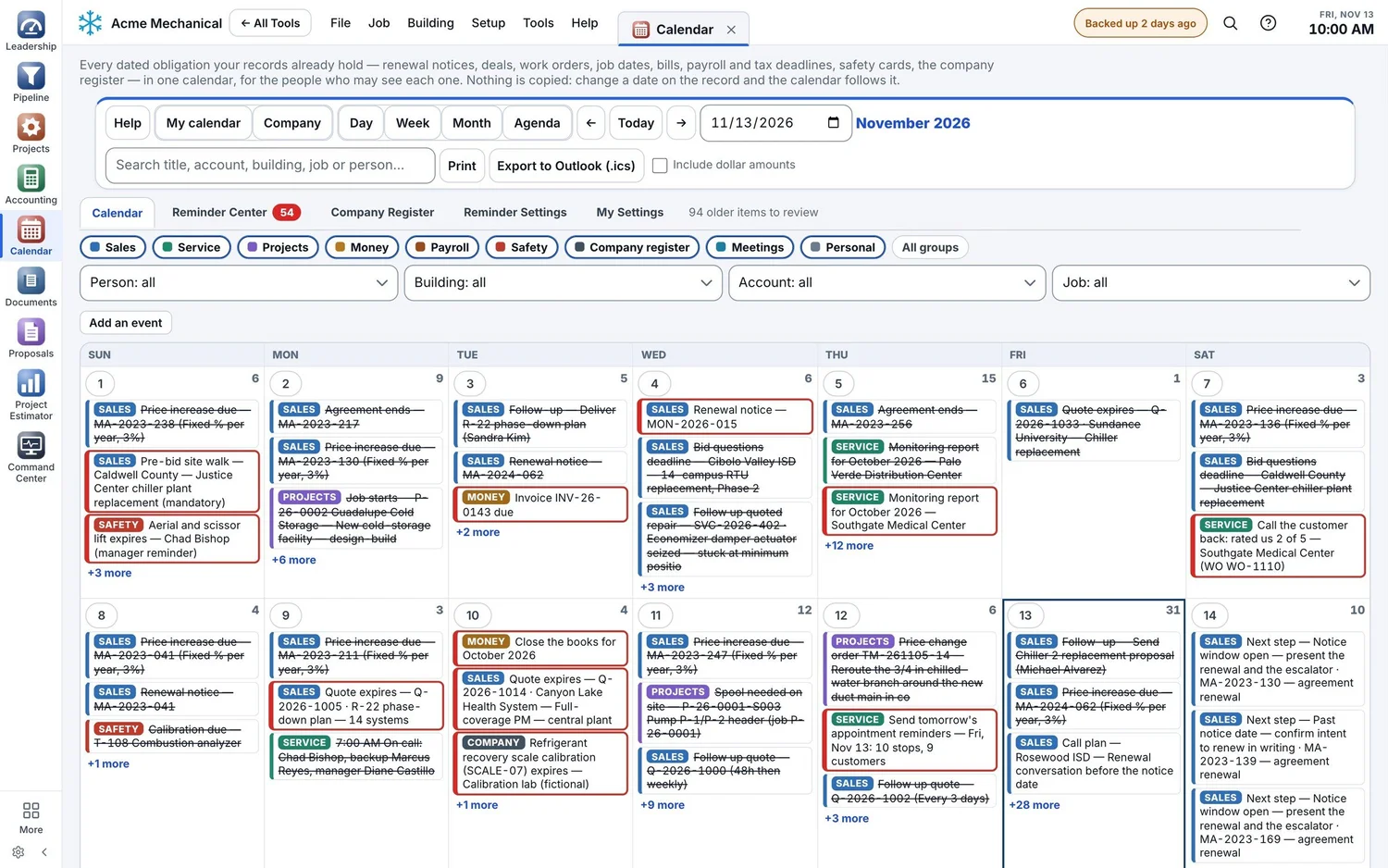
Deadlines buried in one tool get missed, so dated obligations also sit on the company calendar.
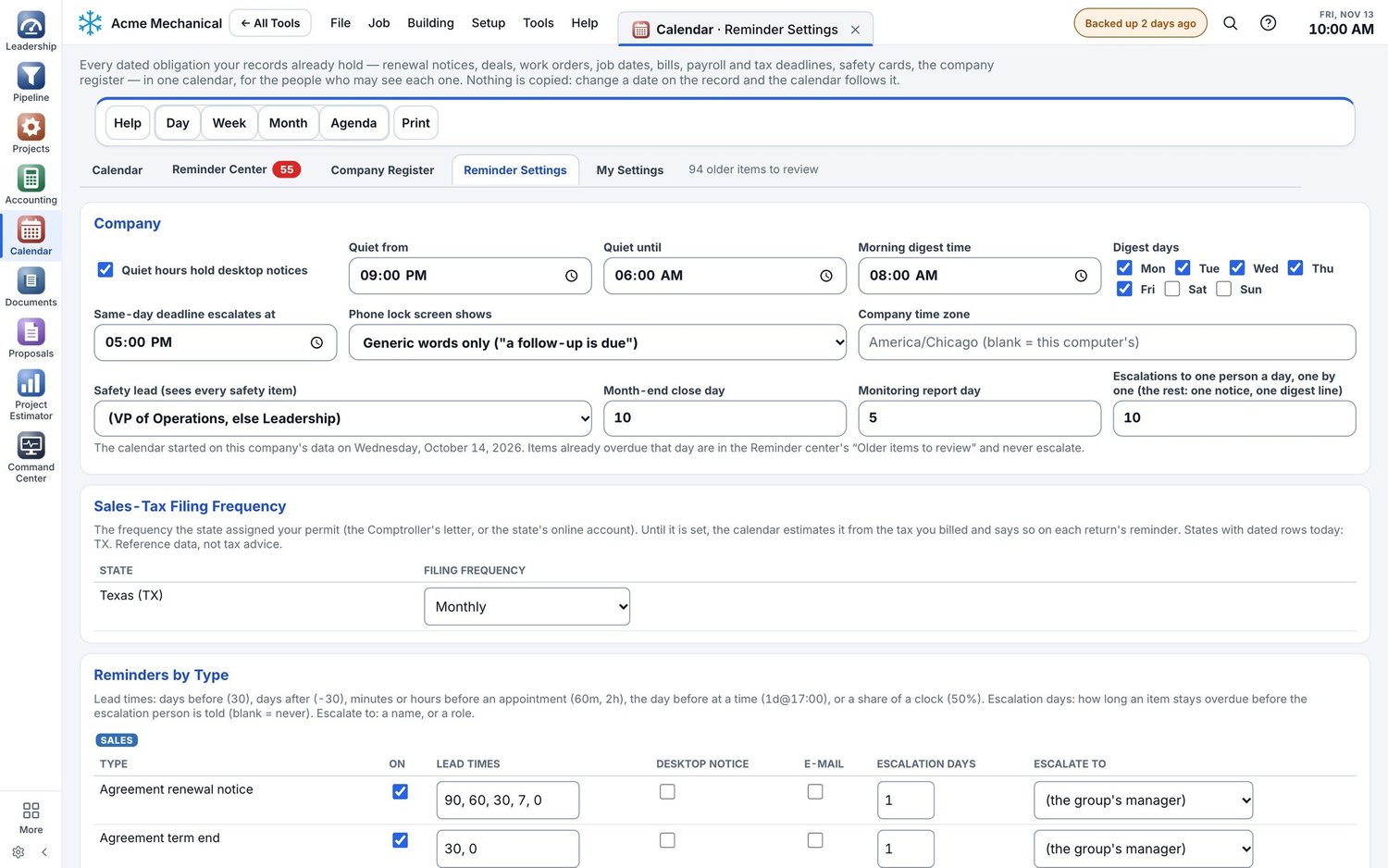
Reminders that come too late are no help, so each kind of deadline has its own reminder days.
Leak Rules, Cylinders and the Phase-Down
The Refrigerant Compliance Planner holds each building's refrigerant position, and the field records feed it so nothing is typed twice.
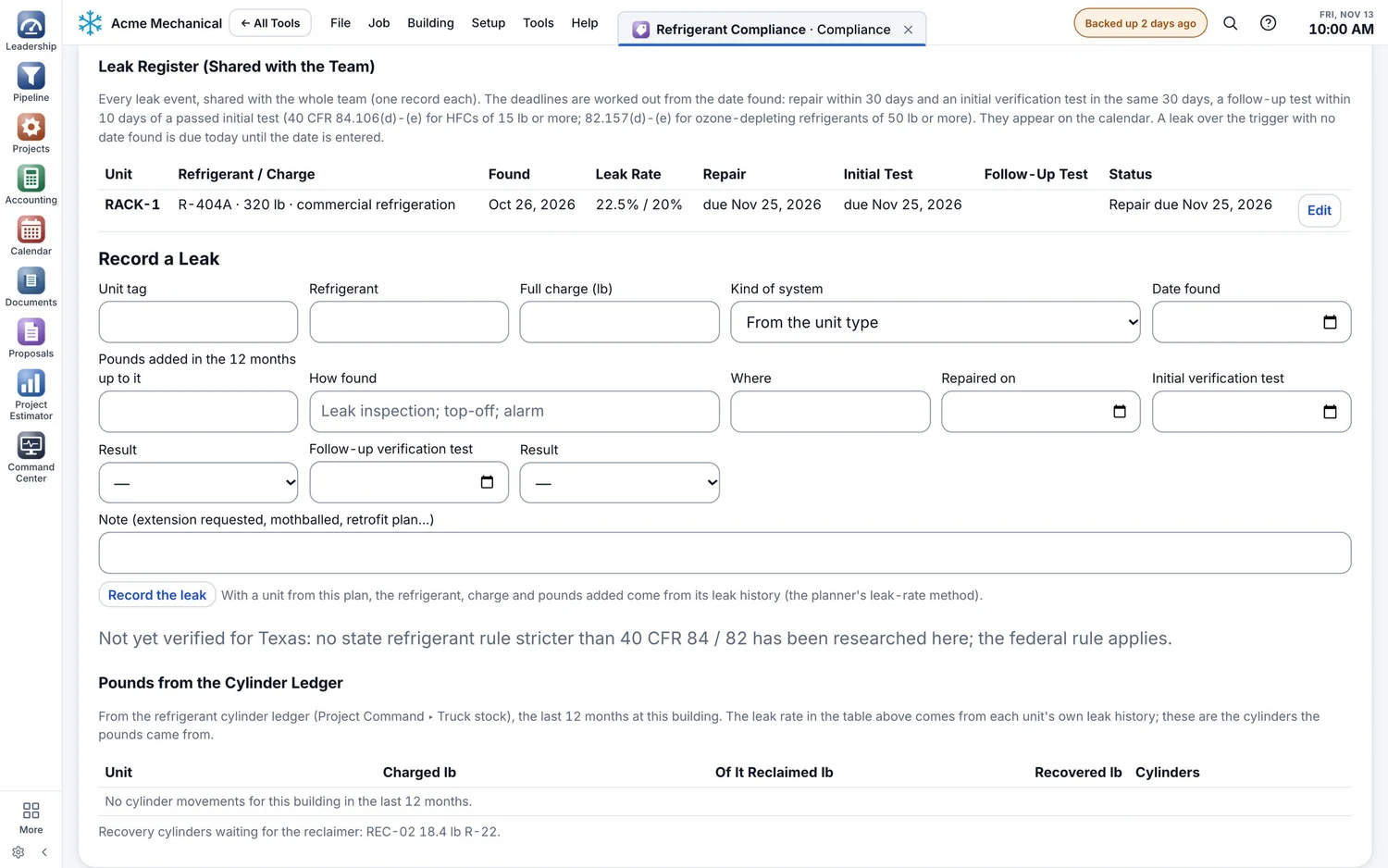
The Shared Leak Register
- Each leak event is one record shared with the whole team: the unit, the full charge, the date found, the repair and both verification tests.
- It fills itself from saved plans, from refrigerant records on the phones, or by hand.
- The 30-day repair and verification deadlines are worked out from the date found and placed on the calendar.
- Systems with 1,500 lb or more of an HFC in commercial refrigeration or industrial process also get an automatic leak detection record.
Chronic Leakers
- A unit that had 125% or more of its full charge added in a calendar year is flagged, with the March 1 due date.
- Units at 100% or more are marked Close so you can act before year end.
- The Word report writes one section per unit with the twelve items the regulation asks for, in its order, with a signature block.
- Neither the Word report nor the Excel workbook carries a price or a cost.
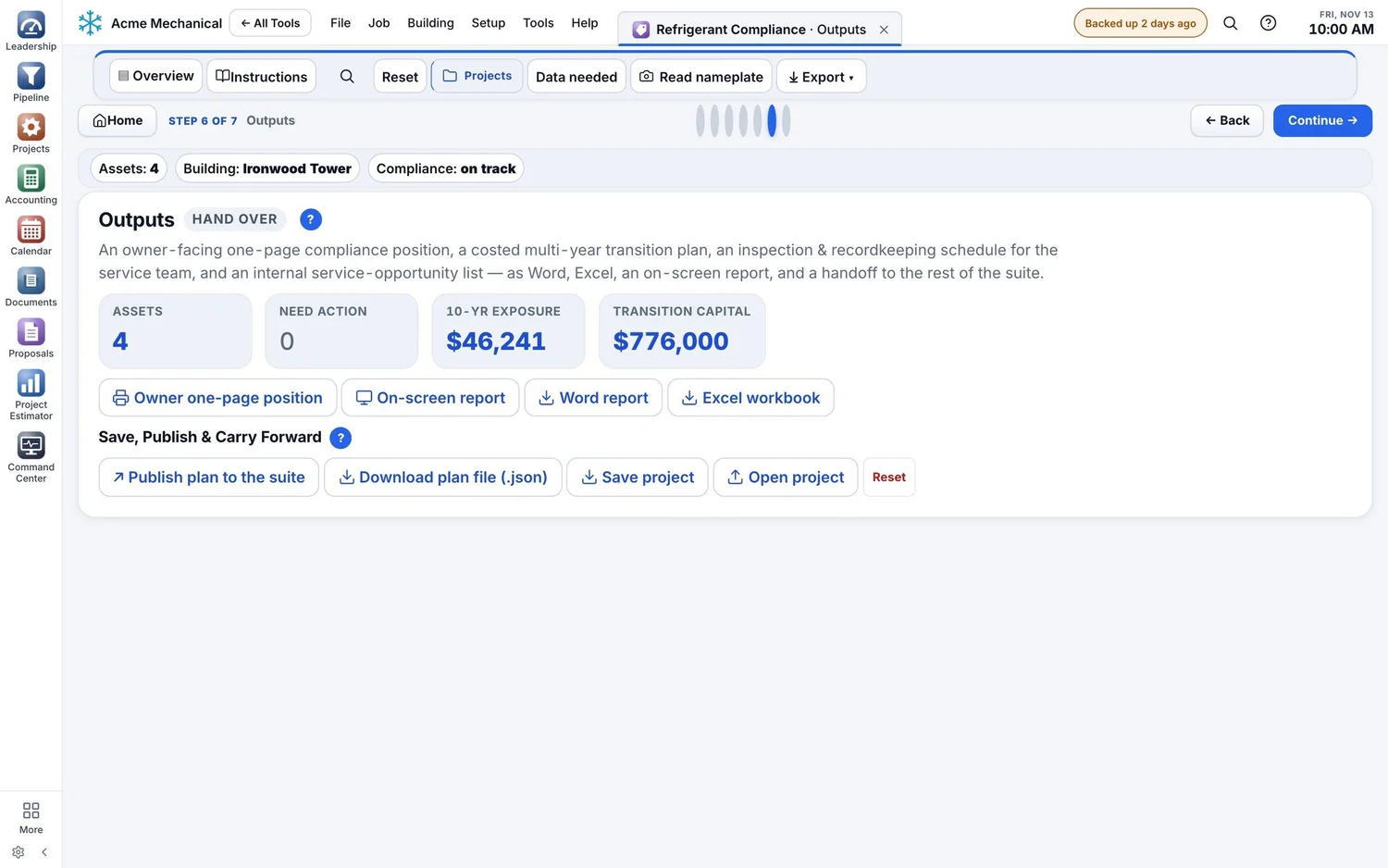
Refrigerant plans should carry forward, so outputs publish to the other tools.
The Cylinder Ledger
- Every cylinder and every pound in and out of it, signed out and returned on the phone by scanning the tag.
- A scale reading checks the book. Outside the tolerance the cylinder does not close until someone accepts the scale with a reason.
- Flags include mixed refrigerants in a recovery cylinder, a charge that is not the unit's refrigerant and a cylinder past its requalification date.
- The recovery log lists pounds recovered each month and each shipment to a reclaimer.
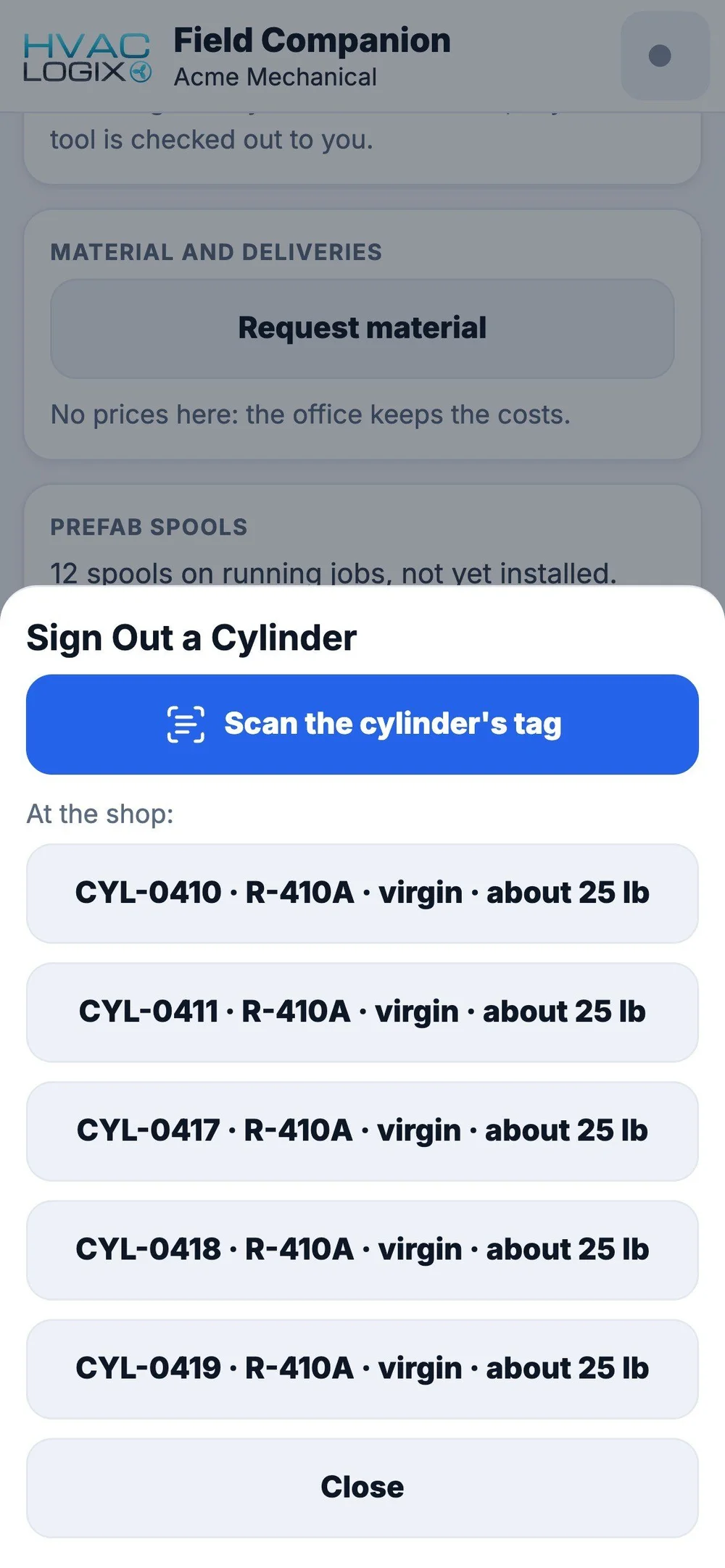
Refrigerant goes missing without a ledger, so technicians sign cylinders out by tag on the phone.
State Rules and the Phase-Down
- For buildings in Washington, California, New York and New Jersey the leak register adds the state duty beside the federal dates. State Rules covers all 50 states and DC, and where a state has no rule of its own the federal rule applies.
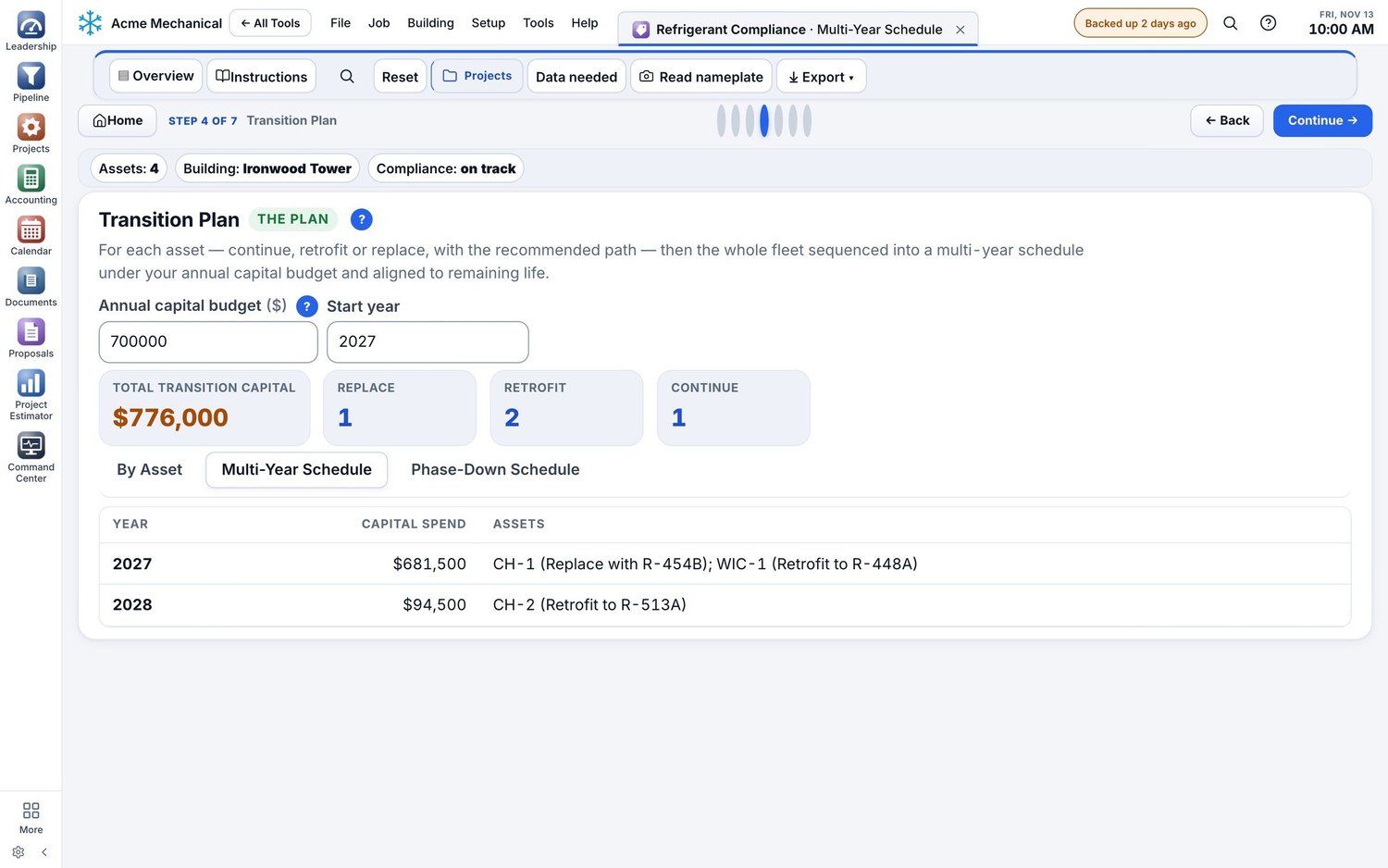
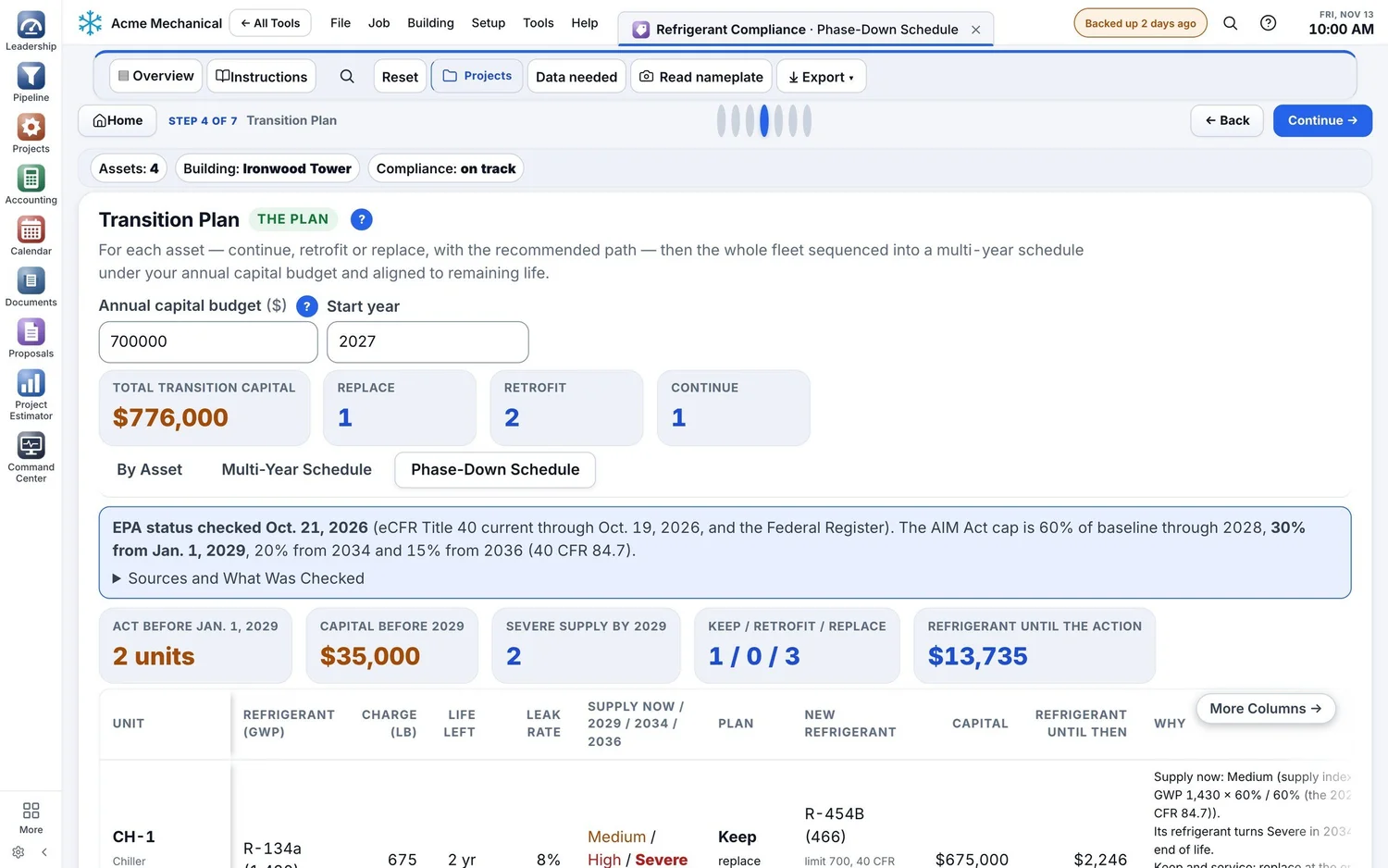
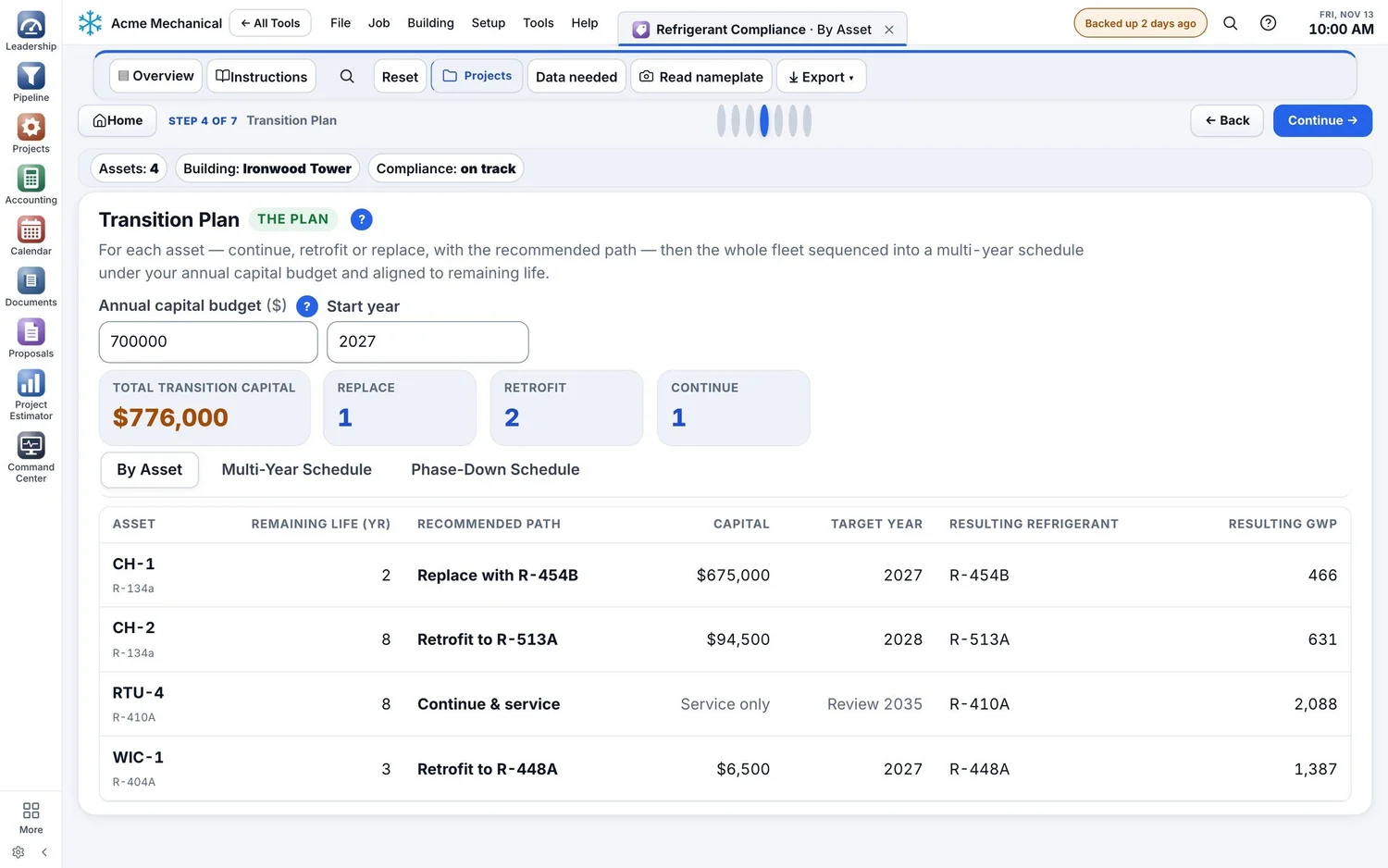
- The phase-down schedule plans each unit as keep, retrofit or replace, year by year, against the federal HFC cap.
- One click sends the schedule to the Capital Plan as a suggestion, and nothing changes there until you accept it.
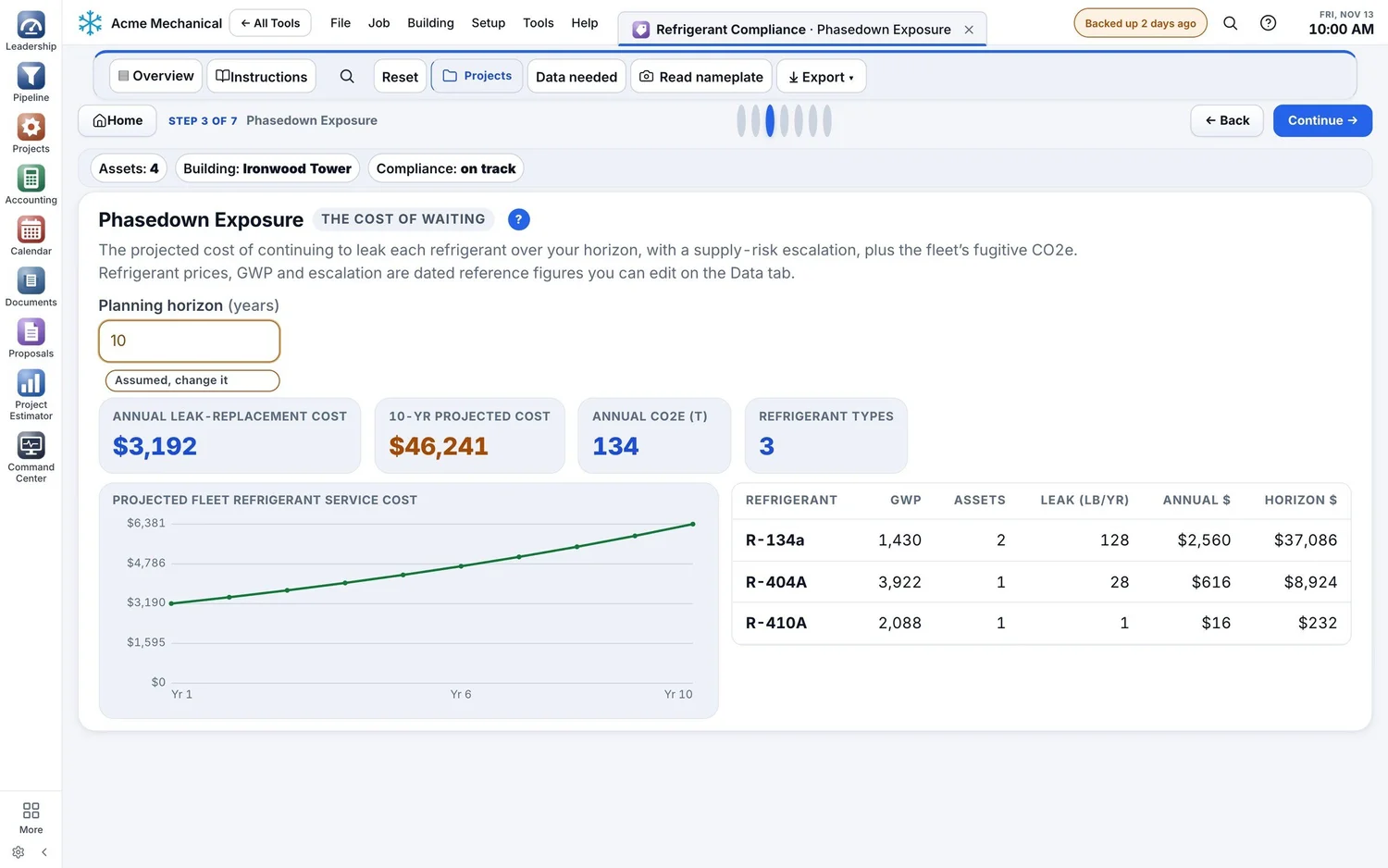
Phase-down costs rise each year, so the exposure is projected over the planning horizon.
Prevailing Wage, Apprentices and Bid Rules
Certified Payroll in Every State with a Law
The WH-347 for federal work, and each prevailing-wage state's own report from the same paid payroll: the state's form as a PDF ready to sign, an upload file, or an Excel worksheet in the order the state's online system asks. Each row shows its verification status and sources.
Learn More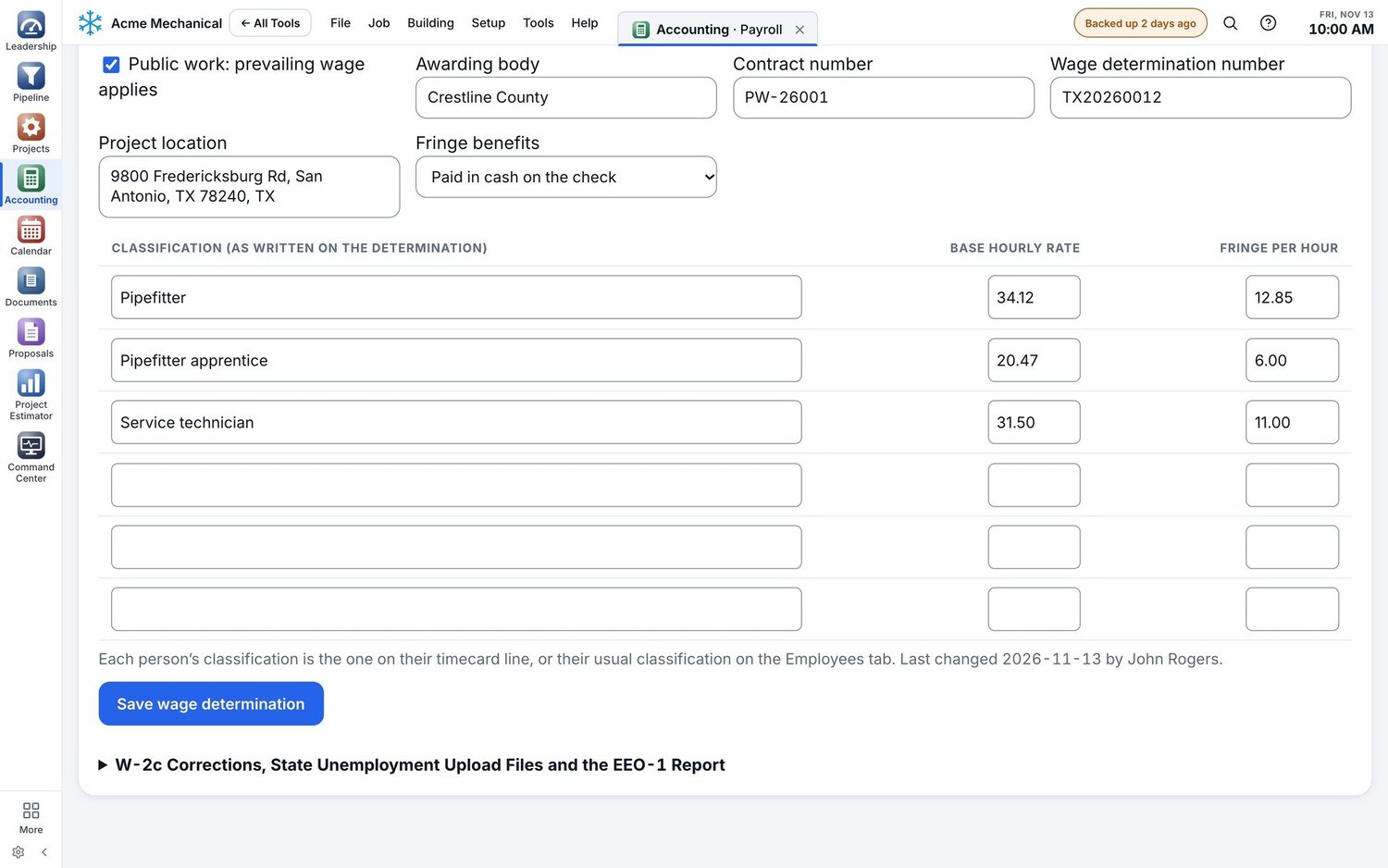
Paying below the prevailing rate brings back pay, so each public job carries its wage determination.
Apprentice Ratios by Day and Craft
On a public job, the week's journeyworker and apprentice counts are checked against the program's ratio day by day. An unregistered worker paid as an apprentice is flagged, and the same warnings print under "Check before signing" on the certified payroll.
Learn MoreShow Less
Too many apprentices on a public job means paying them the journeyworker rate for the day. The daily check catches it before payroll is certified.
- Extra apprentices over the ratio are named, fewest hours first (29 CFR 5.5(a)(4)(i)(C)).
- A program registered in another state is flagged, because the project locality's ratio applies.
- On an IRS credit project, the hours short and the $50-an-hour exposure are shown (26 CFR 1.45-8).
- Good-faith requests to programs are logged with their due dates.
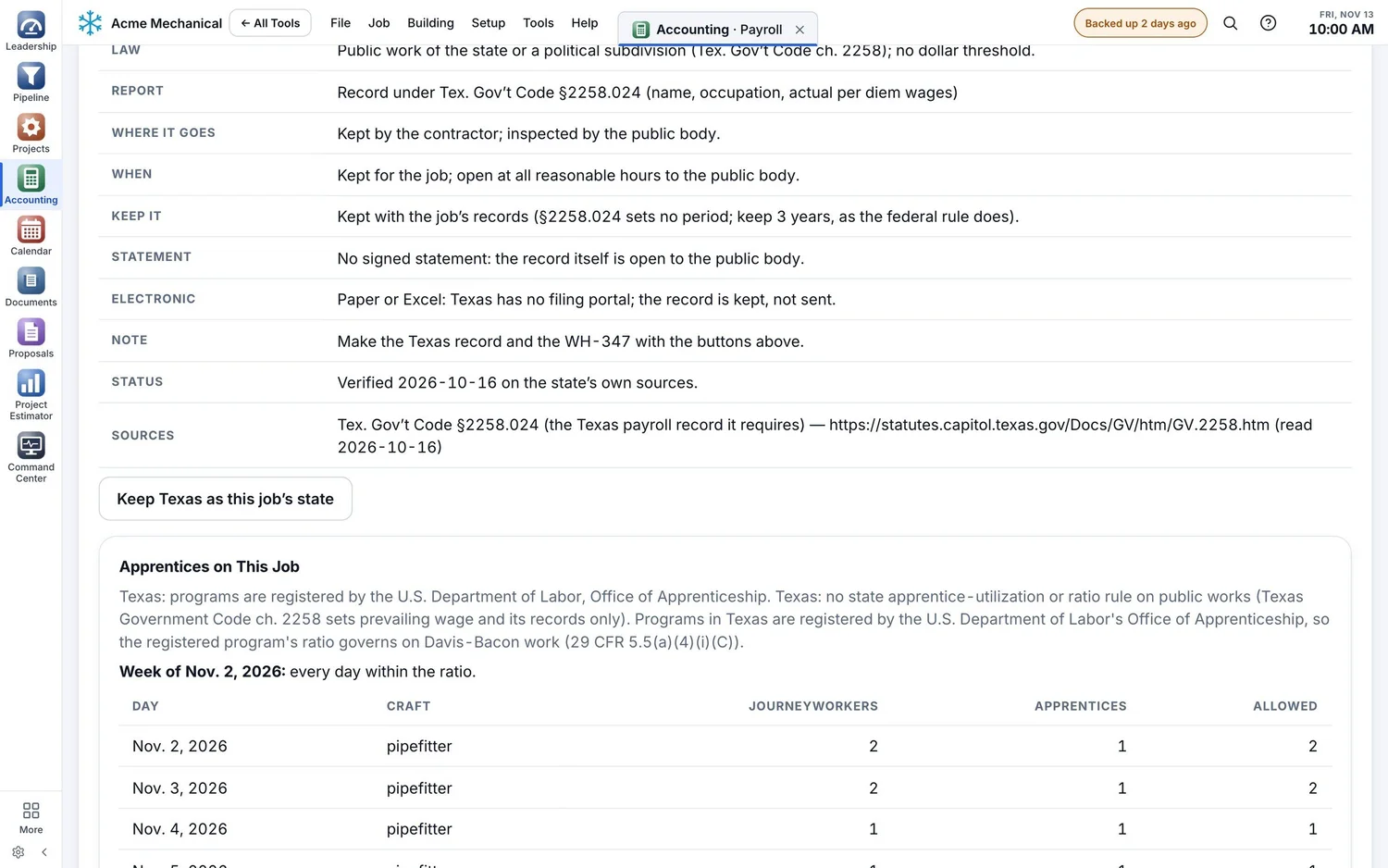
Apprentice ratios are checked by the state, so the week's apprentices are counted day by day.
Public Bid Rules on the Estimate
Pick the customer type and the Project Estimator shows the purchasing method the customer must use at this bid value, the bonds the law asks for and a split-purchase check against the customer's other quotes in the last 12 months. Federal and Texas levels are built in. For another state, type the customer's own levels.
Learn More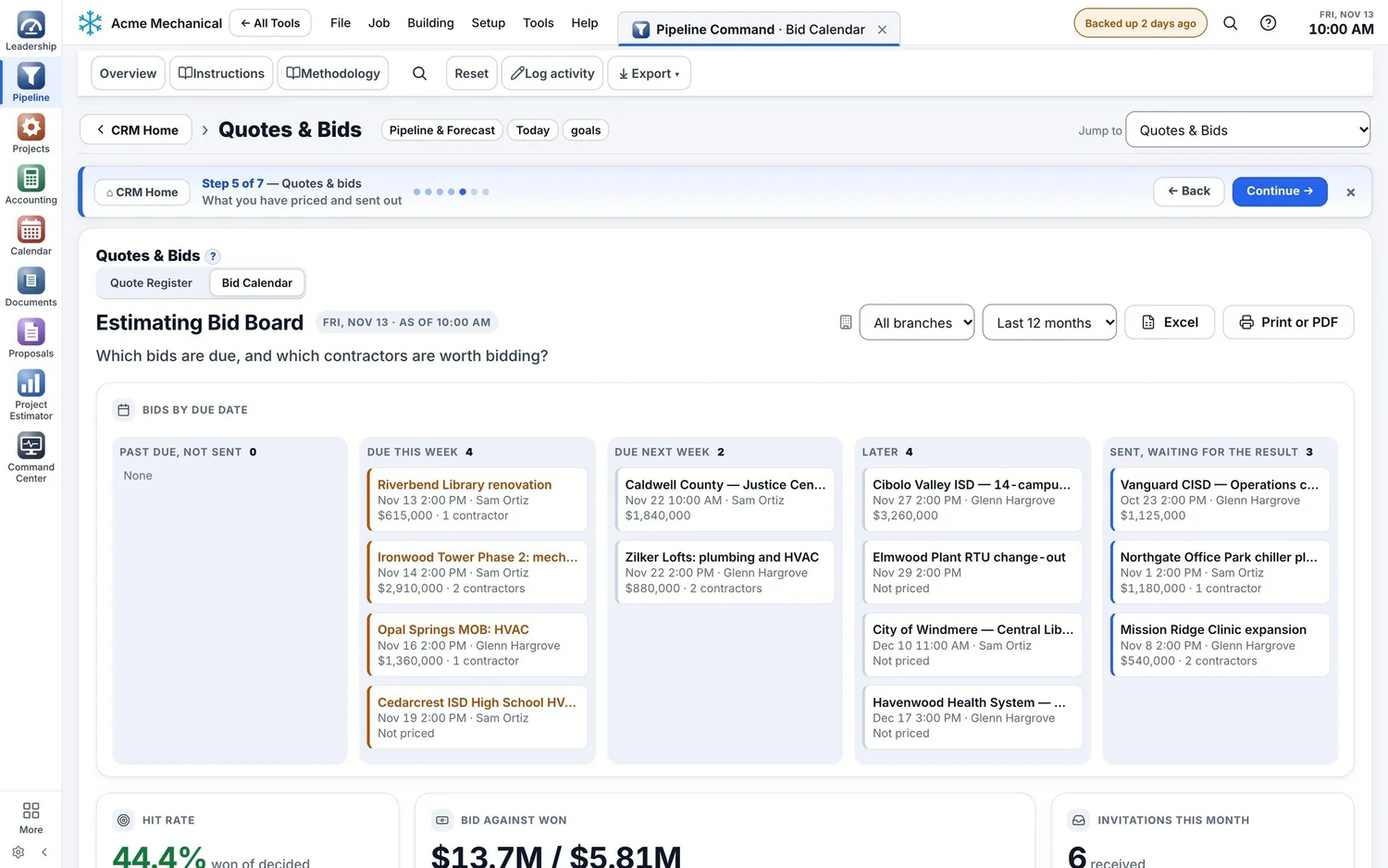
Public bids have strict dates, so each one sits on the bid calendar with its walkthrough.
Prompt Payment and Filing Deadlines
Each state's private prompt-payment act sets calendar dates for what customers owe you and what you owe subcontractors. Payroll and tax filing deadlines come from a dated table for the federal rows and every state, with unverified states labeled instead of guessed.
Learn MoreShow Less
Knowing the day a customer's payment is legally late helps you collect faster, and paying subcontractors on time avoids interest. Both dates go on the calendar.
- Texas: a private-job pay application is due 35 days after it is sent, and interest can run after that.
- Texas: a subcontractor is paid within 7 days after the customer pays you on that job.
- Public and residential jobs are left out.
- Research data with the citation, not legal advice.
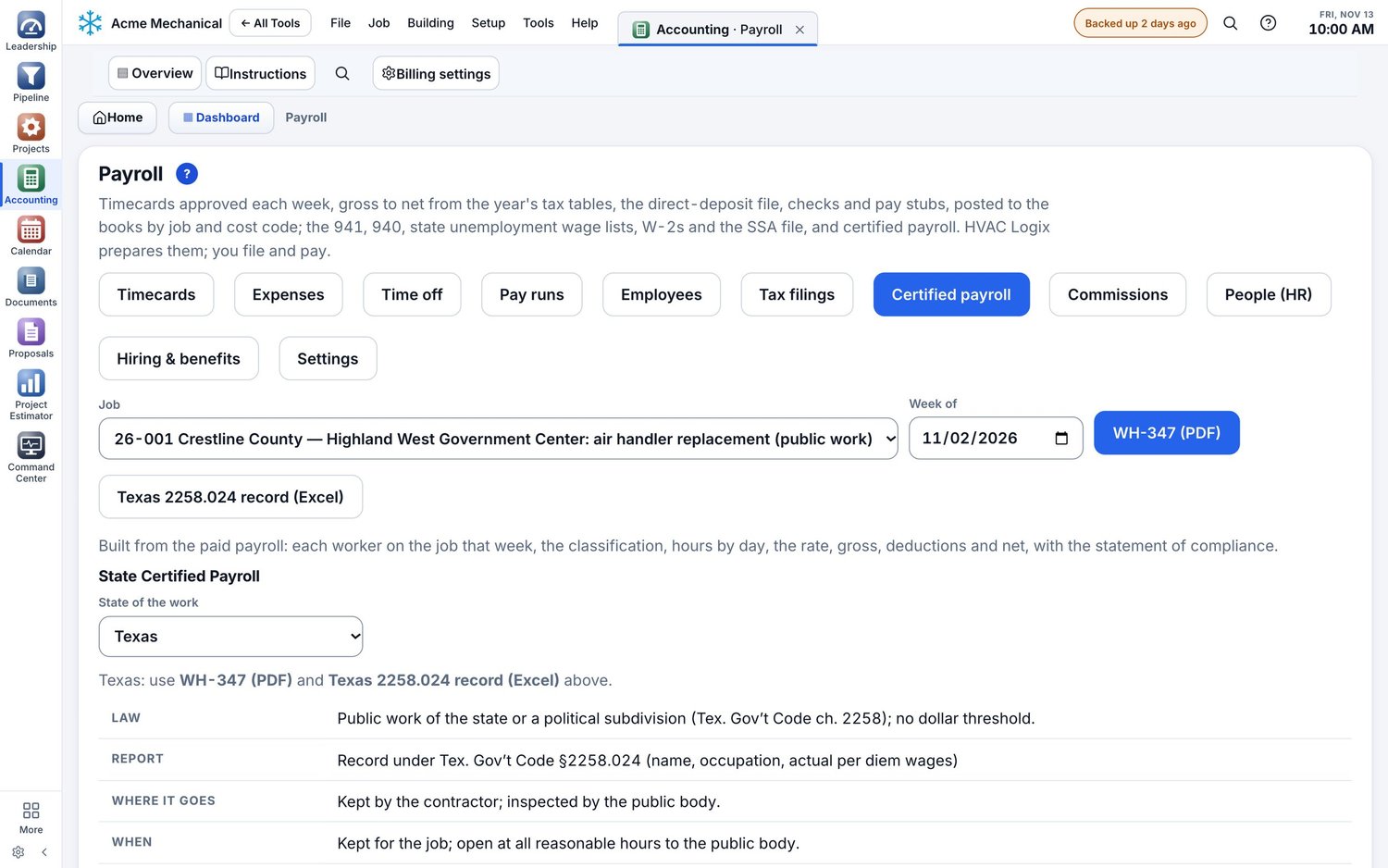
Certified payroll for public work, built from the same paid timecards.
Maintenance Standards and Building Performance Laws
Compliance is also a service you sell. These tools turn a standard or a city law into a record, a due date and a conversation with the customer.
Compliance Packs
For each building and its equipment list, a record of the maintenance program that NFPA 70B, ASHRAE/ACCA Standard 180 and ASHRAE 241 ask for. Each pack shows a status, the gaps with the section each comes from, next due dates on the calendar and a one-page report.
Learn MoreBuilding Performance Standards Tracker
For every building you keep, the tracker shows which performance standard or benchmarking law applies, whether the building is covered and why, its energy use against the limit and the dates. HVAC Logix prepares, reminds and archives. The building's own team files.
Learn MoreShow Less
Building performance fines can run large every year a building stays over its limit. Showing an owner that exposure turns into retrofit and controls work.
- Covers 20 laws, including New York City Local Law 97, Boston BERDO 2.0 and Washington State Clean Buildings.
- A table for 2026 to 2035 shows the limit, this building, the overage and the fine.
- Dates go on the calendar at 90, 30 and 7 days.
- Saves a one-page report and a Portfolio Manager upload file.
Periodic Testing
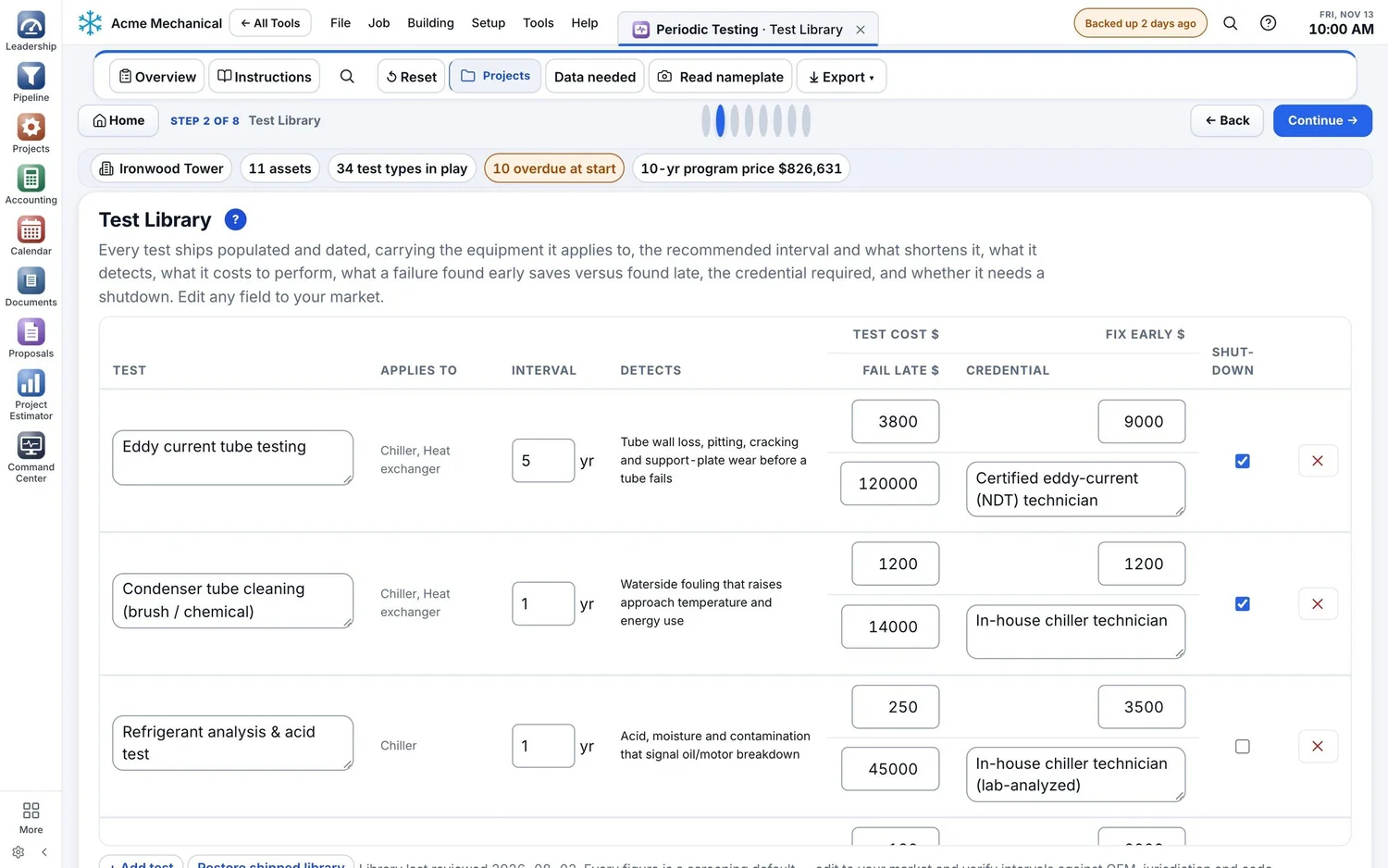
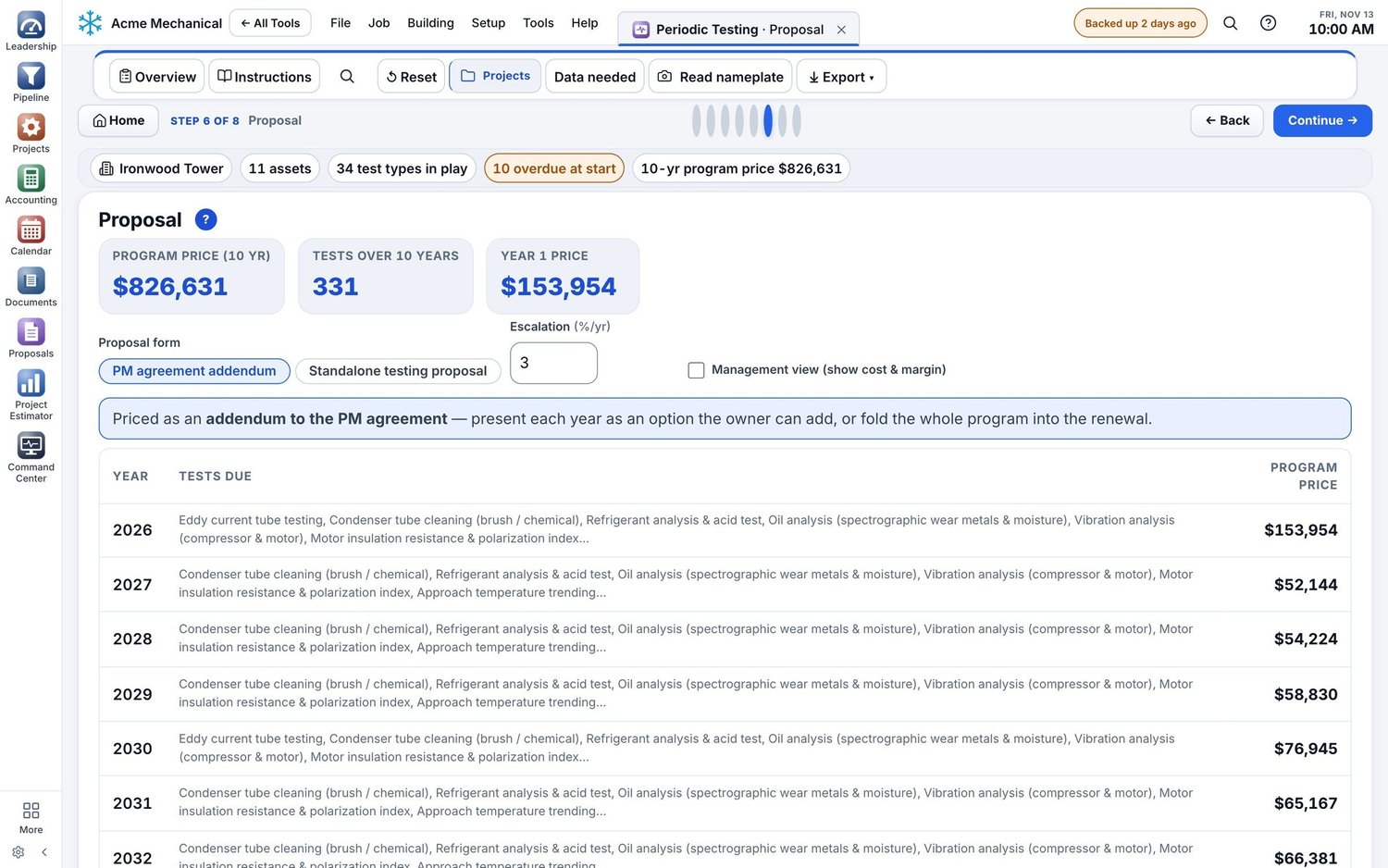
A documented multi-year calendar of the tests that run on three-, five- and ten-year cycles, such as eddy current tube testing, relief valve certification and vibration analysis, with findings recorded and trended.
Learn More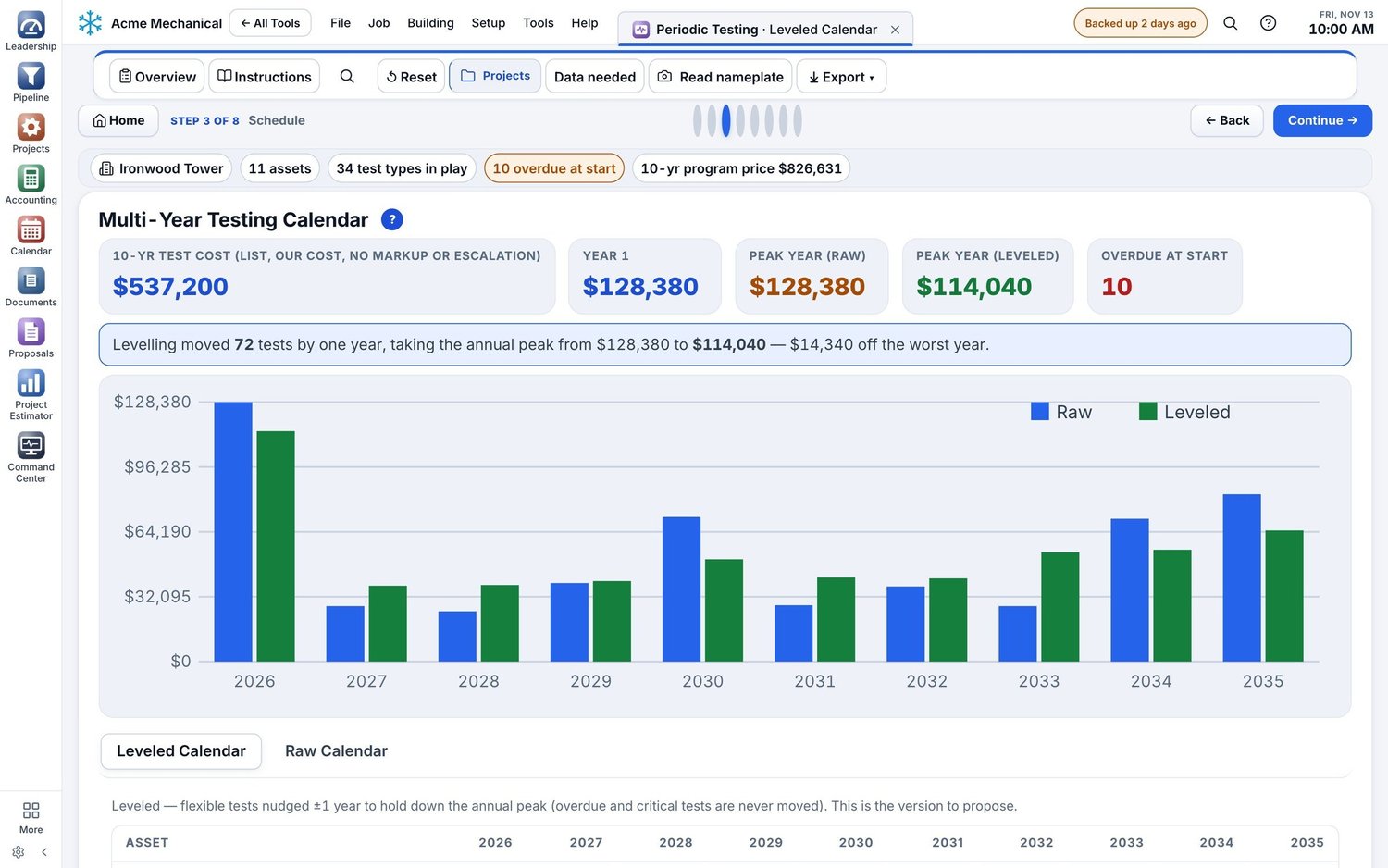
Multi-year tests are easy to forget, so the calendar levels them across the years.
Talking Points for Sales
Pipeline Command turns the rules into talking points on each account, marked Act Now, Plan or Good to Know, each with the rule it comes from and the date that rule was read.
Learn More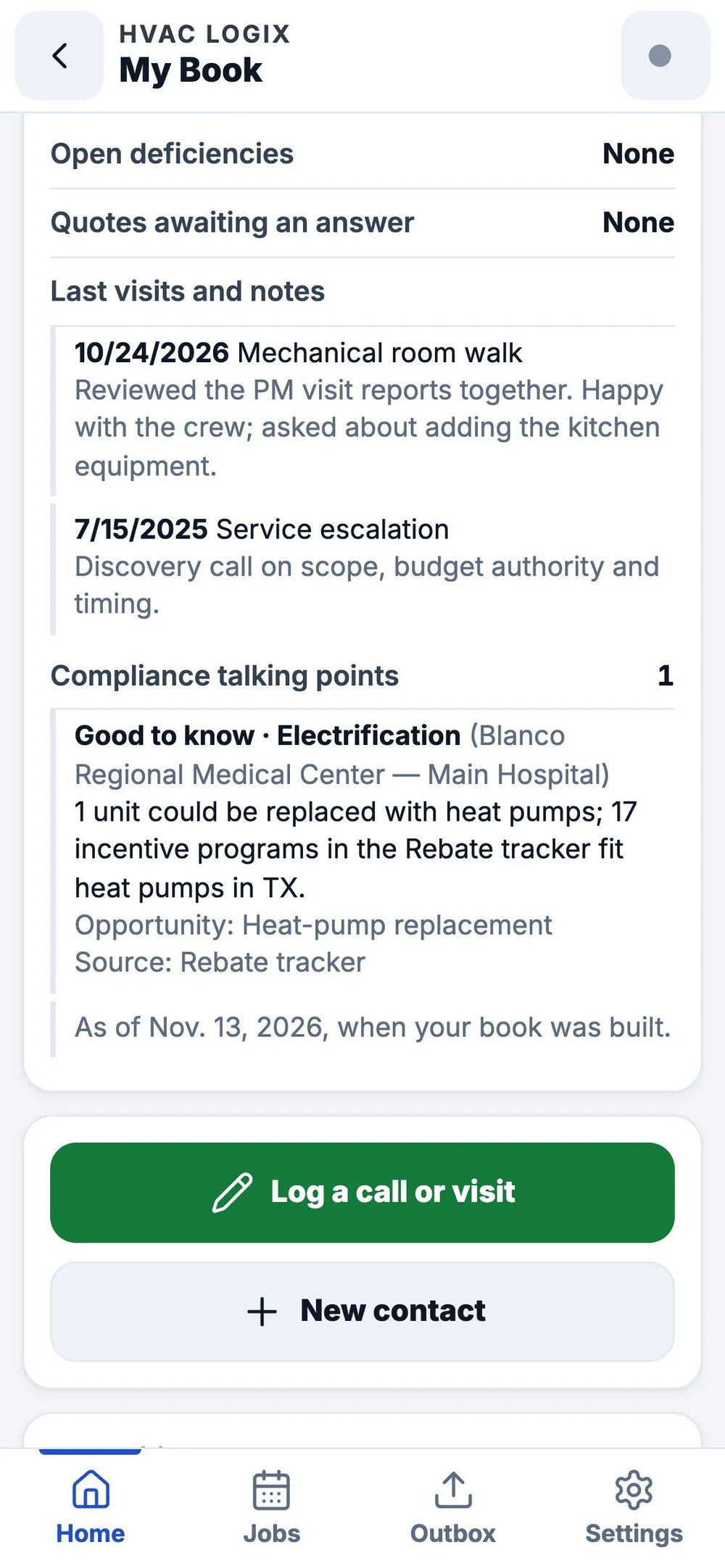
Rules make good sales conversations, so each account shows its compliance talking points.

Permits, Certificates and the Gates That Enforce Them
Permits and Inspections
- The AHJ Directory keeps each authority once: area covered, portal, inspection lead time, fees and the date someone last checked.
- Permit Check reads the words of the work against the model codes and the authority's own rules and shows Likely Required with the reason. It is a prompt, and the authority decides.
- Permit Watch lists permits expiring in 30 days, expired, waiting on a re-inspection or sitting on a closed job.
- A job is not closed, and its final retainage is not billed, while a permit on it has not passed its final inspection.
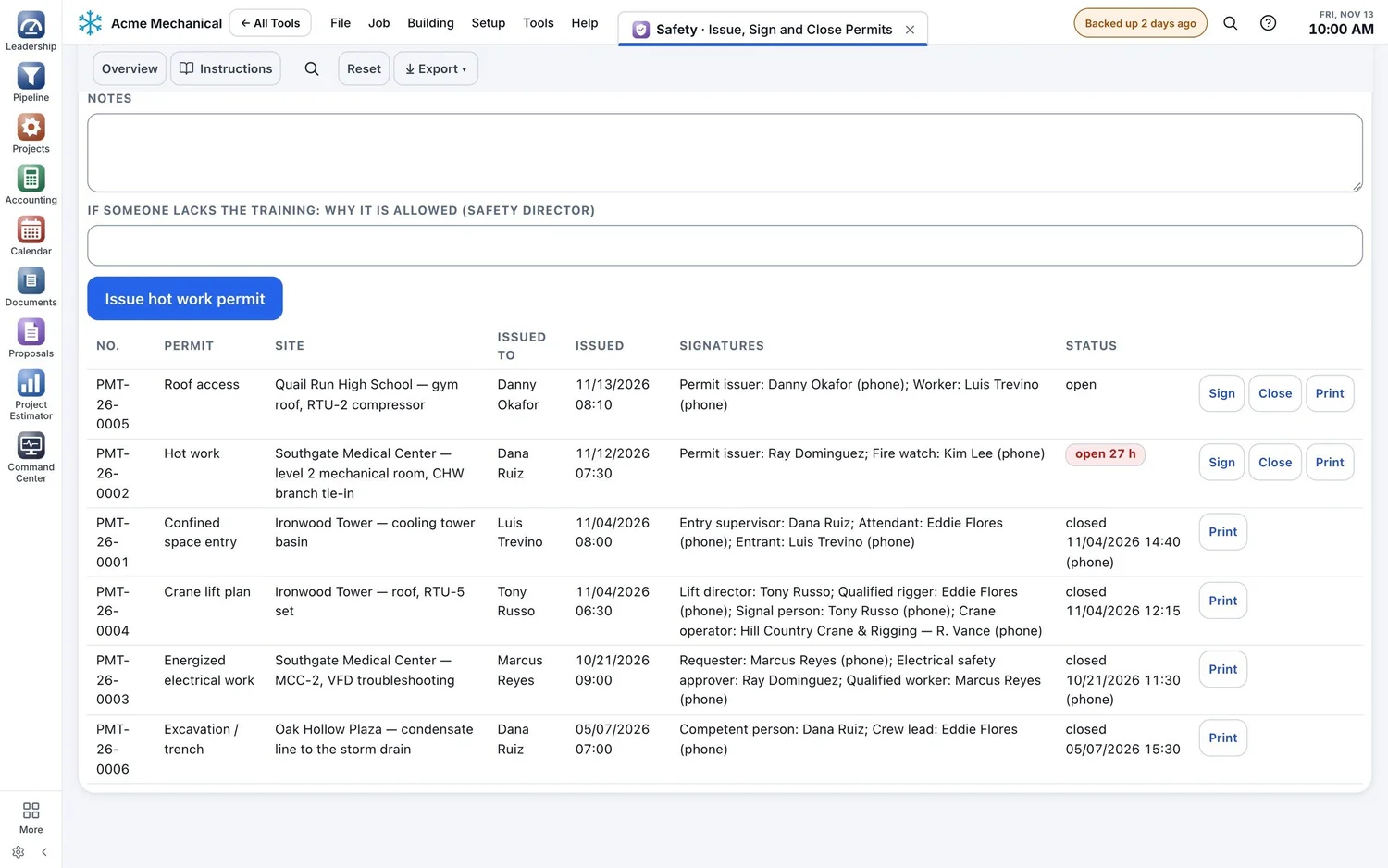
Work started without a permit can be stopped, so each permit is tracked with its status.
Subcontractor Compliance Files
- Policies from the certificate, bonds, license, prequalification status and signed documents for each subcontractor.
- Your own requirements for limits and endorsements are checked against what is on file.
- With the approval rule on, an expired certificate of insurance holds the payment on Pay Bills.
- Every expiry is listed on the calendar.
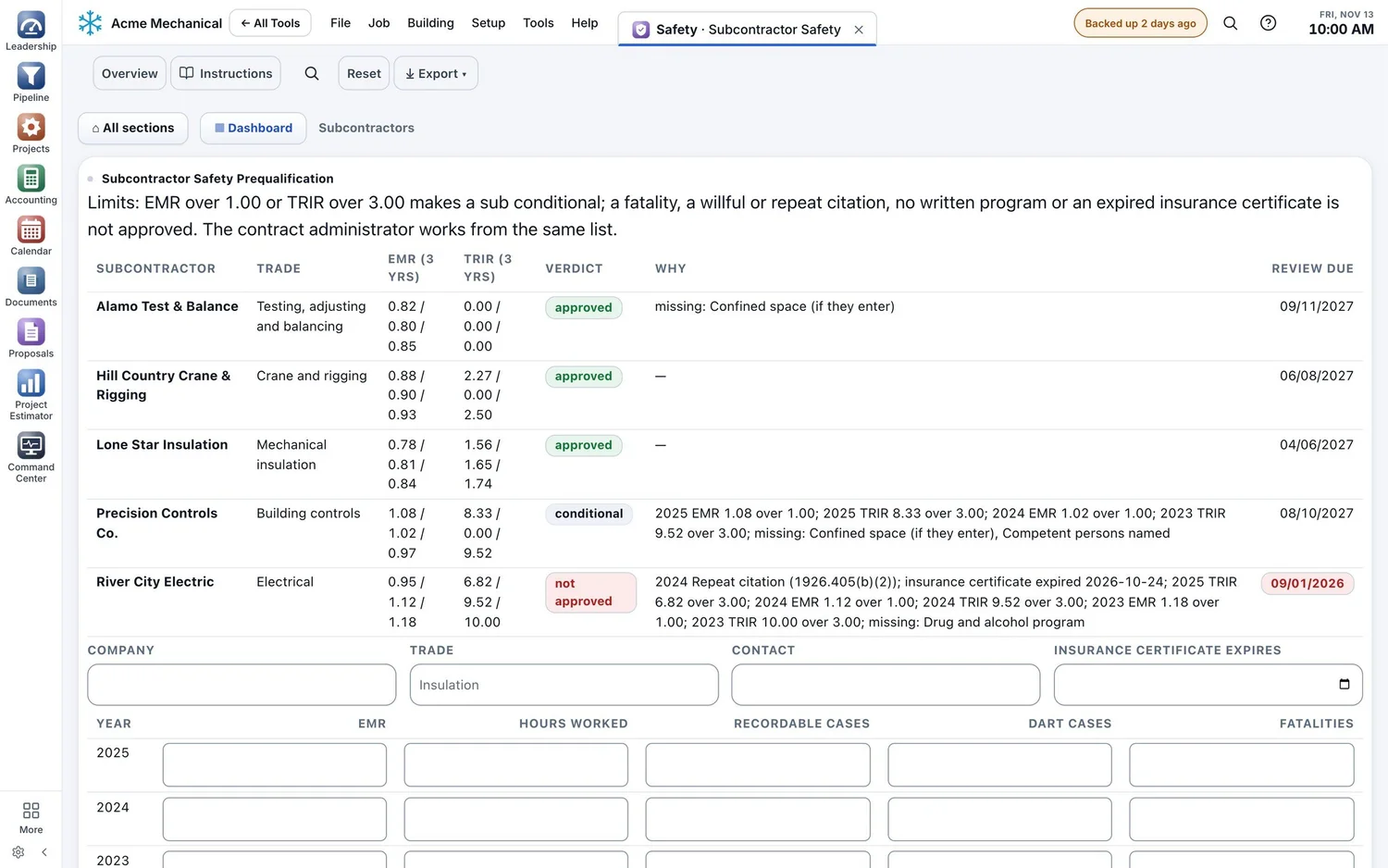
An unqualified subcontractor puts you at risk, so each gets a prequalification verdict.
Your Own Insurance
- Contract Check compares a customer's required limits against the policies in force before anyone prices the job.
- Claims and loss runs are kept by policy, with five policy years of loss history.
- The renewal timeline counts back from each expiry, and the Renewal Package gathers what the broker asks for in Word and Excel.
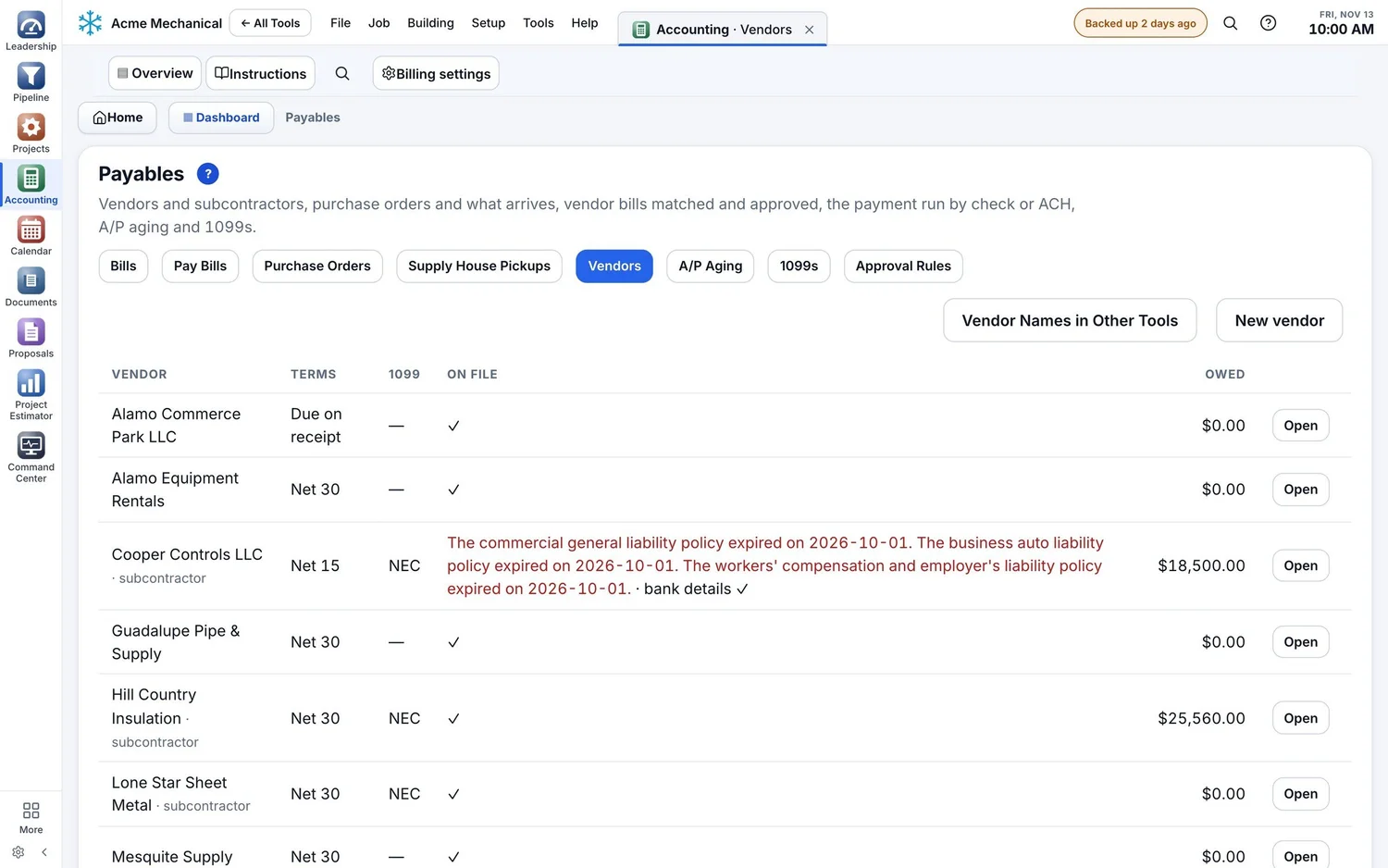
Paying a vendor with lapsed insurance is a risk, so the vendor list flags expired certificates.
Grease Interceptor Records
- Each interceptor is recorded once per building with its permit number and pump-out frequency.
- Pump-outs keep the hauler, the manifest number and the measured depths.
- The City Report gives the record for a date range in Word or Excel for the customer to hand the inspector.
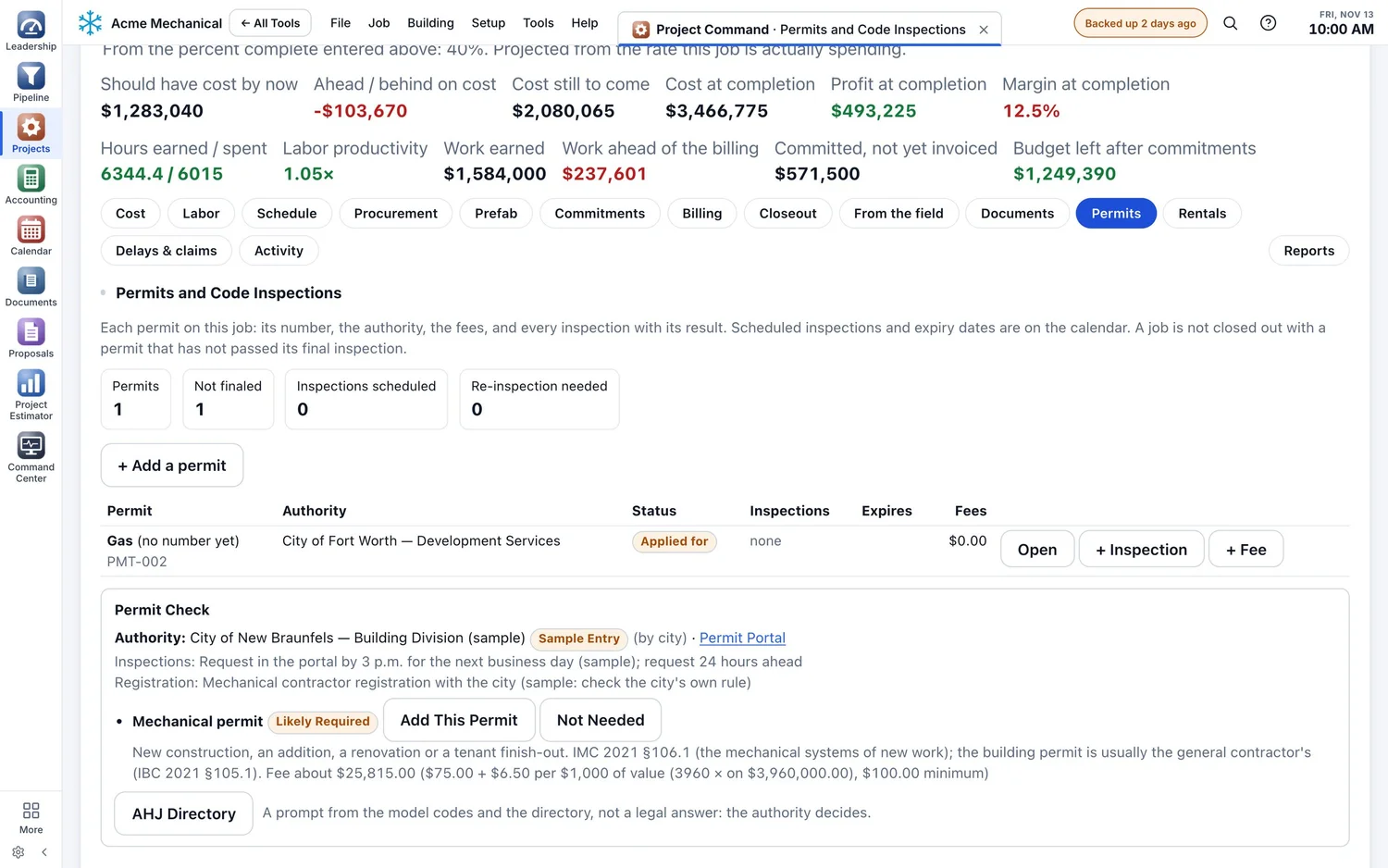
Permits and inspections tracked on the job, so work does not start without them.
Records You Can Stand Behind
Tamper-Evident Records
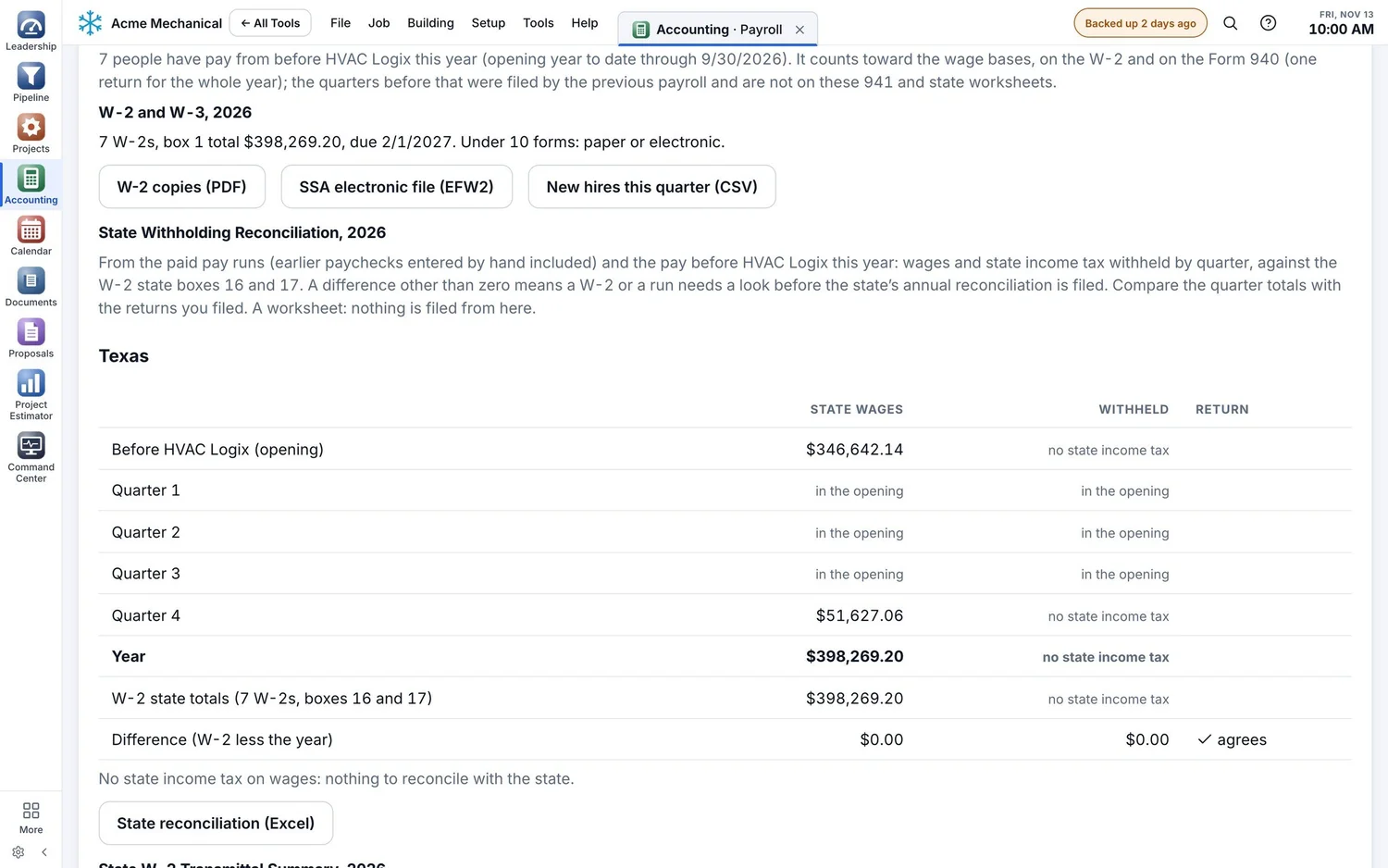
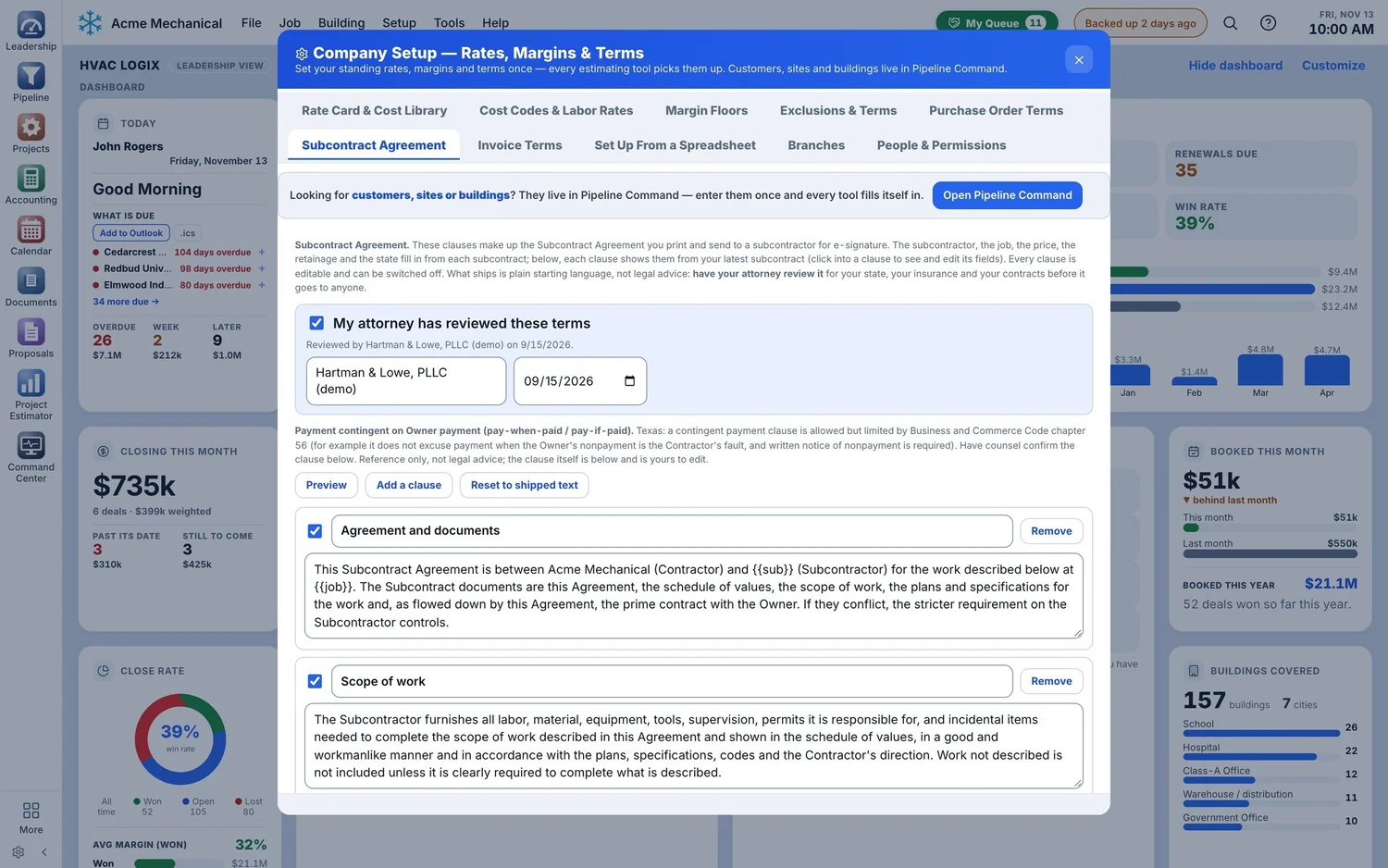
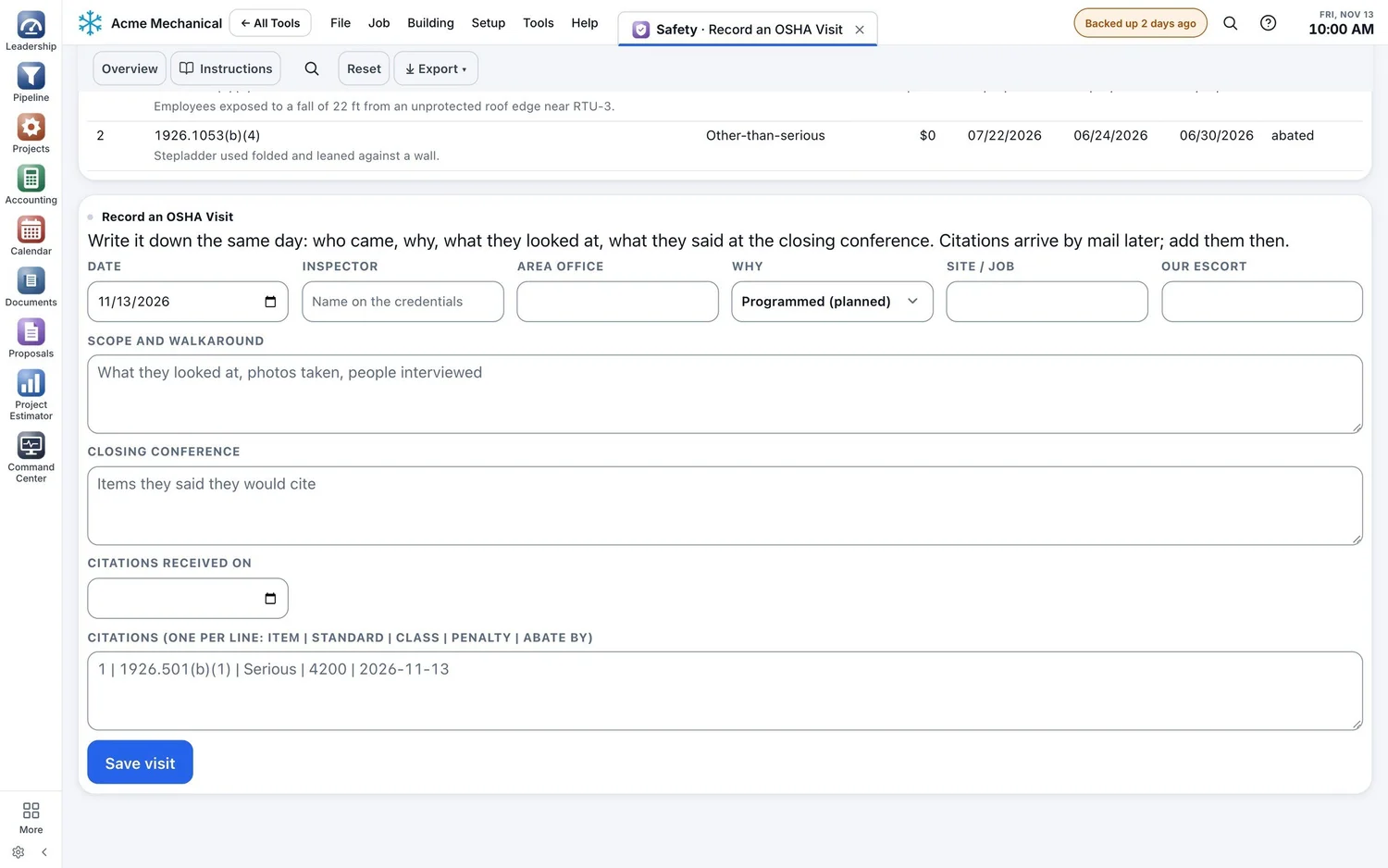
Lockout records, safety inspections, vehicle inspections, refrigerant leaks, cylinder movements and other compliance records are sealed in a hash chain. Reports carry the latest fingerprint, and Verify Records lists any record changed or removed since it was sealed.
Learn MoreShow Less
When an inspector or a lawyer asks whether a record was changed, a provable answer avoids fines and lost claims.
- Each record gets a digital fingerprint with the name, date and time when it is saved; a change adds a dated entry, never a silent edit.
- The fingerprint prints on every report and export of these records.
- Verify checks a fingerprint copied from a printed report.
- Keep printed or PDF copies outside the computer: an earlier fingerprint cannot be made to match again.
Every Rule Dated and Sourced
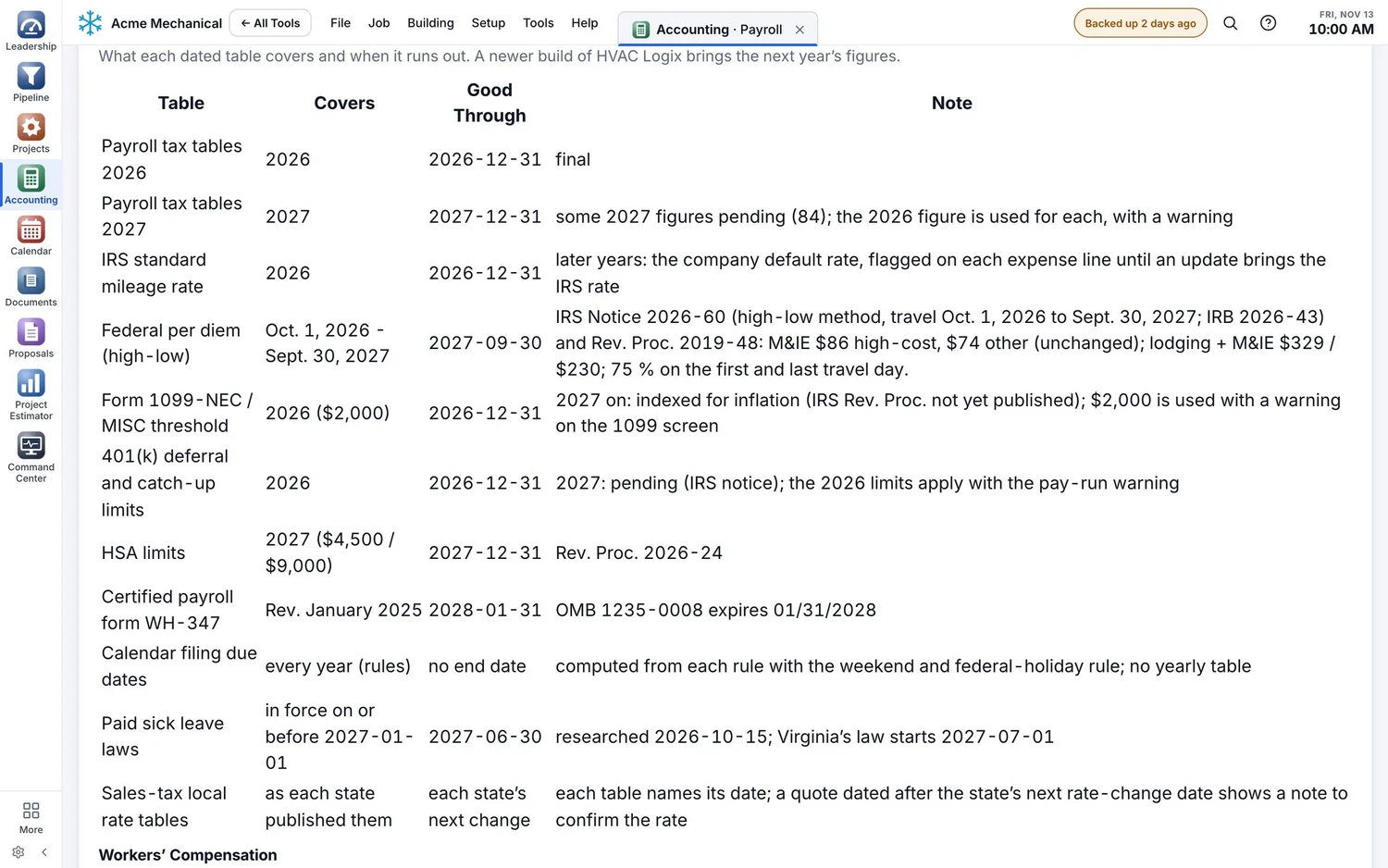
Rules are kept as dated tables with the source of each row and the date it was read. All 50 states and DC are covered.
Learn MoreShow Less
A rule applied from an outdated table can cost a fine or a refund. Every row shows where it came from and when, so stale rules are visible.
- Compliance rules are kept in one dated data file.
- Payroll, mileage, per diem, the 1099 threshold and sales tax tables list the date each one runs out.
- A dated pack, such as the building performance laws, shows its date on every screen and report.
- The program works out dates and warns; a person checks and files.
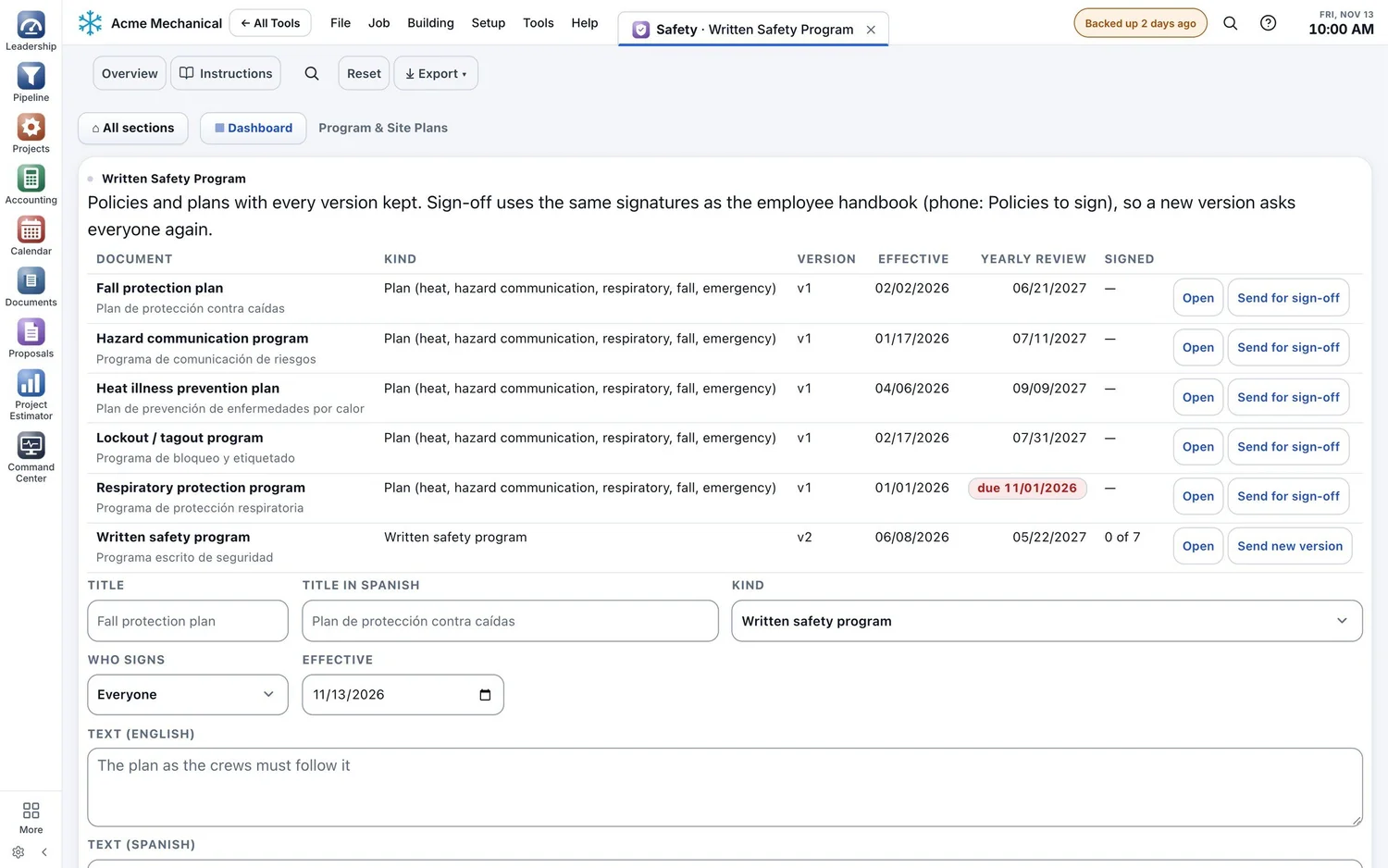
Customers ask for your written programs, so each one is kept with its version and review date.
The Company Register
Insurance policies, surety bonds, contractor and trade licenses, vehicle registrations, instrument calibration and sales-tax permits, each with its expiry, its reminders and the document itself.
Learn MoreShow Less
A lapsed insurance policy or license can cost a contract or leave the company uninsured on a job. Every dated company item reminds its owner and escalates if it lapses.
- Standard reminders come 90, 60, 30 and 7 days ahead and on the day.
- A lapse escalates to company leadership at 5:00 PM on the day it expires.
- Renewed asks for the new date and keeps the old one in the history.
- Leases and loan covenant reports can be kept too.
The Security Answer Pack
When a hospital, university or federal customer sends a security questionnaire, HVAC Logix answers the program's part from the copy you run, with a software bill of materials and a register of every remote connection to that customer's building.
Learn MoreShow Less
Institutional customers do not award work until security questions are answered. The pack answers them quickly and truthfully.
- Covers the topics common questionnaires ask about, worked out from this copy's settings.
- The software bill of materials saves in the standard CycloneDX format.
- Connections outside a customer's approved range are marked in red.
- Incident steps draft a notice to the customer's IT contact.
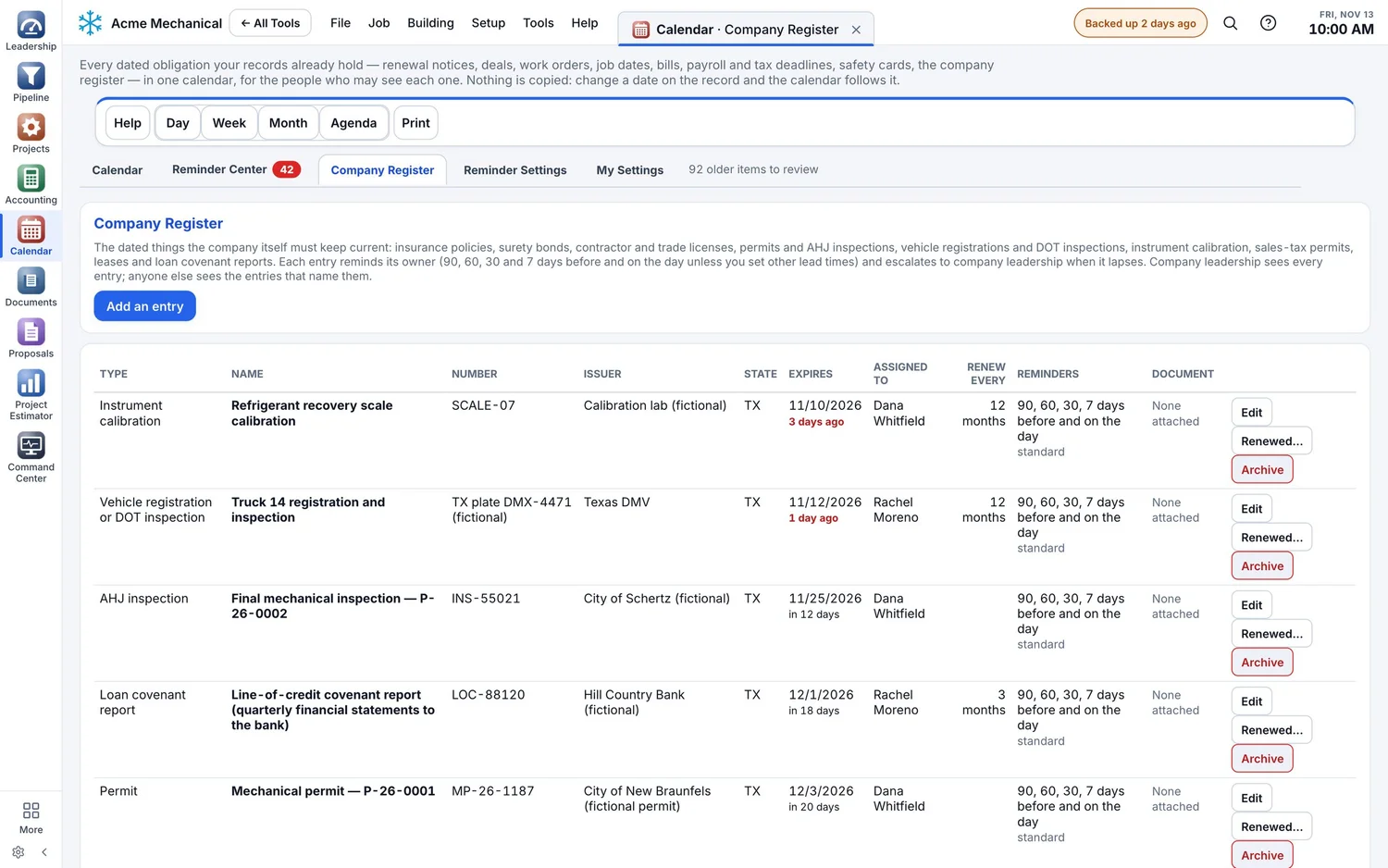
The company register: dated records you can stand behind in an audit.
Frequently Asked Questions
Does HVAC Logix file reports with agencies for us?
Is this legal advice?
How do we know a rule is current?
Which state refrigerant rules are covered?
Can someone change a compliance record after the fact?
Be First When HVAC Logix Opens
Stop paying people to copy numbers between programs. Join the list and we will tell you the day downloads open, with setup guides ready.
Launching early 2027 for HVAC Logix. Nothing to buy today, and no sales calls.
