
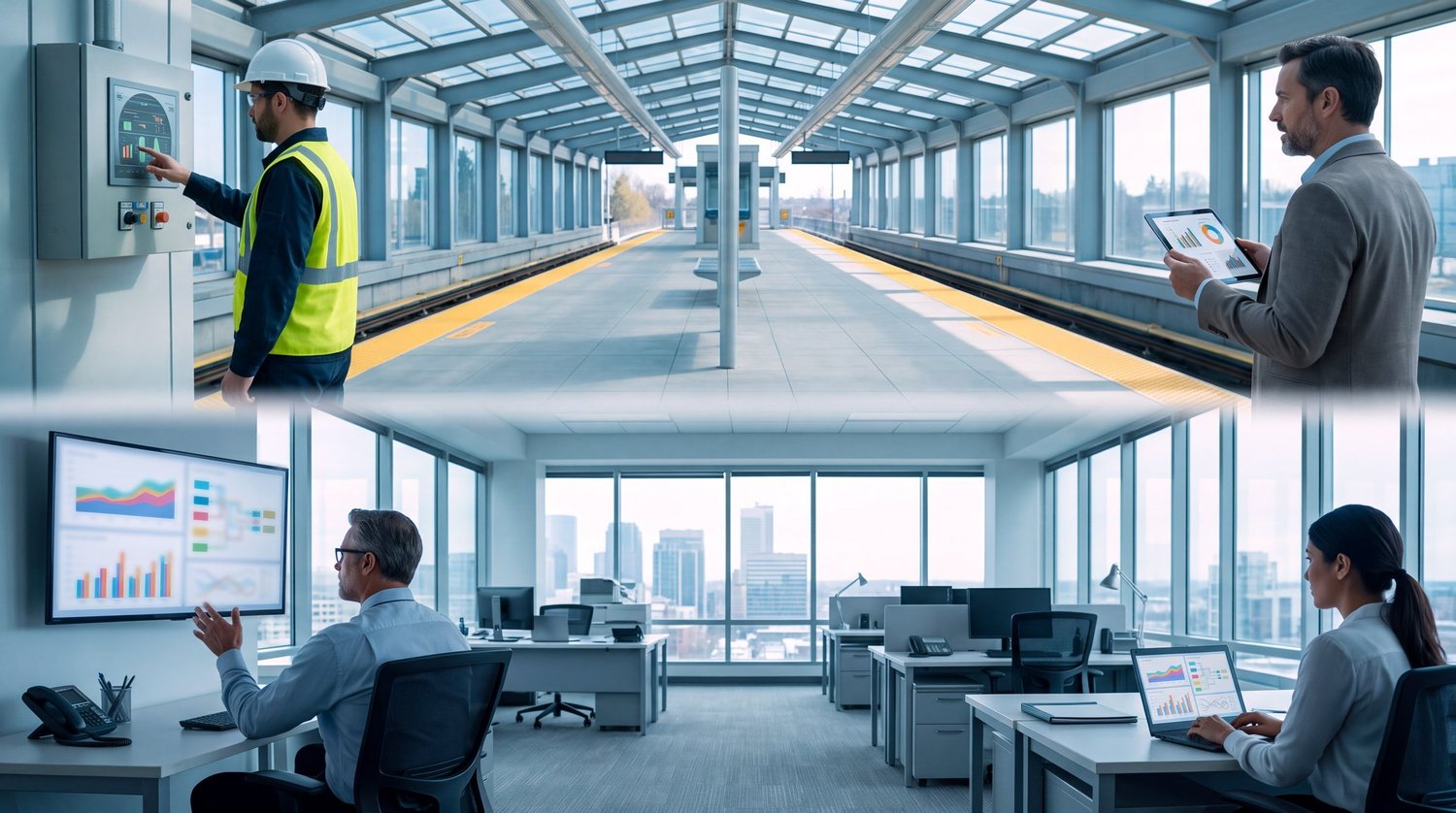
Transit facilities move large numbers of people through escalators, elevators and platforms that run all day, under fixed-guideway life safety code and public-agency accountability. Facilities Logix's transit playbook covers rail and bus stations, transit hubs, maintenance shops, DOT buildings, ferry terminals, rail yards and marinas. It tracks the systems riders depend on, the transit rules that apply, the capital reserve and station energy.
Federal Transit and Rail Rules, with Their Dates
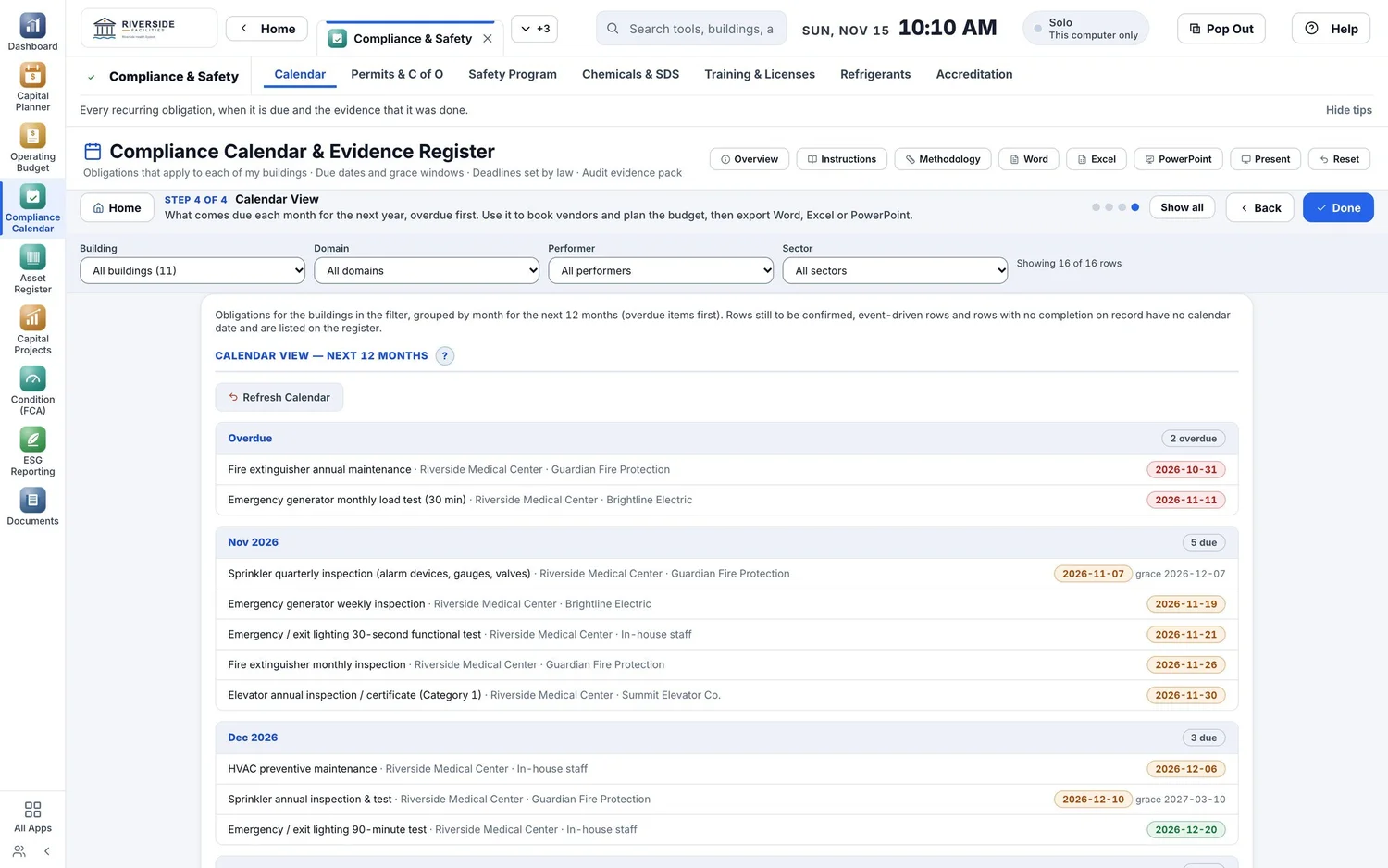
The Compliance tab lists the obligations from the compliance library that apply, with the same dates as the Compliance Calendar. Facts about the agency, such as whether it receives Federal Transit Administration (FTA) funds or operates a rail fixed guideway, decide which rows appear.
FTA Recipients
- Transit Asset Management plan fully updated at least every 4 years (49 CFR 625.29)
- National Transit Database asset inventory and facility condition reporting on the TERM scale each year, with at least a quarter of facilities assessed each year (49 CFR 625.55)
- Public Transportation Agency Safety Plan reviewed and updated each year (49 CFR 673.11)
Rail Fixed Guideway Operators
- An ongoing internal safety review covering every safety plan element within 3 years, with an annual report to the State Safety Oversight Agency (49 CFR Part 674)
- The State Safety Oversight Agency's audit at least once every 3 years
- Safety certification training for rail safety oversight staff, with recertification every 2 years (49 CFR Part 672)
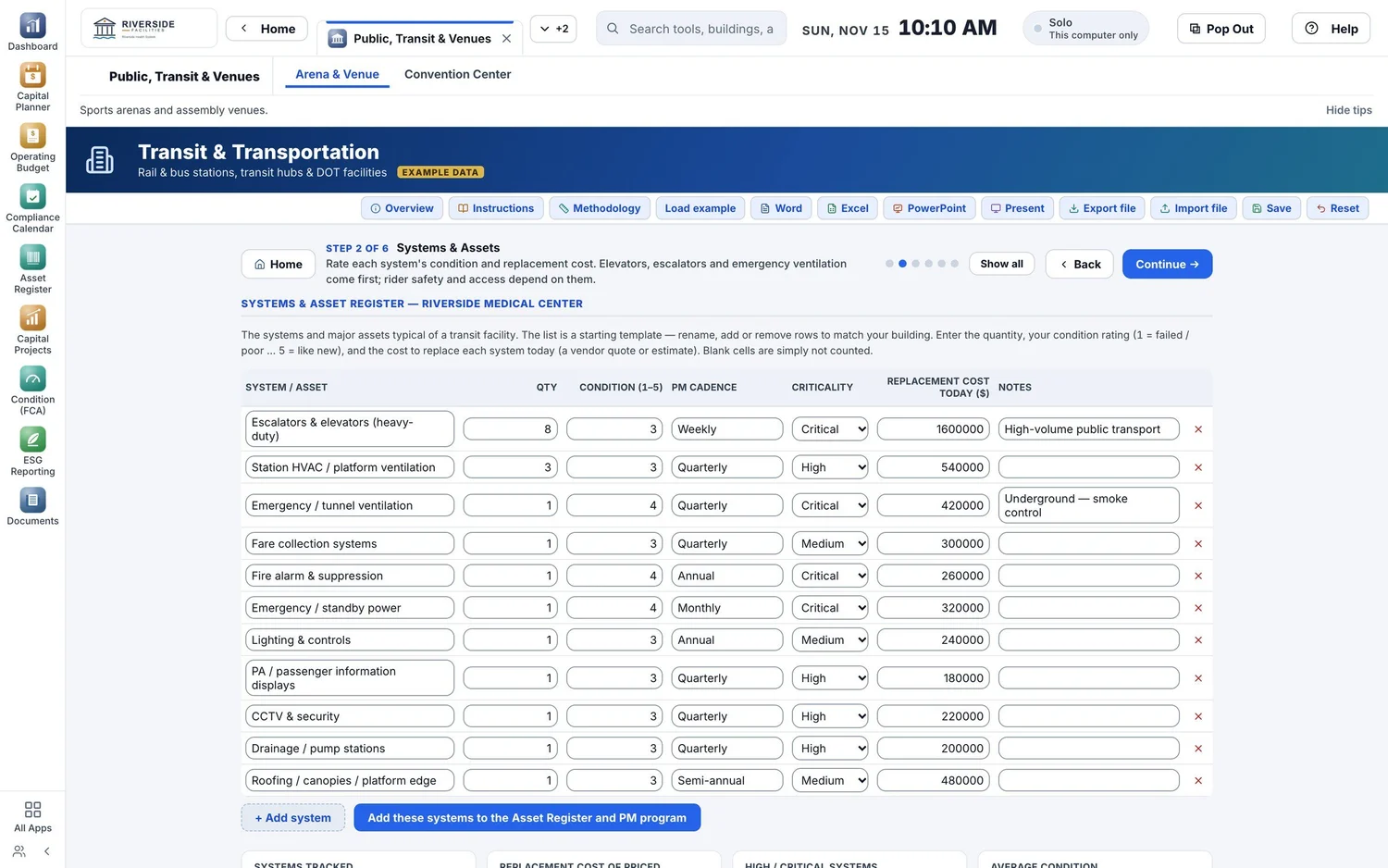
Systems & Assets in Transit & Transportation: rate each system's condition and replacement cost. Elevators, escalators and emergency ventilation come first; rider safety and access depend on them.
Track, Yards and Stormwater
- Federal Railroad Administration visual track inspection for general-system track: weekly or twice weekly on main track and sidings, monthly in yards (49 CFR Part 213)
- Industrial stormwater permit inspections each quarter and the annual report where a maintenance or yard facility holds one
Marinas
- Pick Marina as the type and the marina rows apply: electrical system inspection and ground-fault testing on a rolling schedule so the whole system is covered at least once a year (NFPA 303, flagged Confirm)
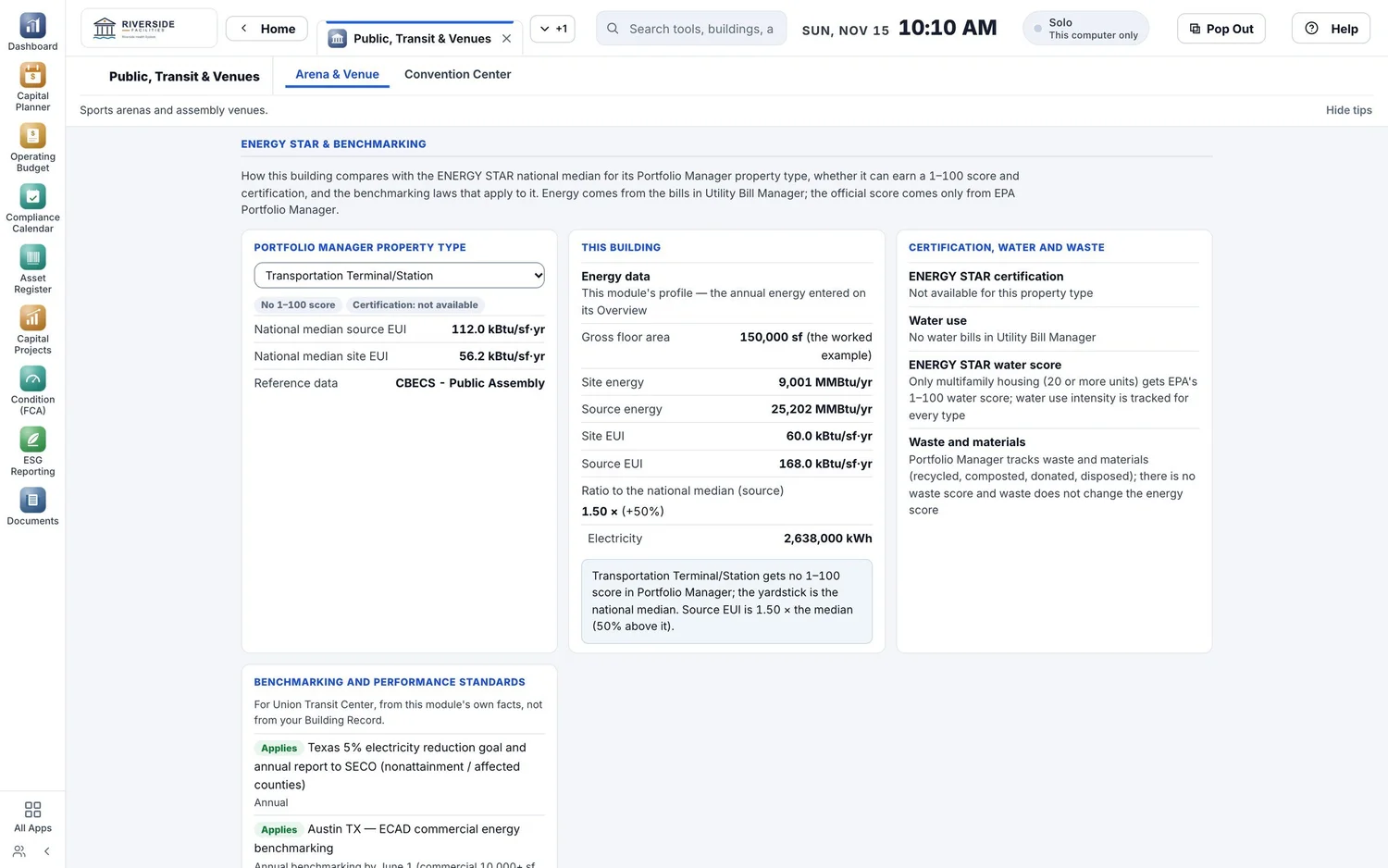
ENERGY STAR in Transit & Transportation: stations and terminals compare with the ENERGY STAR national median (no 1–100 score). The energy comes from your bills; see where the facility stands and which benchmarking laws apply.
Systems Every Station Has
- Elevator and escalator periodic inspections and Category 1 tests, fire alarm and sprinkler testing, smoke control system tests and generator tests
- Each appears only when your equipment records show the equipment
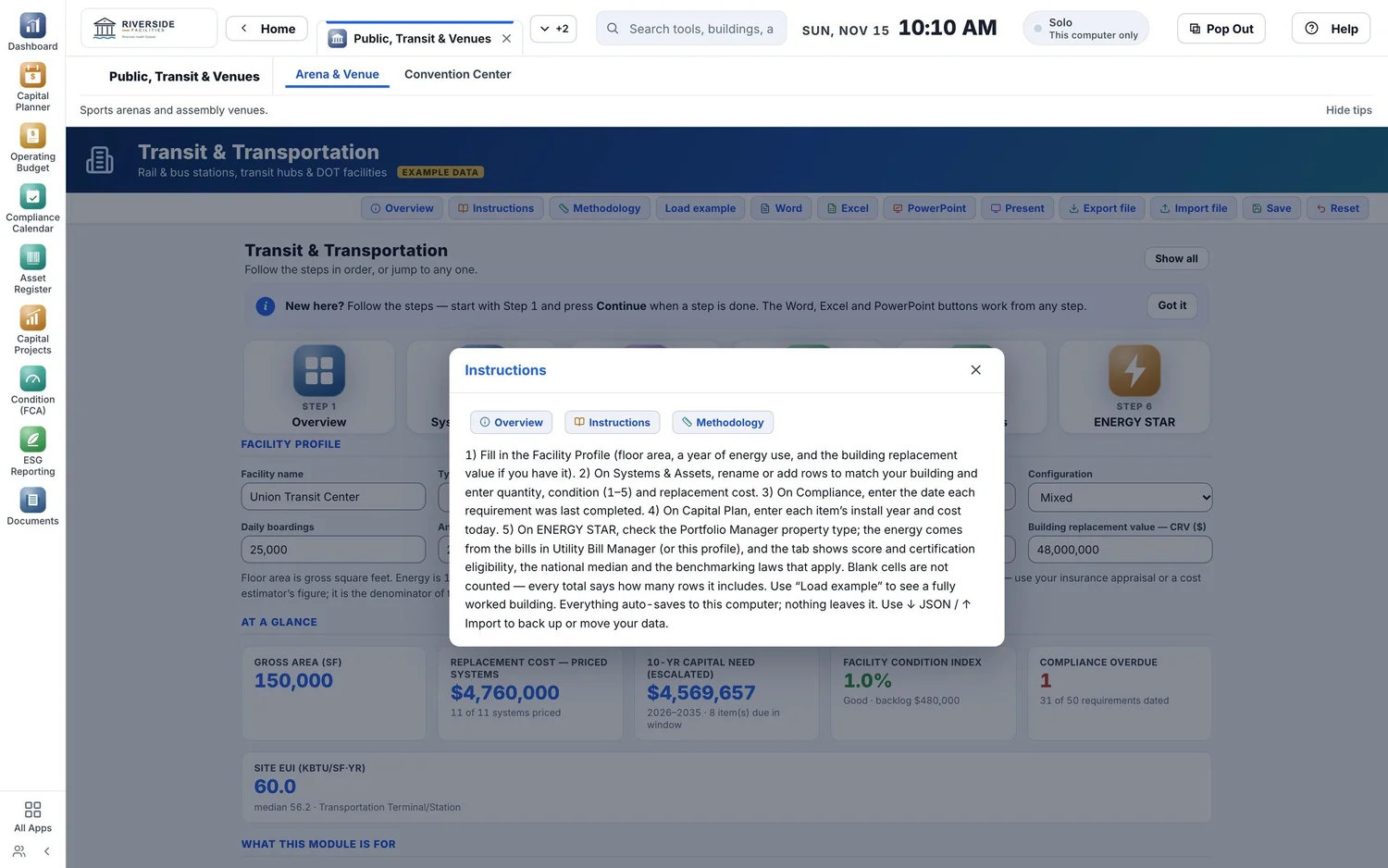
Instructions in Transit & Transportation: how to work through it, step by step.
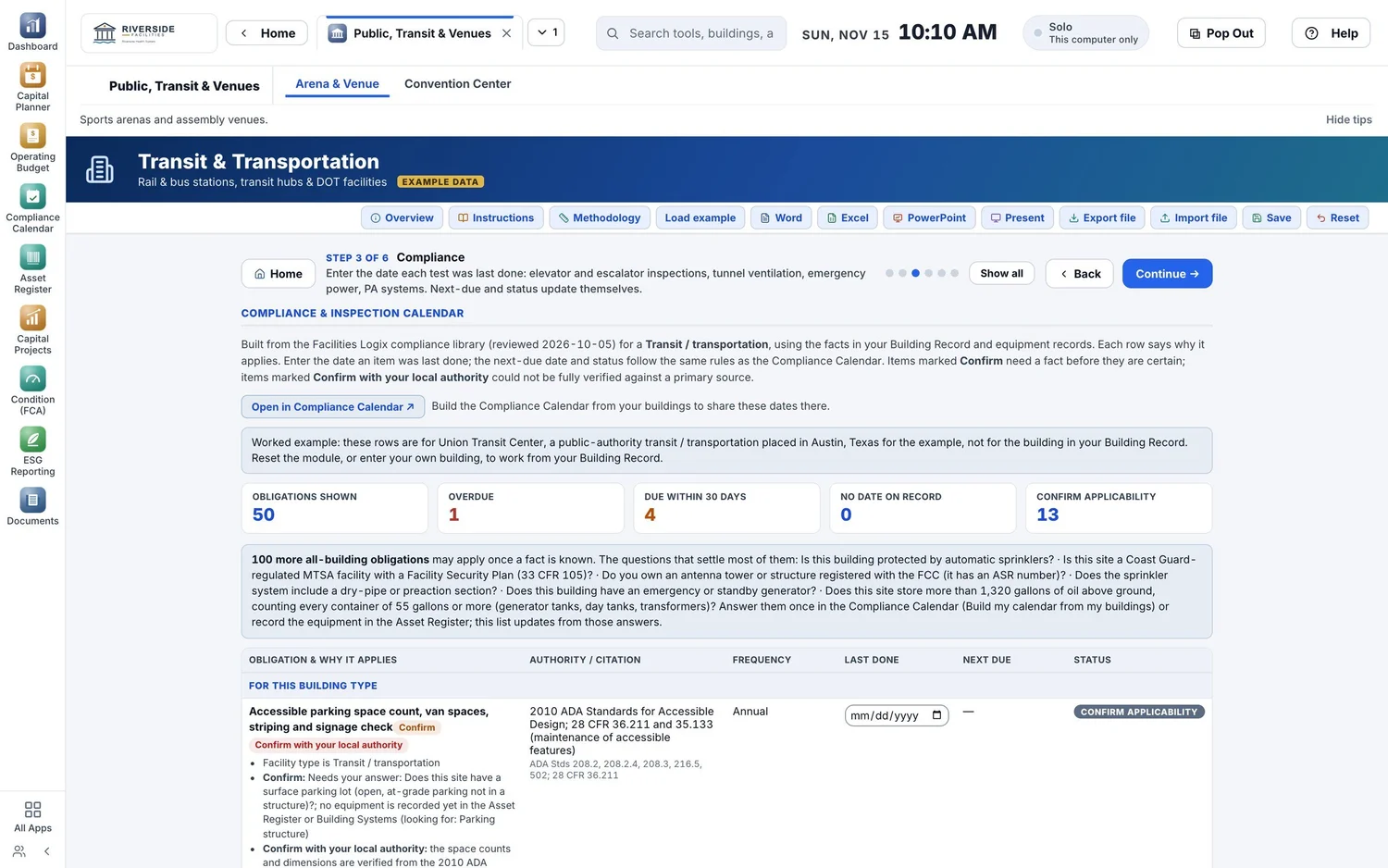
Federal transit and rail rules carry many dates, so the obligations that apply are listed with their citations.
Vertical Transport First
Systems with PM Cadence
- Heavy-duty escalators and elevators, weekly, Critical
- Emergency and tunnel ventilation for smoke control underground, quarterly, Critical
- Station HVAC and platform ventilation, quarterly
- Emergency and standby power, monthly, Critical, and fire alarm and suppression, annual, Critical
- PA and passenger information displays, CCTV and security, fare collection, and drainage and pump stations, quarterly
- Lighting and controls, annual, and roofing, canopies and platform edge, semiannual
Profile
- Type: rail or subway station, bus terminal or depot, multimodal hub, transit maintenance shop, DOT or agency building, ferry terminal or port facility, rail yard or rail maintenance facility, or marina
- Configuration: at-grade, elevated, underground or mixed
- Capital lines for escalator and elevator modernization, station HVAC, emergency ventilation, fare collection, fire and life safety, emergency power, CCTV, roof and canopy, and lighting
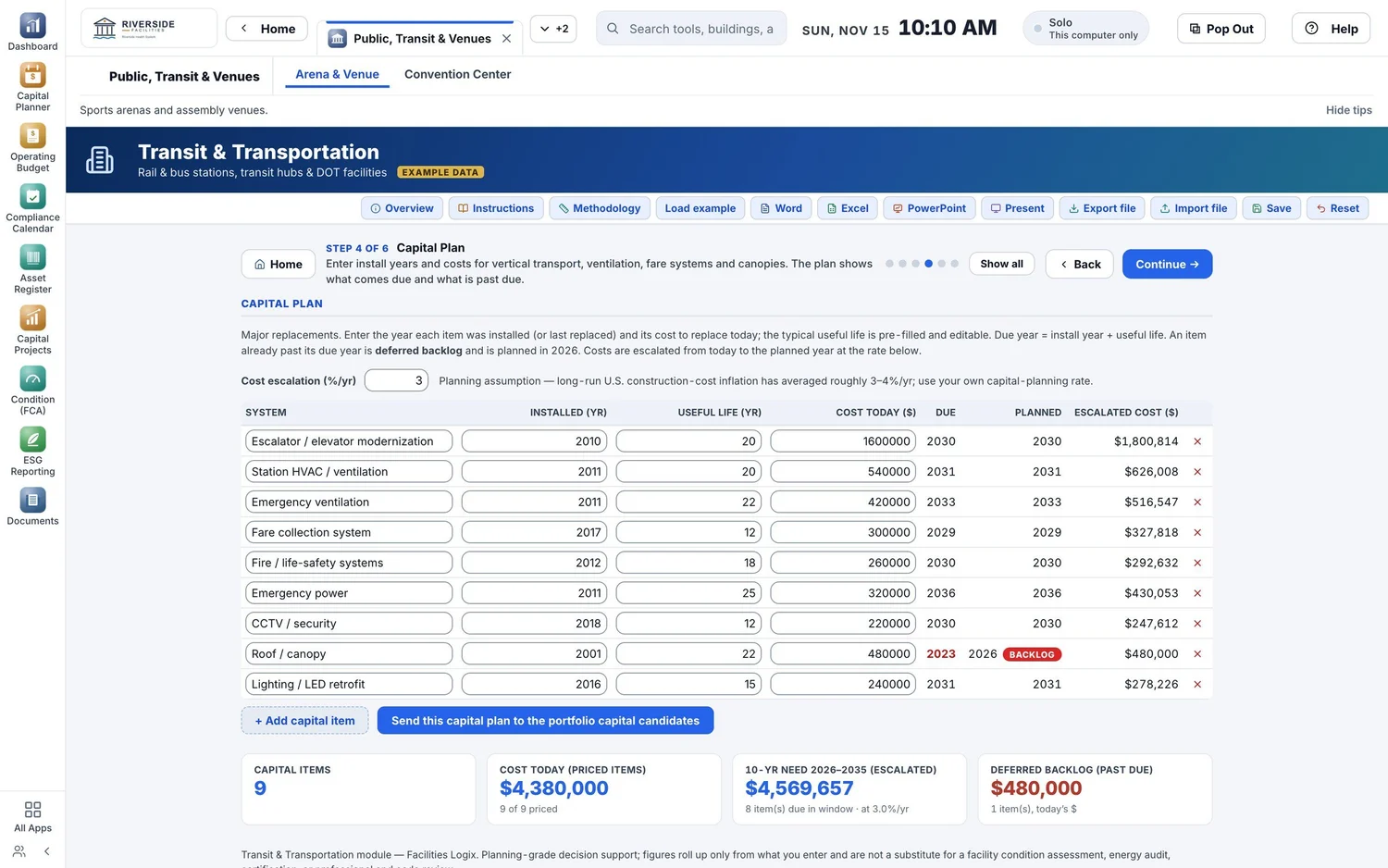
Capital Plan in Transit & Transportation: enter install years and costs for vertical transport, ventilation, fare systems and canopies. The plan shows what comes due and what is past due.
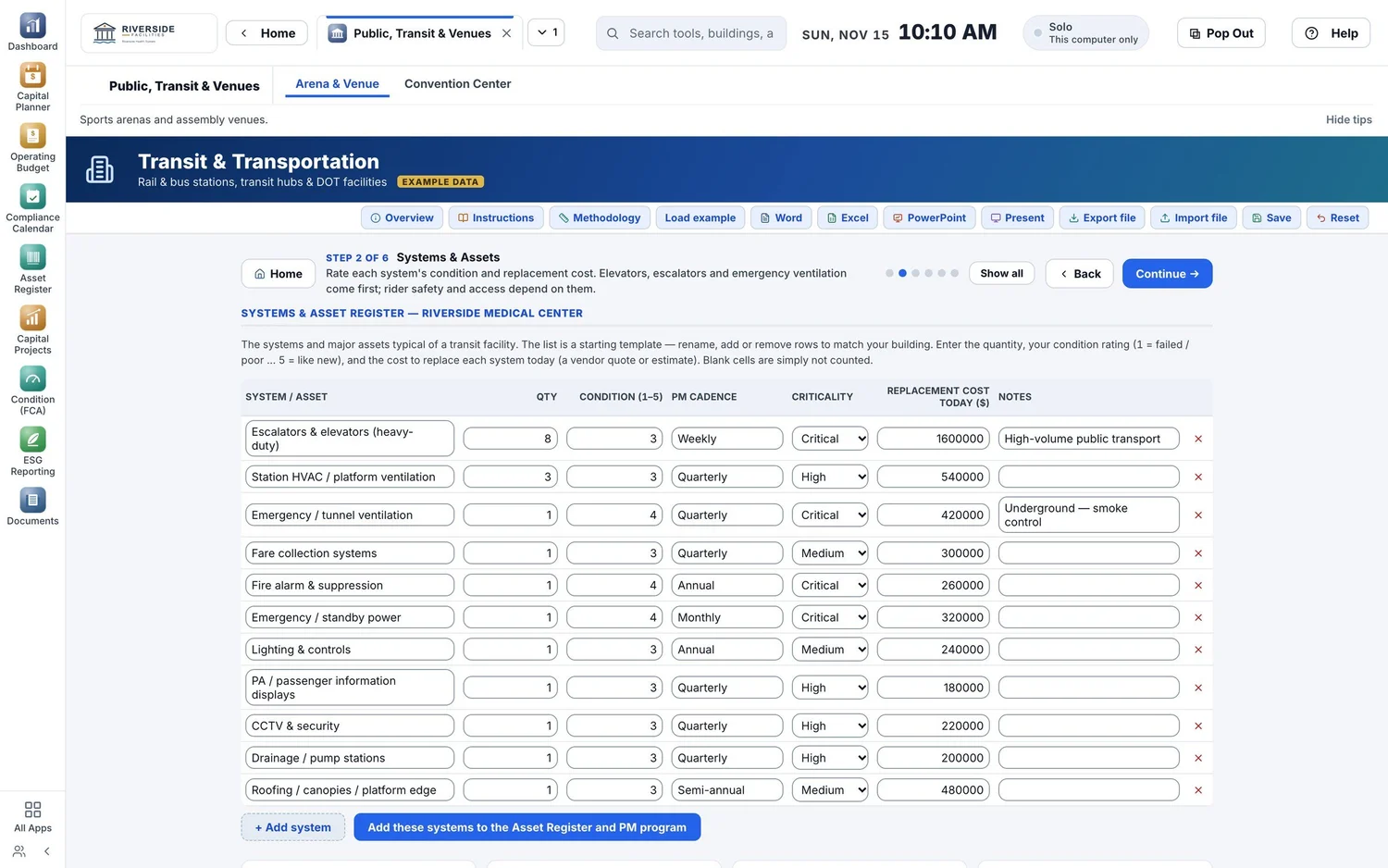
Escalators and elevators out of service strand riders, so vertical transport sits at the top of the list.
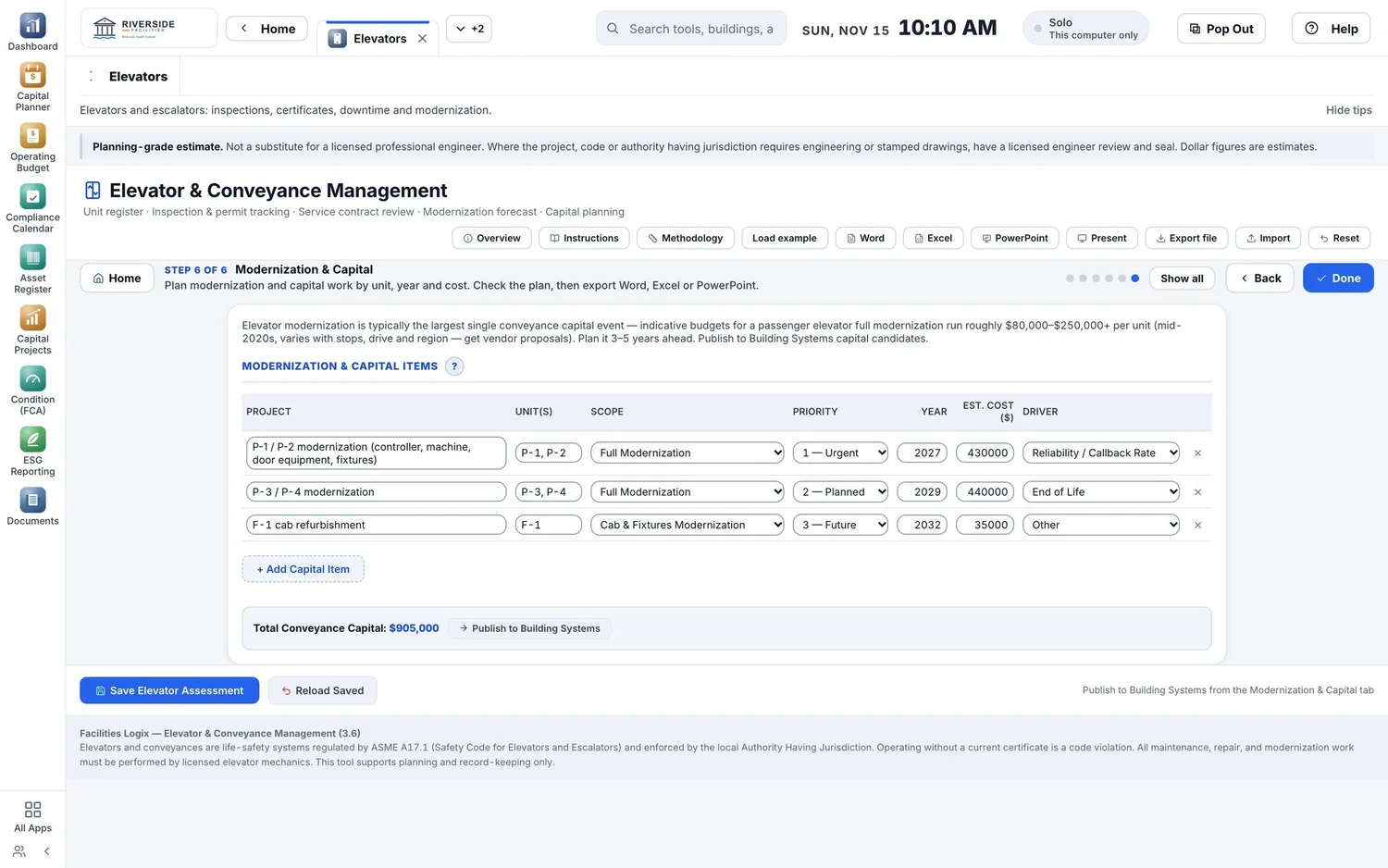
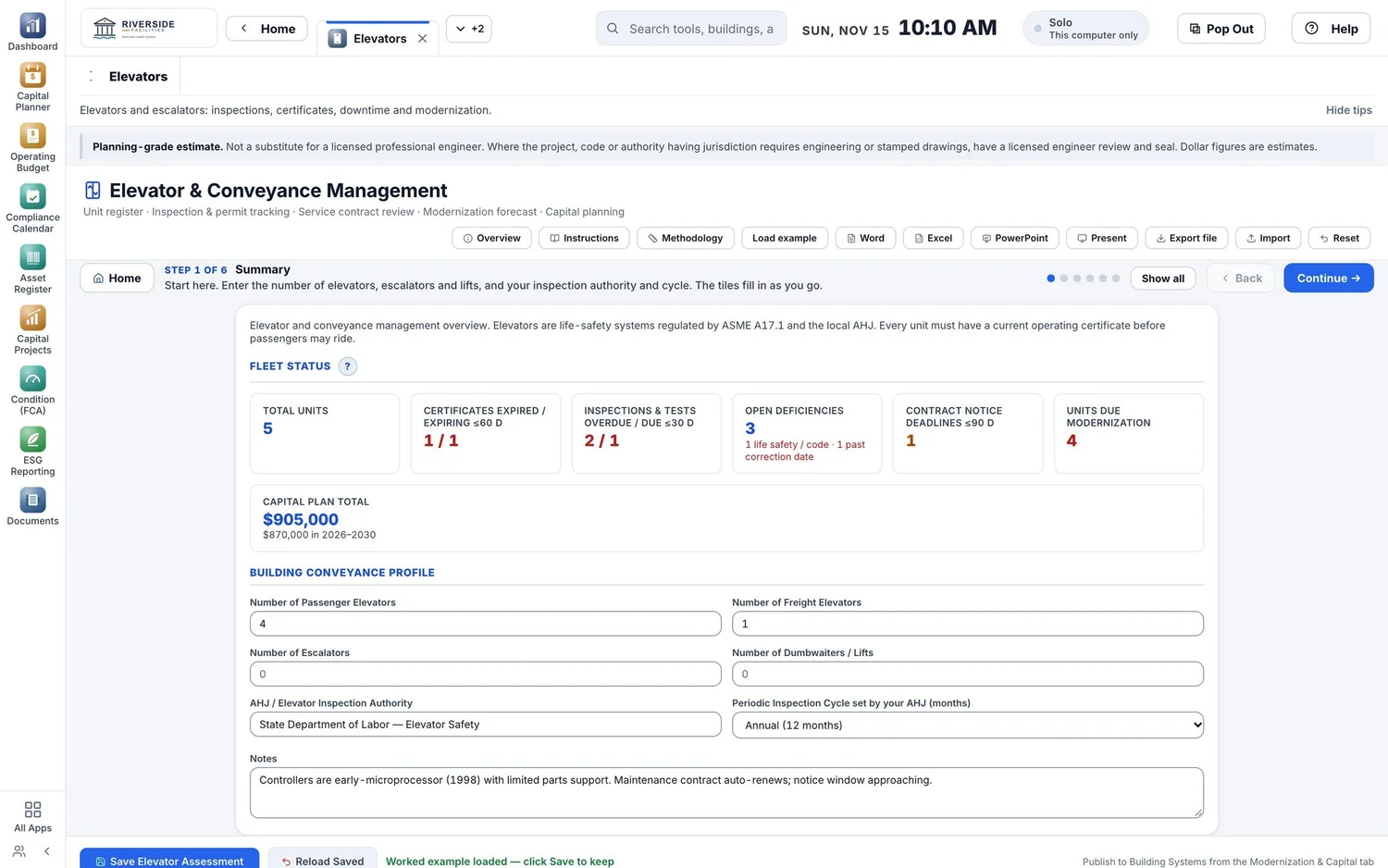
One Report for the Board
Compliance Tab
Enter the date each test was last done, and the next due date and status update themselves, shared with the Compliance Calendar.
Learn MoreWord, Excel, PowerPoint and Present
Systems, obligations with their status, the capital reserve and the benchmarks in one report.
Learn MoreShow Less
Escalator modernization and emergency ventilation are big-ticket lines, and the report makes the funding case for them. It opens with the decision: the deferred backlog to fund now and the escalated 10-year need.
- Facility Condition Index on the NACUBO/APPA scale
- Capital need by year, with the peak year named
- Compliance status: overdue, due soon, current and no date
- Site energy use against the transit terminal median
- Assumptions and formulas printed, and a SAMPLE watermark on example data
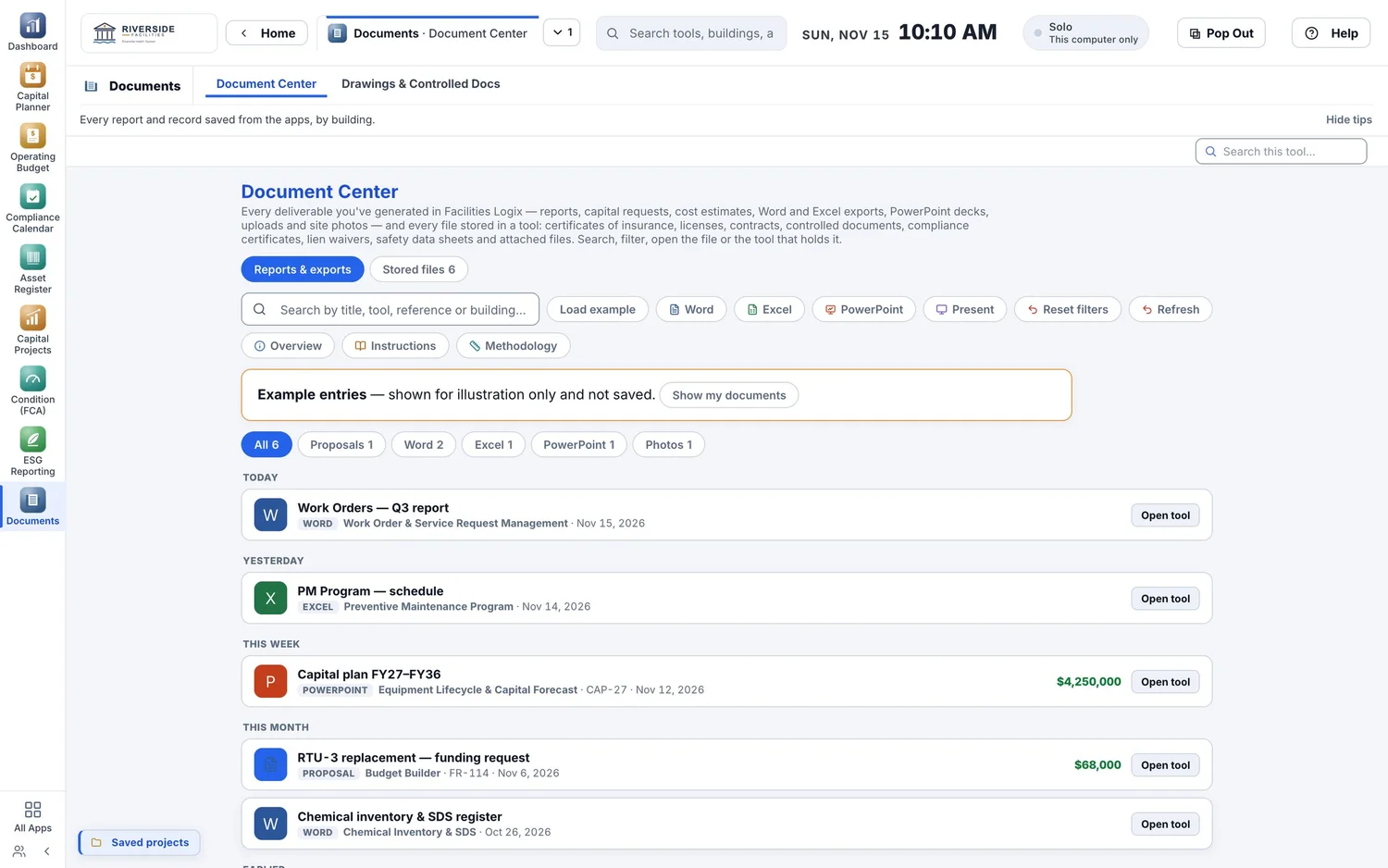
Every report the program makes is kept in one Document Center, grouped by building.
ENERGY STAR
Stations and terminals compare with the transportation terminal national median (about 56 kBtu/sf site, with no 1-100 score). Maintenance shops compare as repair services and DOT buildings as offices.
Learn MoreShow Less
Knowing where a station stands against the median is the first step to lowering its energy bill. Each transit type is matched to its Portfolio Manager property type.
- The terminal median on a source basis: 112.0 kBtu/sf
- Rail yards compare as repair services, ferry terminals as terminals, marinas as recreation
- Any Portfolio Manager type can be picked instead, saved per building
- Benchmarking and performance-standard laws listed from the city, state, sector and size
- Energy from the 12 months to the latest bill
The Benchmarks Tab
Yardsticks
- Energy use intensity against the transit terminal median
- Elevator and escalator availability, because public-facing uptime is an ADA and service obligation
- NFPA 130 egress, the fixed-guideway life safety standard that governs stations and smoke control
- Passenger volume, because heavy foot traffic drives escalator and elevator wear
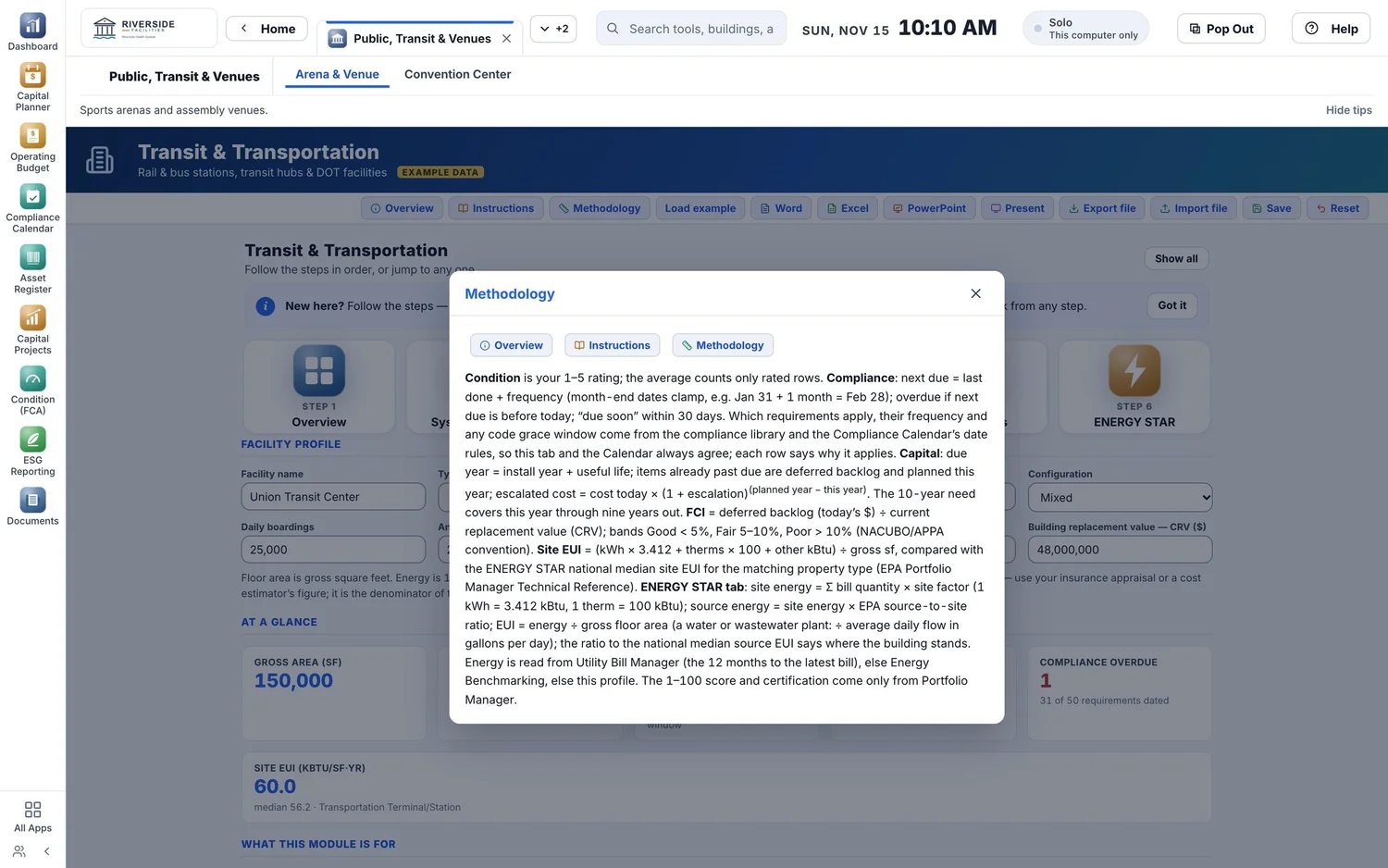
Methodology in Transit & Transportation: the formulas and standards behind every number.
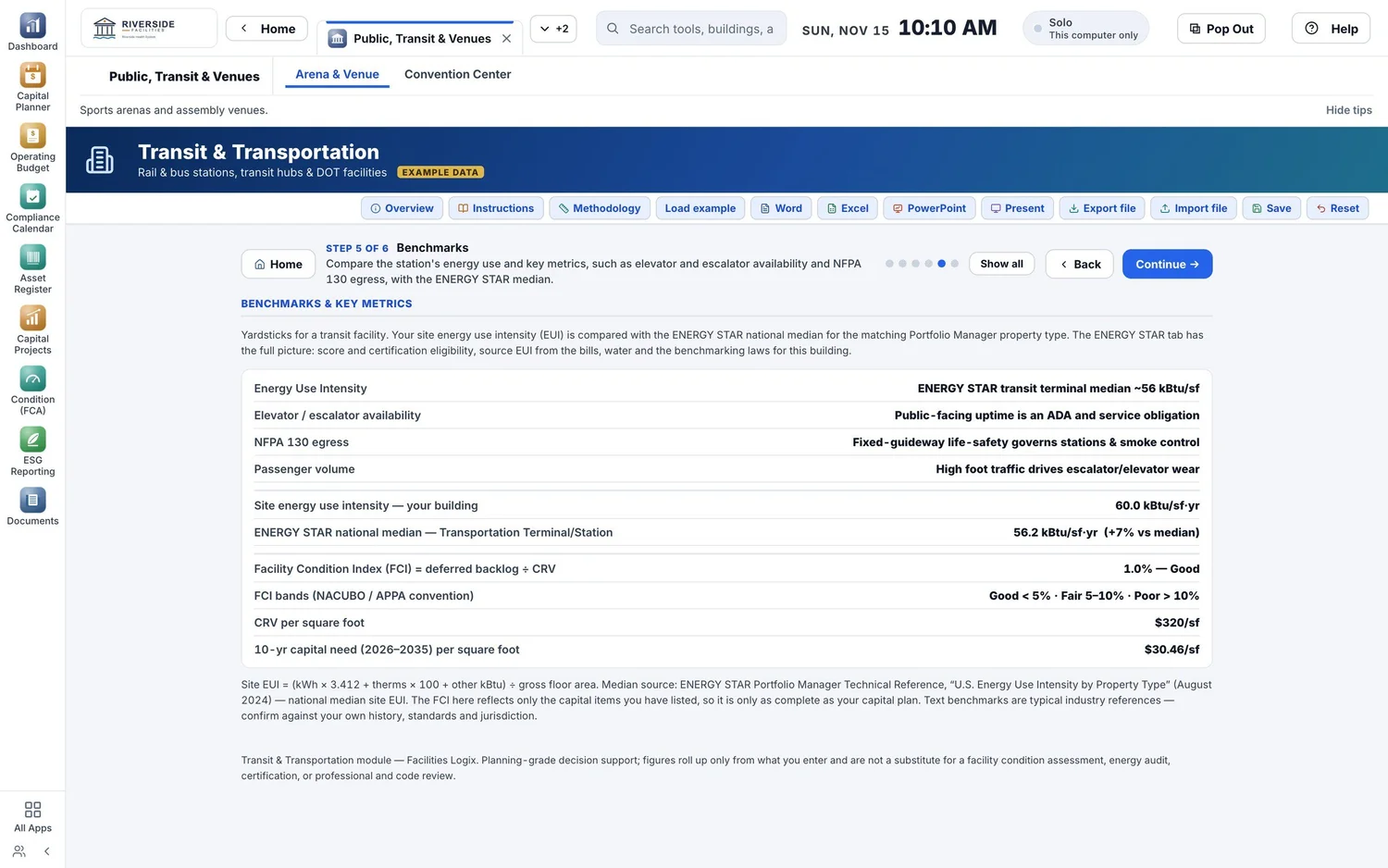
Benchmarks in Transit & Transportation: compare the station's energy use and key metrics, such as elevator and escalator availability and NFPA 130 egress, with the ENERGY STAR median.
Riders Moving, Reports Filed
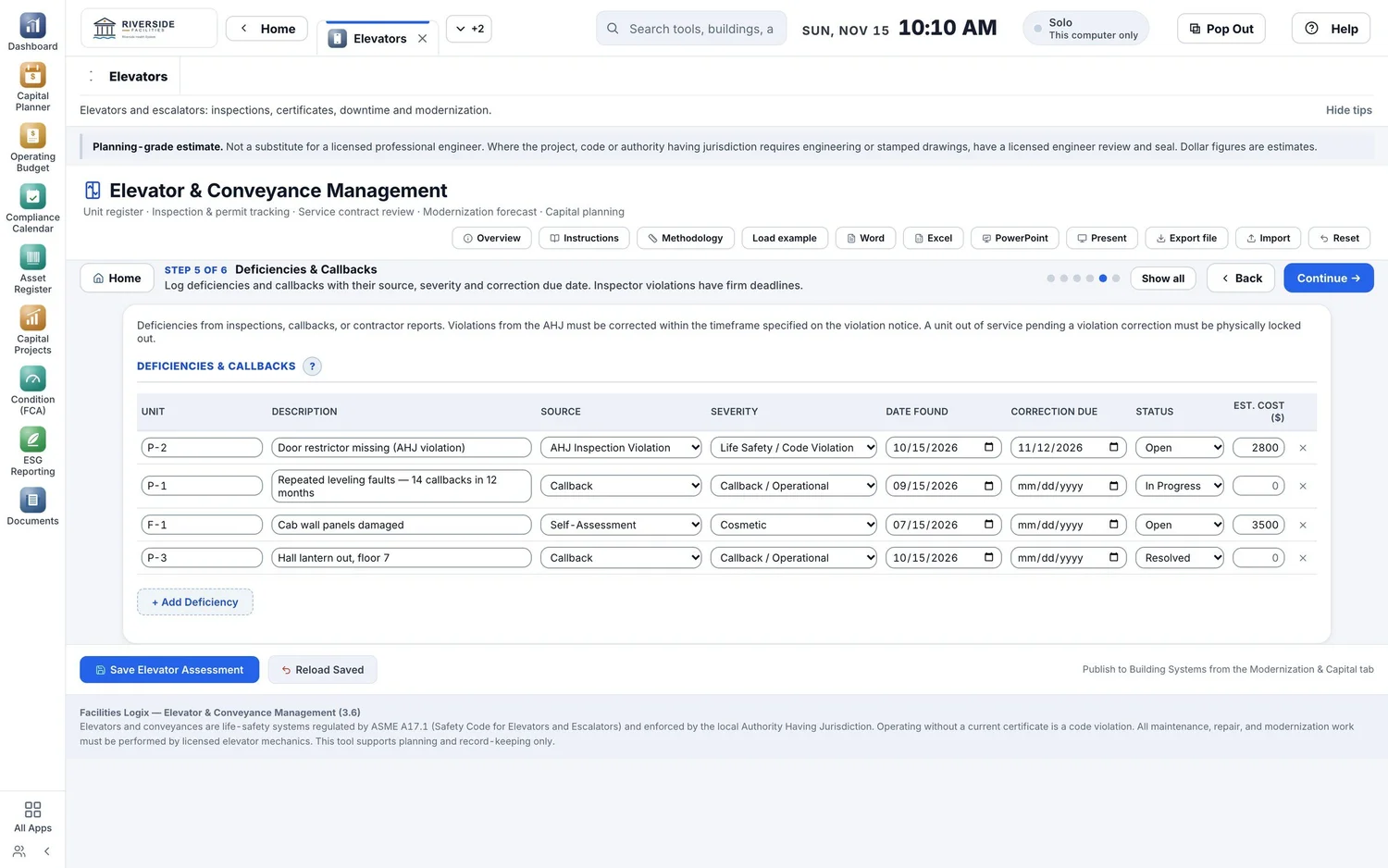
Escalators and Elevators Watched
Vertical transport sits at the top of the list, with weekly PM, inspections and modernization lines in view.
Learn MoreShow Less
An escalator replaced in an emergency costs more than one modernized on schedule, and a stranded rider is an accessibility problem. The library adds the code tests by equipment, and modernization has its own capital line.
- Escalators and moving walks: annual inspection and Category 1 test, including step and skirt checks
- Traction elevators: the Category 5 full-load test every 5 years
- State rows where they apply, such as Pennsylvania inspections every 6 months
- Modernization starts on a 20-year capital line
FTA Dates Not Missed
The asset management plan, condition reporting and safety plan review each carry a due date and status.
Learn MoreShow Less
These plans come with FTA funding, so a lapse puts grant money under scrutiny. Each row names its proof and who signs, so the work is scheduled instead of rushed.
- One Building Record answer turns them on: the agency receives FTA funds
- The TAM plan is prepared under the accountable executive
- Proof named: the TAM plan, the NTD submission and the Board-approved safety plan
- Safety plan updates are signed by the Accountable Executive and approved by the Board
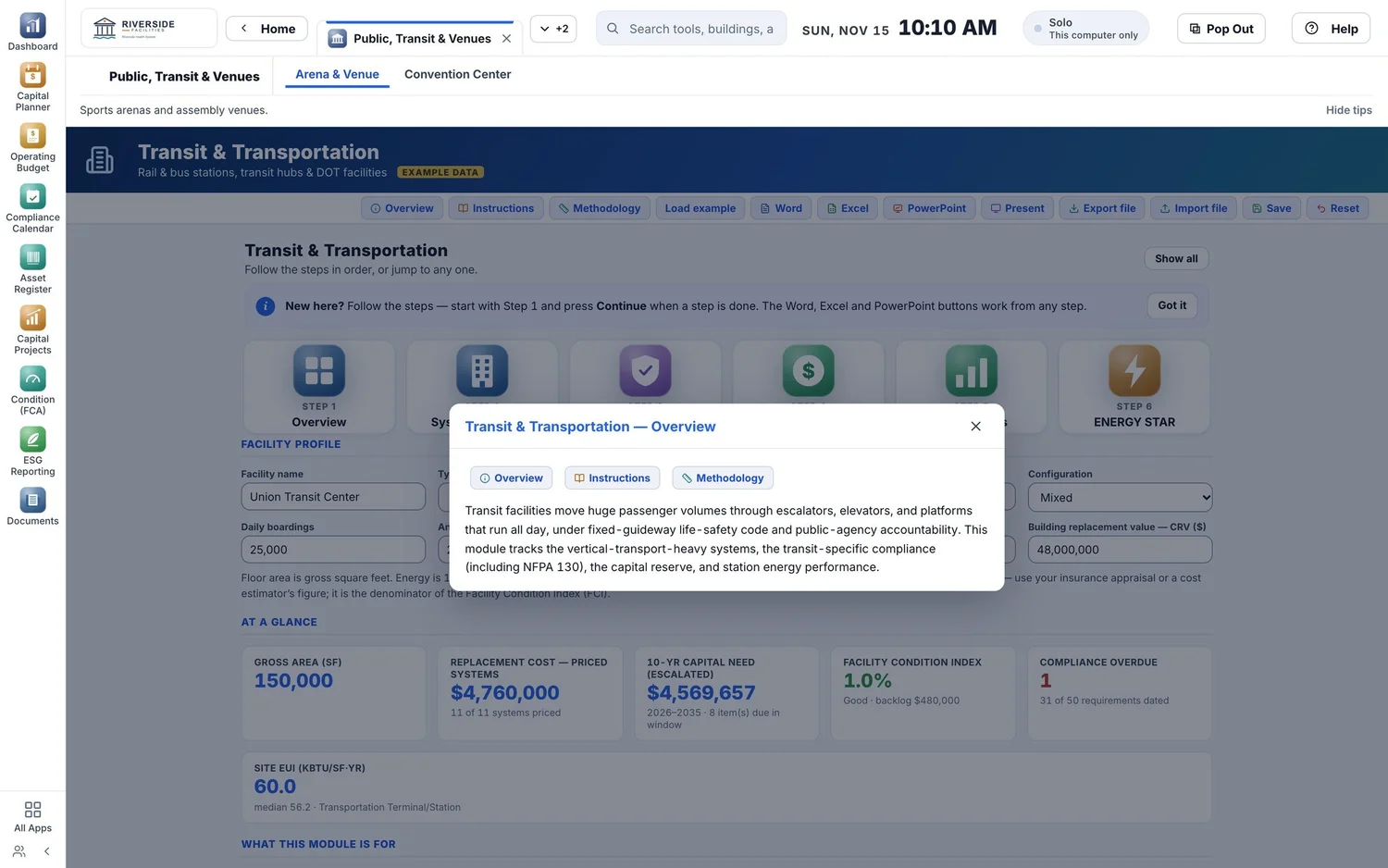
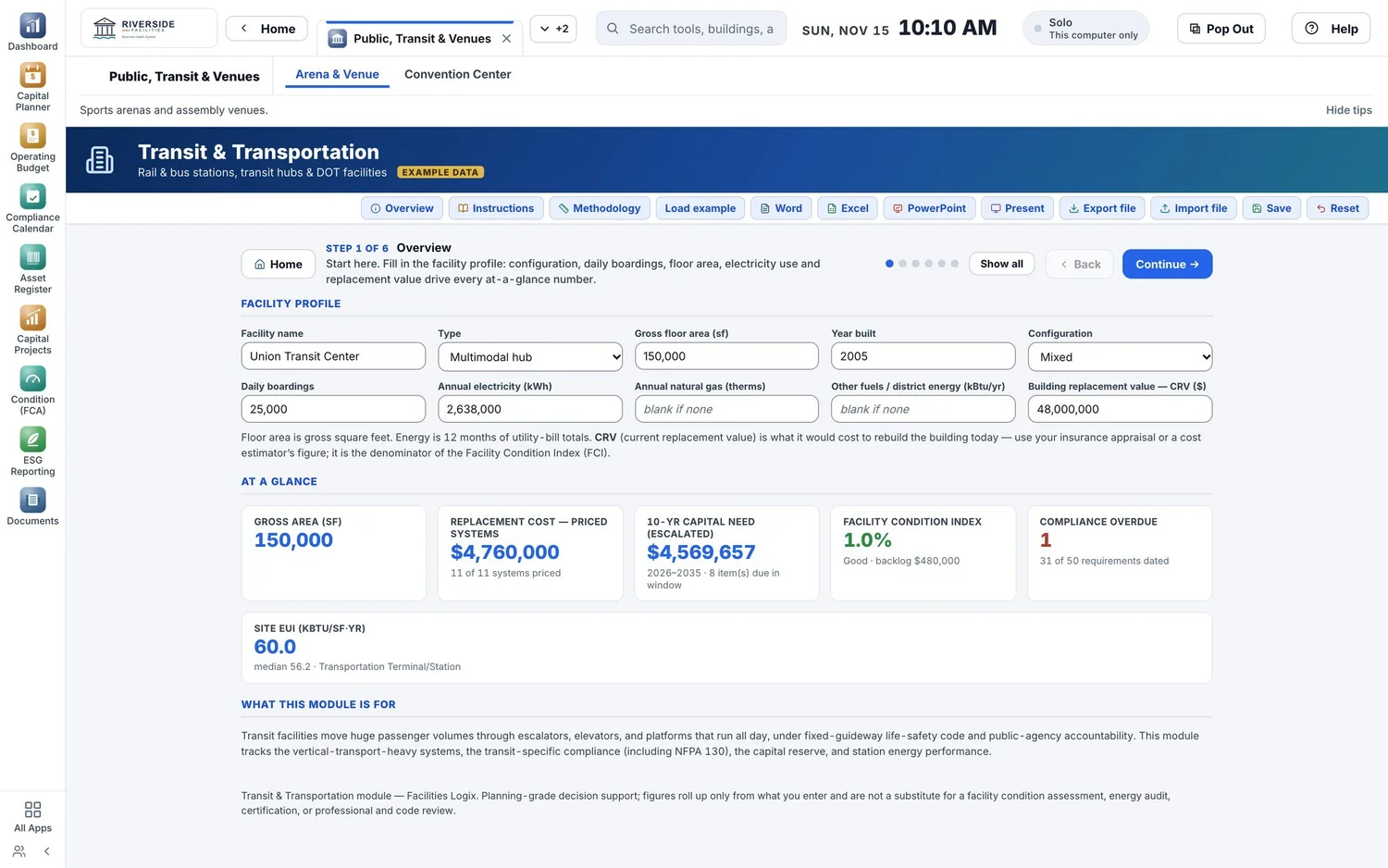
Overview in Transit & Transportation: its scope, why it matters and who uses it.
One Place for Mixed Facilities
Stations, shops, yards, ferry terminals and marinas share one playbook, and the type decides which rows apply.
Learn MoreShow Less
One playbook for every transit building means one set of training and one capital list instead of several programs. The type also sets the energy yardstick each building is judged by.
- Maintenance shops and rail yards compare as repair services; DOT buildings as offices
- Each building keeps its own calendar, capital plan and report
- A rail fixed guideway answer adds the State Safety Oversight rows
- General-system track adds the federal track inspection rows
Frequently Asked Questions
Does it track NFPA 130 inspections?
Does it file our National Transit Database reports?
Where do ferry terminals and marinas fit?
Be First When Facilities Logix Opens
Stop chasing building records across spreadsheets and binders. Join the list and we will tell you the day downloads open, with setup guides ready.
Launching early 2027 for Facilities Logix. Nothing to buy today, and no sales calls.
