
The Whole Safety Program, Where the Work Is Run
A safety program kept in binders is out of date on the day someone gets hurt. HVAC Logix keeps safety inside Project Command, beside the jobs, the crews and the schedule. The safety director sees what needs attention today, the crew signs permits and job hazard analyses on the phone in English or Spanish, and Leadership gets the rates and the prequalification pack from the same records.
Launching Early 2027 · Join the Early-Access List
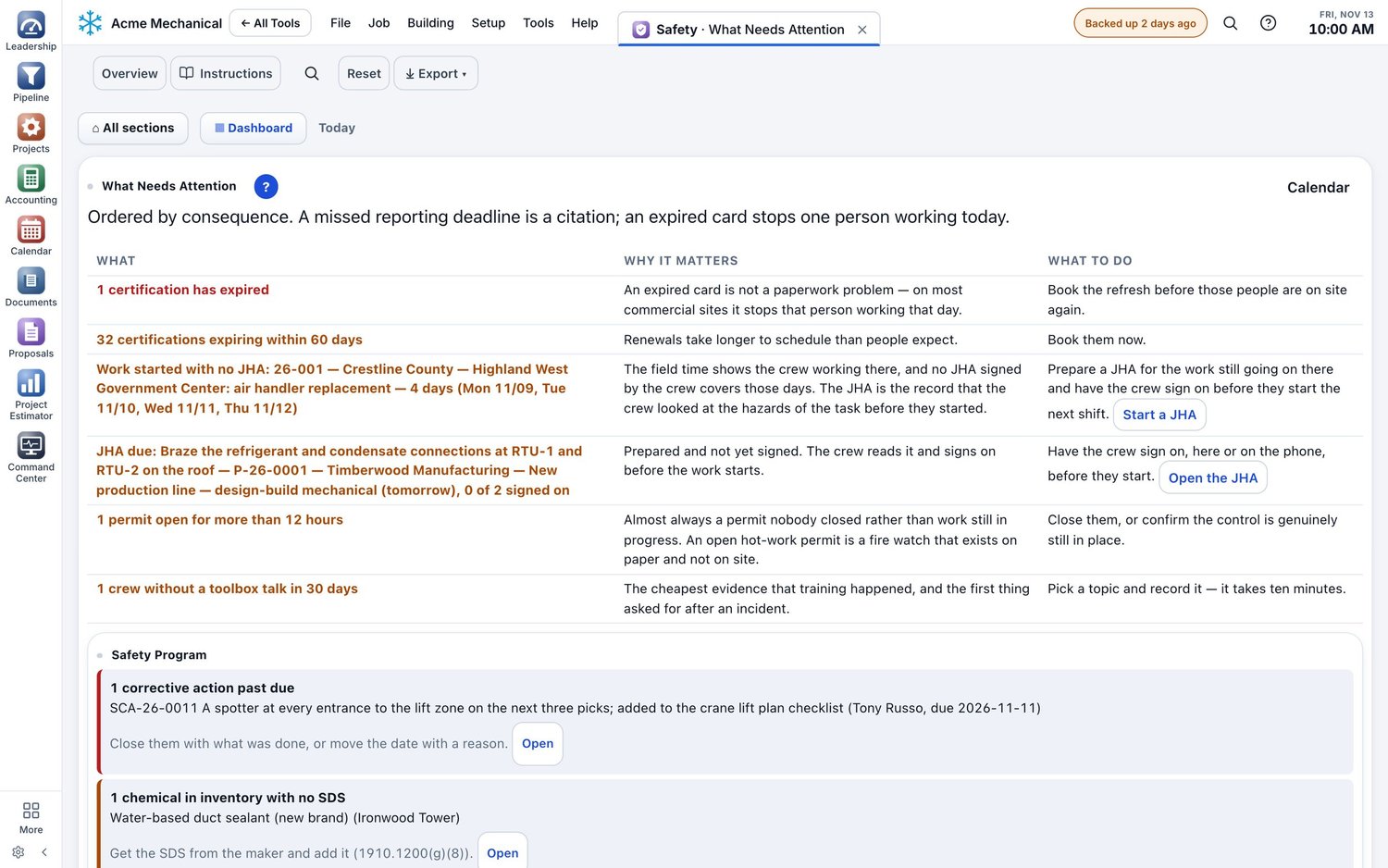
Safety Today Puts the Consequences First
The Today tab lists everything with a consequence attached, ordered by how bad that consequence is. If nothing is wrong it says so and stays short.
The Reporting Clock
A fatality is eight hours and an in-patient hospitalization, amputation or loss of an eye is twenty-four. The clock starts when you learned the event was work-related, and it sits at the top of Today until the call is made.
Learn MoreShow Less
A late report to OSHA is a citation on top of a bad day. The clock is worked out for you, including the cases people usually get wrong.
- An injury reported Monday from a Friday fall starts its clock on Monday (29 CFR 1904.39(b)(7)).
- A hospitalization, amputation or eye loss is reportable only if it happened within 24 hours of the incident.
- A death is reportable if it occurs within thirty days of the incident.
- Recordability uses the same rules as the 300 log.
The Safety Director's List
Corrective actions past due, incidents not investigated after 48 hours, citations past their abatement date, chemicals with no SDS, PPE at or below its minimum, toolbox talks not given and subcontractors not cleared. Open goes straight to the tab.
Learn MoreShow Less
An open citation past its abatement date, or an incident never investigated, can turn a small problem into a larger penalty. One list shows the safety director what needs action today.
- Also lists abatement certifications, contest deadlines and site plans missing emergency information.
- Program documents past their yearly review are listed.
- An incident closes only when the root cause is written, every action is done and a recordable case is on the log.
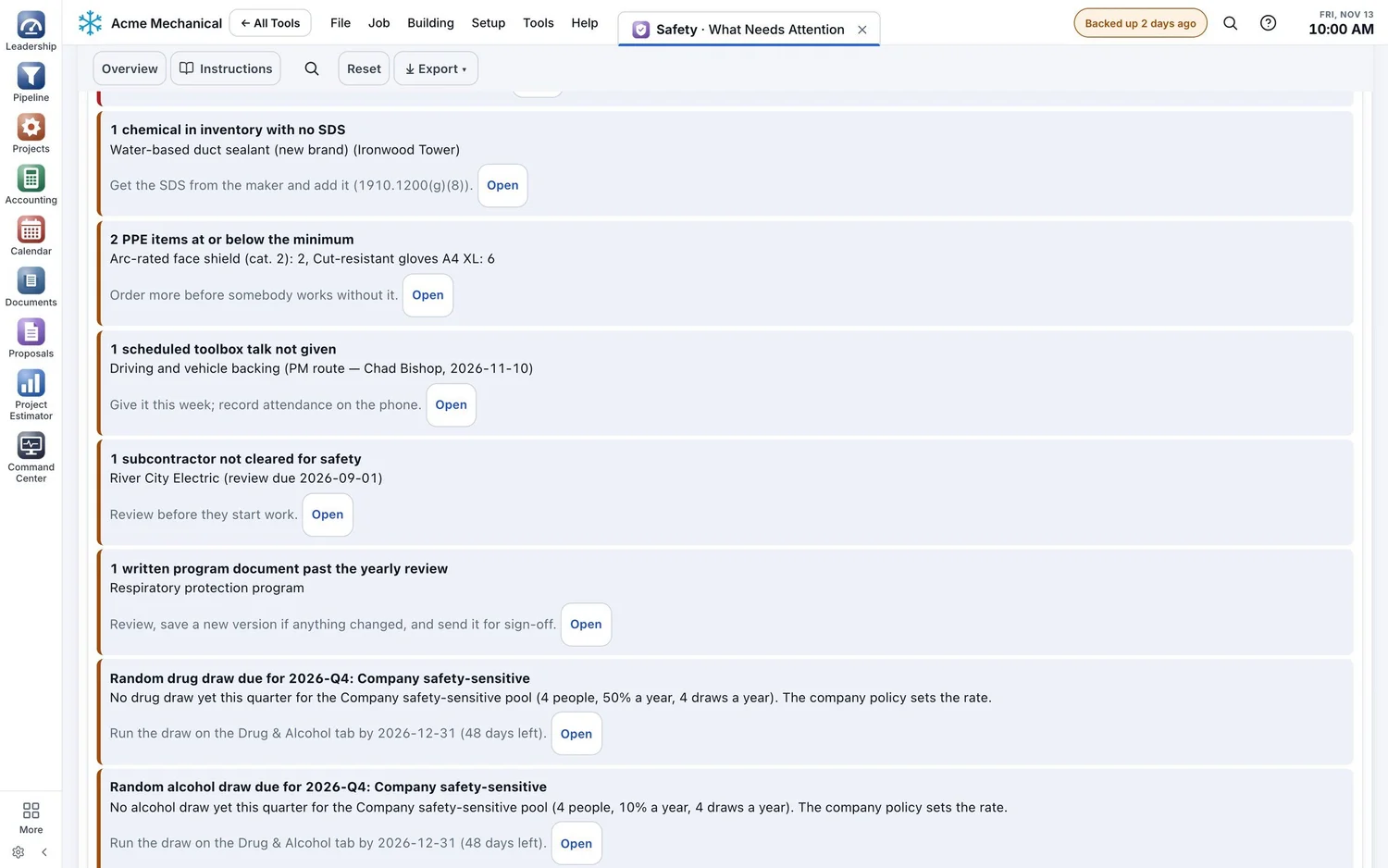
Overdue safety items hide in many lists, so the director's list puts each one in a single line with its fix.
Cards and Open Permits
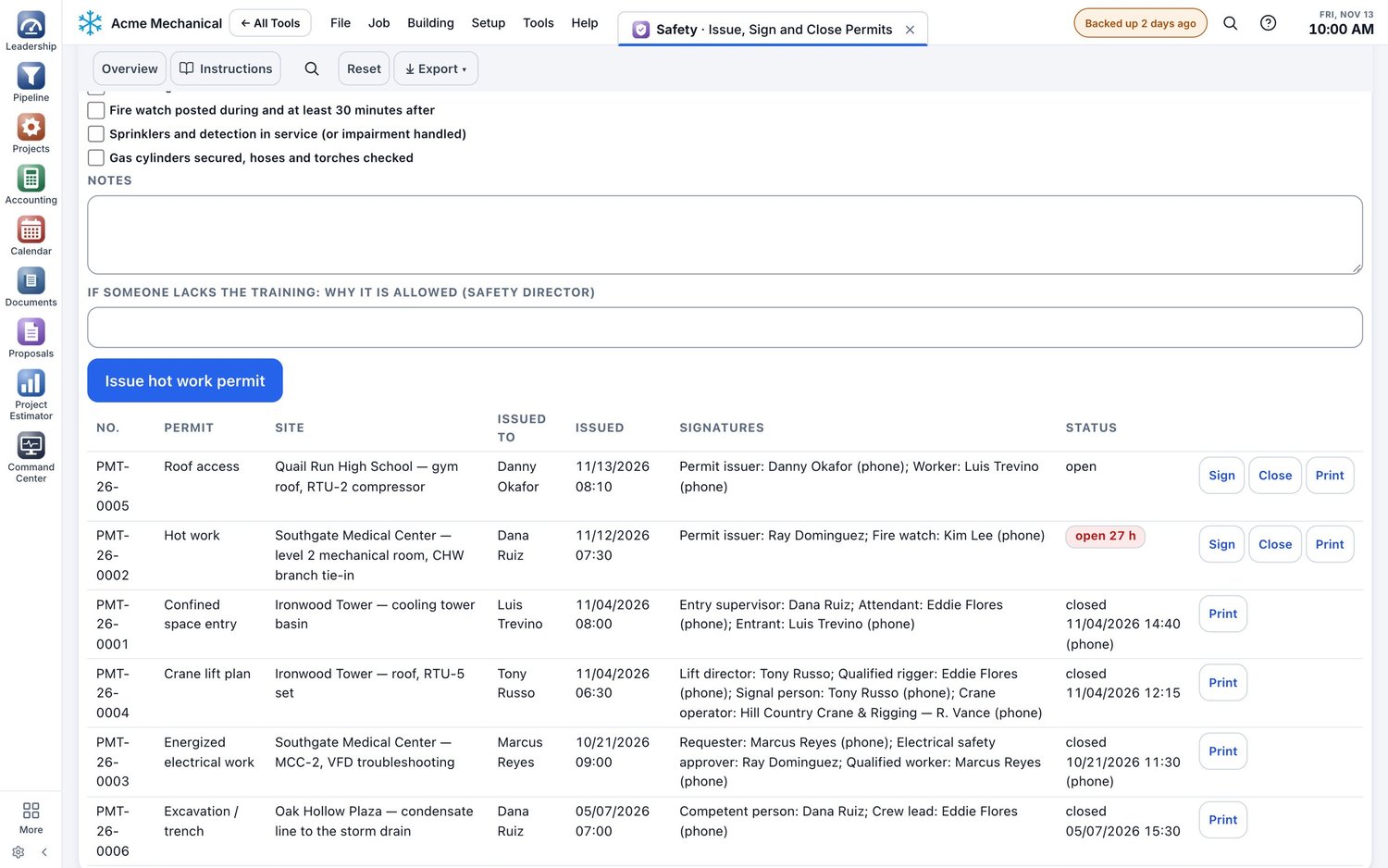
A certification inside sixty days of expiry is flagged early, because renewals take time to schedule. A hot-work permit still open after twelve hours is shown, because it is almost always one nobody closed.
Learn MoreShow Less
A worker on a job with an expired card can mean a citation or a stop-work order, and a hot-work permit left open is a fire risk nobody is watching. Both surface early.
- Card holders, the safety lead and the person's manager are all reminded.
- Hot work closes with the 30-minute fire watch recorded.
- Permits can be issued, signed and closed on the phone.
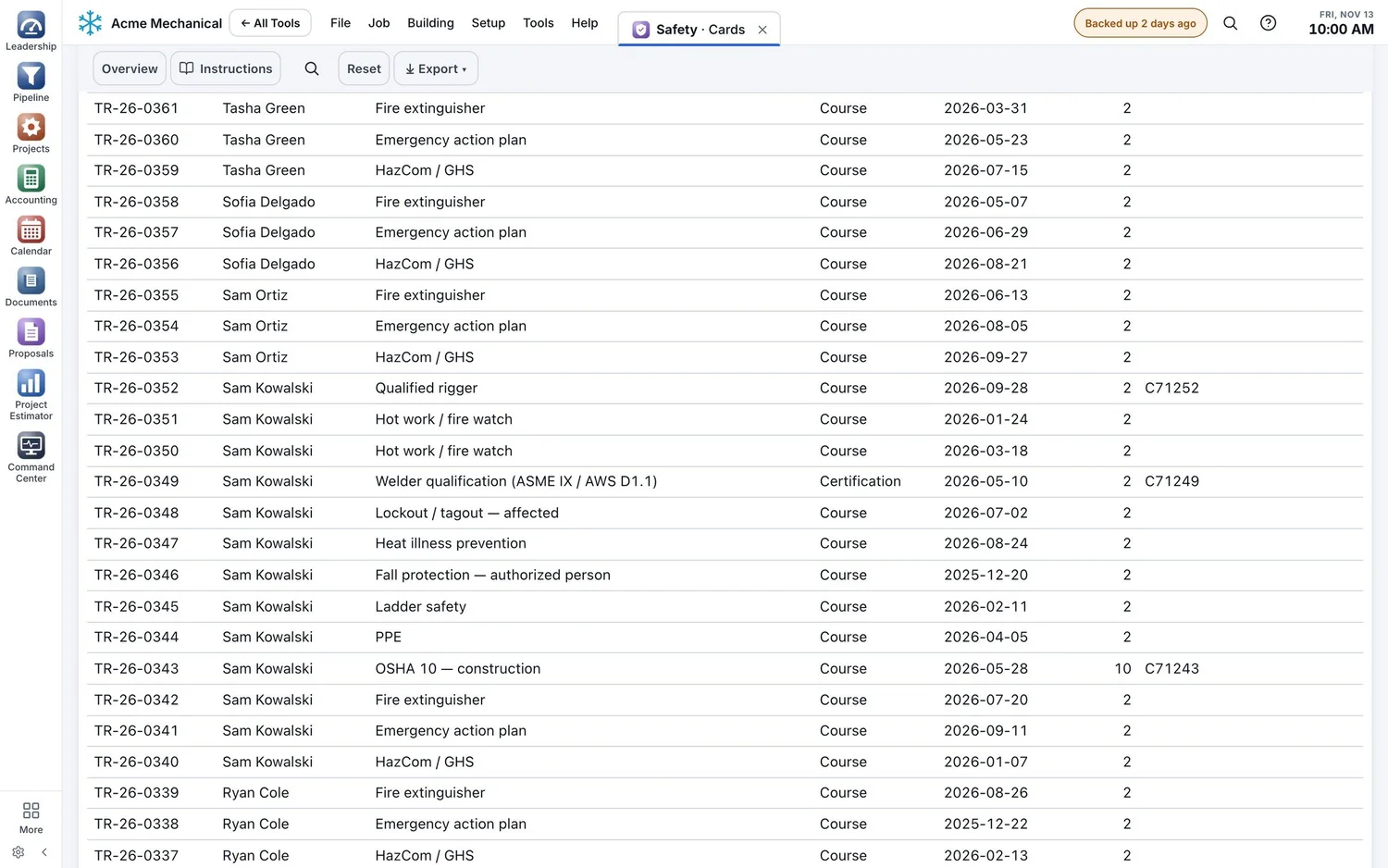
An expired card can keep a worker off a site, so every card shows its expiry and who holds it.
The Dashboard
Lagging figures (TRIR, DART, lost-time rate, EMR and its trend) beside leading ones: observations, inspections done, audit scores, training held, talk attendance and corrective actions closed on time. View the company or one branch, job, crew or foreman.
Learn MoreShow Less
A lower experience modification rate means lower insurance premiums, and leading indicators show what drives it before injuries happen.
- Rates use the 300A hours, so they match the prequalification answers.
- A month-by-month chart for this year, the last 12 months or last year.
- Compare branches, jobs, crews or foremen side by side.
- Lagging figures include near misses, first-aid cases and vehicle incidents.
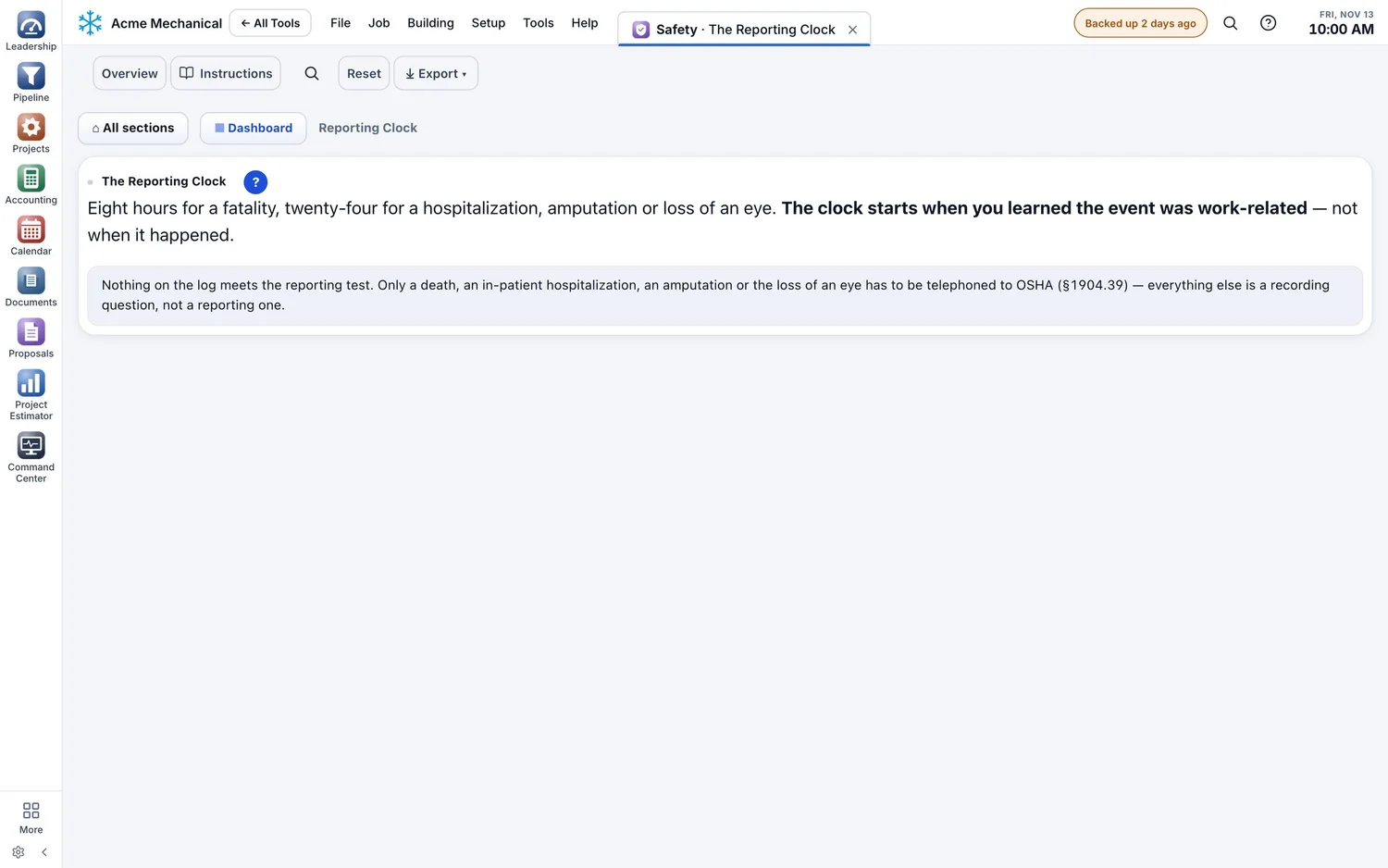
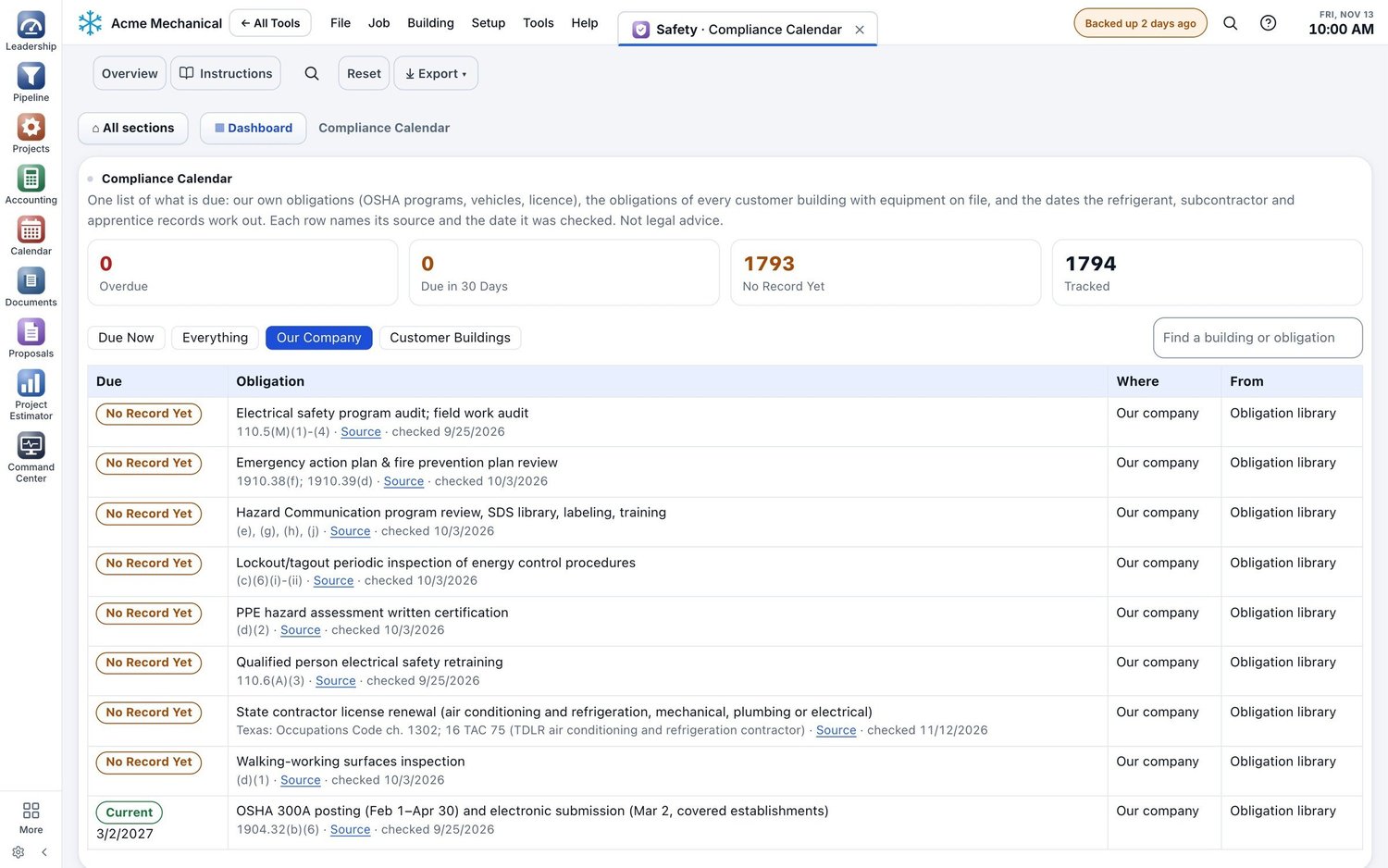
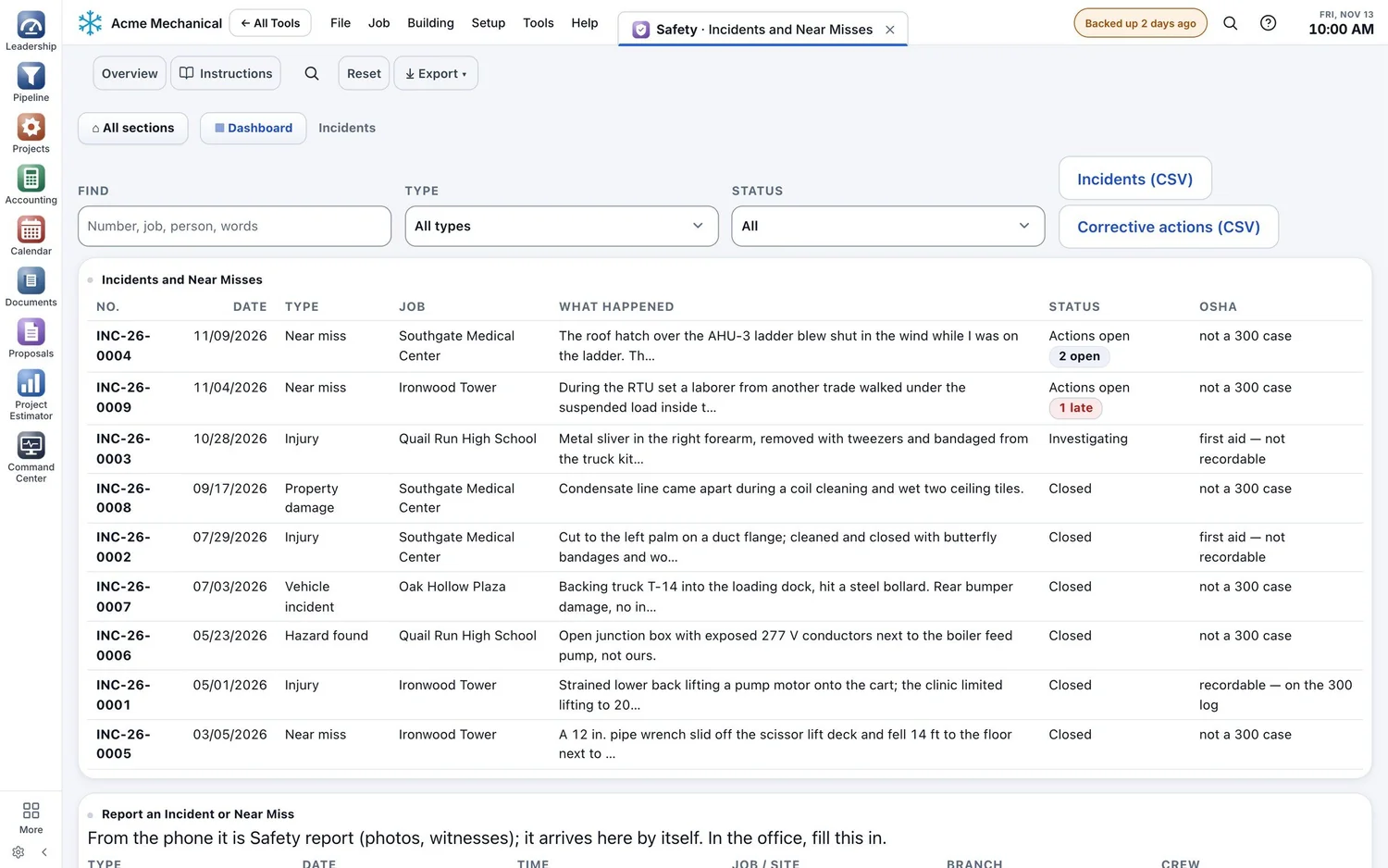
The reporting clock shows which incidents must be reported and how much time is left.
Recording and Reporting, Kept Apart on Purpose
Confusing the 300 log with the duty to telephone OSHA is the expensive mistake. HVAC Logix treats them as two separate obligations and shows the rule behind every answer.
The 300 Log
- Fill the form and the recordability verdict appears before you commit anything.
- The first-aid list is treated as closed, so a treated case reads "check" instead of a confident no.
- A case entered by mistake is taken off the log with who, when and why. It is never erased.
- Each recordable case is counted once, in its most serious column, as on the 300A.
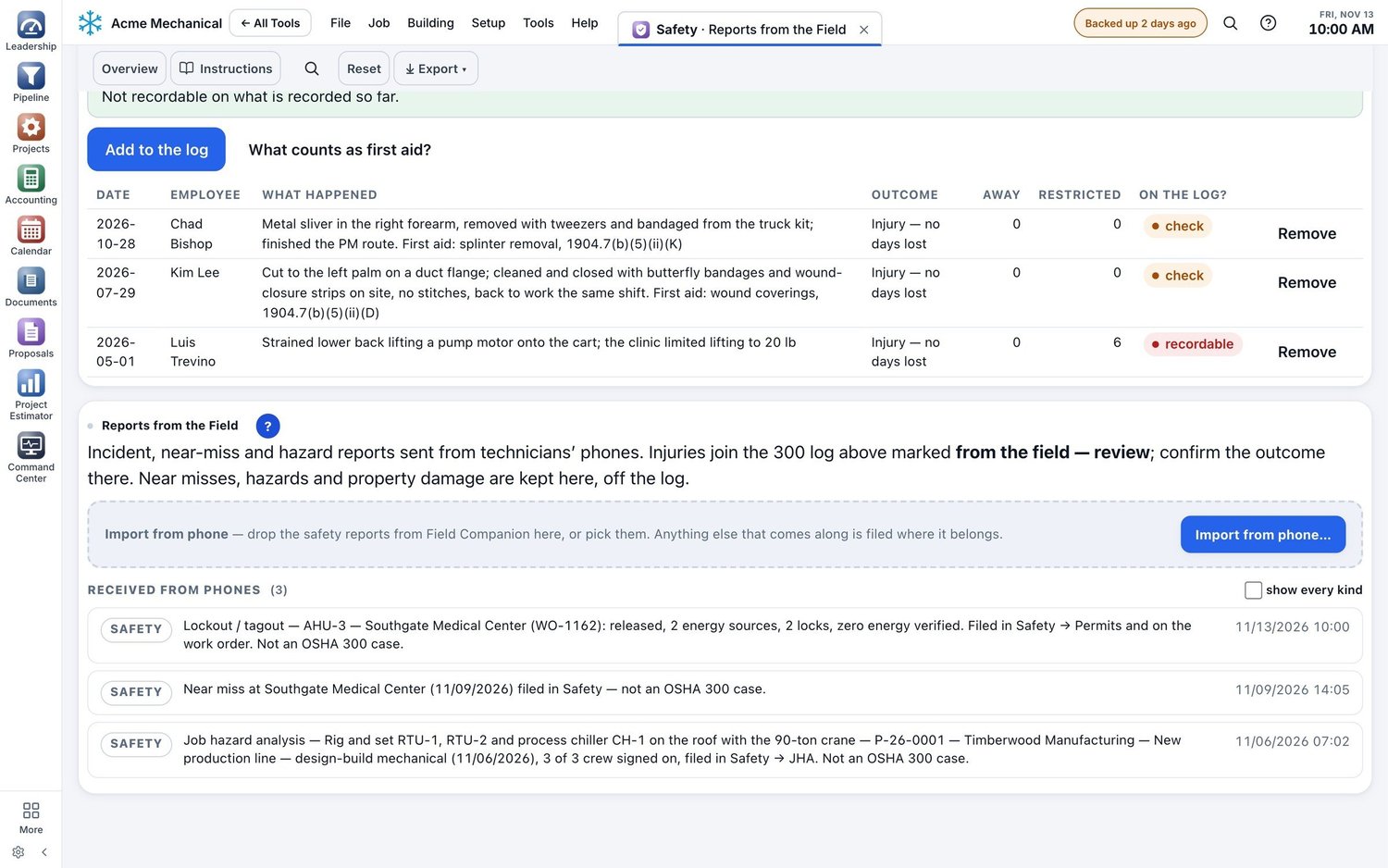
Recording the wrong case on the 300 log causes trouble at audit, so the verdict appears before anything is saved.
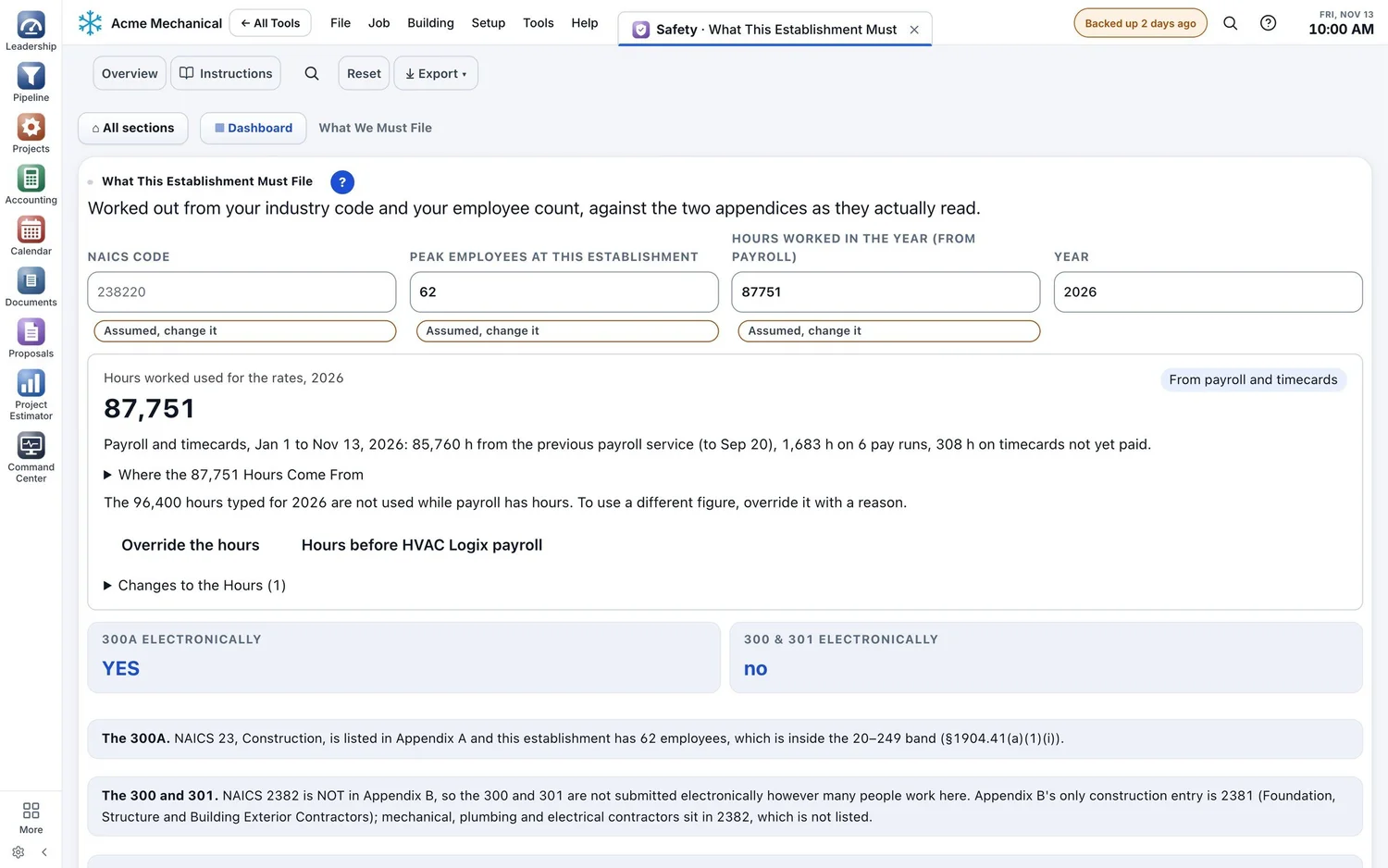
What You Must File
- The answer is worked out from your NAICS code and peak employee count, with the reason shown.
- The 300A file for OSHA's Injury Tracking Application is made in OSHA's column order, and OSHA's own checks run first.
- A file that would be rejected is not made, and the reason is listed.
- You upload the files yourself. HVAC Logix files nothing with anybody.
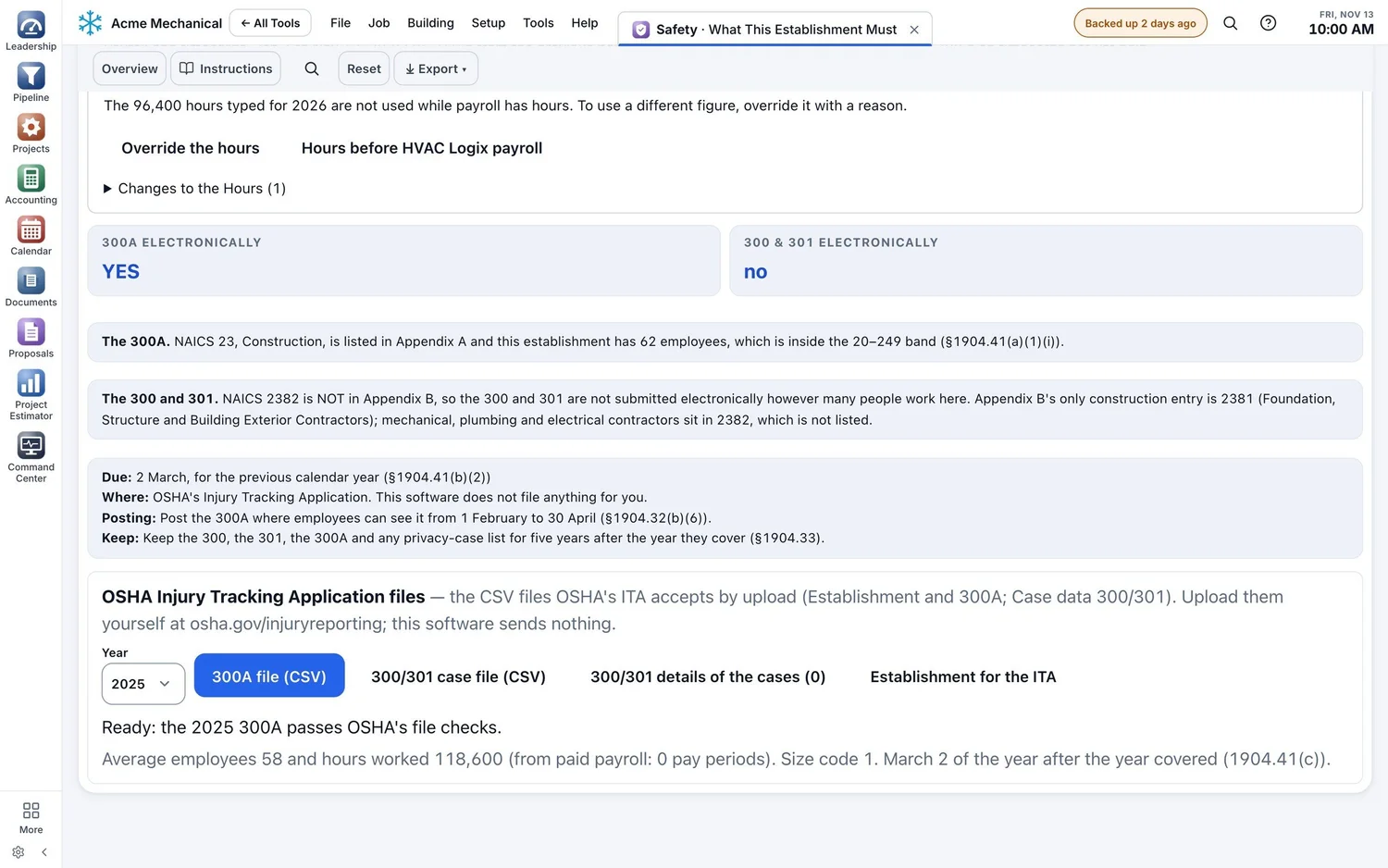
Not every company must file the same forms, so the answer is worked out from your industry code and headcount.
Rates and Prequalification
- TRIR and DART on the standard 200,000-hour constant, with hours from paid payroll or the figures you type.
- With no hours entered a rate reads unknown, never 0.00.
- Three prior years, EMR history, insurance, licenses, written programs and references are kept on the same tab.
- The Prequalification Pack is one Excel workbook: cover, safety record, the 300 log without names and the training roster. It holds no job cost, markup or margin.
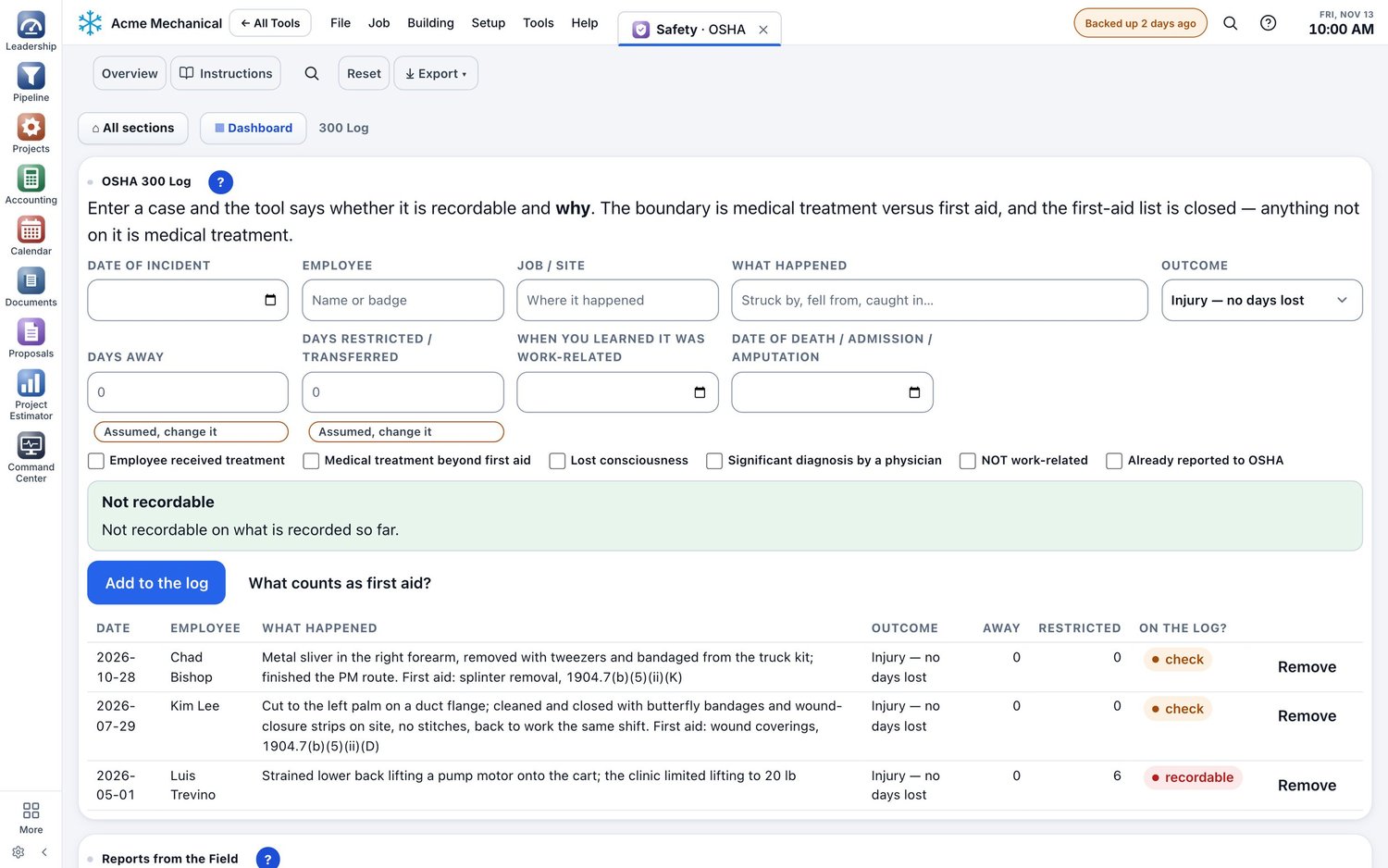
The OSHA 300 log, kept apart from reporting on purpose.
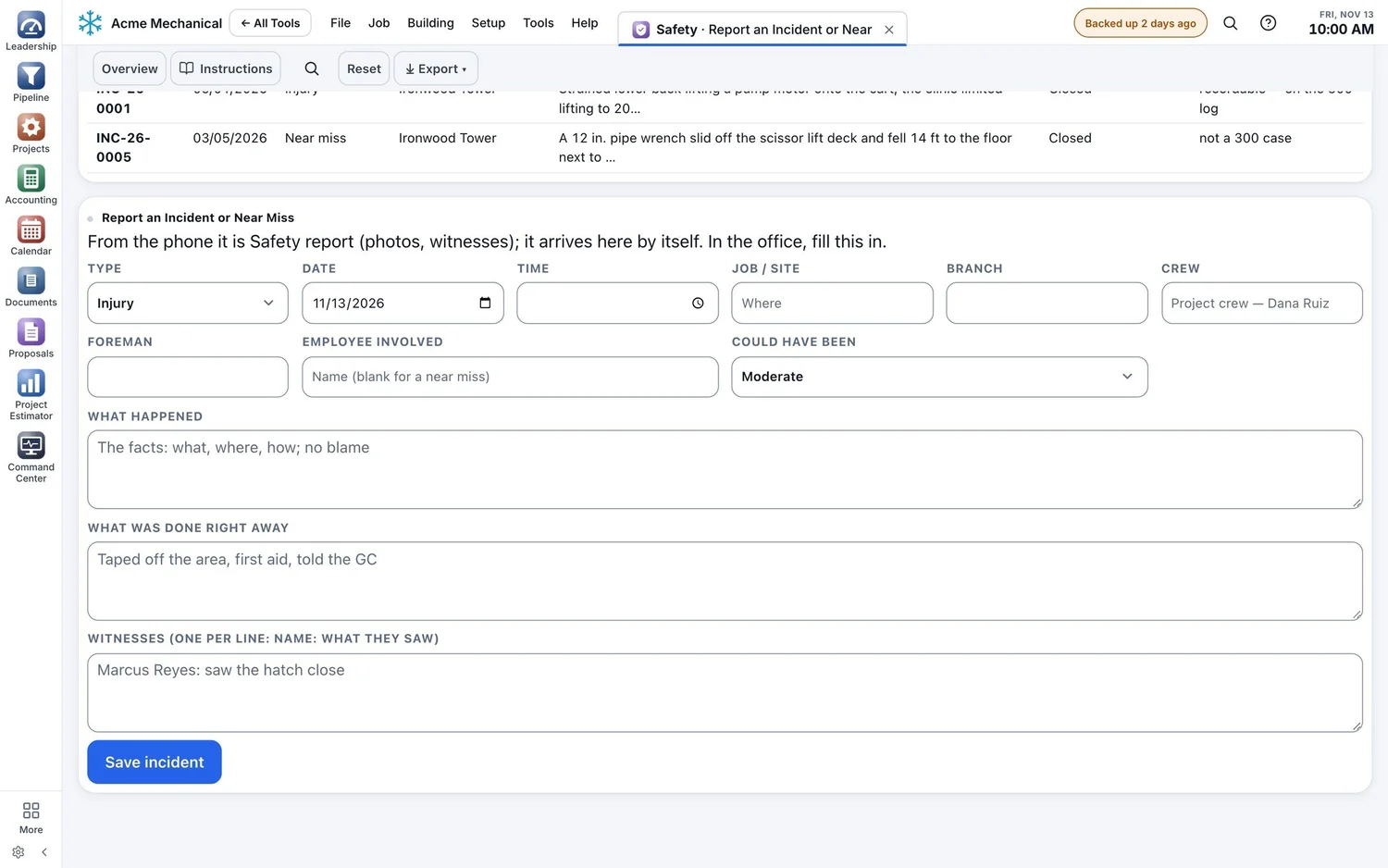
The Crew Does the Paperwork Where the Hazard Is
Field Companion carries the safety program to the roof and the mechanical room. Reports are filled with no signal and reach the office with the technician's other records.
Safety Today on the Phone
Home shows the talks due with Give This Talk, the open permits to sign or close, and Emergency: where to go, with the muster point and the nearest hospital one tap from a call.
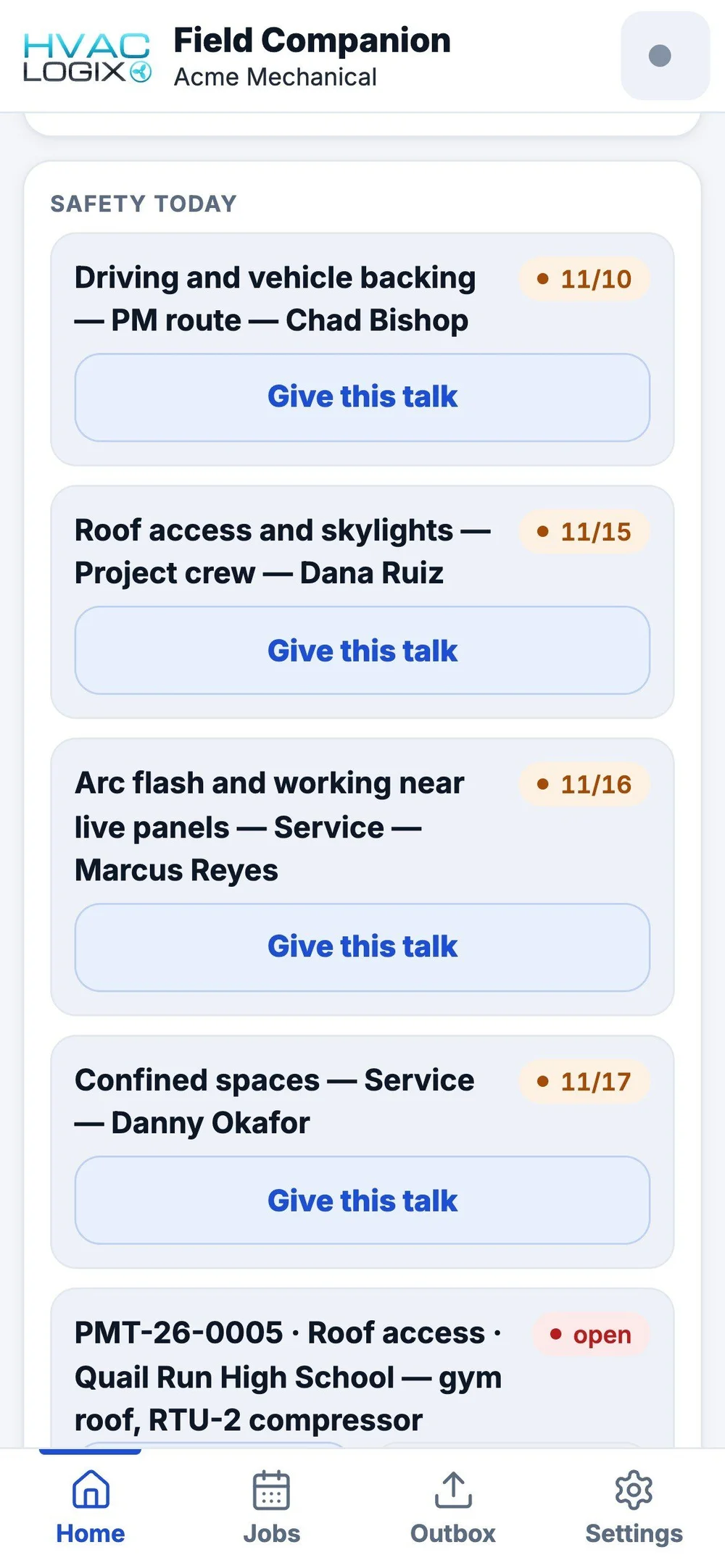
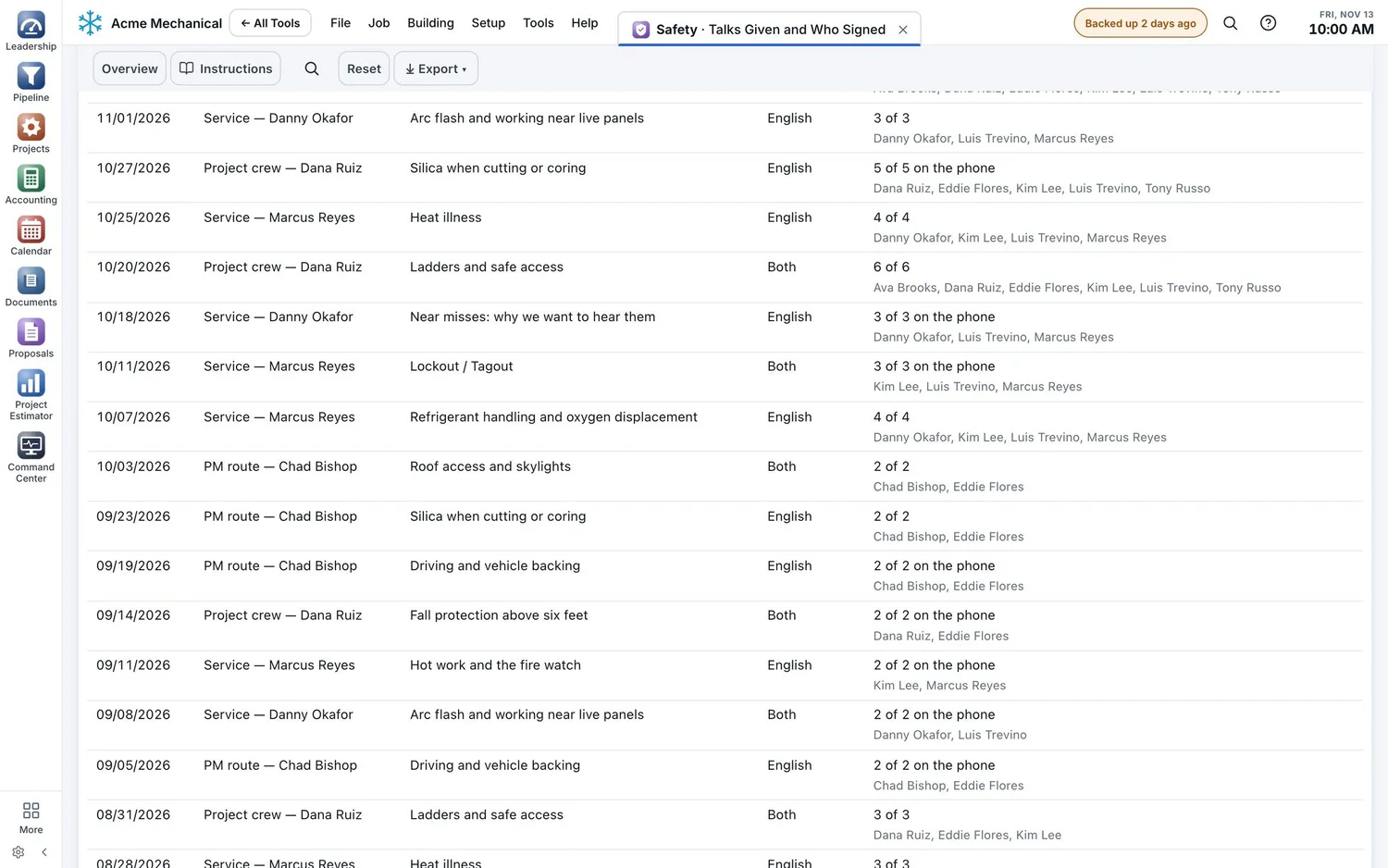
Talks forgotten on busy days leave crews unprepared, so the phone shows the talks due today.
Job Hazard Analyses and Toolbox Talks
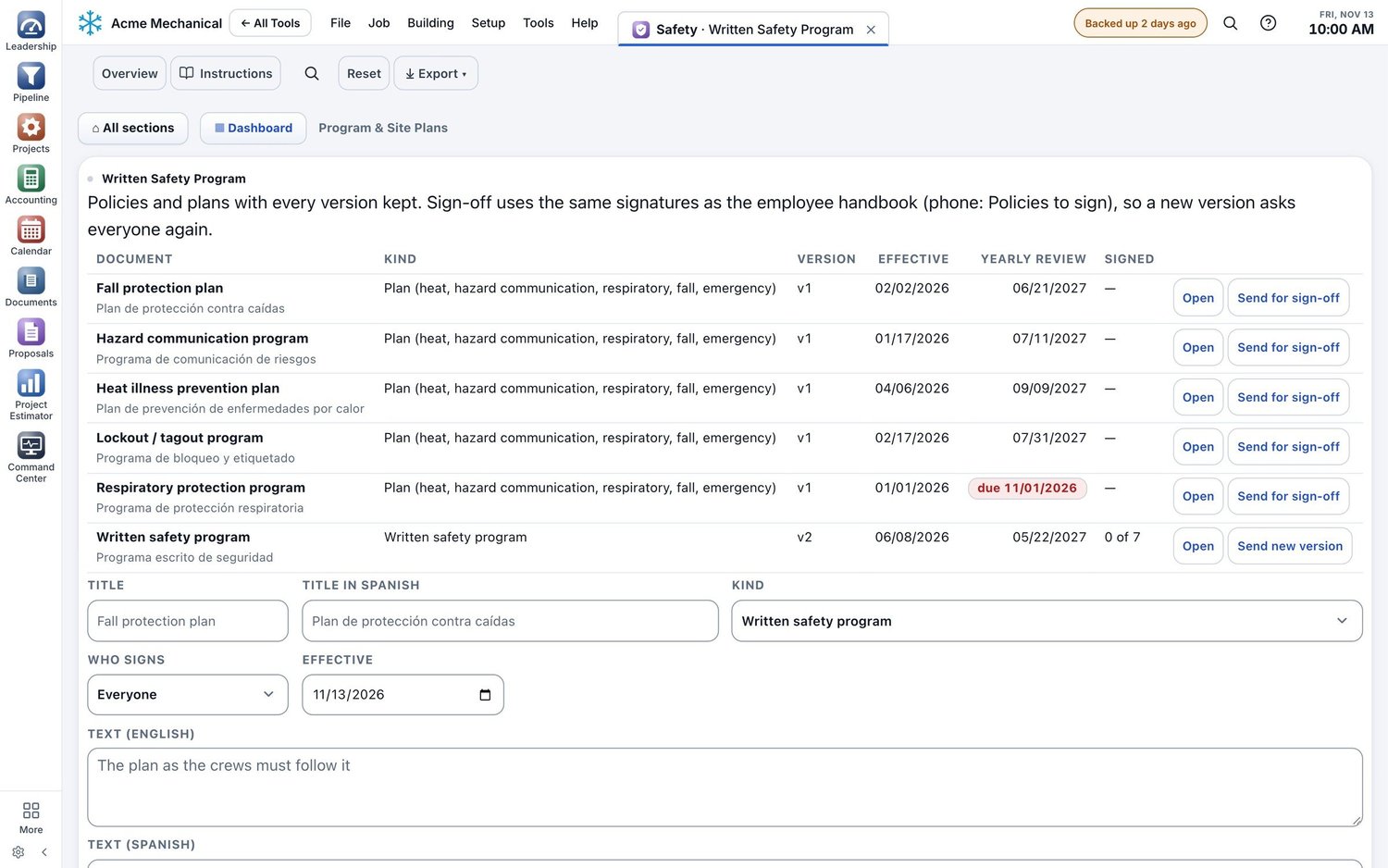
A JHA starts from the built-in templates, and each crew member signs with the language they read it in. For a toolbox talk the foreman picks the talk, reads the points and each worker taps Sign.
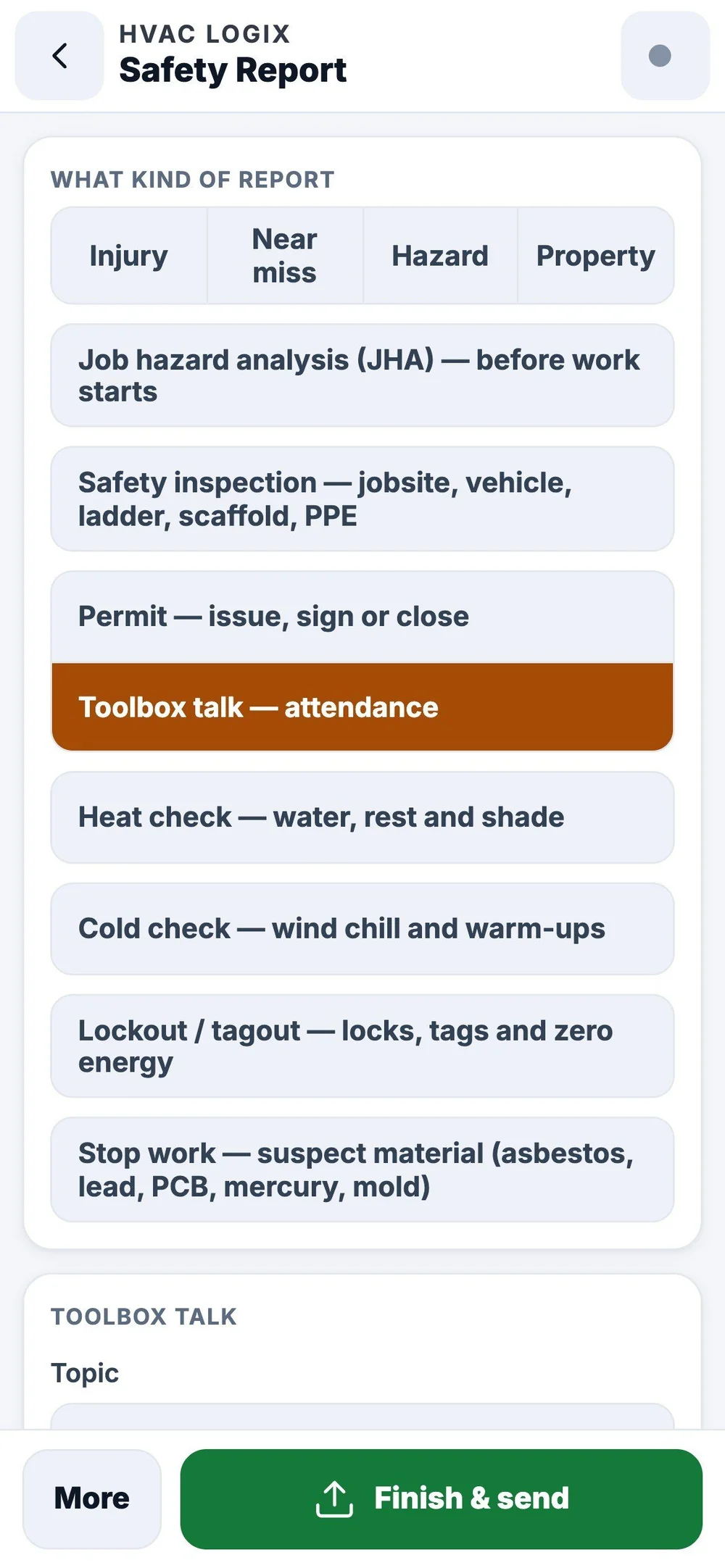
Crews sign in faster on the phone, so the foreman records the talk and who attended.
Permits and Lockout
The phone can issue, sign and close a permit. A lockout / tagout record starts from the service ticket with the unit already filled in: energy sources, each lock scanned on by its QR tag, zero energy verified, and the release.
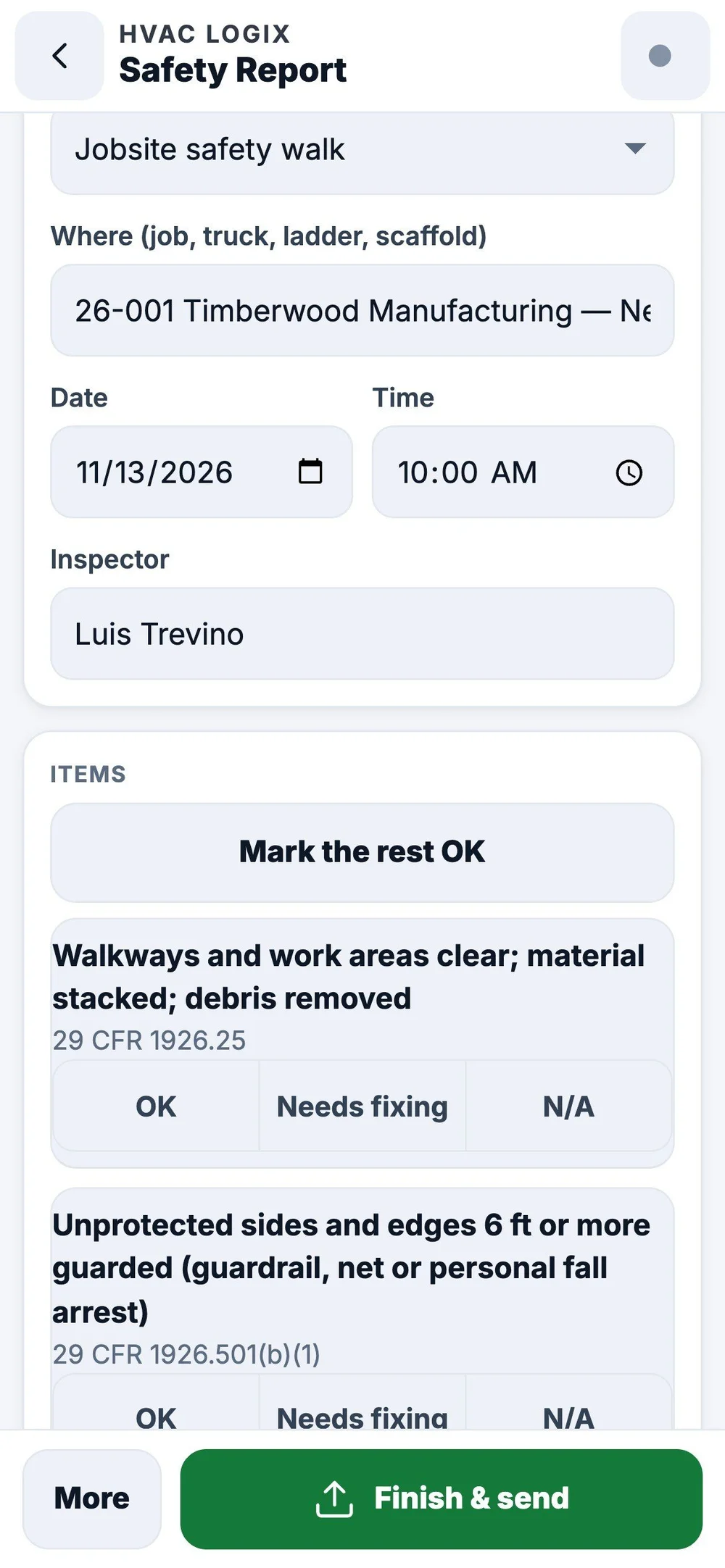
Inspections on paper get lost, so the phone walks through each item with OK, Needs fixing or N/A.
English and Spanish
Each person's phone and safety documents can be set to Spanish, written by hand for US trade Spanish. A JHA prints in English, Spanish or both, and talk sheets carry a bilingual sign-in table. The office screens stay in English.
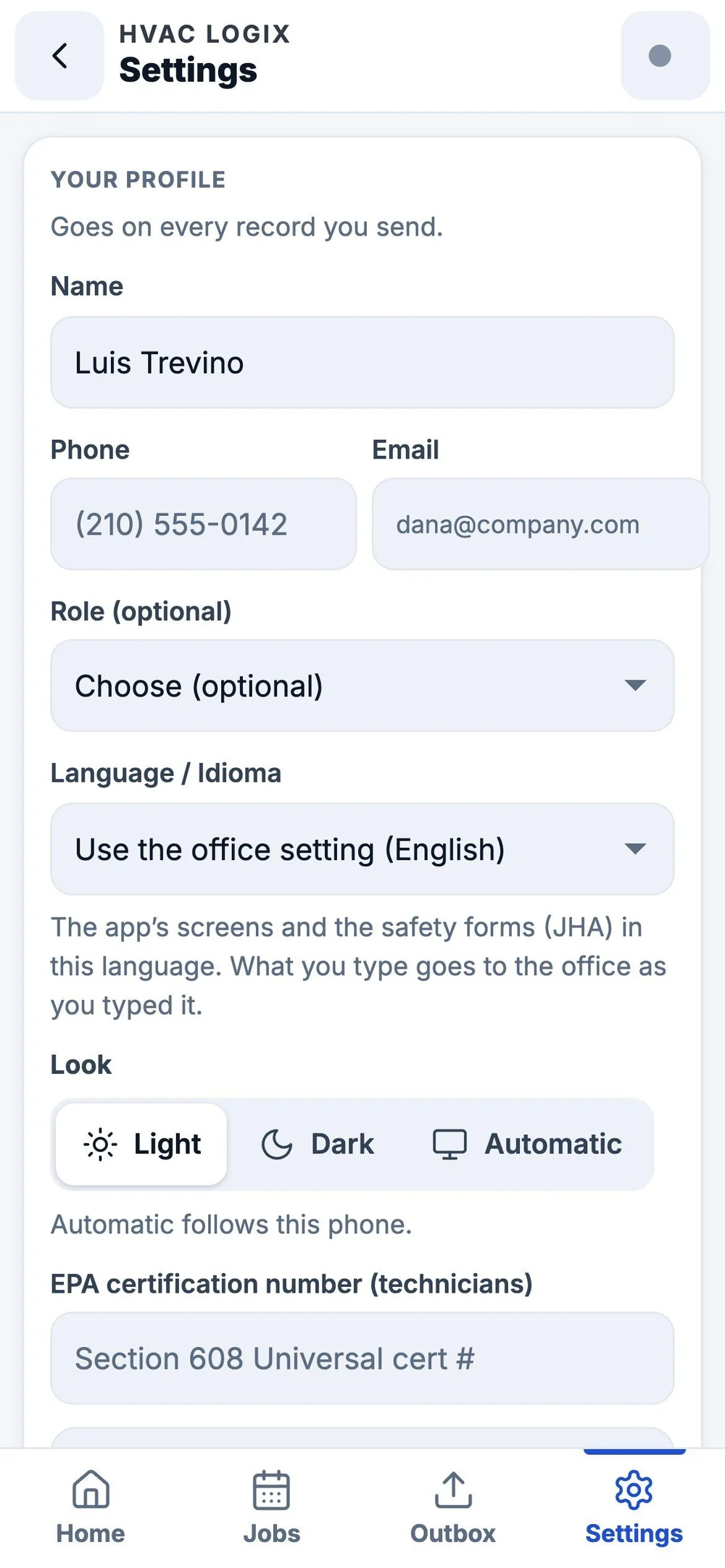
Crew members read best in their own language, so each phone can be set to Spanish.
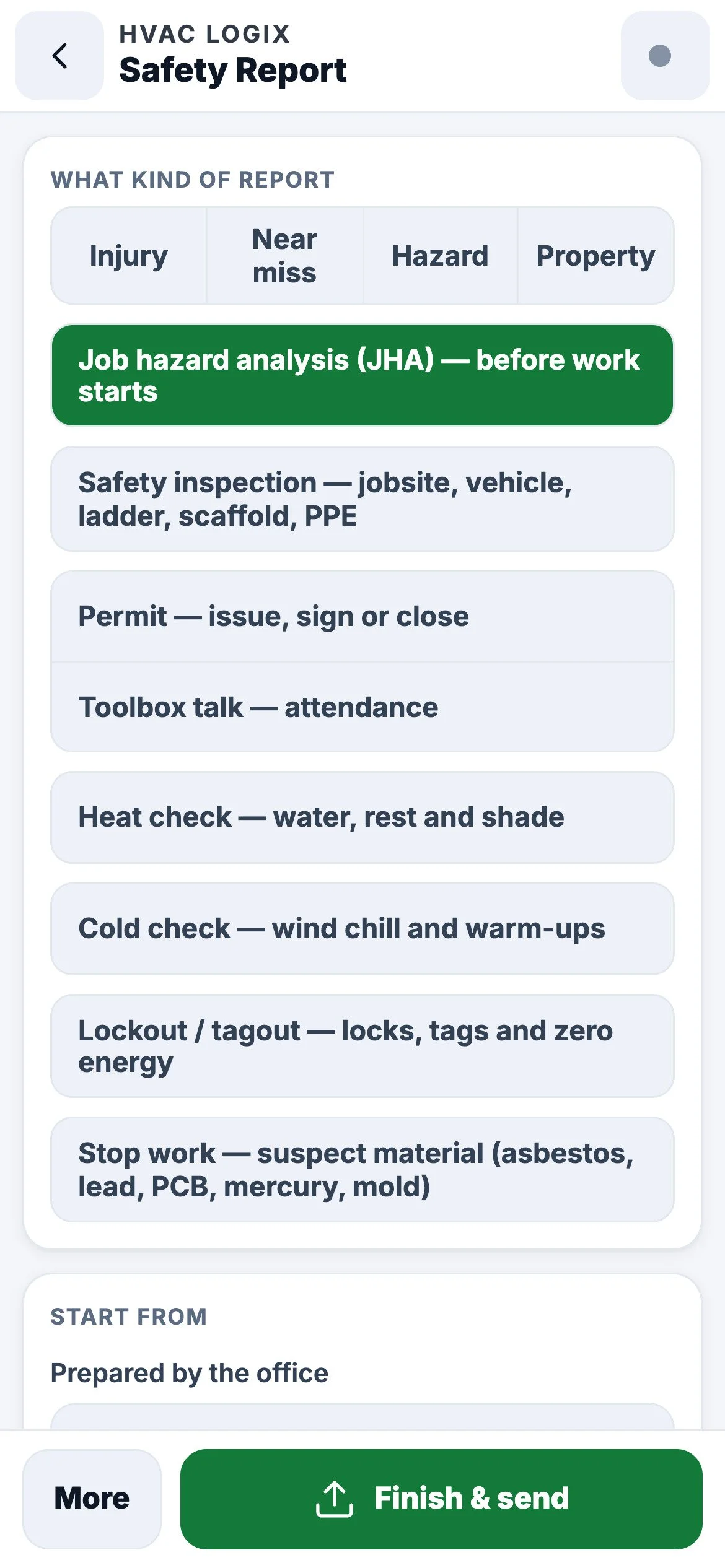
Permits, Lockout, Heat and Hazardous Materials
Permits That Check Themselves
Hot work, confined space entry, excavation, energized electrical work, crane lifts, roof access and elevated work. Every check must be Yes, confined space needs its first gas reading, and a crane lift at 75% or more of capacity is flagged as critical.
Learn MoreShow Less
One incident on a permit-required task can cost a life, a claim and a citation. Permits enforce every check before work starts.
- Confined space limits: oxygen 19.5 to 23.5%, flammables under 10% LEL, H2S under 10 ppm, CO under 35 ppm.
- A crane lift needs the load and the crane's capacity at the radius.
- Each role signs, and the permit closes with the condition the area was left in.
- Permits print for the job file.
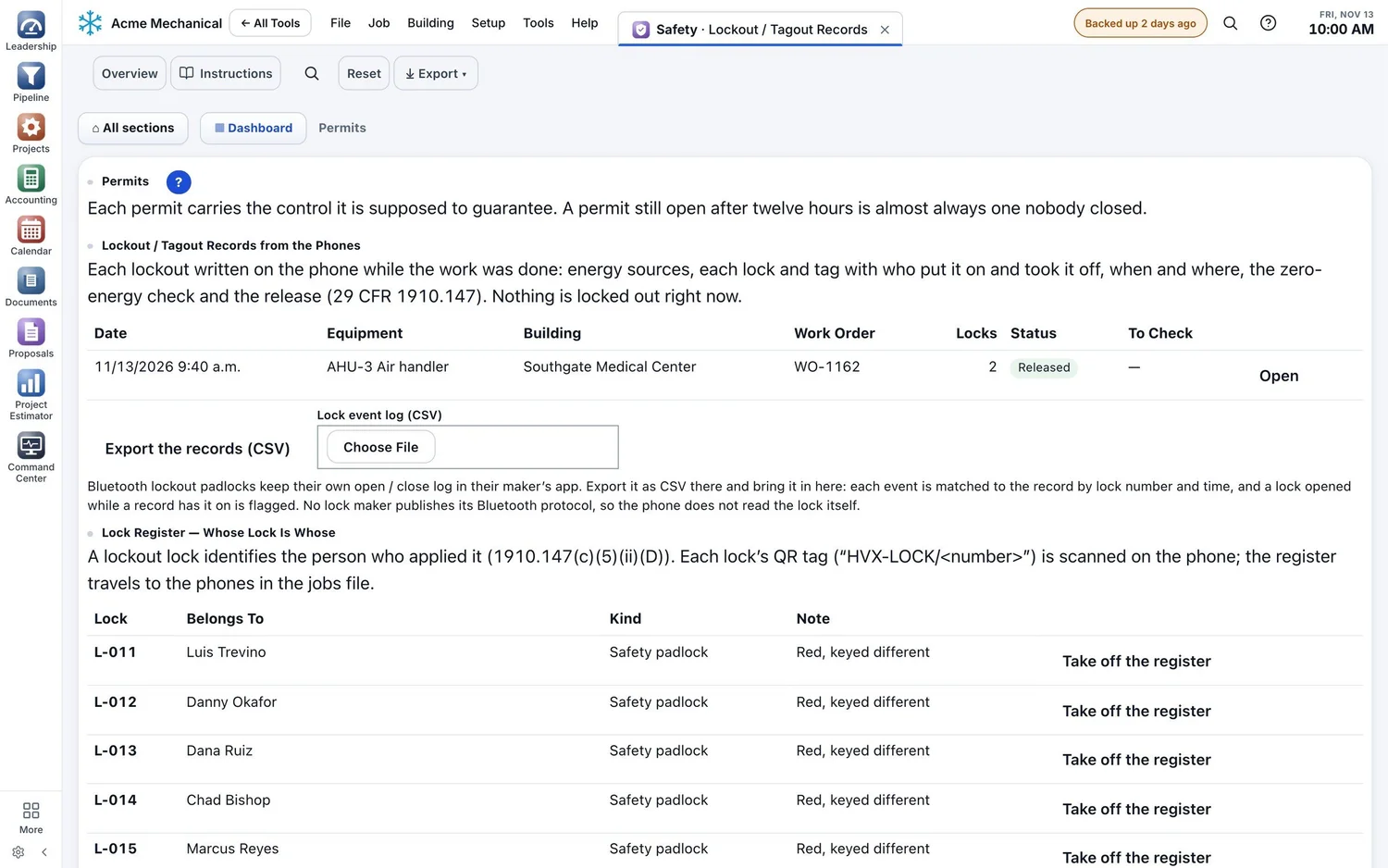
Hot work without a permit is a disaster waiting, so each permit carries its checks and stays open only as long as allowed.
Training Checked Before the Permit
The crew's cards are checked against the permit. A missing card refuses the permit unless the safety director writes why it is allowed.
Learn MoreShow Less
Sending an untrained worker into a hazard invites injury and a citation. The permit checks the crew's training before it is issued.
- Cards and the training matrix are both checked.
- An override needs the safety director's written reason.
- For a permit-required confined space, the dispatch assignment itself is refused until an authorized override is recorded.
Lockout Records at the Office
Safety lists the lockout records from the phones with the ones still locked out first. The lock register says whose lock each one is, and QR tags for the locks print on a label sheet.
Learn MoreShow Less
An energy-control mistake can cost a life and bring a citation, and a complete record protects your people and your company. The record is built as the work is done.
- Energy sources, isolation and the release of stored energy are each recorded.
- Zero energy is verified, with the meter proven on a live source before and after (NFPA 70E 120.6).
- A lock taken off by someone else asks for the company's note.
- Lock events exported from Bluetooth padlock apps are matched, and a lock opened during a lockout is flagged.
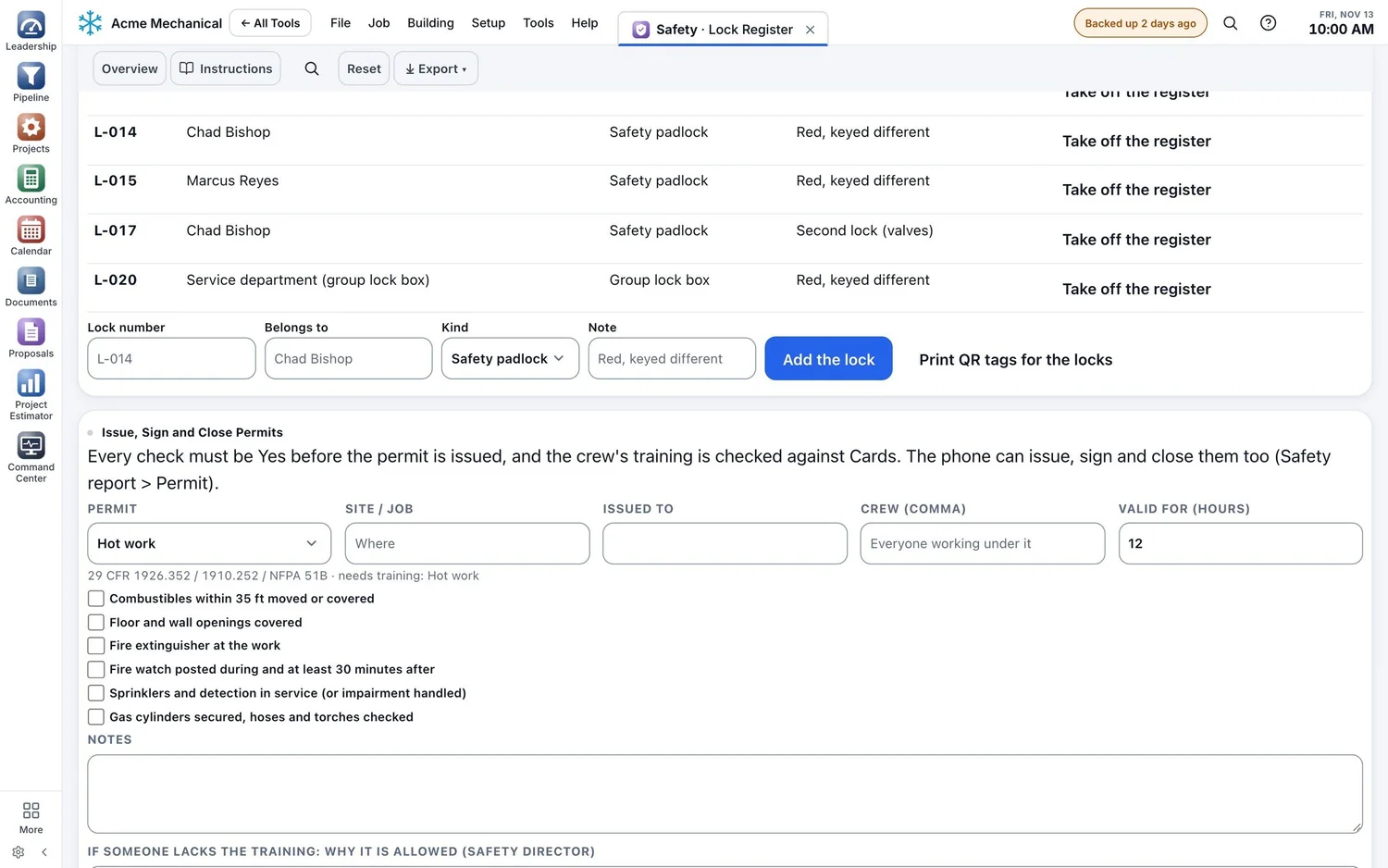
Locks left on equipment cause confusion, so the lock register shows who holds each lock.
Heat-Illness Prevention
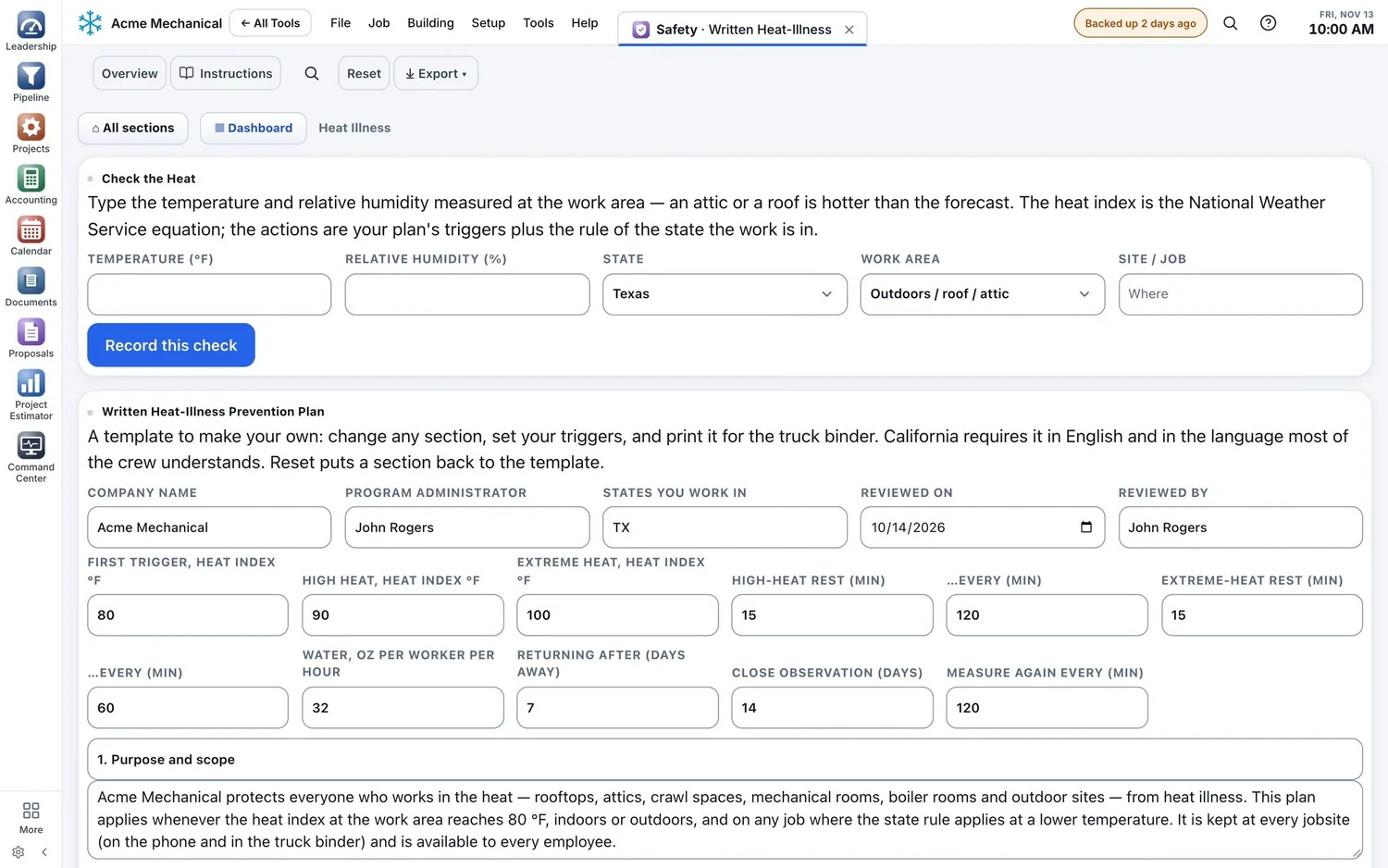
A written plan template in ten sections, your own triggers, acclimatization schedules for new and returning workers, heat checks and break logs from the phones, a training record, and each state's rule with its date and source.
Learn MoreShow Less
A heat illness can cost a life, a claim and a citation. The program keeps the plan, the checks and the training records together.
- The heat index uses the National Weather Service equation from readings at the work area.
- Acclimatization follows NIOSH 2016 for new and returning workers.
- Anyone whose heat training is more than a year old is listed for a refresher.
- The phone can read a thermometer display from a photo, on the phone.
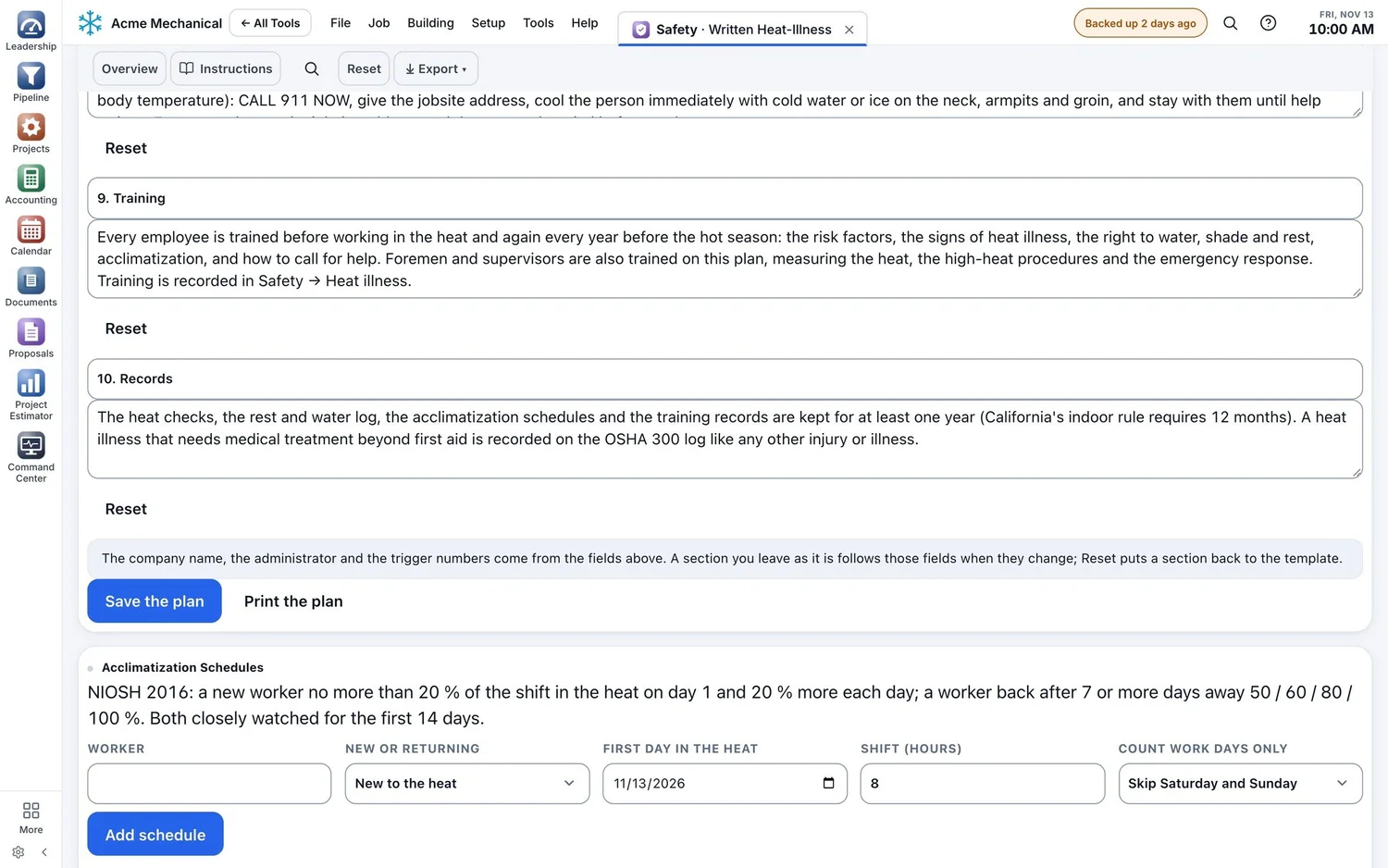
Heat illness can be fatal, so the written plan and triggers are kept with the forecast check.
Stop Work for Suspect Material
Anyone can press Stop Work on the phone. The job shows On Hold, the project manager, service manager, safety and Leadership get a message, and the case runs step by step from the notification letter through sampling, abatement, the change order and a signed release to resume.
Learn MoreShow Less
Disturbing asbestos or lead can bring exposure claims and costly cleanup. Stopping right away, with a full record, protects workers and turns the delay into a paid change order.
- A building built before 1981 is presumed to have asbestos in certain materials until surveyed (29 CFR 1926.1101).
- Abatement contractors' licenses and insurance are checked.
- The delay notice is due within the contract's notice days, and late notices are flagged.
- Exposure records are kept for employment plus 30 years (29 CFR 1910.1020).
Cold-Stress Prevention
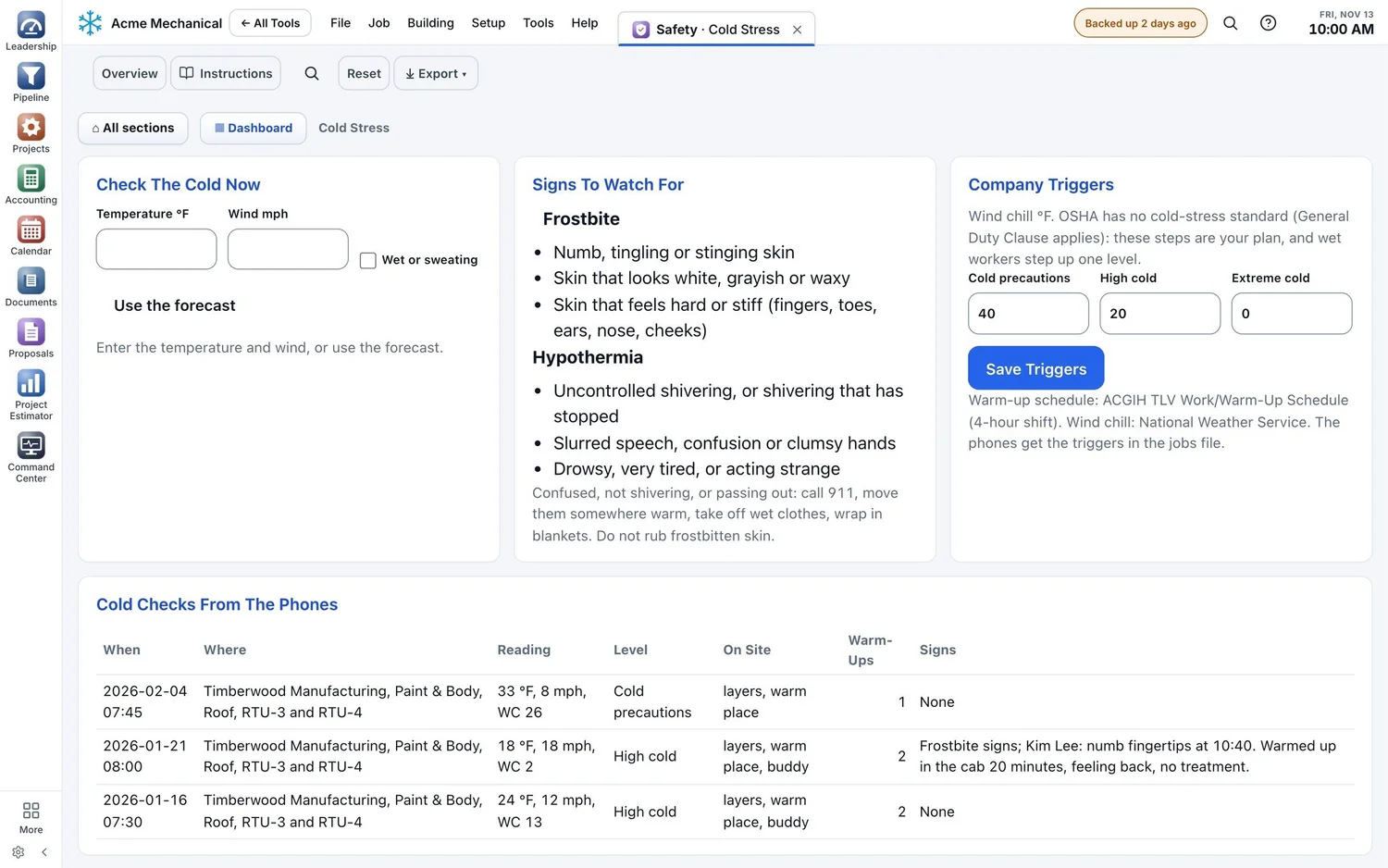
Cold work hurts people above freezing too, especially when they are wet. Safety keeps a cold-stress plan with your own triggers, works out wind chill and the warm-up break schedule for the shift, and files the crew's Cold Check from the phone. A cold injury is still recorded as an injury.
Learn MoreShow Less
A cold injury means lost time and a claim. The plan works out the safe work and warm-up schedule for the conditions on site.
- Wind chill uses the National Weather Service formula.
- Warm-up breaks follow the ACGIH work and warm-up schedule for a 4-hour shift.
- Wet conditions raise the level one step, since hypothermia can happen above 40 °F.
- OSHA has no cold-stress standard; your plan's triggers are yours to set.
Training, Inspections and Testing on One Record
Training for Every Employee
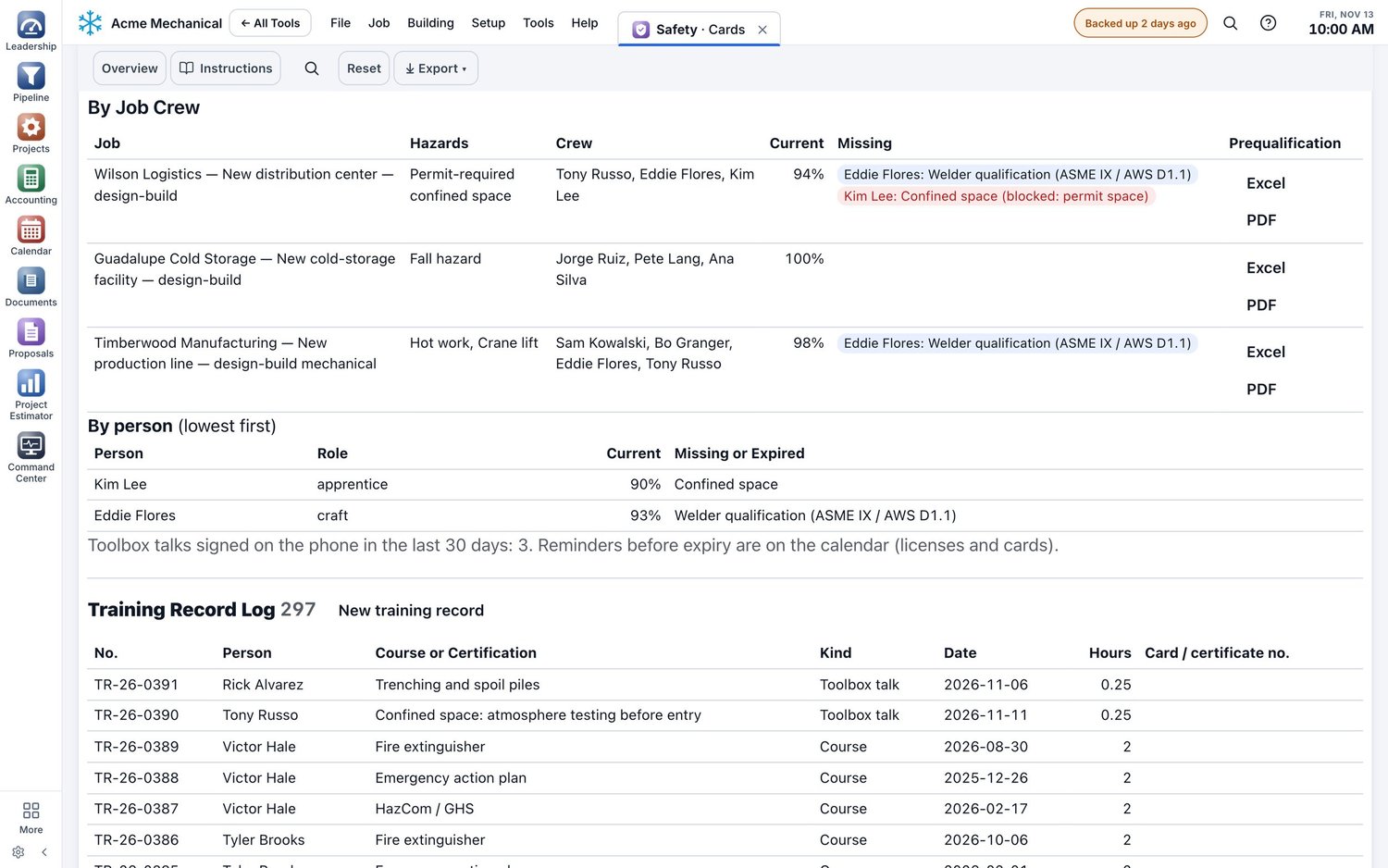
A catalog with each item's refresher interval, every employee's records with expiry dates, compliance by person, crew and company at 30, 60 and 90 days, and Excel or PDF training matrices per job crew for prequalification.
Learn MoreShow Less
Prequalification questionnaires decide who gets to bid. A training matrix per crew answers them in minutes.
- Reading a certificate scan fills in the training fields for you to check.
- Expiry is filled in from the catalog's refresher interval.
- Job requirements can be set by trade, hazard and crew.
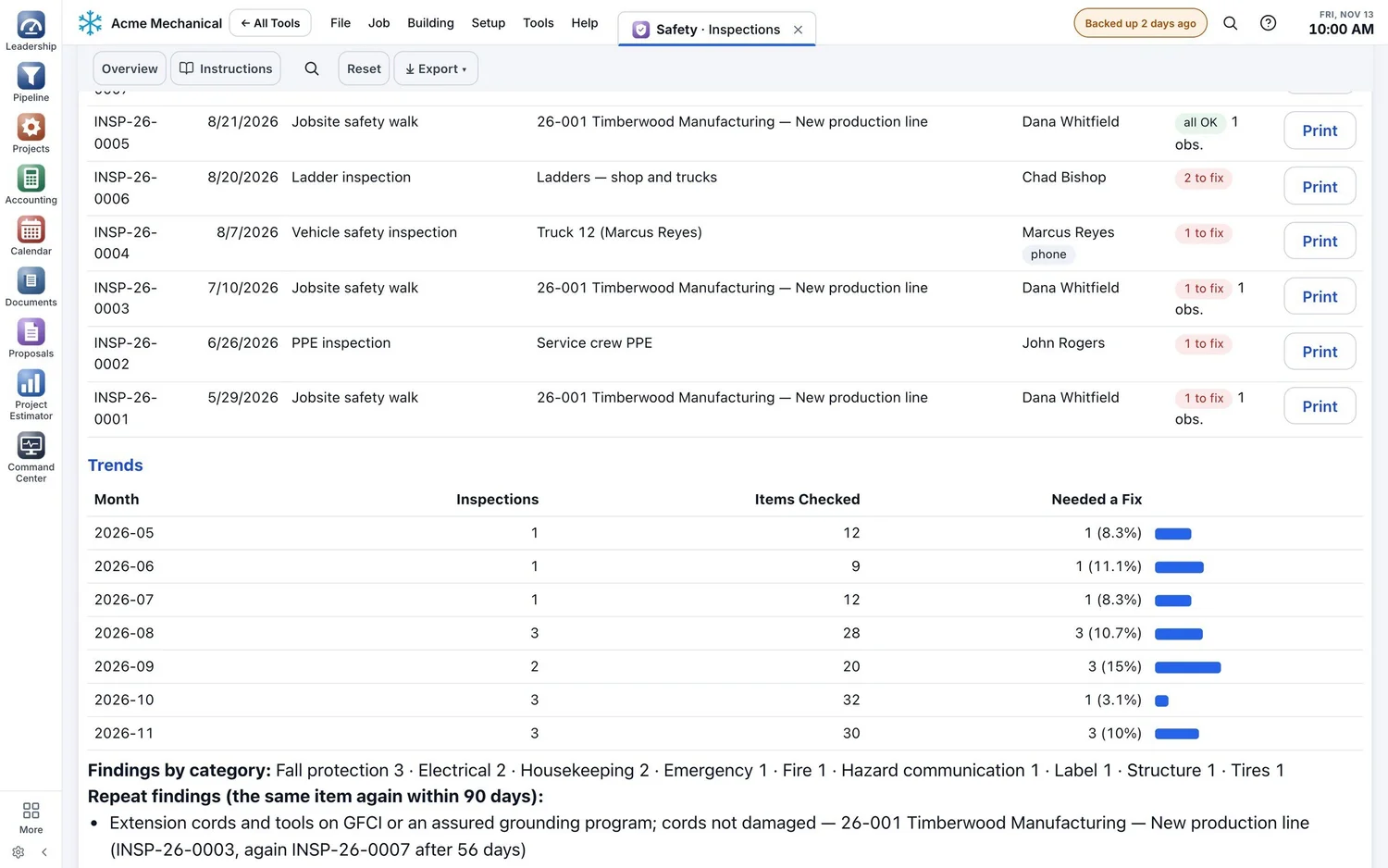
Repeat findings point to a bigger problem, so trends show what inspectors find most.
Hazards Flagged on the Board
Flag a job's hazards and a person without current training for them is flagged on the dispatch board. For a permit-required confined space the assignment is refused until an authorized leader records an override with a reason.
Learn MoreShow Less
A dispatcher who cannot see training gaps can send the wrong person to a hazardous job. The board shows it before the assignment.
- Hazards are set per job.
- Only Leadership, an Administrator or the VP of Operations can override a confined-space refusal.
- The override reason is kept.
Inspections with Corrective Actions
Five checklists come built in: jobsite walk, vehicle, ladder, scaffold and PPE, each item with the OSHA rule behind it. Every Needs Fixing opens a corrective action with a person responsible and a due date set by severity.
Learn MoreShow Less
Hazards found and fixed by your own crew cost far less than ones found by an inspector. Every finding gets an owner and a deadline.
- Due dates by severity: imminent danger today with work stopped, high 1 day, medium 7, low 14.
- Repeat findings within 90 days are tracked.
- Schedules put due inspections on the calendar and the inspector's phone.
- Checklists can be edited or copied.
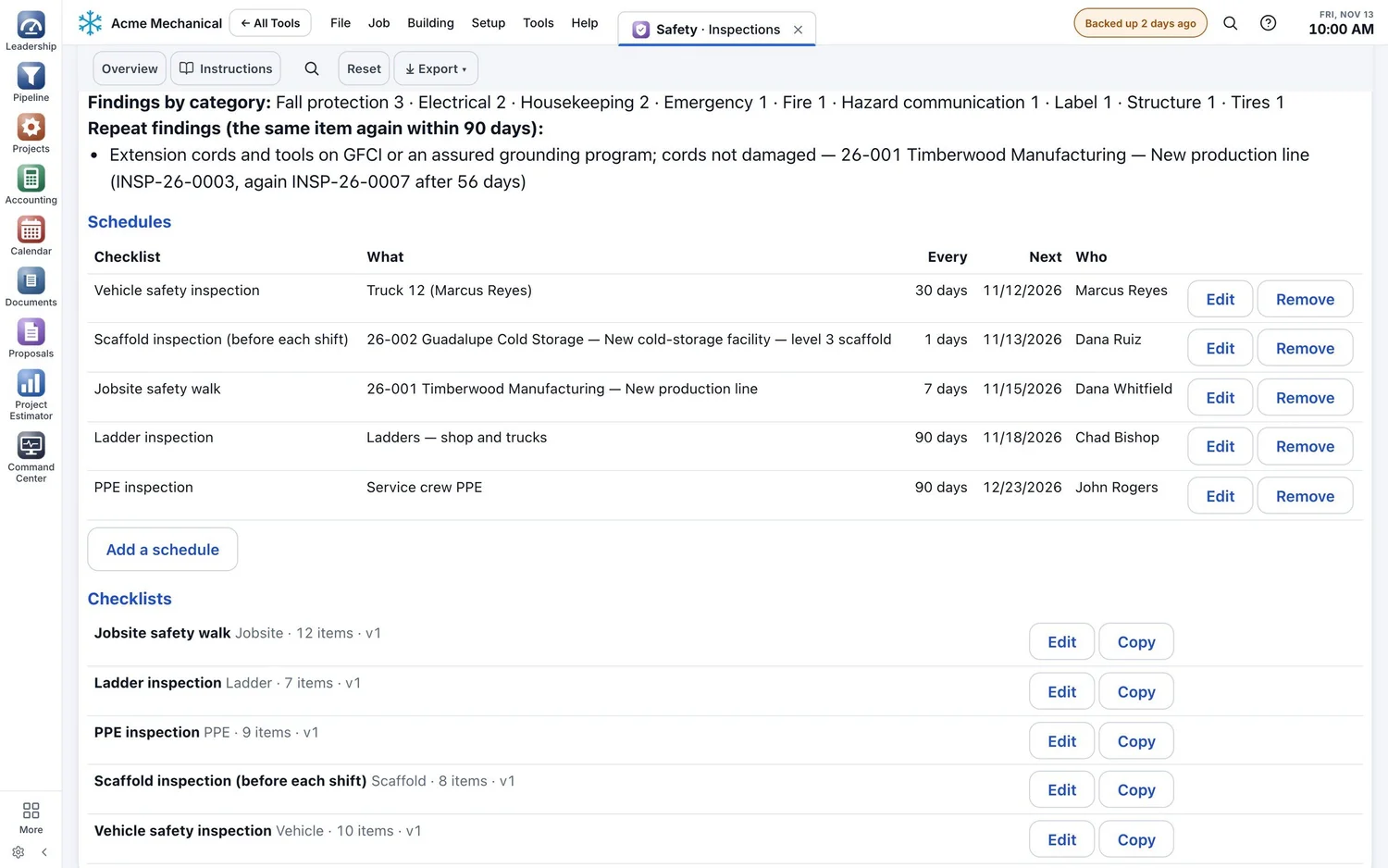
Missed inspections leave hazards in place, so each one shows who does it and when it is next due.
Drug and Alcohol Testing
Random pools, a draw anyone can re-check from its selection record, scheduled tests with the post-accident clock shown, and a quarterly draw reminder. Results are sealed, each look is logged, and only HR and Safety see them.
Learn MoreShow Less
A random draw that cannot be proven fair invites challenges, and a missed post-accident test can cost a claim. The program keeps both defensible.
- The draw uses a secure random seed, and its fingerprint is kept.
- The post-accident clock shows 2 and 8 hours for alcohol and 32 hours for drugs.
- Positives and refusals are kept 5 years, negatives 1 year.
- State notes cover limits on random testing in the states that have them.
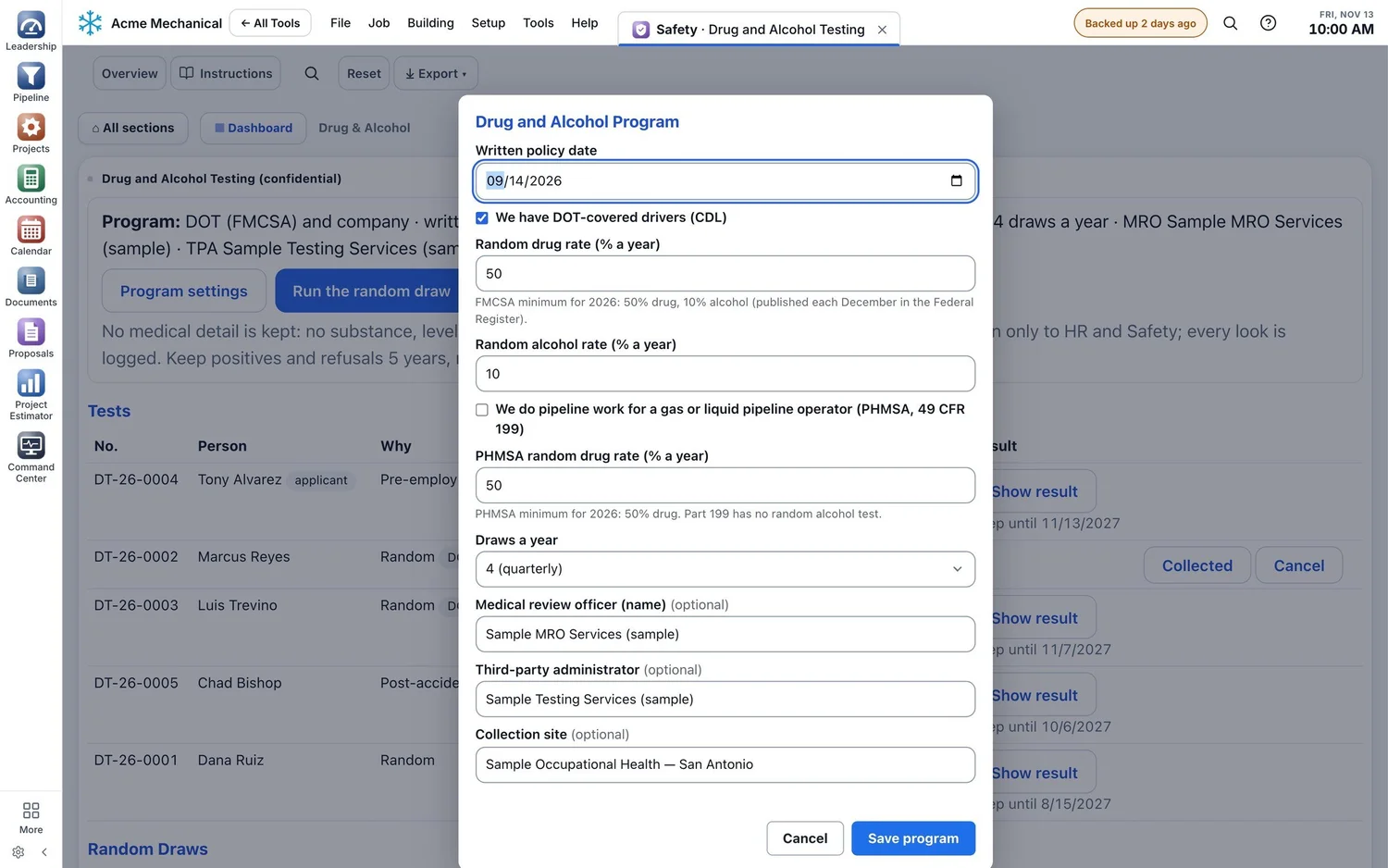
Drug testing must follow written rules, so program settings and random rates are kept on record.
SDS, Chemicals and PPE
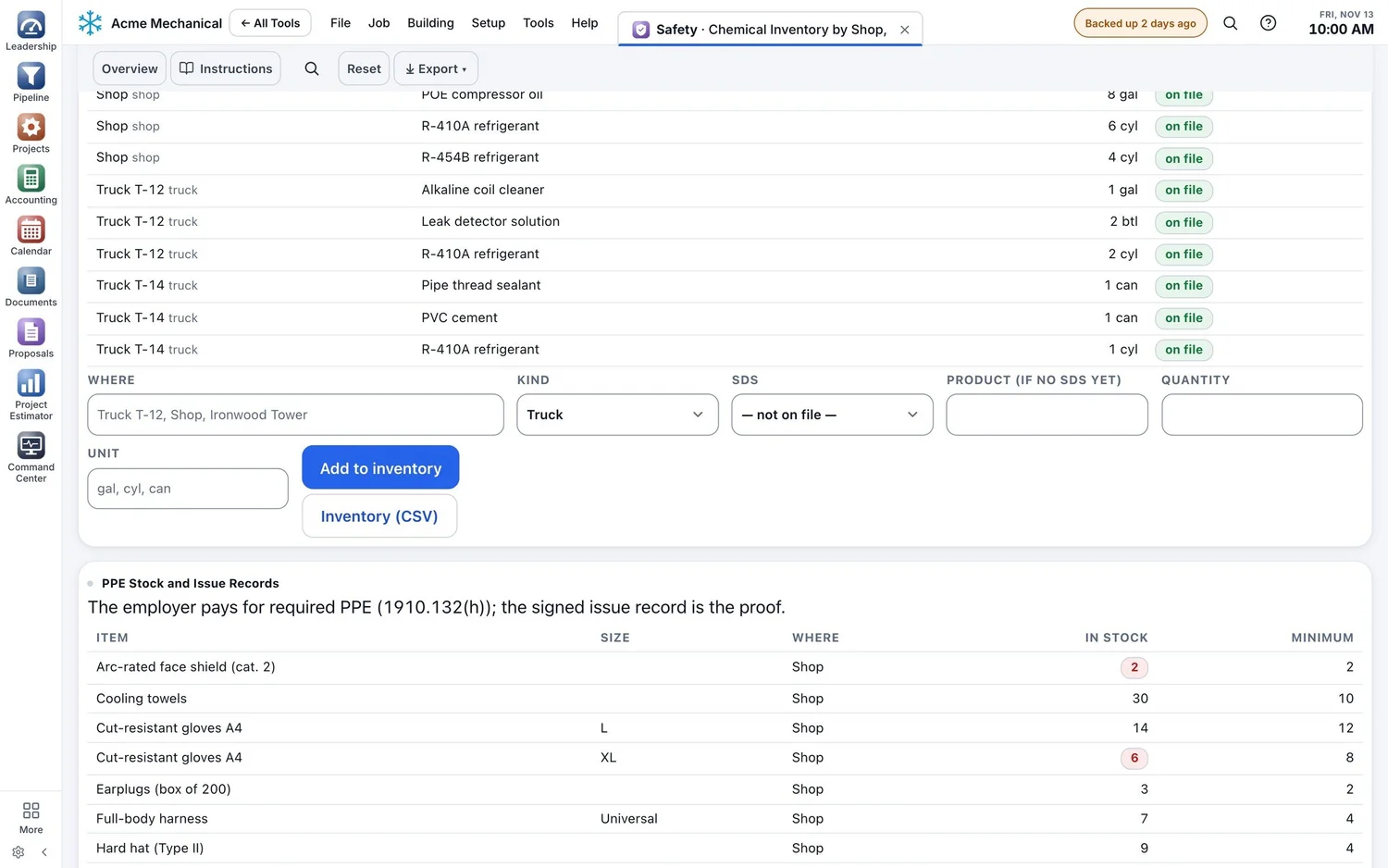
An SDS library with Spanish copies, a chemical inventory by shop, truck and job, and PPE stock with minimums and issue records signed by the employee.
Learn MoreShow Less
A missing safety data sheet can bring a citation, and running out of PPE stops work. Both are tracked where the chemicals and crews are.
- Each SDS records the product, maker, signal word, pictograms and date.
- A chemical with no SDS is flagged.
- Issue records are signed by the employee.
- Inventory and issue records export as CSV.
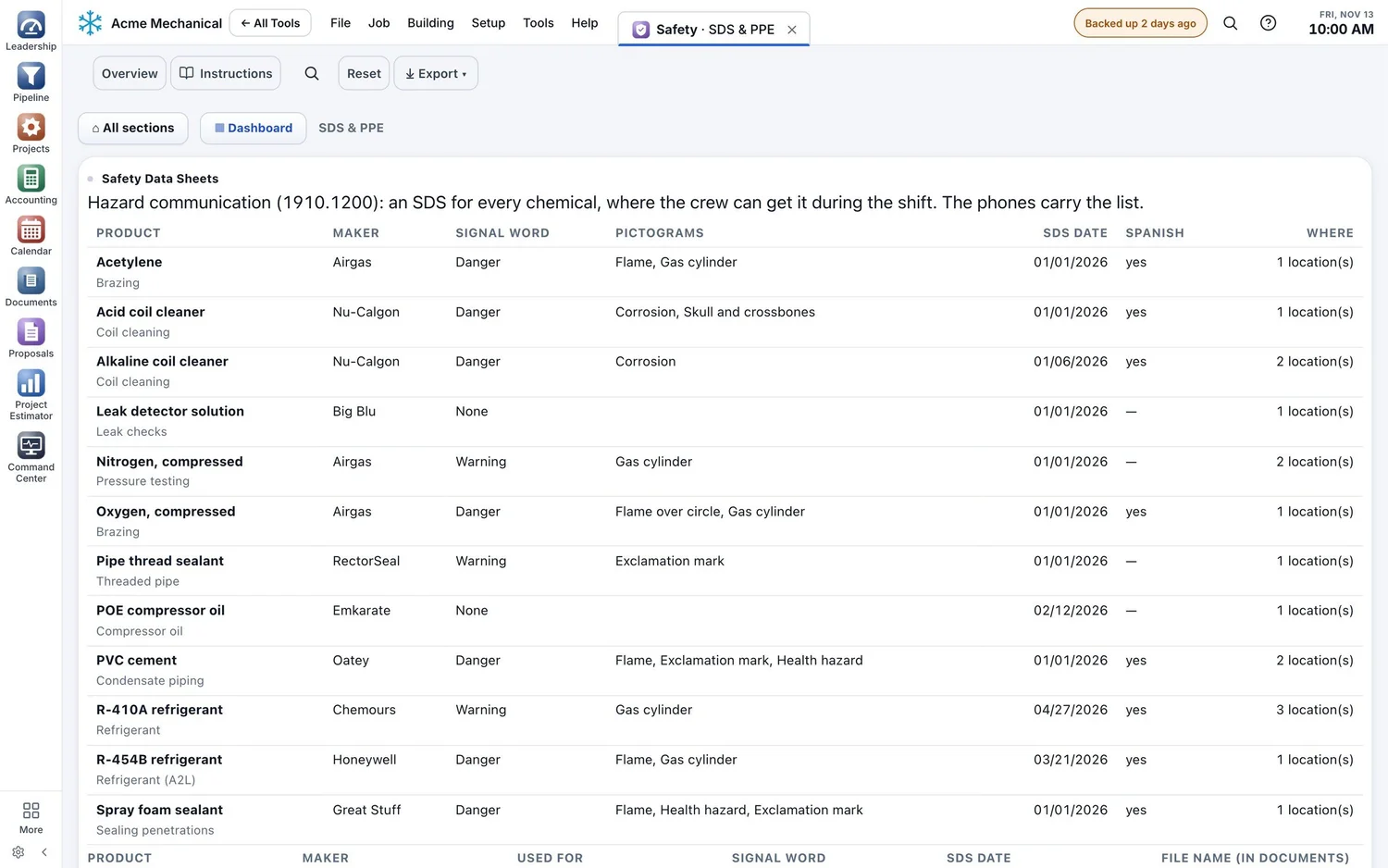
Workers have a right to know what they handle, so every safety data sheet is in one library.
What Safety Hands to the Other Departments
Safety records are not a separate binder. They use the same employees, jobs and vendors as the rest of HVAC Logix.
Operations and Projects
- A hazmat hold shows on the job and the work order until safety or Leadership signs the release.
- The replacement scope from a hazmat case becomes a change order awaiting approval, with the delay notice tracked against the contract's notice days.
- A site-specific safety plan per job carries the emergency plan to the phones.
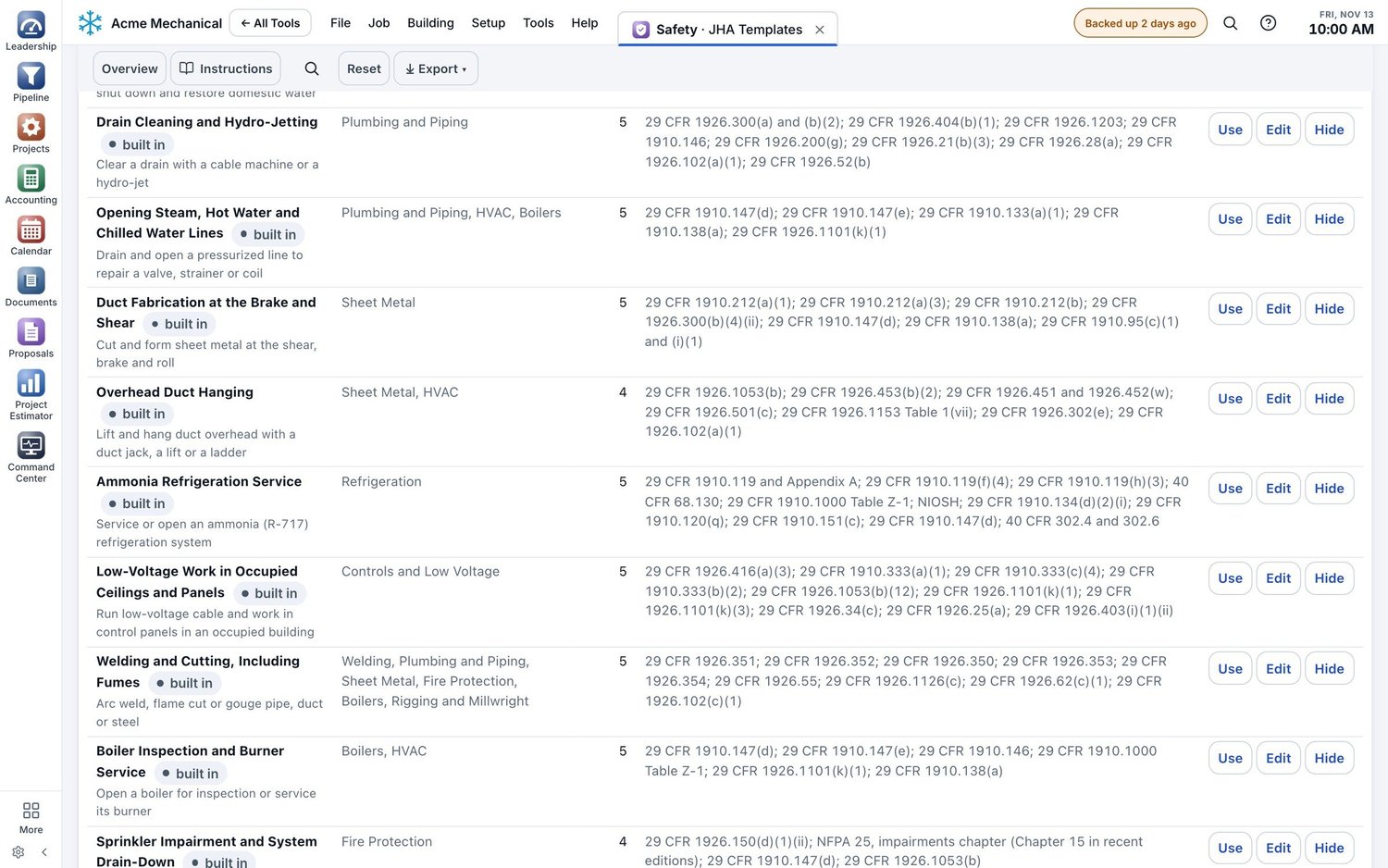
Writing a job hazard analysis from scratch takes time, so ready templates start one for each kind of work.
HR, Payroll and Risk
- Names on cases, cards, permits and JHA crews come from the employee list, so records stay with the right person.
- An incident can open a workers' compensation claim on the Risk desk and keep the return-to-work dates.
- The insurance renewal package pulls the safety program: EMR, OSHA rates, training and the drug and alcohol program.
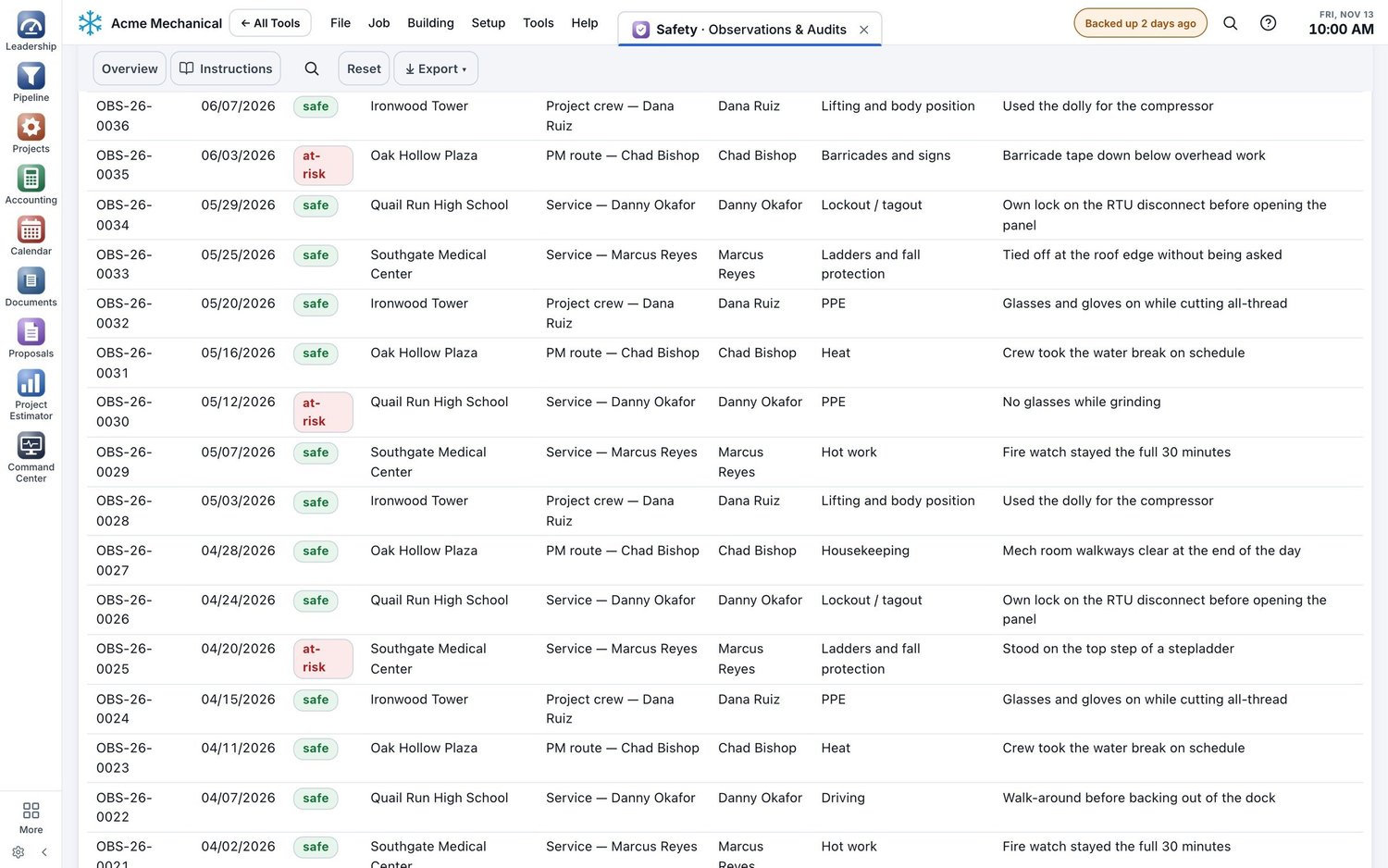
Good safety habits deserve credit, so observations record safe and at-risk behavior by crew.
Purchasing and Subcontracts
- Subcontractor safety prequalification gives a verdict of approved, conditional or not approved, reviewed yearly.
- Your own answers to a general contractor's or customer's safety questionnaire export to CSV or print.
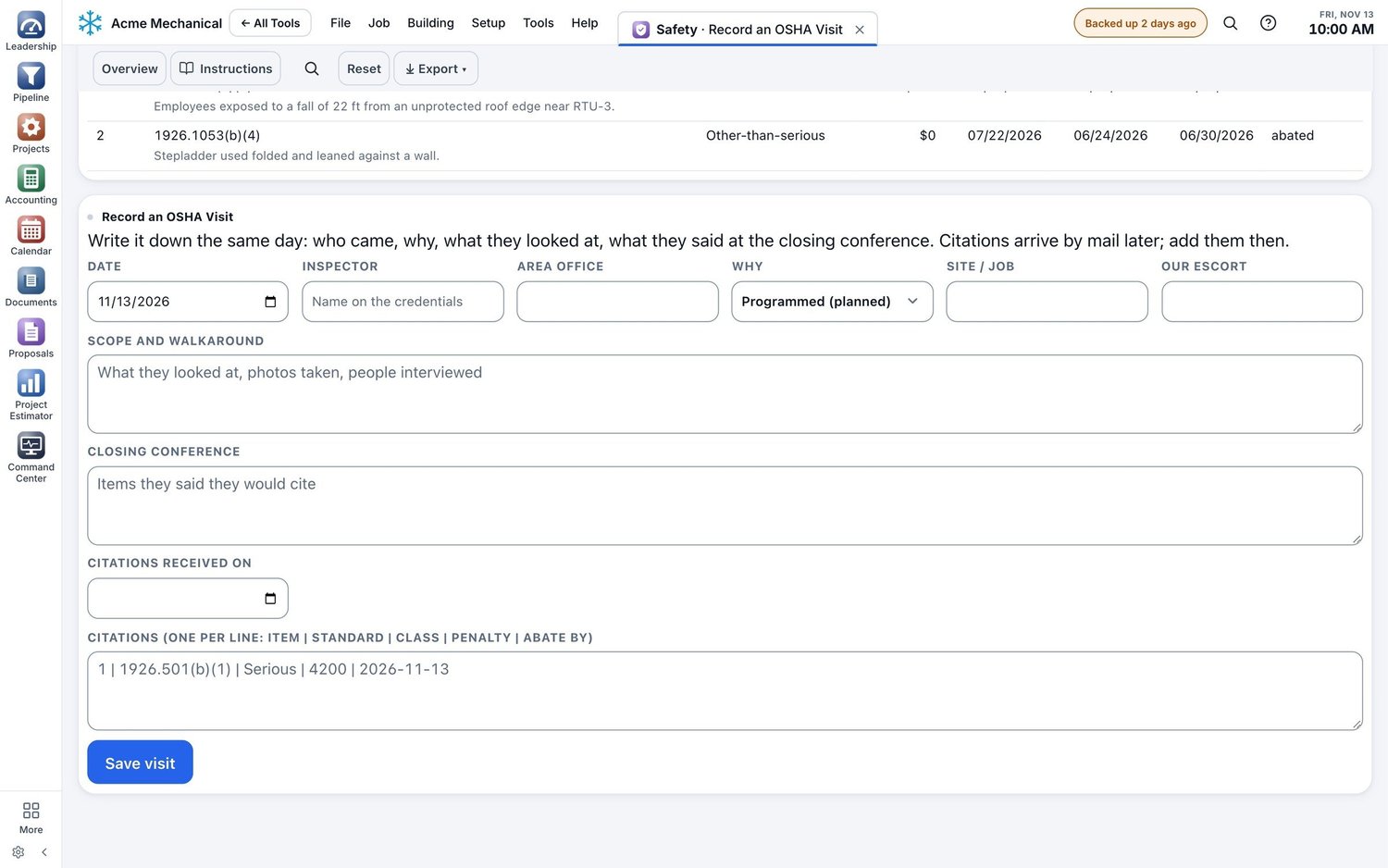
- Each OSHA visit is tracked with its contest deadline, citations, abatement dates and certification.
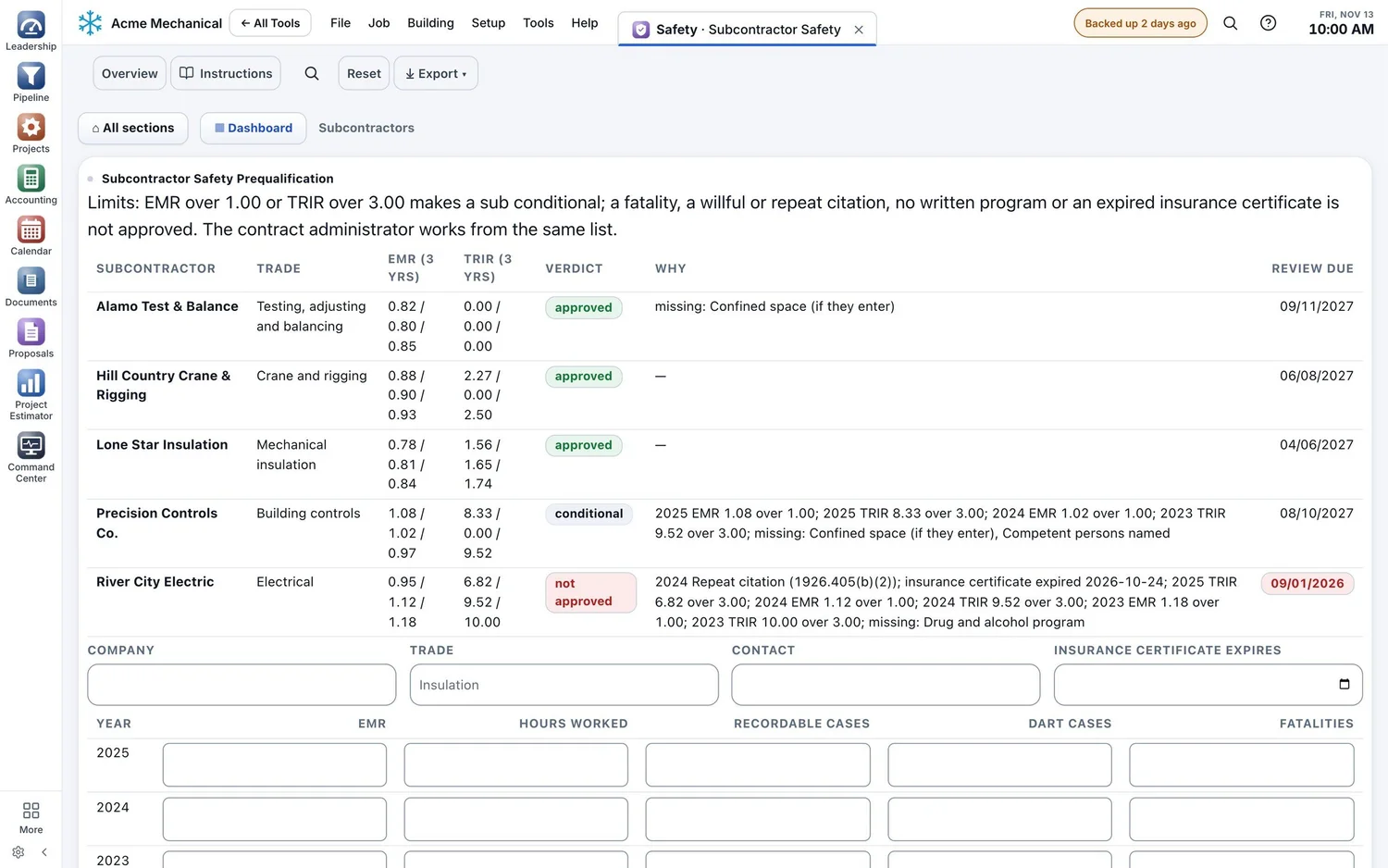
Unsafe subcontractors put your record at risk, so each gets a prequalification verdict.
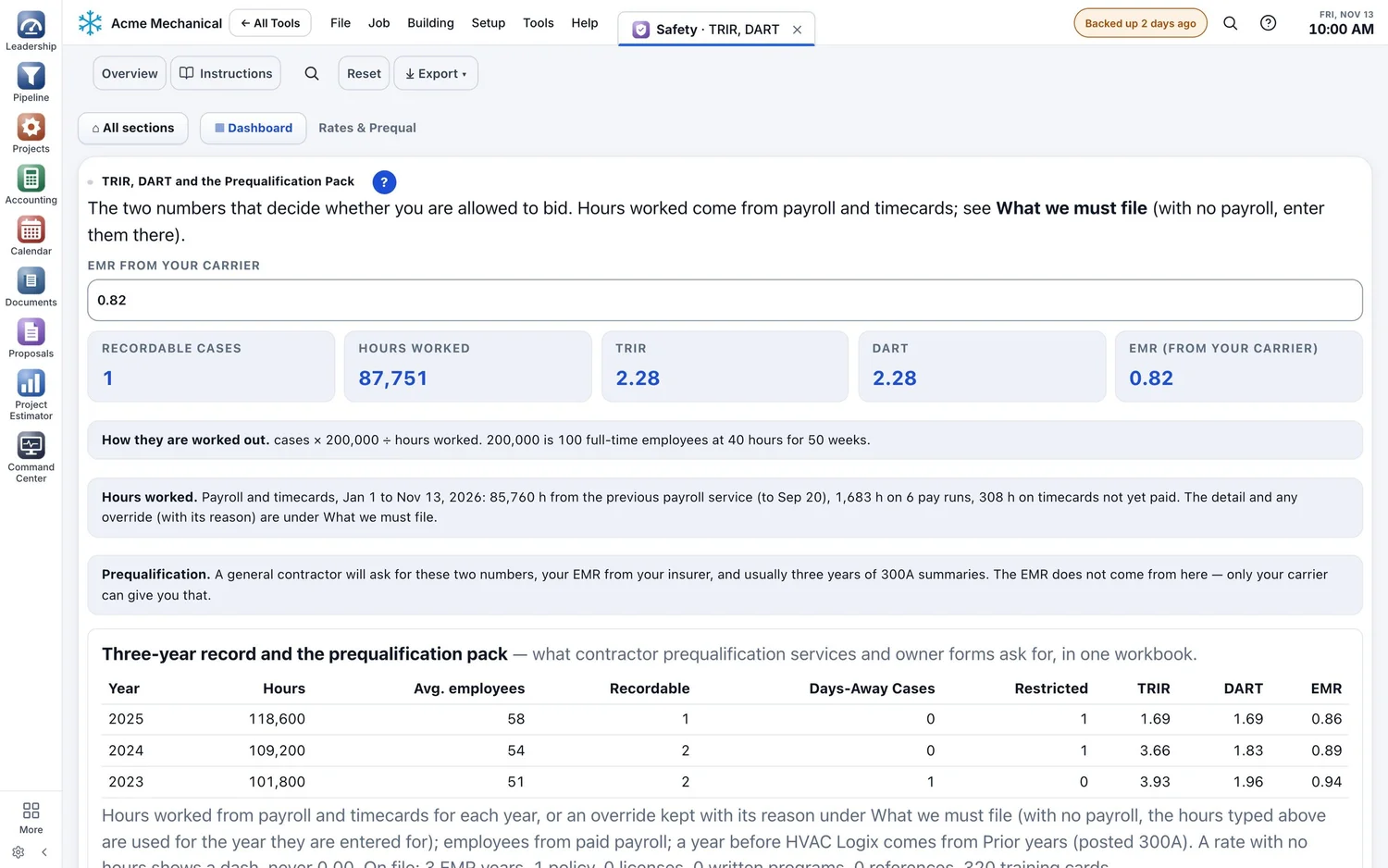
Contractors ask for safety numbers before you can bid, so TRIR, DART and EMR come from the same payroll hours and cases.
Frequently Asked Questions
Does HVAC Logix file anything with OSHA for us?
Can crews fill out safety forms with no signal?
What is available in Spanish?
Who can see drug and alcohol test results?
Does a lockout record count as an OSHA 300 case?
Be First When HVAC Logix Opens
Stop paying people to copy numbers between programs. Join the list and we will tell you the day downloads open, with setup guides ready.
Launching early 2027 for HVAC Logix. Nothing to buy today, and no sales calls.
