
The Programs That Keep People Safe and the Records That Prove It.
Safety and risk records tend to live in binders, spreadsheets and one person's memory. Facilities Logix keeps them beside the buildings, equipment and people they concern: the safety program, chemical inventory, incidents, fire and life safety testing, emergency plans, insurance and the cybersecurity of your building systems.
Launching Early 2027 · Join the Early-Access List
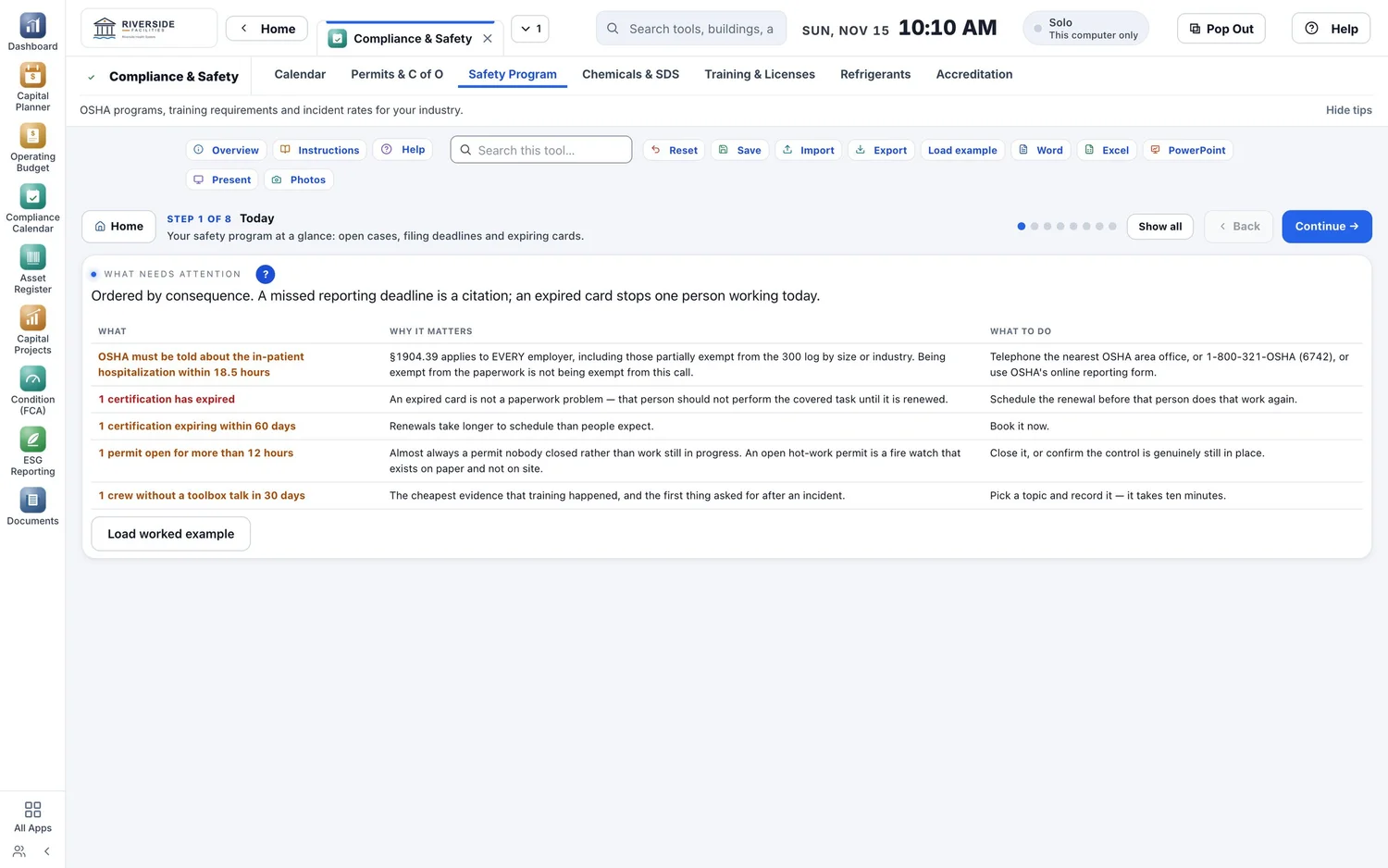
The Safety Program, Kept in One Auditable View
Safety Program
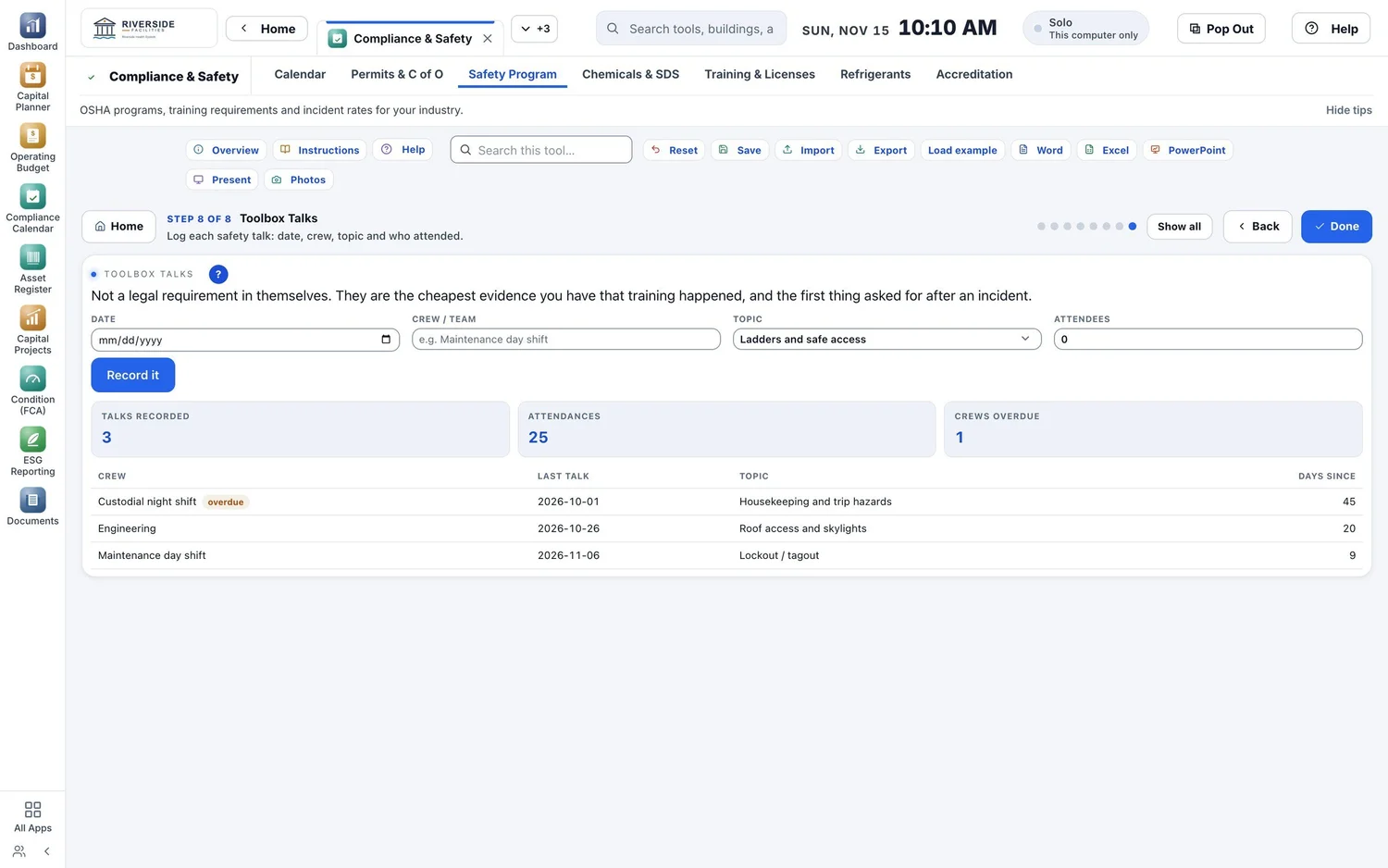
The injury and illness log and its annual summary, kept apart from the reporting clock that runs in hours when someone is badly hurt. Plus what your establishment has to file electronically, your recordable and days-away rates, expiring cards, open permits and toolbox talks.
Learn MoreShow Less
A late serious-injury report or a missed electronic filing brings penalties on top of the injury. The program keeps both on a clock.
- A fatality reported within 8 hours; hospitalization, amputation or loss of an eye within 24
- Recording criteria applied; borderline first-aid cases marked Check
- NAICS code, peak employees and hours decide the electronic-filing duty
- Hot work, lockout and confined space permits closed when the work ends
Chemicals & SDS
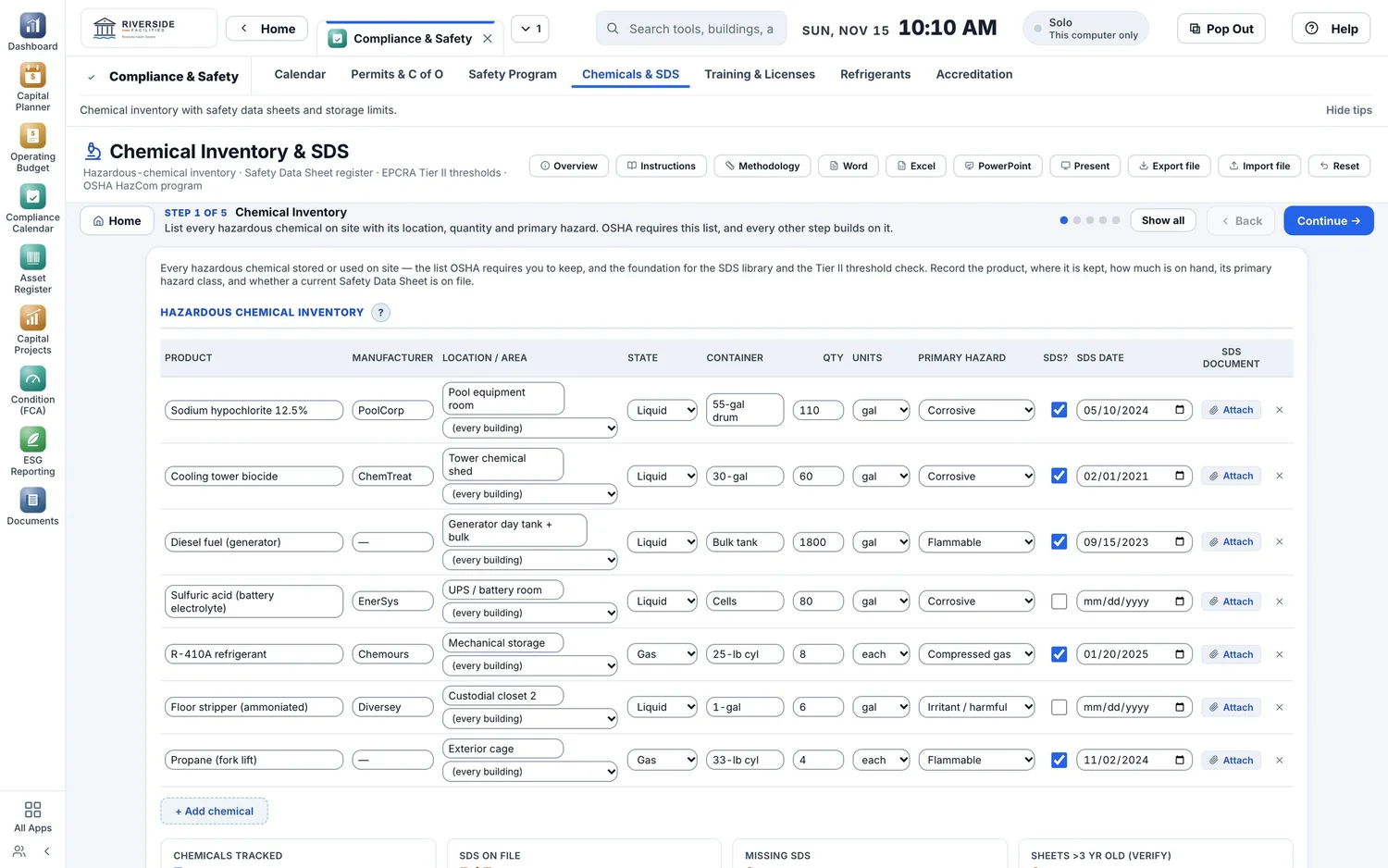
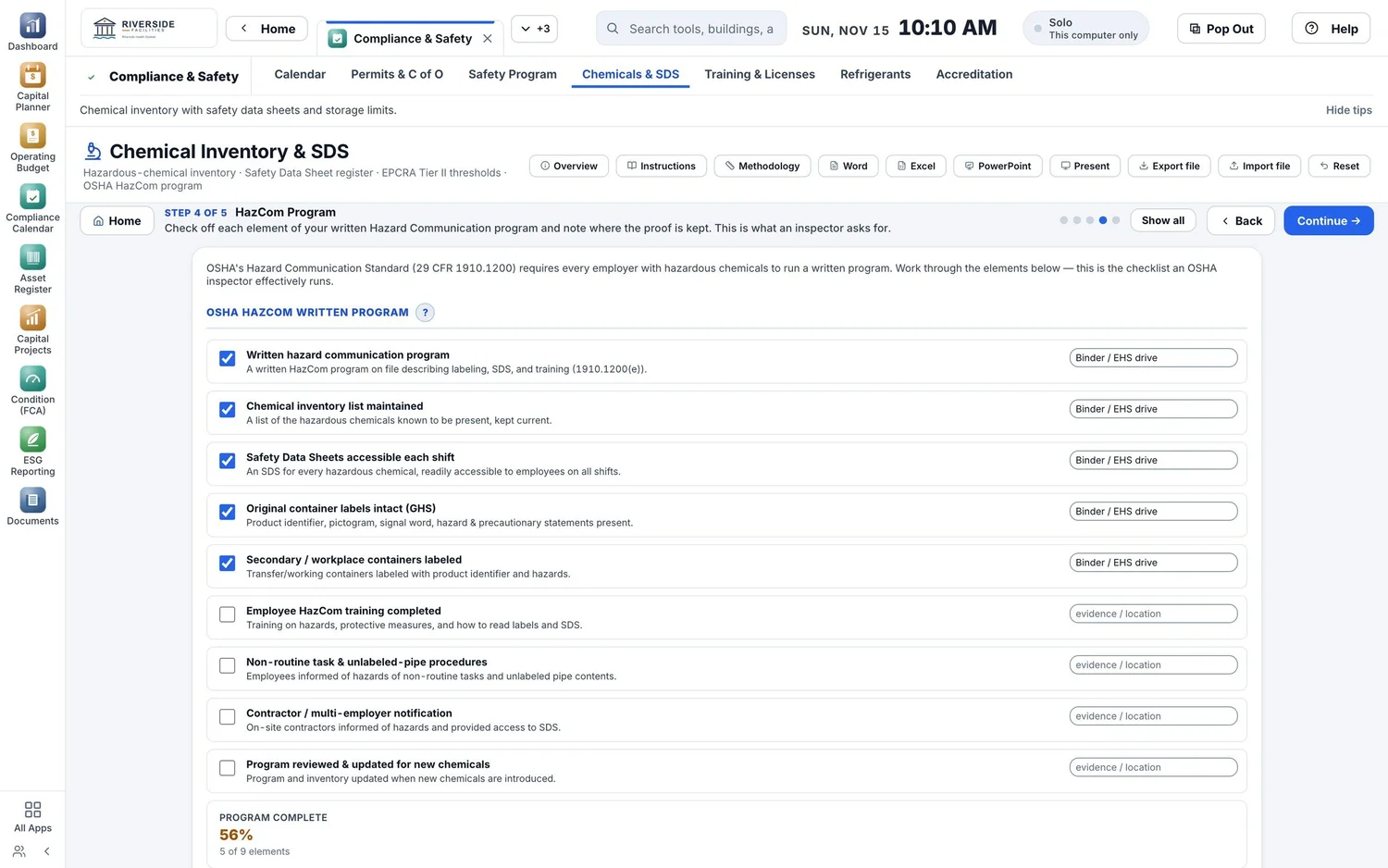
A hazardous-chemical inventory, a safety data sheet register, an EPCRA Tier II threshold check and a hazard communication written-program checklist.
Learn MoreShow Less
Missing a chemical reporting threshold, or a missing data sheet during an inspection, brings fines. The register shows both before an inspector does.
- Which products have a data sheet on file, which are missing one, and which are old
- The sheet stored inside the software and opened offline
- The EPCRA Tier II inventory is due March 1
- Storeroom items marked SDS required link to their record
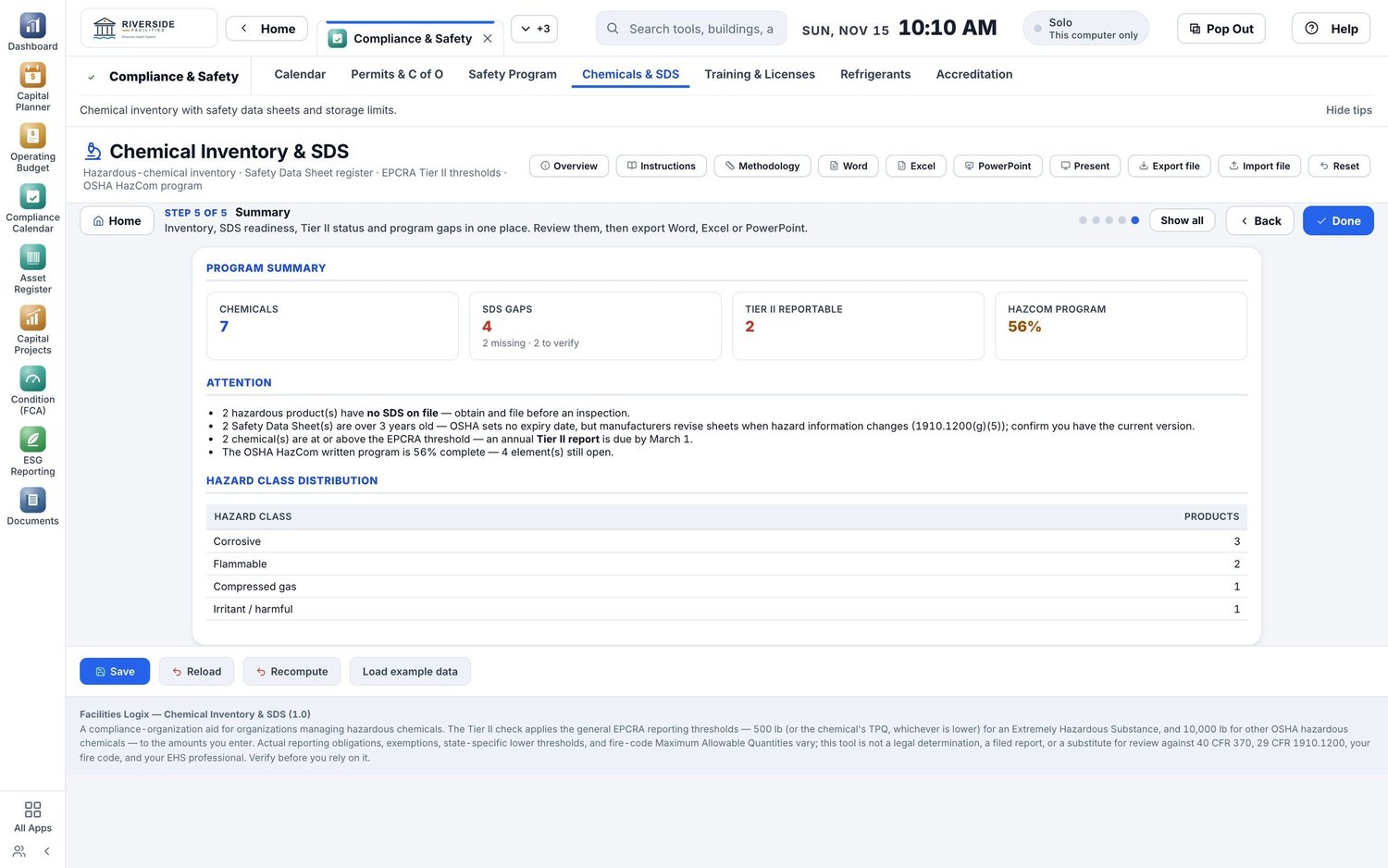
Summary in Chemical Inventory & SDS: inventory, SDS readiness, Tier II status and program gaps in one place. Review them, then export Word, Excel or PowerPoint.
Training & Licenses
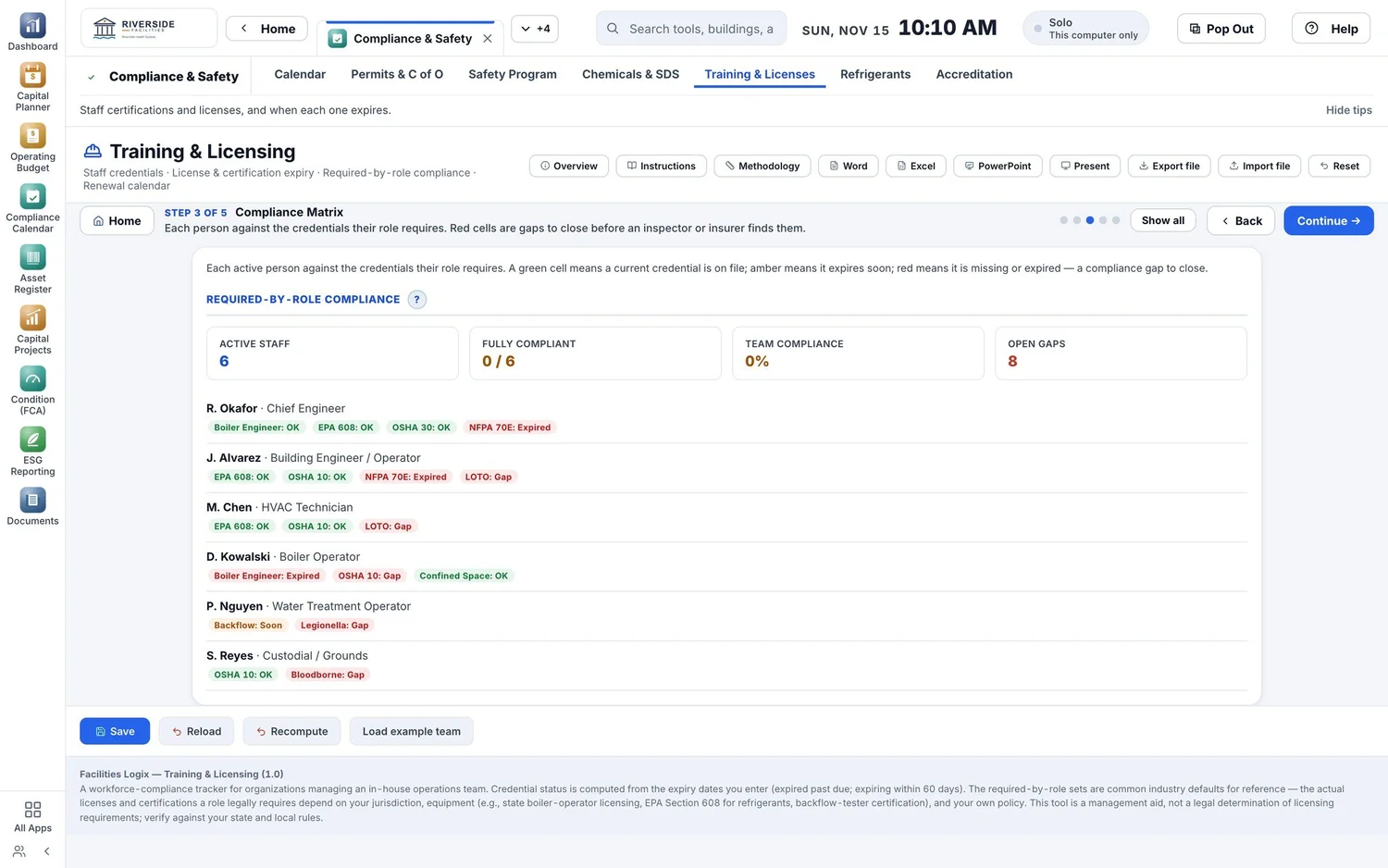
Staff licenses and certifications with expiry tracking, a required-by-role matrix and a renewal calendar for credentials such as boiler operator, refrigerant handling, backflow and arc flash.
Learn MoreShow Less
Work done by an unlicensed person can void insurance and bring a violation. Each role's required credentials are checked against what is on file.
- Roles decide the required credentials: a boiler operator needs different ones than a custodian
- Credentials within 60 days of expiry flagged amber
- A renewal calendar worked from the top, overdue items first
- Import the staff list from a file
Incidents
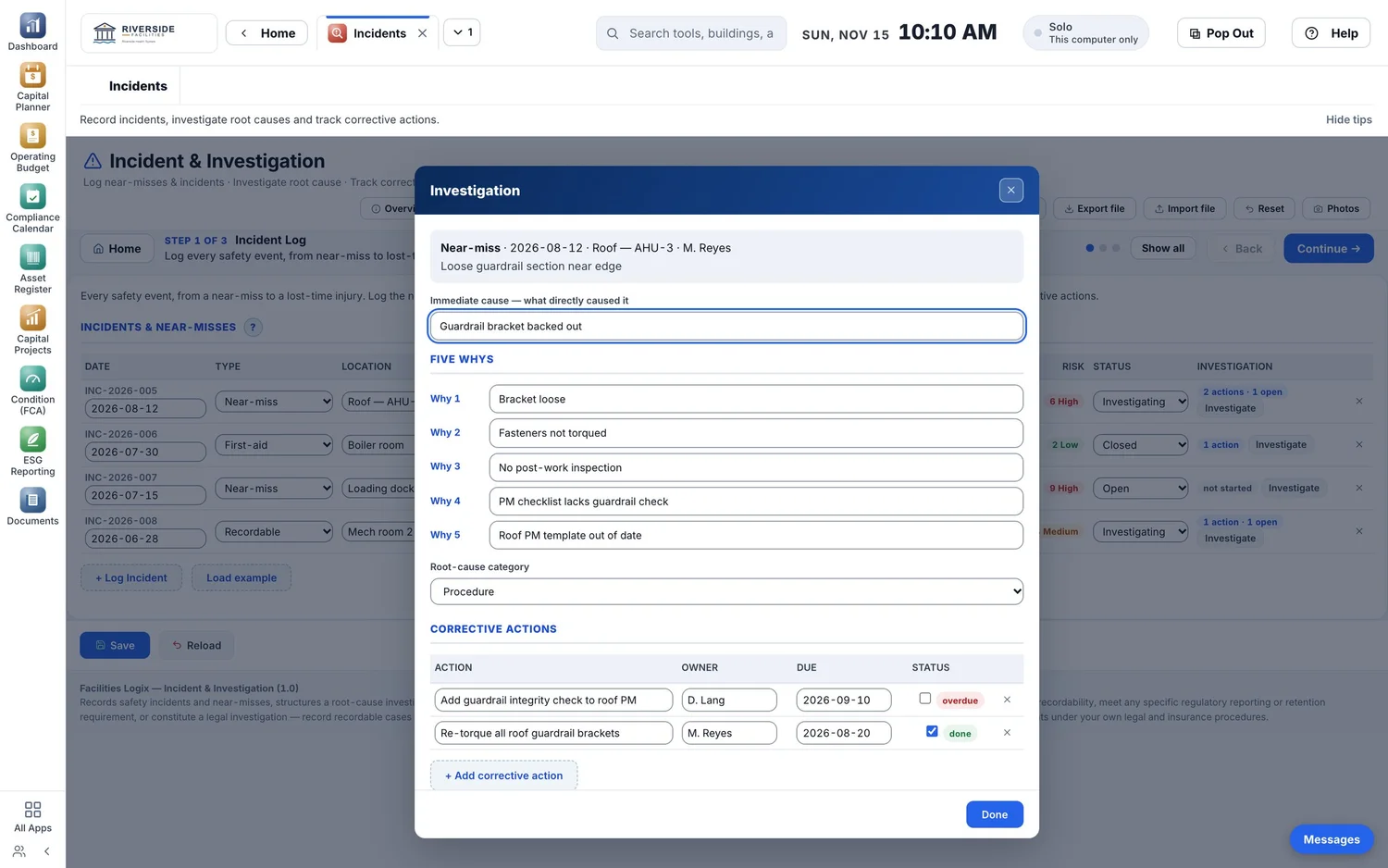
Log near-misses and incidents, run a five-why root-cause investigation and track corrective actions to closure.
Learn MoreShow Less
Near-misses are the free warnings before an injury, and each injury costs far more than the fix. The log tracks every event until its actions are done.
- Each event rated by severity and likelihood
- Corrective actions tracked with owner, due date and status
- Overdue actions surface on their own
- Trends by type and root cause
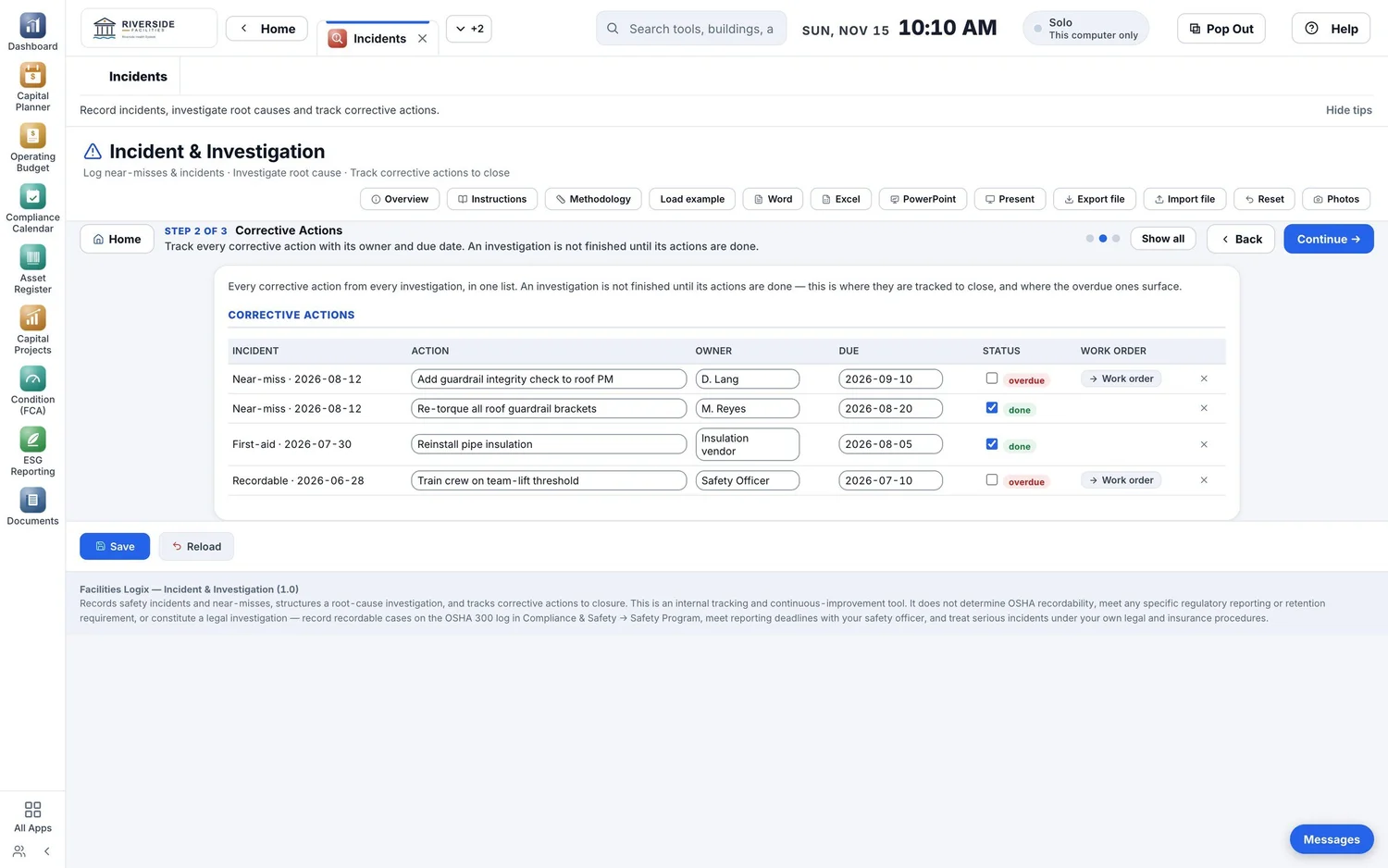
Corrective Actions in Incident & Investigation: track every corrective action with its owner and due date. An investigation is not finished until its actions are done.
Safety in Every PM
Standard PM procedures carry their safety precautions: lockout and tagout, PPE, arc flash and confined space where they apply. The field app shows them first.
Learn MoreReport from the Field
Anyone with the field app can report a near-miss or an incident with photos on the spot. No medical detail is collected on the device.
Learn MoreShow Less
An unreported near-miss is a lost chance to prevent the next injury. Anyone with the phone app can report on the spot.
- Pick near-miss or injury type, describe what happened and add photos
- Incidents go to the office ahead of other waiting work
- Saved on the device first, so it works with no signal
- Reaches the Incidents log as if entered at a desk
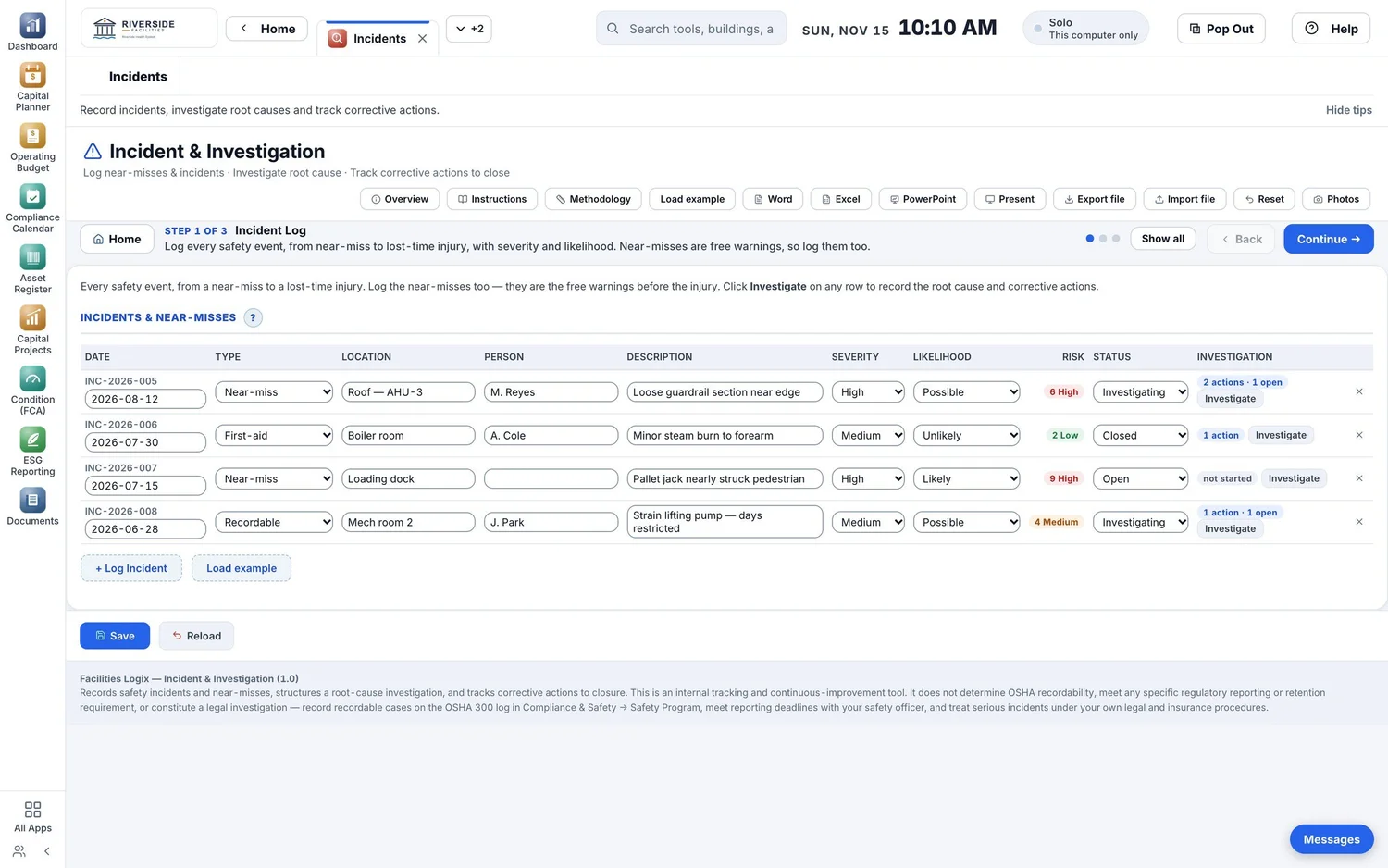
Incident Log in Incident & Investigation: log every safety event, from near-miss to lost-time injury, with severity and likelihood. Near-misses are free warnings, so log them too.
Inspection, Testing and Maintenance Without the Binder
What the Tool Tracks
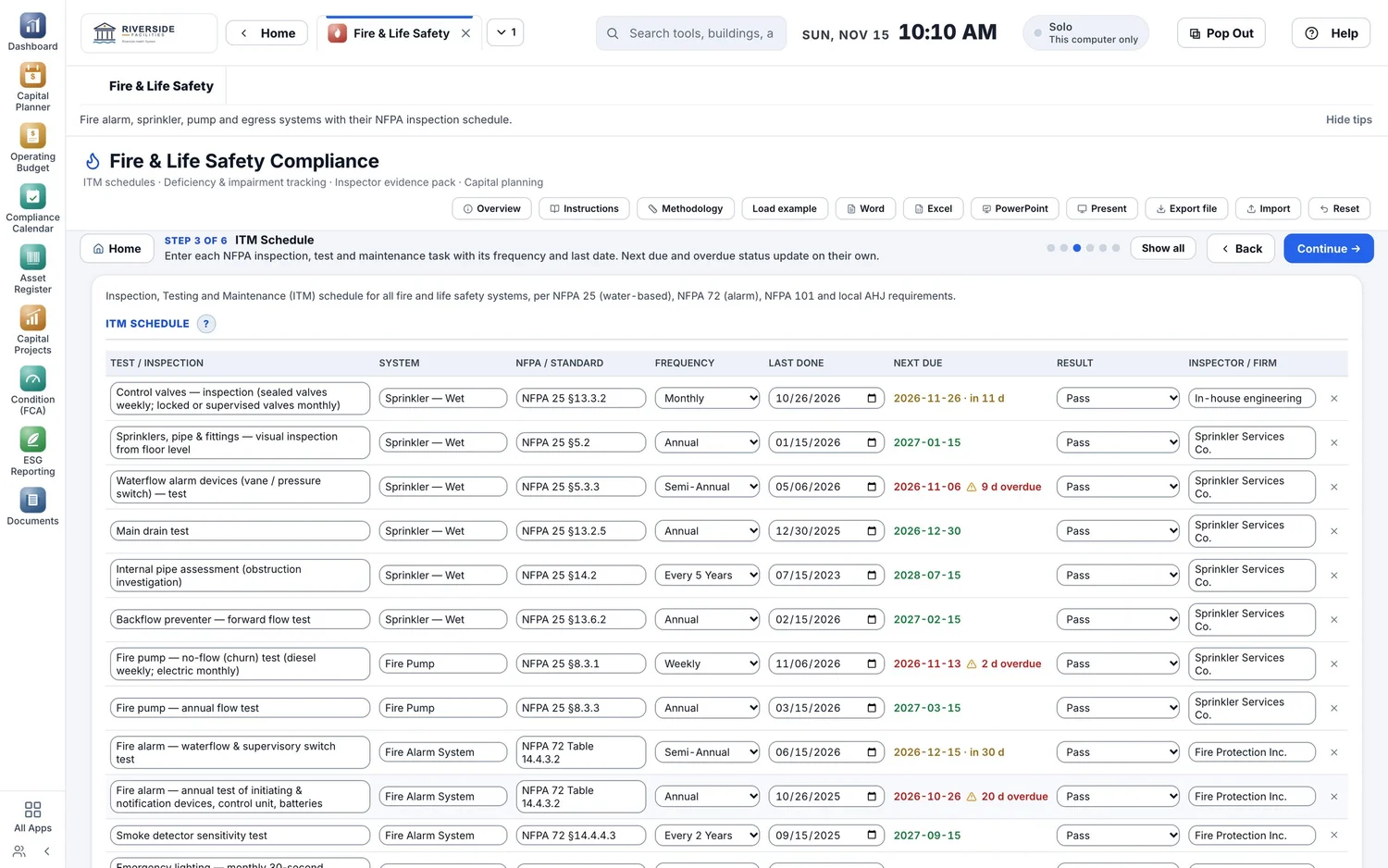
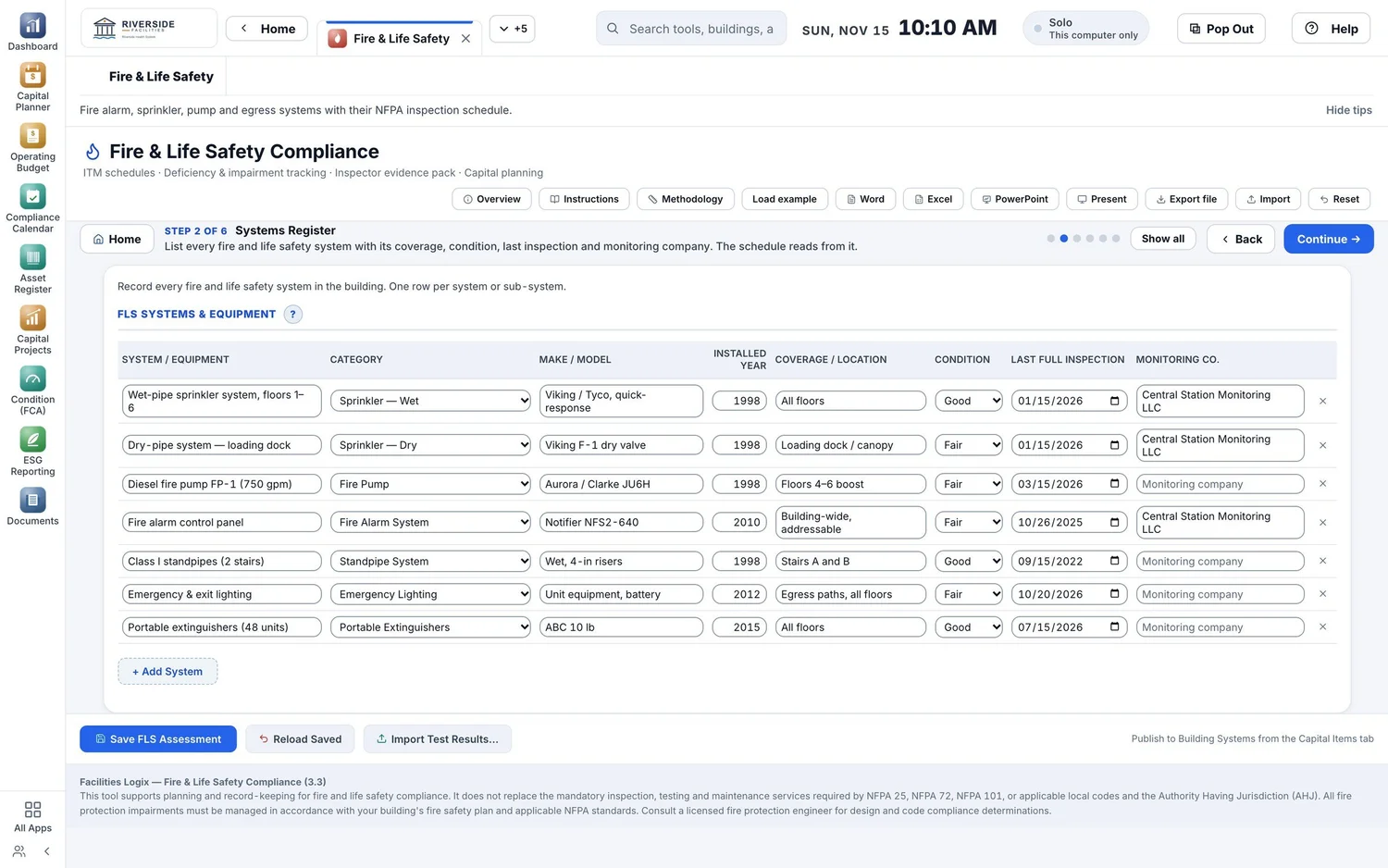
- Fire alarm, sprinkler, fire pump and egress systems with their inspection, testing and maintenance schedules
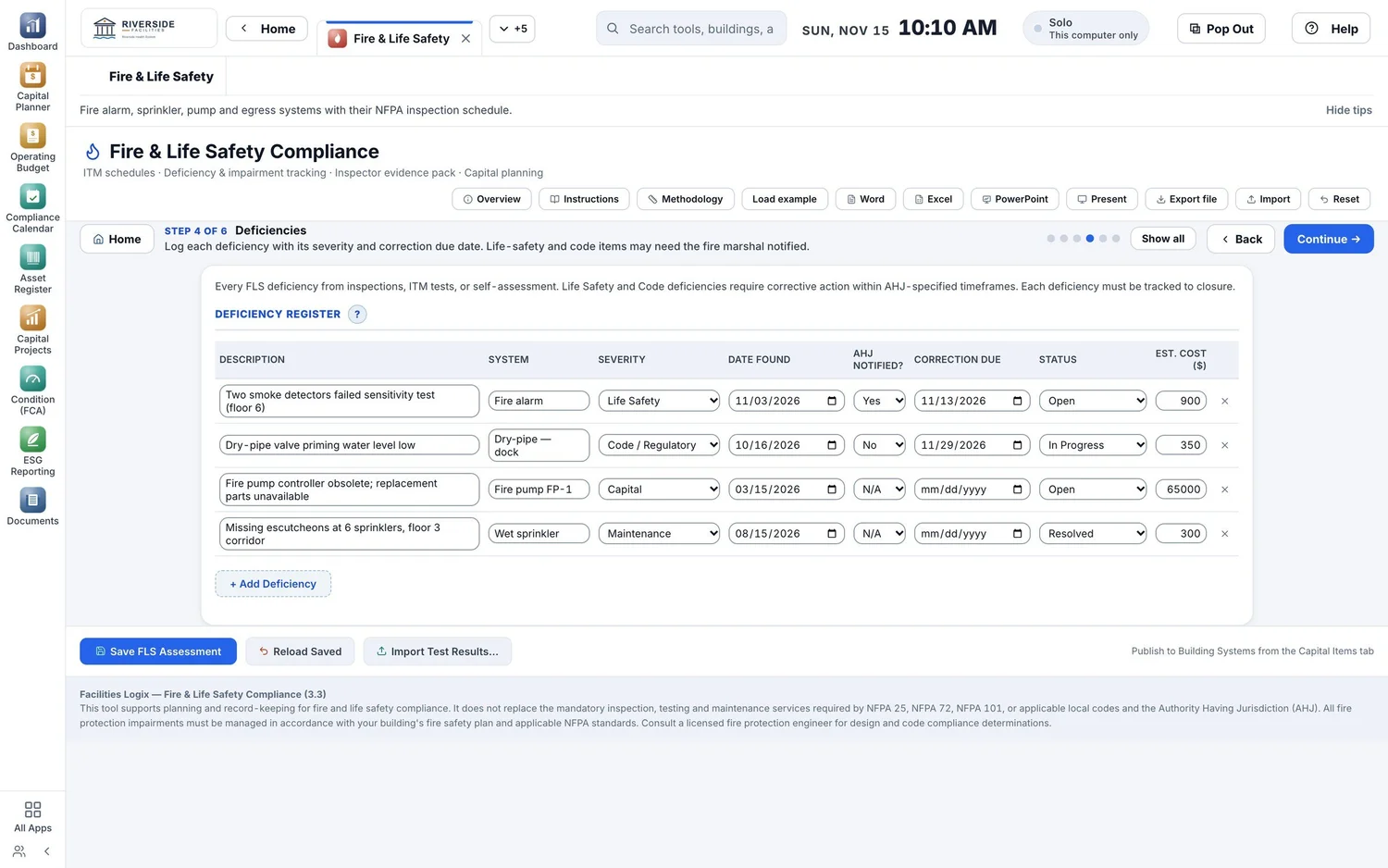
- Deficiencies and impairments, open until resolved
- An evidence pack for the authority having jurisdiction
- Fire and life safety capital planning
Import Test Results
- A testing company's result list for fire alarm, sprinkler, fire doors, emergency lighting, generators, backflow and elevators
- A failed device, or a row with a deficiency, becomes an open deficiency
- A result word that cannot be placed refuses the row; it is never read as a pass
- The report PDF is kept with the import and named on every row
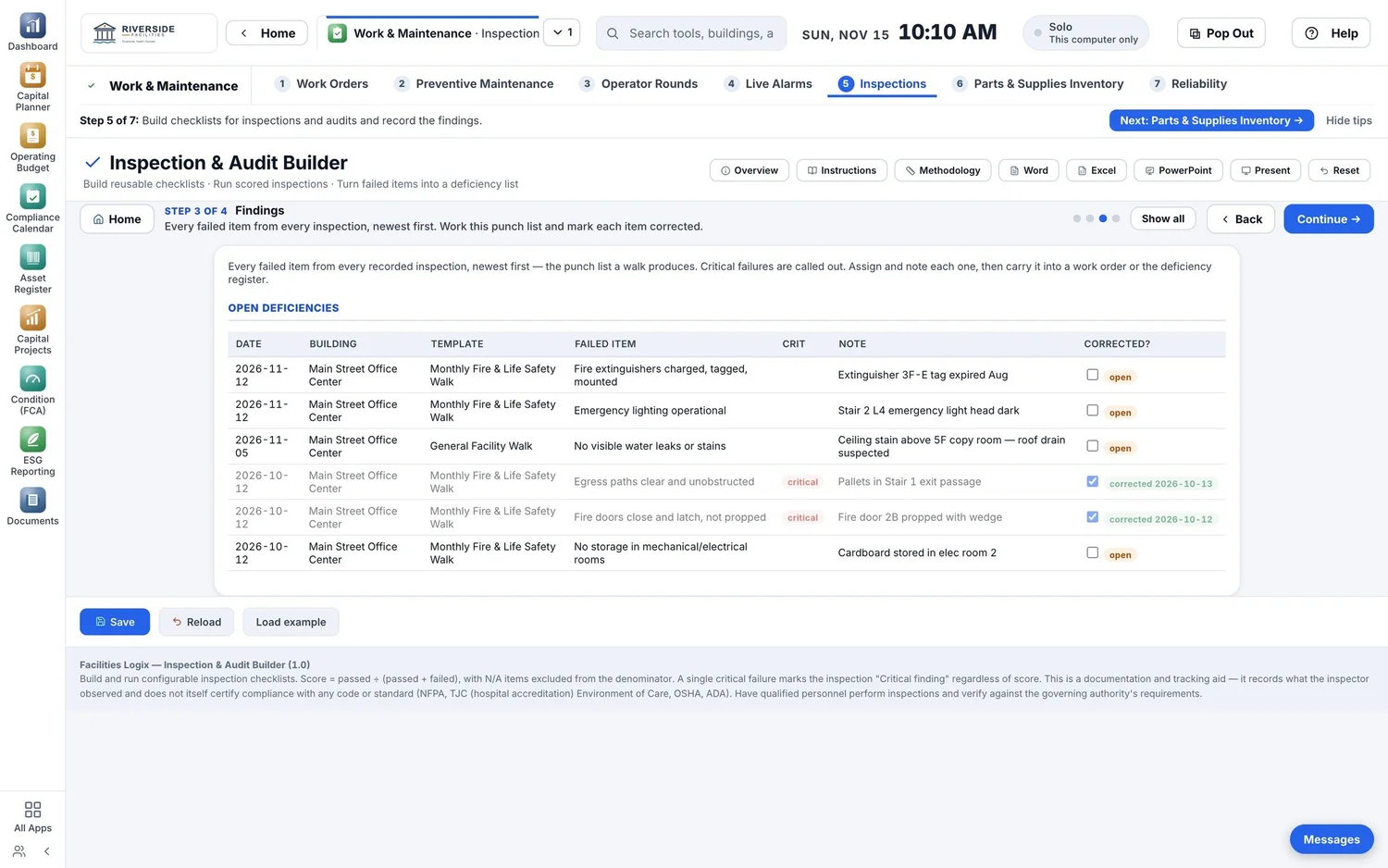
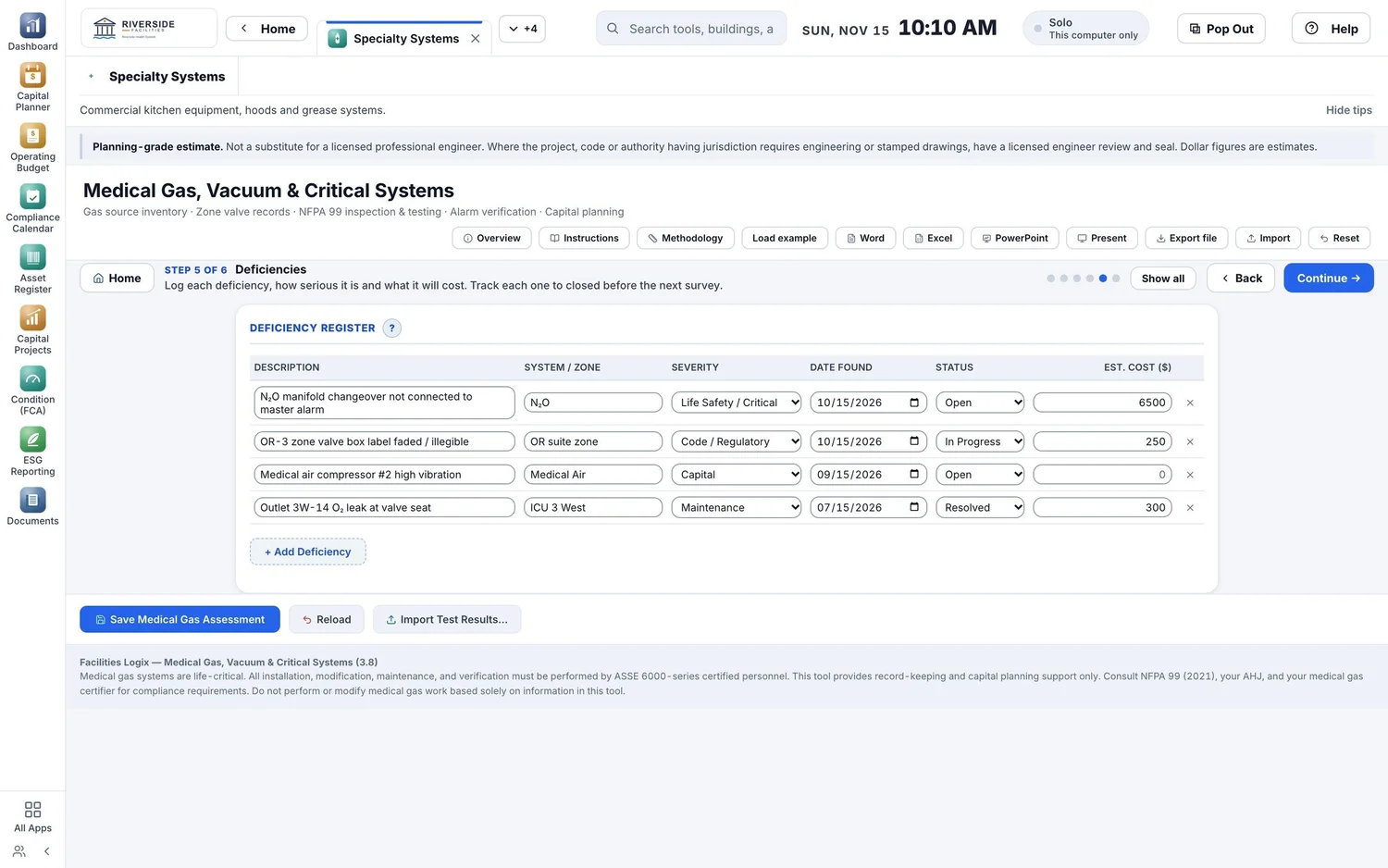
Findings in Inspection & Audit Builder: every failed item from every inspection, newest first. Work this punch list and mark each item corrected.
Plans, Drills and the Numbers to Call
Plans and Continuity
Keep emergency plans, drills and training, emergency contacts and resources, and continuity of operations in one place. Emergency vendors are picked from your vendor list, and their after-hours numbers fill in and stay current. The contacts travel to the field app for every role.
Company Alerts
Send a fire alarm, evacuation, shelter in place, utility outage, water shutoff, weather closure or safety bulletin to everyone, a building's staff, a role, a team or the people on call. Emergency and urgent alerts ask each person to acknowledge, and the sender sees who has and who has not. Alerts are written in English and Spanish.
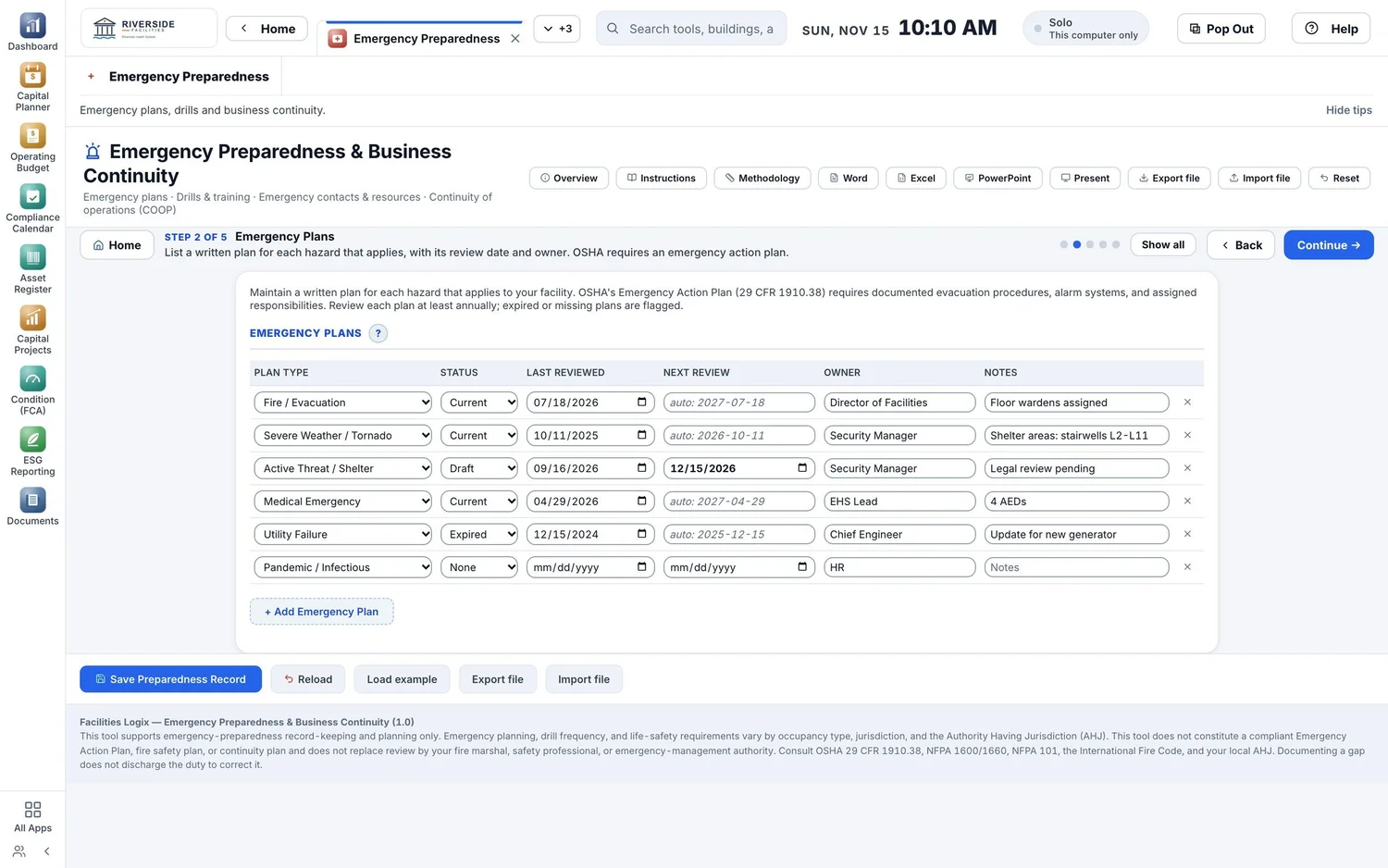
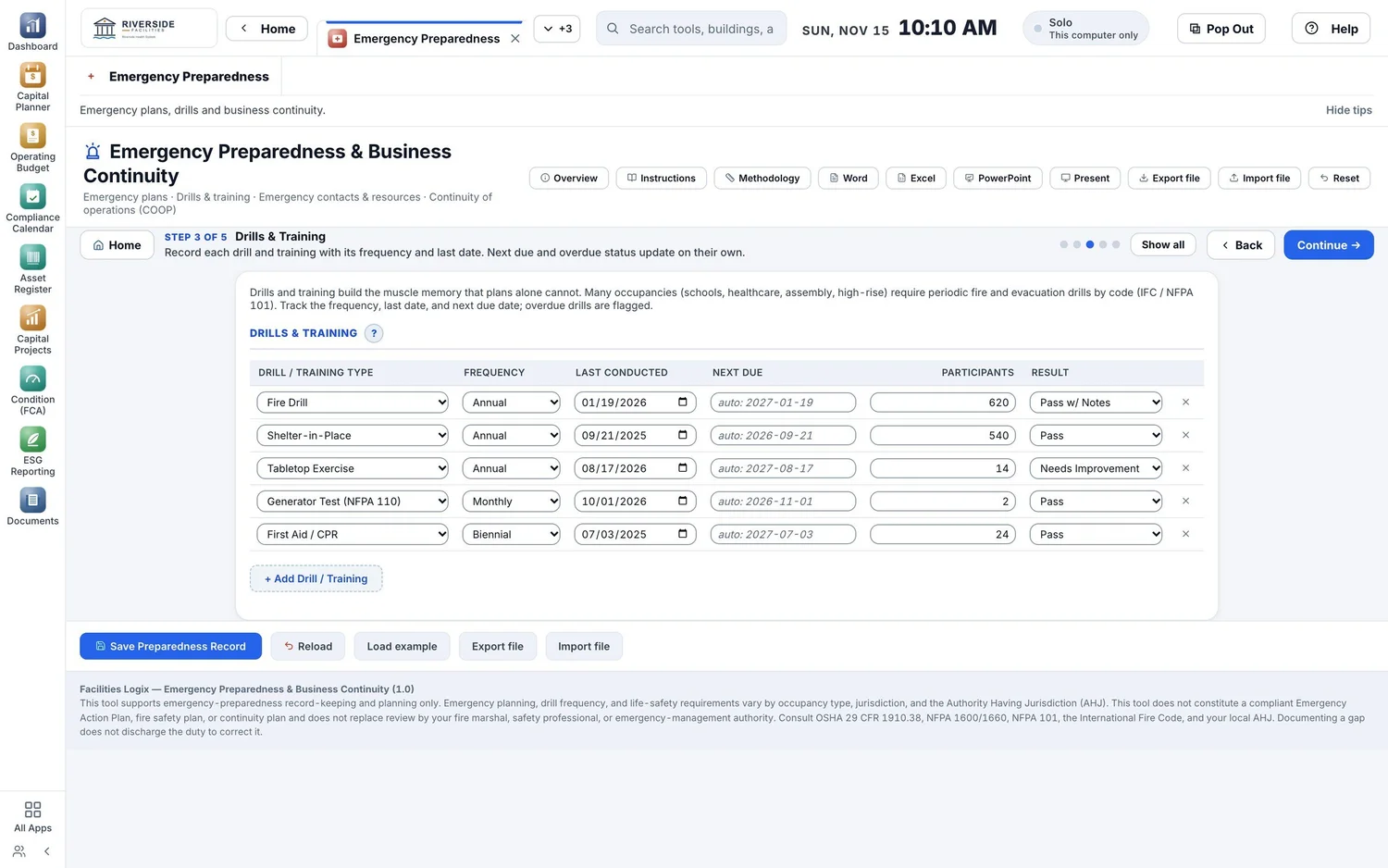
Emergency Plans in Emergency Preparedness & Continuity: list a written plan for each hazard that applies, with its review date and owner. OSHA requires an emergency action plan.
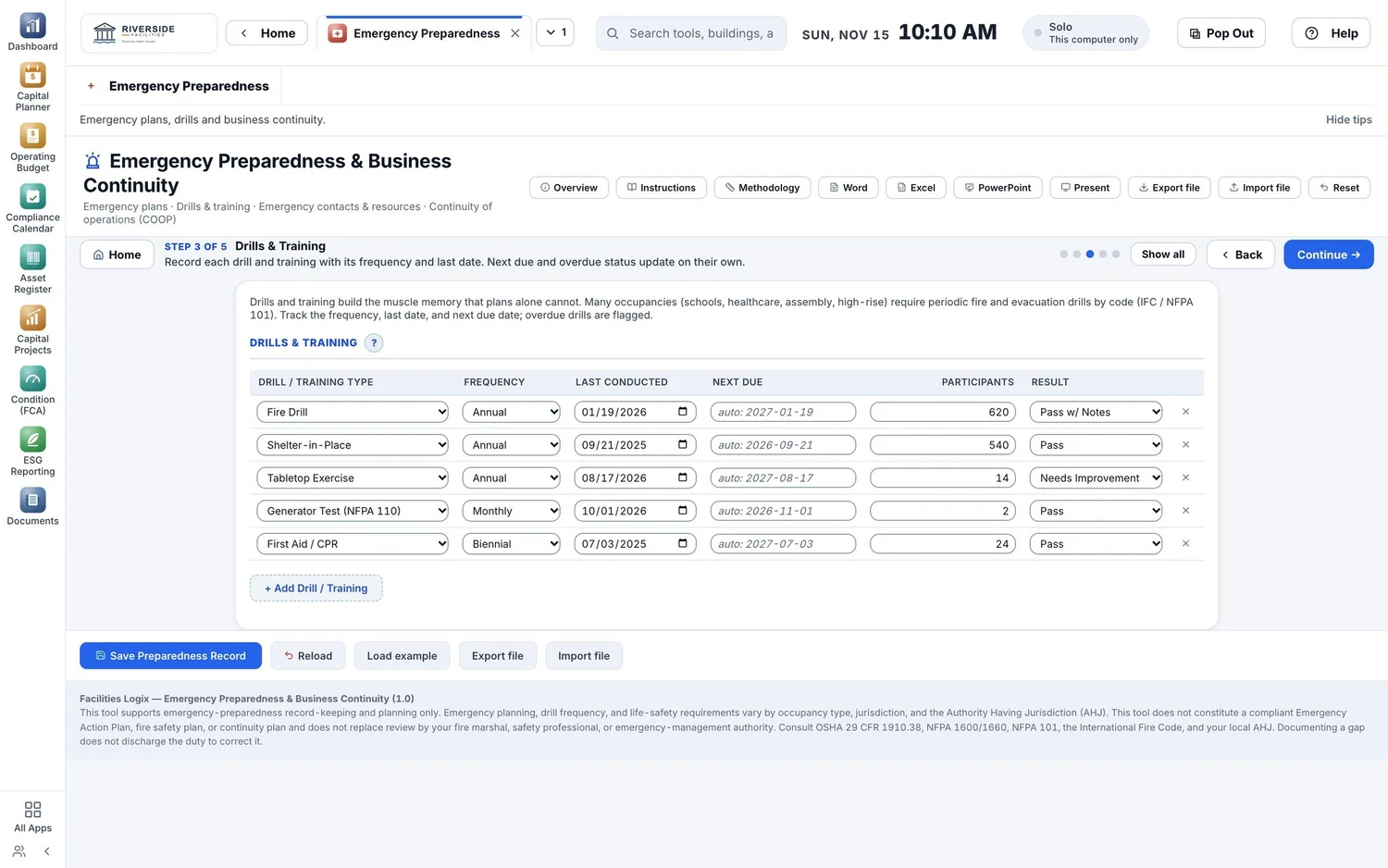
Drills that are not recorded cannot be proven, so every drill and training session keeps its date.
Insurance, Cyber Exposure and Climate Hazards
Insurance & Risk
Your organization's insurance program: property and liability policies, insured values and underinsurance flags, claims and loss ratio, certificates issued to lenders and tenants, and total cost of risk.
Learn MoreShow Less
Being underinsured is found out at claim time, when a coinsurance penalty can apply. The program compares insured limits with replacement value before then.
- Total insured value per building: building, contents and business income
- Policy limits, deductibles, premiums and renewal dates
- Claims history, which is what carriers look at when they price
- A summary checks for the coverages an organization is usually expected to carry
OT Cybersecurity
A networked controller inventory, internet-exposure and hardening posture, per-device risk scoring and an incident-response plan for building automation and other operational systems.
Learn MoreShow Less
Ransomware on a building controls server can shut a building down and cost far more than prevention. The inventory finds the devices attackers look for first.
- Each device marked if reachable from the internet or still on default credentials
- Risk combines criticality with exposure, unsupported firmware and default passwords
- A hardening posture score aligned to CISA and NIST guidance
- An incident-response plan for a compromised controller
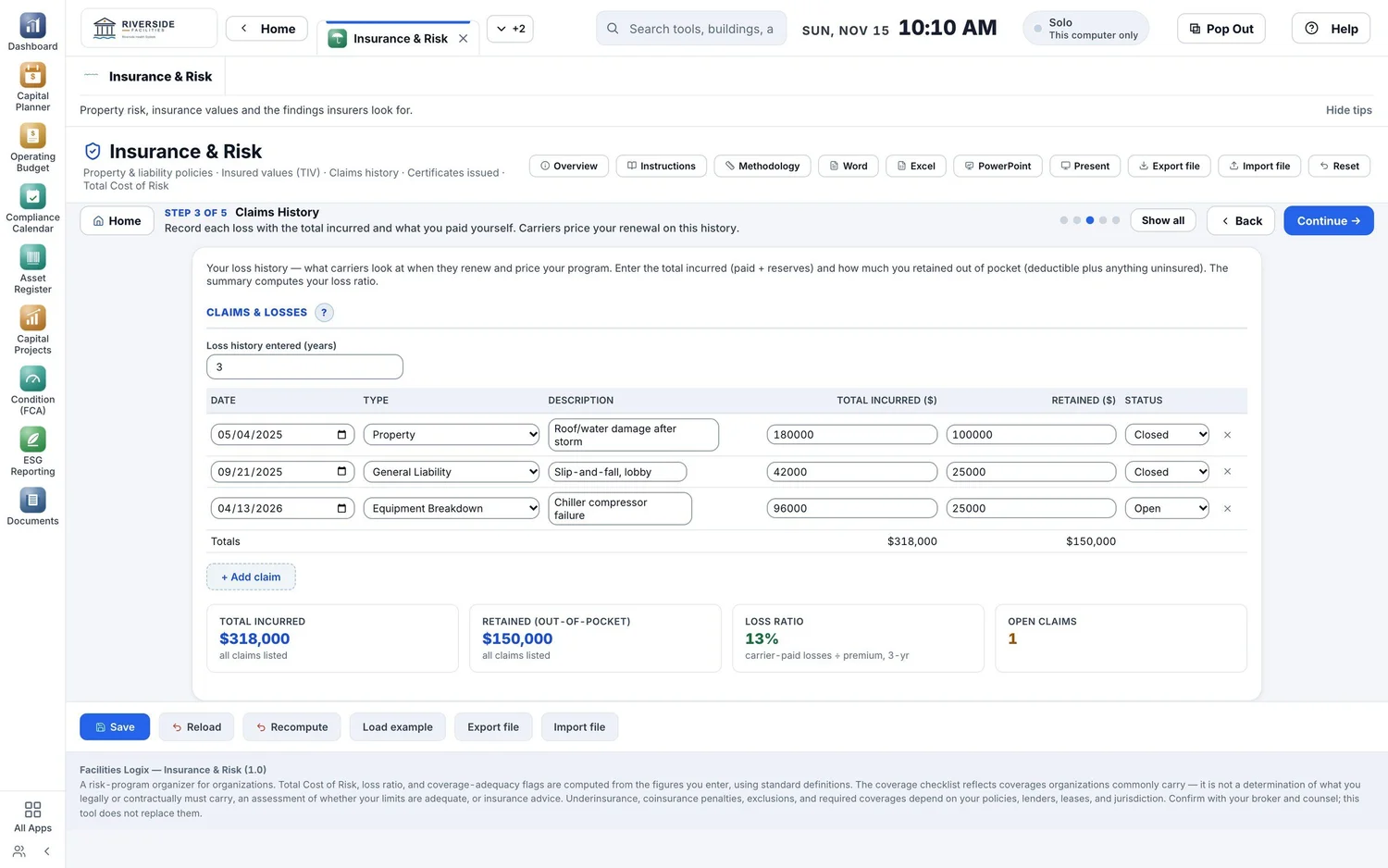
Claims History in Insurance & Risk: record each loss with the total incurred and what you paid yourself. Carriers price your renewal on this history.
Climate Resilience
Each building's exposure to flood, wildfire, seismic, wind and extreme heat, with hardening measures and prioritized findings linked to continuity planning.
Learn MoreShow Less
Insurers and lenders now price flood, wildfire and heat. Knowing each building's exposure first puts hardening money where it cuts the most loss.
- Exposure set from FEMA flood maps, wildfire risk, seismic design category, wind and heat
- Each hardening measure marked Yes, Partial, No or N/A
- Findings where elevated exposure meets an open measure
- Top actions listed by hazard across the portfolio
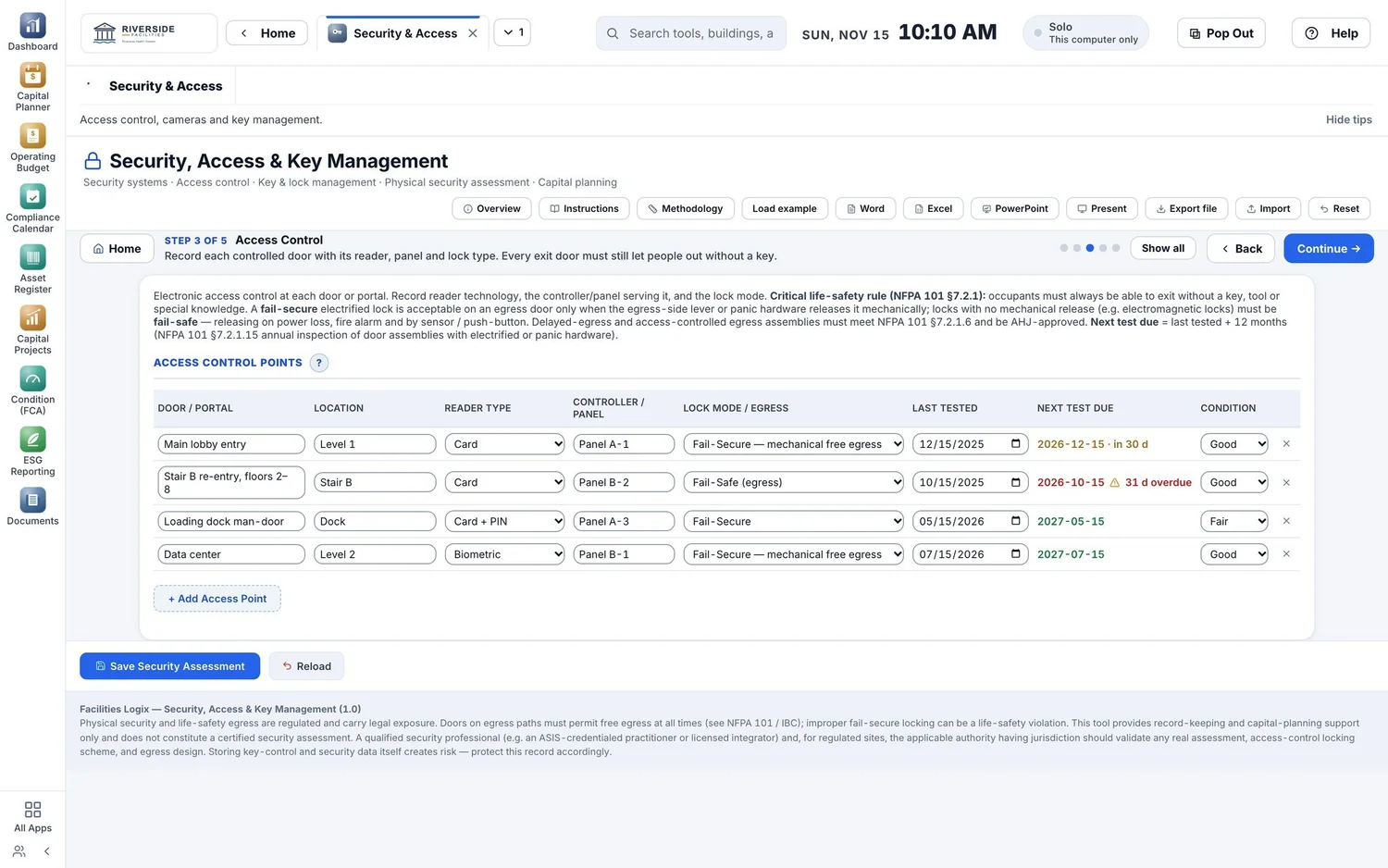
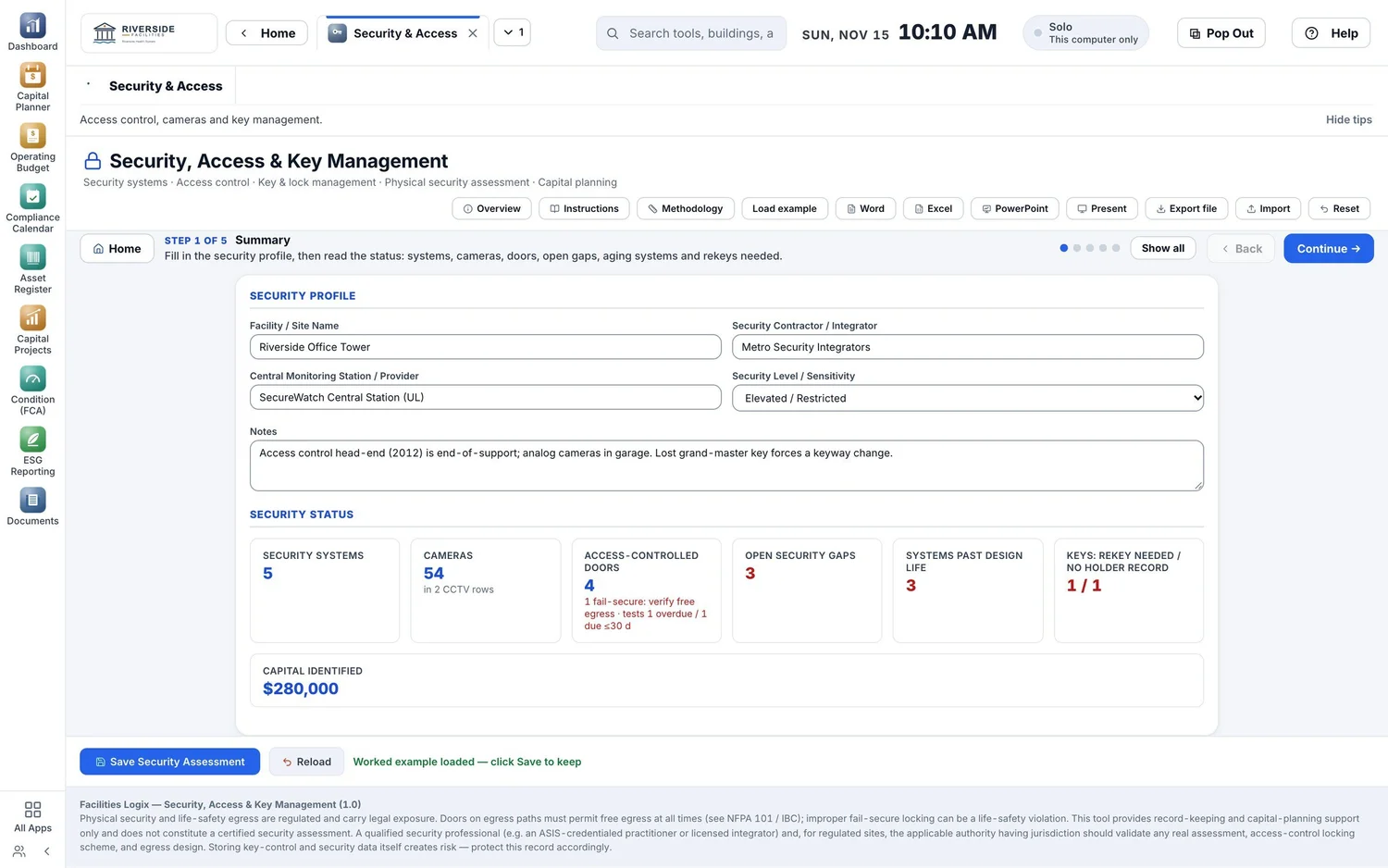
Security & Access
Physical security systems, access control, key and lock management and a physical-security assessment.
Learn MoreShow Less
A lost master key can mean rekeying a building. Key records and system ages show the exposure before it becomes a bill.
- Keys needing a rekey or with no holder on record counted
- Security systems tracked against design life
- Each access-controlled door with reader, controller and lock mode
- Open security gaps and capital identified on the Summary
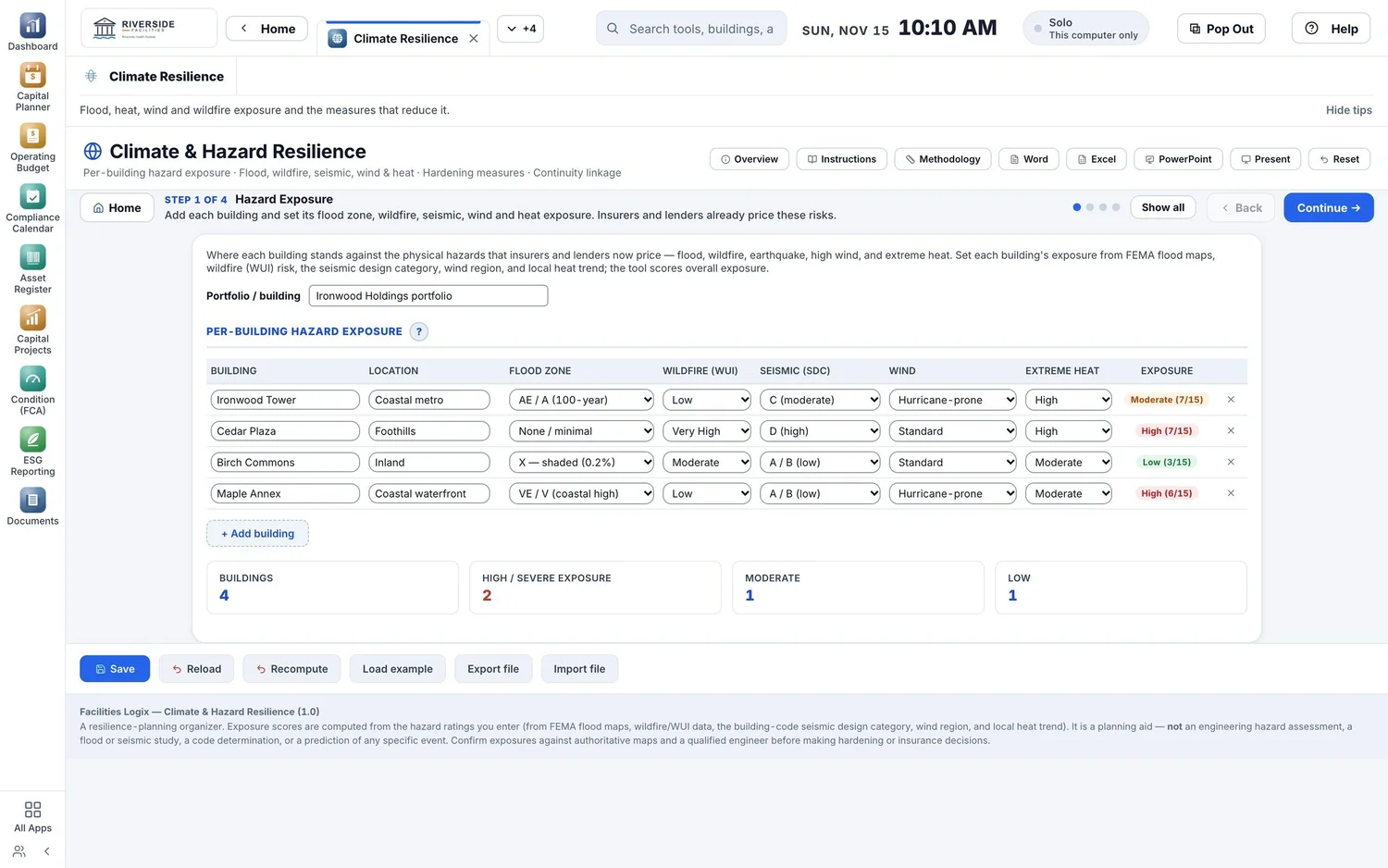
Hazard Exposure in Climate & Hazard Resilience: add each building and set its flood zone, wildfire, seismic, wind and heat exposure. Insurers and lenders already price these risks.
Vendor Insurance
Certificates of insurance tracked for every vendor, with holds on work orders and purchase orders when one lapses.
Learn MoreEmergency Power Readiness
An advisory score per building from fuel, battery and test records, so a gap is found before the outage.
Learn MoreShow Less
A gap in fuel, battery or test records is cheapest to close before the power fails. The score names the item to fix for each building.
- Fuel hours and UPS minutes green at or above required, amber at 75 percent or more
- The 36-month four-hour test turns amber 60 days before it is due
- The yearly fuel quality test turns amber in its last 30 days
- Status is the worst item, with what to fix
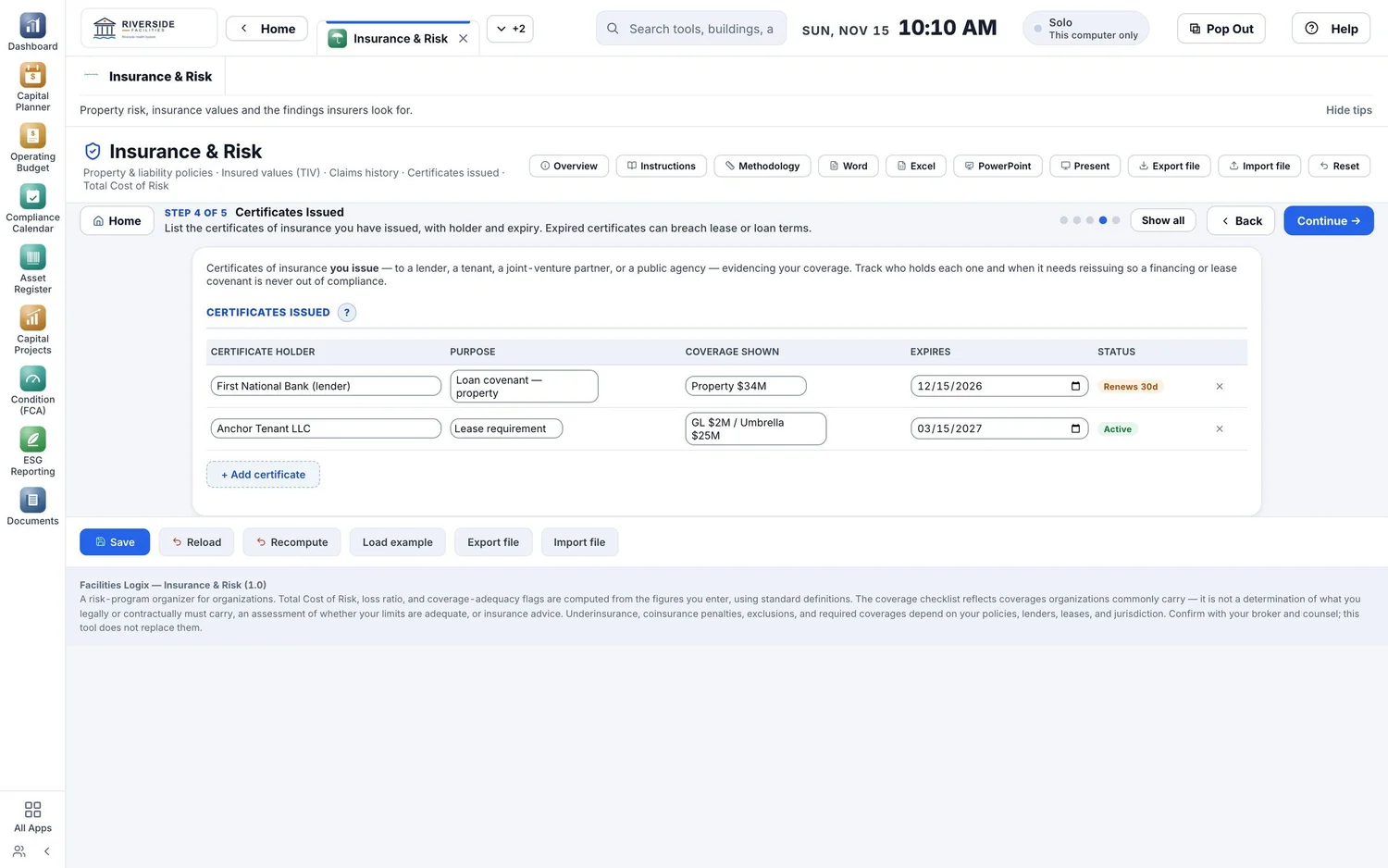
Certificates Issued in Insurance & Risk: list the certificates of insurance you have issued, with holder and expiry. Expired certificates can breach lease or loan terms.
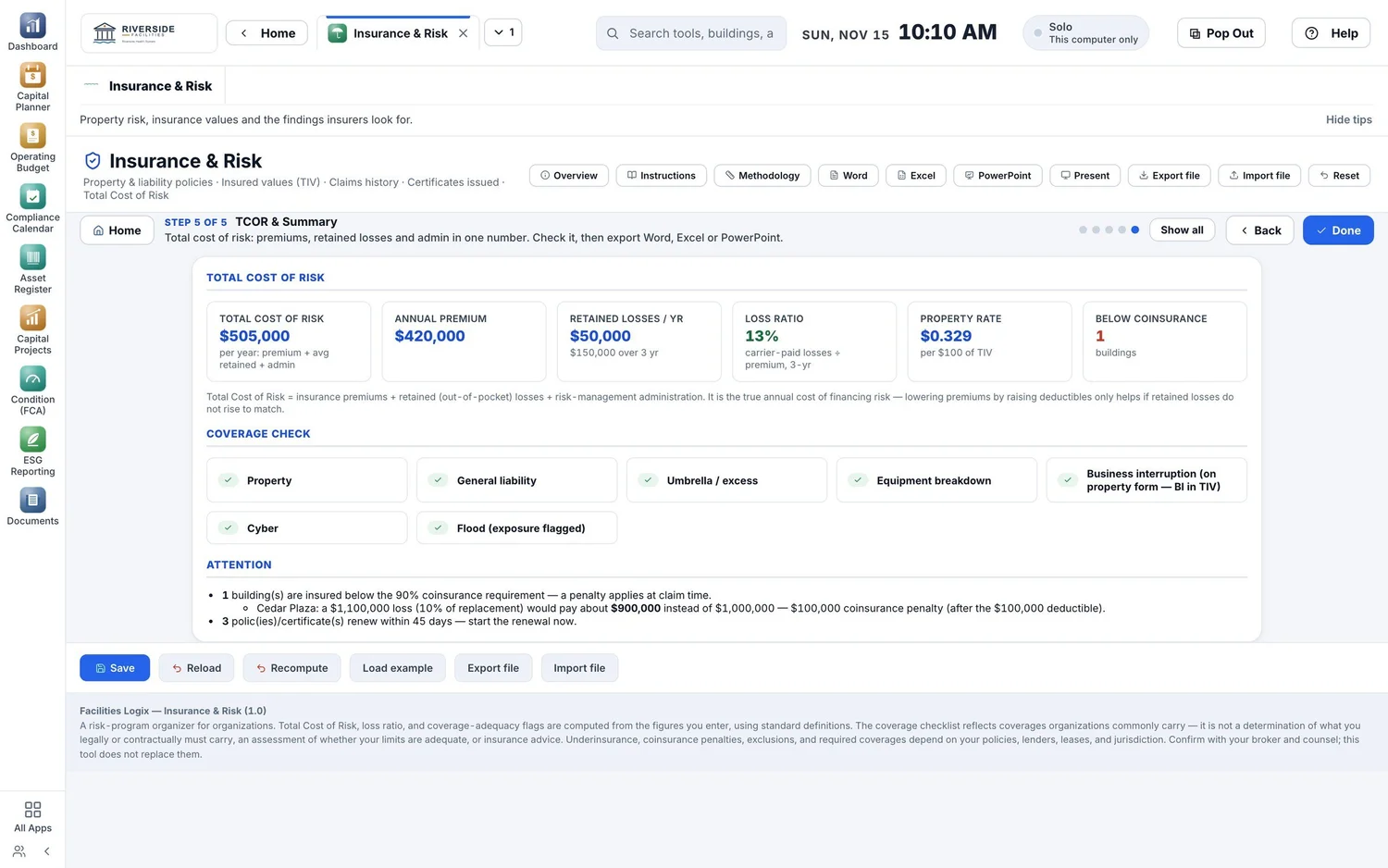
Insurance costs grow when nobody sees the whole picture, so policies, claims and the total cost of risk sit together.
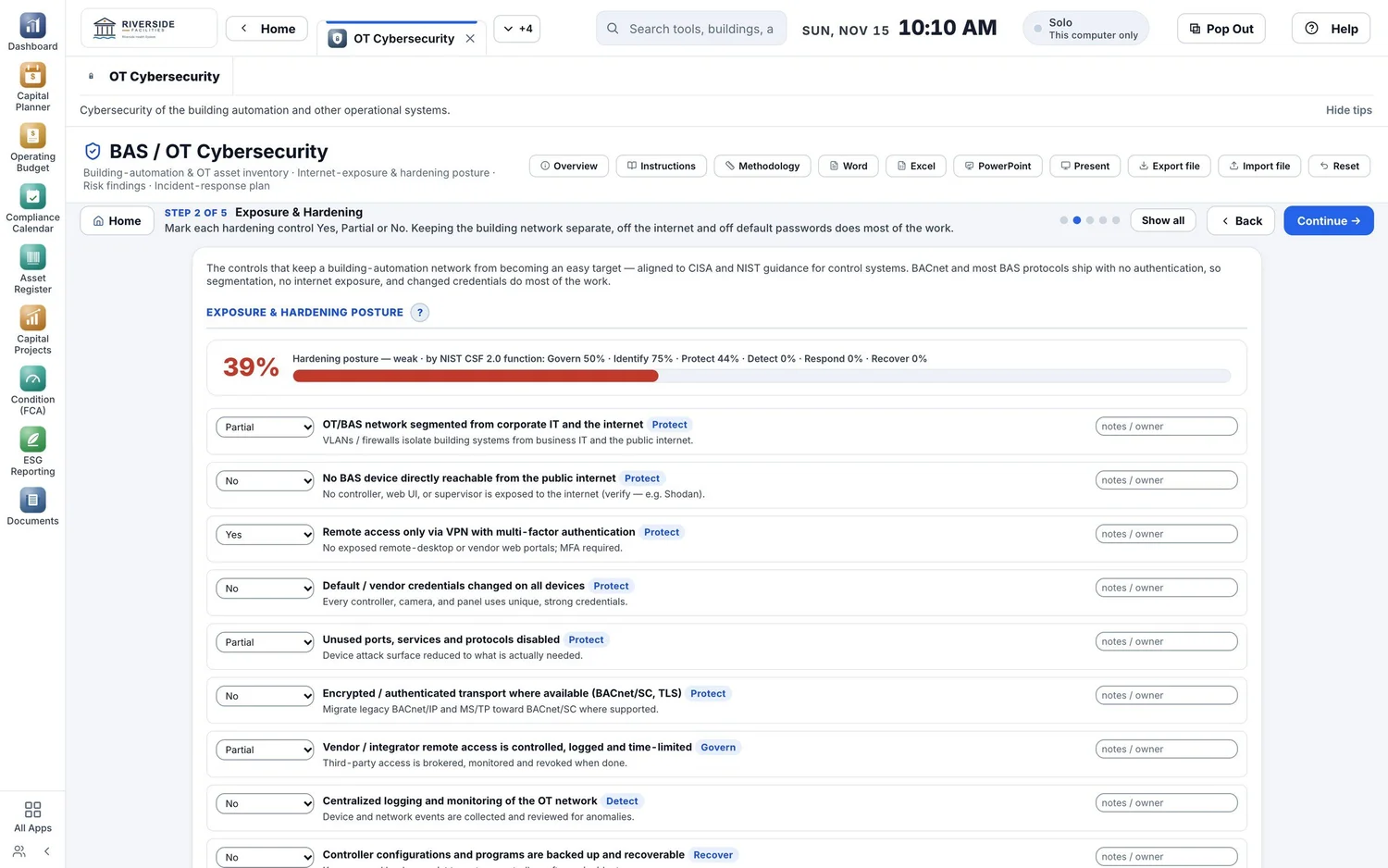
Risk Seen Early, at Every Level
Leadership
Open deficiencies by severity, overdue compliance, insurance position and total cost of risk, building by building.
Learn MoreShow Less
Risk that is not priced is not funded. Leadership sees deficiencies, compliance and insurance side by side for every building.
- Total cost of risk on the insurance summary
- Overdue obligations and the oldest overdue item from the compliance calendar
- Open deficiencies grouped by severity on the Dashboard
- Property-level risk rating in the portfolio table
Management
One place for the safety program, impairments, drills and corrective actions, with dates that remind before they lapse.
Learn MoreShow Less
A drill or impairment that slips past its date is a finding and a risk. One set of records keeps them dated and reminded.
- Fire and life safety inspection, testing and maintenance schedules with impairment tracking
- Emergency plans, drills and continuity of operations
- Emergency contacts picked from the vendor list, with after-hours numbers filled in
- Those contacts travel to the phones for every role
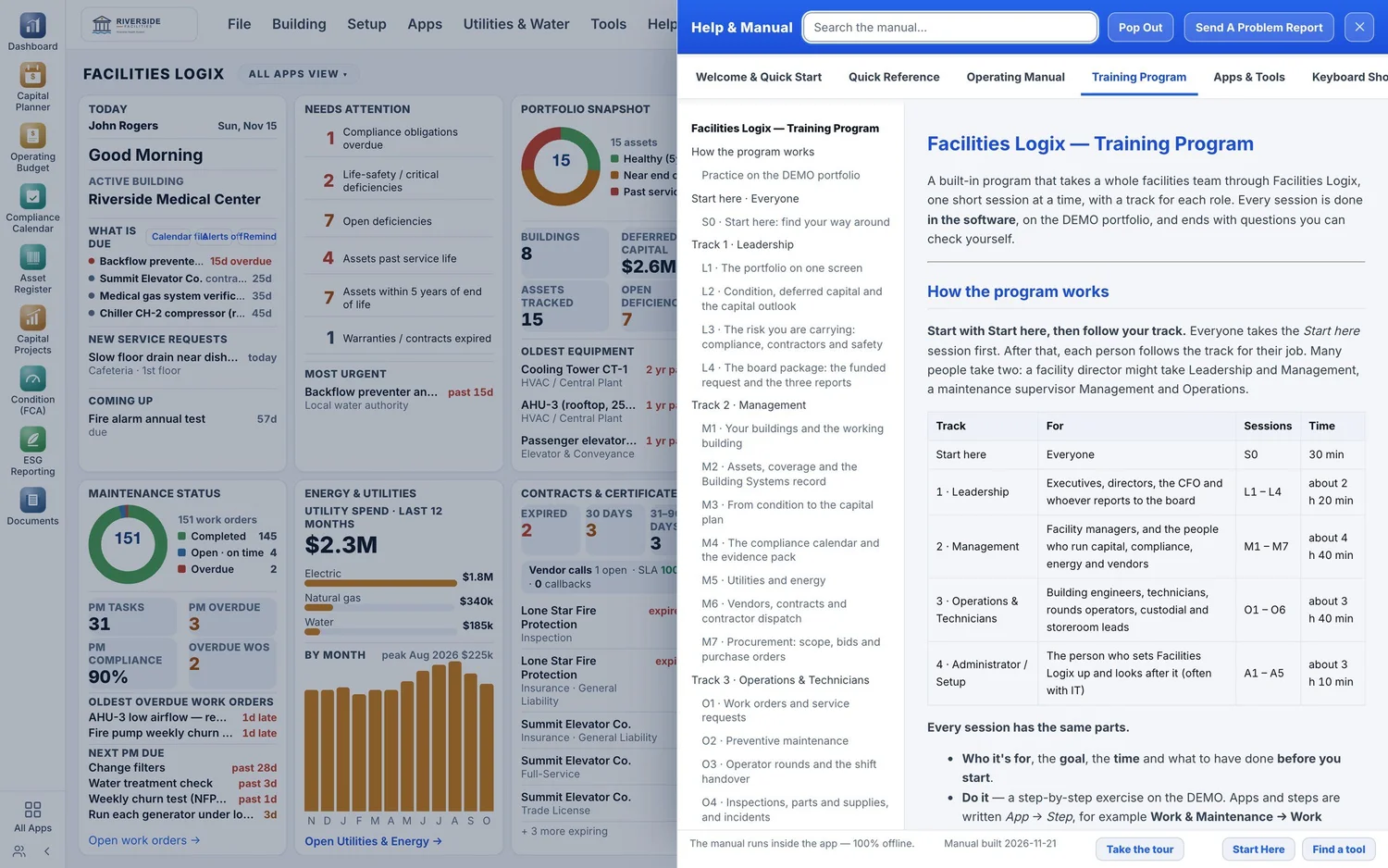
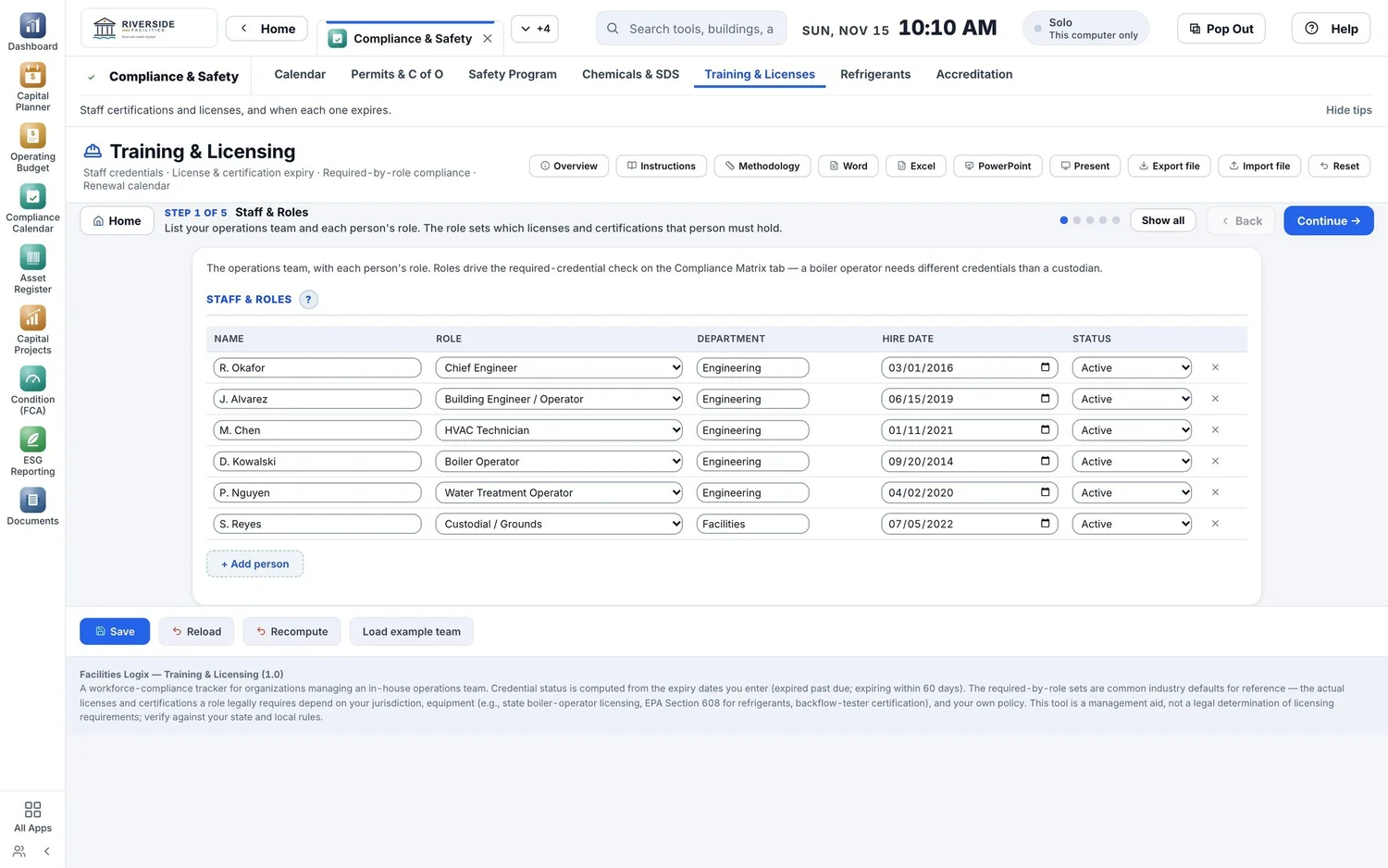
The Training Program: tracks for leadership, management, operations and administrators on the sample portfolio.
Operations
Safety steps in front of the technician before the work starts, safety data sheets kept offline on the device and a simple way to report a near-miss.
Learn MoreShow Less
An injury on the job costs more than any delay to read a safety step. Safety comes first on the phone, before the work starts.
- Each PM opens on a Safety First card
- Lockout, arc flash and confined space precautions in the procedure where they apply
- Safety data sheets for your buildings kept on the device
- Report a near-miss with photos, with no medical detail collected
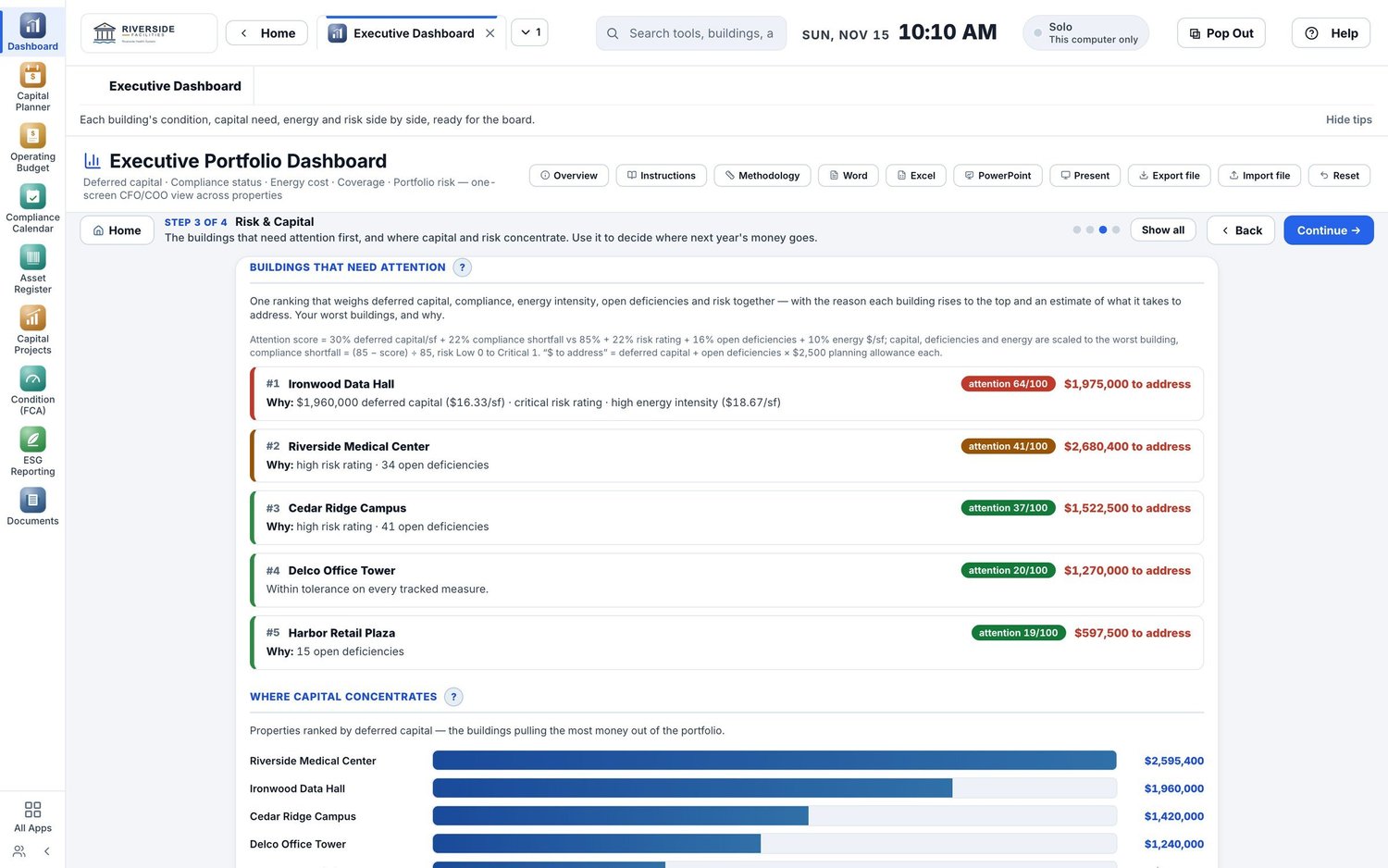
The buildings that need attention first, with the reason beside each one.
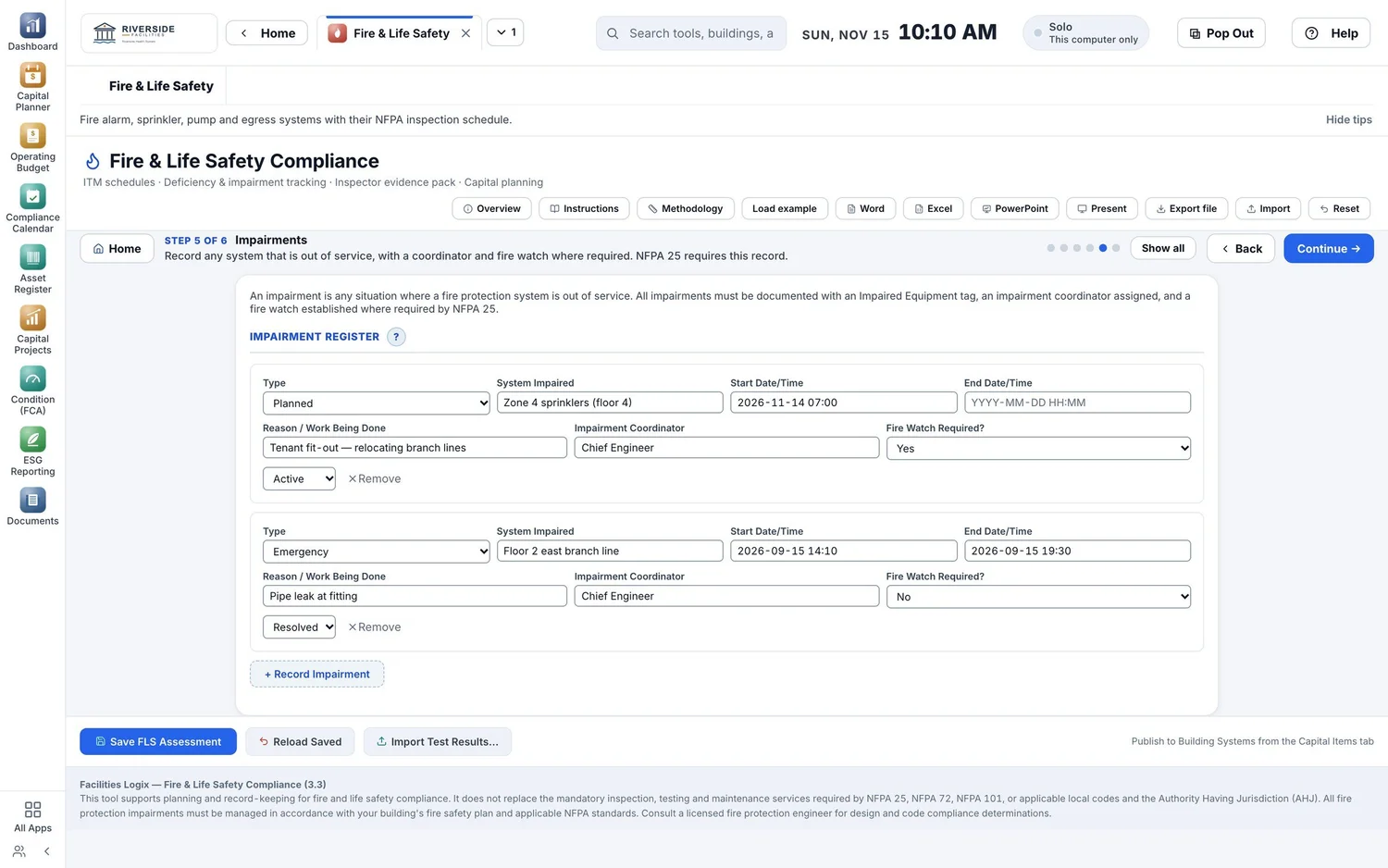
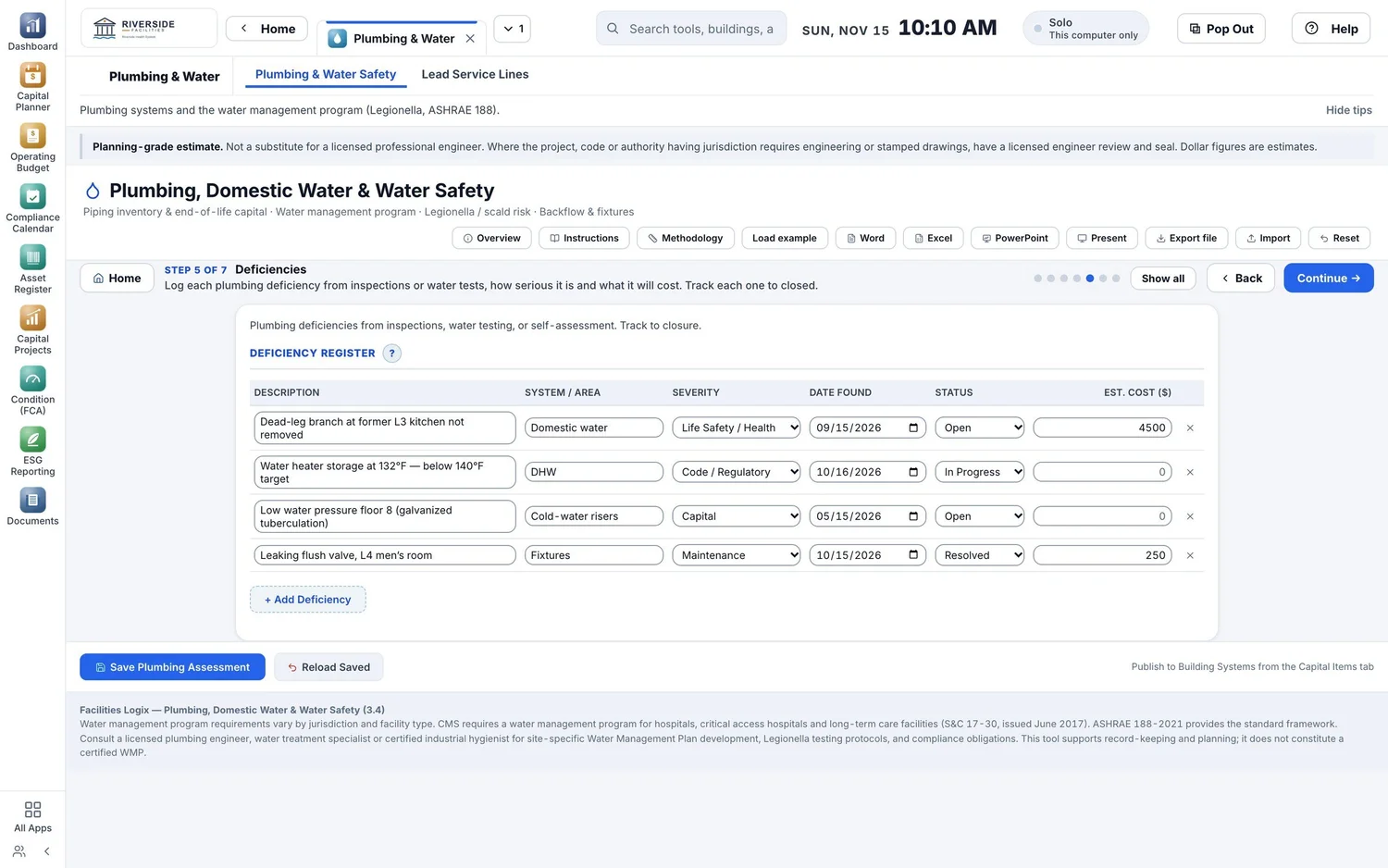
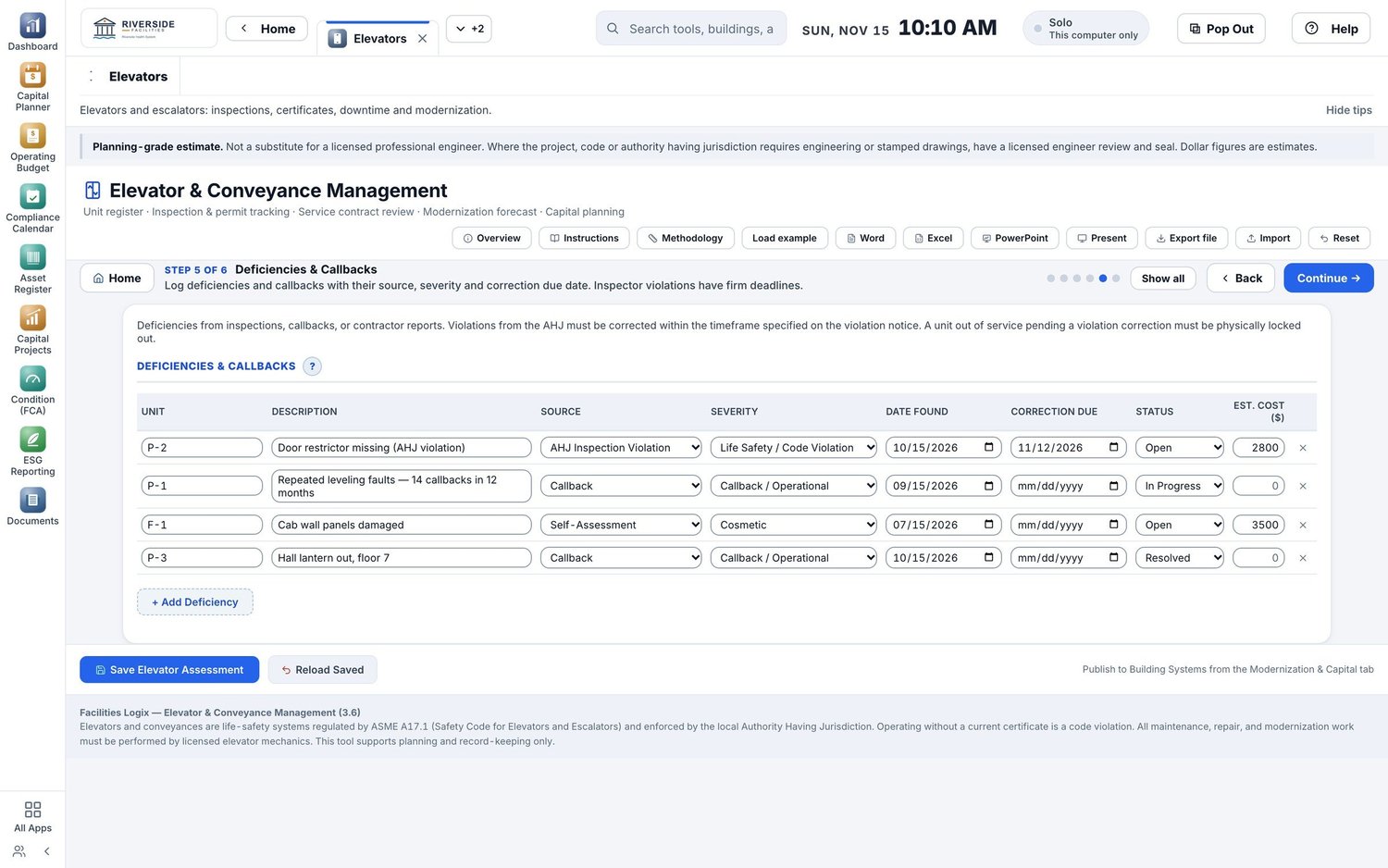
An impaired sprinkler system is a hidden risk, so every impairment is logged until it is restored.
Frequently Asked Questions
Does Facilities Logix replace our fire alarm or security monitoring?
Is the OT cybersecurity tool a network scanner?
Are company alerts a mass notification system?
Be First When Facilities Logix Opens
Stop chasing building records across spreadsheets and binders. Join the list and we will tell you the day downloads open, with setup guides ready.
Launching early 2027 for Facilities Logix. Nothing to buy today, and no sales calls.
