


The Whole Airport, from the Airfield to the Control Tower.
Launching Early 2027 · Join the Early-Access List
An airport keeps its certificate by doing documented work on schedule, and the duties are split among the airport, the Federal Aviation Administration (FAA), the Transportation Security Administration (TSA), airlines and tenants. Facilities Logix's airport playbook walks your team through twelve steps. You answer a short list of airport facts, and each answer turns its own FAA, TSA and Environmental Protection Agency (EPA) obligations on or off. Every one carries its citation, frequency and next due date, and it shares those dates with the Compliance Calendar.
Part 139, the Airfield, Fuel, Security and Grants, Each with Its Own Date
Seventy obligations in the compliance library are written for airports. Each row names its regulation, how often it recurs and the evidence that proves it. A fact you leave at Not Sure keeps its rows at Confirm. The app never quietly decides yes or no for you.
Airport Certification (14 CFR Part 139)
- FAA periodic certification inspection: Class I, II and III airports with scheduled service on a 9-to-15-month cycle, Class IV on a 12-to-18-month cycle
- Daily airfield self-inspection, including a night inspection, after unusual conditions and right after an accident or incident; records kept 12 months (139.327)
- Training for everyone with movement or safety area duties, and for every pedestrian and driver there, before first access and every 12 consecutive calendar months; records kept 24 months (139.303, 139.329)
- Aircraft rescue and firefighting (ARFF): recurrent training and a live-fire drill every 12 months (139.319(i)), and the timed response, with the first vehicle at the midpoint of the farthest air carrier runway within 3 minutes (139.319(h))
- Airport Emergency Plan reviewed with every coordinating party every 12 months, and a full-scale exercise every 36 months at Class I airports (139.325)
- Snow and ice control plan (139.313), with the annual review and the pre- and post-season meetings that AC 150/5200-30D recommends
- Wildlife: a hazard assessment after a triggering strike, plus a plan review and biologist-led training every 12 months (139.337)
- Airport condition reporting through NOTAMs (Notices to Air Missions), with each dissemination kept 12 months (139.339)
- Safety Management System (SMS) under Part 139 Subpart E: orientation materials and SMS training every 24 months, and manual changes sent to the FAA each year
Airfield Lighting, Signs and Pavement
- Airfield lighting maintenance on the AC 150/5340-26C schedule: daily outage and control checks, monthly insulation-resistance tests of every series circuit, semiannual and annual vault and regulator checks (139.311)
- Sign interiors cleaned and lamp-circuit current checked at least twice a year
- Airport-owned PAPI, VASI and REIL units: daily lamp check, monthly aiming and cleaning, quarterly obstacle-clearance check, semiannual cable insulation tests
- Where Airport Improvement Program (AIP) grants paid for pavement: the Grant Assurance 11 maintenance-management program, with a detailed inspection each year (or every 3 years with a PCI history) and a monthly drive-by inspection
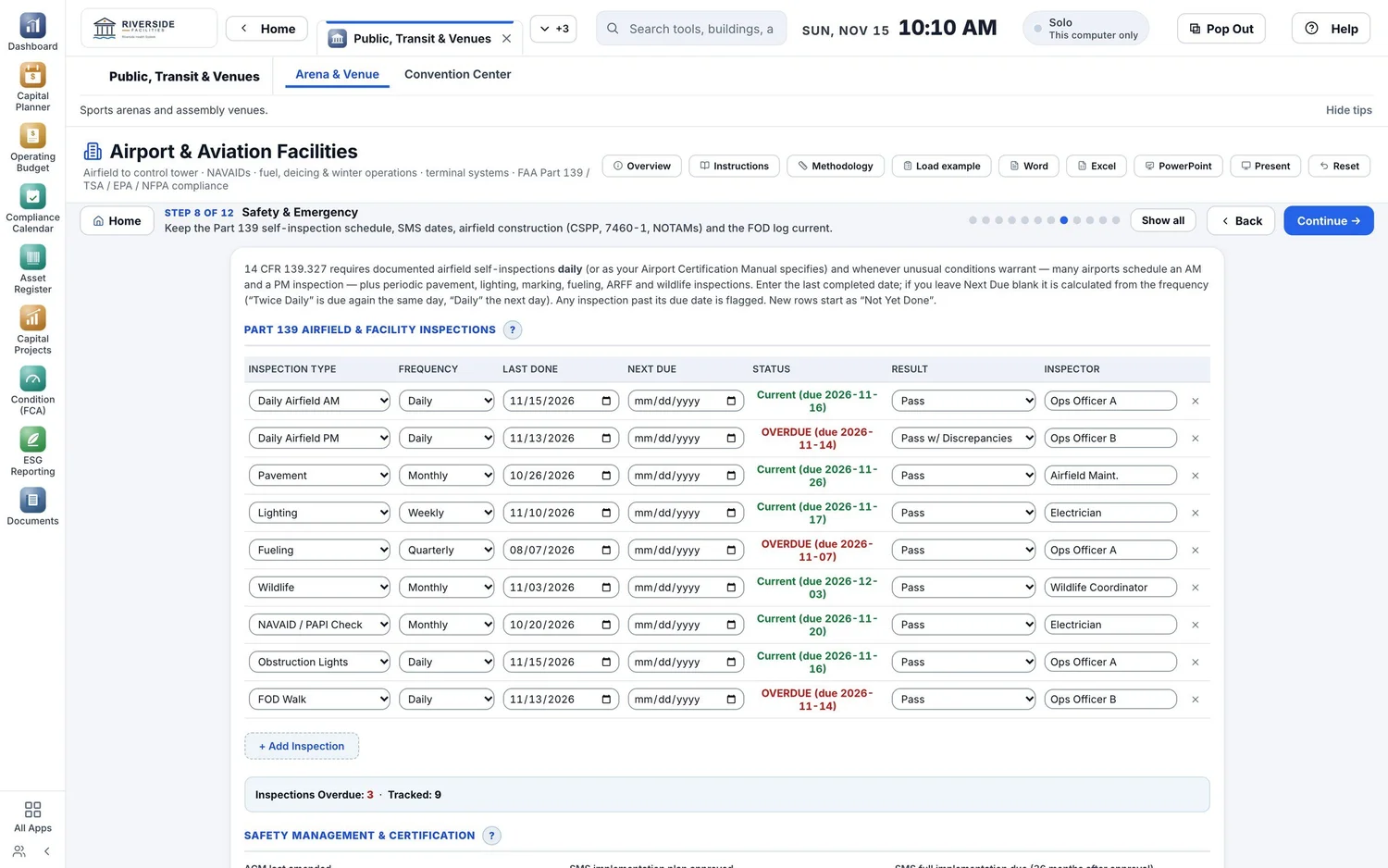
Safety & Emergency in Airport & Aviation Facilities: keep the Part 139 self-inspection schedule, SMS dates, airfield construction (CSPP, 7460-1, NOTAMs) and the FOD log current.
NAVAIDs, Weather Stations and the Control Tower
- Non-federal navigational aids (NAVAIDs) under 14 CFR Part 171 and Order 6700.20C: the monthly ground check and maintenance log, and the FAA's periodic inspection (annual; every 6 months for CAT II/III ILS)
- An airport-owned automated weather observing system (AWOS): maintenance every 4 months and an annual FAA-witnessed verification (AC 150/5220-16E)
- Federal Contract Tower: the airport keeps the tower facility and the Minimum Equipment List items it owns in working order (JO 7210.78; flagged Confirm)
- Non-federal tower: shift equipment checks, recordings and logs under AC 90-93B, a voluntary practice
- Obstruction lights checked every 24 hours or monitored automatically, with any outage over 30 minutes reported for a NOTAM (AC 70/7460-1N)
- Lightning protection on the tower and critical buildings inspected under NFPA 780 (flagged Confirm, since the interval may be set by your authority)
Fuel and Hydrant Systems
- Each fueling agent's facilities inspected at least once every 3 consecutive months (14 CFR 139.321), plus a written training confirmation every 12 months and the supervisor fire-safety course every 24 months
- NFPA 407: hydrant emergency fuel shutoff system checked every 6 months and each device yearly; fueling hose inspected before use each day and pressure-checked monthly
- Airport hydrant systems under 40 CFR 280.252: hydrant pit and piping vault walkthroughs every 30 days and line tightness testing (semiannual or annual)
- The spill prevention plan (SPCC) is flagged when aboveground oil storage passes 1,320 gallons
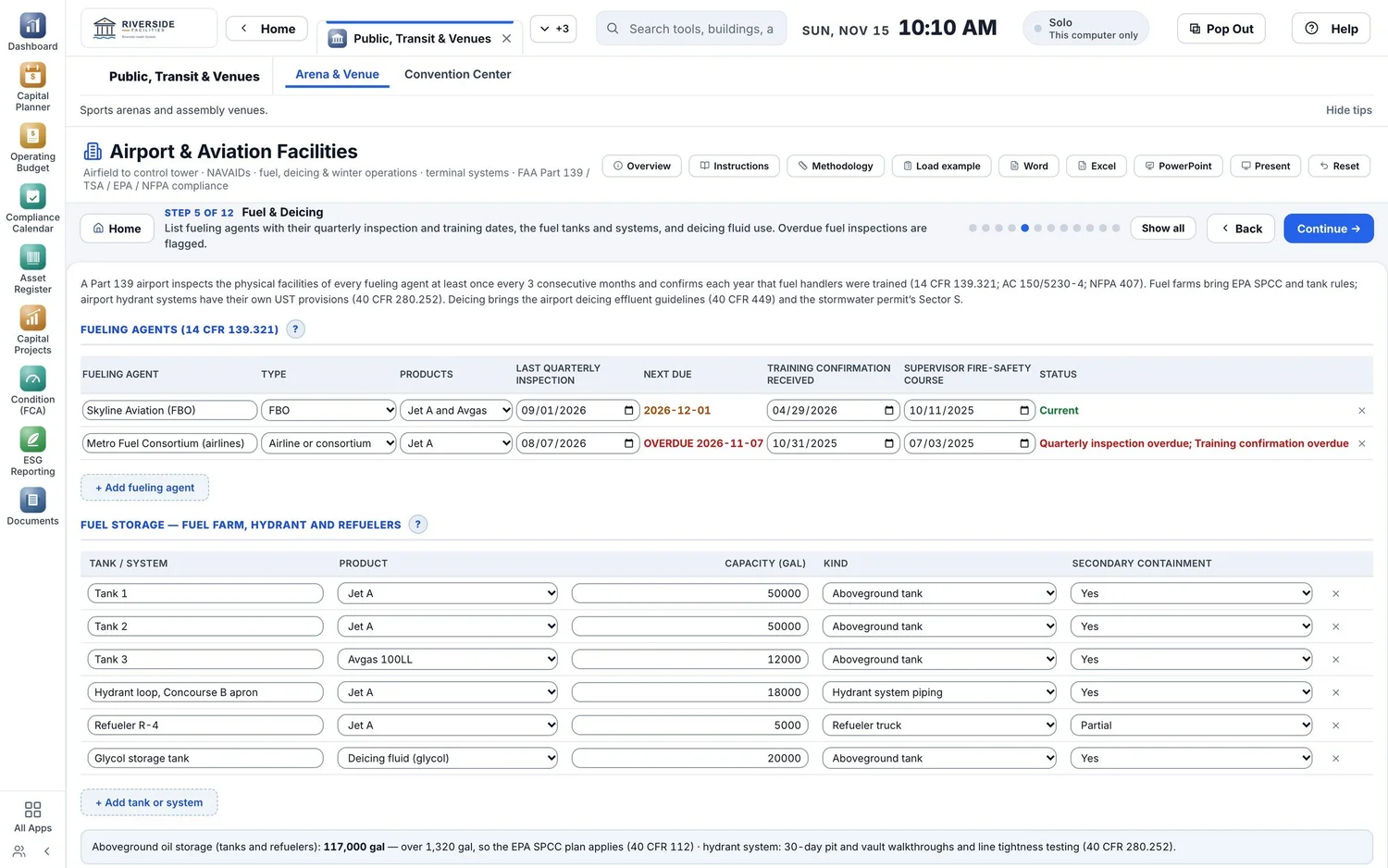
Fuel & Deicing in Airport & Aviation Facilities: list fueling agents with their quarterly inspection and training dates, the fuel tanks and systems, and deicing fluid use. Overdue fuel inspections are flagged.
Deicing and Stormwater
- 40 CFR 449: primary airports with 1,000 or more jet departures certify each year that no urea pavement deicers are used
- Industrial stormwater permit, Sector S: quarterly routine inspections, monthly inspections through the deicing season and deicer records
- Sector S benchmark sampling (BOD5, COD, ammonia, pH) once the airport uses more than 100,000 gallons of glycol or 100 tons of urea a year, worked out from the amounts you enter
Security, Accessibility and the Terminal
- TSA airport security program under 49 CFR 1542, the ID media (badge) audit at least once a year and the incident-management procedures reviewed every 12 months
- Department of Transportation (DOT) airport accessibility at airports with 10,000 or more enplanements: service animal relief areas, captioning, accessible kiosks and boarding lifts (49 CFR 27.71-27.72)
- Automated people mover safety program, inspection and testing under ASCE 21 and state conveyance law (flagged Confirm)
- Elevators, escalators and moving walks follow the conveyance rows every building gets
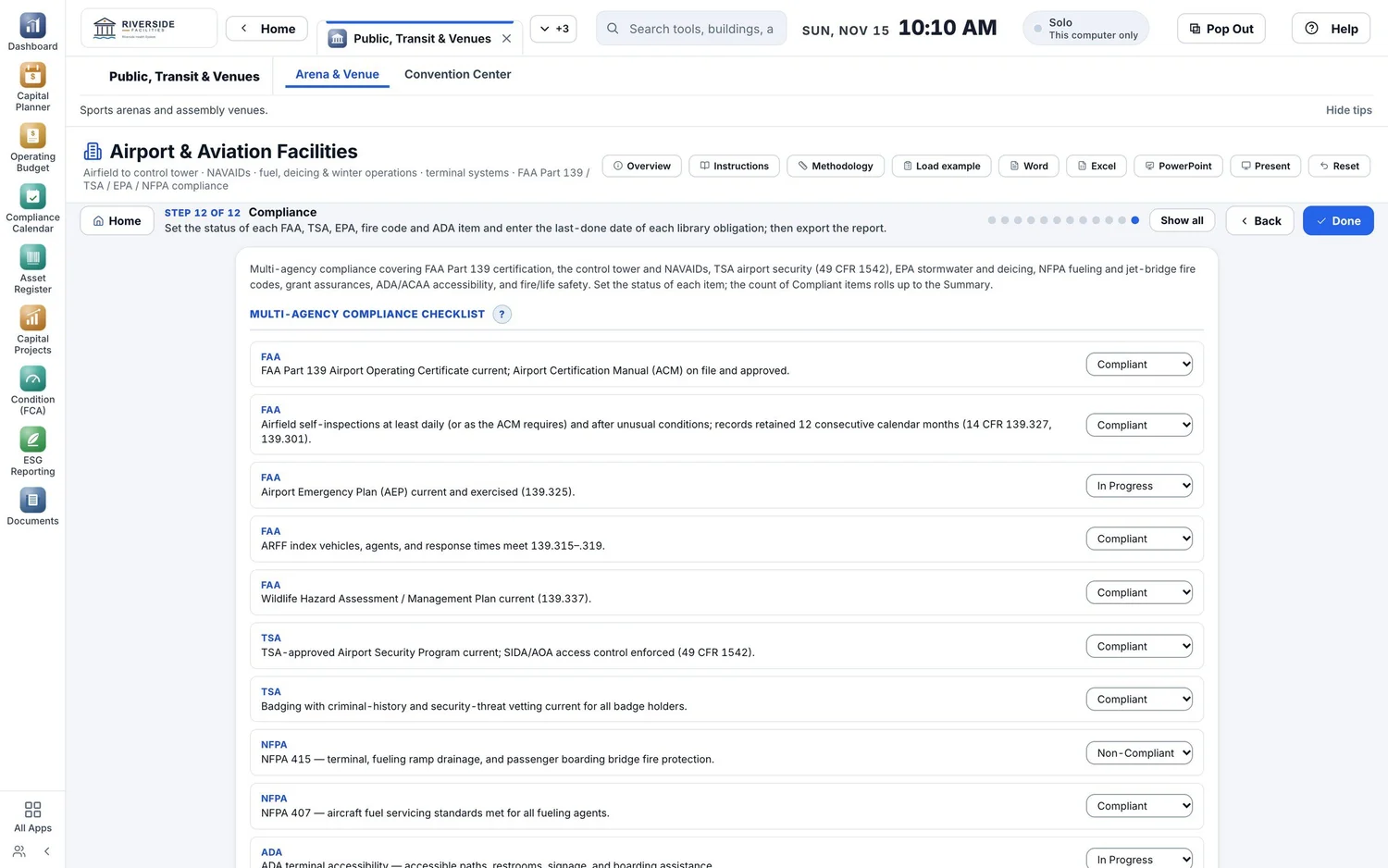
Compliance in Airport & Aviation Facilities: set the status of each FAA, TSA, EPA, fire code and ADA item and enter the last-done date of each library obligation; then export the report.
Construction and Airspace Notices
- FAA Form 7460-1 at least 45 days before construction, cranes included (14 CFR Part 77)
- FAA Form 7480-1 at least 90 days before building, activating or changing a runway or taxiway (14 CFR Part 157)
- A Construction Safety and Phasing Plan (CSPP) and the contractor's safety plan compliance document for airfield projects (14 CFR 139.341; AC 150/5370-2G)
Grants, Passenger Facility Charges and Reports
- Airport Layout Plan kept current (Grant Assurance 29) and land for FAA facilities on written request (Grant Assurance 28)
- FAA Form 5100-127 Operating and Financial Summary within 120 days after fiscal year end (Grant Assurance 26)
- Passenger facility charges (PFCs): quarterly reports, an annual audit, and the July 1 revenue estimate at medium and large hubs (14 CFR 158)
- Unaccommodated gate request reports due February 1 and August 1 at medium and large hubs (Grant Assurance 39)
- Disadvantaged business enterprise (DBE) goal and annual report, and the ACDBE concession report by March 1 (49 CFR 26 and 23), noting that goal updates are paused under the October 2025 interim final rule
- Part 150 noise program: a revised noise exposure map when operations change noise exposure by 1.5 dB
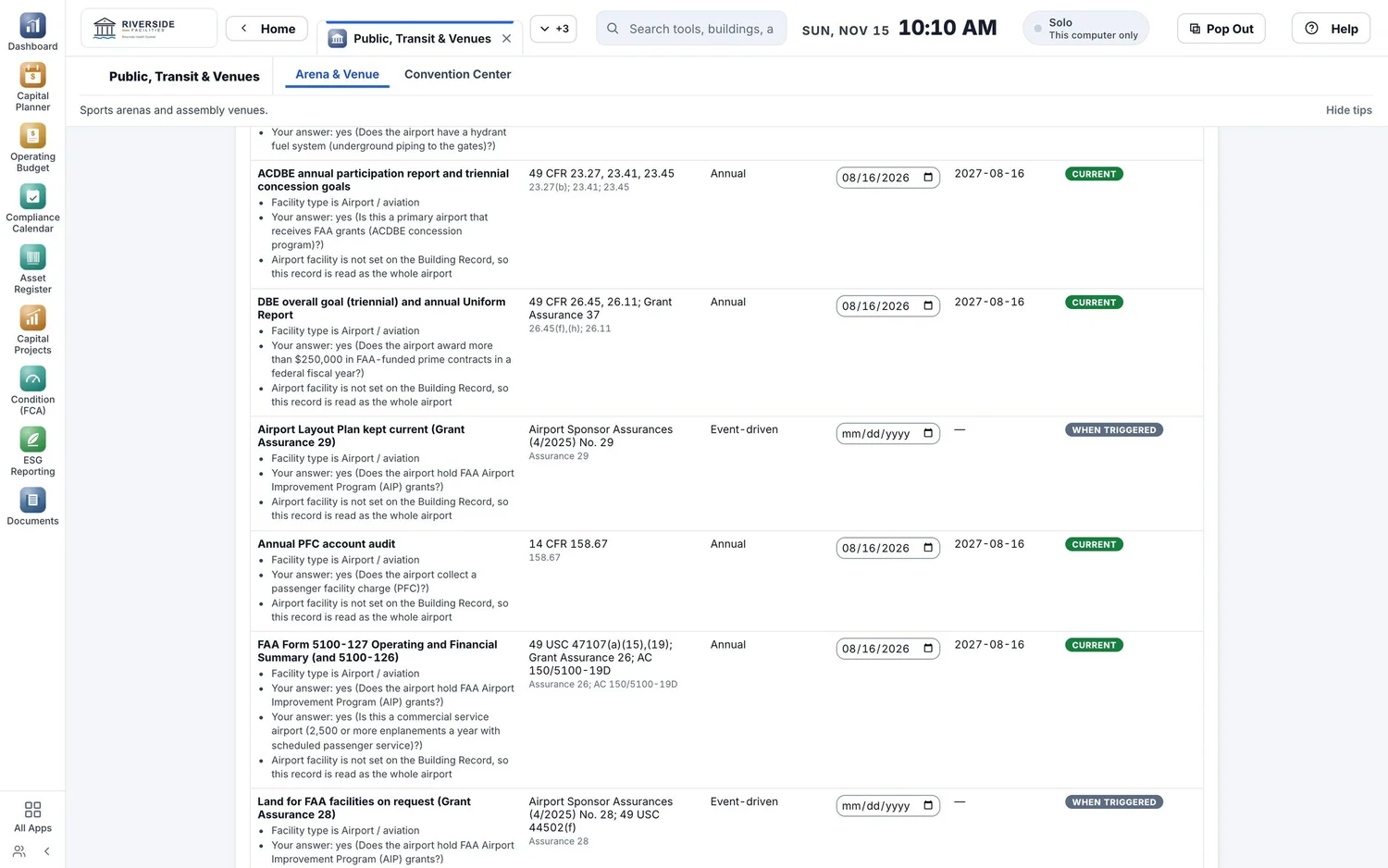
Compliance in Airport & Aviation Facilities: set the status of each FAA, TSA, EPA, fire code and ADA item and enter the last-done date of each library obligation; then export the report.
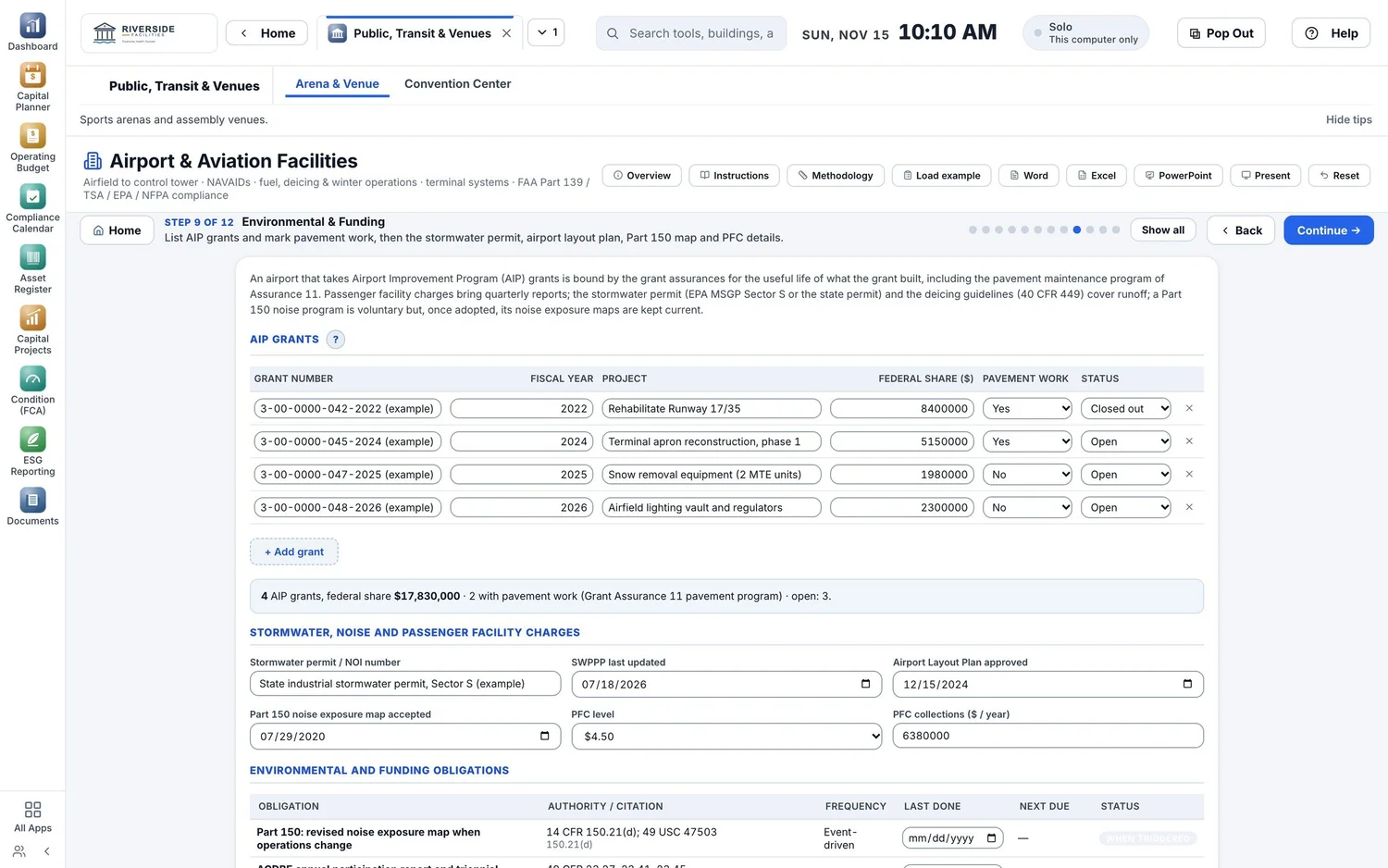
Airport grant and environmental dates are easy to lose among Part 139 duties, so each has its own row and due date.
Twelve Steps, Built Around How an Airport Is Actually Split
Summary and Airport Facts
Hub class, Part 139 class I-IV, ARFF index, tower type, enplanements, jet departures and gates, then the airport facts: TSA program, snow and ice, fueling agents, hydrant system, stormwater permit, deicing, AIP grants, PFCs, Part 150, airport-owned visual aids, non-federal NAVAIDs, AWOS, obstruction lights, lightning protection, people mover, wildlife plan, DBE and ACDBE. A fact your registers already show is filled in for you.
Learn MoreShow Less
Staff hours go only to duties the airport actually owes. Many facts fill themselves in from figures already entered, so nobody researches applicability twice. A register can turn Not Sure into Yes, never into No.
- Fewer than 1,000 jet departures switches off the 40 CFR 449 urea certification
- 10,000 or more enplanements turns on the DOT accessibility duties
- A grant row marked as pavement work turns on the Grant Assurance 11 program
- Glycol and urea amounts entered decide whether Sector S benchmark sampling applies
- Medium or large hub class brings the PFC revenue estimate and gate reports
Asset Register
Eighteen categories, from terminal HVAC, boarding bridges and baggage handling to airfield lighting, NAVAIDs, emergency power, fuel systems, deicing, snow removal equipment, ARFF vehicles and runway and taxiway pavement. Remaining life is worked out from install year and design life. A failed asset in a critical category counts as a critical system down.
Learn MoreShow Less
A failed critical asset costs the most when leadership hears about it late. Eleven of the eighteen categories count as critical, so a Failed rating there shows on the summary and goes to Building Systems as a deficiency.
- Critical: terminal HVAC, boarding bridges, baggage, people movers, airfield lighting and NAVAIDs
- Also critical: the control tower, emergency power, fuel systems, ARFF vehicles and pavement
- Six locations: terminal, concourse, airfield, control tower, fuel farm and landside
- The report charts remaining design life for every asset, with negative years past life
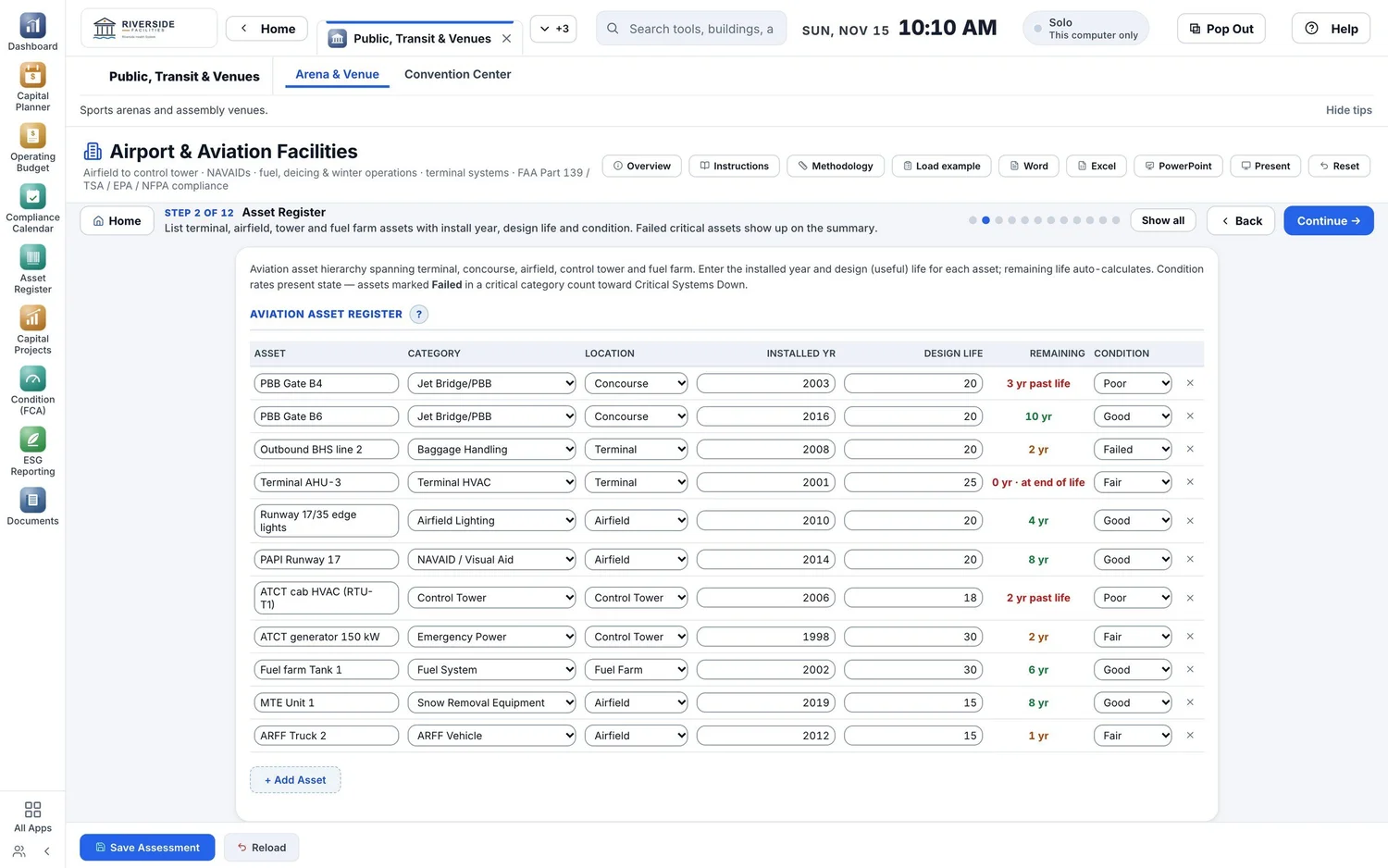
Asset Register in Airport & Aviation Facilities: list terminal, airfield, tower and fuel farm assets with install year, design life and condition. Failed critical assets show up on the summary.
Airfield
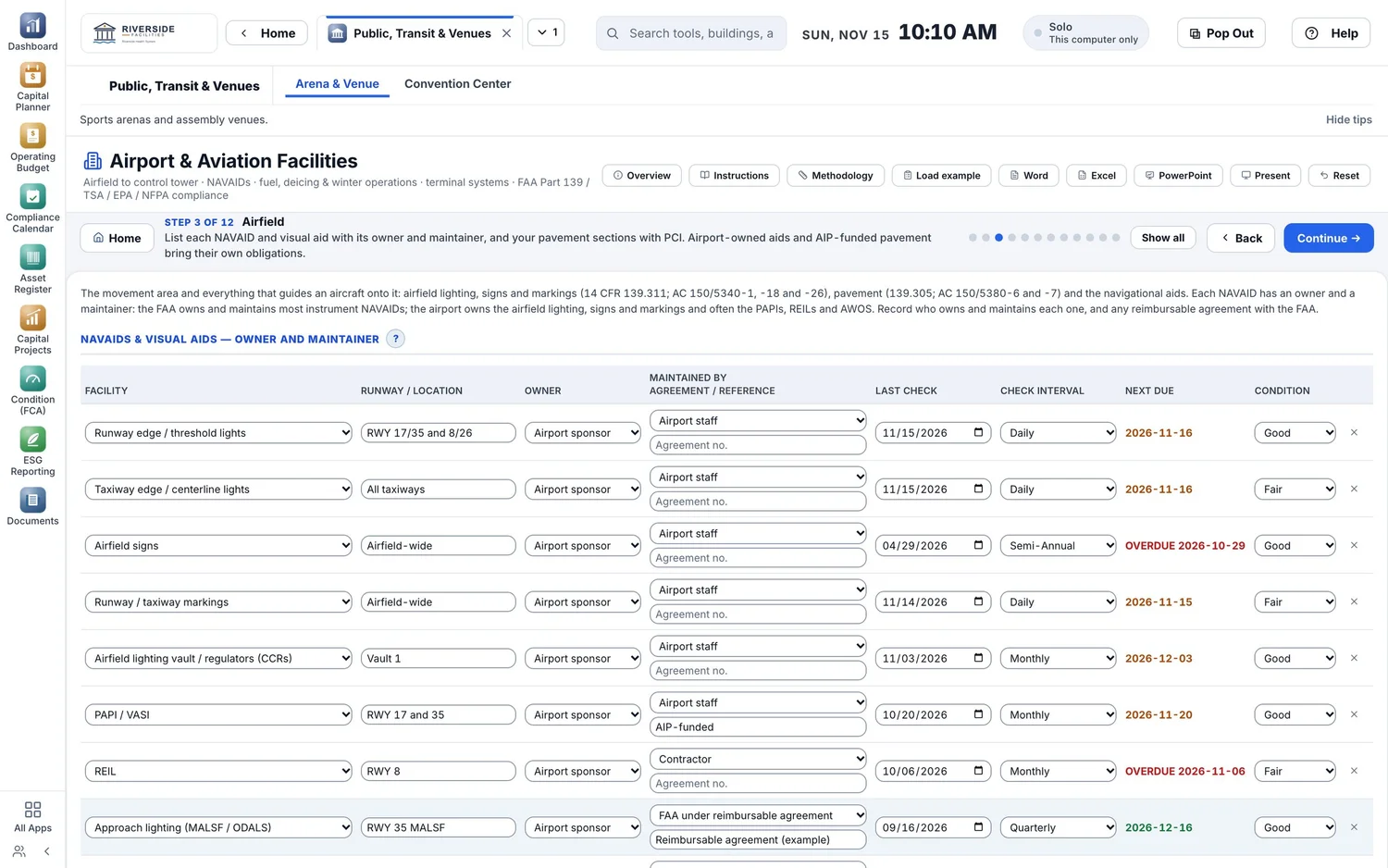
Every NAVAID and visual aid with who owns it (FAA, airport or tenant), who maintains it (FAA Technical Operations, airport staff, a contractor, or the FAA under a reimbursable agreement) and its check interval. A typical airfield list starts it: edge and centerline lights, signs, markings, the vault and regulators, PAPI, REIL, beacon, wind cone, approach lighting, ILS, DME, VOR, NDB, AWOS, ASOS, RVR, radar and obstruction lights.
Learn MoreShow Less
Paying for upkeep the FAA owes, or skipping upkeep the airport owes, both cost money. Picking an aid fills in its typical owner, maintainer and check interval, and your team can change any of them.
- ILS, VOR, DME, ASOS, RVR and radar default to FAA Technical Operations, annual
- PAPI, REIL and NDB start blank, since either party may own them
- Pavement sections carry PCI, survey age (flagged past 3 years) and AIP funding
- The report gives the square yards below PCI 70 and the lowest section
Control Tower
Cab HVAC, equipment room cooling, generator, UPS and batteries, transfer switch, elevator, fire alarm and suppression, lightning protection, obstruction lights, cab glass and consoles, access control, roof and the ATC equipment, each with the party responsible for your tower type.
Learn MoreShow Less
A tower generator nobody tests is an outage waiting to happen. Pick the tower type and each system's responsible party follows it, so no work is paid for twice or left to no one.
- FAA-operated tower: the FAA for every system (Order 6000.15J)
- Federal Contract Tower: the airport keeps the building; UPS and ATC equipment show Shared
- Non-federal tower: the airport for everything
- Generator weekly, UPS and transfer switch monthly, cab HVAC quarterly, each marked critical or not
- Rows the FAA maintains stay off the airport's published assets
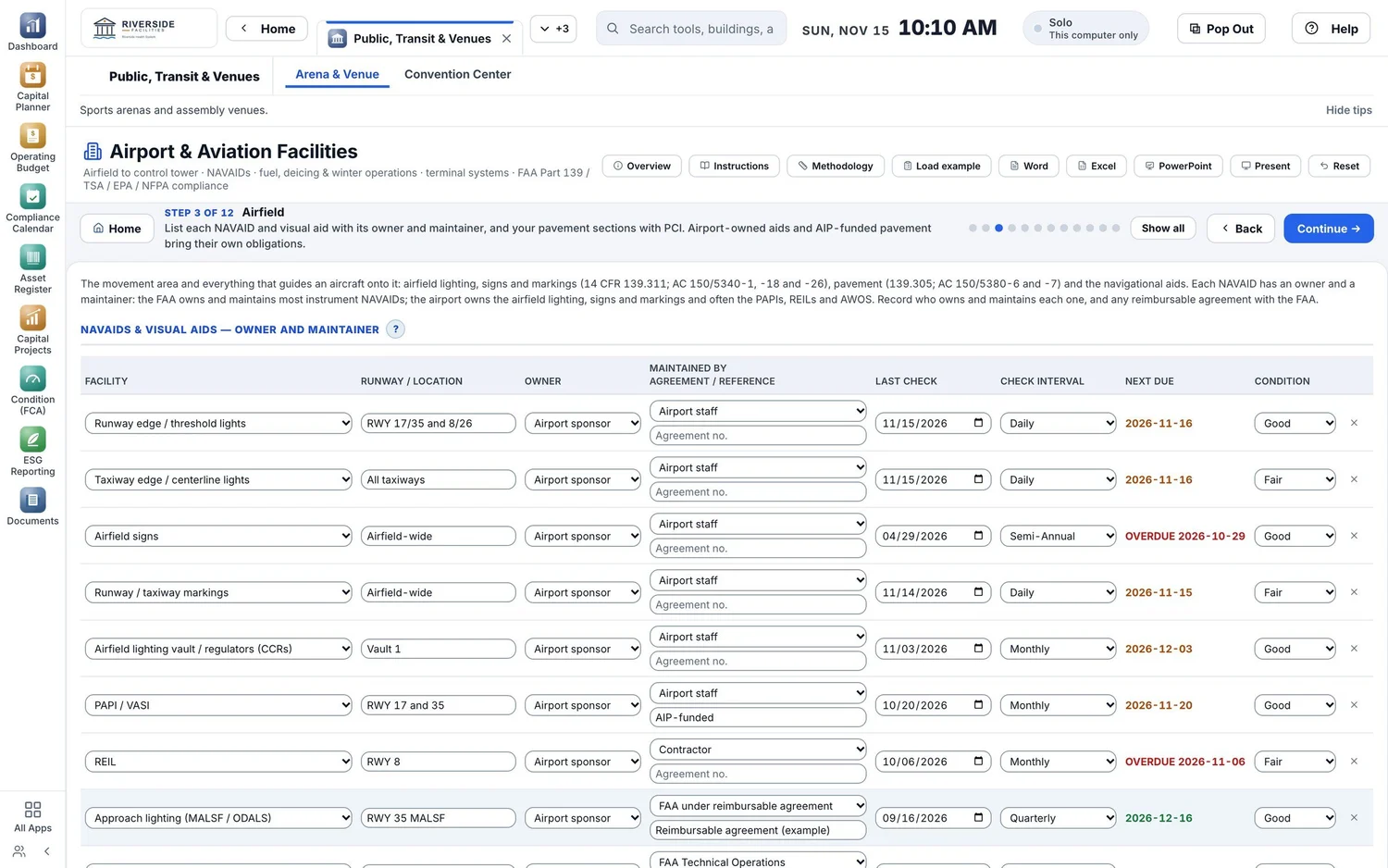
Airfield in Airport & Aviation Facilities: list each NAVAID and visual aid with its owner and maintainer, and your pavement sections with PCI. Airport-owned aids and AIP-funded pavement bring their own obligations.
Fuel and Deicing
Fueling agents with their inspection, training and supervisor course dates; tanks, hydrant piping and refuelers with product, capacity and secondary containment; and deicing fluid and urea use.
Learn MoreShow Less
A lapsed fueling agent inspection is an FAA finding the airport should see before the inspector does. Each agent's status checks three clocks at once and names exactly what is missing.
- Quarterly inspection, 12-month training confirmation and 24-month supervisor course, each checked
- Status reads Current or lists each overdue or missing item in red
- An agent with an open item becomes a deficiency in Building Systems
- A tank row marked hydrant piping turns on the hydrant system rules
- Glycol and urea amounts entered decide whether stormwater benchmark sampling applies
Terminal Systems
People movers, elevators, escalators, moving walks, boarding bridges, 400 Hz ground power, preconditioned air, baggage conveyors, TSA screening equipment, terminal HVAC, fire alarm and sprinkler and flight information displays, each with who owns it, who maintains it and availability.
Learn MoreShow Less
Boarding bridges, baggage conveyors and ground power keep flights moving, so their downtime gets expensive fast. Each row starts with a typical owner and interval, and TSA-owned equipment stays off the airport's budget.
- Bridges, 400 Hz and preconditioned air quarterly; baggage conveyors and terminal HVAC monthly
- Checkpoint screening and checked-bag EDS default to TSA and its contractor
- Terminal availability is the simple average of the figures entered
- Only airport-owned systems publish to Building Systems
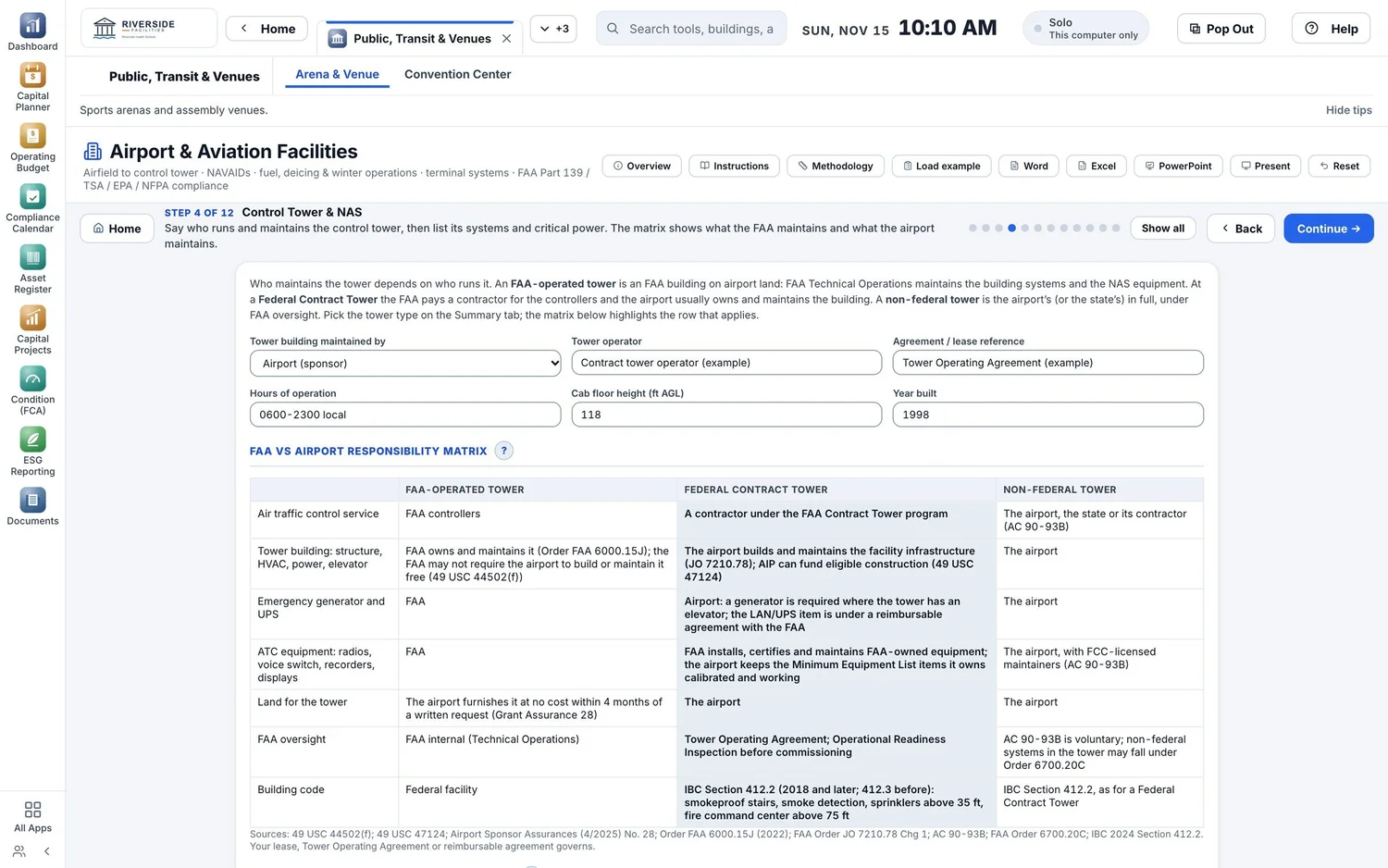
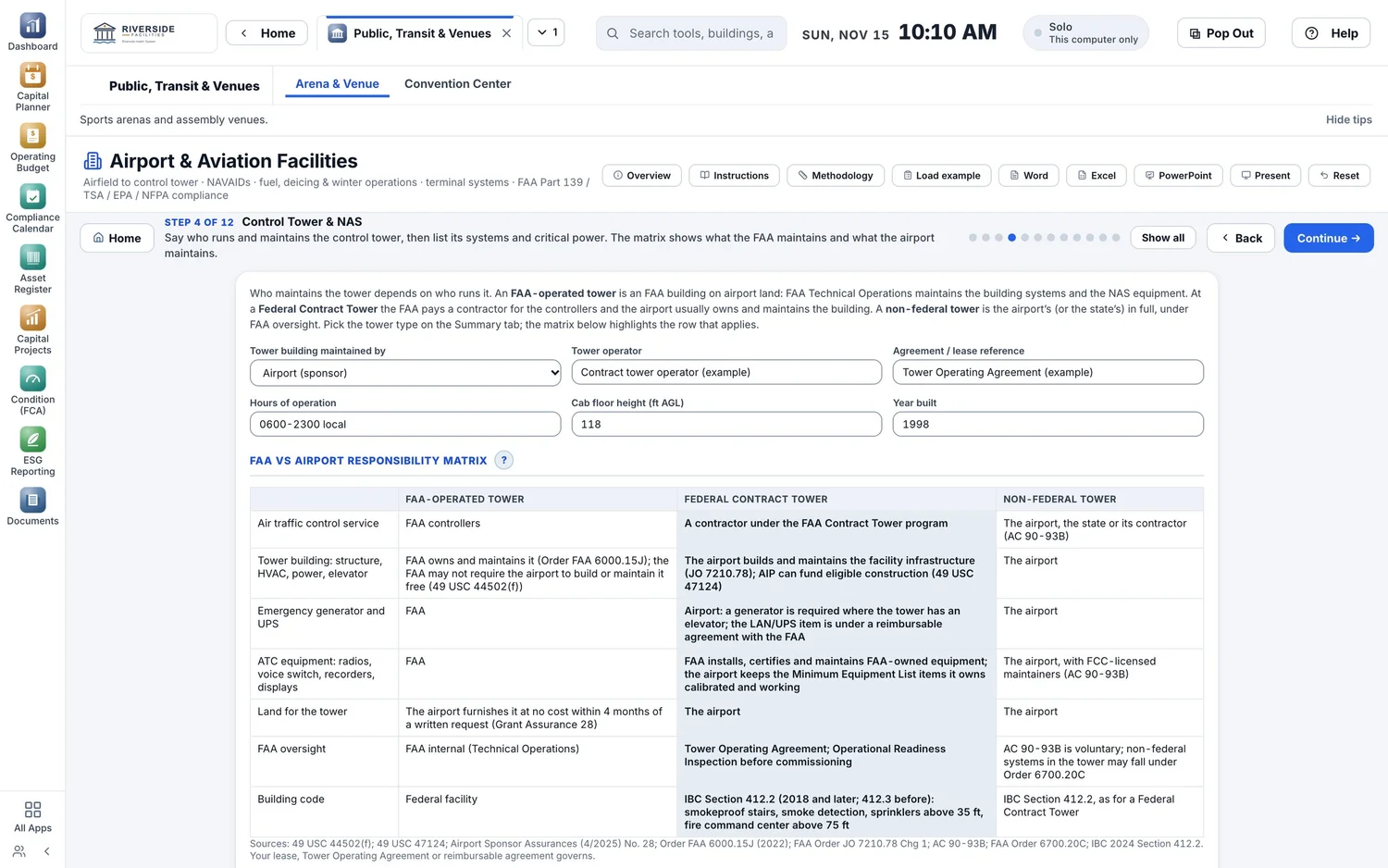
Control Tower & NAS in Airport & Aviation Facilities: say who runs and maintains the control tower, then list its systems and critical power. The matrix shows what the FAA maintains and what the airport maintains.
Record the Tower Separately
Set the Airport Facility field on the Building Record and a control tower, terminal or airfield becomes its own building. Each then carries only its own obligations: the tower gets its upkeep, obstruction lights, lightning protection, generator, UPS and elevator, and the airfield gets Part 139.
Learn MoreShow Less
Splitting the airport into its parts keeps each budget honest: tower costs are not buried in the terminal, and Part 139 airfield work is not charged to the tower. Each part is a building of its own.
- Each part gets its own Compliance Calendar, work orders and capital plan
- The terminal can be rated against the ENERGY STAR median while the tower is tracked apart
- The Portfolio Manager type is set per building, such as Office or Fire Station
- Rows a part does not need stay off its calendar
Systems and Capital
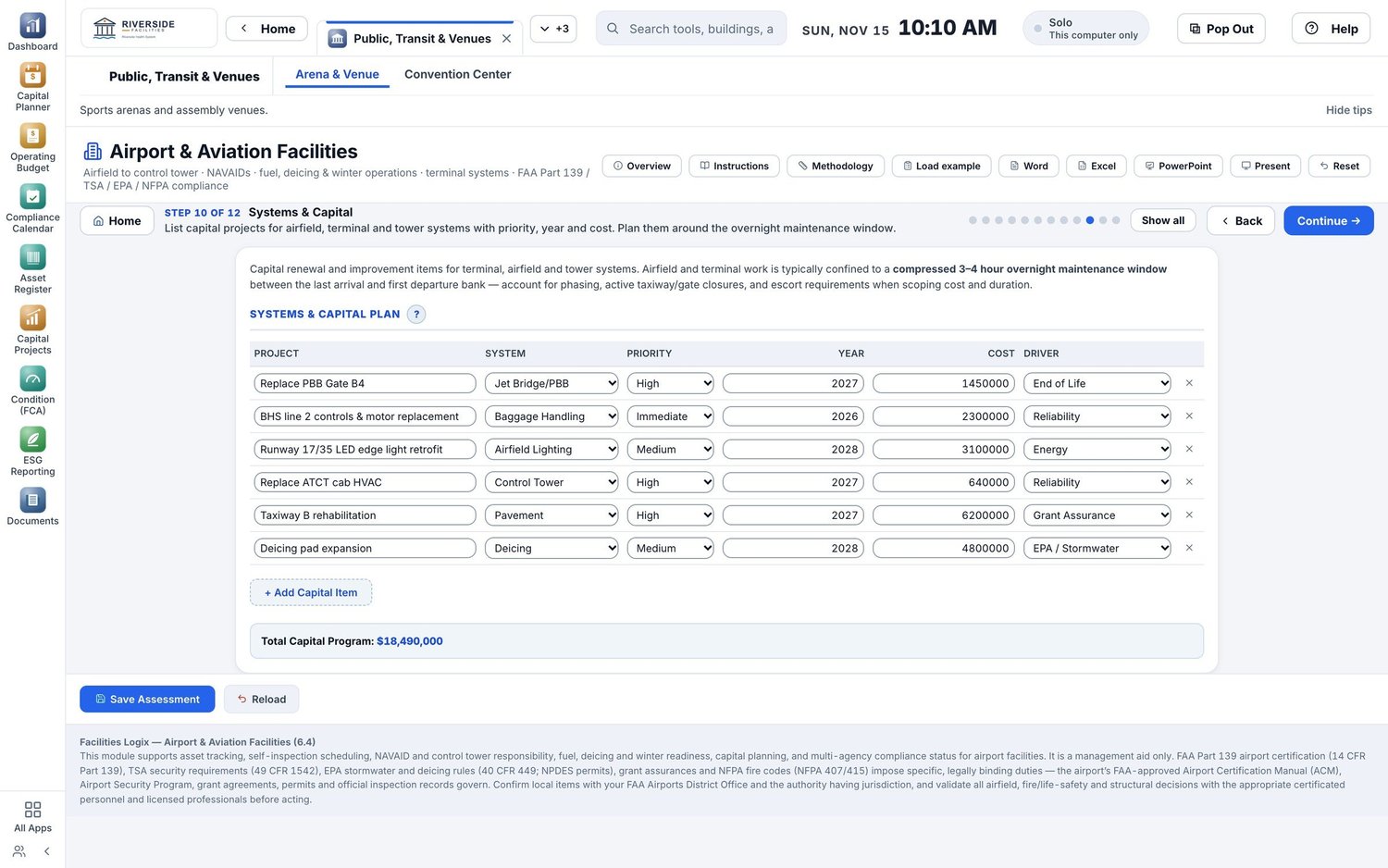
Capital projects for airfield, terminal and tower systems with priority, year and a driver such as FAA Part 139, TSA security, ADA, grant assurance or EPA stormwater, planned around the overnight maintenance window.
Learn More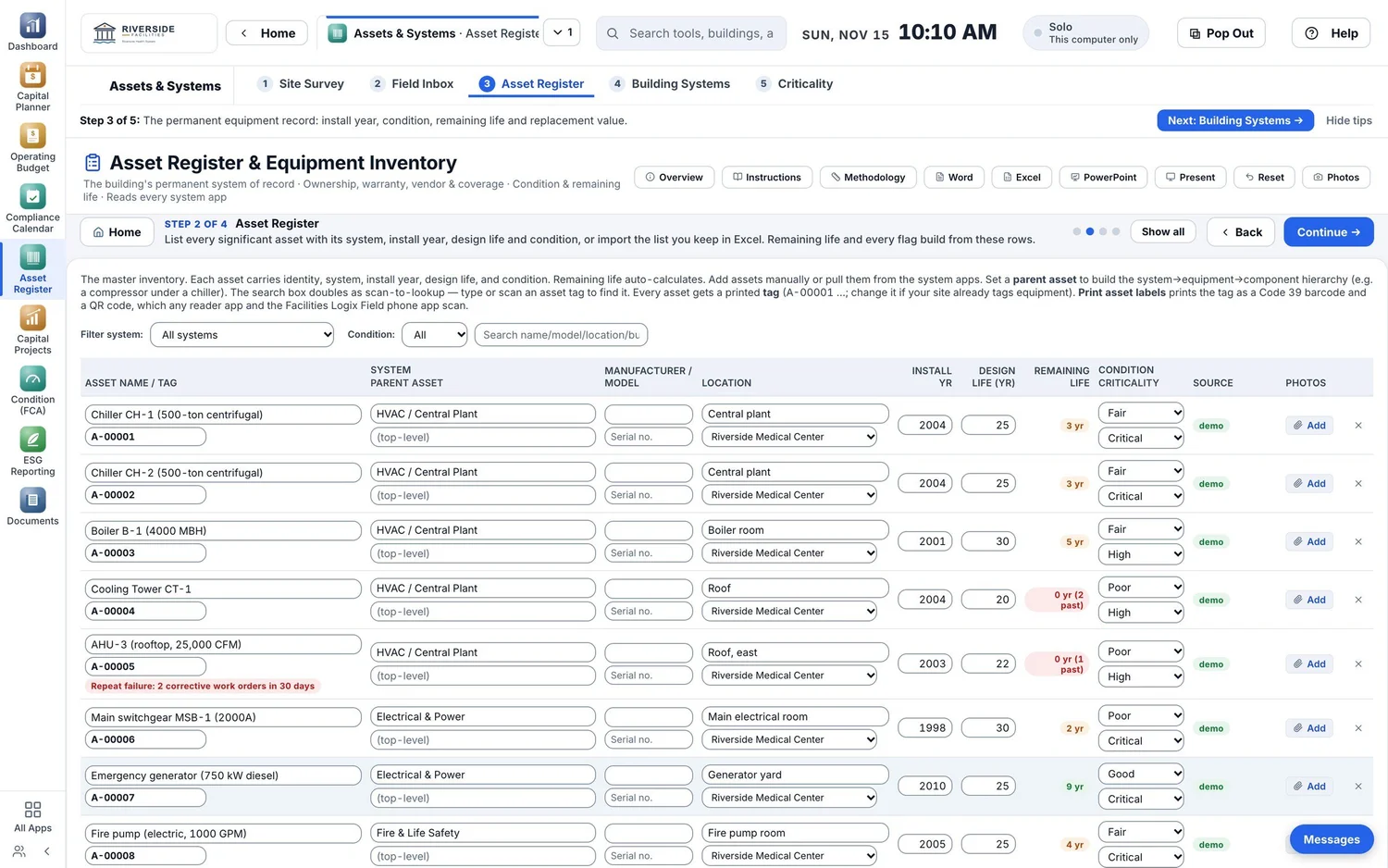
Asset register with install year, remaining life, condition and criticality.
The Daily Self-Inspection to the Annual FAA Visit
Safety and Emergency Tab
- A self-inspection schedule with inspection types for the morning and afternoon airfield checks, pavement, lighting, signs and markings, safety areas, fueling, ARFF readiness, wildlife, NAVAID and PAPI checks, obstruction lights, snow and ice readiness and FOD walks
- Each inspection has a frequency from twice daily to annual, a last-done date, a next-due date, a result (Pass, Pass With Discrepancies, Fail) and the inspector
- SMS dates, with full implementation 36 months after plan approval
- Airfield construction projects with their CSPP, contractor safety plan, Form 7460-1 and NOTAM status, and a Ready to Start column
- A foreign object debris (FOD) log: date, area, items found and who found them
Fuel, Winter and Terminal Checks
- Fueling agents turn red when the quarterly inspection, training confirmation or supervisor course is overdue
- Snow and ice control plan dates and each snow removal unit with its condition, Ready flag and last service
- Terminal systems with their last inspection, interval, next due and availability percentage
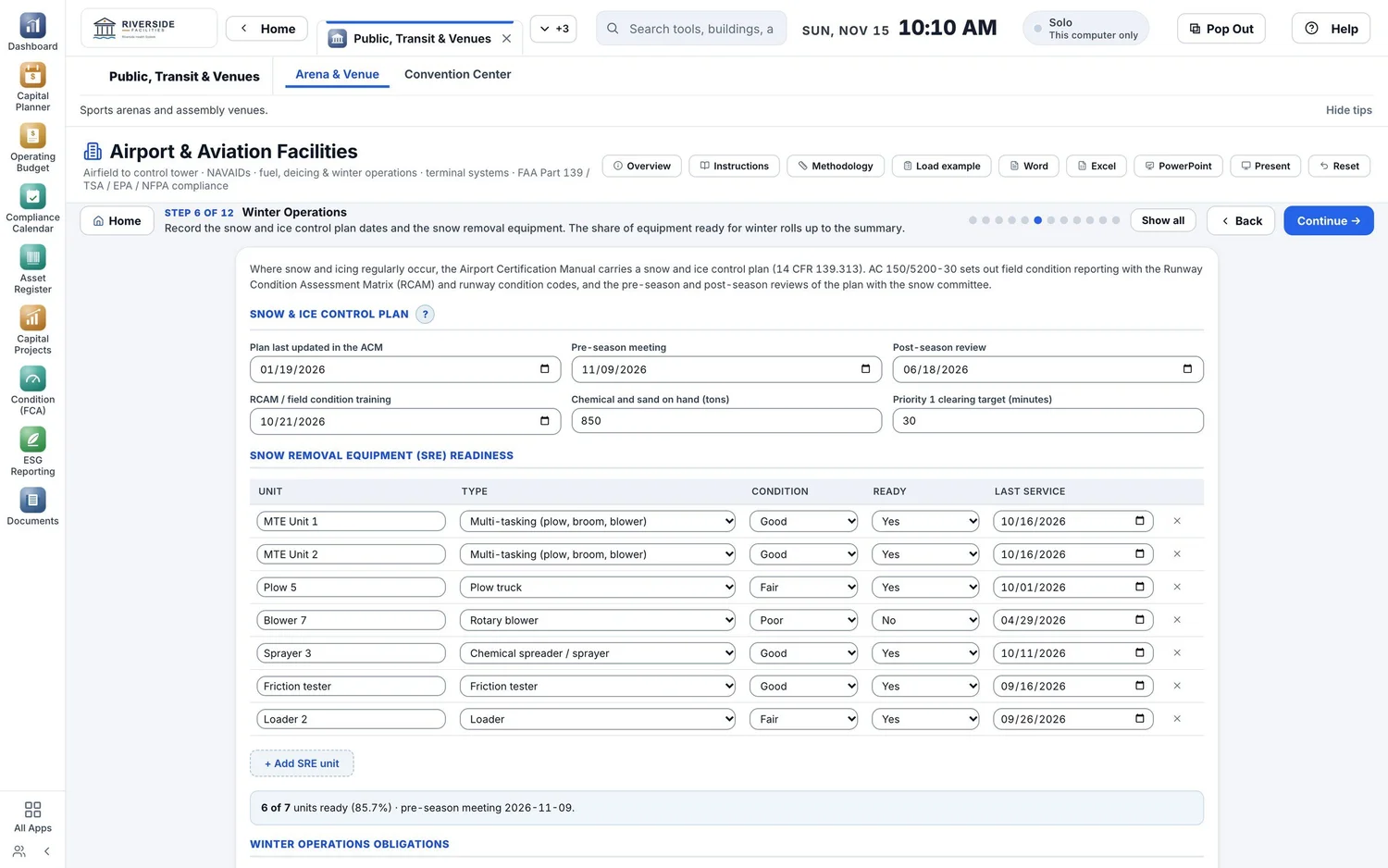
Winter Operations in Airport & Aviation Facilities: record the snow and ice control plan dates and the snow removal equipment. The share of equipment ready for winter rolls up to the summary.
The Multi-Agency Checklist
- Sixteen starting items across FAA, TSA, NFPA, ADA, DOT and EPA, each set to Compliant, In Progress, Non-Compliant, Not Assessed or N/A
- It covers the operating certificate and certification manual, self-inspections, the emergency plan, ARFF, wildlife, the TSA program and badging, NFPA 415 and NFPA 407, terminal accessibility, fire and life safety, tower responsibility, NAVAID ownership, the stormwater permit, grant assurances and DOT accessibility
Who Maintains What
- A tower responsibility matrix for an FAA-operated tower, a Federal Contract Tower and a non-federal tower, covering air traffic service, the building, generator and UPS, ATC equipment, land, FAA oversight and the building code
- A TSA screening matrix showing what TSA buys and maintains and what stays with the airport or airlines, from screening equipment to the checked baggage system and checkpoint space
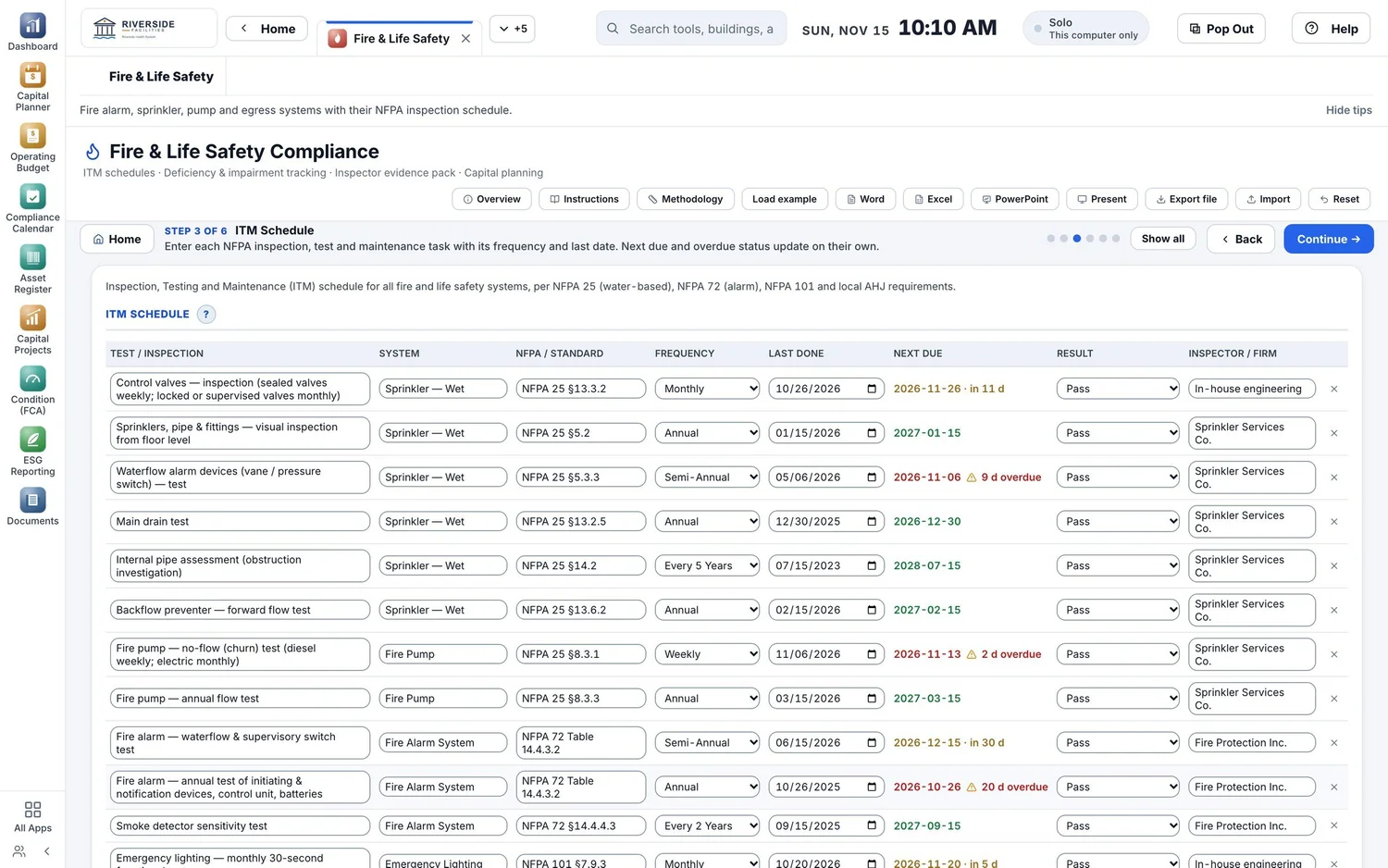
ITM Schedule in Fire & Life Safety Compliance: enter each NFPA inspection, test and maintenance task with its frequency and last date. Next due and overdue status update on their own.
Ready for the Certification Inspection
Compliance Tab
Every library obligation that applies, with its authority, citation, frequency, last done, next due and status. Each area tab also shows its own rows, and a date entered in either place is the same date in the Compliance Calendar.
Learn MoreWord, Excel and PowerPoint
A report, workbook and deck with the obligations that apply, what is overdue, the NAVAID and tower responsibility matrix, pavement condition, winter readiness and the capital program.
Learn MoreShow Less
The report opens with the decision, so leadership sees what to fund and fix first without reading every page. It is built from the same figures the screen shows.
- A decision line naming overdue Part 139 inspections, fueling agents with open items and systems down
- Four headline figures: inspections overdue, obligations overdue, critical systems down and the capital program
- Charts of remaining design life, pavement PCI by section and capital by system
- Airfield projects missing CSPP, 7460-1 or NOTAM paperwork are named
- A SAMPLE watermark while the worked example is loaded
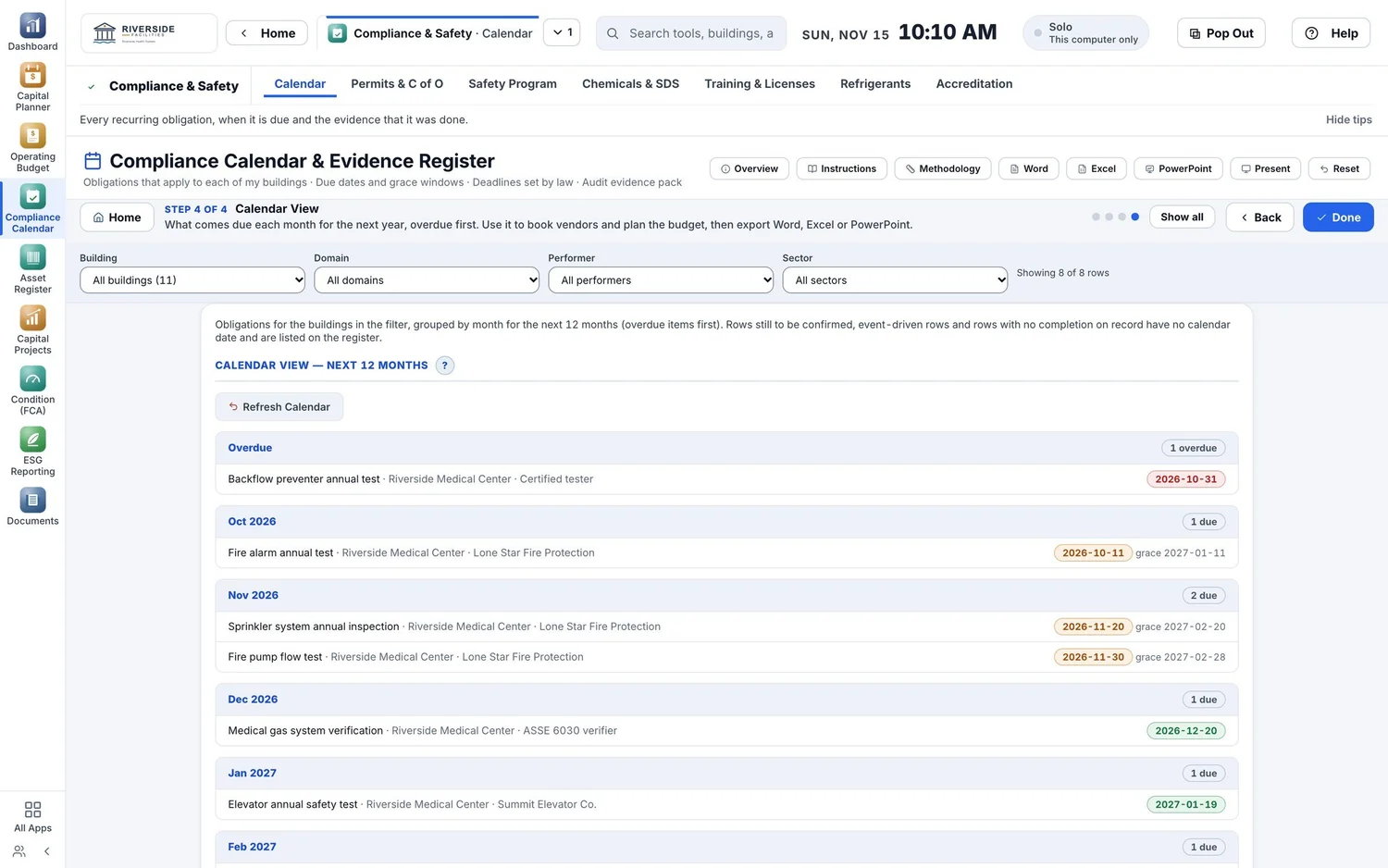
The twelve-month compliance calendar with due and overdue items.
ENERGY STAR
The terminal compared with the EPA national median for Transportation Terminal/Station, with energy from your utility bills and the benchmarking laws that apply.
Learn MoreShow Less
Energy is a bill the airport pays every month, and knowing how far the terminal sits from the national median is the first step to cutting it. The tab uses Portfolio Manager's own arithmetic, from site energy to source energy.
- National median for the type: 112.0 kBtu/sf source, 56.2 site
- This type has no 1-100 score or certification, and the tab says so
- Other airport buildings can be set as Office, Repair Services, Fire Station, Parking or warehouse
- Energy comes from the 12 months to the latest utility bill
Publish to Building Systems
Assets, airport-owned NAVAIDs, tower and terminal systems and capital items go into the shared framework for portfolio roll-up.
Learn MoreShow Less
Publishing puts airport problems on the portfolio's funding list, where they compete for capital on the same terms as every other building. It sends deficiencies, not just assets.
- Overdue Part 139 inspections become code and regulatory deficiencies
- A failed critical asset becomes a Critical System Down deficiency
- Fueling agents with open items and Non-Compliant checklist items are sent too
- Capital priorities map to the portfolio's three levels, Urgent first
- Publishing again replaces the airport's earlier rows instead of duplicating them
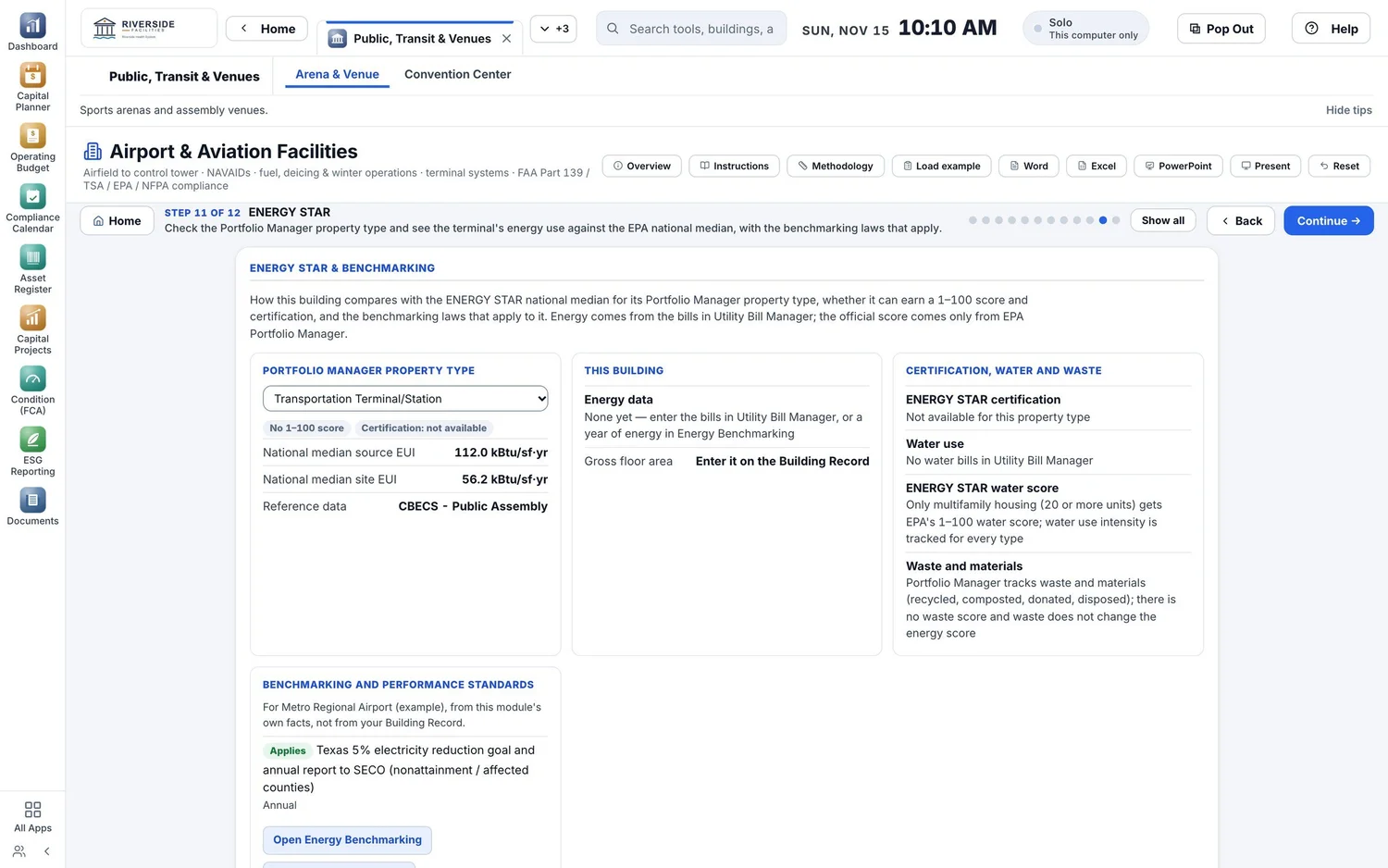
ENERGY STAR in Airport & Aviation Facilities: check the Portfolio Manager property type and see the terminal's energy use against the EPA national median, with the benchmarking laws that apply.
The Operational Snapshot
On the Summary Tab
- Assets tracked, inspections overdue, jet bridges and critical systems down
- Obligations overdue and checklist compliance (compliant items divided by applicable items)
- Pavement PCI, area-weighted, rated on the ASTM D5340 scale, with surveys over 3 years old and AIP-funded sections flagged
- Airport-owned NAVAIDs and visual aids, and winter equipment ready (units marked Ready divided by units listed)
- The capital program total and terminal availability
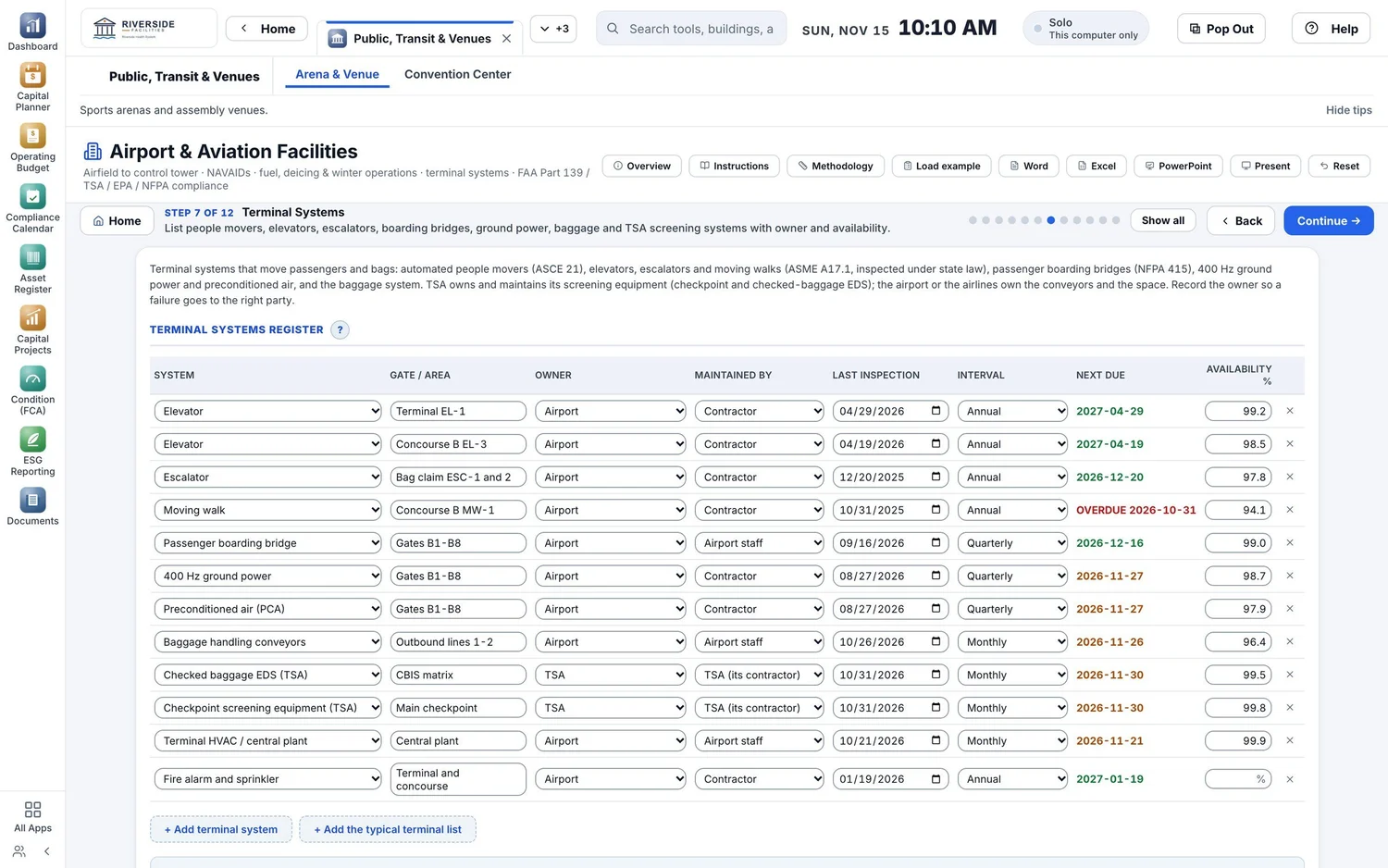
Terminal Systems in Airport & Aviation Facilities: list people movers, elevators, escalators, boarding bridges, ground power, baggage and TSA screening systems with owner and availability.
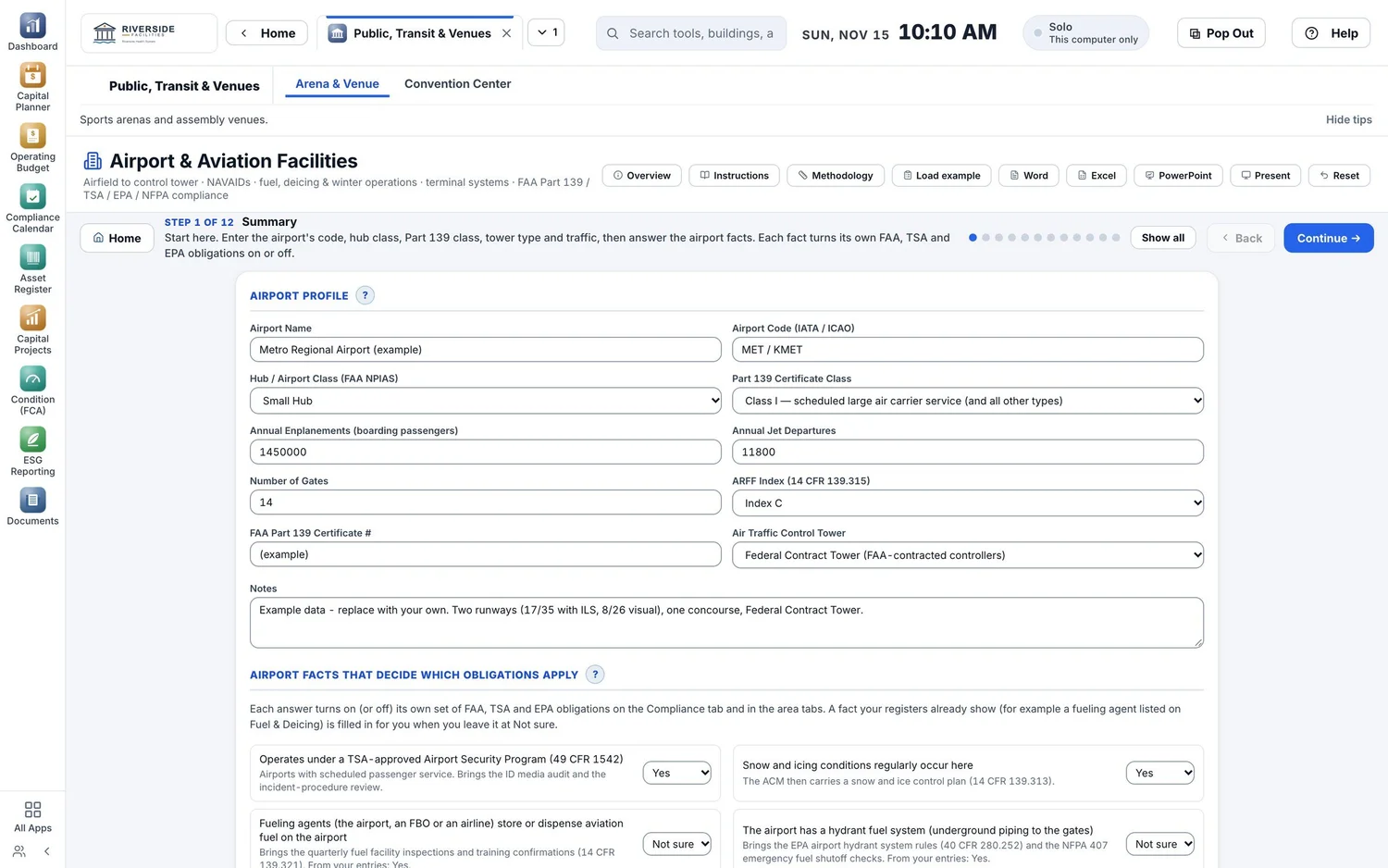
Airport leaders need status without a walk around the field, so the summary shows overdue inspections and systems down.
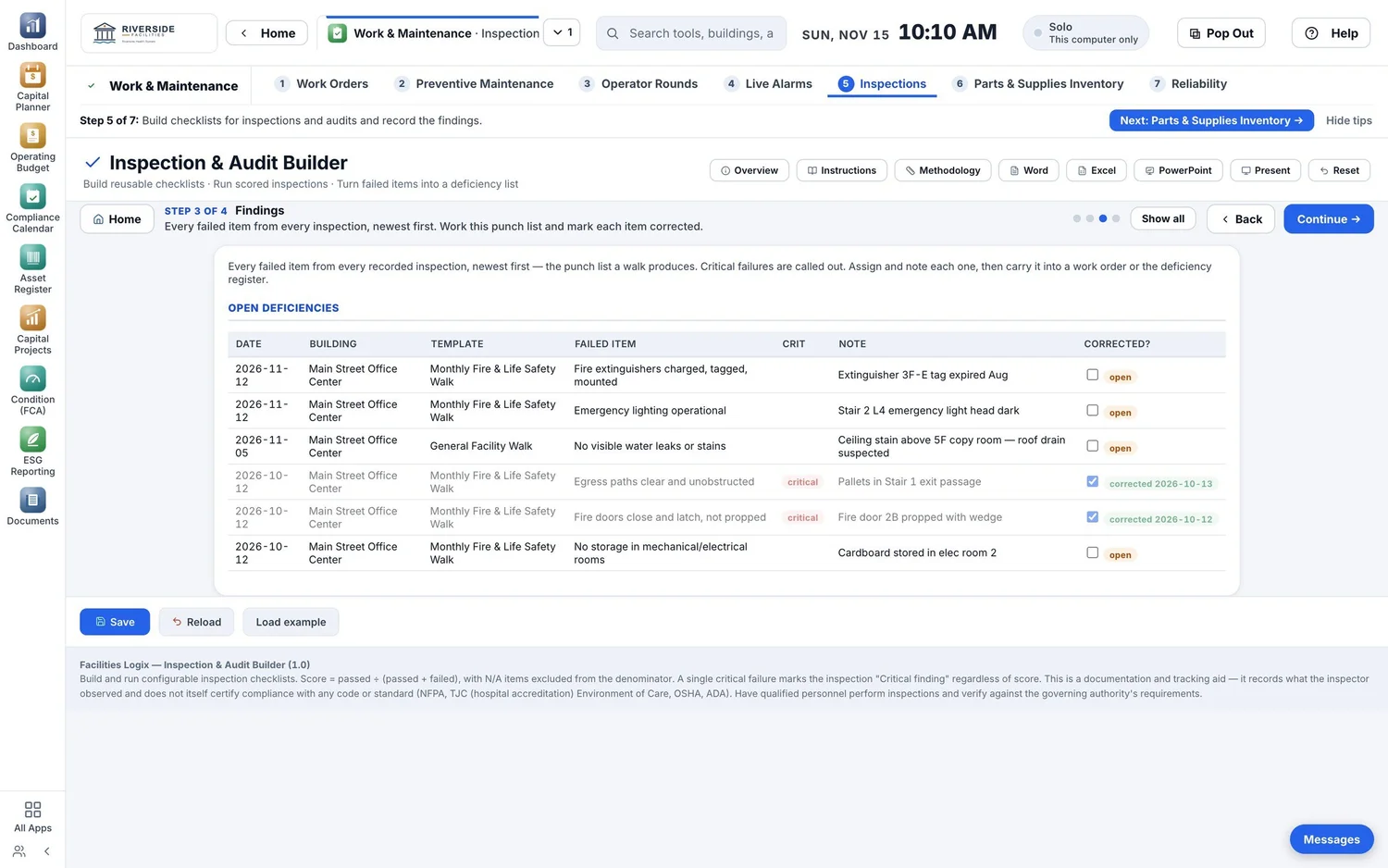
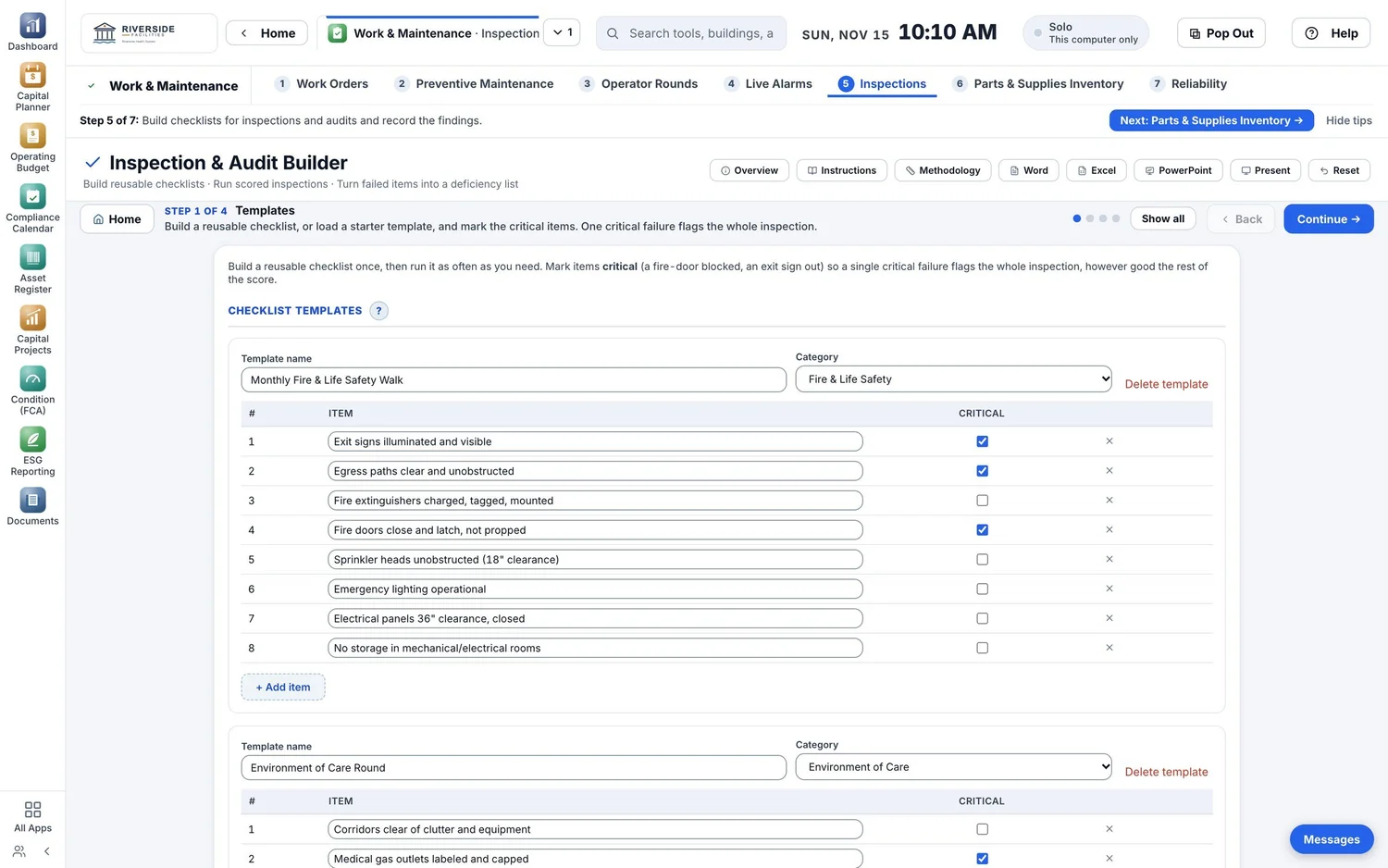
Every Date in One Place, and Every Gap Visible
No Gaps in the Split
Failures happen where responsibility is split, like a PAPI nobody maintains or a tower generator nobody tests. Naming who owns and who maintains every aid and system closes that gap.
Learn MoreShow Less
A gap in responsibility gets paid for twice: once in the failure and again in the emergency repair. Every aid and system carries a named owner and maintainer, and the FAA's share stays off the airport's books.
- Maintainer choices include the FAA under a reimbursable agreement, with the agreement number
- Each row's next due date turns red when it is overdue
- The report counts airport-owned and FAA-owned aids and the checks overdue
- Only aids the airport owns are published as airport assets
Ready for the FAA Visit
Self-inspection records, training dates, fuel inspections and emergency plan reviews sit in one place with their evidence, not in separate binders and spreadsheets.
Learn MoreShow Less
An inspection finding costs staff days to answer, and continued operation depends on documented work. Each library row names the record that proves it and who performs it, so evidence is gathered before the inspector asks.
- Self-inspection and fuel facility records kept 12 months; training records 24 months
- The NOTAM log kept 12 months; the timed ARFF drill on record
- Performers named, from airport operations to a qualified wildlife biologist
- Evidence attaches as work is done and exports as an evidence pack
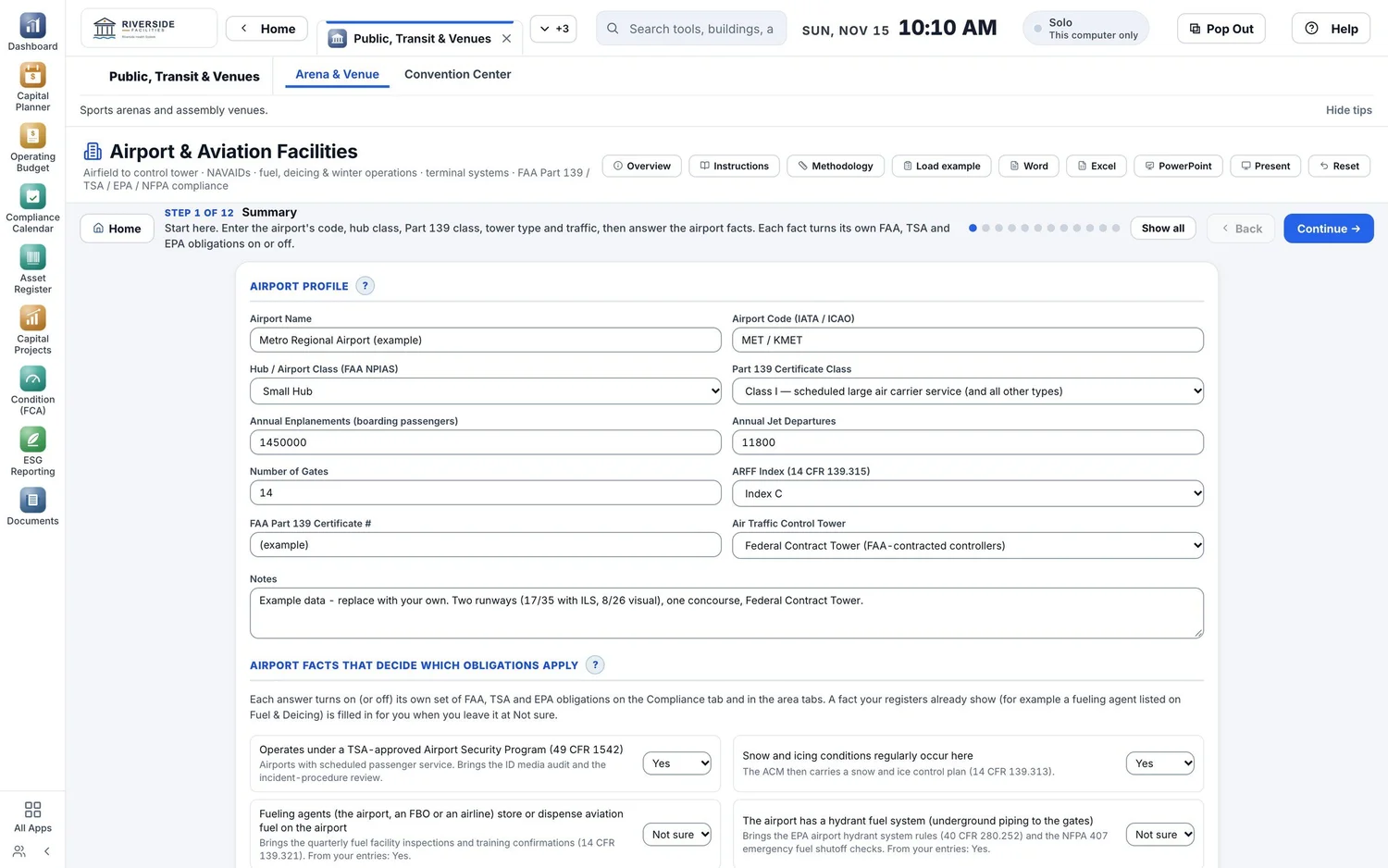
Summary in Airport & Aviation Facilities: start here. Enter the airport's code, hub class, Part 139 class, tower type and traffic, then answer the airport facts. Each fact turns its own FAA, TSA and EPA obligations on or off.
Dates That Are Not Missed
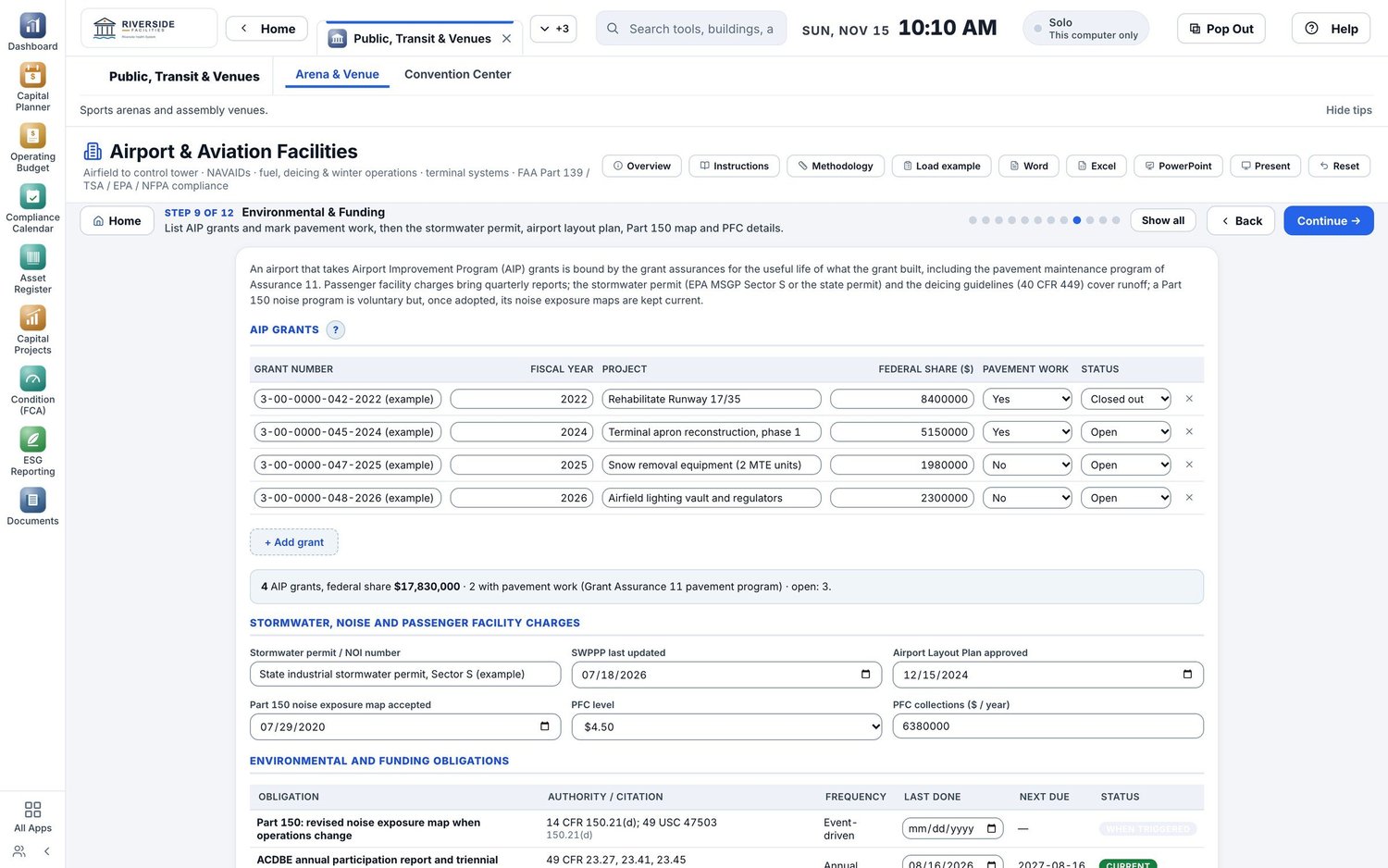
Grant, PFC, DBE and stormwater reports carry their due dates, so a filing deadline is seen in time and not discovered after it passes.
Learn MoreShow Less
Grant and PFC money comes with reporting duties, and a missed filing invites scrutiny of funds the airport depends on. These reports sit with finance and planning, so each row names its owner and its proof.
- Owners named: airport finance, the DBE liaison officer, planning or the environmental manager
- Proof named, such as the CATS filing confirmation for Form 5100-127
- Due soon means within 30 days, matching the Compliance Calendar
- The Responsible box takes a vendor, such as the independent auditor for the PFC audit
Honest About What It Knows
Rows the research could not pin to a primary source say Confirm with your local authority or FAA Airports District Office. Your certification manual, security program, grant agreements and permits always govern.
Learn MoreShow Less
Acting on a wrong rule wastes money either way: work you never owed, or a duty you skipped. Each row shows how sure the research is, so checking time goes only where it is needed.
- Verified rows carry their primary source link and the date reviewed
- Federal Contract Tower upkeep, lightning protection and people movers are marked Confirm
- A missing Building Record fact is named, and its rows wait until it is filled in
- An AHJ override records a frequency your authority sets
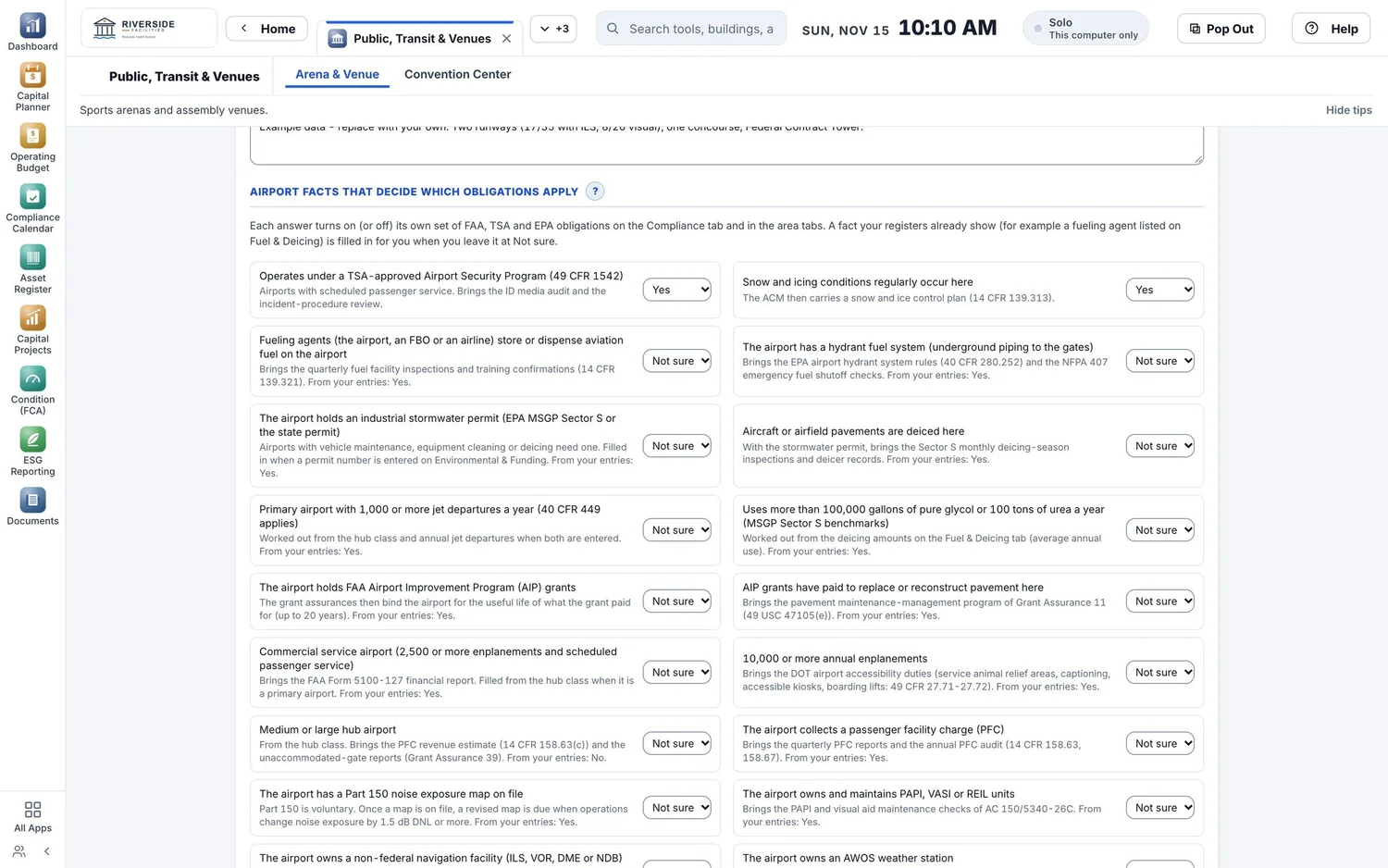
Summary in Airport & Aviation Facilities: start here. Enter the airport's code, hub class, Part 139 class, tower type and traffic, then answer the airport facts. Each fact turns its own FAA, TSA and EPA obligations on or off.
Frequently Asked Questions
Does Facilities Logix replace our Airport Certification Manual?
Can the control tower be kept separately from the airfield?
What if we do not know the answer to an airport fact?
Does it file our FAA, PFC or DBE reports?
Be First When Facilities Logix Opens
Stop chasing building records across spreadsheets and binders. Join the list and we will tell you the day downloads open, with setup guides ready.
Launching early 2027 for Facilities Logix. Nothing to buy today, and no sales calls.
