
Everything Your Team Stocks to Run the Buildings, in One Record.
A repair waits when nobody knows where the part is or whether it is in stock. Parts & Supplies Inventory covers more than spare parts. It tracks MRO parts and critical spares, filters, janitorial and cleaning supplies, paper and restroom products, liners, maintenance chemicals, PPE, lamps and batteries, grounds and ice melt, office and break-room supplies, and a tool crib, across every storeroom, closet, cart and truck.
Launching Early 2027 · Join the Early-Access List
From the Shelf to the Purchase Order
Dashboard
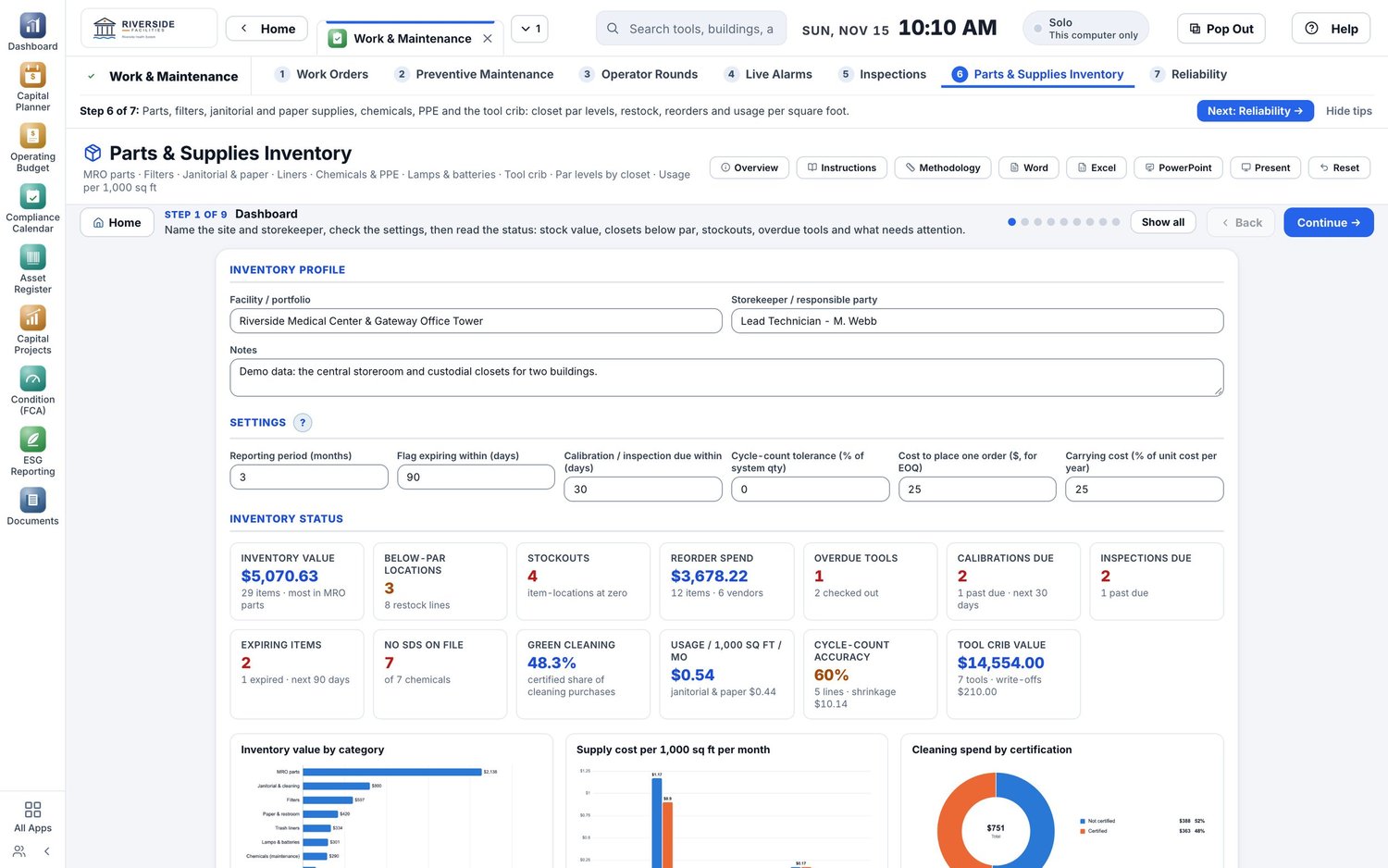
Status tiles, three charts and a Needs Attention list: stockouts, locations below par, overdue tools and expiring stock.
Learn MoreShow Less
A stockout stops a job, and overstock ties up cash. The Dashboard shows both before they cost money.
- Settings for reporting period, expiry windows and cycle-count tolerance
- Order and carrying cost settings used in the order quantity
- The Executive Dashboard shows stock value, stockouts and reorder spend
- Overdue tools and expiring stock in Needs Attention
Items
Each item's group, unit, pack size, home storeroom, on hand, unit cost, reorder point, reorder quantity and maximum, with its preferred vendor and the asset it serves.
Learn MoreShow Less
Ordering by feel buys too much of one thing and too little of another. Reorder points and quantities are worked out from your own usage.
- Reorder point = weekly usage x lead time + safety stock
- Safety stock at 95 percent service uses z = 1.645
- Order quantities rounded up to whole packs
- An optional economic order quantity from order and carrying cost
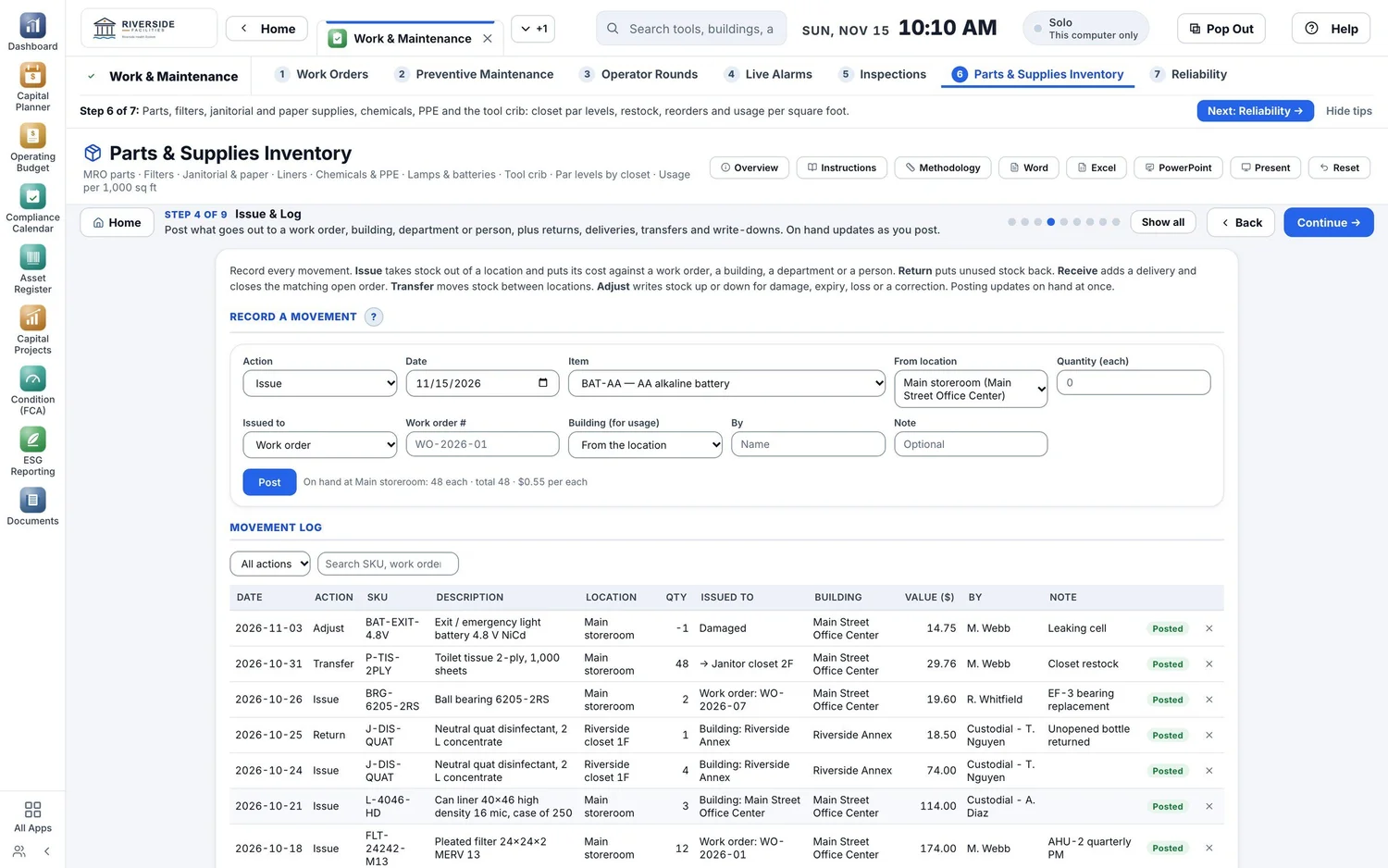
Issue & Log in Parts & Supplies Inventory: post what goes out to a work order, building, department or person, plus returns, deliveries, transfers and write-downs. On hand updates as you post.
Locations & Par
Every storeroom, janitor closet, custodial cart, tool crib and truck by building and floor, each with a minimum and maximum for the items it keeps.
Learn MoreShow Less
A closet that runs out sends someone across campus for supplies. Par levels move stock before it runs out.
- Restock is triggered at each location's Min
- Need = Max minus on hand, filled from the home storeroom
- The emptiest location is filled first
- Post All Restock Moves updates every location at once
Issue & Log
Issue to a work order, building, department or person. Return, receive, transfer and adjust. Every post changes on hand at once.
Learn MoreShow Less
Parts that leave the storeroom unrecorded are a cost nobody can explain. Every movement is posted to a work order, building, department or person.
- Adjust with a reason: damaged, expired, lost, found or correction
- Parts issued to each work order totaled into its internal cost
- Technicians issue parts from the phone, from a storeroom at that building
- Bin, item and tool labels open the right screen when scanned
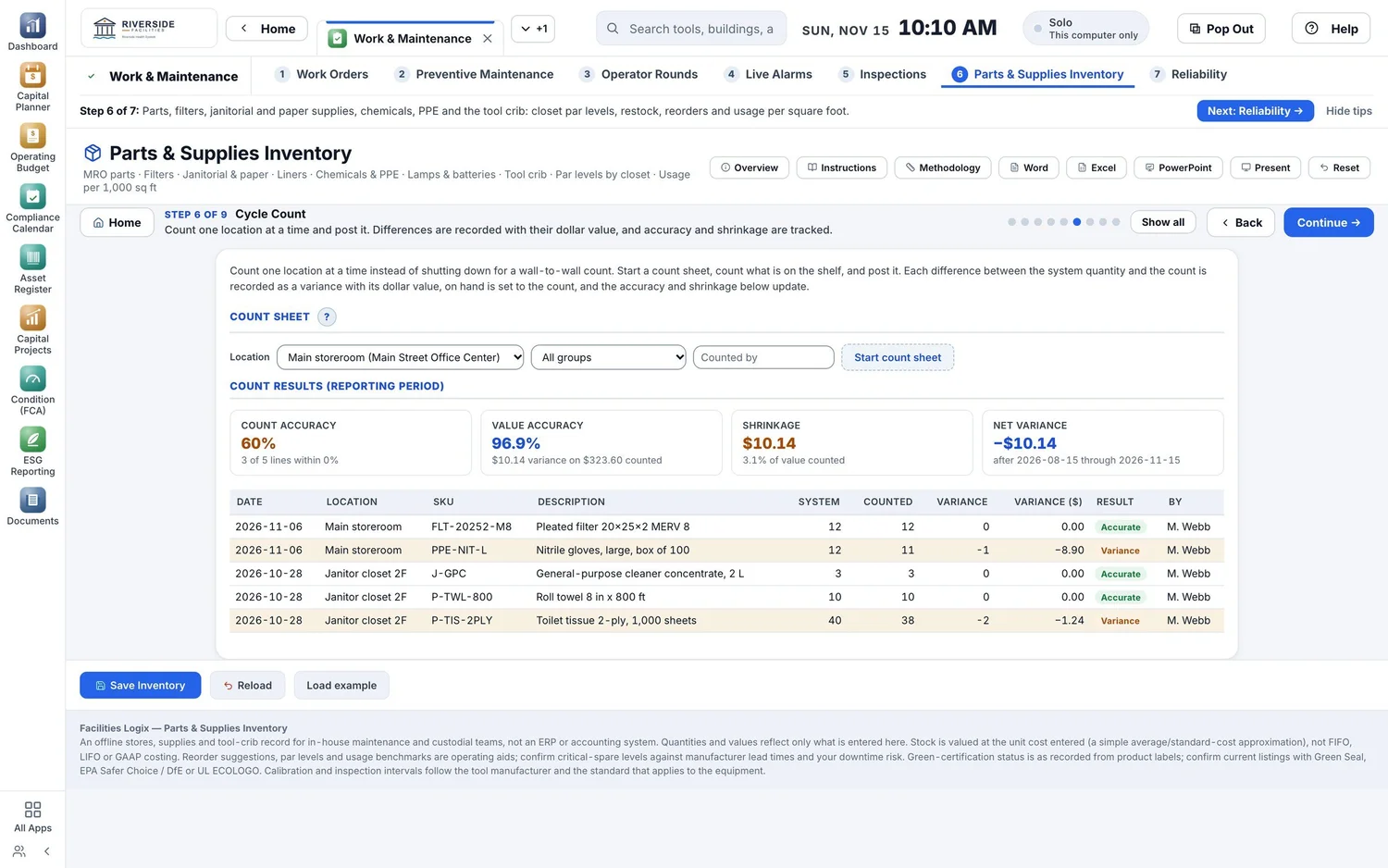
Cycle Count in Parts & Supplies Inventory: count one location at a time and post it. Differences are recorded with their dollar value, and accuracy and shrinkage are tracked.
Restock & Reorder
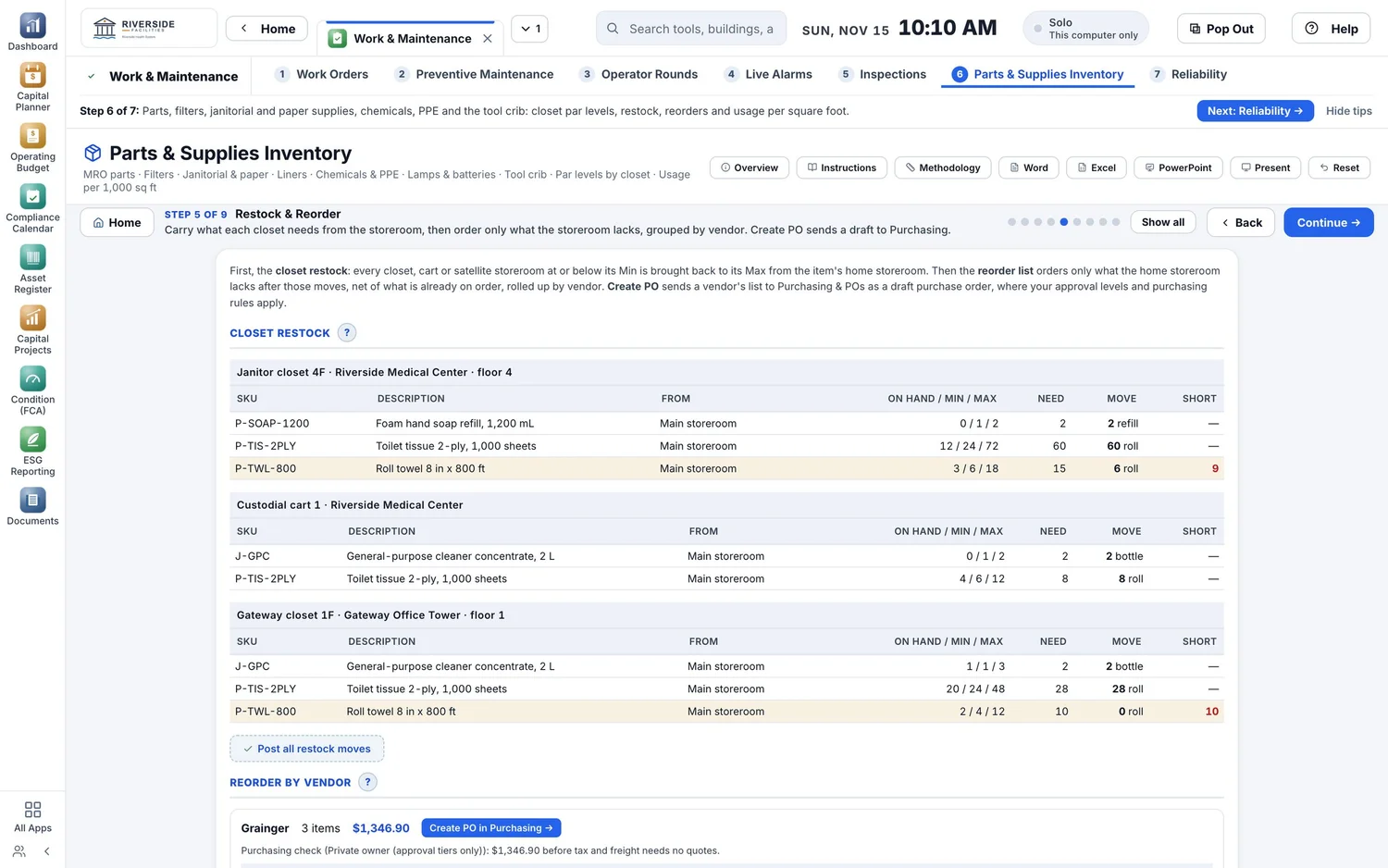
The closet restock list, the reorder list by vendor with Create PO, what is on order, and a reorder-point calculator.
Learn MoreCycle Count
Count one location at a time and post the count. Accuracy, value accuracy and shrinkage are worked out for you.
Learn MoreShow Less
Shrinkage that is never measured is never stopped. Counting one location at a time puts a number on it.
- Accuracy = lines within tolerance / lines counted x 100
- Value accuracy = (1 - total dollar variance / system value) x 100
- Shrinkage = the total of losses found
- On the phone, counts are blind by default
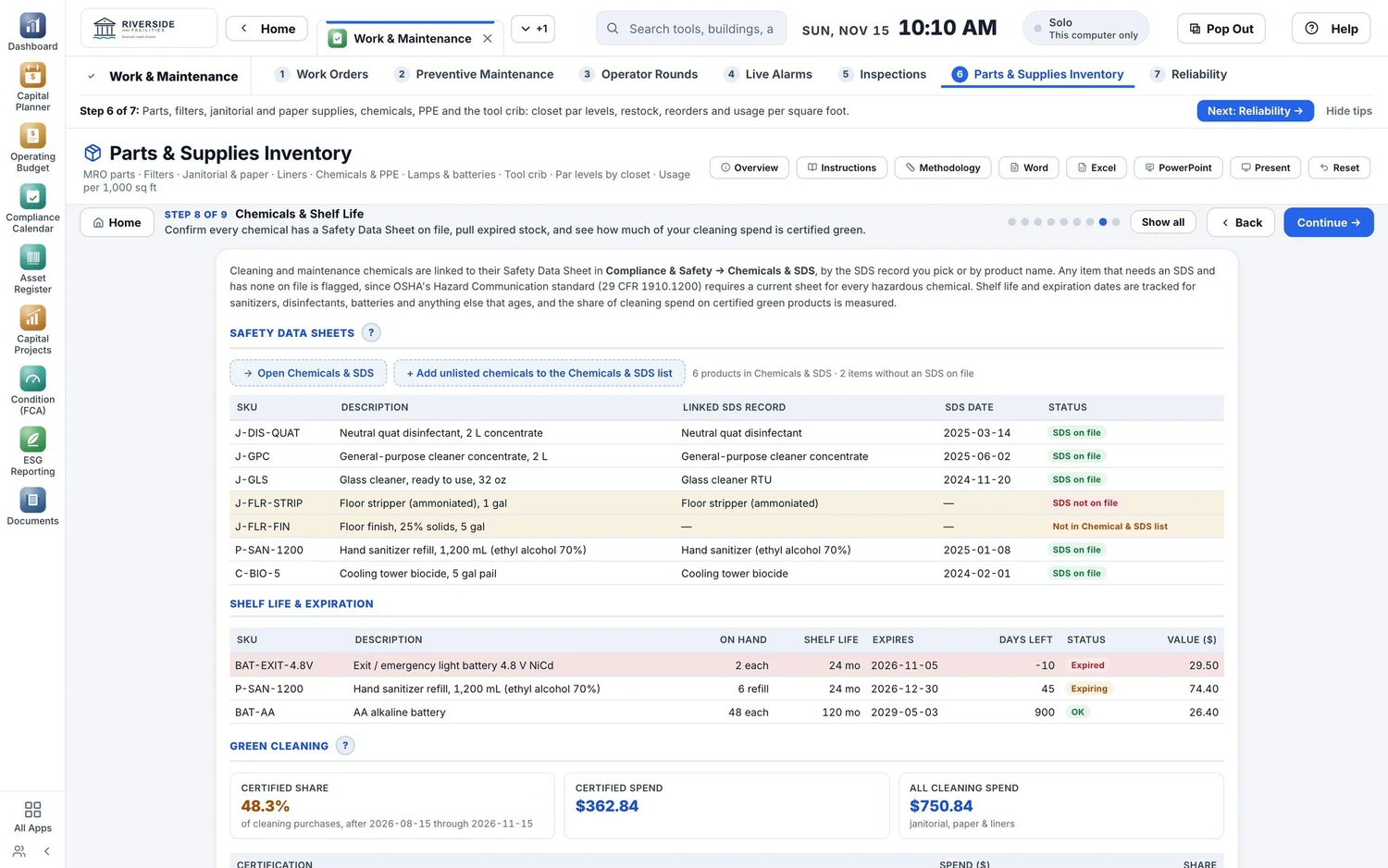
Chemicals & Shelf Life in Parts & Supplies Inventory: confirm every chemical has a Safety Data Sheet on file, pull expired stock, and see how much of your cleaning spend is certified green.
Tool Crib
Tools by tag and serial: check out with a due-back date, check in with condition, calibration and inspection dates, repairs and write-offs.
Learn MoreShow Less
Lost tools get bought twice, and an out-of-calibration meter gives readings nobody should trust. The crib tracks who has what and what is due.
- Overdue lists for tools past their due-back date
- Calibration and inspection due within the window, past due included
- Replacement value of the crib = cost of tools in service
- Check out and check in from the phone
Chemicals & Shelf Life
Every item that needs a safety data sheet with its linked record, expired and expiring stock, and your green-cleaning share.
Learn More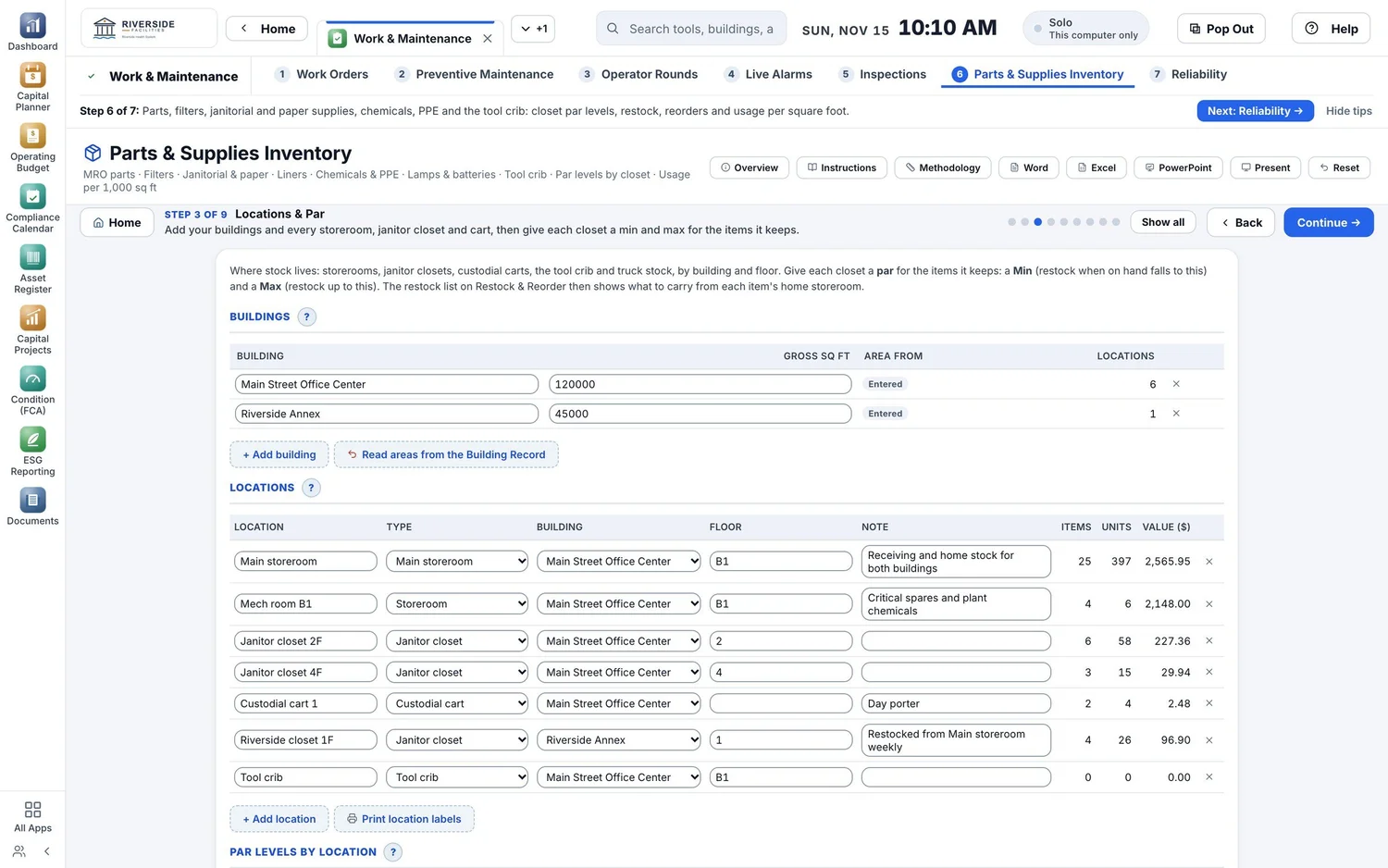
Locations & Par in Parts & Supplies Inventory: add your buildings and every storeroom, janitor closet and cart, then give each closet a min and max for the items it keeps.
Usage & Benchmarks
Usage per building and per 1,000 square feet per month, by group and by item, exported to Word, Excel or PowerPoint.
Learn MoreShow Less
Supply spend that cannot be compared across buildings cannot be managed. Usage is normalized by floor area so buildings line up.
- Usage per 1,000 sq ft per month = issues less returns / (sq ft / 1,000) / months
- A janitorial column that counts janitorial, paper and liner items only
- Green-cleaning share by certification, such as Green Seal or EPA Safer Choice
- Floor area read from the Building Record where names match
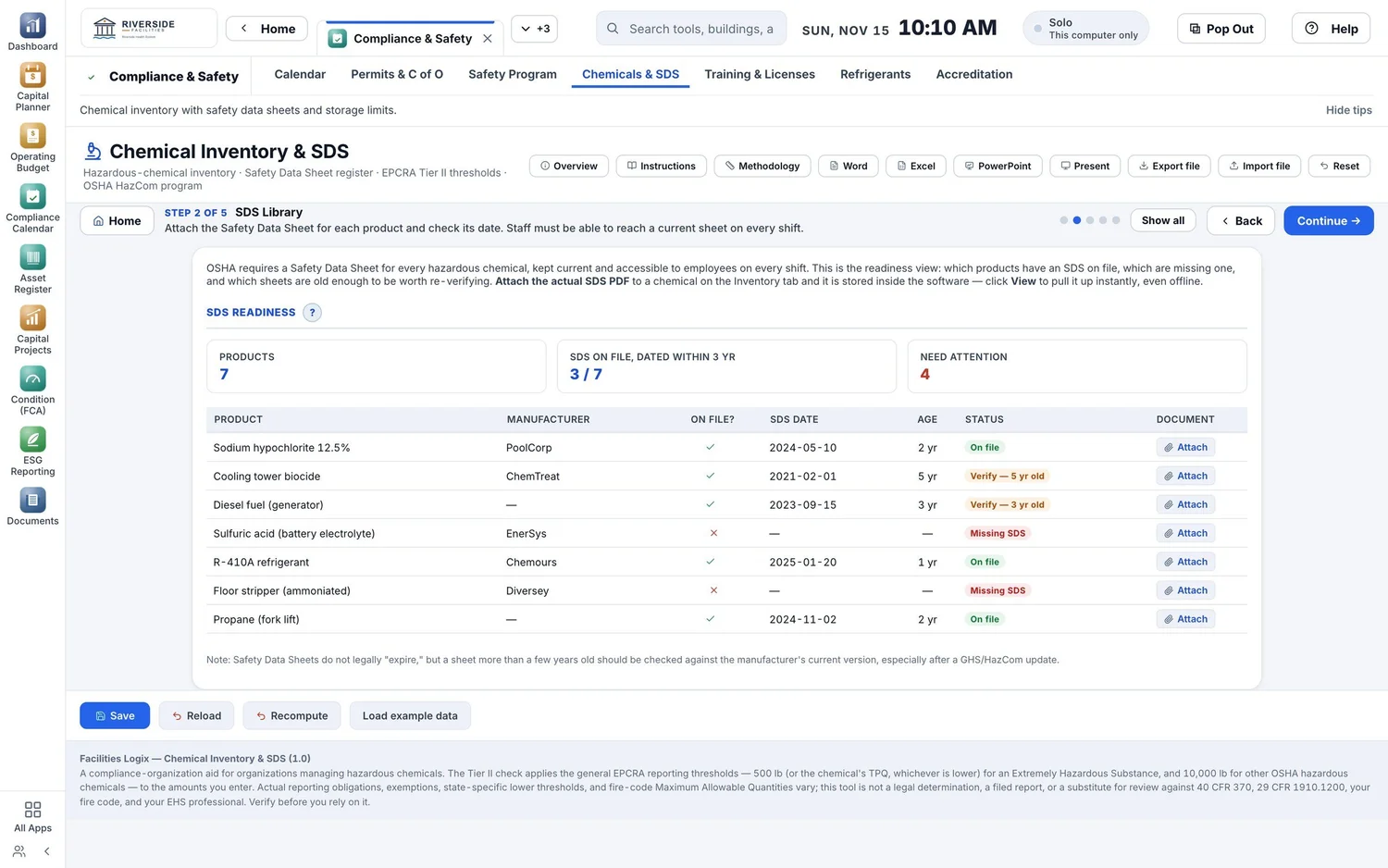
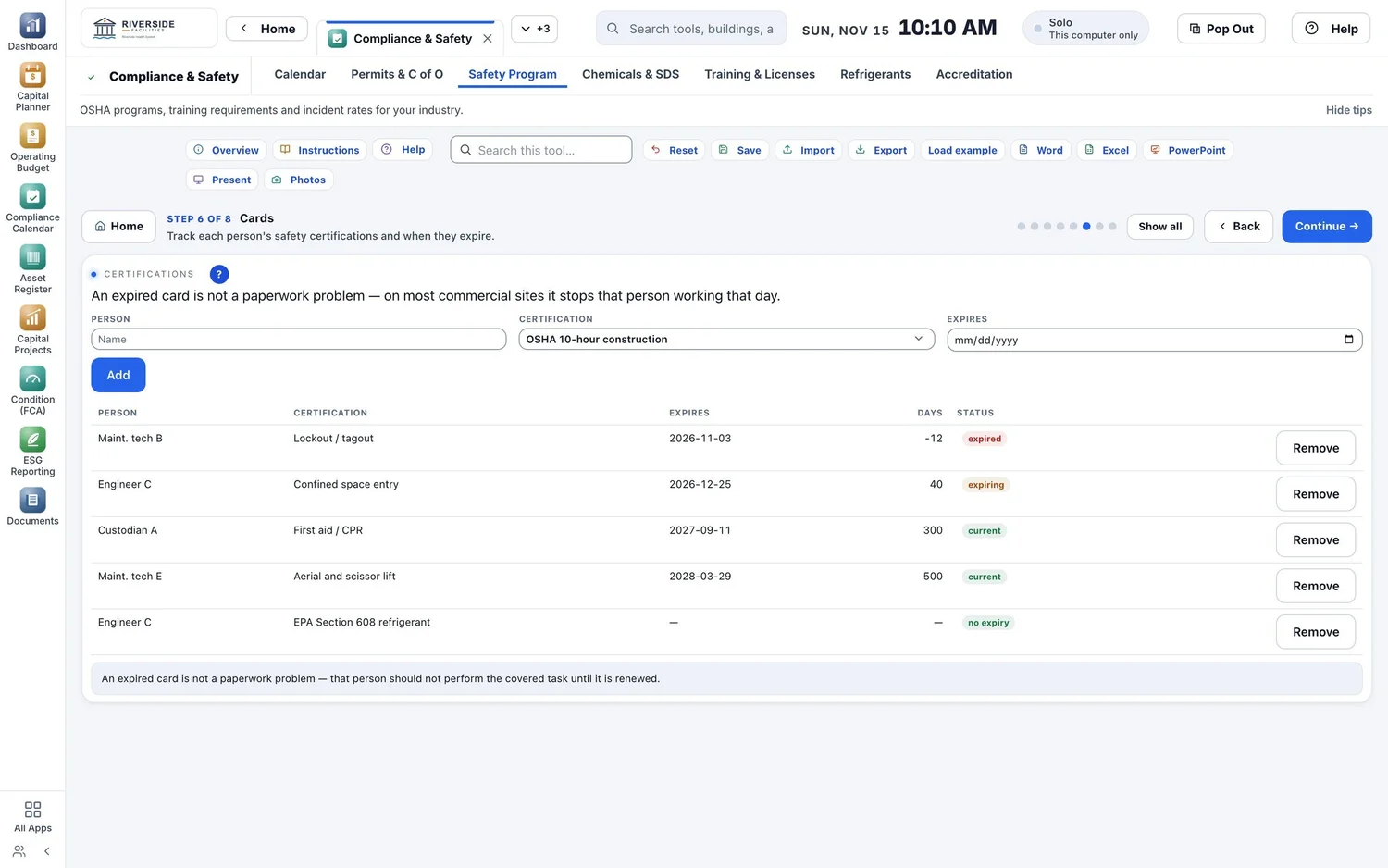
SDS Library in Chemical Inventory & SDS: attach the Safety Data Sheet for each product and check its date. Staff must be able to reach a current sheet on every shift.
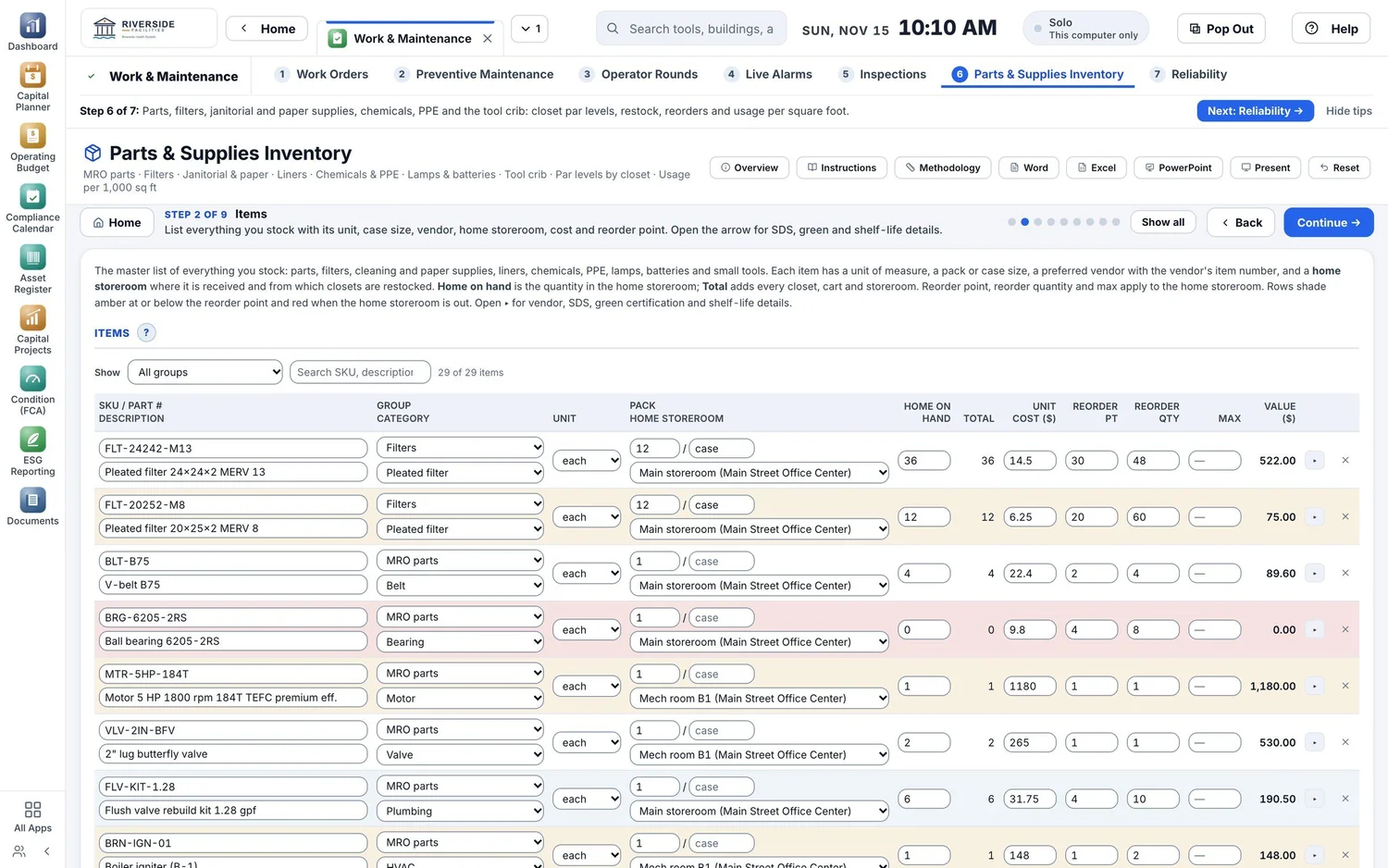
Parts hunted for at the last minute delay repairs, so each item shows where it is and how many are on hand.
The Math Is Done for You, and Shown
Closet Par Levels
- A location needs restocking when on hand falls to its minimum; the need is the maximum less on hand
- Needs are filled from the item's home storeroom, emptiest location first
- Post All Restock Moves records every transfer in one step
- Shortfalls the storeroom cannot fill flow into the reorder
Reorder
- Net position counts stock on hand, stock moved to closets, stock on order and any closet shortfall
- Quantities round up to whole packs or cases
- A reorder point from your own usage: weekly usage times lead time plus safety stock
- An optional economic order quantity from annual usage, order cost and carrying cost
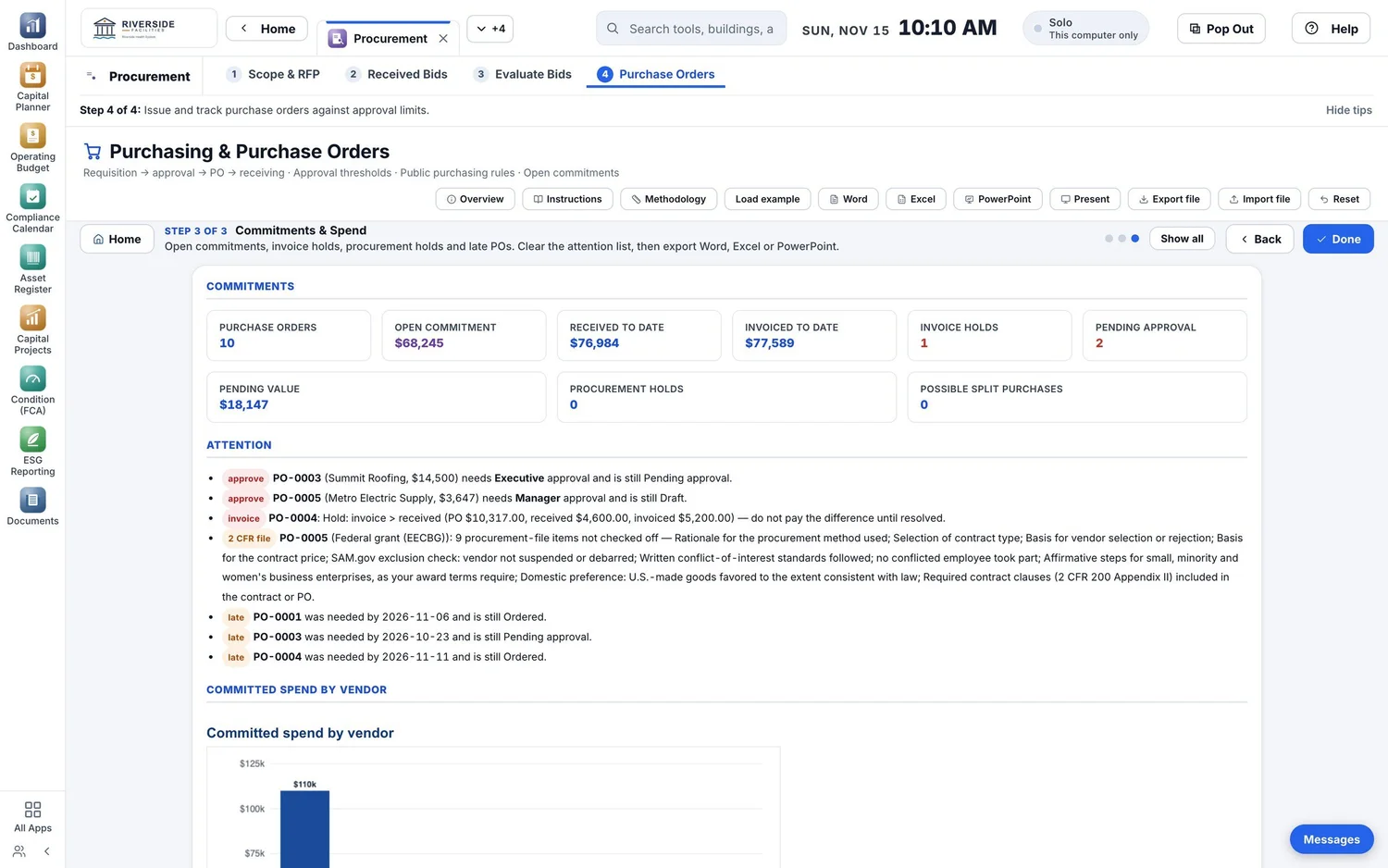
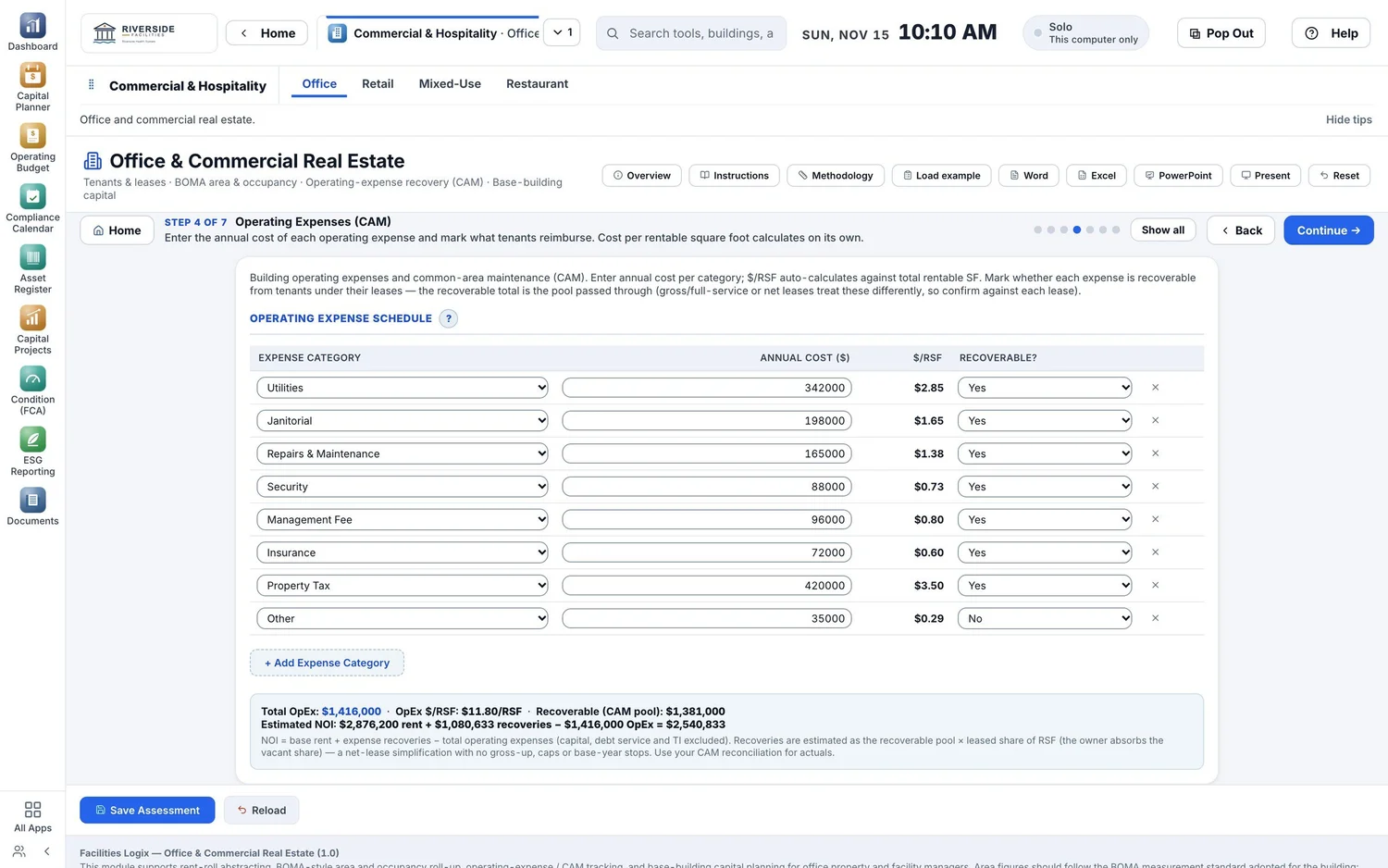
Commitments & Spend in Purchasing & Purchase Orders: open commitments, invoice holds, procurement holds and late POs. Clear the attention list, then export Word, Excel or PowerPoint.
Into Purchasing
- Create PO sends that vendor's lines to Procurement as a draft purchase order
- The draft gets the same approval level, required purchasing method and split-purchase check as any purchase
- Lines count as on order until your team clicks Receive
- Supplier price lists in Invoices & Payables match to items, keep price history and receive onto the shelf
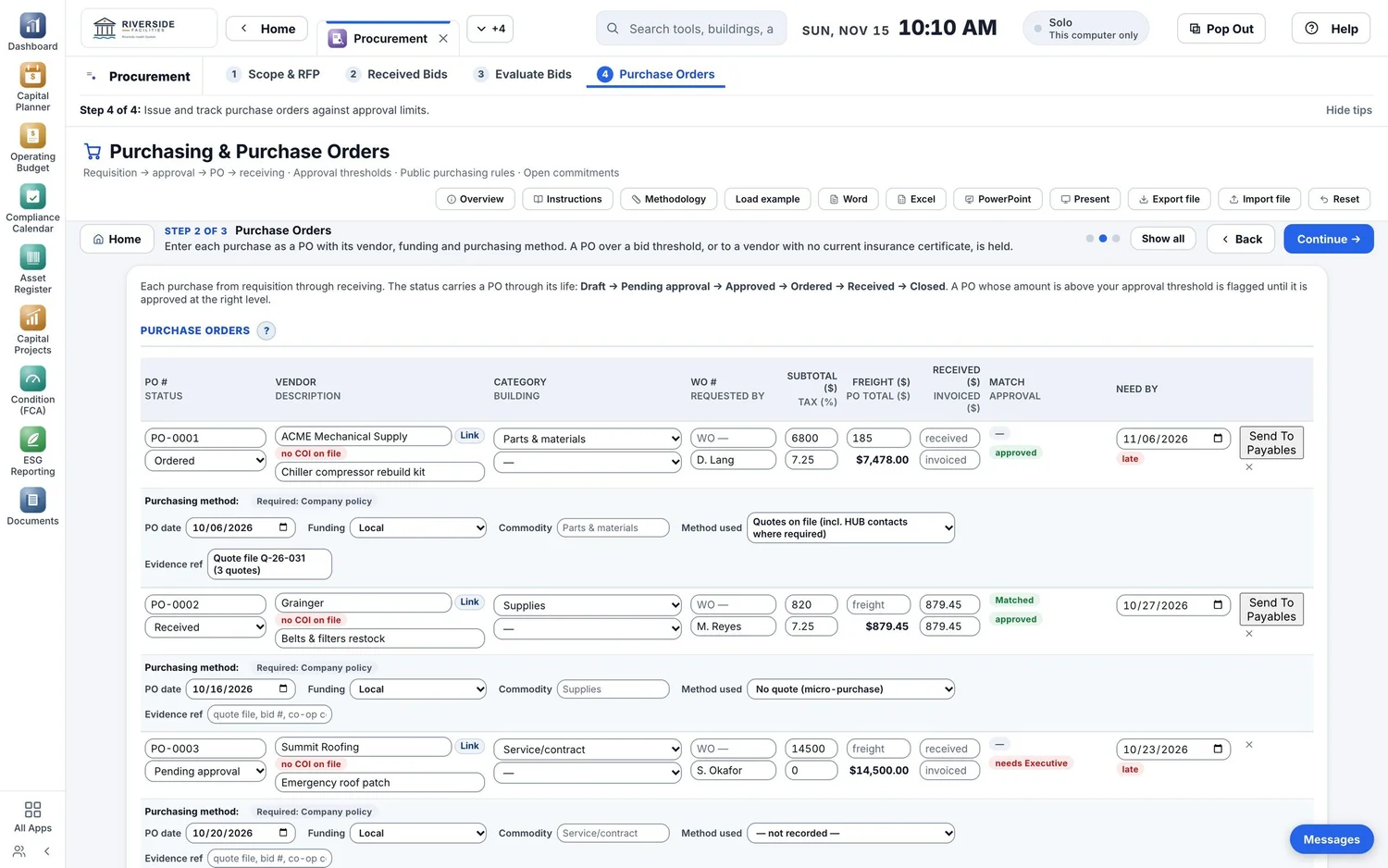
Purchase Orders in Purchasing & Purchase Orders: enter each purchase as a PO with its vendor, funding and purchasing method. A PO over a bid threshold, or to a vendor with no current insurance certificate, is held.
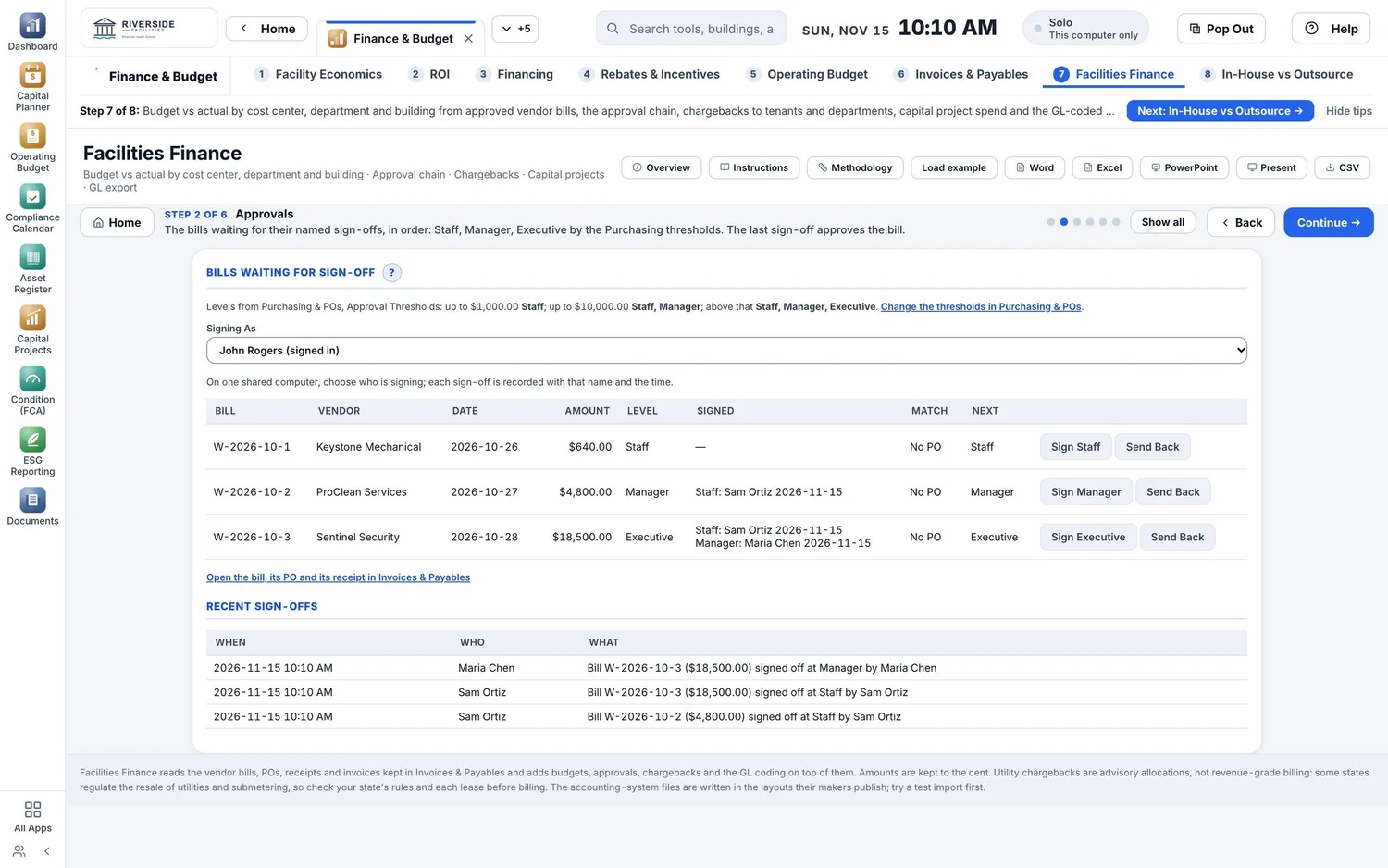
Know Where the Torque Wrench Is and Whether the Sheet Is on File
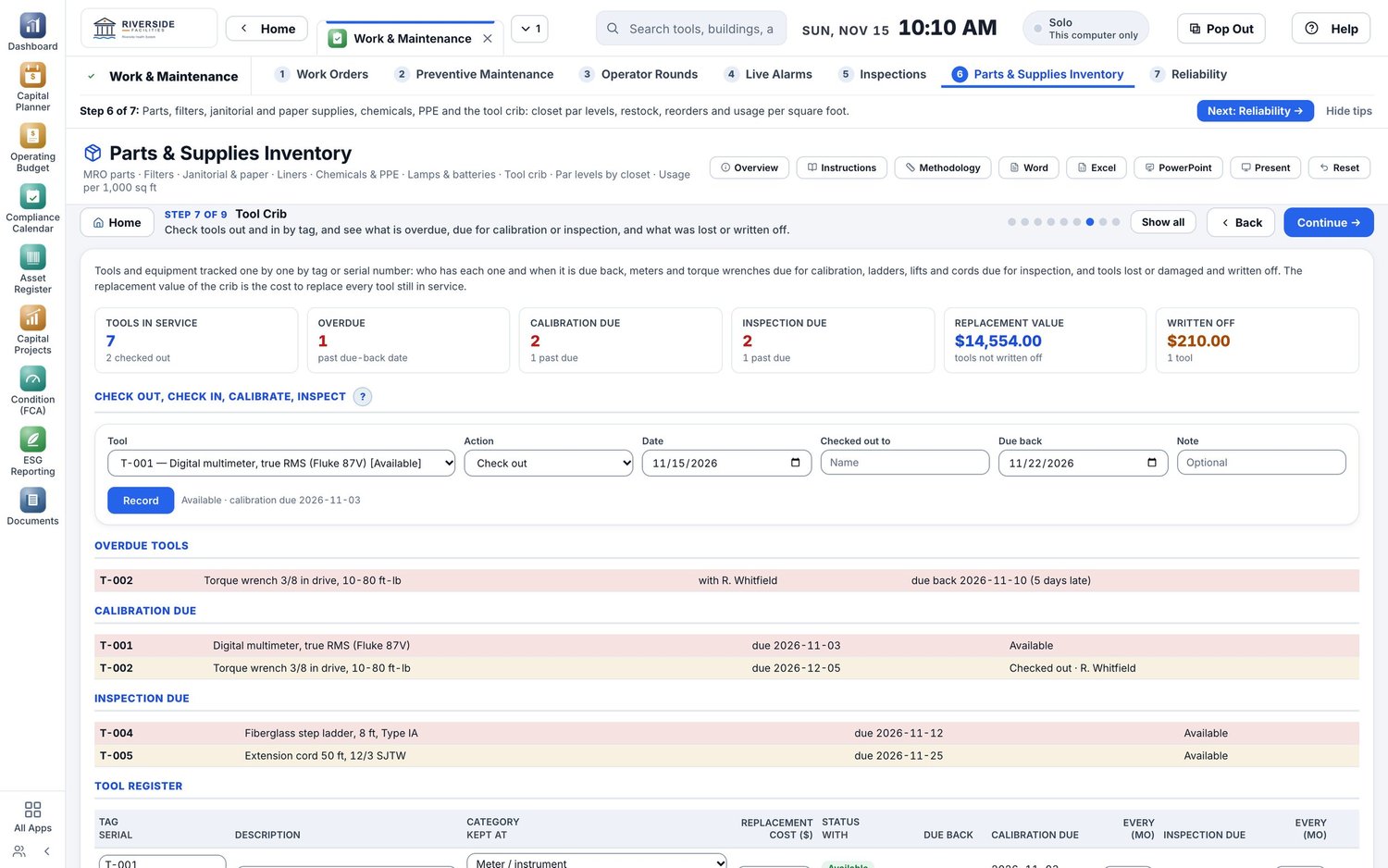
The Tool Crib
Each tool has a tag and a serial number. Check it out to a person with a due-back date and check it in with its condition. Overdue, calibration-due and inspection-due lists keep meters, torque tools and ladders from being used past their dates, and the crib's replacement value is always known.
Chemicals and Safety Data Sheets
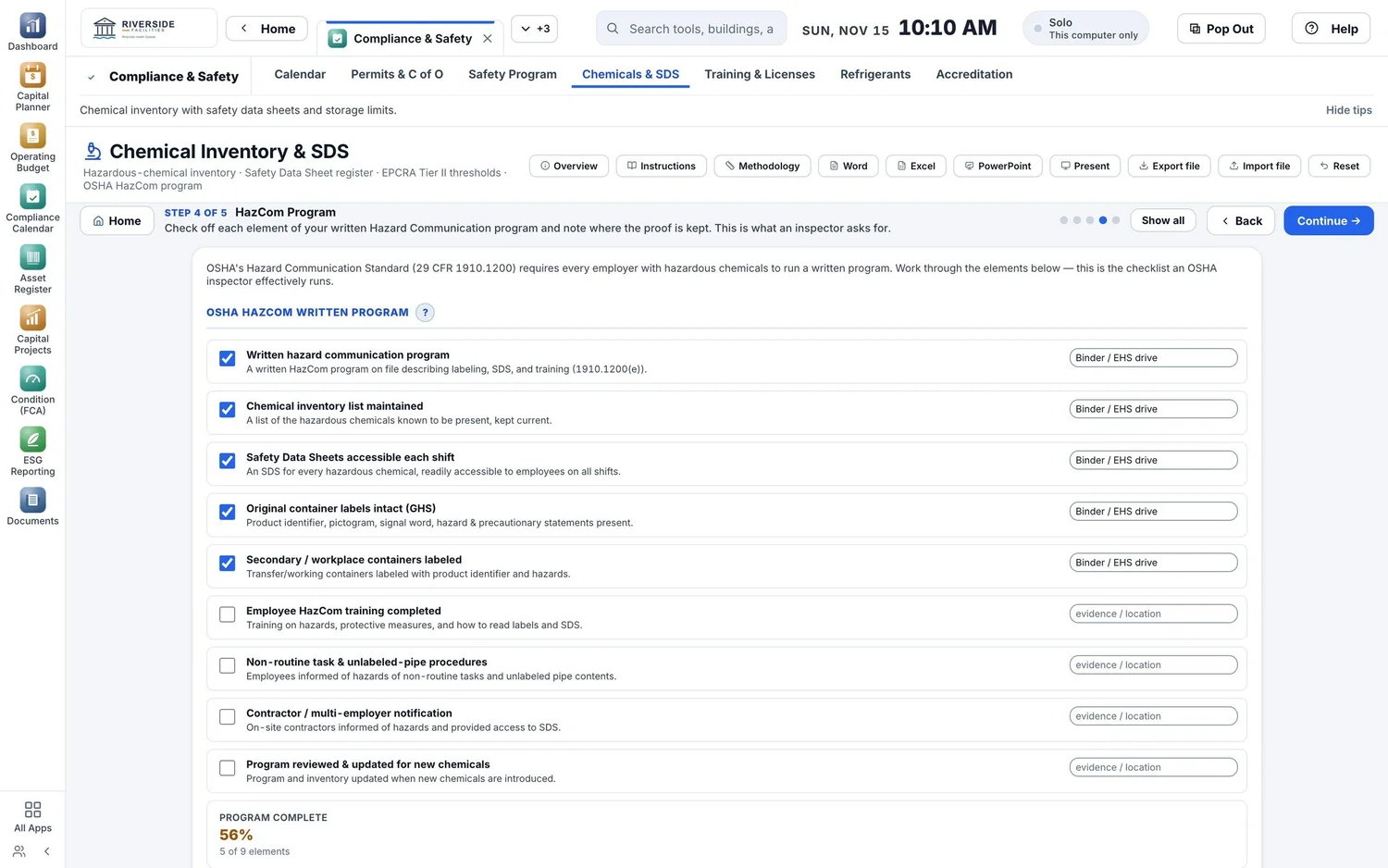
Items marked as needing a safety data sheet link to the Chemicals & SDS record in Compliance & Safety. The tab shows which have a sheet on file and which do not, adds unlisted chemicals to the chemical inventory, and reports the share of cleaning spend that carries a recognized green-cleaning certification.
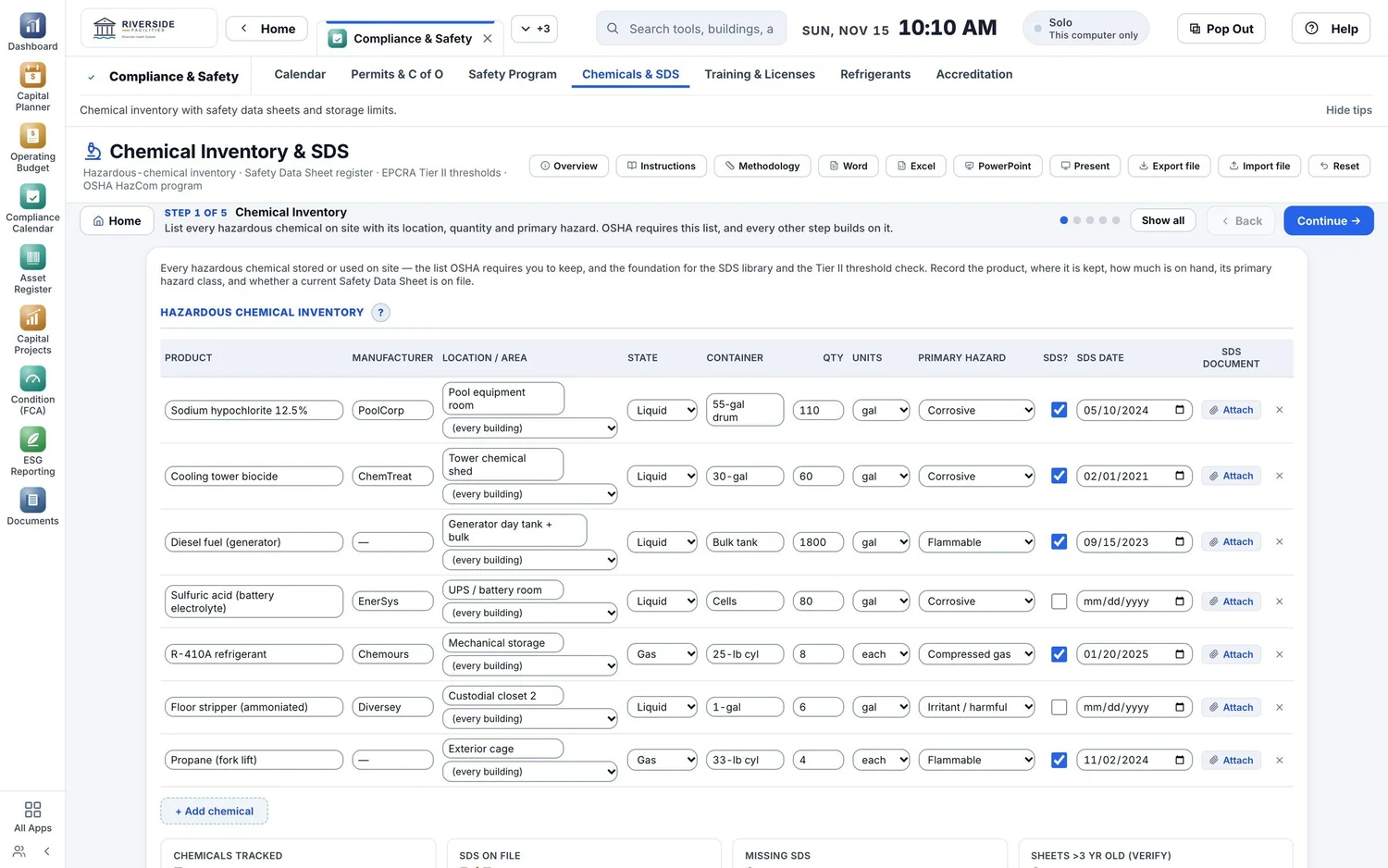
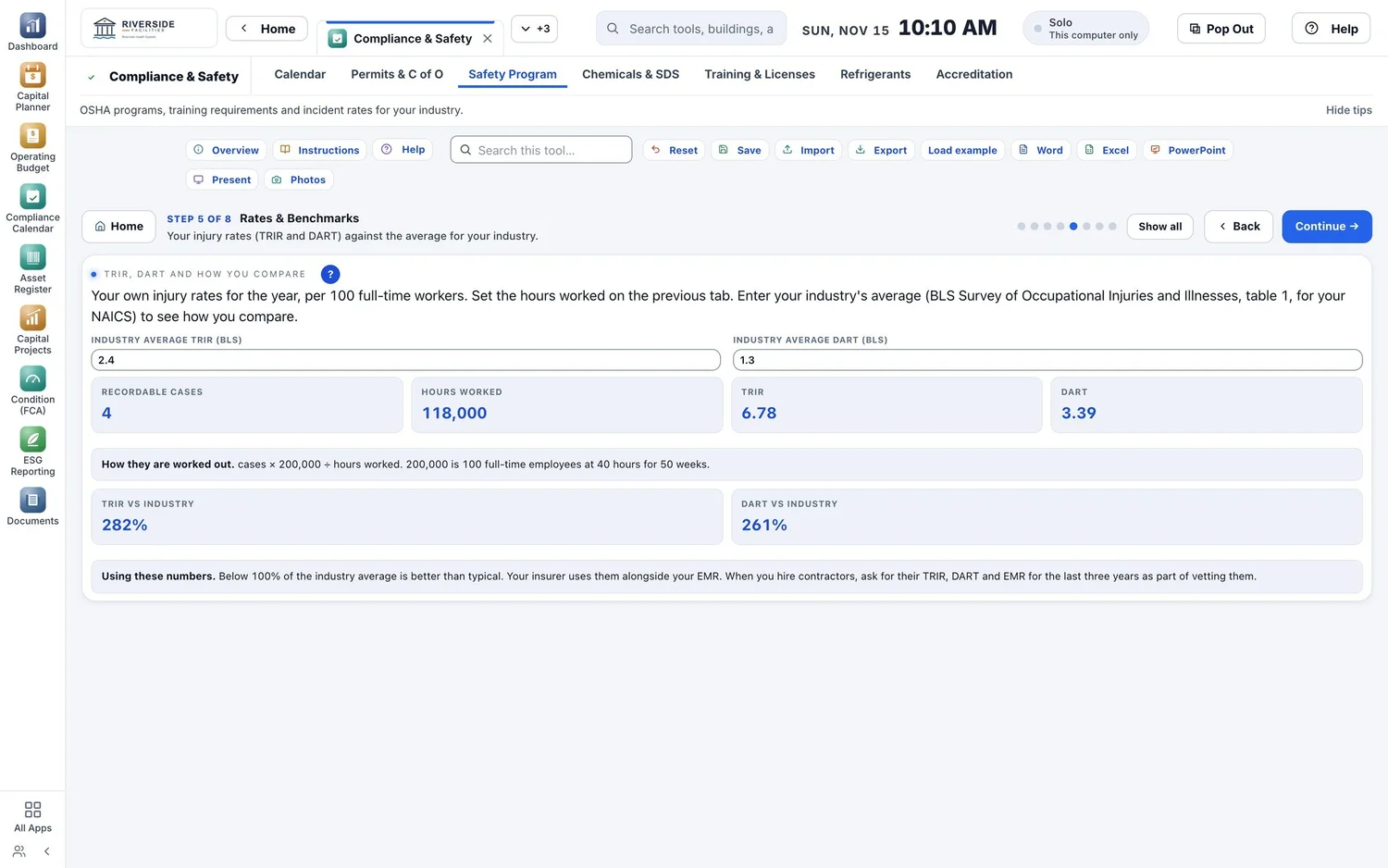
Chemical Inventory in Chemical Inventory & SDS: list every hazardous chemical on site with its location, quantity and primary hazard. OSHA requires this list, and every other step builds on it.
Stock Handled Where the Work Happens
On a Phone or Tablet
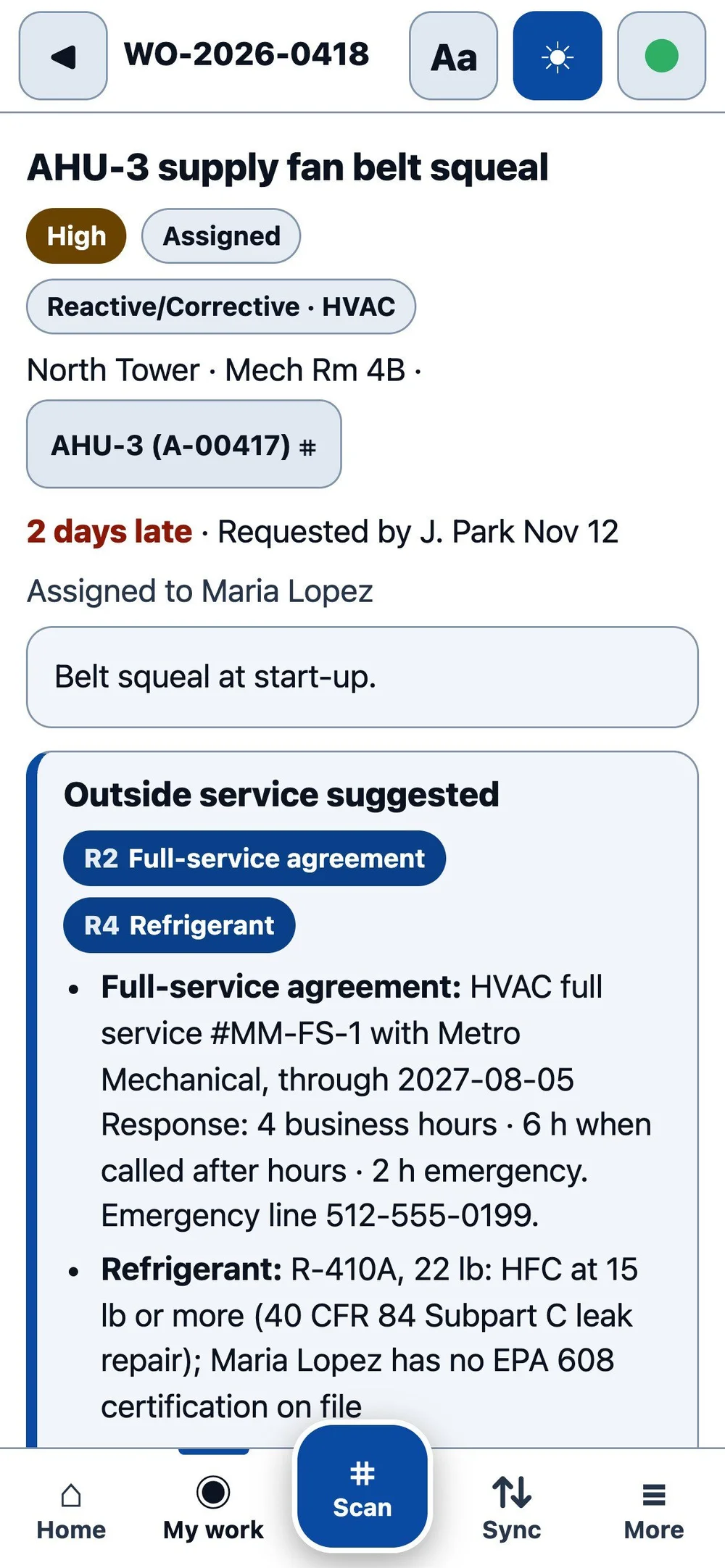
- Issue parts to a work order from a storeroom at that building
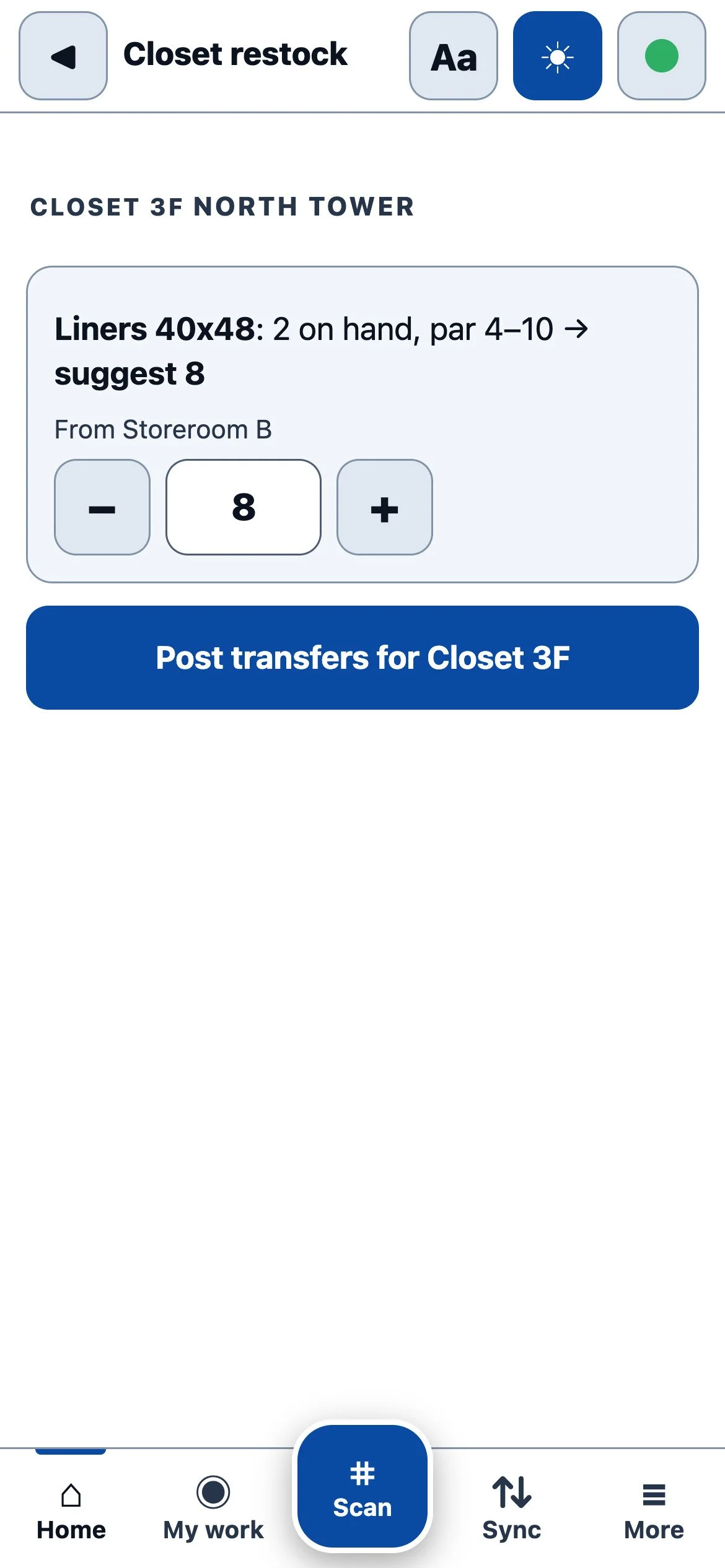
- Closet Restock: closets below par with the suggested quantity to fill
- Cycle Count, blind by default
- Tool Crib check-out and check-in
- Scan bin, item and tool labels printed from the inventory
At the Office
- Parts issued to each work order are totaled into its internal cost
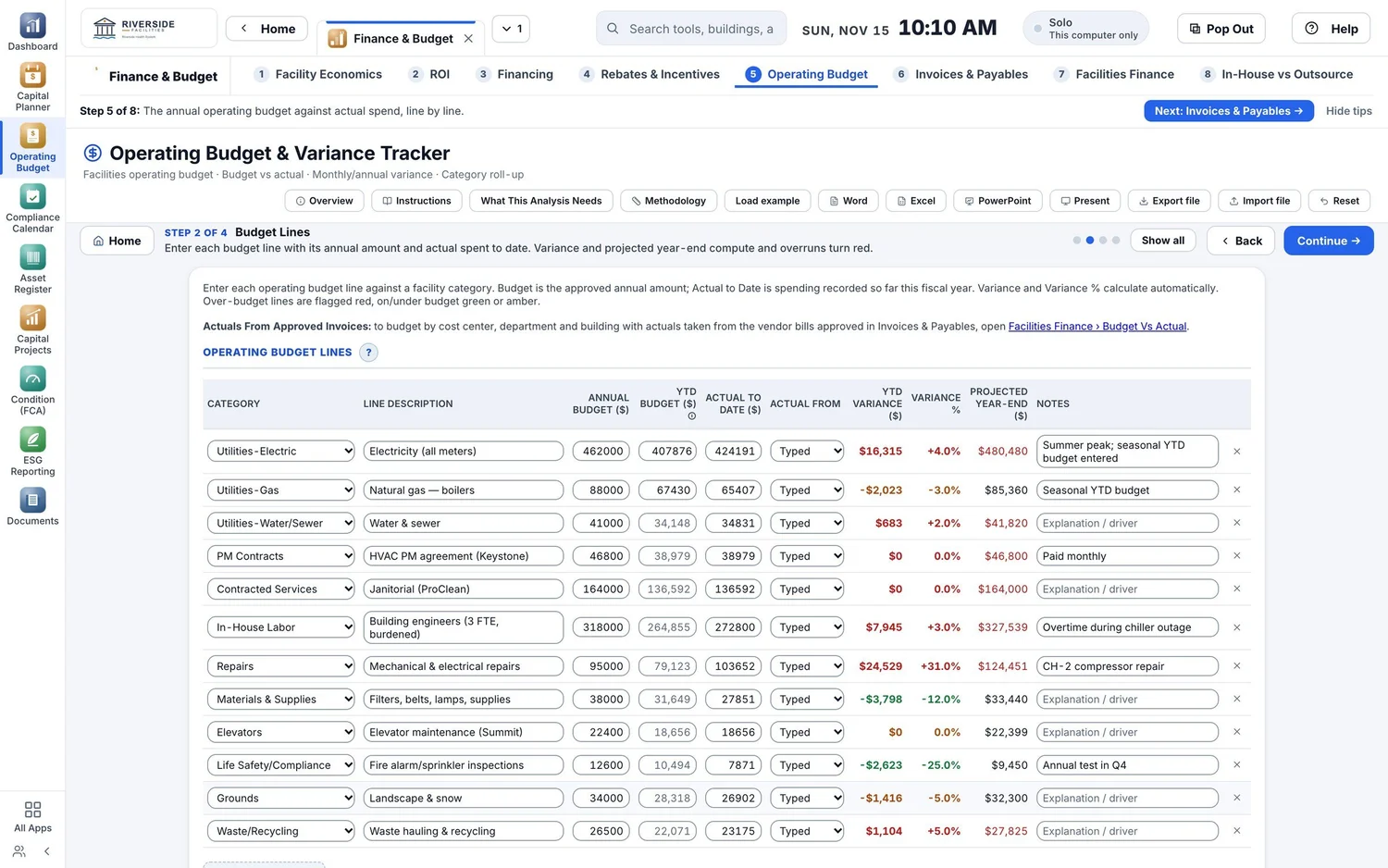
- Usage feeds the operating budget
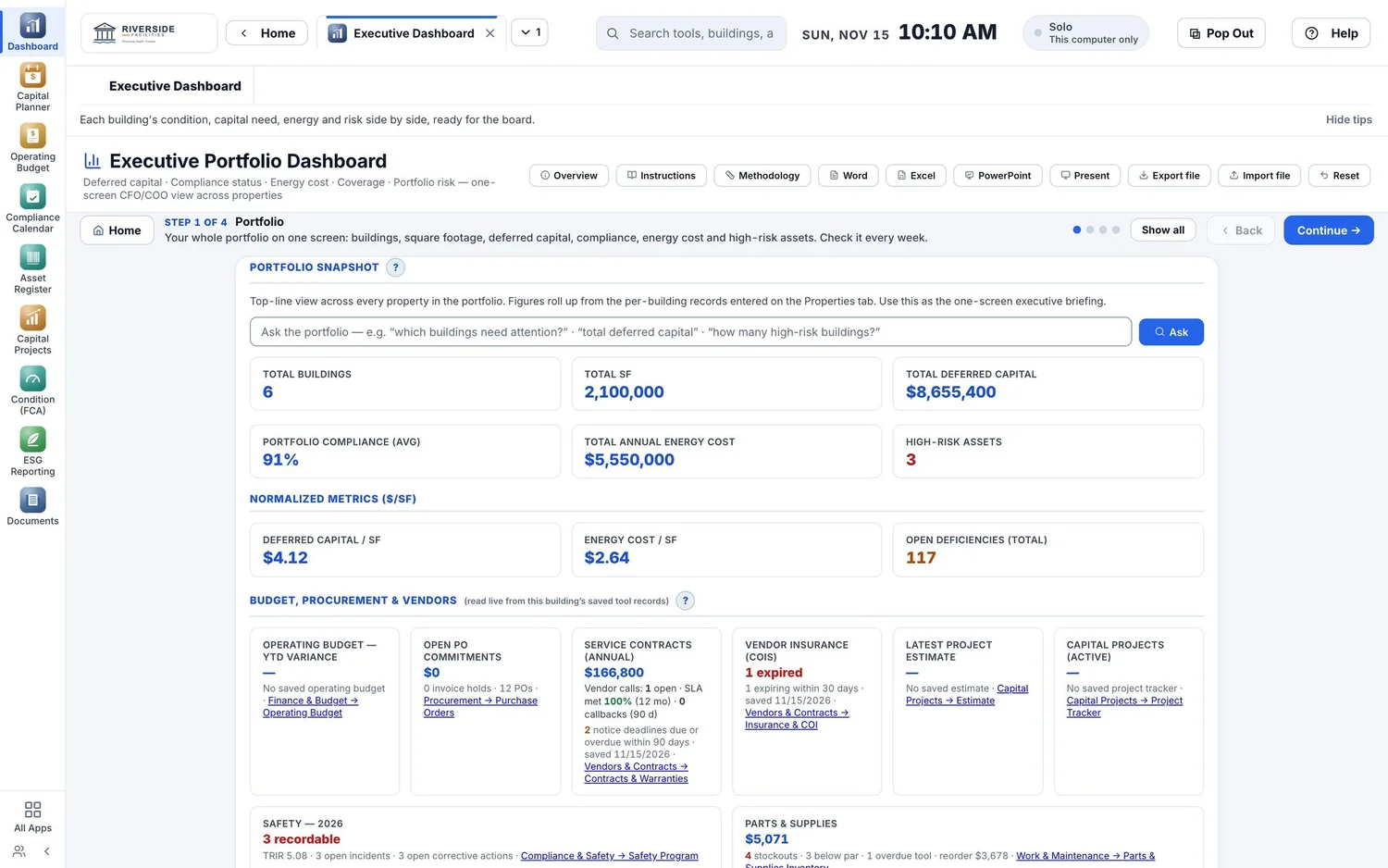
- A Parts & Supplies card on the Executive Dashboard: stock value, stockouts, locations below par, overdue tools and reorder spend
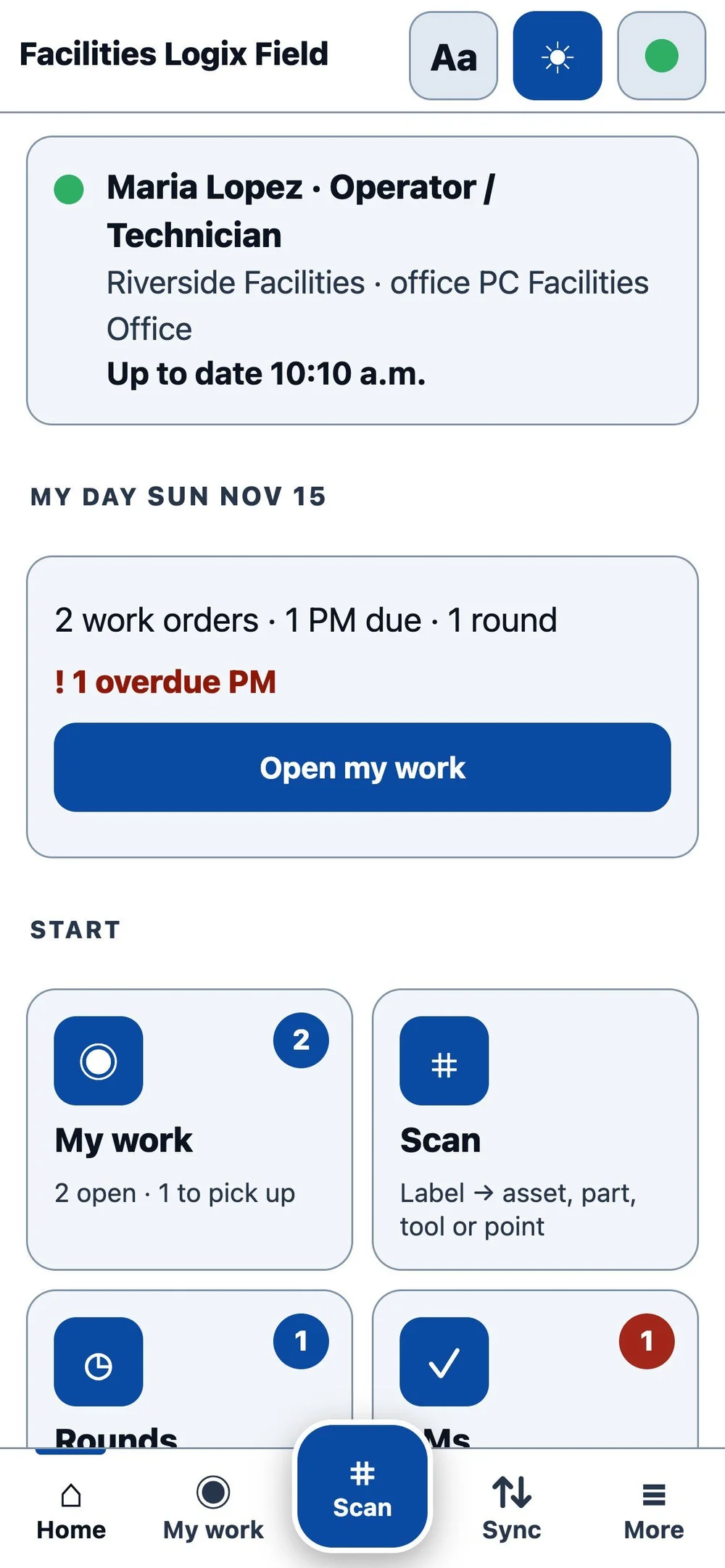
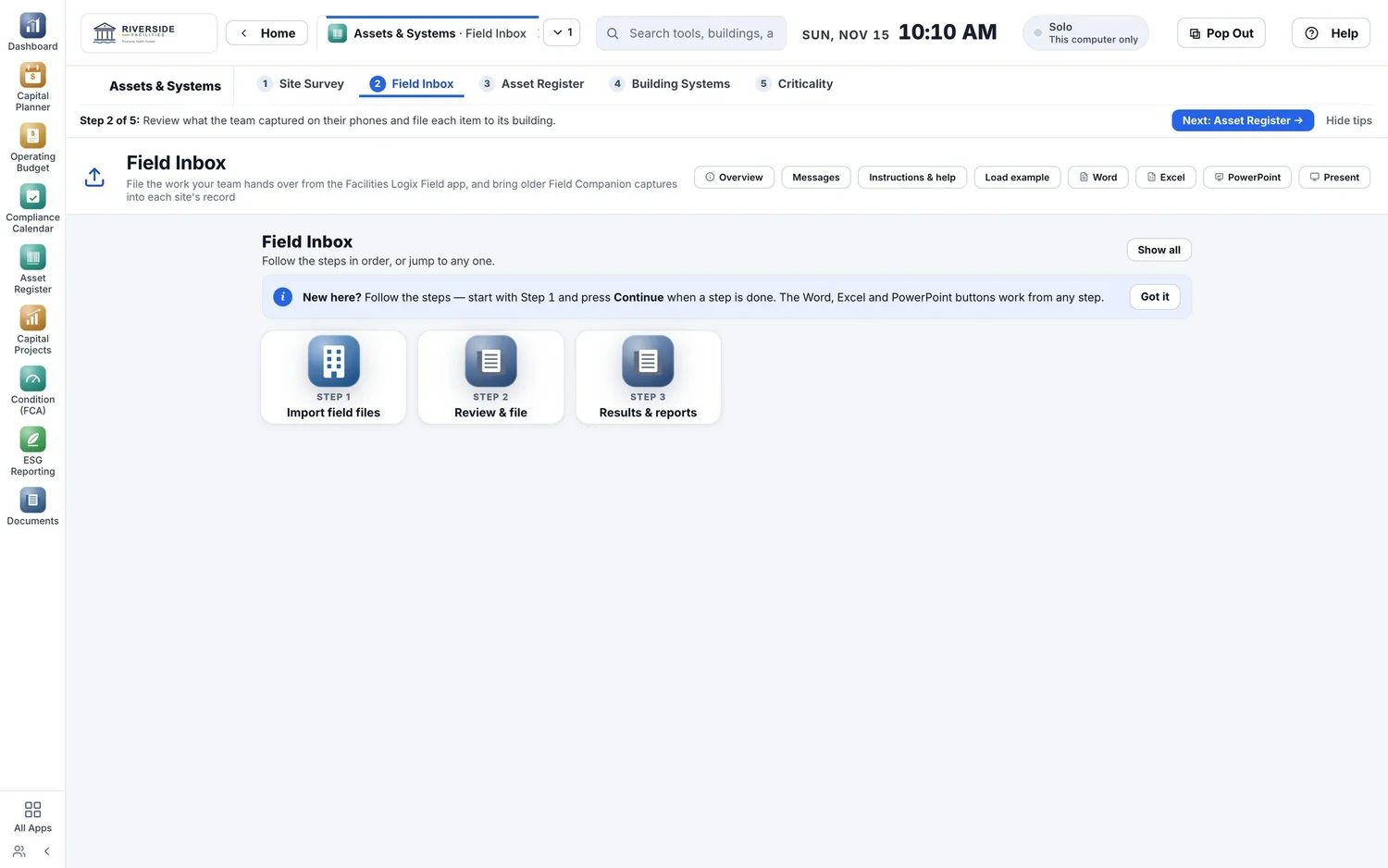
Facilities Logix Field home screen.
Less Hunting, Fewer Emergency Orders
Leadership
Stock value, shrinkage and supply spend per square foot, building by building, on the Executive Dashboard.
Learn MoreShow Less
Inventory is cash on a shelf, and leadership should see how much. Stock value and supply spend come straight from the storeroom record.
- Value = on hand x unit cost, across every location
- A case costs unit cost x pack quantity
- Shrinkage measured by cycle counts
- Reorder spend shown beside stock value
Management
Reorders that follow your purchasing rules, critical spares tied to the assets they serve and a custodial program you can benchmark.
Learn MoreShow Less
Reorders that skip purchasing rules can break a bid threshold. Reorders go through the same approvals as any purchase order.
- Create PO in Purchasing drafts the order by vendor
- The same approval level and required purchasing method as any PO
- A 12-month split-purchase check on every draft
- Received lines move from on order to on hand
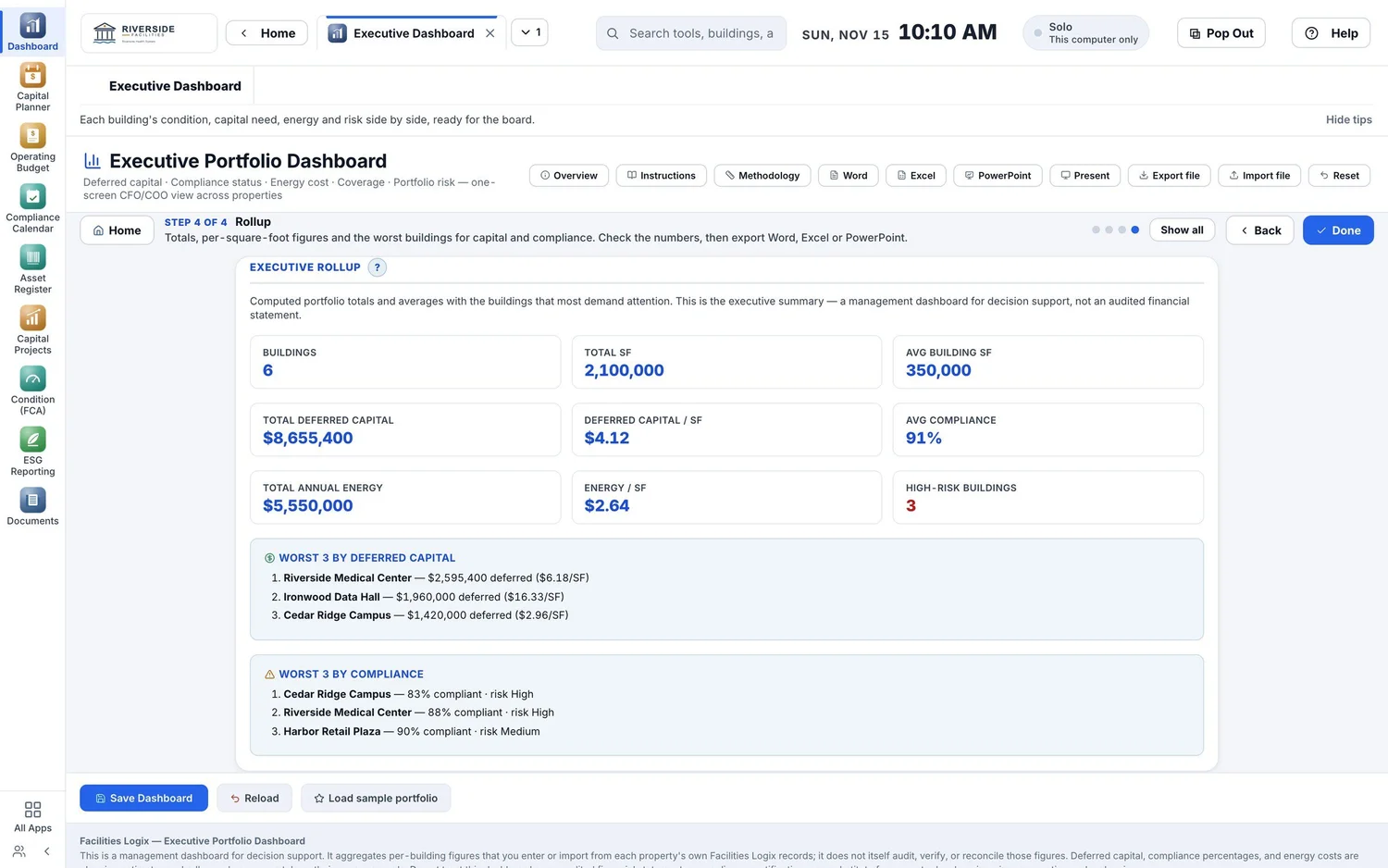
Rollup in Executive Portfolio Dashboard: totals, per-square-foot figures and the worst buildings for capital and compliance. Check the numbers, then export Word, Excel or PowerPoint.
Operations
The part is where the record says it is, the closet is stocked before it runs out, and the calibrated tool is actually calibrated.
Learn MoreShow Less
A technician hunting for a part or a tool is paid to wait. The phone shows where it is and records what was used.
- Closet Restock lists closets below par with the quantity to fill
- Add Part draws from storerooms at the job's building
- Tool check out and check in at the crib
- Every scan of a label opens the right item
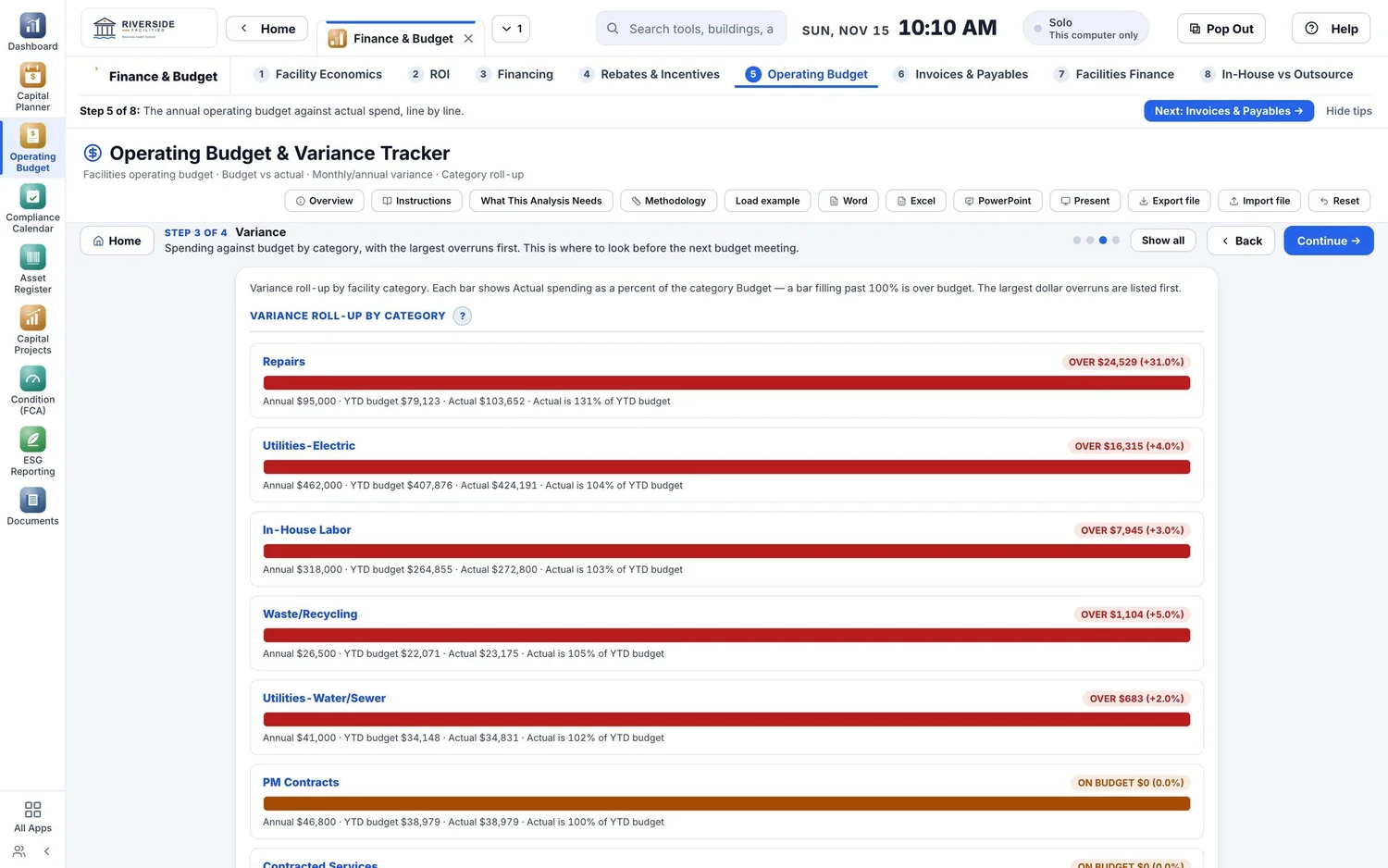
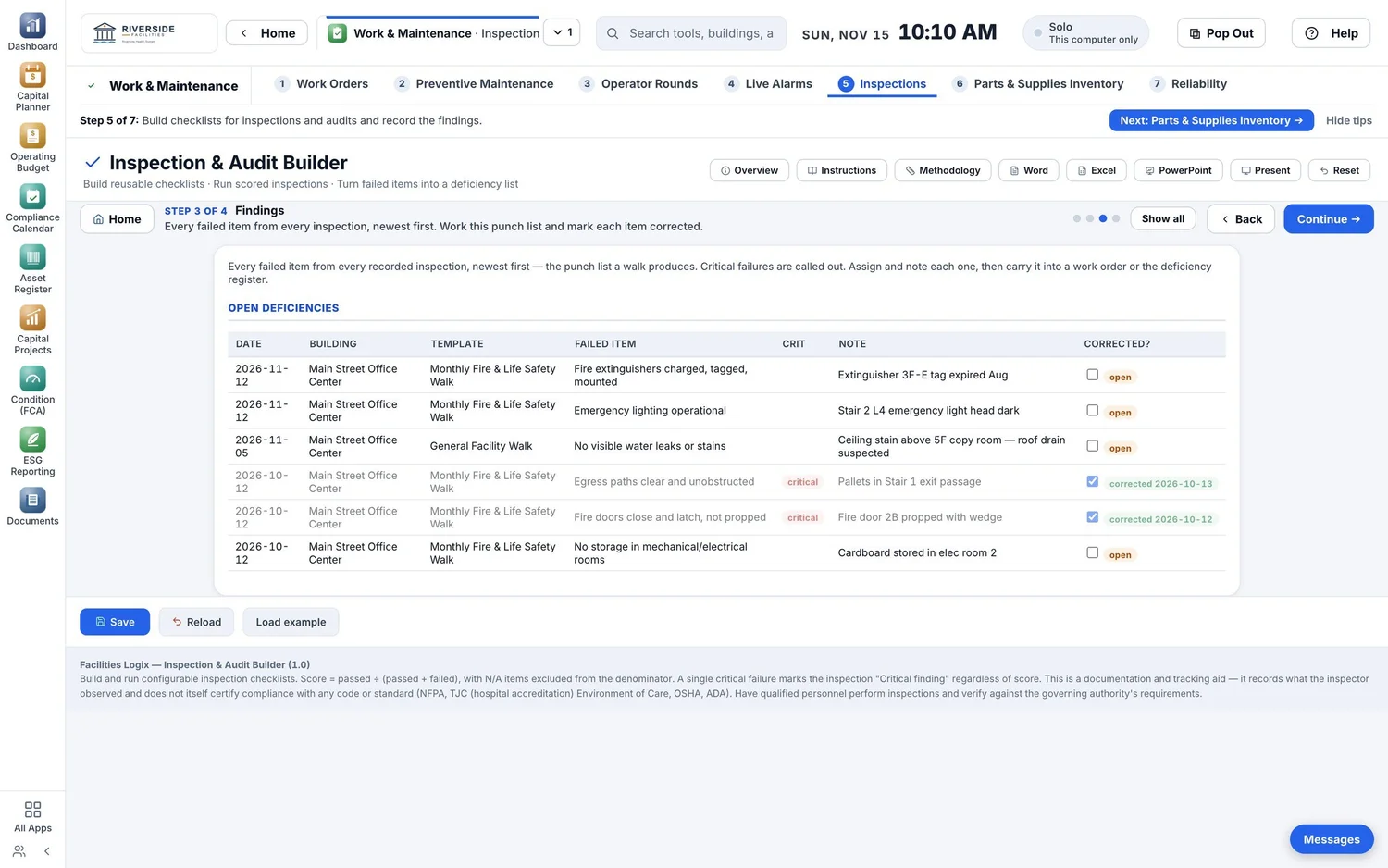
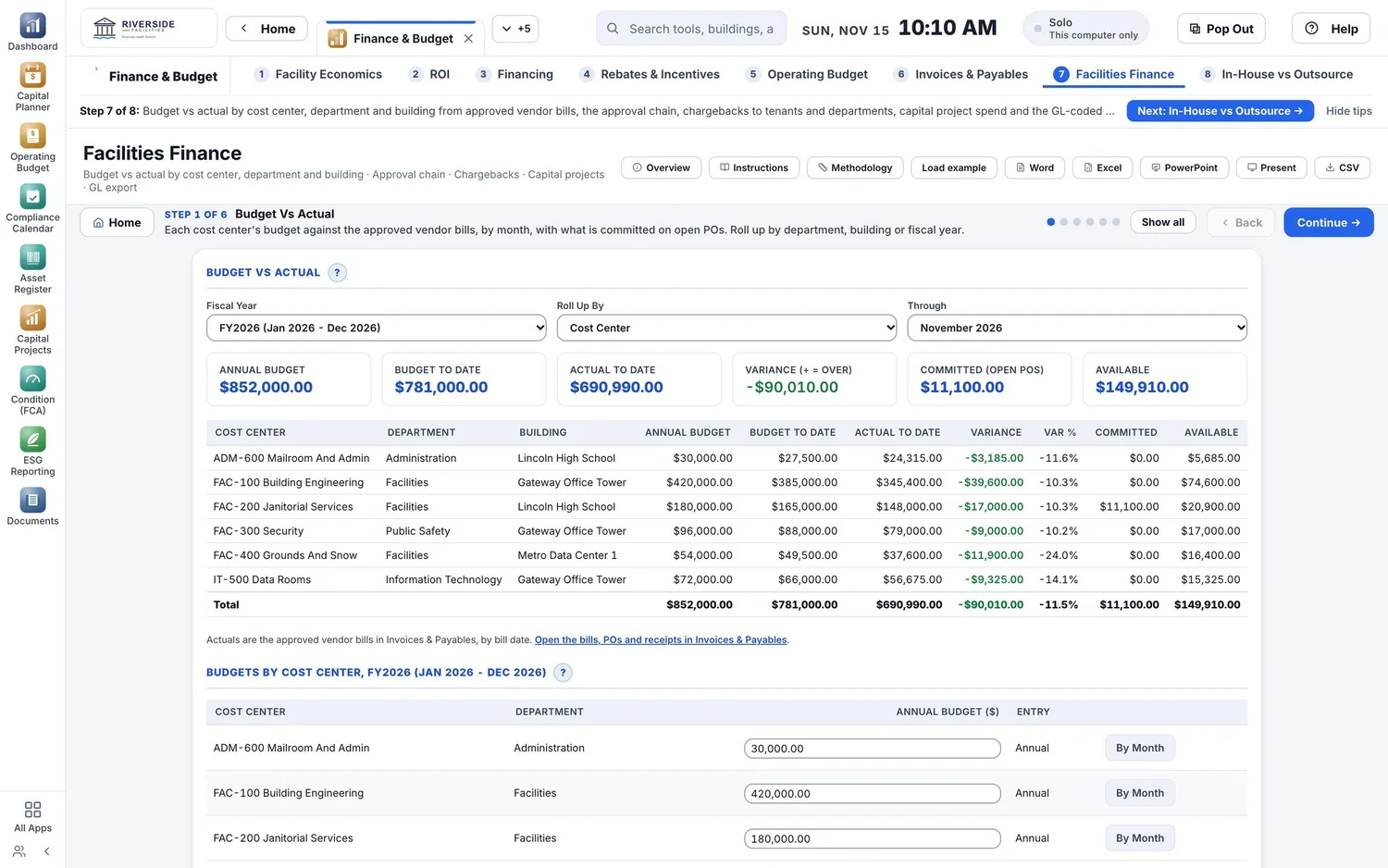
Variance in Operating Budget & Variance: spending against budget by category, with the largest overruns first. This is where to look before the next budget meeting.
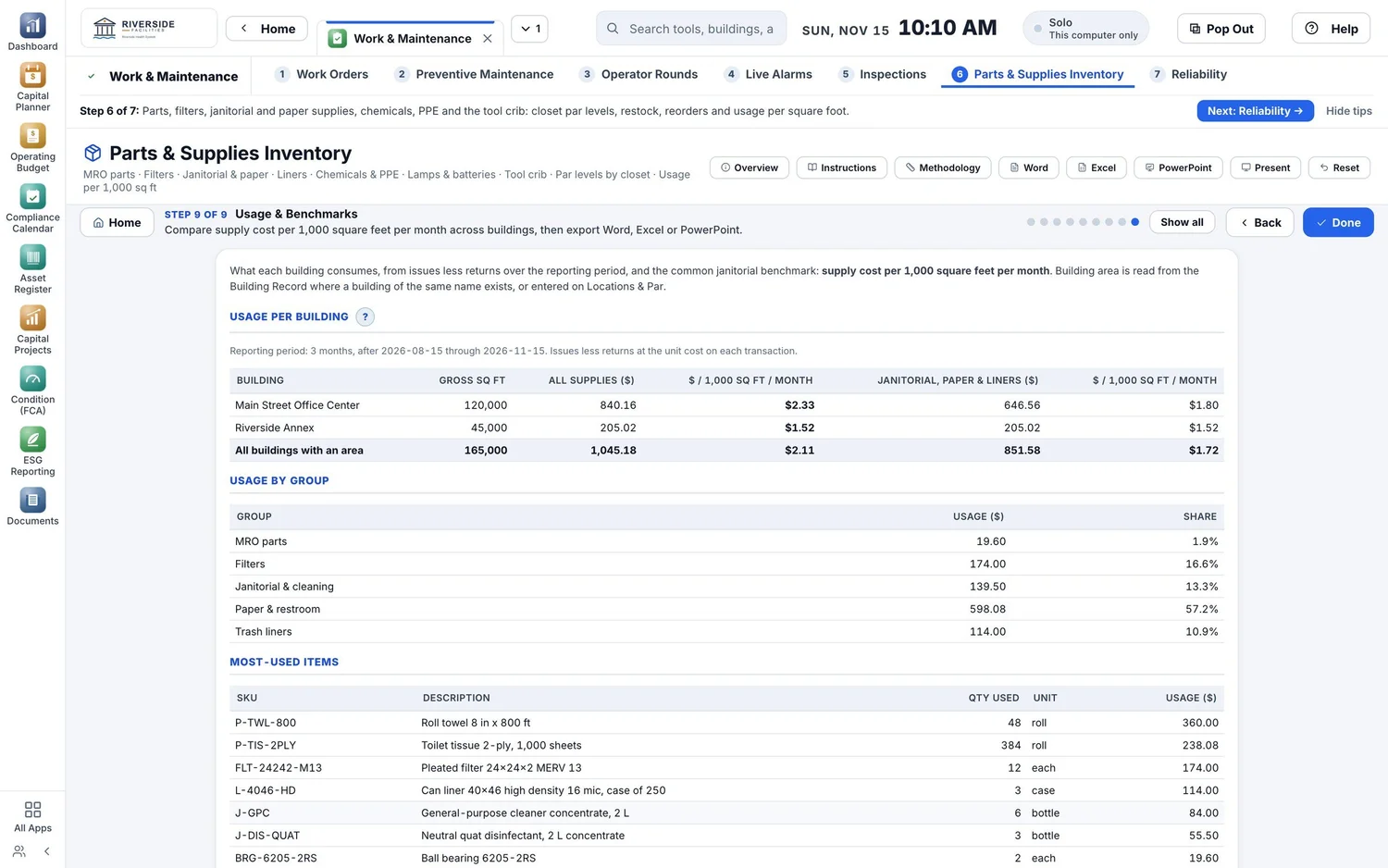
Supply spend is hard to judge without a comparison, so usage is measured per building and per square foot.
Frequently Asked Questions
Is this only for maintenance spare parts?
Can we load our current stock list?
How does a reorder become a purchase?
Be First When Facilities Logix Opens
Stop chasing building records across spreadsheets and binders. Join the list and we will tell you the day downloads open, with setup guides ready.
Launching early 2027 for Facilities Logix. Nothing to buy today, and no sales calls.
