
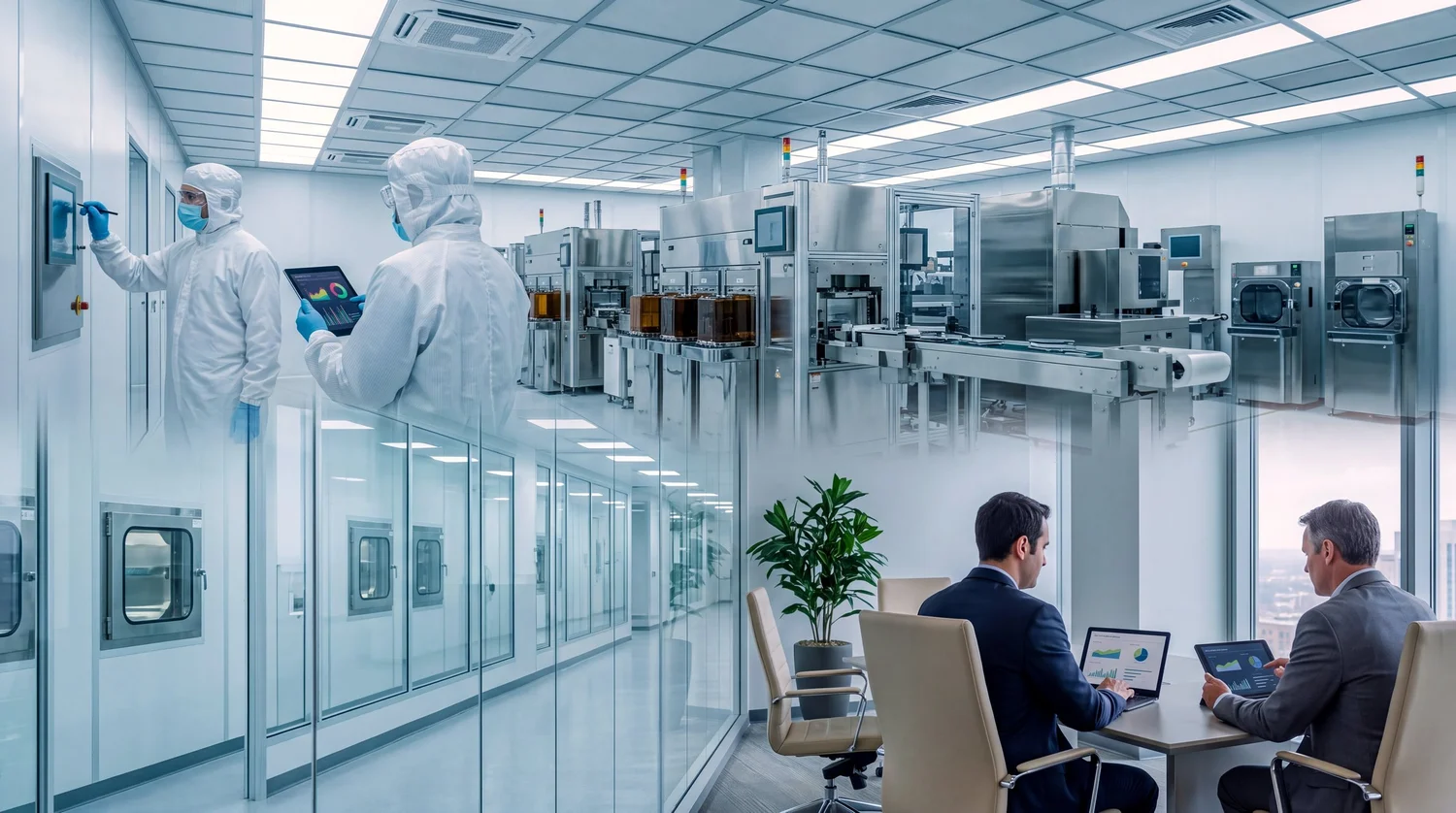

Every Classified Room, Its Readings and Its Next Certification.
Launching Early 2027 · Join the Early-Access List
In pharma, biotech, compounding and semiconductor work, the cleanroom is the barrier that protects the product. Facilities Logix keeps a register of every classified space, logs environmental monitoring against its limits, reads particle counter exports, tracks the filters and air handlers that hold the class, and puts each recertification on the calendar.
Classification, Certification and Compliance
Pick the industry (pharma, biotech, semiconductor, medical device, compounding pharmacy or aerospace) and the governing standard: ISO 14644, USP 797 and 800, or EU GMP. Library obligations apply when the building has a cleanroom or the item named, with the same dates as the Compliance Calendar.
ISO 14644
- Cleanroom classification recertification by particle count (ISO 14644-1 and 14644-2, 2015): annually, with the interval extendable on risk assessment and consistently compliant monitoring data; stricter where regulated
- HEPA filter installed-leak test (ISO 14644-3 method; ISO 14644-2 Annex A; IEST-RP-CC034): annual is common practice and Annex A suggests up to 24 months; flagged Confirm because the library could not verify it from a primary source
Sterile Compounding (USP 797 and 800)
- Certification of primary engineering controls and classified rooms before first use, at least every 6 months and after any change, covering airflow, HEPA integrity, particle counts and pressure differentials (USP General Chapter 797)
- Minimum air changes flagged on USP sites: ISO 7 rooms at 30 per hour and ISO 8 rooms at 20
- Hazardous drug rooms (USP 800) as their own room use, with the negative-pressure containment USP 800 adds noted in the methodology
EU GMP
- Grades A to D in the register, with Grade A and B rooms on a 6-month recertification interval (EU GMP Annex 1)
Supporting Rules
- Chemical hygiene plan reviewed at least annually (OSHA 29 CFR 1910.1450)
- Fume hood performance test at least annually (ANSI/ASSP Z9.5) and biosafety cabinet certification at least annually (NSF/ANSI 49), where present
- Compressed and hazardous gas storage annual self-inspection (NFPA 55), flagged Confirm
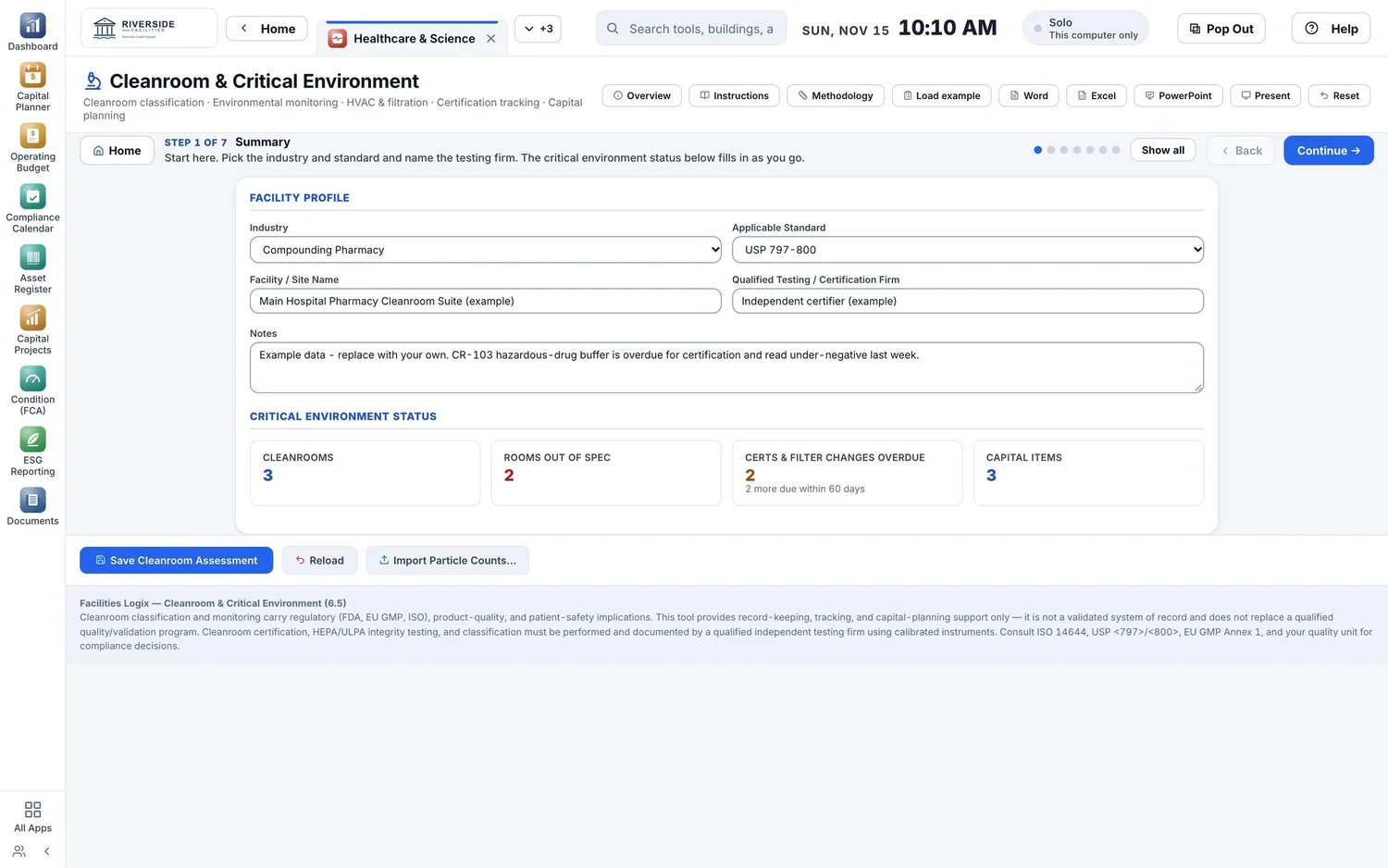
Summary in Cleanroom & Critical Environment: start here. Pick the industry and standard and name the testing firm. The critical environment status below fills in as you go.
Recertification Interval the Tool Uses
- USP 797 sites: every 6 months
- EU GMP Grade A and B: 6 months
- ISO 5 and cleaner: 6 months as conservative practice (ISO 14644-2 allows up to 12)
- Other classes: 12 months
- Enter your own next-due date to follow a stricter procedure

Instructions in Cleanroom & Critical Environment: how to work through it, step by step.
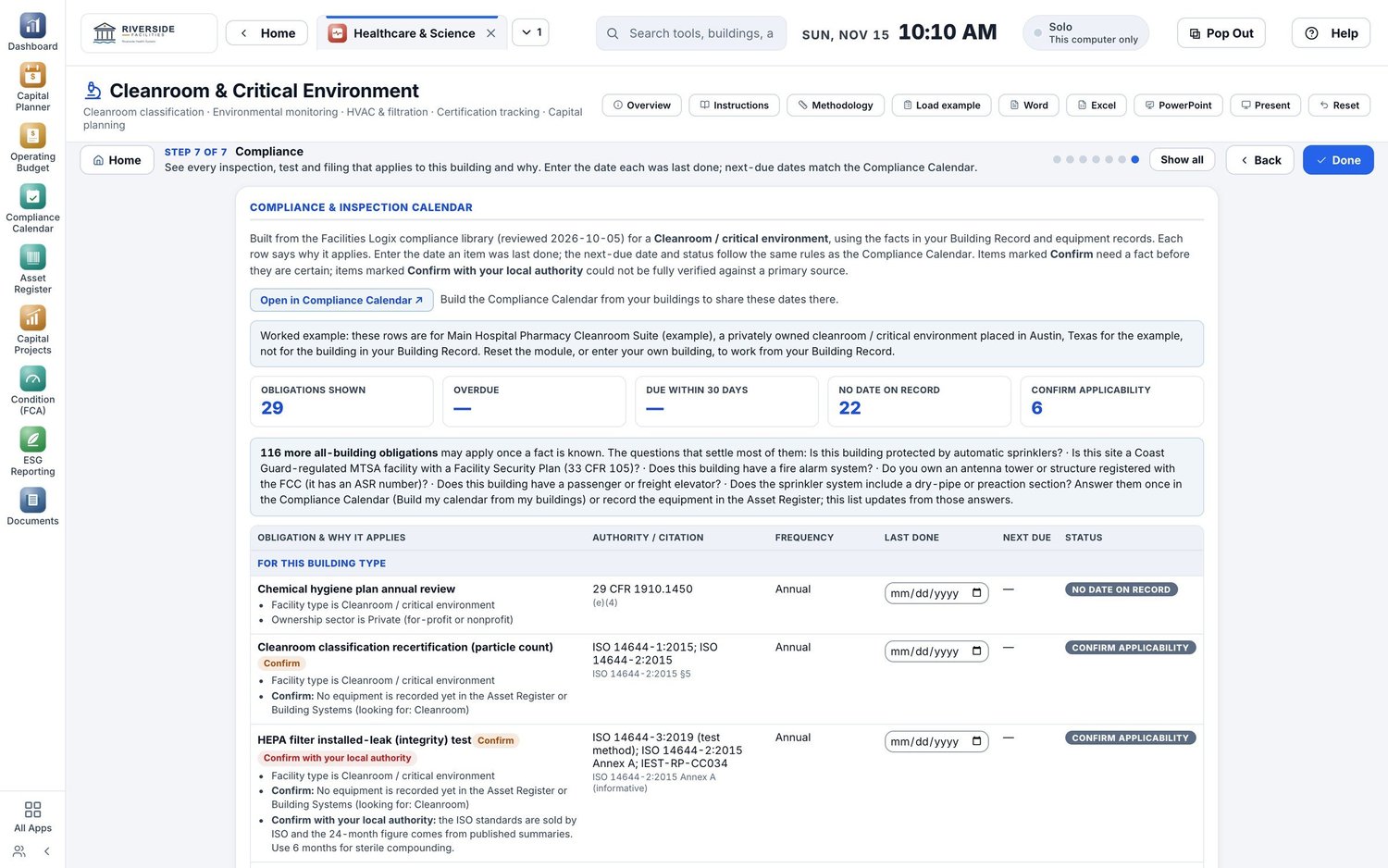
Cleanroom rules differ by industry and class, so the obligations that apply are listed with their citations and dates.
The Register and the Air That Holds the Class
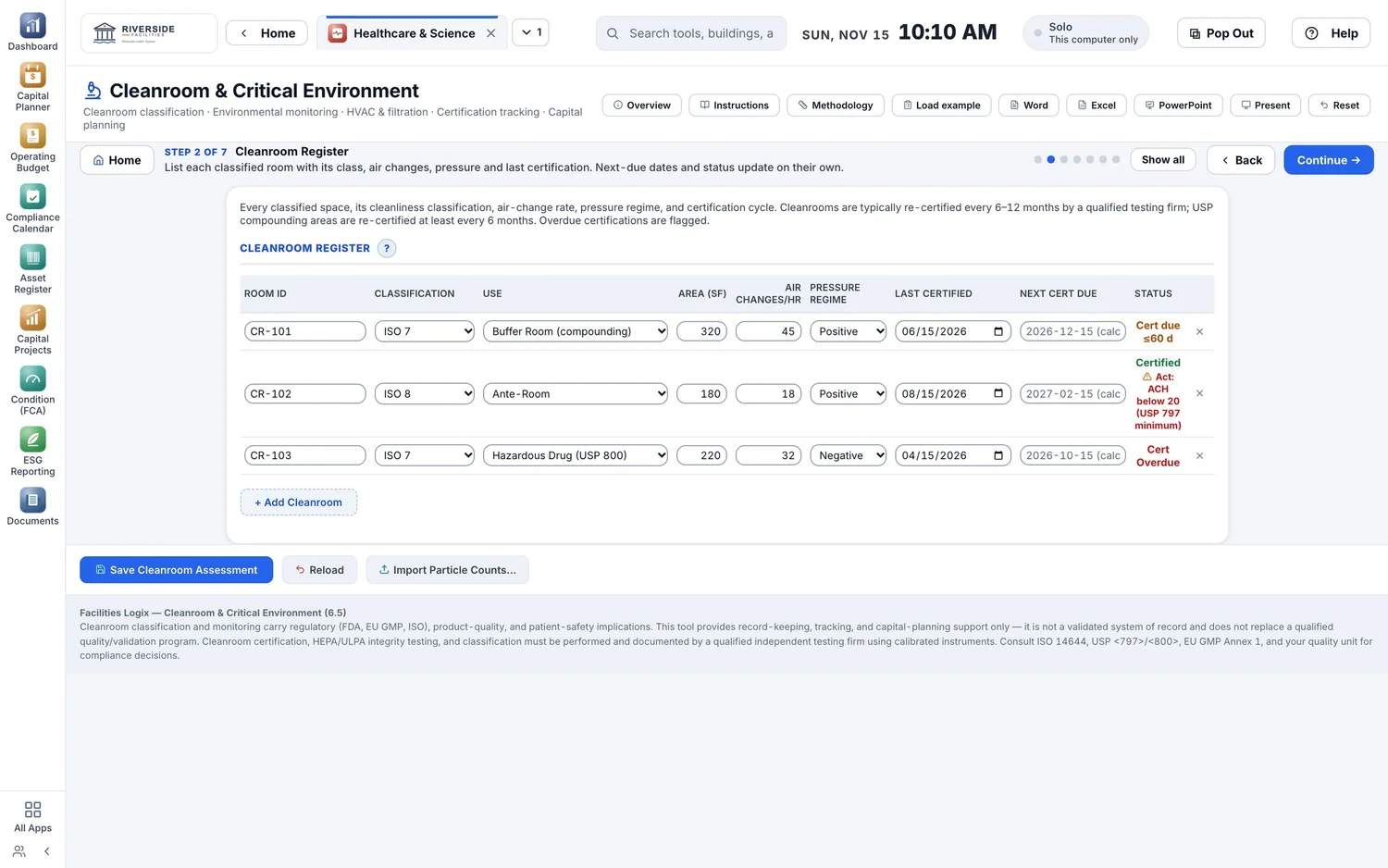
Cleanroom Register
Each room's class (ISO 5 to 8, Grade A to D, or the legacy Class 100 to 100,000), use, area, air changes, pressure regime (positive, negative, cascade or neutral), last certification, next due and status.
Learn MoreShow Less
A room that misses recertification or drifts out of class puts product quality and batch release at risk, so the register gives each room one status a quality lead can read at a glance.
- Status reads Certified, Cert Due Within 60 Days or Cert Overdue, in green, amber or red.
- Low air changes show on their own line, so a certified room with an airflow problem is not hidden.
- Overdue rooms publish to Building Systems as Code / Regulatory deficiencies with the class and due date.
- The report's register table puts class, air changes, pressure and status side by side.
Room Uses
Sterile fill and aseptic processing, compounding buffer and ante-rooms, hazardous drug rooms, cell and gene therapy, wafer fabrication, photolithography, device assembly, packaging, QC sampling and gowning.
Learn MoreShow Less
Knowing what each room is for keeps certification and repair money on the rooms where a failure costs product. The methodology notes the class each use usually holds, so a mismatch is easy to spot.
- Sterile compounding: ISO 5 in the hood, buffer rooms typically ISO 7, ante-rooms ISO 7 or 8 (USP 797).
- Hazardous drug rooms: negative-pressure containment and external venting (USP 800).
- EU GMP Grade A critical zones: unidirectional airflow, about ISO 5 at rest and in operation.
- The use appears beside class, area and pressure in the register and its reports.
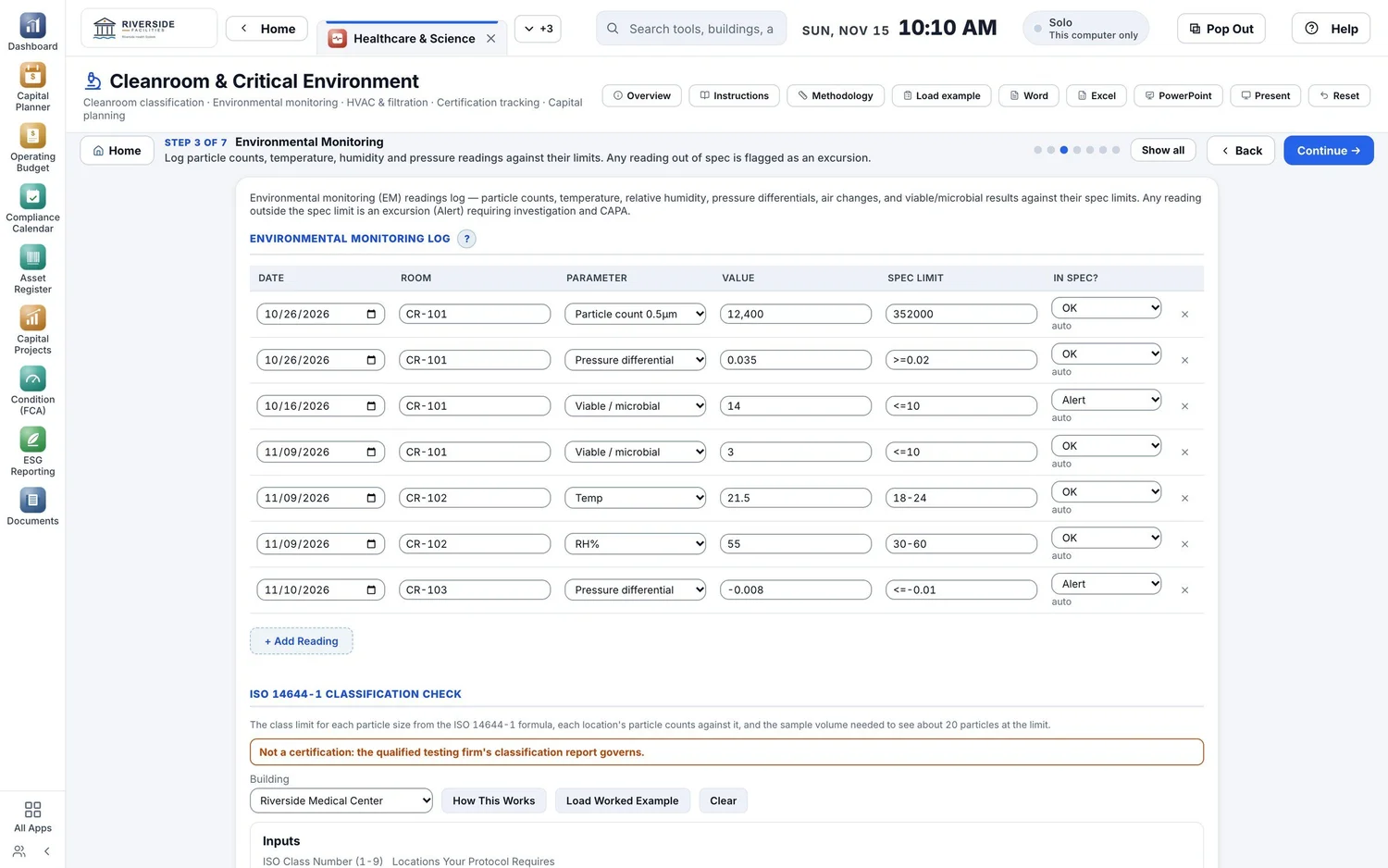
Environmental Monitoring in Cleanroom & Critical Environment: log particle counts, temperature, humidity and pressure readings against their limits. Any reading out of spec is flagged as an excursion.
HVAC and Filtration
HEPA and ULPA terminal filters, ducted HEPA, prefilters and final filters, dedicated and shared air handlers, recirculation units, fan filter units and containment fans, each with filter life, last change and next due.
Learn MoreShow Less
A HEPA filter that fails its leak test at certification means a failed room, a retest and product at risk, so filter work is tracked ahead of the testing firm's visit. Terminal filters are integrity-tested at each certification and replaced on condition, while prefilters change on a much shorter cycle.
- Each component carries a condition: Good, Fair, Poor or Critical.
- Overdue changes flag red on the row.
- Reports mark each filter Overdue, Due Within 60 Days or Current.
- HEPA and ULPA replacement is its own capital category.
Capital
Recertification campaigns, HEPA and ULPA replacement, air systems, controls and monitoring, room construction and pressurization, by priority, year and driver (end of life, regulatory, out of spec, certification due), published to the portfolio's building systems roll-up.
Learn More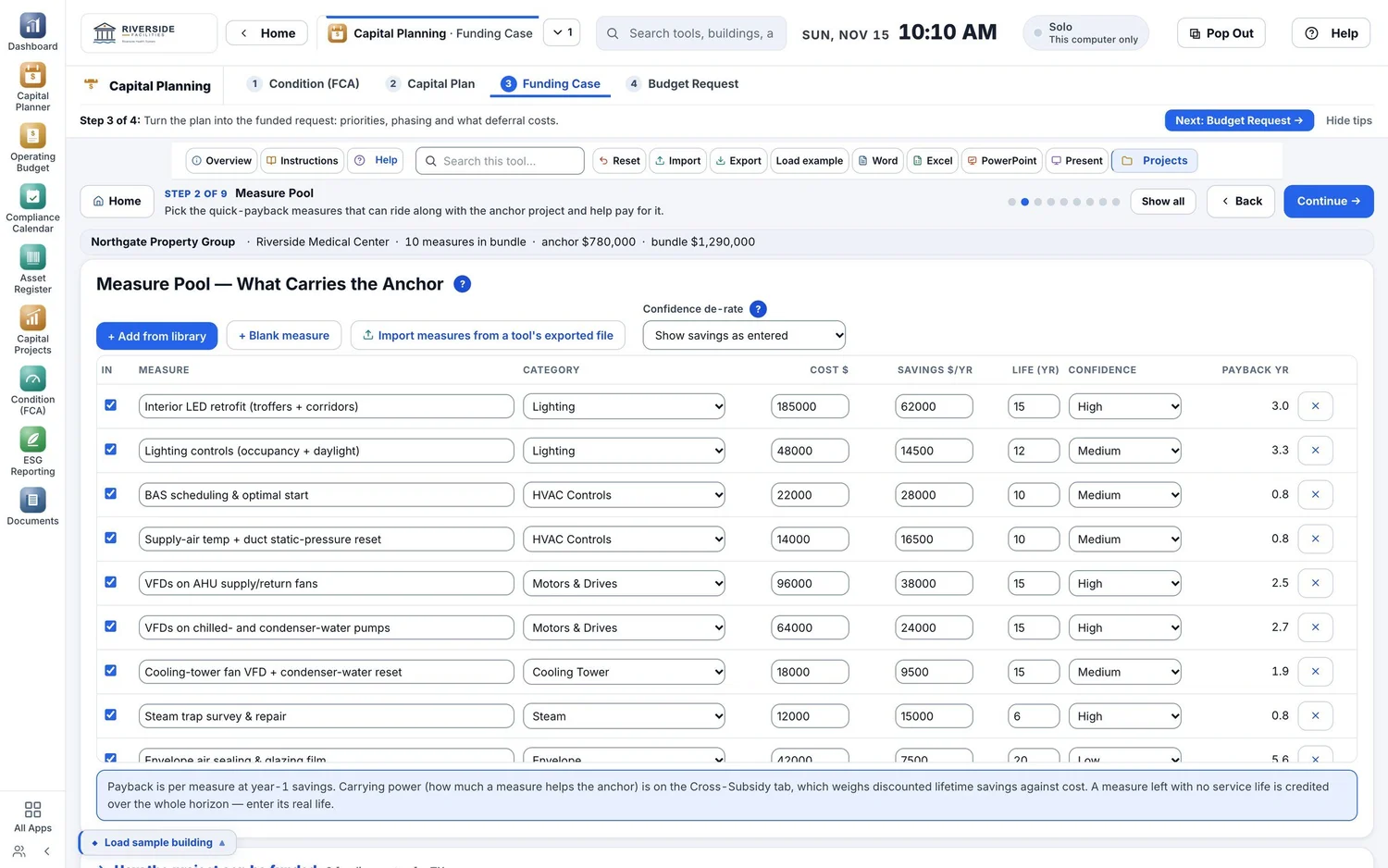
Measure Pool in Capital Bridge: pick the quick-payback measures that can ride along with the anchor project and help pay for it.
Import a Room List
A room list from a space program or a spreadsheet can carry each room's class; those rooms go to the cleanroom register too. A class the tool does not list is named in the preview and never changed to another class.
Learn MoreShow Less
Retyping a space program costs staff hours and invites typos in the one field an auditor checks first: the class. The import reads the list once and fills both places.
- Headings such as ISO class, GMP grade or cleanliness class are recognized.
- Every room goes to Space & Workplace; classified rooms also join the cleanroom register.
- Areas given in square meters convert to square feet.
- The same list imported twice adds nothing; rooms update by room ID.
- Rooms marked N/A, none or not classified stay out of the register.
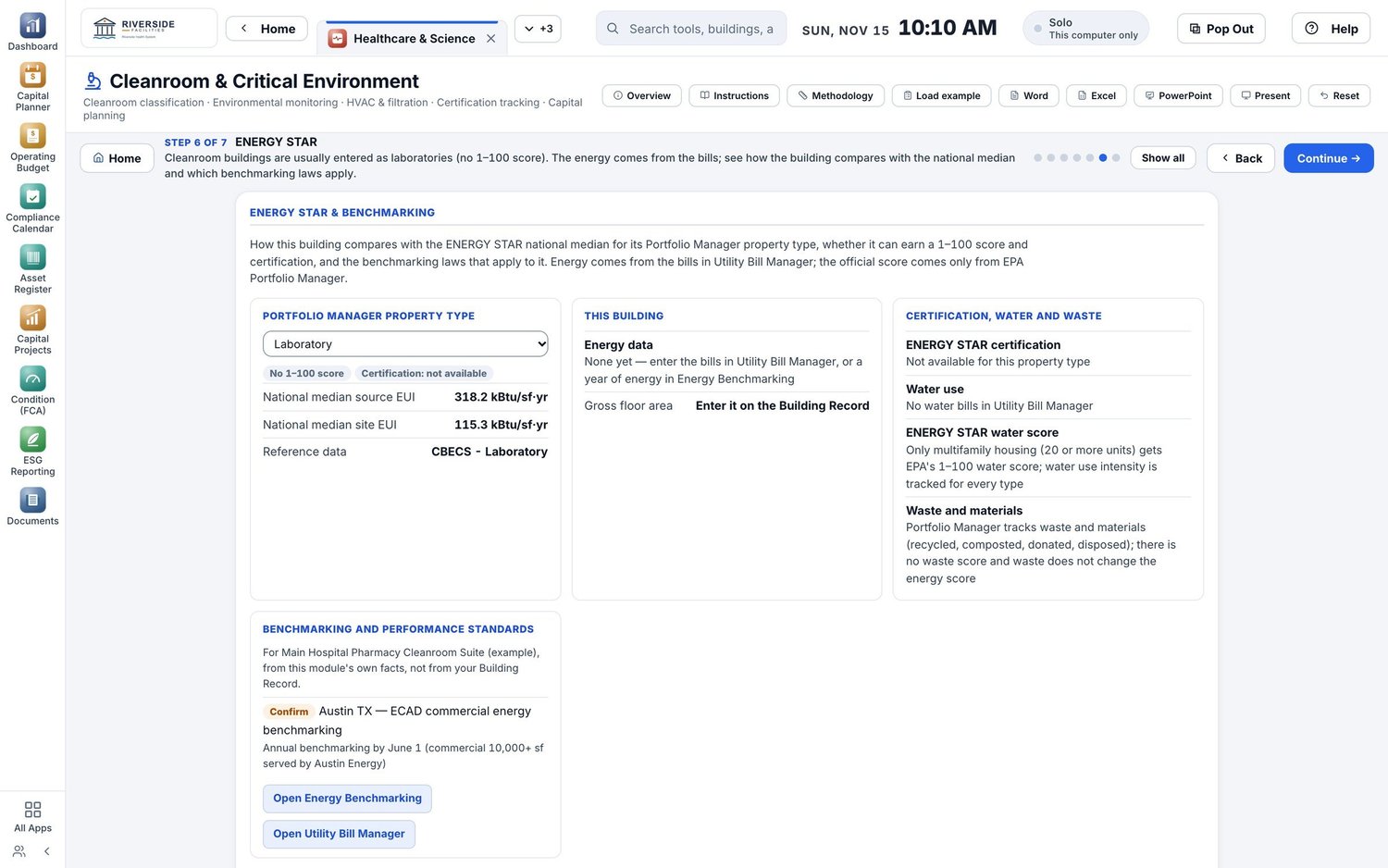
ENERGY STAR in Cleanroom & Critical Environment: cleanroom buildings are usually entered as laboratories (no 1–100 score). The energy comes from the bills; see how the building compares with the national median and which benchmarking laws apply.
Proving the Room Still Holds Its Class
Environmental Monitoring Log
- Particle counts at 0.5 and 5 microns, temperature, relative humidity, pressure differential, air changes and viable or microbial results, each against its spec limit
- Write a range, a minimum or a maximum and OK or Alert is set automatically; any Alert is an excursion for investigation and corrective action in your quality system
- The particle limit for the room's class appears as a prompt
Particle Counter Import
- A portable counter's or a monitoring system's export, one row per sample, with the 0.3, 0.5, 1.0 and 5.0 micron channels found whatever the instrument calls them
- Counts become particles per cubic meter from the sample volume; each location's samples on a day are averaged and judged against its room's class limit
- The log gets one reading per room, day and channel with the worst location's average; the preview lists every location over its limit, and the same file twice adds nothing
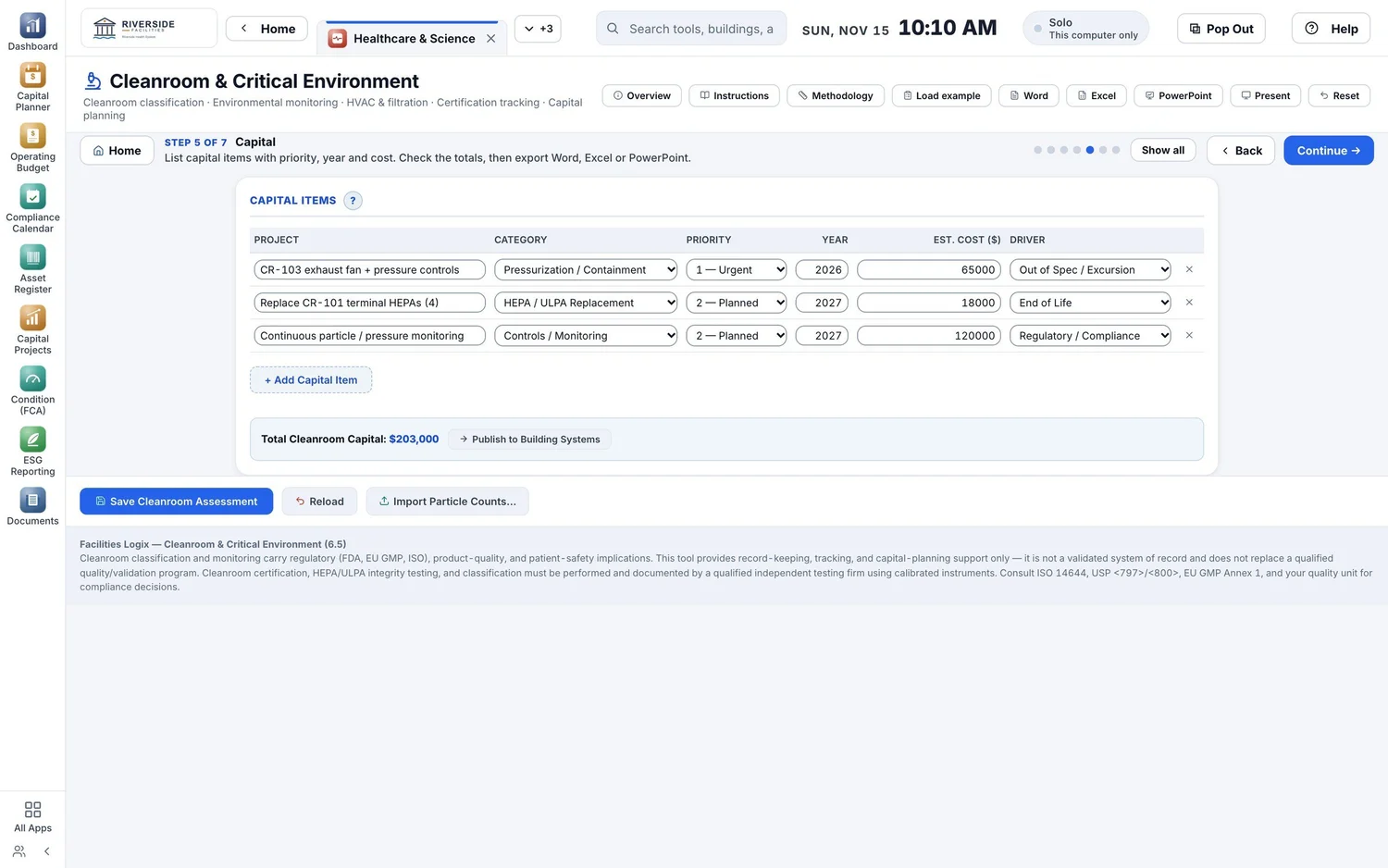
Capital in Cleanroom & Critical Environment: list capital items with priority, year and cost. Check the totals, then export Word, Excel or PowerPoint.
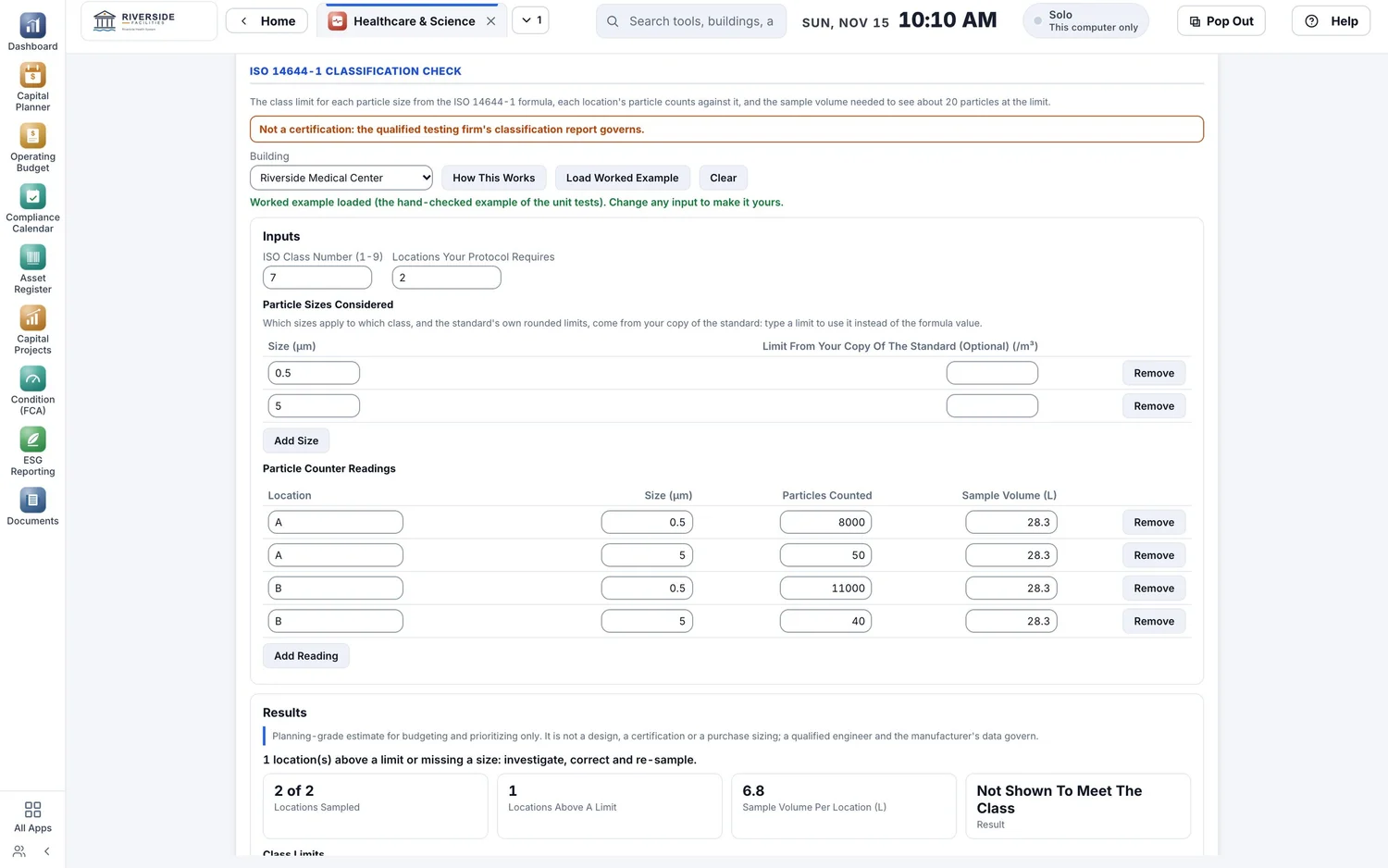
ISO 14644-1 Classification Check
- The class limit at each particle size from the standard's formula, to three significant figures; type a limit from your copy of the standard to use it instead
- Each location's mean per size must be at or below the limit, with the number of locations your protocol requires
- The sample volume needed to see about 20 particles at the limit of the largest size, at least 2 liters
Critical-Room Log and Live Watch
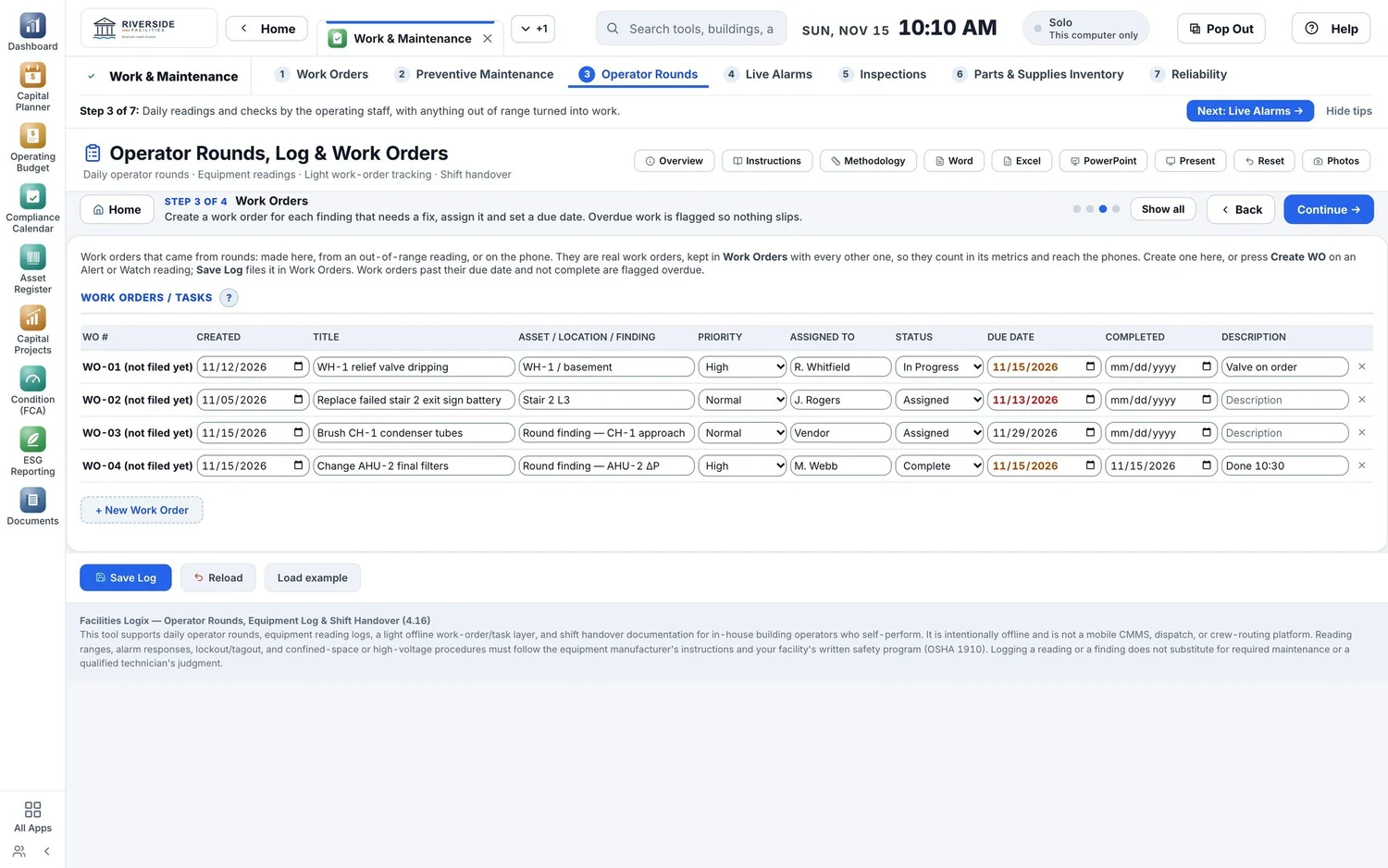
- Cleanrooms and compounding rooms can join the Critical-Room Pressure and Air-Change Log, with an excursion work order for each failing reading
- Live Alarms offers starting limits for operating rooms and clean rooms (ASHRAE 170), editable per point, and shows each critical room as a red, amber or green tile
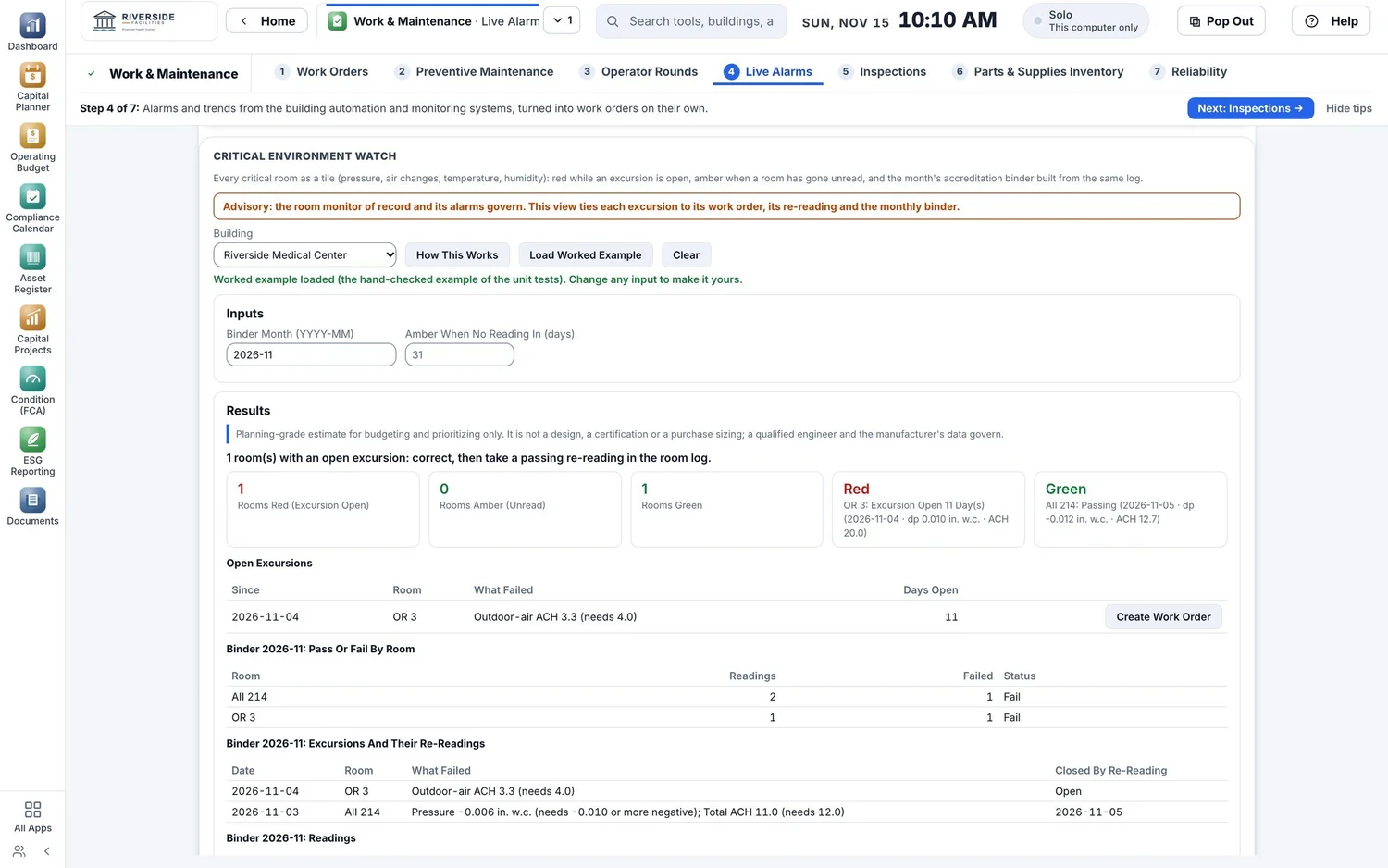
An excursion found at certification is too late, so every room shows red or amber the moment it drifts.
Records for the Quality Unit
Compliance Tab
Every inspection, test and filing that applies to the building and why. Enter the date each was last done; next-due dates match the Compliance Calendar.
Learn MoreReports
Word, Excel and PowerPoint reports from the playbook; the classification check also exports to Word, Excel, PowerPoint, PDF, print and CSV.
Learn MoreShow Less
Capital for recertification campaigns and filter replacement is easier to win when the risk is on one page. Each cleanroom report opens with a decision line and the numbers behind it.
- Headline figures: rooms out of spec and certifications or filter changes overdue.
- Tables for the register, the monitoring log with each result, filtration status and capital.
- Capital rows carry priority, year, cost and driver, such as out of spec or certification due.
- The profile page names the industry, the governing standard and the certification firm.
- A SAMPLE watermark marks any report made from the worked example.
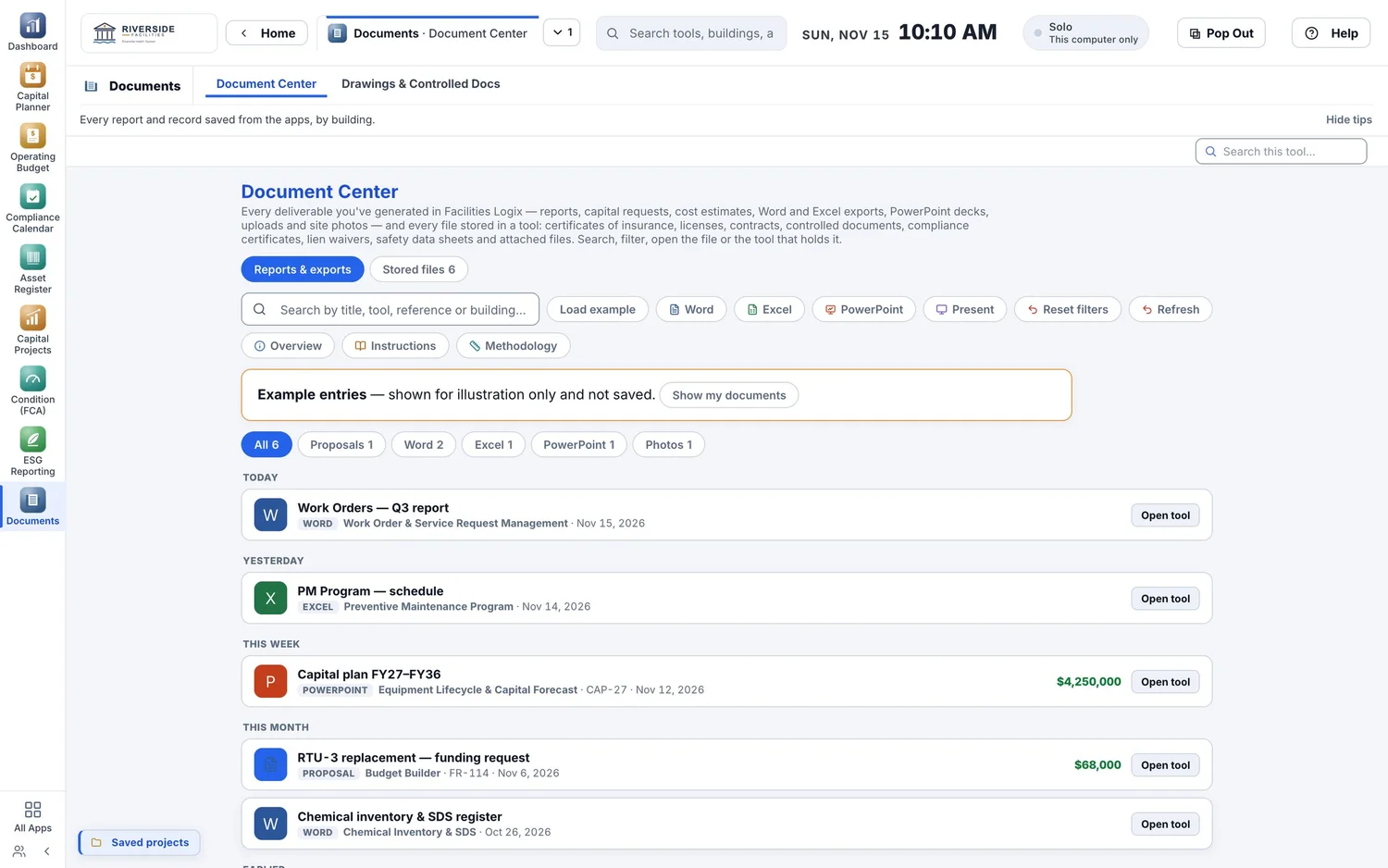
Every report the program makes is kept in one Document Center, grouped by building.
ENERGY STAR
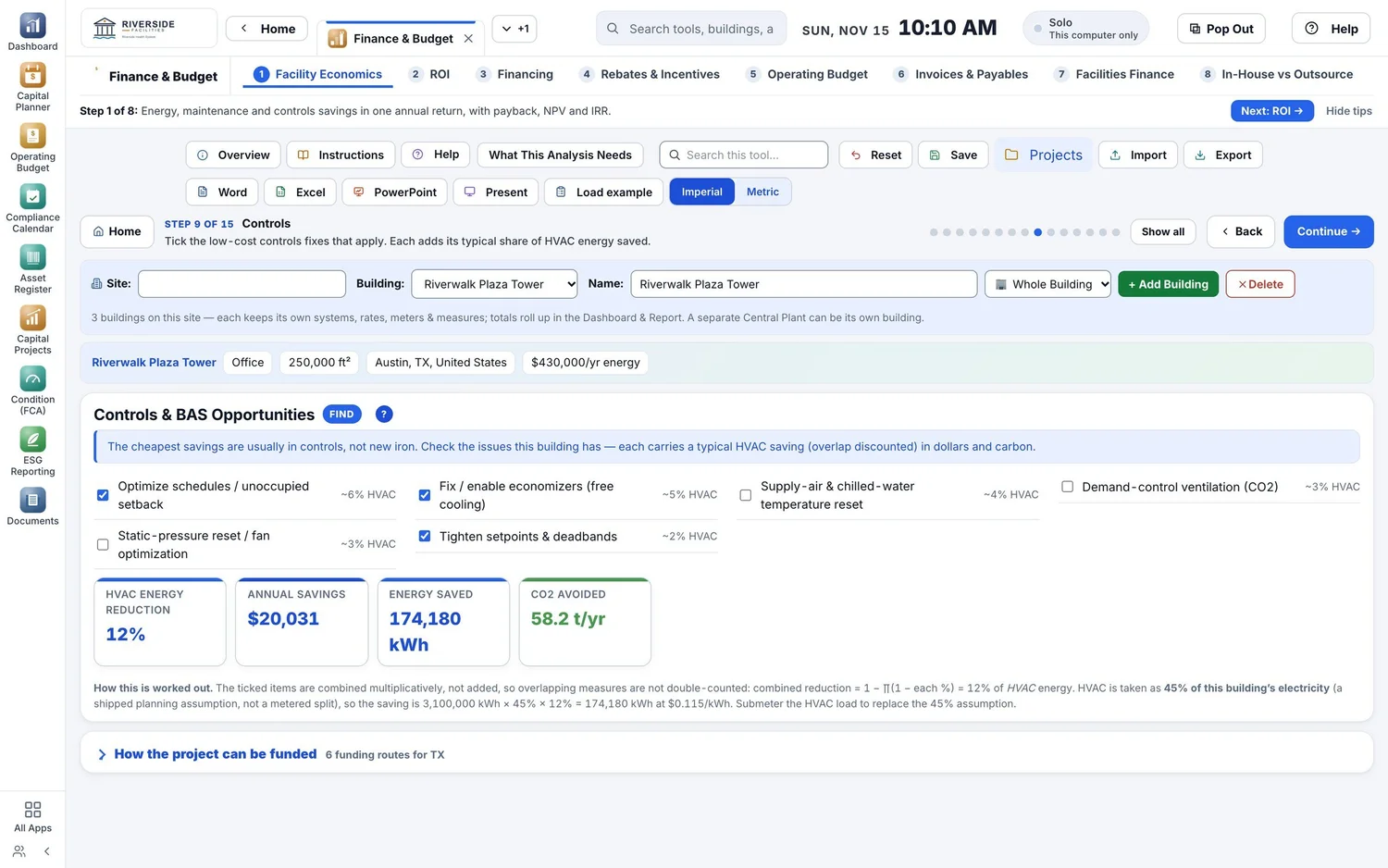
Cleanroom buildings are usually entered as laboratories, which compare with the national median (no 1 to 100 score). Facility Economics also carries a planning estimate for a semiconductor or cleanroom fab: about 500 kBtu per square foot typical and 350 for a high performer, marked as an industry planning estimate.
Learn MoreShow Less
A cleanroom suite uses far more energy per square foot than an office, so knowing where the building sits against its peers shows where efficiency money pays back. The tab defaults to the Laboratory property type and lets you pick Manufacturing/Industrial Plant or Other - Technology/Science instead.
- The national median for laboratories is 318.2 kBtu per square foot source, 115.3 site.
- Energy comes from Utility Bill Manager, the 12 months to the latest bill.
- The tab lists the benchmarking and performance-standard laws that apply to the building.
The Critical Environment Status
Summary Numbers
- Cleanrooms in the register
- Rooms out of spec: a latest reading on Alert, an overdue certification or, on USP sites, air changes below the minimum
- Certifications and filter changes overdue
- Capital items
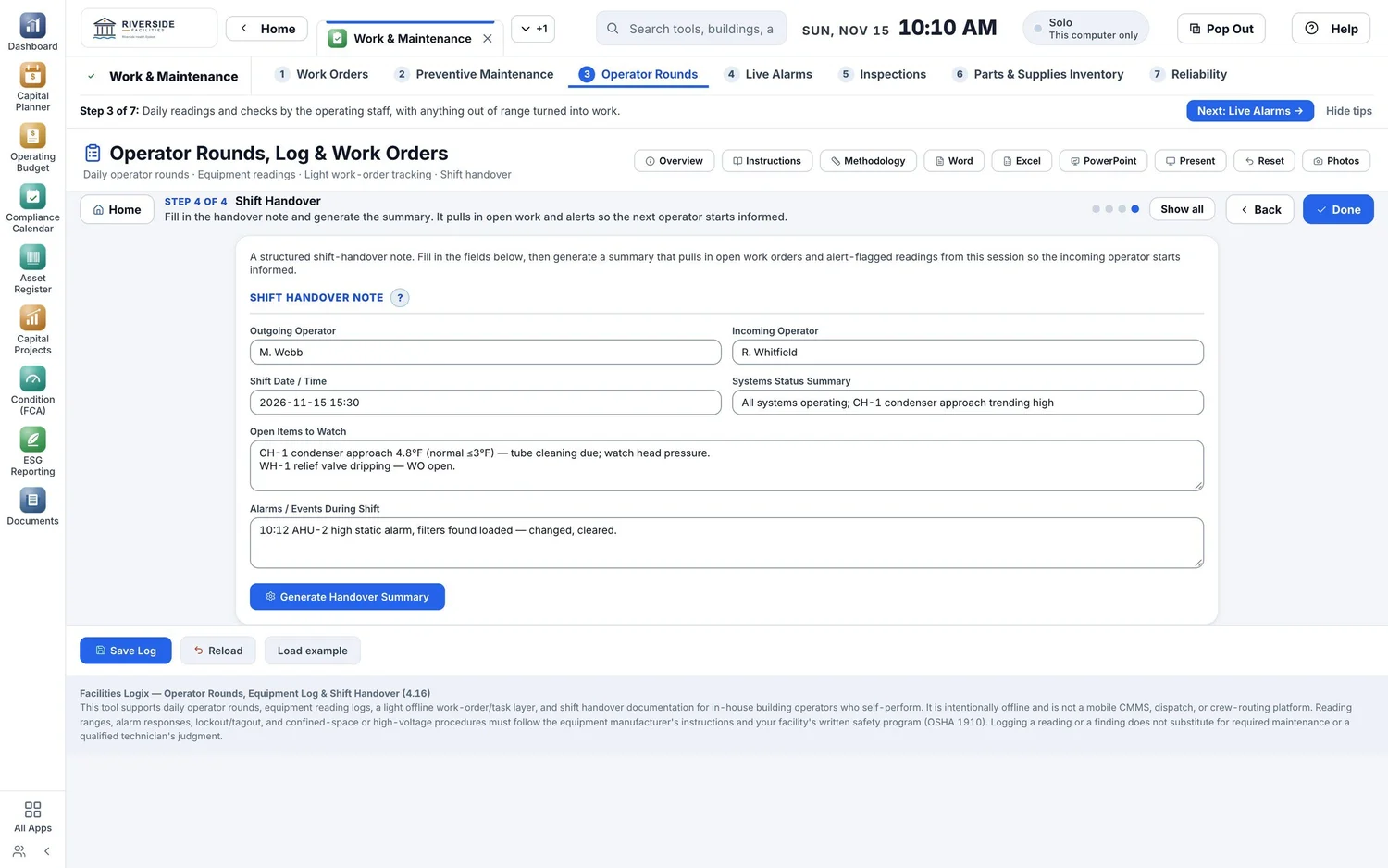
Shift Handover in Operator Rounds, Log & Work Orders: fill in the handover note and generate the summary. It pulls in open work and alerts so the next operator starts informed.
No Surprise Excursions at Certification
Drift Seen Between Certifications
Monitoring readings and imported particle counts show a room trending toward its limit before the testing firm arrives.
Learn MoreShow Less
A room caught drifting before certification costs a correction, not a failed certification and a retest. Every reading is judged the moment it is entered, and the trend is kept on paper for the quality unit.
- Each excursion publishes to Building Systems as a Code / Regulatory deficiency with its value and limit.
- A bare-number limit reads as a maximum for counts and a minimum for pressure and air changes.
- Reports list every monitoring reading with its limit and result.
- Rooms Out of Spec follows the latest reading, so a room clears once a passing one is logged.
No Missed Recertification
Room and filter due dates are calculated from the last certification, so a 6-month cycle does not quietly become a year.
Learn MoreShow Less
A lapsed certification can stop production or a compounding program until the room is retested, so each due date is calculated, not remembered.
- Leave next due blank and the calculated date shows in the field, marked calc.
- Rooms turn amber 60 days out, enough time to book the testing firm.
- Switch the profile's standard to USP 797 and every room's calculated interval follows.
- Filter rows carry their own next-due dates in the same summary.
- Reports show each room's next certification and status.
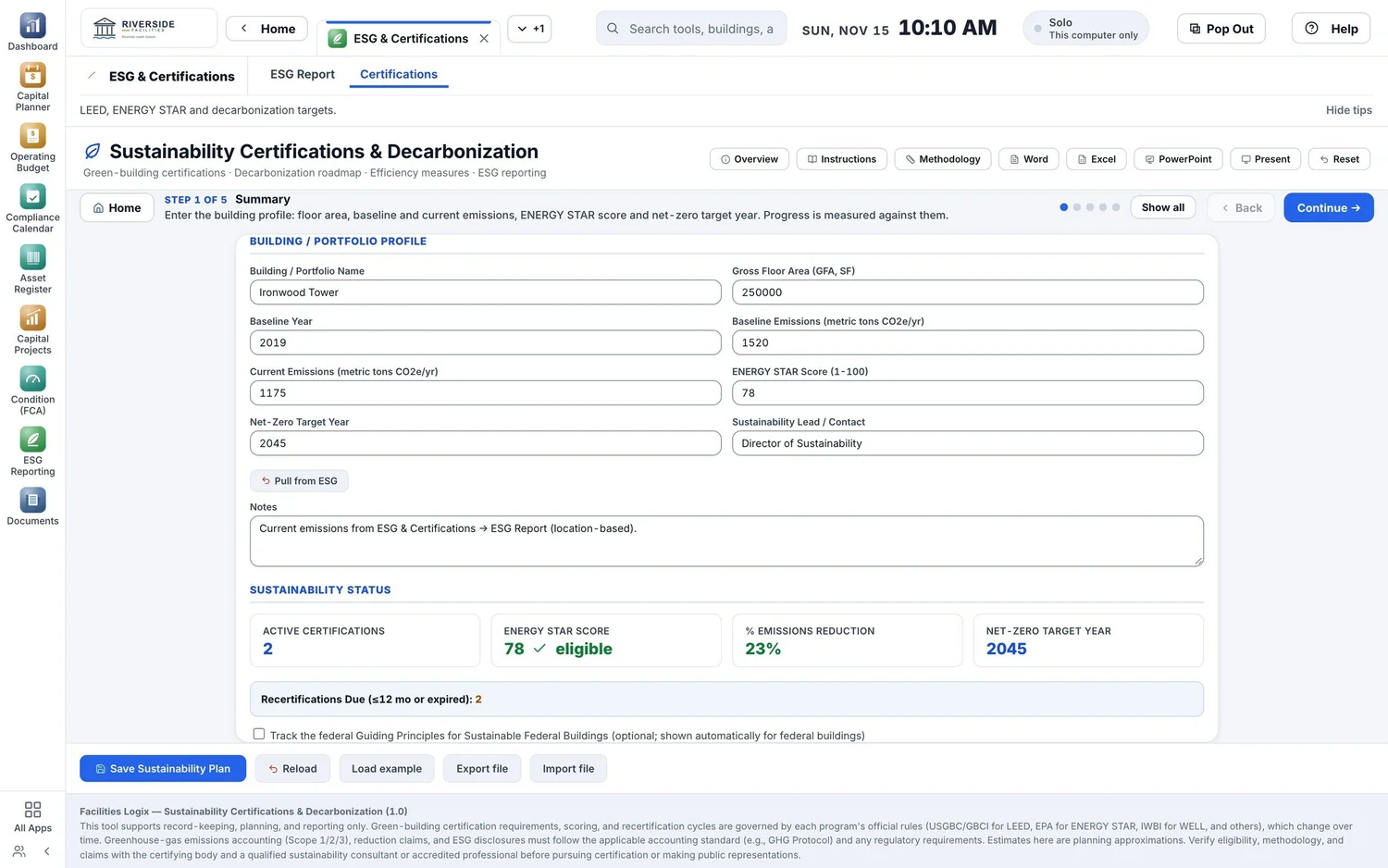
Summary in Sustainability & Decarbonization: enter the building profile: floor area, baseline and current emissions, ENERGY STAR score and net-zero target year. Progress is measured against them.
No Retyping Counter Data
A counter export becomes judged readings in one import instead of a spreadsheet exercise.
Learn MoreShow Less
Copying counter data by hand takes staff time and creates transcription errors an auditor can question. The import reads the counter's file as it comes.
- Date, location, room and volume columns are found under common names such as sample point or probe.
- Sample volume can be liters, cubic feet or cubic meters, read from the heading.
- Columns already in particles per cubic meter or cubic foot are read as concentrations.
- Each location is matched to its room by room ID, or the longest room ID its name starts with.
Frequently Asked Questions
Is the ISO 14644-1 check a certification?
Is this a validated system of record?
What does it offer a semiconductor site?
Be First When Facilities Logix Opens
Stop chasing building records across spreadsheets and binders. Join the list and we will tell you the day downloads open, with setup guides ready.
Launching early 2027 for Facilities Logix. Nothing to buy today, and no sales calls.
