


A parking structure is mostly concrete, coatings, ventilation, lighting and life safety, with structural inspection duties that more cities now write into law. Facilities Logix's parking playbook covers above-grade decks, underground and mixed garages, automated garages and surface lots. Four questions about post-tensioned decks, deicing salts, card payments and EV chargers decide which inspections apply, and each one carries its citation, frequency and next due date.
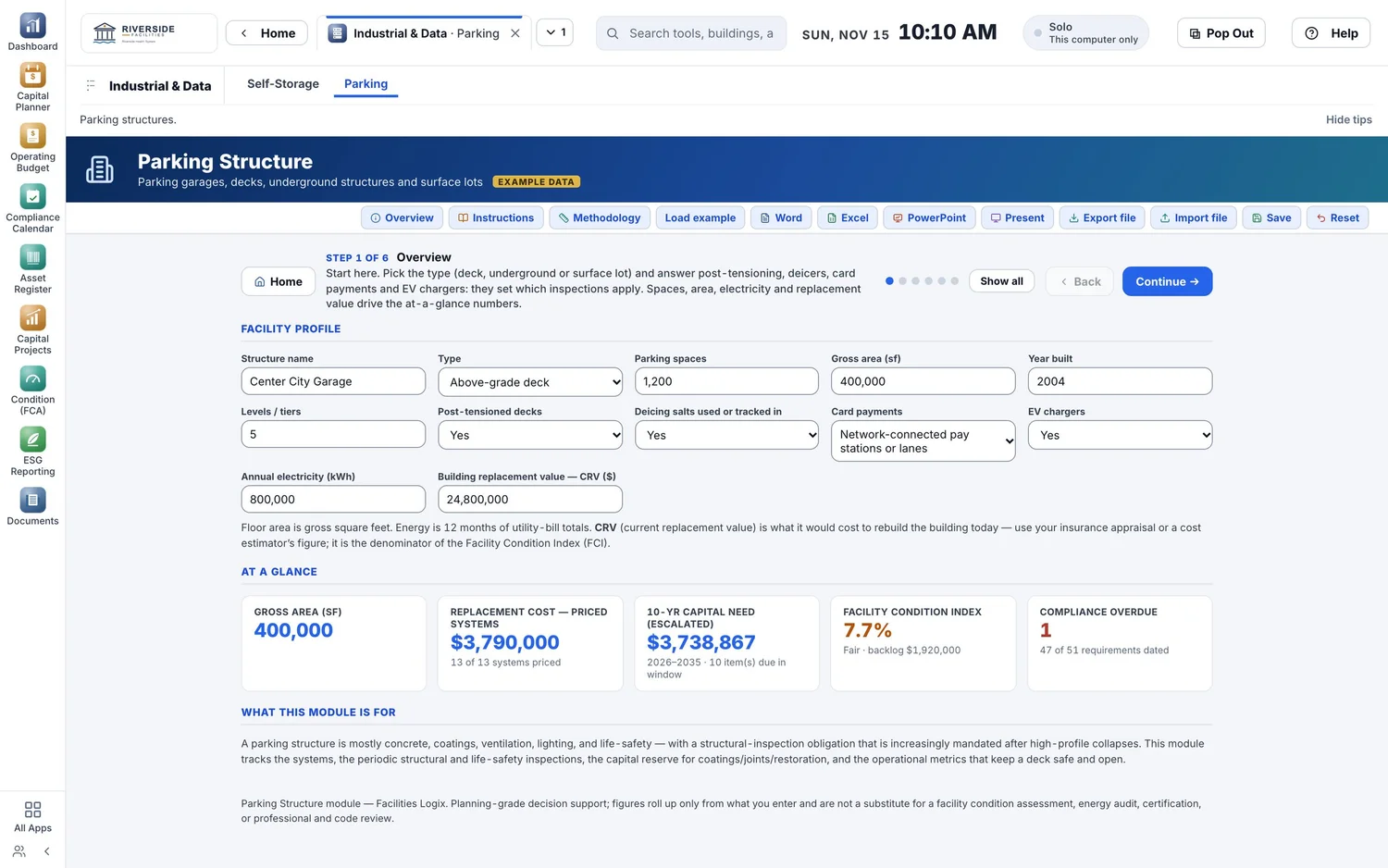
Structural, Ventilation, Accessibility, Payment and Charging Rules
A surface lot does not get the parking-structure inspections. The Compliance tab shows the rows that apply, where they apply, with the same dates as the Compliance Calendar. Rows marked Confirm are ones your team checks with the local authority.
New York City (Local Law 126 of 2021, Amended by Local Law 71 of 2024)
- A condition assessment by a Qualified Parking Structure Inspector (QPSI) for every structure by January 1, 2028 in its sub-cycle, then at least every 4 years, with the report filed within 60 days
- An annual observation between assessments, using the QPSI's own checklist, by or under a QPSI
- Unsafe conditions protected at once and corrected within 90 days of the report
- After a Safe With Repairs or Engineering Monitoring report, a new assessment no earlier than 18 months and no later than 2 years after the first filing
Everywhere Else (ACI PRC-362.2-21)
- An engineer's walk-through observation at least once a year, an industry standard that is law only where adopted
- A condition appraisal when the walk-through finds extensive deterioration, with repair design under ACI CODE-562
- Deck washdown and drain cleaning after the deicing season, joint sealant and traffic membrane inspection, and post-tensioned tendon and anchorage observation on decks that have them; these three are marked Confirm
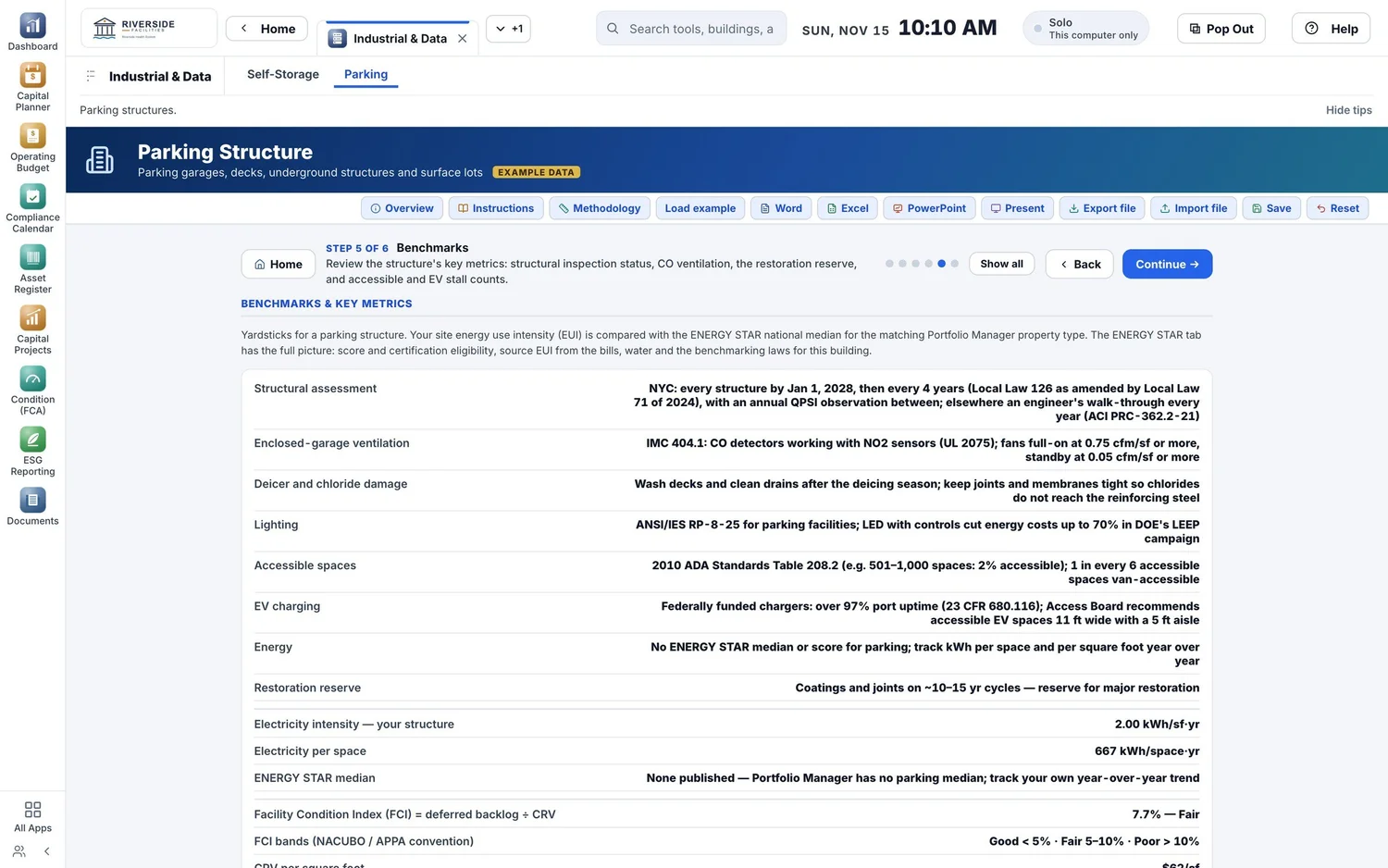
Benchmarks in Parking Structure: review the structure's key metrics: structural inspection status, CO ventilation, the restoration reserve, and accessible and EV stall counts.
Florida
- The milestone inspection of condominium and cooperative buildings three or more stories (Fla. Stat. 553.899): phase one by December 31 of the year the building reaches 30 years (25 where the local agency requires), then every 10 years, with phase two within 180 days when phase one finds substantial deterioration
- In Miami-Dade County, the parking lot lighting and guardrail certification with each building recertification
Fort Lee, New Jersey
- A condition assessment of parking structures serving commercial or multifamily property by December 31, 2026, then every 5 years; marked Confirm
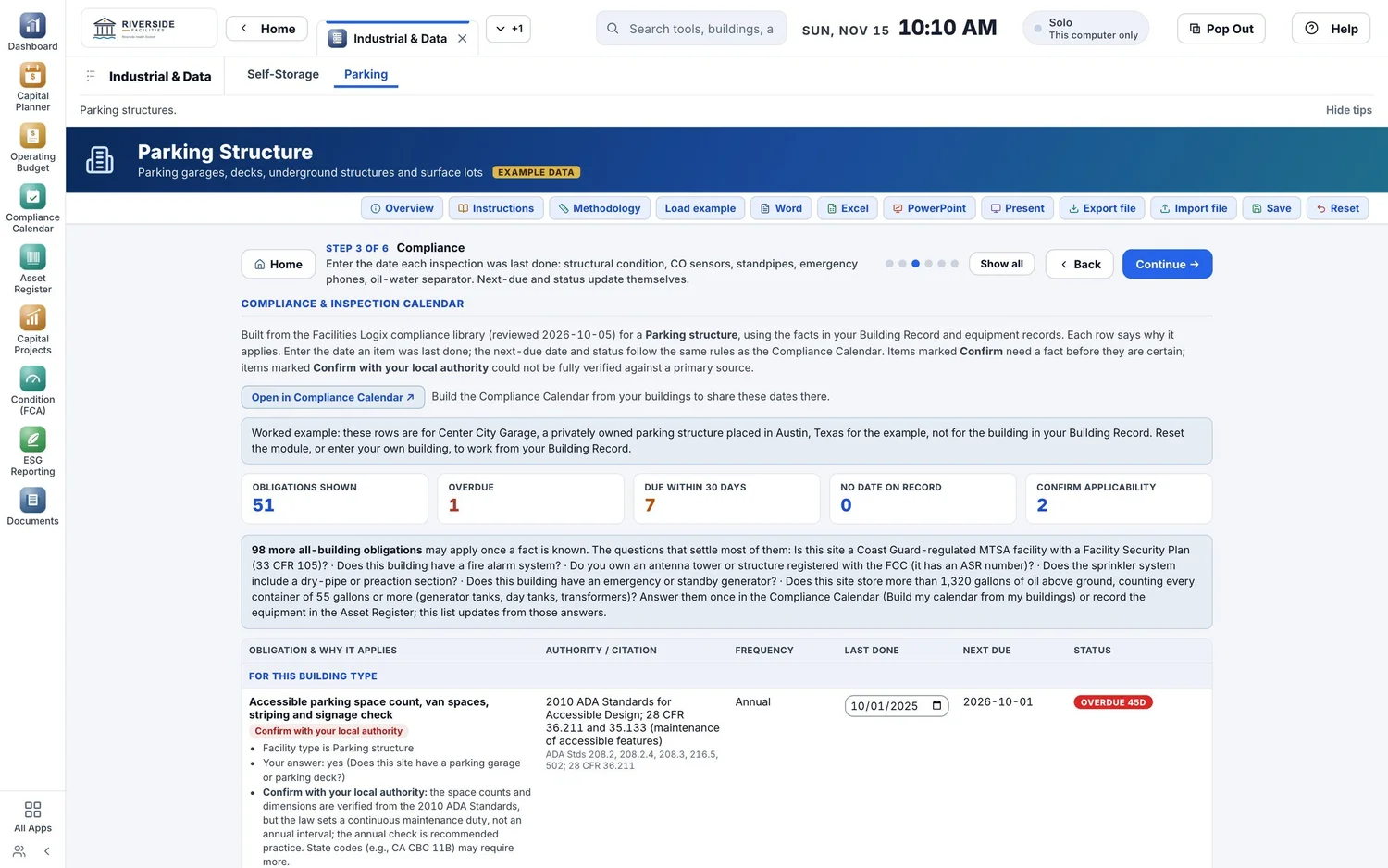
Compliance in Parking Structure: enter the date each inspection was last done: structural condition, CO sensors, standpipes, emergency phones, oil-water separator. Next-due and status update themselves.
Enclosed-Garage Ventilation (IMC 404.1)
- Carbon monoxide detectors working with nitrogen dioxide sensors, listed to UL 2075, calibrated on the manufacturer's schedule
- Fans full-on at 0.75 cfm per square foot or more, standby at 0.05 or more
- Marked Confirm, since the calibration interval comes from the detector maker
Accessible Parking (2010 ADA Standards Table 208.2)
- Accessible and van-accessible space counts, striping and signage checked once a year and after every restriping or resurfacing; marked Confirm
- For example, 501-1,000 spaces need 2 percent accessible, and 1 in every 6 accessible spaces is van-accessible
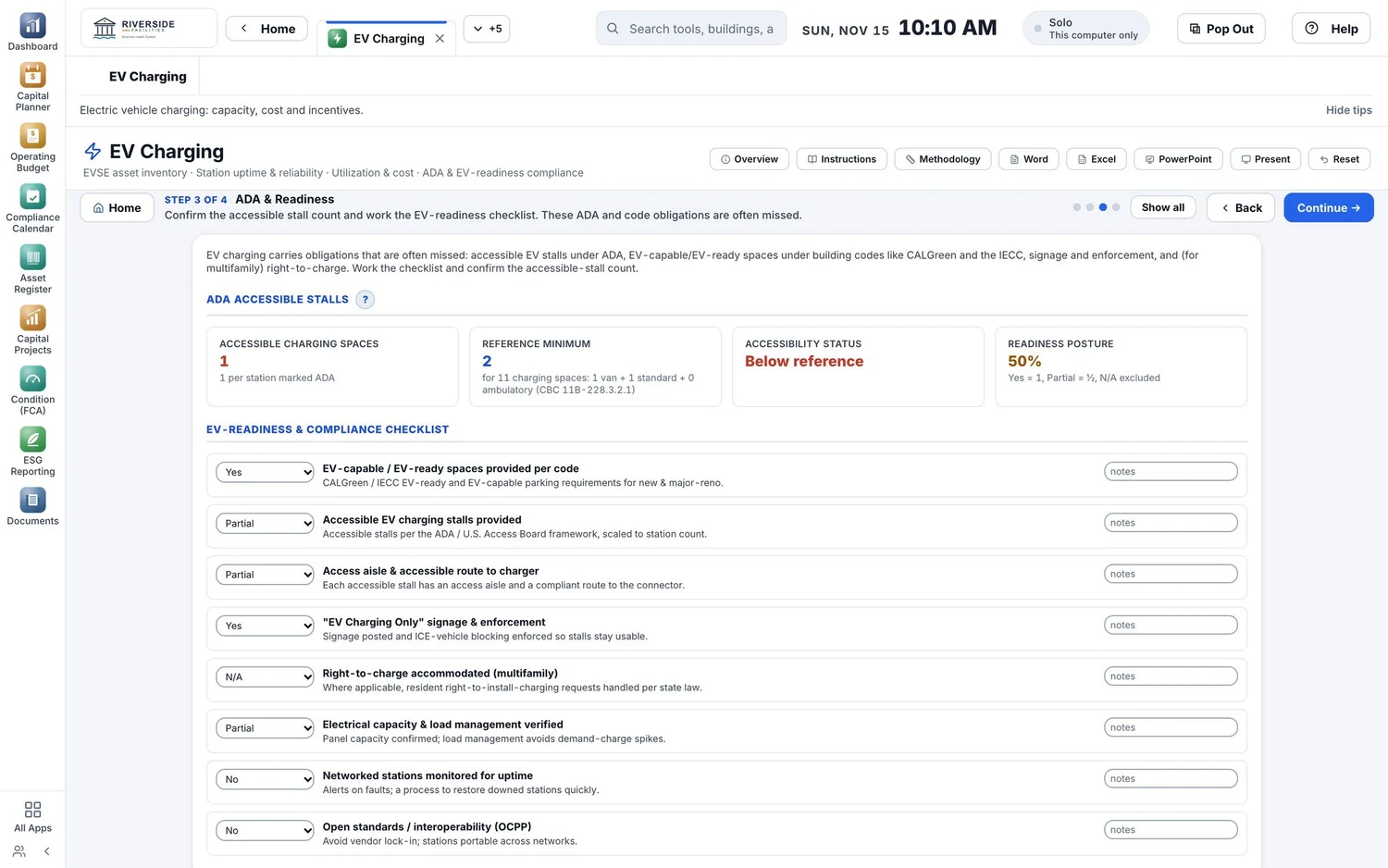
ADA & Readiness in EV Charging: confirm the accessible stall count and work the EV-readiness checklist. These ADA and code obligations are often missed.
Card Payments (PCI DSS v4.0.1)
- Quarterly external vulnerability scans for network-connected pay stations and lanes, and after significant changes
- Annual validation and card-reader tamper inspection, both marked Confirm
- Point-to-point encryption (P2PE) or standalone terminals do not bring the quarterly scan
Federally Funded EV Chargers (23 CFR 680)
- Each port averaging more than 97 percent uptime per year, worked out monthly over the prior 12 months
- Quarterly session, uptime and outage data, and annual maintenance cost by March 1
- Funded chargers serviced only by electricians with the required training credential
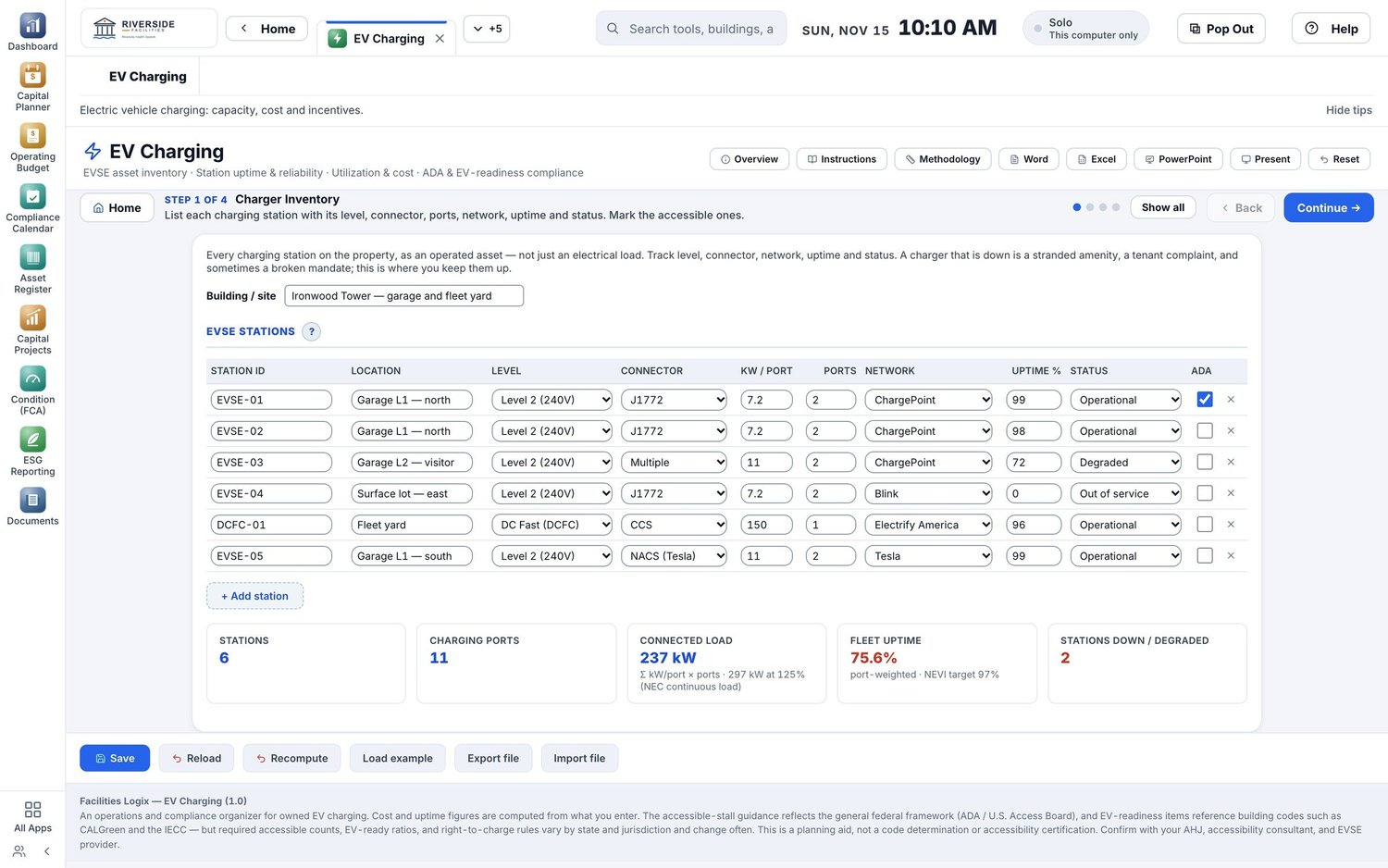
Charger Inventory in EV Charging: list each charging station with its level, connector, ports, network, uptime and status. Mark the accessible ones.
Stormwater
- Oil and grit separators, catch basin sumps and lot inlets inspected at least yearly and after large storms, set by your local permit; marked Confirm

Summary in EV Charging: inventory, cost recovery and compliance gaps in one place. Check it, then export Word, Excel or PowerPoint.
The Structure First, Then Everything It Carries
Five Types
Above-grade deck, below-grade or underground, mixed above and below, automated or mechanical, or surface lot.
Learn MoreShow Less
Paying an engineer for inspections a site does not need is wasted budget. The type decides which structural rows apply and how Portfolio Manager treats the energy.
- A surface lot keeps the accessible-space check but not the structural assessment
- Decks, underground, mixed and automated garages get the parking-structure rows
- Outside New York City, the engineer's annual walk-through replaces the QPSI observation
- Portfolio Manager counts parking as an open lot, partially enclosed or completely enclosed garage
Four Questions
Post-tensioned decks (yes, no or not known), deicing salts, card payments (network-connected, P2PE or standalone, or none) and EV chargers (none, yes, or federally funded). Each answer turns its own rows on or off.
Learn MoreShow Less
Each question stops services being bought by default, such as quarterly scans for a garage with no networked pay stations or tendon checks on a deck without tendons.
- Not Known keeps the tendon row at Confirm, never a silent no
- Federally funded chargers measure uptime over 525,600 minutes a year, less excluded outages
- Funded charger work orders carry the electrician's EVITP or apprenticeship certificate
- Card payments bring the annual validation, set by your acquirer or card brand
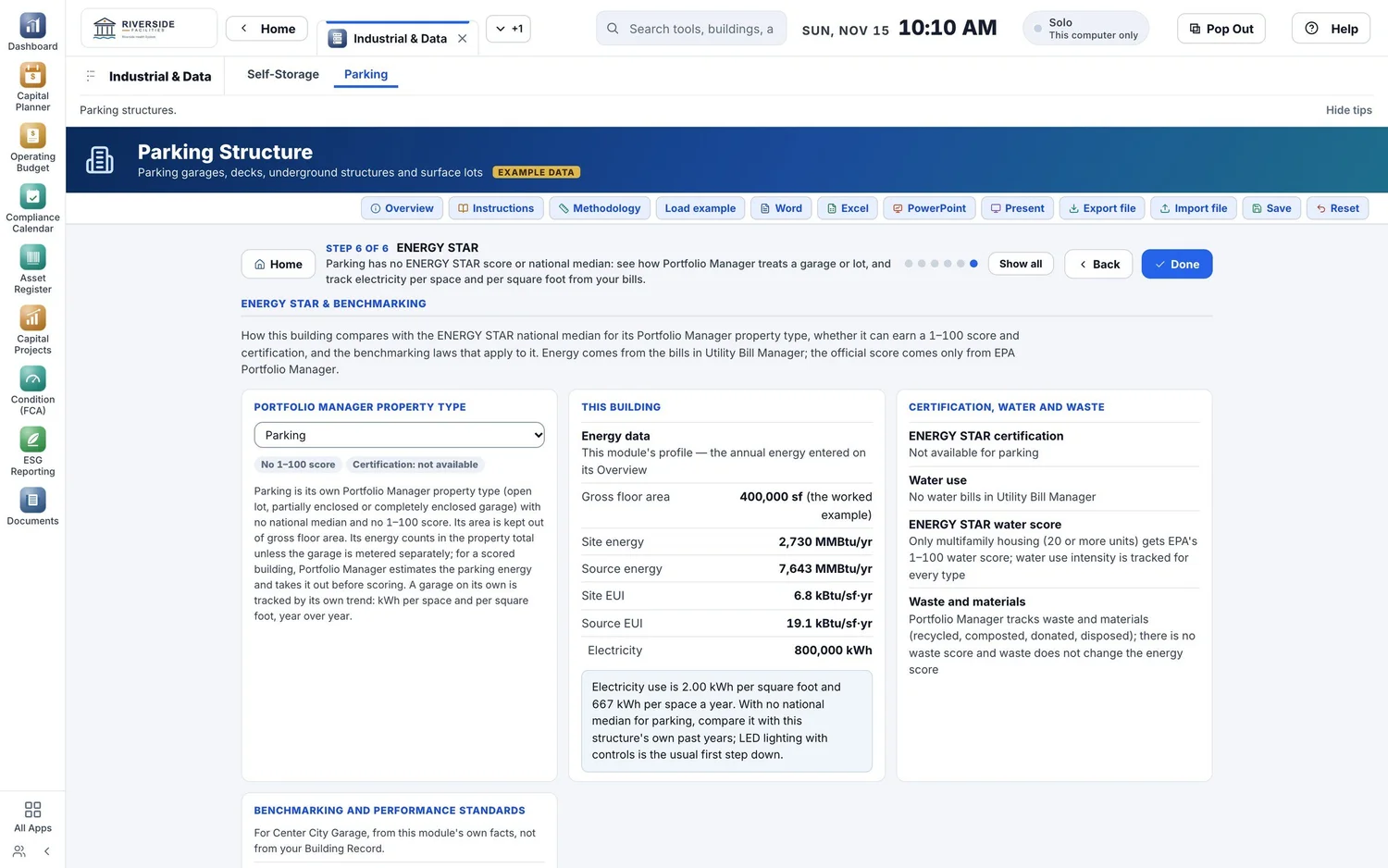
ENERGY STAR in Parking Structure: parking has no ENERGY STAR score or national median: see how Portfolio Manager treats a garage or lot, and track electricity per space and per square foot from your bills.
Structure and Protection
Structural frame and slabs including post-tensioned tendons (annual, on the condition assessment cycle), expansion joints and sealants (annual), traffic membrane and deck coating (annual, recoated on a 10-15 year cycle), snow and deicer management (annual).
Learn MoreShow Less
Chlorides that reach the reinforcing steel turn a coating job into a structural repair, the costliest fix in a garage. The structure rows carry the highest criticality so they lead every list.
- Frame, slabs and tendons rated Critical; joints and membrane rated High
- Capital lines start at 15 years for restoration, 12 for membrane, 10 for joints
- The washdown row asks for work orders listing the levels done
- Joint inspections ask for a leak log and spot repairs before the next winter
Life Safety and Ventilation
Ventilation with CO and NO2 sensors (quarterly), fire standpipe and sprinklers (annual), elevators and stairs (monthly), security cameras and emergency phones (quarterly).
Learn MoreShow Less
A failed CO sensor or standpipe can close levels and the revenue they earn until it is fixed. These rows rank just below the structure, and each test date follows its code's own interval.
- Standpipe and sprinklers rated Critical; ventilation, elevators, cameras and phones High
- NFPA 25 rows stay current through the code's grace window
- Fire extinguishers serviced yearly under NFPA 10
- Capital lines: ventilation and sensors 18 years, fire and standpipe 20, elevator modernization 25
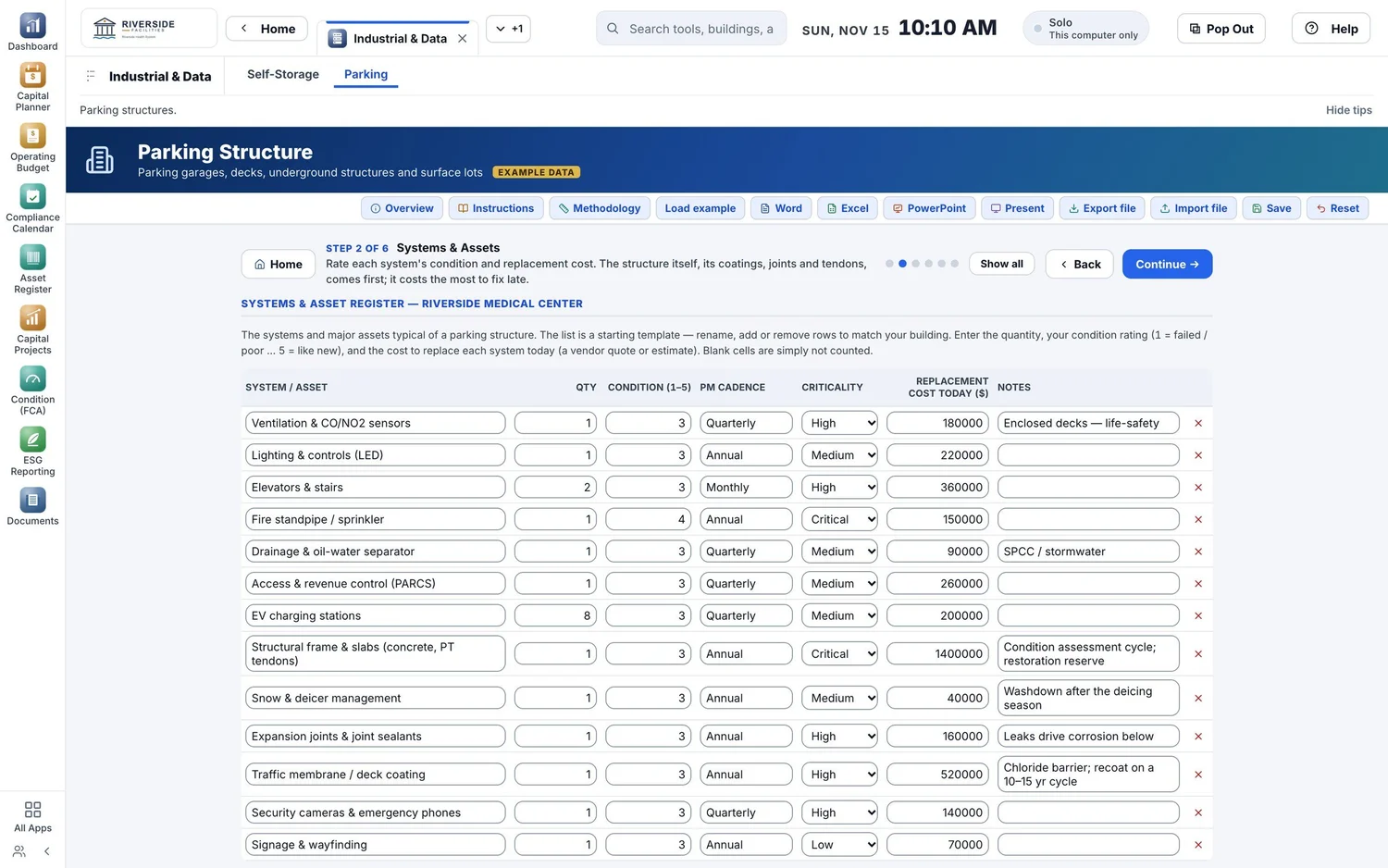
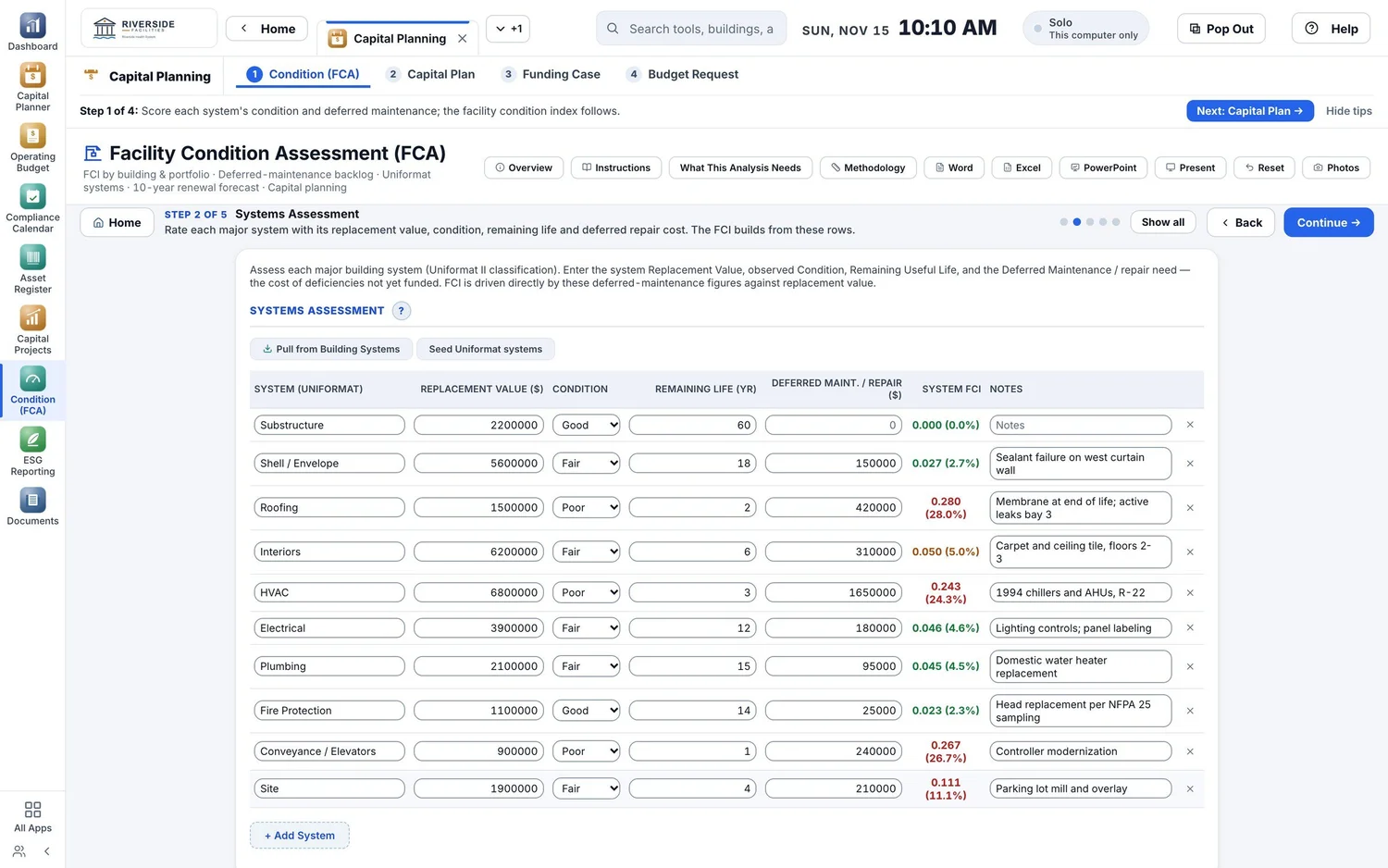
Systems & Assets in Parking Structure: rate each system's condition and replacement cost. The structure itself, its coatings, joints and tendons, comes first; it costs the most to fix late.
Operations
Access and revenue control (quarterly), EV charging stations (quarterly), LED lighting and controls (annual), drainage and oil-water separator (quarterly), signage and wayfinding (annual).
Learn MoreShow Less
Revenue control and EV chargers bring in money, and a dead pay station or charger loses it every day. Each operations system has its own cadence and capital line, so replacement is budgeted before it fails.
- Revenue control on a 10-year capital line, EV charging expansion 12, LED retrofit 15
- LED with controls cut energy costs up to 70% in DOE's LEEP campaign
- The separator is noted for SPCC and stormwater duties
- Separator inspection and cleanout semiannually under the local stormwater permit
Profile
Structure name, parking spaces, gross area, year built, levels and a year of electricity.
Learn MoreShow Less
A few numbers turn the profile into a budget case. Spaces and area give energy per stall and per square foot, and the replacement value sets the Facility Condition Index the board reads.
- Replacement value, such as an insurance appraisal, is the FCI denominator
- FCI bands: Good under 5%, Fair 5-10%, Poor over 10%
- Area gives the 10-year capital need per square foot
- The electricity entered here is used when no utility bills are on file
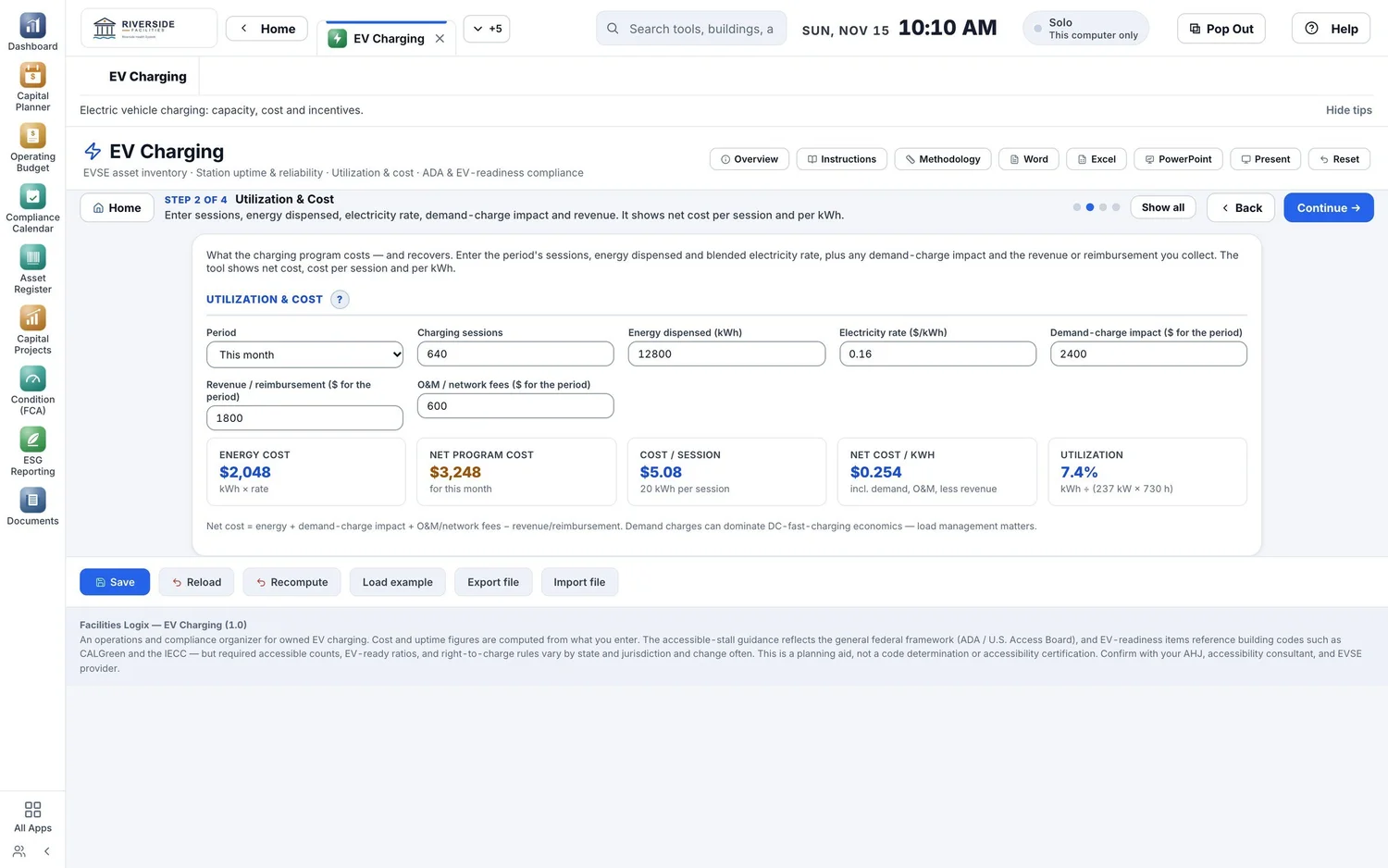
Utilization & Cost in EV Charging: enter sessions, energy dispensed, electricity rate, demand-charge impact and revenue. It shows net cost per session and per kWh.
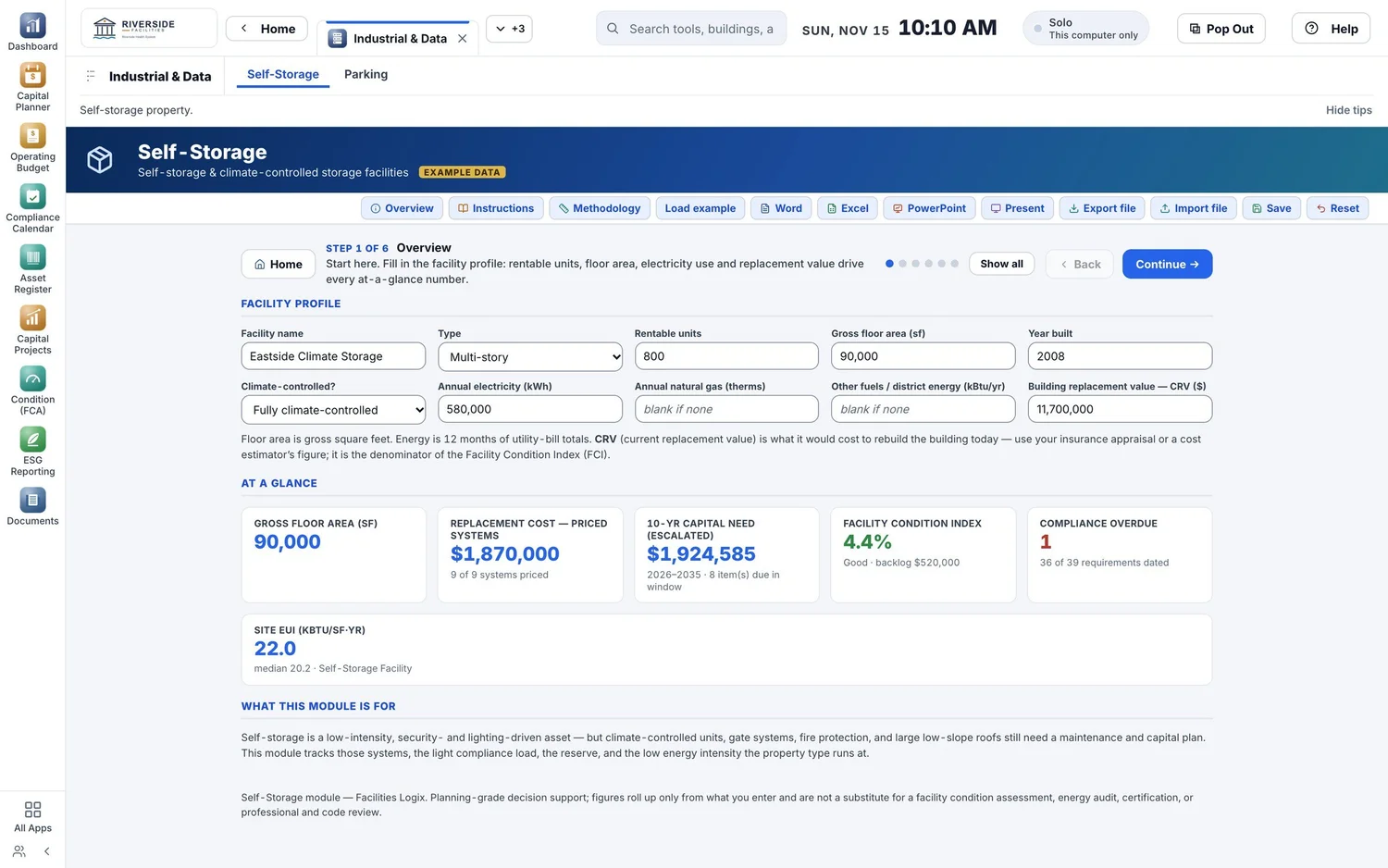
Overview in Self-Storage: start here. Fill in the facility profile: rentable units, floor area, electricity use and replacement value drive every at-a-glance number.
From the Annual Walk-Through to the Monthly Elevator Test
Structure Rounds
- The annual walk-through observation, or in New York City the annual observation on the QPSI's checklist
- Joints, sealants, membranes and, on post-tensioned decks, tendon anchorages looked at during the walk-through
- Washdown and drain cleaning after the deicing season where deicing salts are used
Life-Safety Tests from the Library
- Sprinkler valves, quarterly and annual inspections, and the standpipe flow test every 5 years (NFPA 25)
- Fire extinguishers inspected monthly and serviced every year (NFPA 10)
- Elevator periodic inspection and Category 1 test every year, and firefighters' service tested monthly (ASME A17.1)
- CO and NO2 detector calibration in enclosed garages
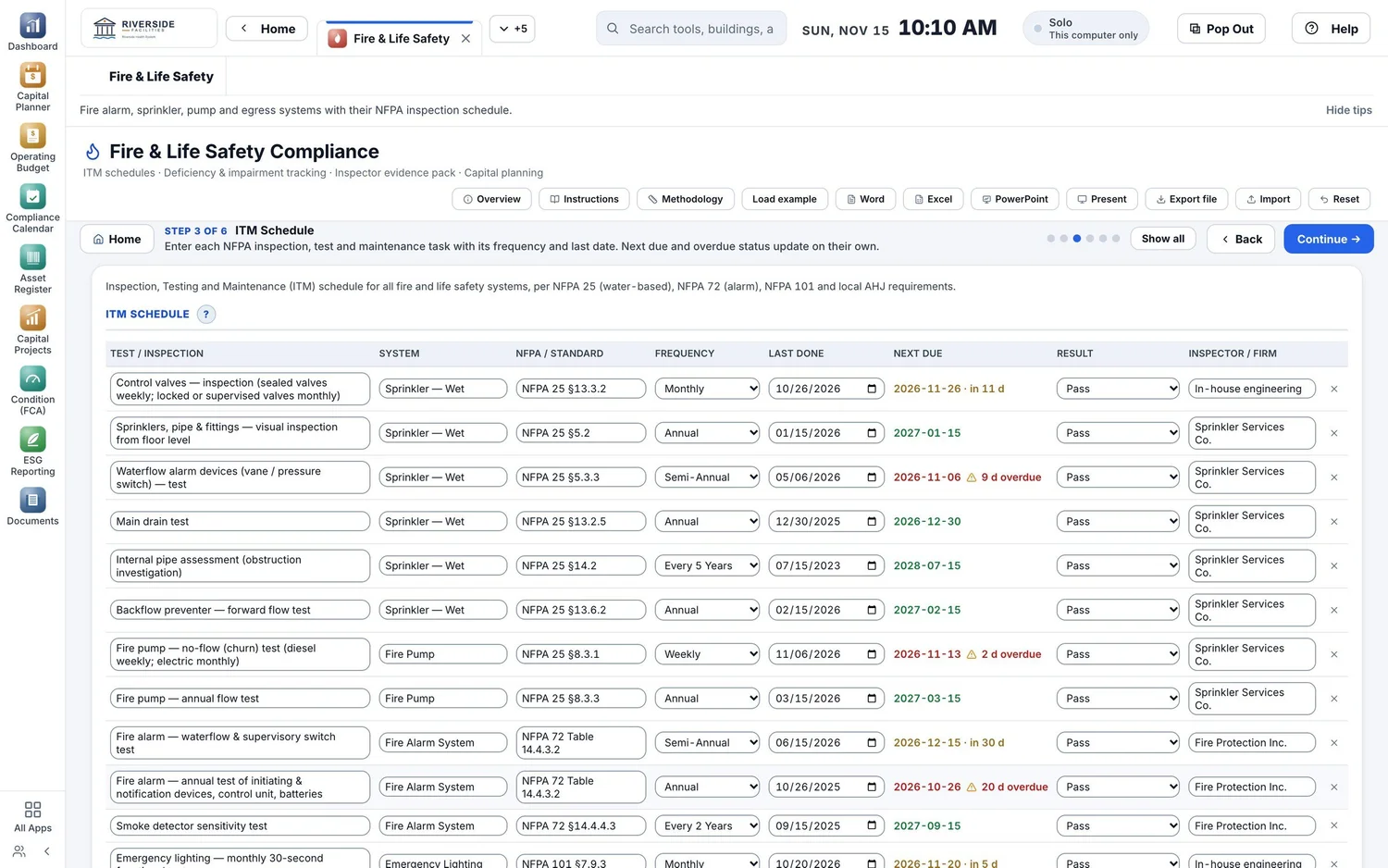
ITM Schedule in Fire & Life Safety Compliance: enter each NFPA inspection, test and maintenance task with its frequency and last date.
System Upkeep on Its Own Cadence
- Ventilation sensors, drainage and separators, revenue control, EV chargers, cameras and emergency phones on quarterly PM to start
- Elevators and stairs monthly; lighting, structure, joints, membranes, signage and snow management annually
- Every cadence is a starting point your team edits
How the Dates Work
- Enter the date each was last done; the next due date and status update themselves and match the Compliance Calendar
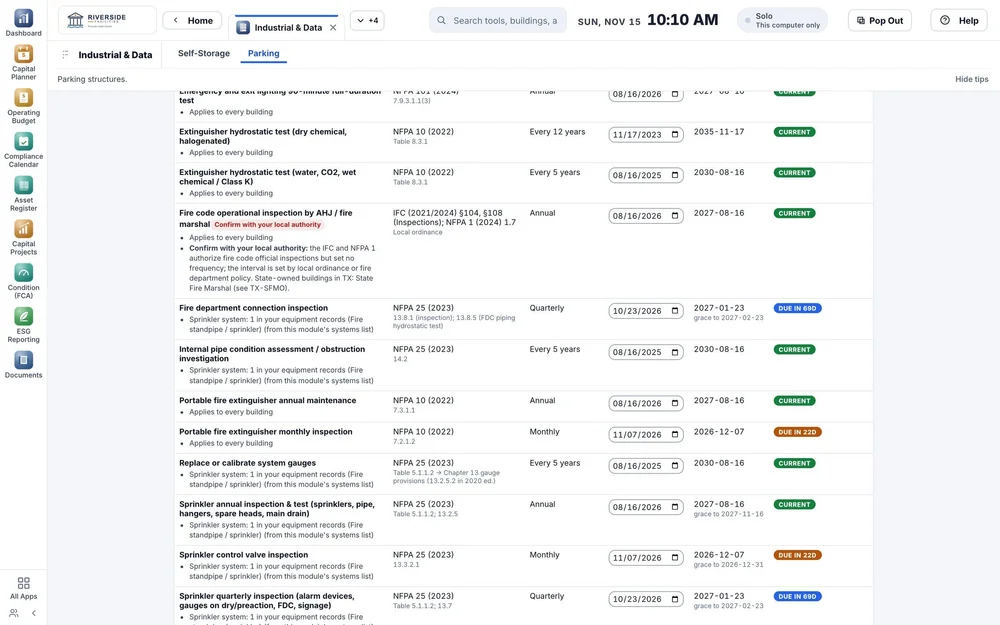
Compliance in Parking Structure: enter the date each inspection was last done: structural condition, CO sensors, standpipes, emergency phones, oil-water separator. Next-due and status update themselves.
Ready for the Engineer and the Building Department
Benchmarks Tab
Structural inspection status, CO ventilation, the restoration reserve, and accessible and EV stall counts in one view.
Learn MoreShow Less
Boards fund what they can compare. The tab sets the structure's own figures beside the yardsticks, so the case for restoration money is plain.
- FCI, replacement value per square foot and 10-year need per square foot
- Electricity per space and per square foot, tracked against past years
- Accessible EV spaces 11 ft wide with a 5 ft aisle, as the Access Board recommends
- The FCI is only as complete as the capital plan, and the tab says so
Capital Plan
Structural restoration, traffic membrane, joints and sealants, elevator modernization, LED retrofit, access and revenue system, ventilation and sensors, EV charging expansion, fire and standpipe, drainage and separators, each with its due year and escalated cost.
Learn More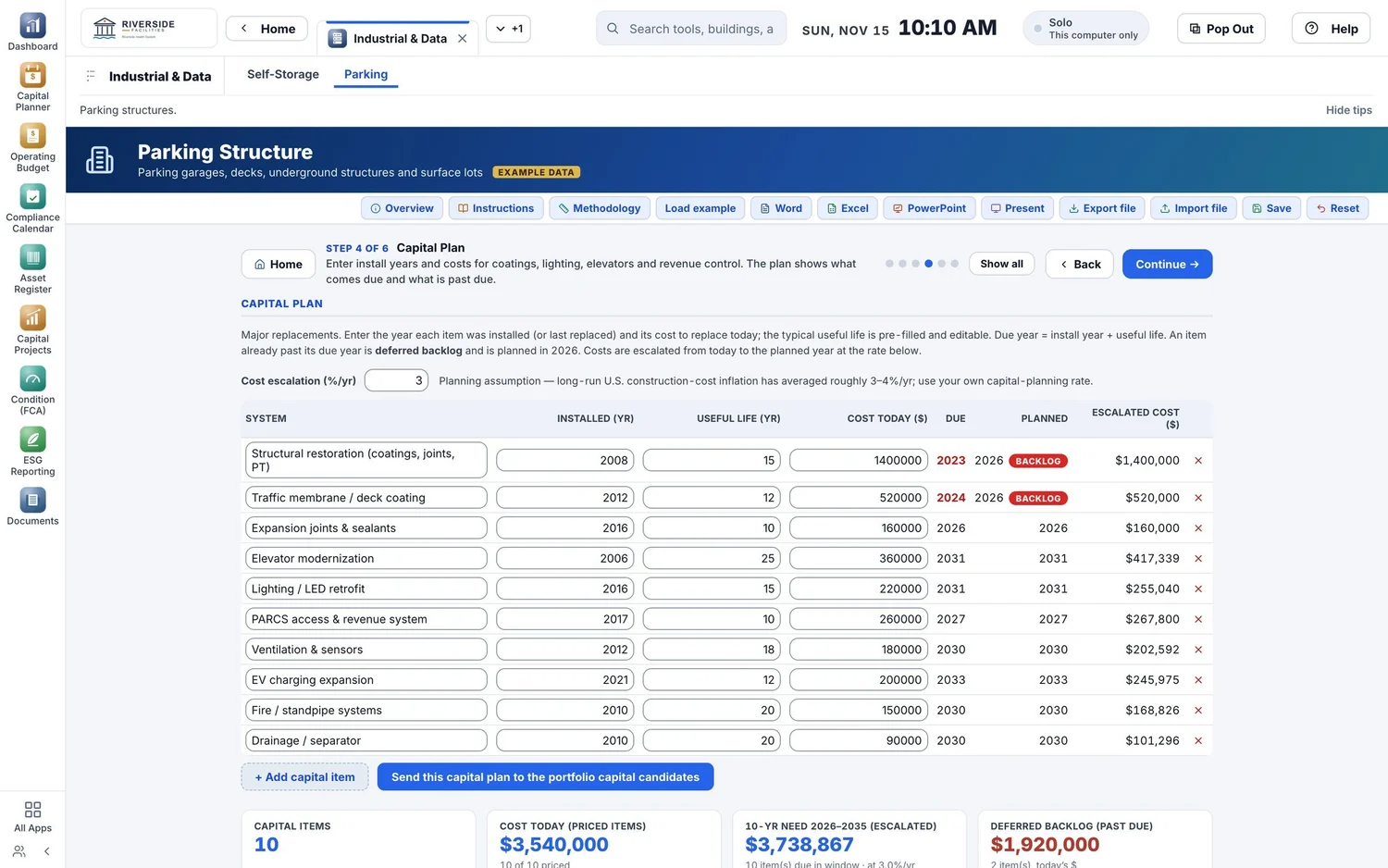
Capital Plan in Parking Structure: enter install years and costs for coatings, lighting, elevators and revenue control. The plan shows what comes due and what is past due.
ENERGY STAR Tab
Parking has no ENERGY STAR score or national median. Portfolio Manager keeps parking out of gross floor area and takes parking energy out before scoring the building it serves. The tab shows electricity per square foot and per space from the bills.
Learn MoreShow Less
With no national median, the savings case for a garage comes from its own history. The tab tracks that trend and points to the usual first step down.
- The 12 months to the latest bill give electricity per space and per square foot
- LED lighting with controls named as the usual first measure
- Energy counts in the property total unless the garage is metered separately
- Benchmarking laws that apply are listed from the city, state, sector and size
Word, Excel, PowerPoint and Present
The playbook and its compliance rows export to Word, Excel and PowerPoint, or show full screen with Present.
Learn MoreShow Less
A restoration request is easier to approve when the board sees the cost of waiting. The report leads with the decision: the deferred backlog to fund now and the escalated 10-year need.
- A capital need by year chart with the peak year named
- Deferred backlog by system, largest first
- Compliance status: overdue, due soon, current and no date
- Electricity per square foot and per space, with no median claimed
- Assumptions and formulas printed, and a SAMPLE watermark on example data
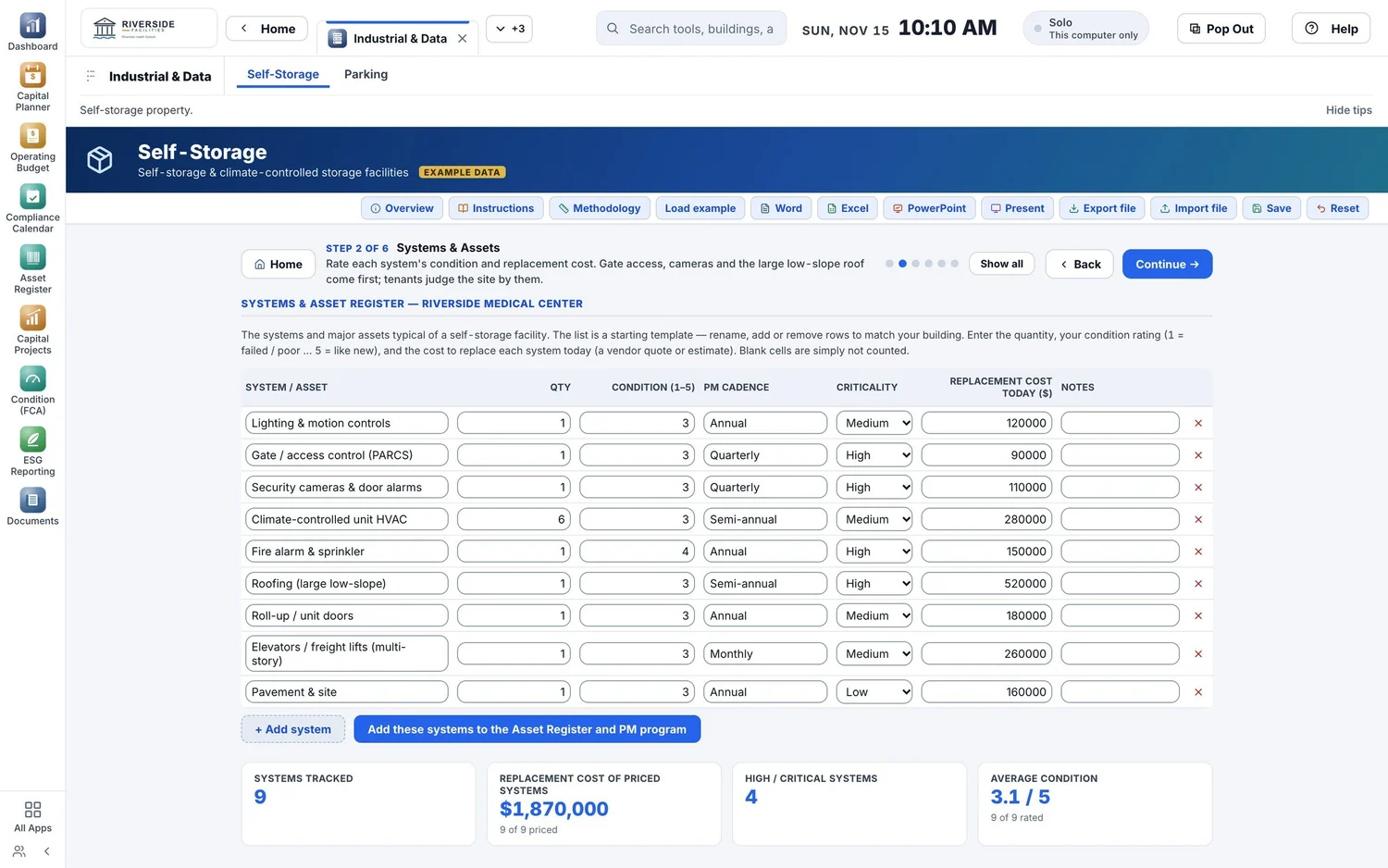
Systems & Assets in Self-Storage: rate each system's condition and replacement cost. Gate access, cameras and the large low-slope roof come first; tenants judge the site by them.
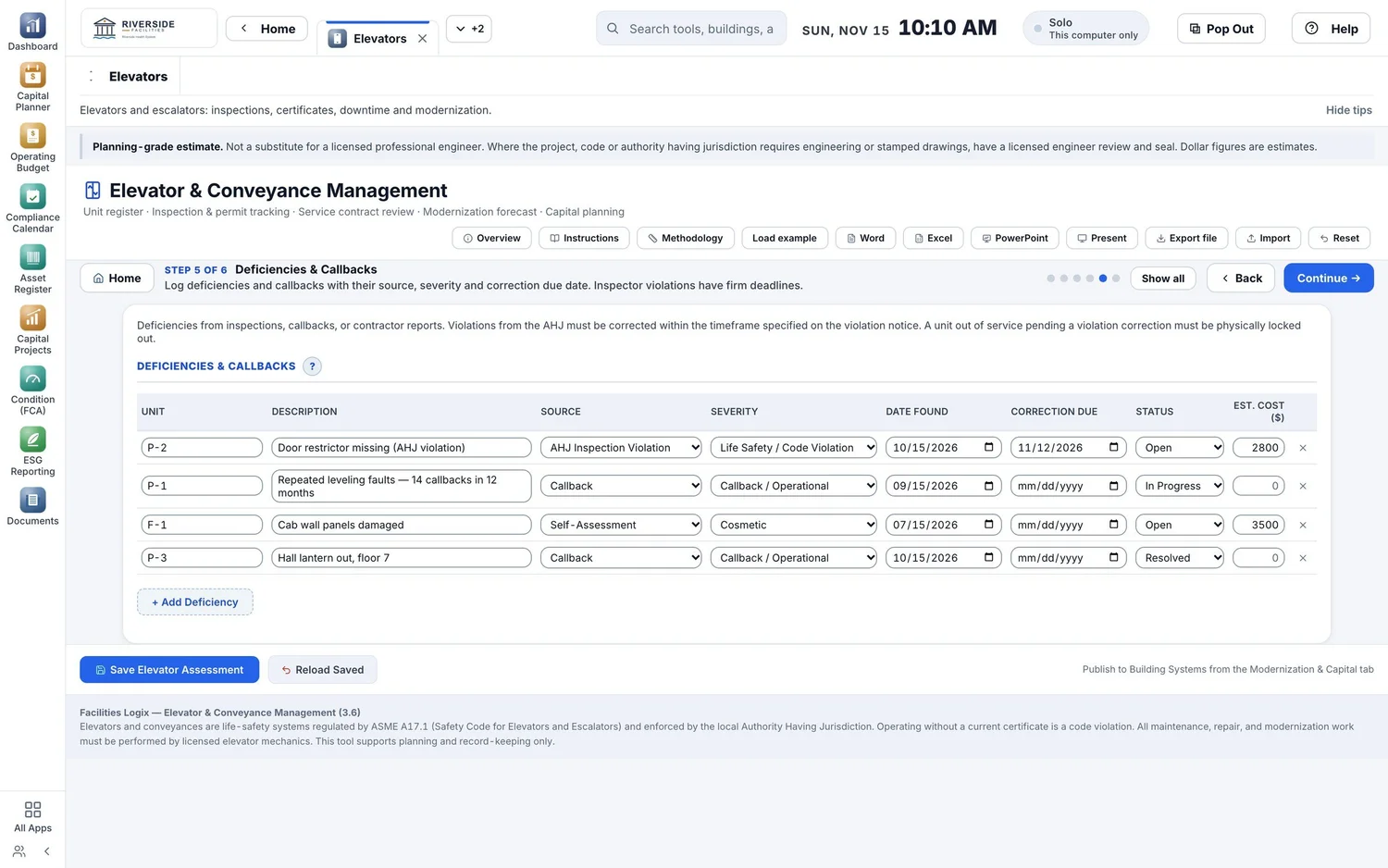
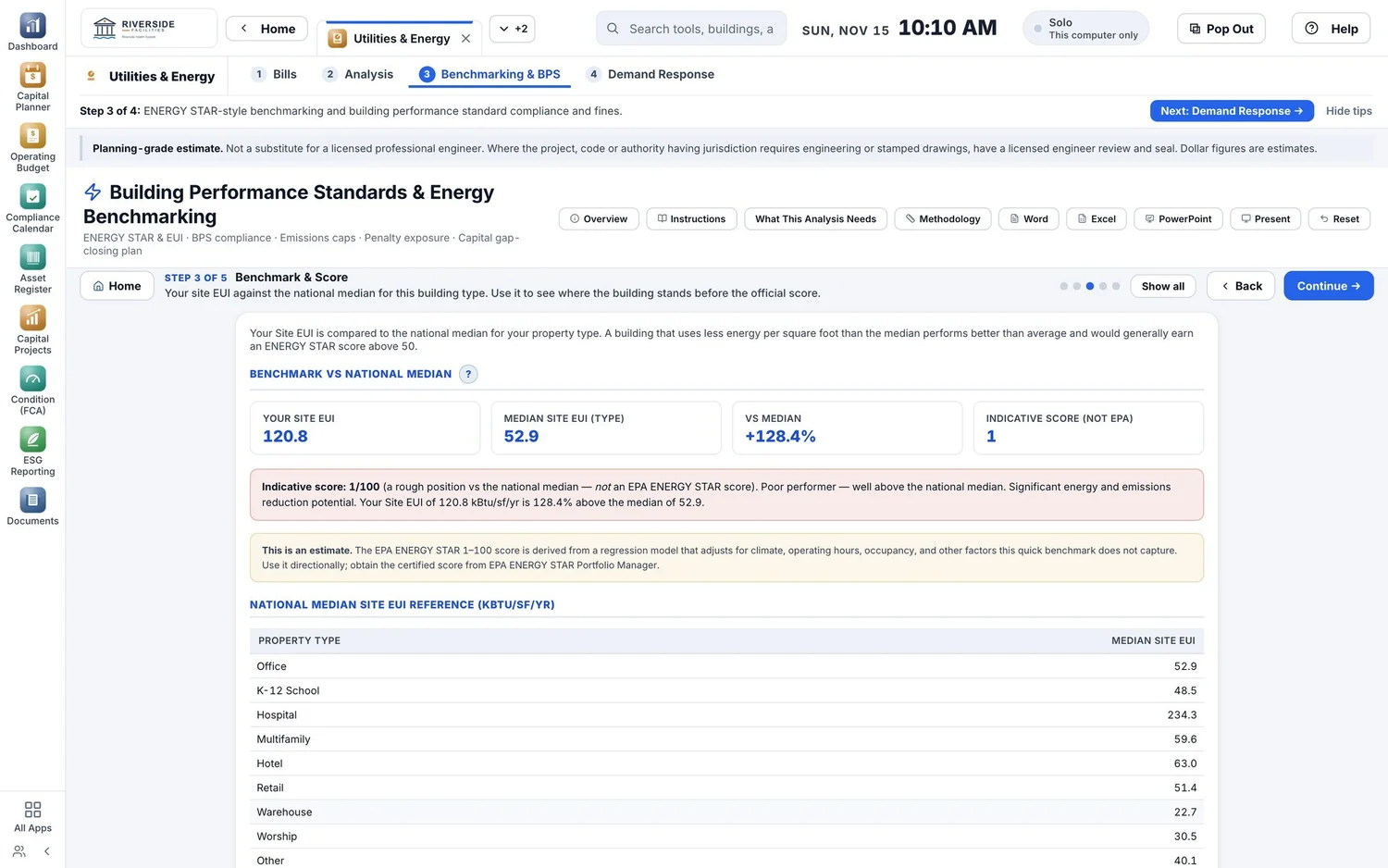
Benchmarks Written for Parking
From the Playbook
- Structural assessment status: NYC on its sub-cycle then every 4 years, elsewhere an engineer's walk-through every year
- Enclosed-garage ventilation against IMC 404.1
- Deicer and chloride damage: washdown after the season, joints and membranes kept tight so chlorides do not reach the reinforcing steel
- Lighting against ANSI/IES RP-8-25
- Accessible and van-accessible spaces against Table 208.2
- EV port uptime over 97 percent for funded chargers
- Electricity per space and per square foot, year over year
- The restoration reserve for coatings and joints on roughly 10-15 year cycles
Condition and Capital
- Average condition on a 1-5 scale, deferred backlog, the Facility Condition Index and the 10-year capital need
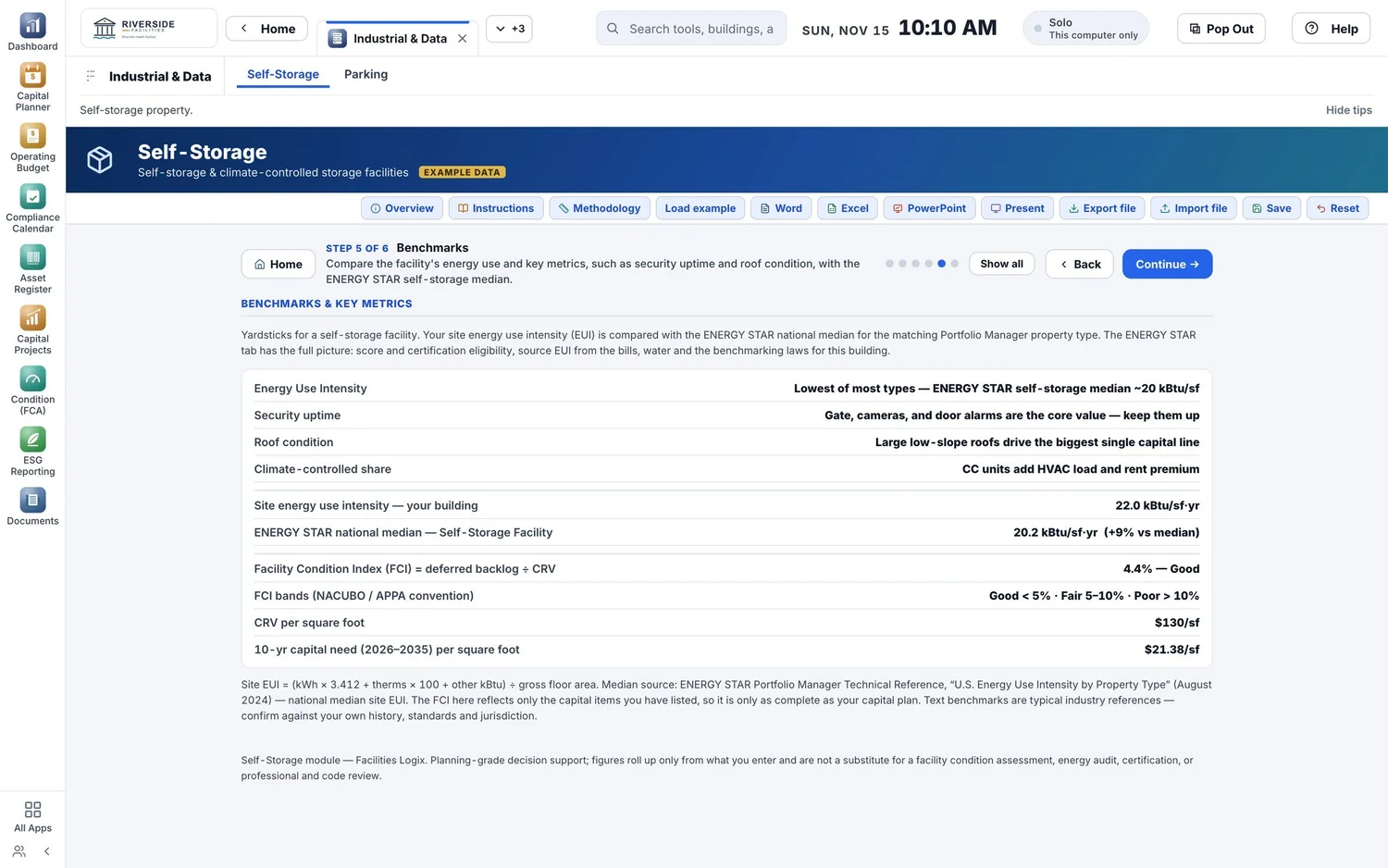
Benchmarks in Self-Storage: compare the facility's energy use and key metrics, such as security uptime and roof condition, with the ENERGY STAR self-storage median.
Catch Deterioration While It Is Still a Repair
No Missed Filing Windows
Sub-cycle deadlines, annual observations and 90-day repair windows each carry a date, so nothing waits until a notice arrives.
Learn MoreShow Less
A missed filing or repair window invites enforcement, and work done in a rush rarely costs less. Each row names the record that closes it, so the paperwork is ready when the date comes.
- Unsafe conditions: repair permits and an amended report showing them corrected
- SREM: monitoring records and the amended report accepted by DOB
- The annual observation checklist kept on site for DOB and the QPSI
- Each row names who performs it, such as a QPSI licensed in New York
The Right Rows for Each Site
A surface lot, a post-tensioned deck and a garage with network-connected pay stations each get only the rows that fit them.
Learn MoreShow Less
Every row that does not fit a site is staff time and contractor money spent for nothing. Rows follow each structure's own answers and location, and each says why it applies.
- City rows such as Local Law 126 or Fort Lee appear only where the Building Record places the site
- Elevator and sprinkler rows appear when the equipment records show the equipment
- An unanswered question leaves its rows at Confirm, not quietly on or off
- Each structure in the portfolio keeps its own type and answers
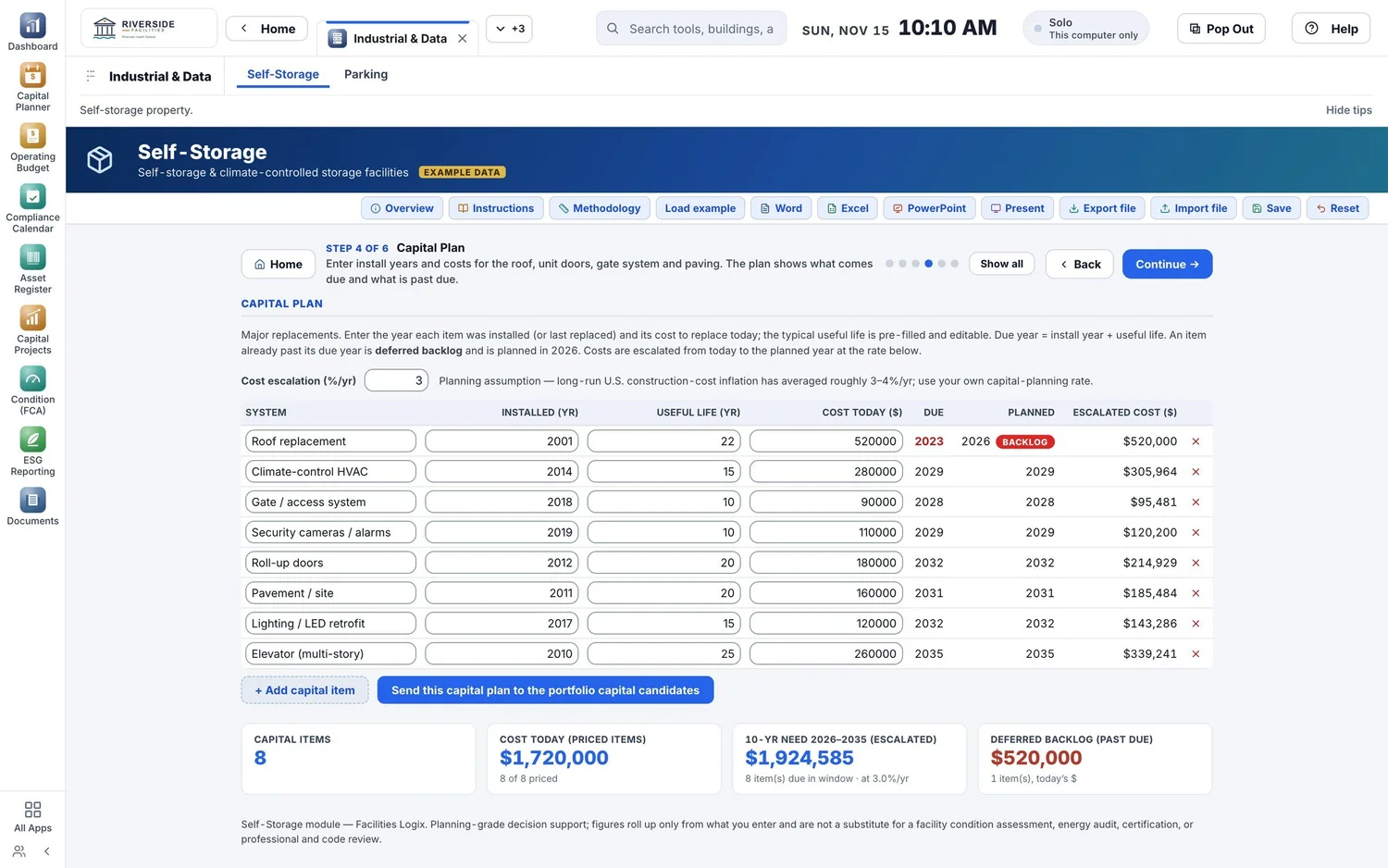
Capital Plan in Self-Storage: enter install years and costs for the roof, unit doors, gate system and paving. The plan shows what comes due and what is past due.
A Reserve Built from Records
Coatings, joints and membranes have long, predictable cycles. A capital plan built from their age and condition shows the restoration coming.
Learn MoreLess Paper
Inspection dates, findings and the capital plan live in one record instead of binders and spreadsheets.
Learn MoreShow Less
Hours spent hunting for last year's engineer report are paid hours. One record holds the dates, findings and evidence, and exports them for the engineer or the building department.
- Attach reports and certificates as each inspection is done
- Export the evidence pack, with why each row applies and its source
- Send the systems to the Asset Register and PM program in one step
- Send the capital plan to the portfolio's capital candidates
Frequently Asked Questions
Does a surface lot get the structural inspection rows?
Does Facilities Logix replace our Qualified Parking Structure Inspector or engineer?
Why are some rows marked Confirm?
Can a parking garage get an ENERGY STAR score?
Be First When Facilities Logix Opens
Stop chasing building records across spreadsheets and binders. Join the list and we will tell you the day downloads open, with setup guides ready.
Launching early 2027 for Facilities Logix. Nothing to buy today, and no sales calls.
