
Agreements Priced from the Tasks, Delivered on Schedule, Renewed on Time
Maintenance agreements are the steadiest revenue a mechanical contractor has, and the easiest to underprice, under-deliver and forget to renew. HVAC Logix carries an agreement through its whole life: the estimate built from each unit's tasks, the signed terms, the visits on the dispatch board and the phones, the invoice on its billing day, and the renewal worked months before the notice date.
Launching Early 2027 · Join the Early-Access List
Price the Tasks, Not the Units
The Maintenance Estimator builds an agreement from the bottom: each covered unit, the tasks it needs at the chosen frequency, and the hours at the skill tier required.
Equipment and Task Sets
Add a line per covered unit. Choosing the equipment type loads its task list. The hours and skill tier for each task are your own, entered once or imported, so the price reflects the real work on each machine, including difficult access.
Learn MoreShow Less
Agreements priced by counting units and remembering last year's number lose money by month six. Building the price from each unit's tasks puts every hour you will spend into what you charge.
- Tasks are priced by skill tier, so filter changes are not billed at your senior rate.
- Frequency is set per task, because a quarterly agreement is not four monthly ones.
- Add or delete tasks per unit to match the machine in front of you.
- Each line records quantity, location or tag.
Cost, Margin and Price
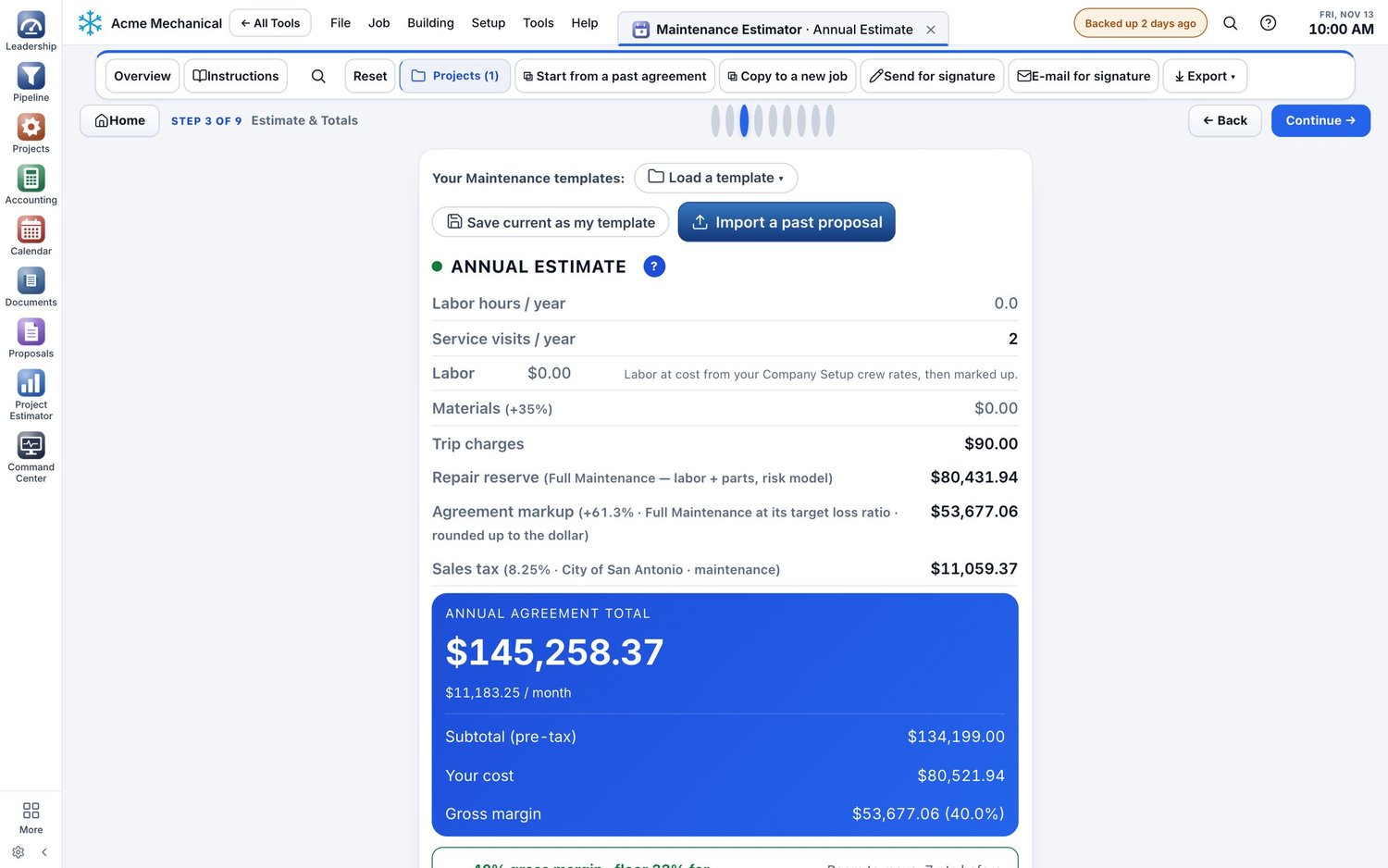
The annual estimate rolls up labor hours by tier, materials, filters and belts into a total cost, a margin and an annual price. When the margin looks low, the screen shows where the hours are.
Learn MoreShow Less
When an agreement loses money, the cause is almost always task hours, not rates. The roll-up shows the hours first, so you fix the real problem before the price goes out.
- Labor hours by tier: divide by your technicians' productive hours to check you can staff it.
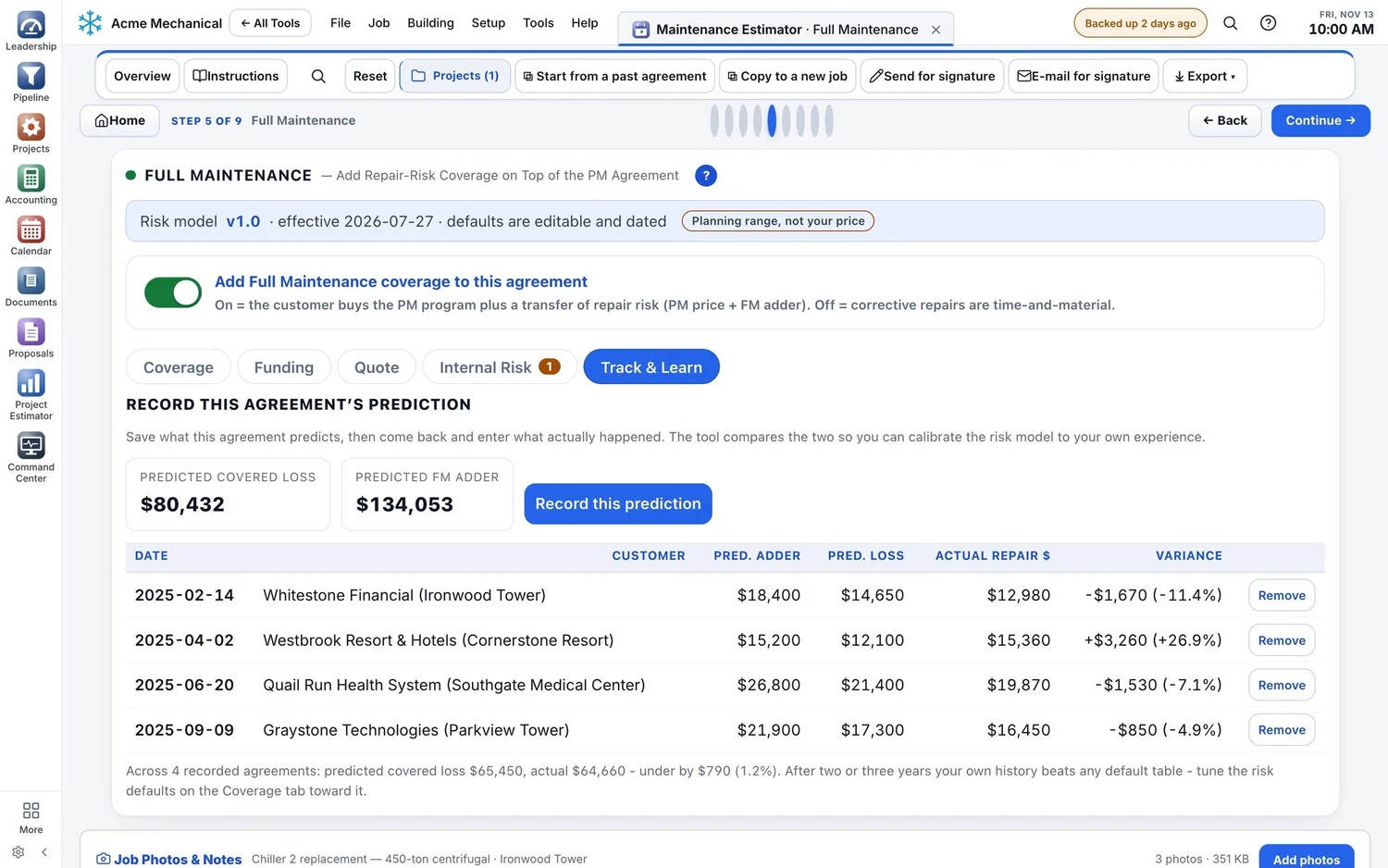
- Full Maintenance adds repair coverage as an adder over the PM price.
- Coverage per asset: labor only, labor and parts, or everything short of replacement, with not-to-exceed limits.
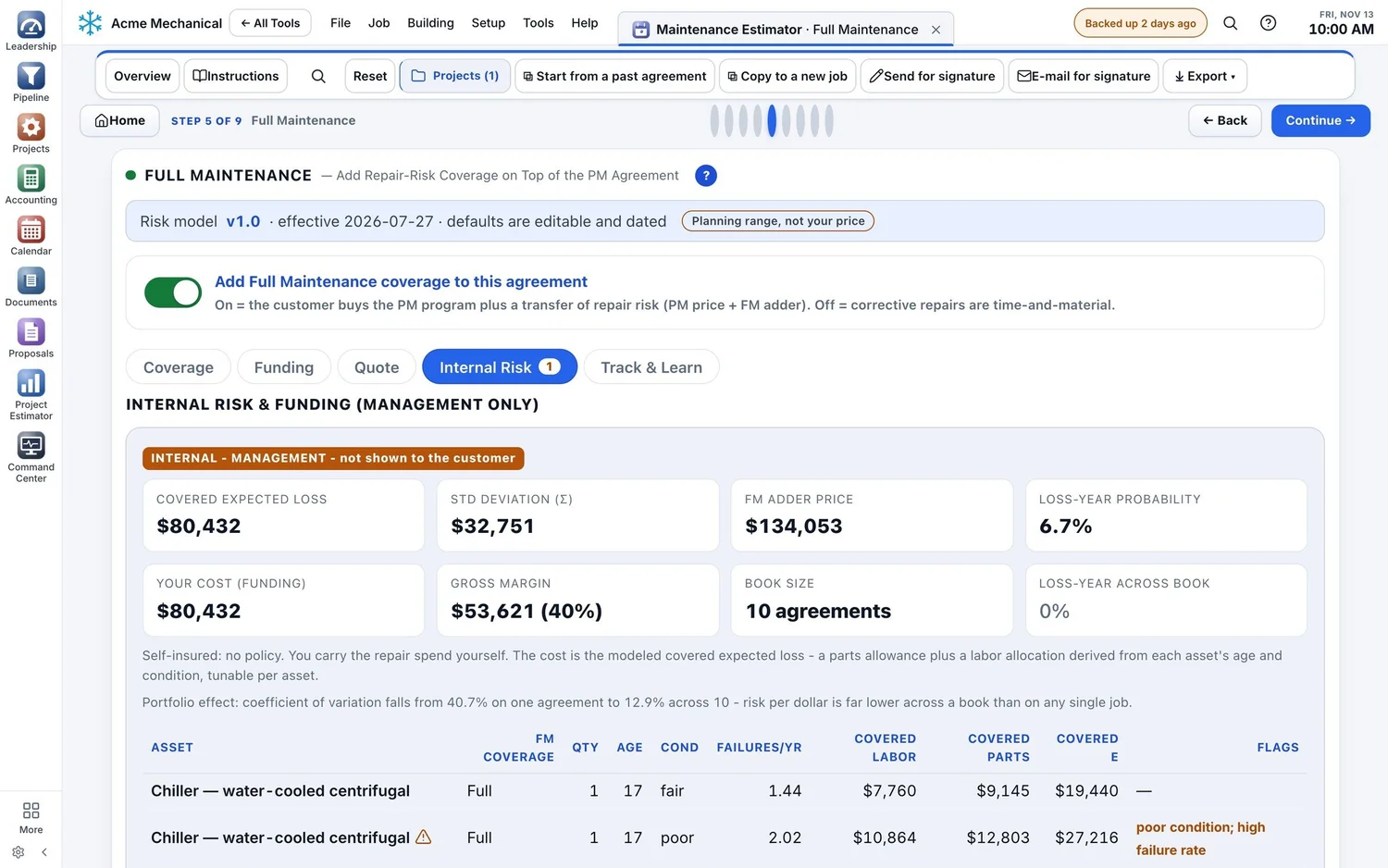
- A management-only view shows risk and funding; the customer never sees it.
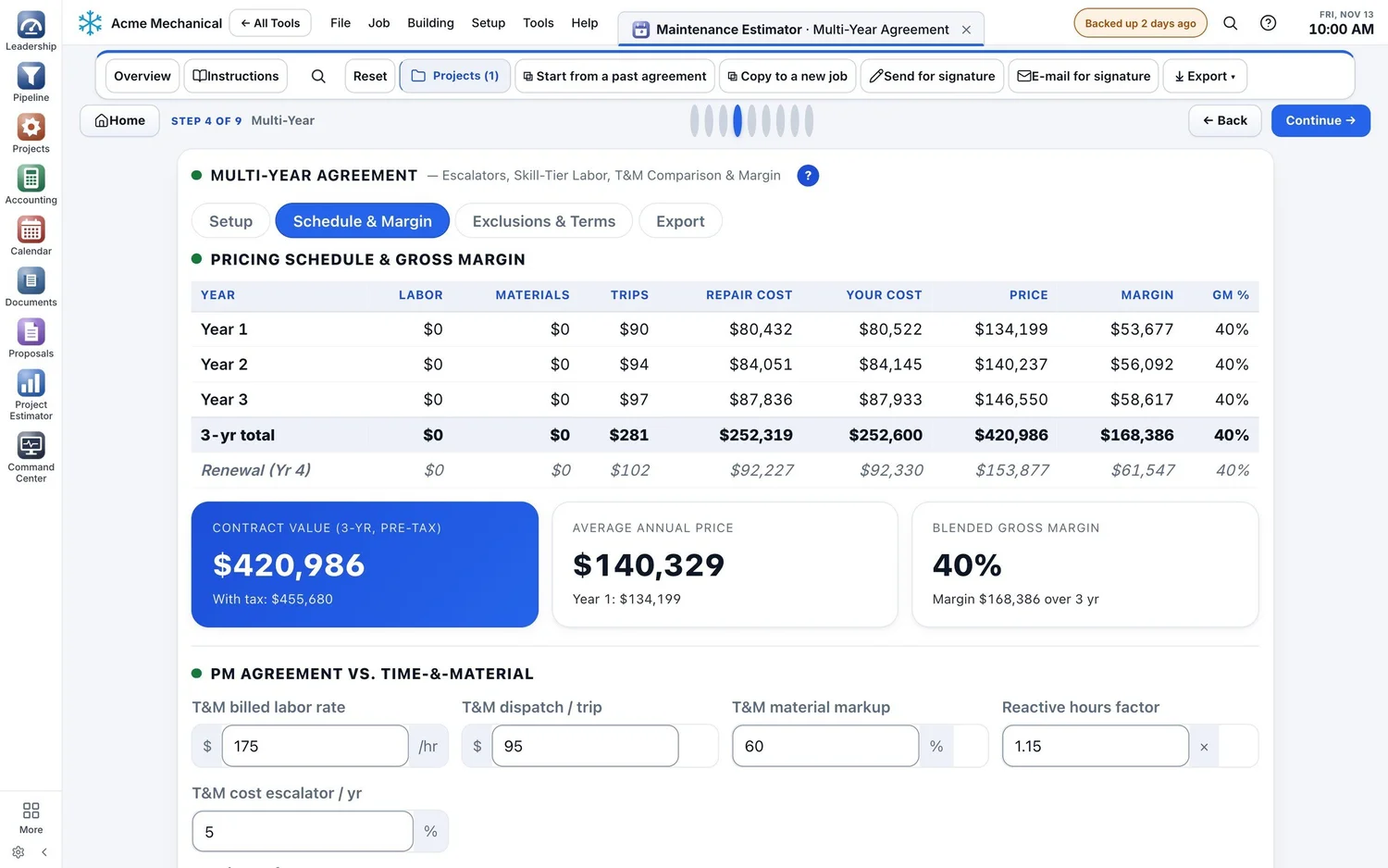
A multi-year price set by guess can lose money in year three, so the schedule shows cost, price and margin each year.
The Multi-Year Schedule
For a term longer than a year, read the year-by-year schedule with escalation, the term total and the renewal price, beside a comparison of the agreement against time and materials.
Learn MoreShow Less
A multi-year agreement at a flat price loses money by year three as labor costs rise, and the year after the term is where agreements quietly die. The schedule settles both at signing.
- The renewal price is written into the document, removing the renewal argument.
- The comparison sets the agreement against the owner's expected cost of calling you only when something breaks.
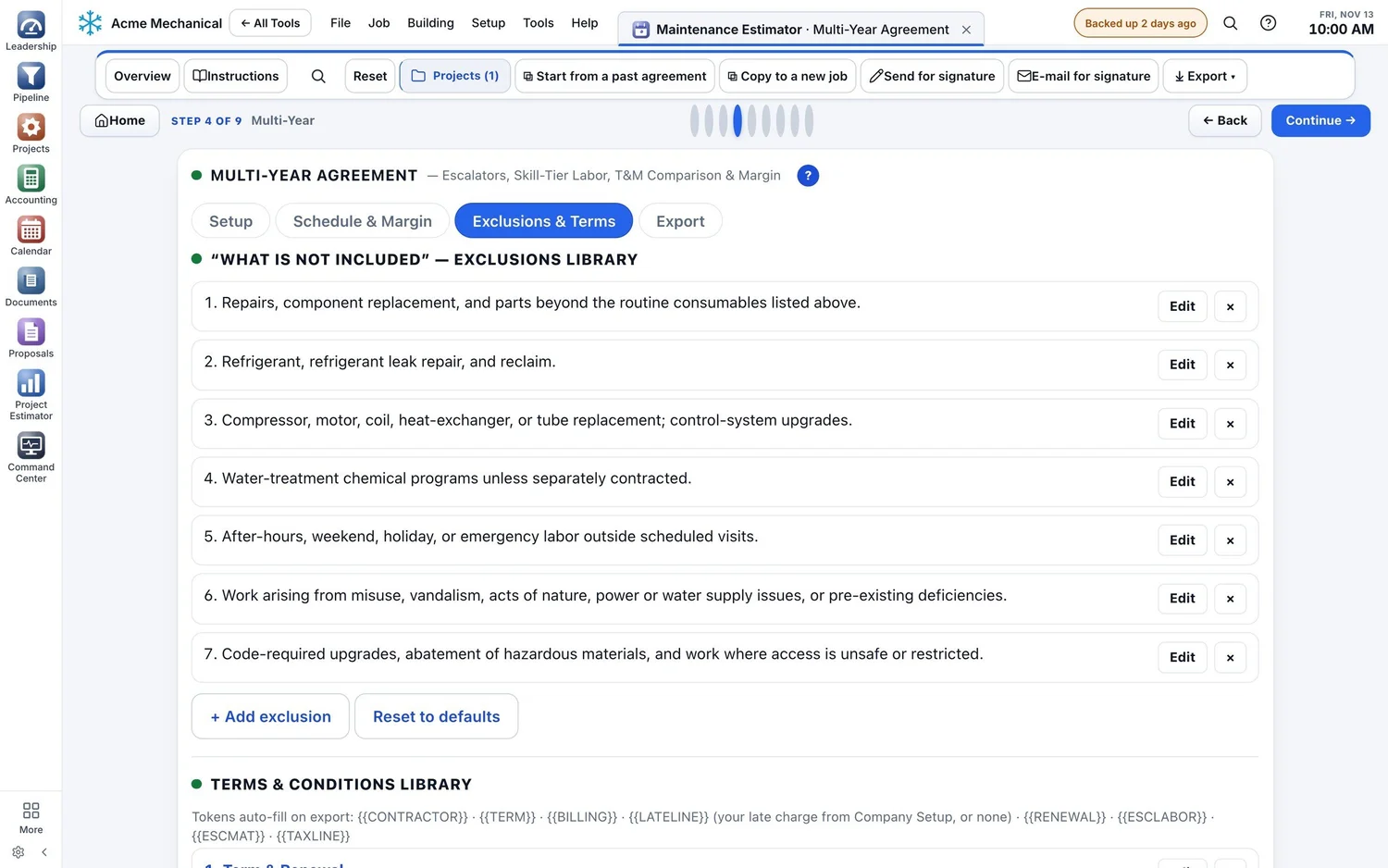
- Sub-tabs: Setup, Schedule and Margin, Exclusions and Terms, and Export.
- If year five looks unaffordable, the escalation is too steep; if it matches year one, too low.
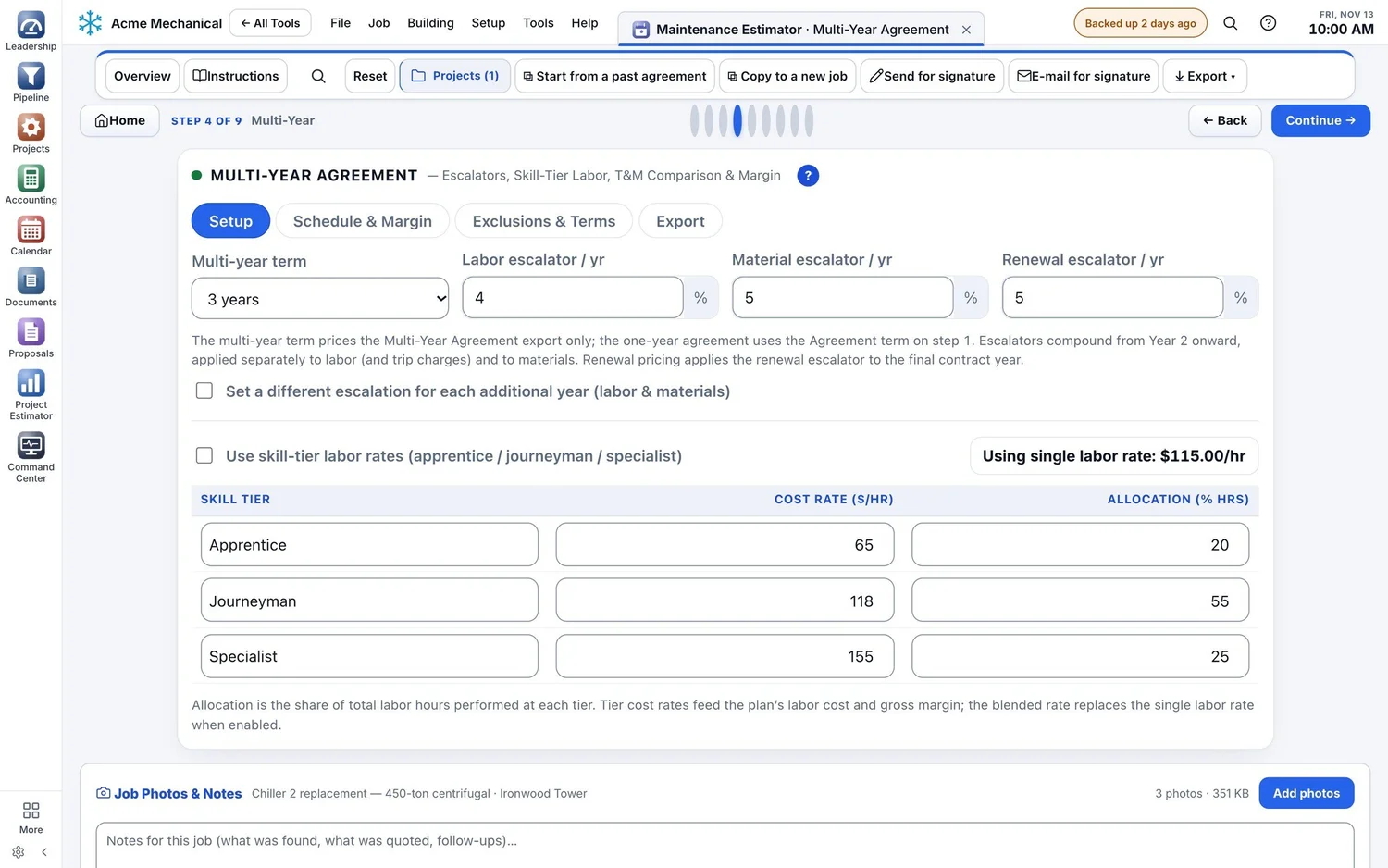
Labor rates rise over a long agreement, so the multi-year setup carries escalation for each skill tier.
Start from a Project Handoff
When a completed project is handed over from an estimator, a banner offers to start the agreement from it: the customer, site, contact and one equipment line per installed unit, with a task set matched to the recommended frequency.
Learn MoreShow Less
The PM proposal is due the day the warranty clock starts, and every week it waits is coverage a competitor can win. Starting from the handoff gets it out while the customer still remembers your install.
- Fills the customer, site, contact, account manager and agreement term.
- Carries the company profile across, so branding is automatic.
- From another computer, load the handoff file through Import; your saved agreements are untouched.
- Treat the tasks and hours as a starting point and review them before pricing.
The Proposal and the Workbook
The customer gets a branded Word proposal: covered equipment and scope by unit, investment, inclusions, exclusions, terms and acceptance. Your team keeps the Excel estimate. Cost and margin never appear on the customer's copy.
Learn More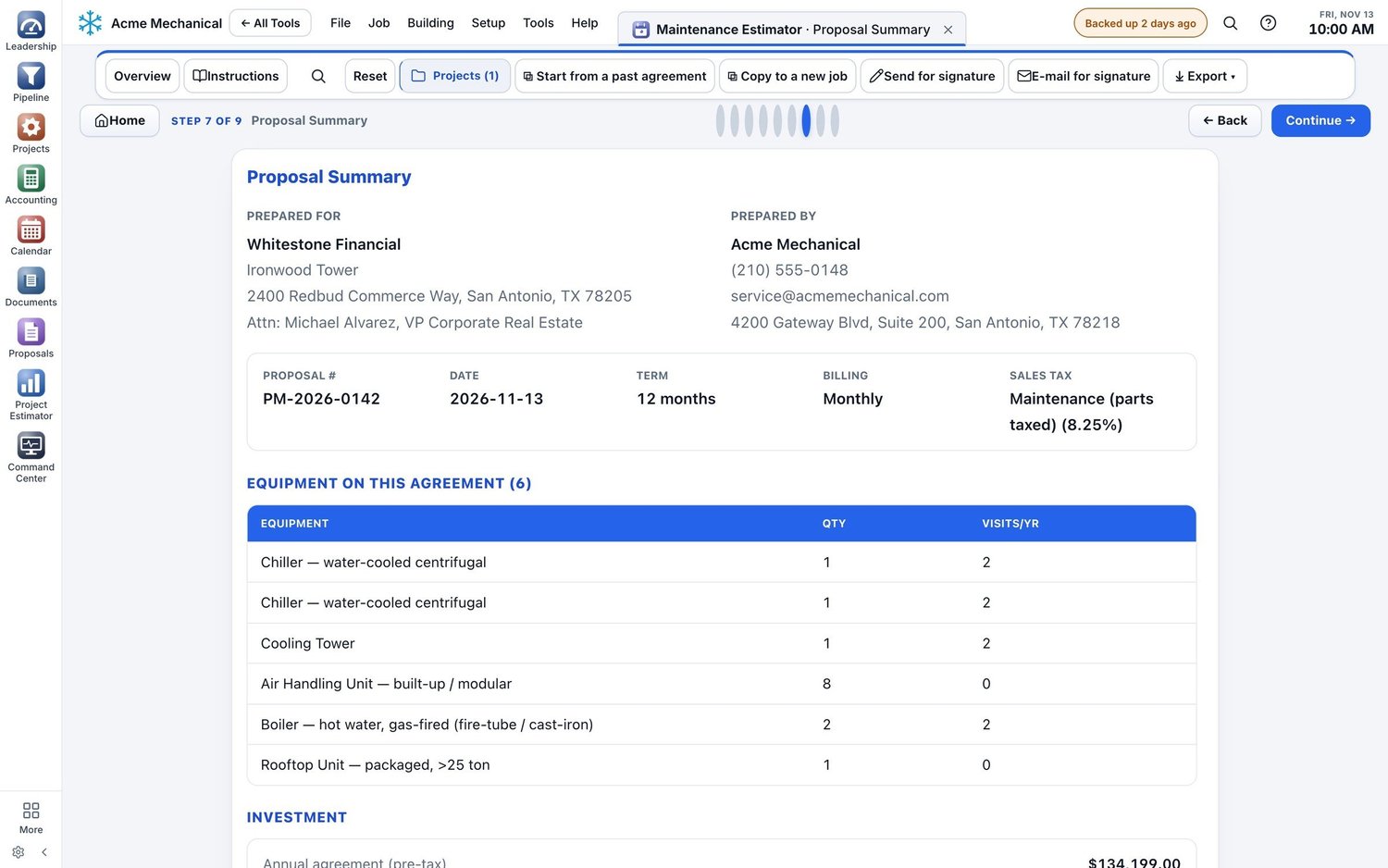
Owners sign what they understand, so the proposal summary lists covered equipment and the investment.
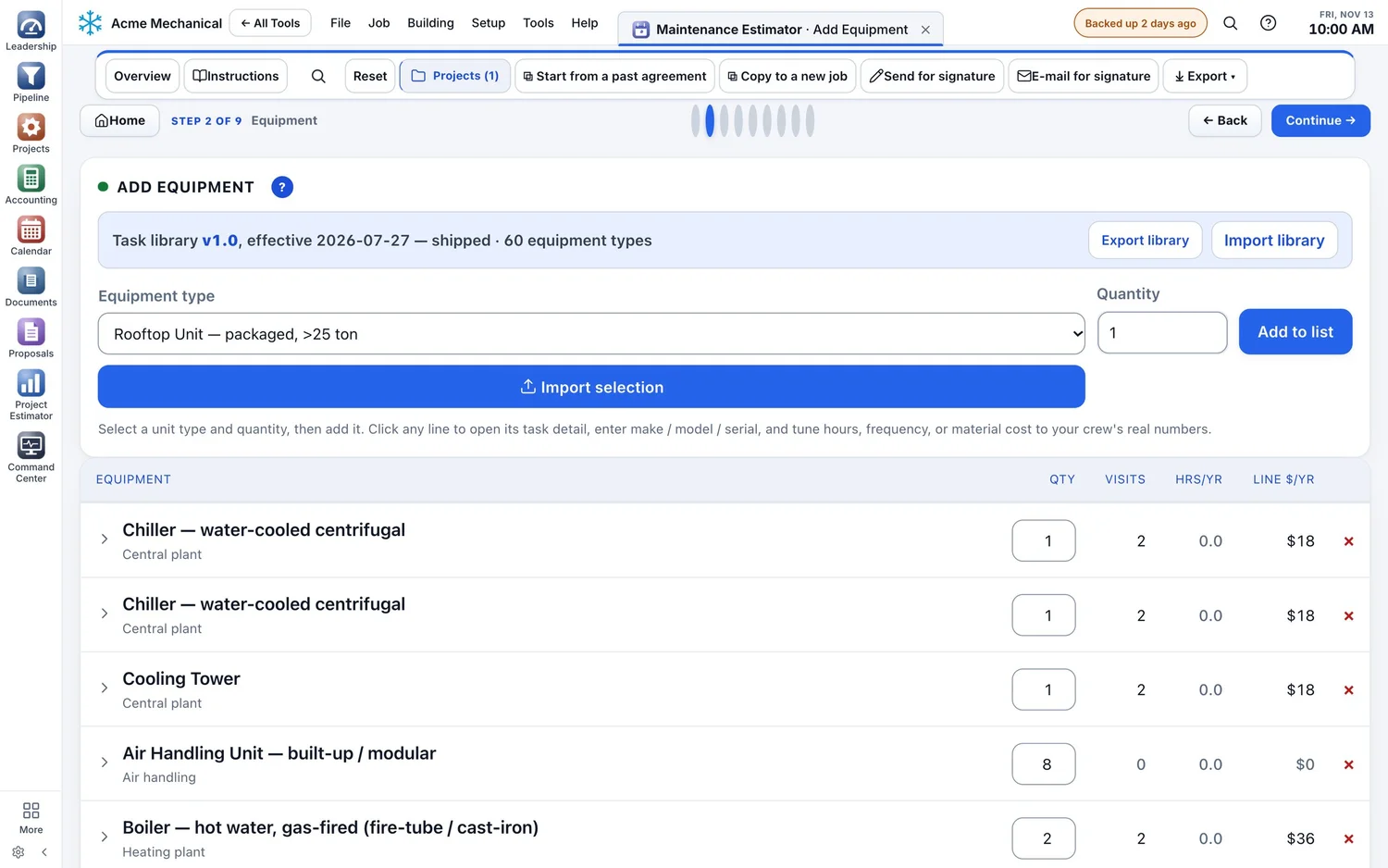
Maintenance priced by task and visit, with cost, margin and price shown together.
Build the Offer the Building Actually Needs
Full Maintenance as an Adder
- Preventive maintenance stays the base of every agreement; repair coverage is added on top
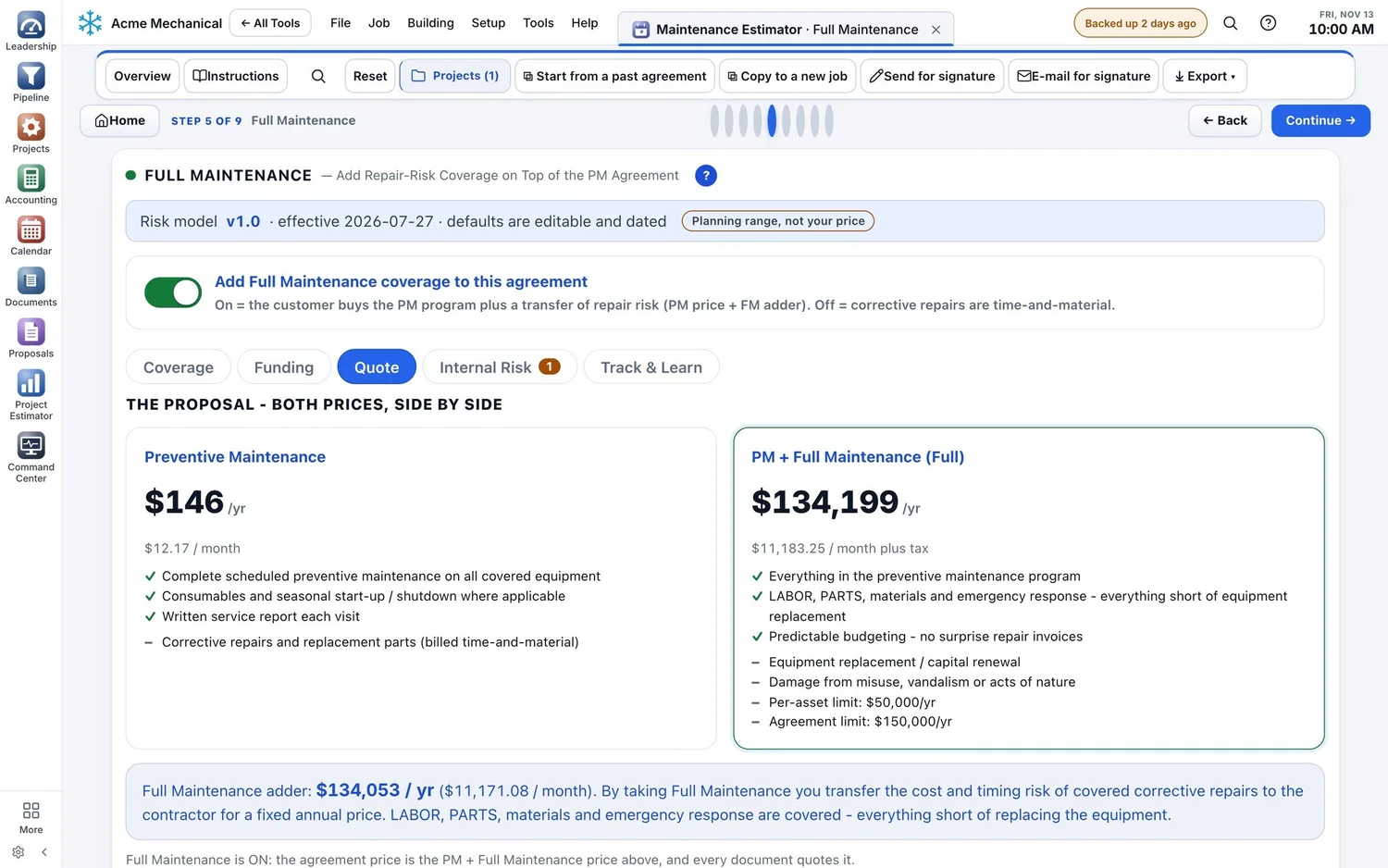
- Three levels, per asset if you like: Labor Only, Labor and Parts, or Full
- Name the components you will not cover and cap exposure with not-to-exceed limits
- Priced from each asset's age, condition and run hours, with major components modeled as failure events
- Three ways to fund the risk compared side by side: self-insured, insured, or insured with a deductible allowance
- An internal view, for management only, flags assets that are unwise to cover
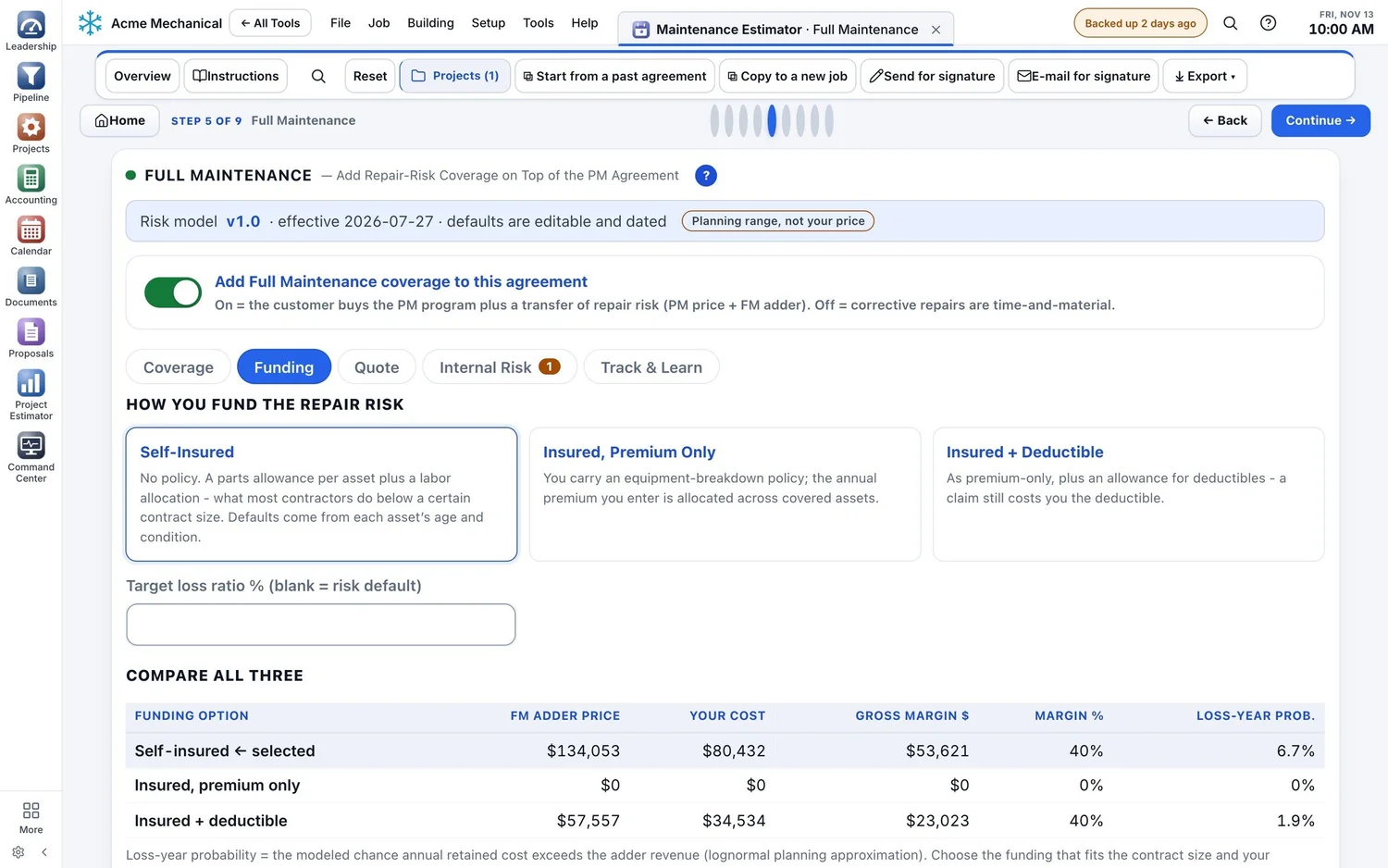
Repair coverage has to be funded somehow, so the options compare self-insured and insured coverage.
Additional Services from Adjacent Trades
- A library of service names, priced only from your own rates, such as backflow testing, infrared electrical scanning, generator load-bank testing, water treatment and damper testing
- Services that match the equipment on the job are recommended
- Declare once which trades you perform in-house, subcontract or do not offer
- Place each service as Included, a priced Option, or Available later; the base PM price never changes quietly
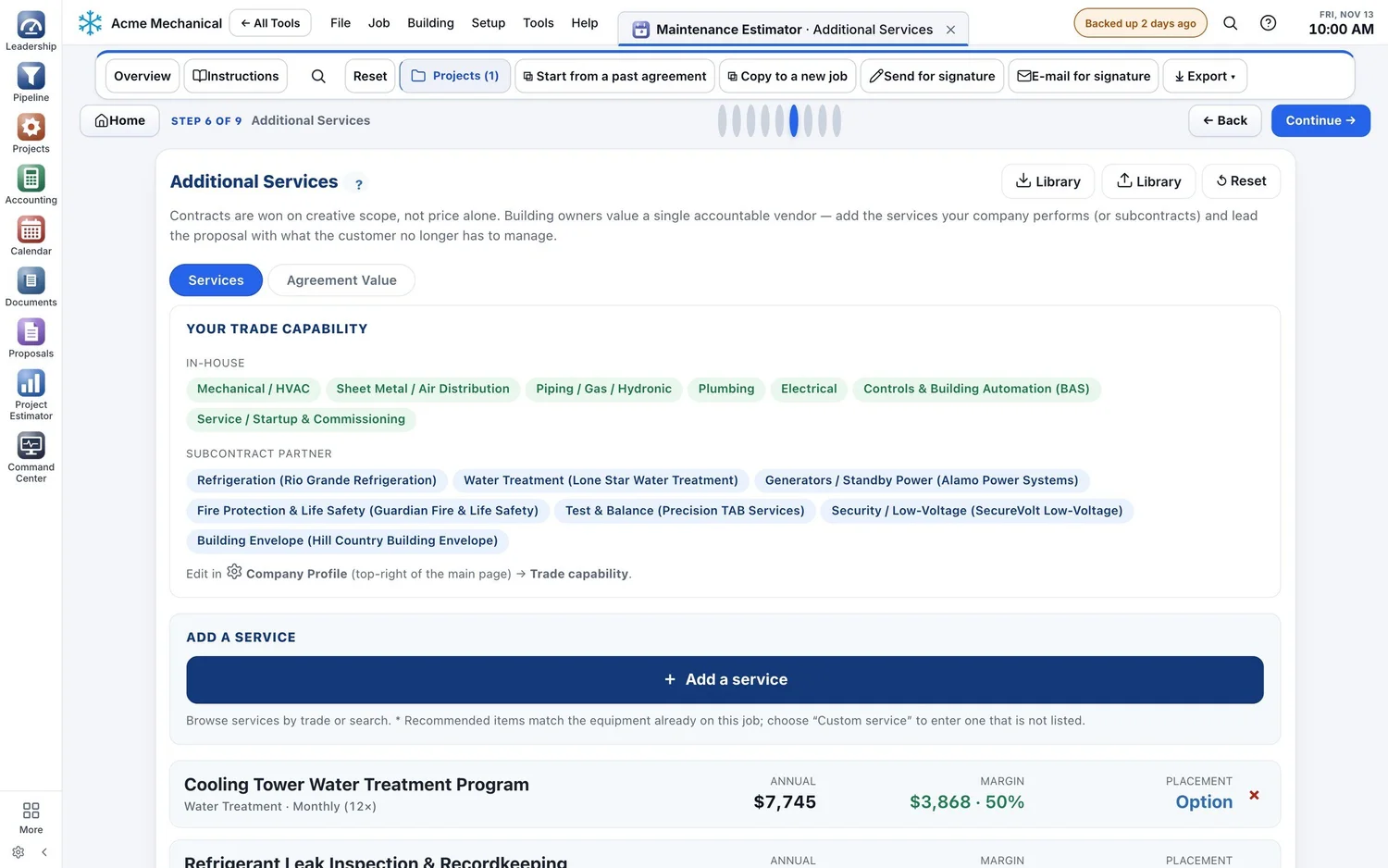
Adjacent-trade work is easy to leave out, so additional services are added from a library.
Remote Monitoring
- Sold included in an agreement, as an add-on line, or as a stand-alone monitoring agreement
- Three tiers: alarms only, alarms with a monthly report, or alarms with the report and trend analytics
- Priced from your own monitoring rate card by site and by point
- A read-only advisory service; it is not a life-safety system and never commands equipment
The Packaged Offer
- Combine the agreement with what other tools published for the building: a capital project, financing, the multi-year testing calendar, ongoing commissioning
- A good, better, best ladder: project only, plus first-year maintenance, plus the multi-year agreement
- One combined monthly figure, shown as a planning illustration
- A component with no published source is marked price to confirm, never guessed
Building Care
- Kept with the customer's building: failure codes, the reliability of its equipment, operator rounds and the shift handover
- Walk a round point by point; each reading is graded OK, Watch or Alert as it is typed against the limits you set from the nameplate or the manual
- An Alert reading can open a service work order by itself when the round is finished
- A criticality register with a failure-response playbook, inspections sold as a service, comfort-complaint patterns, and standard response times with a not-to-exceed on the agreement
What It Costs to Keep It in House
- The In-House Cost tab sets out what the owner would spend to keep this maintenance in house beside what the agreement costs
- Technicians start from the agreement's own labor hours; enter the customer's real wage, burden, supervision, tools, training, vehicle and supplies
- Pull the building's service invoices from the last 12 months for the repairs outside the agreement
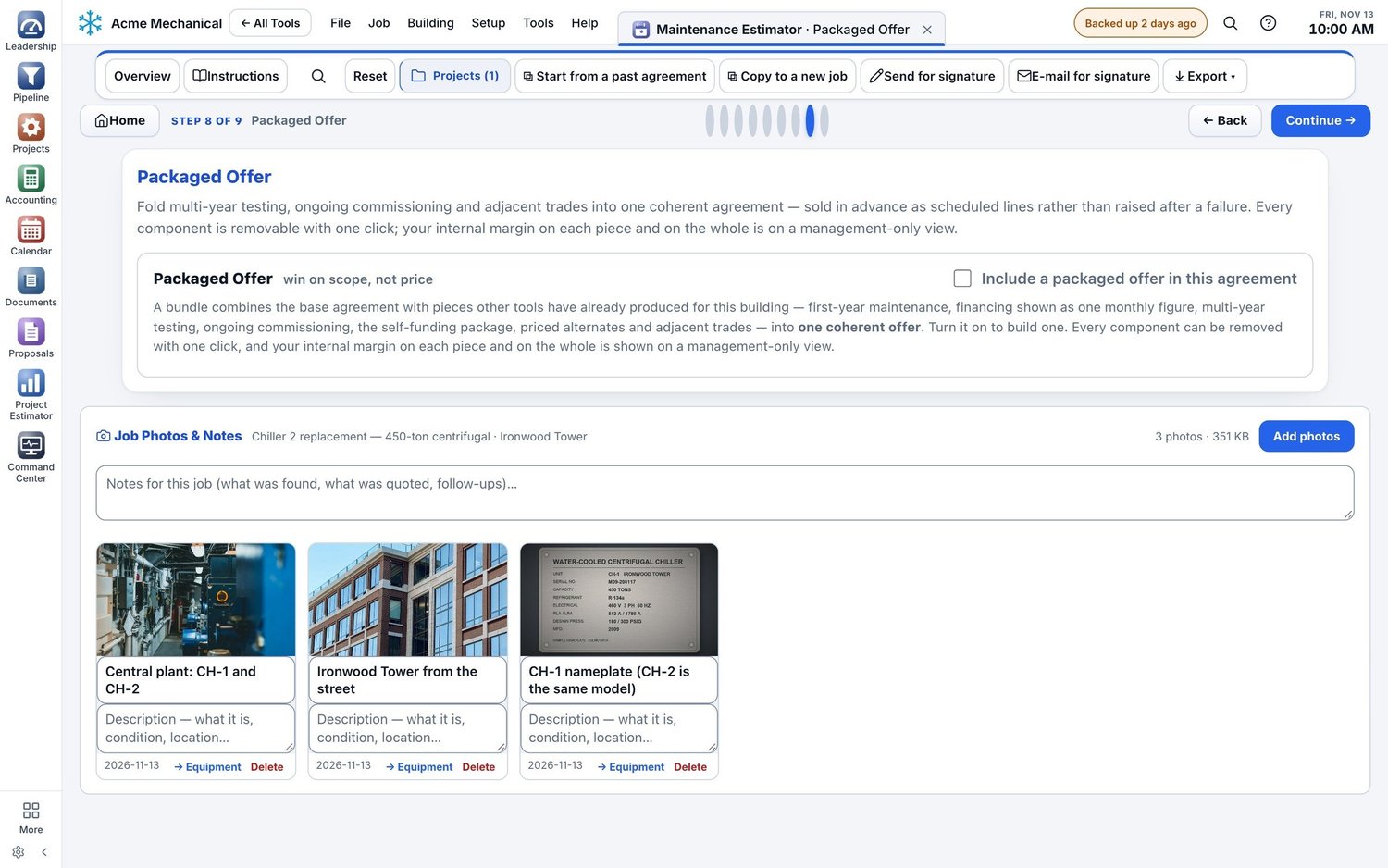
Owners like one decision, so the packaged offer combines the agreement with other published work.
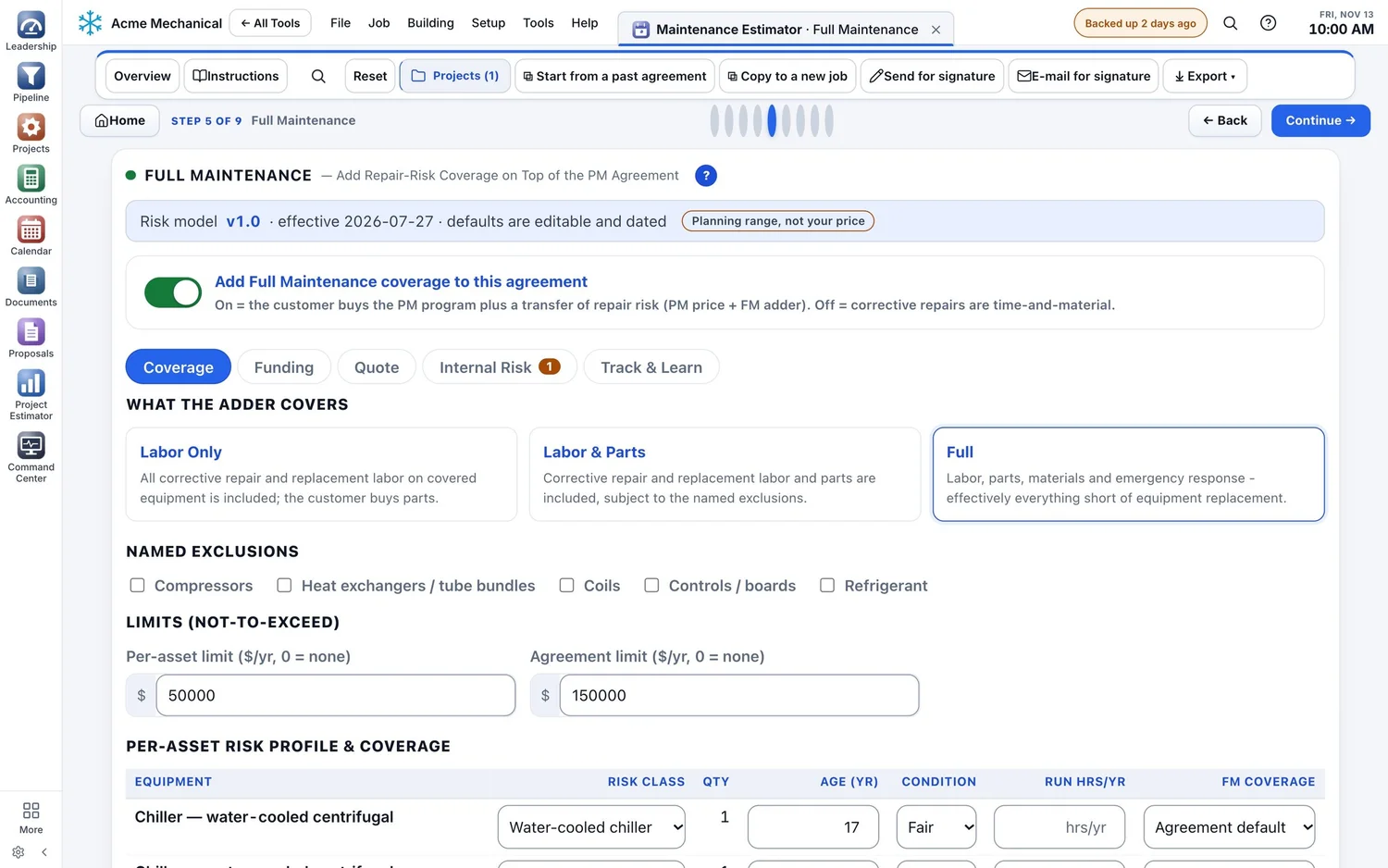
Repair coverage priced by guess can lose money, so the adder sets the level, exclusions and not-to-exceed limits per asset.
Every Agreement You Hold, with the Date That Really Matters
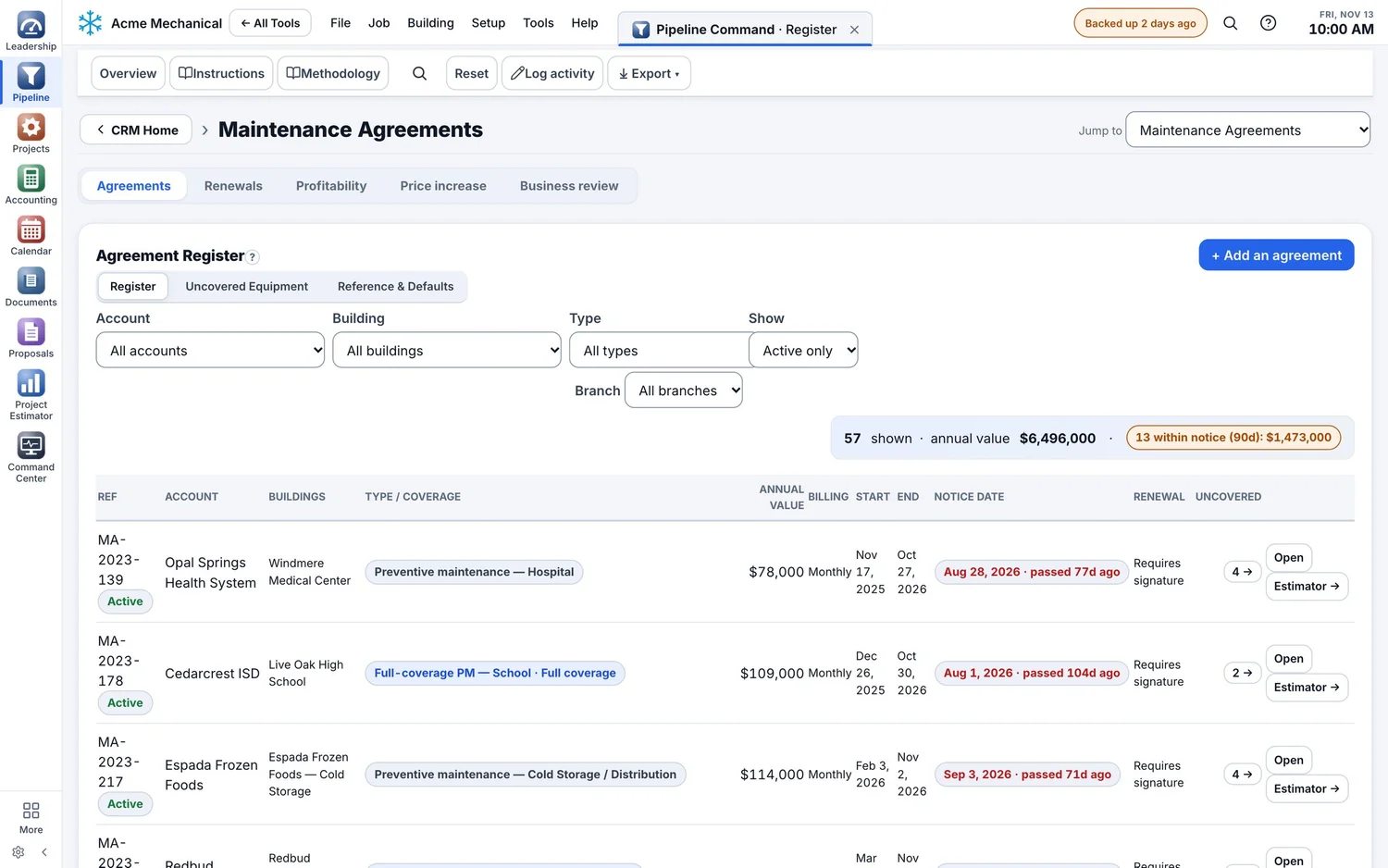
Maintenance Agreements in Pipeline Command holds one record per agreement: the account, the covered buildings and assets, the coverage level, the annual value and billing frequency, the term and the signatures.
The Notice Date Is the Deadline
The register computes the notice date, the end date less the notice period, and treats it as the real deadline, because an evergreen agreement renews itself unless notice is given by then. Agreements whose notice date falls within 90 days are flagged as the value at risk this quarter.
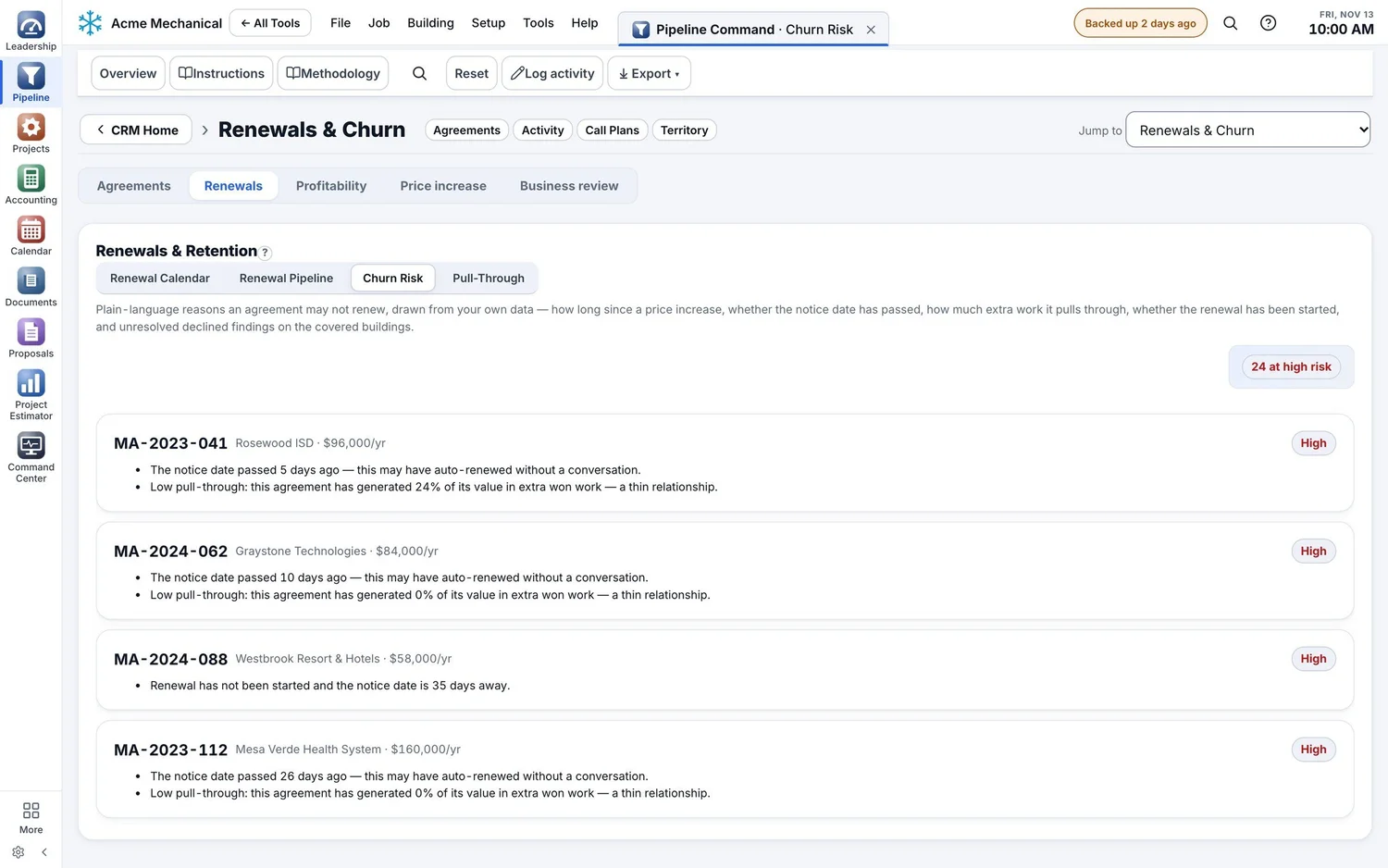
Agreements lapse when the notice date slips by, so agreements near their deadline are flagged with the reason.
Response Times and Not to Exceed
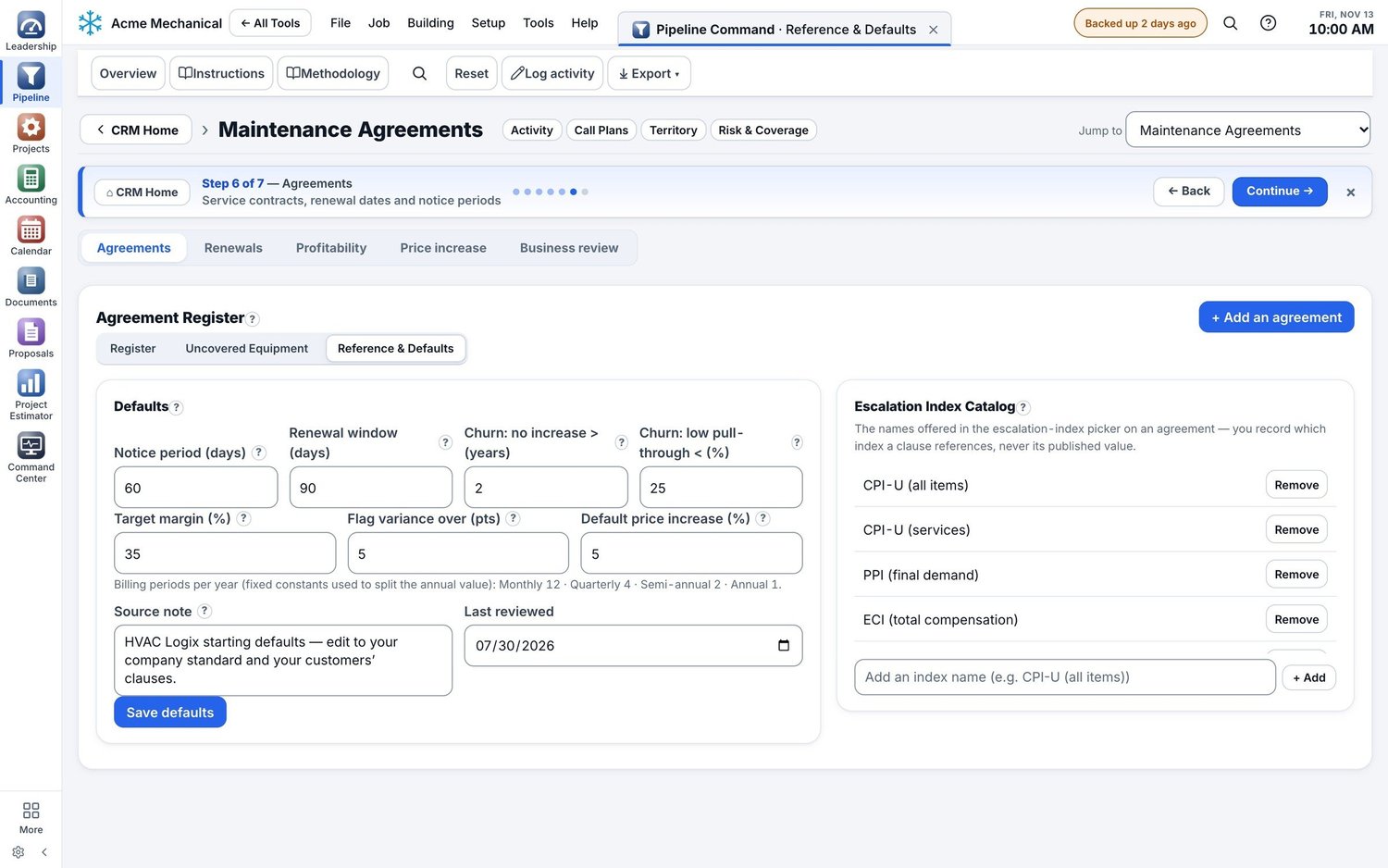
A new agreement's response terms start blank. Enter your own for Emergency, High, Normal and Low. Each says whether it counts clock hours, business hours or business days. A not-to-exceed per call can be set once and used on every call taken under the agreement.
The Escalation Clause
Record the escalation mechanism, a fixed percent or a named index, the last increase, the exclusions and both signatories. The register keeps the terms your service desk and your bookkeeper will both rely on.
Uncovered Equipment
One click from any agreement lists the assets on covered buildings that the agreement leaves off. The customer already trusts you with the site and your technician is already there.
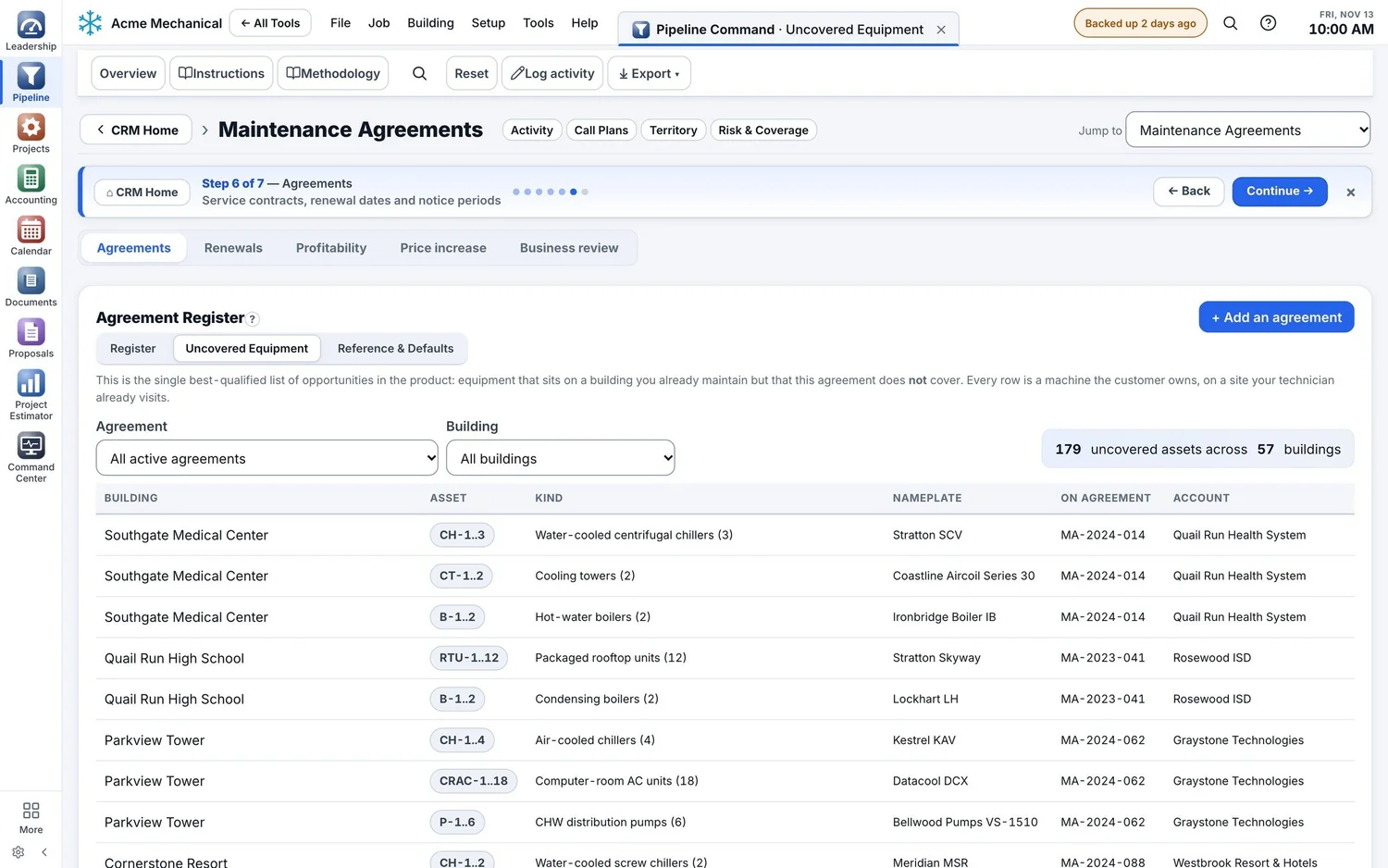
Uncovered units are work you already almost have, so one click lists them on covered buildings.
From the PM Queue to a Signed Visit on the Phone
Visits Due, on the Dispatch Board
Each agreement carries its PM visits per year. Visits that are due appear in the Schedule's queue beside service calls, and Plan Routes never places one after its due date or earlier than its window.
Learn More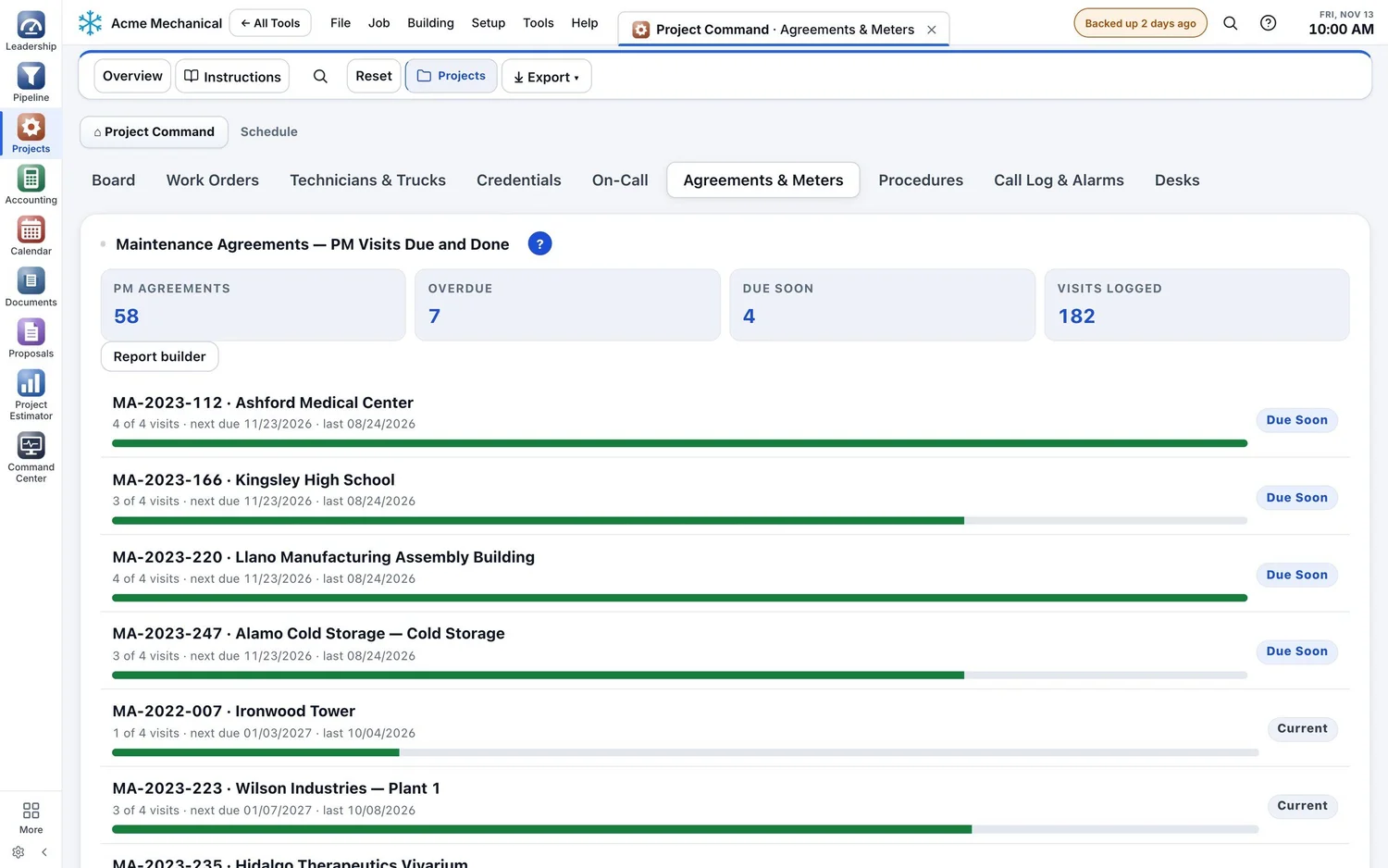
Visits due get forgotten in a busy week, so the board shows every agreement's due visits.
The Maintenance Visit on the Phone
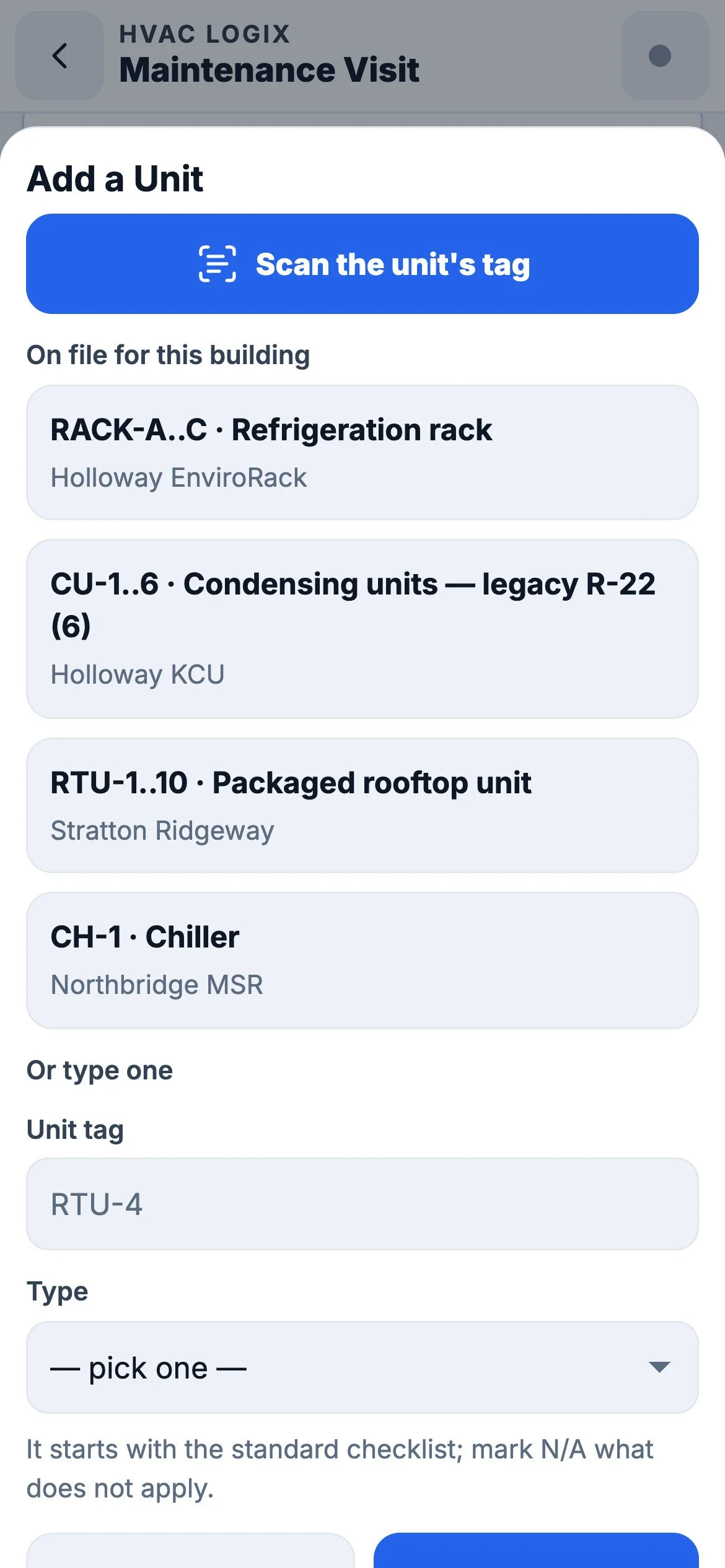
The technician gets a checklist per unit with only the tasks due on that visit: annual tasks on the first visit of the contract year, quarterly tasks on every visit. Filters, readings, deficiencies and photos are recorded with no signal, and the visit lands on the agreement at the office.
Learn MoreShow Less
Every deficiency a technician writes down is a repair you can sell. The visit sends them to the office as opportunities, so they do not die in a notebook.
- Deficiencies become opportunities at the office.
- Each unit's card has a step-by-step procedure to follow.
- Scan a unit's tag to open its manuals and history on the phone.
- A branded one-page visit report can be left with the customer.
- On Route, On Site and Done taps tell the office where the visit stands, even with no signal.
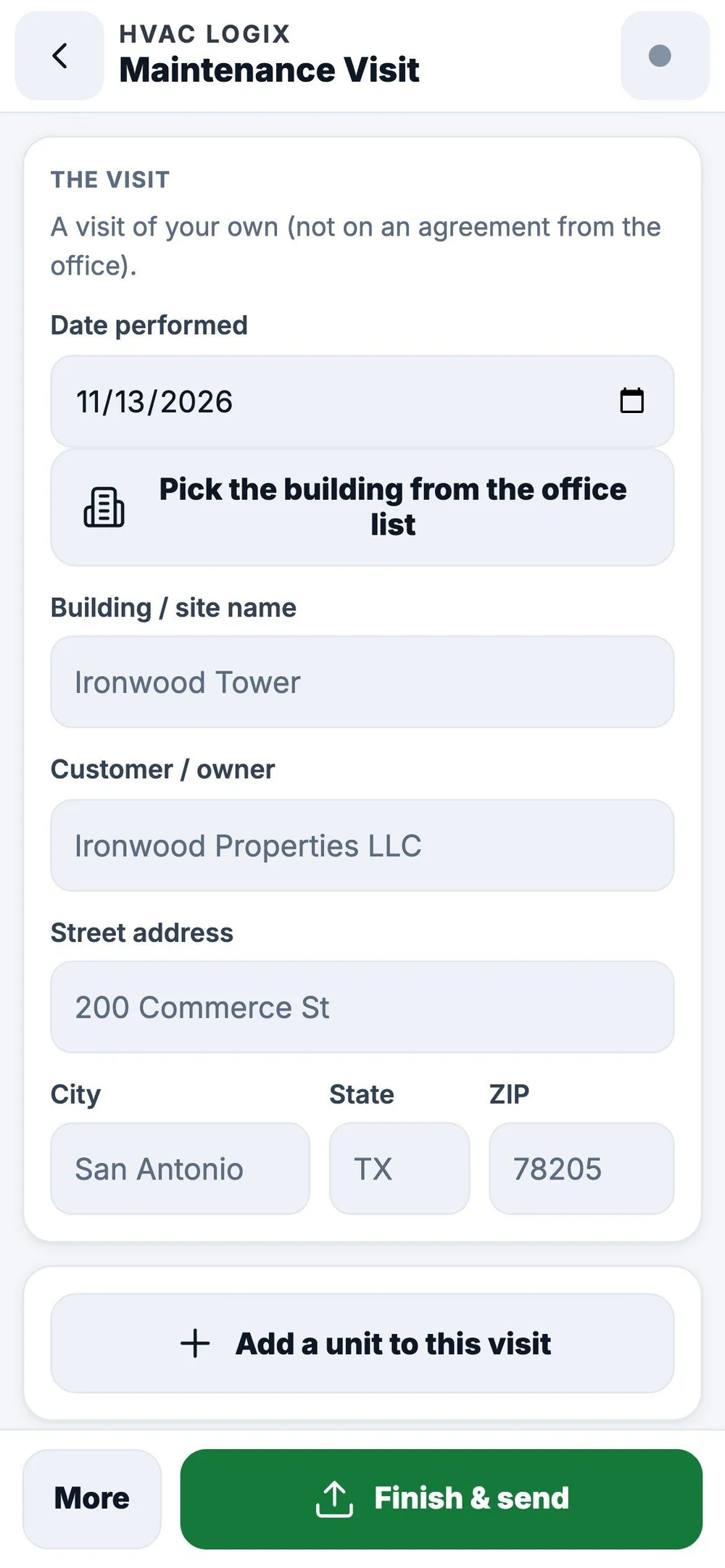
Paper PM sheets get lost, so the visit is recorded on the phone unit by unit.
Step-by-Step Procedures
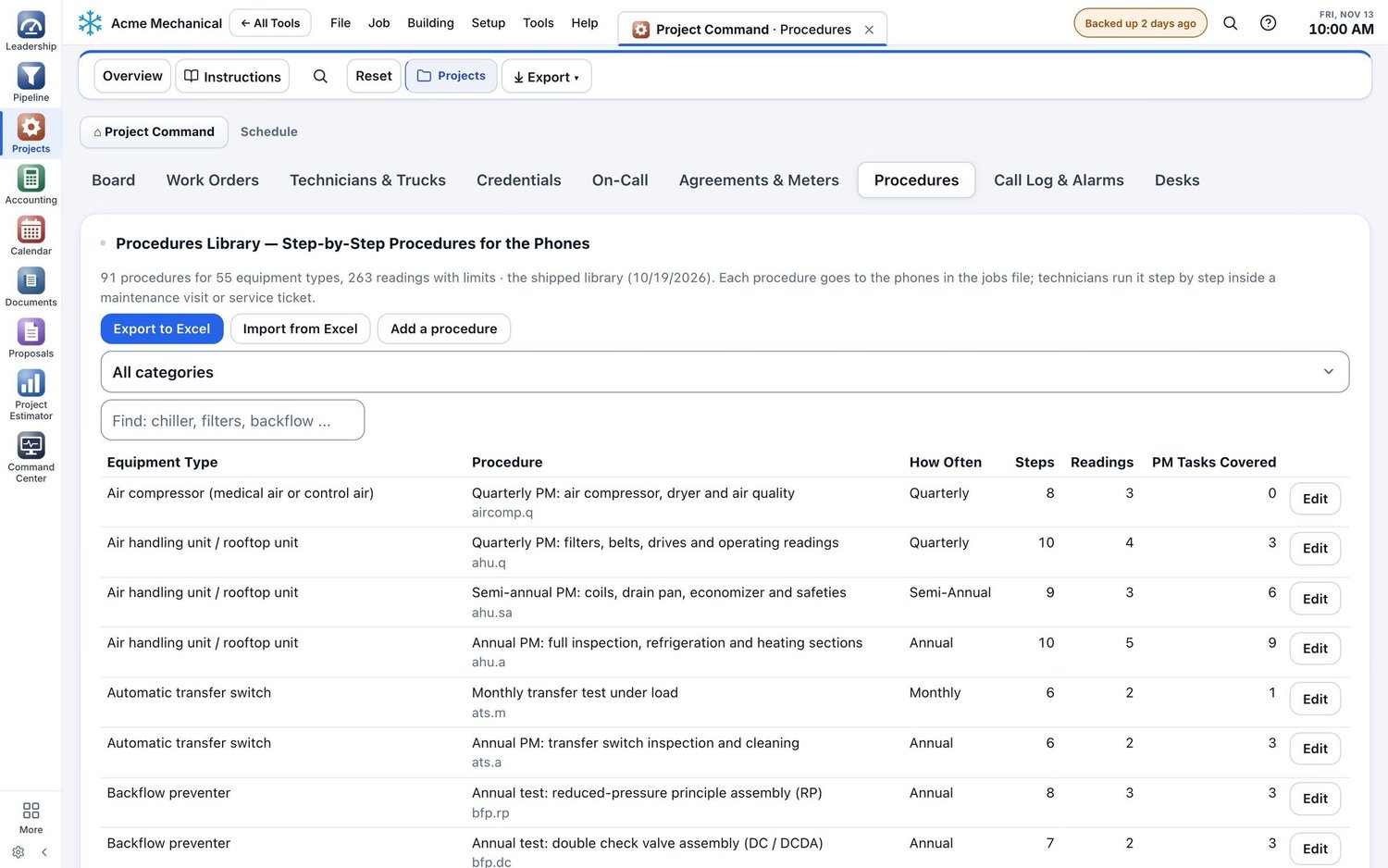
Procedures for the unit's type come first, with the ones that cover this visit's tasks marked. Completing a procedure marks those PM tasks done and files every reading with its limits.
Learn MoreShow Less
A reading taken against clear limits catches a failing unit before it becomes an emergency call or a lost customer. Procedures put the limits in front of the technician at the step where the reading is taken.
- Each reading shows OK, Watch or Out of Range as it is typed.
- An out-of-range reading needs a note of what was found or done.
- Safety notes, tools and PPE are acknowledged before Step 1.
- A step marked Not Done needs a note.
- Edit the library or round-trip it through Excel; the maker's manual and your code authority govern.
PM by Run Hours, Starts and Readings
Some maintenance comes due when the equipment has run, not when the calendar says. Put a meter on a unit, set a plan every so many hours or starts, and HVAC Logix dates the next one from the meter's own usage and lists it in the PM queue.
Learn MoreShow Less
Belts, bearings and compressor oil fail on run time, not on the calendar. Servicing by meter prevents the failure without paying for visits the equipment does not need yet.
- Meters count run hours, starts, cycles, gallons, kWh or a counter you name.
- Readings come from the technician's visit, typed entries or a monitored point.
- Due at the interval or the months, whichever comes first, marked Overdue or Due Soon.
- Each row says why, such as hours to go and the date expected.
- A lower reading is refused unless marked Meter Replaced or Reset.
Readings Out of Range
Set a limit on a reading, such as condenser approach, and any PM visit or ticket reading outside it is listed for the office, with a corrective work order one click away. Nothing is created without the office.
Learn MoreShow Less
A reading drifting out of range is a repair you can sell before it becomes a breakdown. The office sees every one, from any source, in one list.
- Set At Least and/or At Most, the unit of measure and the day the limit starts.
- Covers PM visits, service tickets and condition readings typed at the office.
- Out-of-range readings also show on the calendar.
- The corrective work order states the reading, its source, the range and what to do.
- Dismissing one needs a reason.
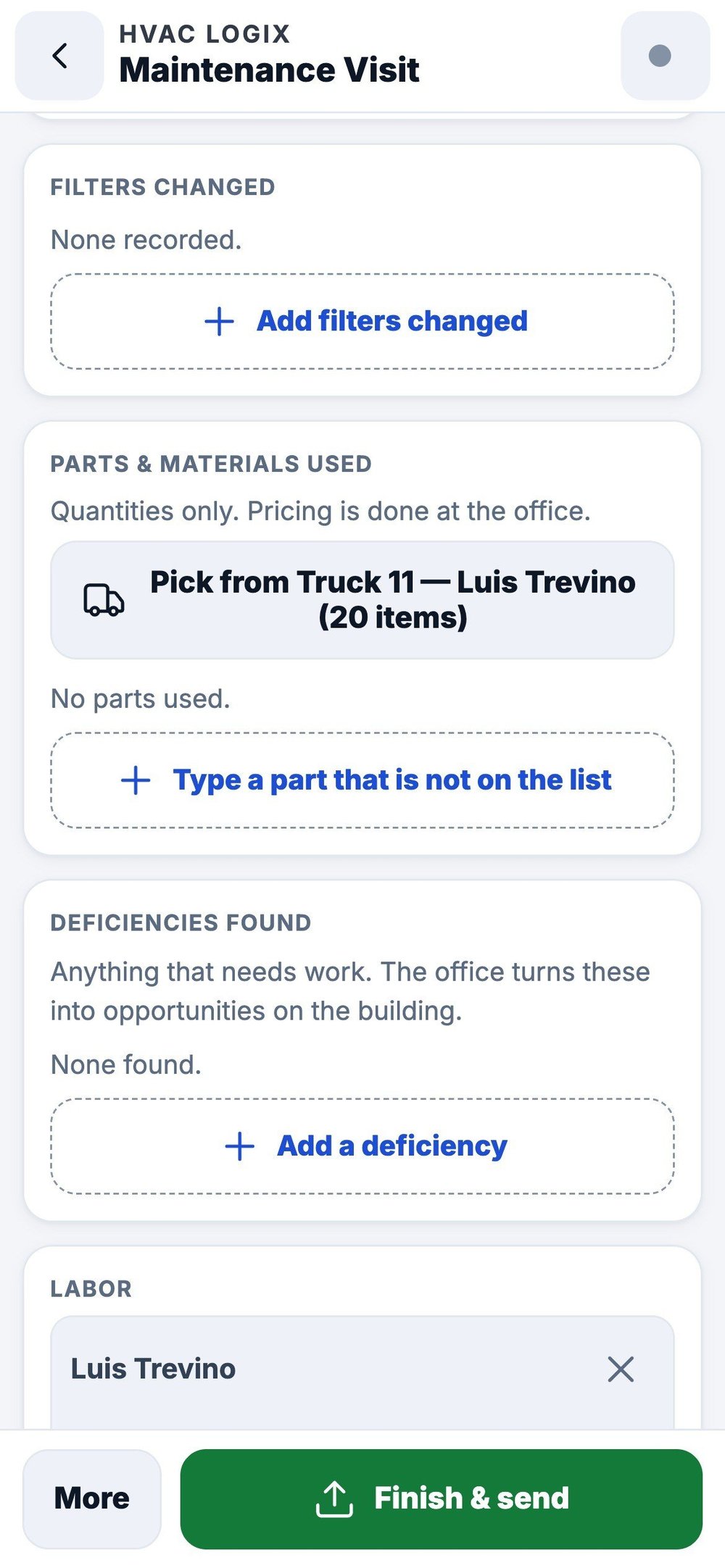
Problems found on a visit are sales leads, so deficiencies and parts are logged on the phone.
Compliance Packs and Periodic Testing
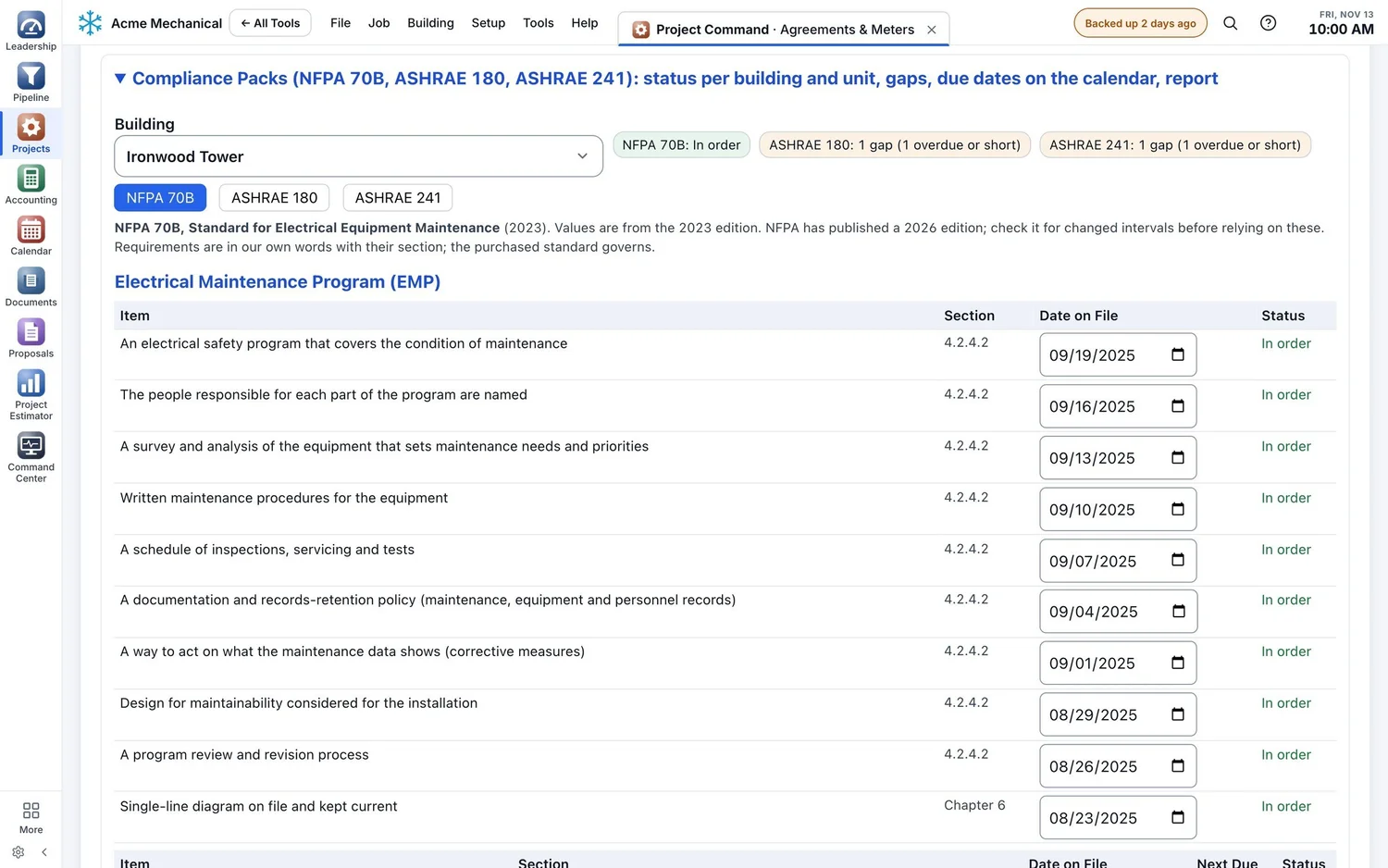
Keep each building's NFPA 70B, ASHRAE 180 and ASHRAE 241 program with its status, gaps and next due dates. Periodic Testing lays out the multi-year calendar of tests that run on three, five or ten year cycles and prices them as an agreement addendum.
Learn MoreManuals with the Equipment
IOMs, O&M manuals, wiring diagrams, parts lists, submittals and service bulletins attached to a unit, the building or a make and model. A model's manual is stored once and shows on every unit of that model. Upload a whole folder and each file is matched by its name or text for you to review. On the phone, scan the unit's tag and its manuals open, even offline.
Learn MoreShow Less
A technician hunting for a wiring diagram is a billable hour lost, or a second trip. Manuals travel with the equipment, so the answer is on site.
- Also holds start-up reports, warranties and sequences of operation.
- The same file is stored once, checked by its contents.
- Keep Offline sends a document to the phones with the jobs file.
- Ctrl-K or Cmd-K finds documents by unit tag, make, model, type or title.
- Technicians can add a document from Files or the camera.
Each Agreement Billed on Its Day
The Month's Drafts in One Step
Ready to Bill lists every active agreement whose billing period falls due in the month, worked out from its start date, billing frequency and annual value. Create the Drafts makes one draft per agreement, and a period that already has a draft cannot be drafted twice.
Learn More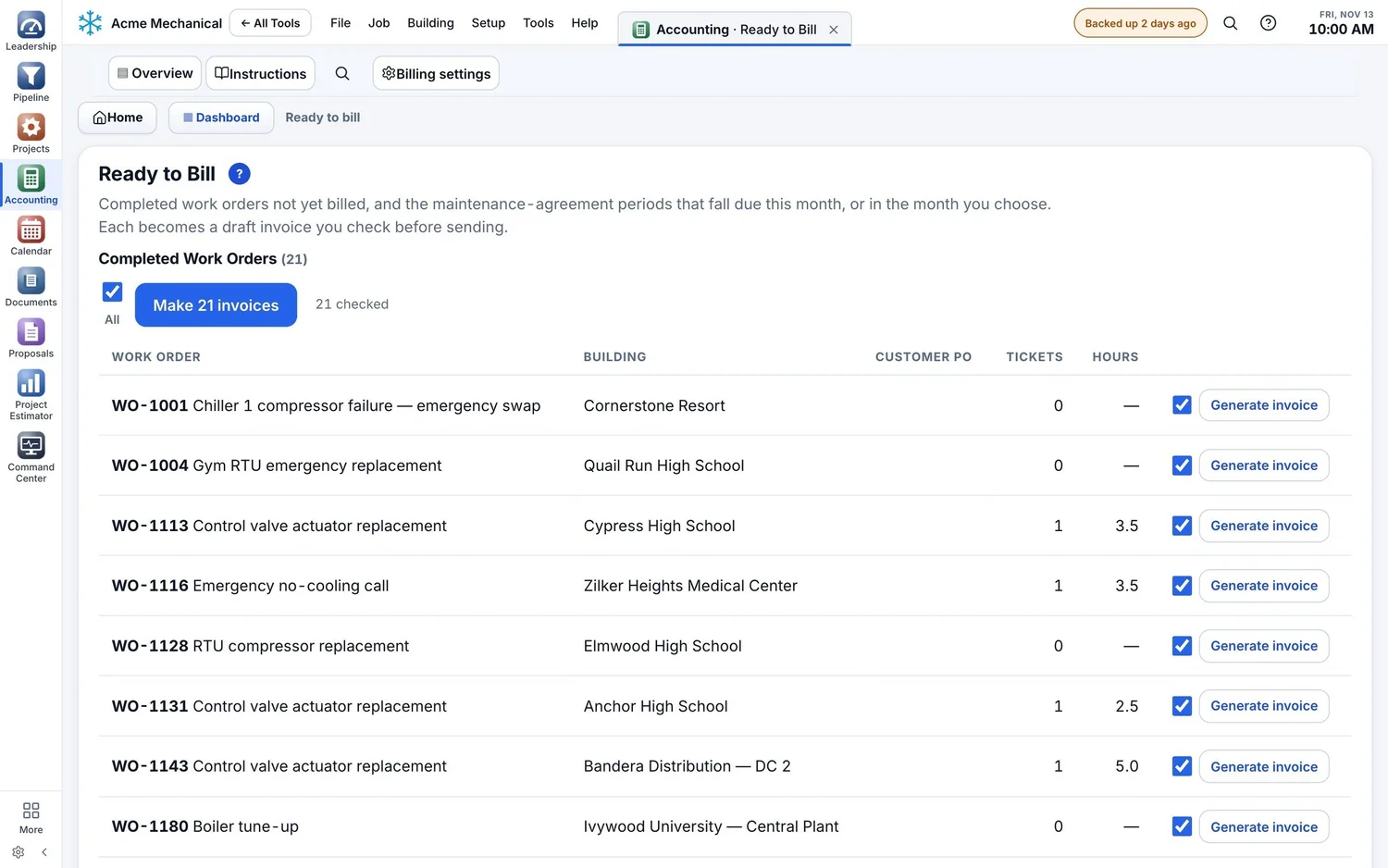
Agreements billed late hurt cash, so Ready to Bill lists every agreement due this month.
Covered Lines on Service Calls
A service call taken at an agreement building is priced from the tickets, and the lines the coverage level covers print at zero, marked covered under the agreement's number. Written exclusions and units the agreement does not list are billed.
Learn MoreThe Agreement's Own Terms
Where the agreement sets a minimum billable time per visit or an emergency response charge, the invoice adds those lines by itself.
Learn MoreShow Less
A short visit or a midnight call billed at the wrong rate is money the agreement already entitles you to. The invoice applies the agreement's terms every time, without anyone remembering them.
- The top-up line names the minimum, the agreement, the ticket and the hours added.
- Billed at the visit's straight-time rate, or the after-hours rate on an after-hours call.
- The response charge applies to calls marked after hours or Emergency.
- Both are ordinary lines that can be marked Covered; blank terms add nothing.
The Escalator at Renewal
When a renewal is recorded, the agreement's escalator is applied: the fixed percent, or the index change you type for an index-linked clause. The new price starts the day after the old end date, and the agreement keeps a price history.
Learn MoreShow Less
A renewal at last year's price is a raise you gave away. The escalator is applied when the renewal is recorded, so no increase depends on someone remembering it.
- Periods before the new start date are still billed at the old price, and the draft says so.
- Applied only within 180 days of the end date, so it cannot raise the price twice.
- An index-linked agreement with no index change typed is left alone, with a message.
- A Negotiated or None clause renews at the same price for you to change.
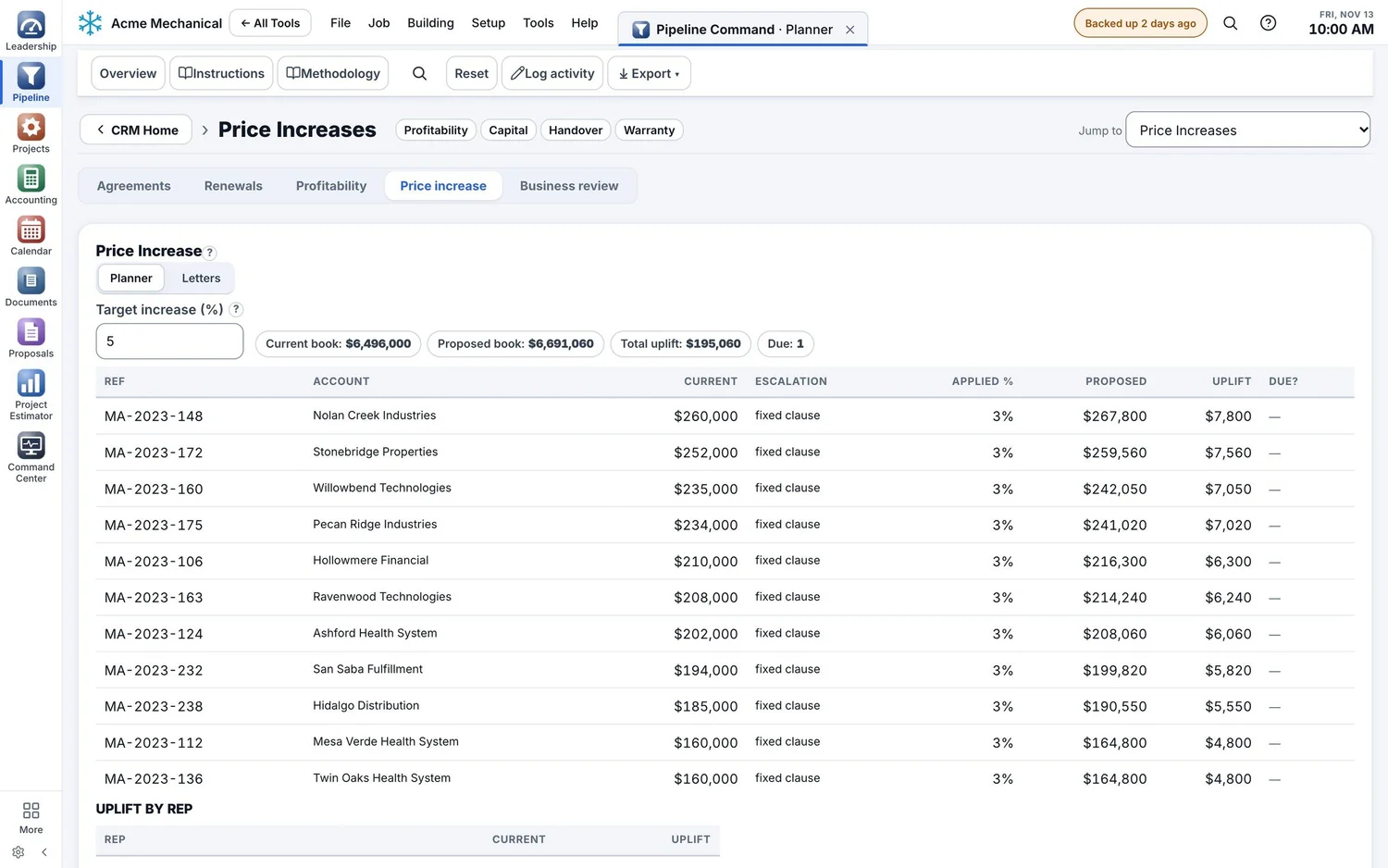
Price increases are often skipped, so the planner shows each agreement's current and proposed price.
Billed in Advance
An agreement paid ahead is marked prepaid. With the books kept in HVAC Logix, the invoice posts to deferred revenue and each month-end entry moves what has been earned to maintenance agreement revenue.
Learn MoreShow Less
Cash collected up front is good for the business, but booking it all as revenue at once misstates profit. Deferred revenue keeps the books right without extra work.
- Earned straight-line by month, or as the period's PM visits are completed.
- Each invoice earns exactly its amount, to the cent.
- A month cannot post while an earlier month with revenue to recognize has no entry.
- The schedule and rollforward tie to the deferred revenue account in the ledger.
- The customer's invoice stays the same.
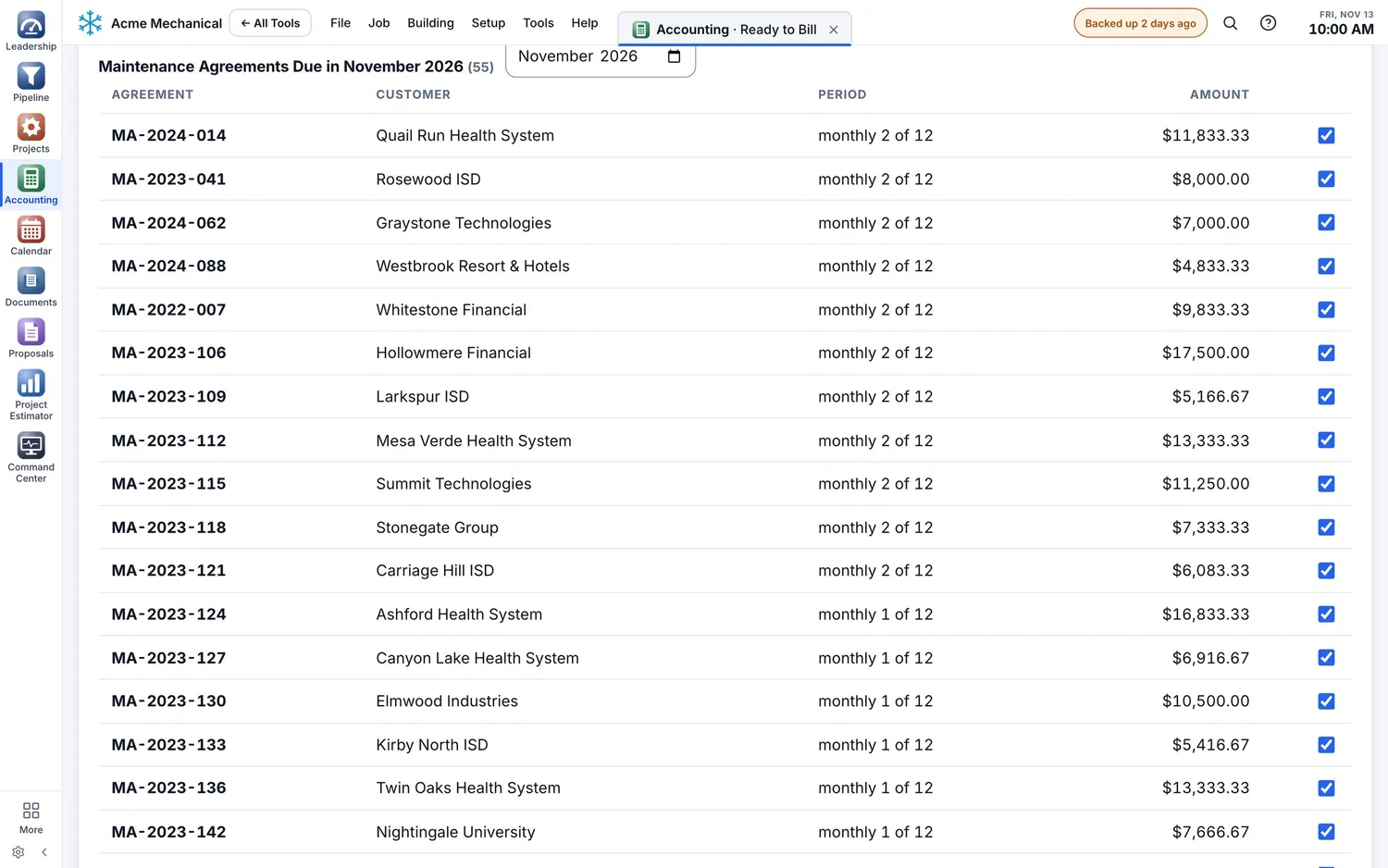
Every agreement due this month drafted in one step, on its own billing day.
Work the Book You Already Have
Renewals and Churn
- A renewal calendar by notice date, with days remaining and the value at risk
- A renewal pipeline: Upcoming, Contacted, Proposal Out, Renewed, Renegotiated, Lost, with a dated trail
- Churn risk in plain words: no price increase in years, a notice date passed, a renewal not started, declined findings unresolved
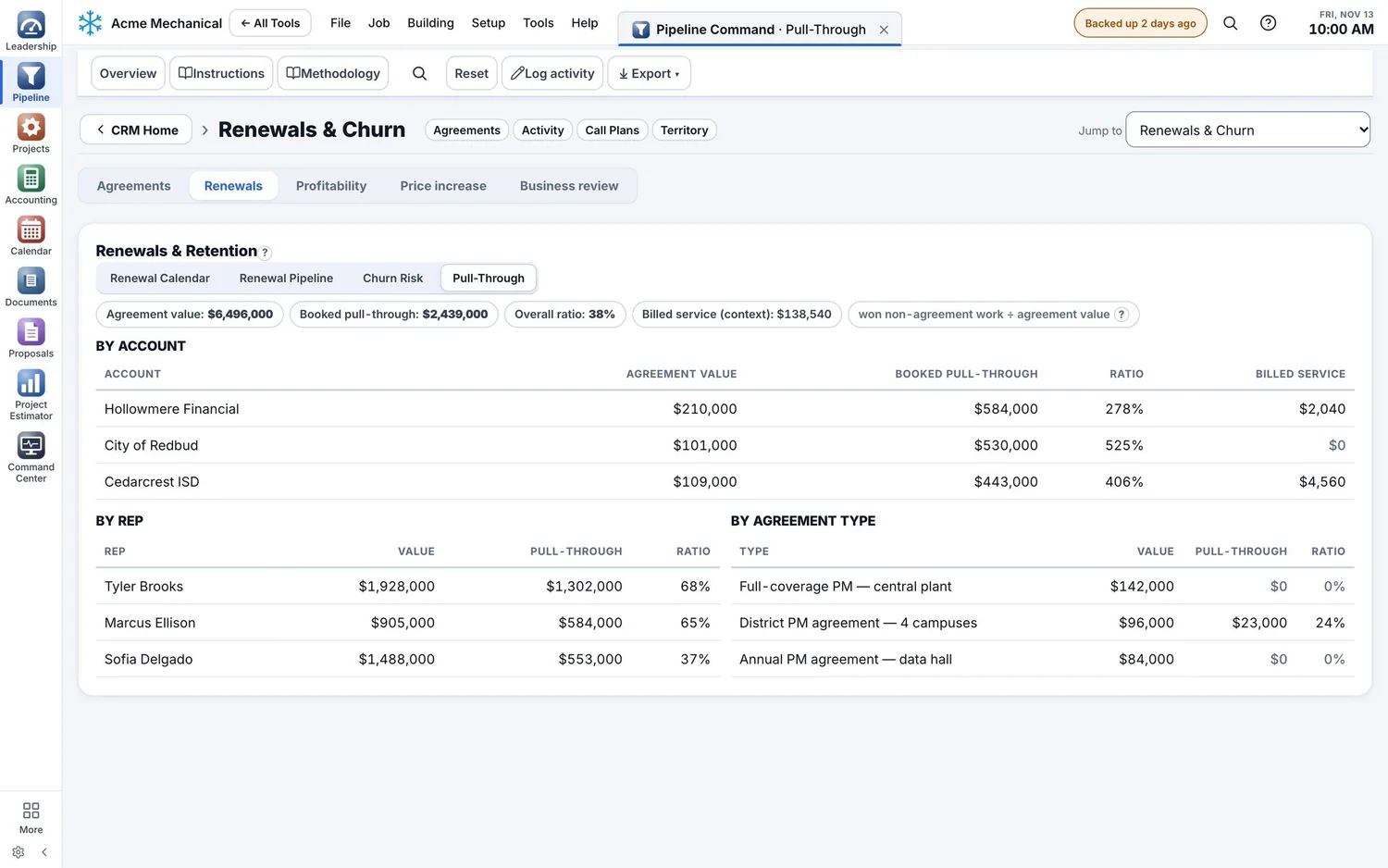
- Pull-through: how much extra awarded work each agreement generates, by account, rep and type
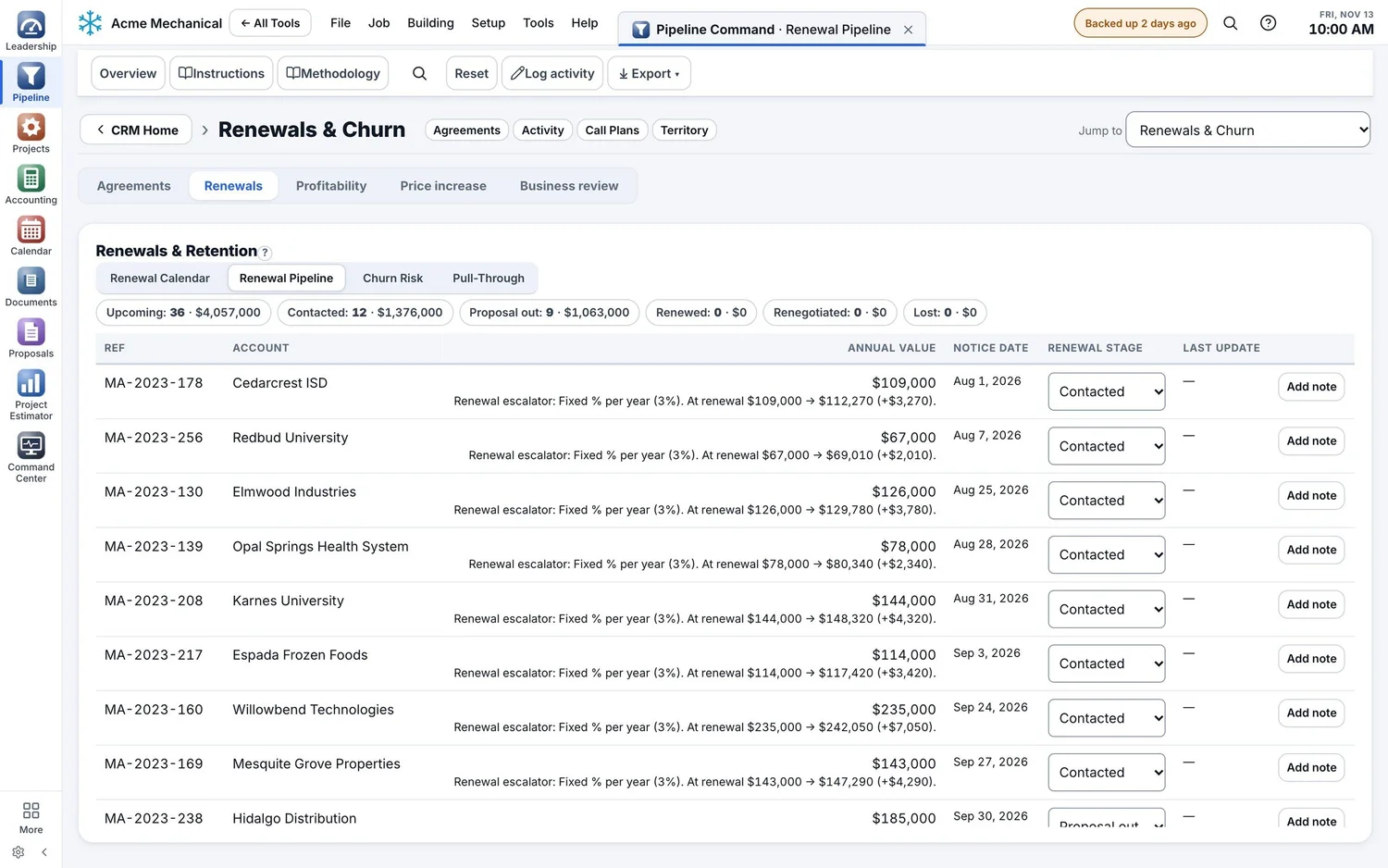
Renewals left to chance get lost, so each one moves through a renewal pipeline.
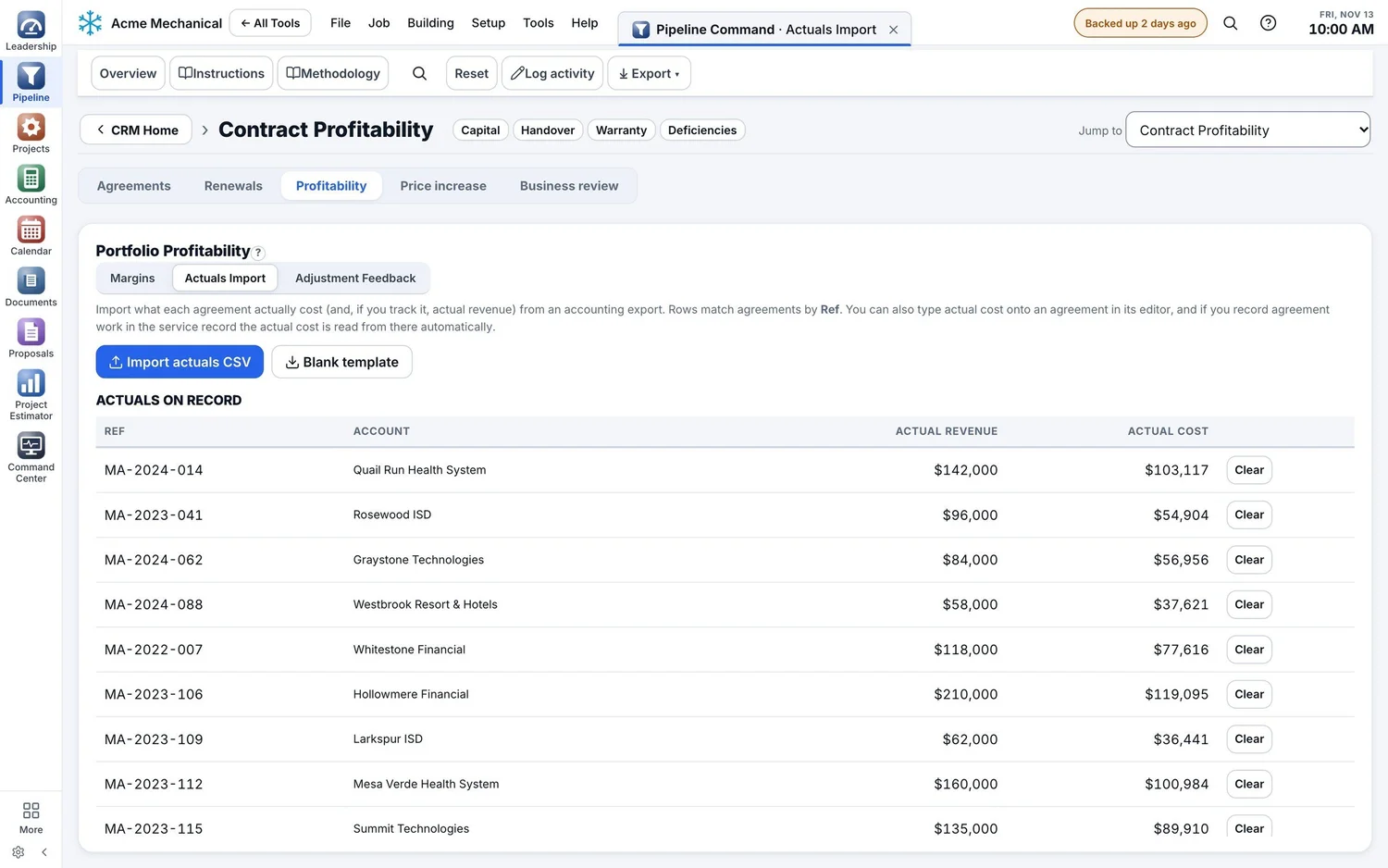
Contract Profitability and Price Increases
- Agreements ranked by margin, the estimate against what the work actually cost, worst first
- Actual cost typed, imported from CSV, or read from the service record of agreement-covered work
- A book-wide increase planned at a target percent while respecting each agreement's clause
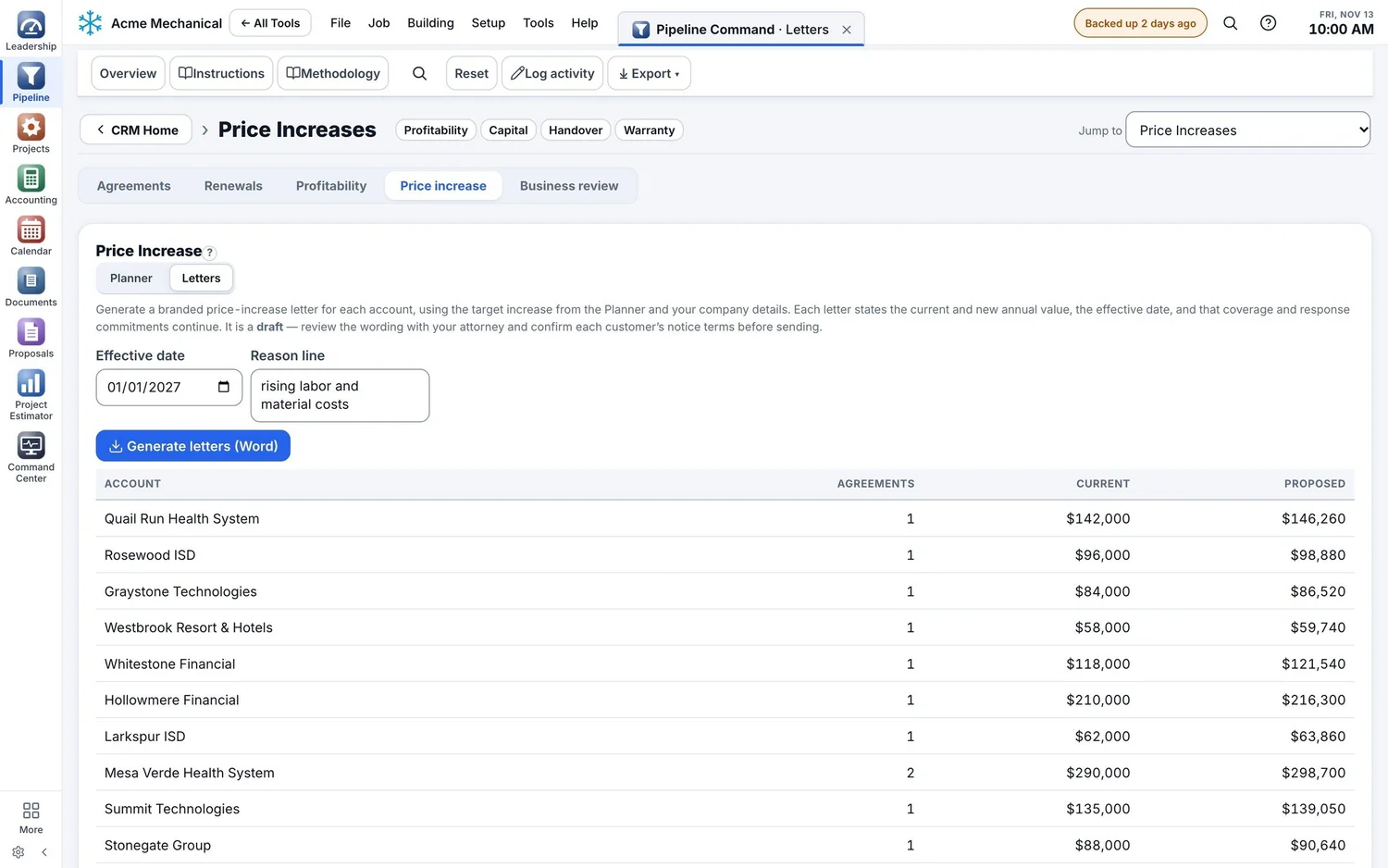
- A branded draft letter per account stating the current and new annual value, to review with your attorney before sending
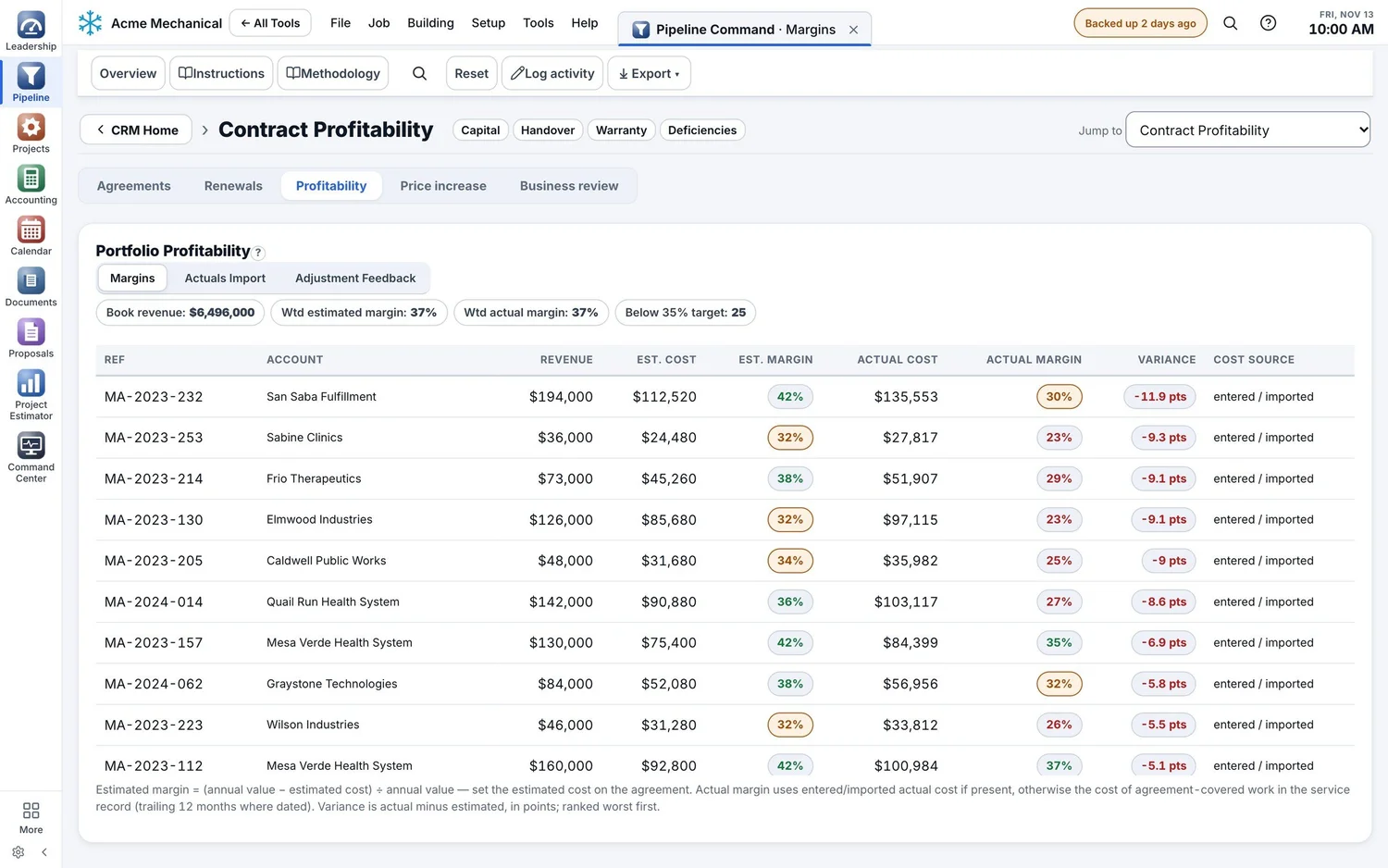
Some agreements lose money quietly, so they are ranked by margin worst first.
The Annual Business Review
- A customer-facing review assembled from records already in the suite; nothing is invented
- The service you delivered, split by under agreement or billed
- What you found and recommend, with deferred items called out
- Equipment reliability for the renewal: repeat failures, bad actors and downtime from the building's coded work orders
- Equipment passports: each unit's tamper-evident history of service, readings, refrigerant and warranty, handed to the owner as a file they can check themselves
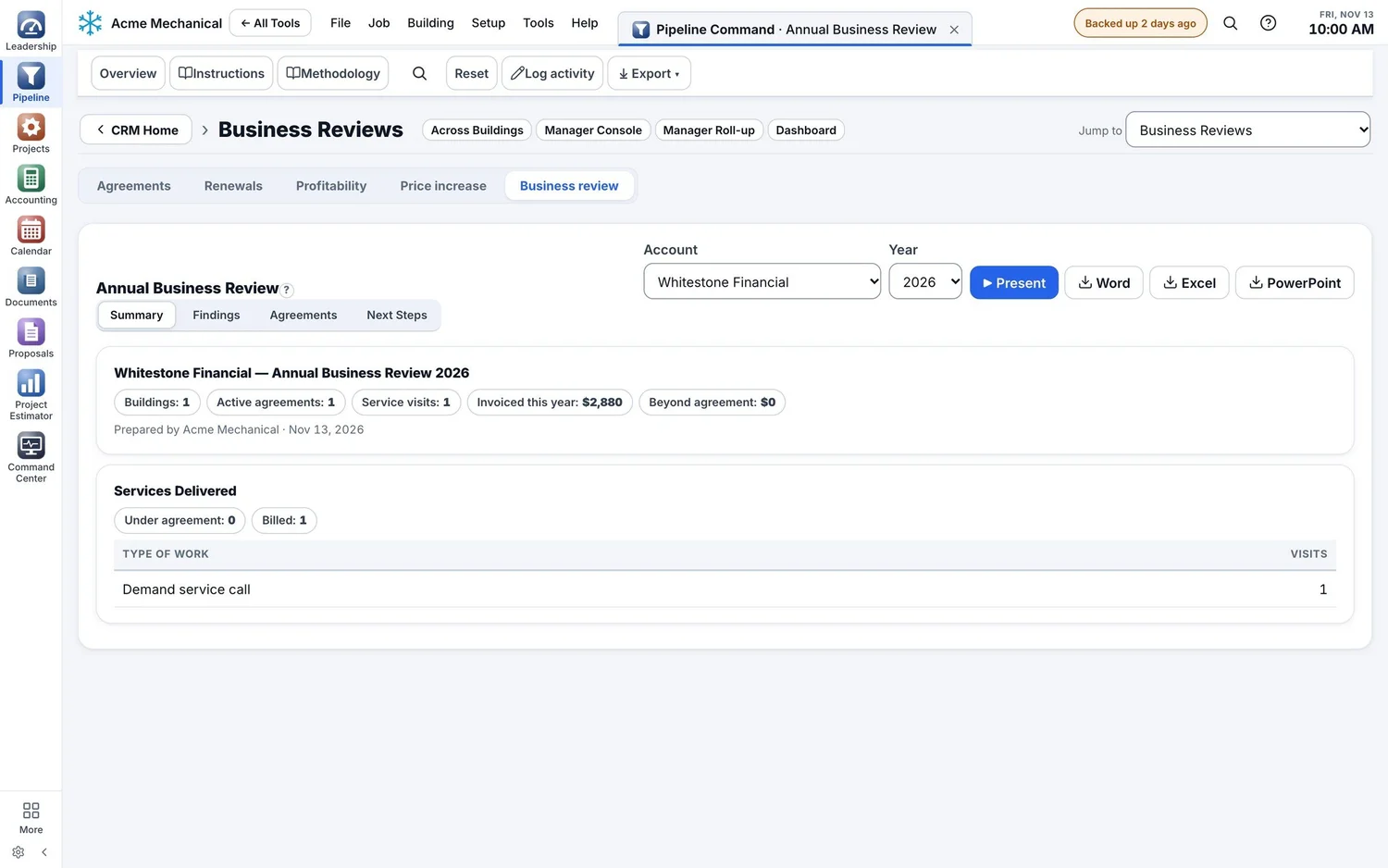
Owners forget the service you gave, so the annual review is built from your records.
Recurring Revenue for Leadership
- Agreement and monitoring revenue by month for the last 12 months on the Leadership Dashboard
- Monthly and annual recurring revenue, new and churned, with gross churn and net growth
- Renewals coming due in the next 12 months, and how many renew automatically
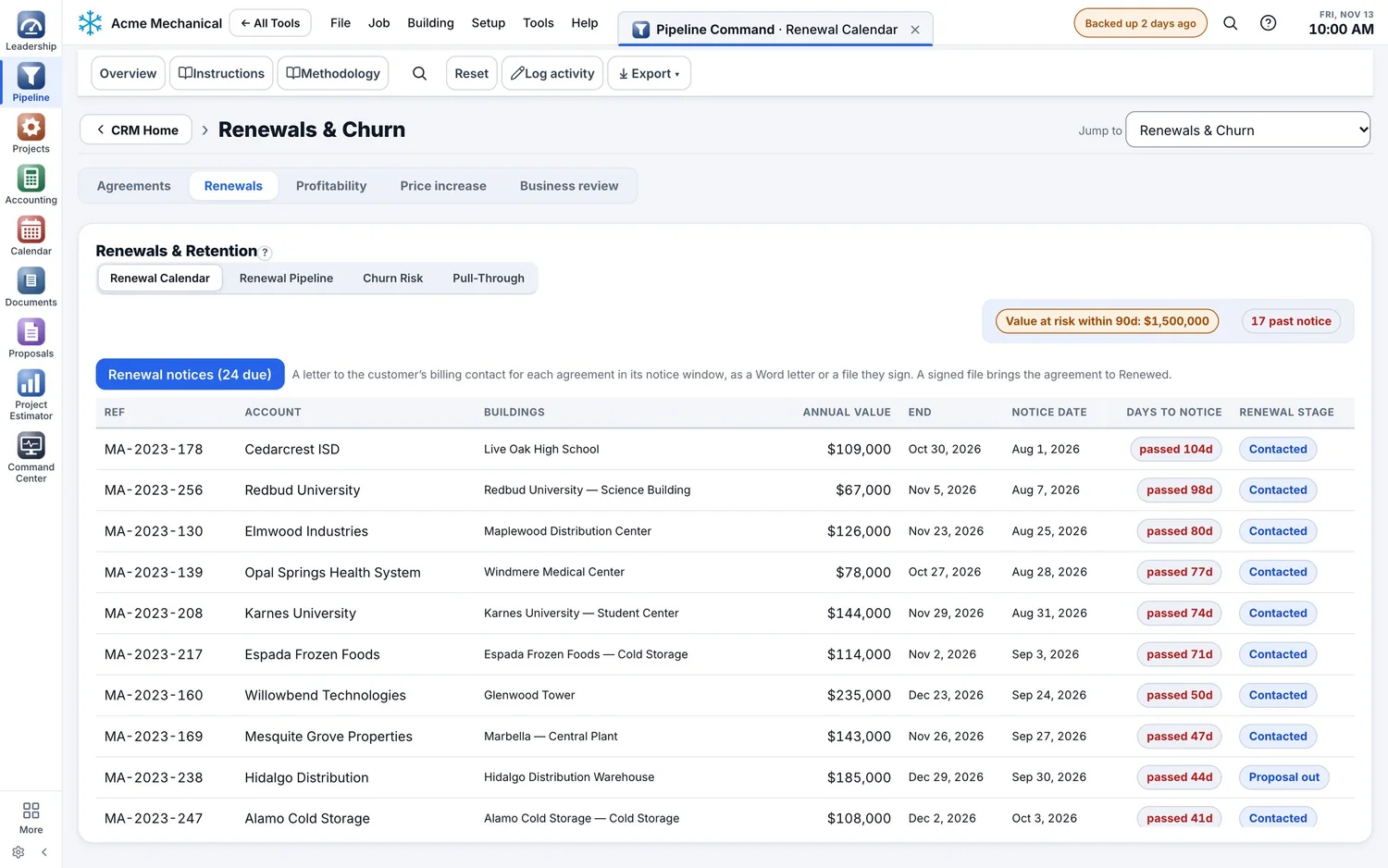
Frequently Asked Questions
Can one agreement mix coverage levels across equipment?
Which date does HVAC Logix treat as the renewal deadline?
How does a service call at an agreement customer get billed?
Does remote monitoring control the customer's equipment?
Is a price increase applied automatically?
Be First When HVAC Logix Opens
Stop paying people to copy numbers between programs. Join the list and we will tell you the day downloads open, with setup guides ready.
Launching early 2027 for HVAC Logix. Nothing to buy today, and no sales calls.
