
People Records That Live Beside Payroll, Safety and the Work
HVAC Logix keeps hiring, onboarding, licenses, benefits, time off, scorecards and reviews in the same system that dispatches your technicians and pays them. An EPA card added by HR is the card Safety tracks. A raise approved after a review is the rate payroll uses. A person who leaves hands off their accounts and jobs in one action. Nothing is typed into a second program.
Launching Early 2027 · Join the Early-Access List
HR Without a Separate HR System
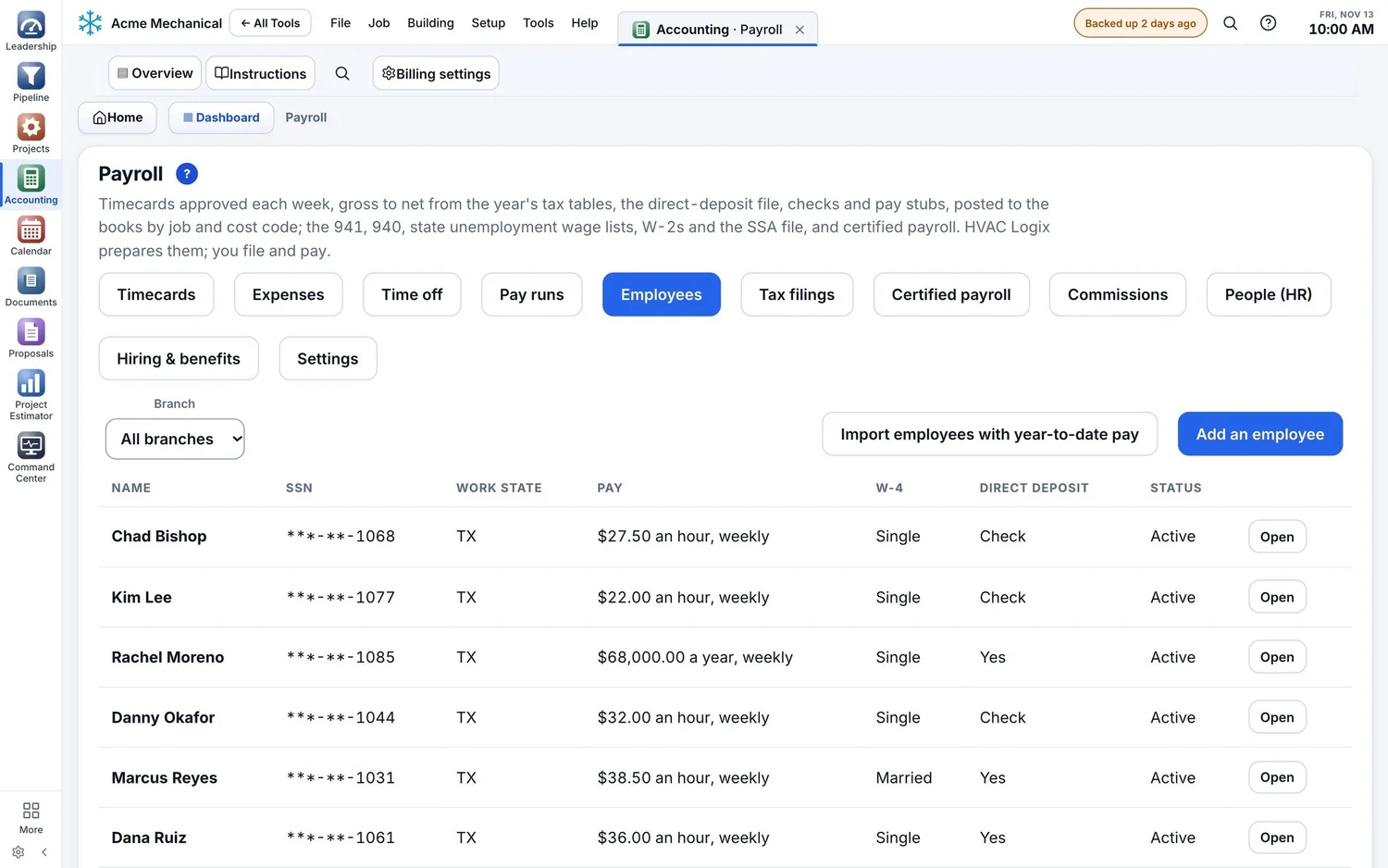
Each person has one record. HR, payroll, safety and dispatch each see the part their role allows.
An HR Role of Its Own
The HR role keeps the new-hire checklist, licenses, reviews and confidential HR records, and sees payroll as view only. HR never changes pay or runs payroll, and an HR person does not need bookkeeper rights to do the job.
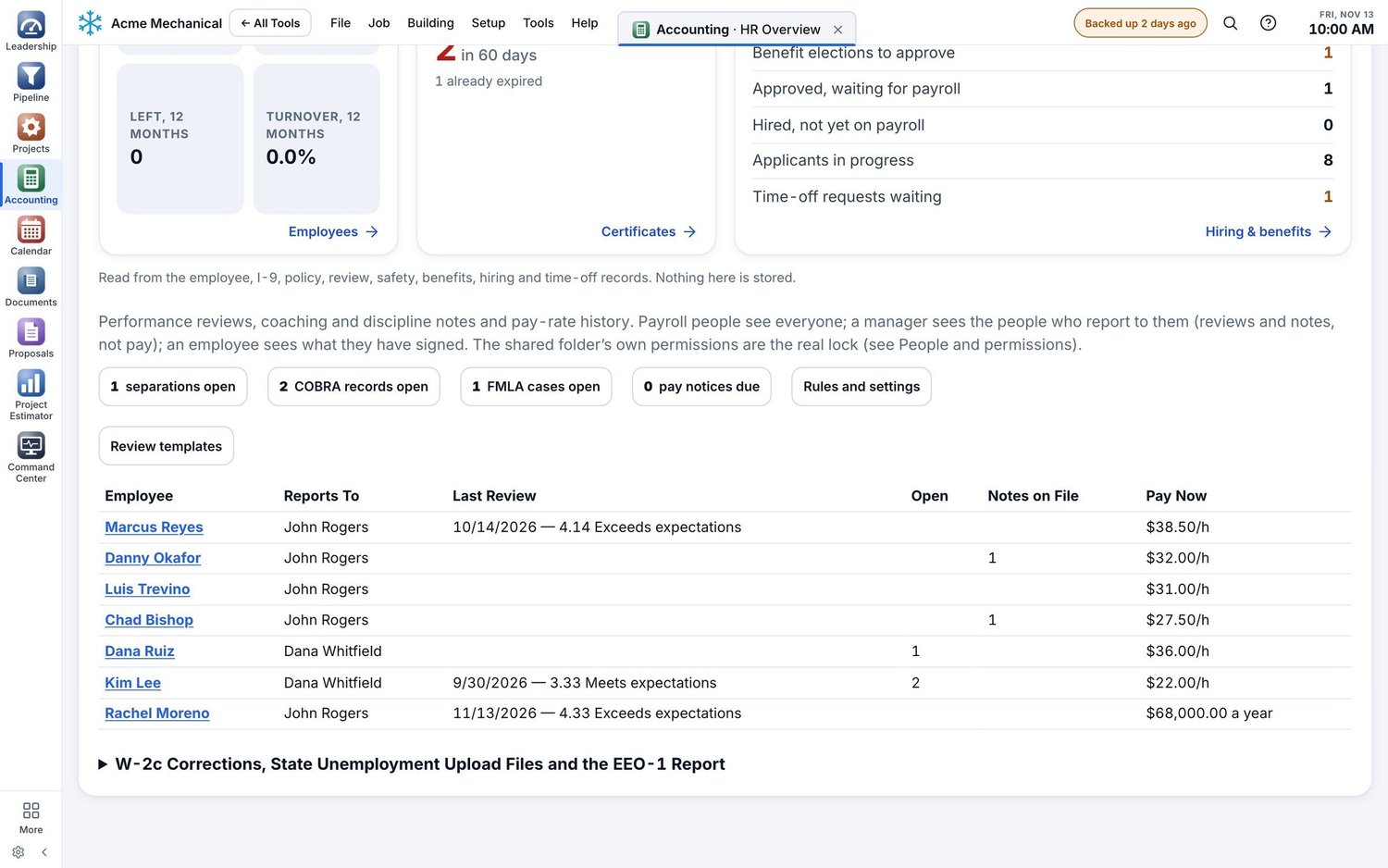
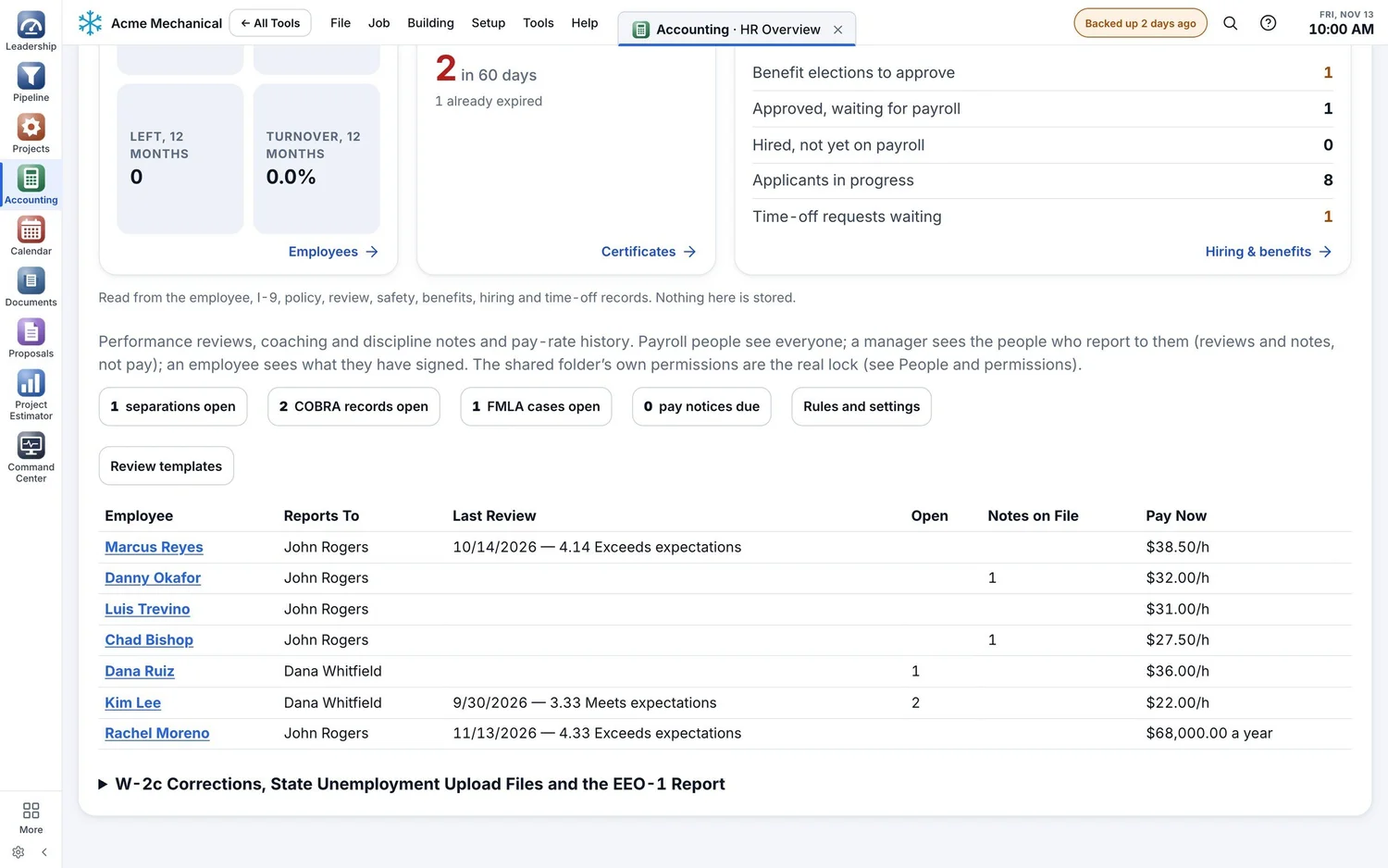
HR needs its own view without touching pay, so the HR overview shows reviews, certificates and hiring at a glance.
The Manager on the Record
Each person's record names who they report to. That manager gets the reminders, rates the scorecard and sees their own people's reviews and notes, never their pay.
Who Sees What
Payroll people see everyone. A manager sees the people who report to them. An employee sees their own reviews once signed and their own notes once final. Nobody else sees that the records exist.
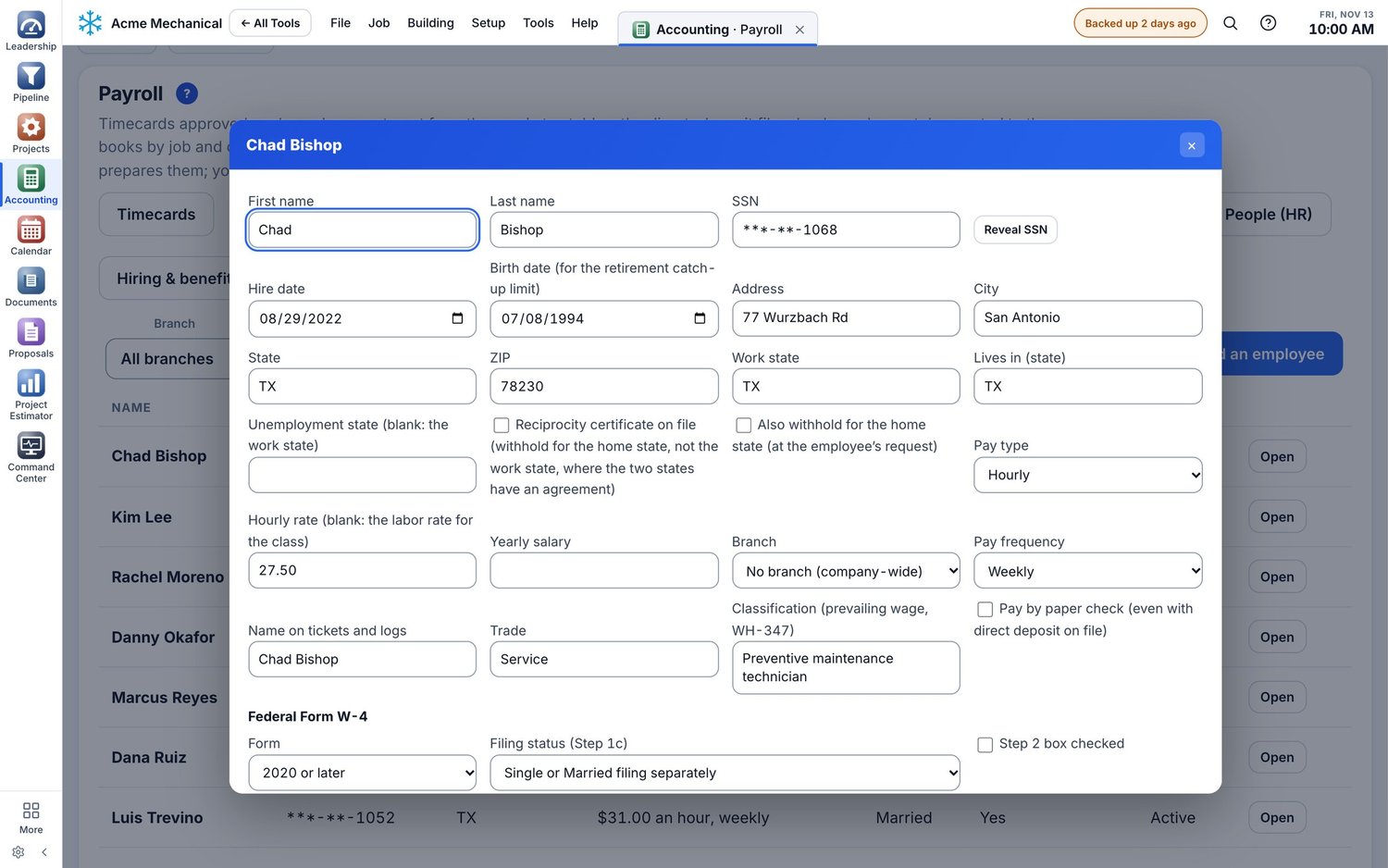
One employee record for pay, HR, licenses and who may see what.
From the Opening to the First Paycheck
Openings and Applicants
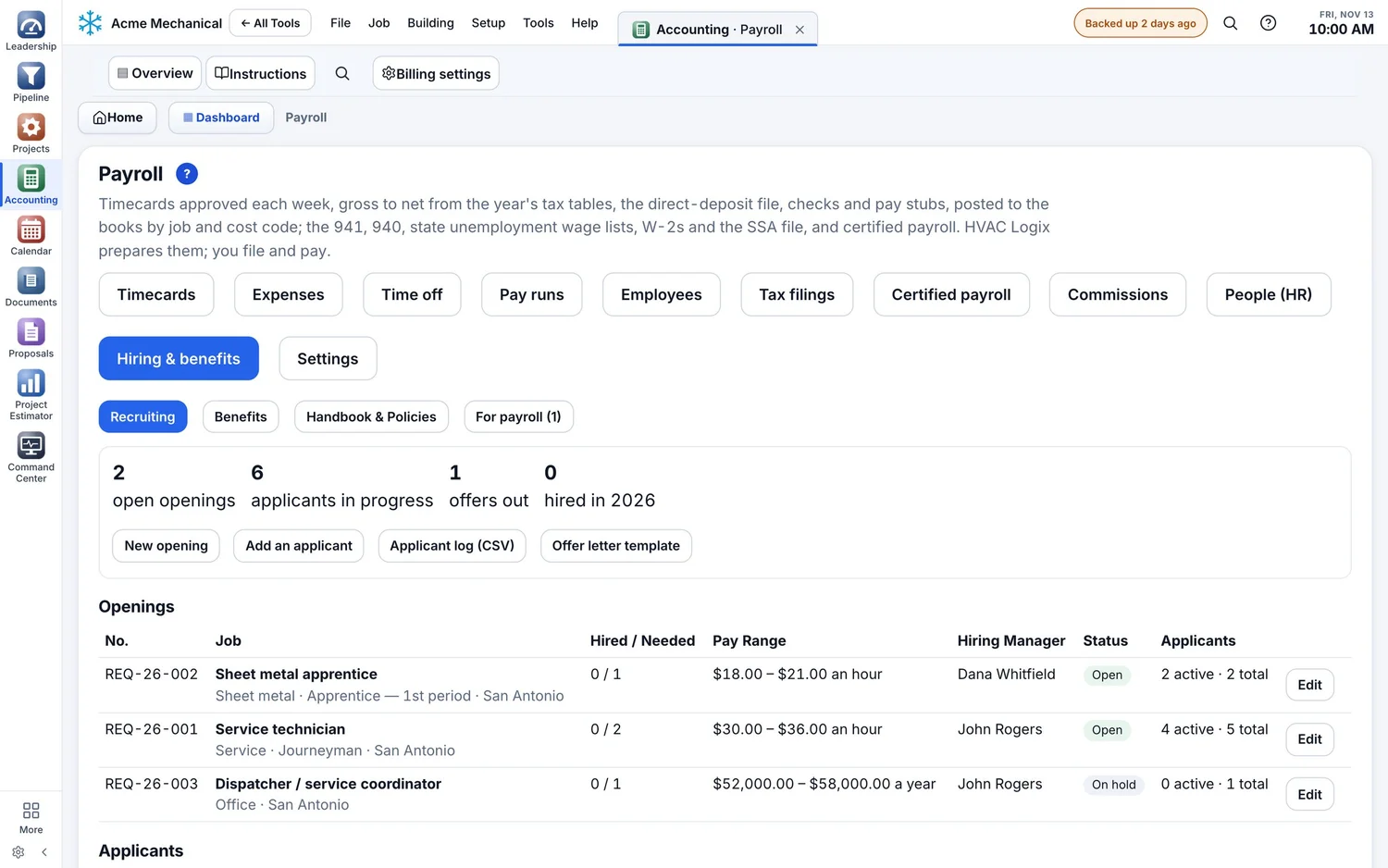
Post an opening with its trade, class, pay range and hiring manager. Add applicants from a call, an e-mail or a walk-in, attach the resume and move each person through phone screen, interview and offer. Recruiting keeps job-related notes only and never an SSN, birth date or age.
Learn MoreShow Less
An open technician seat is billable work turned away, and a sloppy hiring file invites discrimination claims. Recruiting moves applicants quickly and keeps only job-related facts.
- Interviews record the date, interviewer, a 1-to-5 rating and a recommendation.
- A person not selected gets a job-related reason on file.
- Nothing about race, religion, national origin, disability or family is kept.
- Each record is kept at least one year (29 CFR 1602.14).
- Resumes stay on your own computer.
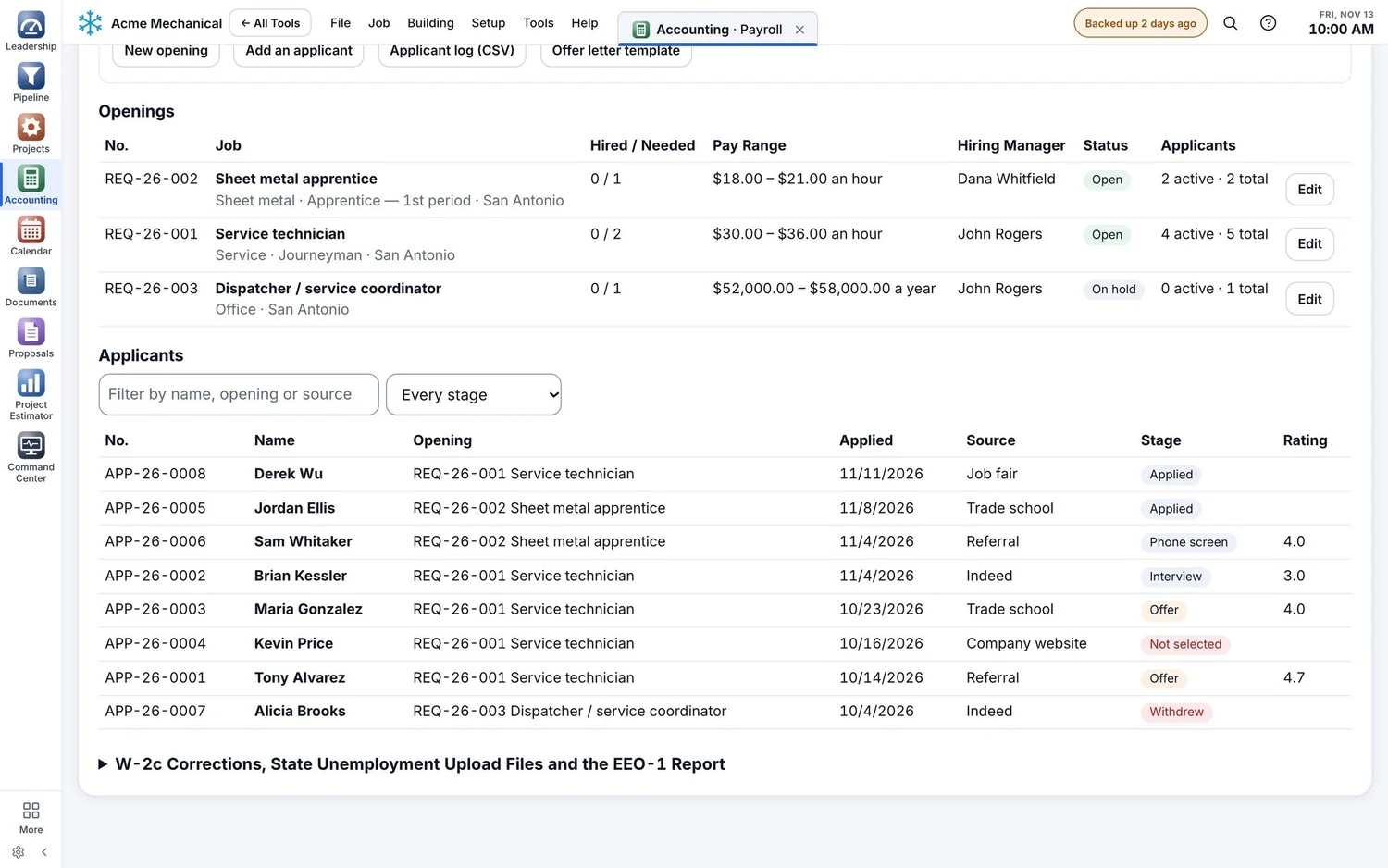
Applicants lost in e-mail are lost hires, so each one moves through stages with a rating.
Offers
An offer records the pay, first day, answer-by date and what it depends on. A pre-employment drug test is scheduled in Safety from the offer, and the offer letter prints from your company's template.
Learn MoreShow Less
A vague offer leads to disputes over pay and start dates later. The offer puts every term in writing before the person starts.
- Conditions can include a drug test, a background check and the driving record.
- The drug test appears in Safety, so nobody starts before it is cleared.
- The letter prints from your own offer template.
Hire in One Step
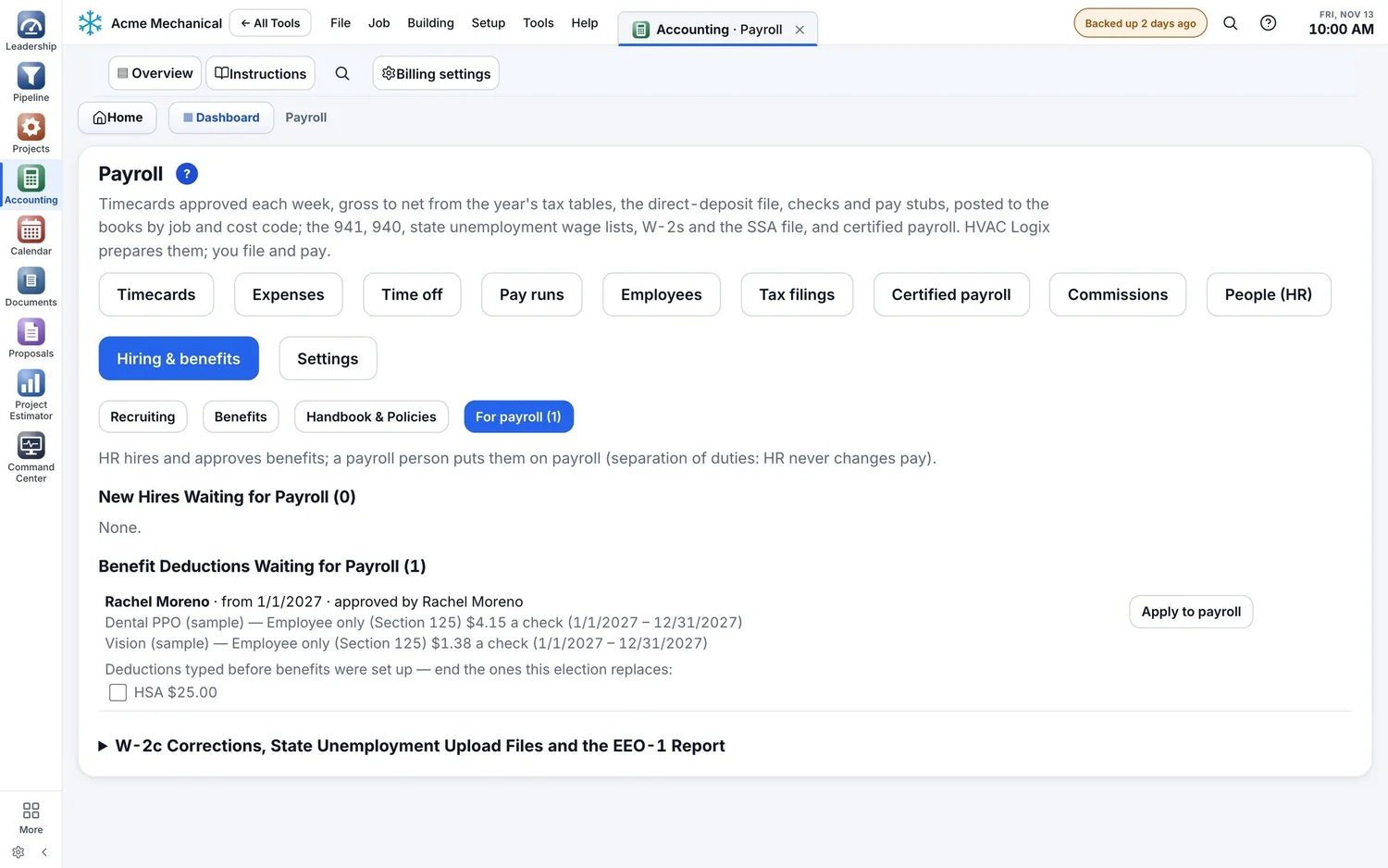
When the offer is accepted, Hire makes the employee record, opens the new-hire checklist and moves the person's licenses to the Safety cards with their expiry reminders. The new employee then waits for a payroll person to add them to payroll.
Learn MoreShow Less
Typing a new hire into three places wastes office time and loses details. Hire carries what recruiting already knows into the employee record.
- The record gets name, contact, first day, work state, pay, trade and class, and reports-to.
- An HR person can hire without payroll rights; HR never changes pay.
- The new hire waits under For Payroll until a payroll person presses Add to Payroll.
The New-Hire Checklist
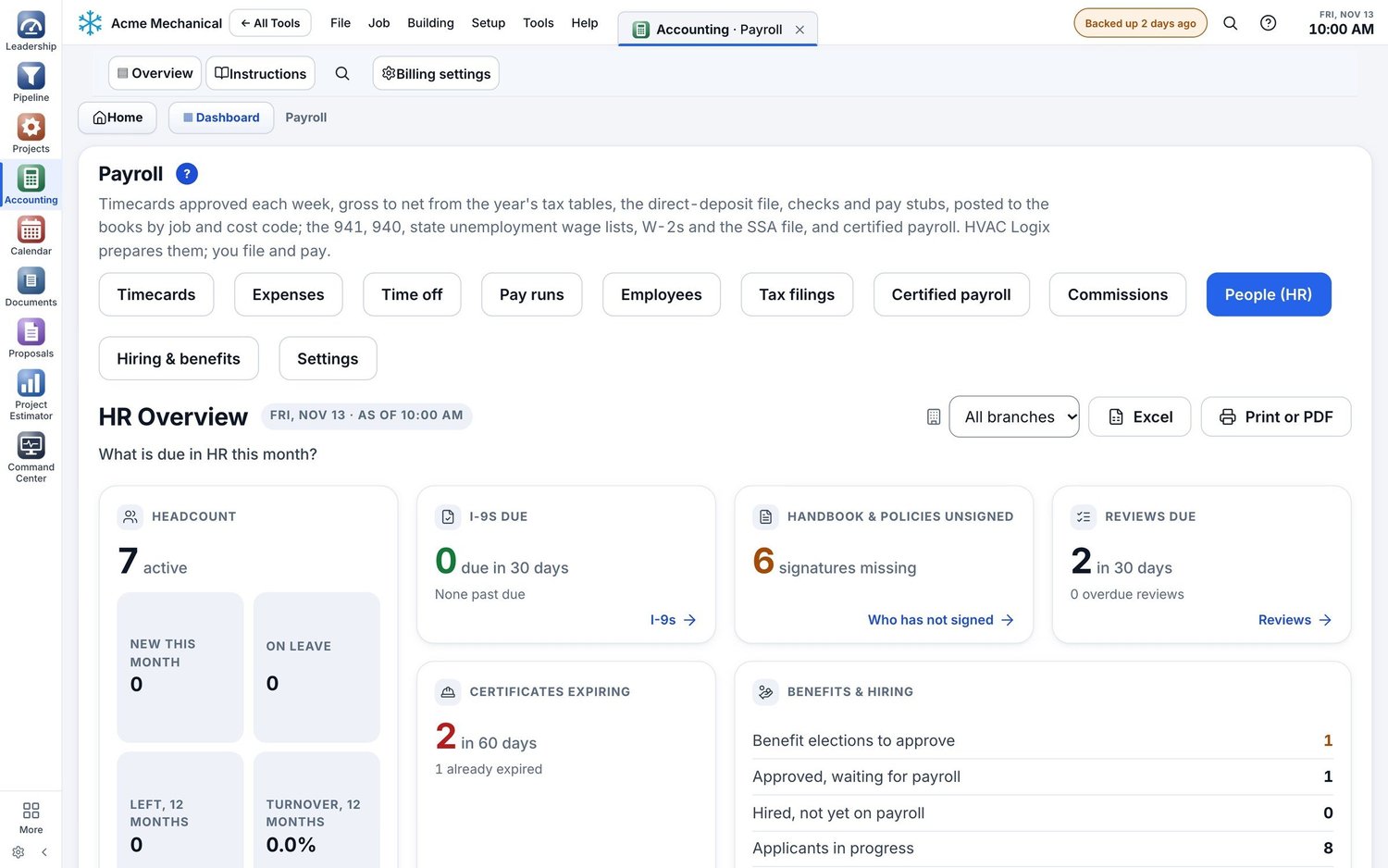
Form W-4, the state withholding certificate, Form I-9, the state new-hire report, direct deposit, the handbook acknowledgment, safety orientation, the EPA 608 card, the state trade license, the driving record check and an emergency contact. Change the list once for every employee.
Learn MoreShow Less
A missed W-4, I-9 or new-hire report can bring fines, and an unchecked license can put an unqualified person on a job. The checklist makes sure every hire is complete.
- Each item is Open, Done with a date, or Not Needed.
- Changing the company list keeps everyone's ticks where the wording is unchanged.
- The handbook item shows done when the current handbook is signed.
- Only that the driver's license was checked is recorded here; its dates live in the fleet register.
Form I-9 Dates
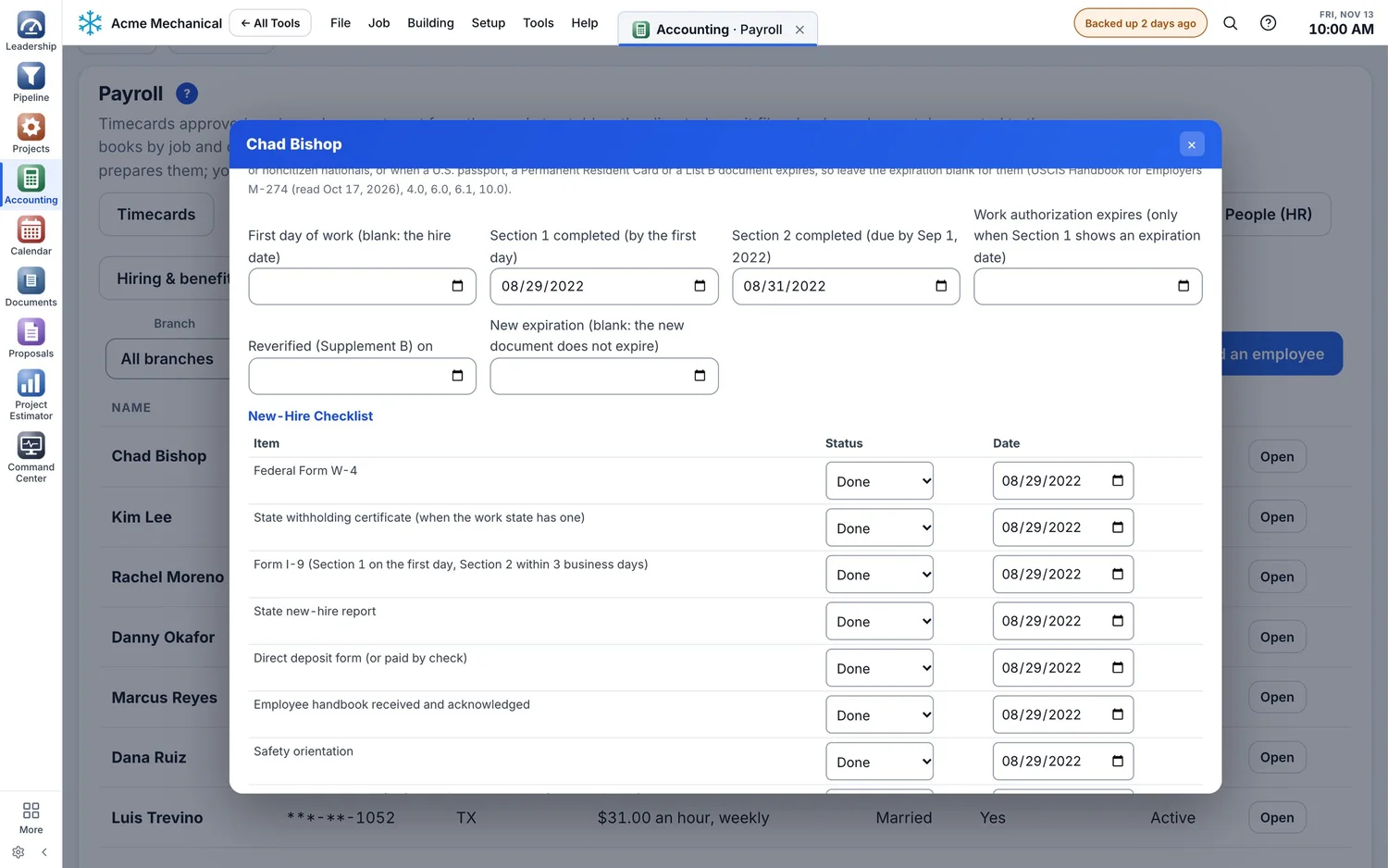
HVAC Logix keeps only the dates, never document numbers, copies or citizenship status. It shows when Section 2 is due, reminds the manager and the bookkeeper before a work authorization expires, and shows how long to keep the form after the last day.
Learn MoreShow Less
I-9 errors can carry fines in a federal inspection. The dates and reminders keep every form on time without storing sensitive documents.
- Section 2 is due within 3 business days of the first day of work.
- Reverification reminders come 90, 60, 30 and 7 days ahead, and on the day.
- Keep the form 3 years after hire or 1 year after employment ends, whichever is later.
- Source: USCIS Handbook for Employers M-274.
Handbook and Policies
Write the handbook or a policy and say who signs it. Employees sign on the phone by confirming they received and read it and typing their name. Changing the text makes a new version, and everyone signs again.
Learn MoreShow Less
A signed acknowledgment is your proof when a policy dispute reaches a hearing. Every employee signs the current version, and the record shows it.
- Policies can be written in English and Spanish.
- Choose who signs: everyone, field or office.
- Paper or typed signatures at the office are recorded too.
- The acknowledgment prints.
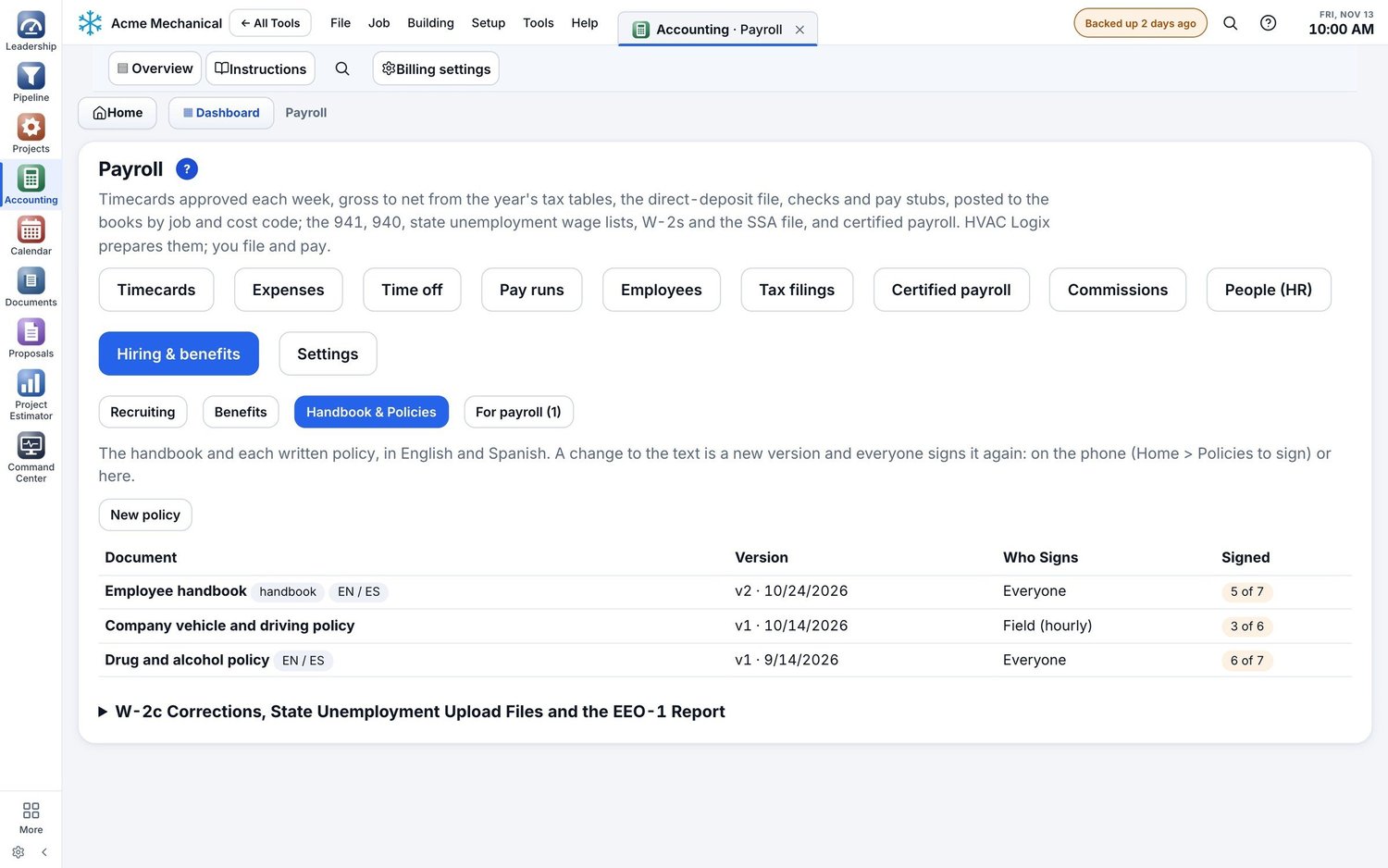
Unsigned policies cause disputes, so each handbook and policy shows its version and who signed.
Know Who Is Current Before You Send Them
Licenses and Certifications
EPA Section 608 by type, state trade licenses, OSHA 10 and OSHA 30 and the other safety cards, each with issue and expiration dates. A card reads Current, Expires In N Days, Expired or No Expiration, and these are the same cards the Safety tool tracks.
Learn MoreShow Less
An expired license on a job can mean a fine or a stop-work. Every card is tracked in one place for HR and Safety.
- EPA 608 types follow 40 CFR 82.161(a); a 608 card does not expire.
- A card shows Expires In N Days at 60 days or fewer.
- A refrigerant charge by a technician without a matching 608 type shows a warning.
- The work is still recorded, since an apprentice may work under close supervision.
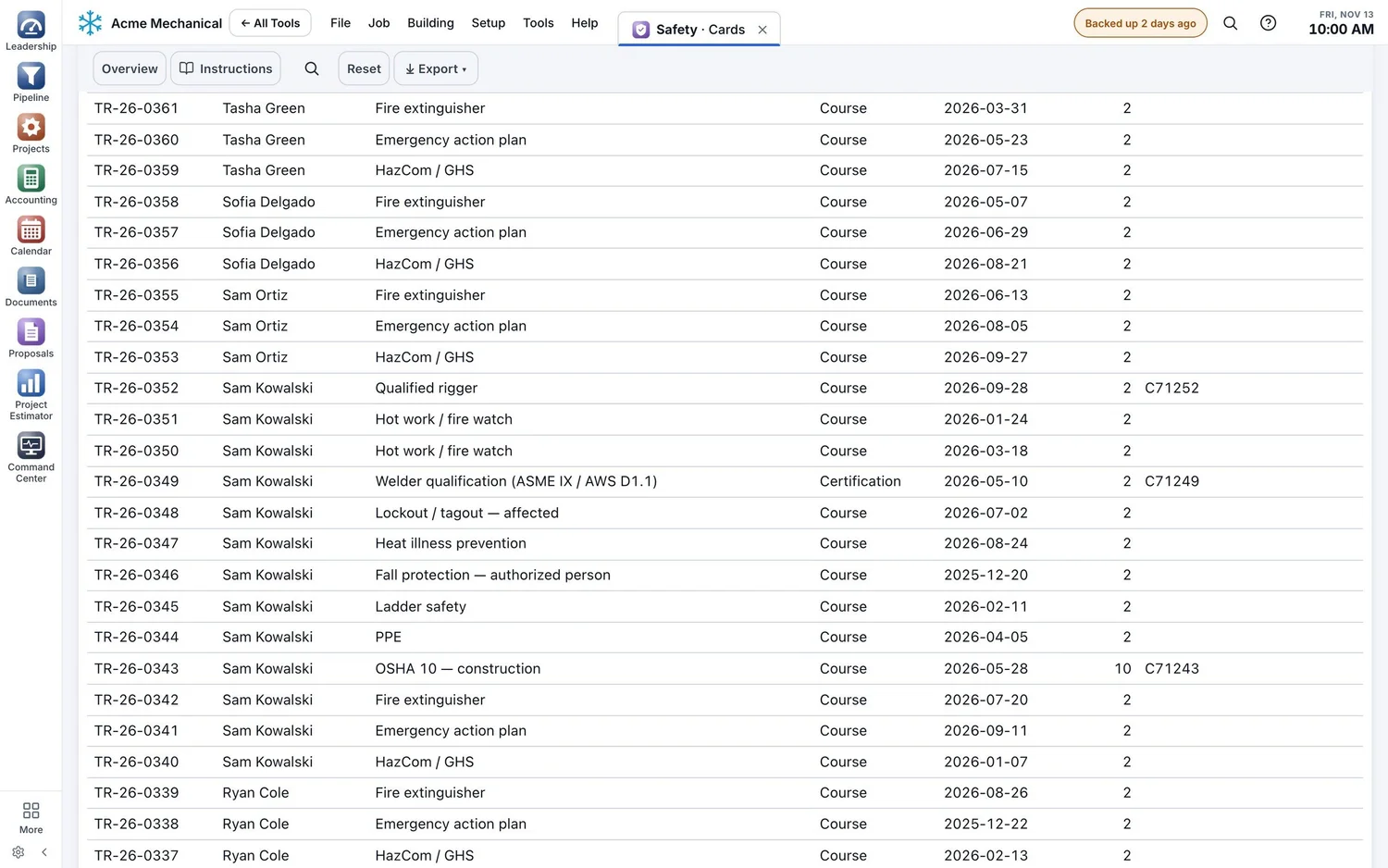
An expired card can keep someone off a job, so every card shows its expiry.
Reminders to the Right People
The card holder and the safety lead are reminded before a card expires, and the person's manager gets a reminder of their own on the calendar.
Learn MoreShow Less
A reminder that reaches only the card holder is easy to miss. Reminding the manager too keeps a lapsed license from costing a job.
- The manager is the person's Reports To on the HR record.
- No duplicate reminder when the manager is the card holder or the safety lead.
- I-9 reminders go to the manager, or the bookkeeper when no manager is set.
The EPA 608 Check on Refrigerant Work
A cylinder charge or recovery, at the office or from the phone, shows a warning when the technician has no EPA 608 card of a type that covers the refrigerant. The work is always recorded.
Learn More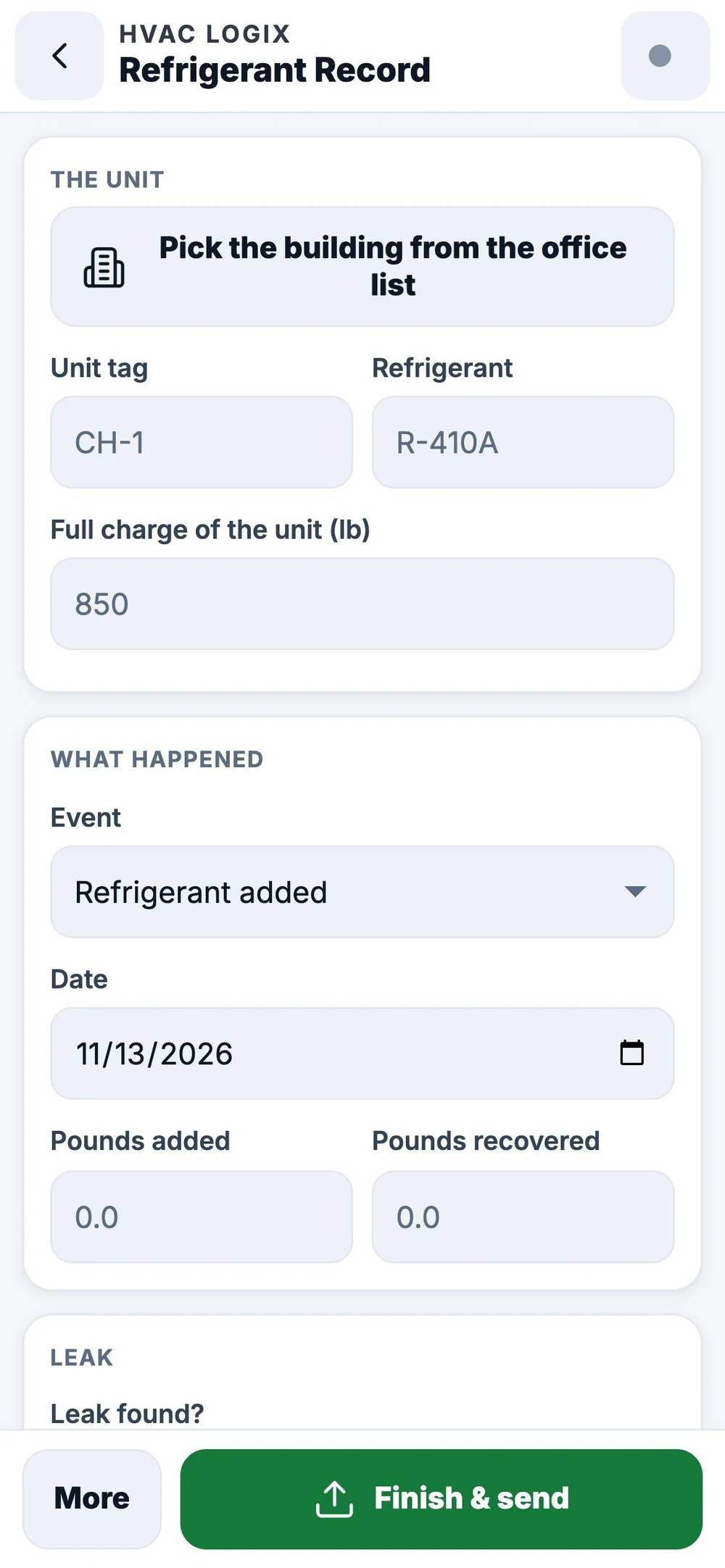
Refrigerant work needs a certified technician, so the phone log warns when a card is missing.
Safety Training for Every Employee
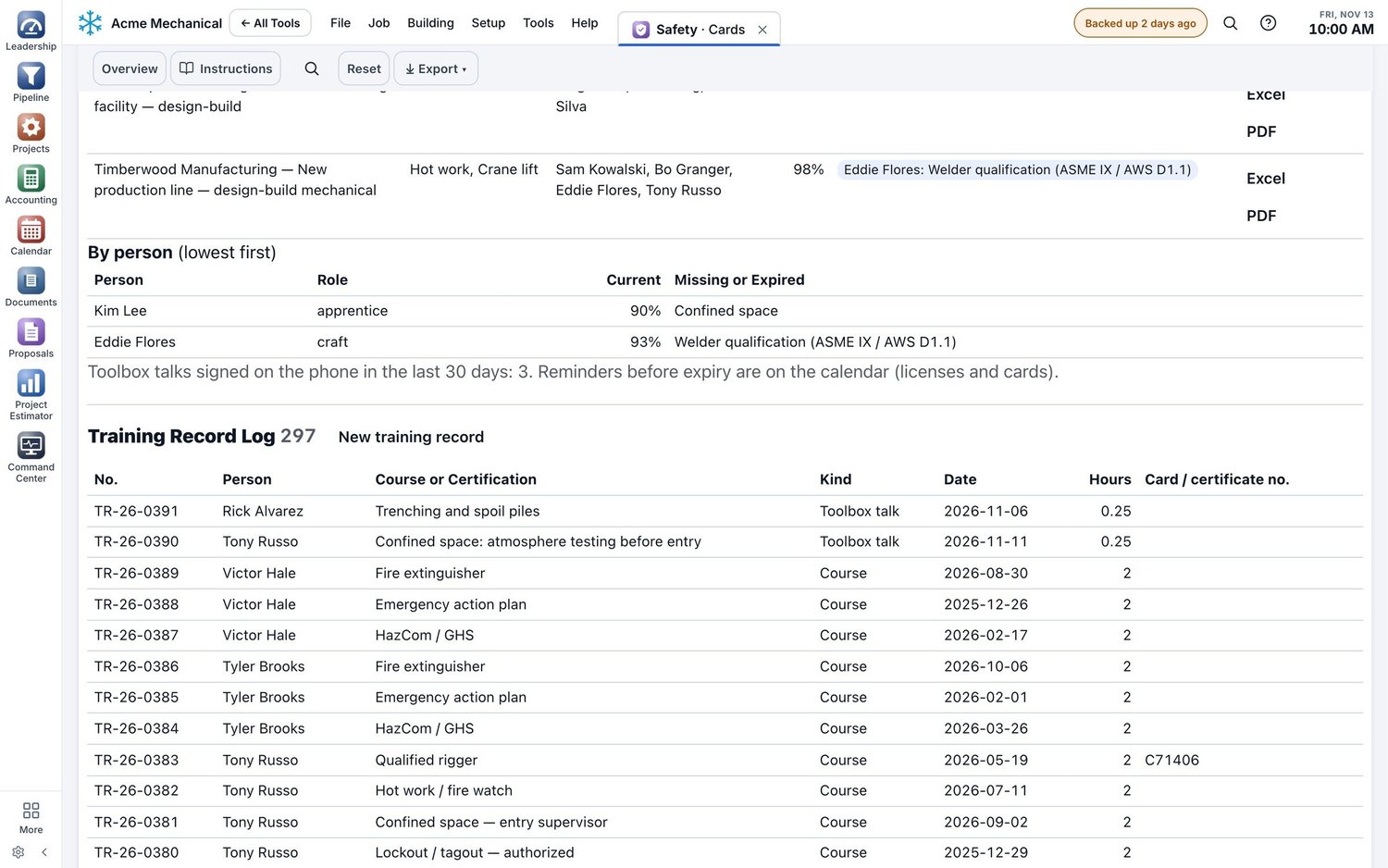
A training catalog with refresher intervals, each employee's records and expiries at 30, 60 and 90 days, and training matrices by job crew in Excel or PDF for prequalification. A person without current training for a job's flagged hazards is flagged on the board.
Learn More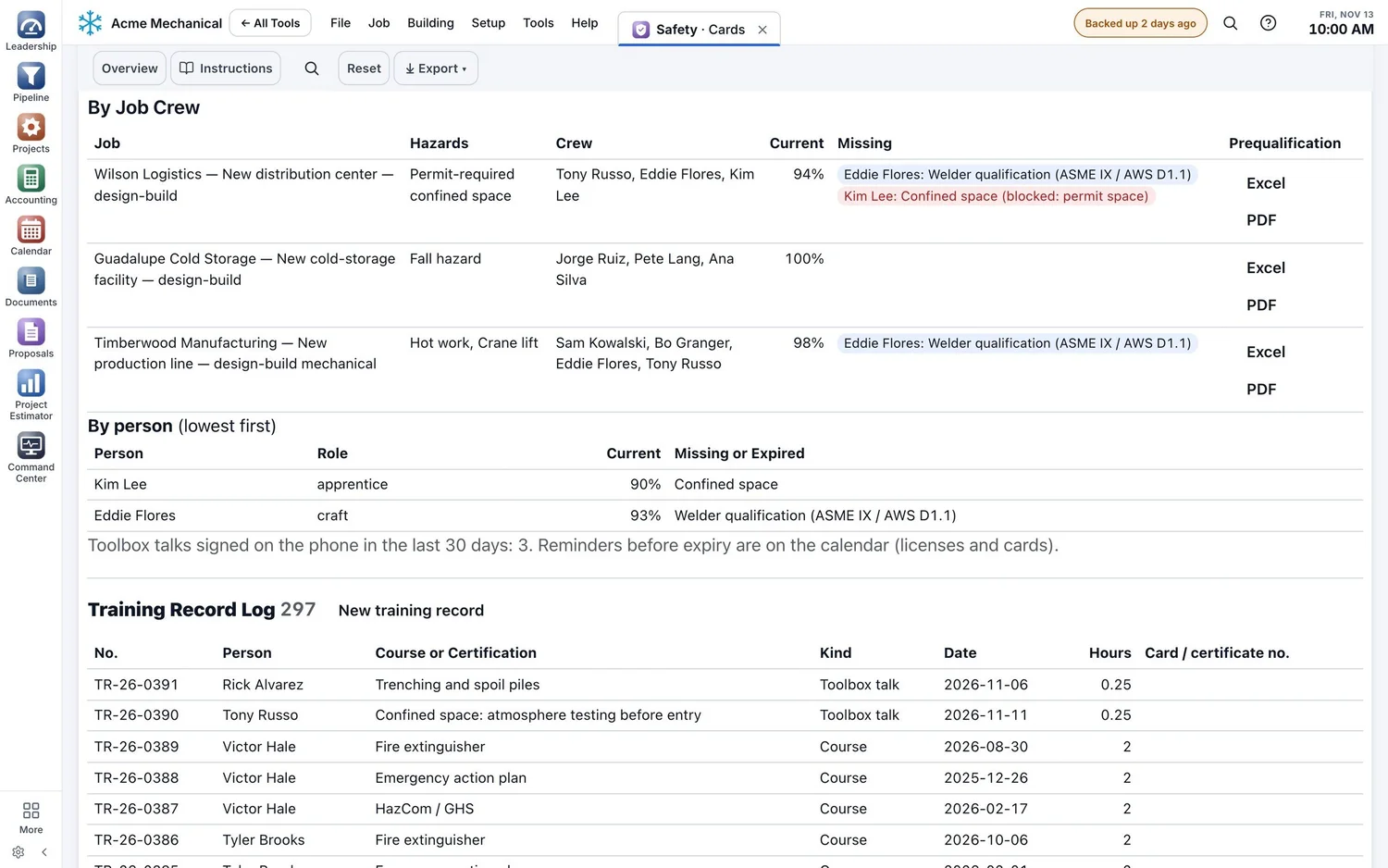
Crews need the right training, so the matrix shows who is current by crew.
Drug and Alcohol Testing
Program settings, random pools and a random draw that anyone can re-check from its saved record. Results are sealed, shown only to HR and Safety on request, and every look is logged.
Learn More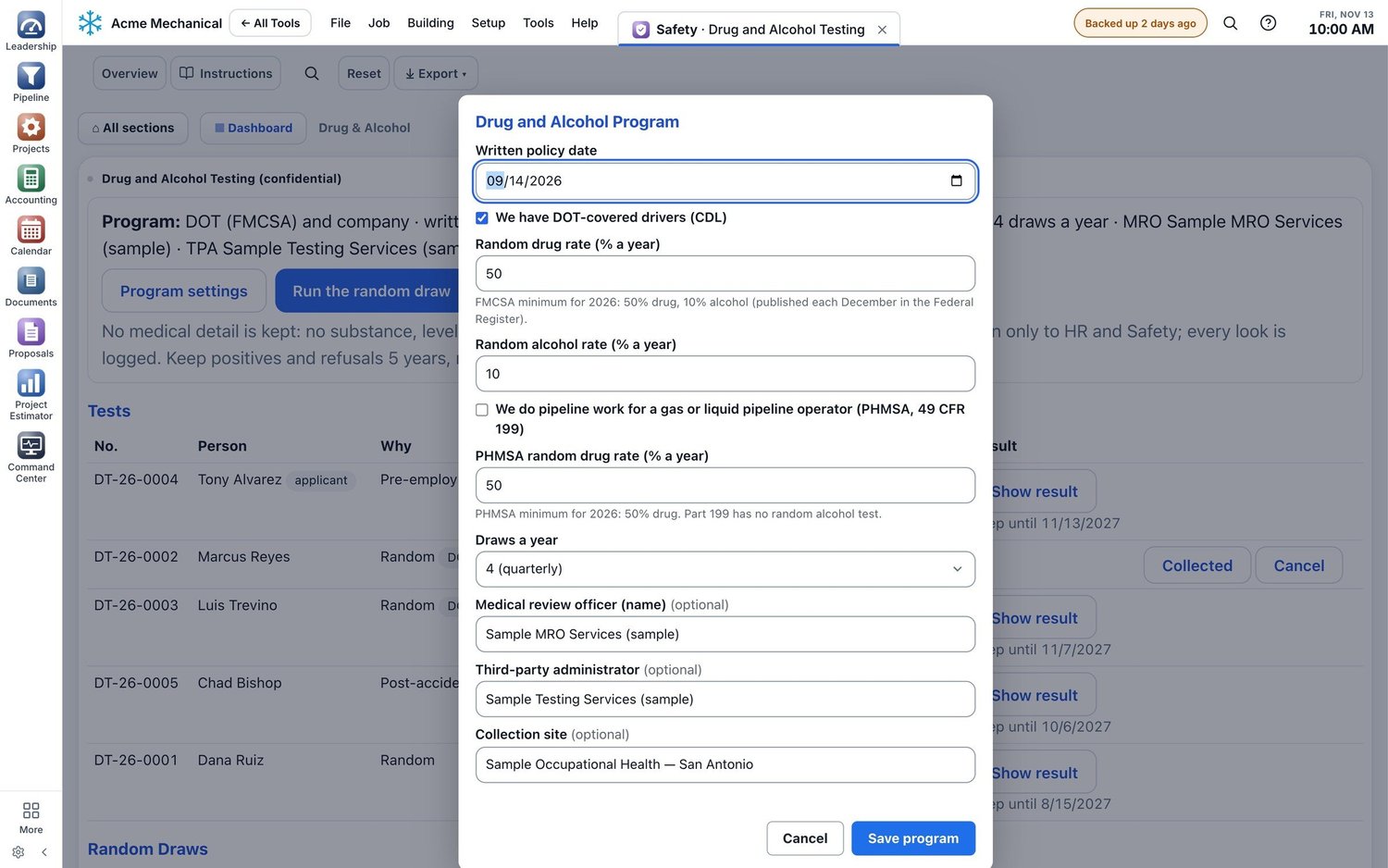
Drug testing must follow written rules, so the program settings are kept on record.
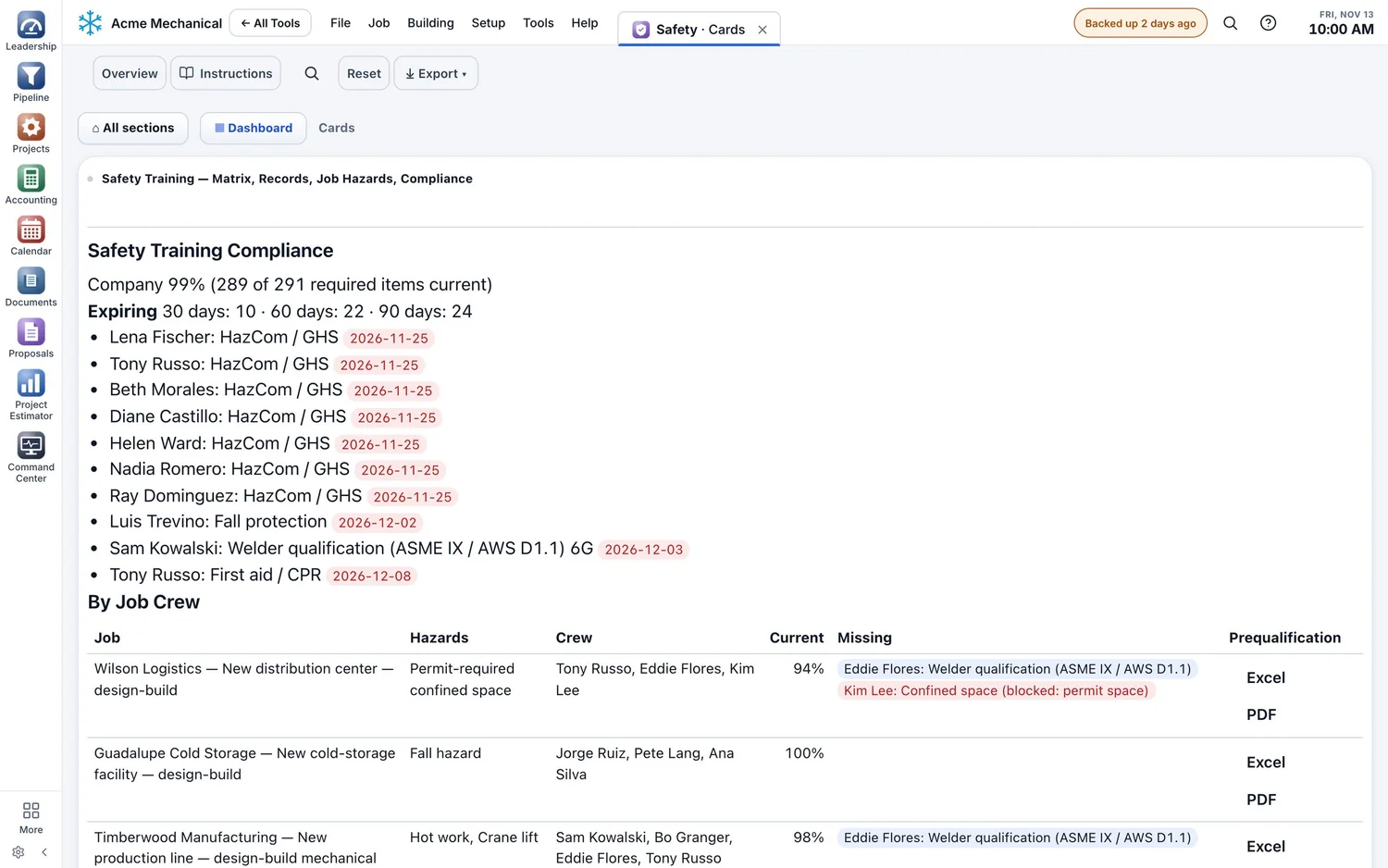
Licenses and safety cards by person and crew, with what is missing before you send them.
Elections, Balances and Reporting That Feed Payroll
Benefits
- Medical, dental, vision, life, disability, HSA and FSA plans with the cost split between employee and company
- Eligibility rules and an open enrollment window
- Elections entered from a paper form or chosen by the employee on the phone
- Approved elections become payroll deductions from the coverage date
- A census file of employees and dependents to send to the carrier yourself
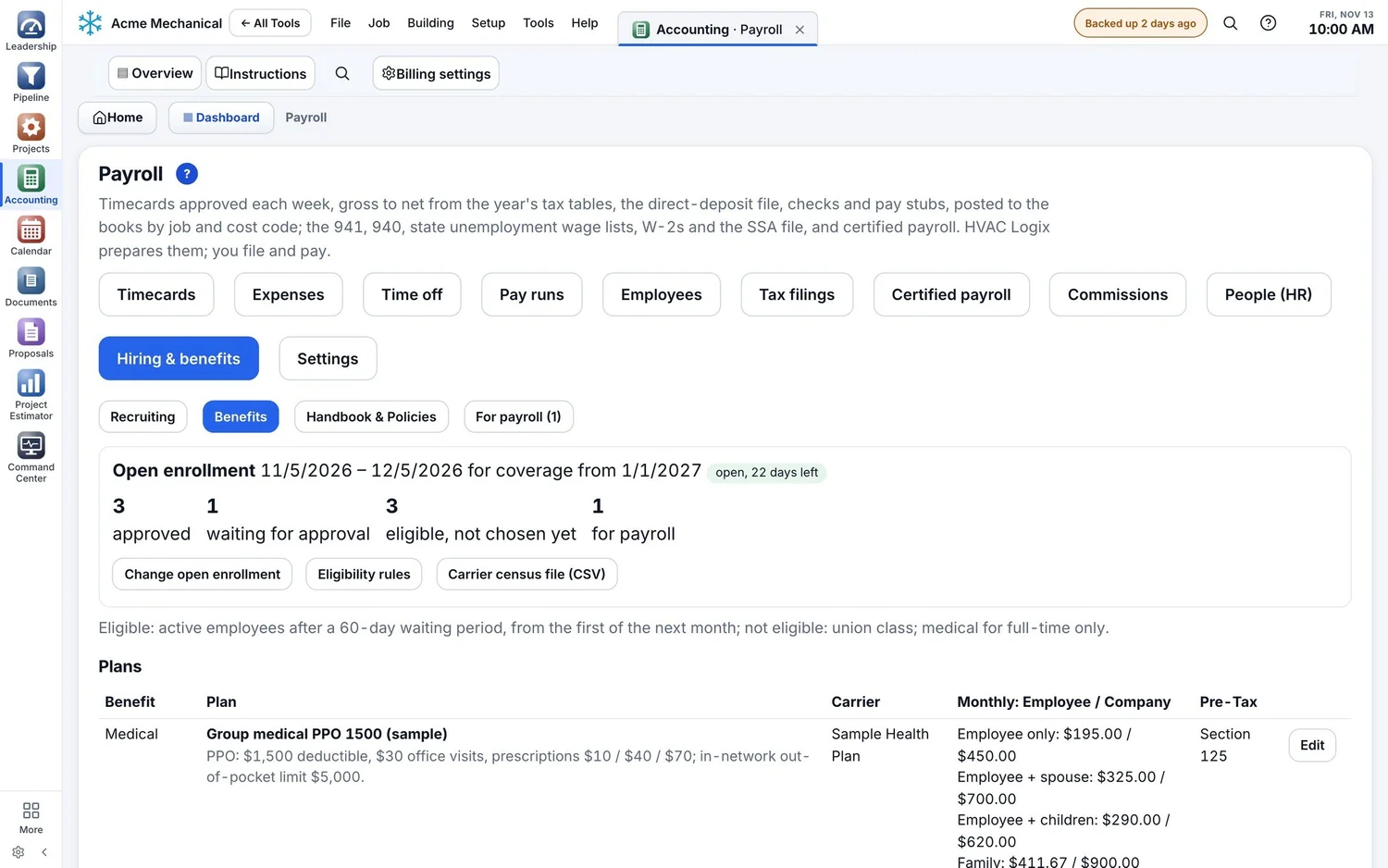
Benefit costs split wrong cost money, so each plan shows the employee and company share.
Paid Time Off and Sick Leave
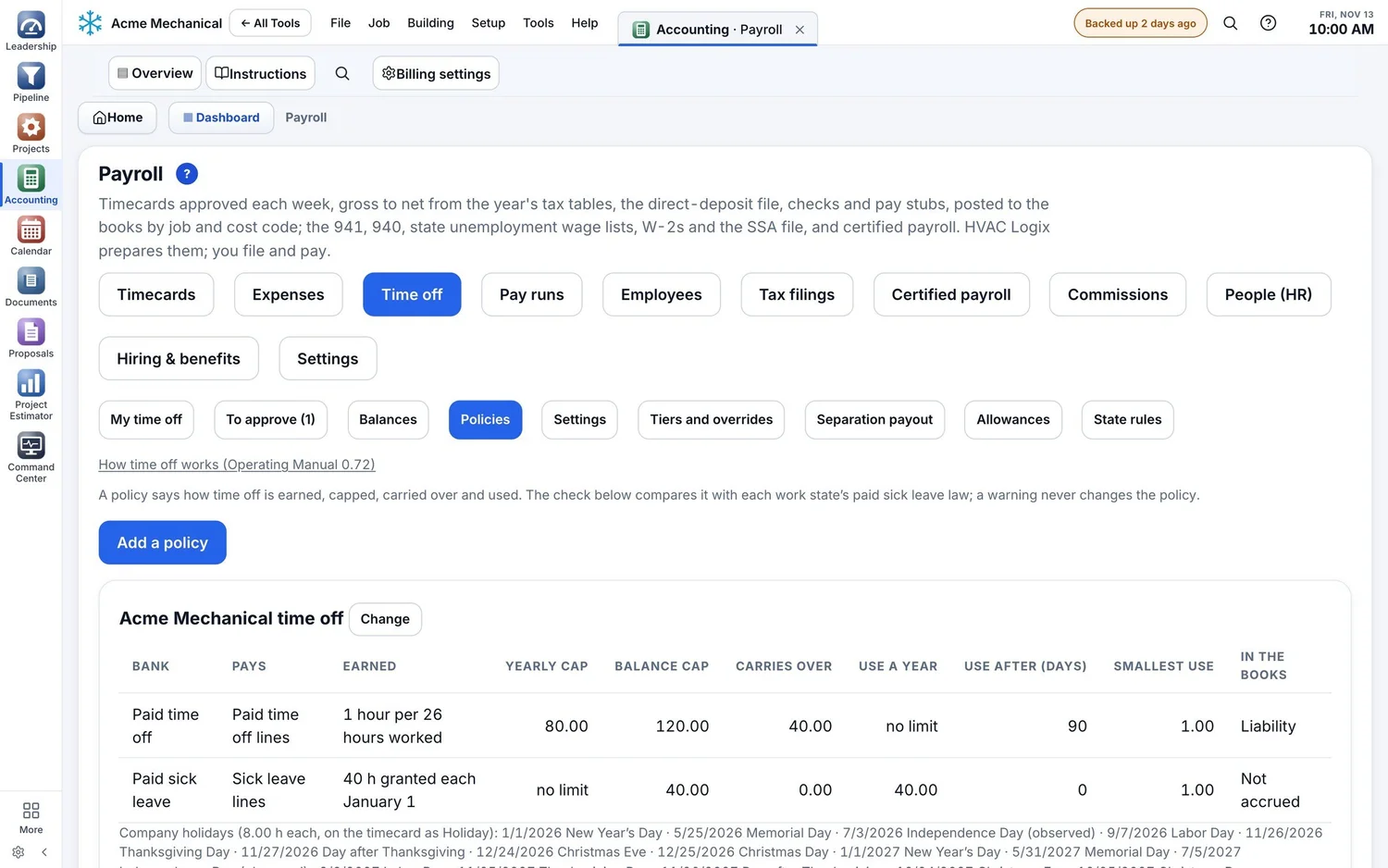
- Company policies with one or two banks, caps, carry-over and waiting periods
- Balances, earned and used this year, in Excel or CSV
- Requests approved by someone other than the person asking
- A check of the policy against each work state's paid sick leave law
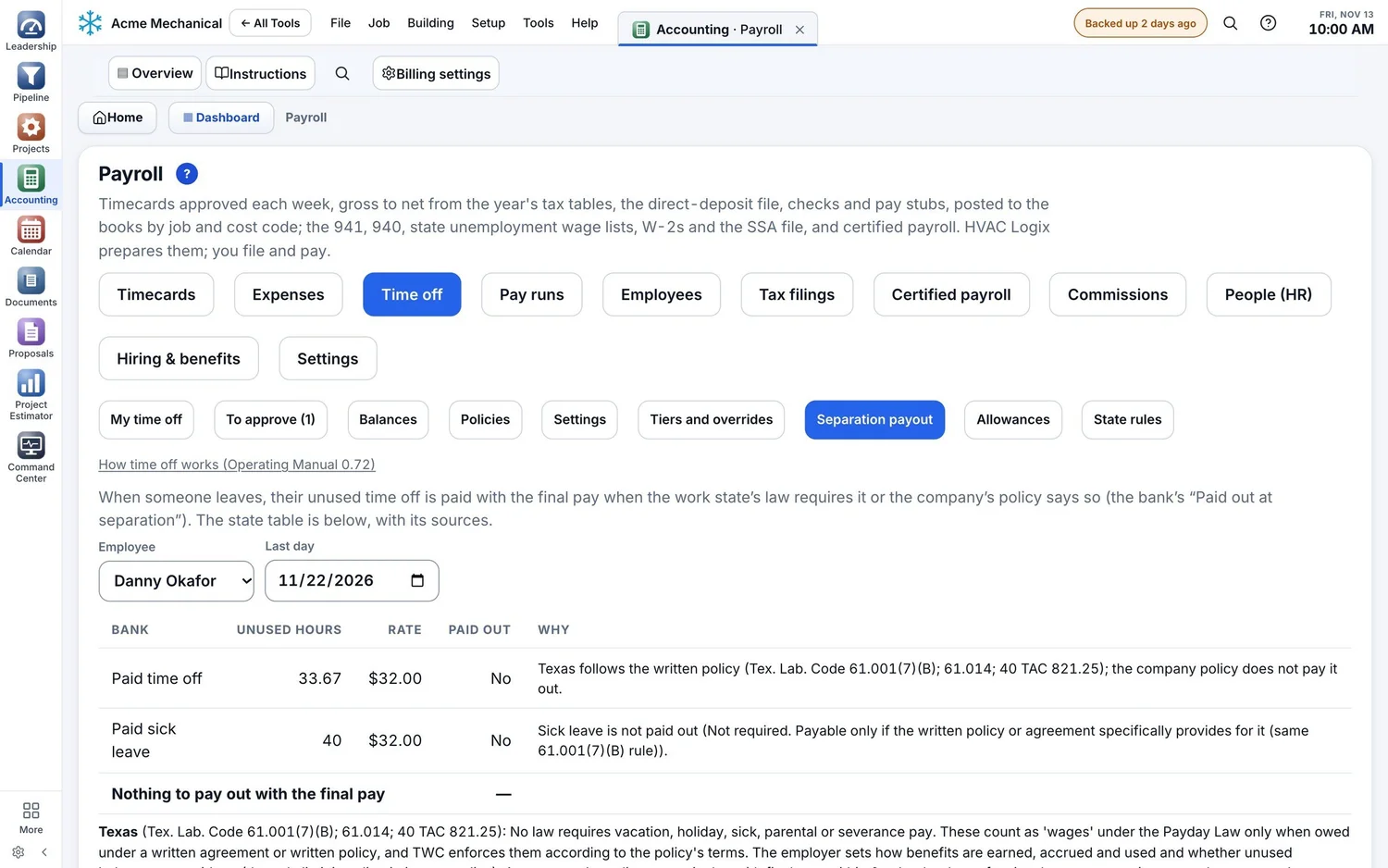
- Unused time off at separation handled by the policy and the state's rule
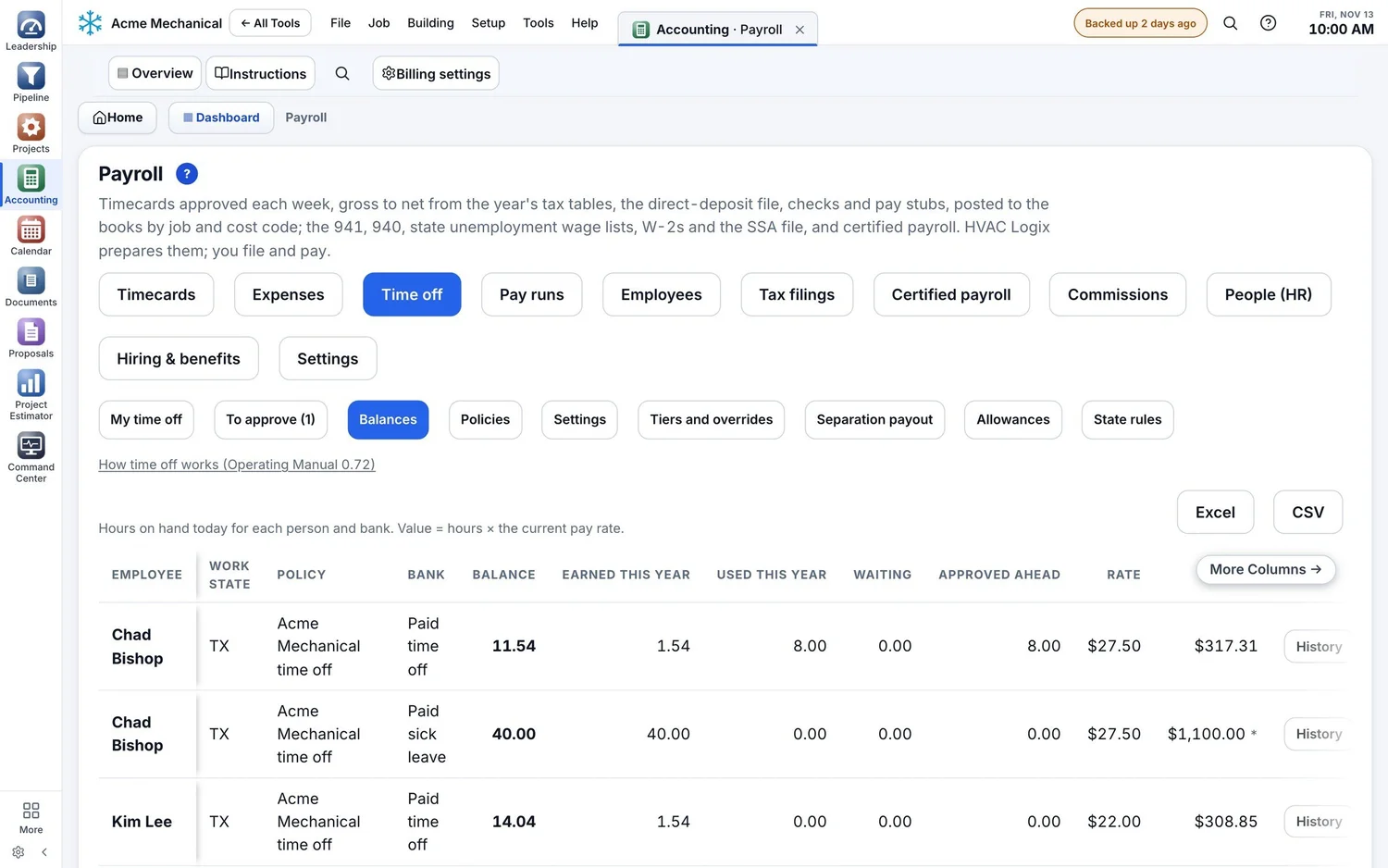
Time-off balances argued over hurt morale, so each person's balance is shown earned and used.
Reporting Data
- Forms 1094-C and 1095-C prepared for an applicable large employer
- EEO-1 Component 1 counts by establishment, with self-identification answers kept apart from the personnel record
- State new-hire report lists by quarter
- Filing stays with you or your CPA
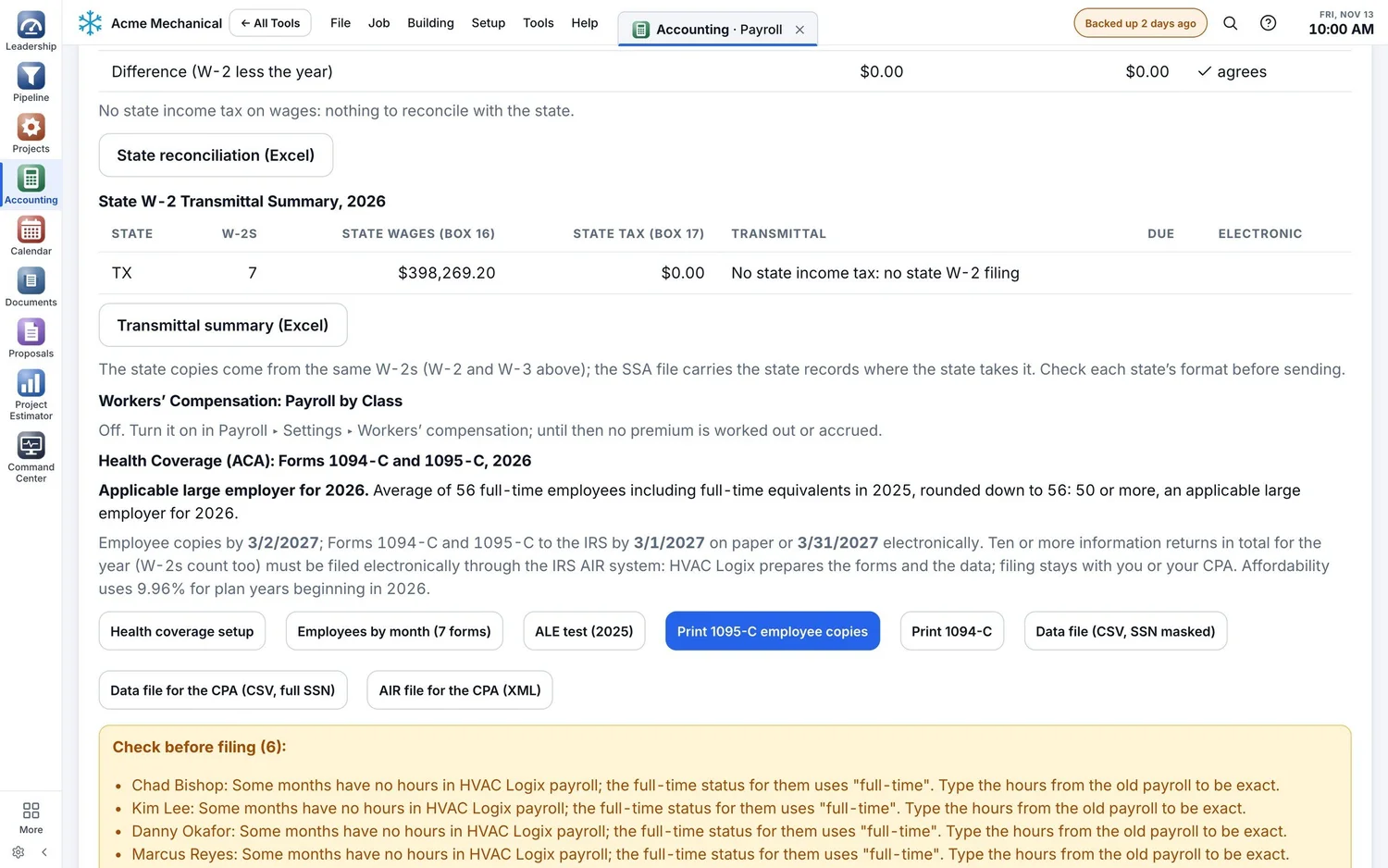
Large employers must file health coverage forms, so they are prepared from payroll and the plan.
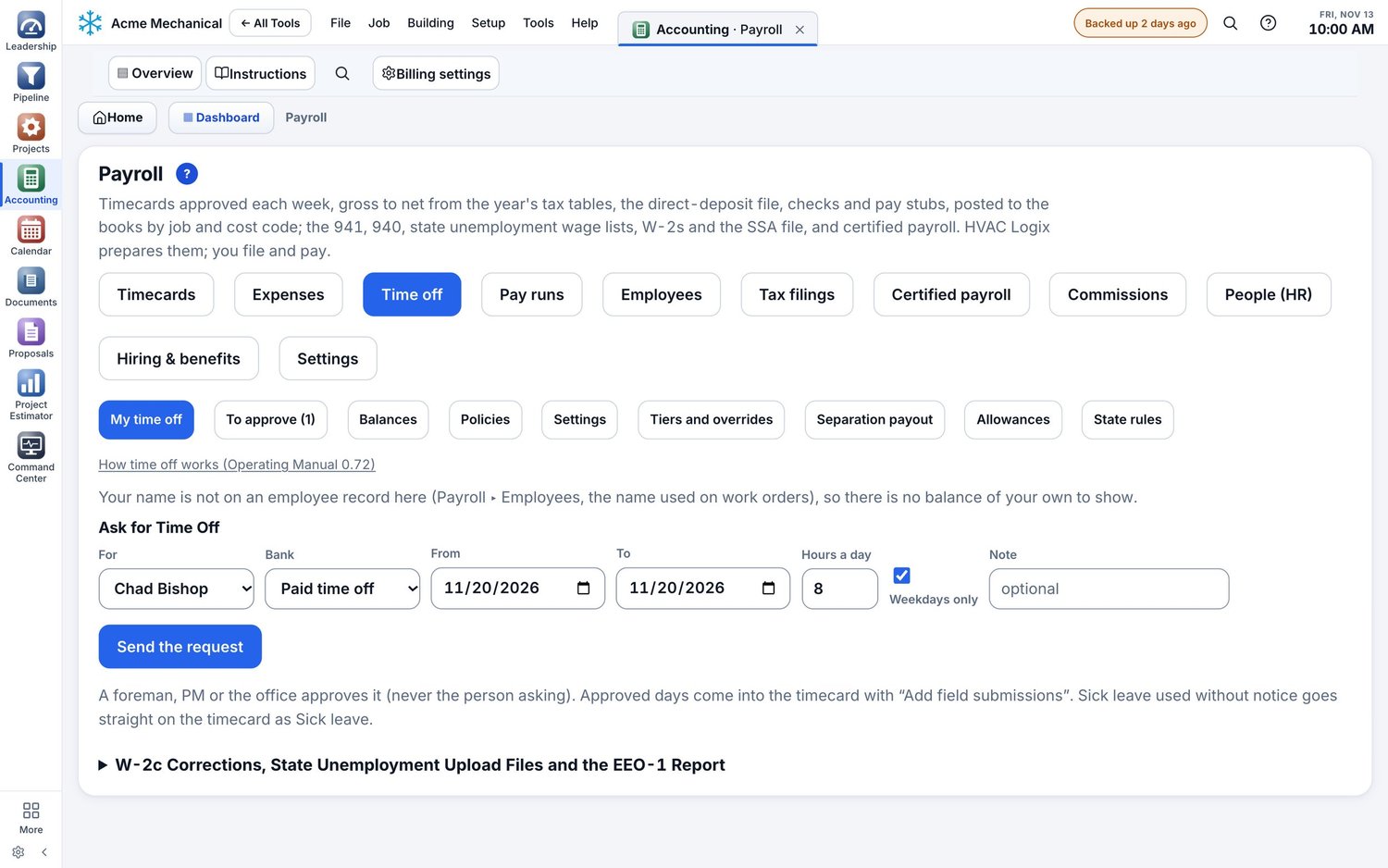
Time-off balances and requests that feed straight into payroll.
Scorecards, Reviews and Pay Decisions on the Record
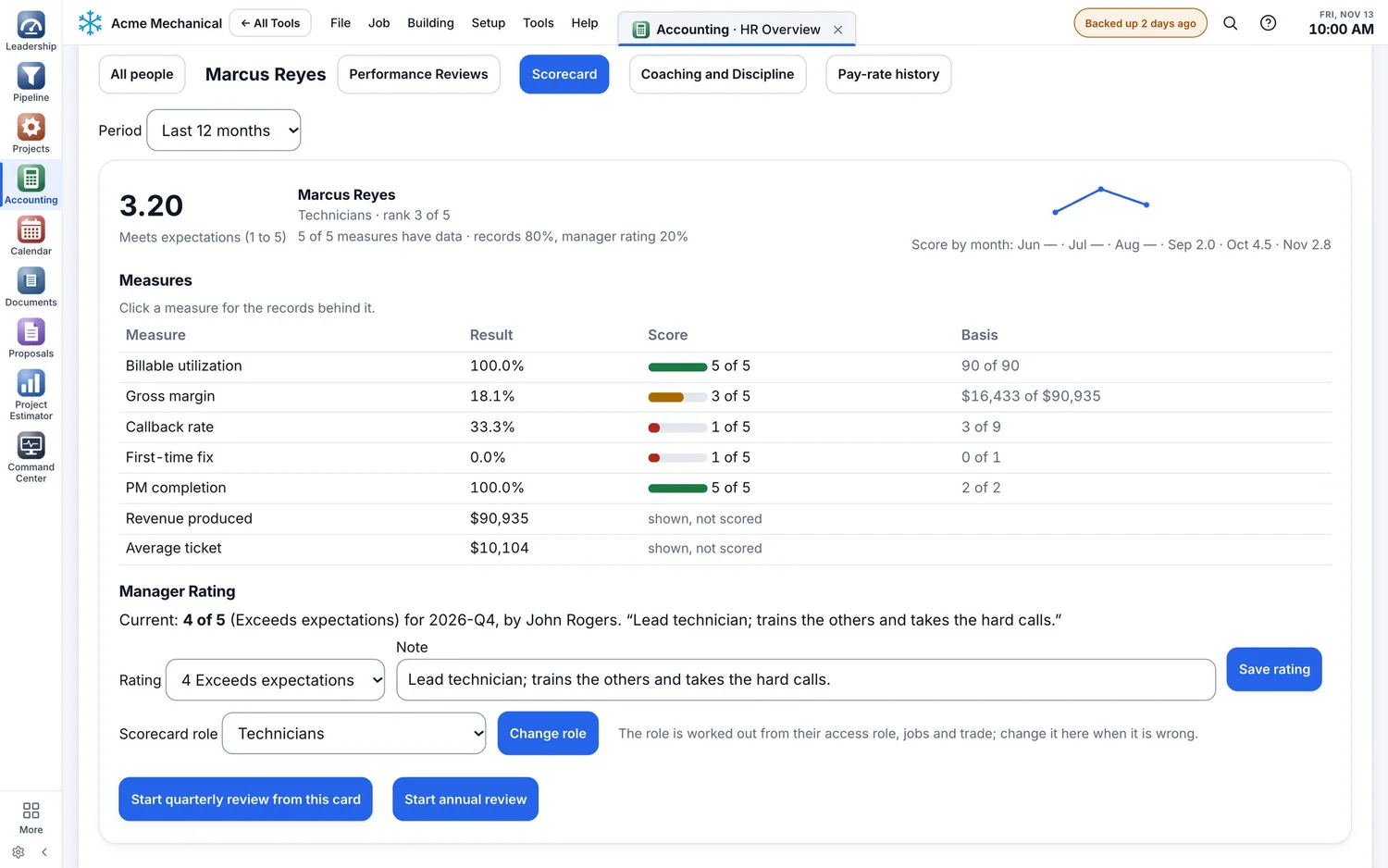
Every employee has a scorecard built from saved records, and reviews start from it.
Scorecards for Every Role
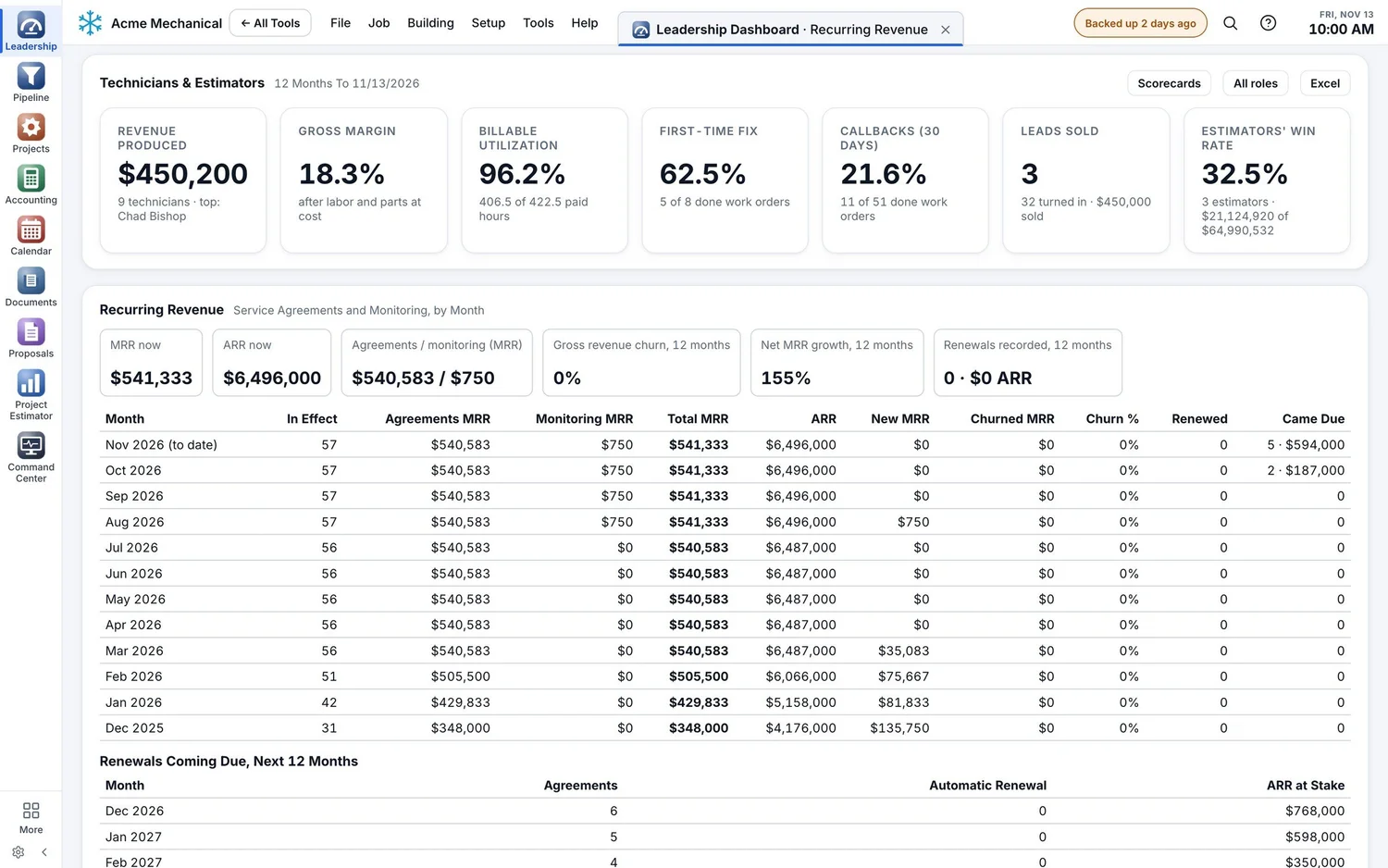
Technicians, estimators, project managers, dispatchers, purchasing, warehouse, accounting and more, all on the same 1-to-5 scale. Each measure has one fixed formula. Click it to see the numerator, the denominator and every record behind it.
Learn MoreShow Less
Paying and promoting on facts rather than impressions keeps good people and moves the right ones up. Every measure comes from saved records, never typed in.
- Click a measure to see its formula, numerator, denominator and every record behind it.
- Rank shows within the role, without other people's names.
- Each card shows the score for the last six months.
- Safety measures use leading indicators only; injury counts are never scored.
No Data Is Not a Zero
A measure with nothing to measure in the period says so and is left out of the score. The manager's quarterly rating covers what records cannot show and counts for 20 percent of the card.
Learn MoreShow Less
Scoring someone zero for work they had no chance to do drives good people away. The card is scored only on what can be measured.
- A card needs at least two measures with data to be scored from records.
- Records count for 80 percent; the manager's rating covers judgment, attitude and teamwork.
- Nobody rates their own card, and every rating keeps who gave it.
Safety Measured the Right Way
Safety measures use leading indicators only: inspections completed, corrective actions closed on time, toolbox talks held and training current. Injury counts are never measured, ranked or rewarded on a scorecard.
Learn MoreReviews Built on the Scorecard
Start a quarterly, annual or 90-day review from the scorecard. It carries the period's numbers, the employee's self-review, the manager's ratings, goals and a development plan. The reviewer signs, which locks it, and the employee acknowledges.
Learn MoreShow Less
A review based on records holds up if a decision is ever challenged, and it is faster to write. The scorecard's numbers go in as of that day.
- A later change in the records never rewrites a signed review.
- Changes after signing go in as dated addenda.
- If the employee declines to sign, the witness is named.
- Anyone without a review gets a first-review date 90 days after hire.
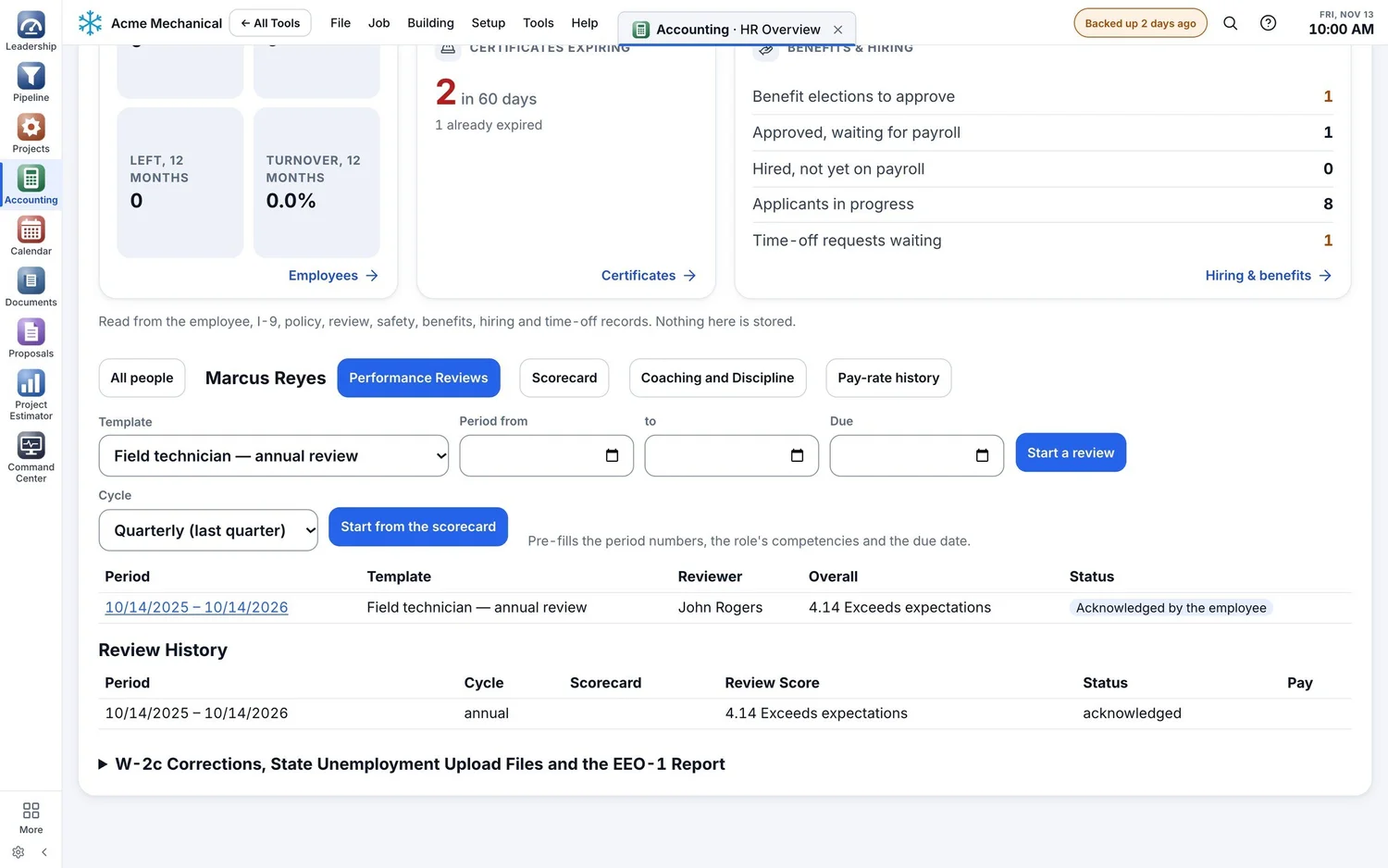
Reviews built from memory are unfair, so each one starts from the scorecard and its history.
Coaching and Discipline
Coaching, recognition and each warning step are written as notes with the facts, what is expected and a follow-up date on the author's calendar. A final note is locked and signed like a review.
Learn MoreShow Less
Undocumented discipline is hard to defend in an unemployment or wrongful-termination claim. Each step is written, dated and signed.
- Steps run from coaching and recognition through verbal, written and final warnings, suspension and termination.
- Each note can name the policy and a witness.
- The list counts the steps on file.
- A manager sees reviews and notes for their own people, never pay.
Raises and Bonuses
A reviewer proposes a raise as a percent or a bonus as an amount. Nothing reaches payroll until a payroll approver approves it. An approved raise goes into the pay-rate history that payroll reads, and an approved bonus goes on the next pay run.
Learn MoreShow Less
A raise entered with the wrong date or never approved means overpayment or back pay later. Raises reach payroll only after approval, and payroll pays the right rate on the right day.
- The person who proposed a raise cannot approve it.
- Each timecard line is paid at the rate in effect on its day.
- A raise dated back shows the retroactive pay owed, including overtime at one and a half times the difference.
- Retro pay goes on the next check as its own line.
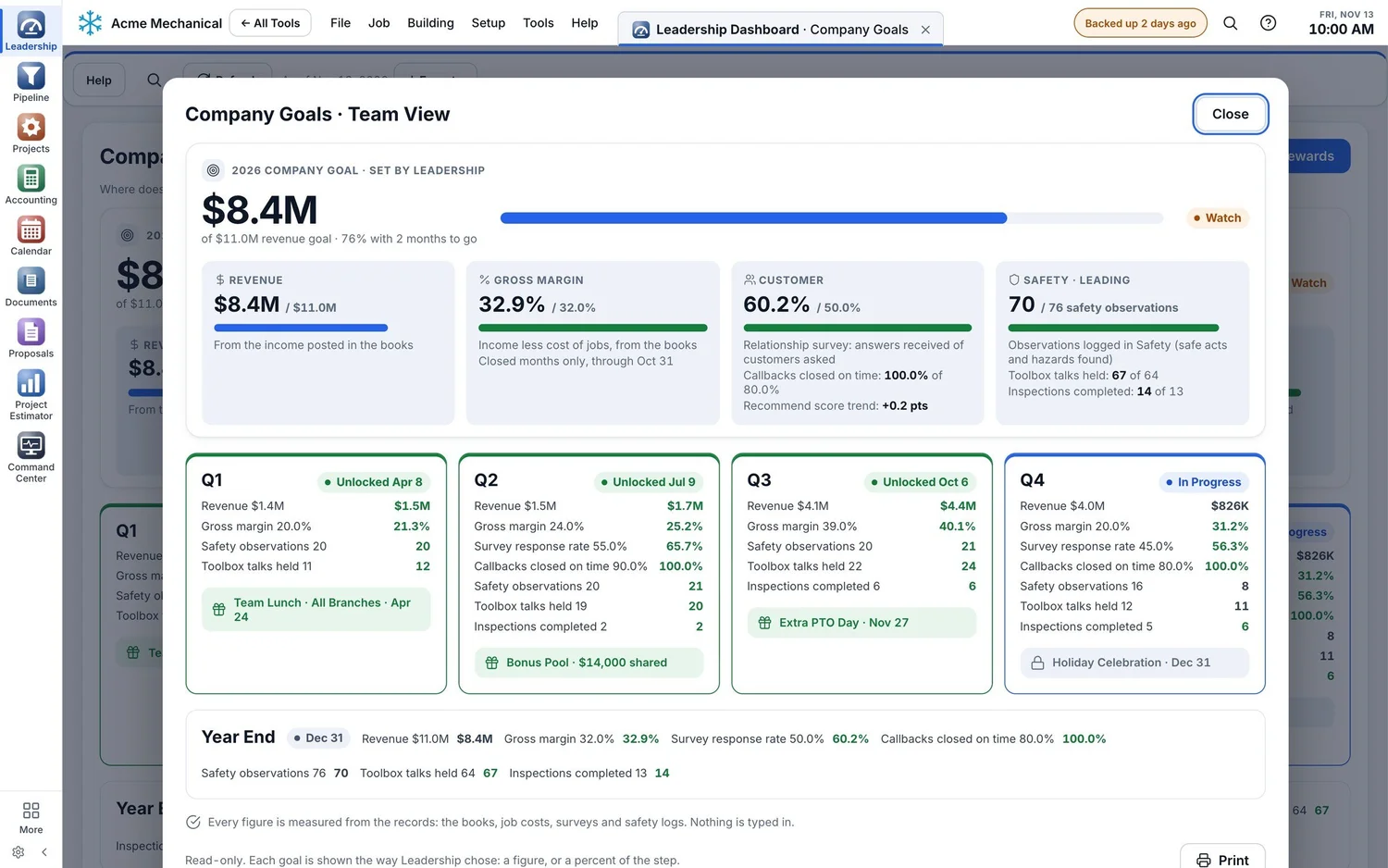
The Right Access for Every Job, and a Clean Handoff When Someone Leaves
Roles for Every Job
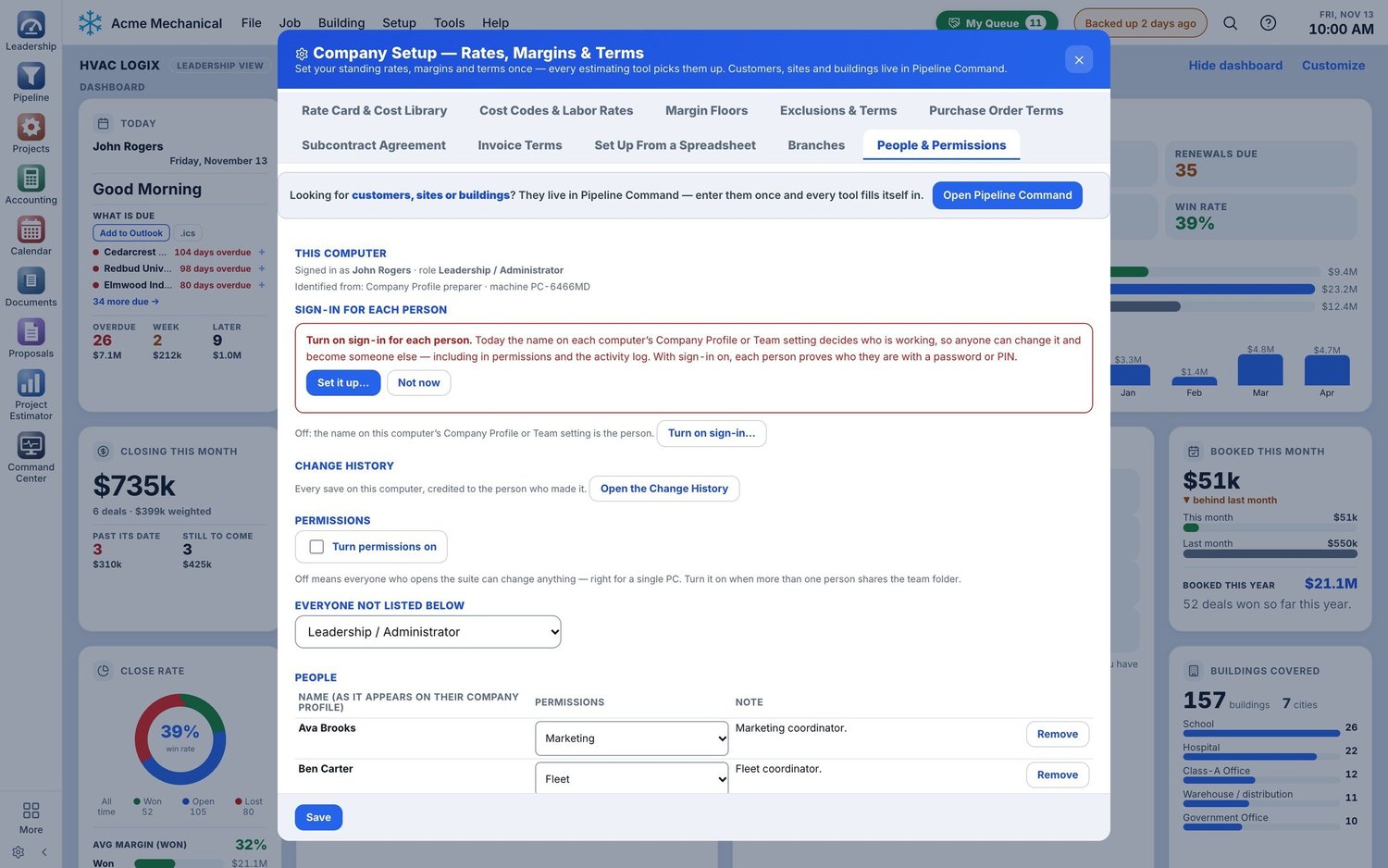
- 36 roles, from Service Manager, Dispatcher and Purchasing to HR, Safety, Fleet, Foreman and Apprentice
- Each role carries only what the job needs
- A refused action names the role and who holds the right
- Every blocked attempt is logged for Leadership
Sign-In for Each Person
- Each person signs in with their own password or PIN
- The name on every entry in the activity log is the person who signed in
- A printed recovery code is kept with the company's important papers
- Off until Leadership turns it on
When Somebody Leaves
- Who Holds Work is built from the records themselves: accounts, agreements, jobs and visits that carry the person's name
- Hand Off shows what moves and what stays before anything happens, then moves it in one action
- History stays as it was: who saved an estimate or performed the work is never rewritten
- Commission stays with the person who held the account when the deal was dated
- The person is set to No Access, with the date they left
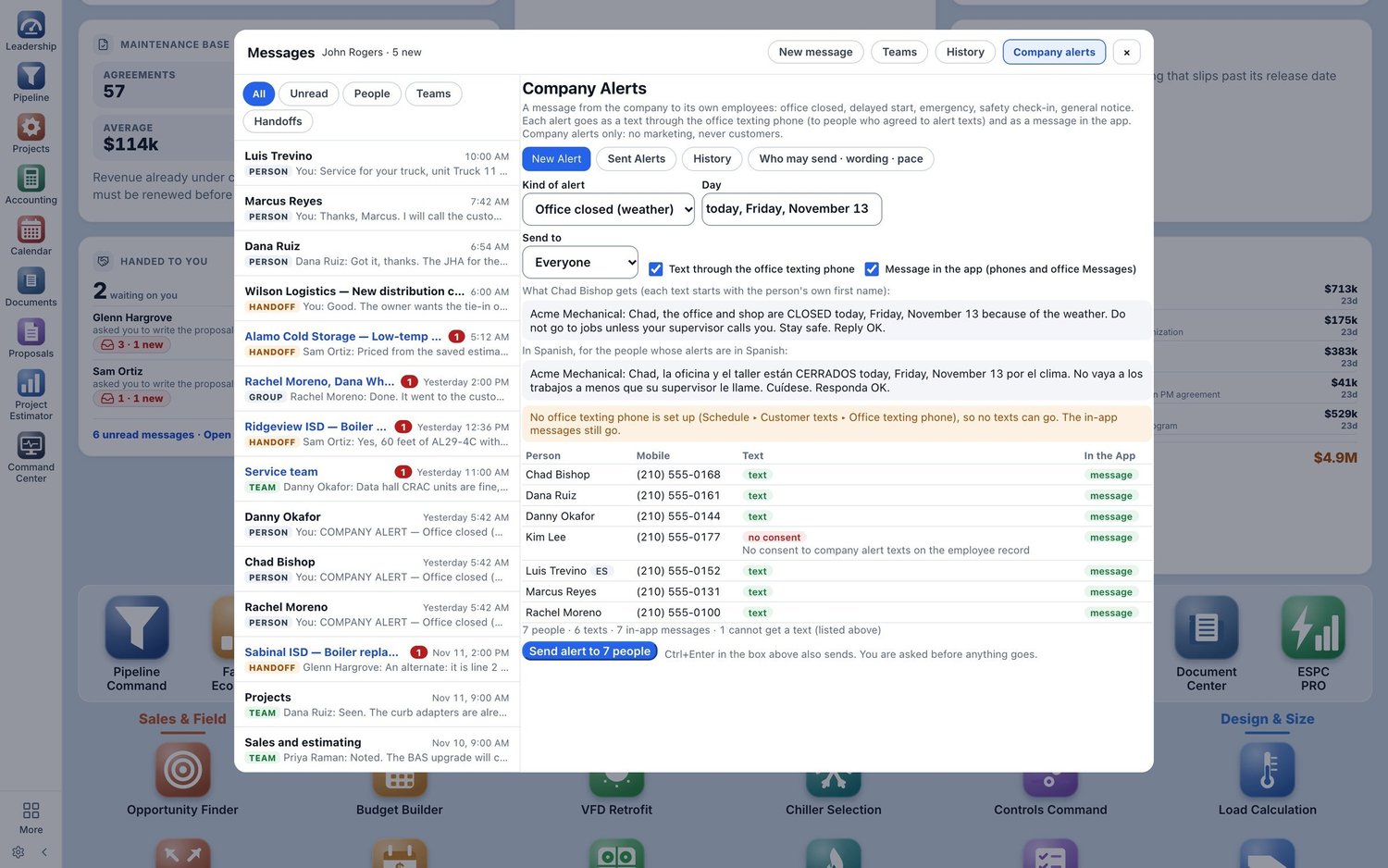
Company Alerts
- One message to everyone, the field, the office, a crew, a branch or picked people
- Technicians see it in Field Companion with one-tap OK and SAFE answers
- Only the people Leadership names may send, and every alert is kept in the history
- Alerts go only to your own employees, never to a customer
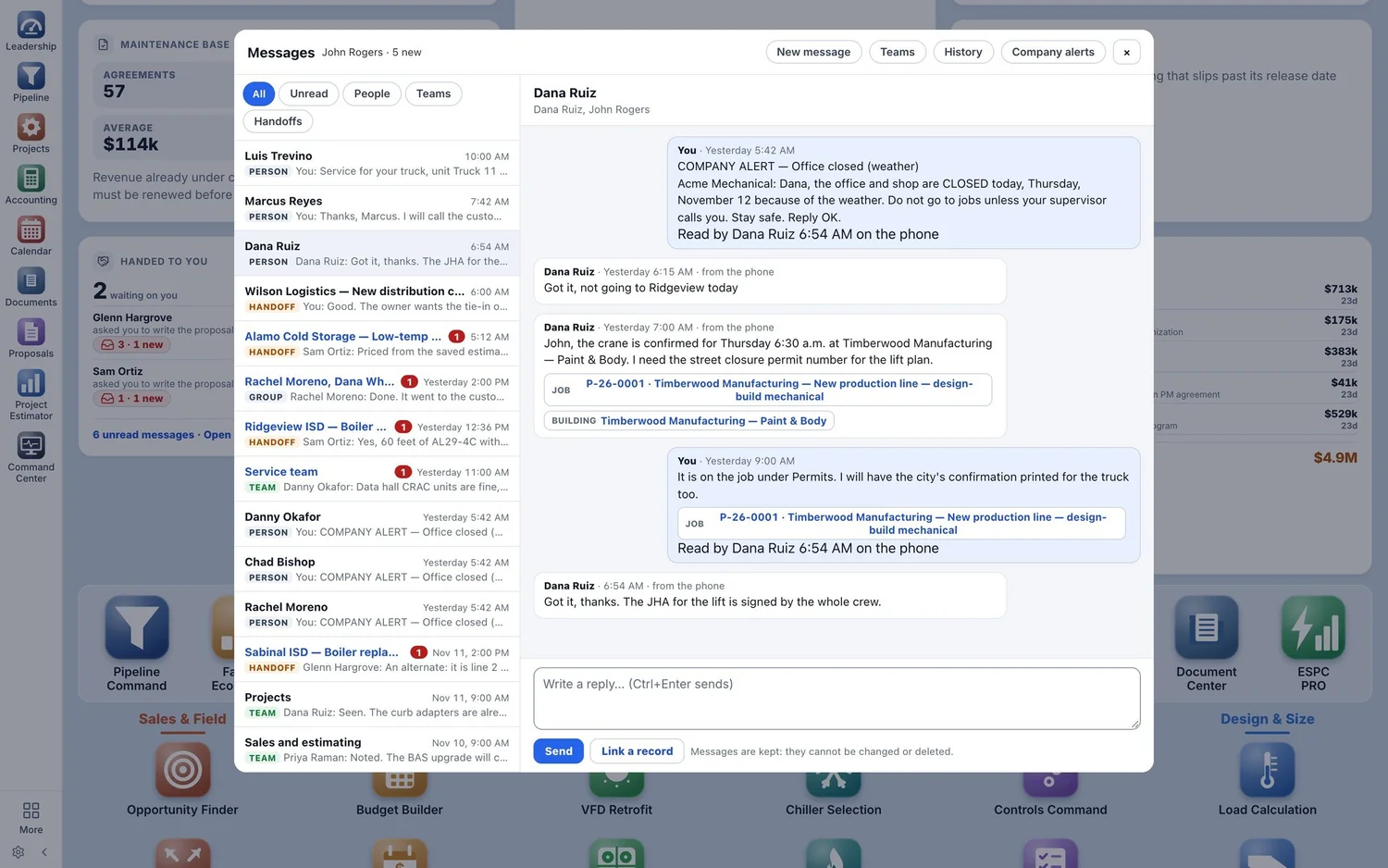
Important notices get lost in e-mail, so company alerts reach everyone inside the program.
Frequently Asked Questions
Does HVAC Logix store copies of I-9 documents?
Can our HR person work without access to change pay?
Who can see a performance review?
Are injury counts used to score or rank employees?
What happens to a departing salesperson's accounts and commission?
Be First When HVAC Logix Opens
Stop paying people to copy numbers between programs. Join the list and we will tell you the day downloads open, with setup guides ready.
Launching early 2027 for HVAC Logix. Nothing to buy today, and no sales calls.
