

Most mechanical contractors perform more than one trade. HVAC Logix carries the trade on the estimate, the work order, the labor rate, the cost code, the timecard and the phone, so plumbing, electrical, sheet metal, piping, refrigeration, controls and fire protection work runs through the same system as HVAC. It also ships tools built for individual trades. This page lists what exists for each trade and says plainly where coverage is lighter.
The Trades Behind Every Building
A mechanical contractor rarely does only mechanical work. These are the trades HVAC Logix carries on the same customer, the same building and the same job, with lighter coverage stated plainly further down the page.











One Platform for Every Trade You Perform
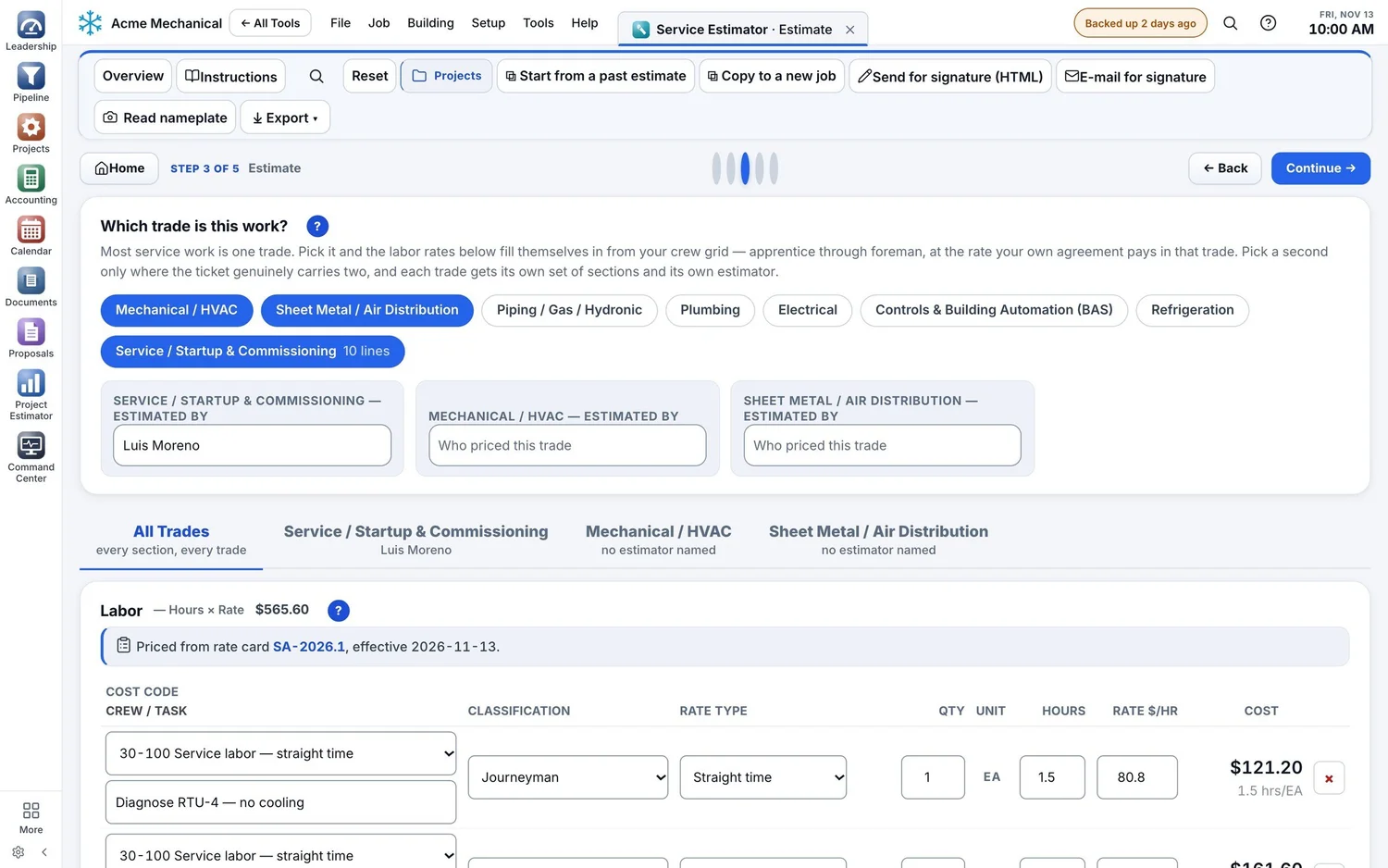
The trade is a field on the record, not a separate program. Here is how each part of the company handles more than one trade.
Declare Your Trades Once
In the Company Profile, mark each of fourteen trades In-House, Subcontract Partner or Not Offered, with the license or certification on file: mechanical and HVAC, sheet metal, piping and gas, plumbing, electrical, controls, refrigeration, service and start-up, water treatment, generators, fire protection and life safety, test and balance, security and low-voltage, and building envelope. Estimates, the manpower forecast, the phone app, the add-on services and the customer survey read that one setting, and no tool is ever hidden because of it.
Learn MoreShow Less
Bidding labor you will actually subcontract, or forecasting crews you do not employ, distorts both price and hiring. One setting tells every tool which hours are your own.
- Only In-House trades load as your crews' hours in the manpower forecast.
- A Subcontract Partner trade is carried as dollars, a cost pass-through, never as your hours.
- Not Offered is the default and hides the trade from the forecast.
- The setting is company-wide and travels in your backup.
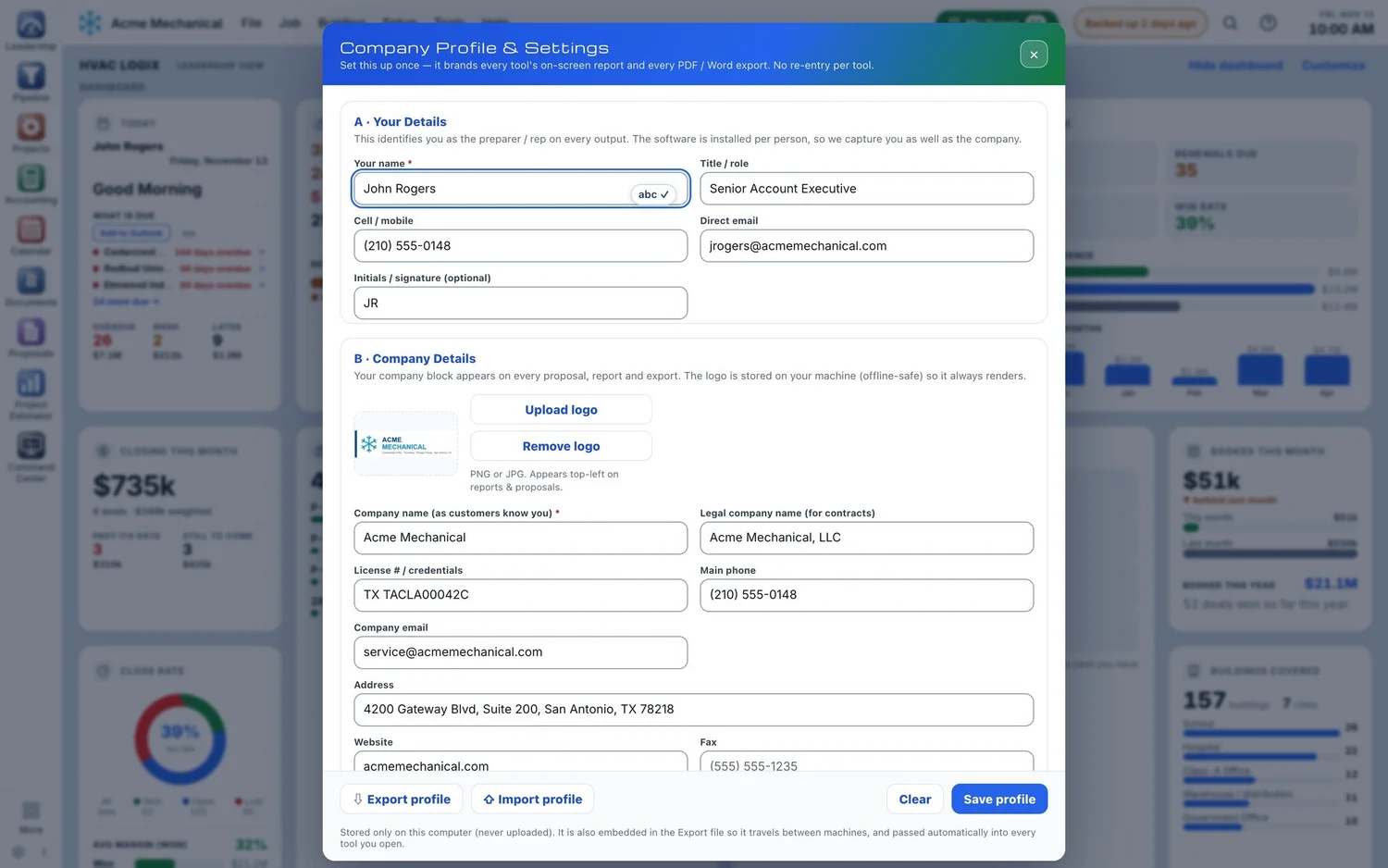
Every screen should know what you do, so your trades are declared once in the company profile.
Sales and CRM
An opportunity can be typed as adjacent-trade work, and every opportunity carries a Labor by Trade tab with the hours behind the dollars. Opportunity Finder reads your trade capability, and the customer survey asks only about the trades you perform in-house.
Learn MoreEstimating and Takeoff
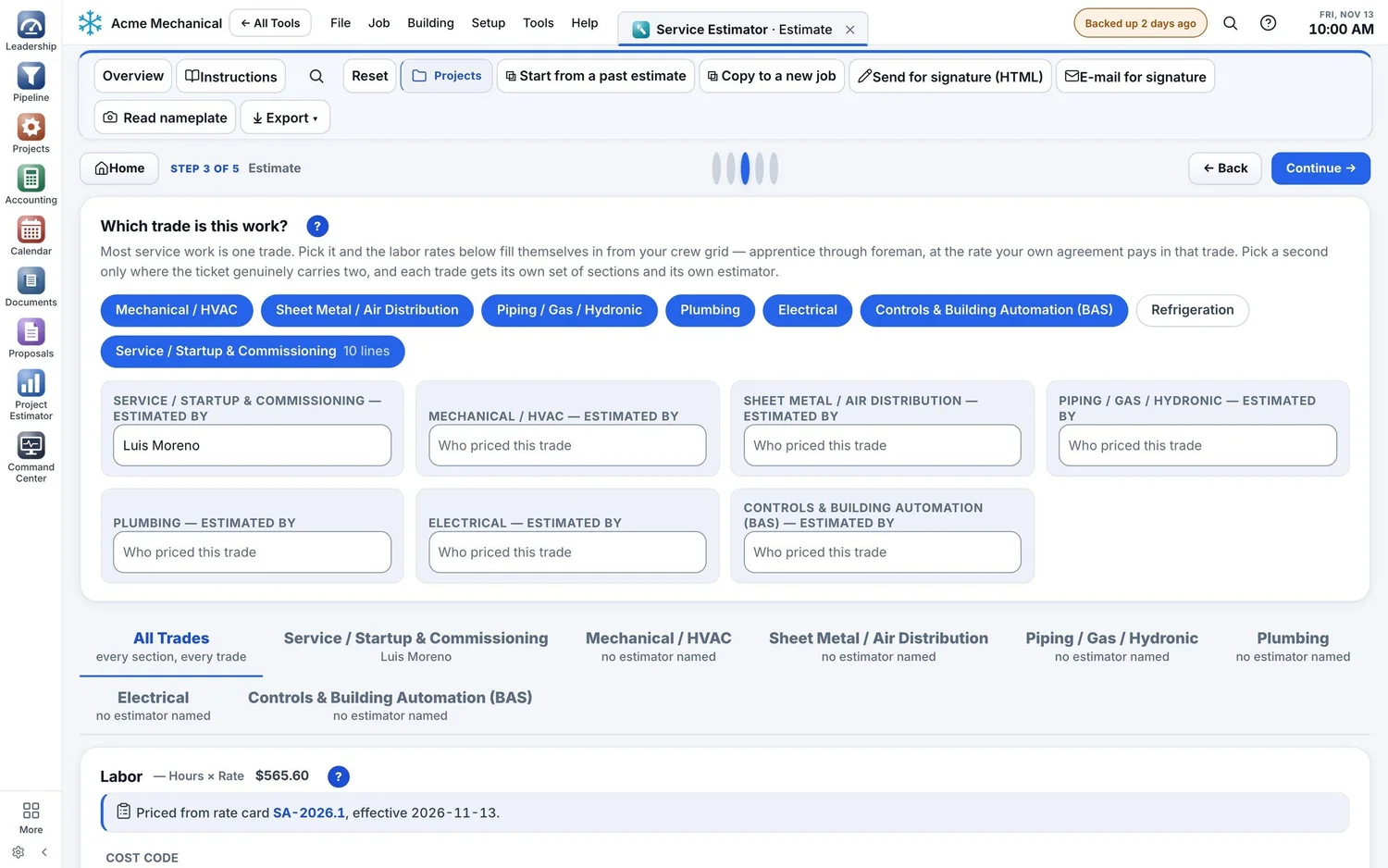
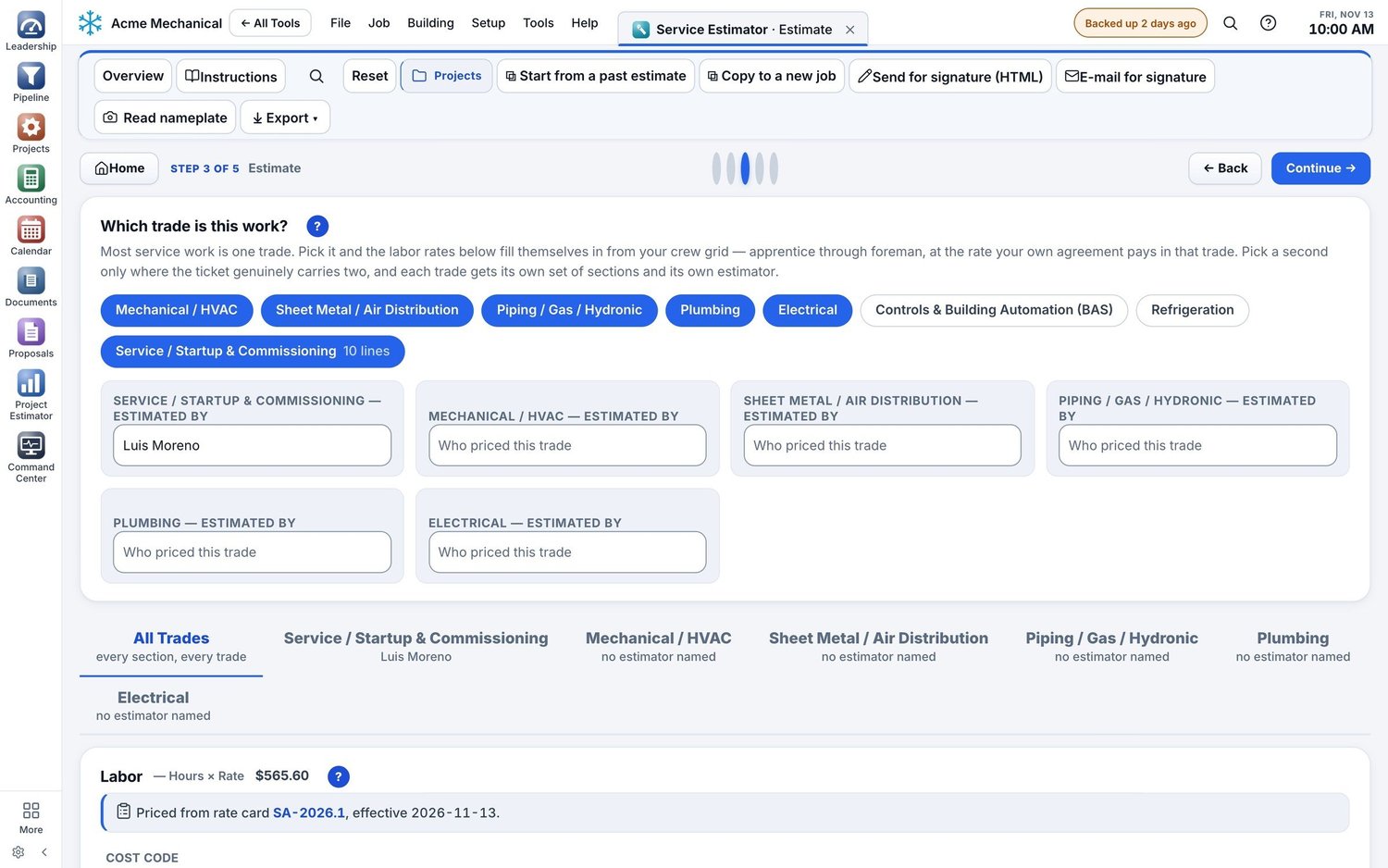
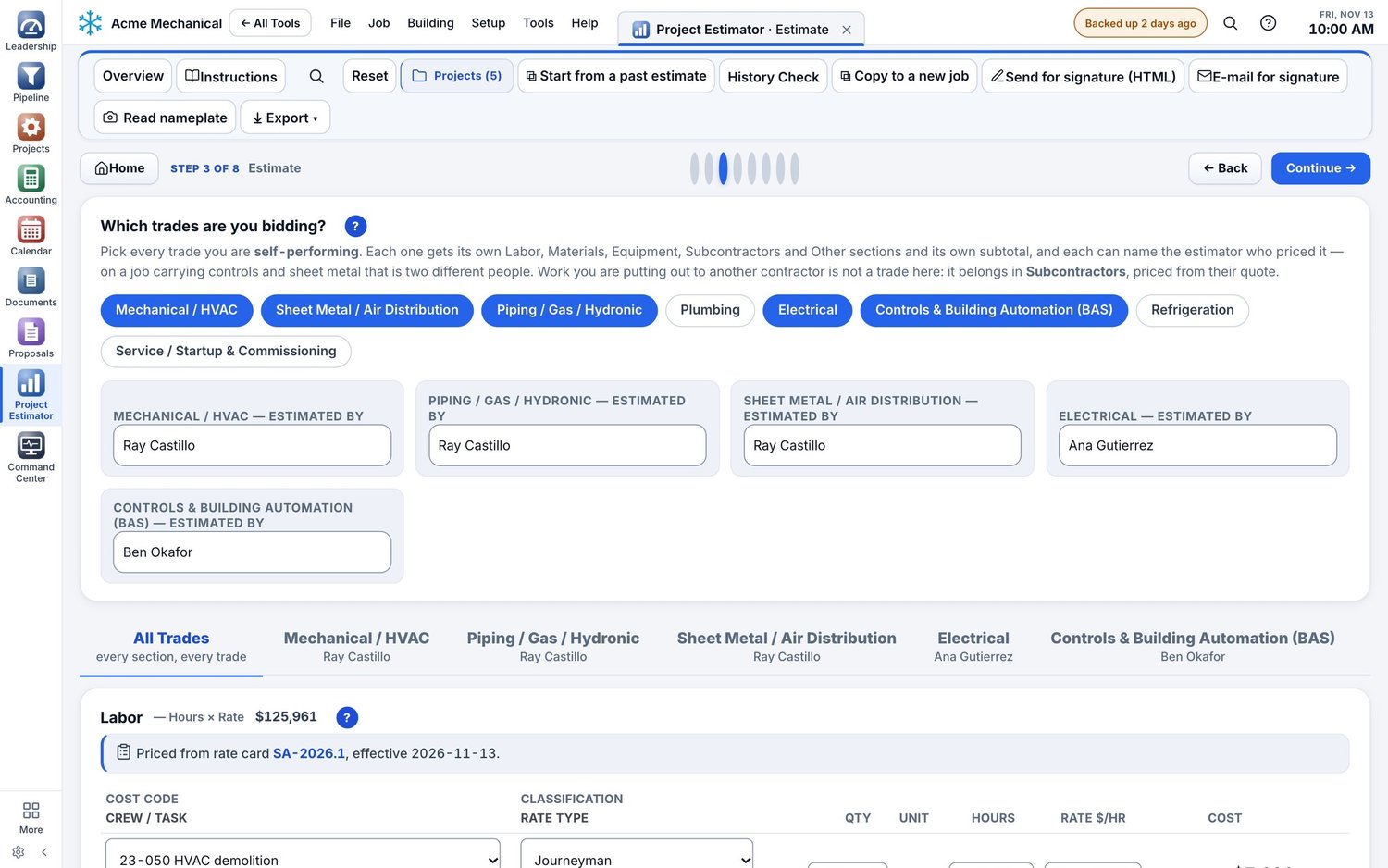
Each self-performed trade you are bidding gets its own Labor, Materials, Equipment, Subcontractors and Other sections, with its own subtotal and its own estimator named against it. Tabs appear when you pick a second trade. Quick-start scope templates, more than 200 of them, cover all fourteen trades, on-screen takeoff lines are added to the trade you pick, and work you always put out to someone else is a subcontractor line priced from their quote.
Learn MoreLabor Rates by Trade and Classification
The Rate Card crew grid runs trade across and classification down, from first-year apprentice to foreman, with one rate where they meet. The labor rate schedule lists fourteen trades, including insulation, laborers, operating engineers and millwrights, each with its own classifications, wage, fringe and burden. It does not assume a union shop. The names ship filled in and every wage ships empty, because the rates are yours.
Learn More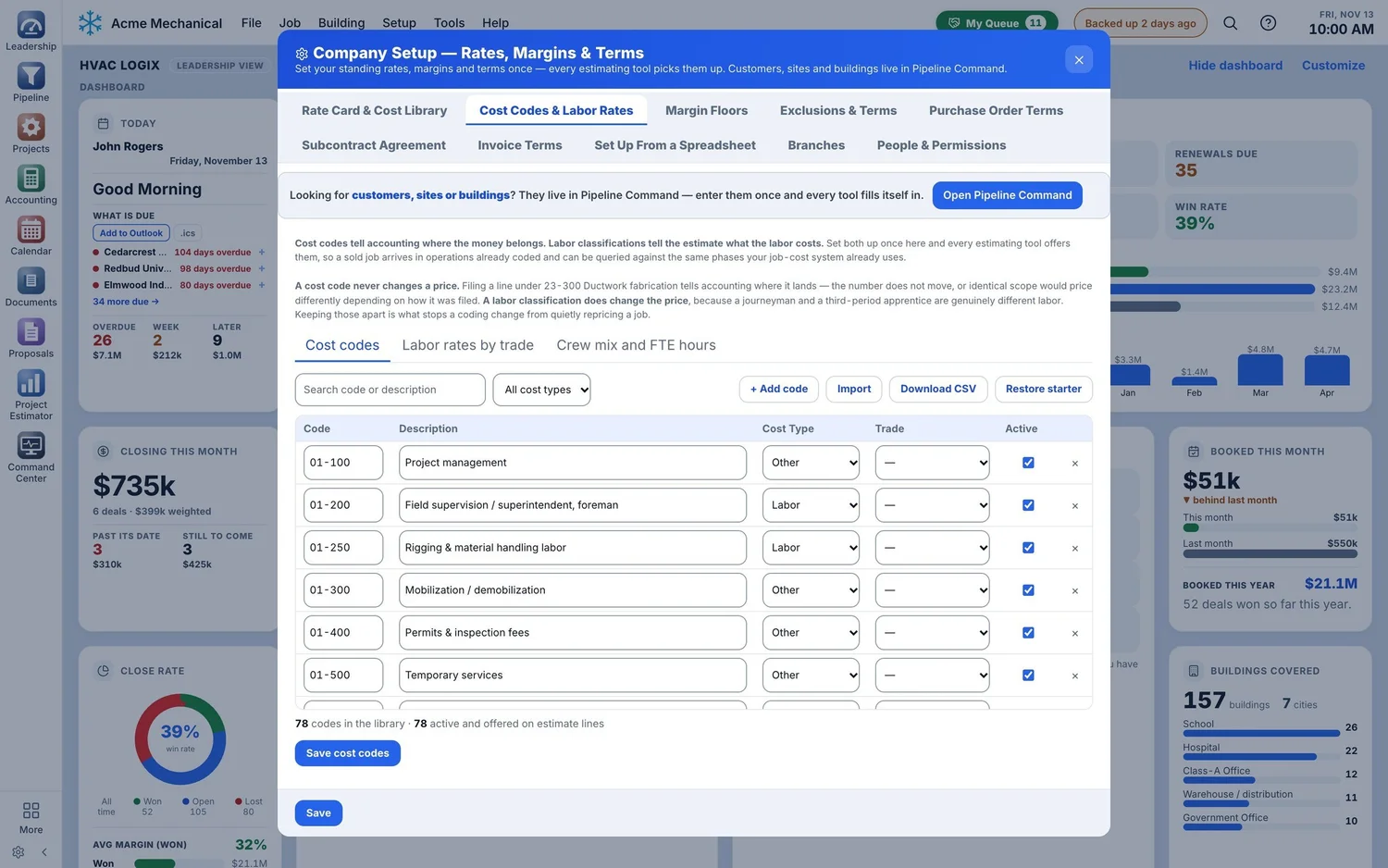
Rates kept in many places drift, so labor rates by trade and class live in one grid.
Cost Codes That Carry the Trade
The starter library of 73 cost codes is numbered on the specification divisions on your drawings: fire protection, plumbing, HVAC, controls and electrical, plus ranges for service work and equipment. Every code carries its cost type and its trade, estimate lines are coded as they are priced, and job cost reports budget against actual by the same codes.
Learn MoreService and Dispatch
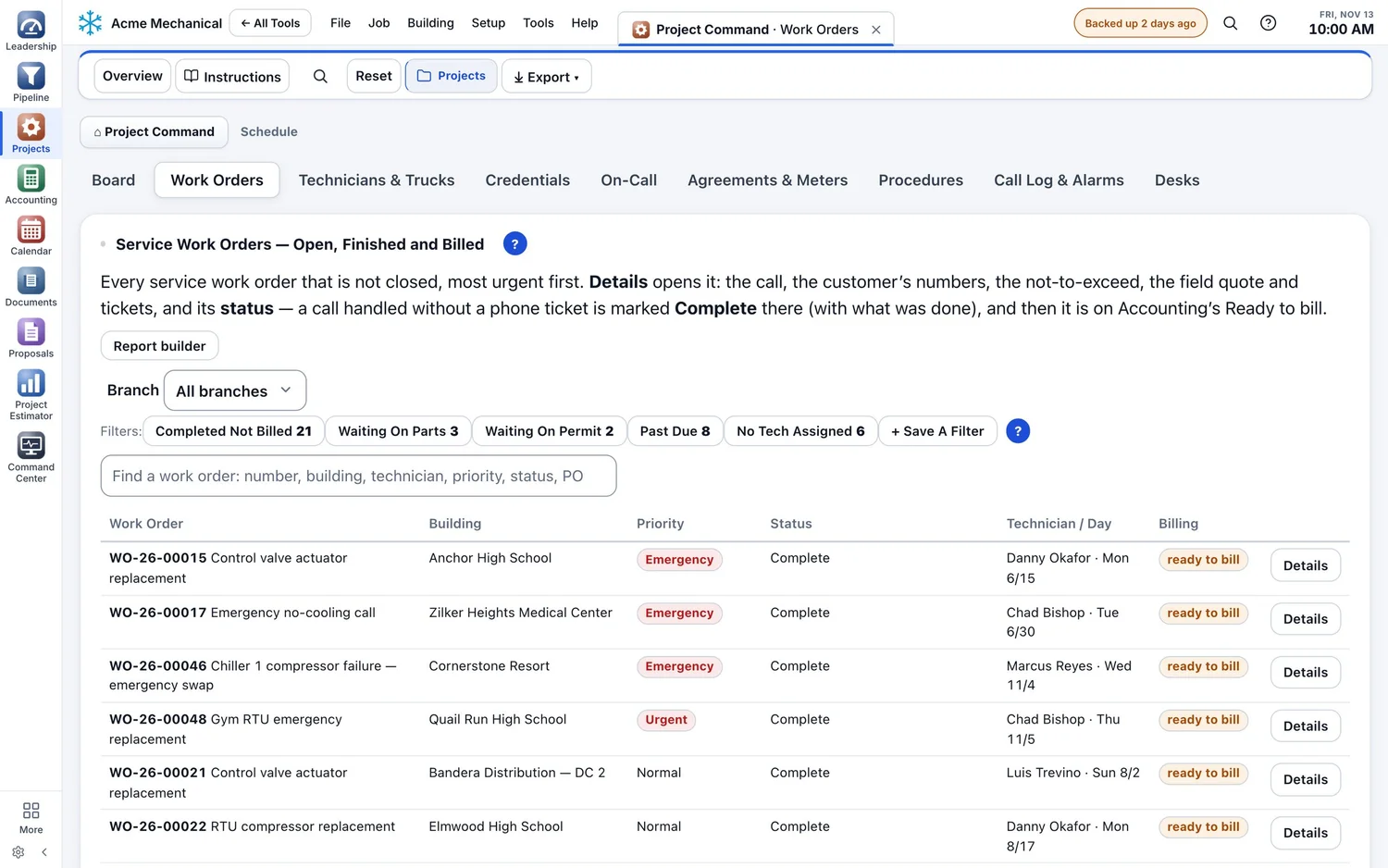
A work order names its trade from the same fourteen. Assigning it lists the technicians whose skills name that trade first, route planning sends a specialty call for refrigeration, controls, electrical, plumbing, piping or fire protection only to a technician with that skill, and the Best Tech ranking scores the same trade ahead of a related one. A monitoring alarm goes first to the on-call person whose trade and region fit it.
Learn More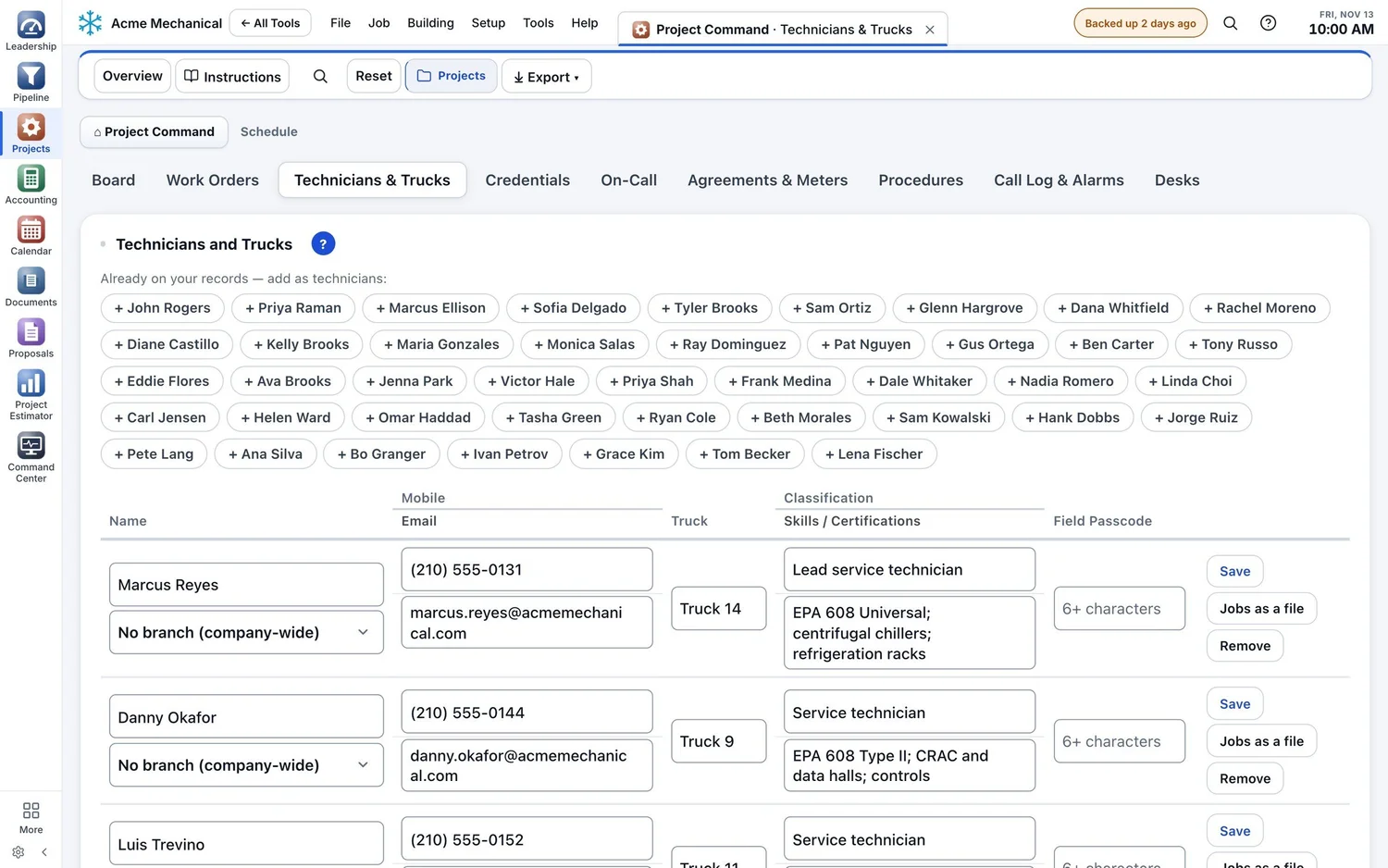
Sending the wrong trade wastes a trip, so each technician's skills and cards sit with the board.
Maintenance Agreements
The PM task library, which lists tasks only and takes its hours from you, goes past mechanical equipment to switchgear, panelboards, transformers, transfer switches, water heaters, backflow preventers, booster pumps, grease interceptors, standby generators, fire and smoke dampers, water treatment and refrigeration. The procedures library ships 91 step-by-step procedures for 55 equipment types across HVAC, plumbing, electrical, fire and life safety and envelope.
Learn More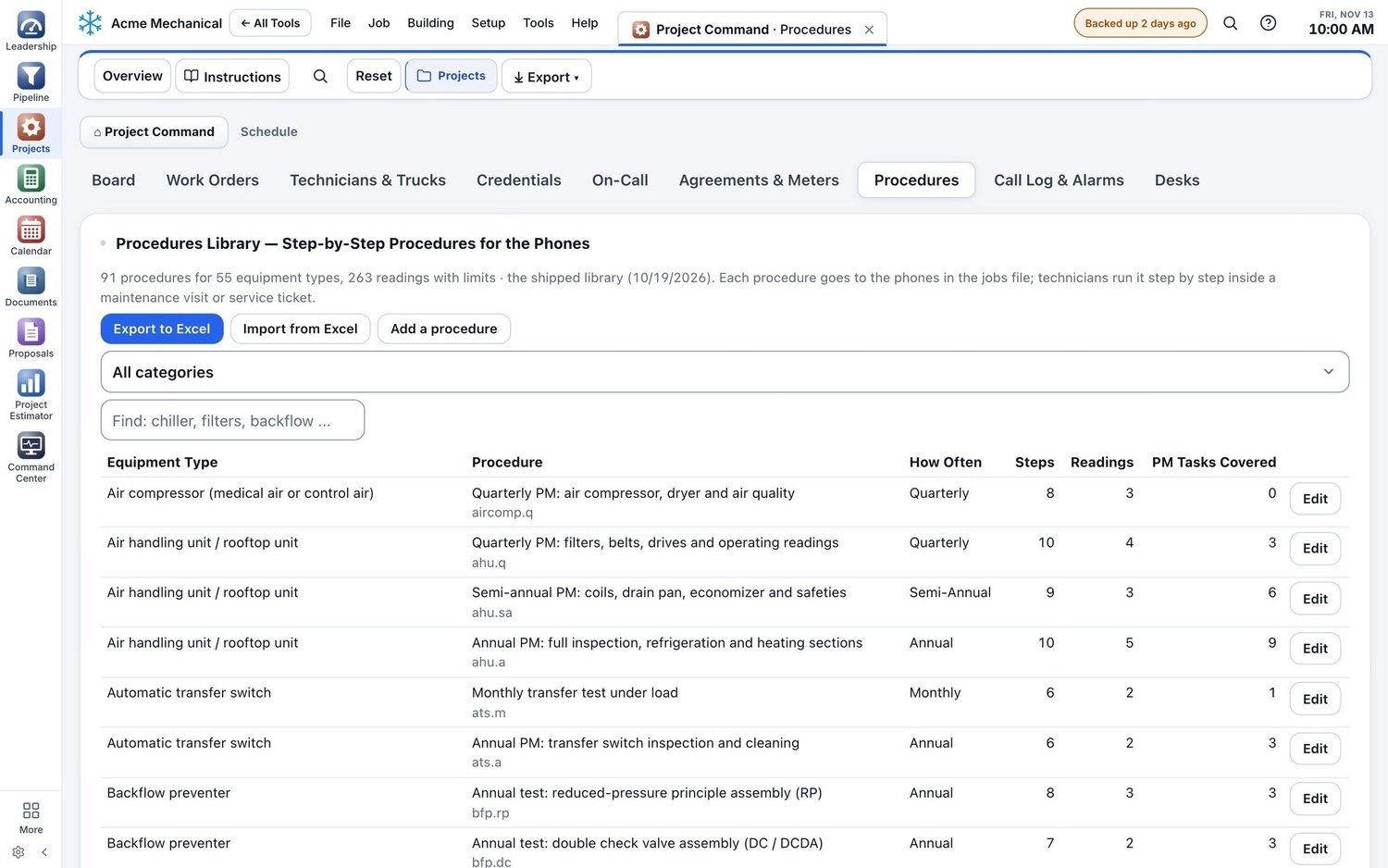
Maintenance goes past HVAC, so the task library covers electrical and other trades.
Projects and Manpower
Backlog and Manpower totals the hours you have sold by trade, for the trades you perform in-house, month by month, and splits each trade into its classifications. On a job, Manpower by Week plans the crew by trade, the daily log records the other trades on site, and subcontractor scorecards rank each subcontractor within its trade.
Learn More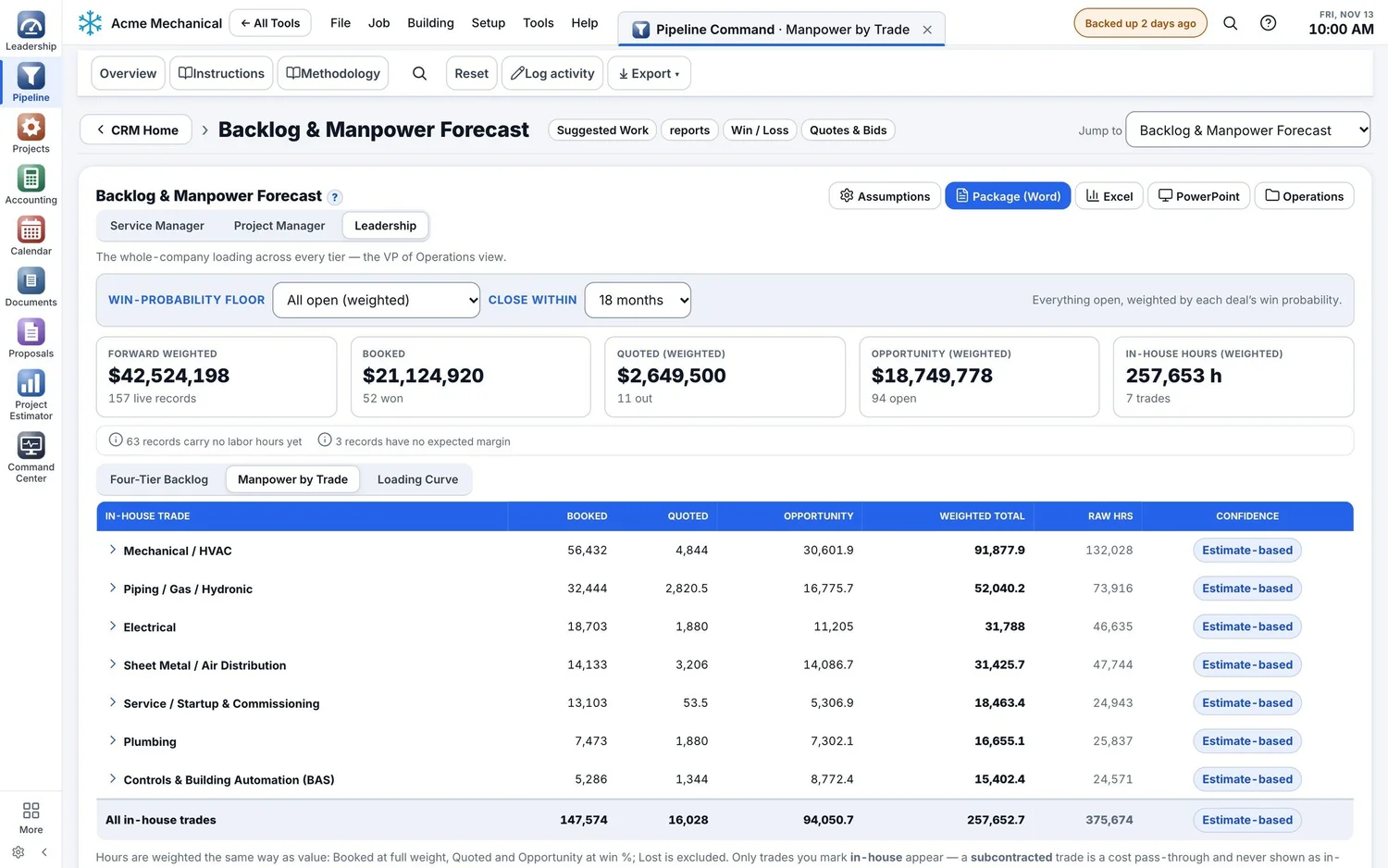
Hiring late loses work, so sold hours are shown by trade month by month.
Payroll, Union and Certified Payroll
Each employee record carries a trade and a classification, and each timecard line keeps its class and trade. Union payroll is set up local by local, each with its trade and its agreement. Certified payroll uses the classification on public work, and apprentice hours are counted by work process.
Learn More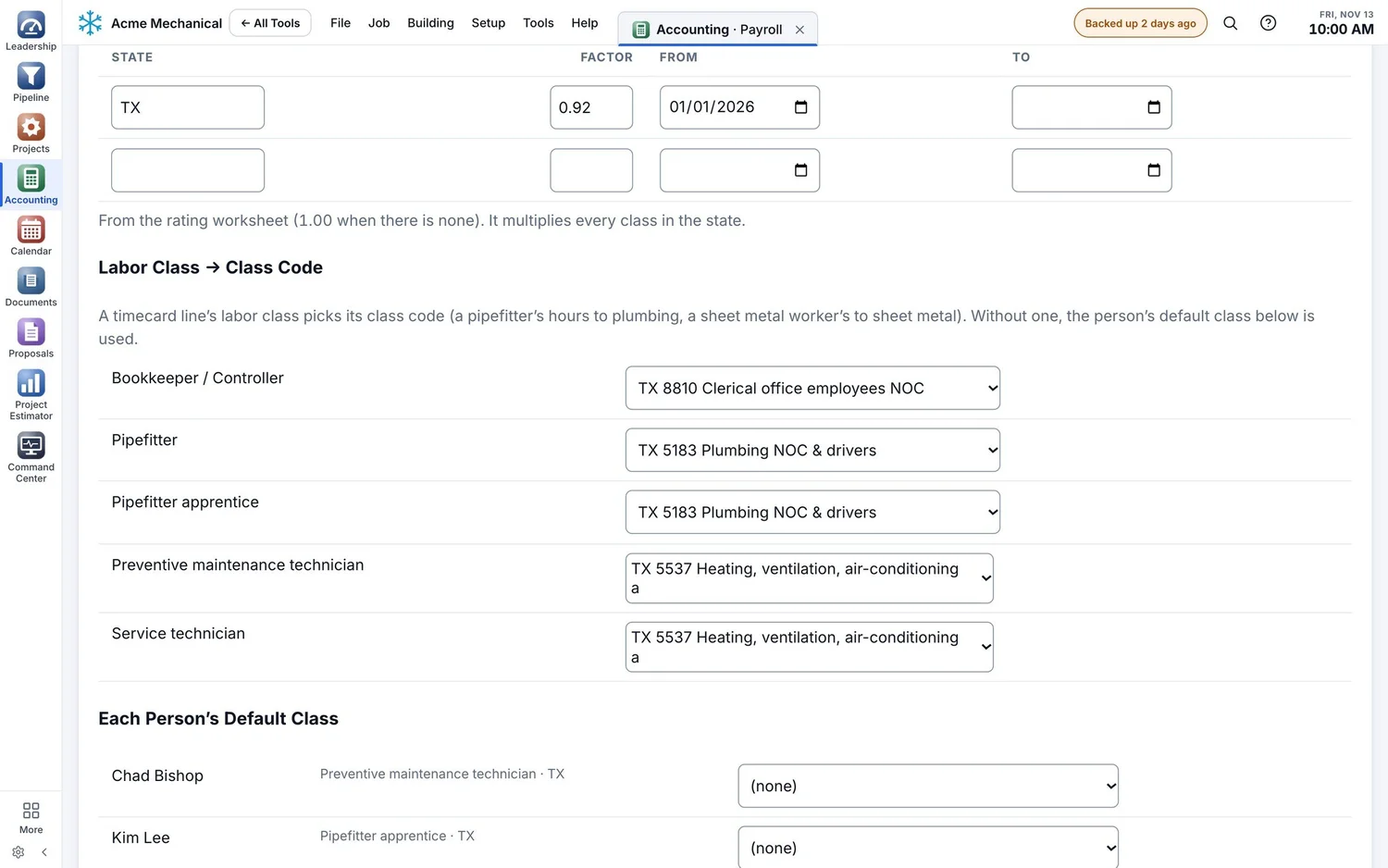
Each trade pays by its own class, so every person carries a class and class code.
The Phone App
Field Companion shows the equipment types, readings and checklists of the trades you mark In-House: voltage and insulation resistance for electrical, backflow check-valve readings for plumbing, box temperature for refrigeration, conductivity and pH for water treatment. Pipefitters, sheet metal workers, electricians, plumbers and their foremen get drawings, field questions, QC checklists and crew time on the same phone.
Learn More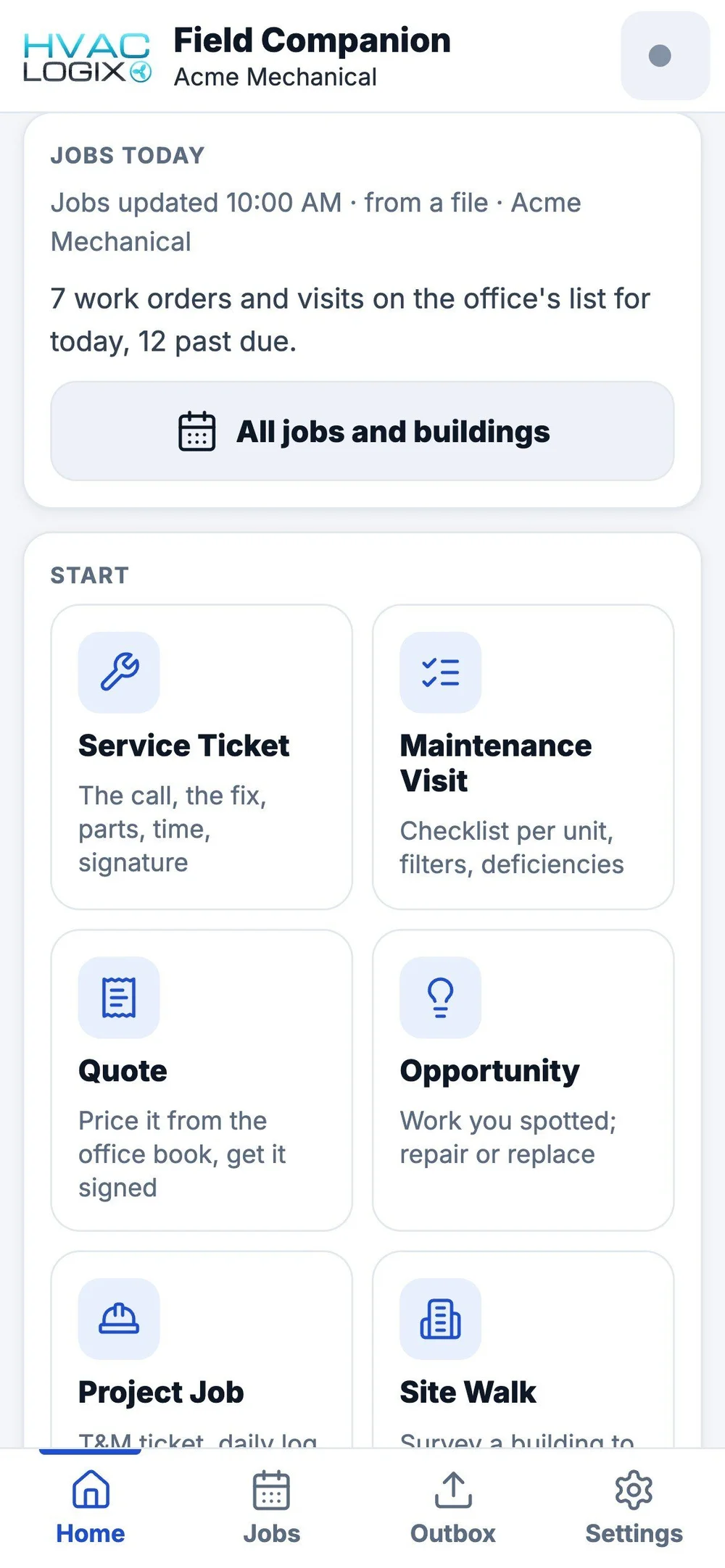
The phone should show only your trades' forms, so each technician sees the right start list.
Purchasing, Accounting and Leadership
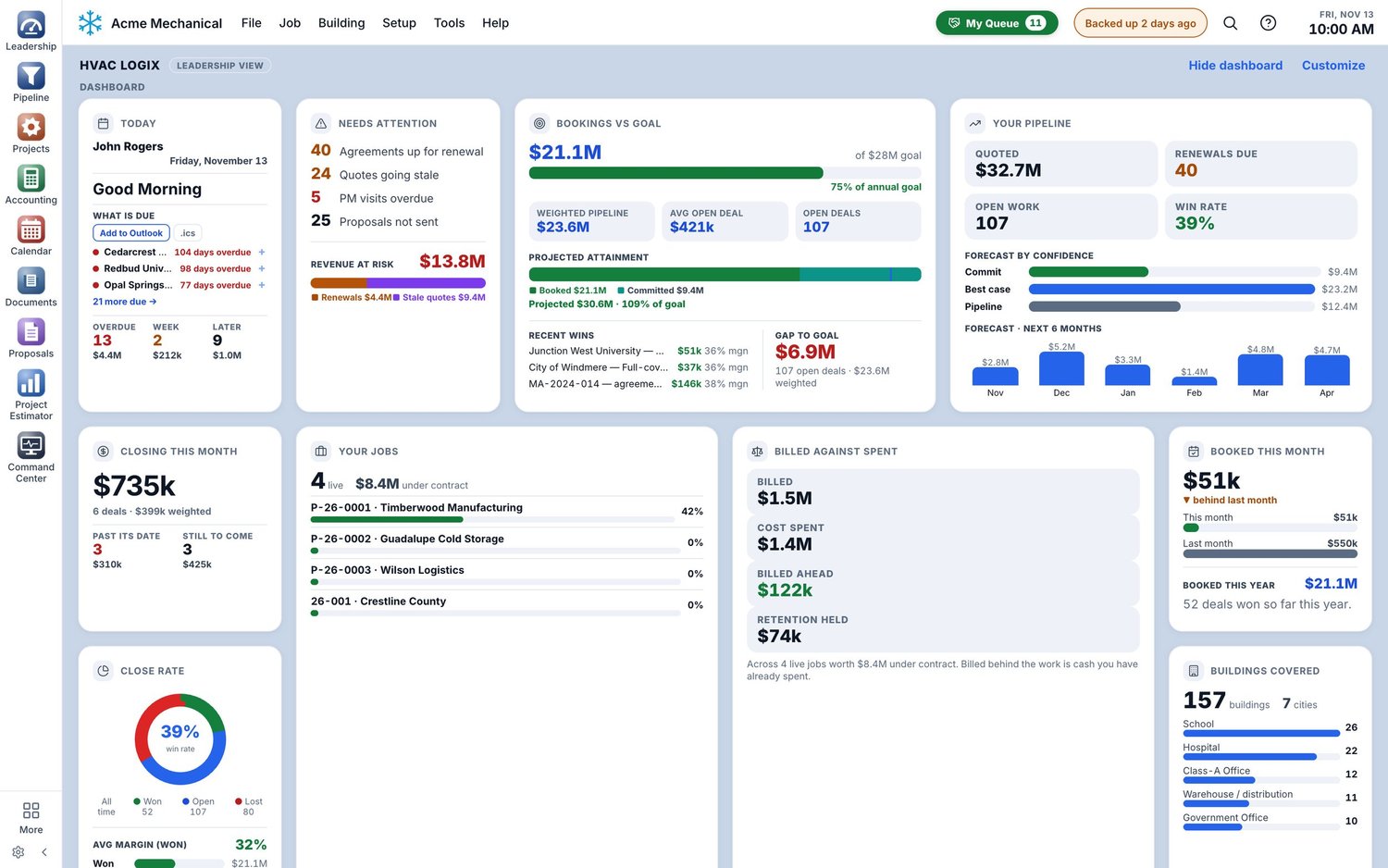
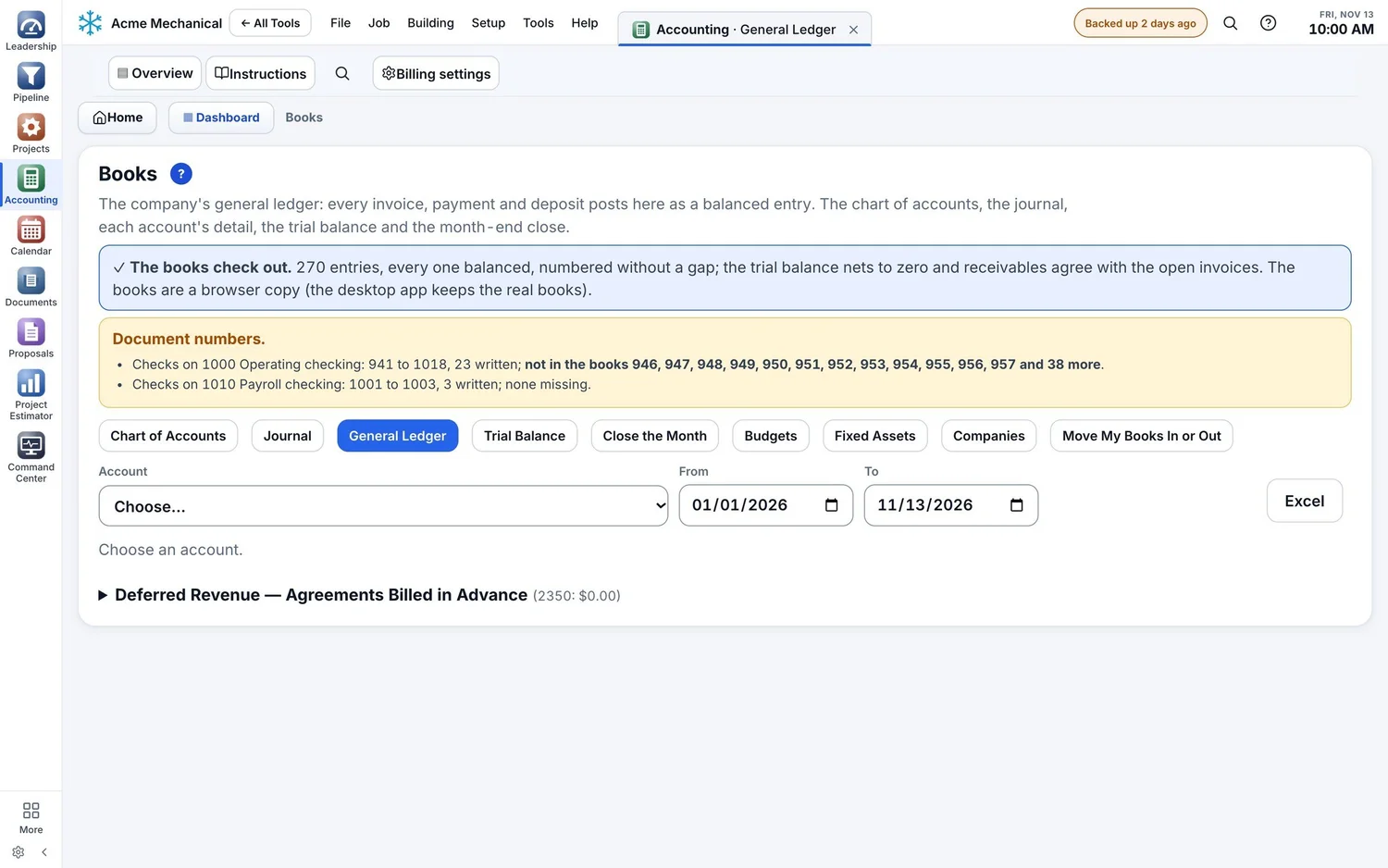
Purchase orders, truck stock, invoices, job cost and the general ledger are one set of records, whichever trade did the work. Leadership reads the whole company from one place, with the trade and the cost code already on the record.
Learn MoreShow Less
When each trade keeps its own books, nobody can say which one makes money. One set of records shows profit by job, branch and trade without a spreadsheet.
- Profit and loss by branch, with the total checked to the cent.
- Company overhead can be shared out over branches by revenue, in exact cents.
- A month-end CPA pack holds the P&L, balance sheet, aging, bank reconciliations and WIP.
- The pack's cover lists anything needing attention, such as an unreconciled bank account.
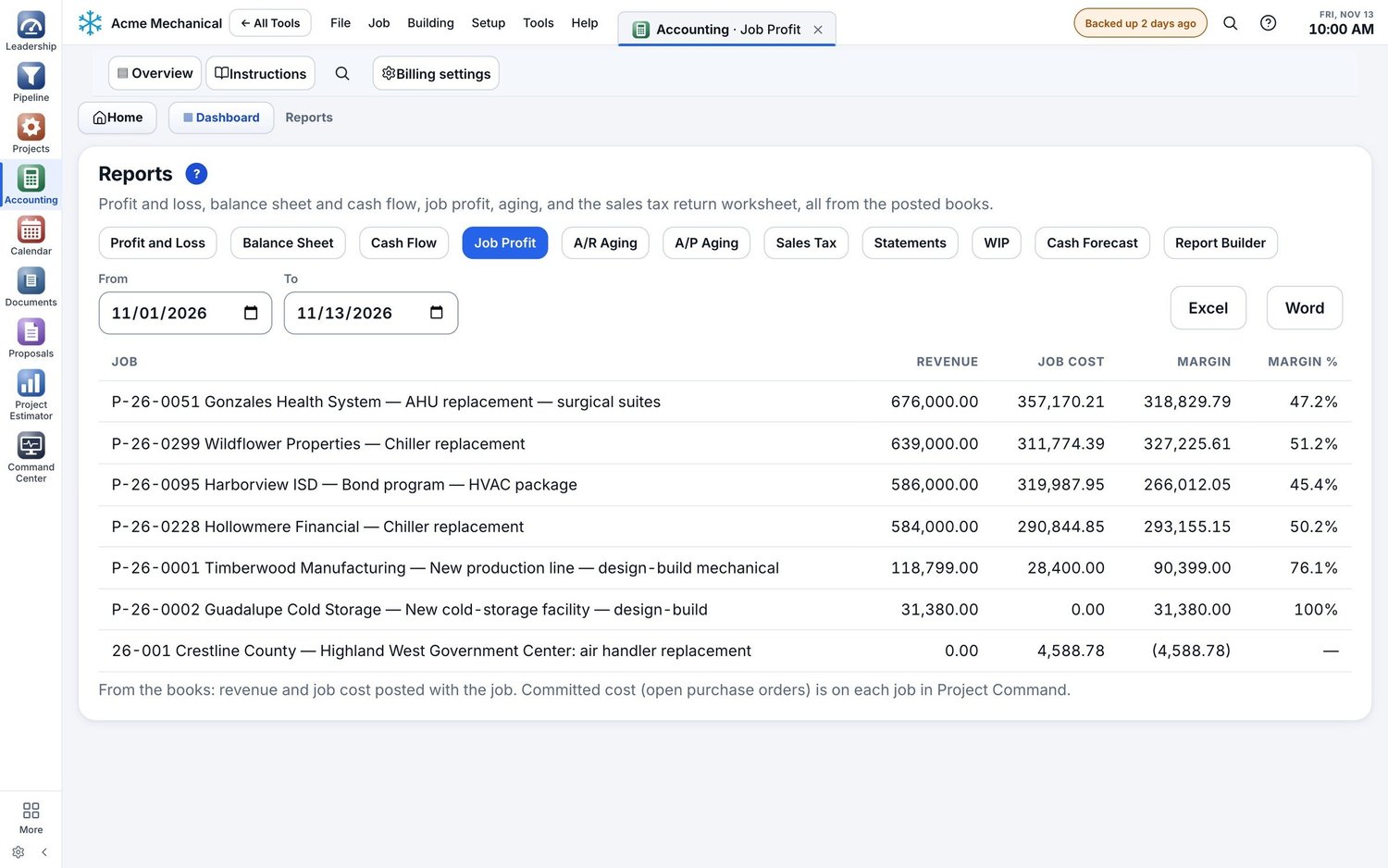
One set of books keeps every trade honest, so job profit comes from the same records.
Trade-Specific Apps and Tools
Everything below is built into the program. The sizing and pricing tools are planning-grade: they give a fast, defensible number, and every report says that the adopted code, the manufacturer and the authority having jurisdiction govern.
Mechanical and HVAC
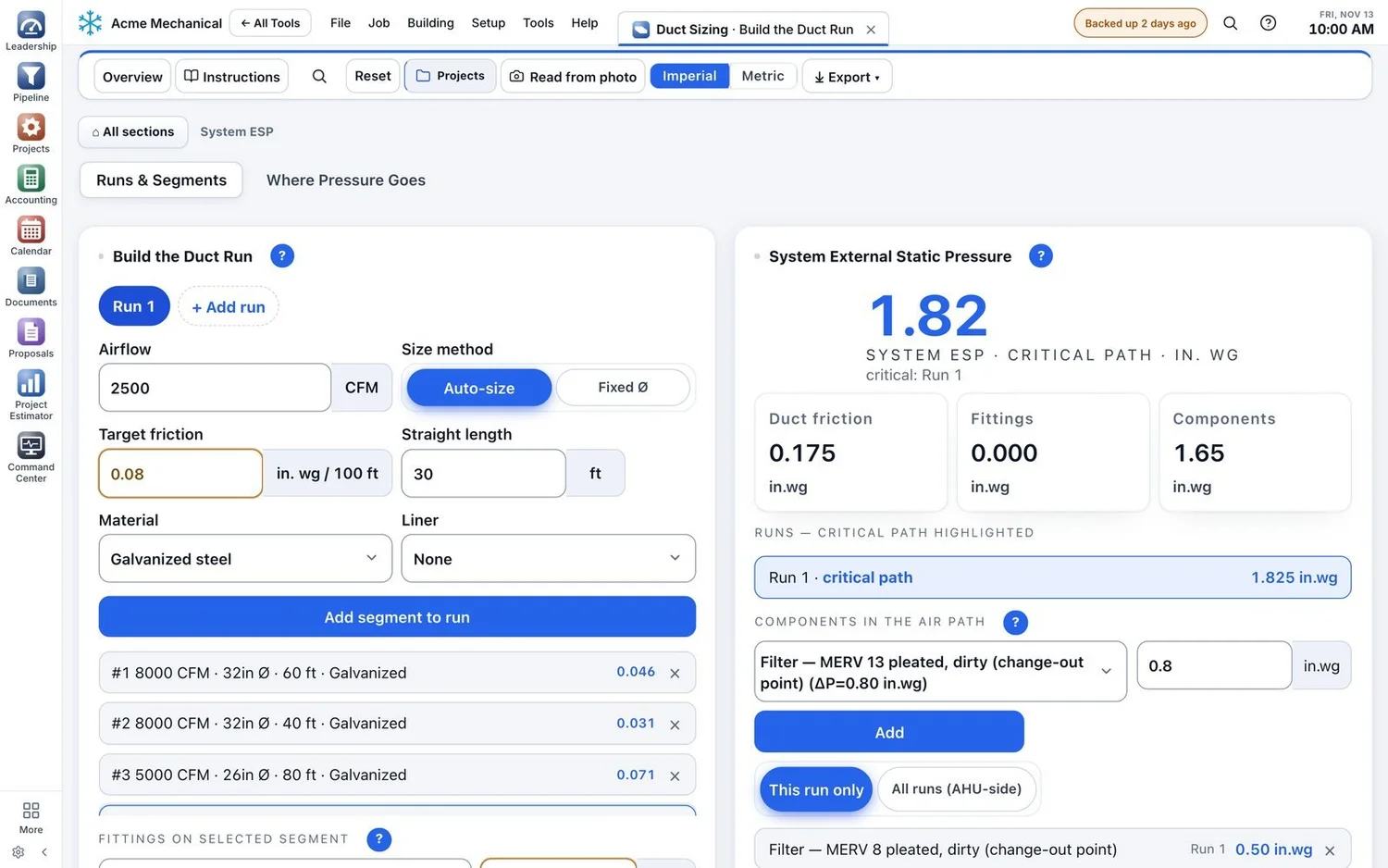
- Load Calculation, Duct Sizing, Hydronic Piping, Chiller Selection, Packaged Equipment, VRF Selector, Plant Optimizer and Quick Tools size it, select it and show the method
- The deepest tool set in the program, covered tool by tool on the Engineering Tools page
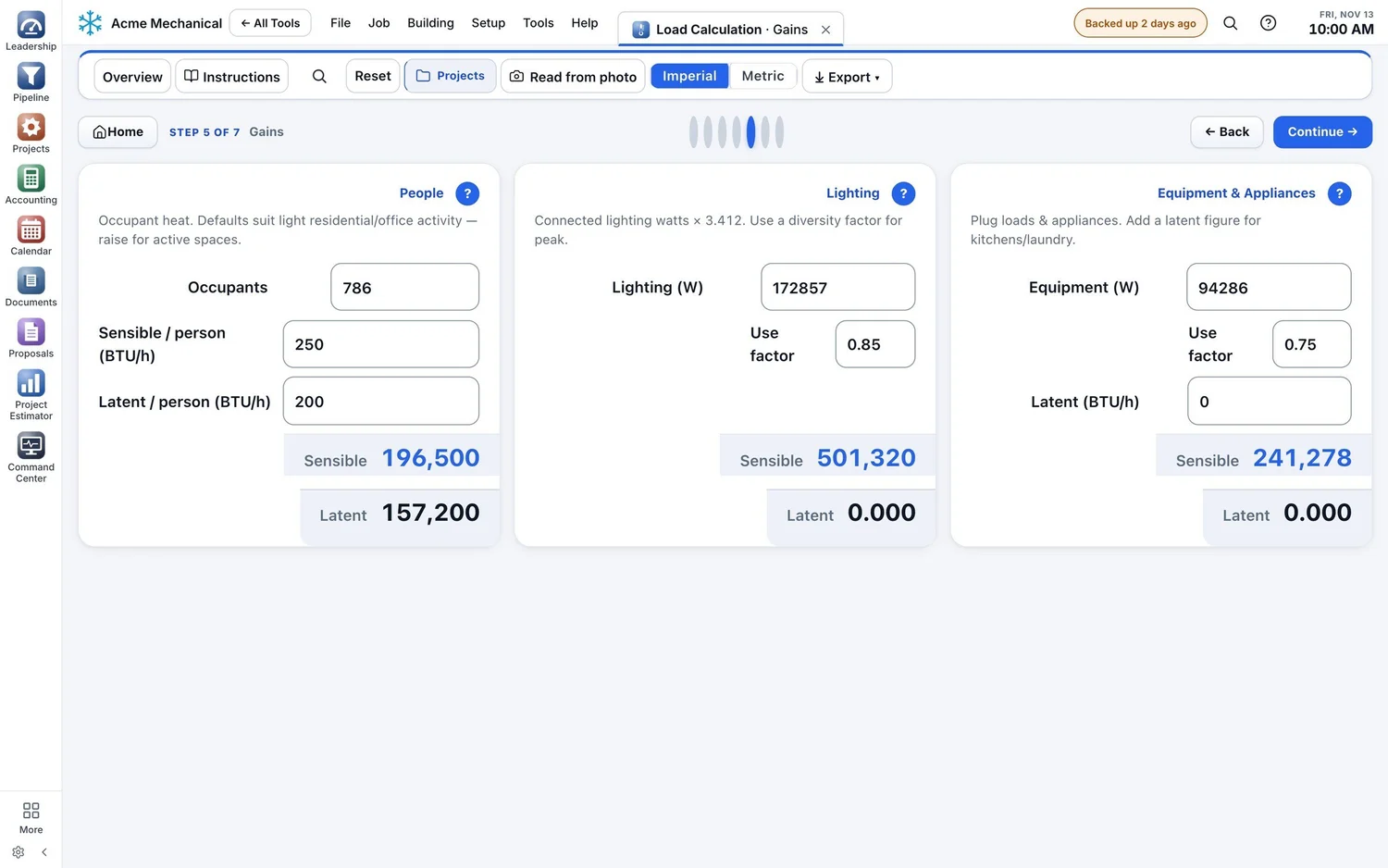
HVAC loads should come from the building, so internal gains are entered space by space.
Plumbing and Gas
- Plumbing & Gas turns a fixture schedule into fixture units, probable demand in GPM, sized water mains, drain-waste-vent at the chosen slope and a gas main by the longest-length method, with a material-and-labor number priced from your own rates and labor units
- PM tasks for water heaters, backflow preventers, booster and recirculation pumps, fixtures, grease interceptors and sump or ejector pumps
- On the phone: plumbing equipment types and readings, and a backflow test report form
- FOG records for grease interceptors: pump-outs, manifest numbers, the 25% rule and a report for the city inspector
- Twelve add-on services, from backflow testing and hydro-jetting to drain camera inspection and water heater service
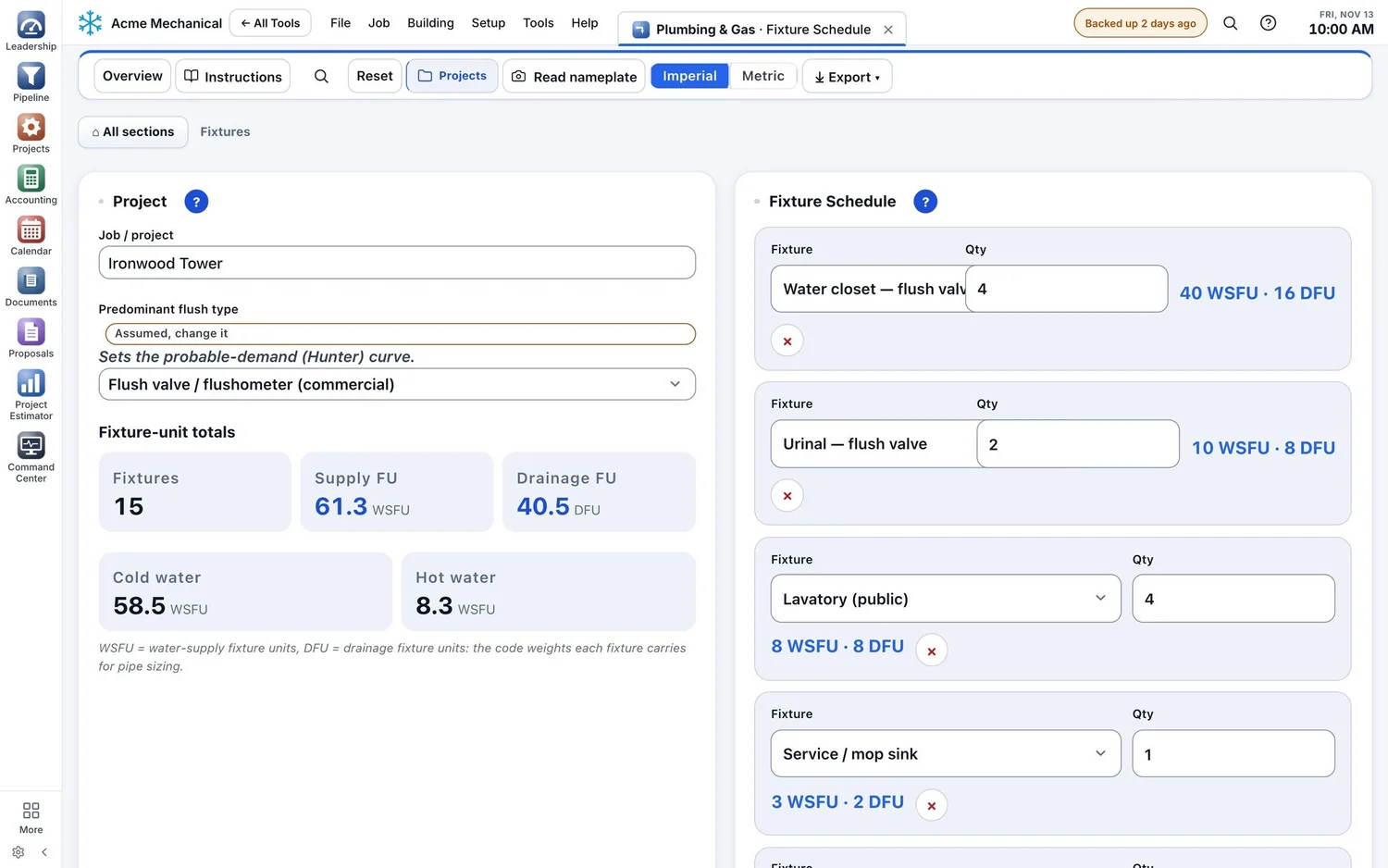
Plumbing sized by habit can starve fixtures, so fixture units become flow and pipe sizes.
Electrical
- Electrical Service turns a building's loads, plus a new heat-pump or other load, into a calculated service size in amps, sized service and feeder conductors, a keep-or-upgrade verdict and a service upgrade priced from your own rates
- Electrical calculations in Field Calculators
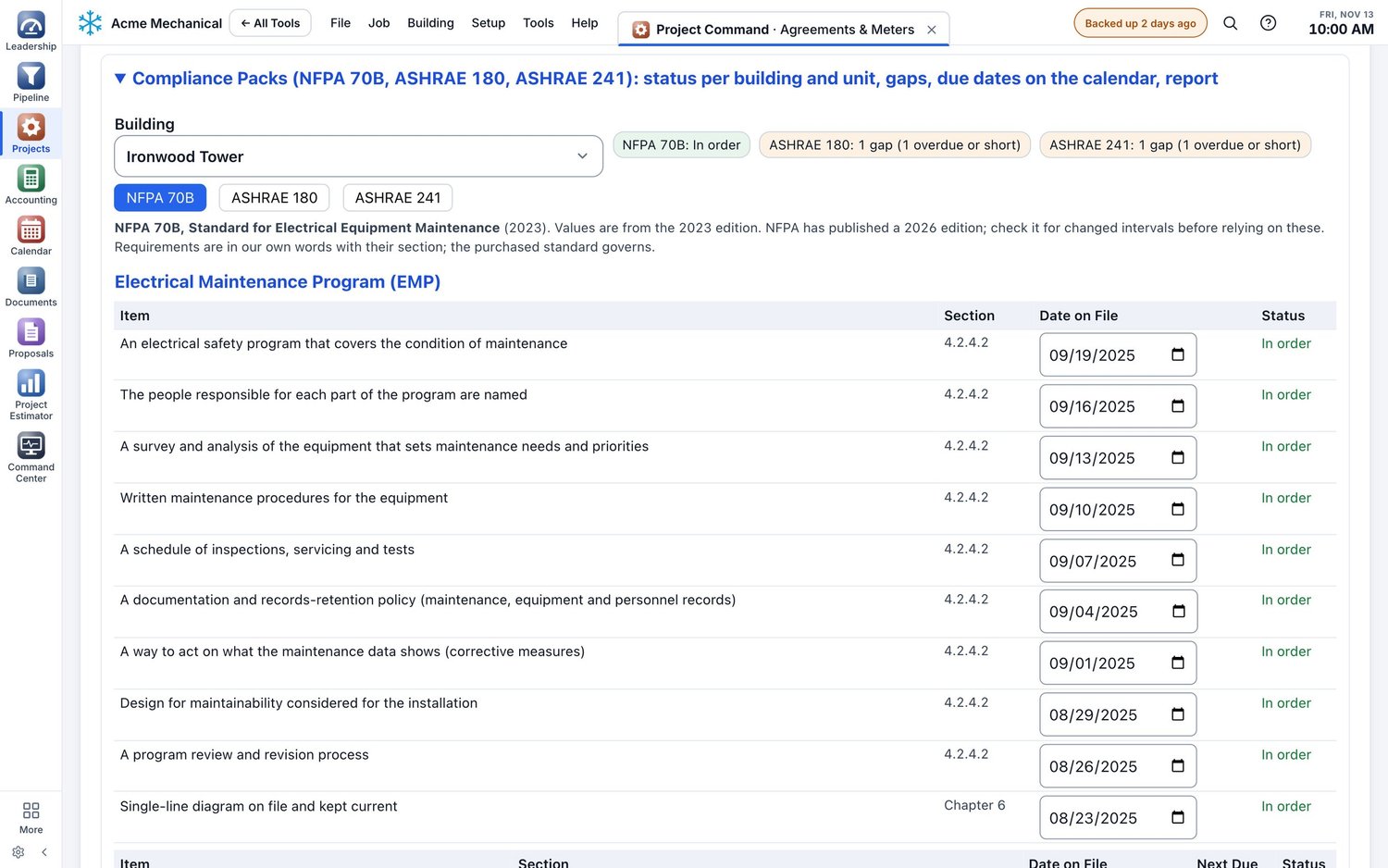
- The NFPA 70B compliance pack: the electrical maintenance program, condition assessment and task intervals for each electrical unit
- PM tasks for switchgear, panelboards, dry-type transformers, transfer switches, motors and motor control centers, drives and emergency lighting
- On the phone: voltage, amps, insulation resistance, infrared temperature rise and ground resistance readings
- Nine add-on services, including infrared scanning, connection torque, motor testing, switchgear testing and arc flash labels
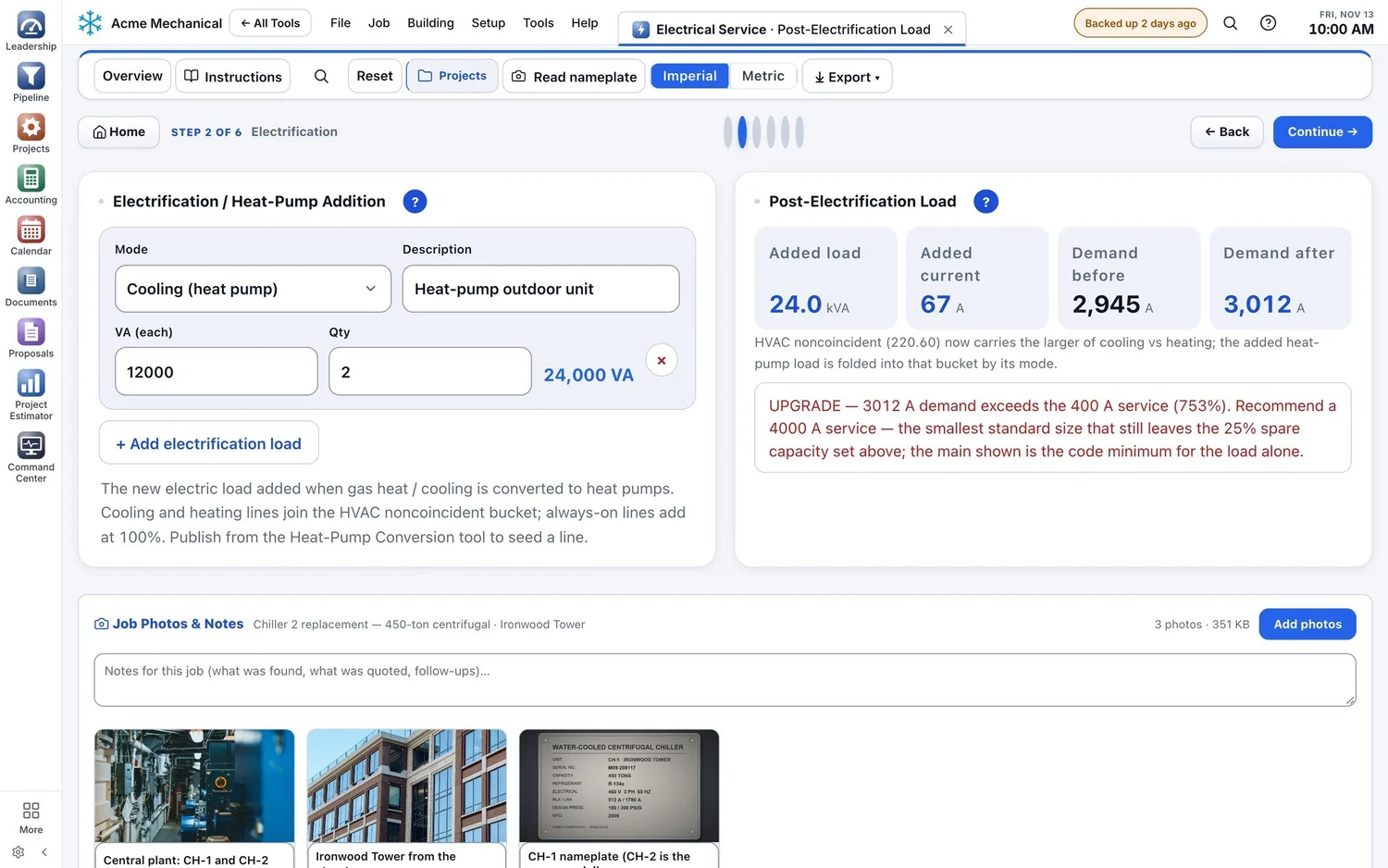
A new heat pump can overload the service, so the added load is checked first.
Sheet Metal
- Sheet Metal imports the take-off from Duct Sizing and produces a cut list, a gauge and weight takeoff by material, shop and field labor hours from your own labor units and a number priced from your own rates
- On-screen takeoff measures rectangular, round spiral and flexible duct, with rectangular duct in pounds by gauge and hangers at their spacing
- A duct leakage test QC checklist on the phone that works out pass or fail from the readings
- Prefabrication tracking for shop-built duct sections and assemblies, from detailed to installed
- Add-on services for fire and smoke damper testing, duct cleaning and dust collection inspection
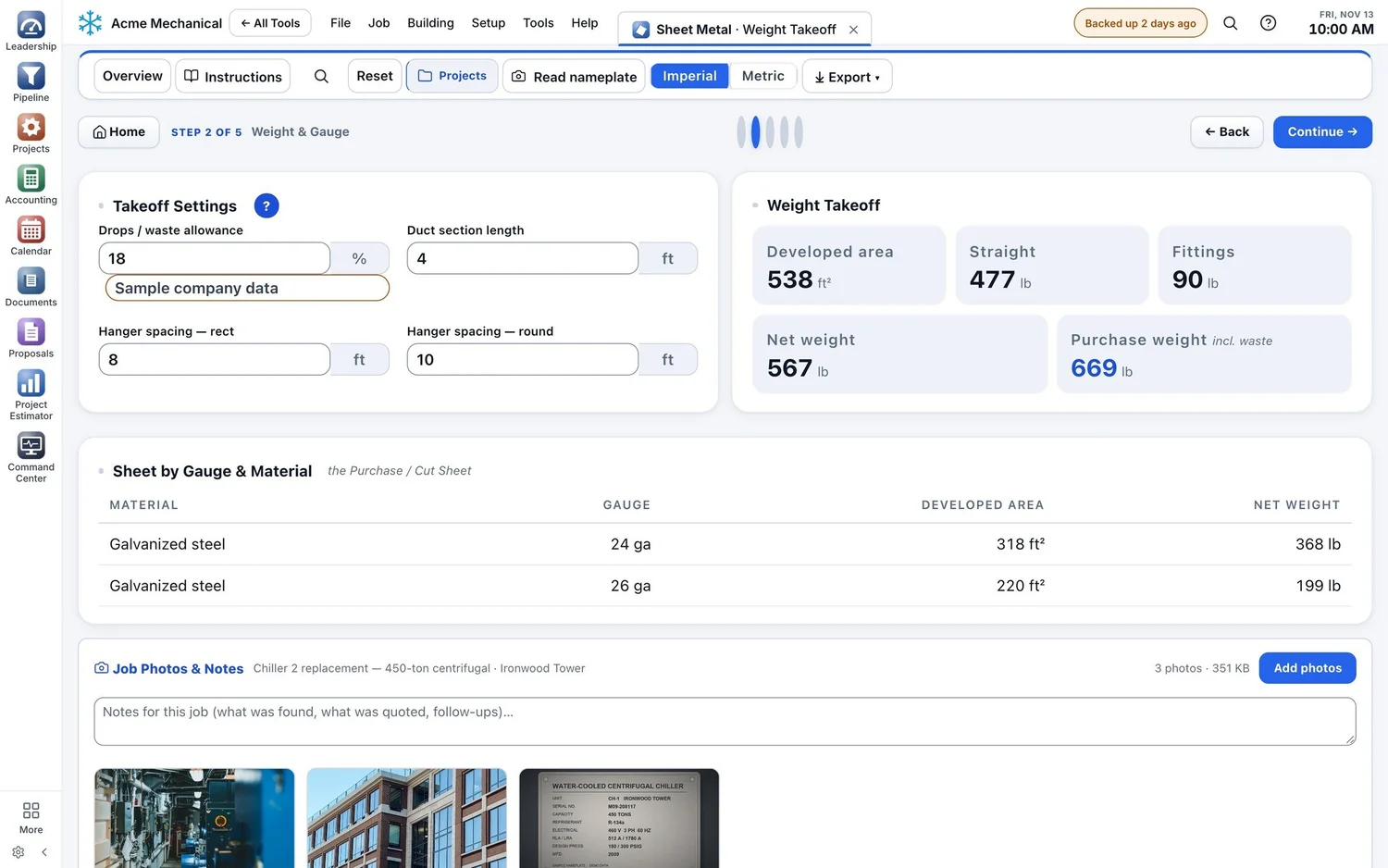
Sheet metal priced by hand misses weight, so the takeoff becomes pounds by gauge.
Piping, Hydronics and Steam
- Hydronic Piping sizes pipe, friction, pump head and expansion tanks, corrects for glycol, and has its own tabs for steam and refrigerant piping
- The labor-unit library has rows for copper, threaded and welded steel, PVC and refrigerant pipe, fittings, hangers, valves and insulation. The hours and the height and difficulty multipliers are yours to enter
- Spools tracked from the detailer's drawing through the shop to installed, with a bill of materials import
- On the phone: a piping pressure test QC checklist and a weld log and NDE form
- Add-on services for fuel-gas pressure tests, hydronic loop flushing and steam trap surveys
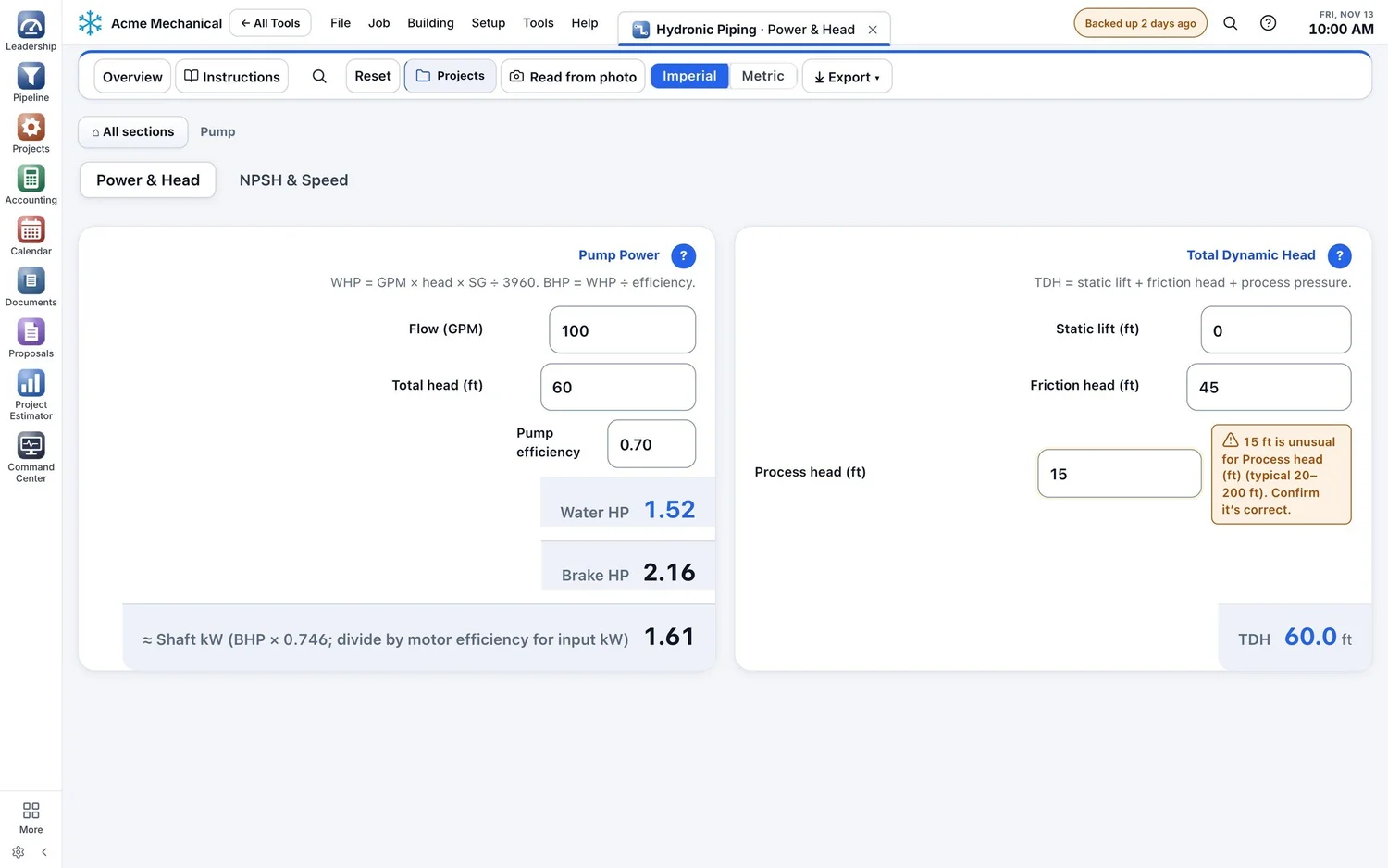
Pumps picked without the head are guesses, so total head is built from the run.
Boilers
- Boiler Plant quantifies six heating-plant savings, from combustion efficiency and failed steam traps to condensate recovery and flue-gas heat recovery, ranked by payback
- PM tasks for hot water, steam and water-tube boilers, and a boiler inspection report form on the phone
- Boiler permits, boiler inspection obligations by state where the library has them, and boiler tests on the Periodic Testing calendar
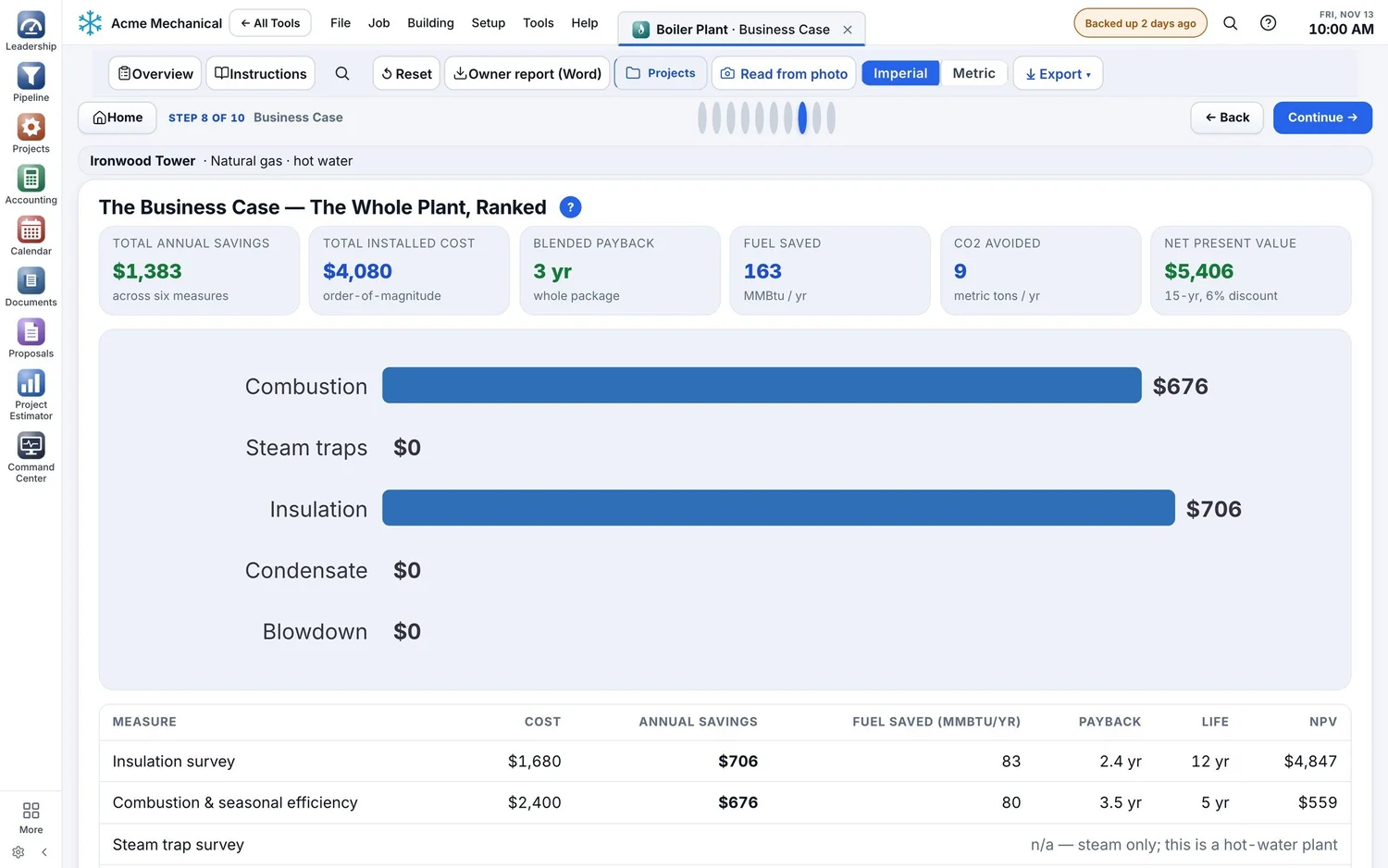
Boiler savings are spread over many fixes, so the whole plant is ranked.
Refrigeration
- Refrigeration sizes walk-in, display-case and process loads by temperature class, selects the rack or condensing units and screens the refrigerant against the transition rules
- Refrigerant Compliance keeps the appliance register, leak rates and repair deadlines, with a refrigerant cylinder ledger and a shared leak register behind it
- An EPA 608 check, by card type, on refrigerant work and on refrigeration work orders
- On the phone: walk-in, display case, ice machine and rack equipment types, with box temperature, pressures, superheat and defrost readings
- Add-on services for walk-in and freezer PM, ice machine cleaning, display case cleaning and leak inspection records
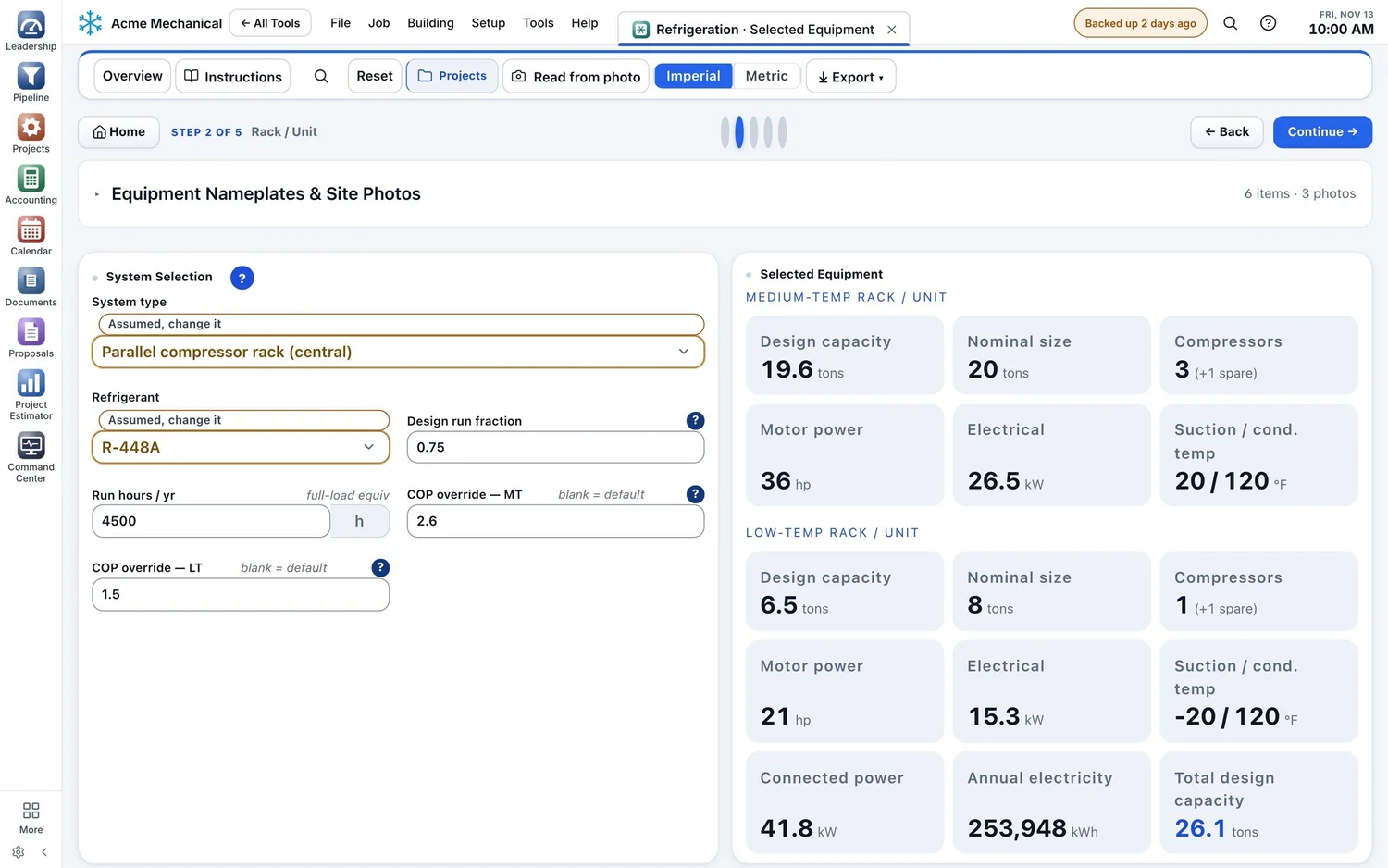
Racks sized from old drawings miss, so equipment is sized from the loads.
Controls and Building Automation
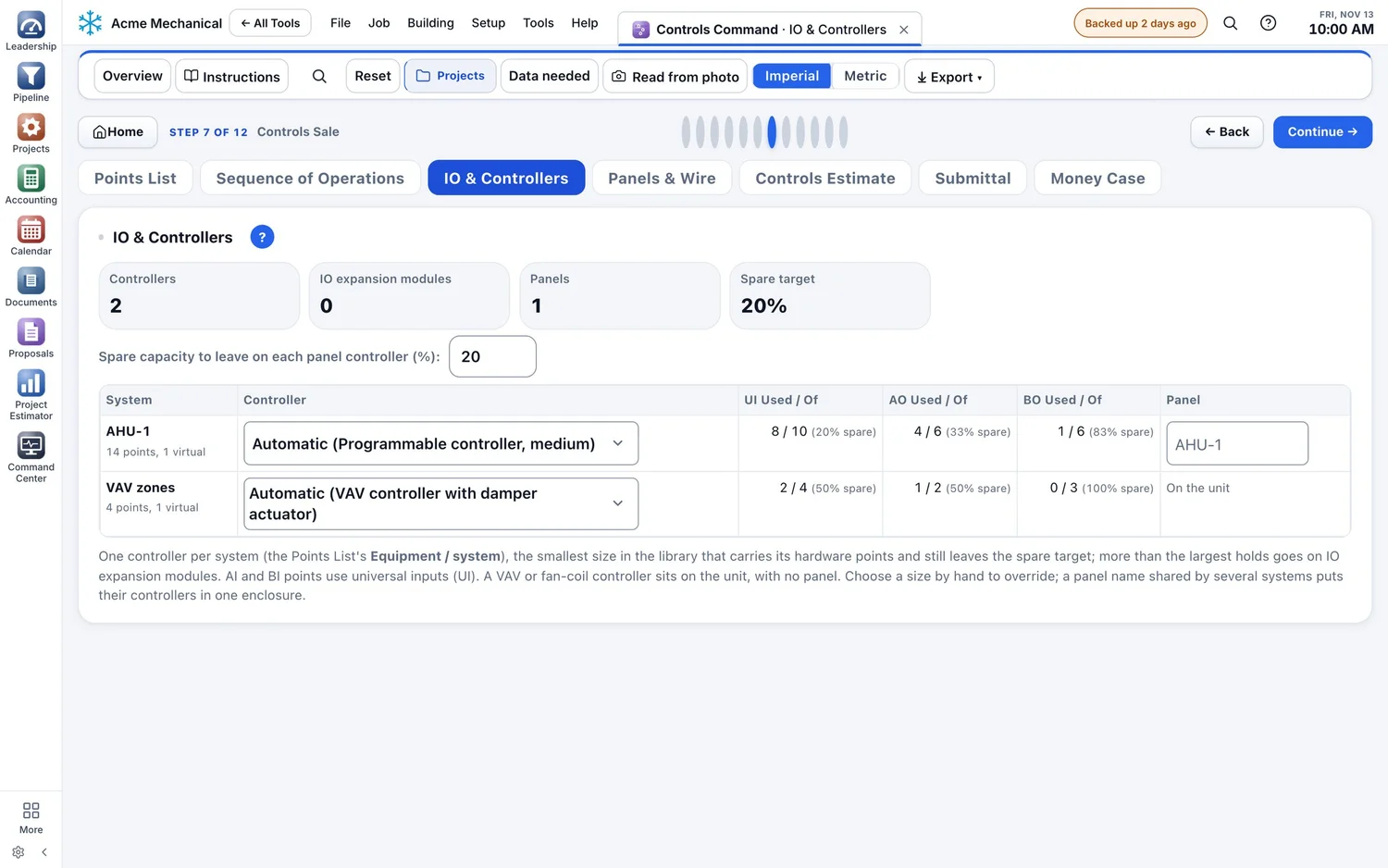
- Controls Command carries the controls job from the points list, controllers, panels and wire through the internal estimate, the submittal, checkout and commissioning
- The controls estimate lands on the Project Estimator's Controls trade at cost
- Read-only building trend data, checked against rules, and alarm monitoring under contract
- PM tasks for controllers, sensors, the front end and VAV box controls
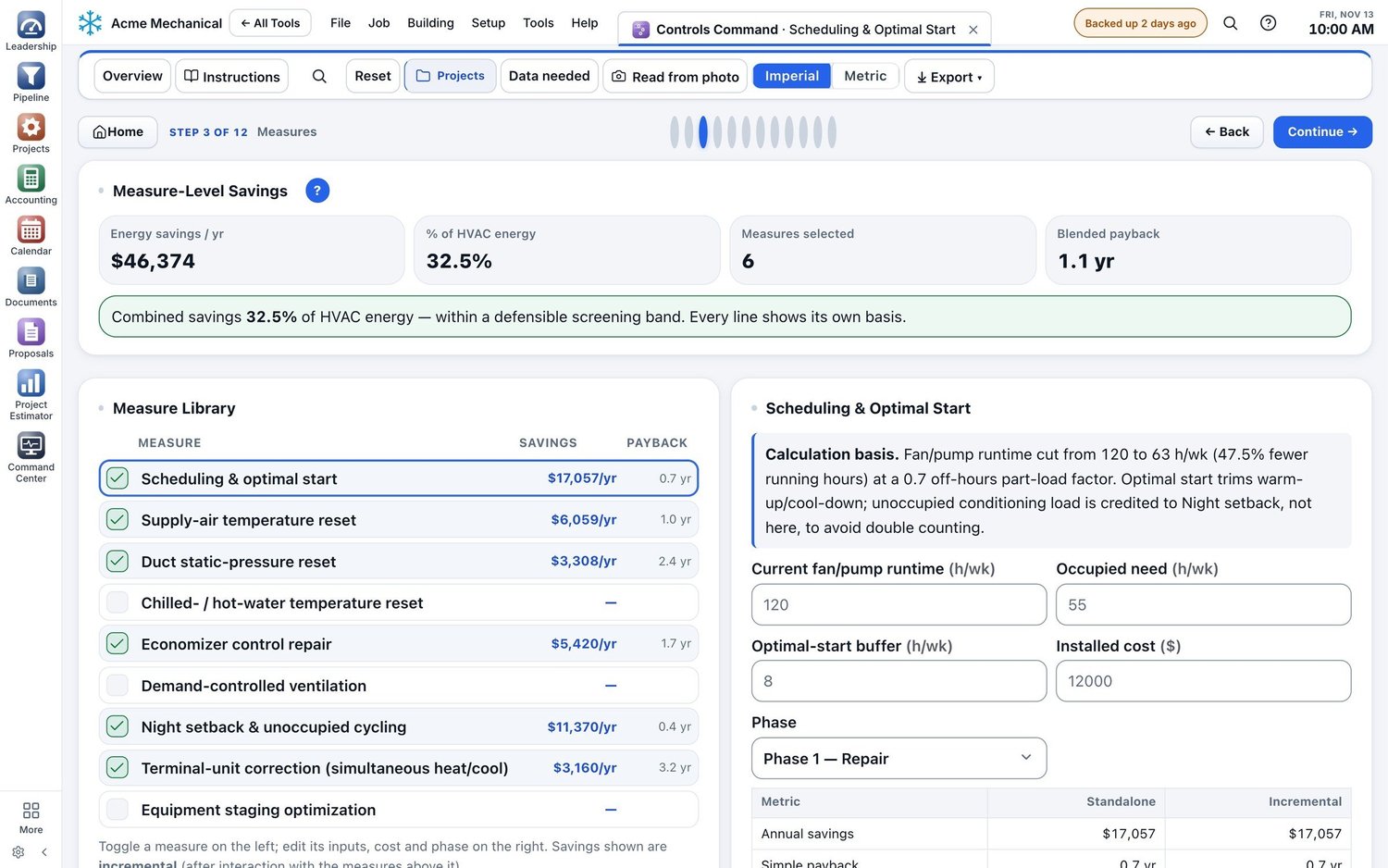
Controls sales need a money case, so each measure shows its saving and payback.
Fire Protection and Life Safety
- Fire Safety prices a fire-alarm or sprinkler-riser device package from a device take-off and your own rates, builds the recurring inspection, testing and maintenance schedule, and writes the proposal
- Inspection intervals cite NFPA 72, NFPA 10, NFPA 101 and NFPA 25 as dated, editable defaults
- On the phone: a sprinkler inspection and test form
- PM tasks for fire and smoke dampers and smoke-control interlocks, and seven add-on services including fire alarm testing, sprinkler inspection, fire pump testing and extinguisher service
- This is a pricing and service tool. It does not do sprinkler hydraulic calculations or fire-alarm system design
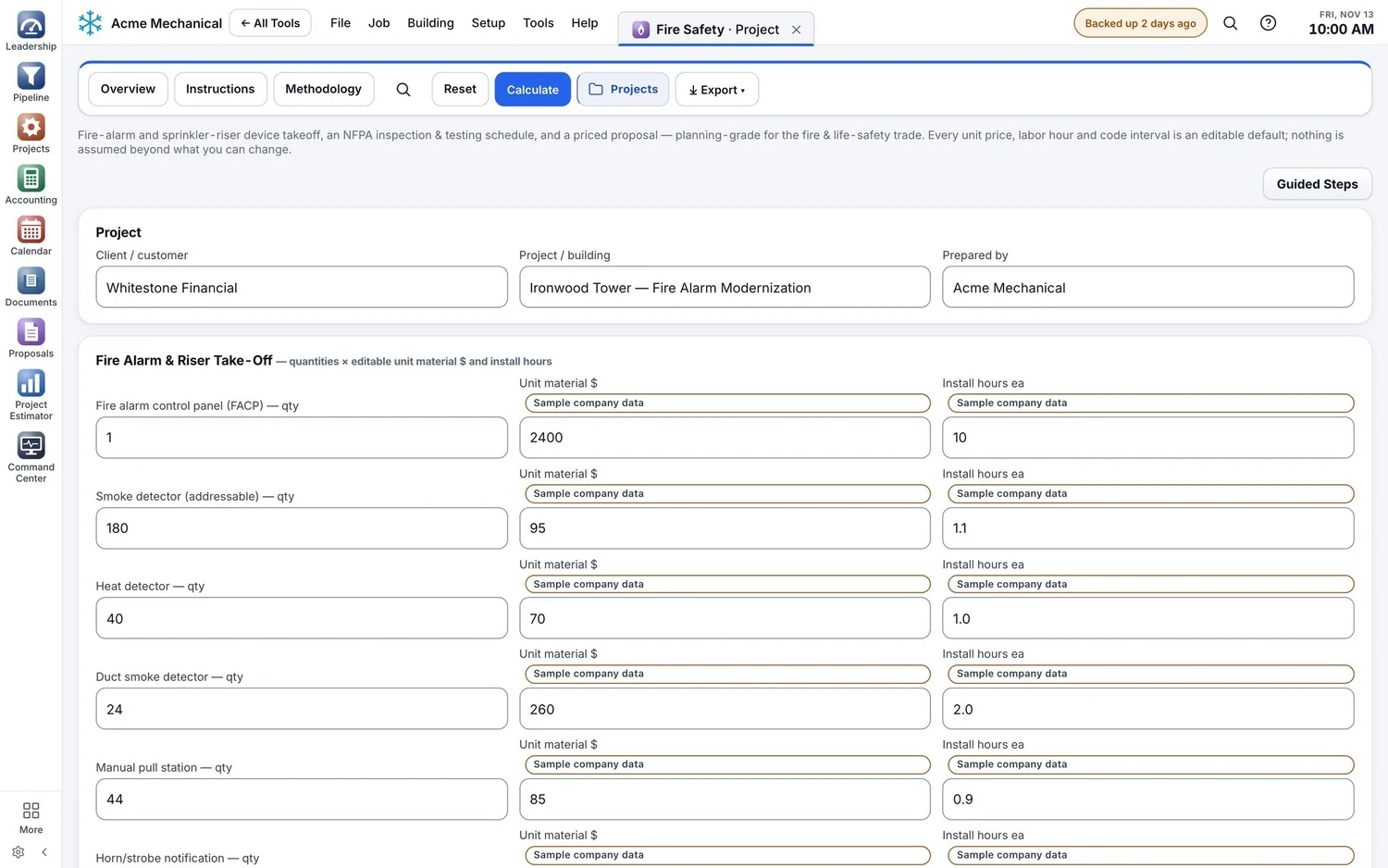
Fire alarm takeoffs take time, so devices and labor are listed for the project.
Service, Start-Up, Commissioning and Test and Balance
- Start-up reports, punch lists and T&M tickets from the phone, filed on the job
- A Test and Balance card on the service ticket: design against actual CFM and GPM, percent of design, and a TAB report for the office
- Controls checkout and commissioning in Controls Command, and Retro-Commissioning for existing buildings
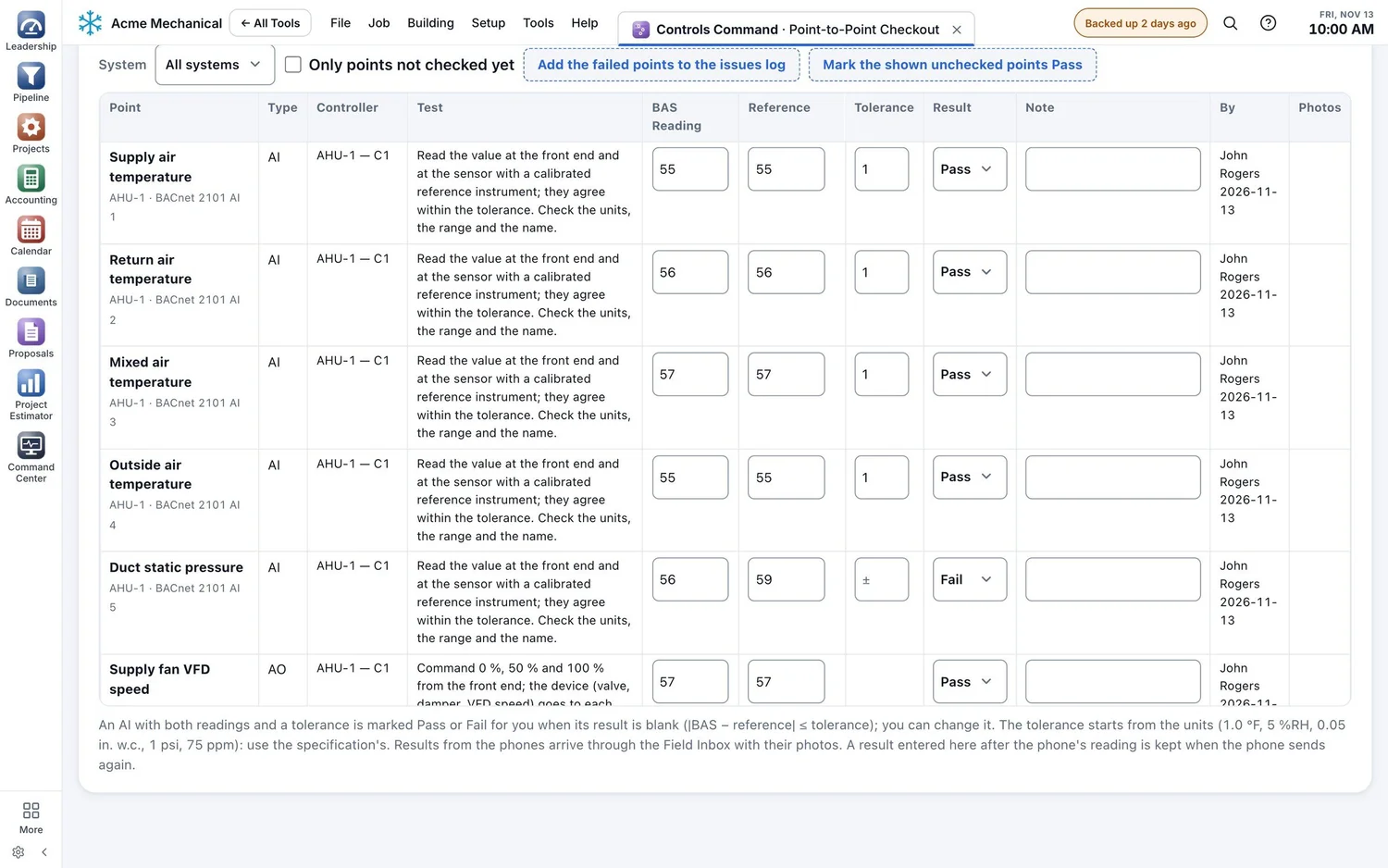
Start-up and checkout records get lost, so readings and results are kept point by point.
Water Treatment and Generators
- Water treatment: PM tasks for tower and closed-loop treatment, conductivity, pH, inhibitor and biocide readings and a water treatment log on the phone, and three add-on services
- Generators: a standby generator PM task, load, frequency, oil pressure and run-hour readings, a generator load test form, and add-on services for load bank testing, fuel polishing and transfer switch testing
- Both are service and maintenance coverage. There is no dedicated sizing tool for either
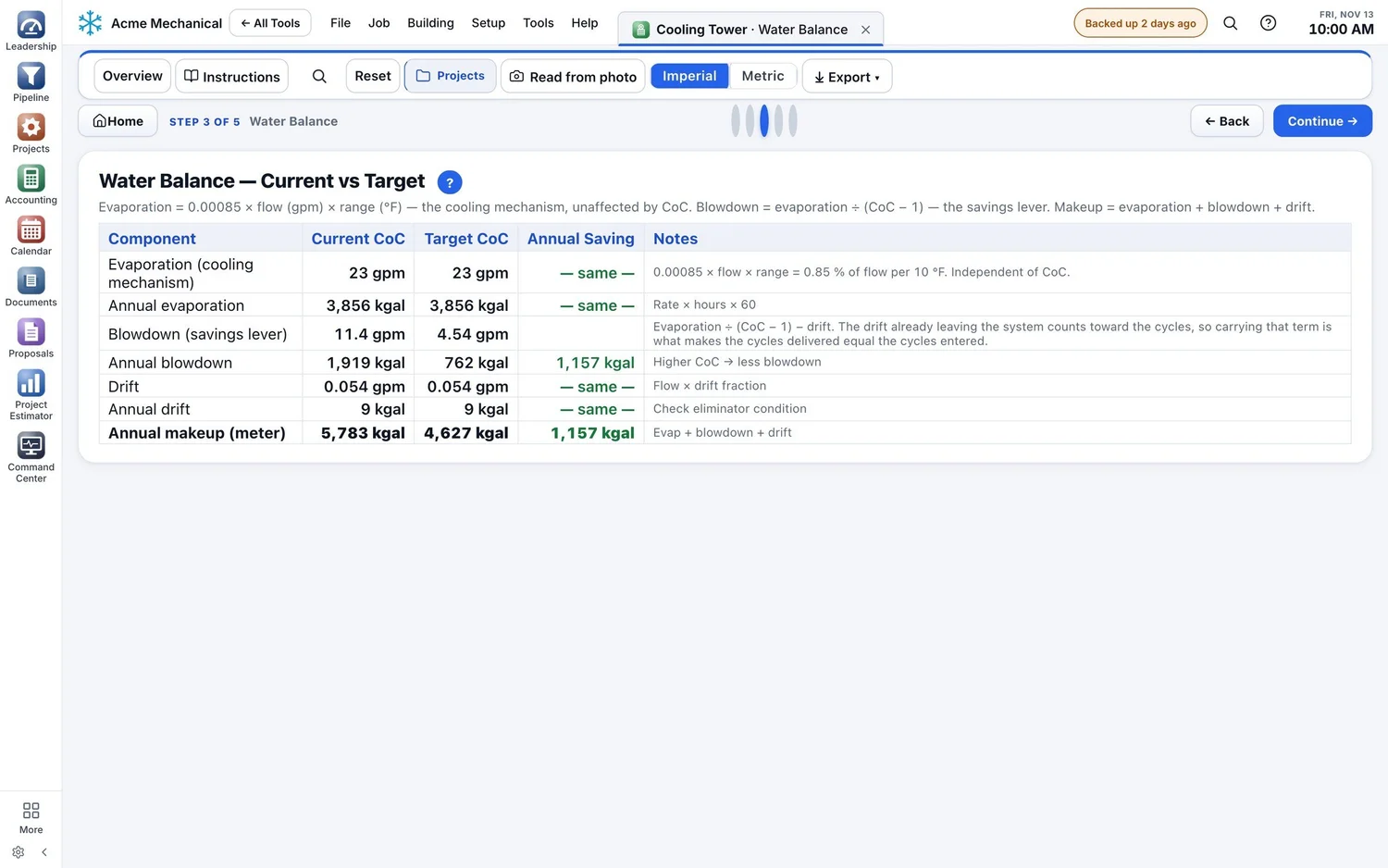
Water treatment saves money only when measured, so the water balance shows the savings.
Specialist Crafts
- Tag a person as a welder, boiler, chiller, backflow, medical gas, sprinkler, insulation, rigging and crane, millwright, water treatment, duct cleaning, generator or low-voltage specialist, with the cards each requires
- The dispatch board warns, or blocks if you choose, when a work order needs a card the person does not hold
- Phone forms for medical gas verification, lift plans and rigging, millwright alignment and insulation, in English and Spanish
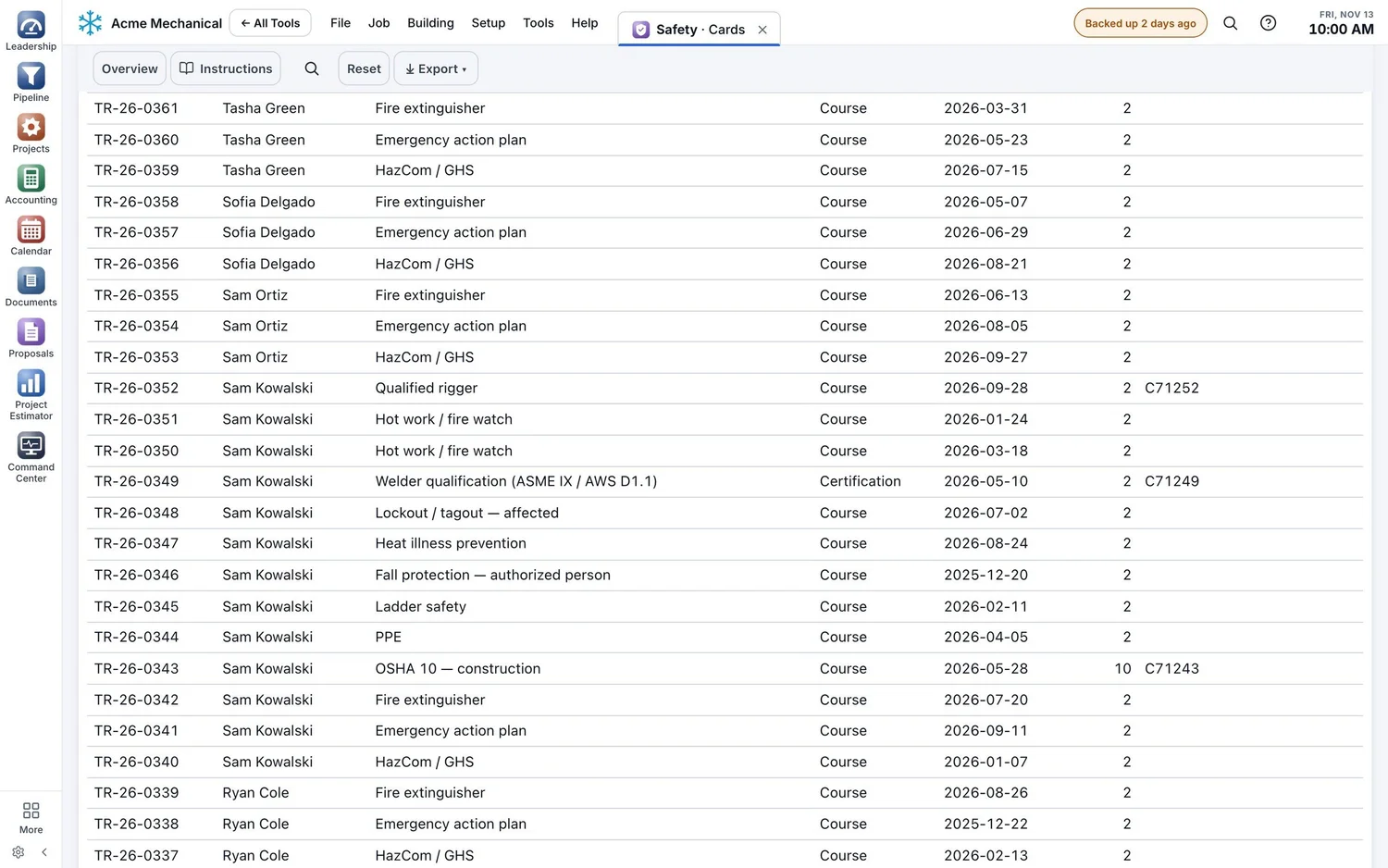
Specialist work needs current cards, so each person's certifications show their expiry.
Security, Low-Voltage and Building Envelope
- Lighter coverage, stated plainly: both are on the trade list, with a few scope templates, phone equipment types and readings, and one add-on service each
- There is no dedicated sizing or pricing tool for either trade
Licenses, Certifications and Compliance by Trade
HVAC Logix tracks the dated things each trade brings with it, names the source for each, and reminds the right person. It is a prompt, not a legal answer: the authority having jurisdiction decides.
Company and People
- The license or certification type and number on file for each trade the company performs
- The Company Register keeps contractor and trade licenses, permits and insurance current, with reminders
- On each employee: EPA Section 608 with its type, a state trade license with its state, number and class, OSHA 10 and OSHA 30, and the other safety cards, each showing Current, Expires in N Days or Expired
- A building can require specific licenses, a site badge, a background check or an orientation, and the schedule checks each technician against them on the day of the work
Permits and Inspections
- Permits by kind: mechanical, electrical, plumbing, gas, building, fire, boiler and refrigeration, each with its inspections
- Permit Check reads the words of the work against the permit sections of the 2021 International Mechanical, Fuel Gas, Plumbing, Building and Fire Codes and the authority's own rules, and shows Likely Required with the reason
- A job is not closed, and its final retainage is not billed, while a permit on it has not passed its final inspection
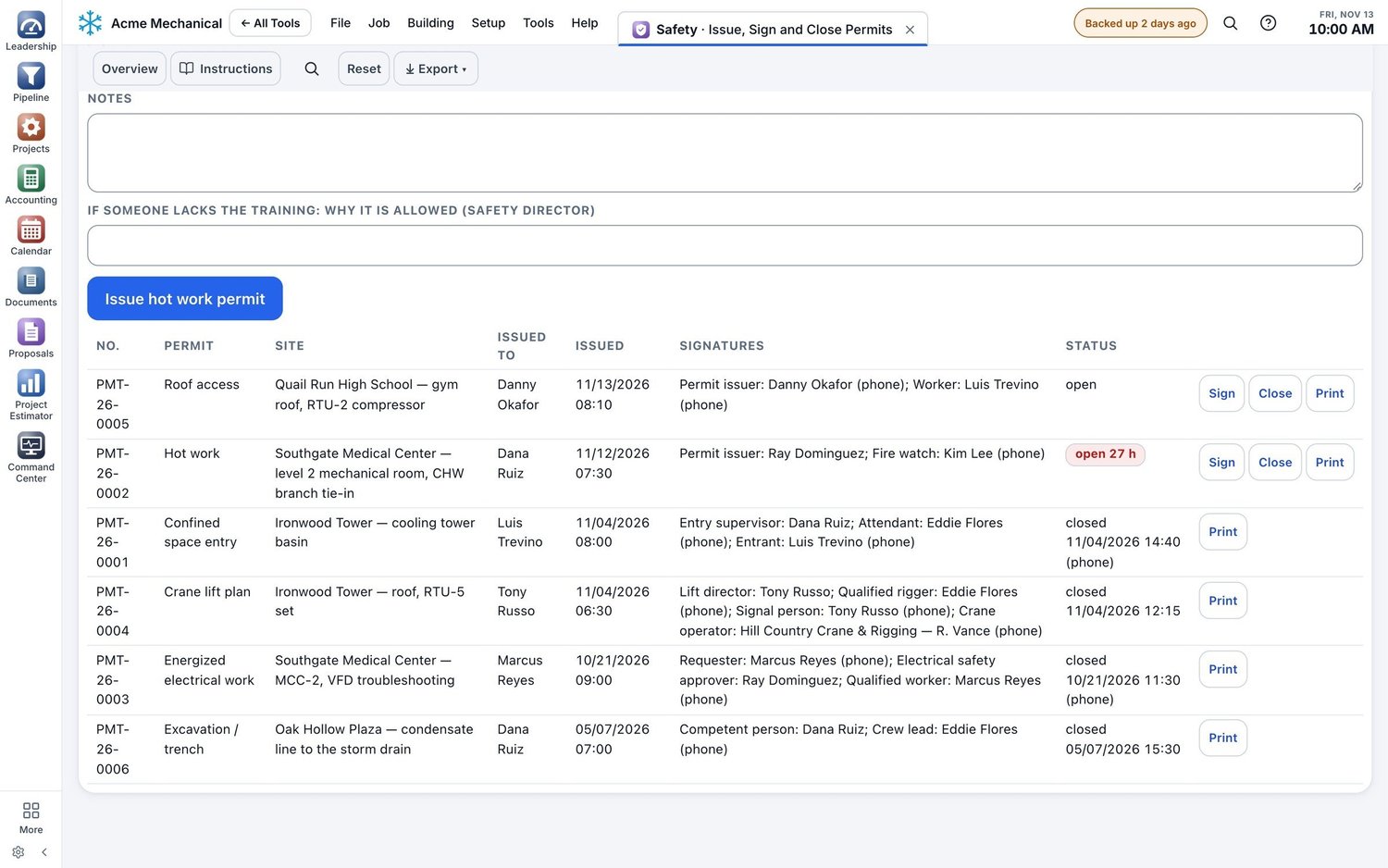
Work without a permit can be stopped, so permits are tracked by kind and status.
Standards and Obligations
- Compliance packs for NFPA 70B electrical maintenance, ASHRAE 180 HVAC maintenance and ASHRAE 241
- A compliance obligations library that works out what applies to a building from its equipment, state and type: a boiler brings its inspection, a backflow assembly its annual test, a cooling tower its cleaning and water management program
- Refrigerant leak rules, the cylinder ledger and state refrigerant rules for refrigeration and HVAC work
- FOG records for grease interceptors, and a calibration register for instruments such as backflow test kits
- Periodic Testing: a multi-year calendar of eddy current, oil analysis, vibration, relief valve and fire-pump tests
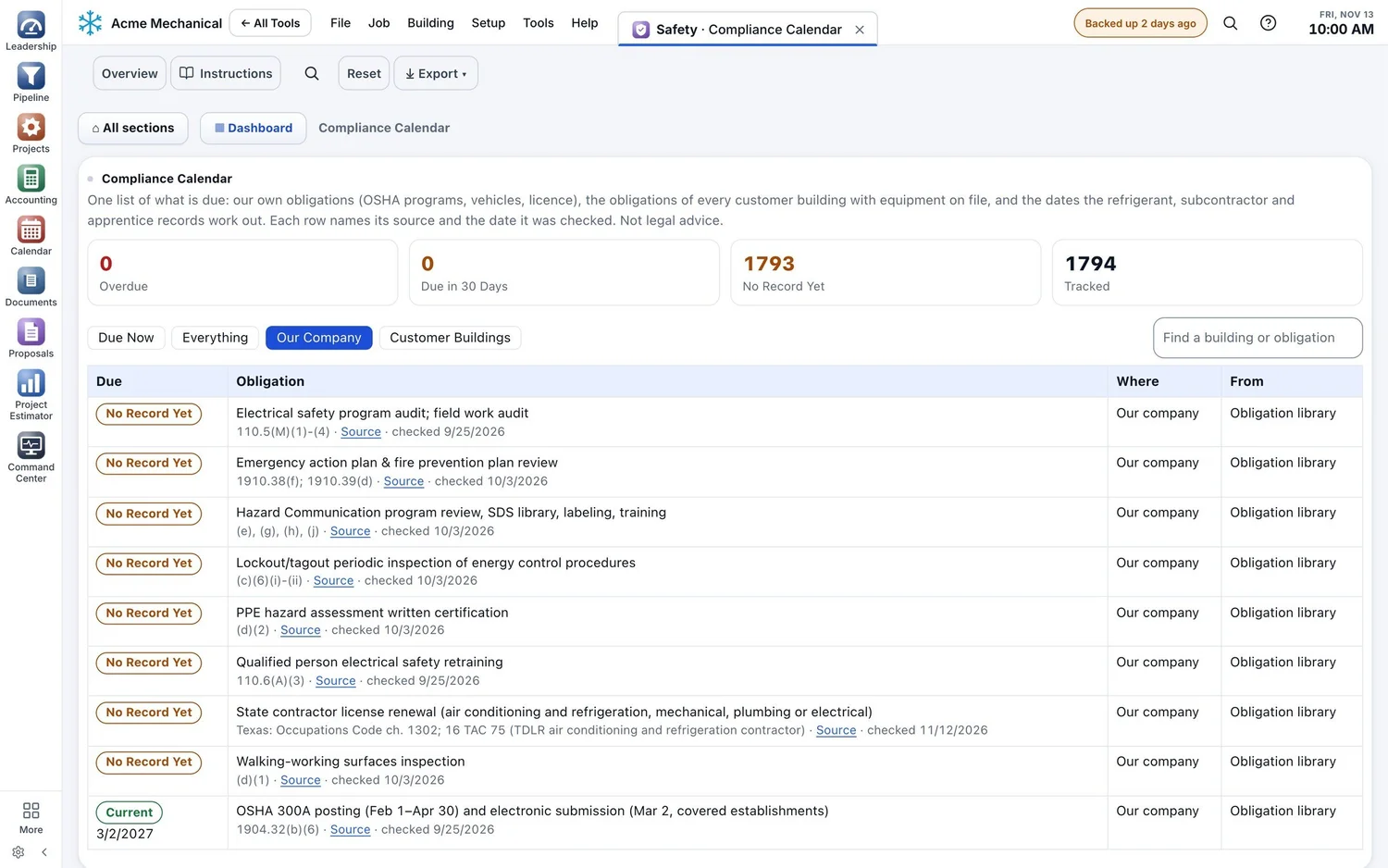
Trade obligations are easy to lose, so each one sits on the compliance calendar.
Safety by Trade
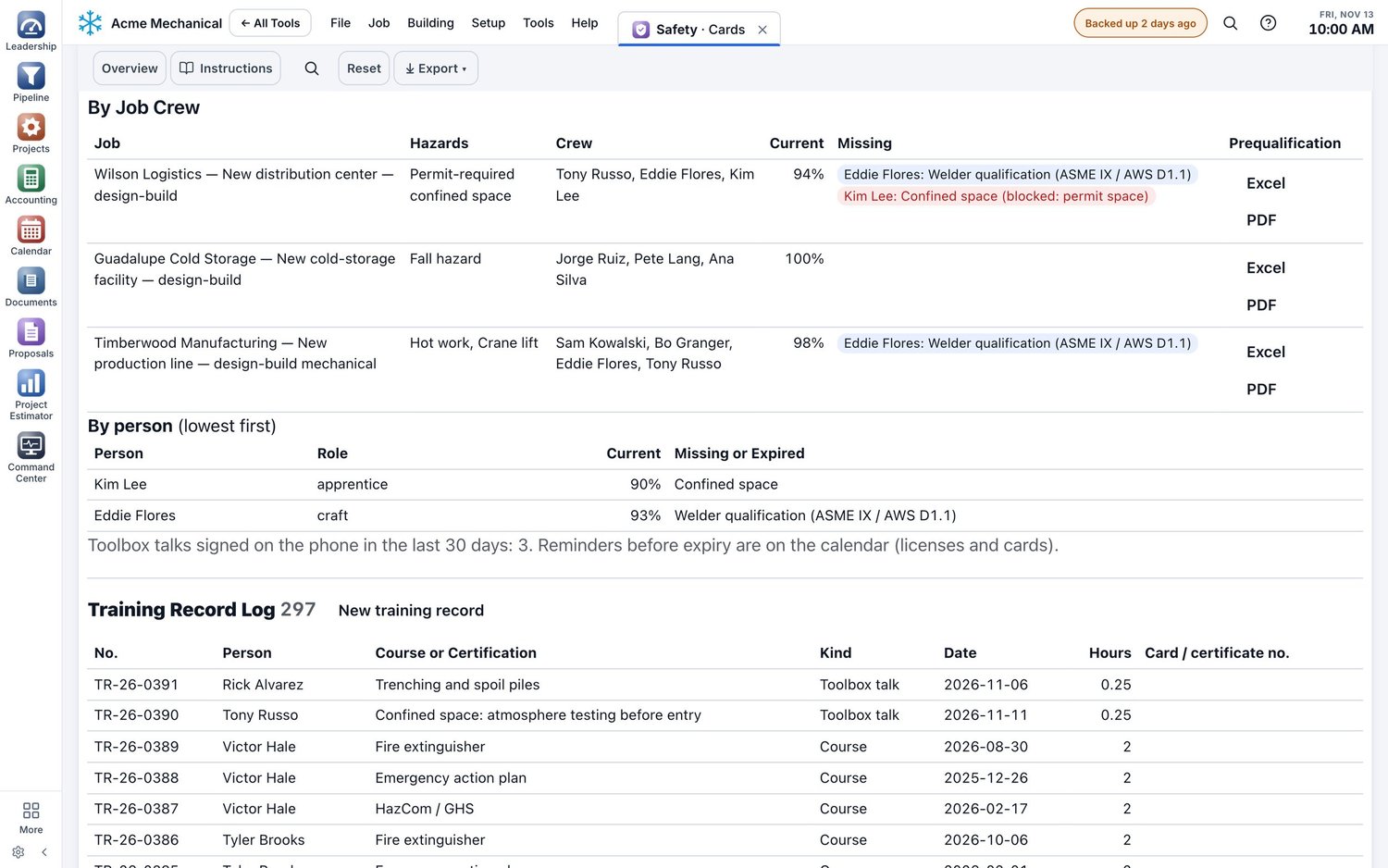
- Job hazard analysis templates for HVAC, refrigeration including ammonia, electrical, plumbing and piping, sheet metal, controls and low voltage, welding, boilers, fire protection, medical gas, insulation, rigging and millwright, water treatment, generators, test and balance, duct cleaning and building envelope, in English and Spanish
- Permits for hot work, confined space entry, excavation and energized electrical work, and lockout and tagout on the phone
- Required training by role and trade, with expiries at 30, 60 and 90 days, and a training matrix per job crew
- Certified payroll for prevailing-wage work in every state, with apprentices tracked on public work
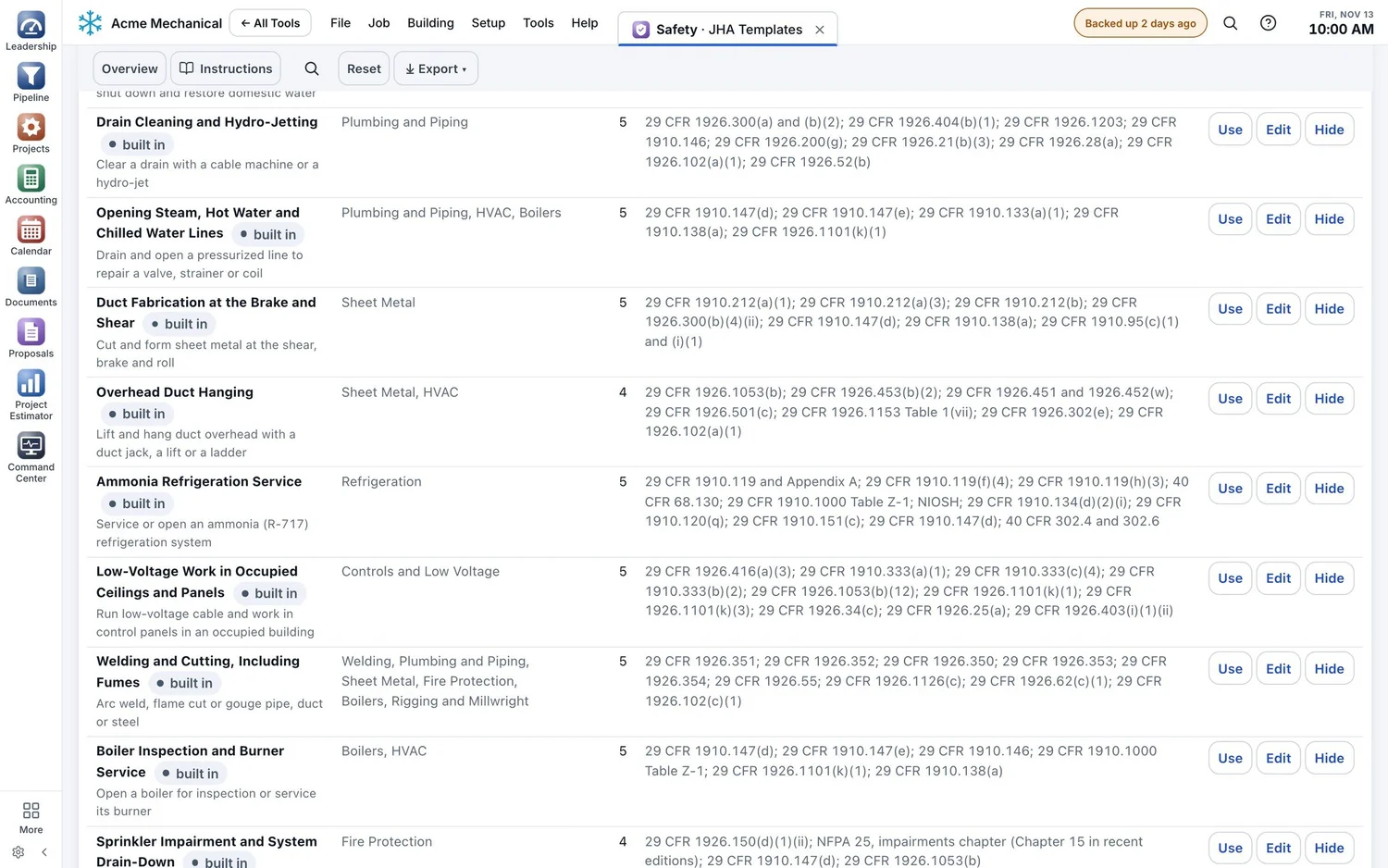
Each trade has its own hazards, so job hazard analyses start from trade templates.
Grow into Adjacent Trades
Customers often prefer one accountable contractor. These tools put the next trade in front of your salesperson with a price, whether your own crews do the work or a partner does.
Scope Expansion
Check the equipment on site and Scope Expansion lists the adjacent-trade services the building needs: a cooling tower brings water treatment, switchgear brings infrared scanning and torque checks, a kitchen brings grease and hood service, a generator brings load bank testing. Each is flagged Recommended, In-House, Partner or License Needed, priced from your own rates into quotable scope, and tracked from surfaced to won.
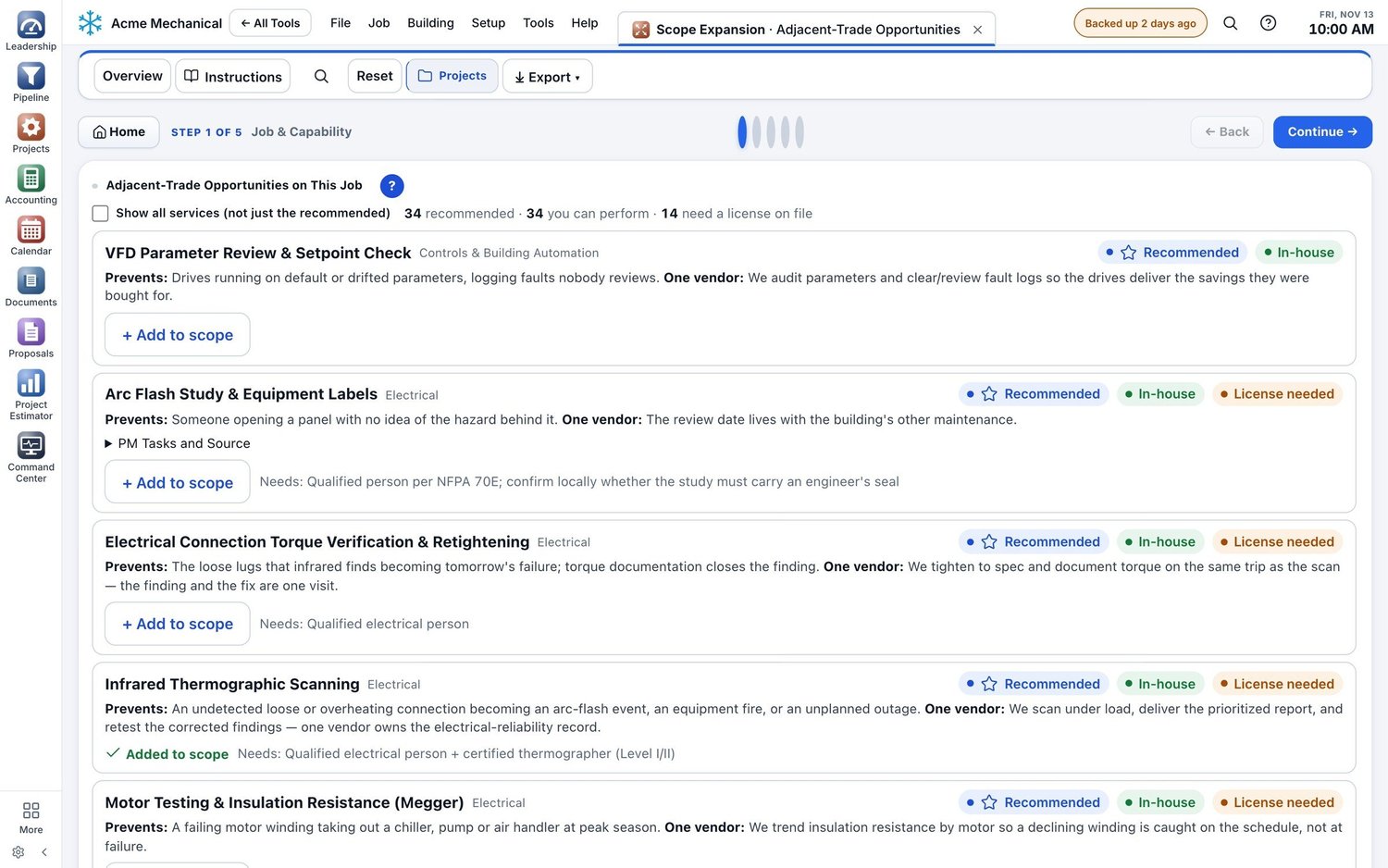
Adjacent work goes unquoted, so Scope Expansion lists the services the building needs.
Additional Services on the Agreement
The Maintenance Estimator's Additional Services tab carries a library of 64 adjacent-trade services across plumbing, electrical, fire and life safety, refrigeration, generators, water treatment, controls, sheet metal and piping. Each is priced from your own rates by count, size and frequency as a real line item, placed as Included, Optional or Available, with your cost and margin shown to you alone.
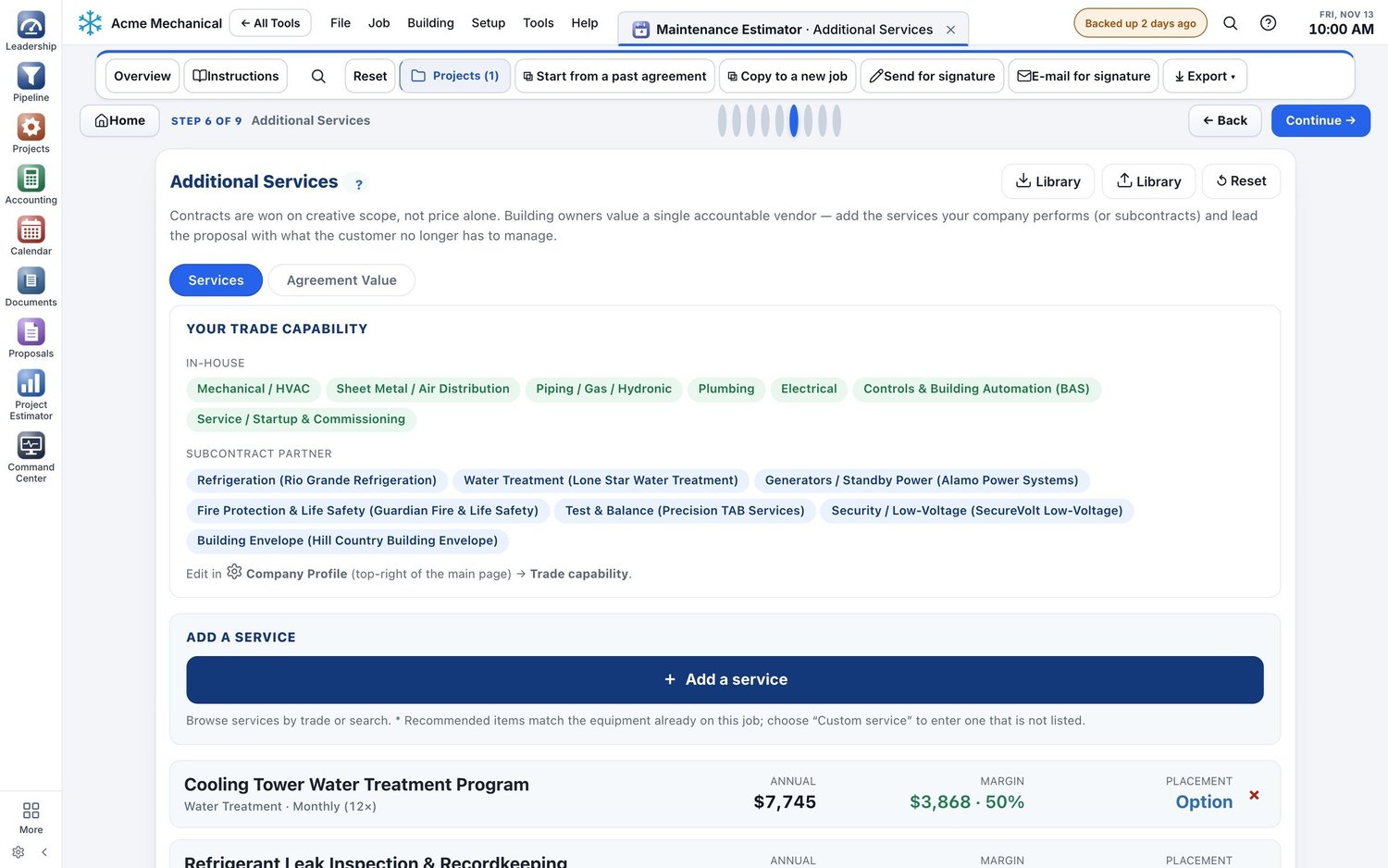
Agreements can carry more trades, so additional services come from a library.
In-House, Partner or Not Offered
A trade you subcontract is carried as a cost with its own markup and never as your crews' hours. A license-required service with no license or partner on file shows a reminder in the estimate. The setting guides what is recommended. It never locks a salesperson out.
Budgets for Any Trade
Budget Builder prices replacement budgets from a built-in database of more than 150 equipment types across all fourteen trades, as a low, typical and high range, with a regional index, a quality tier, contingency and escalation.
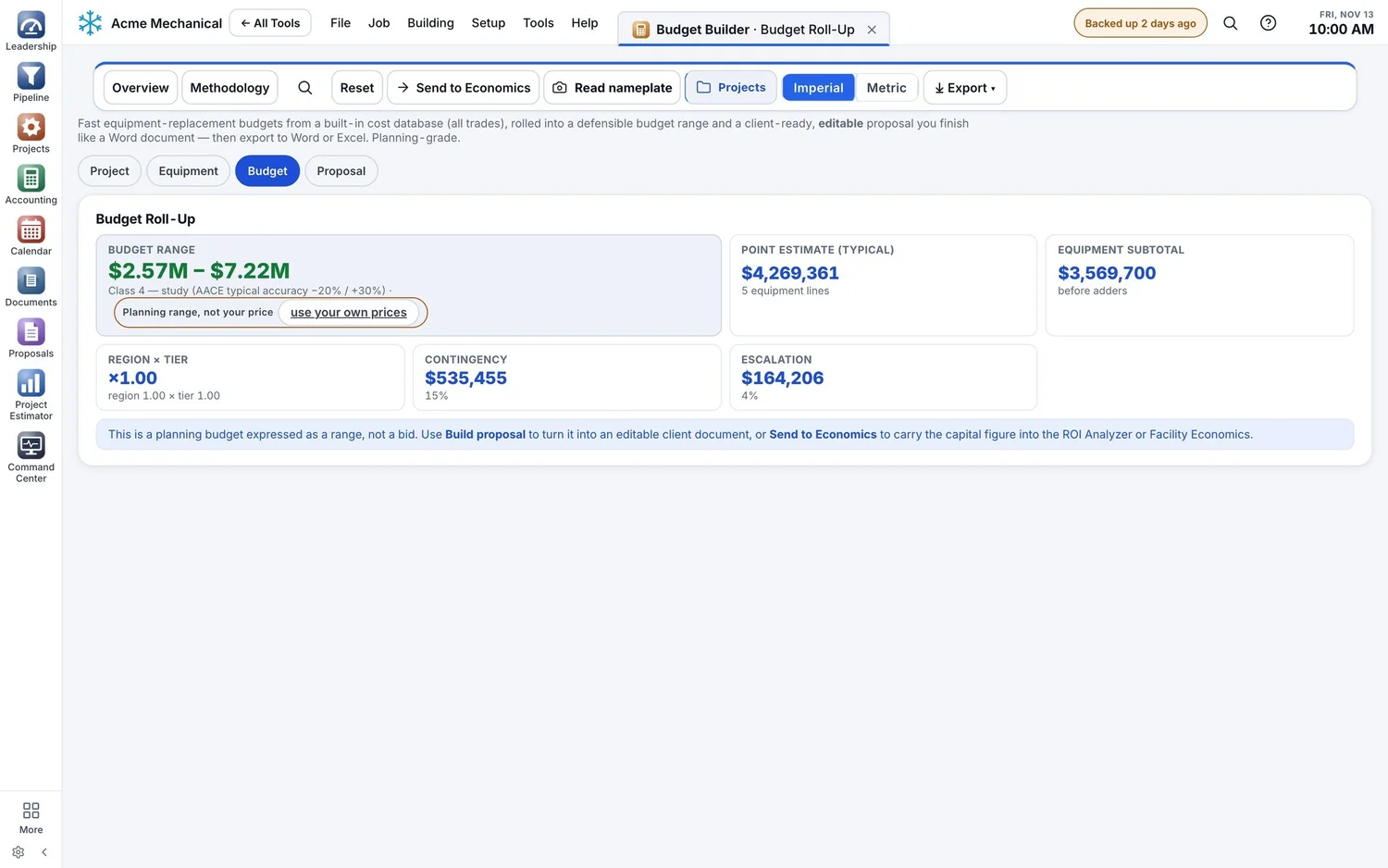
Owners want budgets for any trade, so Budget Builder gives a range.
One Offer for the Whole Building
The Packaged Offer gathers the base estimate or agreement with the adjacent-trade work, the testing calendar and the options into one priced proposal.
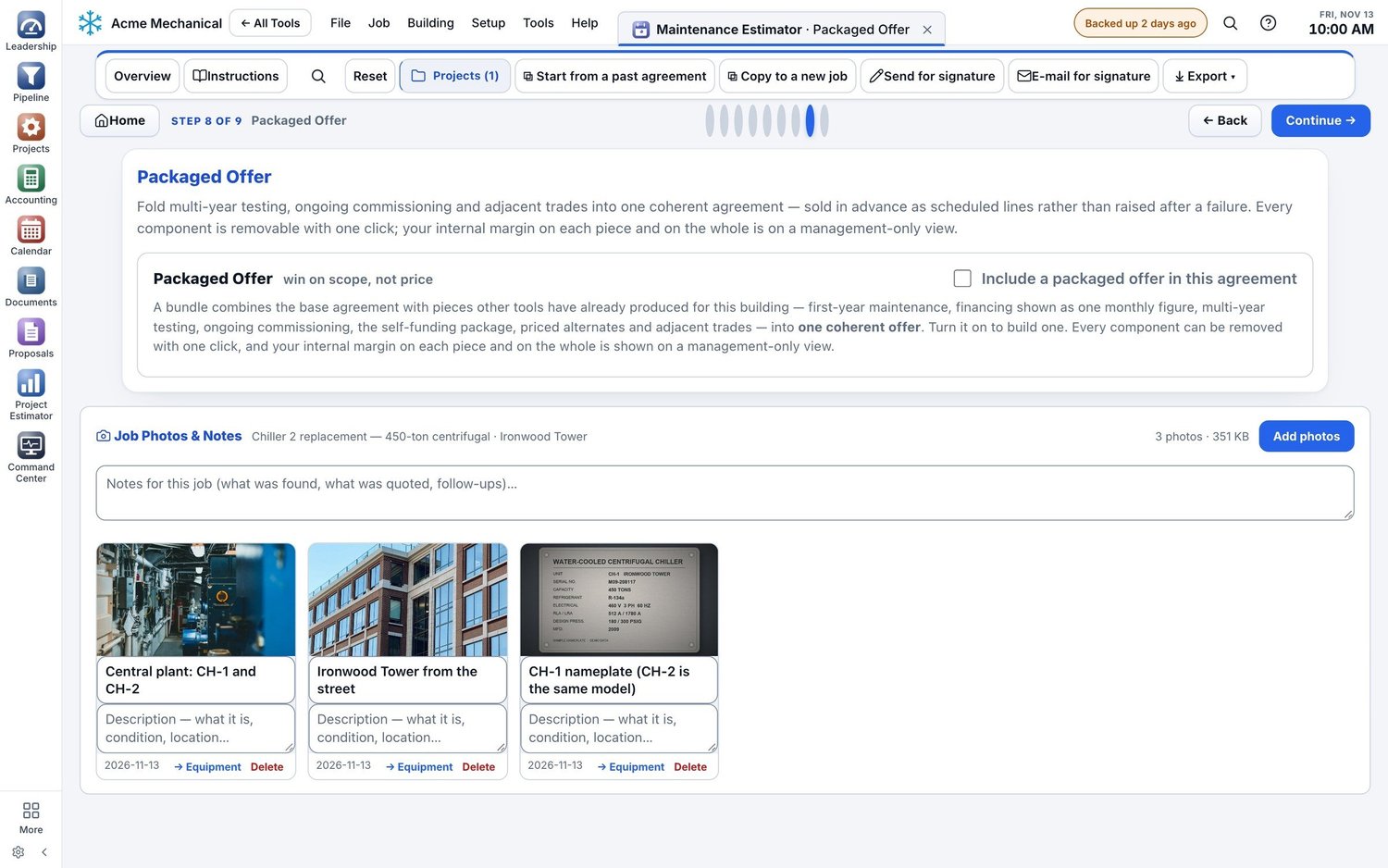
One offer is easier to approve, so the packaged offer gathers every trade's work.
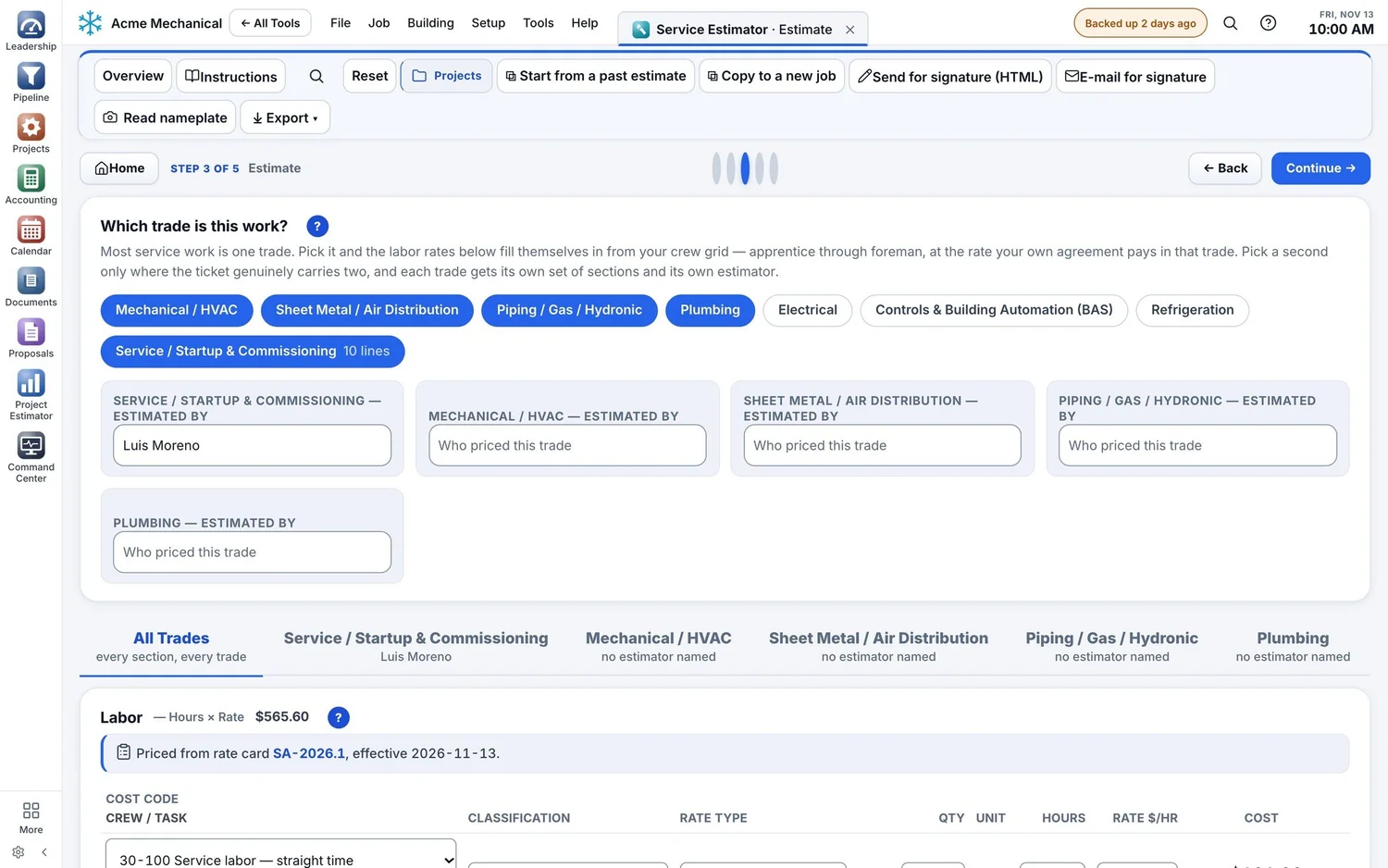
The Payoff: One System in Place of a Program per Trade
One System, Not One per Trade
The plumbing work, the electrical work and the mechanical work are estimated, dispatched, purchased, billed and paid in the same program, on the same customer and building records.
Learn MoreShow Less
Running each trade in its own program means paying for several systems and retyping between them. One program keeps every trade's work on one customer record.
- One company can be your customer, vendor and subcontractor, each role listed by job.
- Saving any estimate creates or updates one matching Pipeline deal, never a stale copy.
- Every deal and agreement has a button to reopen the estimate that built it.
- Each trade's estimate section names its own estimator.
Crews and Costs in One Place
Every trade's hours land on the same timecards and the same job cost, by trade, classification and cost code. The manpower forecast shows which trade is tight in which month.
Learn MoreShow Less
Labor is the biggest cost on most jobs, and it leaks fastest when trades are tracked apart. One timecard and one job cost show every trade's labor against its budget.
- Field hours are priced at the loaded rate for the person's classification, overtime included.
- A code whose actual rate differs from the estimate by more than 25% is flagged.
- A week where hours show more than 15% over the crew plan is marked.
- Estimate labor that cannot be placed in a trade shows as Unassigned, never guessed.
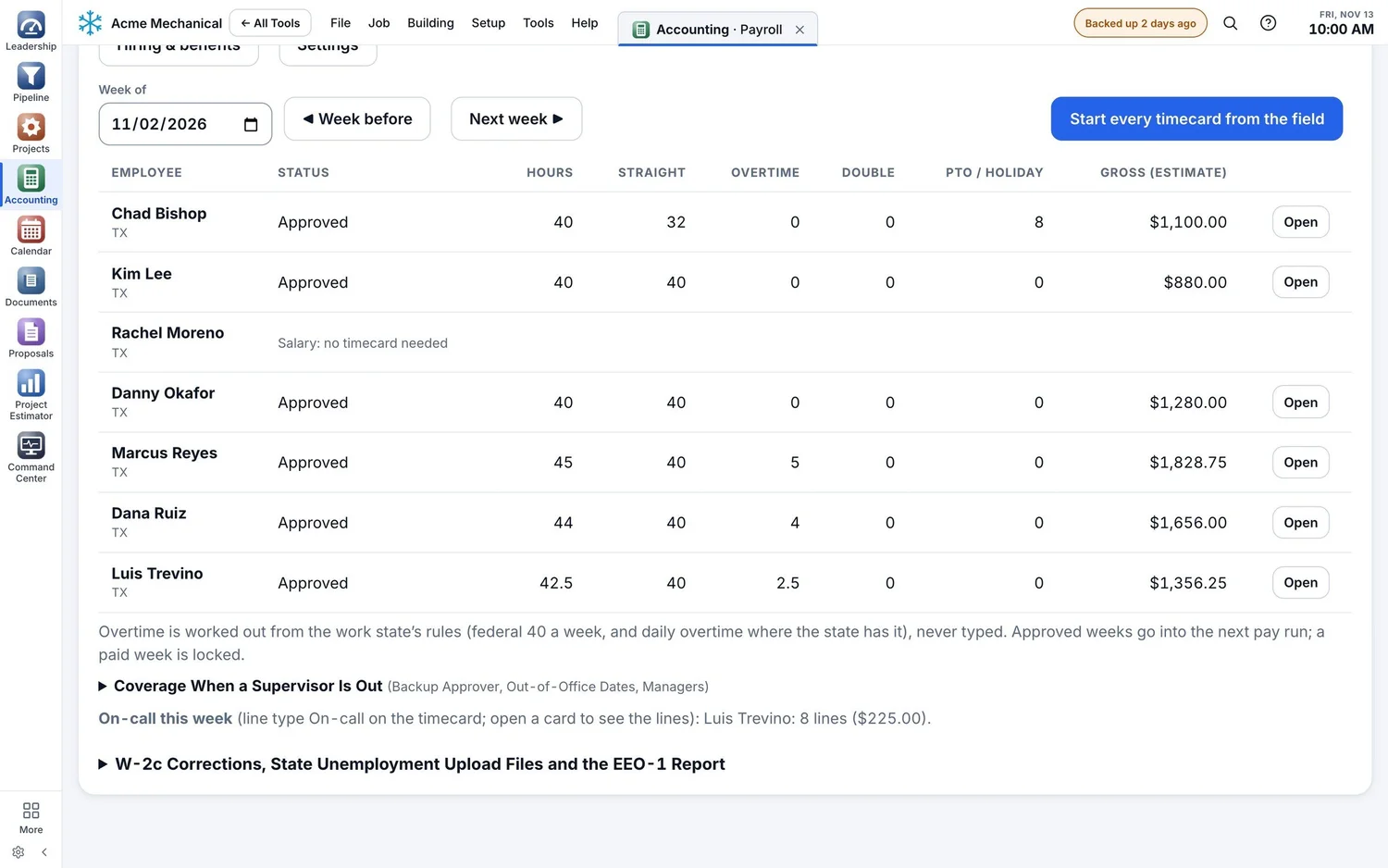
Hours by trade should land once, so every trade fills the same timecards.
Nothing Retyped Between Trades
The customer, the building and the equipment are entered once. A sized duct system becomes a sheet metal number and an electrification load becomes an electrical service check, with the figures imported, not retyped.
Learn MoreShow Less
Every retyped figure is time lost and a chance to bid the wrong number. Figures move between tools by import, with their source shown.
- Opportunity hours by trade are seeded from the estimate, marked estimate-derived.
- Budget Builder's capital figure feeds the ROI Analyzer and Facility Economics.
- The Proposal Composer stamps each imported figure with its tool and export date.
- Building names and areas live on one Site Record that every tool reads.
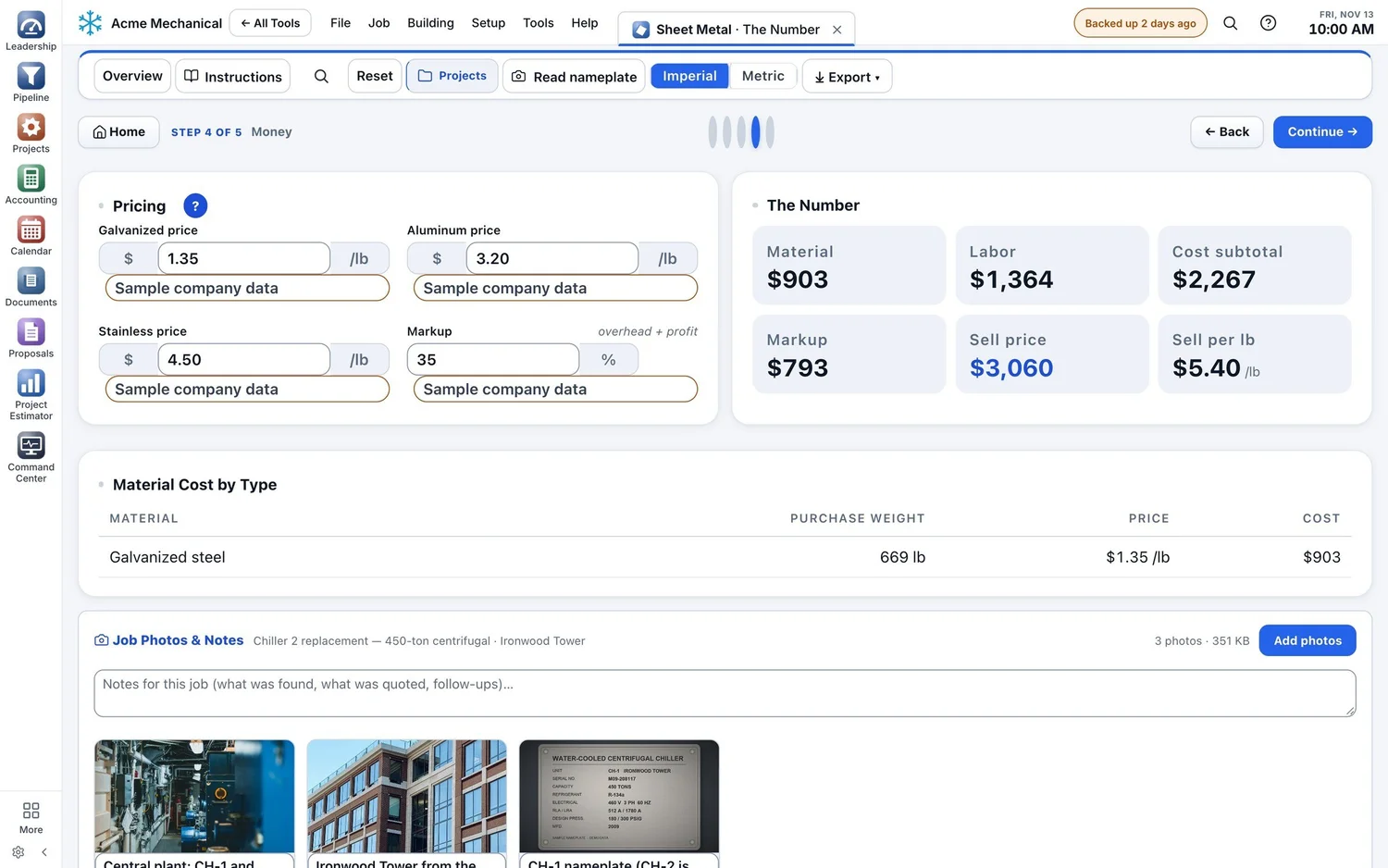
Retyping between trades wastes time, so a sized duct system becomes a priced sheet metal job.
One Proposal for the Customer
A job that carries controls, sheet metal and piping is one estimate with a subtotal per trade and one proposal. An agreement can carry the mechanical PM and the adjacent services on one contract.
Learn MoreHonest About Depth
HVAC, sheet metal, piping, plumbing, electrical, controls, refrigeration and service are the trades with the most behind them. Fire protection, water treatment, generators and test and balance have real but narrower tools. Security, low-voltage and envelope are light. You see every tool before you decide.
Learn MoreShow Less
Knowing exactly what each trade gets before you buy avoids paying to work around a gap later. The program is built to say where its numbers are thin, too.
- Budget Builder prices more than 150 equipment types across all 14 trades.
- Where a trade's forecast hours are mostly guesses, the view says so.
- Specialist cards such as welder, backflow, medical gas and rigger are checked at dispatch.
- Start-up reports offer each specialist trade's own form on the phone, in Spanish too.
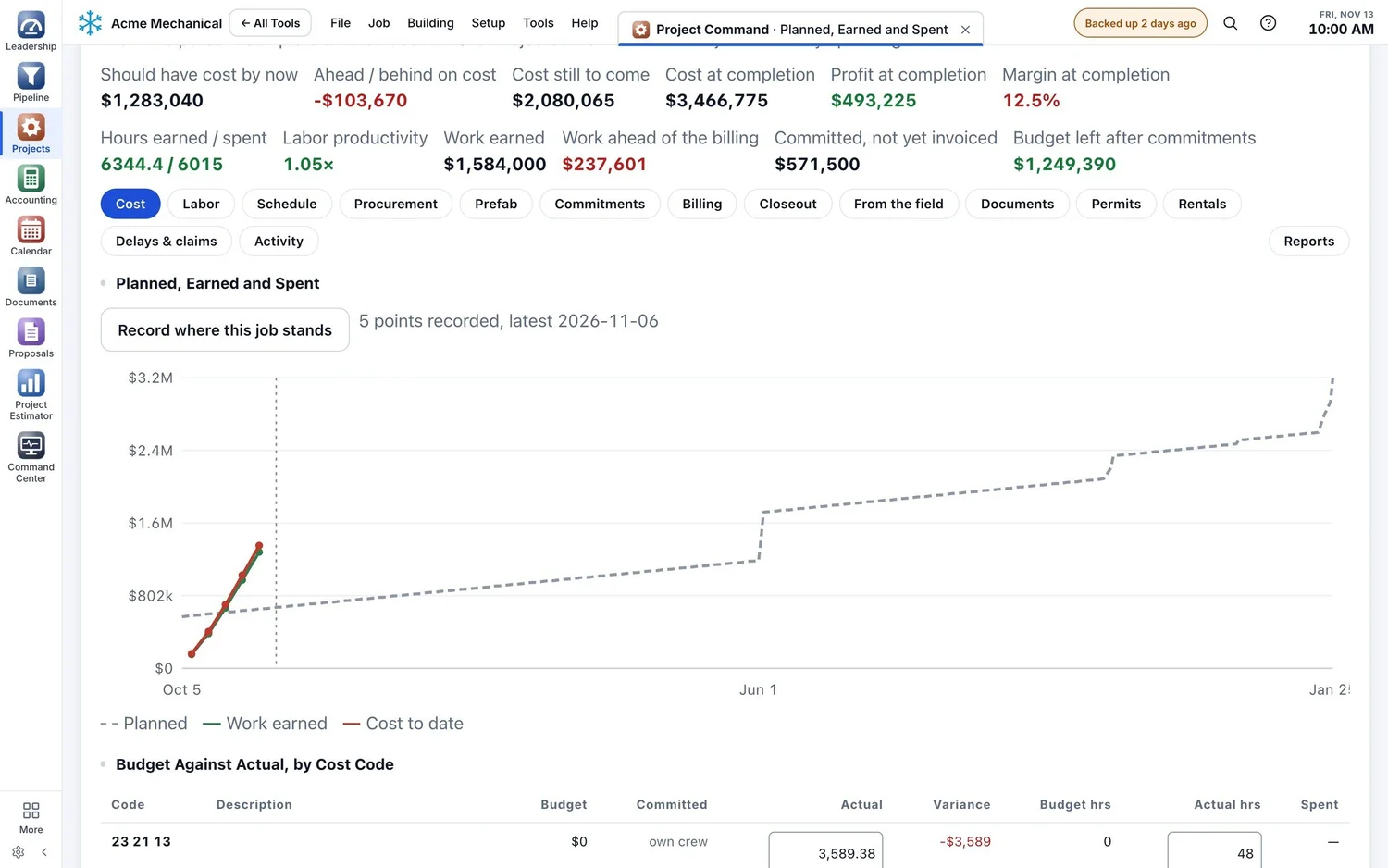
Every trade's cost should land on one job, so cost is shown by cost code against the budget.
Frequently Asked Questions
Does HVAC Logix work for plumbing, electrical and other trades?
Which trades does it recognize?
Are the tools for the other trades as deep as the HVAC tools?
We subcontract some trades. How is that handled?
Will tools for trades we do not perform get in the way?
Does it handle union and open shop crews in several trades?
Be First When HVAC Logix Opens
Stop paying people to copy numbers between programs. Join the list and we will tell you the day downloads open, with setup guides ready.
Launching early 2027 for HVAC Logix. Nothing to buy today, and no sales calls.
