

Docks, Racks and Cold Rooms That Keep Product Moving.
Launching Early 2027 · Join the Early-Access List
A distribution center is a throughput machine: a failed dock door or a red-tagged rack bay stops shipping, and in cold storage a temperature excursion is lost product and a compliance event. Facilities Logix's warehouse playbook covers warehouses, logistics and distribution centers and refrigerated and frozen storage. It inventories dock and material-handling equipment with remaining life, logs rack inspections with red, amber and green damage grades, flags cooler and freezer zones outside their band, keeps the sprinkler design question in front of your team, and carries the refrigeration, storage and safety obligations on the Compliance tab.
Refrigeration, Storage and Lift-Truck Rules with Their Dates
The Compliance tab evaluates the building as a warehouse or as cold storage, whichever its Building Record names, and adds rows as the facts call for them: ammonia, a large HFC charge, high-piled storage, forklifts. Each shows its citation, frequency and next due date, with the same dates as the Compliance Calendar.
Ammonia Refrigeration (ANSI/IIAR 6 and IIAR 9)
- Annual equipment inspections by a qualified inspector
- Every fifth year, the annual inspections done by an independent fifth-year inspector
- Daily, weekly, monthly and quarterly operator tasks in the standard's table ranges, with annual records kept 5 years
HFC Refrigeration (40 CFR 84, AIM Act)
- Systems with a full charge of 1,500 lb or more: automatic leak detection audited and calibrated every year, records kept 3 years
- Systems of 15 lb or more with a GWP above 53: leak rate worked out at each refrigerant addition, from January 1, 2026
- Technicians who open a refrigerant circuit hold the right EPA Section 608 certification type
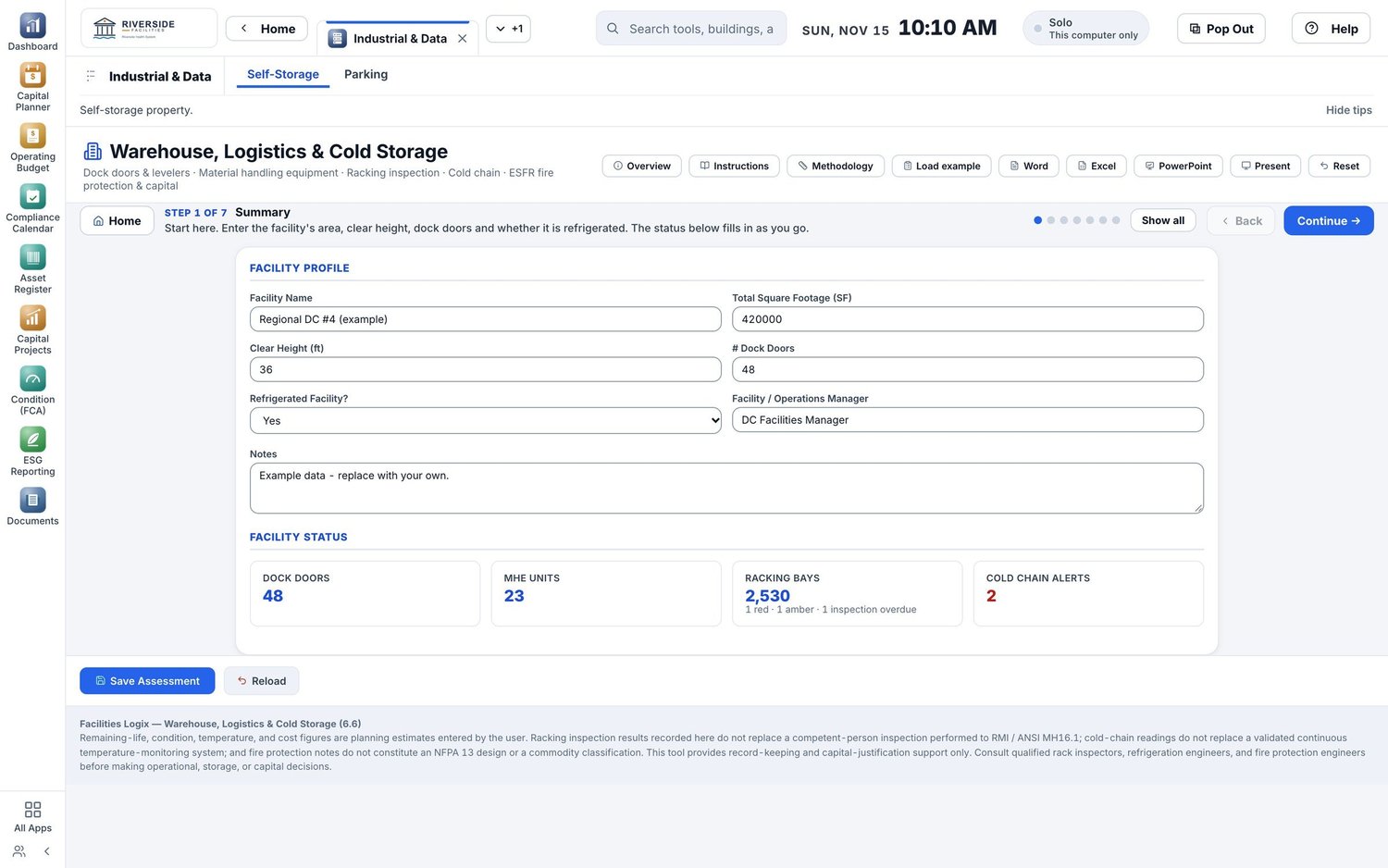
Summary in Warehouse, Logistics & Cold Storage: start here. Enter the facility's area, clear height, dock doors and whether it is refrigerated. The status below fills in as you go.
Chemical Process Safety (40 CFR 68)
- Where ammonia or another chemical is above its threshold: a compliance audit at least every 3 years and the Risk Management Plan resubmitted at least every 5 years
High-Piled Storage (IFC Chapter 32)
- An operational permit for more than 500 square feet of high-piled combustible storage, including aisles, kept current for the period on the permit; many fire departments renew yearly
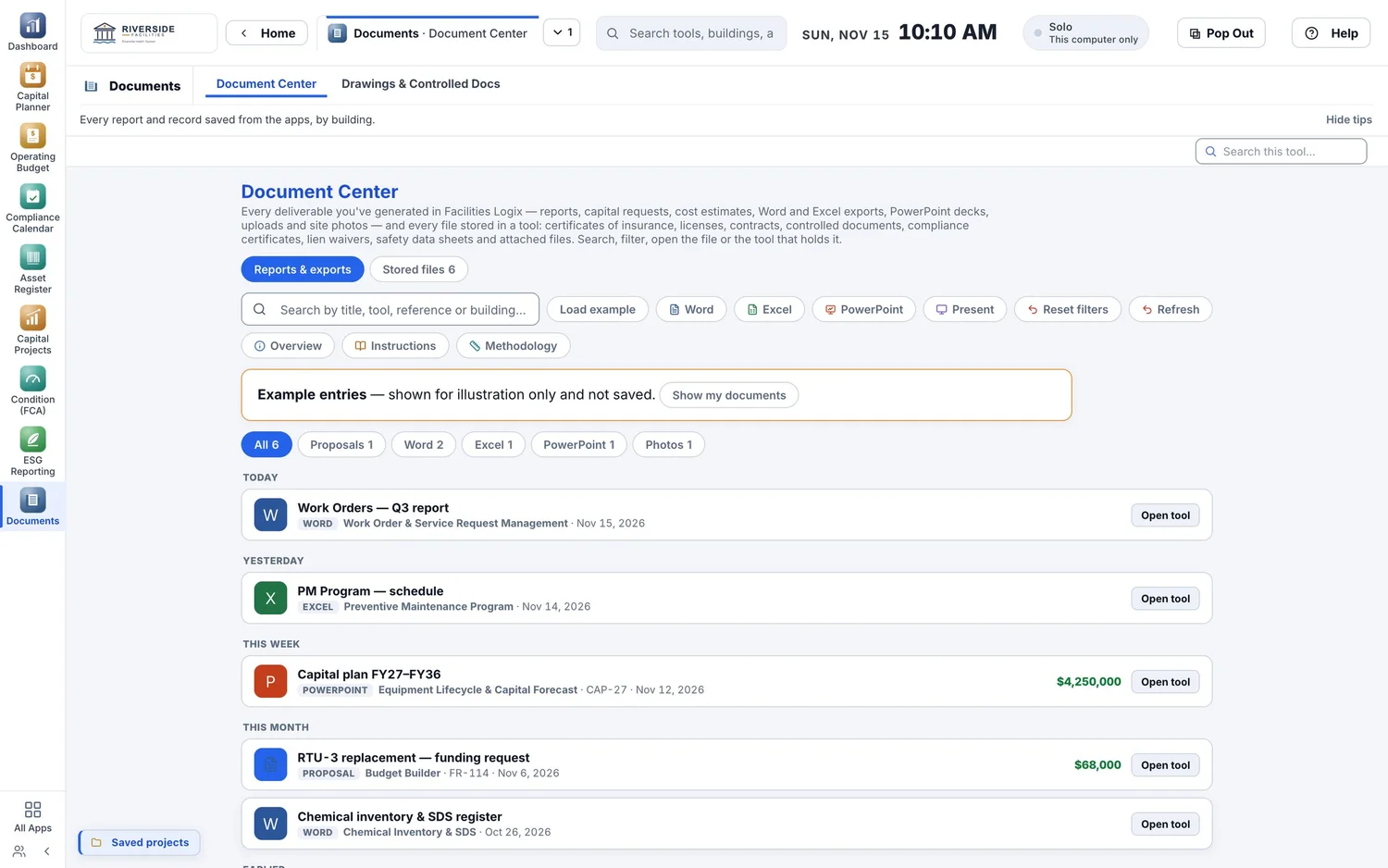
Every report the program makes is kept in one Document Center, grouped by building.
Storage Racks (ANSI MH16.1 and OSHA 1910.176)
- Routine visual checks by staff and periodic inspection by a qualified person, with annual inspection shown as industry practice, and after any impact
- Marked Confirm, because OSHA requires stable, secure storage but sets no interval
Powered Industrial Trucks (29 CFR 1910.178)
- Operator performance evaluation at least every 3 years, with refresher training after an incident
- Each truck examined before use, at least daily, or each shift when used around the clock
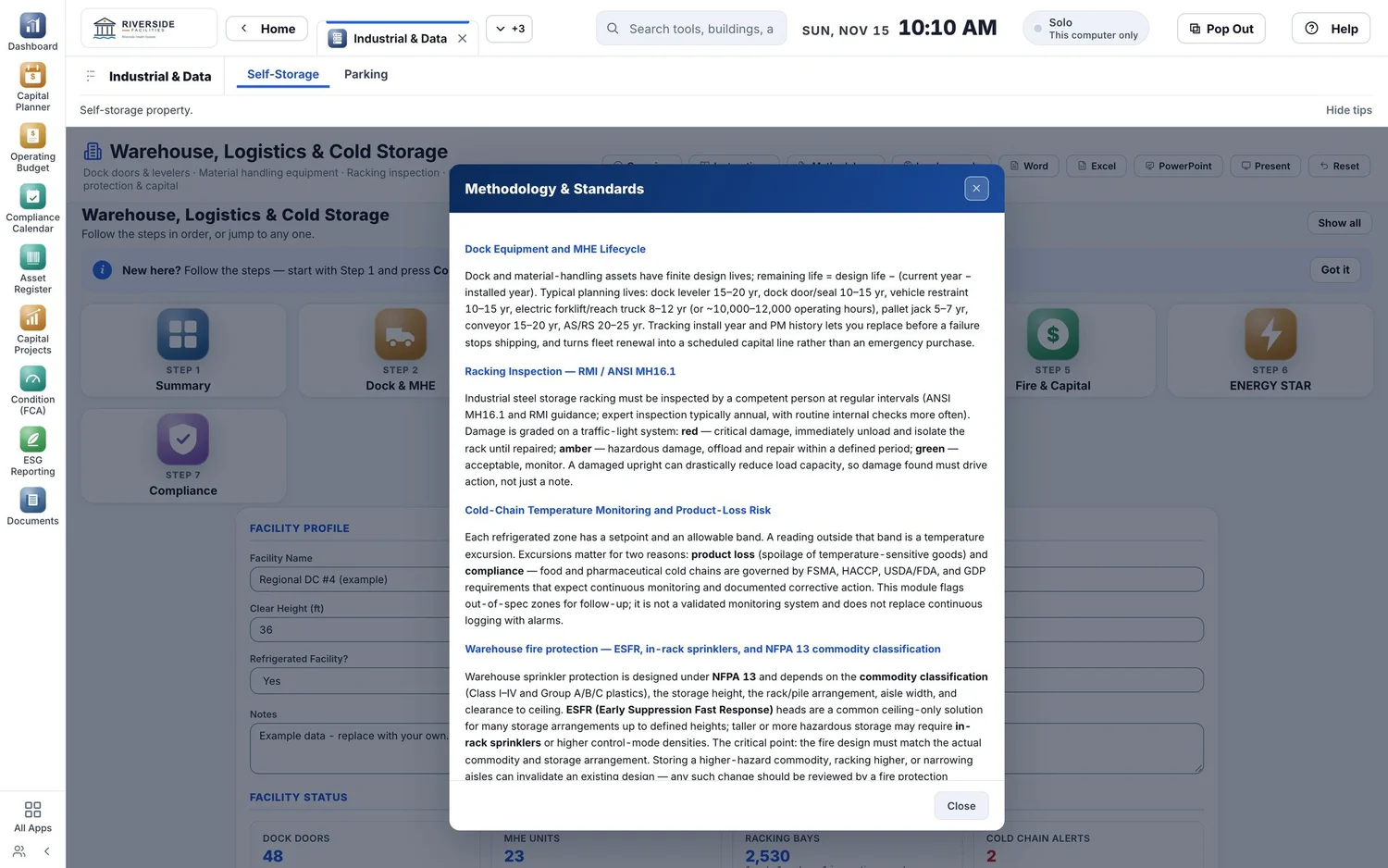
Methodology in Warehouse, Logistics & Cold Storage: the formulas and standards behind every number.
Combustible Dust and Stormwater
- Dust hazard analysis reviewed at least every 5 years where combustible dust is present (NFPA 660)
- Industrial stormwater: quarterly facility inspections and visual assessments, and the annual report by January 30
Sprinklers and Fire Protection (NFPA 13 and NFPA 25)
- The playbook keeps the NFPA 13 point in view: ESFR, in-rack or control-mode design must match the commodity class, storage height, rack arrangement and aisle width, and a change in any of them calls for a fire protection engineer's review
- Sprinkler valve, quarterly and annual inspections and tests come from the building's equipment records
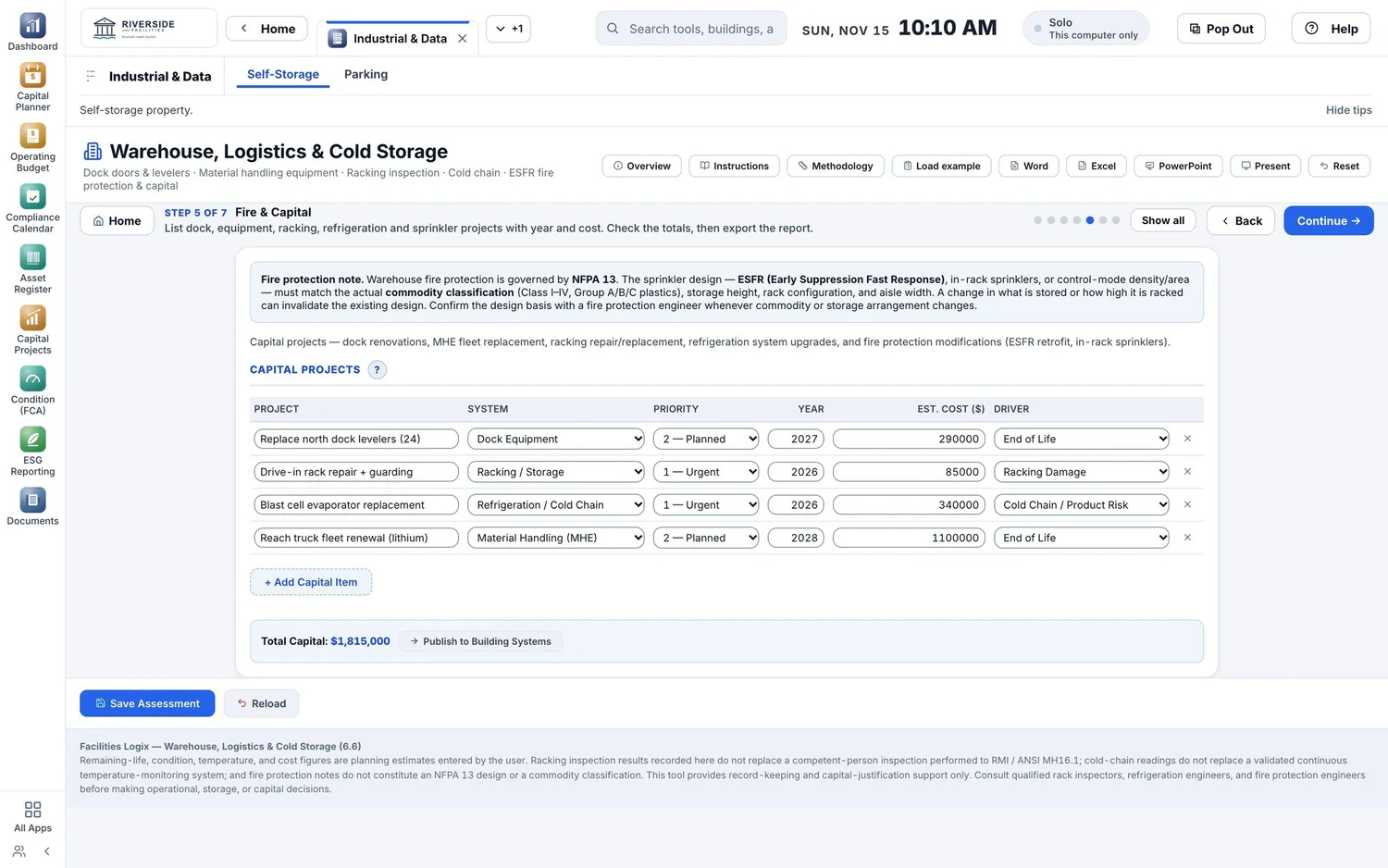
Fire & Capital in Warehouse, Logistics & Cold Storage: list dock, equipment, racking, refrigeration and sprinkler projects with year and cost. Check the totals, then export the report.
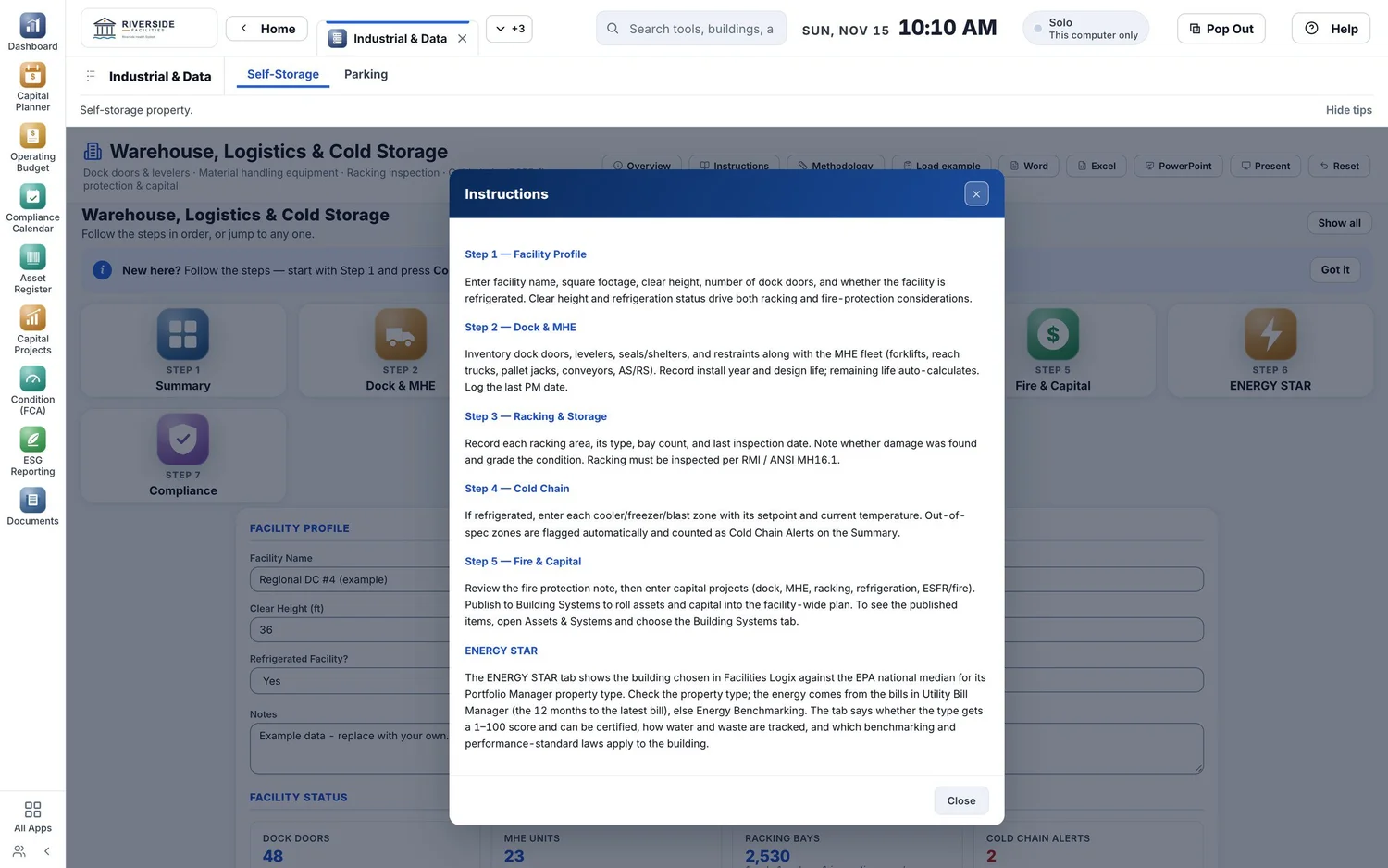
Instructions in Warehouse, Logistics & Cold Storage: how to work through it, step by step.
Four Systems That Set Throughput
Facility Profile
Facility name, total square footage, clear height, number of dock doors and whether the building is refrigerated. Clear height and refrigeration drive both racking and fire protection questions.
Learn MoreShow Less
A few profile facts decide which obligations and energy yardstick apply, so your team tracks what the building needs and nothing it does not.
- Refrigerated: Yes turns on the cold-chain zone checks and alert count
- ENERGY STAR types: non-refrigerated or refrigerated warehouse, distribution center, self-storage
- The declared dock door count prints in the report's facility inputs
- Clear height sits beside the NFPA 13 note on the Fire & Capital tab
Dock Equipment and Lift Trucks
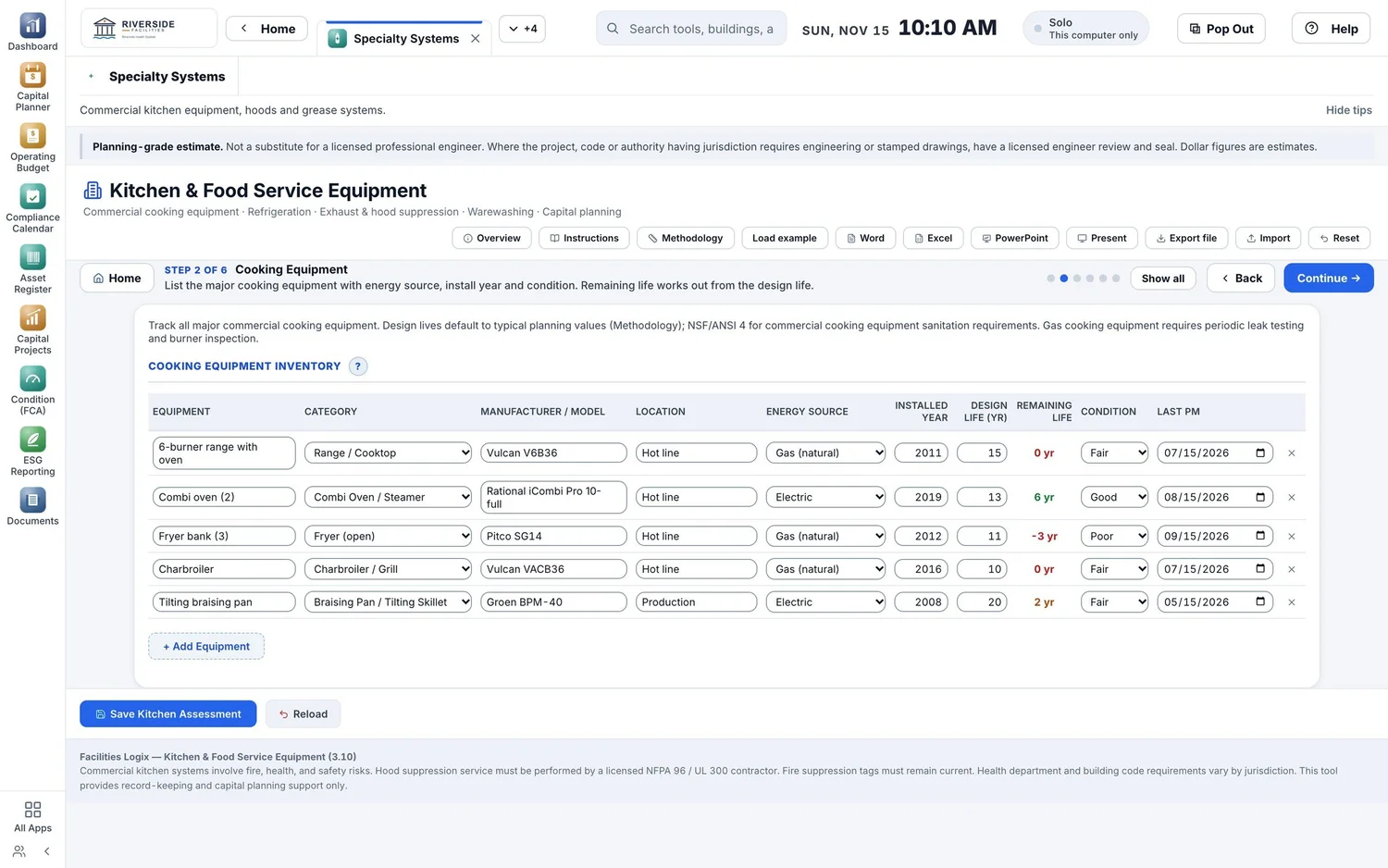
Dock doors, levelers, seals and shelters, vehicle restraints and dock lights and fans, plus forklifts, reach trucks, pallet jacks, conveyors and AS/RS, each with quantity, location, install year, design life, remaining life, last PM and condition.
Learn MoreShow Less
A failed dock door or lift truck stops shipping, and an emergency purchase costs more than one budgeted in advance. Each asset shows how much life it has left.
- Remaining life shows in years, or in red as years past life
- Last PM is kept by month for each asset row
- The report counts units at or past design life and plans their replacement
- Published assets carry quantity, location, design life and last PM
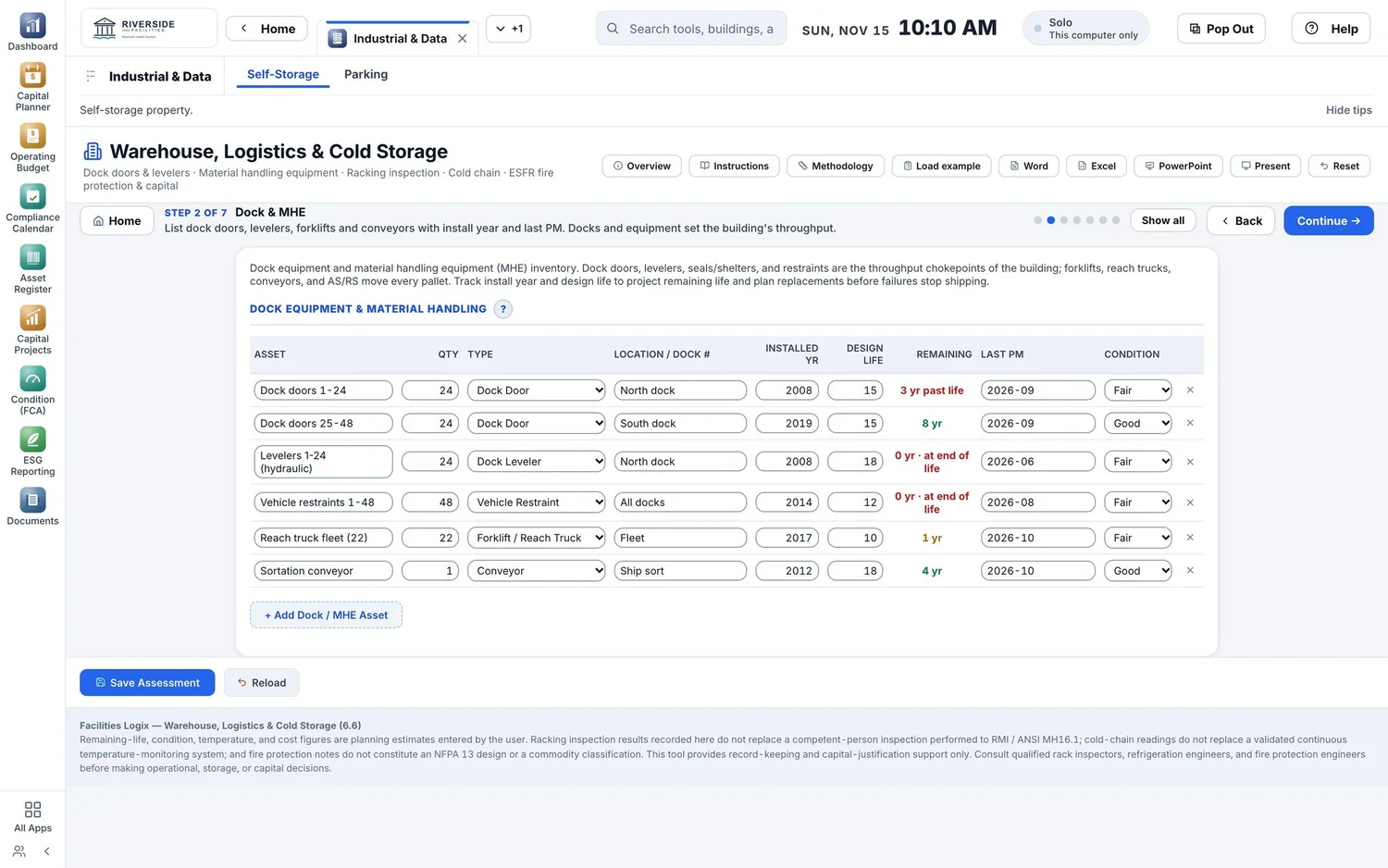
Dock & MHE in Warehouse, Logistics & Cold Storage: list dock doors, levelers, forklifts and conveyors with install year and last PM. Docks and equipment set the building's throughput.
Planning Lives
Dock leveler 15-20 years, dock door and seal 10-15, restraint 10-15, electric forklift and reach truck 8-12 (or about 10,000-12,000 hours), pallet jack 5-7, conveyor 15-20, AS/RS 20-25. Zero or negative remaining life marks a replacement candidate.
Learn MoreShow Less
Typical lives give a starting point for the replacement budget before a dock or truck fails, so capital is spread over the years instead of arriving all at once.
- Remaining life = design life less the years since install
- Lives draw on ASHRAE and RSMeans references
- Each row's design life can be changed to match your own experience
- Assets past life become capital lines with priority, year and cost
Racking
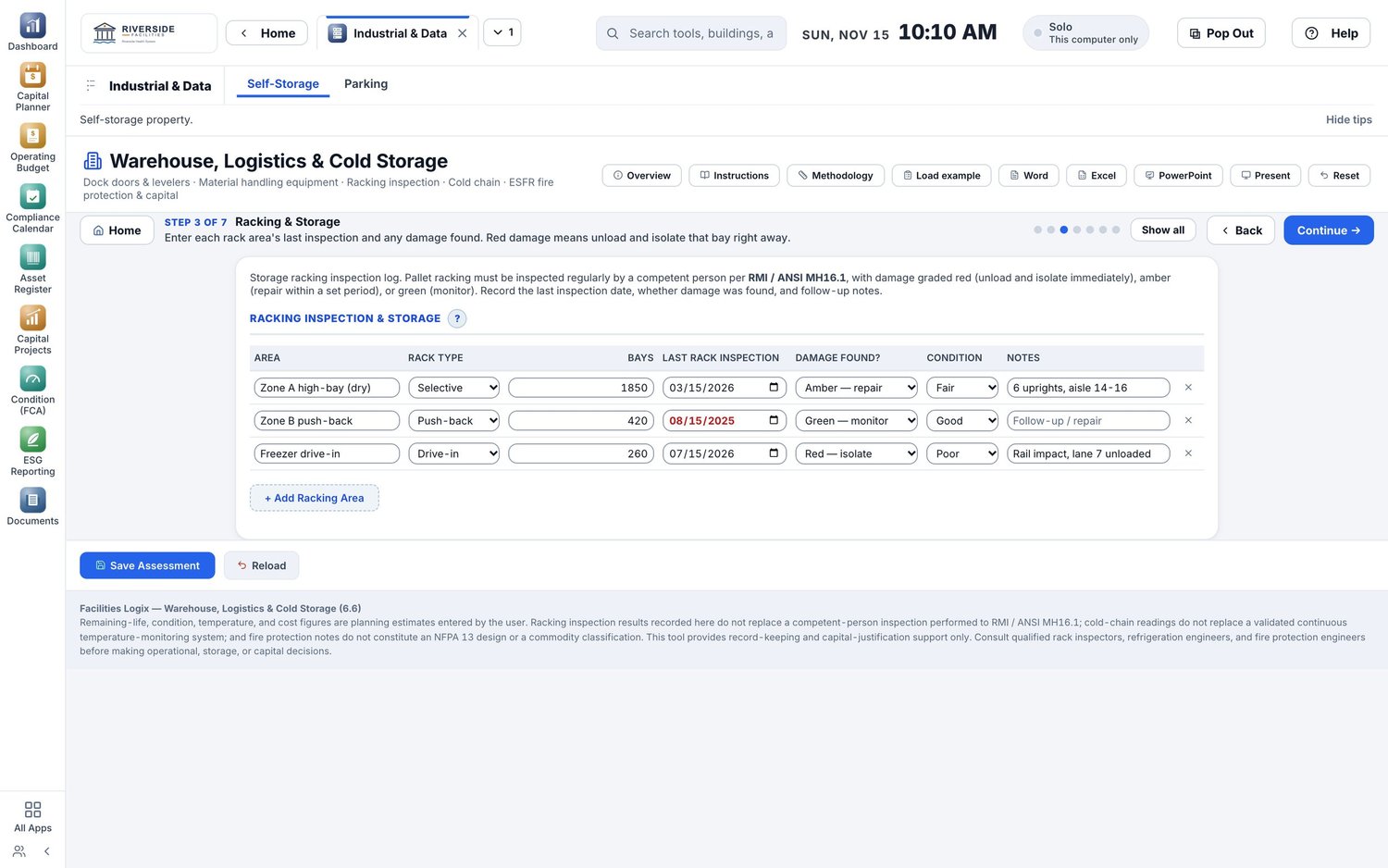
Each rack area with its type (selective, drive-in, push-back, pallet flow, cantilever or mezzanine), bay count, last inspection, damage found and condition.
Learn MoreShow Less
A rack failure can destroy product and injure people; repairing damage on schedule costs far less. Each area keeps its inspection record and grade.
- Damage choices: none, green to monitor, amber to repair, red to isolate
- Condition rated Good, Fair, Poor or Critical
- Bay counts add up to the racking bays on the Summary
- Red and amber areas are counted in the report
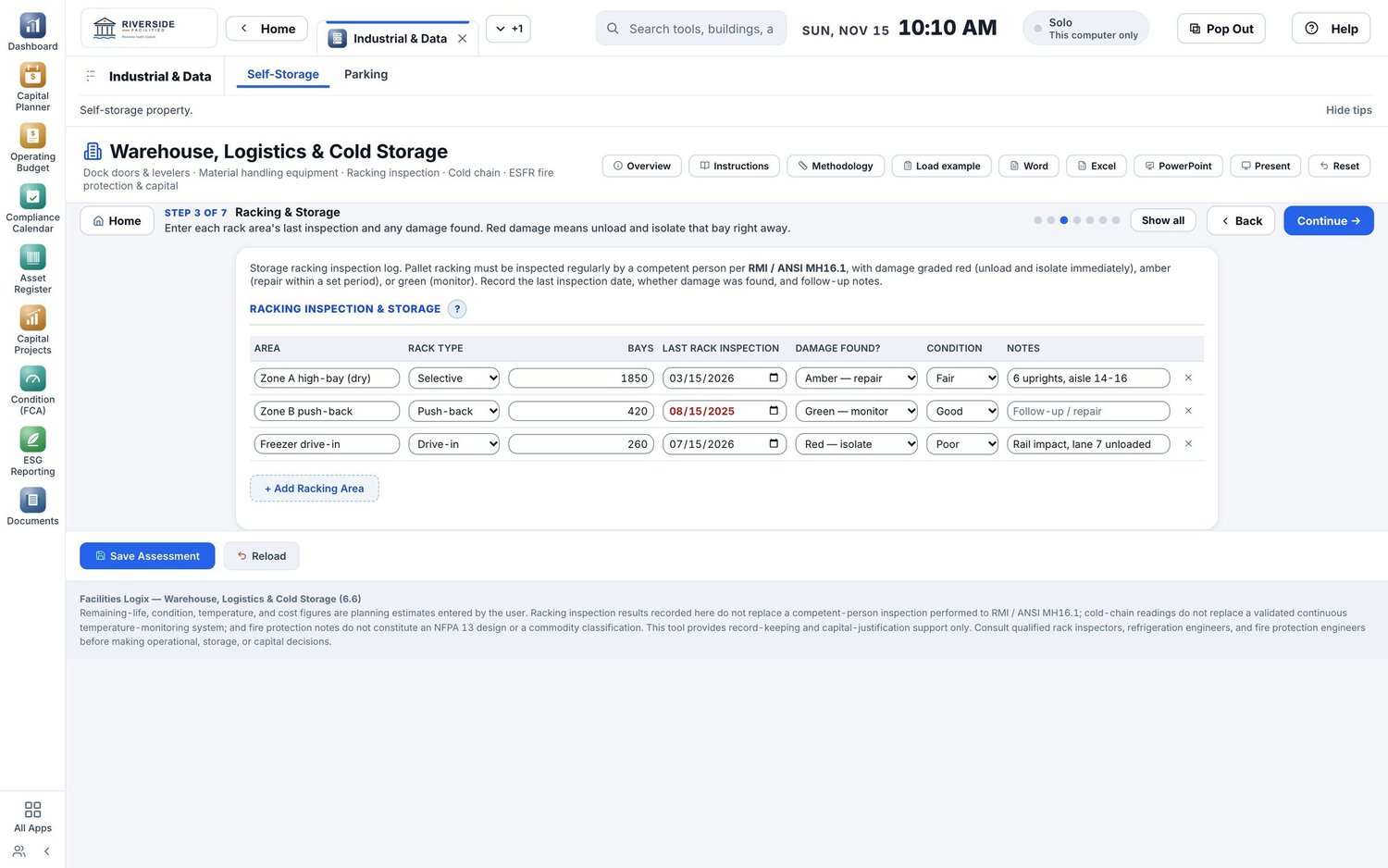
Racking & Storage in Warehouse, Logistics & Cold Storage: enter each rack area's last inspection and any damage found. Red damage means unload and isolate that bay right away.
Cold Zones
Each cooler, freezer and blast zone with setpoint, current temperature, allowed band, the refrigeration system that serves it, last PM and condition.
Learn MoreShow Less
A cold-chain excursion means spoiled product and a compliance event under food and drug rules. Spot readings make sure each one gets corrective action.
- Cooler, freezer and blast zones, with freezer readings below zero handled correctly
- Hover an out-of-spec flag to see why, such as degrees off setpoint
- Excursions post to Building Systems as code and regulatory deficiencies
- FSMA, HACCP, USDA/FDA and GDP named as the rules that apply
Capital Projects
Dock renovation, lift-truck fleet replacement, racking repair, refrigeration upgrades and fire protection work such as ESFR retrofit or in-rack sprinklers, with priority, year, cost and driver. Publish to Building Systems rolls them into the facility-wide plan.
Learn More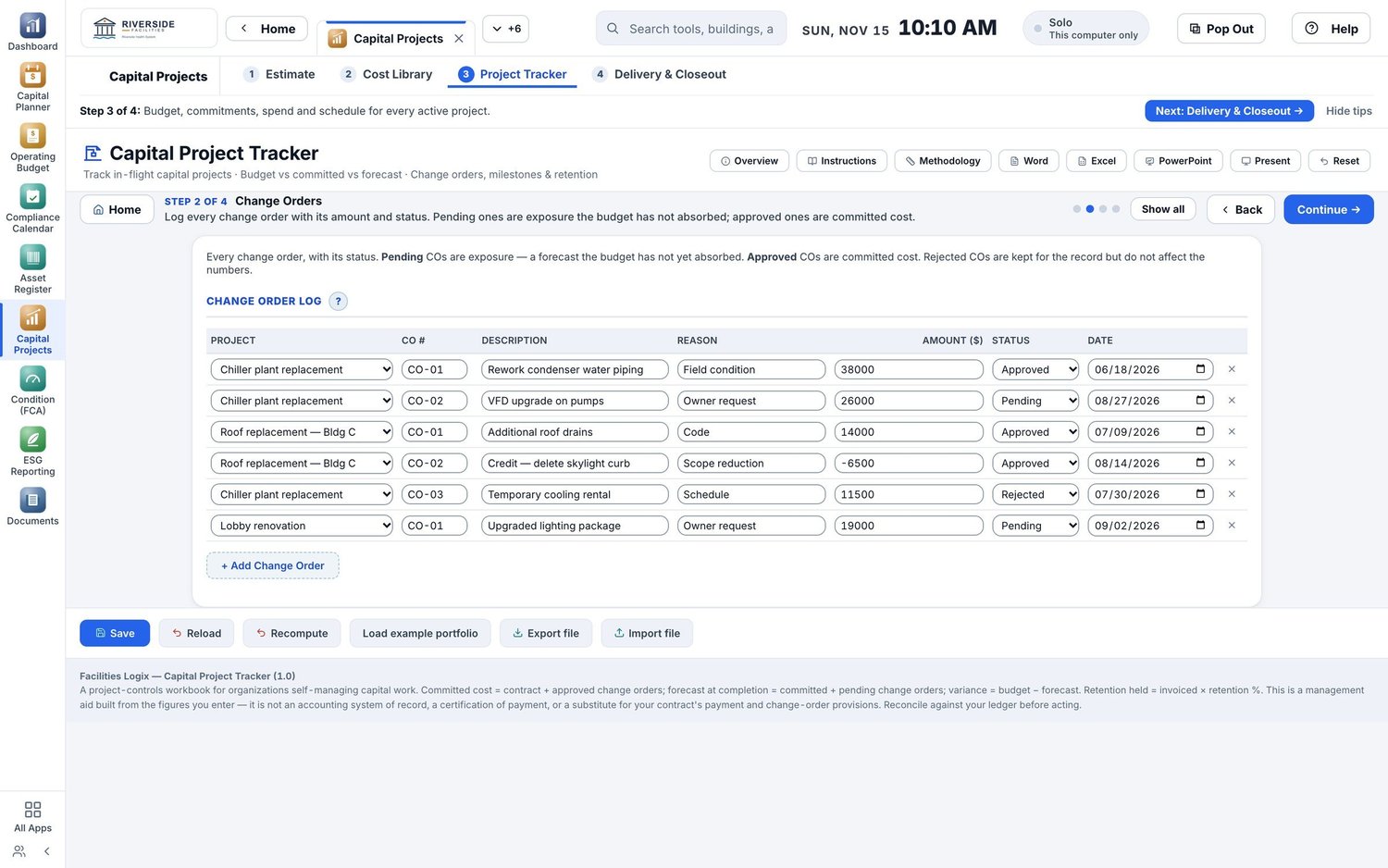
Change Orders in Capital Project Tracker: log every change order with its amount and status. Pending ones are exposure the budget has not absorbed; approved ones are committed cost.
Rack Damage and Cold-Room Excursions, Flagged
Rack Inspection Log
- Damage graded red (unload and isolate the bay at once), amber (offload and repair within a set period) or green (monitor)
- Red and amber areas counted on the Summary
- Any area with no inspection in the last 12 months, or none recorded, shown overdue
Cold-Chain Spot Checks
- A zone is out of spec when it reads outside its allowed band from setpoint (±5 °F if the band is left blank)
- A cooler above 41 °F (FDA Food Code cold holding) or a freezer or blast zone above 0 °F is flagged regardless of the band
- Out-of-spec zones counted as Cold Chain Alerts, each traceable to the refrigeration system that serves it
- A spot-check aid alongside your continuous monitoring system, not a replacement for it
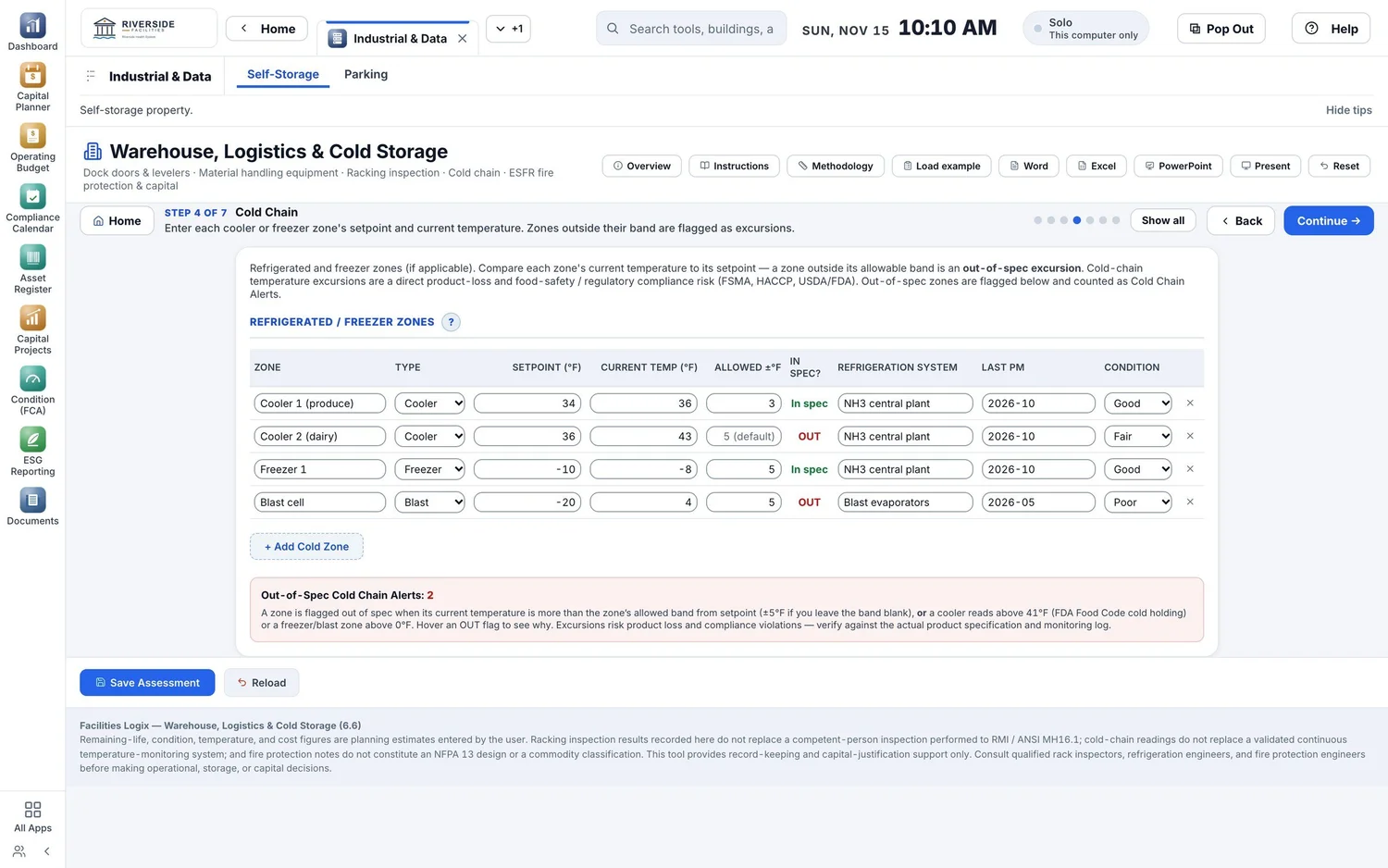
Cold Chain in Warehouse, Logistics & Cold Storage: enter each cooler or freezer zone's setpoint and current temperature. Zones outside their band are flagged as excursions.
Live Monitoring
- A walk-in cooler template (FDA Food Code) and refrigeration, pump and meter templates with starting limits you set
- An out-of-limit reading becomes a numbered work order with the readings and a trend chart; Facilities Logix never commands a controller
Refrigeration Sizing and Refrigerant Check
- The Refrigeration and Low-Temp tool sizes walk-in, case and process loads and selects the rack
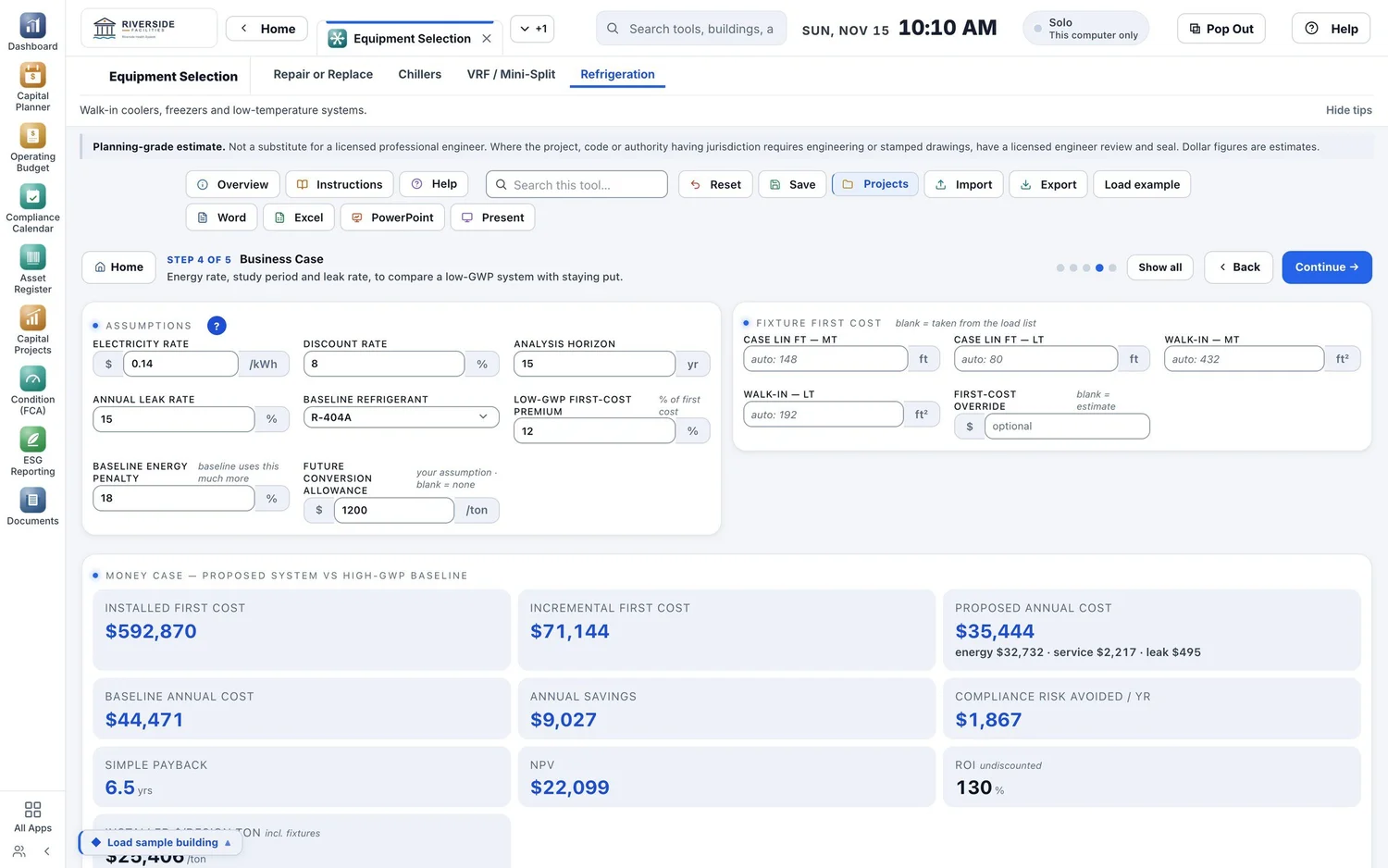
- Its compliance step checks a planned refrigerant against EPA's GWP limit for new systems in its sub-sector, the federal leak-repair rule and the 1,500 lb leak-detection trigger
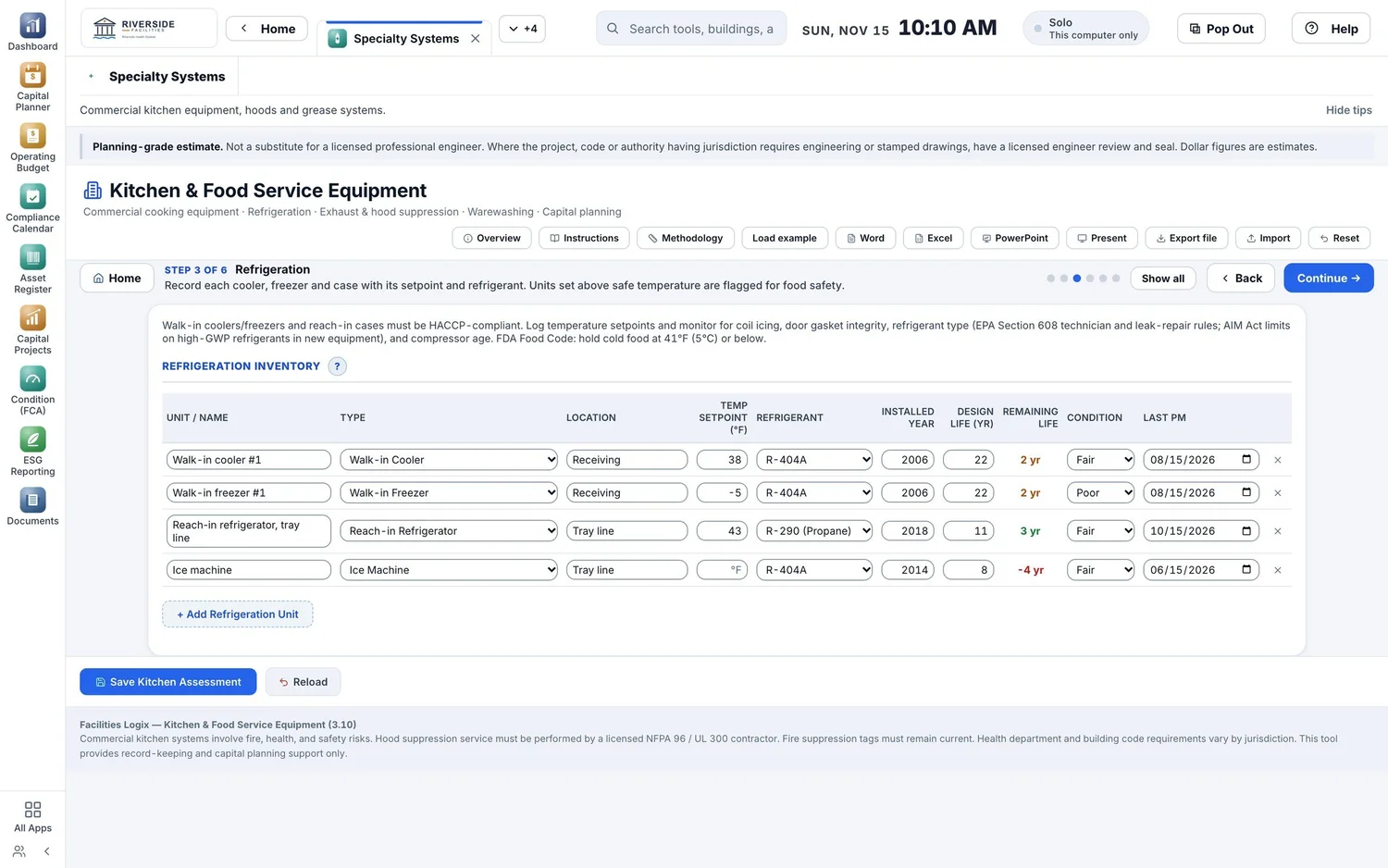
Refrigeration in Kitchen & Food Service Equipment: record each cooler, freezer and case with its setpoint and refrigerant. Units set above safe temperature are flagged for food safety.
Ready for the Fire Marshal and the Food Safety Audit
Facility Status
Dock doors, lift-truck units, racking bays and cold-chain alerts on the Summary tab.
Learn MoreShow Less
Fire marshals and food auditors ask for status on the spot. The Summary turns the tabs into one ranked to-do list leadership can act on.
- First: bring zones that are out of range back into temperature
- Then keep red-tagged racks unloaded and complete overdue inspections
- Then plan replacement of docks and trucks at or past design life
- The capital plan total closes the line
Word, Excel, PowerPoint and Present
The inventory, rack log, cold zones and capital plan export to Word, Excel and PowerPoint, or show full screen with Present.
Learn MoreShow Less
A Distribution Center Briefing replaces hours of assembling status for leadership or an auditor, built from the same tabs your team already keeps.
- Key figures: cold-chain excursions by zone, red and amber areas, units past life, capital plan
- States its assumptions: the 41 °F and 0 °F limits and annual rack inspections
- The Compliance tab's obligations and overdue items are added as sections
- The sprinkler note is stated as a narrative check, not a design
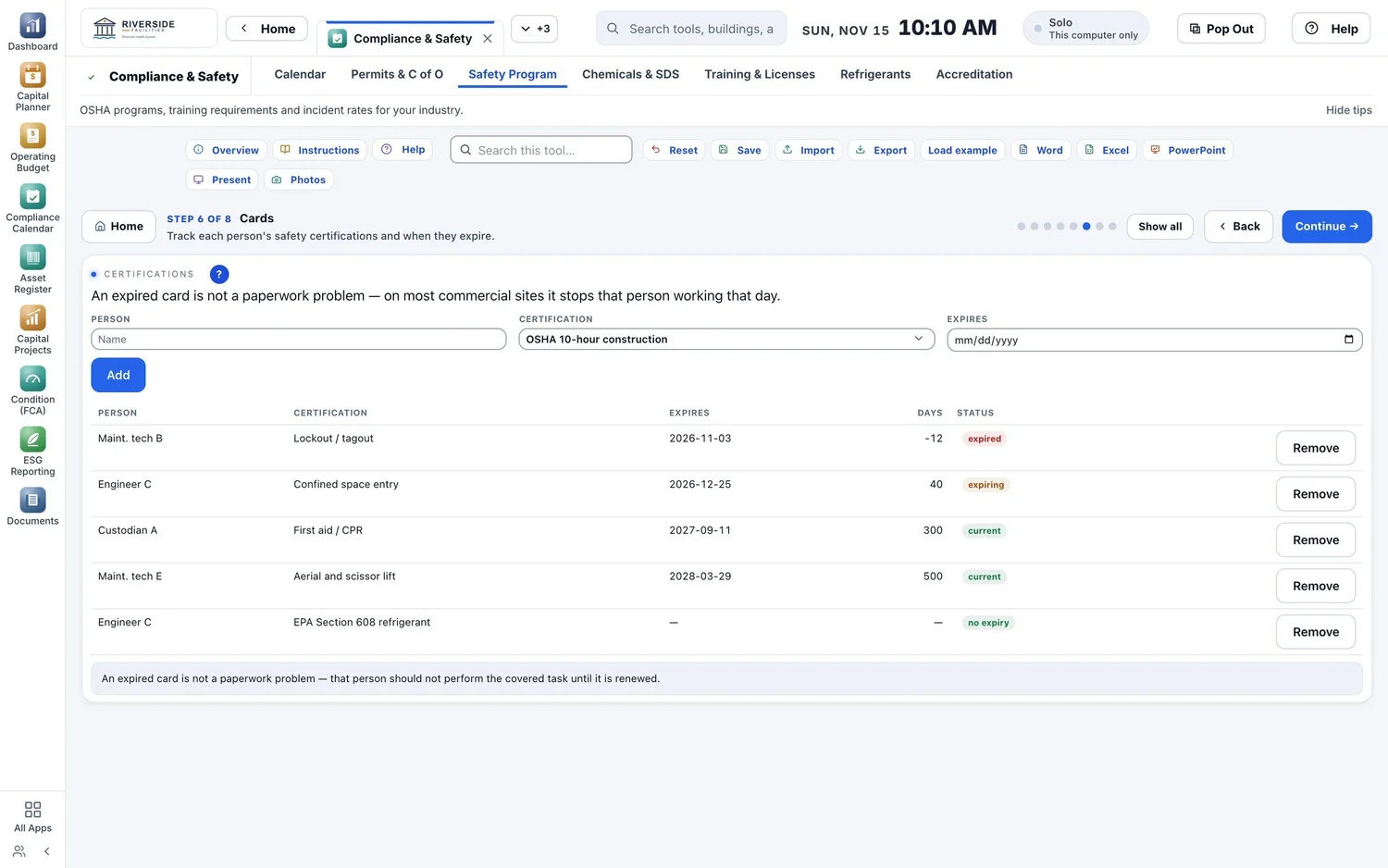
Cards in Safety & Compliance: track each person's safety certifications and when they expire.
ENERGY STAR Tab
Warehouses and distribution centers get a 1-100 ENERGY STAR score and can earn ENERGY STAR certification, refrigerated warehouses too. The energy comes from the bills, compared with the national median, with the benchmarking laws that apply.
Learn MoreShow Less
Refrigeration makes cold storage one of the most energy-hungry building types, so knowing where it stands shows where savings are worth chasing. Medians differ widely by type.
- Warehouses and distribution centers are compared with a national median of 52.9 kBtu per sf source
- Refrigerated warehouses are compared with 235.6 kBtu per sf source
- Self-storage gets no U.S. score; it is scored in Canada only
- Lists the benchmarking and performance-standard laws that apply
Compliance Tab
Every warehouse and cold-storage obligation that applies, why it applies, its citation, frequency, last done and next due.
Learn More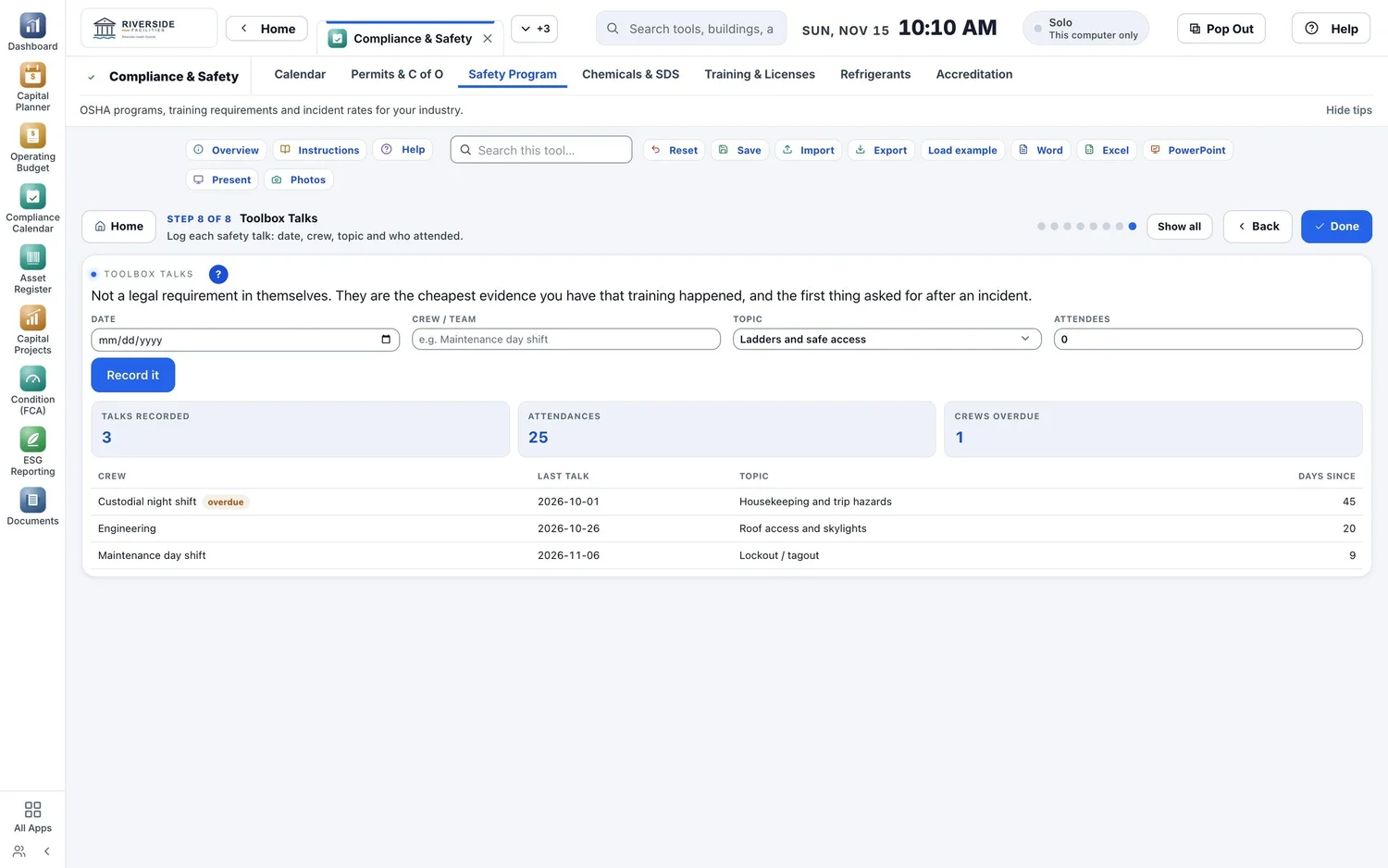
Toolbox Talks in Safety & Compliance: log each safety talk: date, crew, topic and who attended.
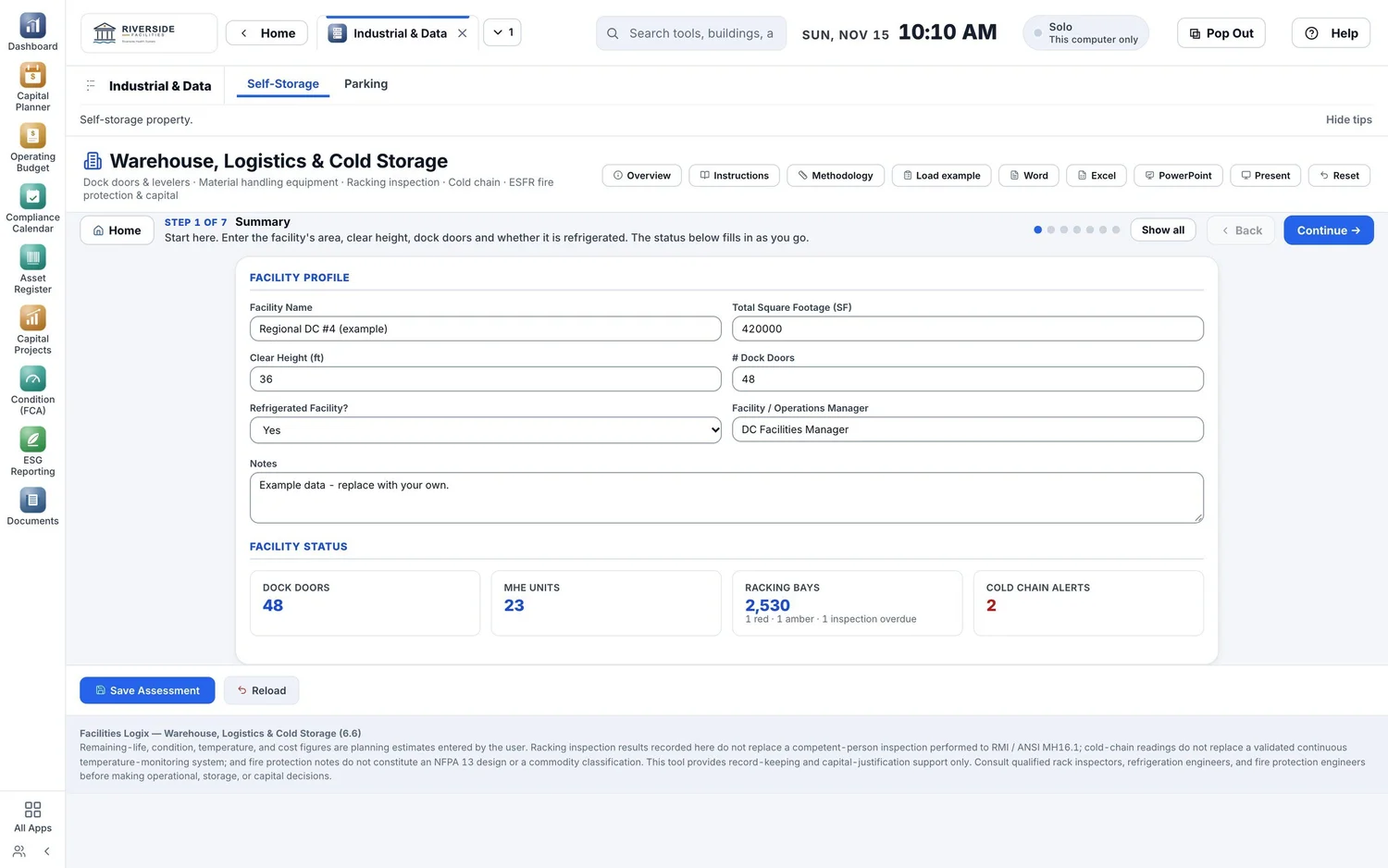
Fire marshals and food auditors ask for status at once, so the summary shows docks, trucks, racking and cold chain.
The Signals That Shipping Is at Risk
From the Playbook
- Remaining life = design life less age, for every dock and lift-truck asset
- Red, amber and overdue rack areas
- Cold-chain alerts by zone
- Total capital by system and driver
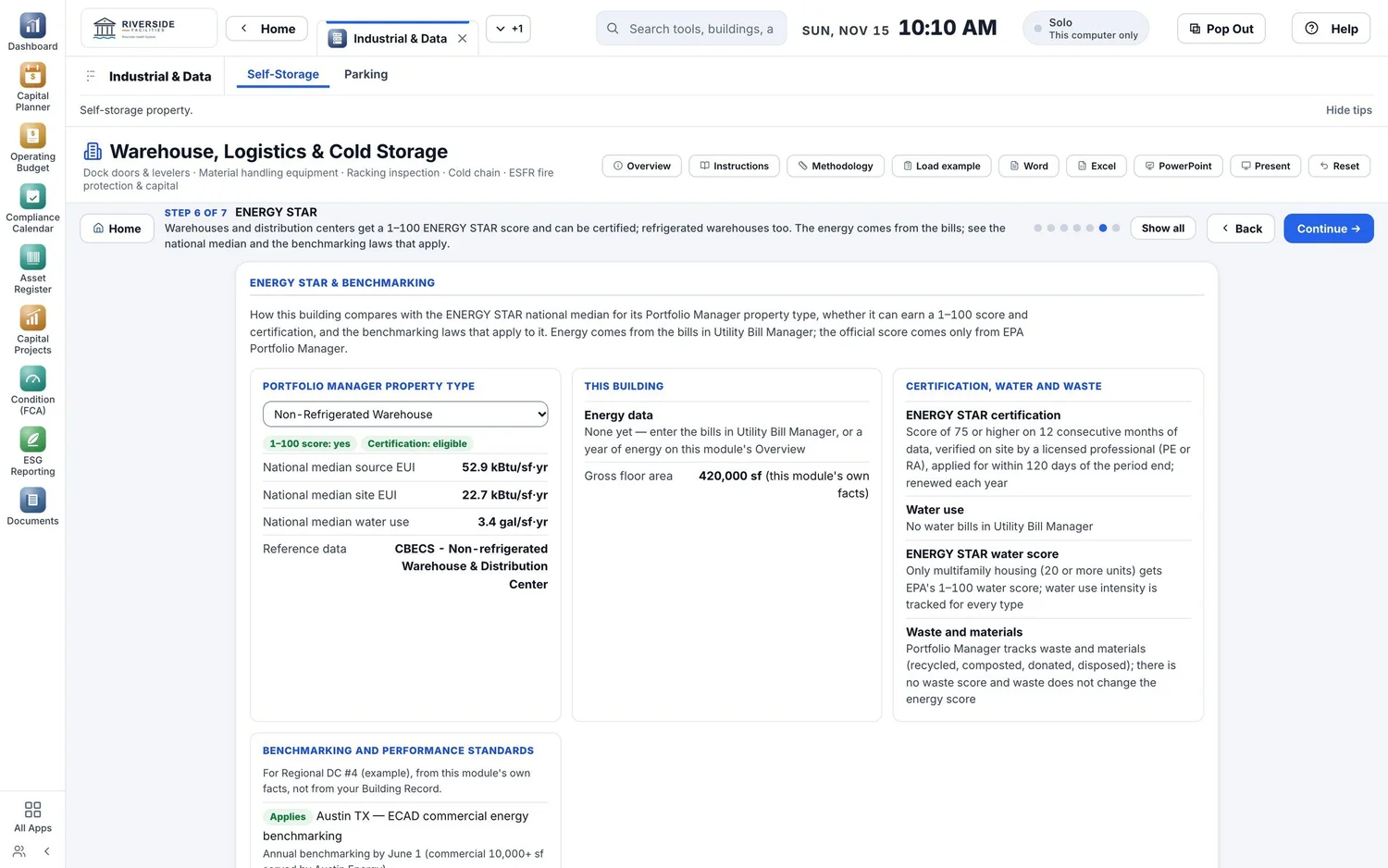
ENERGY STAR in Warehouse, Logistics & Cold Storage: warehouses and distribution centers get a 1–100 ENERGY STAR score and can be certified; refrigerated warehouses too. The energy comes from the bills; see the national median and the benchmarking laws that apply.
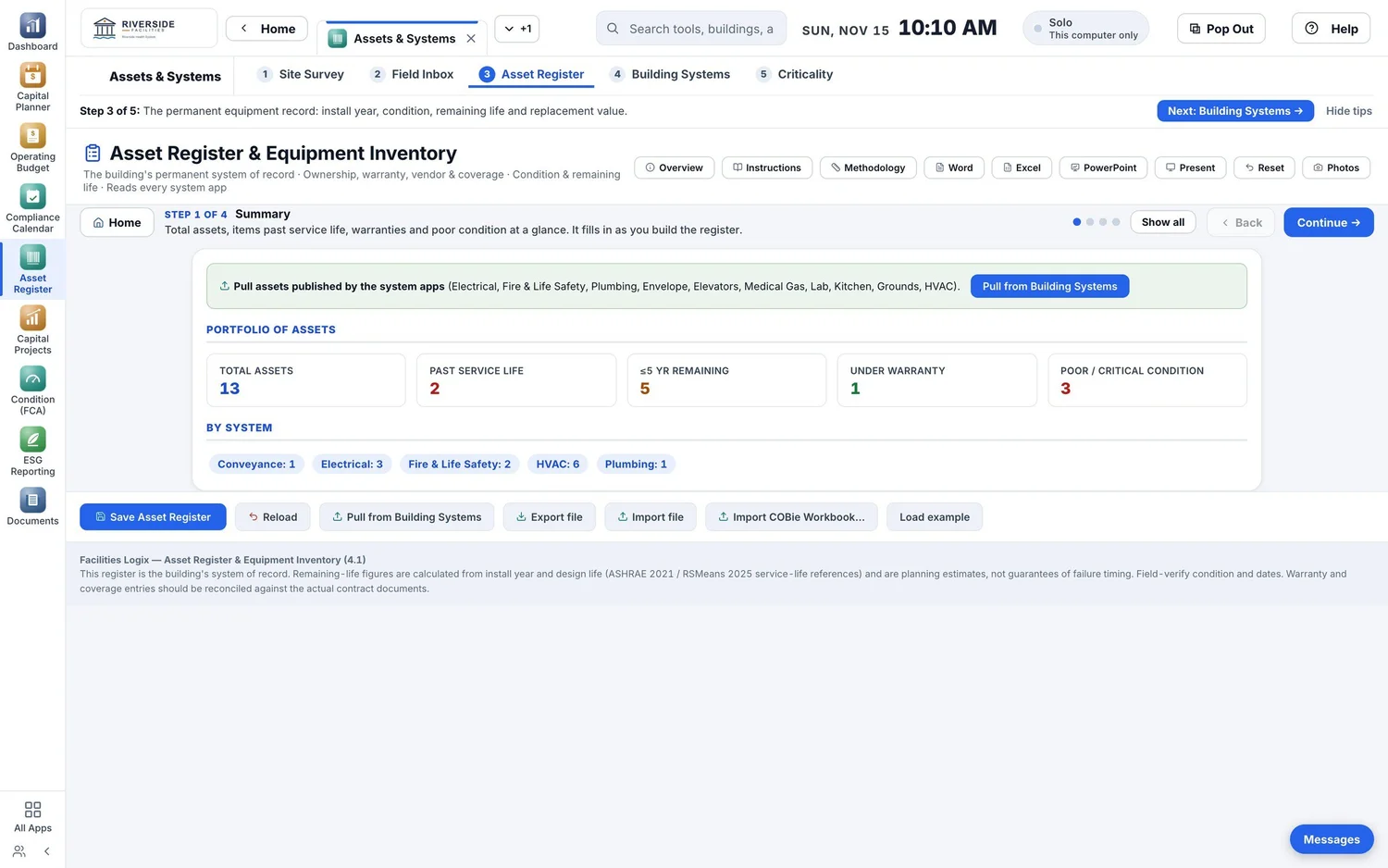
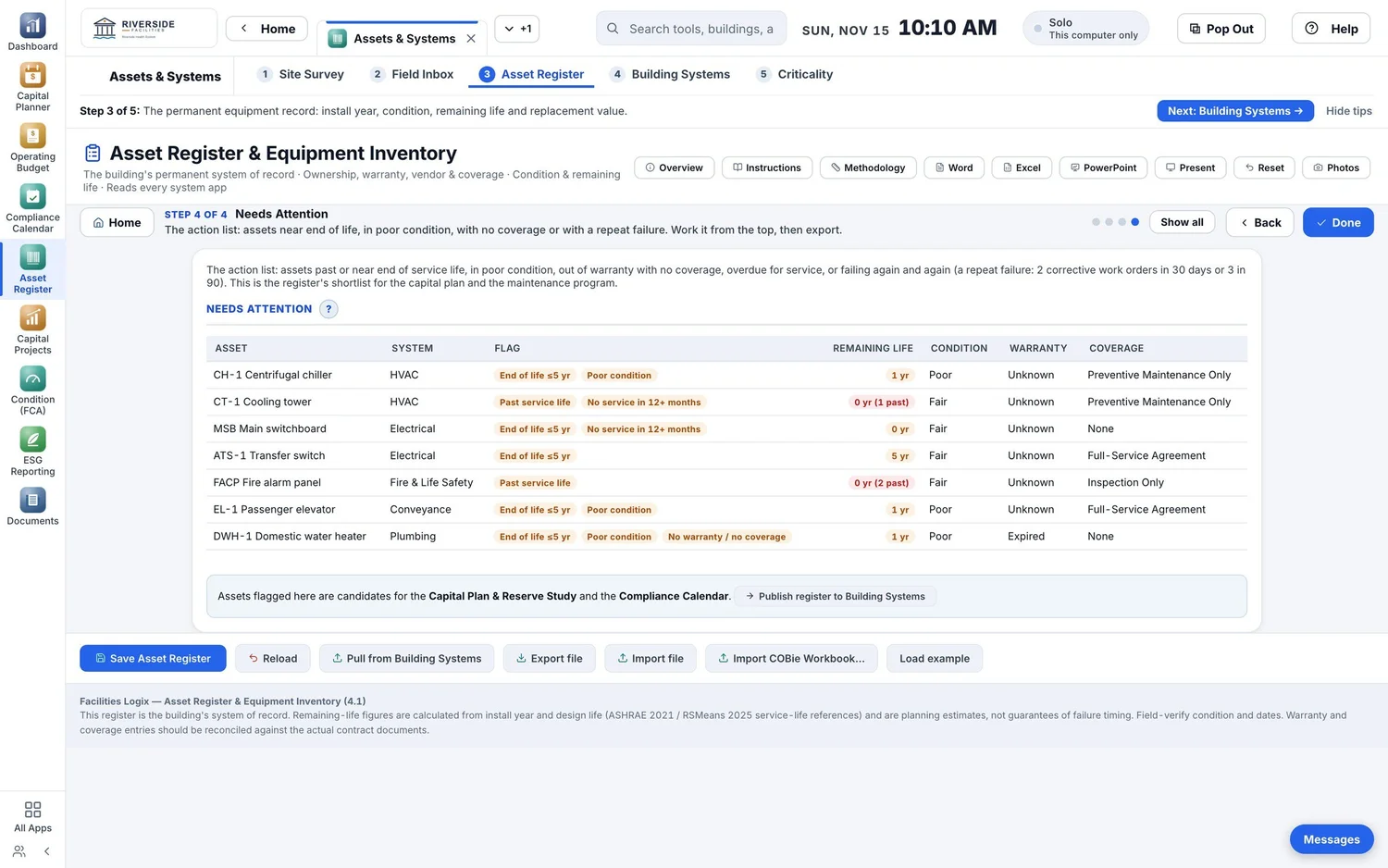
Replace Before It Stops Shipping
Fleet Renewal as a Plan
Install years and design lives turn dock and lift-truck replacements into scheduled capital lines rather than emergency purchases.
Learn MoreShow Less
Scheduling fleet and dock replacement spreads capital over the years instead of forcing emergency purchases. Each project carries the reason it is needed.
- Systems: dock, lift trucks, racking, refrigeration, ESFR fire protection, envelope
- Drivers include end of life, safety or code, racking damage and product risk
- Each line gets a priority, from urgent to future
- Publish rolls each line into the portfolio's capital list with its driver
Damage That Drives Action
A damaged upright can sharply cut load capacity. Grading damage and showing overdue areas keeps a finding from sitting as a note.
Learn MoreShow Less
Racking damage left as a note becomes a collapse, lost product or an injury claim. Publishing turns each finding into a tracked deficiency with an owner.
- Red damage posts as a life safety deficiency
- Amber damage posts as a maintenance deficiency
- Racking damage is its own capital driver for repair or replacement
- The record supports, not replaces, the competent-person inspection
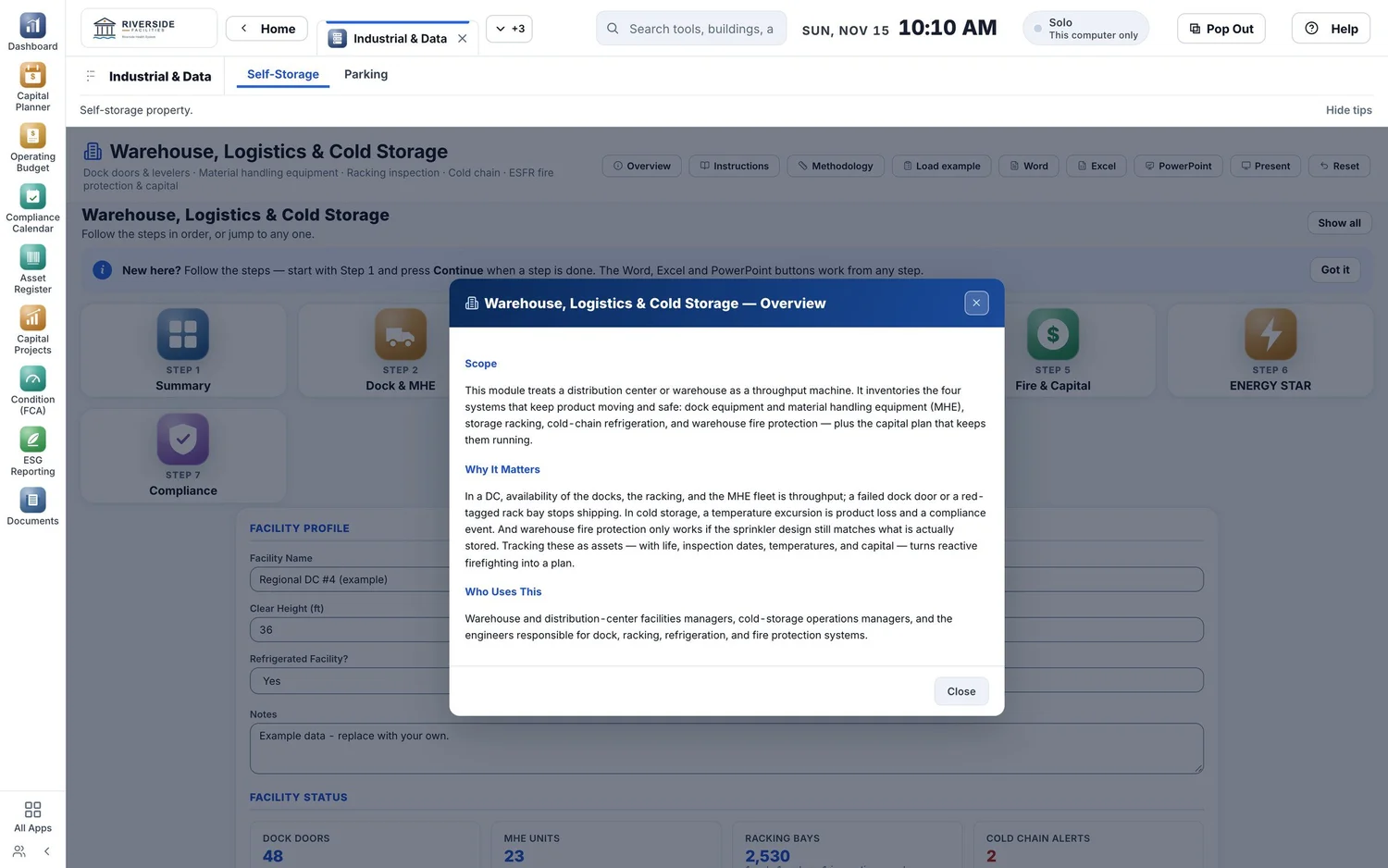
Overview in Warehouse, Logistics & Cold Storage: its scope, why it matters and who uses it.
Product Protected
Zones outside their band are flagged and traced to their equipment, so excursions get corrective action.
Learn MoreShow Less
Spoiled product is lost money, and an undocumented excursion can fail an audit. Each flag points to the refrigeration system behind it, so repairs start in the right place.
- The report's first action is bringing named zones back into range
- Each zone keeps its refrigeration system, last PM and condition
- Each zone stays a Cold Chain Alert on the Summary until it reads in range
- Keep your continuous logging; this supports it
Inspections on Time
Ammonia inspections, leak detection audits, permits and operator evaluations each carry a date instead of living in separate files.
Learn MoreShow Less
A lapsed permit or missed ammonia inspection can bring fines or a shutdown order. Each date is kept once and shared with the Compliance Calendar.
- Leak detection records are kept 3 years; ammonia inspection records 5
- A high-piled storage permit lasts for the period stated on it
- Rows waiting on a fact are asked as questions until answered
- Due soon means within 30 days; overdue items are counted in the report
Frequently Asked Questions
Does the rack log replace a qualified rack inspection?
Is the cold-chain check a validated temperature monitoring system?
Does it tell us whether our sprinklers fit what we store?
Can a cold storage building get an ENERGY STAR score?
Be First When Facilities Logix Opens
Stop chasing building records across spreadsheets and binders. Join the list and we will tell you the day downloads open, with setup guides ready.
Launching early 2027 for Facilities Logix. Nothing to buy today, and no sales calls.
