
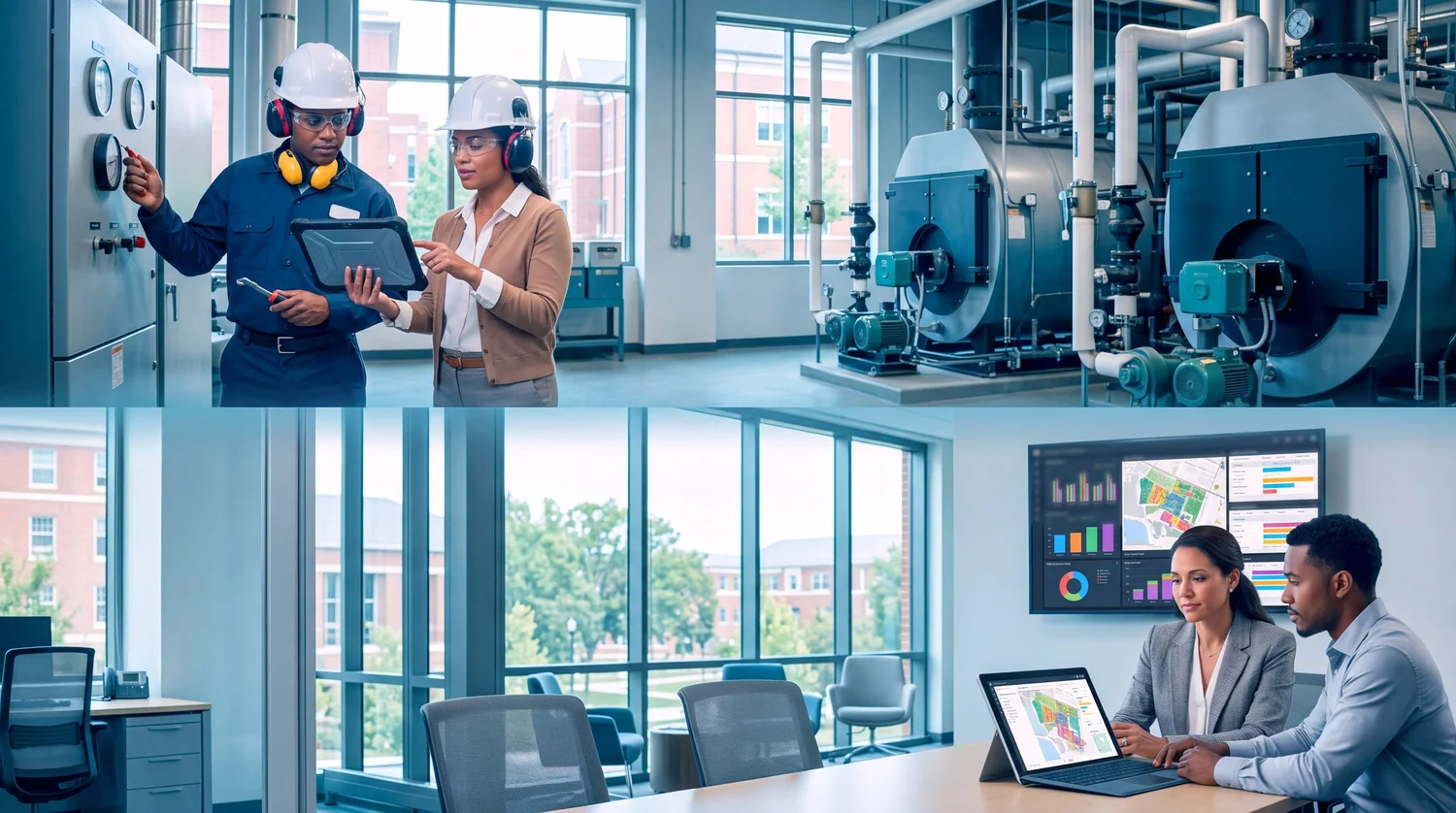

Higher Education: Universities, College Campuses and Student Housing
Launching Early 2027 · Join the Early-Access List
A campus backlog grows building by building while Clery, drill and lab dates sit in separate offices, and trustees fund only the renewal case that has numbers behind it. Three playbooks cover it: University for the campus portfolio and its backlog, Student Housing for residence halls, and Central Utility Plant for the plant and its distribution loop.
Campus Rules from the Compliance Library
Each playbook's Compliance tab lists the library obligations that apply to the building, why each applies, its citation, frequency and next due date, matching the Compliance Calendar. Rows that depend on a feature, such as a fume hood or a pool, apply only when the building has it.
Campus Safety and Housing
- The Clery Act Annual Security Report and Annual Fire Safety Report (34 CFR 668.46 and 668.49), distributed by October 1 each year; the fire log records each on-campus housing fire within 2 business days and keeps the last 60 days open to the public; the fire safety report counts the fire drills held the year before
- Residence hall fire drills: the International Fire Code (IFC) calls for 4 drills a year with all occupants in college and university housing, and NFPA 101 requires regular drills
- Smoke and carbon monoxide alarms in each unit tested every year, smoke alarms replaced 10 years from manufacture (NFPA 72)
- Fair Housing Act design and construction requirements for buildings first occupied after March 13, 1991
- Lead-based paint disclosure at lease for housing built before 1978, and the HUD Lead Safe Housing Rule visual assessment every 12 months where the housing receives HUD assistance
Research and Teaching Labs
- Laboratory fume hood performance testing (ANSI/ASSP Z9.5) at least once a year and after significant changes
- Biosafety cabinet field certification (NSF/ANSI 49) at installation, at least once a year and after relocation, filter change or internal repair
- The Institutional Biosafety Committee's annual report to the National Institutes of Health (NIH) for recombinant or synthetic nucleic acid research
- Radioactive sealed source leak tests at intervals not over 6 months, with a physical inventory every 6 months (10 CFR 35.67 and license conditions)
- The chemical hygiene plan reviewed at least once a year (29 CFR 1910.1450) and the bloodborne pathogens exposure control plan reviewed at least once a year (29 CFR 1910.1030)
- Radiation-producing machine registration and inspection under the state radiation control program; the library's interval detail is written for Texas (25 TAC 289)
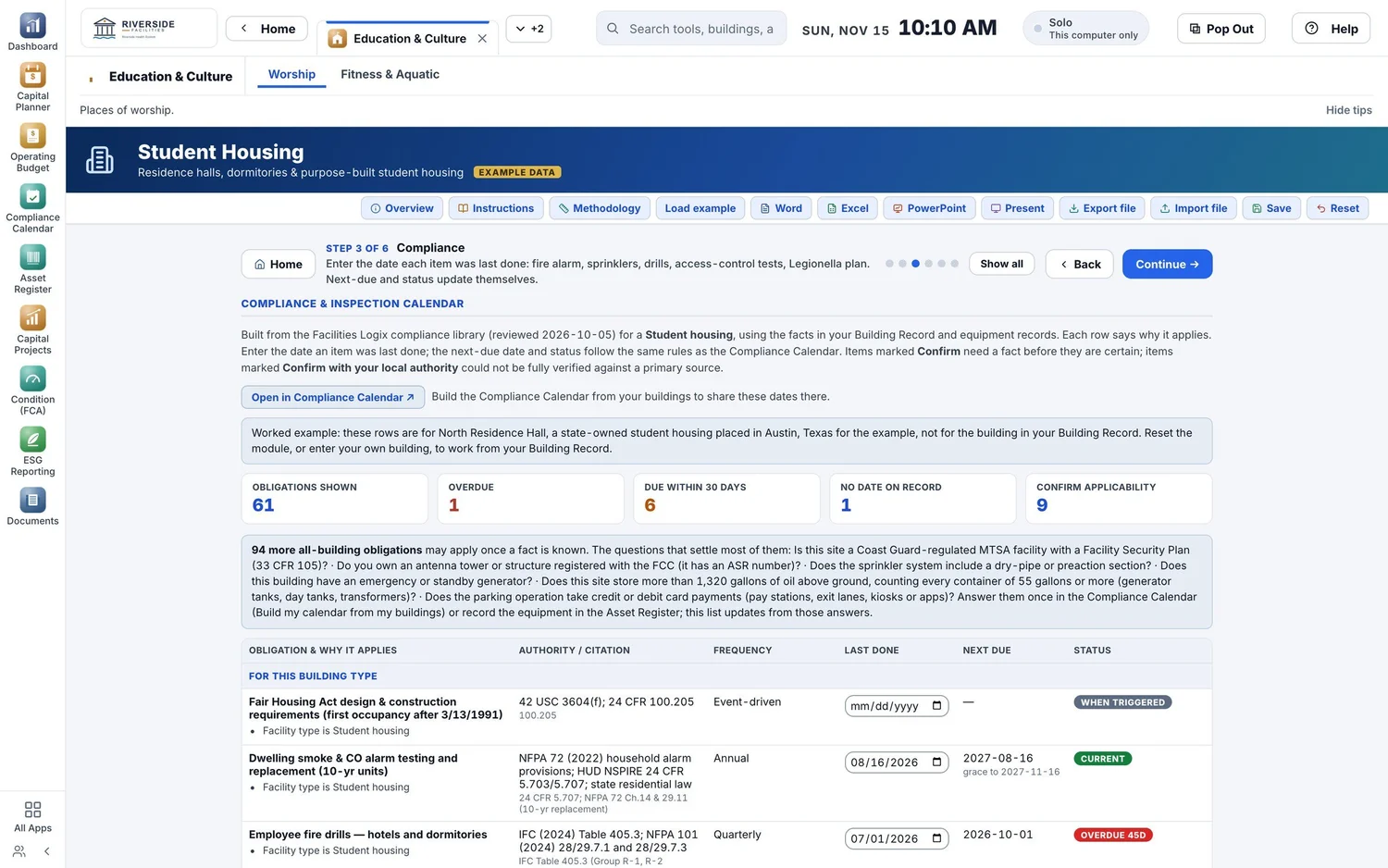
Compliance in Student Housing: enter the date each item was last done: fire alarm, sprinklers, drills, access-control tests, Legionella plan. Next-due and status update themselves.
Athletics, Recreation and Events
- Bleacher and grandstand inspection under ICC 300, at least once a year
- Stage rigging inspection under ANSI E1.47: Level 1 every year and Level 2 at least every 5 years
- Per-event permits under the IFC for pyrotechnic special effects and for tents and temporary structures
- Pools: drain covers verified every year under the Virginia Graeme Baker Pool and Spa Safety Act; chemistry tested and logged under the CDC Model Aquatic Health Code (free chlorine or bromine and pH before opening, then every 2 hours with manual feed or every 4 hours with an automated controller); a trained, credentialed pool operator
- Indoor ice rinks with combustion resurfacers: Minnesota requires carbon monoxide and nitrogen dioxide testing at least twice a week, and Massachusetts at least three times a week
- Campus kitchens: a food protection manager credential renewed at most every 5 years, and the retail food permit and health inspection
Farm, Parking and Plant
- Agricultural campuses: grain handling safety training every year (29 CFR 1910.272), pesticide safety training under the EPA Worker Protection Standard within the last 12 months, and weekly and daily inspections at a permitted concentrated animal feeding operation (40 CFR 412)
- Campus parking structures: the annual walk-through condition observation (ACI guide, not law unless adopted locally) and local rules such as New York City's Local Law 126
- The central plant: ammonia refrigeration inspection (IIAR 6) with an independent inspector every fifth year, annual audit and calibration of automatic leak detection for systems of 1,500 lb or more (40 CFR 84), the EPA Risk Management Plan compliance audit at least every 3 years, industrial stormwater inspections every quarter where the plant's permit applies, and, in California only, the annual report on gas-insulated switchgear by June 1
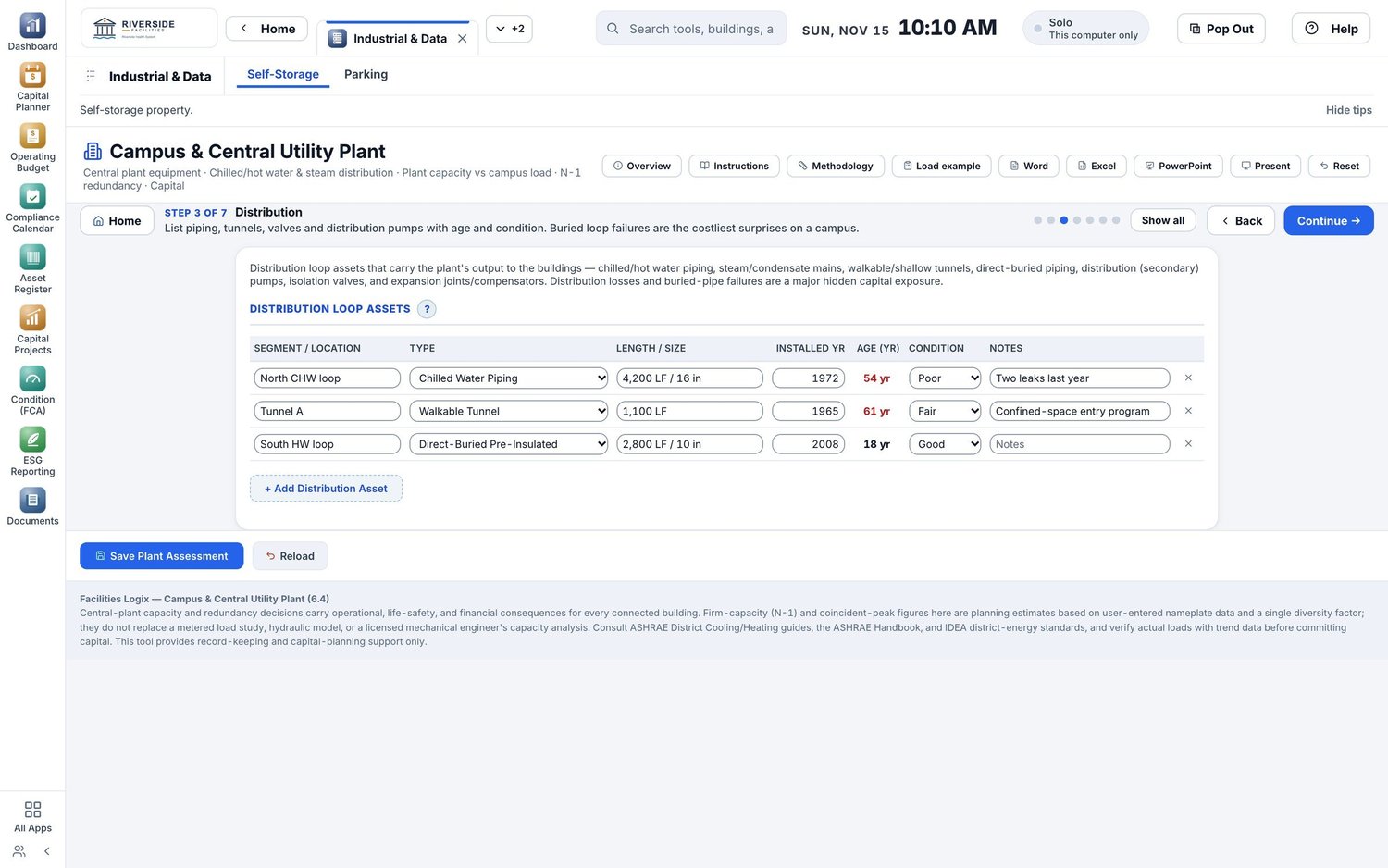
Distribution in Campus & Central Utility Plant: list piping, tunnels, valves and distribution pumps with age and condition. Buried loop failures are the costliest surprises on a campus.
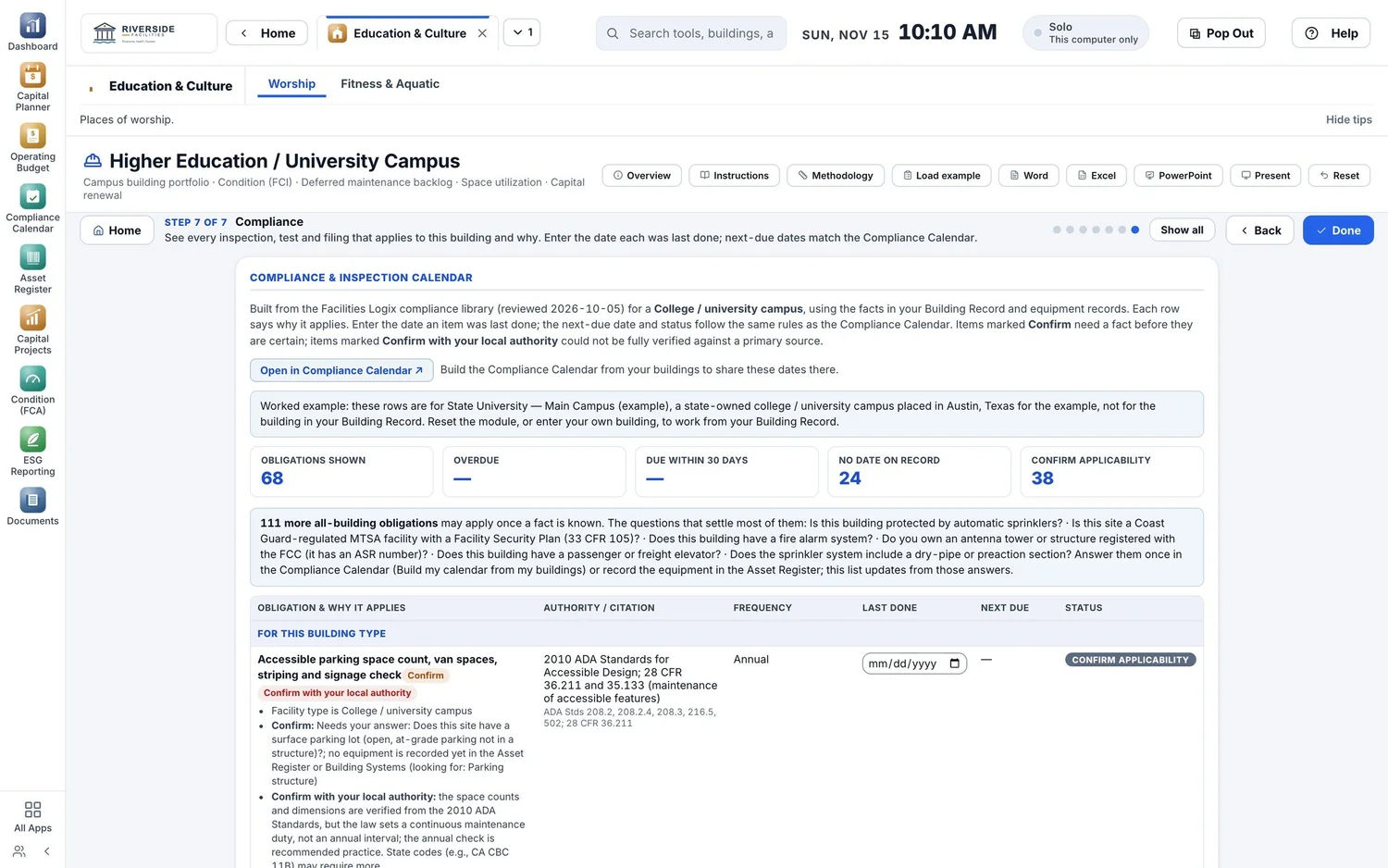
Campus rules come from many sources, so each building lists what applies with its citation and date.
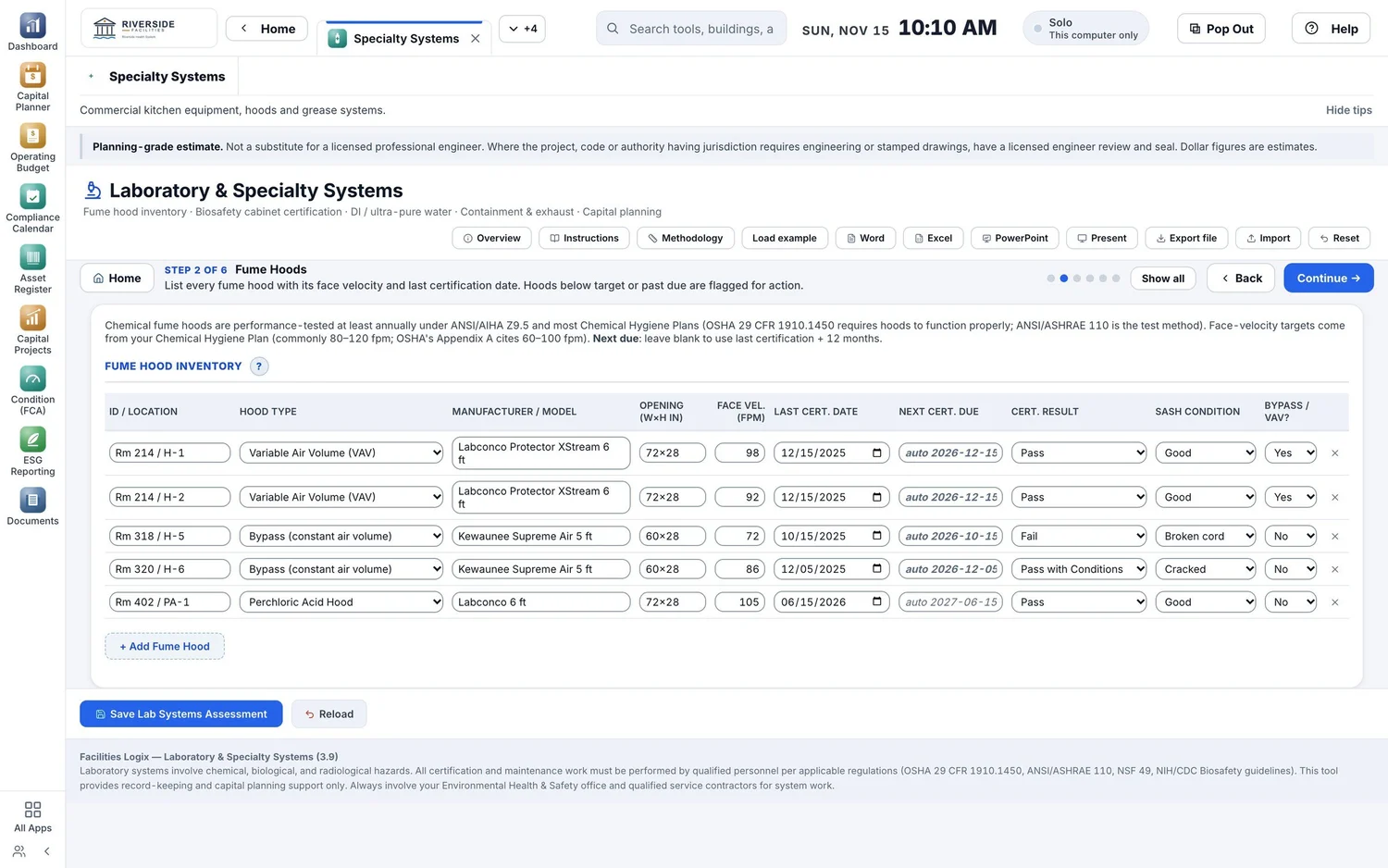
Every Building Type on Campus
University Playbook
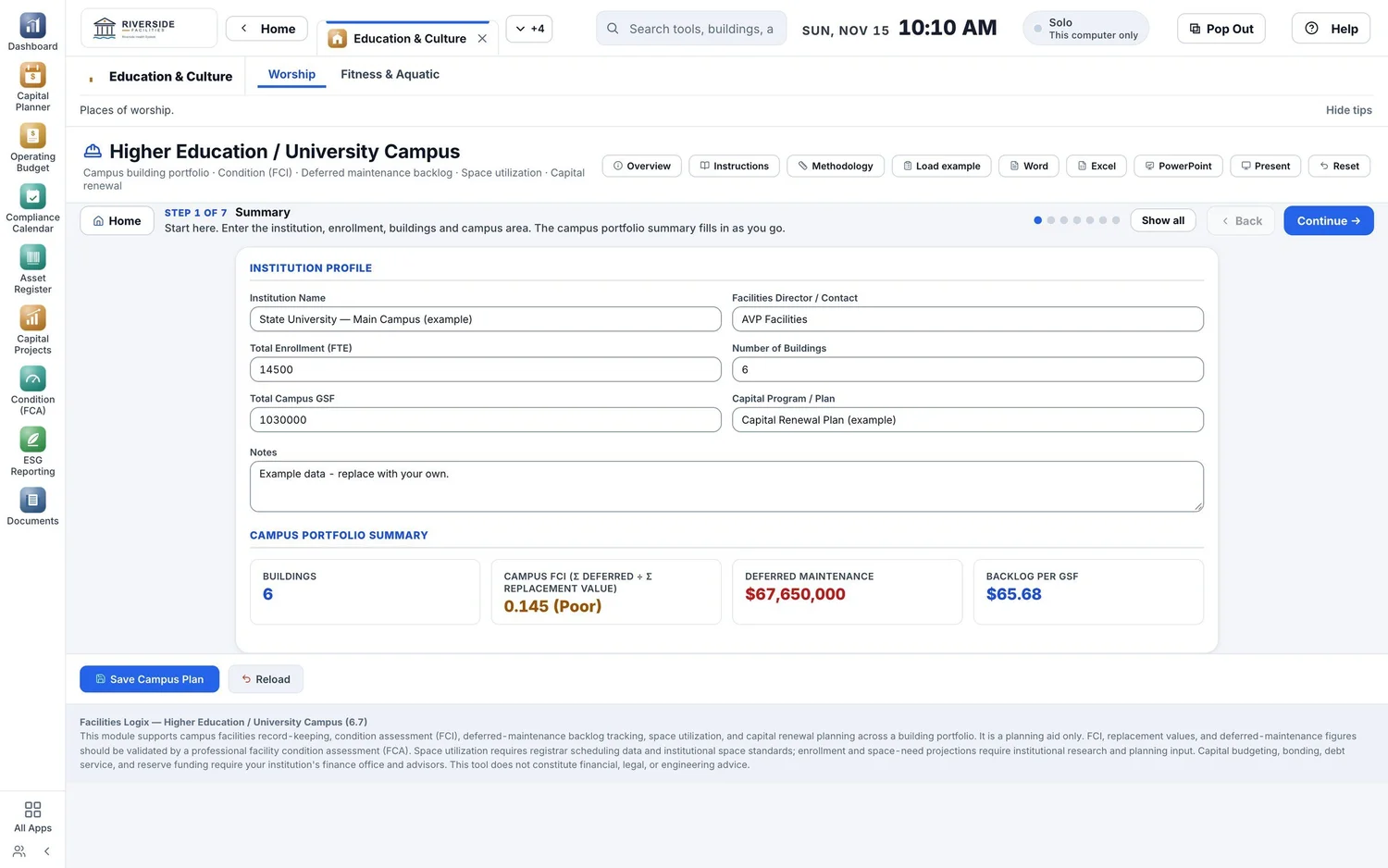
- Institution profile: enrollment (FTE), number of buildings, total campus gross square feet and the capital renewal program
- Building types: residence hall, academic and classroom, research and lab, library, student union, athletics and recreation, administrative, dining, medical and health, utility and plant, and parking
- Each building's year built, gross square feet, replacement value and deferred maintenance
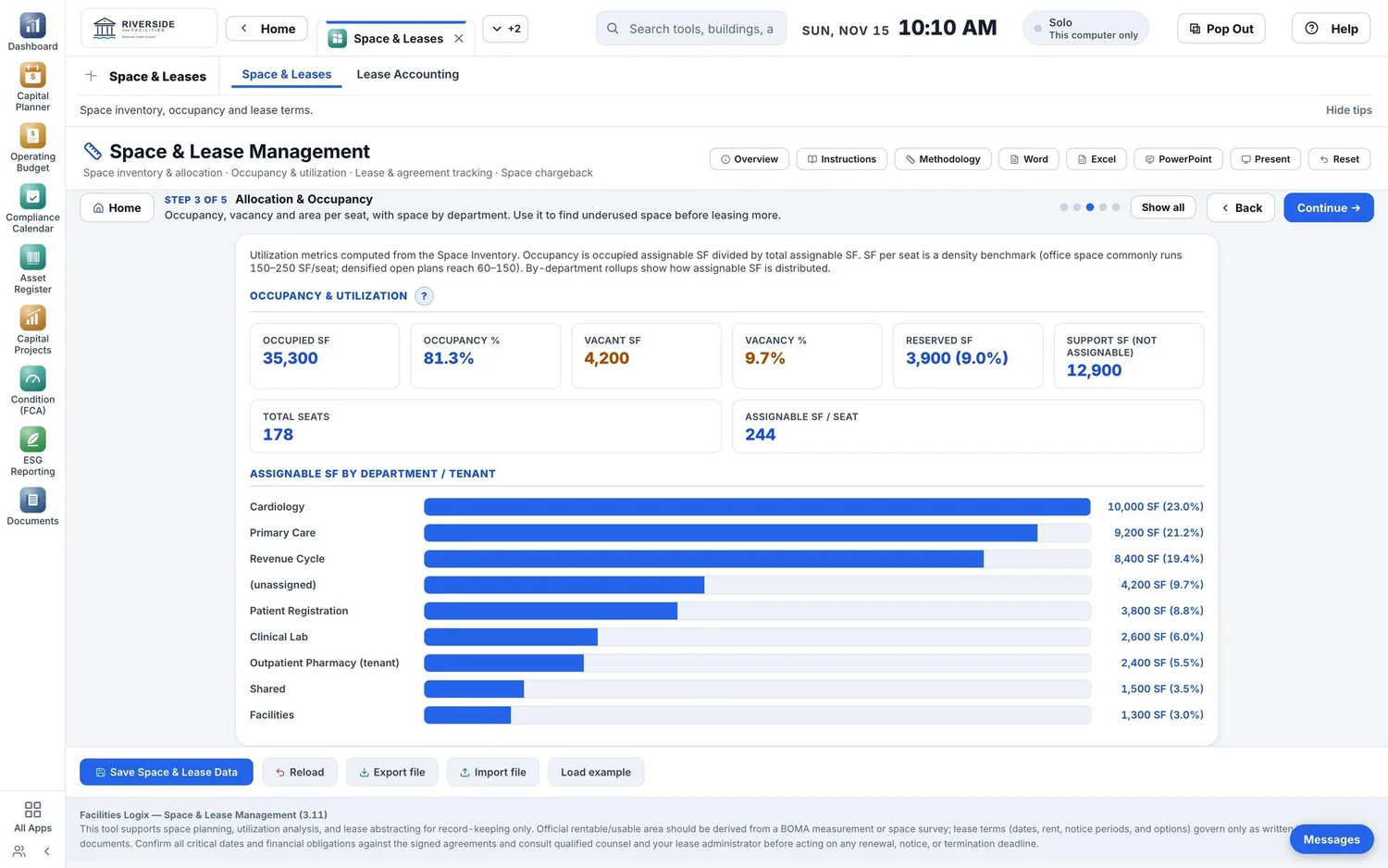
- Space Utilization: assignable square feet, station or seat counts and utilization for classrooms and labs
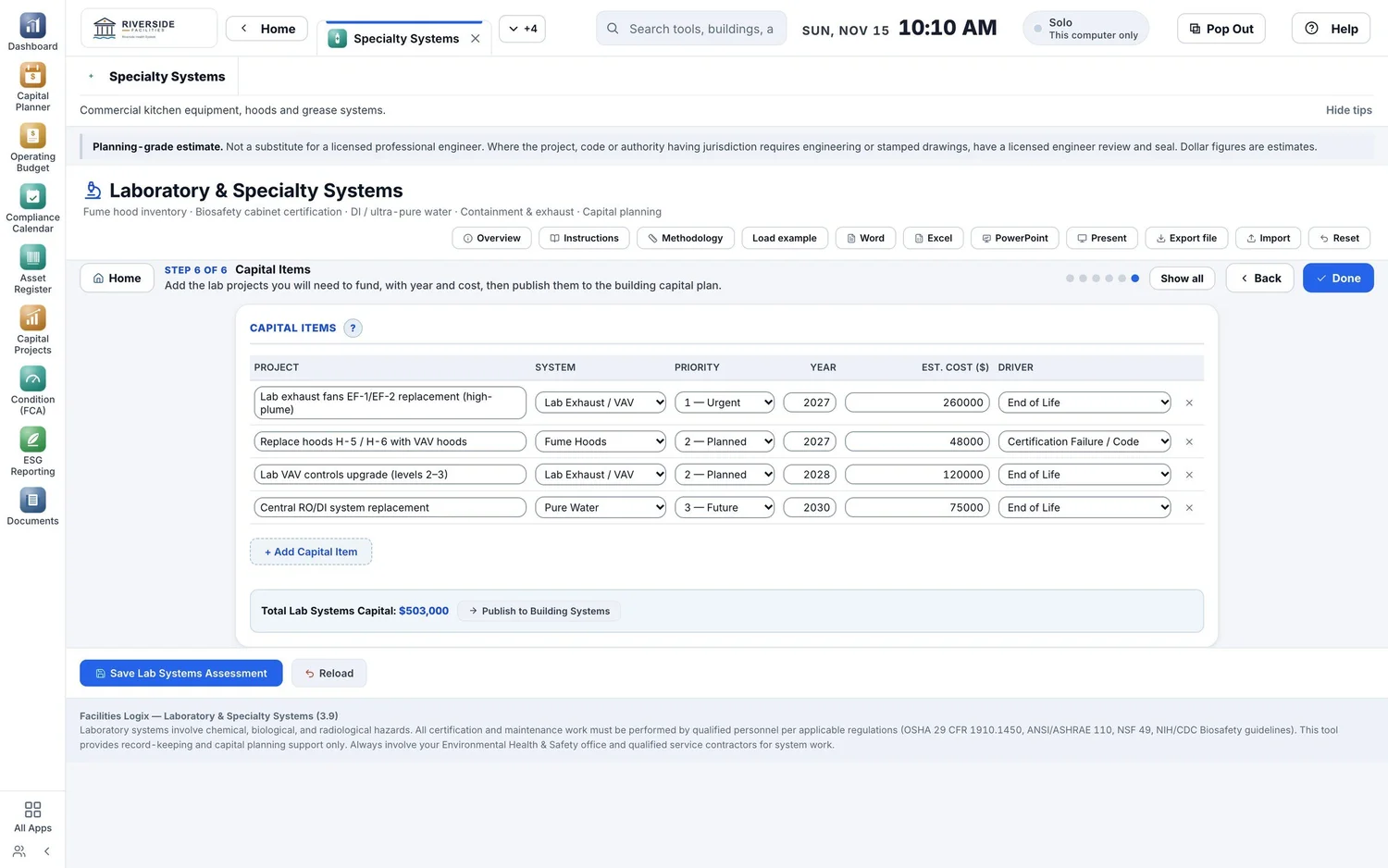
- Capital Renewal: projects by building with system, priority, year, cost and driver
- Publish to Building Systems rolls campus assets, deficiencies and capital into the shared Facilities Logix data
Student Housing Playbook
- Types: university residence hall, purpose-built off-campus, Greek or affiliated housing, and graduate or family housing; dining from none to a servery or a full dining hall
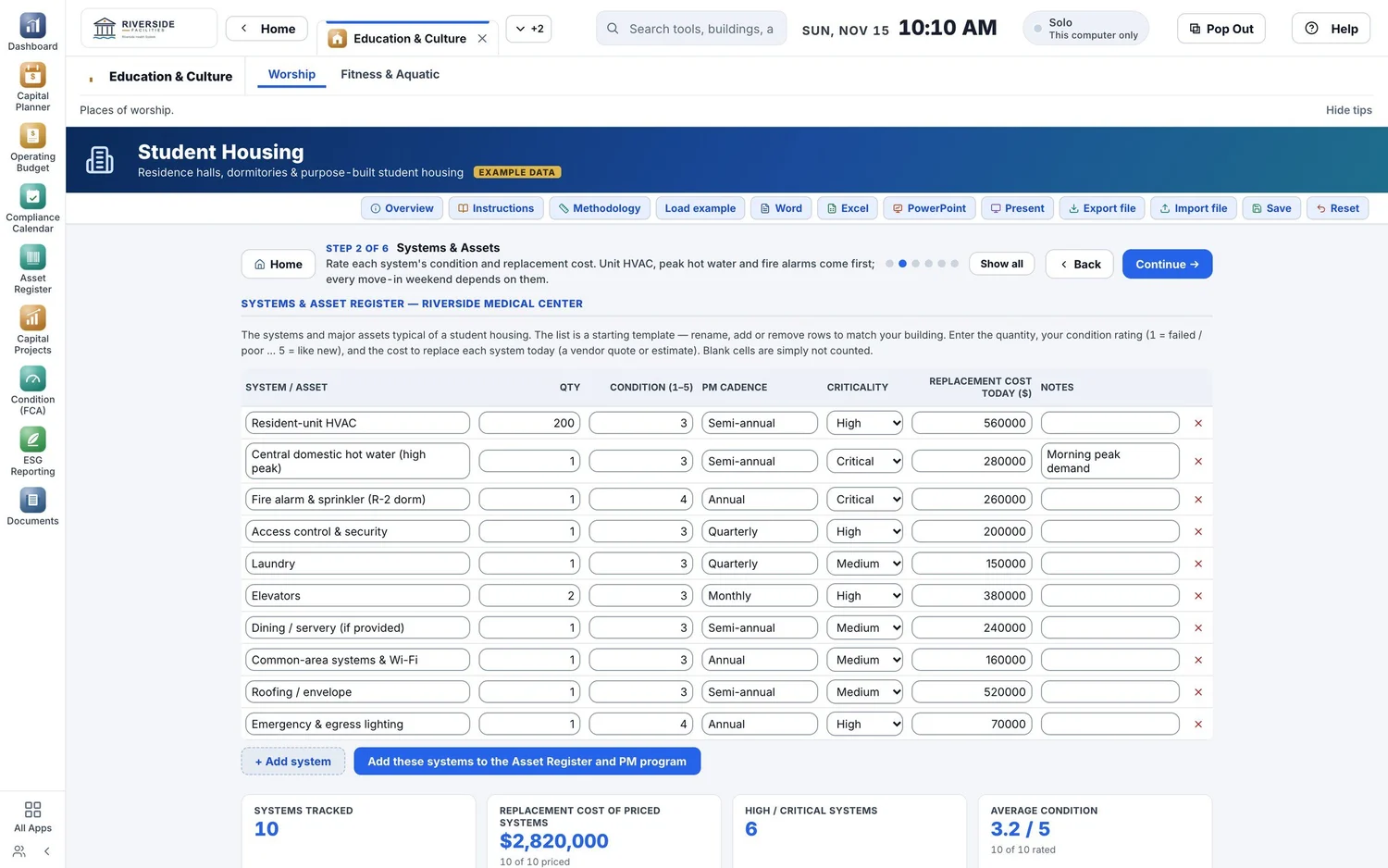
- Starting systems and PM cadence: resident-unit HVAC and central domestic hot water (sized for the morning peak) semi-annual; fire alarm and sprinkler for the dormitory annual; access control and security quarterly; laundry quarterly; elevators monthly; dining or servery semi-annual; common-area systems and Wi-Fi annual; roofing and envelope semi-annual; emergency and egress lighting annual
- Capital lines: resident-unit HVAC, domestic hot water, roof, fire and life-safety systems, elevator modernization, access control, common-area refresh and laundry equipment
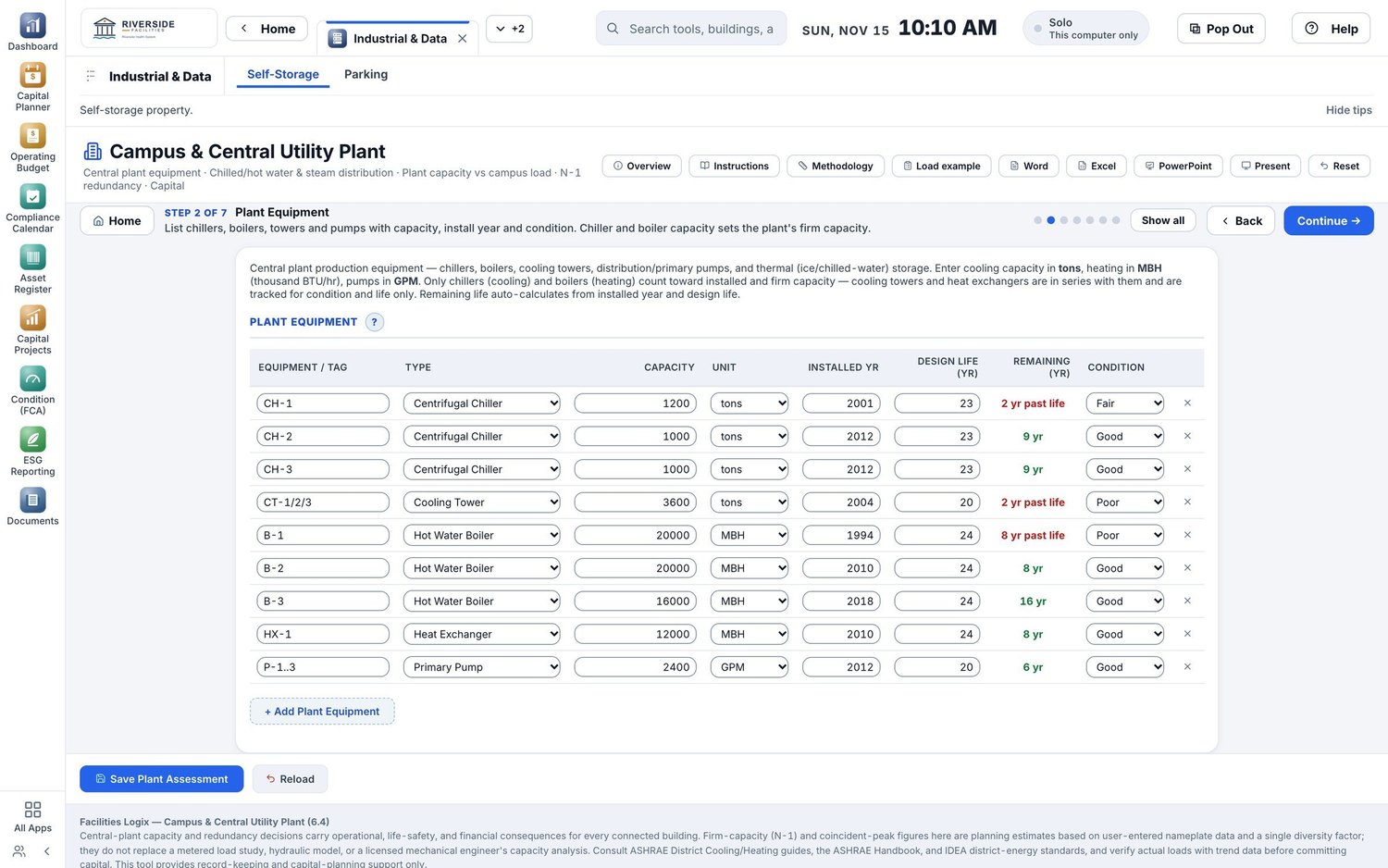
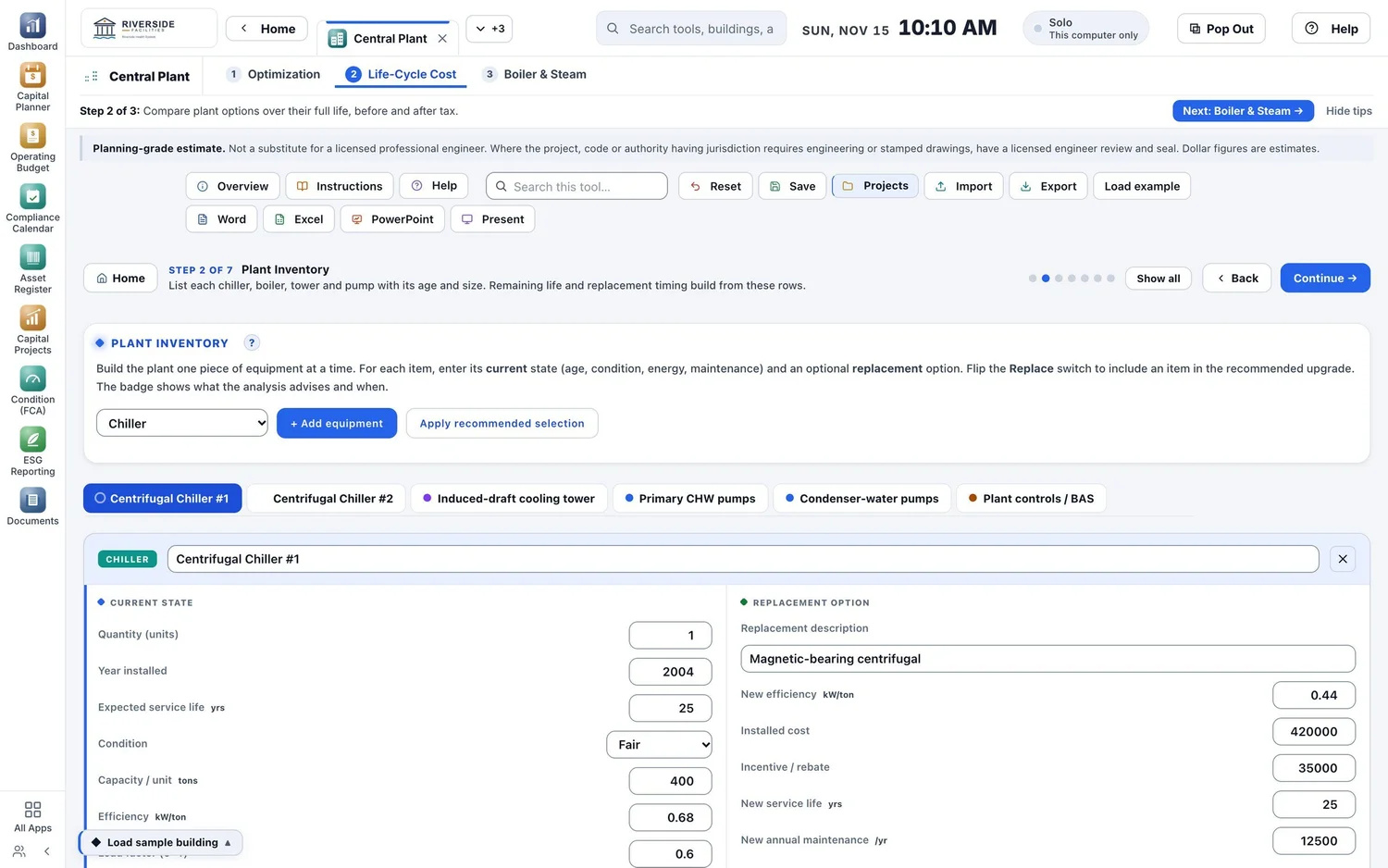
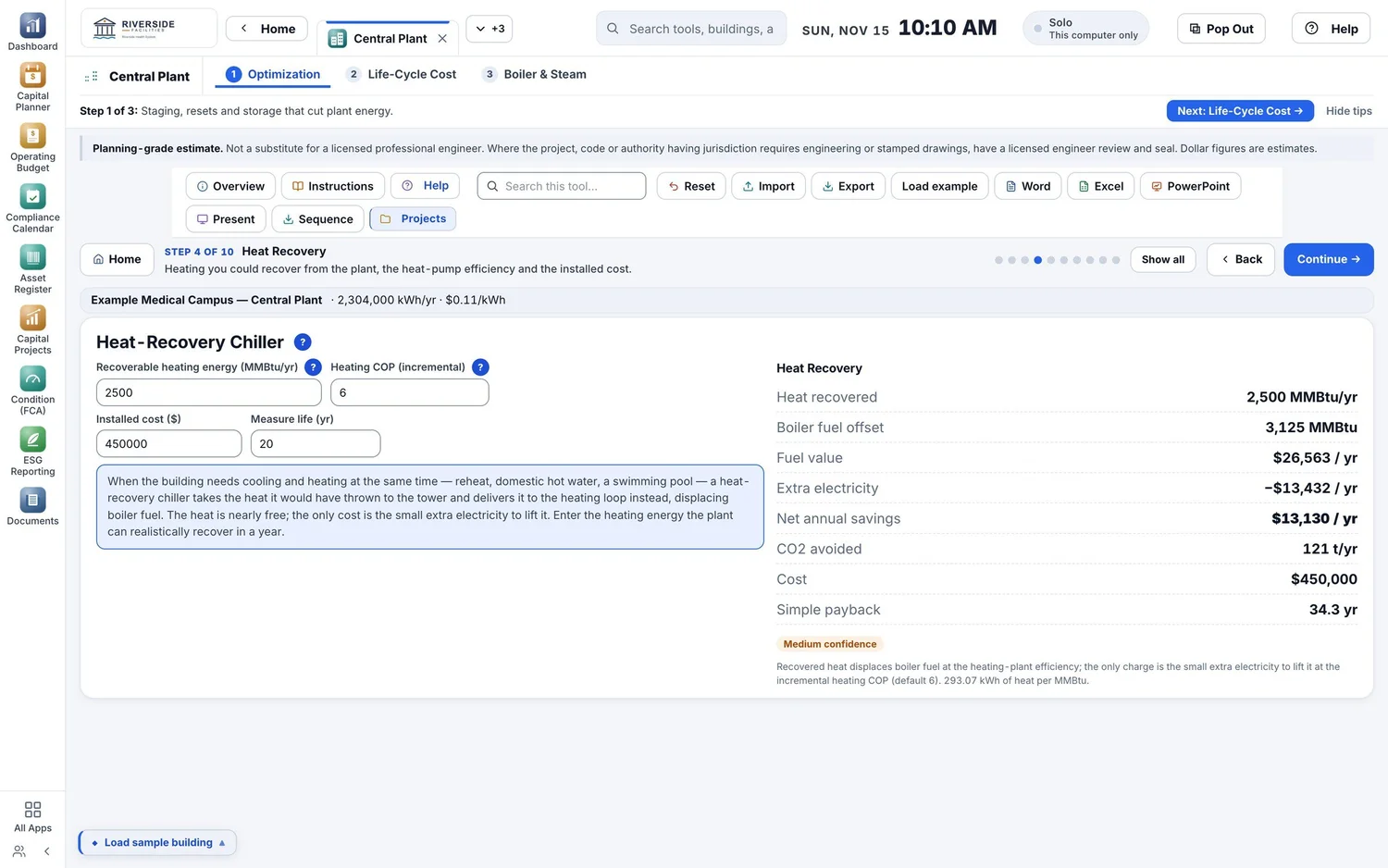
Plant Equipment in Campus & Central Utility Plant: list chillers, boilers, towers and pumps with capacity, install year and condition. Chiller and boiler capacity sets the plant's firm capacity.
Central Utility Plant Playbook
- Plant equipment: centrifugal, screw, absorption and air-cooled chillers, hot water and steam boilers, cooling towers, primary, distribution and condenser water pumps, ice and chilled water thermal storage, and heat exchangers, each with capacity, install year, design life and condition
- Distribution: piping, tunnels, valves and distribution pumps with age and condition
- Buildings served: each building's area, peak cooling and heating load, connection type and whether it is metered
- The plant sits under Industrial & Data in Facilities Logix and serves any campus
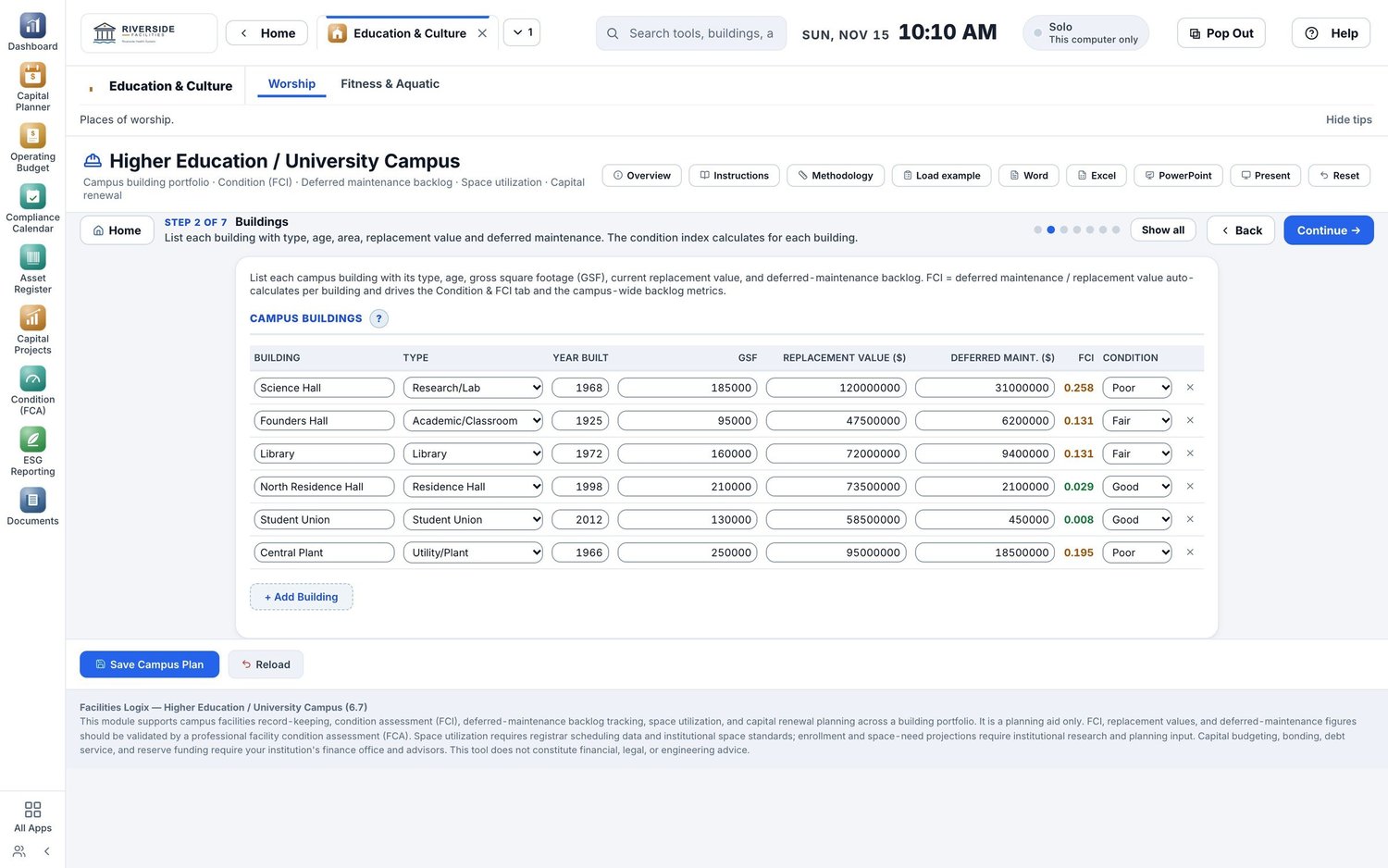
Campus buildings are tracked in separate spreadsheets, so every building appears in one list.
The Residence Hall Checklist
The Student Housing playbook starts with this checklist. Dates start blank and your team edits the list.
Student Housing Starting Checklist
- Fire alarm inspection and testing (NFPA 72): annual
- Sprinkler testing (NFPA 25): annual
- Dormitory life safety for the residential occupancy (NFPA 101 and the IBC): annual
- Fire and evacuation drills (state and campus rules): semi-annual
- Access control and security test: quarterly
- Elevator inspection and certificate (ASME A17.1 and the state): annual
- Legionella water management for domestic hot water (ASHRAE 188): annual
- ADA and Fair Housing accessibility: annual
- Emergency notification under the Clery Act, if on campus: annual
- Bed bug and pest control (integrated pest management): quarterly
- Boiler certificate and inspection (state boiler code): annual
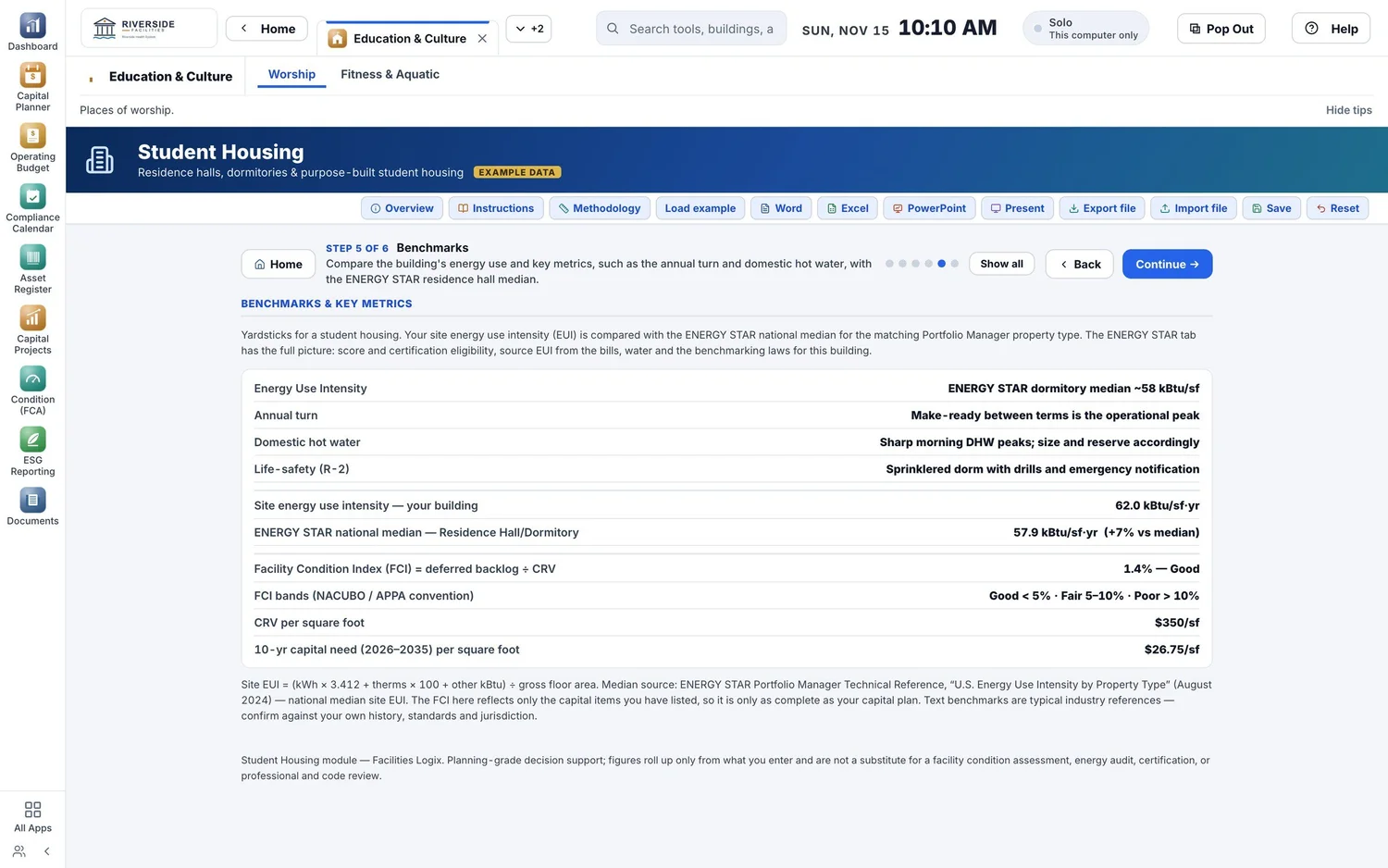
Benchmarks in Student Housing: compare the building's energy use and key metrics, such as the annual turn and domestic hot water, with the ENERGY STAR residence hall median.
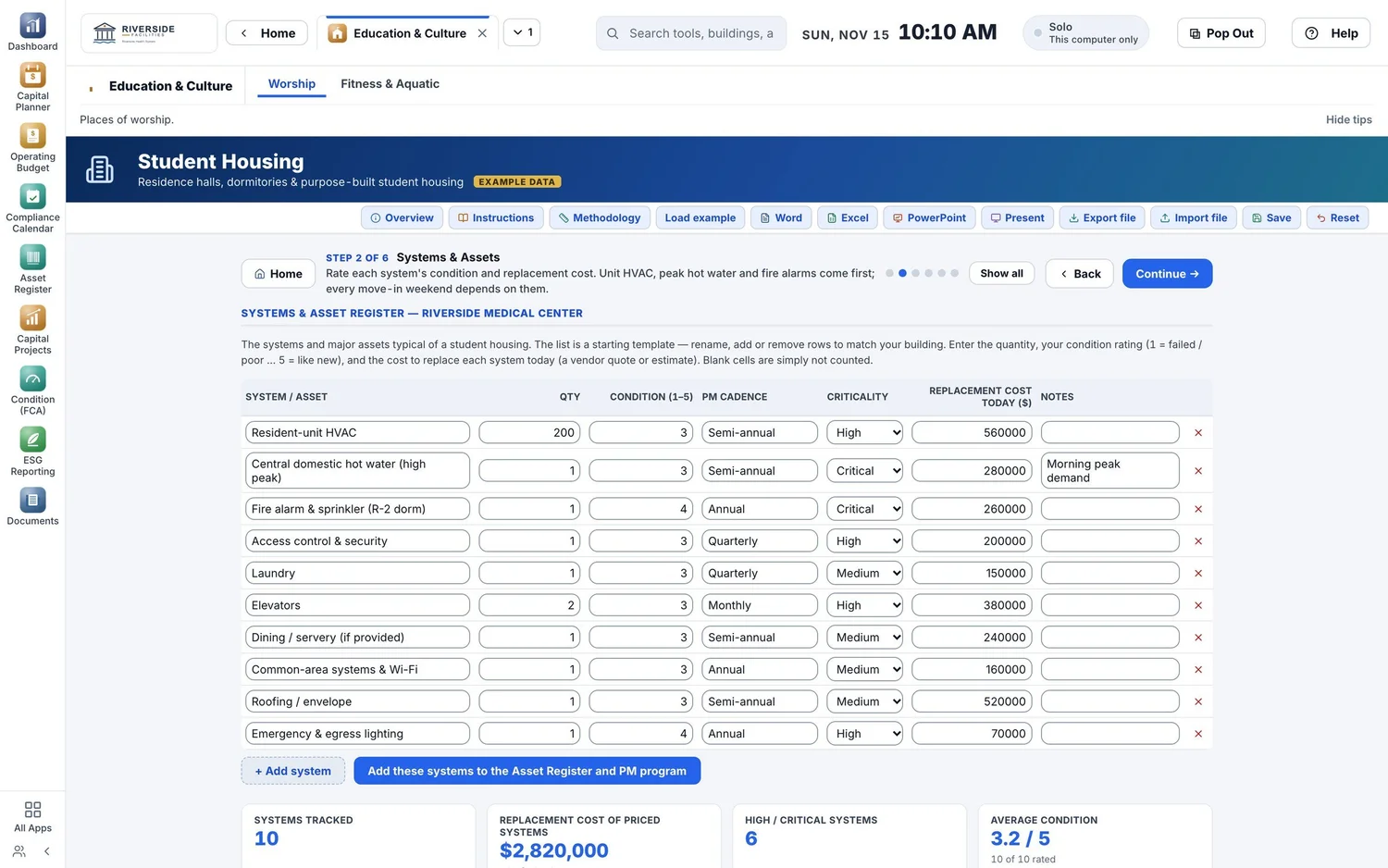
Residence hall checks happen between terms, so the playbook starts with the systems that need them.
Ready for Trustees and Auditors
Compliance Tab
Every inspection, test and filing that applies to the building and why, with the date last done and the next due date, the same as the Compliance Calendar. The Clery report's October 1 date is one of the fixed deadlines the calendar carries.
Learn MoreTrustee Packets
Word, Excel and PowerPoint reports, and Present mode, for cabinet and trustee meetings.
Learn MoreShow Less
Trustees fund what they can see. The Capital Renewal Briefing puts the backlog and its cost in front of them with the case already made.
- Opens with campus FCI, total deferred maintenance and backlog per gross square foot
- FCI by building chart names the worst building and how many exceed 10%
- Backlog now and after programmed renewal, with the share retired
- Space utilization chart names the least-used space
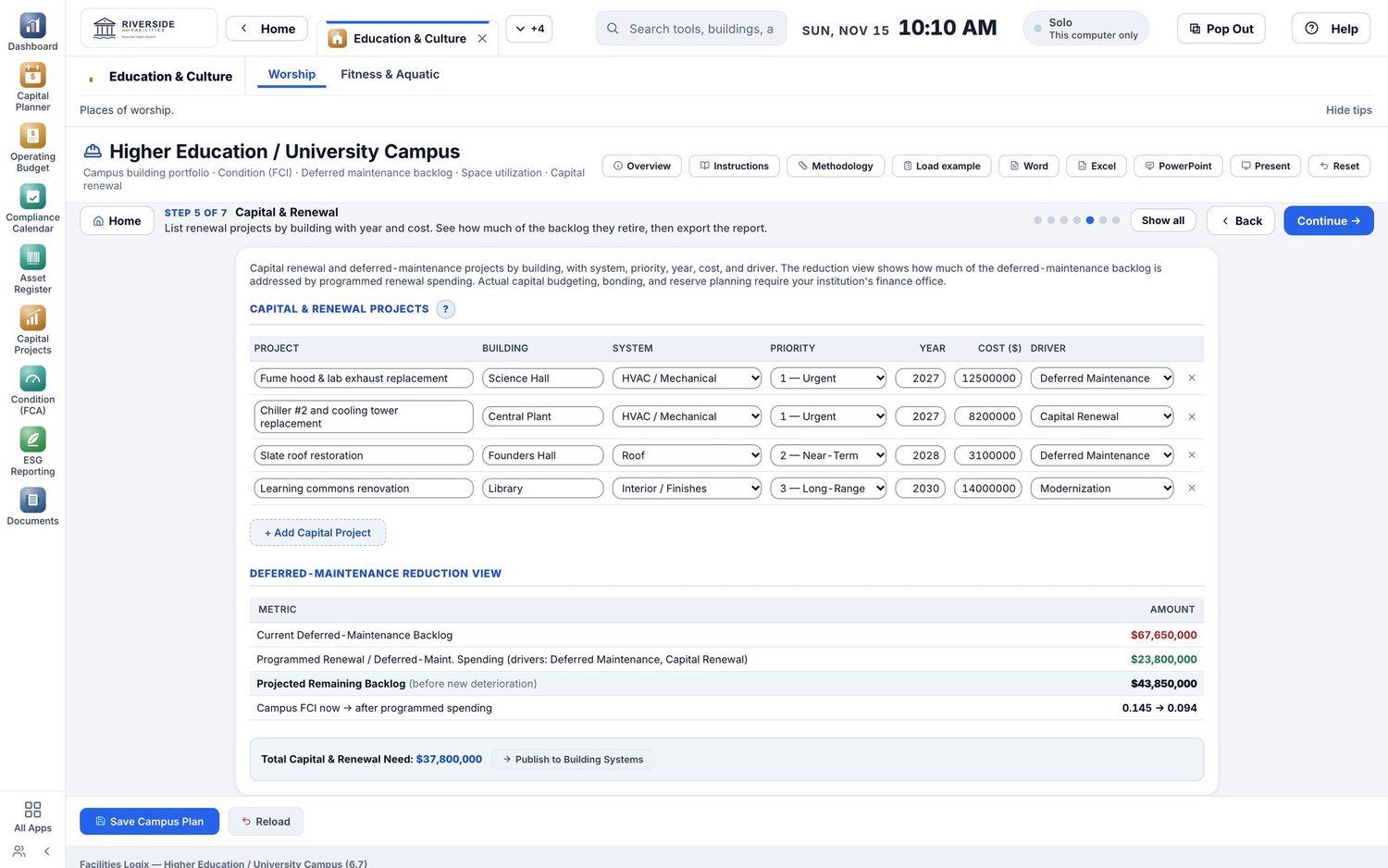
Capital & Renewal in Higher Education / University Campus: list renewal projects by building with year and cost. See how much of the backlog they retire, then export the report.
ENERGY STAR Tab
Campus buildings compare with the national median for college and university. Residence halls get a 1-100 score in Portfolio Manager but cannot earn certification; a college or university property gets no score.
Learn MoreShow Less
Campus utility budgets are large; comparing each building with its median shows where energy projects pay back first.
- College median: 84.3 kBtu per square foot site, 180.6 source; water 13.4 gallons
- Residence hall median: 57.9 site, 107.5 source
- Energy comes from each building's bills or from Energy Benchmarking
- Benchmarking and performance-standard laws that apply, with projected fines
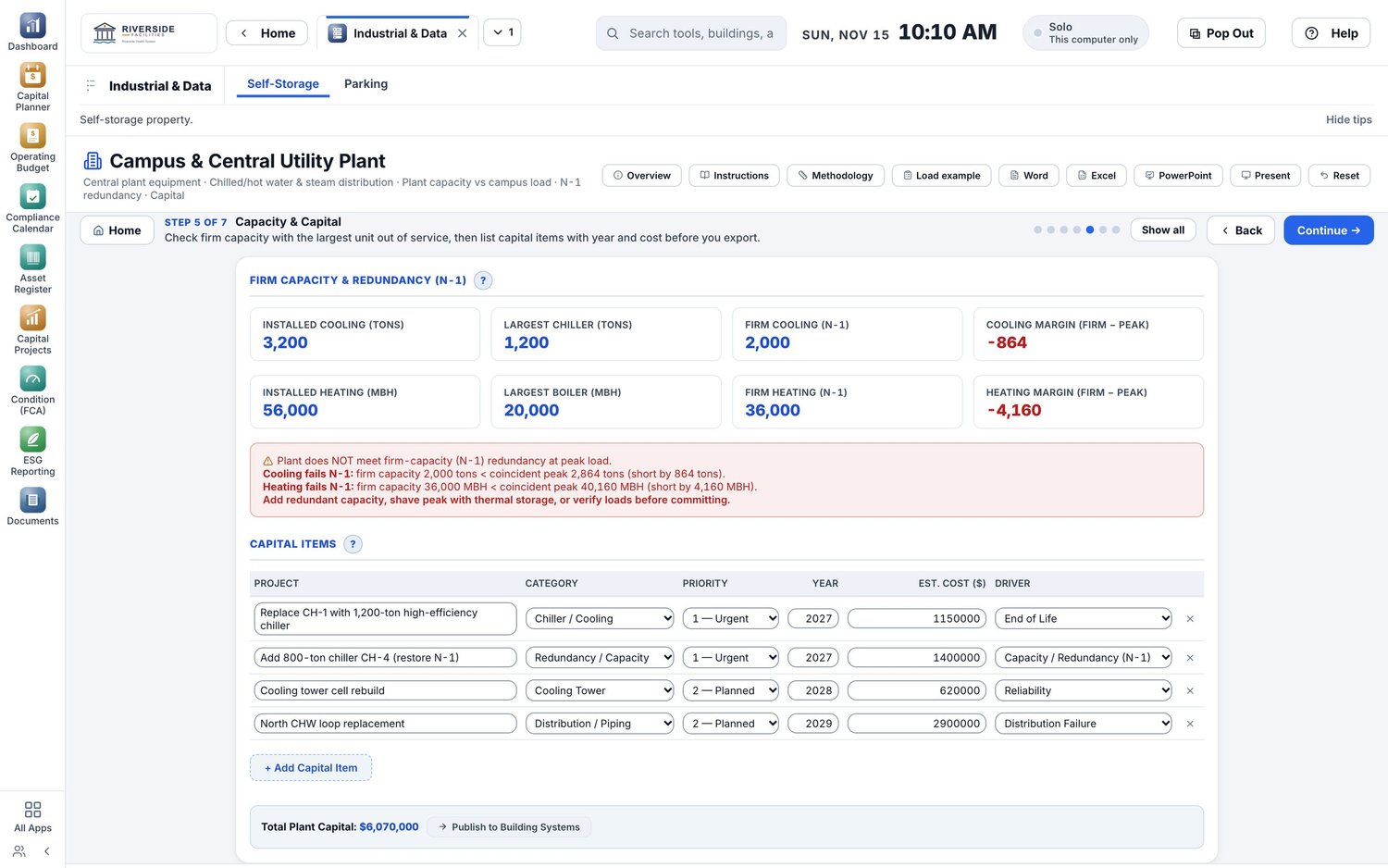
Plant Capacity Report
The plant's installed, firm and peak numbers side by side, with capital items by year, ready to export.
Learn MoreShow Less
A plant short of N-1 means emergency rentals or curtailment; an overbuilt one ties up capital. The report shows which before money is committed.
- When N-1 fails, it says to fund redundancy or verify loads before connecting more buildings
- Cooling margin with the largest chiller out, in tons; heating with the largest boiler out, in MBH
- Equipment past design life counted, with remaining life charted by unit
- Only chillers and boilers count toward firm capacity; towers and pumps tracked for life
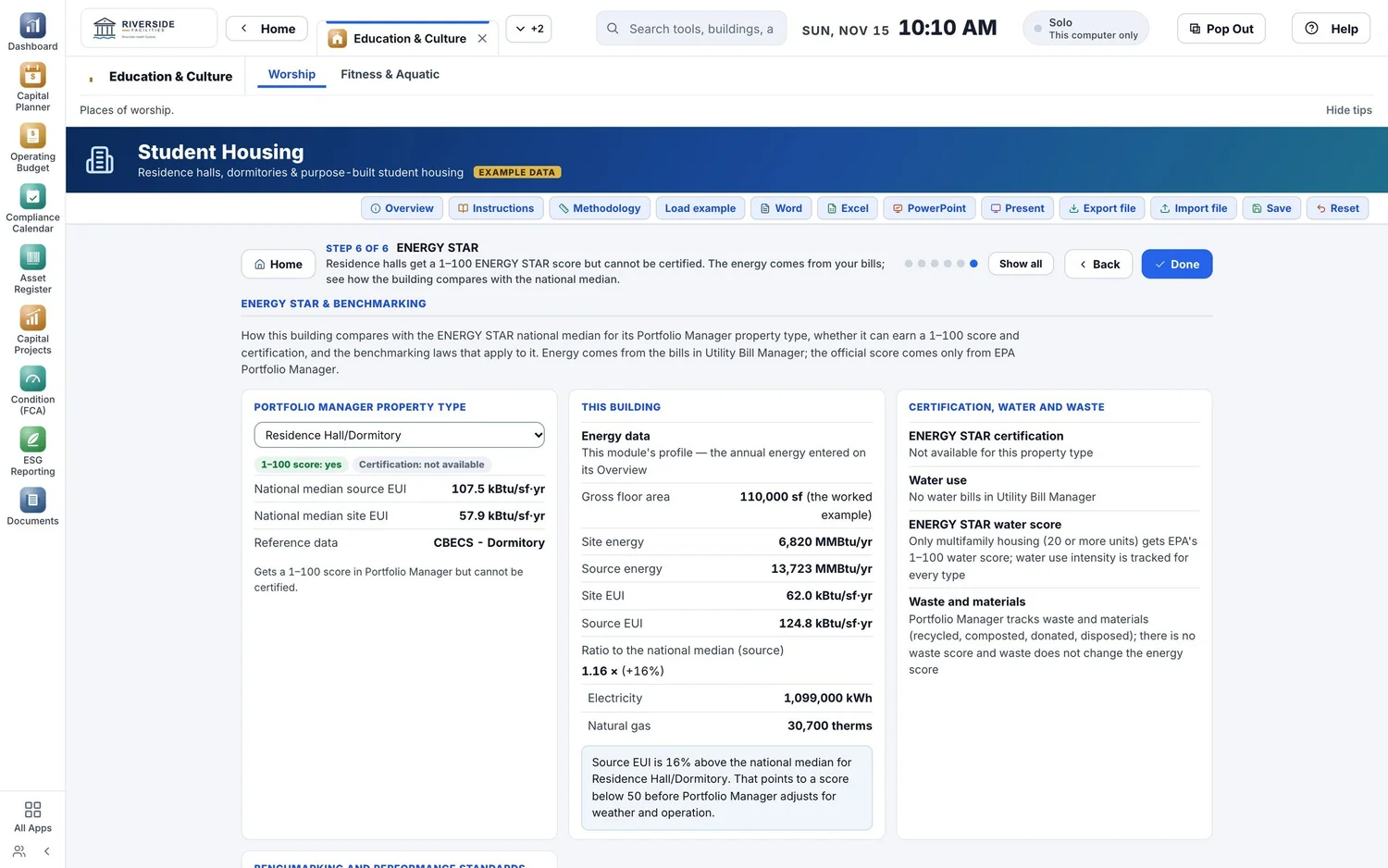
ENERGY STAR in Student Housing: residence halls get a 1–100 ENERGY STAR score but cannot be certified. The energy comes from your bills; see how the building compares with the national median.
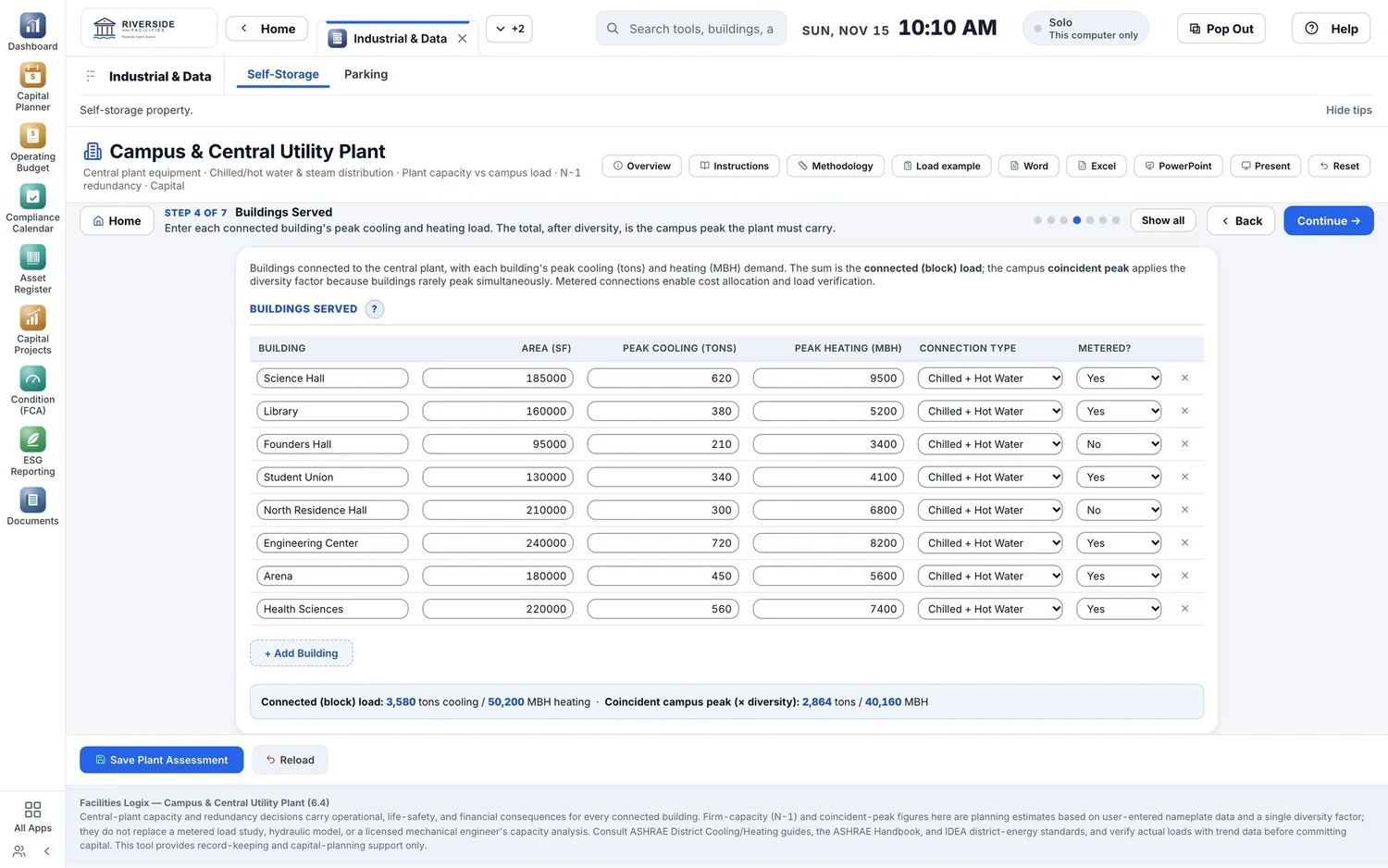
Buildings Served in Campus & Central Utility Plant: enter each connected building's peak cooling and heating load. The total, after diversity, is the campus peak the plant must carry.
Backlog, Space and Firm Capacity
Campus Condition
- Facility condition index for each building: deferred maintenance divided by replacement value
- Campus condition index weighted by replacement value
- Bands: Good under 0.05, Fair 0.05 to 0.10, Poor 0.10 to 0.30, Critical over 0.30
- Deferred-maintenance backlog per gross square foot, to compare over time
- The reduction view: programmed renewal spending against the current backlog
Space
- Assignable to gross square feet as an efficiency indicator
- Station occupancy: seats or stations used against those available; low use points to space you can consolidate
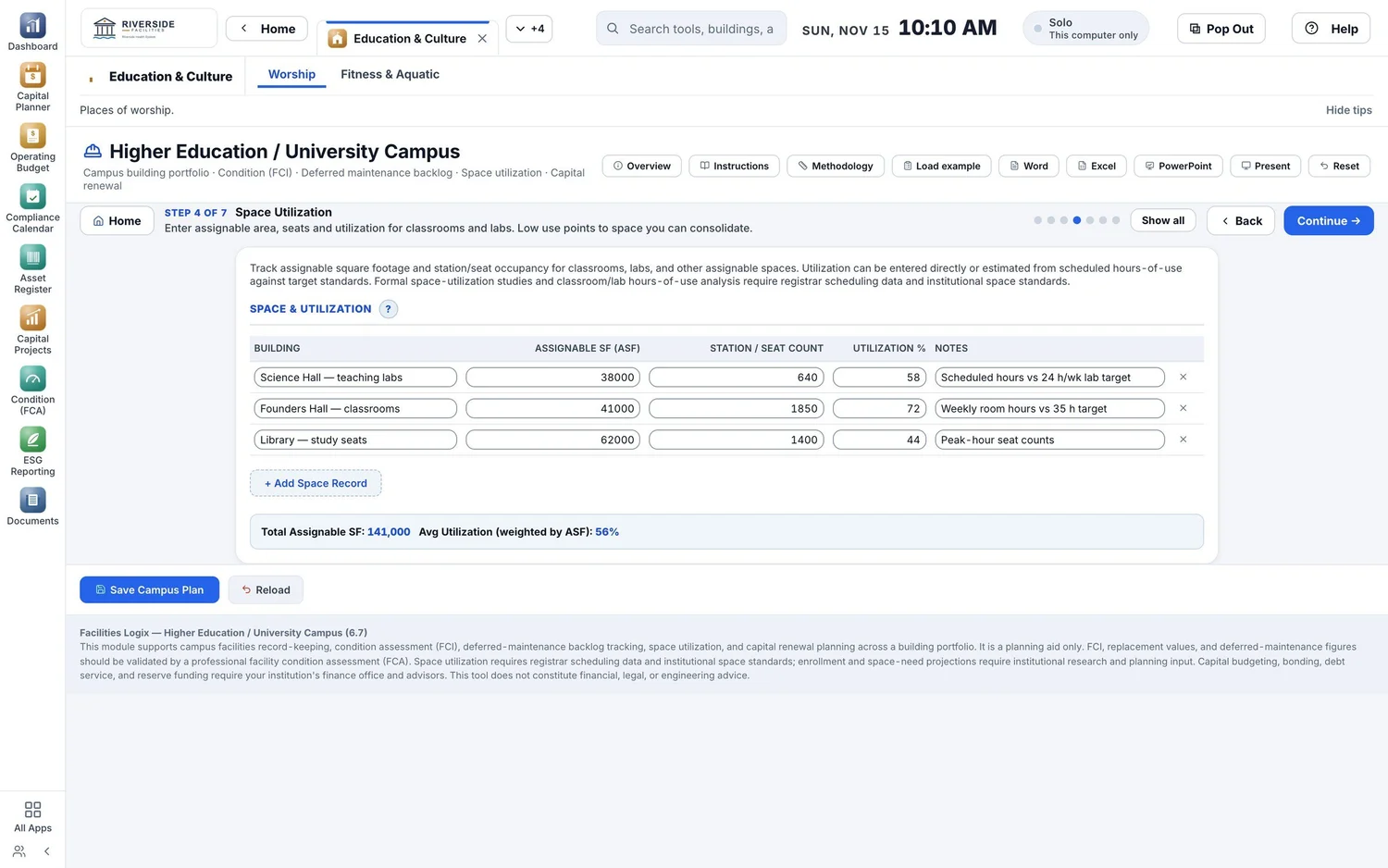
Space Utilization in Higher Education / University Campus: enter assignable area, seats and utilization for classrooms and labs. Low use points to space you can consolidate.
Residence Halls
- Energy use intensity against the ENERGY STAR dormitory median of about 58 kBtu per square foot
- The annual turn: make-ready between terms is the operating peak
- Domestic hot water: sharp morning peaks to size and reserve for
- Life safety: a sprinklered residence hall with drills and emergency notification
Central Plant
- Firm capacity (N-1): installed capacity less the single largest unit, for cooling and for heating
- Campus peak: the sum of connected building peaks times a diversity factor from 0.60 to 0.90
- Remaining life of each production unit
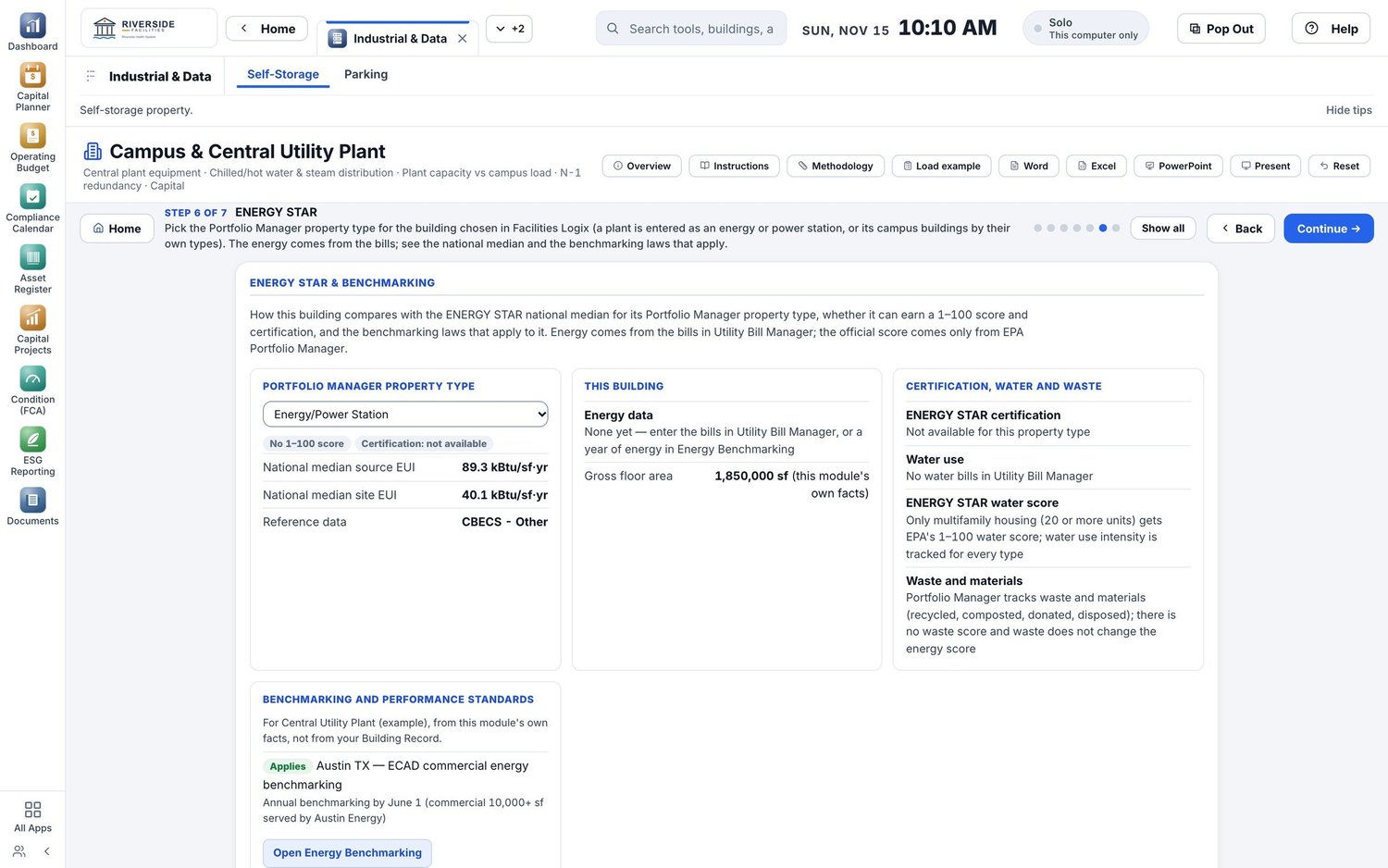
ENERGY STAR in Campus & Central Utility Plant: pick the Portfolio Manager property type for the building chosen in Facilities Logix (a plant is entered as an energy or power station, or its campus buildings by their own types). The energy comes from the bills; see the national median and the benchmarking laws that apply.
A Renewal Case Leadership Can Defend
One Campus Picture
Every building's condition, backlog and space use in one place instead of separate spreadsheets for each department.
Learn MoreShow Less
Renewal money goes further when it goes to the worst building first, on a basis provosts and business officers can defend.
- Campus FCI is weighted by replacement value, so large costly buildings count more
- Past an FCI of about 0.30-0.40, replacement is often cheaper than repair
- Projects tagged by driver: deferred maintenance, renewal, code and ADA, energy, safety
- Only deferred-maintenance and renewal projects count toward retiring backlog
Dates in One Calendar
Clery deadlines, dormitory drills, lab hood and cabinet tests and pool logs sit on the same calendar, so nothing waits for someone to remember it.
Learn MoreShow Less
A missed federal filing or lapsed lab certification costs more to fix after the fact. Fixed deadlines and intervals sit on one schedule.
- Fixed statutory dates, such as Clery's October 1, sit beside interval rows
- Lab rows apply only to buildings with a fume hood or biosafety cabinet
- Evidence named: published security and fire reports, fire log, hood certification sticker and report
- Each row can link the responsible vendor and its service contract
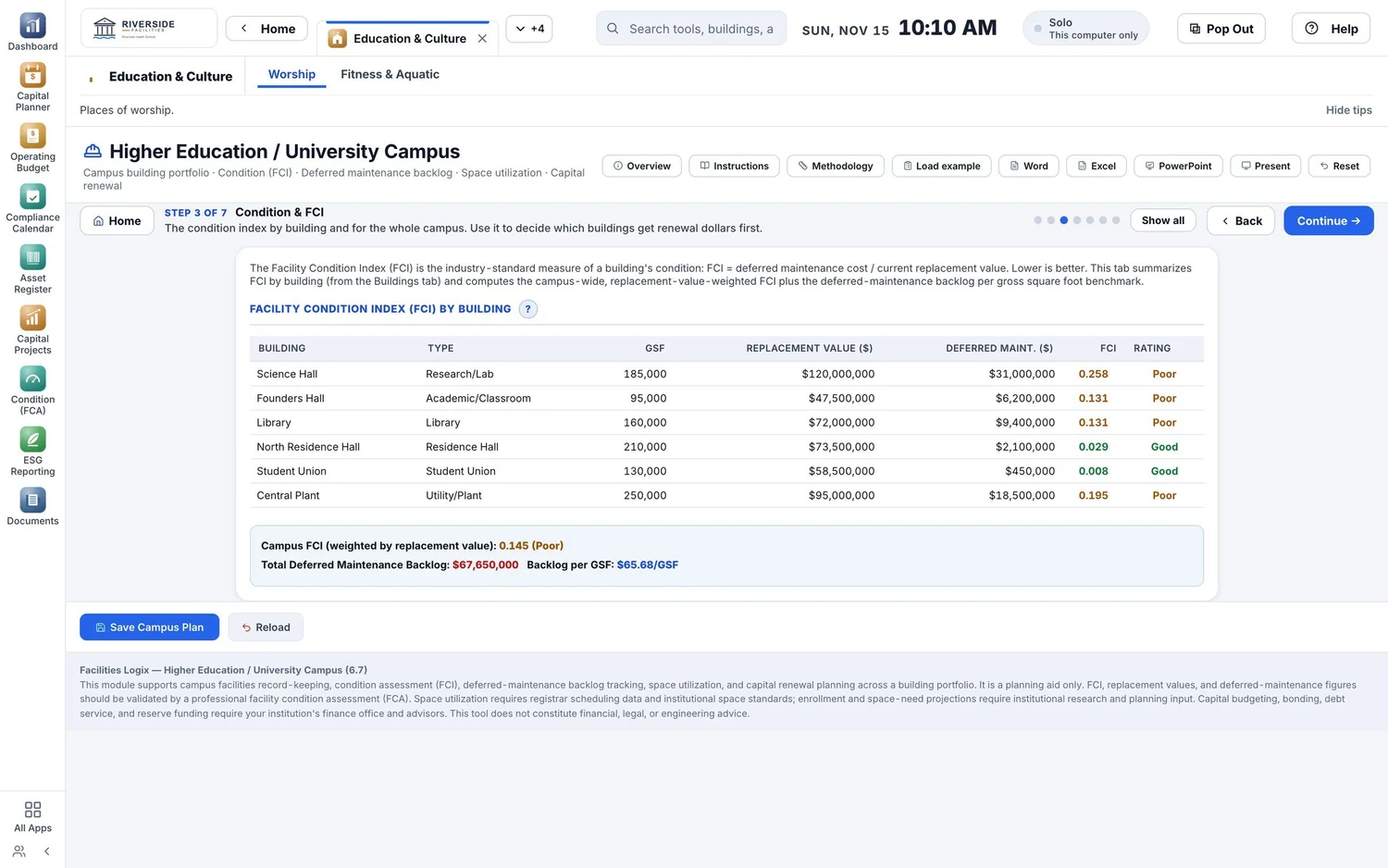
Condition & FCI in Higher Education / University Campus: the condition index by building and for the whole campus. Use it to decide which buildings get renewal dollars first.
Plant Risk in Plain View
The firm-capacity test shows whether the campus can still meet peak with its largest unit out of service, before a failure answers the question.
Learn MoreShow Less
Knowing the margin before a design day lets the campus budget a redundant chiller instead of paying for emergency rentals.
- Coincident peak = connected load × diversity factor; a blank factor uses full load
- A negative margin is flagged red
- Capital that restores firm capacity is prioritized first
- Thermal storage can defer chiller capacity by shifting load off the peak
Professionals Still Do Their Part
Facilities Logix organizes the data that a facility condition assessment, institutional research and a licensed engineer's capacity analysis rely on. It does not replace them.
Learn MoreShow Less
Paid assessment and engineering hours go further when the data is gathered before the professionals arrive.
- Deferred maintenance ideally comes from a professional facility condition assessment
- FCI bands follow APPA and NACUBO (Rush, 1991); the 30% Critical split is a convention
- Firm capacity is a nameplate screening test, with no part-load or fouling derating
- Bonding, debt service and reserve funding stay with the finance office
Frequently Asked Questions
Does it track the Clery Act deadlines?
Do research labs get their own rows?
Is the central plant part of the University playbook?
Can residence halls earn an ENERGY STAR score?
Be First When Facilities Logix Opens
Stop chasing building records across spreadsheets and binders. Join the list and we will tell you the day downloads open, with setup guides ready.
Launching early 2027 for Facilities Logix. Nothing to buy today, and no sales calls.
