
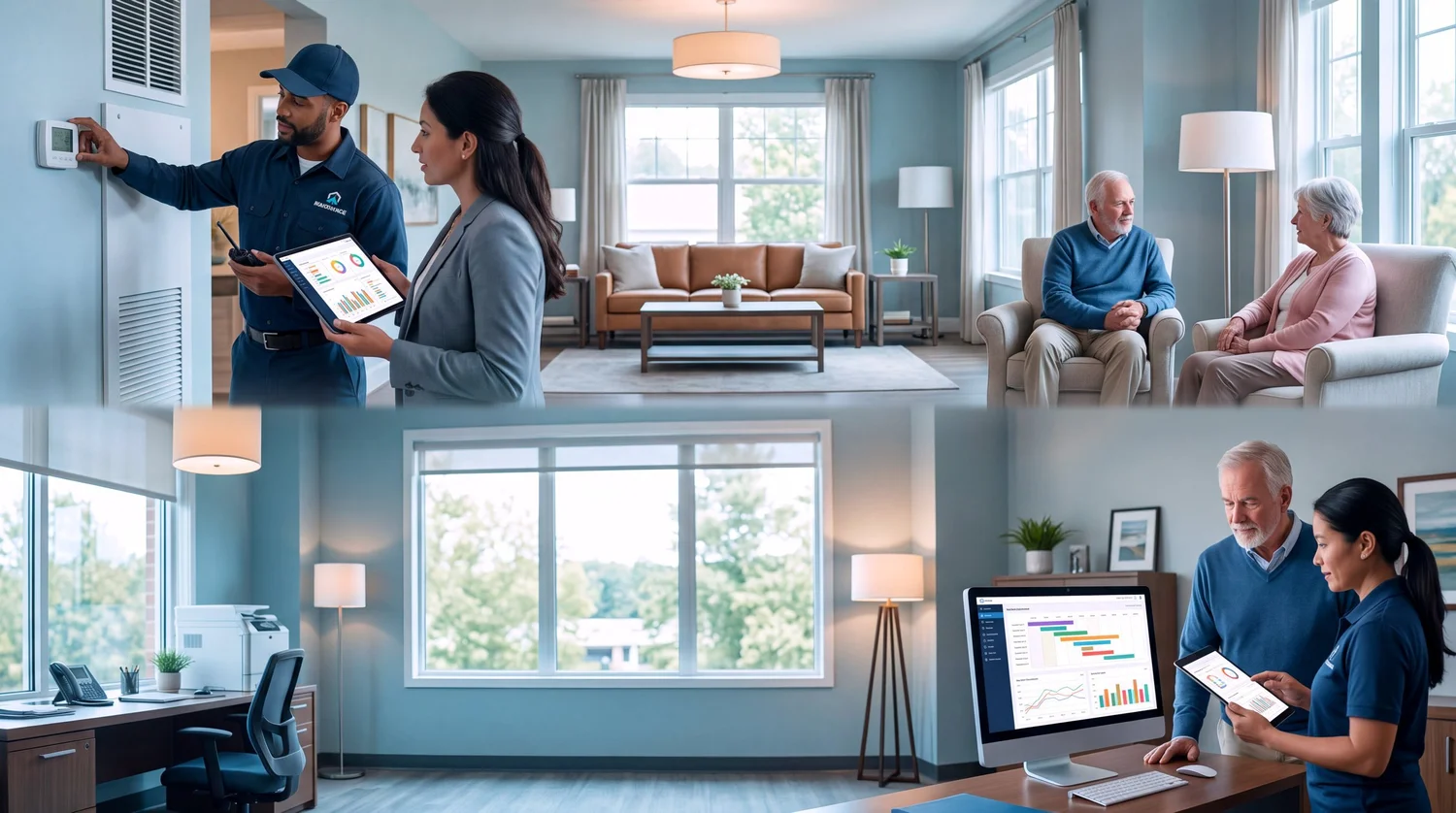

Round-the-Clock Care Needs a Building That Never Lets Up.
Launching Early 2027 · Join the Early-Access List
Senior living blends hospitality, healthcare and 24-hour life safety for residents who depend on the building. The Senior Living playbook tracks the resident-care and building systems, the life-safety code, drills on every shift, standby power, water management for Legionella, kitchens and state licensing, with the capital reserve and the energy comparison beside them.
The Compliance Load of a Care Community
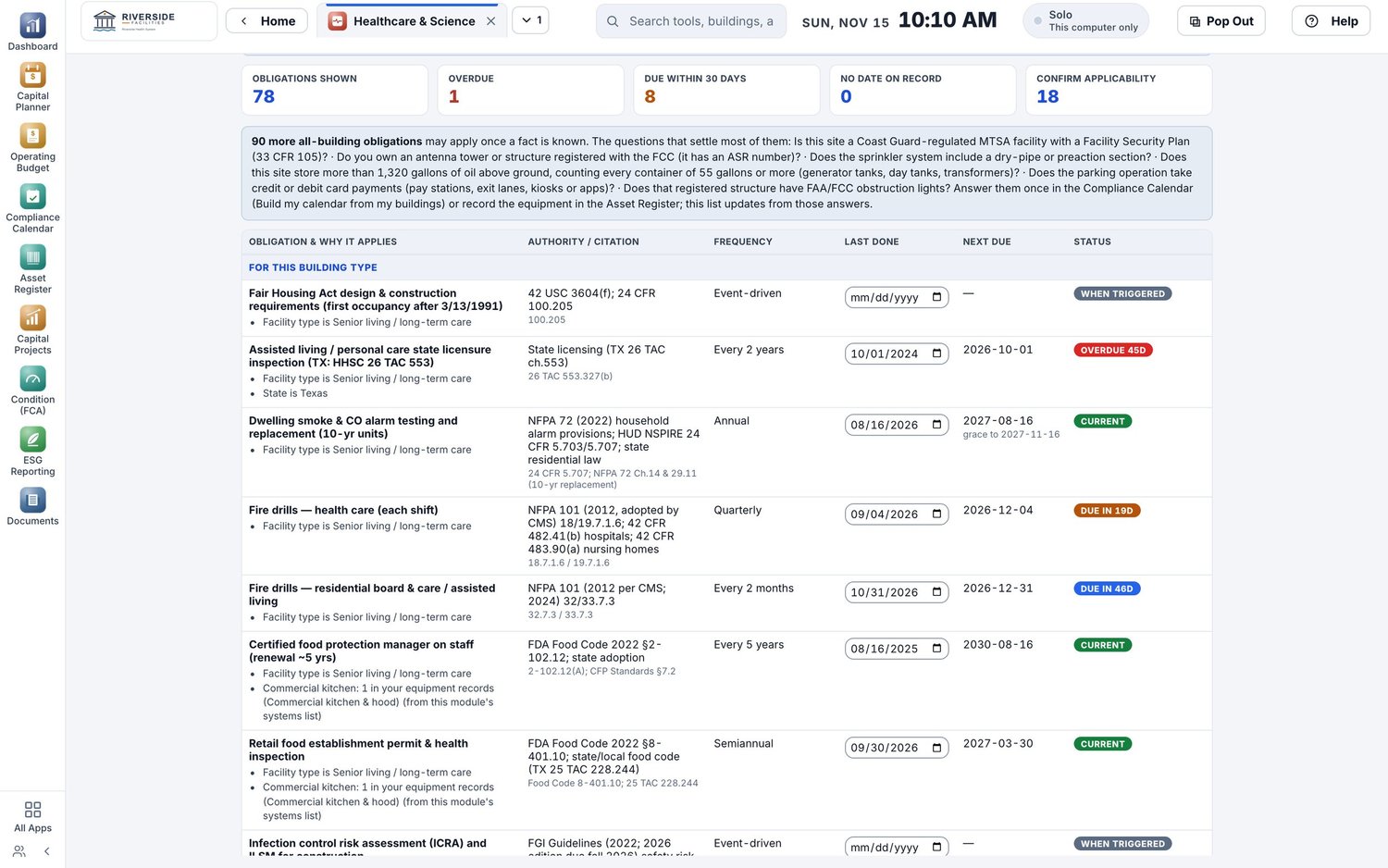
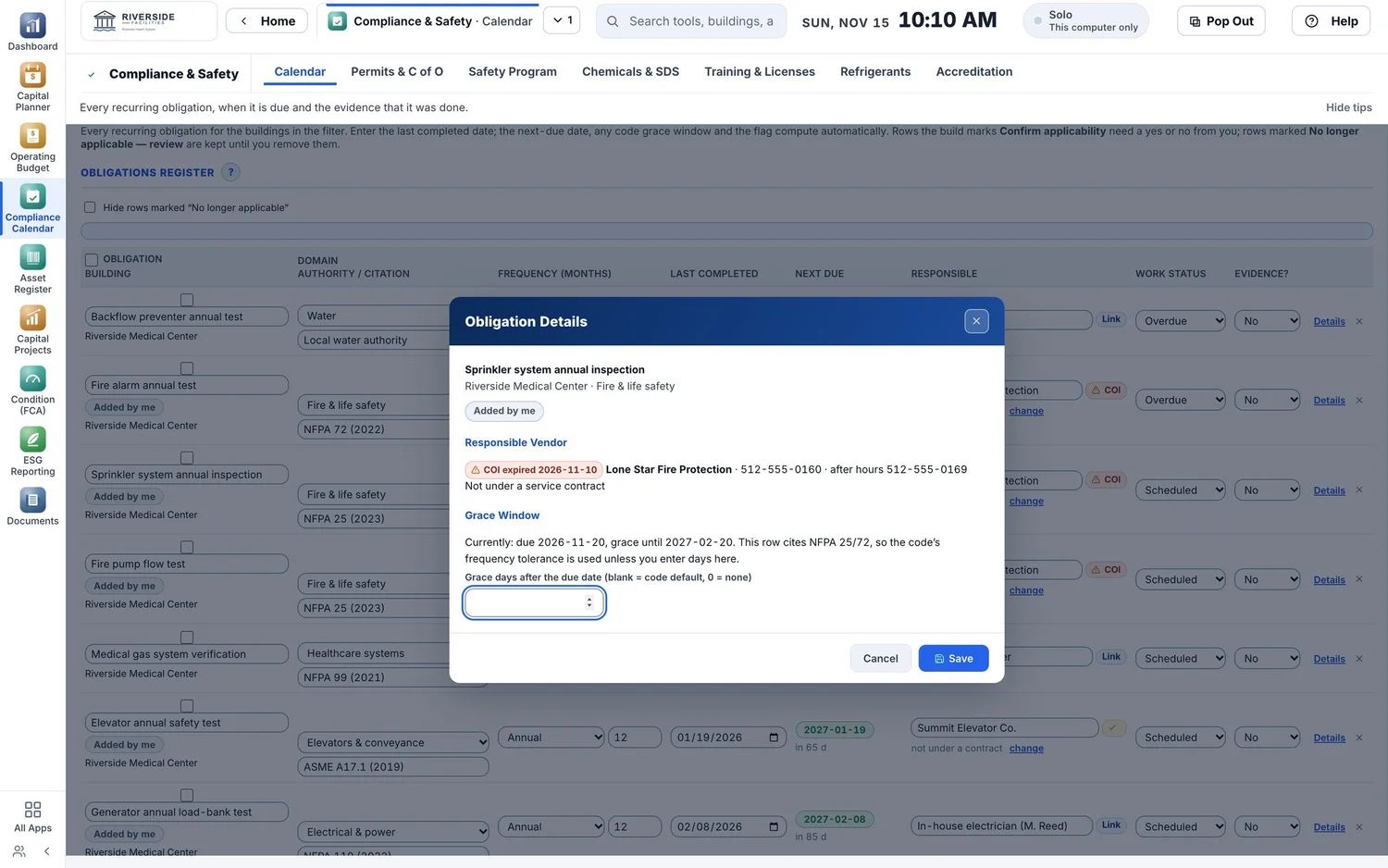
Library obligations apply when the community's facts say so (for example participation in the Centers for Medicare & Medicaid Services (CMS) program, a commercial kitchen, piped medical gas or HUD assistance). Each row carries its authority, citation, frequency and evidence, with the same dates as the Compliance Calendar.
Skilled Nursing and CMS
- The long-term care Life Safety Code survey (42 CFR 483.90(a), NFPA 101 of 2012): a standard survey no later than 15 months after the last one, with a statewide average of 12 months or less
- The Life Safety Code and Health Care Facilities Code (NFPA 101 and NFPA 99, 2012) as CMS adopts them
- Emergency preparedness program review at least annually for long-term care (42 CFR 483.73)
- Two emergency exercises a year for inpatient providers, one full-scale or functional and one more (42 CFR 483.73(d)(2))
- The CMS water management program for Legionella (CMS QSO-17-30, 42 CFR 483.80): annual review
- Infection control risk assessment and Interim Life Safety Measures for construction projects
Drills
- Health care occupancies: fire drills quarterly on each shift, at least 12 a year for three shifts, including alarm transmission (NFPA 101, 18/19.7.1.6; 42 CFR 483.90(a))
- Residential board and care and assisted living: six drills a year on a bimonthly basis, at least two at night while residents sleep, with actual evacuation to the assembly point (NFPA 101, 32/33.7.3)
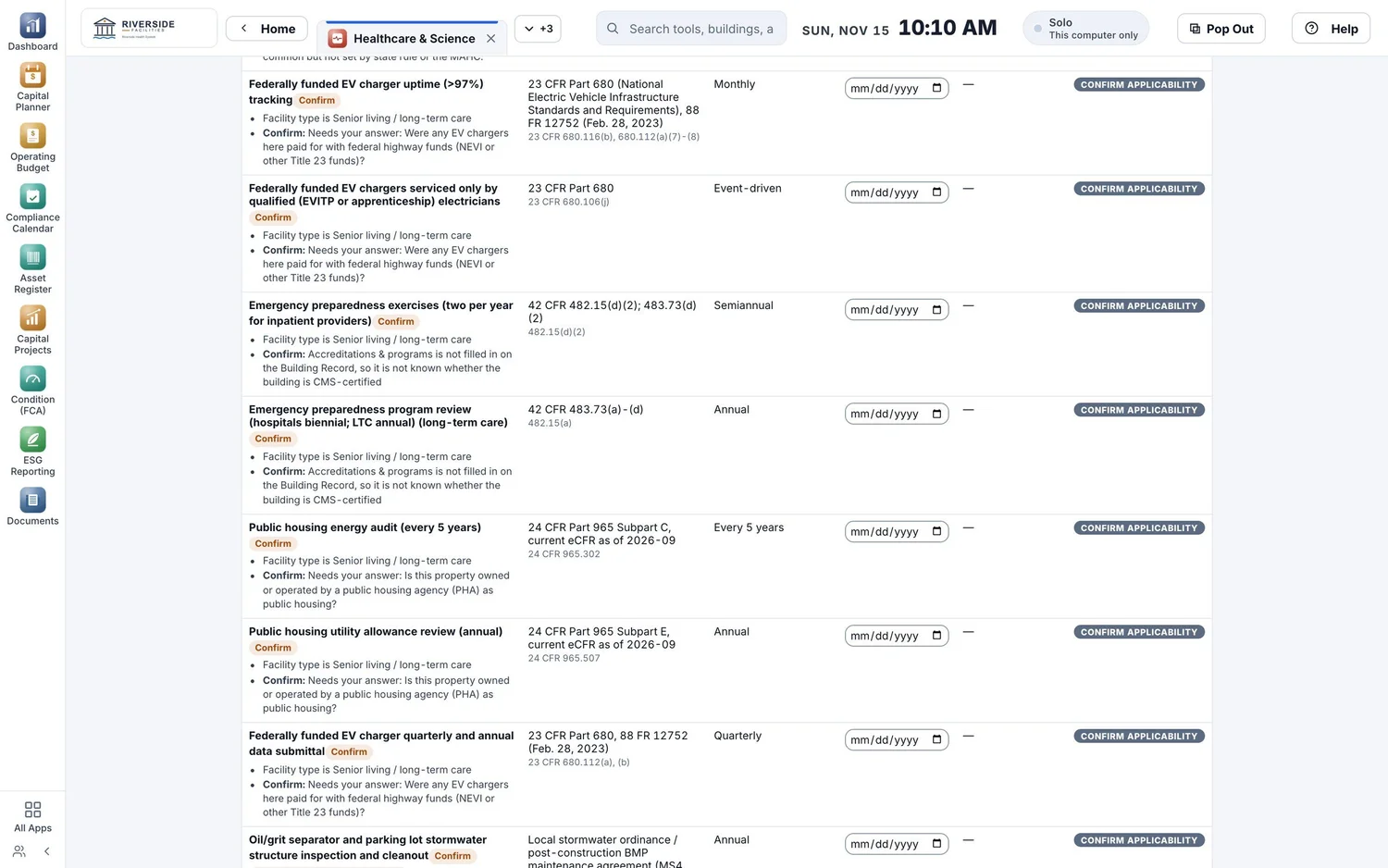
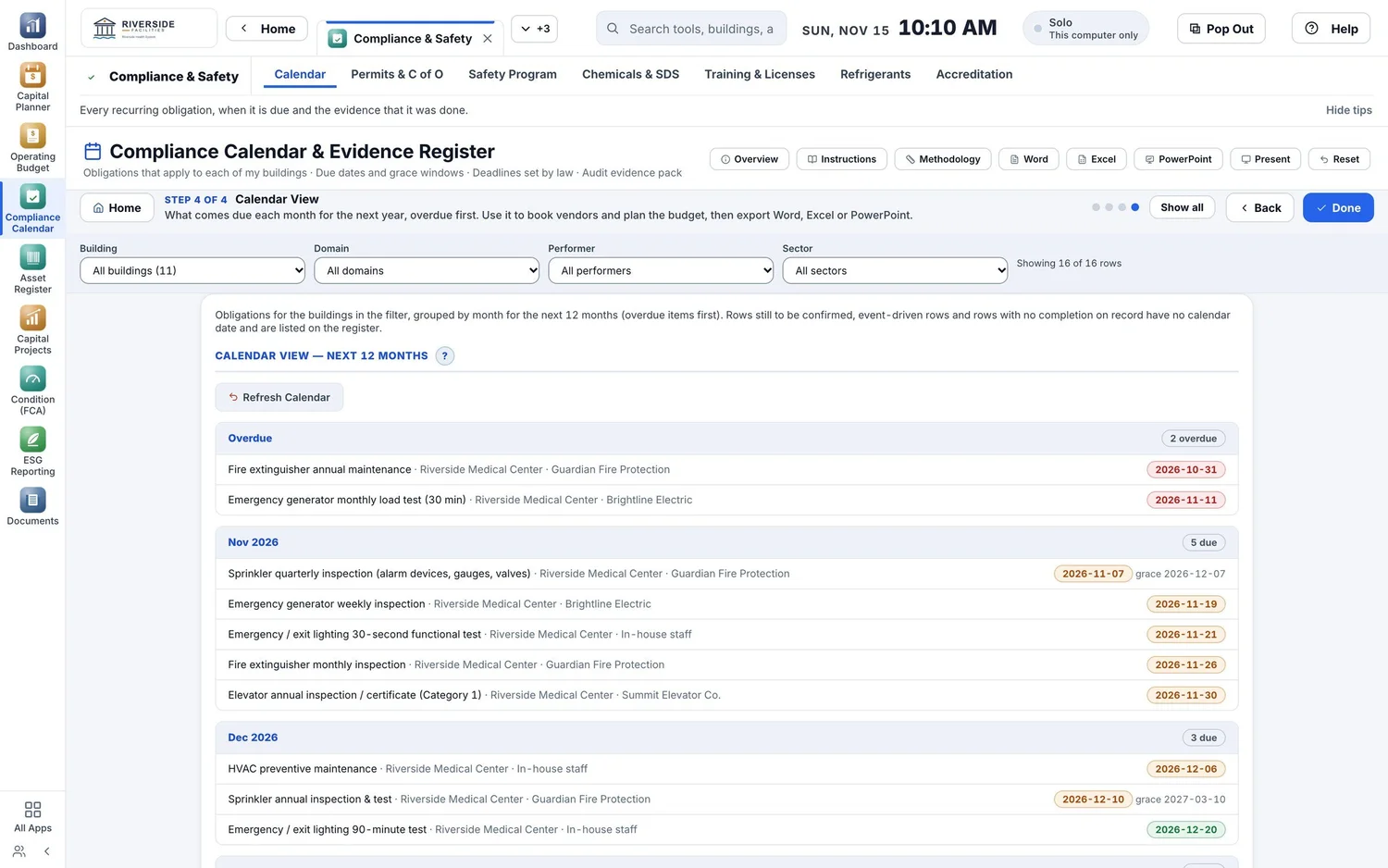
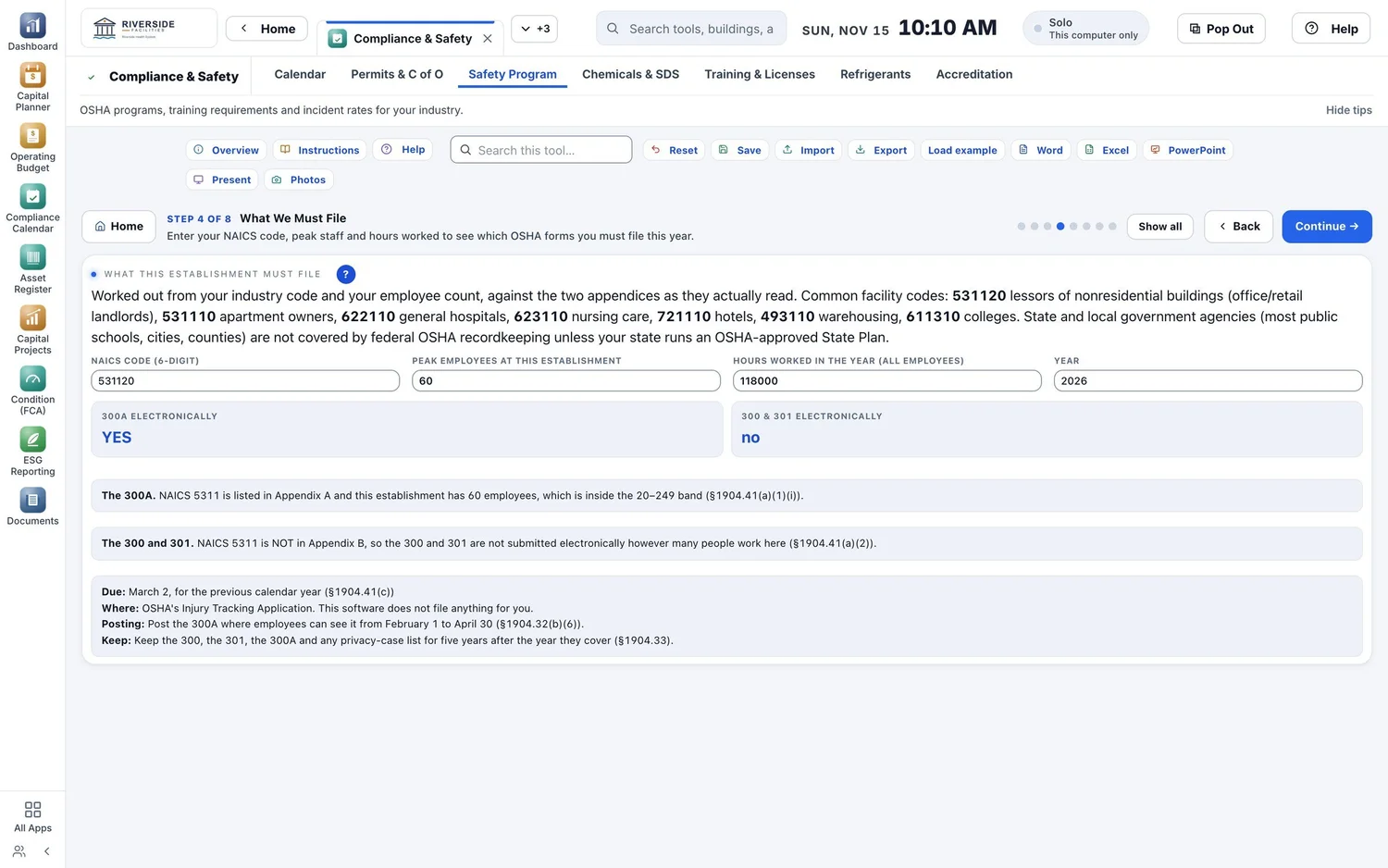
Compliance in Senior Living & Care: enter the date each item was last done: life-safety survey, drills on every shift, generator tests, Legionella plan, CMS emergency plan. Status updates itself.
Licensing and Housing Rules
- State assisted living licensure inspection, carried in the library for Texas (26 TAC 553: at least once every two years after the initial inspection); other states follow their own licensing rule
- Dwelling smoke and carbon monoxide alarms tested annually and smoke alarms replaced 10 years from manufacture (NFPA 72)
- HUD physical inspection under NSPIRE (every 3, 2 or 1 years by score) and the annual self-inspection, for HUD-assisted communities
- Fair Housing Act design and construction requirements for buildings first occupied after March 13, 1991
- Lead-based paint disclosure and, for HUD-assisted housing, the Lead Safe Housing Rule, for buildings built before 1978
- Section 504 web and mobile accessibility for recipients of Department of Health and Human Services funds
Kitchens, Medical Gas and Workers
- A food protection manager with a current certificate on staff (renewed about every 5 years) and the food establishment health inspection (model code: at least once every 6 months unless a risk-based schedule allows longer)
- Medical gas and vacuum inspection, testing and maintenance where provided: annual, with verification after any work (NFPA 99)
- Bloodborne pathogens exposure control plan reviewed at least annually (OSHA 29 CFR 1910.1030)
The Playbook's Own Checklist
- Life-safety code survey (NFPA 101; state, CMS for skilled nursing, AHJ): annual
- Fire alarm inspection and testing (NFPA 72): annual
- Sprinkler and standpipe testing (NFPA 25): annual
- Emergency generator test (NFPA 110 / NFPA 99): monthly run and transfer test
- Fire and evacuation drills on all shifts (NFPA 101 / state): quarterly
- CMS emergency preparedness plan (42 CFR 483): annual
- Water management and Legionella plan (ASHRAE 188 / CMS QSO-17-30): annual
- Kitchen hood and grease-duct cleaning (NFPA 96): semiannual; food-service health inspection: semiannual
- Elevator inspection and certificate (ASME A17.1 / state), medical gas and oxygen inspection (NFPA 99), backflow test, boiler certificate, ADA and Fair Housing review, state licensing re-survey: annual
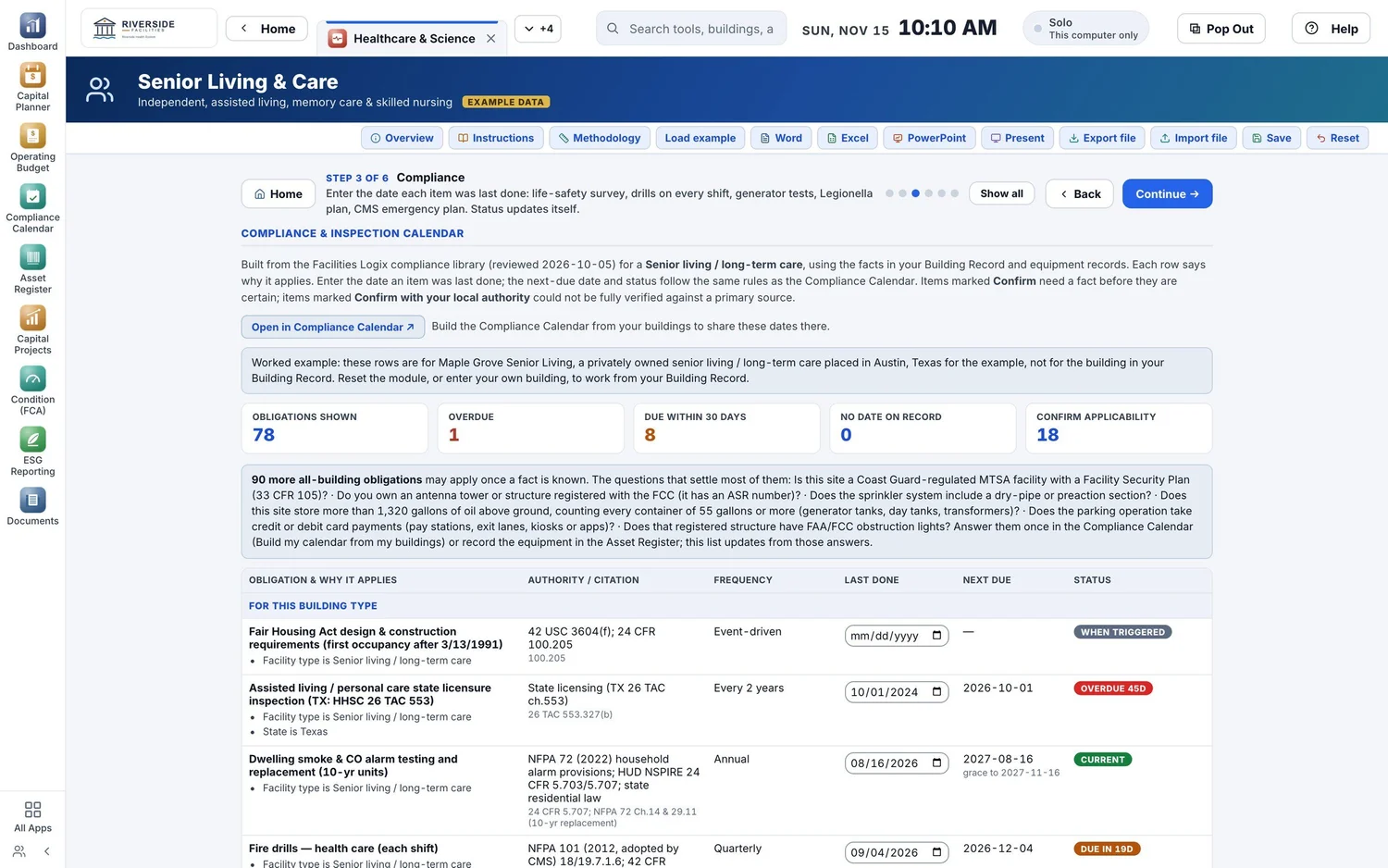
Compliance in Senior Living & Care: enter the date each item was last done: life-safety survey, drills on every shift, generator tests, Legionella plan, CMS emergency plan. Status updates itself.
From the Nurse Call to the Laundry
Profile
- Care level: independent living, assisted living, memory care, skilled nursing or a multi-level continuing care community
- Licensure: state assisted living license, skilled nursing in the CMS program, independent (unlicensed) or mixed
- Units or licensed beds, floor area, year built and a year of energy
Systems and Starting PM Cadence
- Emergency and standby generator (NFPA 110, life-safety branch): monthly
- Central plant and domestic hot water, with anti-scald and Legionella control: semiannual
- Fire alarm and sprinkler (NFPA 72 / 25, NFPA 101 board and care): annual
- Nurse call, resident alert and wander management: quarterly
- Resident unit and common-area HVAC: semiannual
- Elevators: monthly; commercial laundry: quarterly; commercial kitchen and hood: semiannual
- Medical gas and oxygen for skilled nursing (NFPA 99 where provided): annual
- Access control and resident security: quarterly; roofing and envelope: semiannual; building automation: annual
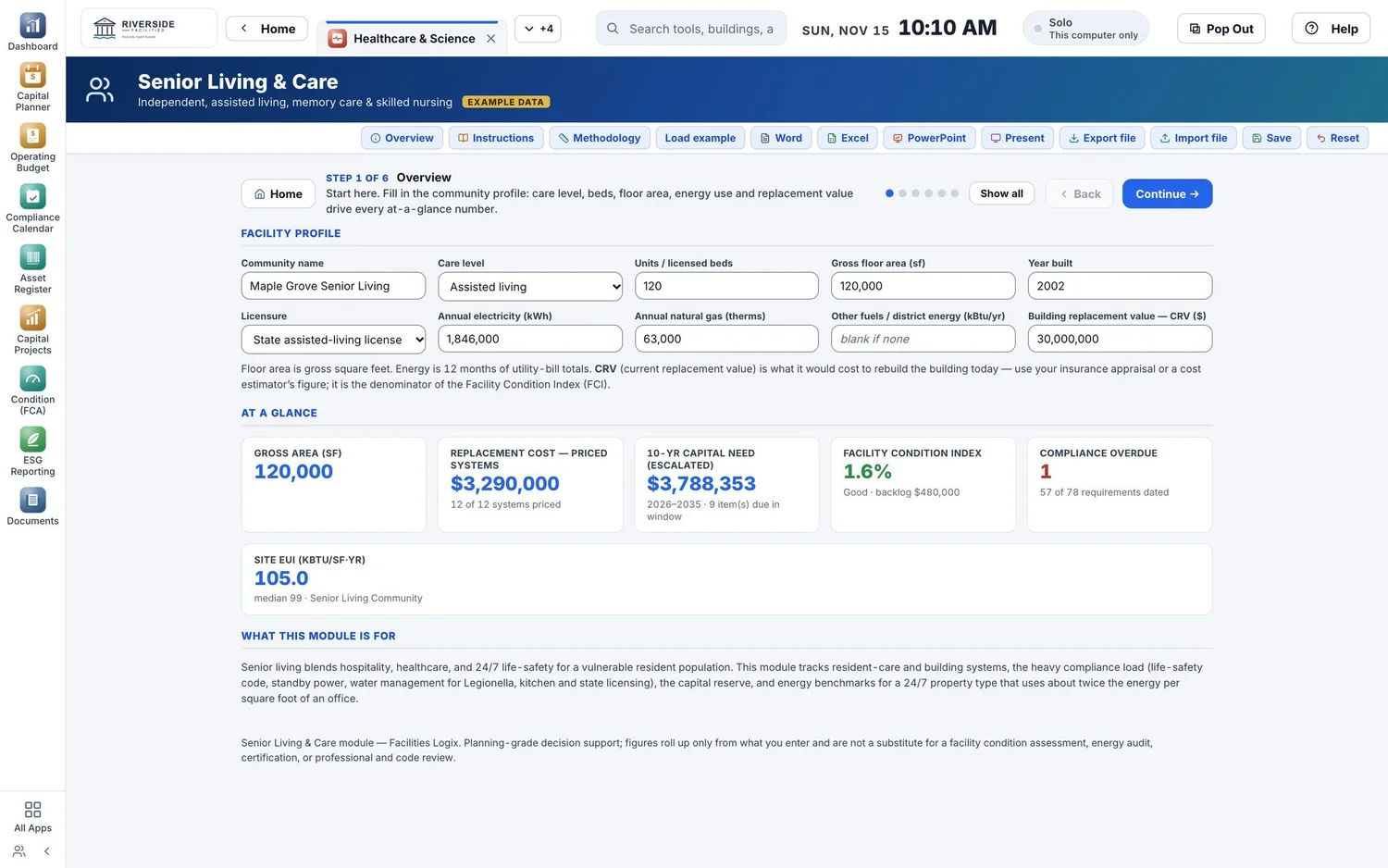
Overview in Senior Living & Care: start here. Fill in the community profile: care level, beds, floor area, energy use and replacement value drive every at-a-glance number.
Capital Reserve Lines
- Resident unit HVAC (15-year life), central plant and hot water (22), emergency generator (25), nurse call and alert (12), roof (22), elevator modernization (25), kitchen equipment (12), life-safety systems (18), resident and common-area furnishings refresh (10), parking and site (20)
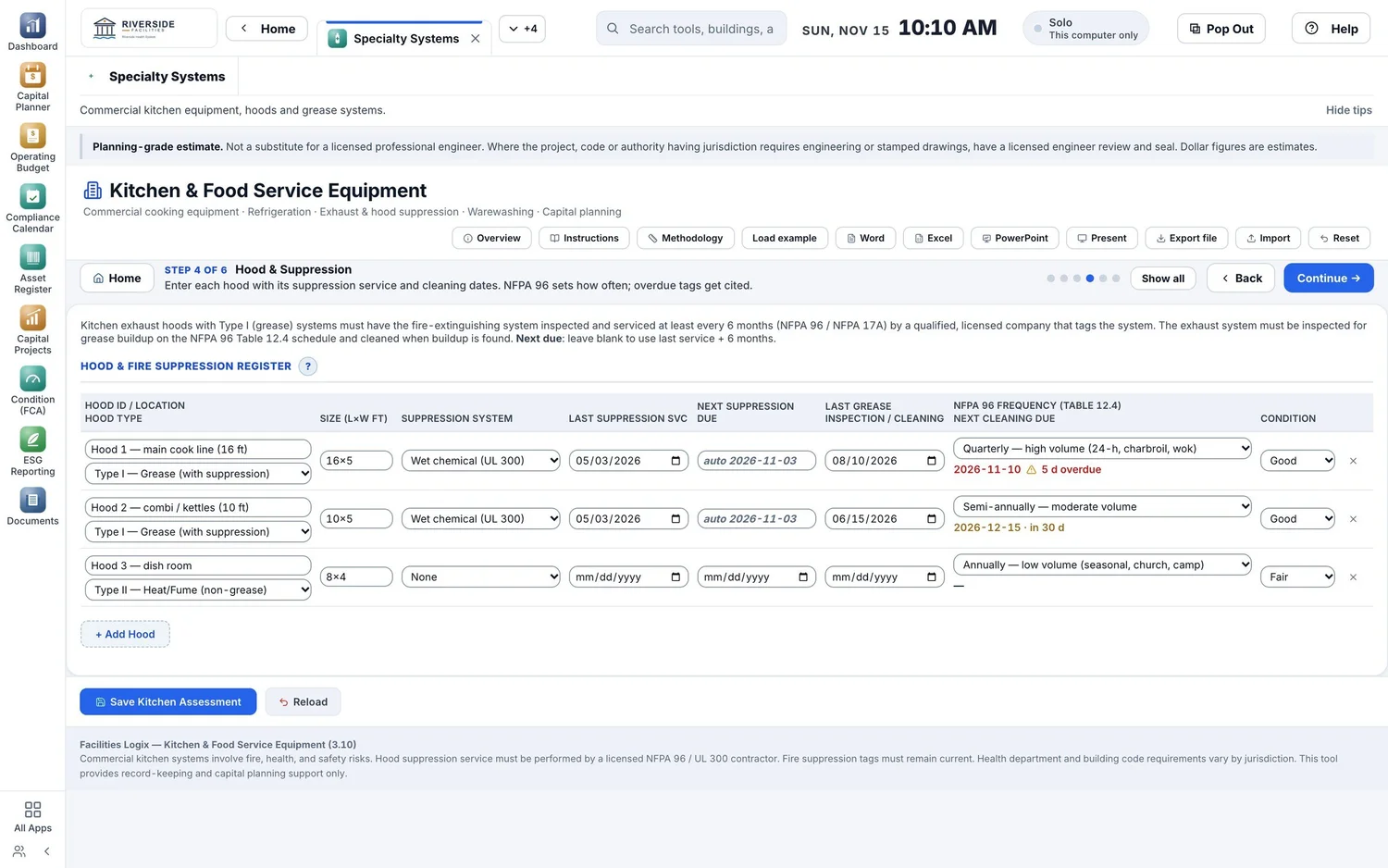
Hood & Suppression in Kitchen & Food Service Equipment: enter each hood with its suppression service and cleaning dates. NFPA 96 sets how often; overdue tags get cited.
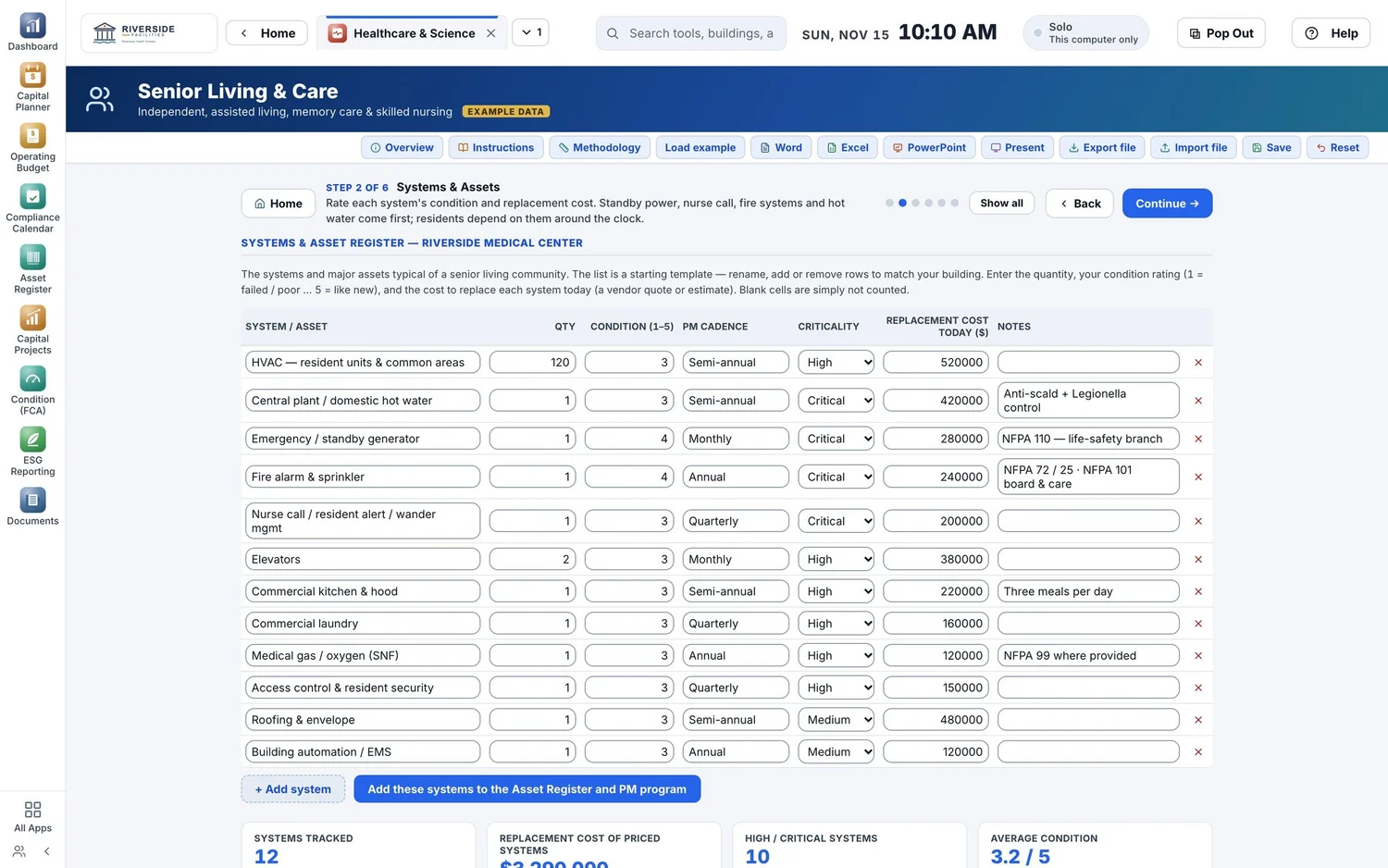
Residents depend on systems such as nurse call, so the playbook starts with the ones that protect them.
The Records That Protect Residents
Hot Water and Scald Risk
The water management program's hazard points and a scald risk rating, with mixing valves to limit delivery to 110°F or below for vulnerable residents and the Monitoring Log for loop temperatures and out-of-range events.
Learn MoreStandby Power
Generator tests sit on the calendar, and Live Alarms offers starting limits for generators (NFPA 110) and domestic hot water (ASHRAE Guideline 12), each editable per point.
Learn MoreShow Less
When power fails, residents who depend on oxygen, elevators and heat depend on the generator, and a failed start is costly in every sense. Live Alarms raises a work order before the outage finds the problem.
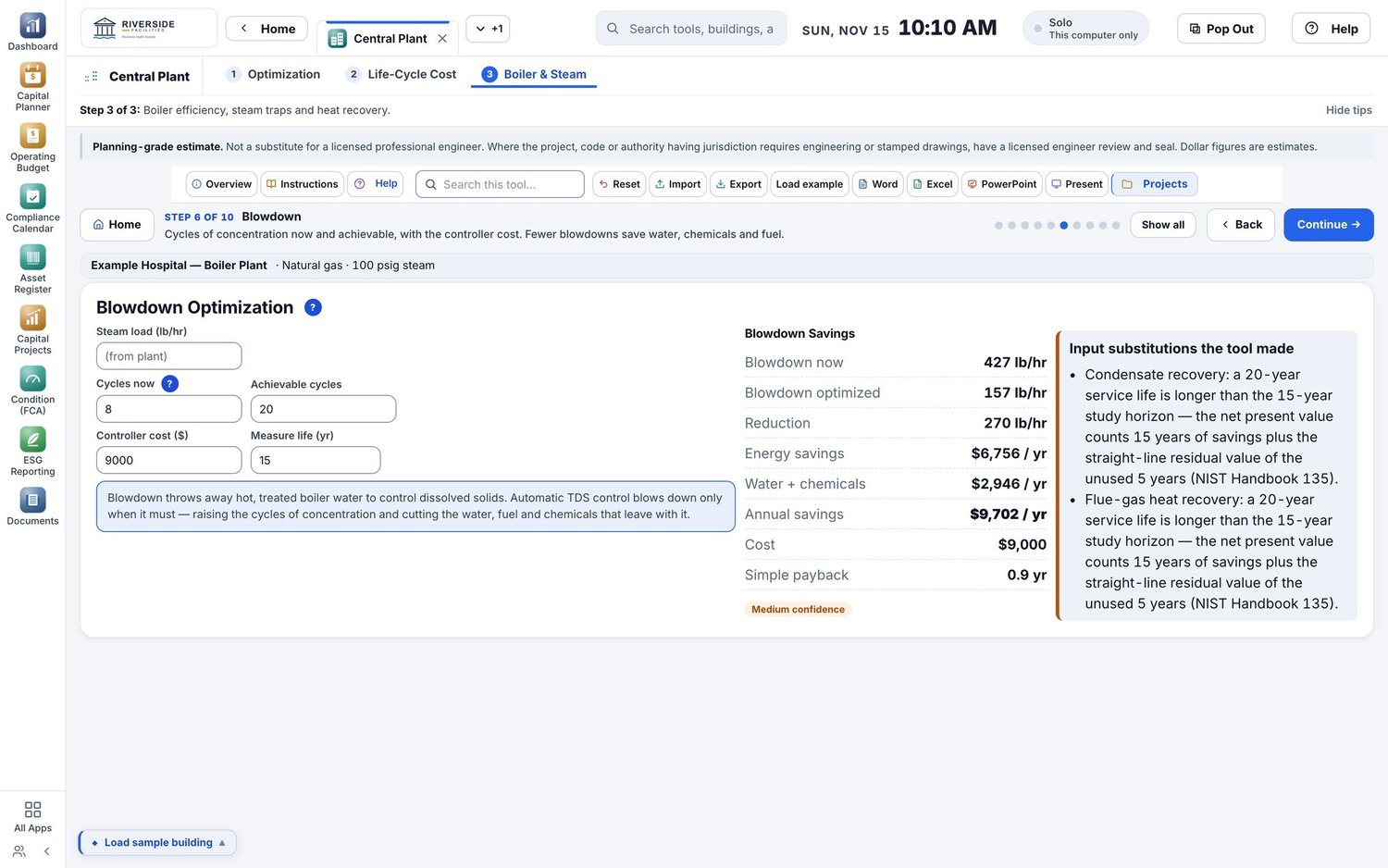
- Generator alarms: not in automatic, low fuel (50% to start), low starting battery, high coolant.
- Transfer switches alarm when on emergency or not in automatic.
- Hot water alarms below 140 °F stored or 124 °F in the loop; cold water above 77 °F.
- Every limit is a starting value you edit per point.
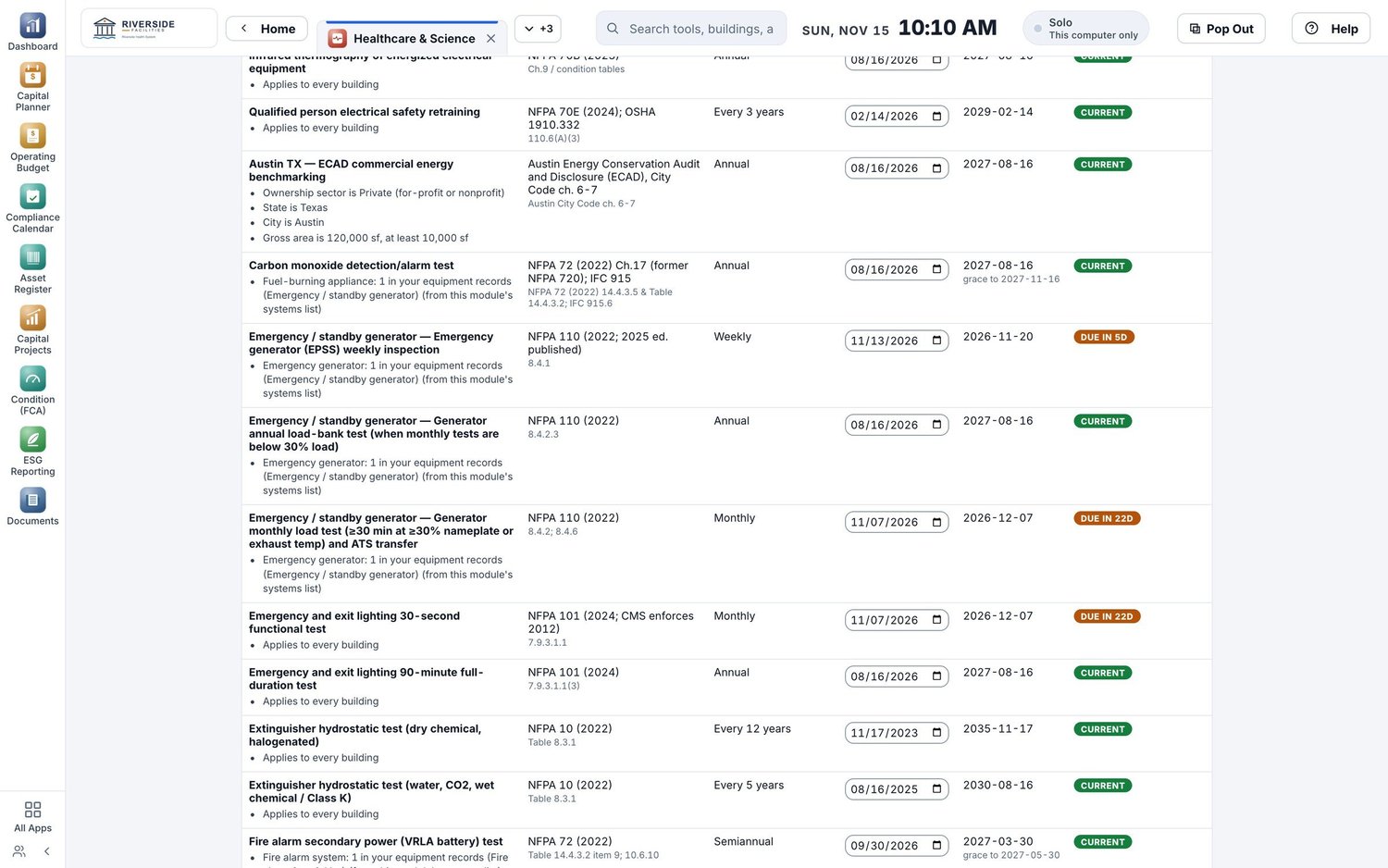
Compliance in Senior Living & Care: enter the date each item was last done: life-safety survey, drills on every shift, generator tests, Legionella plan, CMS emergency plan. Status updates itself.
Medical Gas Where Provided
The Medical Gas tool lists long-term care and skilled nursing among its facility types, with gas sources, zone valves and inspection records.
Learn MoreThe Hospital Workbook Too
The Healthcare module's facility types include long-term care and skilled nursing, for a community that keeps Environment of Care plans and a utility management plan.
Learn More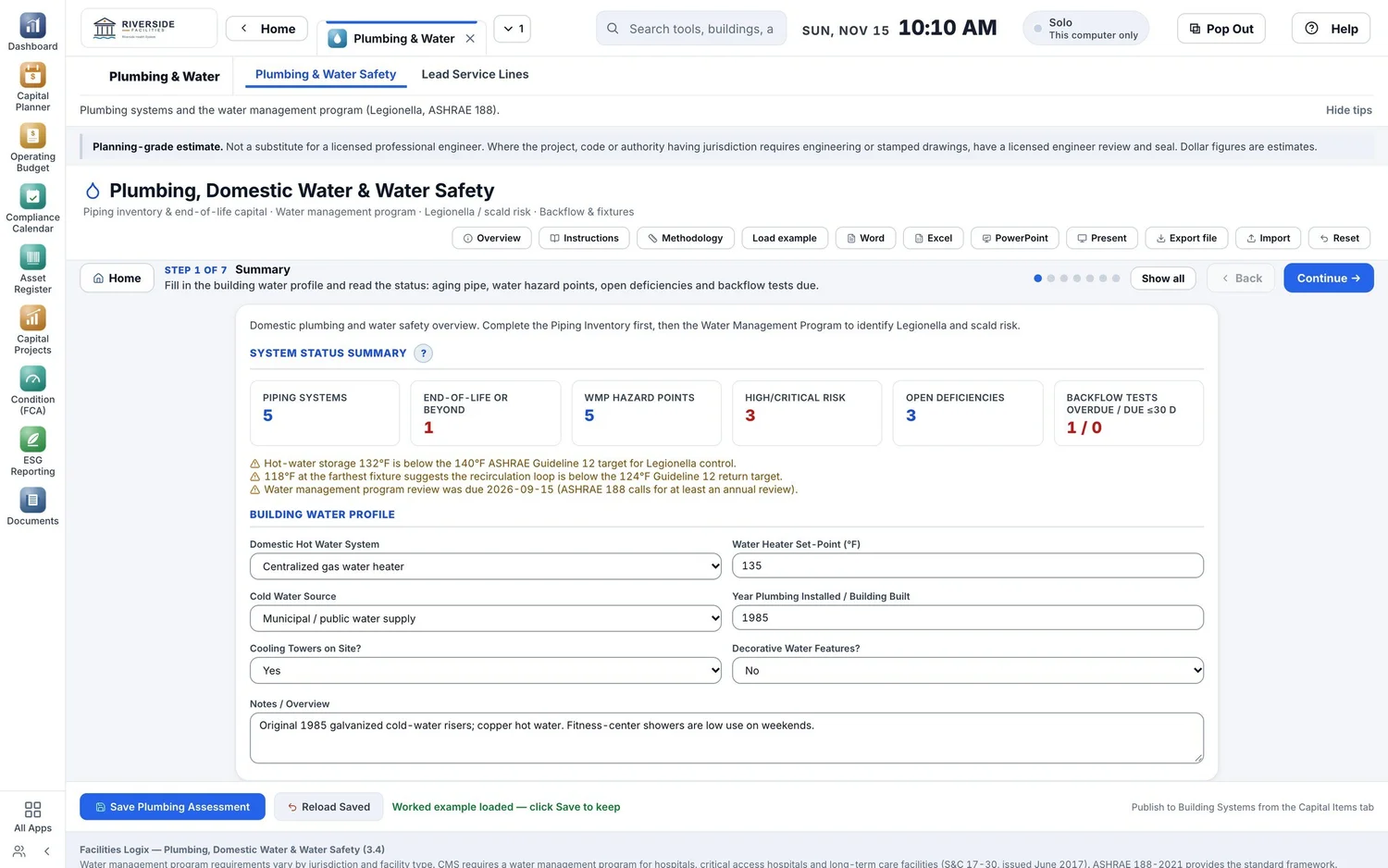
Ready for the State Surveyor
Compliance Tab
Enter the date each item was last done: life-safety survey, drills on every shift, generator tests, the Legionella plan and the CMS emergency plan. Status updates itself, with the same dates as the Compliance Calendar.
Learn MoreReports
Word, Excel and PowerPoint reports with the systems, compliance status, capital reserve and the ENERGY STAR section.
Learn MoreShow Less
Owners and boards fund reserves when they see the backlog and what waiting costs. Each report opens with a funding recommendation built from your own figures.
- Facility Condition Index, rated Good, Fair or Poor on the NACUBO/APPA scale.
- Ten-year reserve need by year, escalated at the rate you set.
- Deferred backlog by system, largest first.
- A compliance chart of overdue, due-soon and current items.
- A SAMPLE watermark marks any report made from the worked example.
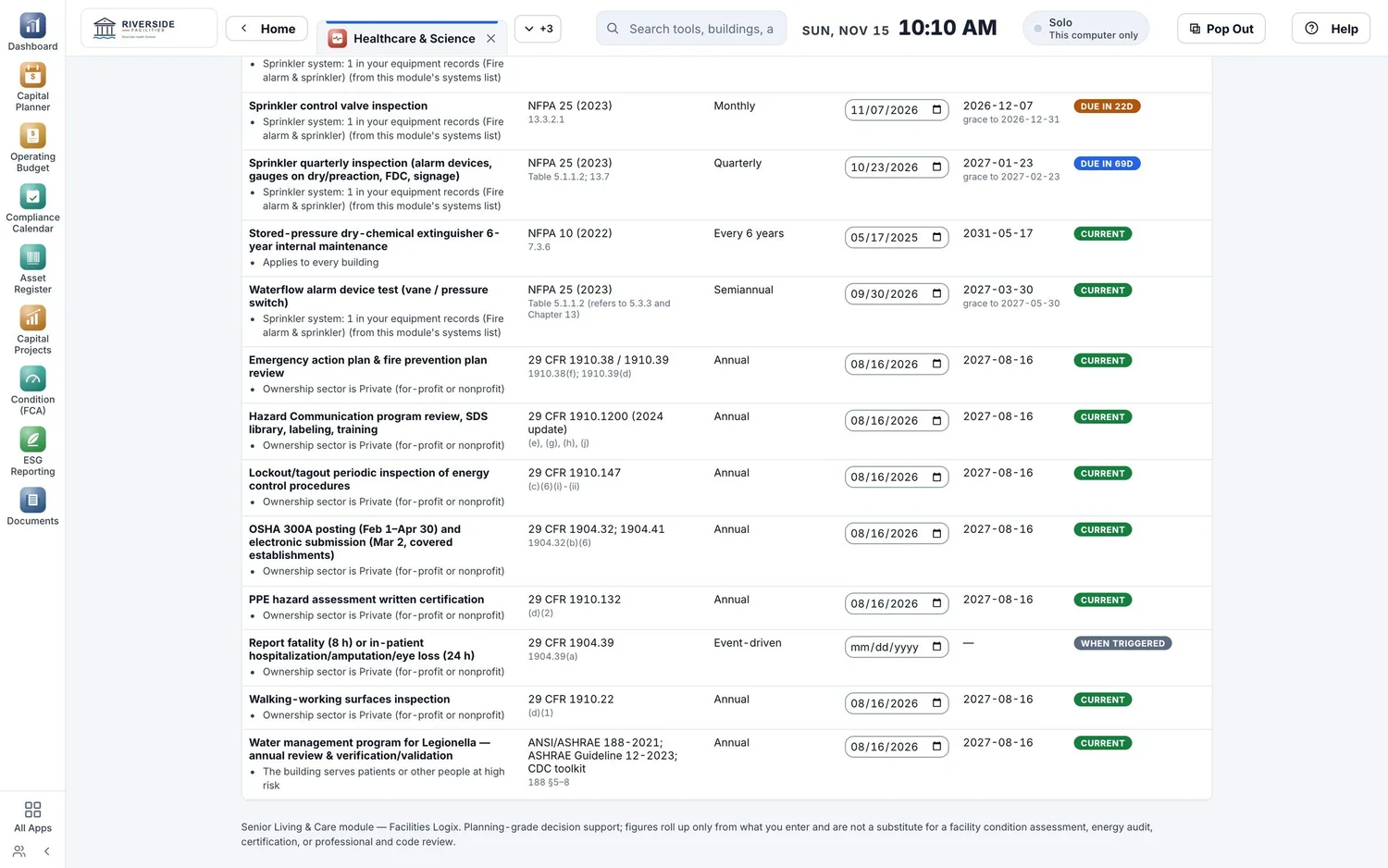
Compliance in Senior Living & Care: enter the date each item was last done: life-safety survey, drills on every shift, generator tests, Legionella plan, CMS emergency plan. Status updates itself.
ENERGY STAR
Senior living communities get a 1 to 100 ENERGY STAR score and are eligible for certification. The energy comes from your bills.
Learn MoreShow Less
A community that runs around the clock pays for energy every hour, so knowing where it stands against peers shows where savings are. The tab defaults to the Senior Living Community property type.
- The national median is 213.2 kBtu per square foot source energy.
- Water use is compared with a median of 56.4 gallons per square foot.
- Residential Care Facility has no U.S. score; Multifamily Housing is offered for independent living.
- The tab lists benchmarking and performance-standard laws that apply to the building.
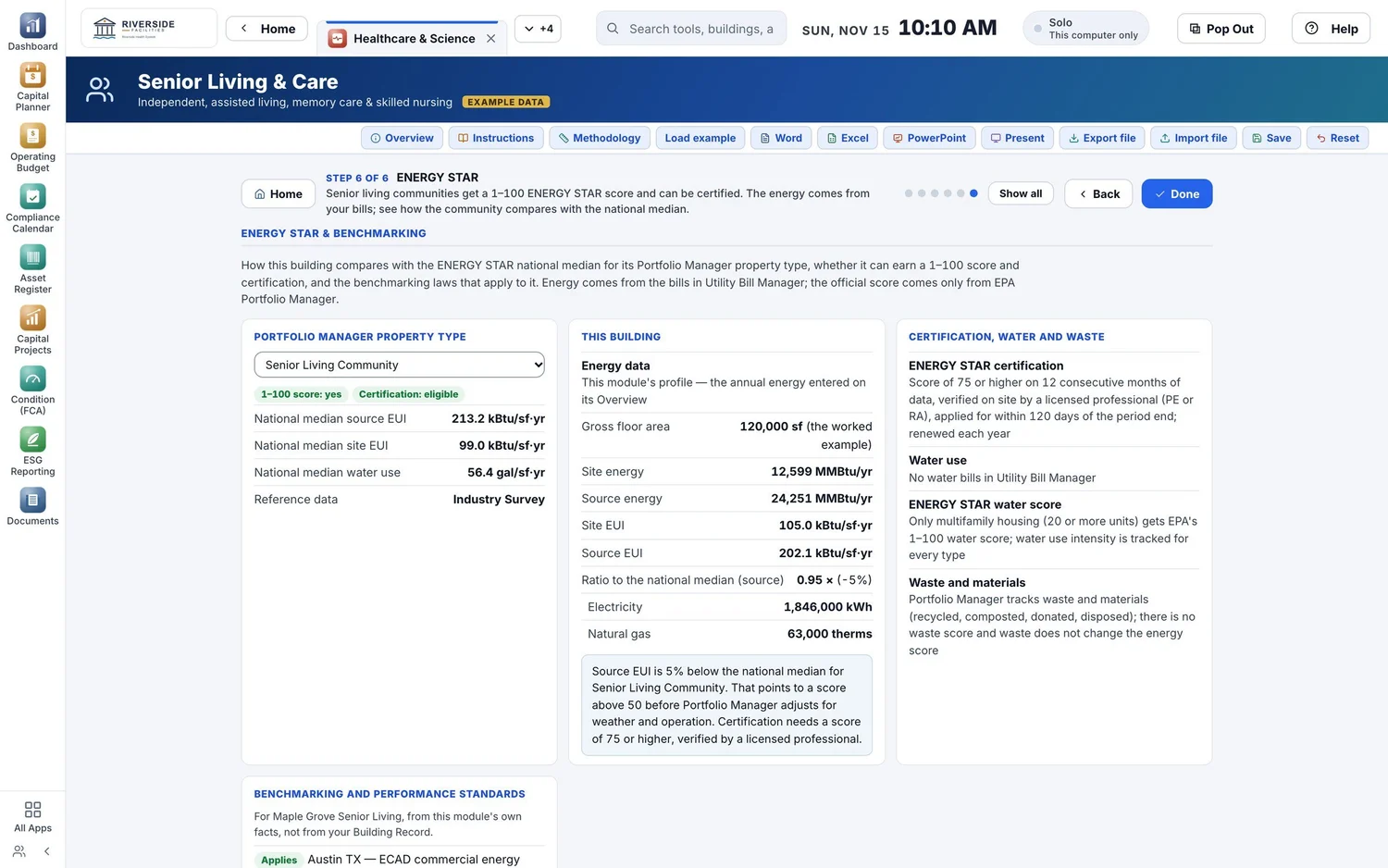
ENERGY STAR in Senior Living & Care: senior living communities get a 1–100 ENERGY STAR score and can be certified. The energy comes from your bills; see how the community compares with the national median.
The Yardsticks in the Playbook
Benchmarks
- Reserve for replacement: per an actuarial reserve study for a continuing care community, or the percent of revenue your organization sets
- CMS Emergency Preparedness Rule: required for skilled nursing in Medicare and Medicaid
- Energy intensity: the ENERGY STAR senior living median of about 99 kBtu per square foot, about twice an office (about 53) and well below a hospital (about 234)
- Water safety: an ASHRAE 188 plan, which CMS surveys for
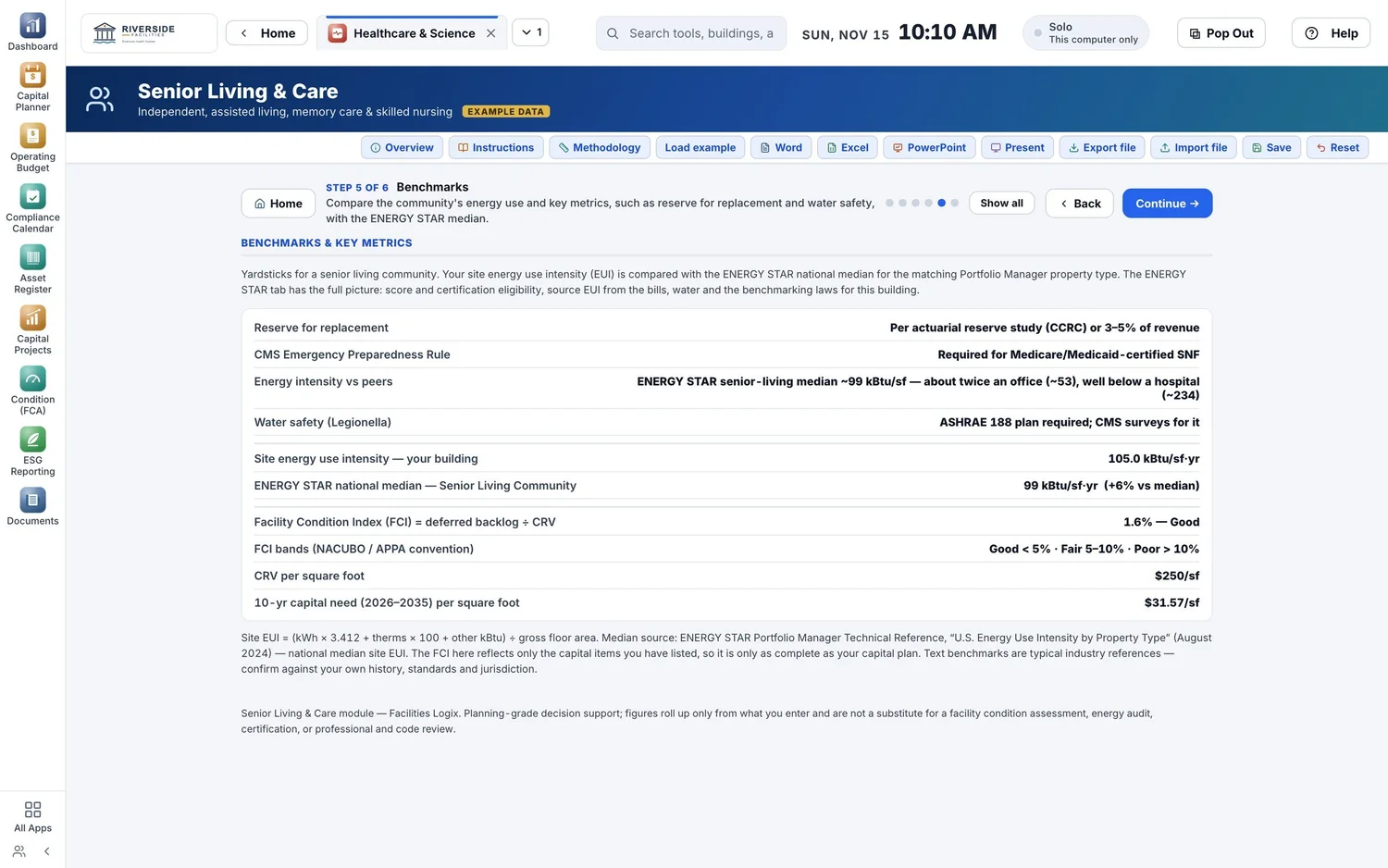
Reserves and energy use are hard to judge alone, so the playbook carries yardsticks written for senior living.
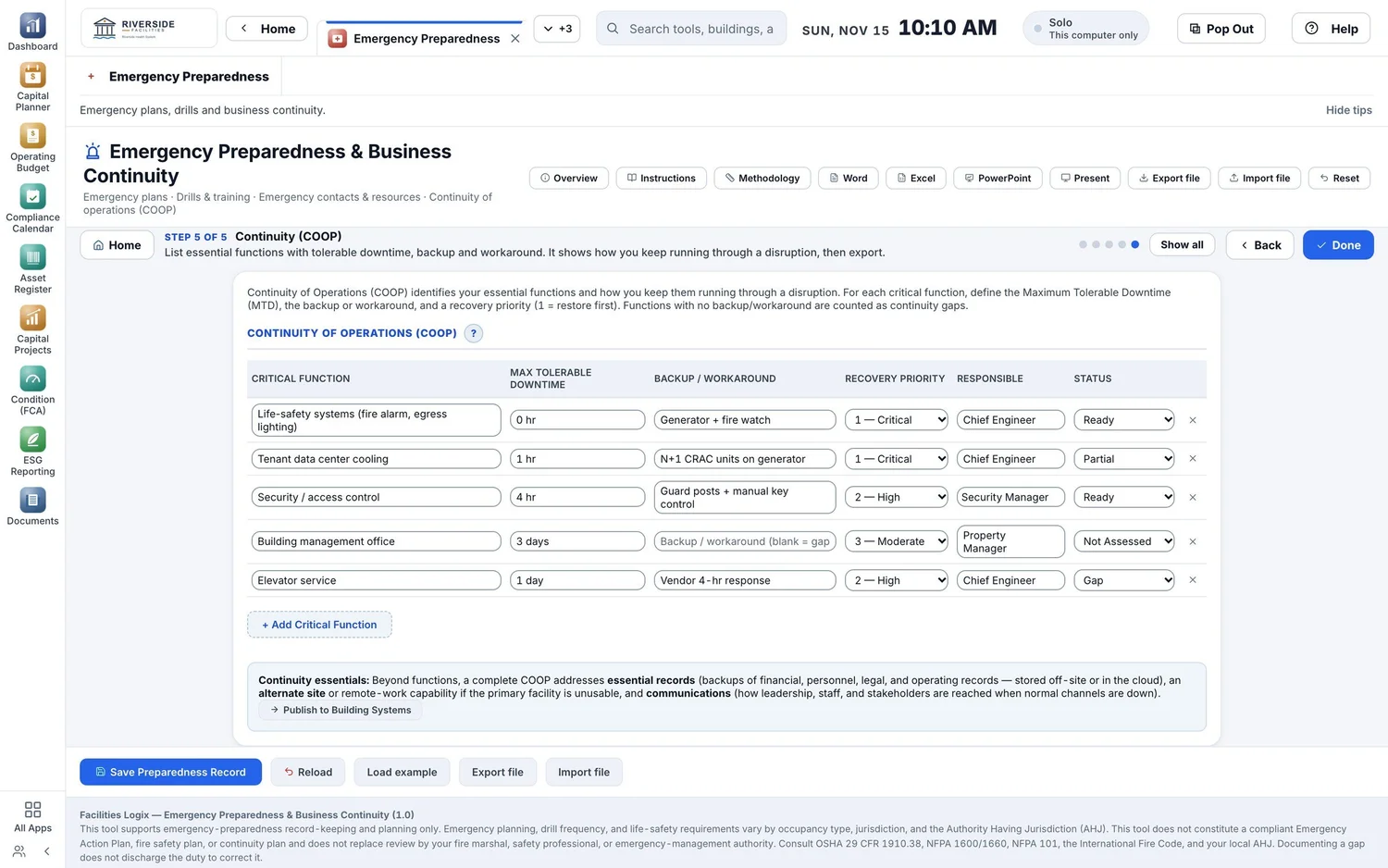
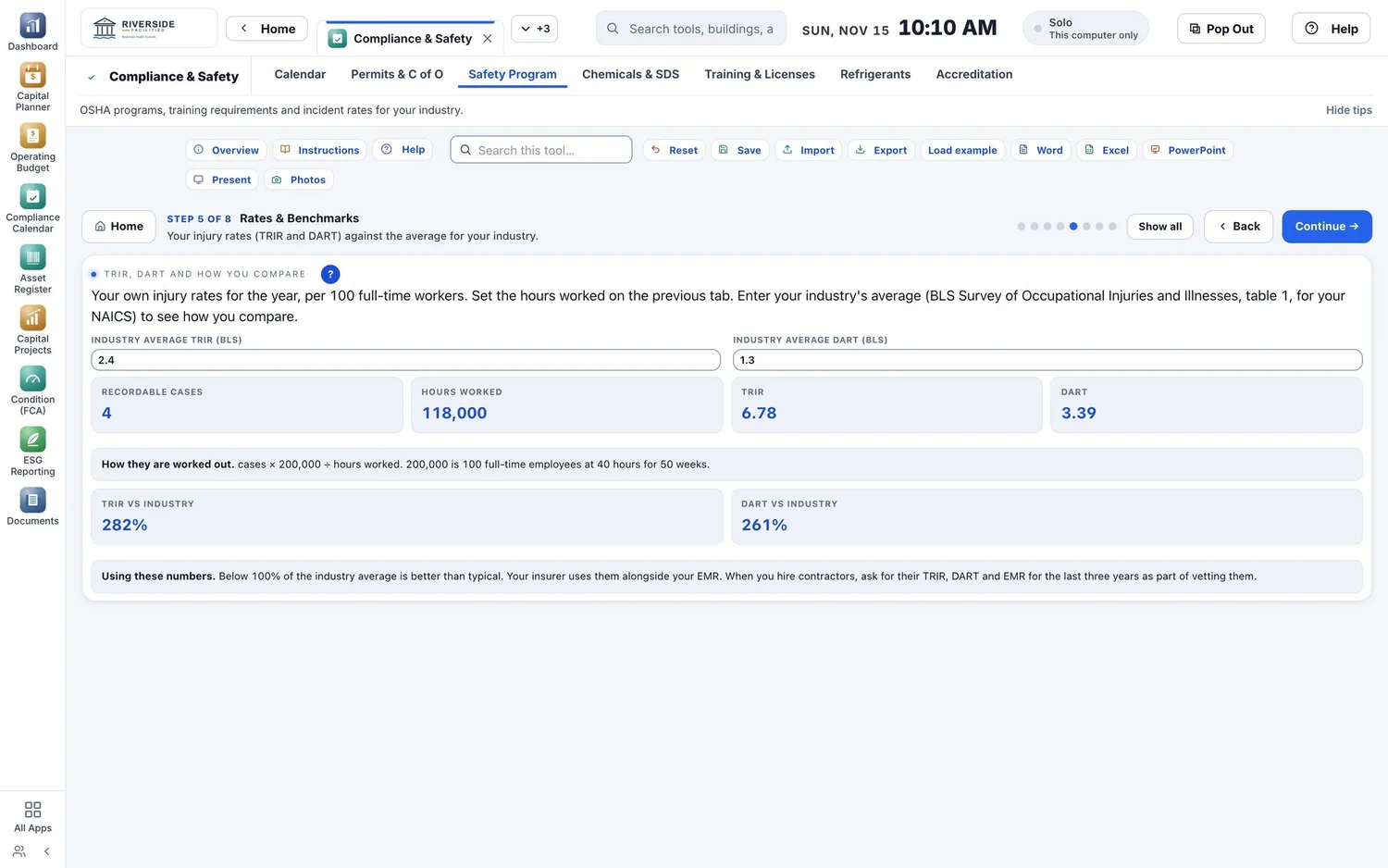
Fewer Surprises for Residents and Staff
Every Shift Covered
Drill schedules by occupancy type keep night drills and every-shift drills from slipping.
Learn MoreShow Less
Missing drill records can drop an assisted living community to the impractical evacuation rating, which triggers the strictest requirements. Each drill row says what the record must hold.
- Board and care logs: date, time, staff and residents present, exits used and evacuation time.
- Health care logs: date, time, shift, staff, alarm method and critique.
- Health care drills run at unexpected times; a coded announcement is allowed 9 p.m. to 6 a.m.
- Drill rows apply by the community's facility type in the compliance library.
One Calendar for Every License
State licensing, CMS, kitchen, elevator and boiler dates in one place instead of separate binders.
Learn MoreShow Less
A lapsed elevator certificate or boiler inspection can shut equipment residents rely on, and a missed licensing date can put the license at risk. One calendar keeps them from slipping.
- Sixteen starting rows, from kitchen hood cleaning to backflow and ADA and Fair Housing reviews.
- Next due is calculated from the last done date and frequency.
- Due within 30 days and overdue items are counted in each report.
- Dates match the portfolio Compliance Calendar.
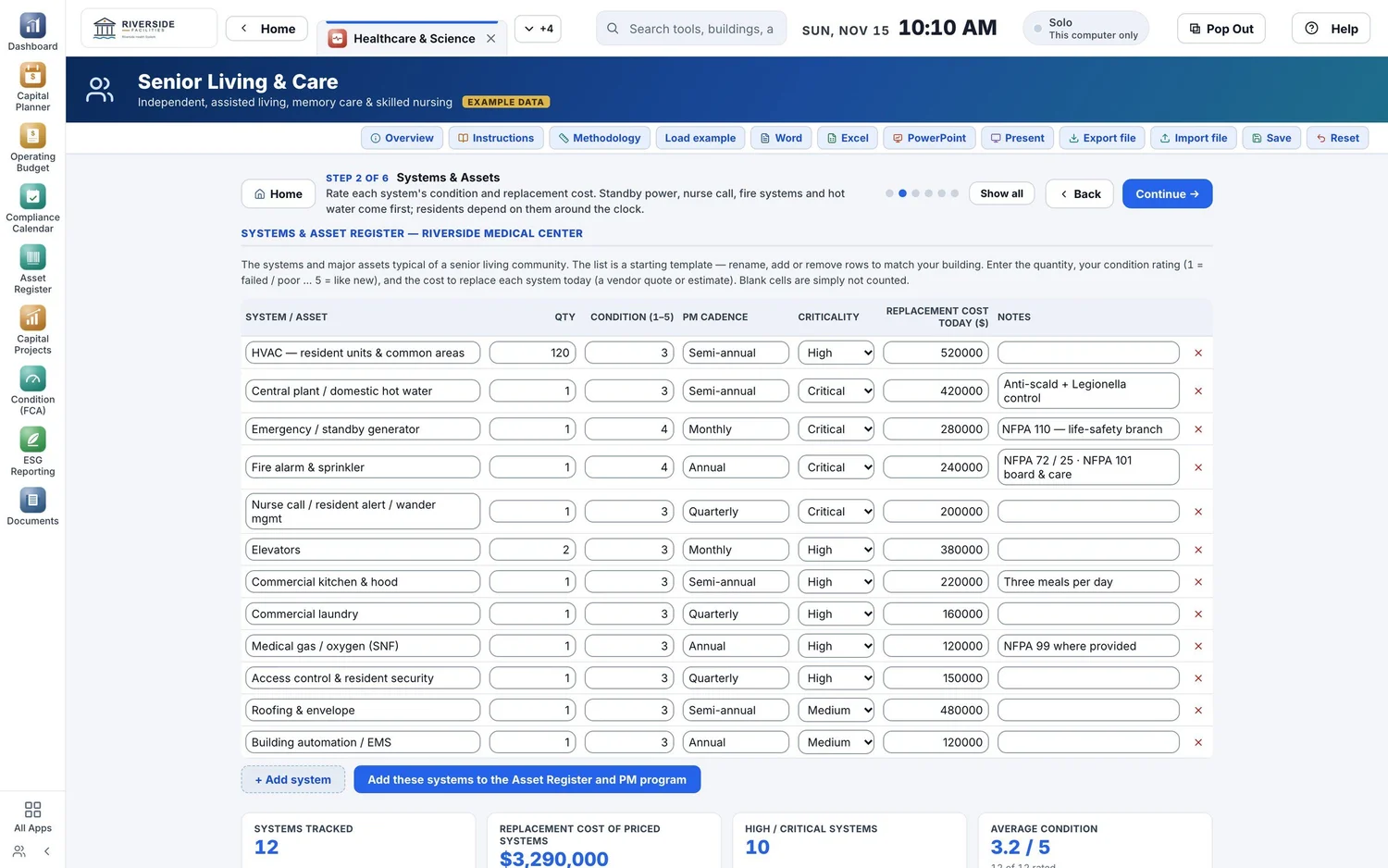
Systems & Assets in Senior Living & Care: rate each system's condition and replacement cost. Standby power, nurse call, fire systems and hot water come first; residents depend on them around the clock.
A Reserve You Can Defend
Replacement years and costs build the reserve for replacement, so the board sees what comes due before it fails.
Learn More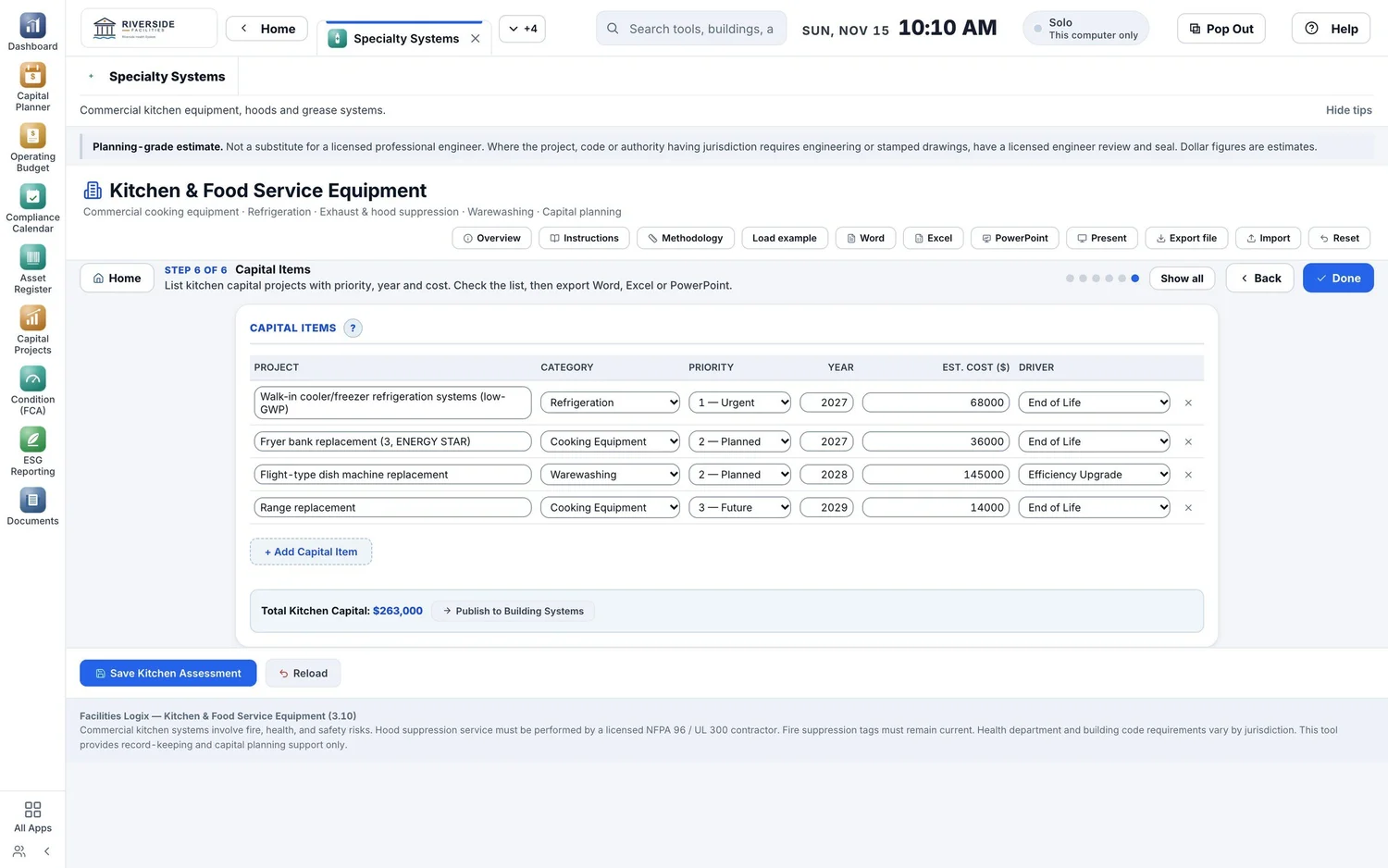
Frequently Asked Questions
Does an independent living building get skilled nursing rules?
Which states' licensing rules are built in?
Does it replace our water management program?
Be First When Facilities Logix Opens
Stop chasing building records across spreadsheets and binders. Join the list and we will tell you the day downloads open, with setup guides ready.
Launching early 2027 for Facilities Logix. Nothing to buy today, and no sales calls.
