

A school district runs dozens of buildings under federal and state school rules, and answers to a board and voters for every capital dollar. The School District playbook keeps the K-12 programs on one tab, puts every school's dates on the compliance calendar, and ranks every school by condition and utilization for the capital and bond plan.
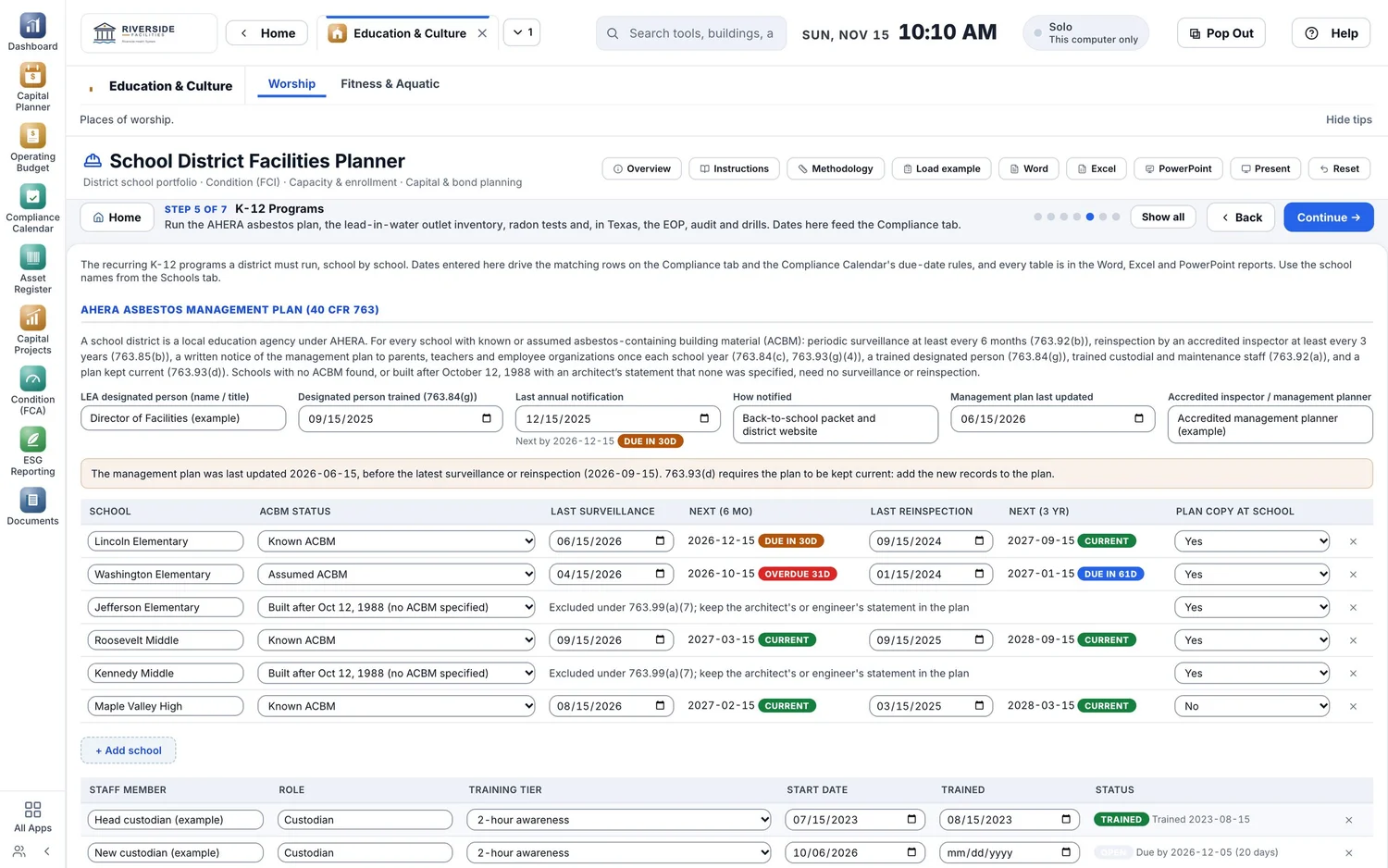
The School Programs, Kept Current School by School
The K-12 Programs tab holds the dates. They feed the School District's Compliance tab, which shares its rows and due dates with the Compliance Calendar.
Asbestos Management Under AHERA (40 CFR 763)
- The Asbestos Hazard Emergency Response Act management plan: the district's designated person and the date they were trained, the accredited inspector or management planner, and when the plan was last updated
- Each school's asbestos status: known, assumed, none found, or built after October 12, 1988 with no asbestos specified. Schools with none found or excluded need no surveillance or reinspection, and the tab says so
- Periodic surveillance of each school with asbestos-containing material every 6 months, and reinspection by an accredited inspector at least every 3 years
- The written notice to parent, teacher and employee organizations at least once each school year, with how it was sent
- Staff training by tier: 2-hour awareness training for custodial and maintenance staff (new staff within 60 days of starting), 14 more hours for staff who disturb the material, the designated person, and the accredited inspector
- A flag when the management plan is older than the latest surveillance or reinspection
Lead in School Drinking Water
- An outlet inventory built on the EPA 3Ts program (Training, Testing and Taking Action): drinking fountains, bottle fillers, kitchen and food-prep faucets, the nurse's office faucet, classroom faucets used for drinking and ice machines
- For each outlet: the date sampled, the result in parts per billion, the action taken, the retest result, the date it went back in service and the next sample date
- Your action level, set by the district (the tab starts at the 10 ppb level of the Lead and Copper Rule Improvements; use your state's school level if it is lower) and your resample interval (the 3Ts suggests annual monitoring)
- An outlet over your level stays on the open list until it is fixed and retested
- A log of when results were shared, with whom and how
- The compliance library also carries the Lead and Copper Rule Improvements school sampling (40 CFR 141.92): from November 1, 2027 the community water system samples at least 20% of elementary schools each year for 5 years, and the district cooperates
Radon Testing
- Radon tests by school: the last test, the highest result, rooms tested, mitigation and the next test
- The EPA action level of 4.0 pCi/L
- Your state's school rule where the library has one: Rhode Island every 3 years; Connecticut, Florida, Vermont and West Virginia every 5 years; Oregon at least every 10 years under the district plan; Colorado, Virginia and the District of Columbia with no fixed retest interval
- Where a state sets no interval or no mandate, the tab says so and uses the EPA practice of retesting every 5 years
Texas School District Safety (Texas Only)
- Texas Education Code 37.108: the multihazard emergency operations plan reviewed at least every 12 months, and the district safety and security audit at least once every 3 years, reported to the board and the Texas School Safety Center
- Texas drill schedule by school for the school year (19 TAC 103.1209): 4 fire evacuation drills (2 each semester), 2 lockdown drills (1 each semester), and 1 secure, 1 evacuation and 1 shelter drill
- These rows apply only to Texas districts; districts in other states add their own state's school safety dates to the compliance calendar
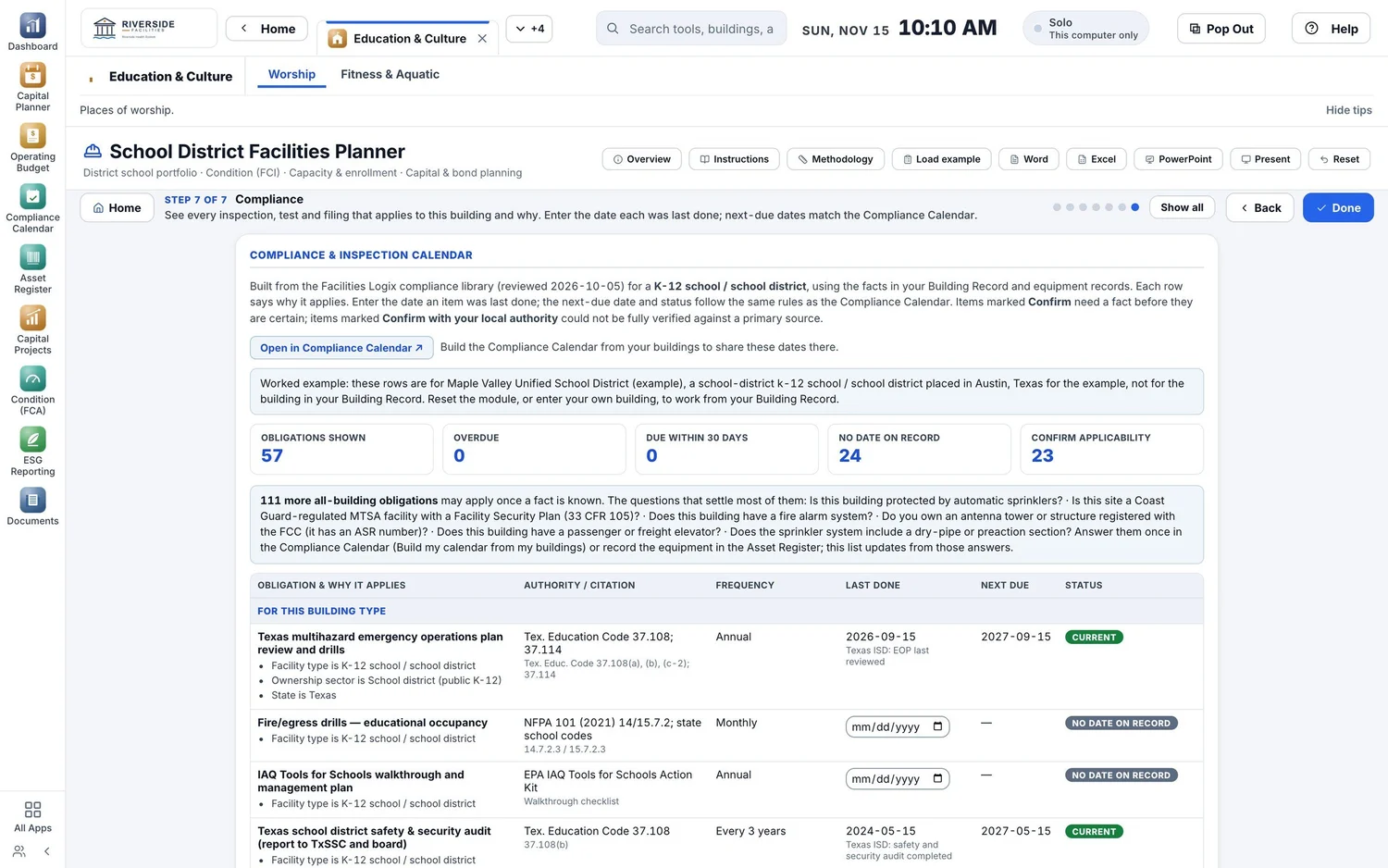
Compliance in School District Facilities Planner: see every inspection, test and filing that applies to this building and why. Enter the date each was last done; next-due dates match the Compliance Calendar.
Other School Rows in the Library
- Fire and egress drills for educational occupancies under NFPA 101: at least one drill every month school is in session, plus one in the first 30 days of operation
- School food service health inspections for National School Lunch Program schools (7 CFR 210.13): at least two each school year
- Playground inspection under the U.S. Consumer Product Safety Commission (CPSC) Public Playground Safety Handbook and ASTM F1487: monthly routine and annual comprehensive
- Bleacher and grandstand inspection under ICC 300, at least once a year
- Stage rigging inspection under ANSI E1.47: Level 1 every year and Level 2 at least every 5 years
- EPA Indoor Air Quality (IAQ) Tools for Schools walkthrough, at least once a year (voluntary federally; some states require it)
- Science labs: the chemical hygiene plan review (29 CFR 1910.1450) and fume hood testing (ANSI/ASSP Z9.5) at least once a year
- School pools: drain cover verification under the Virginia Graeme Baker Pool and Spa Safety Act every year, and pool chemistry testing and logs under the CDC Model Aquatic Health Code
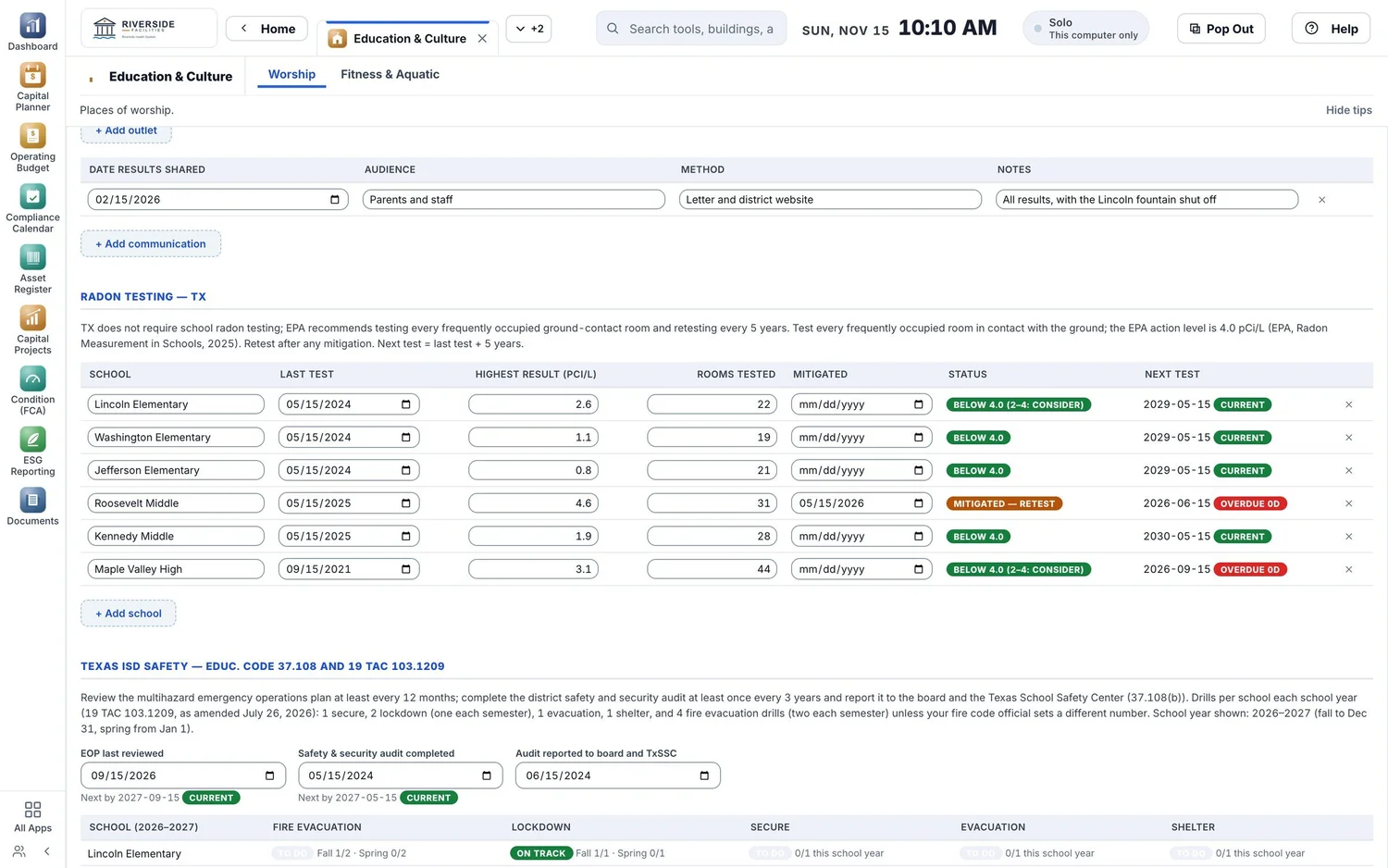
Radon Testing in School District Facilities Planner: each school's last test, highest result and next test date.
A District Planner, Not a Single Building
District Profile
The district name and facilities contact, the number of schools, total enrollment, total building area and the bond or funding program, with a portfolio summary that fills in as you go.
Learn MoreShow Less
Bond and budget conversations start with the size of the problem. The profile holds the district facts once and feeds every total the business office and board see, so nobody rebuilds them for each meeting.
- Portfolio FCI is total deferred maintenance divided by total replacement value
- One escalation rate prices every project in its target year
- Declared schools, enrollment and building area print on the report's inputs page
- A notes field for the bond or funding measure's status
Schools
Each school with its level, year built, square feet, enrollment and rated capacity. Utilization and the condition index show beside every school.
Learn MoreShow Less
Every empty seat still costs heat, power and upkeep, and every overcrowded school drives portables and boundary changes. Utilization puts both on one scale for every school.
- Utilization = enrollment divided by rated capacity
- Over 100% flags overcrowding; well under 70-80% flags a consolidation candidate
- Rated capacity follows your state or district loading standard
- Each school publishes with a 50-year design life and its remaining life
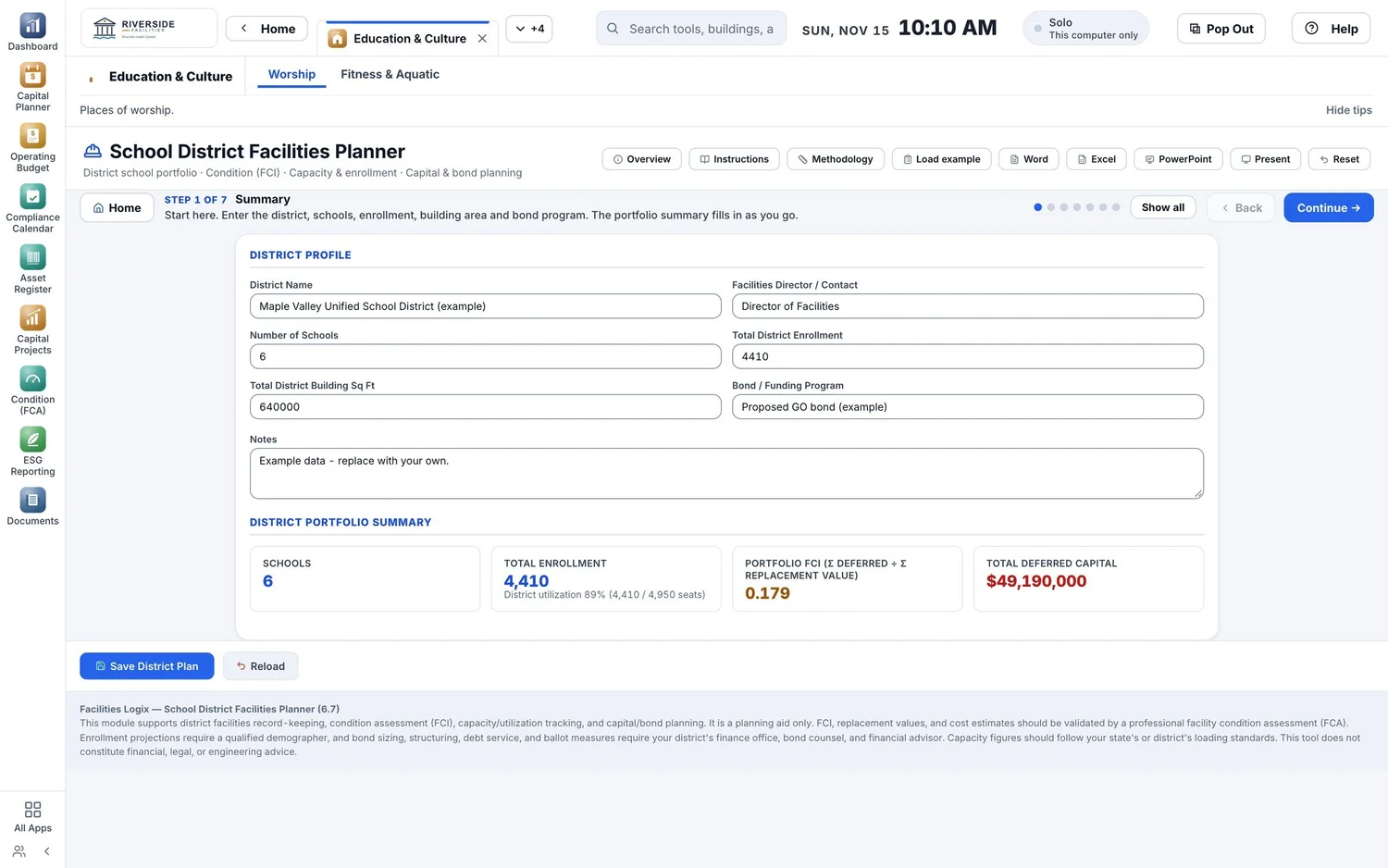
Summary in School District Facilities Planner: start here. Enter the district, schools, enrollment, building area and bond program. The portfolio summary fills in as you go.
Facility Condition
Each school's replacement value and deferred maintenance give its condition index and rating, which flow back to the Schools tab.
Learn MoreShow Less
Bond dollars are finite, and FCI ranks schools by condition need per dollar, so the worst buildings rise to the top of the list. Enter replacement value and deferred maintenance, and the rest is calculated.
- Bands: Good under 0.05, Fair 0.05-0.10, Poor 0.10-0.30, Critical over 0.30
- Critical often means replacement costs less than repair
- The district figure is weighted by value, so a portable never counts like a high school
- Each school's backlog publishes as a capital deficiency with its FCI
Capital and Bond Plan
Projects by school with category, priority, year and cost in today's dollars, escalated to their year at the rate you set, and grouped by year to size and stage a bond.
Learn More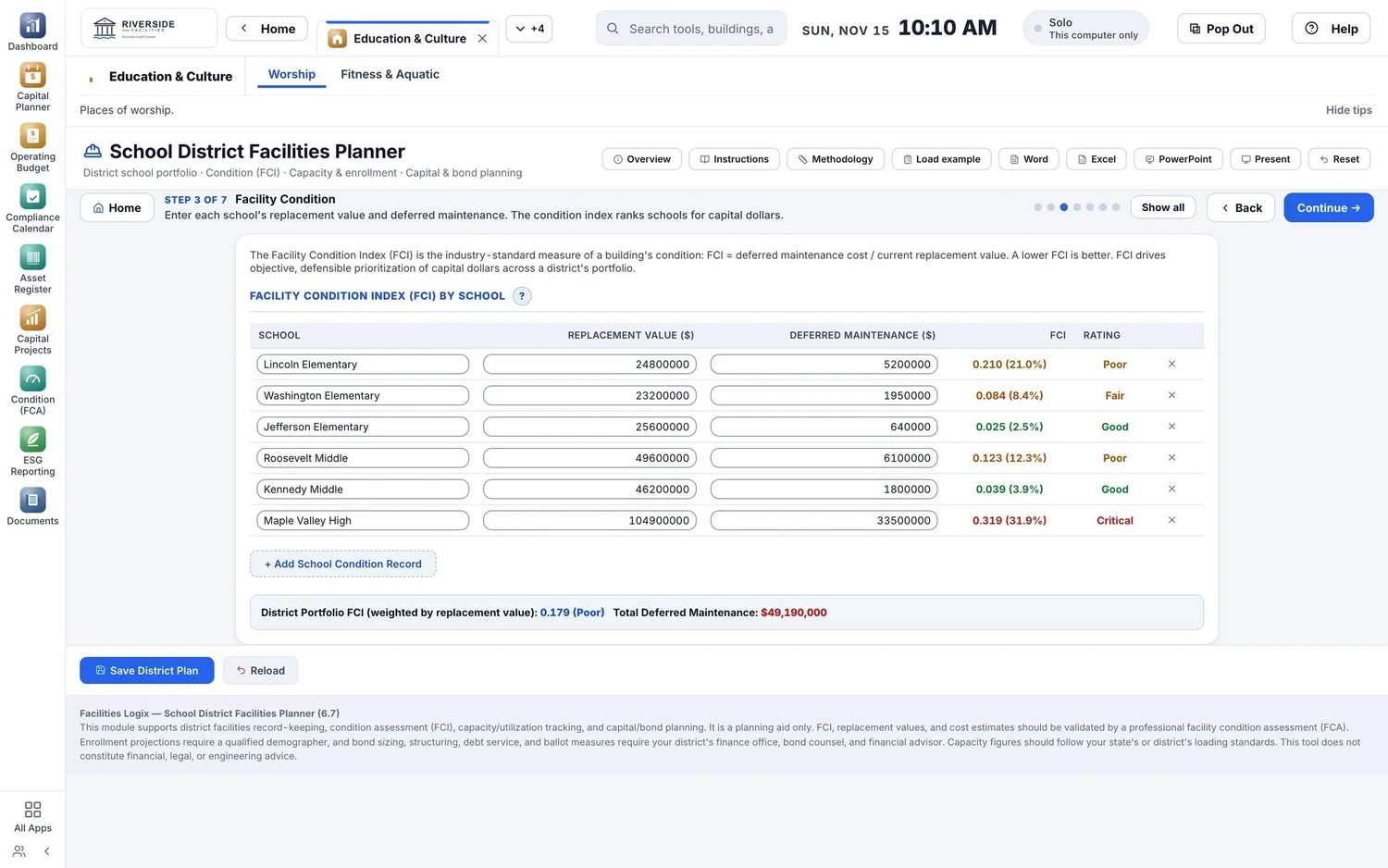
Facility Condition in School District Facilities Planner: enter each school's replacement value and deferred maintenance. The condition index ranks schools for capital dollars.
Shared with Facilities Logix
Publish to Building Systems rolls district assets, deficiencies and capital into the shared Facilities Logix data, so the building systems, preventive maintenance and work orders sit with the same schools.
Learn MoreShow Less
Keeping the bond plan and the maintenance system in separate spreadsheets doubles data entry and lets them drift apart. Publish copies the planner's work into the shared Building Systems data in one step.
- Each school becomes an asset with its level, year built, enrollment and capacity
- Deferred maintenance becomes a capital deficiency with its FCI
- Capital projects carry their priority, year and cost
- Publishing again replaces the planner's earlier entries, so nothing is counted twice
Answers the Calendar Uses
Each school's asbestos status tells the Compliance tab whether the surveillance and reinspection rows apply. Anything the playbook does not ask is asked once in the Compliance Calendar's questions.
Learn MoreShow Less
Paying an accredited inspector to reinspect a school with no asbestos is money spent for nothing. Each school's asbestos status decides whether the surveillance and reinspection rows apply at all.
- Known or assumed material turns on 6-month surveillance and 3-year reinspection
- None found, or built after October 12, 1988 with an architect's statement: no rows, with the reason shown
- Dates from K-12 Programs feed the Compliance tab and say where they came from
- Facts the playbook records win over Calendar answers for the same building
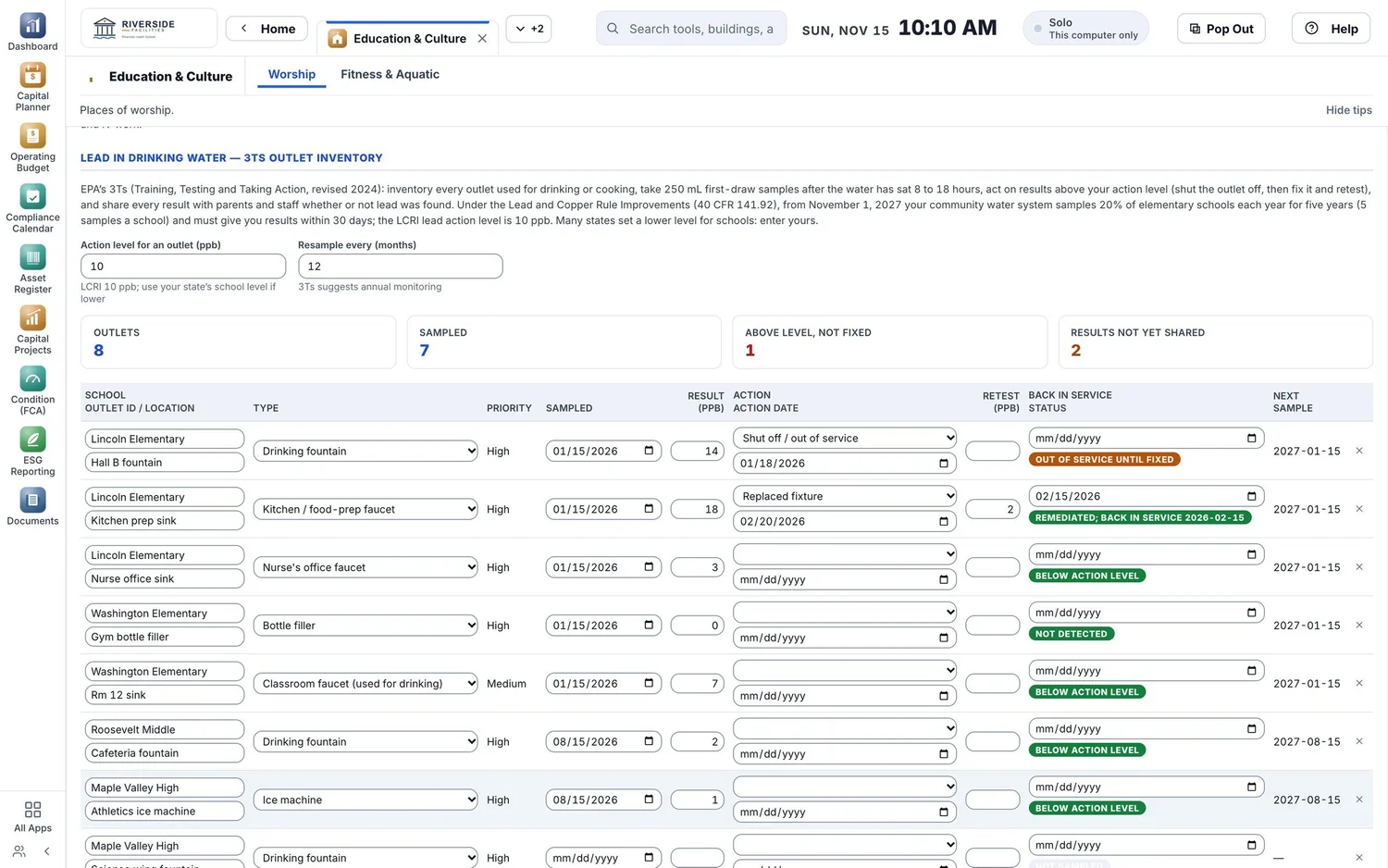
Lead in Drinking Water in School District Facilities Planner: every outlet with its sample results, the fix made and the next sample date.
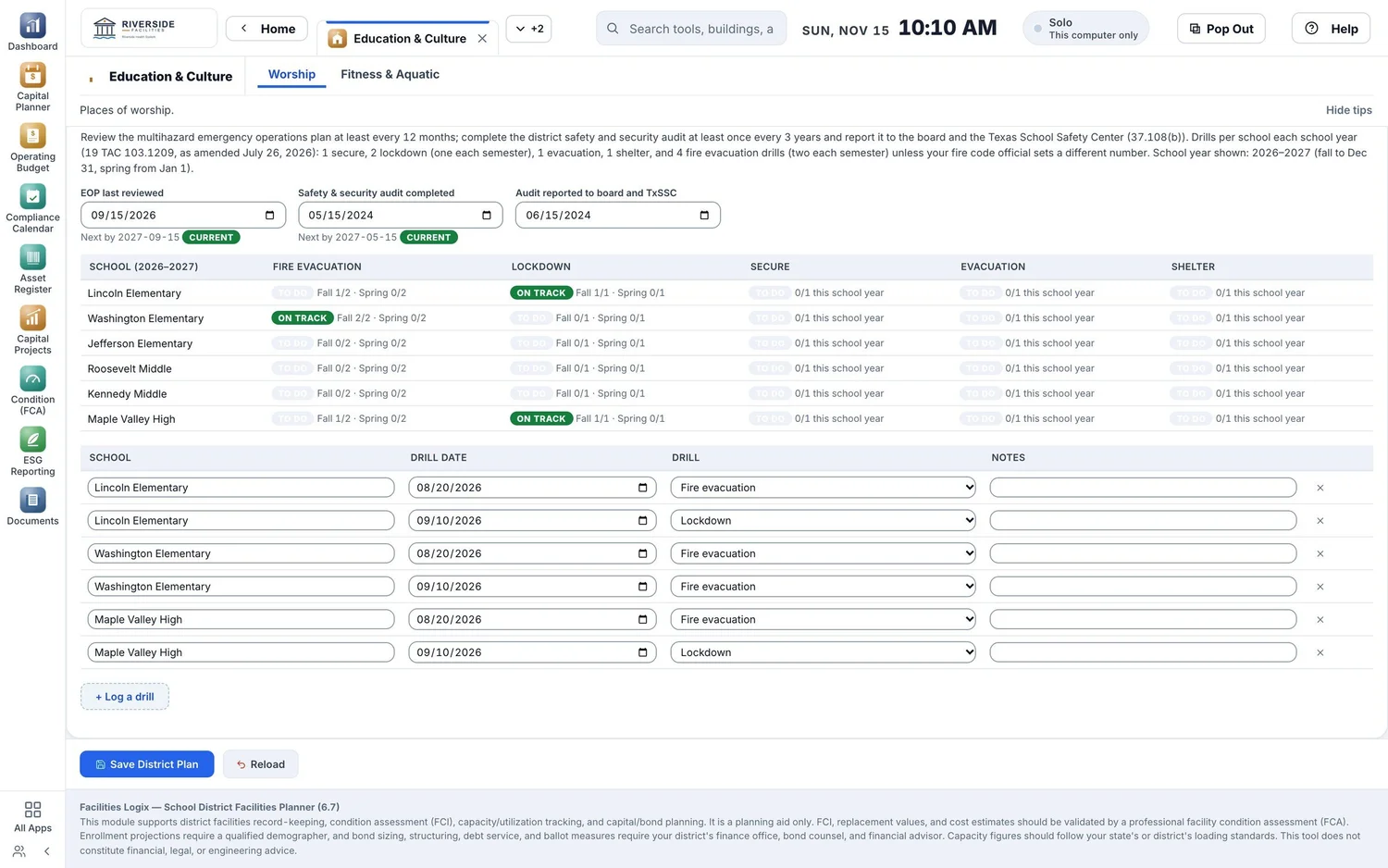
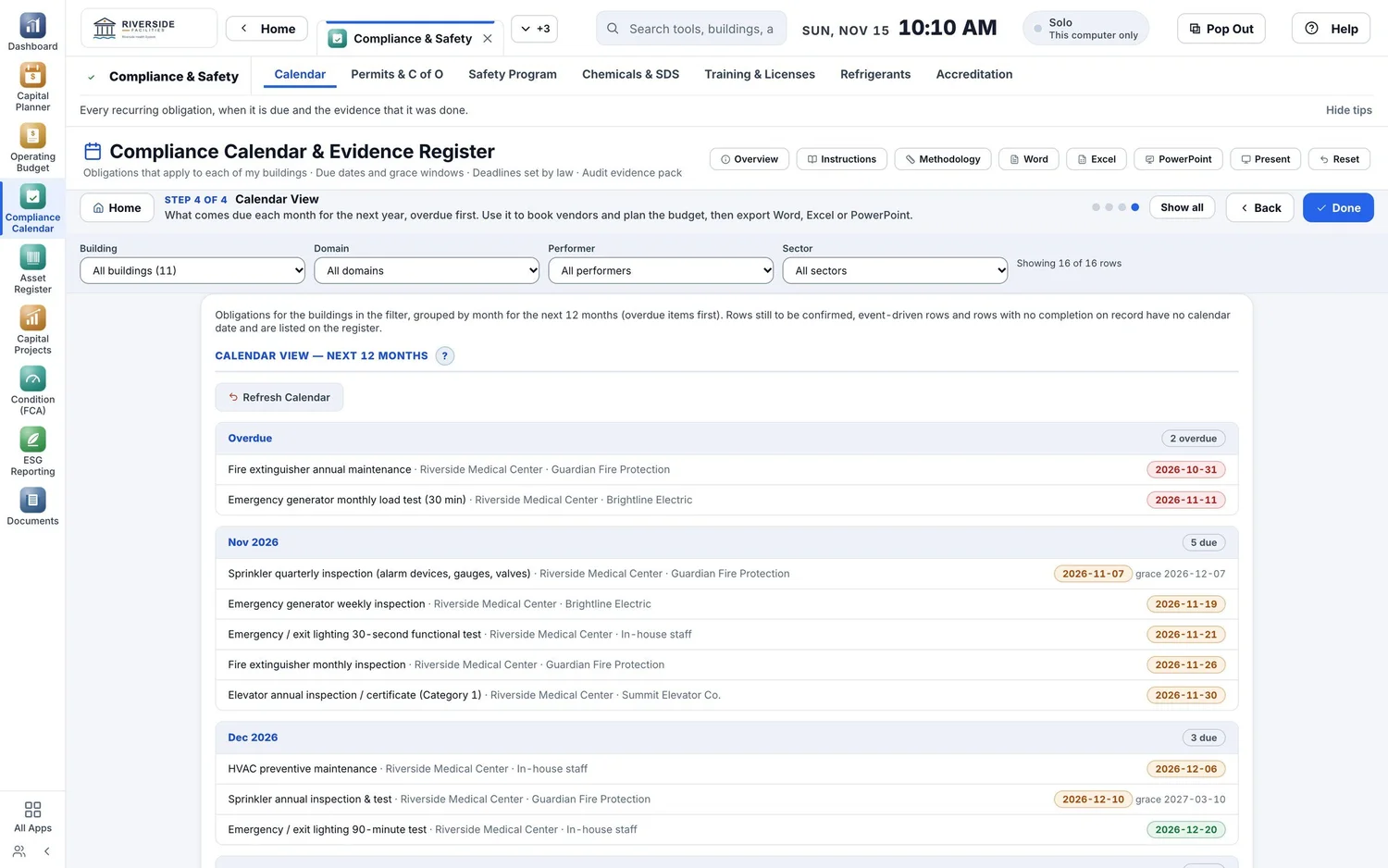
Status on Every Row, School by School
What Each Row Shows
- Asbestos: the next surveillance (6 months) and next reinspection (3 years) for each school, and whether a copy of the plan is at the school
- Training: each staff member's tier, start date and training date, with what is still open
- Water: outlets on the inventory, outlets sampled, outlets above your level and not fixed, and results not yet shared
- Radon: below 2.0; 2.0 to 4.0 (consider action); 4.0 or more (mitigate); and after mitigation, a retest due one month after the system went in
- Texas drills: each drill type done against the need for fall and spring, with a missed semester shown as missed. The school year runs July 1 to June 30
Dates That Agree Everywhere
- Every K-12 date uses the Compliance Calendar's date rules, so a due date on the tab and in the calendar cannot differ
- The date that drives each district row is the oldest across schools, because that school is the next one due
- Due, due within 30 or 90 days, current and overdue are shown the same way across the platform
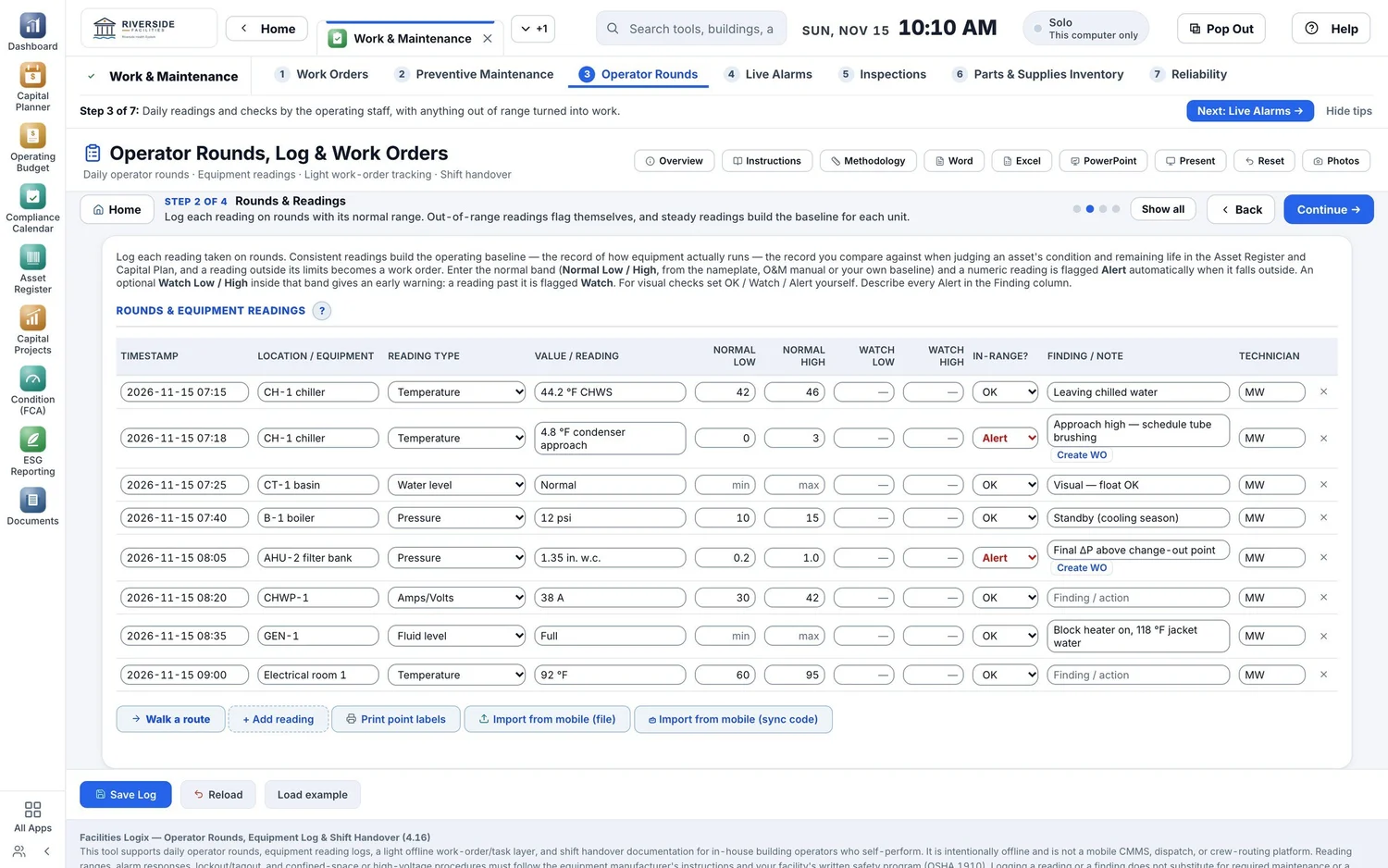
Rounds & Readings in Operator Rounds, Log & Work Orders: log each reading on rounds with its normal range. Out-of-range readings flag themselves.
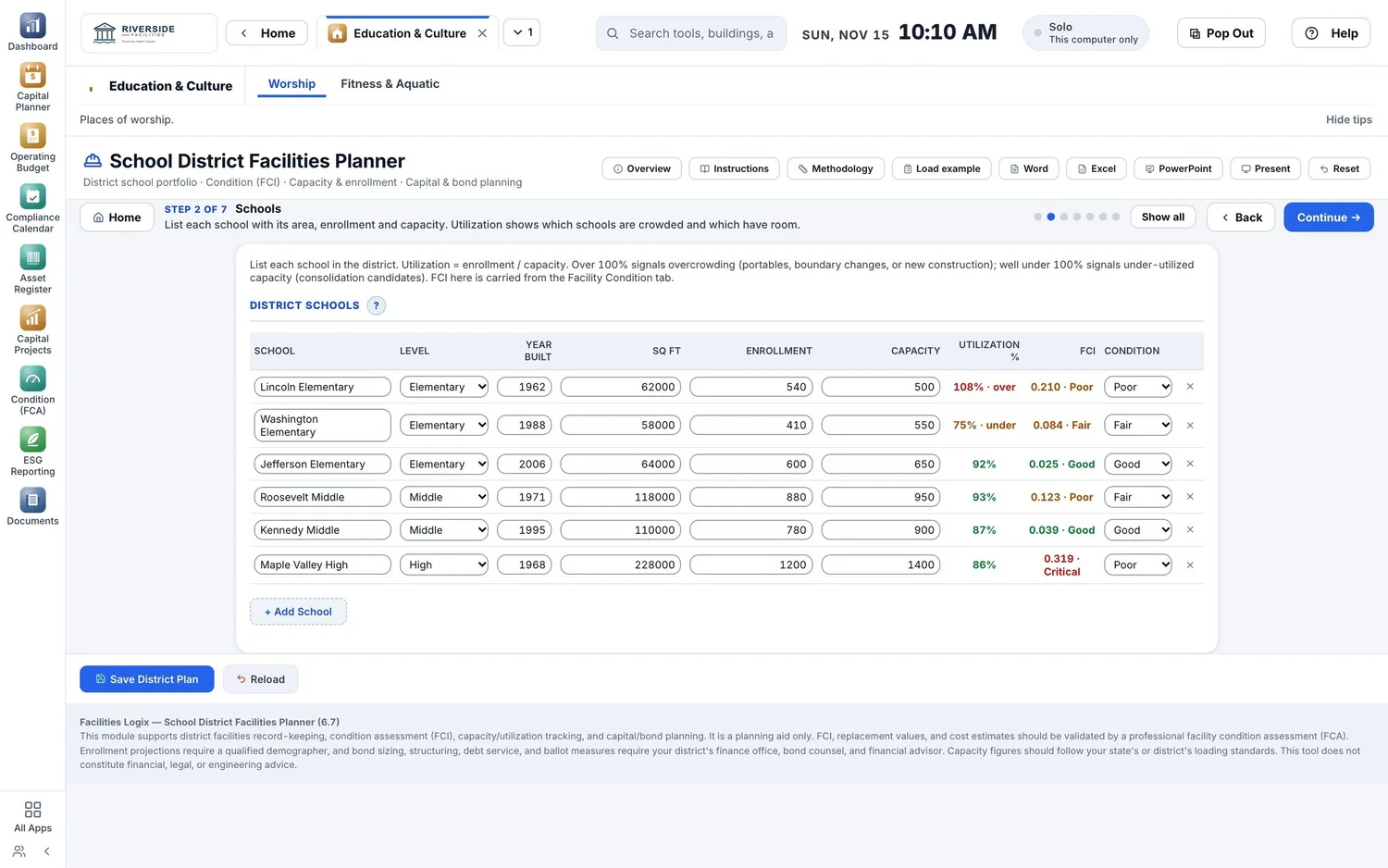
District leaders need the status of every school, so each row shows its condition and use.
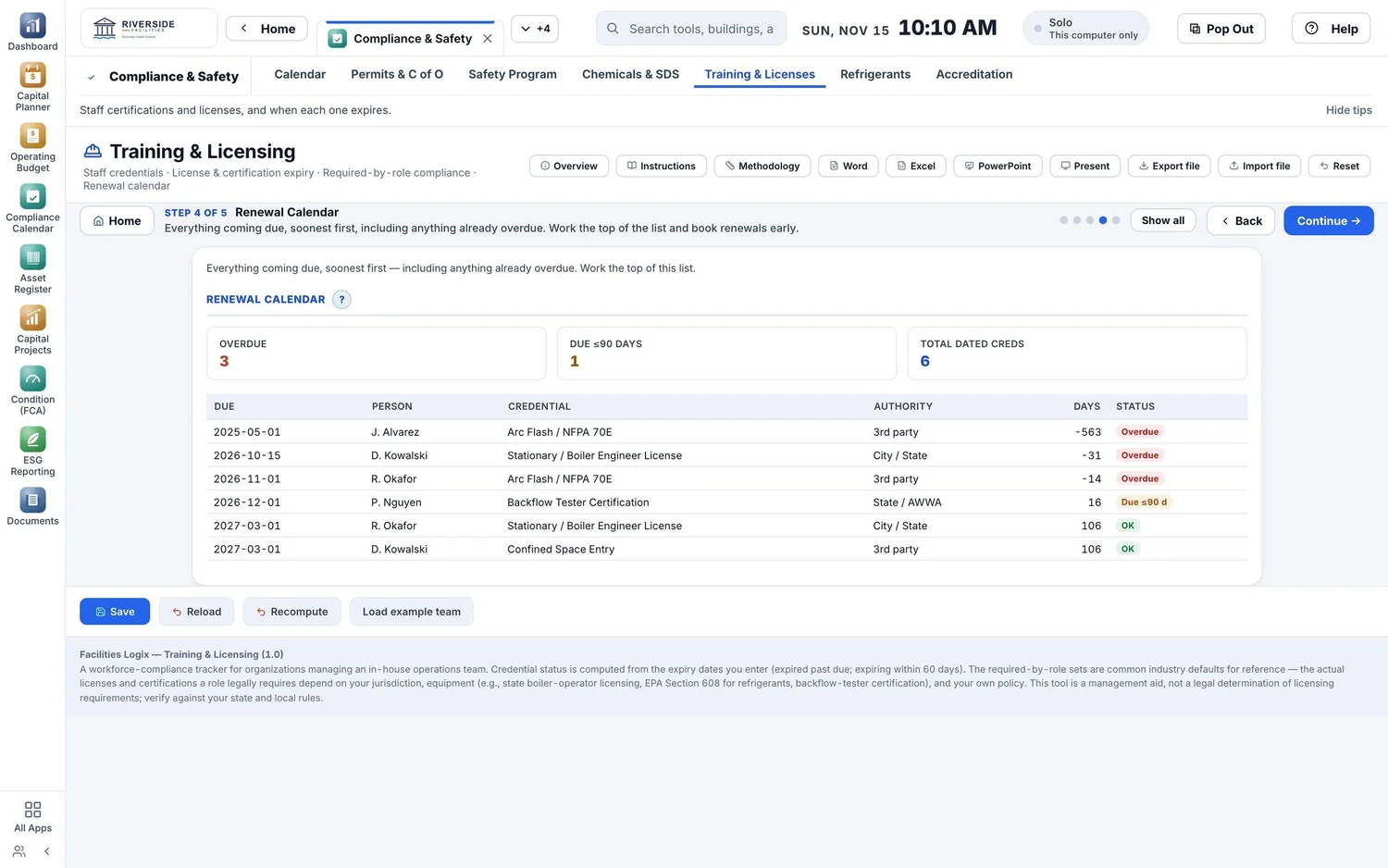
Ready for the Board, the Auditor and the Inspector
Compliance Tab
Every inspection, test and filing that applies to your schools, why it applies, its citation and frequency, when it was last done and when it is next due, with the same dates as the Compliance Calendar.
Learn MoreBoard Packets
Word, Excel and PowerPoint reports, and Present mode for the meeting itself.
Learn MoreShow Less
Public trust in a bond rests on numbers people can follow. The packet is built from the planner's own data: a decision summary, charts and tables, with the methods printed for anyone who checks.
- Charts: FCI by school, and capital and bond phasing by year
- Project costs in today's dollars and escalated to each target year
- An AHERA table by school: status, last and next surveillance and reinspection
- Output from the worked example carries a SAMPLE watermark
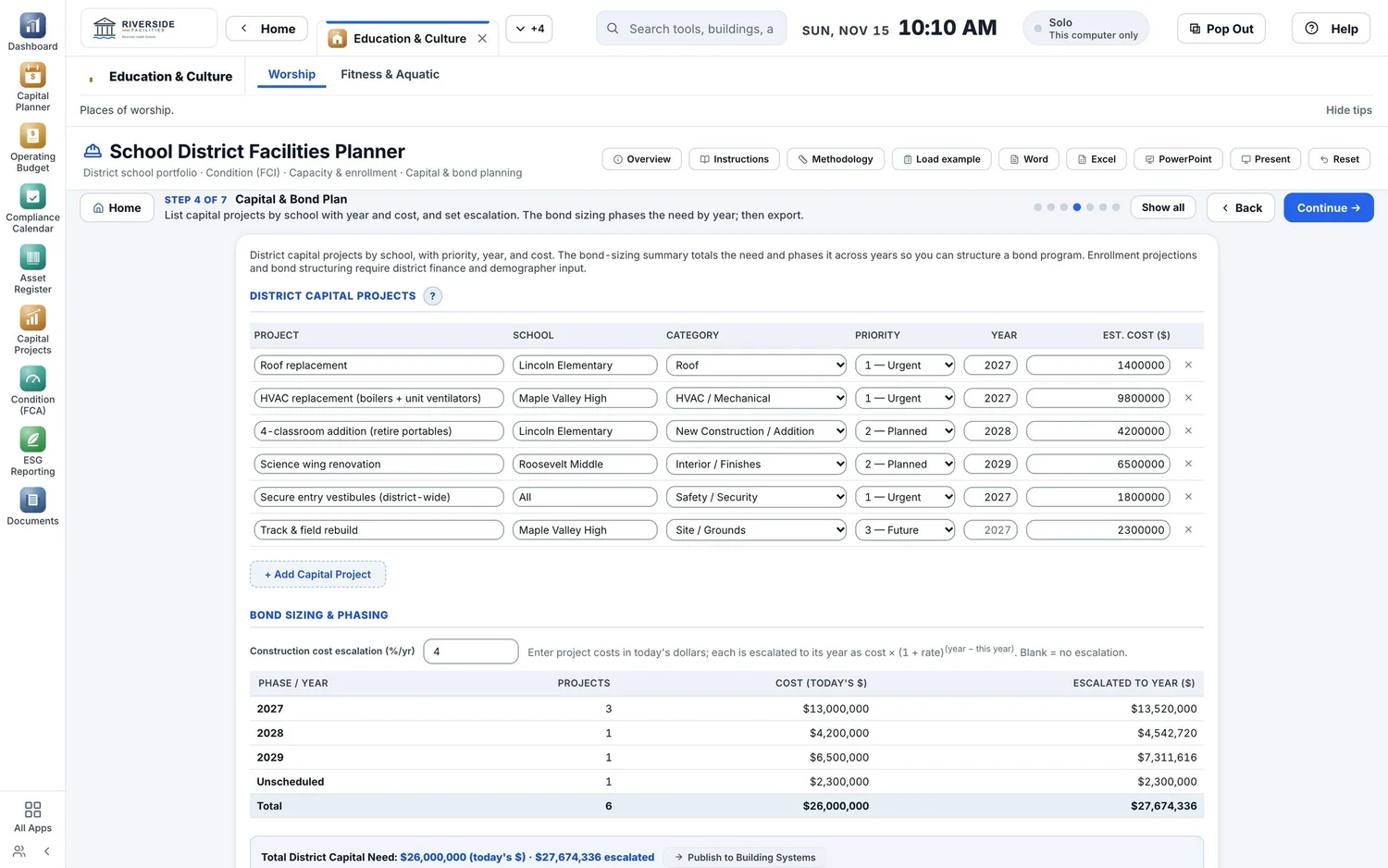
Capital & Bond Plan in School District Facilities Planner: list capital projects by school with year and cost, and set escalation. The bond sizing phases the need by year; then export.
ENERGY STAR Tab
K-12 schools get a 1-100 ENERGY STAR score in Portfolio Manager and can earn certification. The tab compares each school with the national median from its own bills and lists the benchmarking laws that apply. The score itself comes only from Portfolio Manager.
Learn MoreShow Less
Energy saved at one school is money back in the operating budget, and the gap to the median shows which schools to fix first. The tab reads the last 12 months of bills and does the arithmetic Portfolio Manager uses.
- K-12 School source median 104.4 kBtu/sf (site 48.5)
- Preschool and vocational buildings pick their own types; neither gets a score
- Energy from Utility Bill Manager first, else Energy Benchmarking
- The ratio to the median shows which side of a score of 50 the school sits on
Public Purchasing
Purchase orders for a Texas school district follow the Education Code 44.031 thresholds, totaled over 12 months, and possible split purchases are flagged. Other states enter their own limits and citation.
Learn More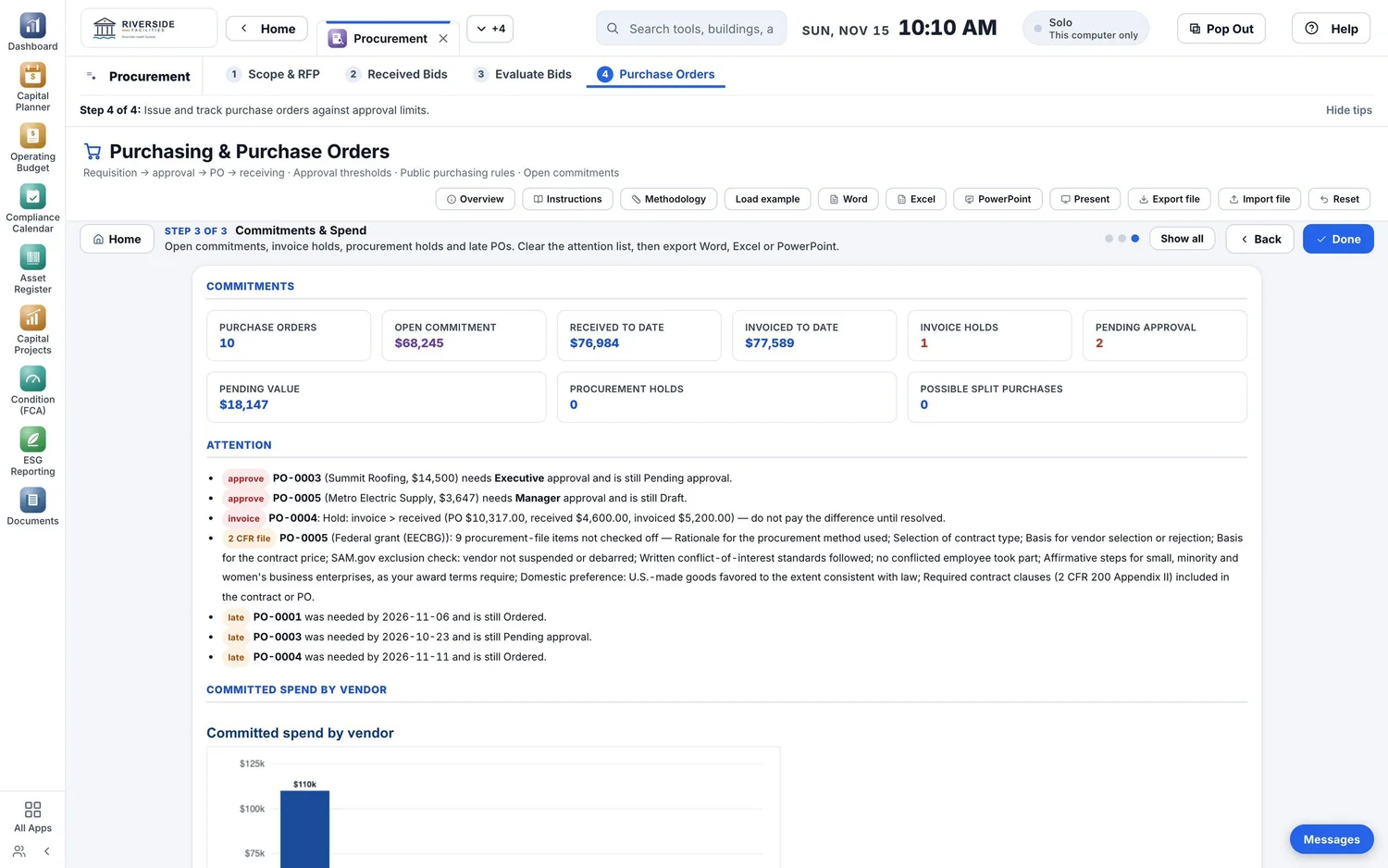
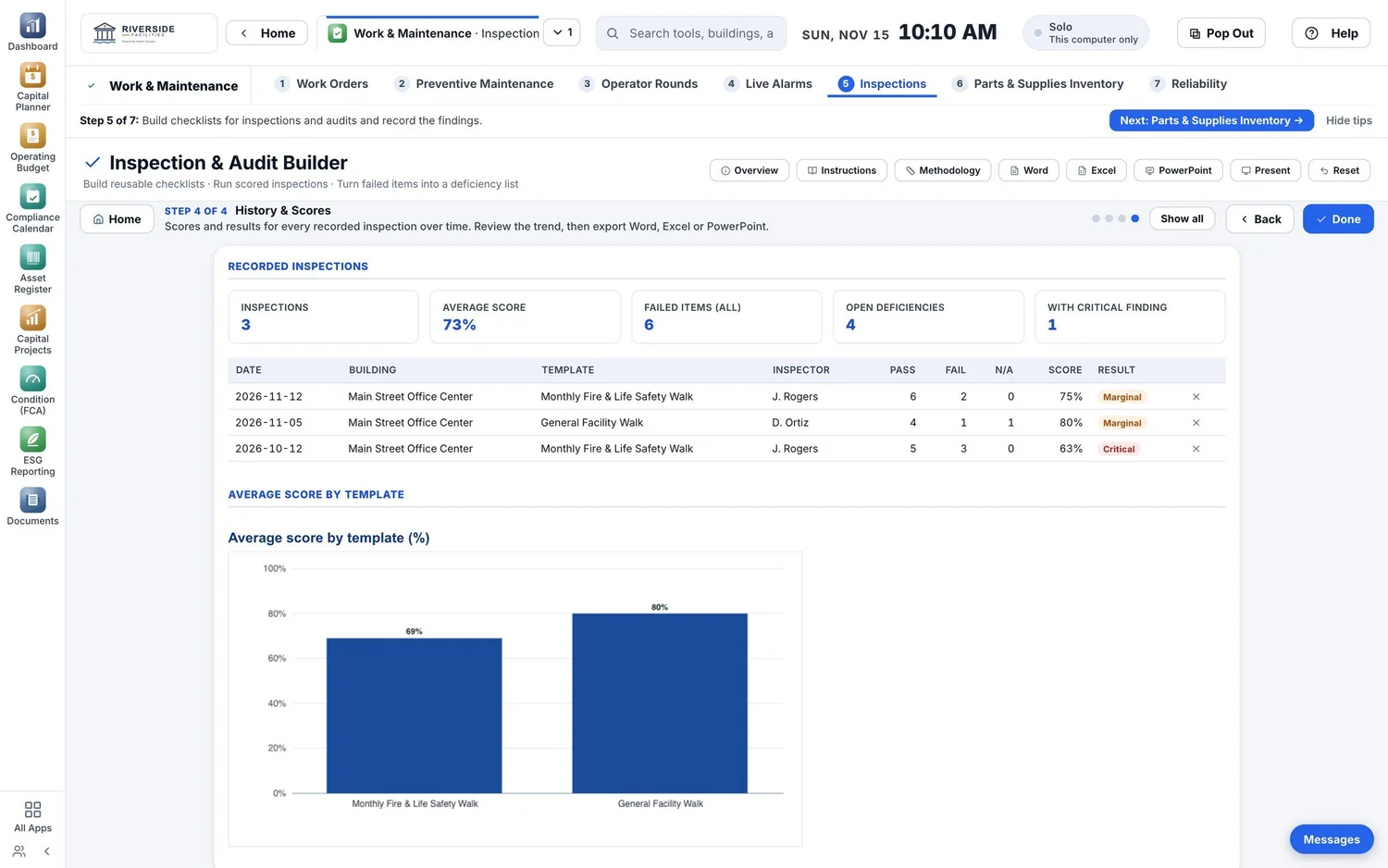
The Numbers Behind a Defensible Bond
Condition and Capacity
- Facility condition index: deferred maintenance divided by current replacement value
- District condition index weighted by replacement value, never a simple average, so a small portable does not count as much as a high school
- Condition bands: Good under 0.05, Fair 0.05 to 0.10, Poor 0.10 to 0.30, and Critical over 0.30, where replacement is often cheaper than repair
- Utilization: enrollment divided by rated capacity. Sustained use above about 100% points to overcrowding; well below about 70 to 80% points to excess capacity
- Bond phasing by year in today's dollars and escalated to the year
Program Counts
- Schools with asbestos-containing material and any missing surveillance or reinspection dates
- Staff training items still open
- Water outlets sampled, above your level and not yet fixed, and results not yet shared
- Radon results at or above 4.0 pCi/L awaiting mitigation or retest
Fewer Binders, Fewer Surprises
One Place for the Programs
The asbestos plan, the outlet inventory, radon results and drill logs live in one tab instead of separate binders and spreadsheets for each school.
Learn MoreShow Less
Separate binders at each school mean staff hours spent hunting records when an inspector or parent asks. One district tab holds every program, with the open items counted at the top.
- Outlets, sampled, above the level and not fixed, and results not yet shared, all counted
- Staff training records show Trained or Open by tier
- A prompt when no AHERA designated person is named
- Whether each school keeps its plan copy, recorded Yes or No
Dates Nobody Has to Remember
Each obligation shows its next due date and why it applies, so a missed surveillance or a lapsed notice shows up before an inspector or auditor finds it.
Learn MoreShow Less
A missed AHERA surveillance or a lapsed notice is a violation an inspector can cite, and fixing it under pressure costs more than doing it on time. Each program counts what is overdue and what has no date yet.
- The same next-due dates as the Compliance Calendar
- Month intervals use calendar months, clamped to month-end
- New custodial and maintenance staff due for awareness training within 60 days
- A flag when the management plan is older than the latest surveillance or reinspection
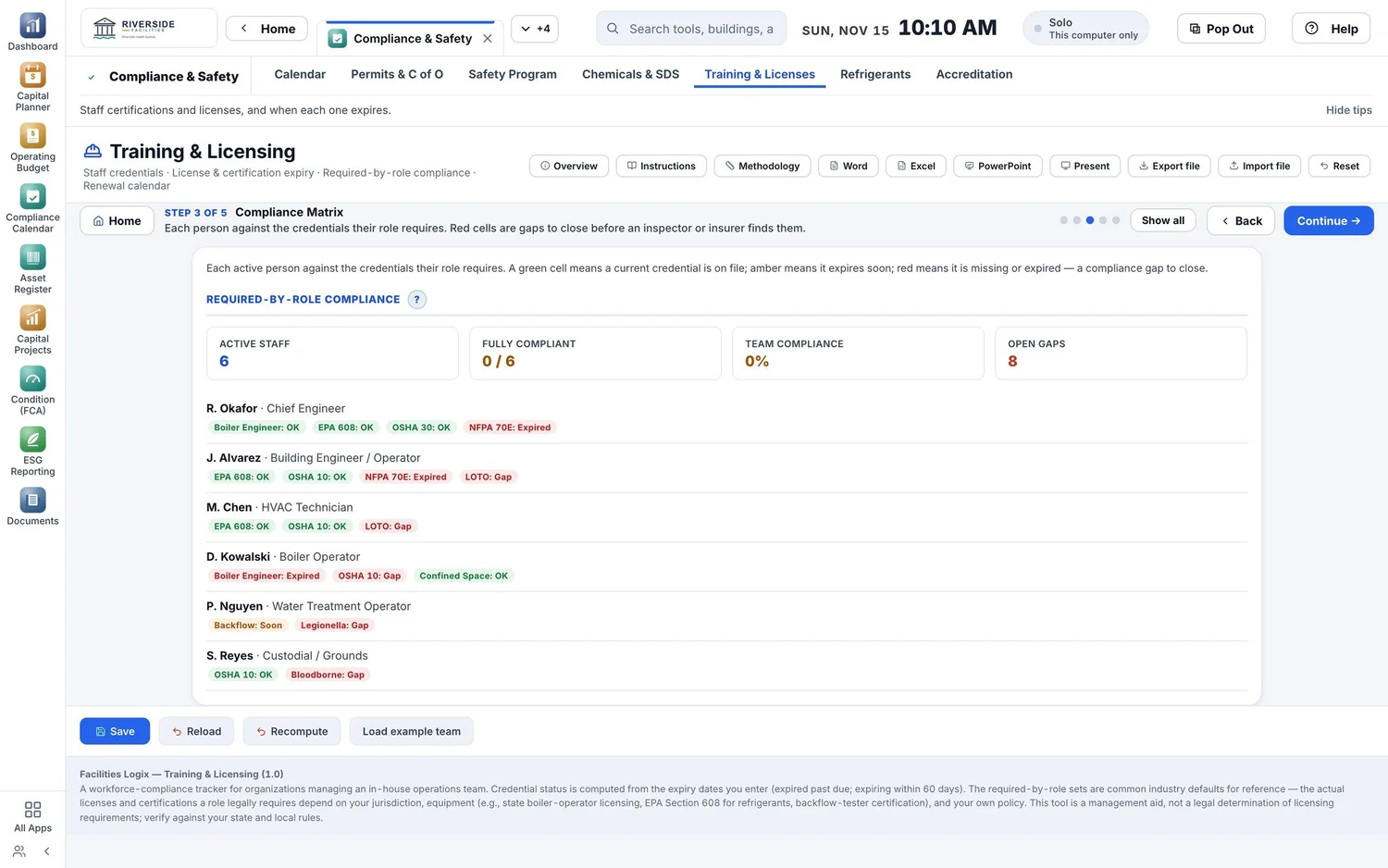
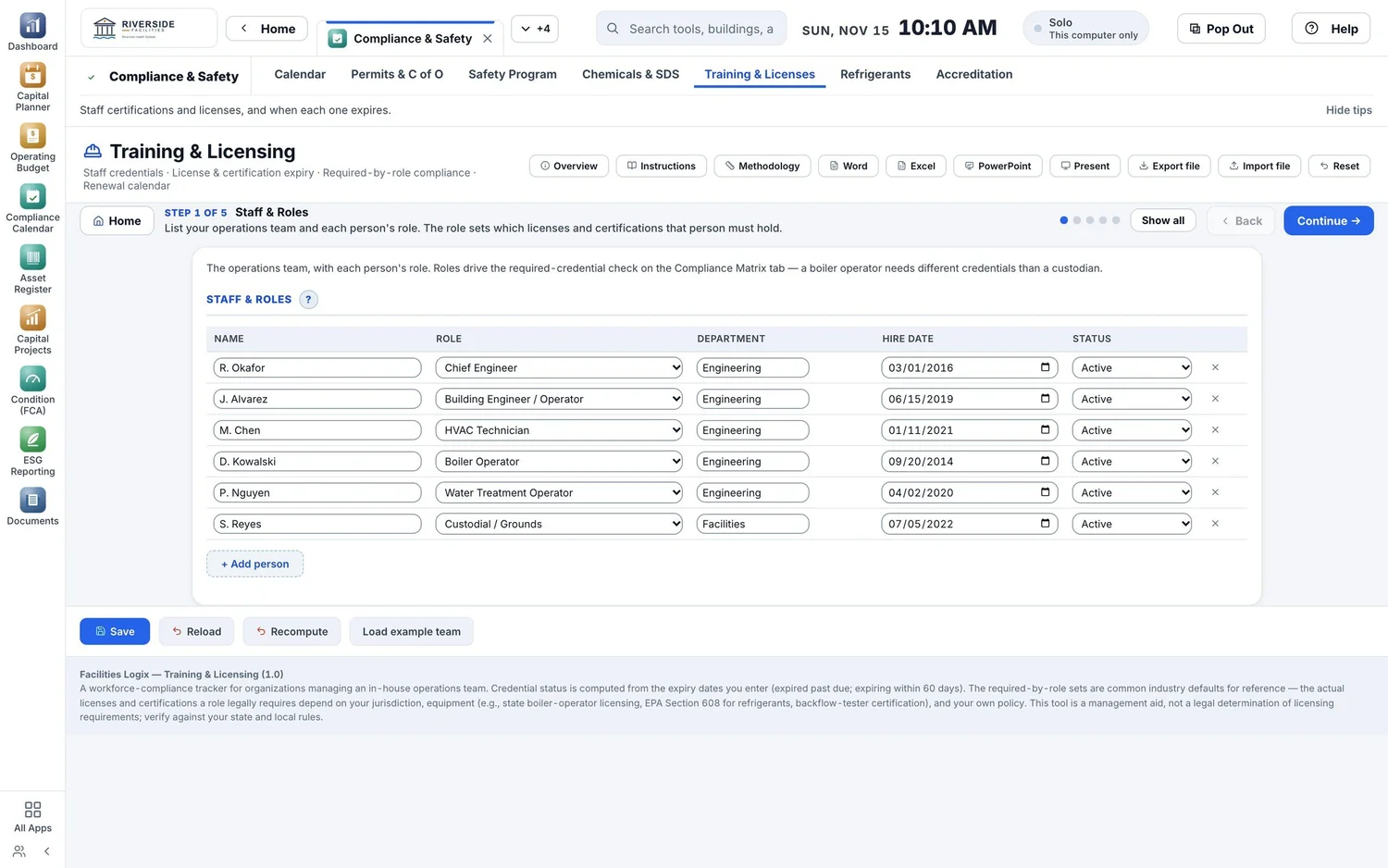
Compliance Matrix in Training & Licensing: each person against the credentials their role requires. Red cells are gaps to close before an inspector or insurer finds them.
A Capital Case the Public Can Follow
Condition and utilization rank every school on the same basis, so leadership can show a board and voters why each project is on the list.
Learn MoreShow Less
A bond sized too small leaves projects unfunded, and one sized too large costs taxpayers more than it needs to. Pairing condition need with capacity need gives a priority order that holds up in a public meeting.
- Bond phasing table: projects, cost today and escalated cost by year
- Unscheduled projects listed separately
- Highest-FCI and over-capacity schools usually carry the top-priority projects
- Every project tied to the school it serves
Professionals Still Do Their Part
Facilities Logix organizes the records that the accredited inspector, the testing laboratory, the demographer and bond counsel rely on. It does not replace them.
Learn MoreShow Less
Professional fees go further when the data they need is already organized. Facilities Logix hands each professional clean records instead of a hunt through binders.
- Accredited inspectors: AHERA records, plan dates and the planner's accreditation number
- Testing laboratories: outlet IDs, sample dates and results
- Demographers: enrollment and rated capacity by school
- Bond counsel and the financial advisor: phased, escalated project costs

Report pages for School Districts: charts and tables built from the facility's own records, ready to present.
Frequently Asked Questions
Are the school safety dates for every state?
Does Facilities Logix do the asbestos inspection or the water testing?
What if our state has no school radon rule?
Can it help size a bond?
Be First When Facilities Logix Opens
Stop chasing building records across spreadsheets and binders. Join the list and we will tell you the day downloads open, with setup guides ready.
Launching early 2027 for Facilities Logix. Nothing to buy today, and no sales calls.
