
Who Uses What Space, on What Terms, and How Well It Serves Them.
Buildings exist for the people in them. Space & Occupants covers the space inventory and the leases behind it, the accounting those leases require, physical security and keys, what occupants say about the building and the accessibility of every route and room.
Launching Early 2027 · Join the Early-Access List
The Inventory, the Critical Dates and the Chargeback
Space Inventory and Occupancy
Who occupies what space, by building, floor and department, for any facility type.
Learn MoreShow Less
Paying for space nobody uses is one of the largest hidden costs. The inventory shows occupancy and vacancy from assignable space.
- Occupancy = occupied assignable square feet / total assignable
- Load factor = rentable / assignable square feet
- Mechanical and circulation counted as support space
- Square feet per seat as a density benchmark
Lease Critical Dates
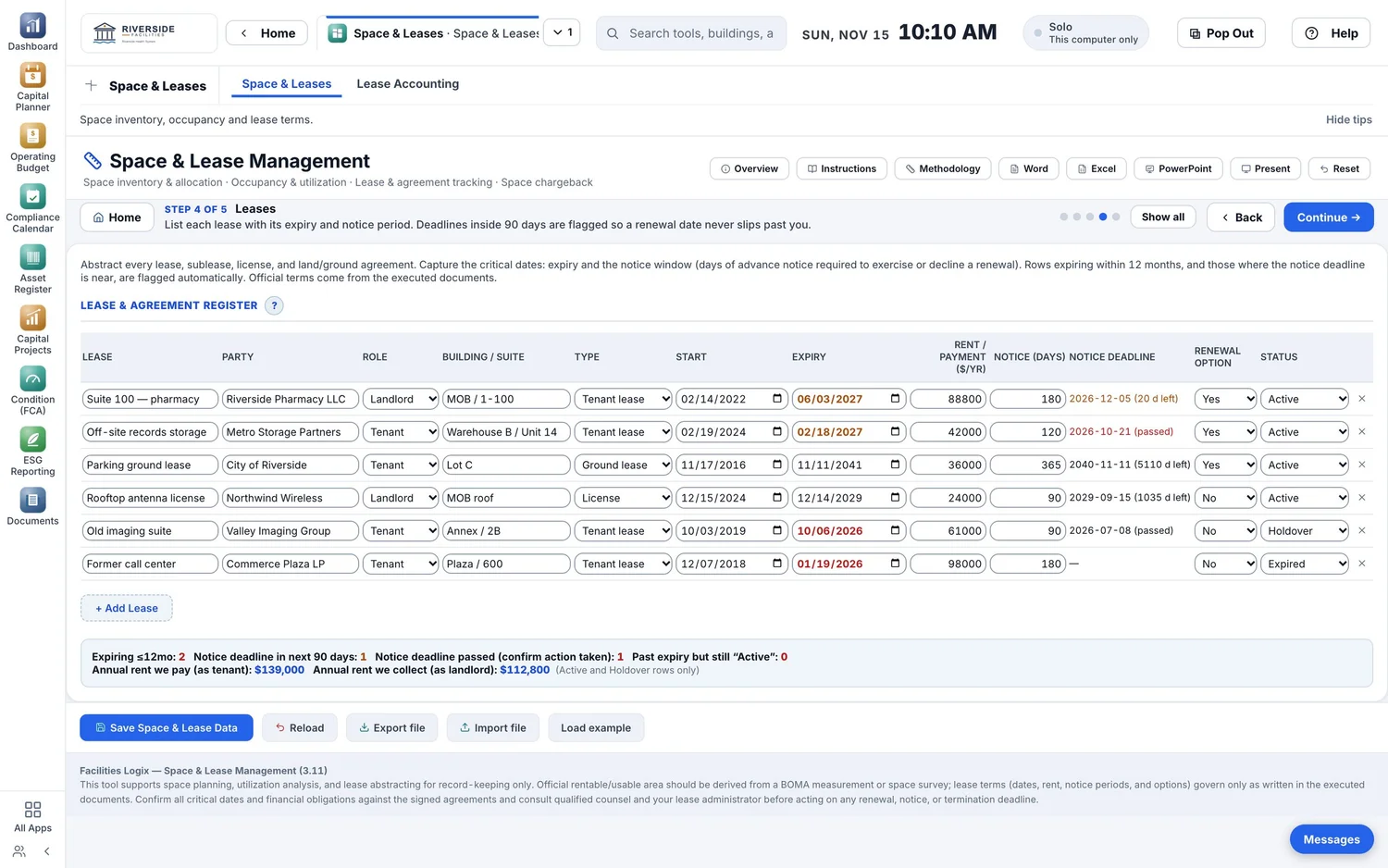
Lease critical dates tracked in one place, so no renewal, notice or expiration passes unnoticed.
Learn MoreShow Less
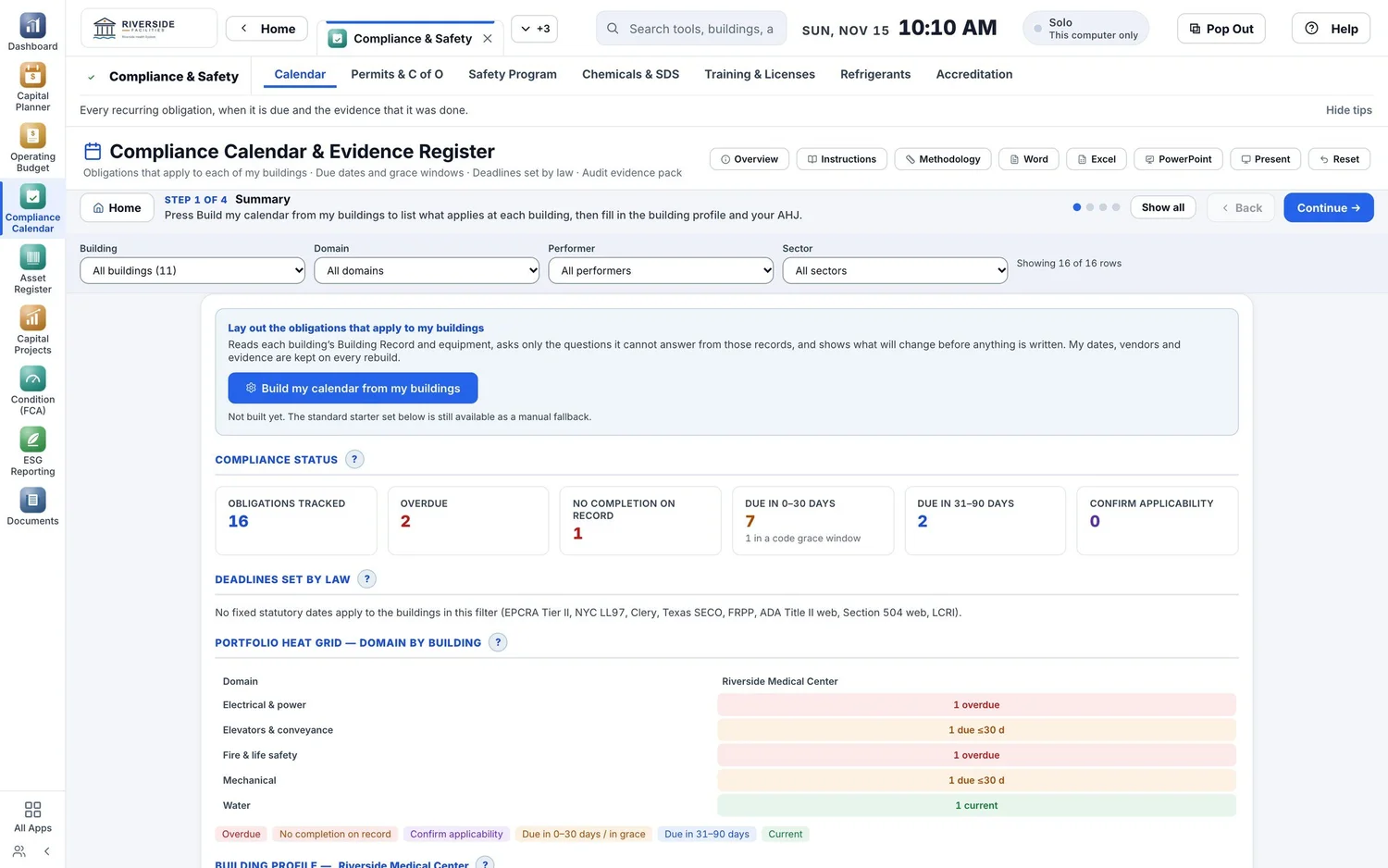
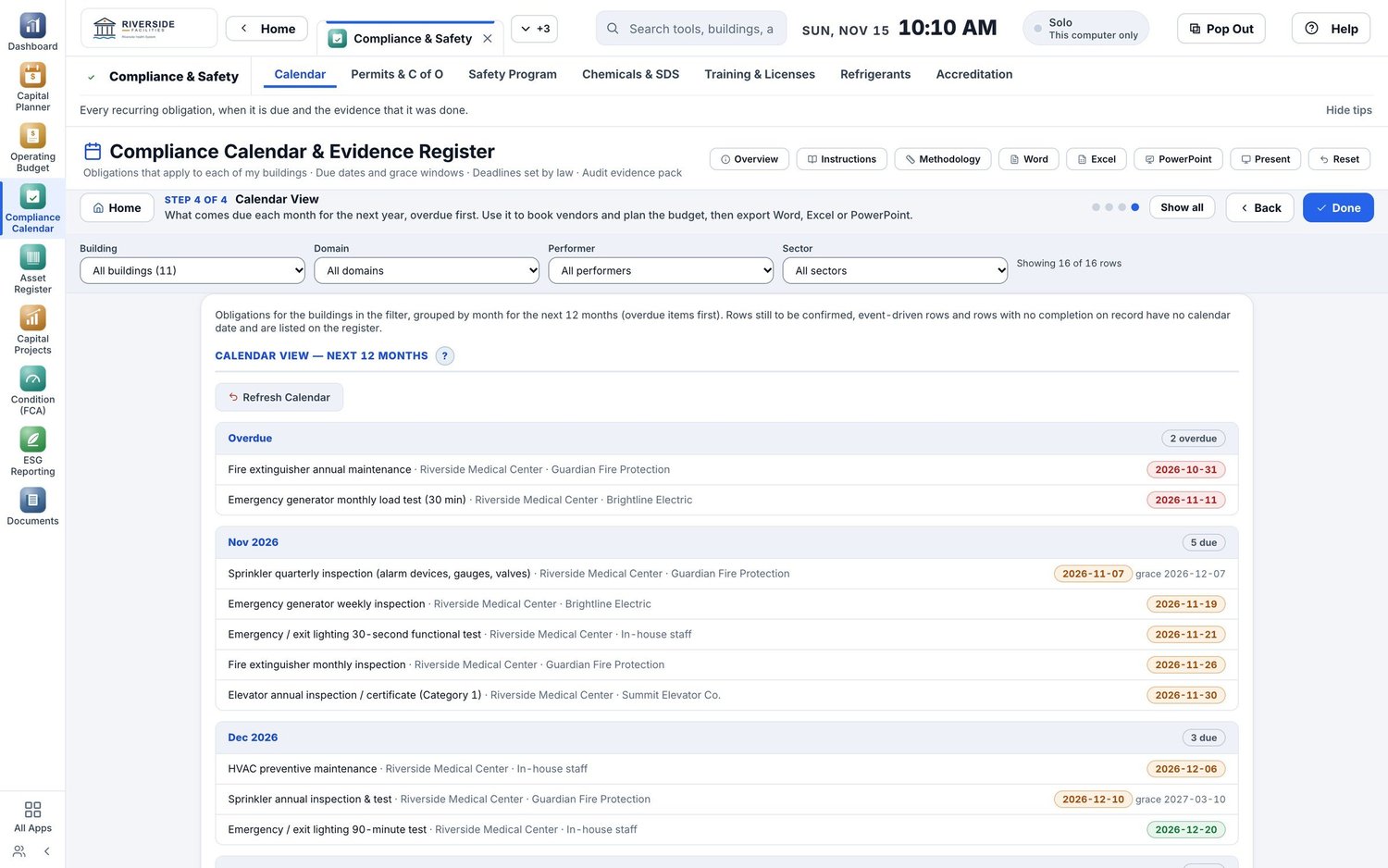
A missed renewal notice can lock in a bad rent for years. Leases expiring within 12 months and notice deadlines within 90 days are counted.
- Notice deadlines within 90 days, or already missed, flagged
- Lease accounting under ASC 842, GASB 87 or SFFAS 54, from the ownership sector
- Schedules, journal entries and the maturity disclosure follow the standard
- Short-term means 12 months or less (24 for federal)
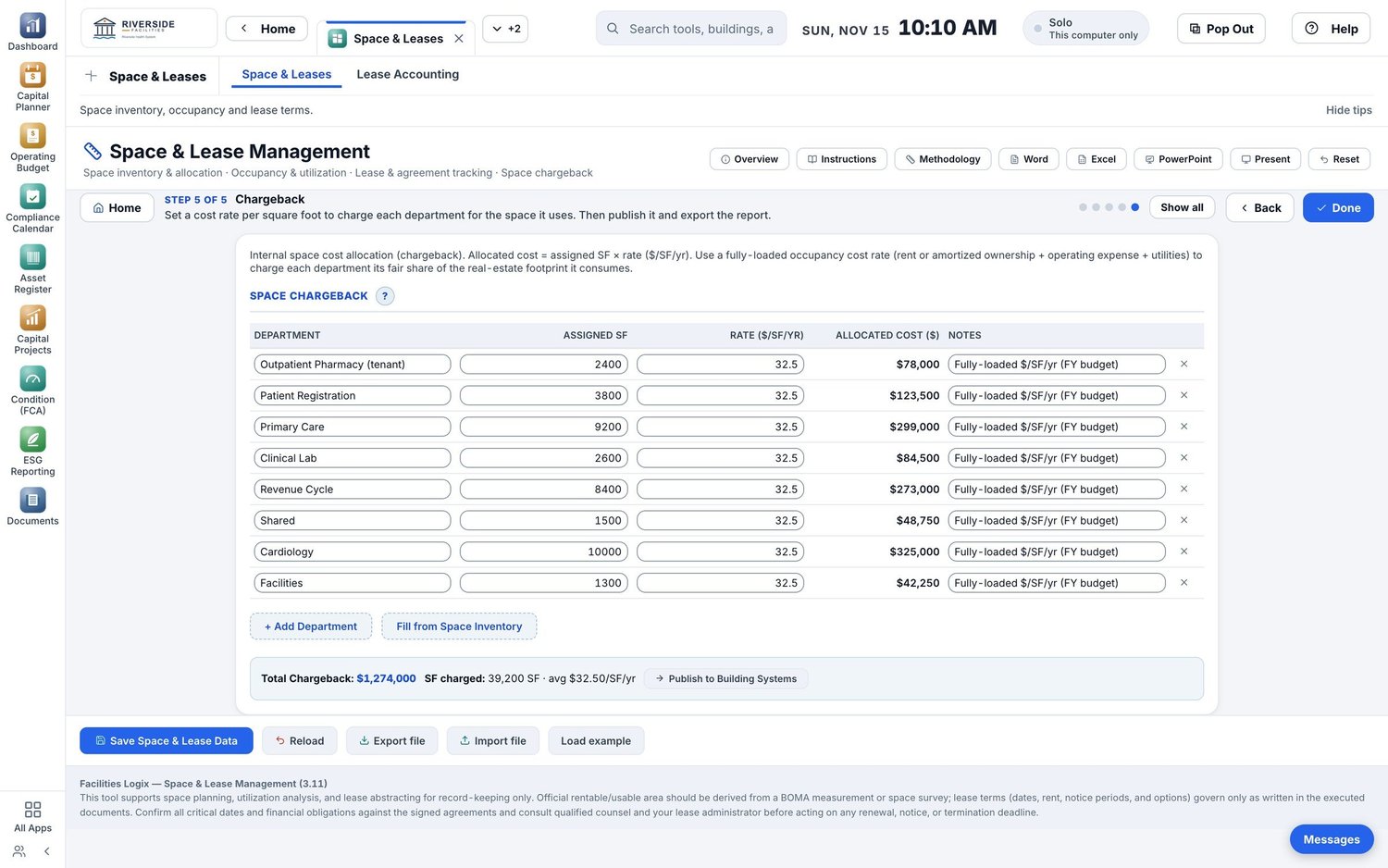
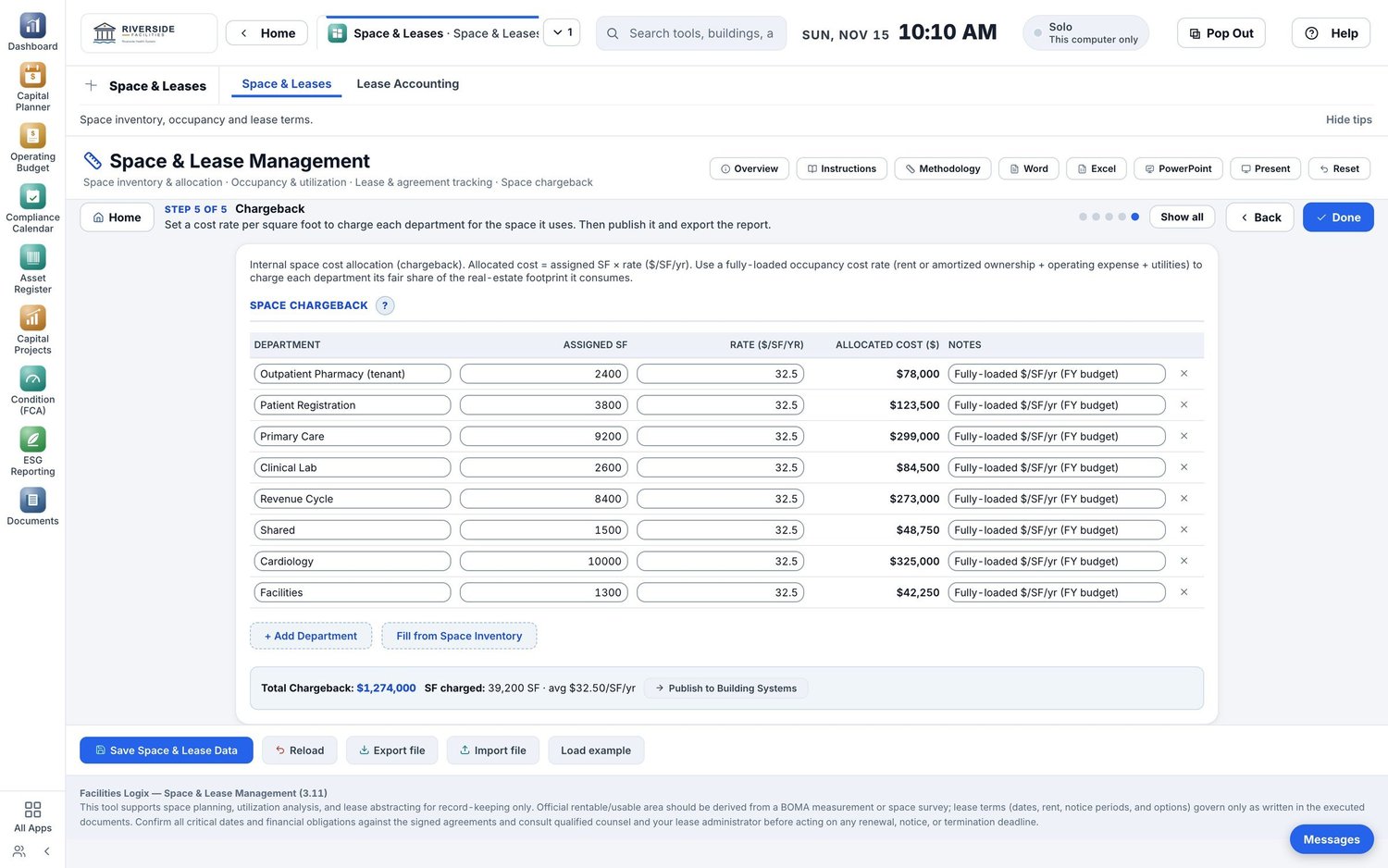
Chargeback in Space & Lease Management: set a cost rate per square foot to charge each department for the space it uses. Then publish it and export the report.
Department Space Chargeback
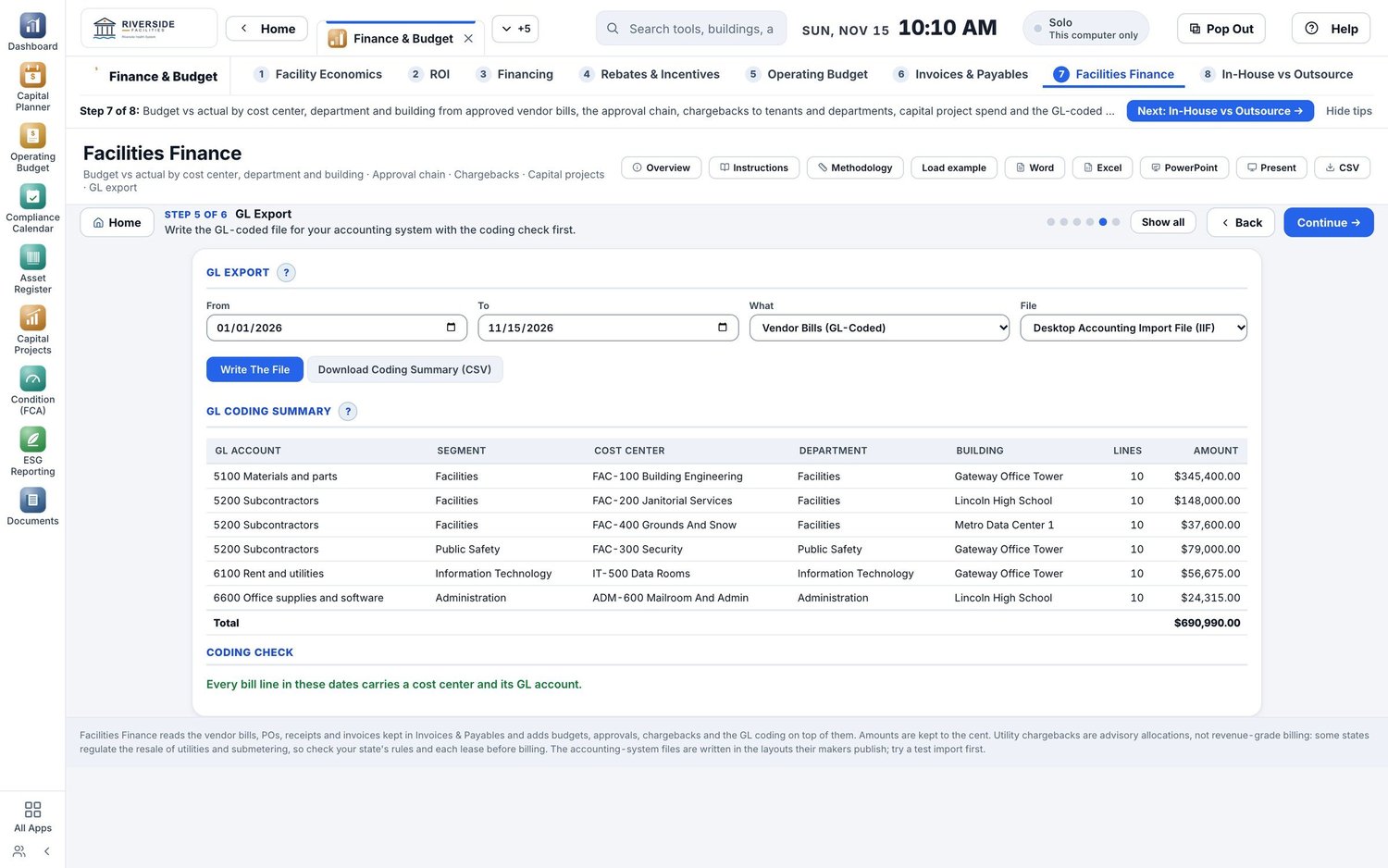
Assigned square feet times the yearly rate, billed one twelfth a month to the cent. Draft invoices are created in Finance & Budget, and a month is never billed twice.
Learn MoreRoom List Import
Bring in a room list from a space program or a drawing's room schedule. Rooms match by floor and room, and areas in square meters are saved as square feet.
Learn MoreShow Less
Keying in a room list by hand costs hours and invites errors. The import reads the list you already have.
- Importing the same list twice adds nothing
- The room name, the file's own use word and the building are kept
- Cleanroom class rows also go to the cleanroom register
- A class the tool does not list is named in the preview, never changed
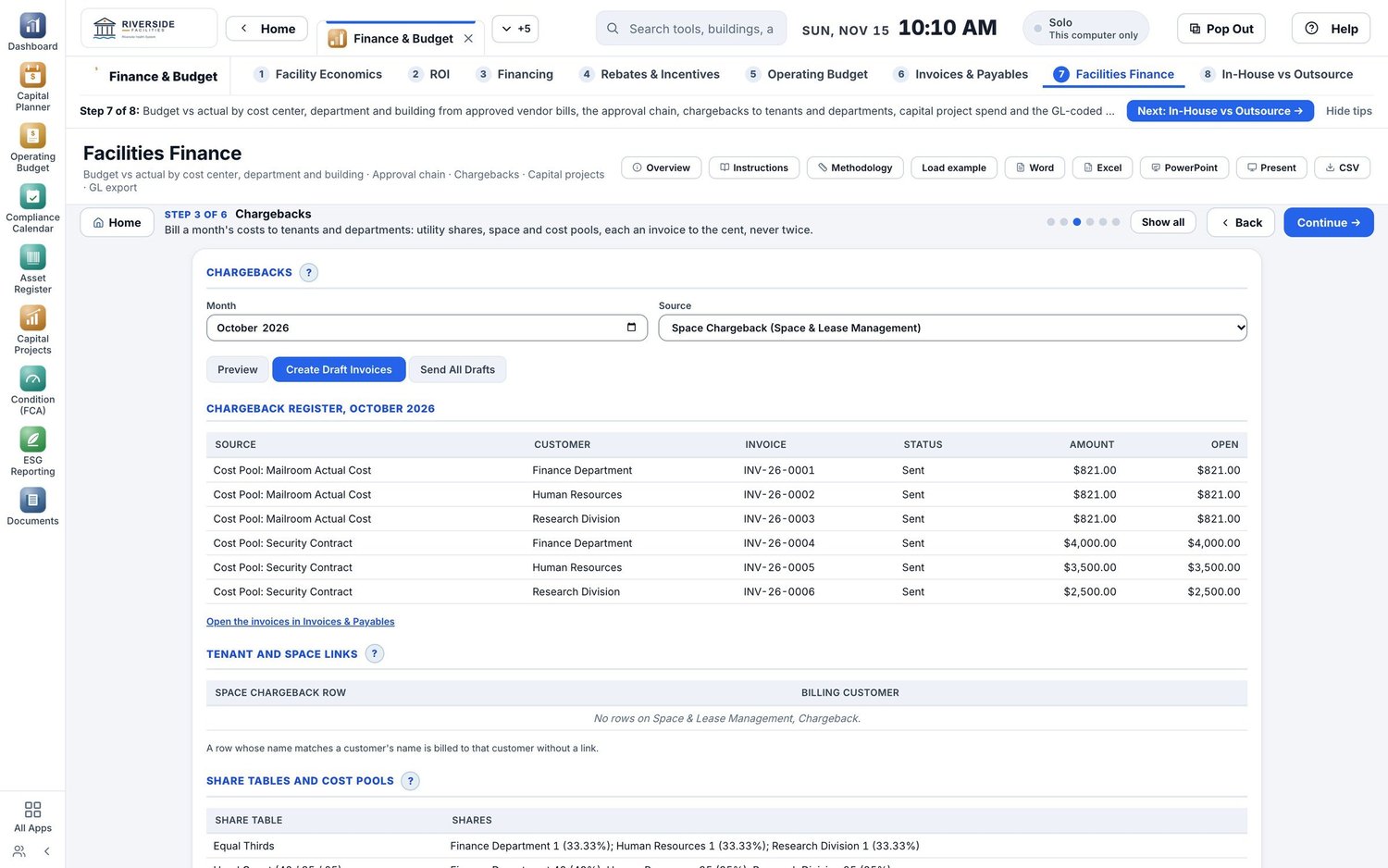
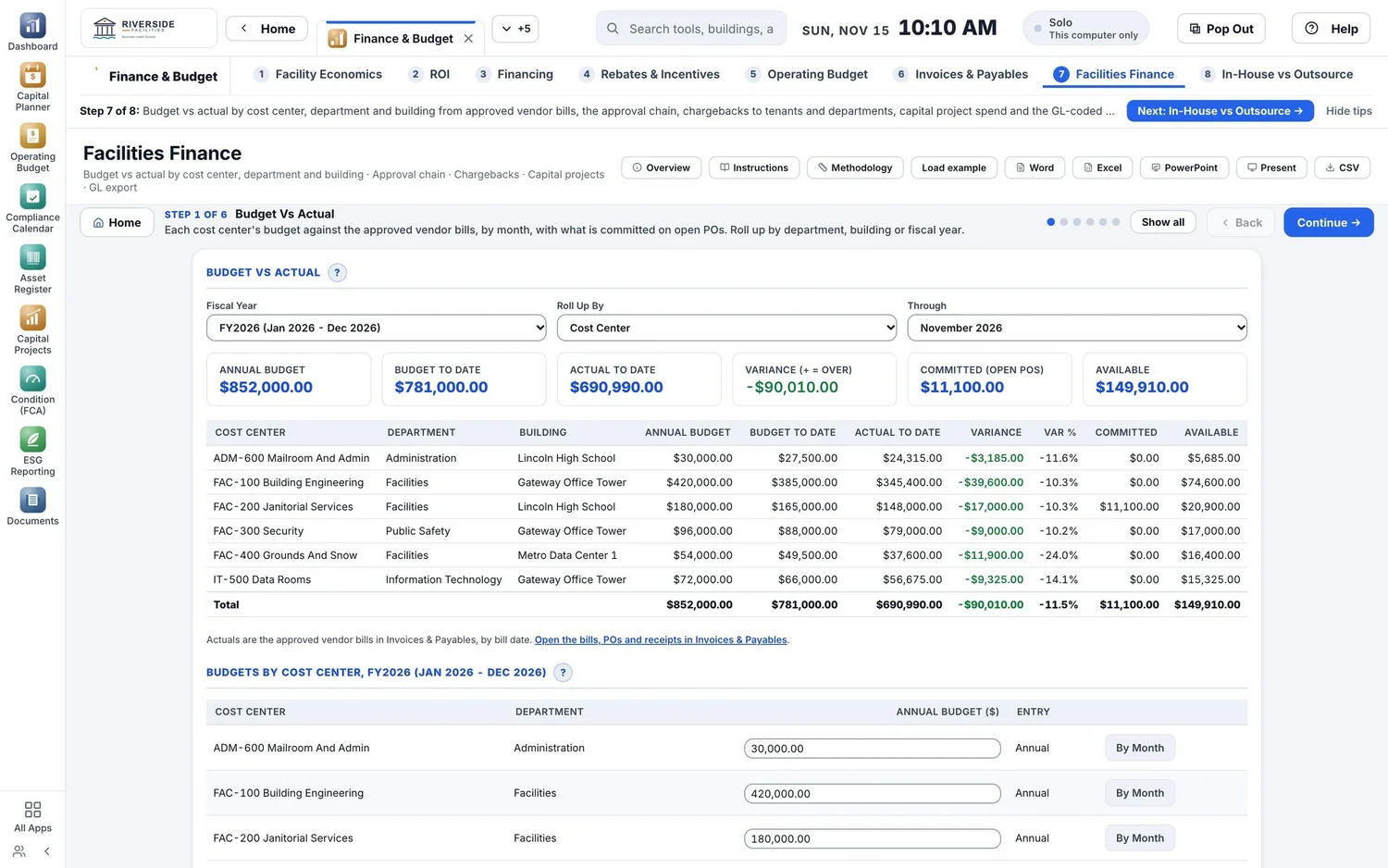
Chargebacks in Facilities Finance: bill a month's costs to tenants and departments: utility shares, space and cost pools, each an invoice to the cent, never twice.
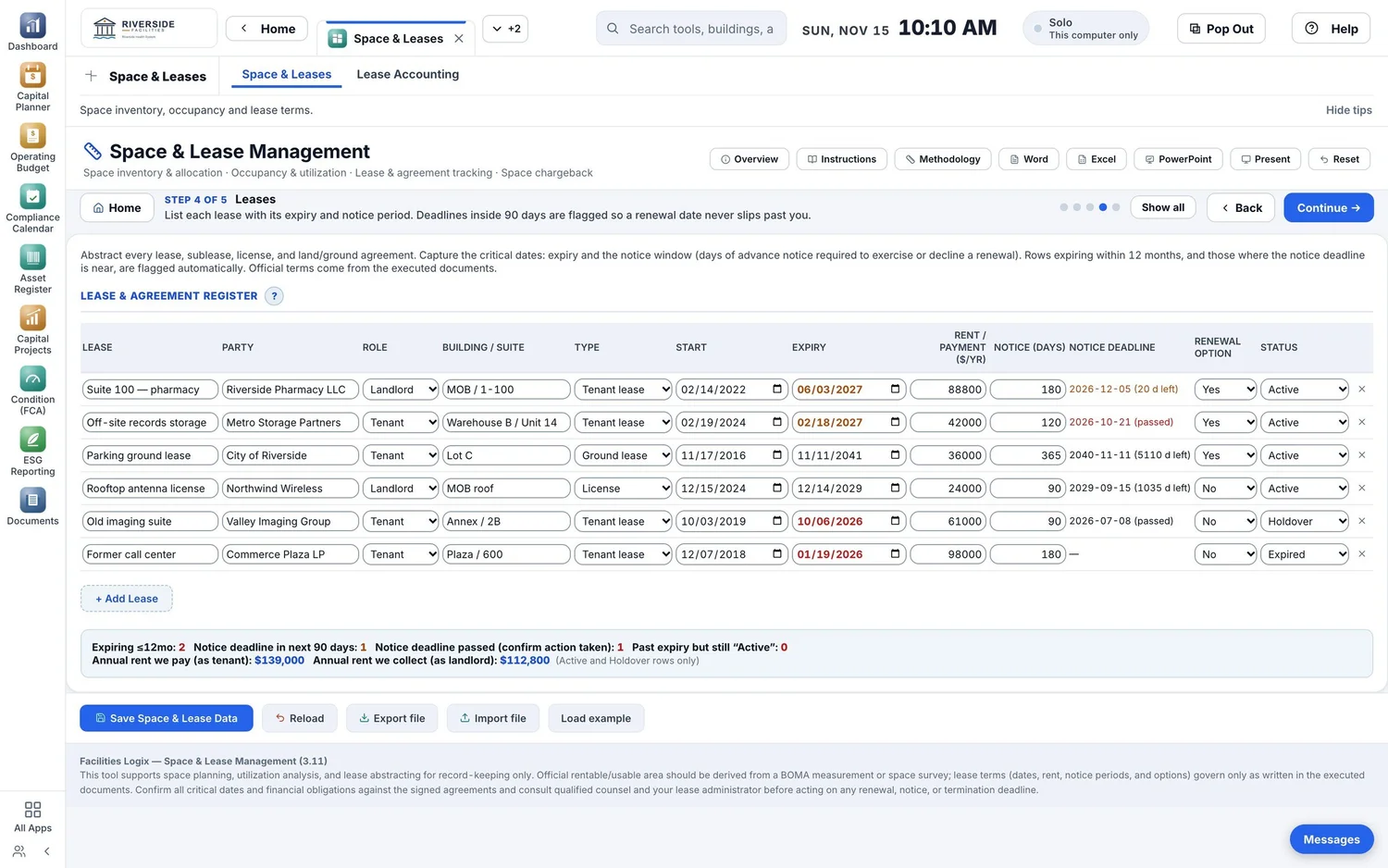
Leases in Space & Lease Management: list each lease with its expiry and notice period. Deadlines inside 90 days are flagged so a renewal date never slips past you.
The Standard That Fits Who Holds the Building
Three Standards
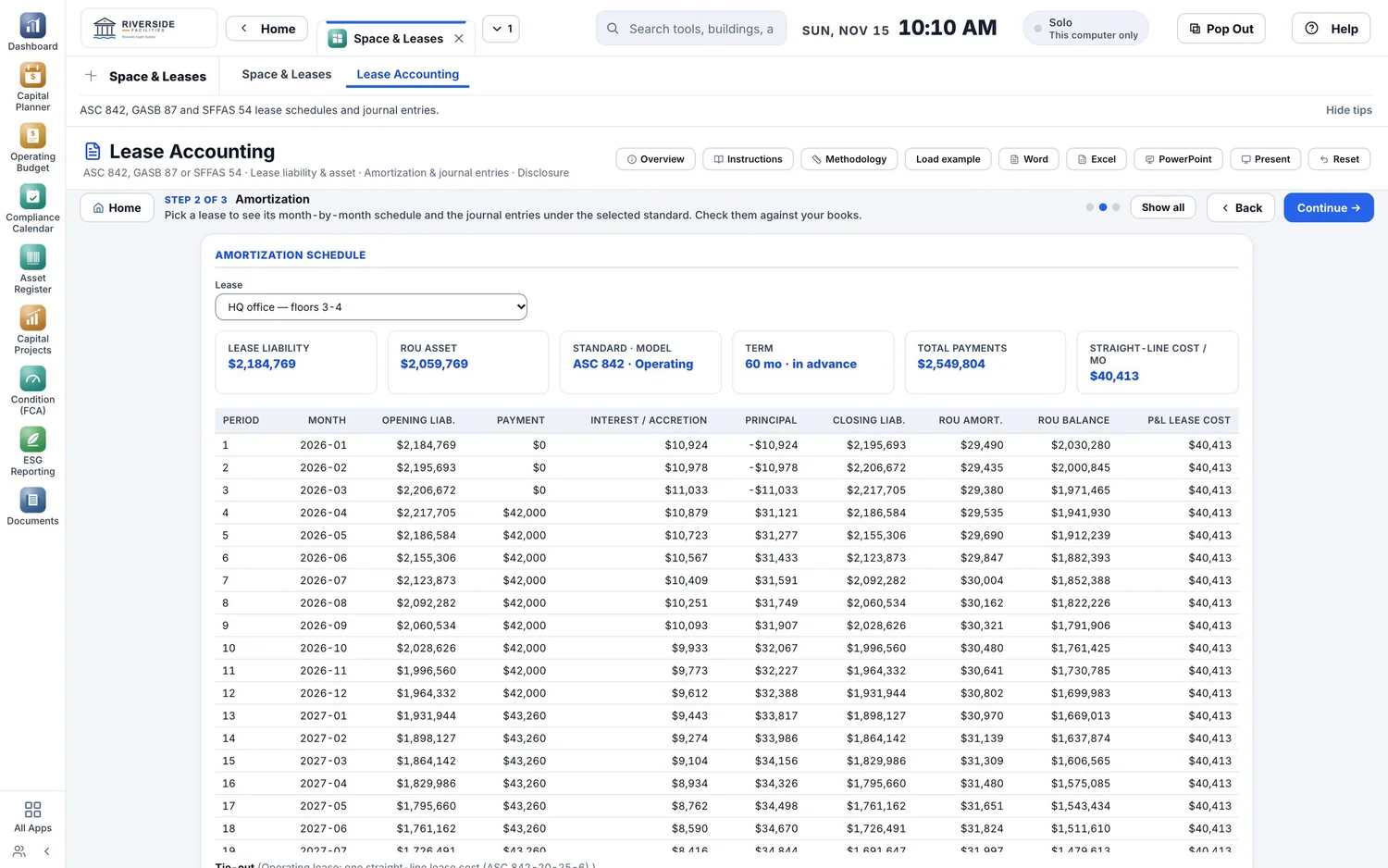
Lease Accounting follows the accounting standard set from each building's sector: ASC 842 for private organizations, GASB 87 for state and local government and SFFAS 54 for federal agencies. Short-term rules, lessee and lessor treatment and the federal markings for intragovernmental leases follow the standard chosen.
What It Produces
The present-value lease liability, effective-interest amortization schedules, the current and long-term split, journal entries and the maturity disclosure. It is analysis and documentation for your finance team; your auditors and accounting policies govern.
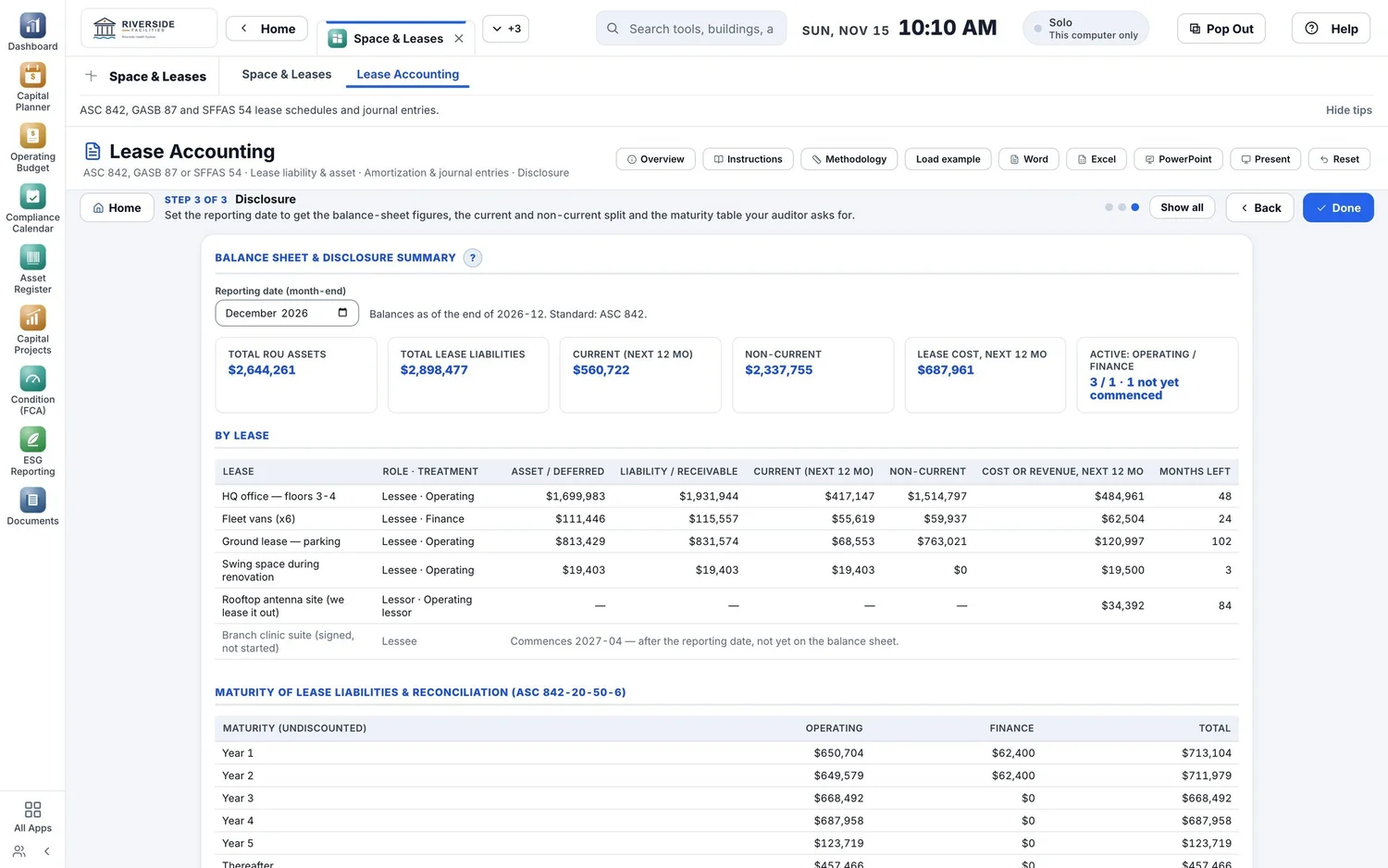
Disclosure in Lease Accounting (ASC 842, GASB 87, SFFAS 54): set the reporting date to get the balance-sheet figures, the current and non-current split and the maturity table your auditor asks for.
Turn Complaints into Patterns and Patterns into a Case
Service Requests
Occupant and tenant service-request intake, triaged before a request becomes a work order.
Learn MoreShow Less
Duplicate and vague requests waste technician trips. Triage sorts each one before it becomes billable work.
- Anyone with the phone app may send a request
- A message becomes a request with Make Work Request
- Some monitoring rules raise a request for a supervisor's approval
- Requests appear on the work order status board
Surveys
An occupant satisfaction survey scored by driver, with response-rate tracking. Each saved survey is kept, and periods line up by building to show the trend.
Learn MoreShow Less
Complaints are cheaper to address before they become lost tenants or unhappy staff. Surveys show the trend building by building.
- Satisfaction scored by driver, so the cause is visible
- Response rates tracked per survey
- Each period lined up with the one before, by building
- A request and feedback log that anticipates the next survey
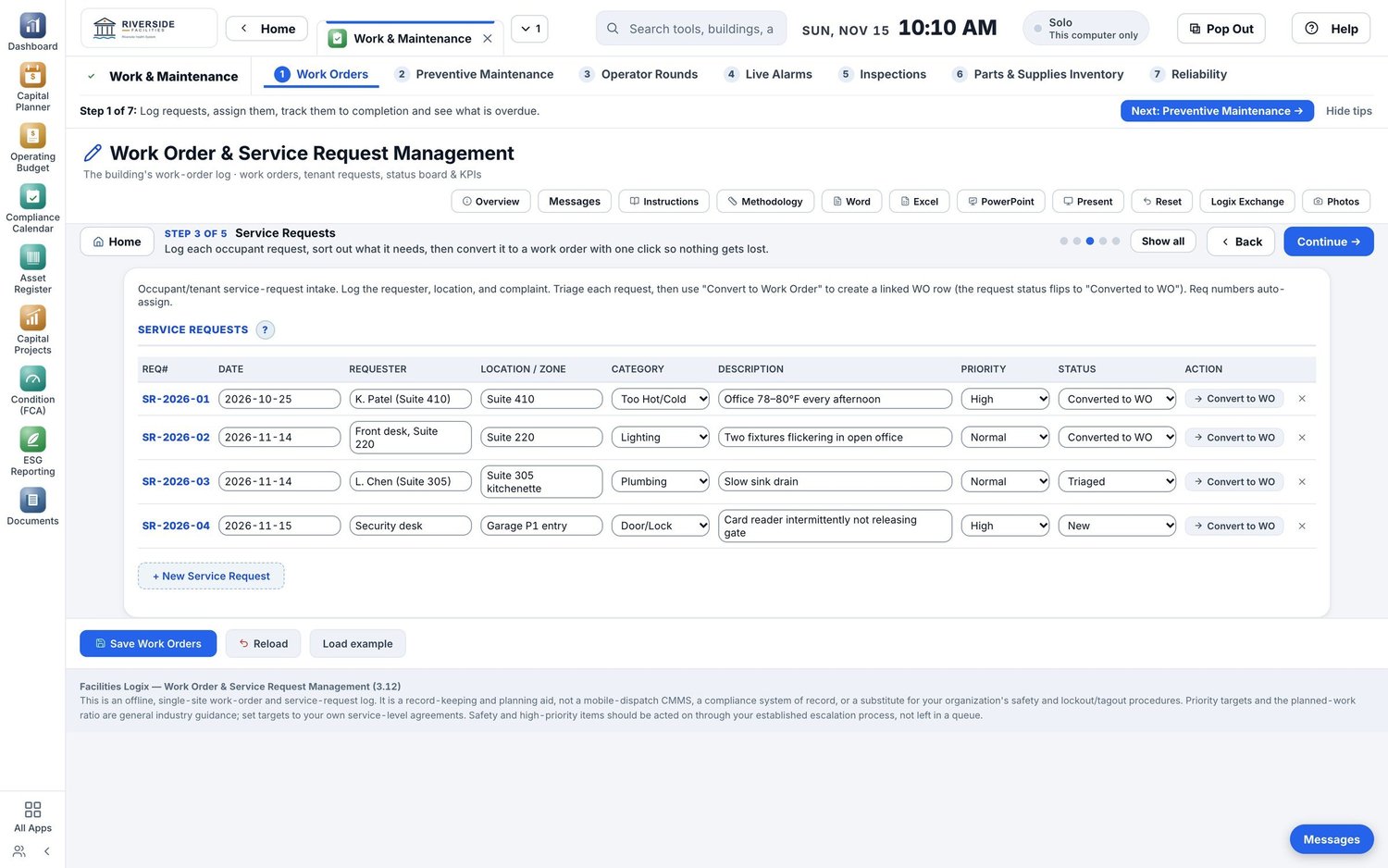
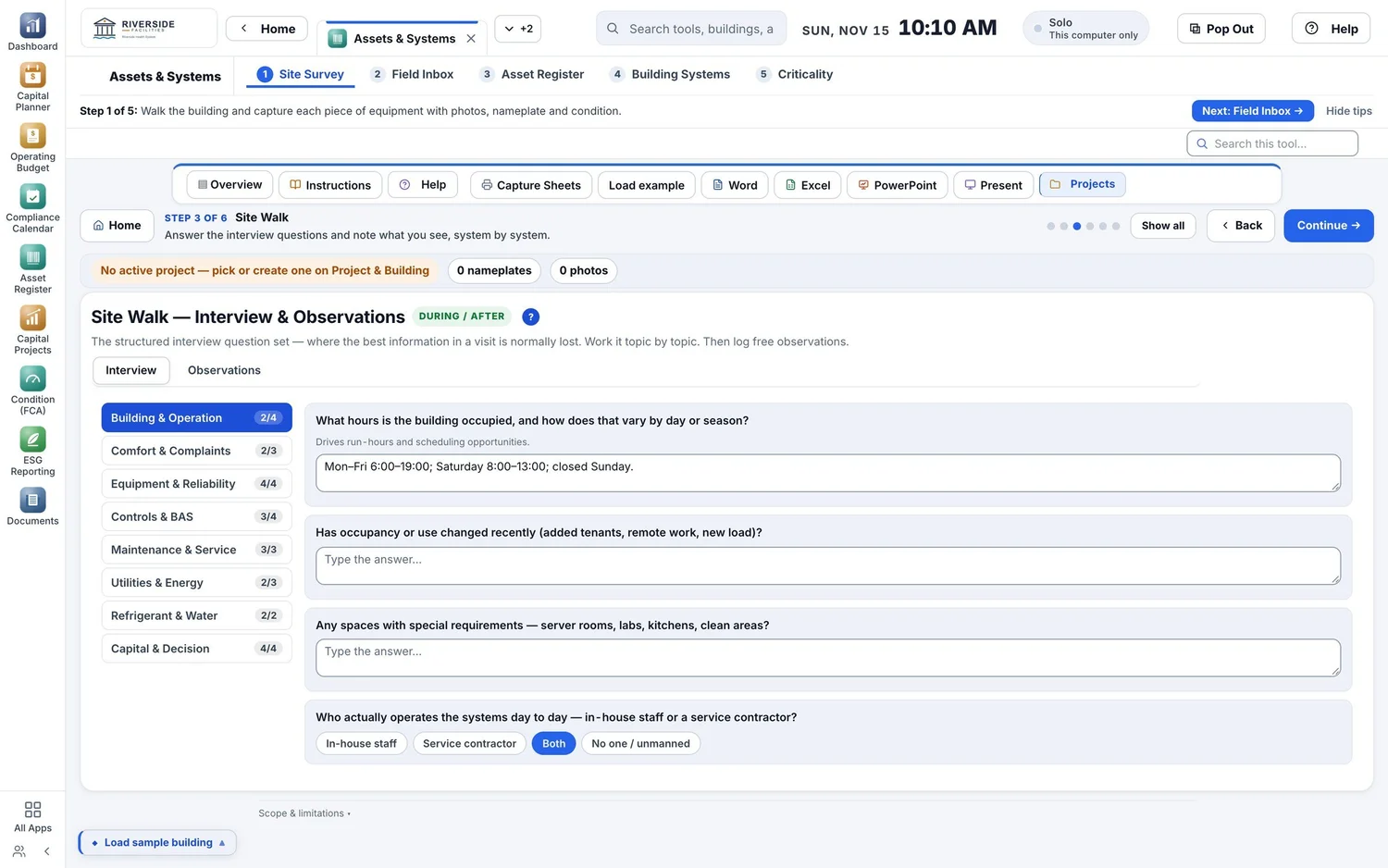
Service Requests in Work Order & Service Requests: log each occupant request, sort out what it needs, then convert it to a work order with one click so nothing gets lost.
Comfort & Complaints
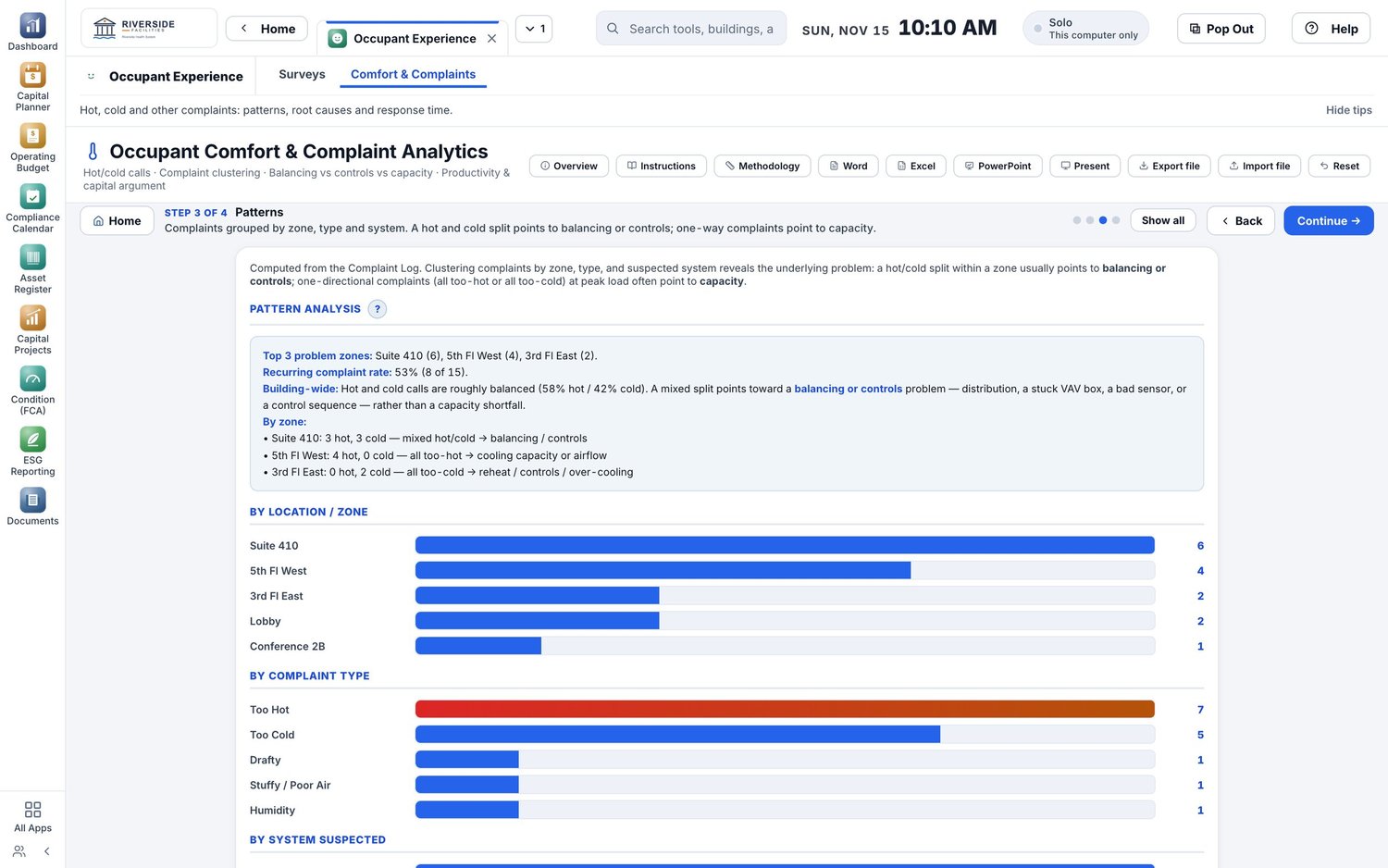
Hot and cold calls sorted by zone, type and system, with response time and root causes: the pattern that turns anecdotes into a capital argument.
Learn MoreShow Less
Fixing hot and cold calls one at a time costs truck rolls without solving the cause. Patterns point to balancing, controls or capacity.
- Complaints per 100 occupants and the top location
- A hot and cold split in one zone usually points to balancing or controls
- All too hot at peak load often points to capacity
- A Capital Argument tab turns recurring zones into a funded fix
Tenant Notices
An occupant or tenant notice is written once and printed for posting or hand-out.
Learn MoreShow Less
Tenants who are not told about a shutdown call the office, and that costs staff time. A notice written once reaches everyone.
- Written in English and Spanish
- Marked External, for posting or hand-out
- Also covers outages, water shutoffs and weather closures
- Staff alerts can ask each person to acknowledge
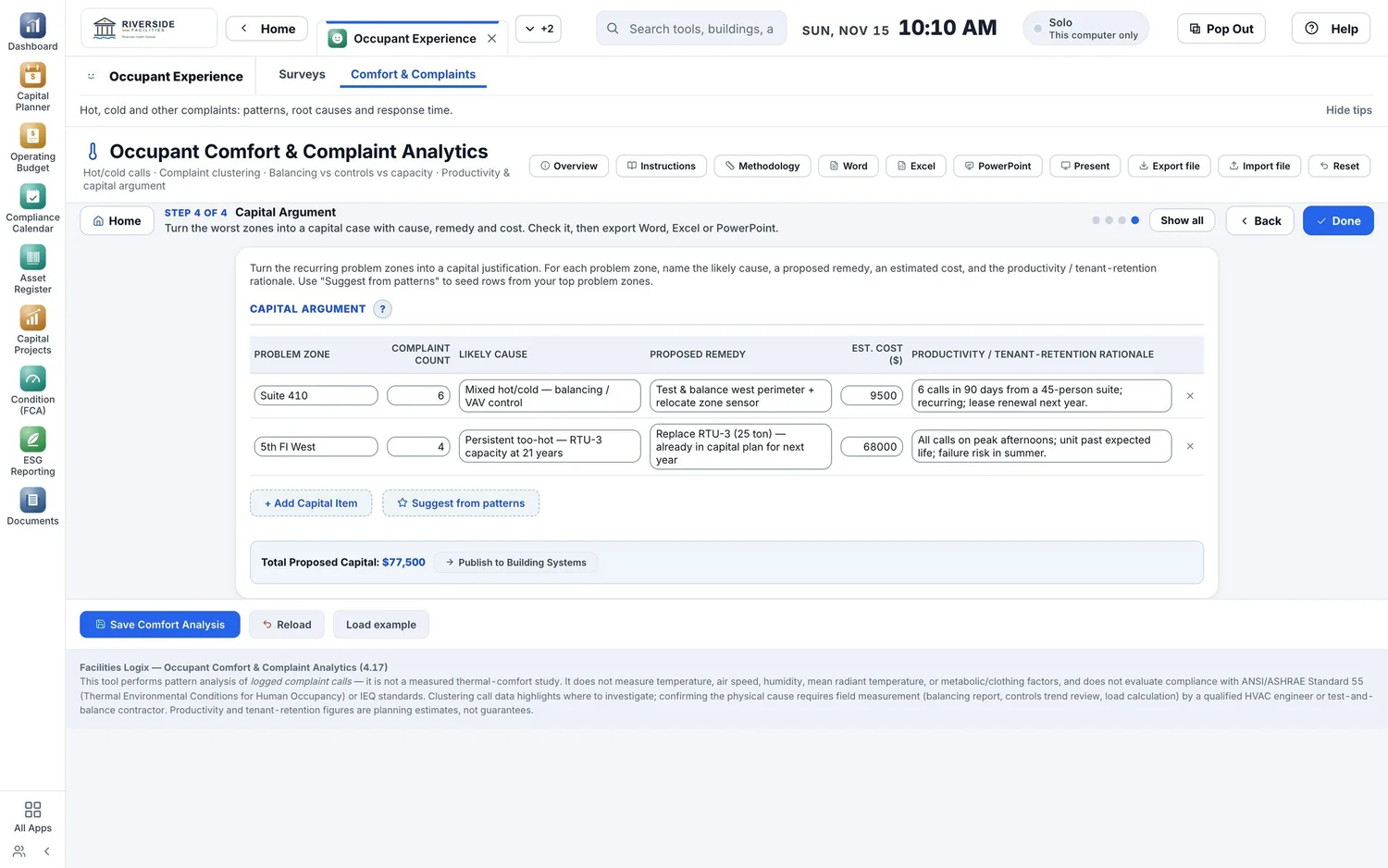
Capital Argument in Occupant Comfort & Complaint Analytics: turn the worst zones into a capital case with cause, remedy and cost. Check it, then export Word, Excel or PowerPoint.
Tenant Utility Allocation
Split a utility bill among tenants by sub-meter, area and hours, as an advisory allocation where the lease allows recovery.
Learn MoreShow Less
Utility costs that tenants should bear stay on the owner's books unless they are allocated. The allocation splits a bill fairly, and finance can invoice it.
- Sub-metered tenants pay for metered use, scaled up when readings are missing
- With under half the readings on file, the area rule is used
- Shares become draft invoices only when the lease allows recovery
- Some states regulate submetering and utility resale; the invoice carries a note
Property Playbooks
Office, retail, mixed-use and multifamily playbooks add tenants and leases, operating-expense recovery, units and turns, and resident service requests.
Learn More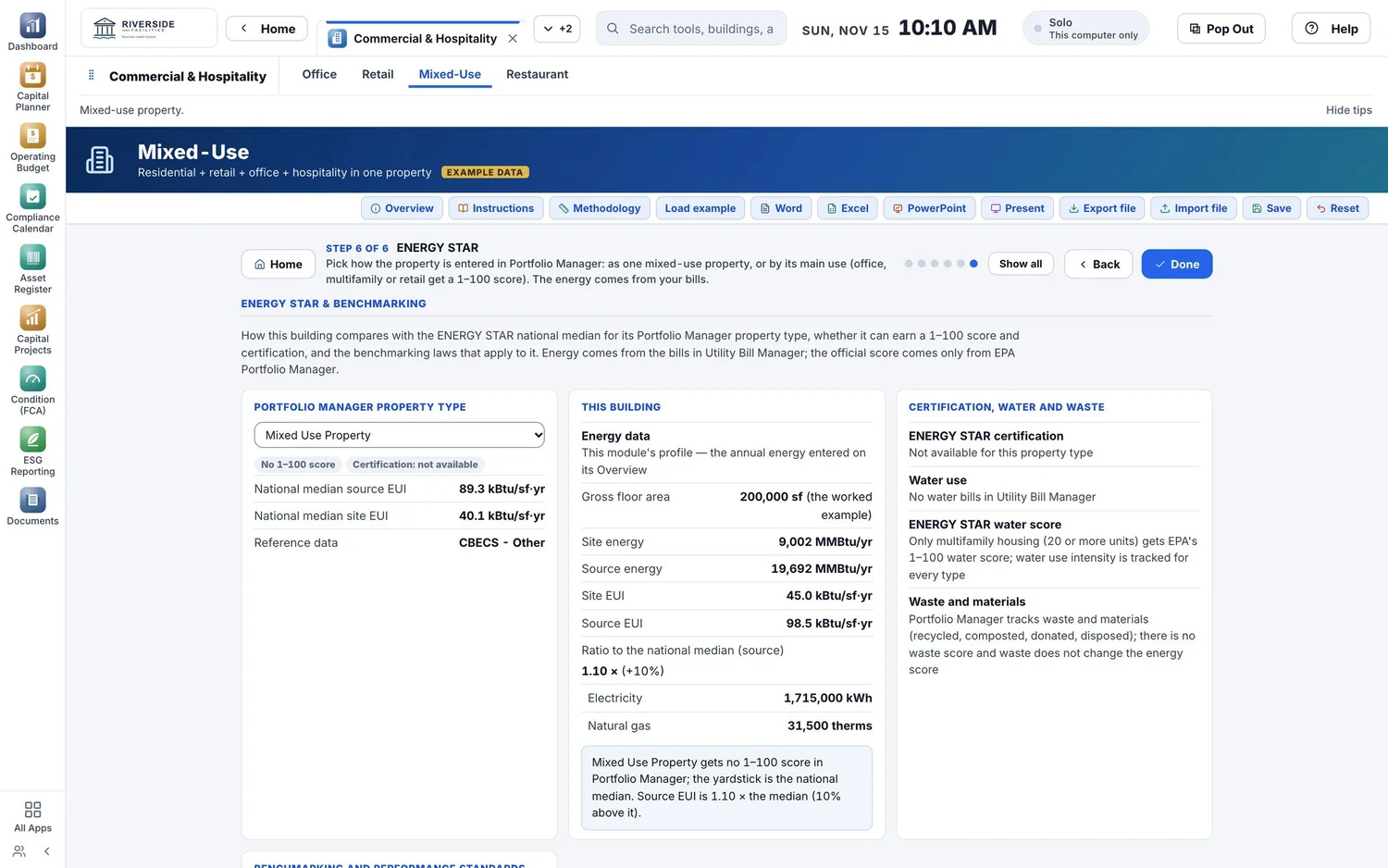
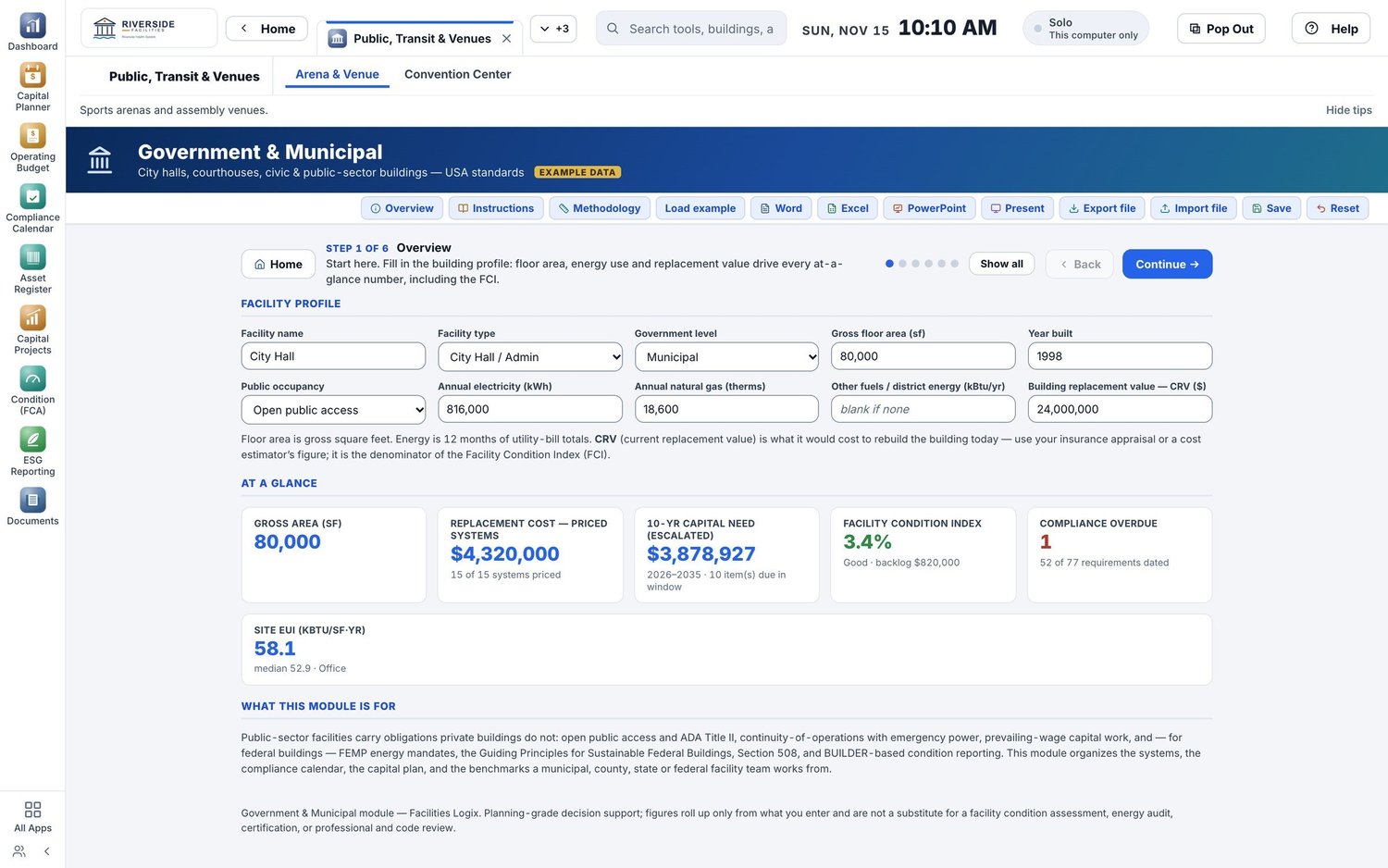
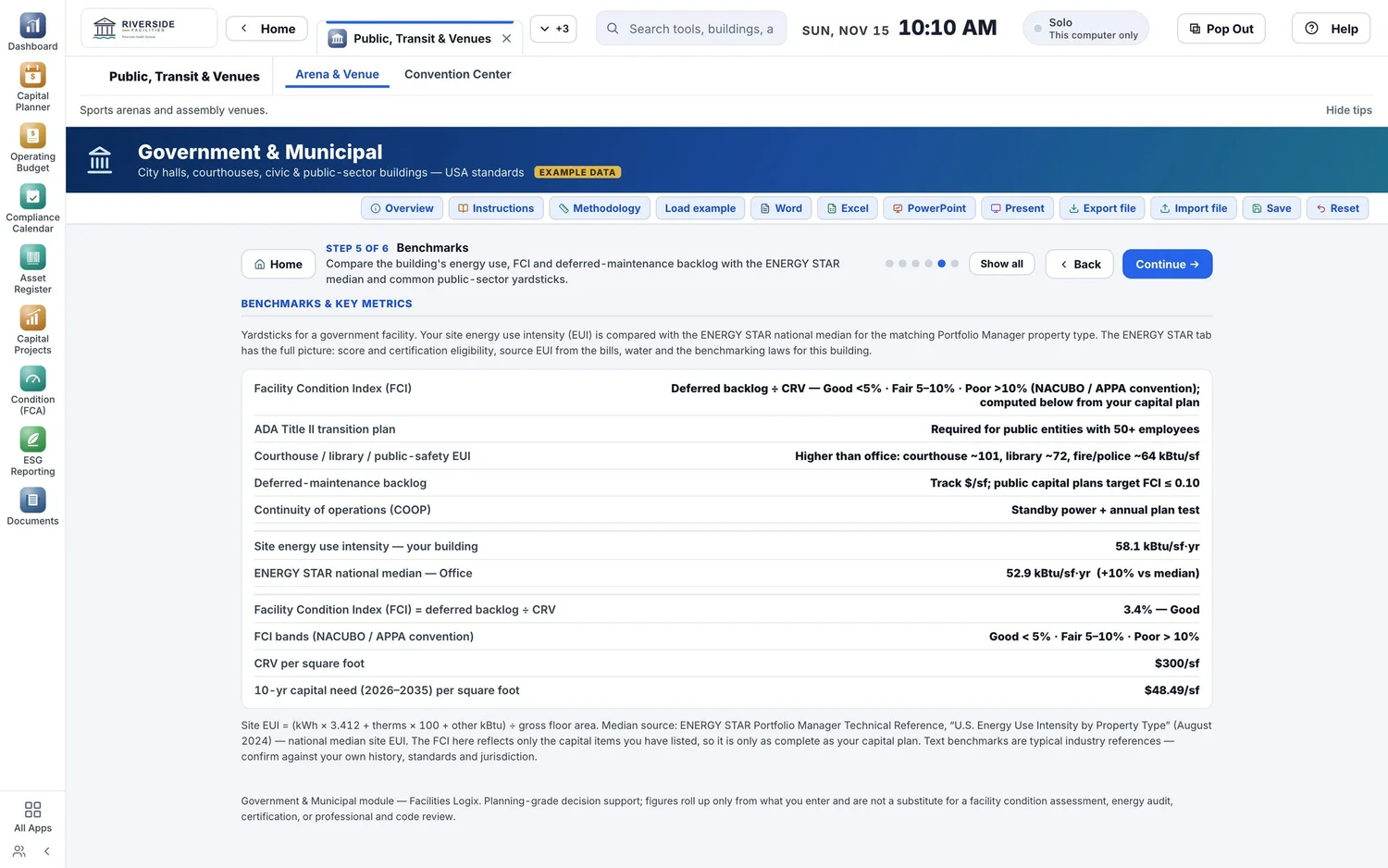
ENERGY STAR in Mixed-Use: pick how the property is entered in Portfolio Manager: as one mixed-use property, or by its main use (office, multifamily or retail get a 1–100 score). The energy comes from your bills.
Keys, Credentials and the Systems That Guard the Doors
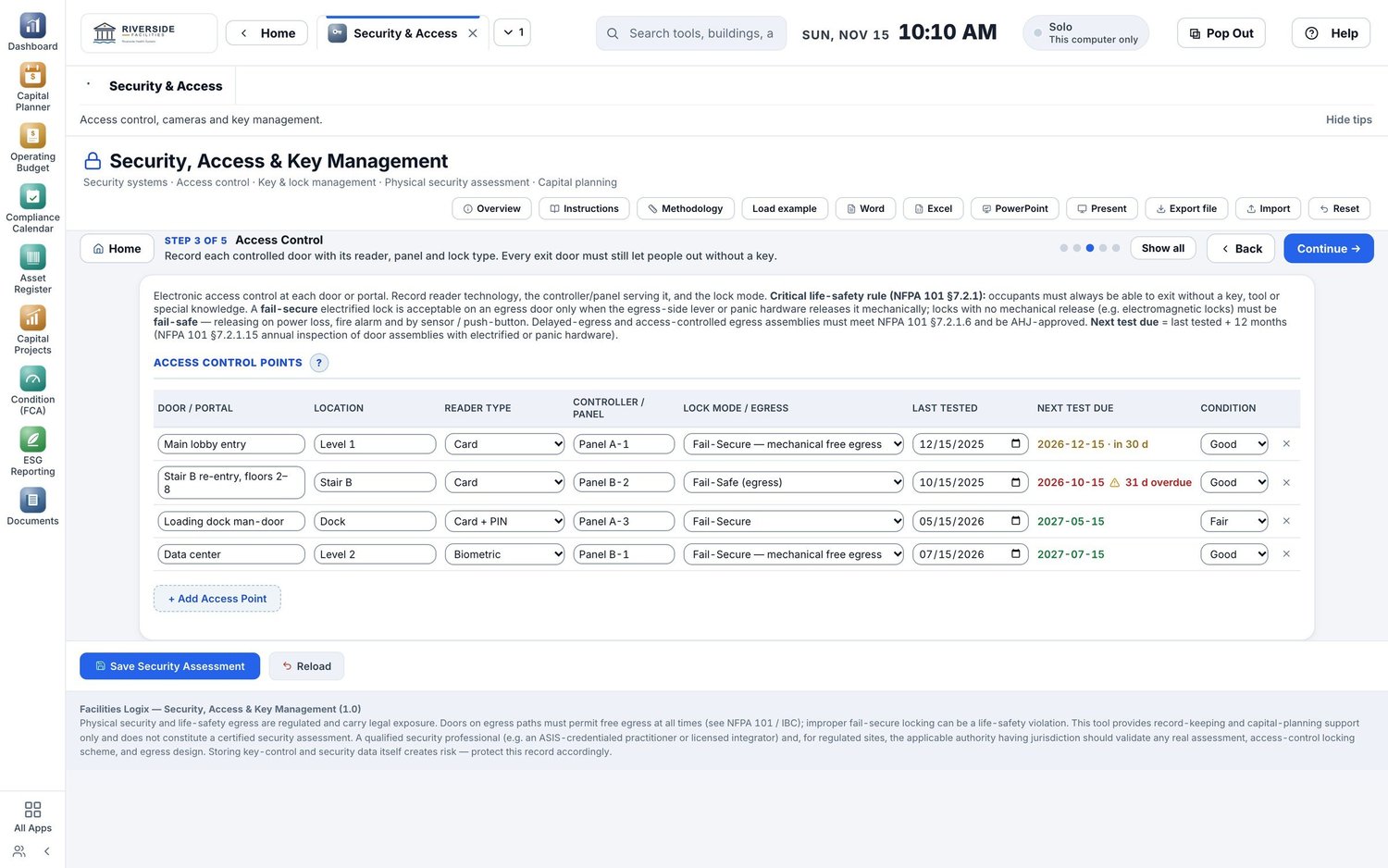
Security, Access & Key Management
- A register of physical security systems, access control and cameras
- Key and lock management
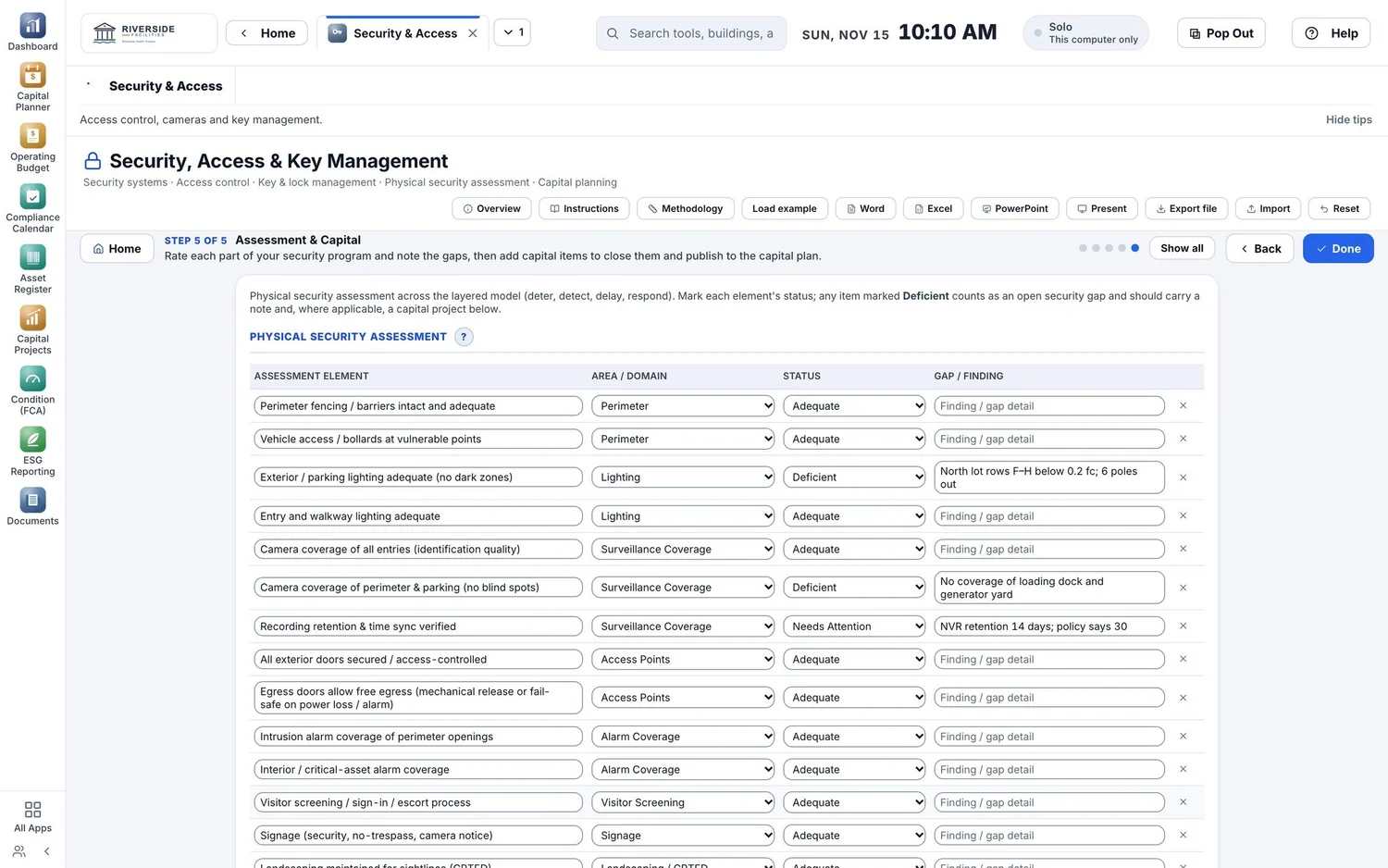
- A physical-security assessment with findings to act on
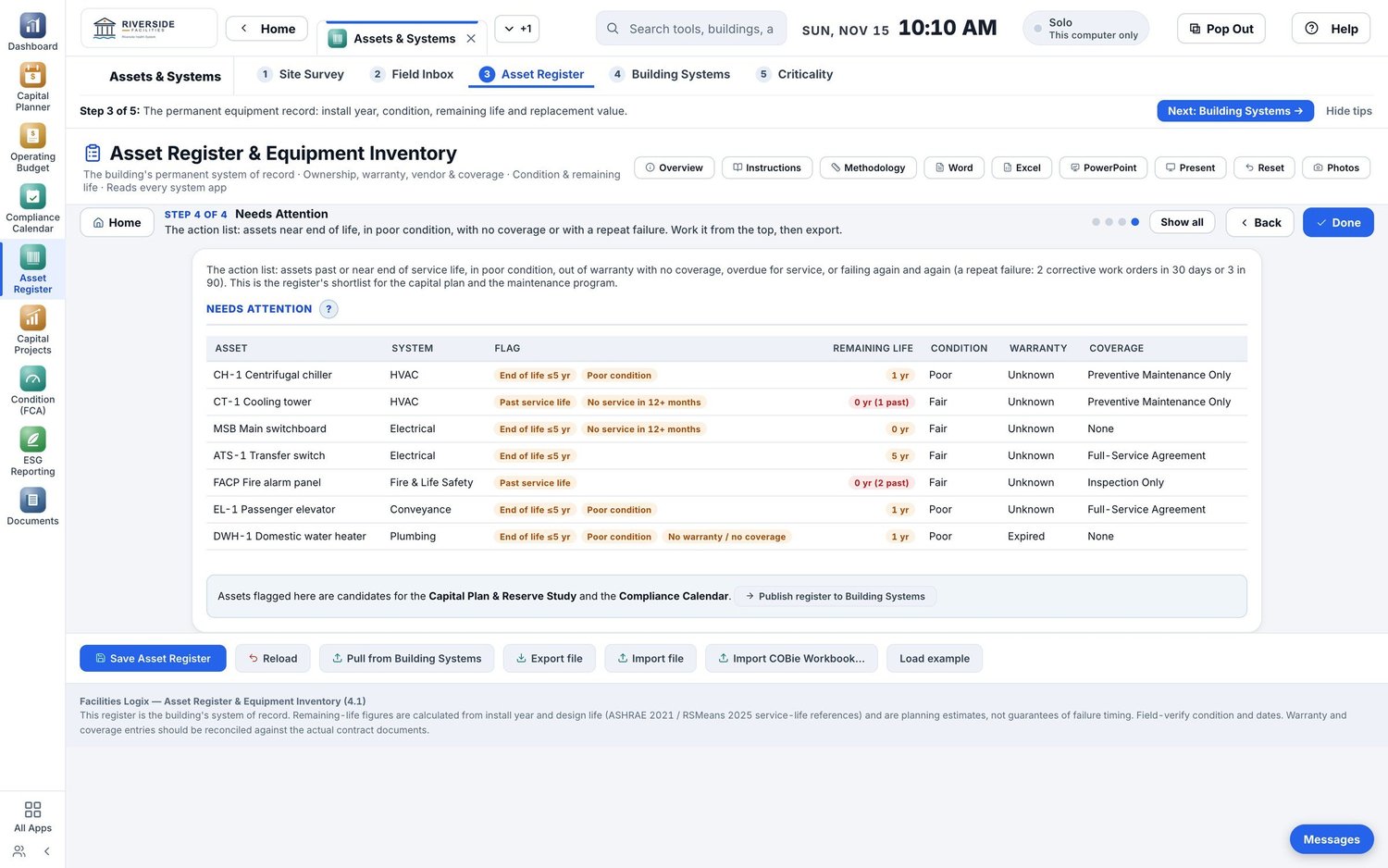
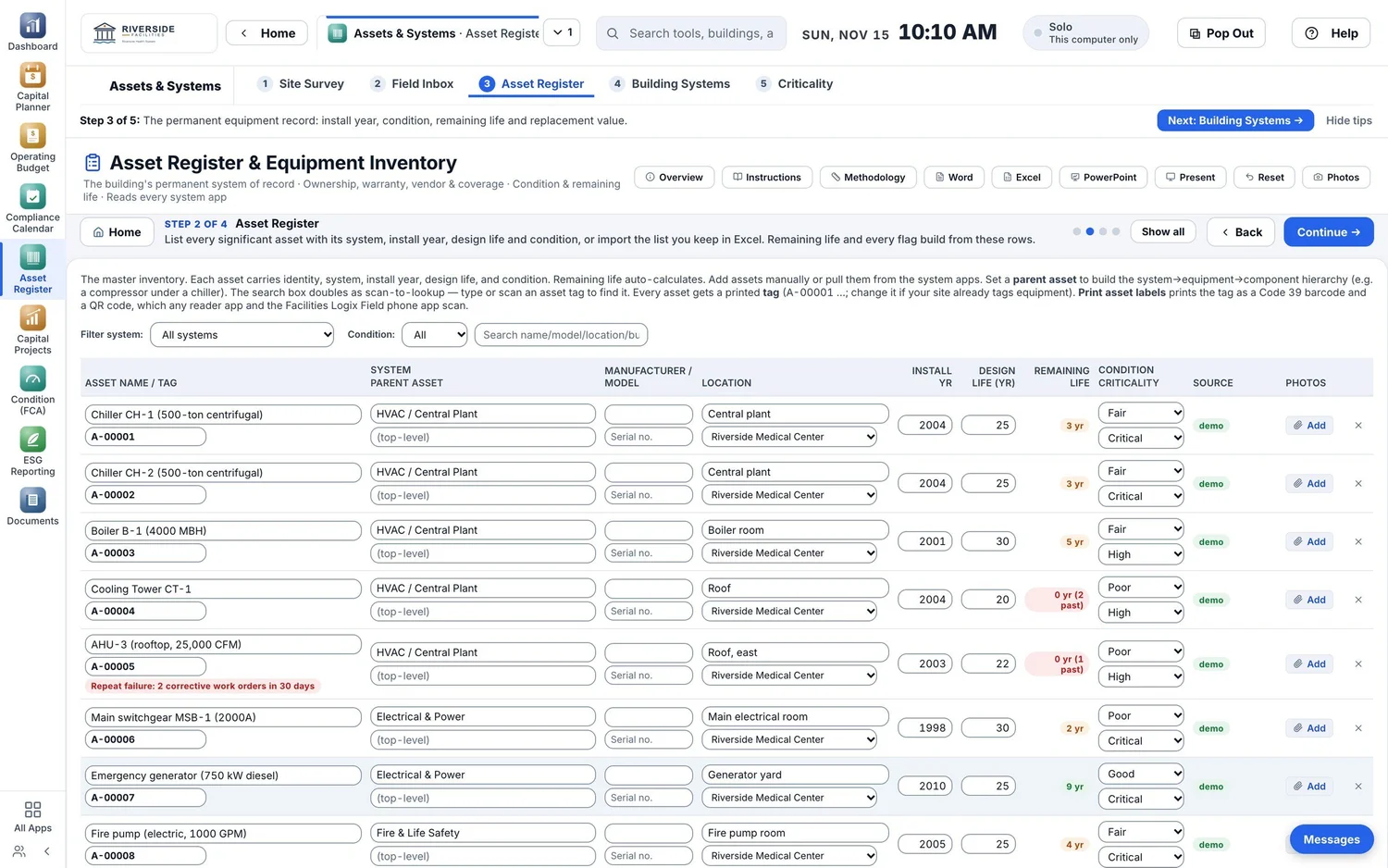
- Condition, remaining life and capital needs published to the shared Building Systems record
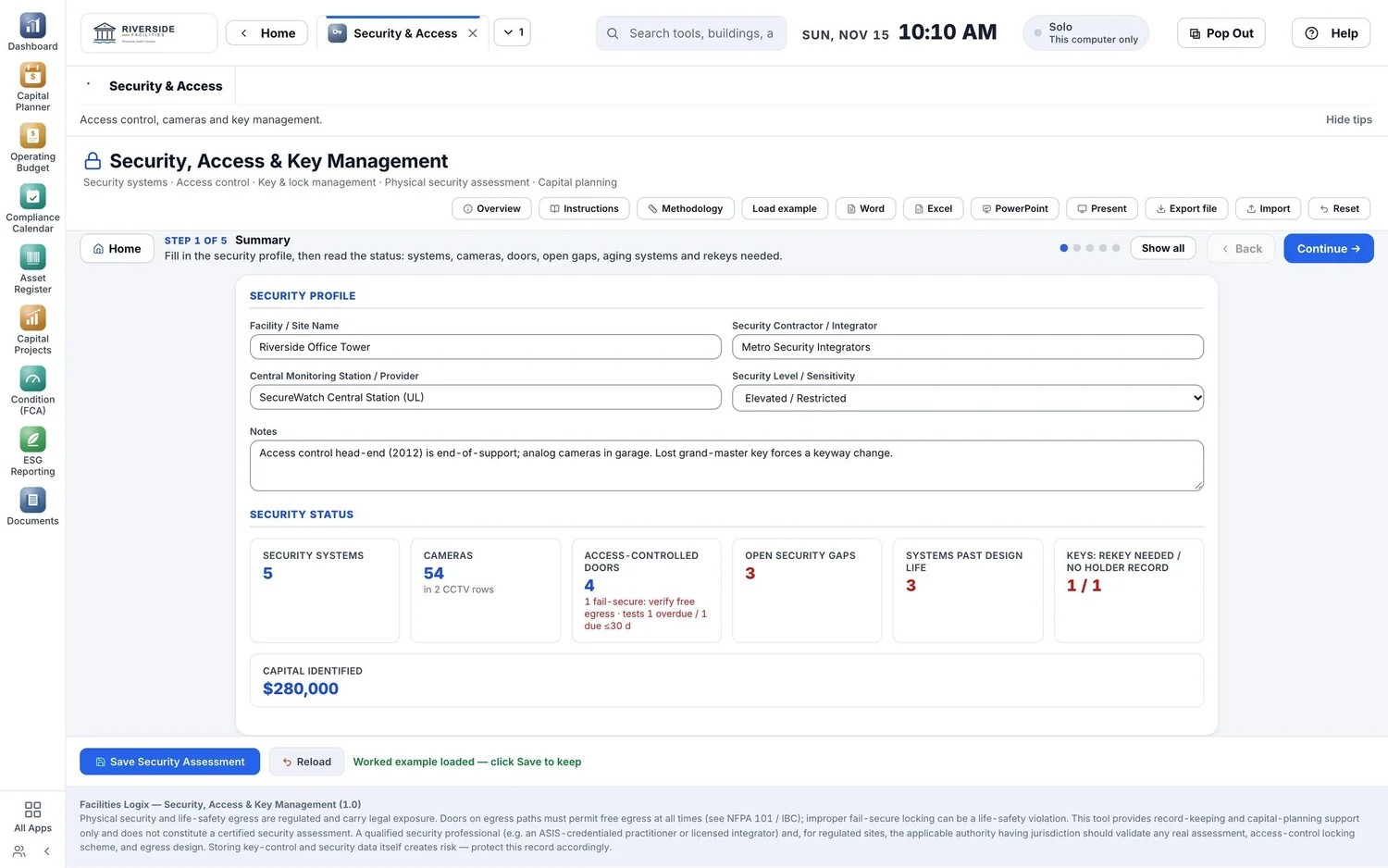
Summary in Security, Access & Key Management: fill in the security profile, then read the status: systems, cameras, doors, open gaps, aging systems and rekeys needed.
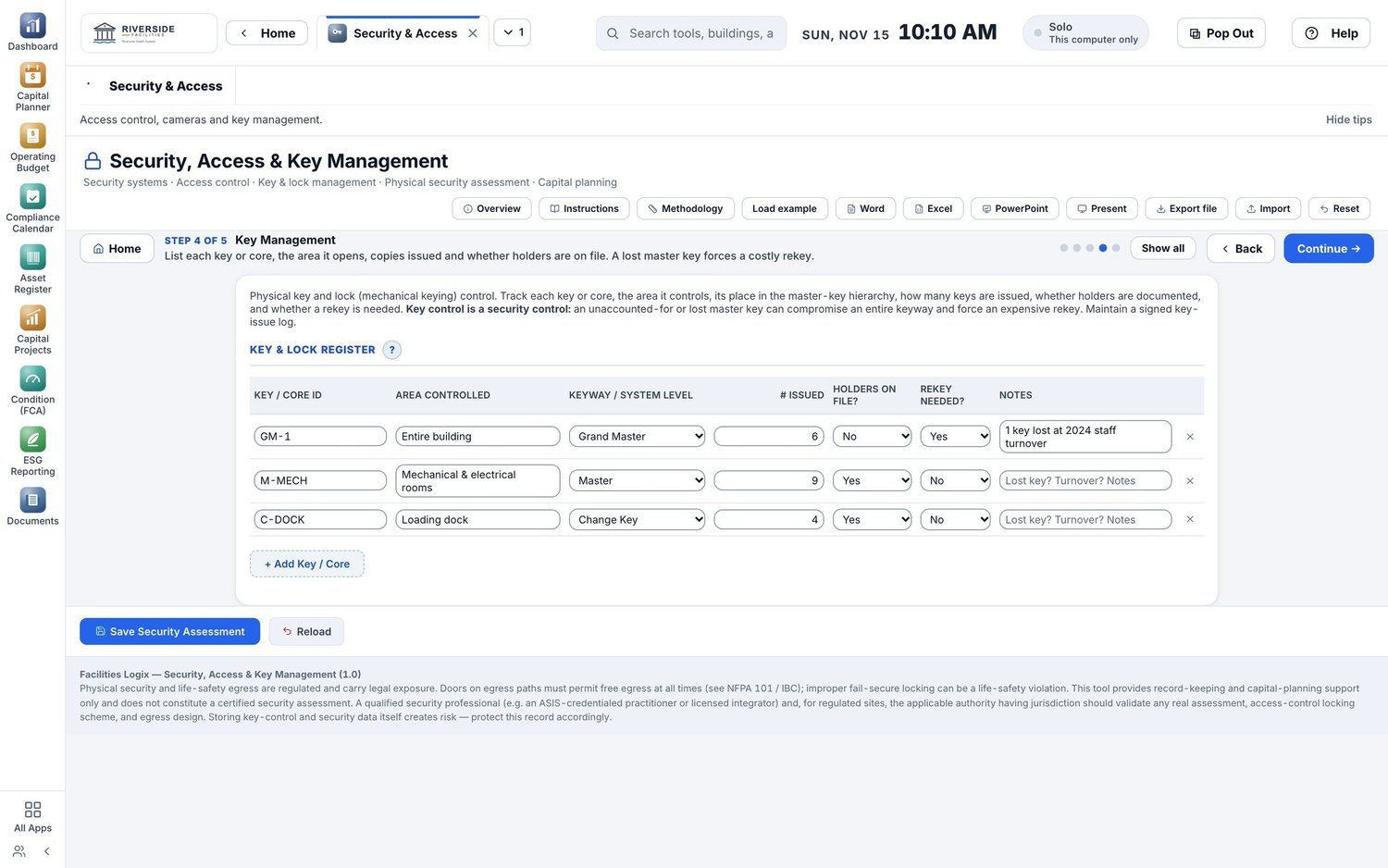
Lost keys and unknown key holders put buildings at risk, so every key and holder is recorded.
The Standard for Each Building, Selected from Its Record
Standard Applied
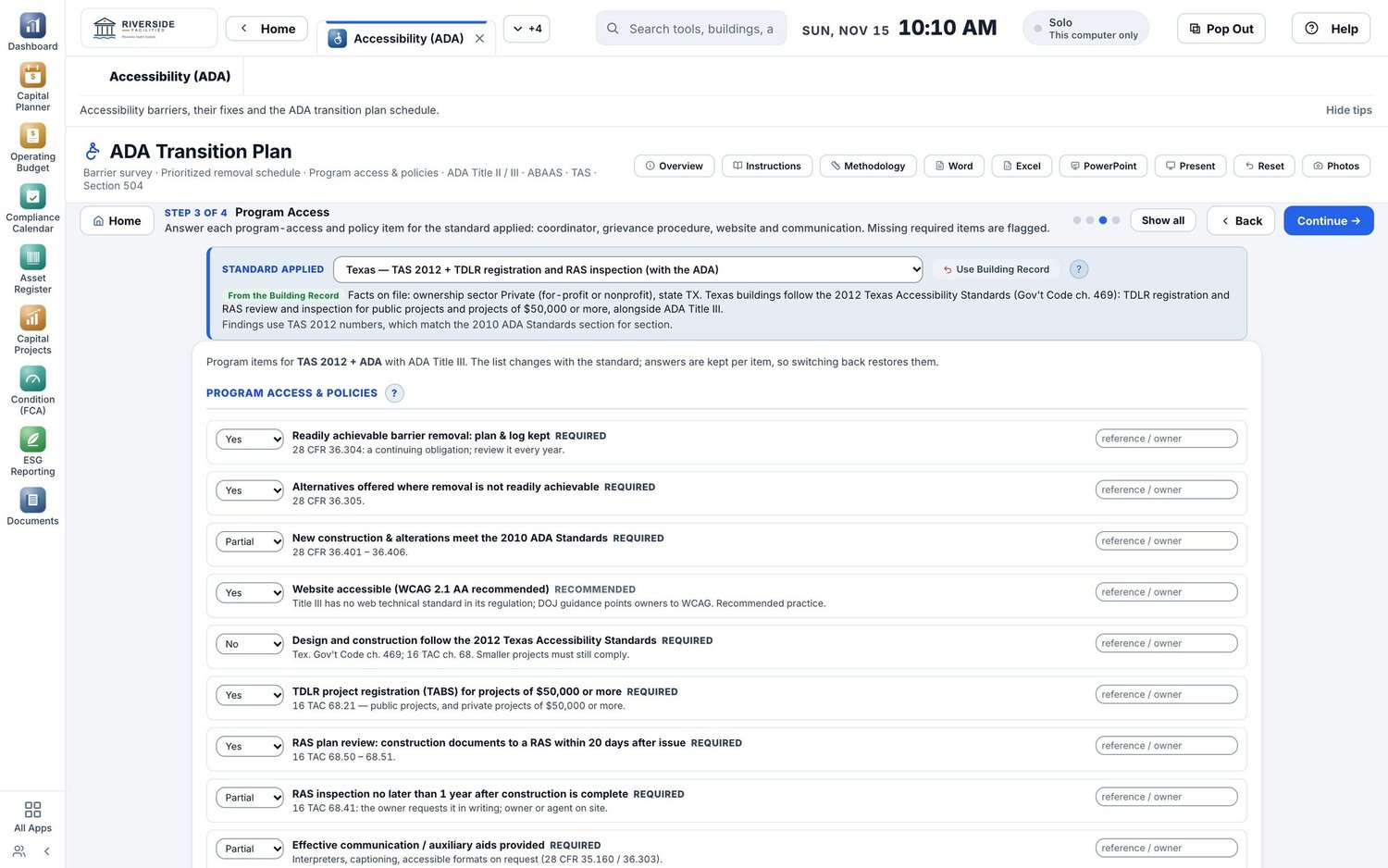
- The 2010 ADA Standards under Title III for private organizations and Title II for state and local government
- The Texas Accessibility Standards in Texas, with registration and inspection
- The federal accessibility standards and Section 508 for federal buildings
- Section 504 for assisted housing and recipients of federal health funds
- A banner shows the standard applied and the reason; switching it keeps your answers
The Transition Plan
- An interior barrier survey keyed to the section numbers of the standard that applies
- A prioritized removal schedule with cost
- The required plan elements and program-access checks
- Deadlines tracked alongside the rest of the compliance calendar
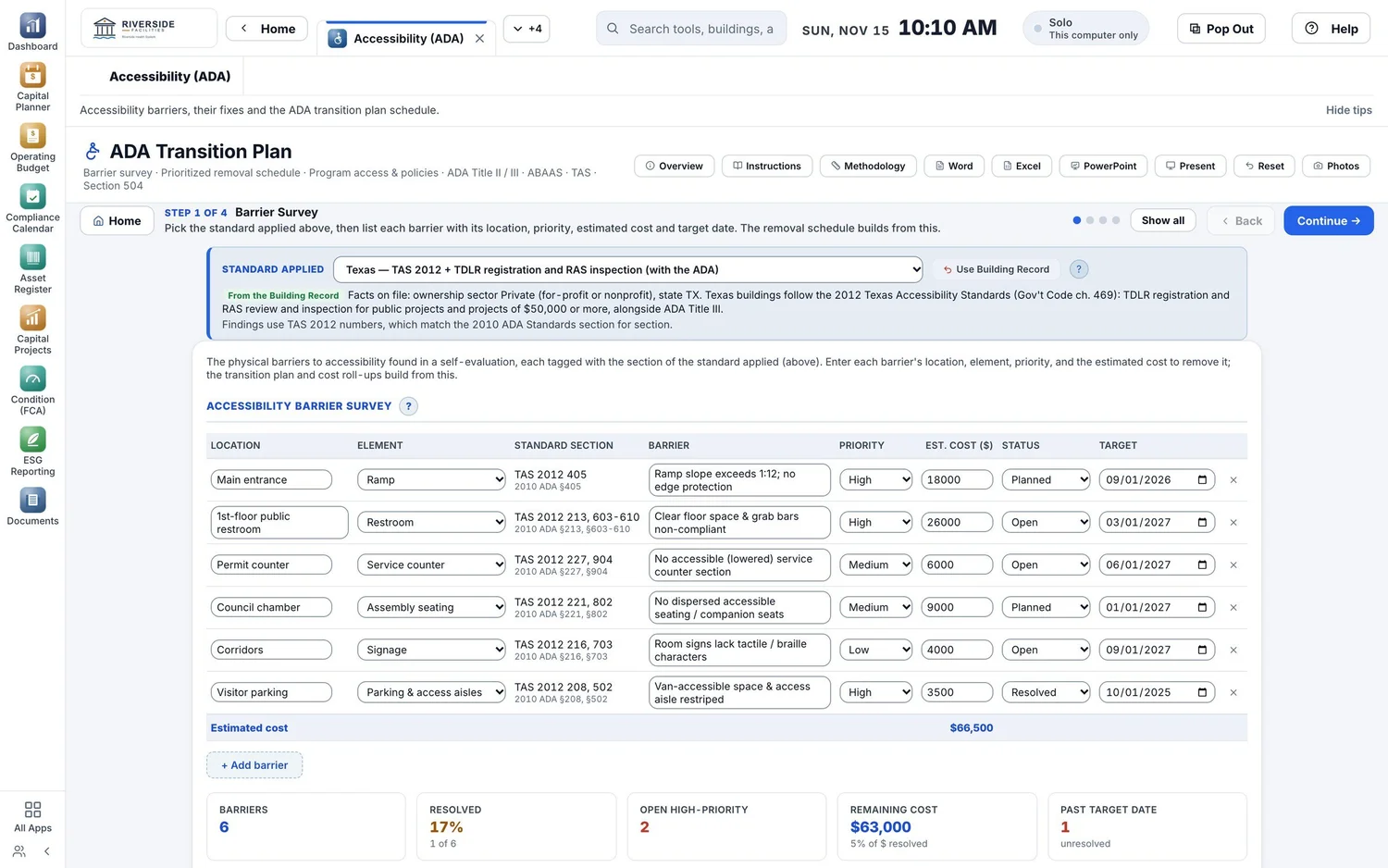
Barrier Survey in ADA Transition Plan: pick the standard applied above, then list each barrier with its location, priority, estimated cost and target date. The removal schedule builds from this.
Space as an Asset, Not an Afterthought
Leadership
Utilization, lease exposure and occupant satisfaction by building, and an accessibility plan with a schedule and a cost.
Learn MoreShow Less
Accessibility barriers left unaddressed can bring complaints and legal costs. The plan sets a schedule and a cost for removing them.
- The standard that applies is shown with the reason, from the Building Record
- Barrier survey section numbers follow that standard
- A prioritized removal schedule with cost
- Program-access and policy checks
Management
Critical dates that remind before they pass, chargebacks that reconcile and complaints that point to a root cause.
Learn MoreShow Less
Chargebacks that do not add up get disputed, and disputes cost time. Every split adds to the cost exactly.
- Space chargeback = assigned square feet x yearly rate, one twelfth a month
- Shares split by largest remainder so they total to the cent
- A month, source and customer is never billed twice
- Lease notice dates counted on the Summary
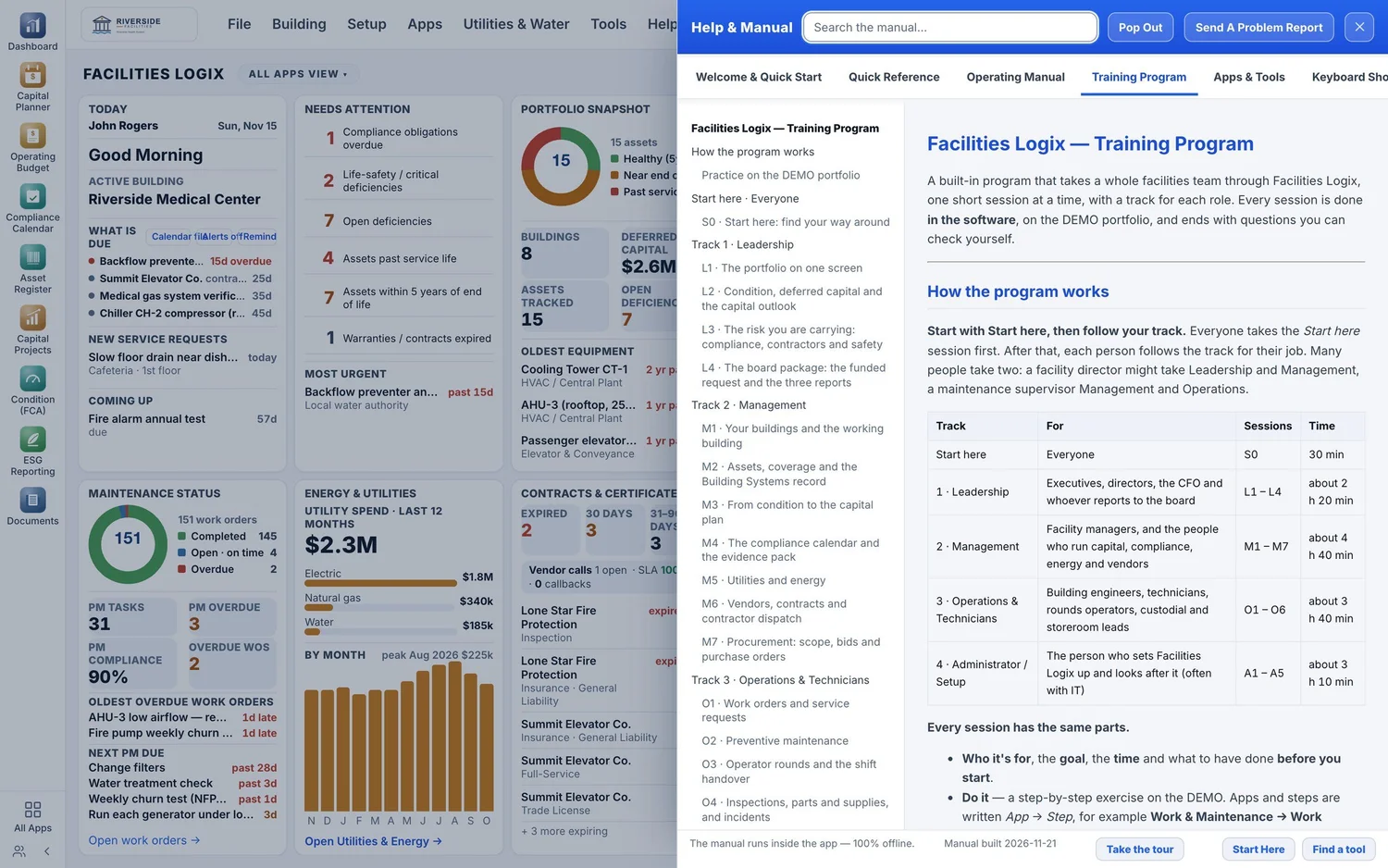
The Training Program: tracks for leadership, management, operations and administrators on the sample portfolio.
Operations
Requests that arrive triaged, and keys and access records that are current when someone needs a door opened.
Learn MoreShow Less
A door that cannot be opened when needed, or keys nobody can account for, cost time and money. Access records stay current.
- Key records show who holds each key
- Keys needing a rekey are counted
- Every exit must open without a key, per NFPA 101
- Requests from occupants arrive already triaged
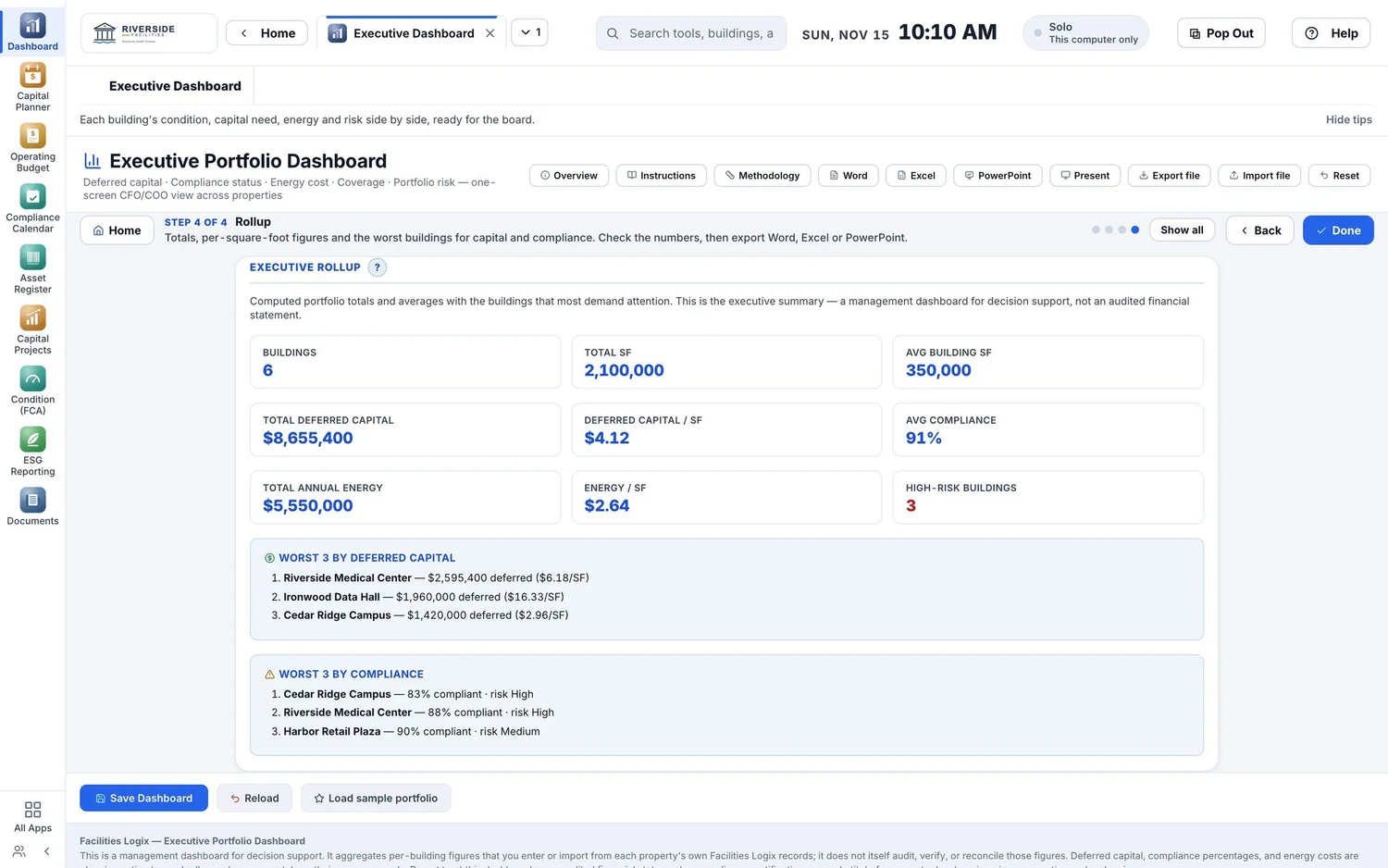
Totals, cost per square foot and the buildings with the most to fix, on one screen.
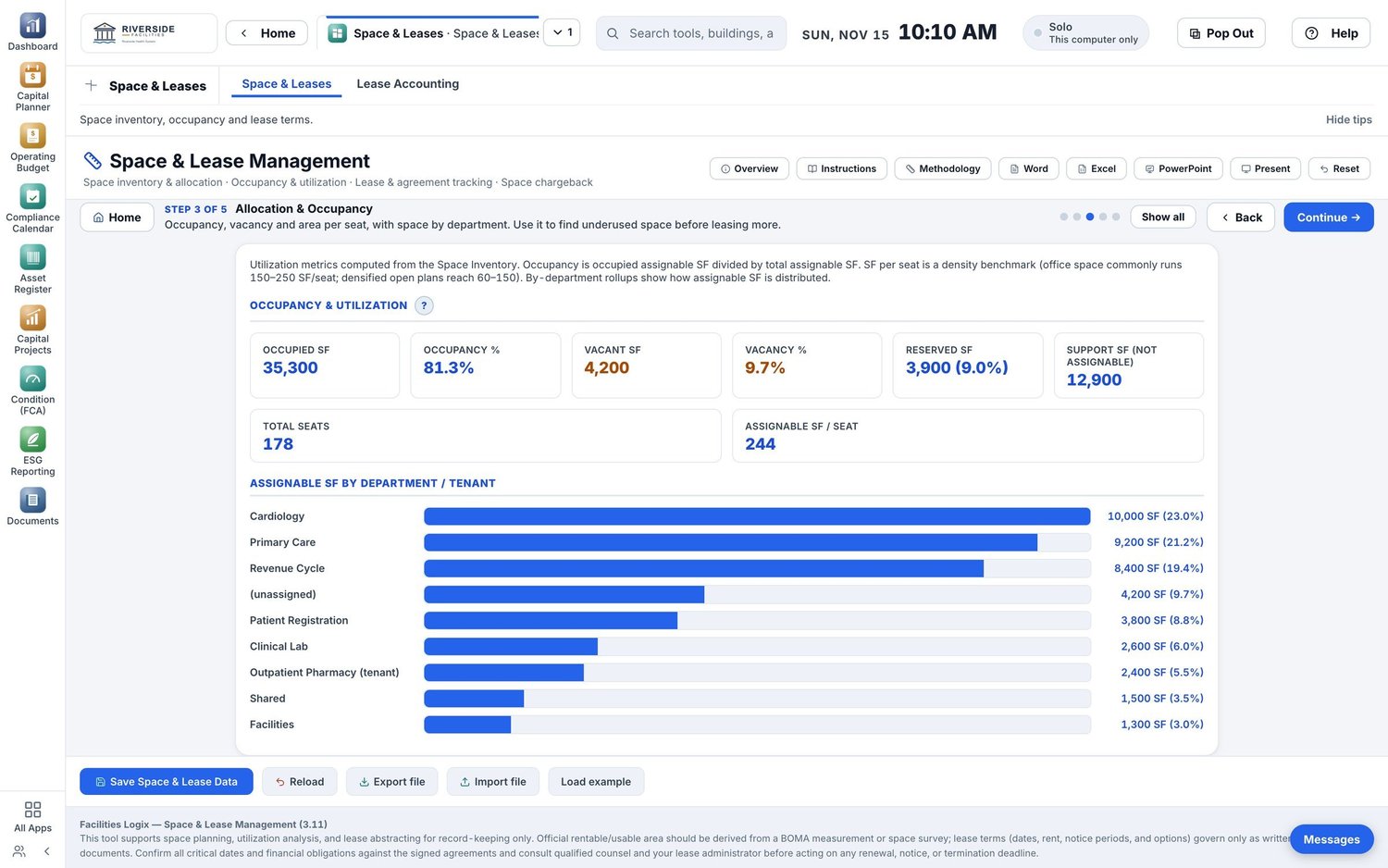
Space that nobody measures gets wasted, so allocation and occupancy are shown by building and department.
Frequently Asked Questions
Does the accessibility tool certify that a building is accessible?
Is the lease accounting audit-ready?
Can we bill tenants for utilities from here?
Be First When Facilities Logix Opens
Stop chasing building records across spreadsheets and binders. Join the list and we will tell you the day downloads open, with setup guides ready.
Launching early 2027 for Facilities Logix. Nothing to buy today, and no sales calls.
