

Buildings for infants and young children are held to some of the strictest standards any building meets: licensing visits that arrive unannounced, a fire drill every month, drinking water with no lead, hot water that cannot scald and playgrounds with the right surfacing. The Child Care playbook keeps those systems and dates in one place for licensed centers, Head Start, pre-K and military child development centers.
Licensing, Life Safety and Lead, by Program Type
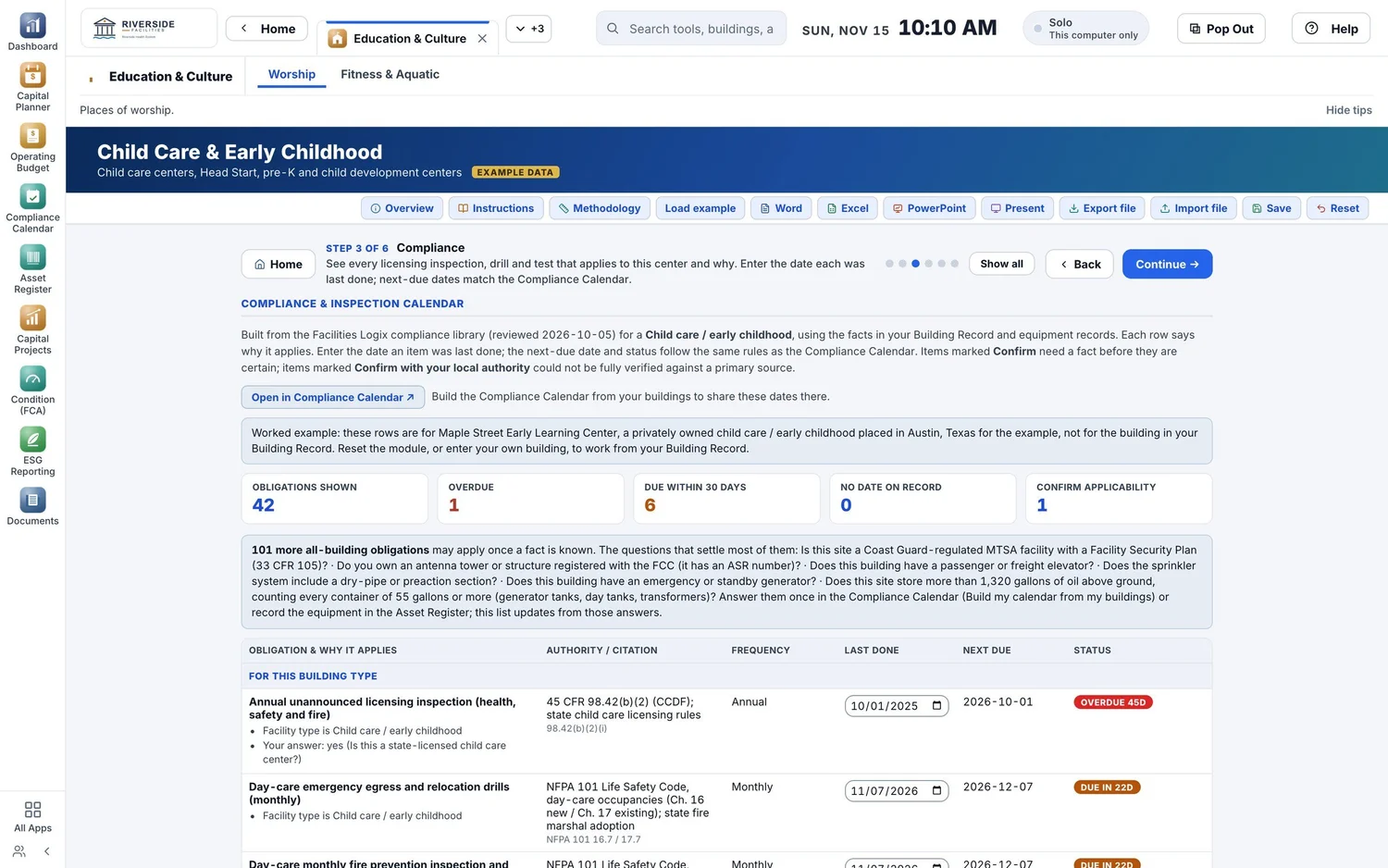
The Compliance tab lists the obligations from the compliance library that apply to the center, with the same dates as the Compliance Calendar. The program type you pick answers which ones apply.
Licensing and Program Rules
- The state licensing agency's unannounced inspection at least once a year for licensed providers, covering health, safety and fire (Child Care and Development Fund rule, 45 CFR 98.42)
- Head Start and Early Head Start: lead in water and paint tested and inspected at least every 2 years where lead may exist (45 CFR 1302.47), and the annual self-assessment that includes facility health and safety (45 CFR 1302.102)
- Military child development centers: at least four unannounced inspections a year, at least one by the installation and one by the major command (10 U.S.C. 1794 and DoD Instruction 6060.02), and a monthly food sanitation inspection where the center serves preschool children and has a kitchen (Tri-Service Food Code)
Life Safety for Day-Care Occupancies (NFPA 101)
- Emergency egress and relocation drills at least monthly with all occupants; centers not open year-round add a drill in the first 30 days of operation
- A monthly fire prevention inspection by a trained senior staff member, with the latest report posted
- A daily check that every exit is clear and usable
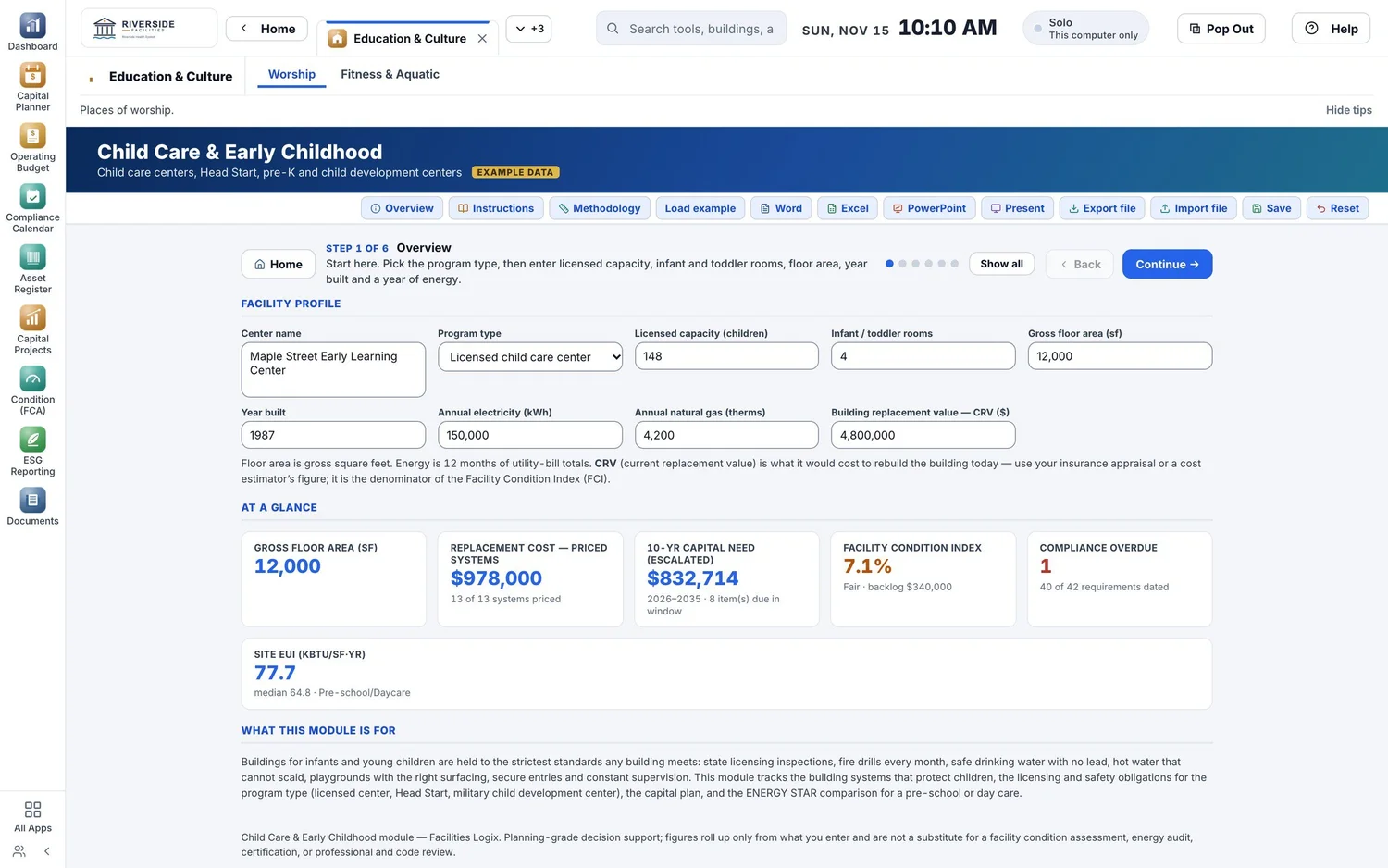
Overview in Child Care & Early Childhood: start here. Pick the program type, then enter licensed capacity, infant and toddler rooms, floor area, year built and a year of energy.
Children's Products and Play Areas
- Cribs that meet the CPSC full-size and non-full-size crib standards (16 CFR 1219 and 1220), checked at purchase and after recalls, for centers with infant rooms
- Playground inspection under the CPSC Public Playground Safety Handbook and ASTM F1487: monthly routine and annual comprehensive
Drinking Water and Radon
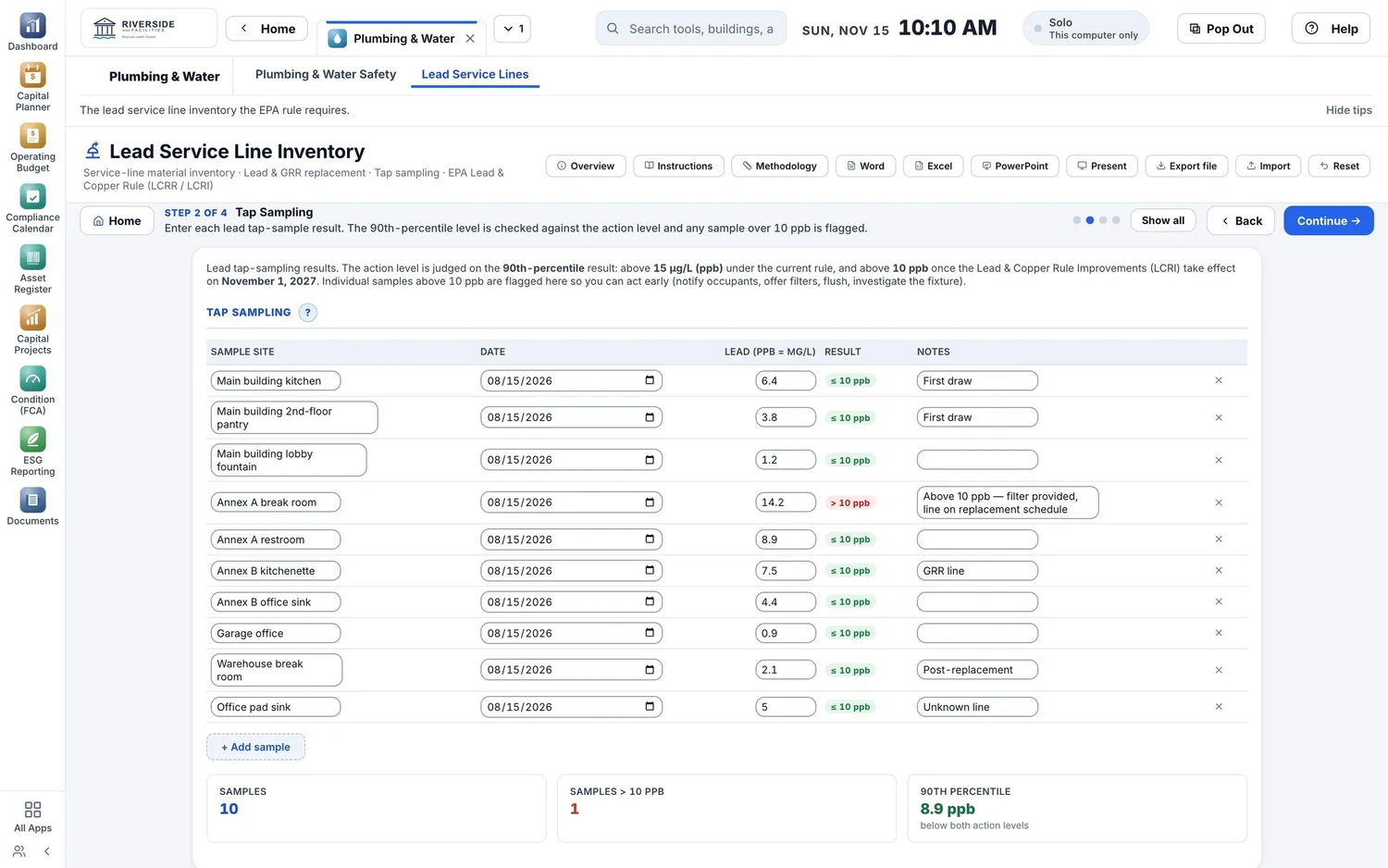
- Lead in drinking water under the EPA 3Ts program: annual program review, resampling per state law or your plan
- The Lead and Copper Rule Improvements (40 CFR 141.92): from November 1, 2027 the community water system samples at least 20% of licensed child care facilities each year for 5 years, 2 samples per facility, and the center cooperates
- Illinois only: radon testing of licensed early care and education facilities at least once every 3 years (225 ILCS 10/5.8)
- Illinois only: lead-in-water testing for licensed facilities built on or before January 1, 2000 that serve children under 6, with action above 2.0 ppb (225 ILCS 10/5.9)
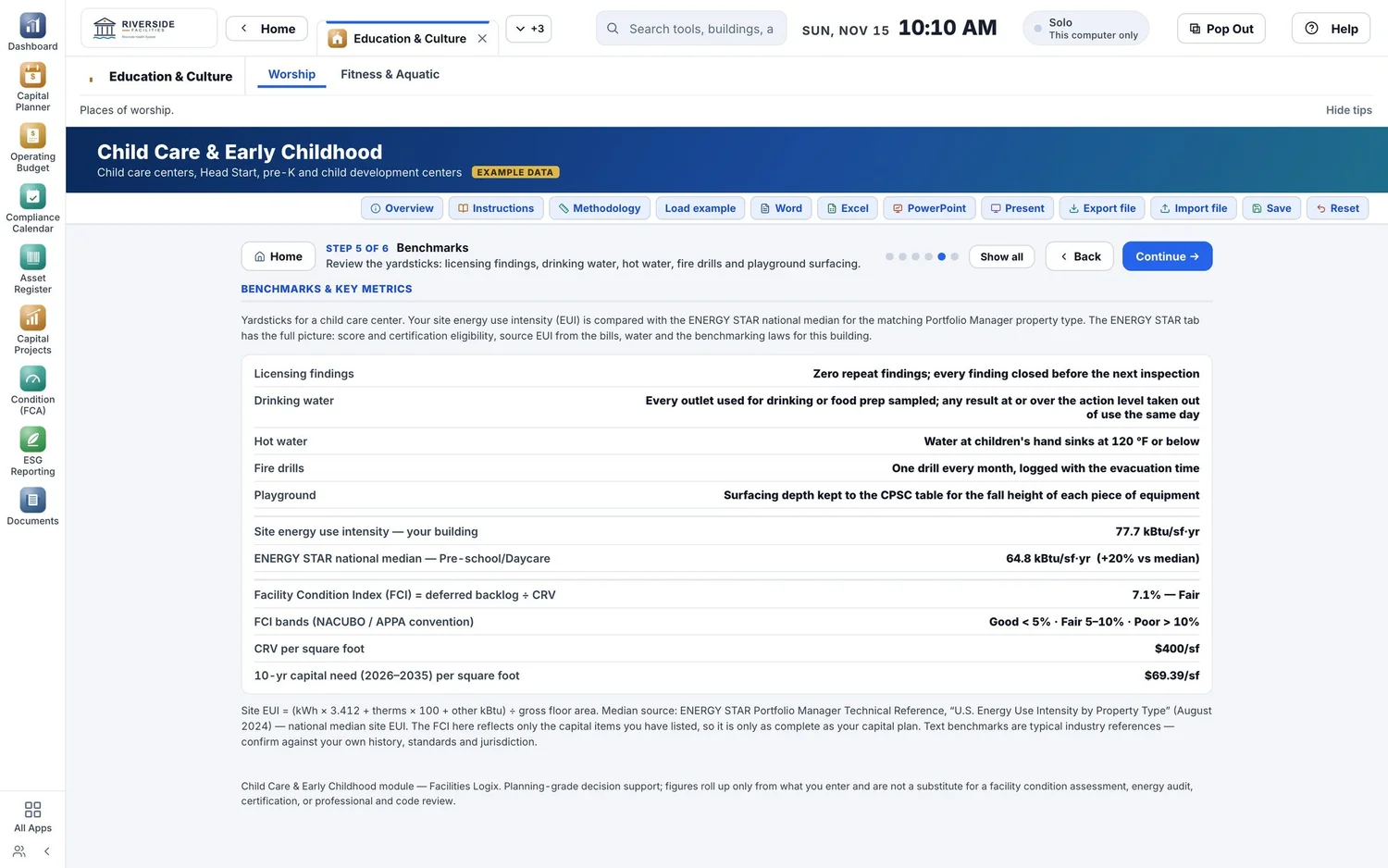
Benchmarks in Child Care & Early Childhood: review the yardsticks: licensing findings, drinking water, hot water, fire drills and playground surfacing.
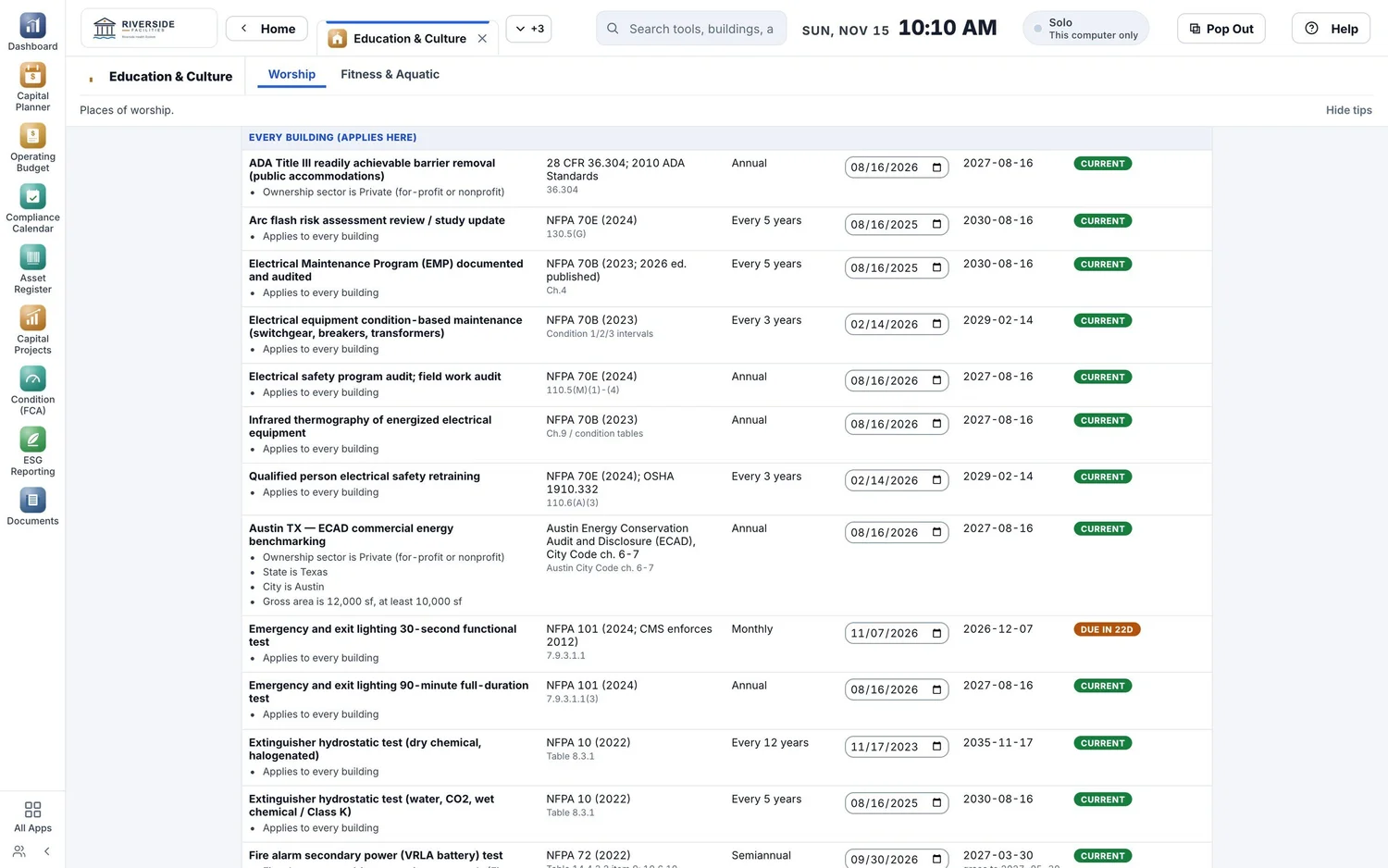
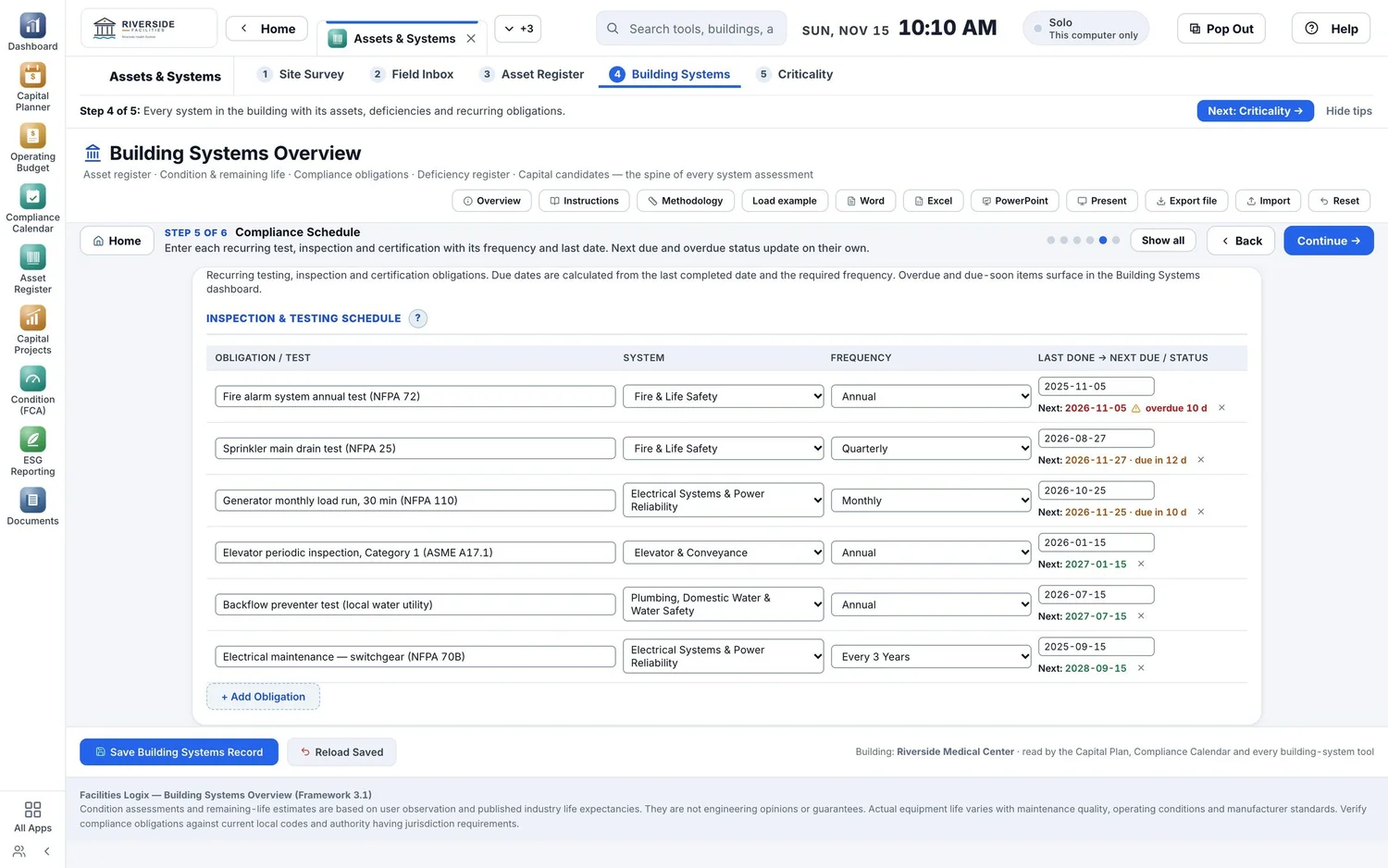
Compliance in Child Care & Early Childhood: see every licensing inspection, drill and test that applies to this center and why. Enter the date each was last done; next-due dates match the Compliance Calendar.
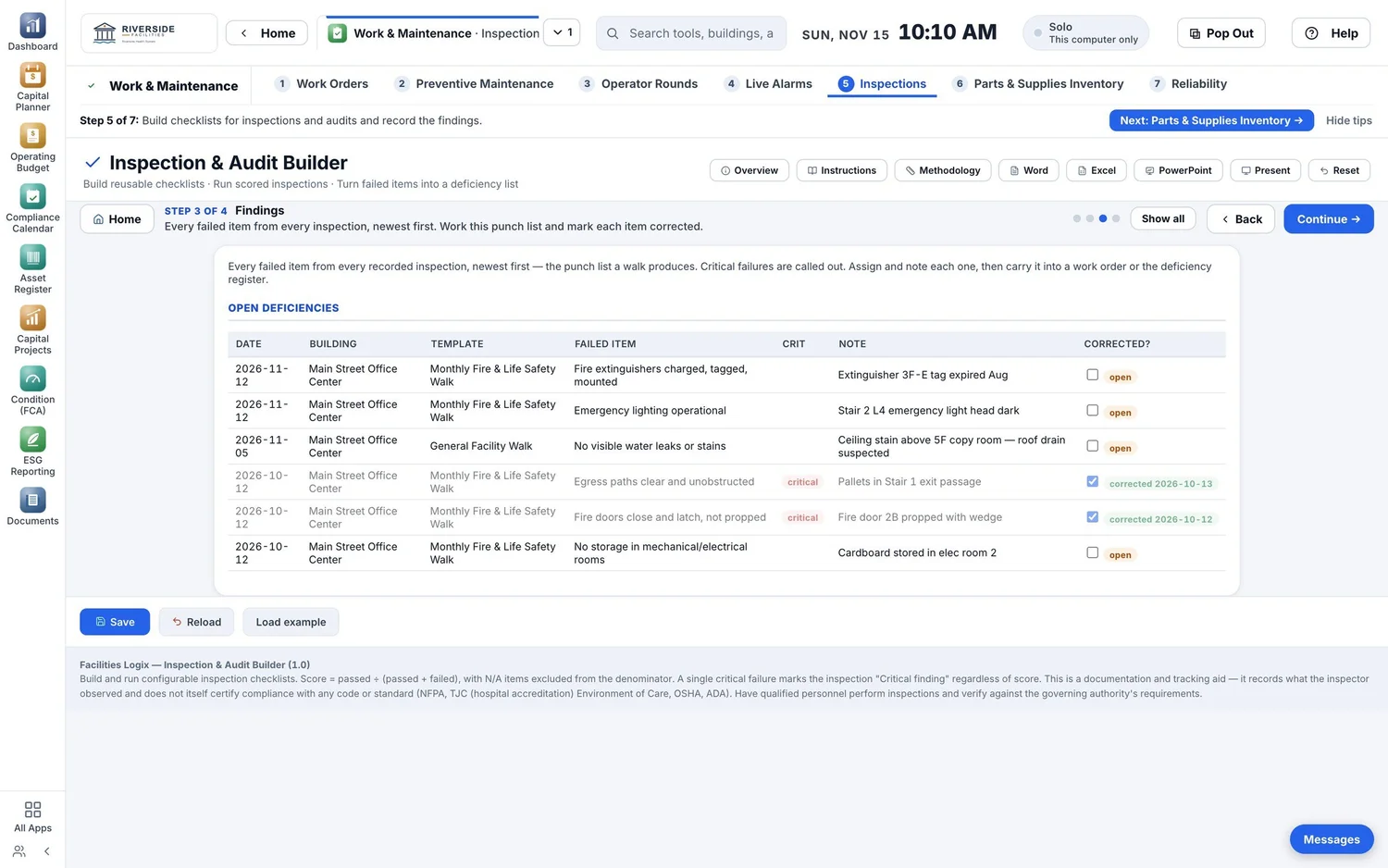
The Systems That Protect Children
The playbook starts with these systems and editable maintenance cadences. It carries no labor hours or costs. Your team rates each one, enters quantities and replacement costs, and edits the list to fit the center.
Starting Systems and PM Cadence
- HVAC and ventilation for high occupant density: quarterly
- Hot water tempering (anti-scald), with hand sinks at 120 °F or below: quarterly
- Drinking water outlets and filters, with lead sampling: quarterly
- Playground equipment and surfacing: monthly
- Fire alarm, sprinklers and smoke alarms: annual
- Emergency lighting and exit signs: monthly
- Kitchen and food preparation: quarterly
- Diapering and handwashing plumbing: quarterly
- Secure entry, access control and visitor management: quarterly
- Fencing and gates: monthly
- Window fall protection and safety glazing: annual
- Radon mitigation system, where installed: annual
- Roofing and envelope: annual
Program Types
- Licensed child care center
- Head Start or Early Head Start
- Pre-K or preschool
- Military child development center
- School-age or after-school program
- Faith-based or license-exempt center
- The type answers whether the licensing and Head Start rows apply, so a license-exempt center does not get the licensing inspection and a Head Start grantee gets the Head Start rows
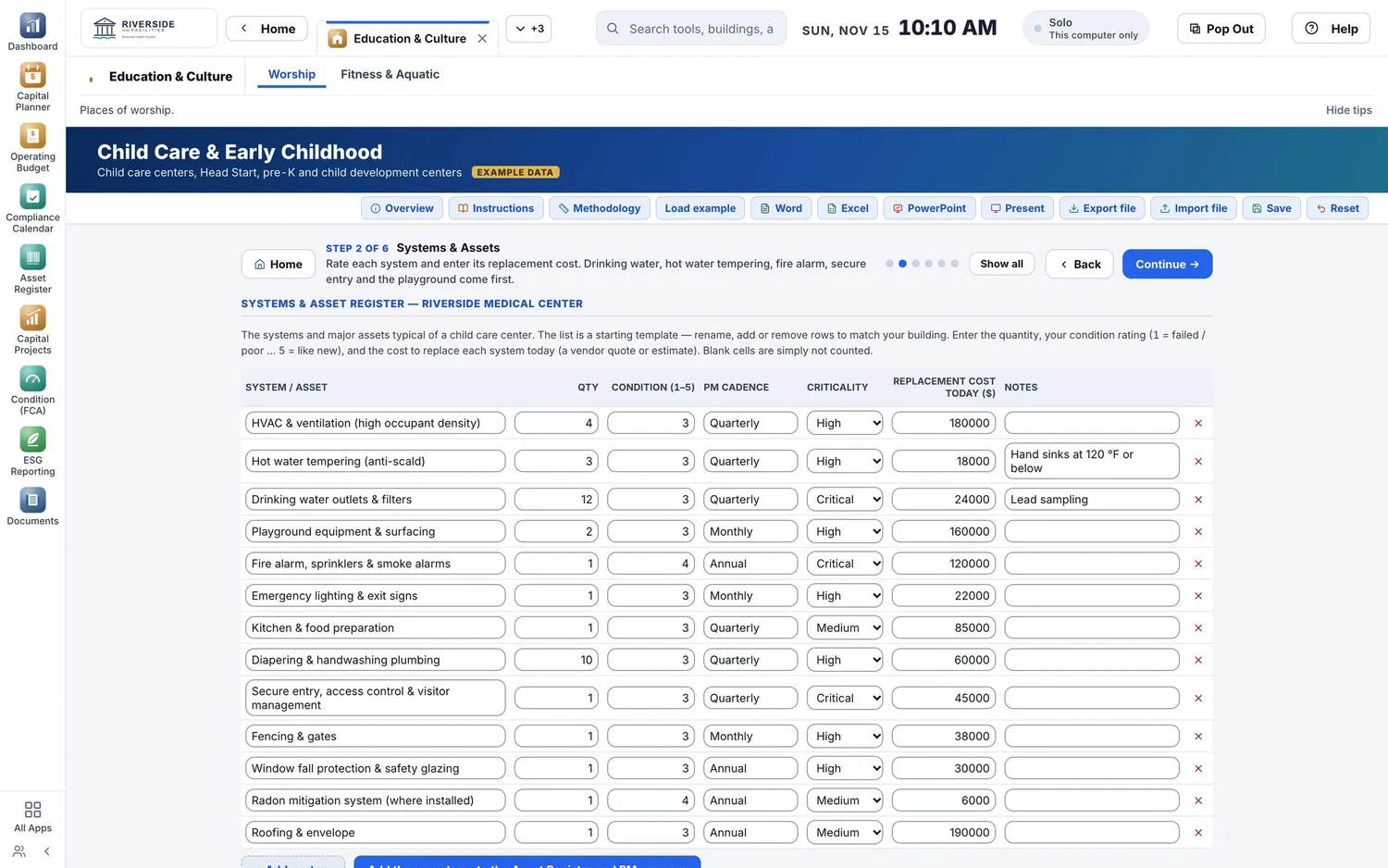
Systems & Assets in Child Care & Early Childhood: rate each system and enter its replacement cost. Drinking water, hot water tempering, fire alarm, secure entry and the playground come first.
Center Profile
- Licensed capacity, infant and toddler rooms, floor area, year built and a year of electricity and gas
- Capital lines to start from: HVAC, playground equipment and surfacing, water heaters and mixing valves, fire alarm, access control and intercom, roof, classroom flooring and kitchen equipment
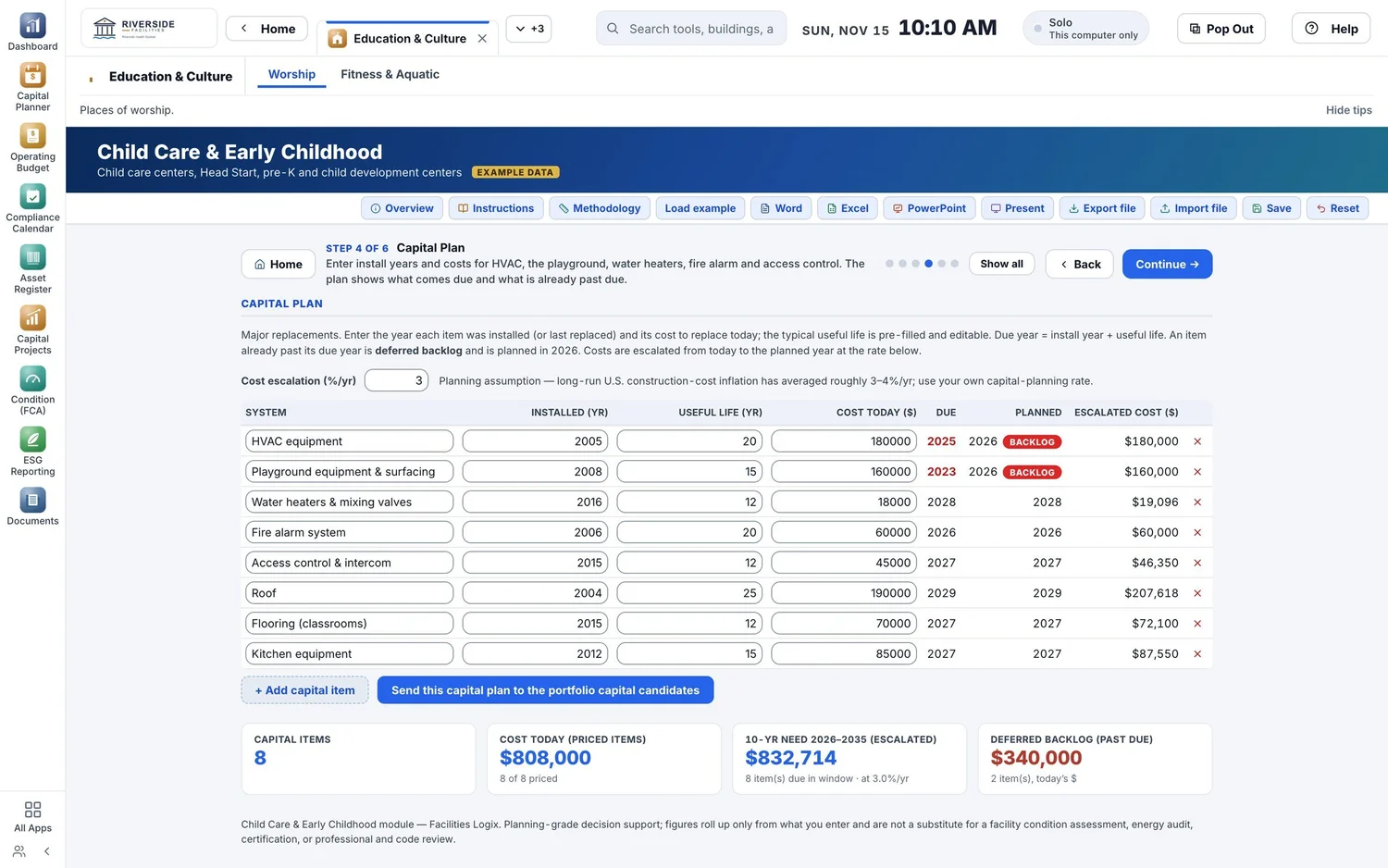
Capital Plan in Child Care & Early Childhood: enter install years and costs for HVAC, the playground, water heaters, fire alarm and access control. The plan shows what comes due and what is already past due.
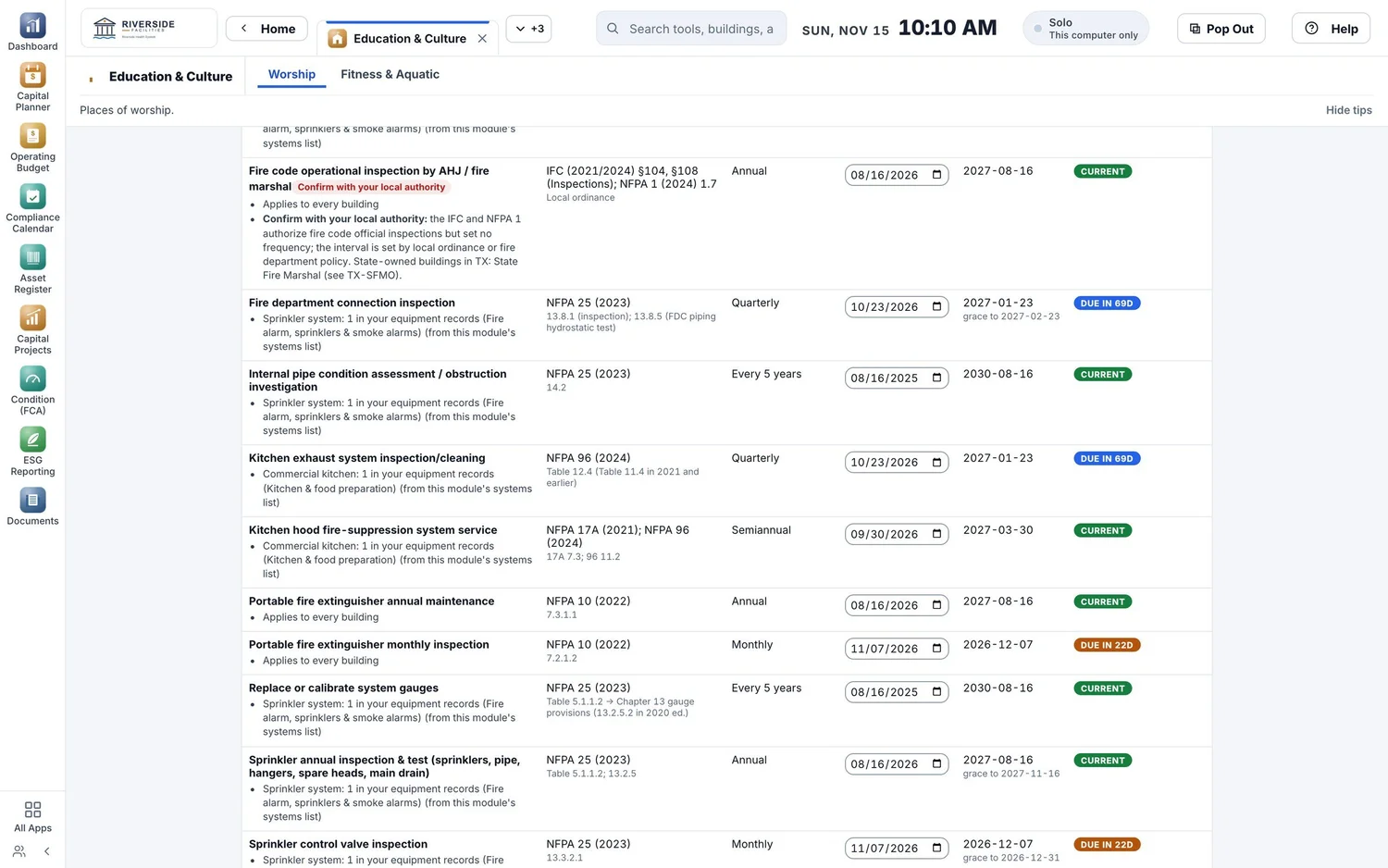
Compliance in Child Care & Early Childhood: see every licensing inspection, drill and test that applies to this center and why. Enter the date each was last done; next-due dates match the Compliance Calendar.
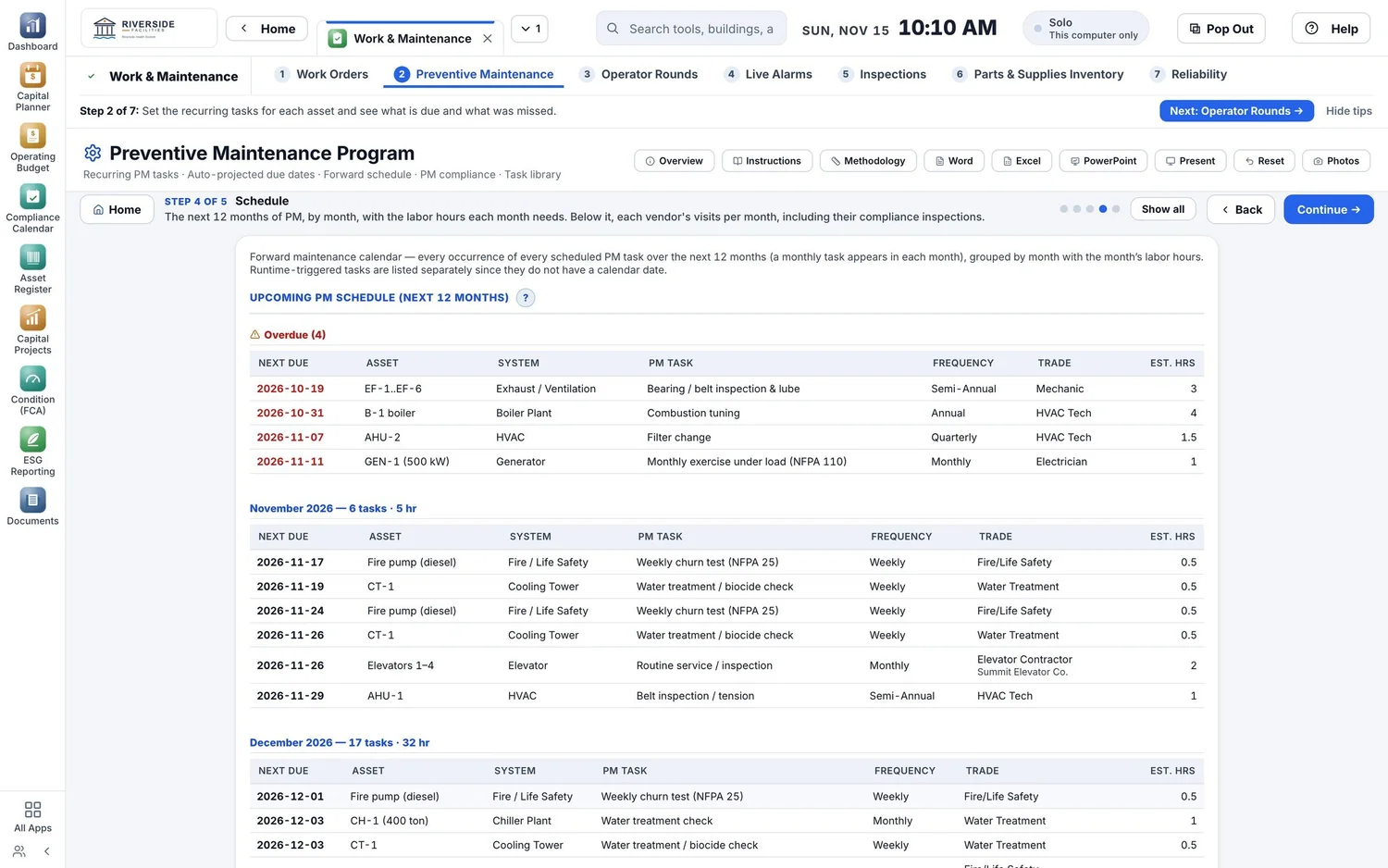
The Checks That Happen Every Month
The Playbook's Starting Checklist
- State licensing inspection: annual
- Fire drill under NFPA 101 for a day-care occupancy: monthly
- Playground inspection: monthly
- Drinking water lead sampling under state law and the EPA 3Ts: annual
- Hot water temperature check, to your organization's standard (Caring for Our Children): monthly
- Fire alarm and sprinkler inspection under NFPA 72 and NFPA 25: annual
- Dates start blank; your team enters the last time each was done
Building-Wide Rows That Also Apply
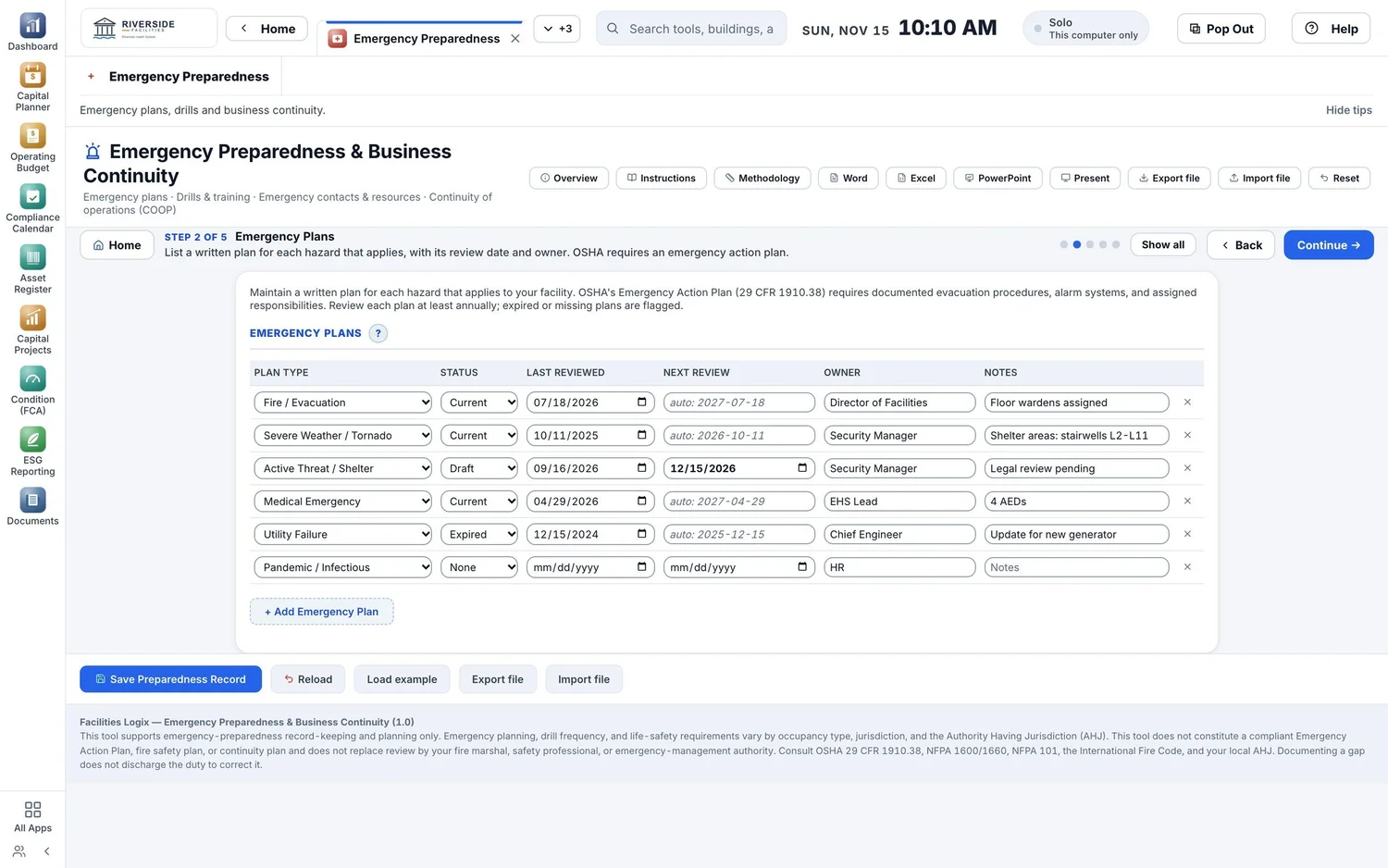
- Fire alarm, sprinkler, extinguisher and emergency lighting inspections from the compliance library apply to the center as they do to every building
- A commercial kitchen adds its hood suppression service and exhaust cleaning rows, and a backflow assembly adds its test
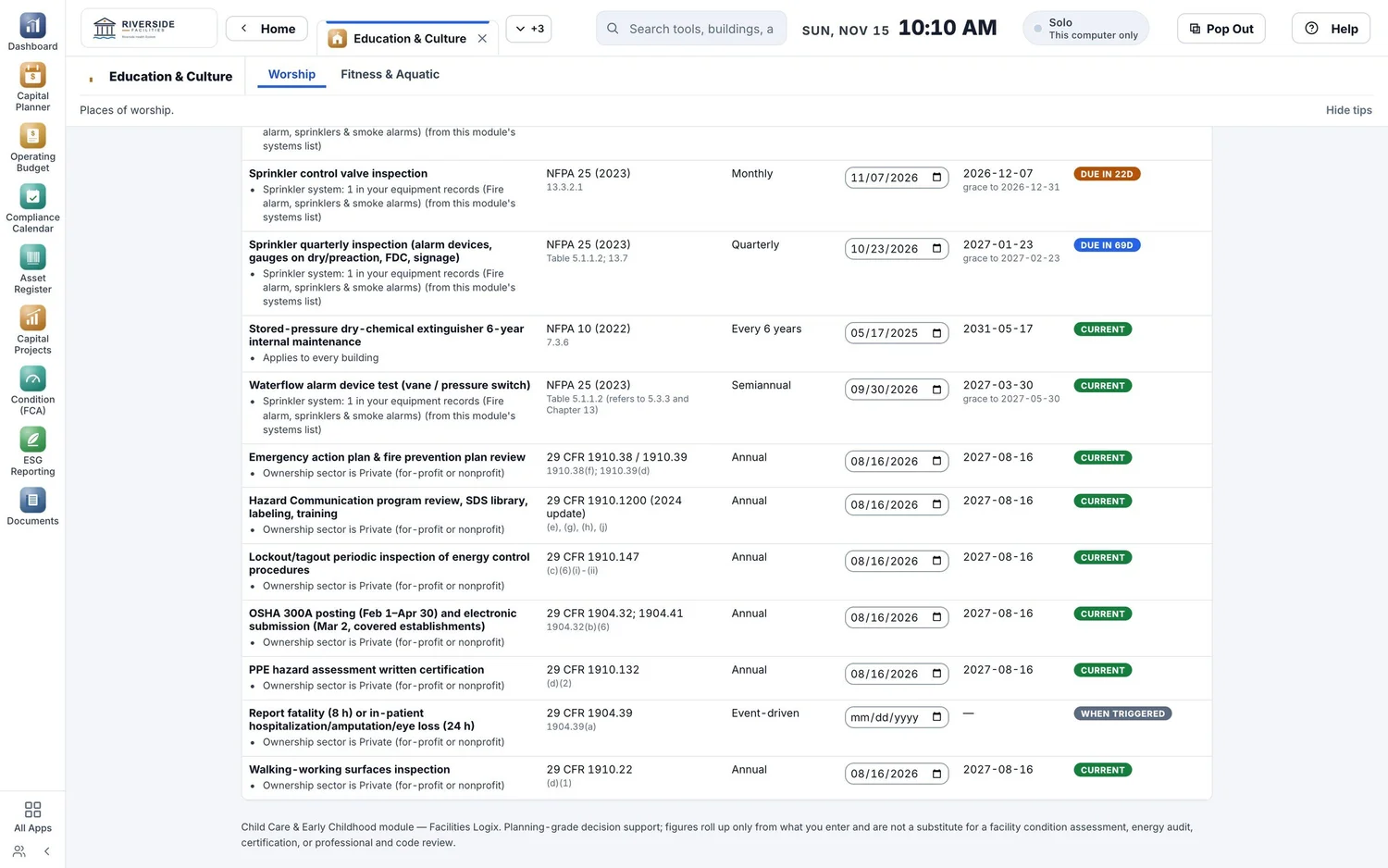
Compliance in Child Care & Early Childhood: see every licensing inspection, drill and test that applies to this center and why. Enter the date each was last done; next-due dates match the Compliance Calendar.
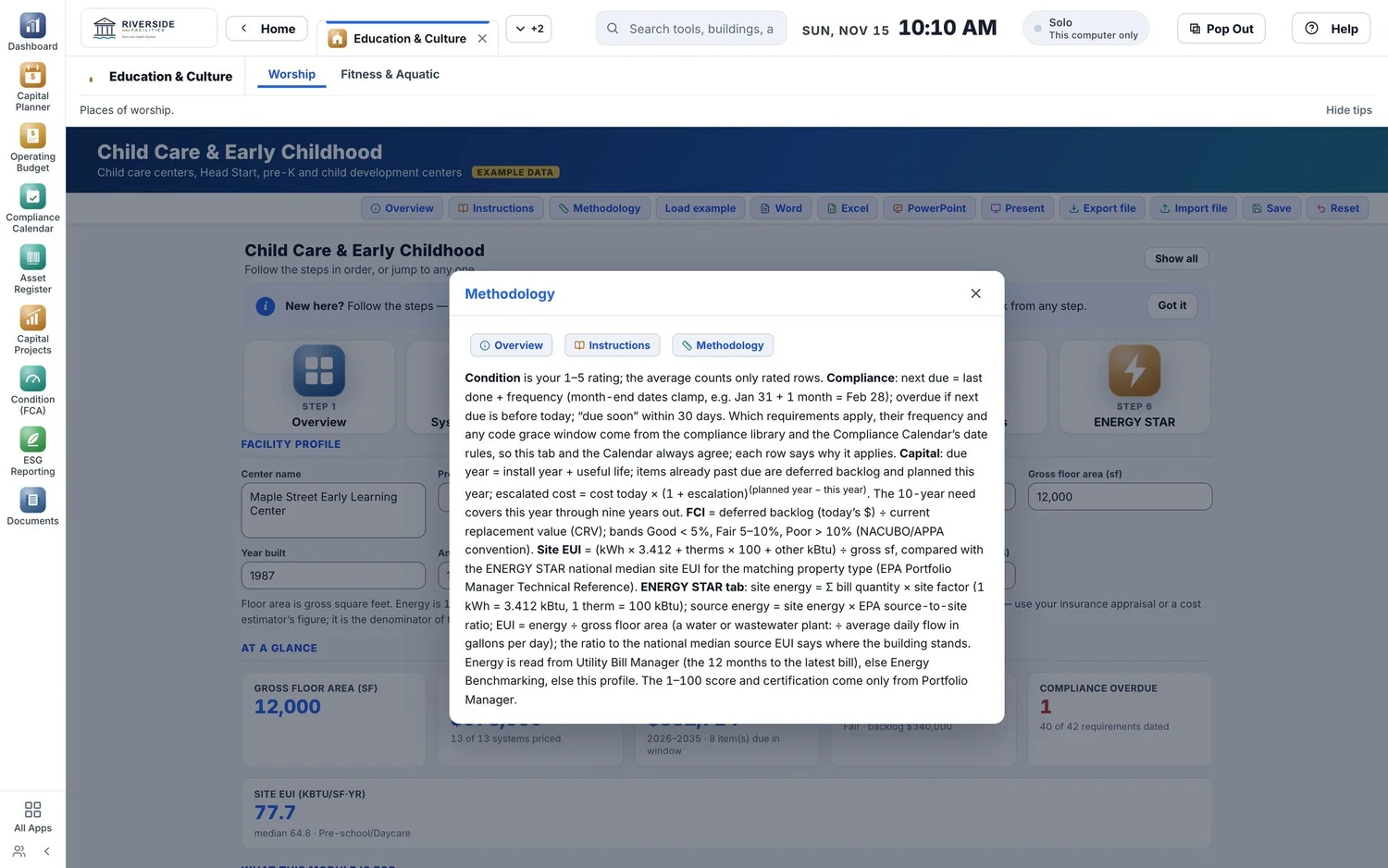
Methodology in Child Care & Early Childhood: the formulas and standards behind every number.
Ready Before the Licensing Visit
Compliance Tab
Every licensing inspection, drill and test that applies to the center and why, with the date last done and the next due date, matching the Compliance Calendar.
Learn MoreReports
A Facility Profile report in Word, a workbook in Excel and a deck in PowerPoint, plus a full-screen Present mode.
Learn MoreShow Less
A packet that assembles itself saves the director hours of copying records before a board or funder meeting, and it puts the capital need in front of the people who pay for it.
- Opens with plain sentences: systems priced, 10-year capital need escalated, and backlog past useful life
- Facility Condition Index against replacement value: Good under 5%, Fair 5-10%, Poor over 10%
- Charts of capital need by year, deferred backlog by system and compliance status
- A compliance table with last done, next due and status for every requirement
- Exports from the worked example carry a SAMPLE watermark
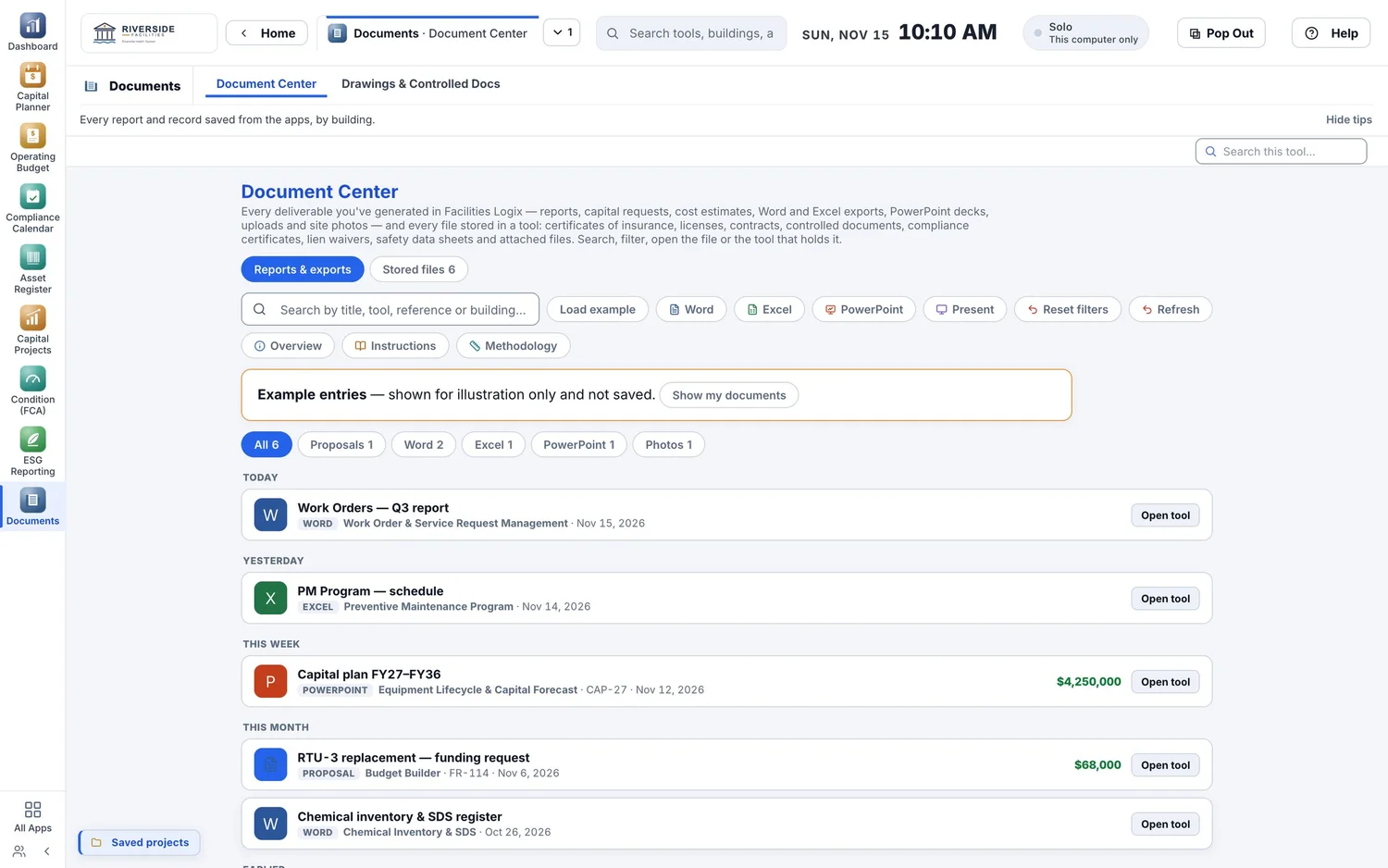
Every report the program makes is kept in one Document Center, grouped by building.
ENERGY STAR Tab
Pre-schools and day cares compare with their ENERGY STAR national median from their own bills. Portfolio Manager gives this property type no 1-100 score.
Learn MoreShow Less
Without a 1-100 score, the comparison with the median is how a center learns whether its utility bills are high for its size, before it spends on upgrades.
- National pre-school and day care median: 64.8 kBtu per square foot site, 131.5 source
- Water use per square foot against the 10.84 gallon national median
- Energy comes from Utility Bill Manager's latest 12 months, so nobody retypes totals
- Lists the benchmarking laws from the library that apply to the building
Capital Plan
Install years and costs for HVAC, the playground, water heaters, the fire alarm and access control show what comes due and what is already past due.
Learn More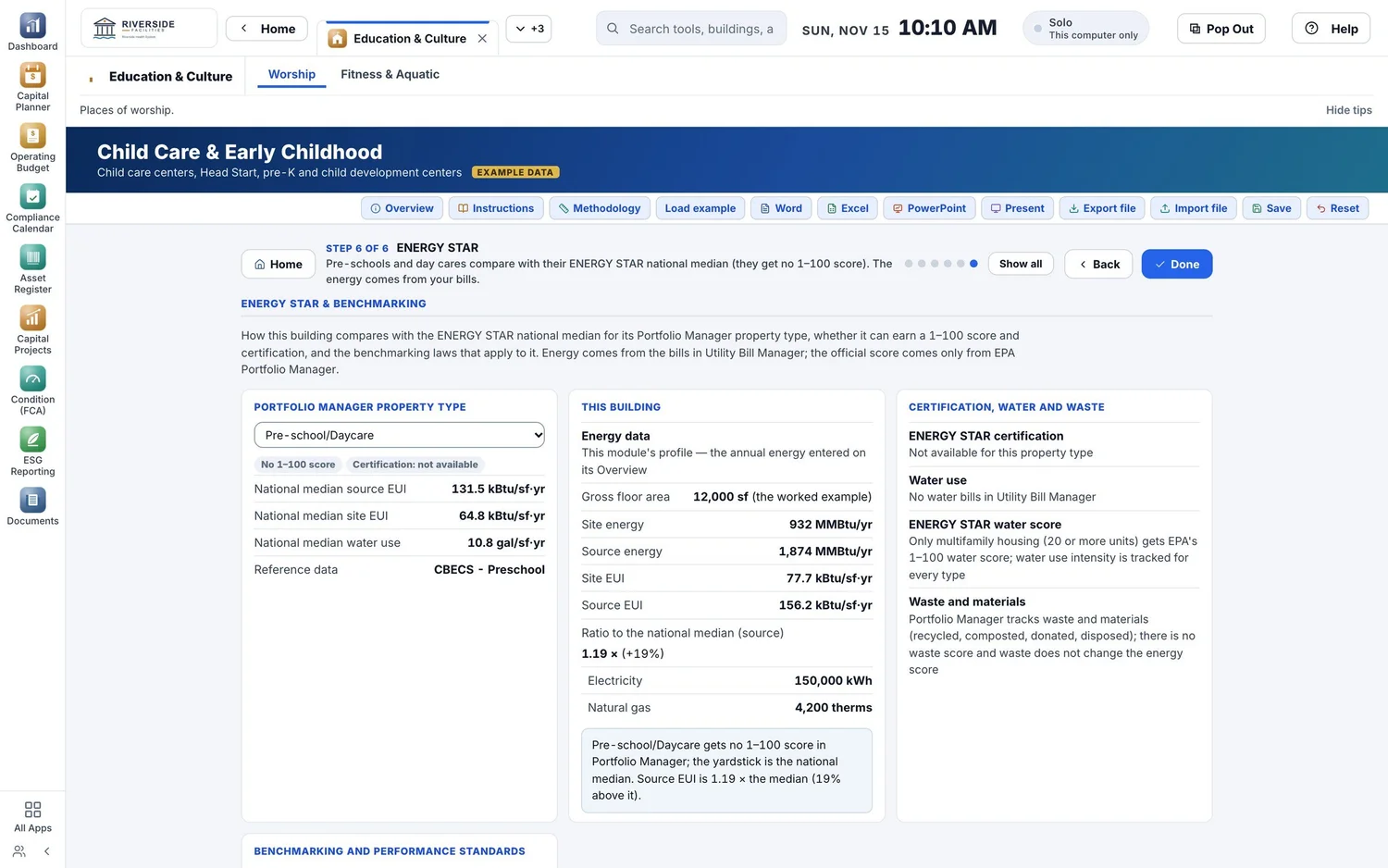
ENERGY STAR in Child Care & Early Childhood: pre-schools and day cares compare with their ENERGY STAR national median (they get no 1–100 score). The energy comes from your bills.
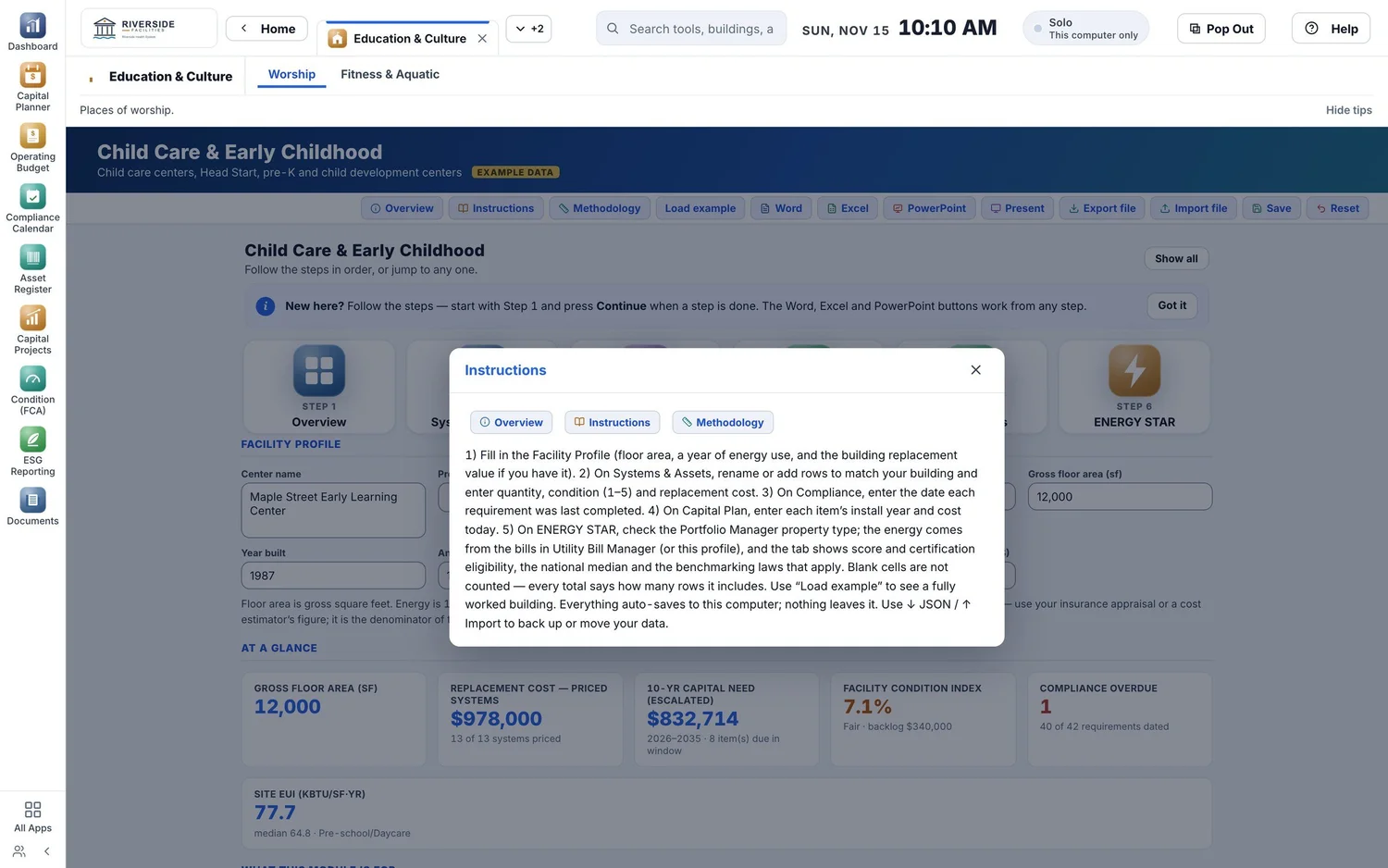
Instructions in Child Care & Early Childhood: how to work through it, step by step.
The Yardsticks
The Benchmarks tab carries these targets for a child care center.
Licensing Findings
Zero repeat findings, and every finding closed before the next inspection.
Learn MoreShow Less
A repeat finding puts the license, and the enrollment and subsidy income behind it, at risk. Closing each finding on record protects that income.
- The licensing row applies when the program type is a licensed center or Head Start grantee
- The library names the evidence to keep: inspection report and corrective action record
- Each Compliance Calendar row holds the document, date, signer, vendor and the file itself
- A date entered in the playbook also updates the Compliance Calendar
Drinking Water
Every outlet used for drinking or food preparation sampled, and any result at or over the action level taken out of use the same day.
Learn MoreShow Less
Sampling on schedule finds a problem outlet while the fix is one fixture or filter, not a rushed center-wide remediation after an outside test.
- Drinking water outlets and filters rated Critical, with a quarterly PM carrying a lead-sampling note
- EPA 3Ts row evidence: the outlet inventory, results and notices
- Head Start rows keep the lead plan, water and paint test reports and remediation records
- Publishing sends the outlets to the Asset Register and PM program as scheduled tasks
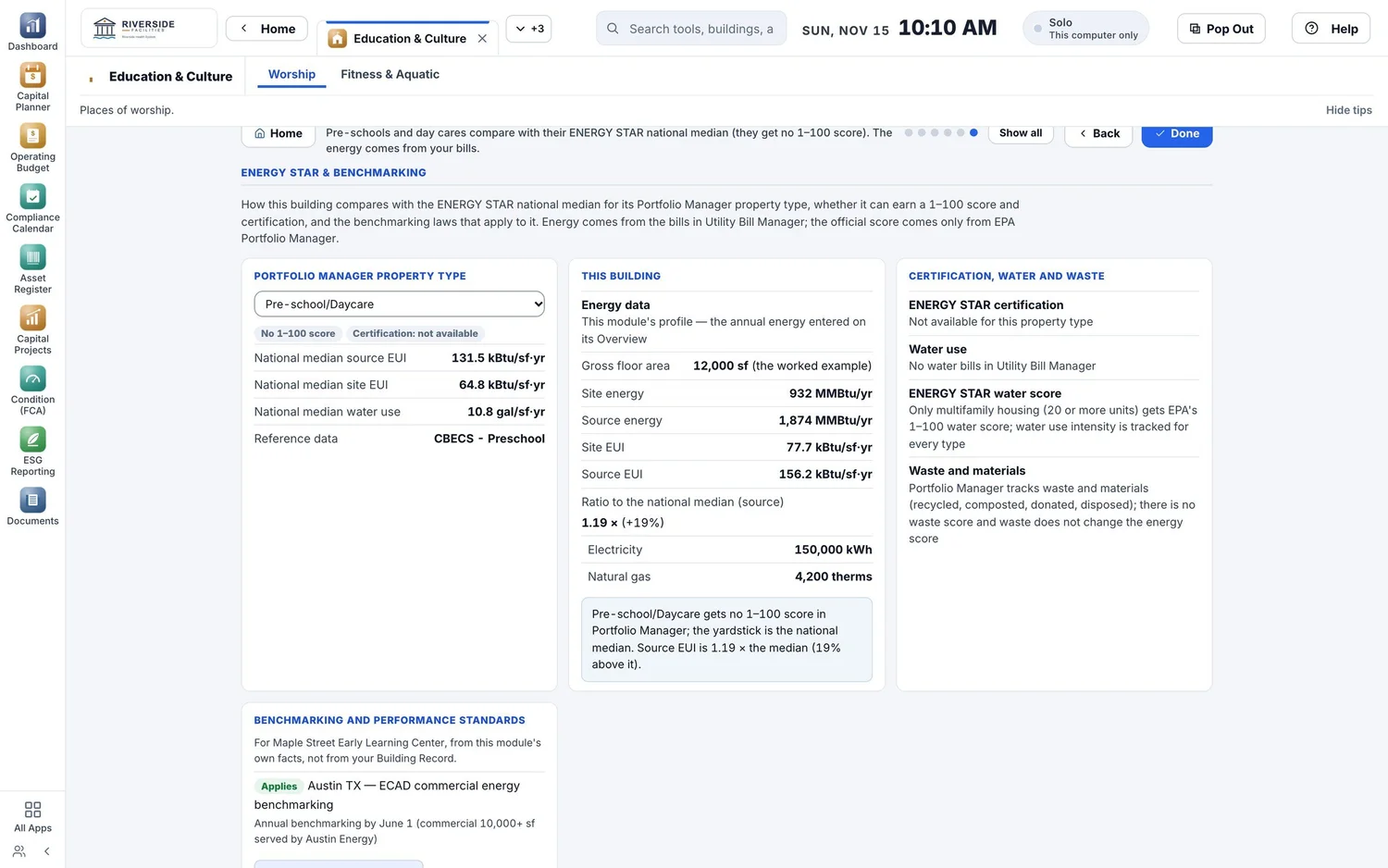
ENERGY STAR in Child Care & Early Childhood: pre-schools and day cares compare with their ENERGY STAR national median (they get no 1–100 score). The energy comes from your bills.
Hot Water
Water at children's hand sinks at 120 °F or below.
Learn MoreShow Less
Replacing a worn mixing valve is a small scheduled expense; a scald injury at a hand sink is a liability no center wants. Tracking the valves keeps the money on the valve.
- Hot water tempering (anti-scald) rated High, with a quarterly PM
- A monthly temperature check row, set to your organization's standard (Caring for Our Children)
- Water heaters and mixing valves start with a 12-year life in the capital plan, editable
- An item past its due year counts as deferred backlog and goes into this year
Fire Drills
One drill every month, logged with the evacuation time.
Learn MoreShow Less
A missed drill is a finding that costs nothing to prevent but a date someone remembers. The playbook remembers it.
- Next due = last drill + one month, clamped to month-end (Jan 31 to Feb 28)
- A drill past its date shows as overdue on the Compliance tab and the Calendar
- The library names the drill log as the evidence to keep
- The report counts requirements overdue, due soon and still without a date
Playground
Surfacing depth kept to the CPSC table for the fall height of each piece of equipment.
Learn MoreShow Less
Topping up surfacing on schedule is routine upkeep; letting it wear down invites fall injuries and an early replacement of the whole play area.
- Playground equipment and surfacing on a monthly PM, rated High
- Monthly routine inspection plus the annual comprehensive one by a certified playground safety inspector
- The inspection report is the evidence the library asks you to keep
- A capital line for equipment and surfacing starts with a 15-year life
Time Back for the People Caring for Children
No Scramble Before a Visit
Drills, inspections, water results and crib records are already dated and in one place when the licensing inspector arrives unannounced.
Learn MoreShow Less
Hours spent hunting for drill logs and test reports before a visit are hours taken from children. Here the records are already filed against each obligation.
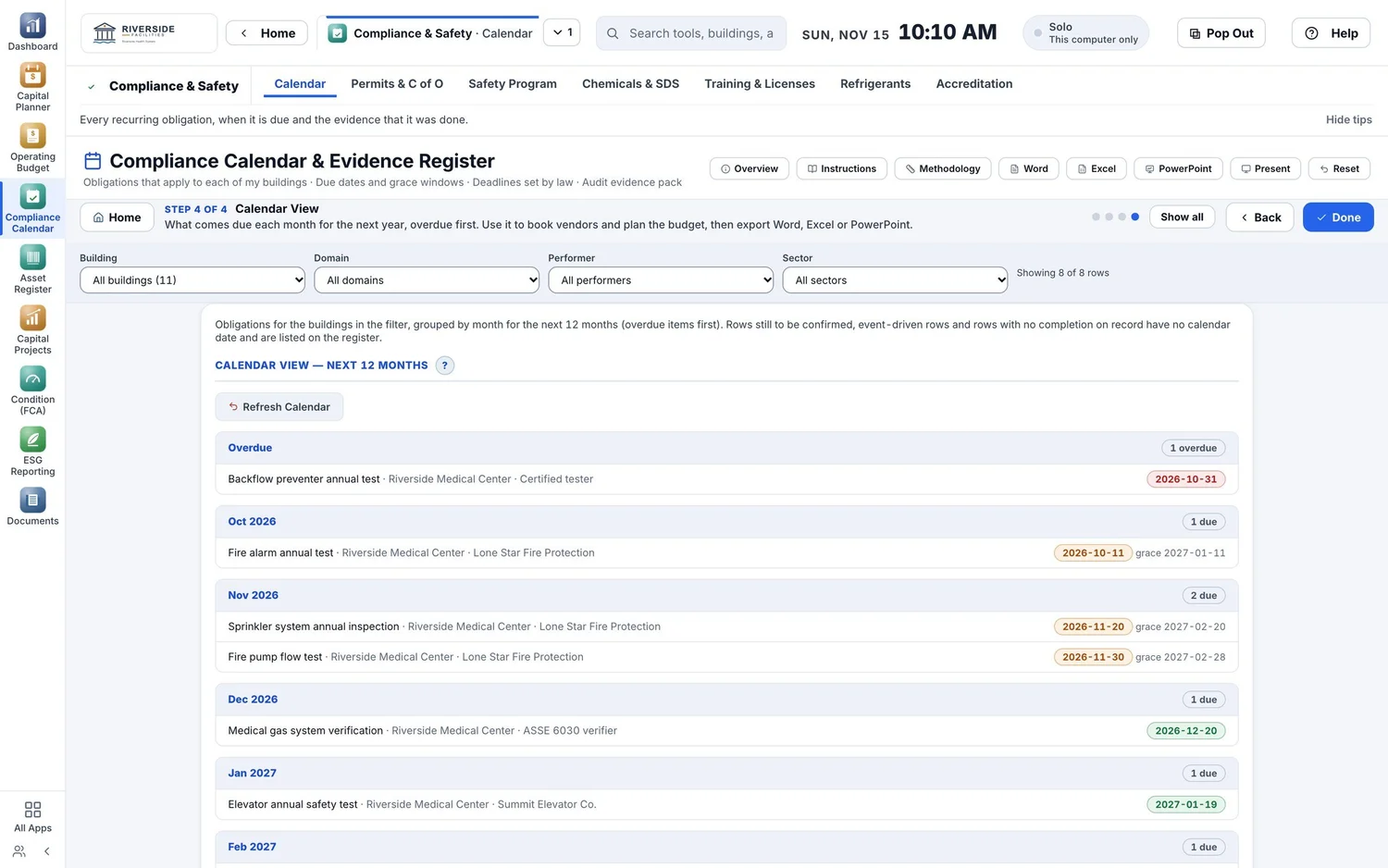
- Each Compliance Calendar row can hold the report file, its date, signer and vendor
- Rows say who performs the work and what evidence is required
- Mark evidence on file as yes, no or partial for each obligation
- The Word report prints the compliance calendar with last done, next due and status
Nothing Quietly Lapses
Every obligation shows its next due date, so a missed monthly drill or a two-year Head Start lead test shows up before it becomes a finding.
Learn MoreShow Less
A lapse caught a month early is a scheduled task; caught by an inspector, it is a finding. Due dates are worked out for you.
- Next due = last done + frequency; weekly and daily rows count in days
- Fire alarm and sprinkler rows stay current through the code's grace window, up to 15 months for annual
- A date entered in the playbook writes back to the Compliance Calendar
- Rows waiting on a missing fact list the question that settles them
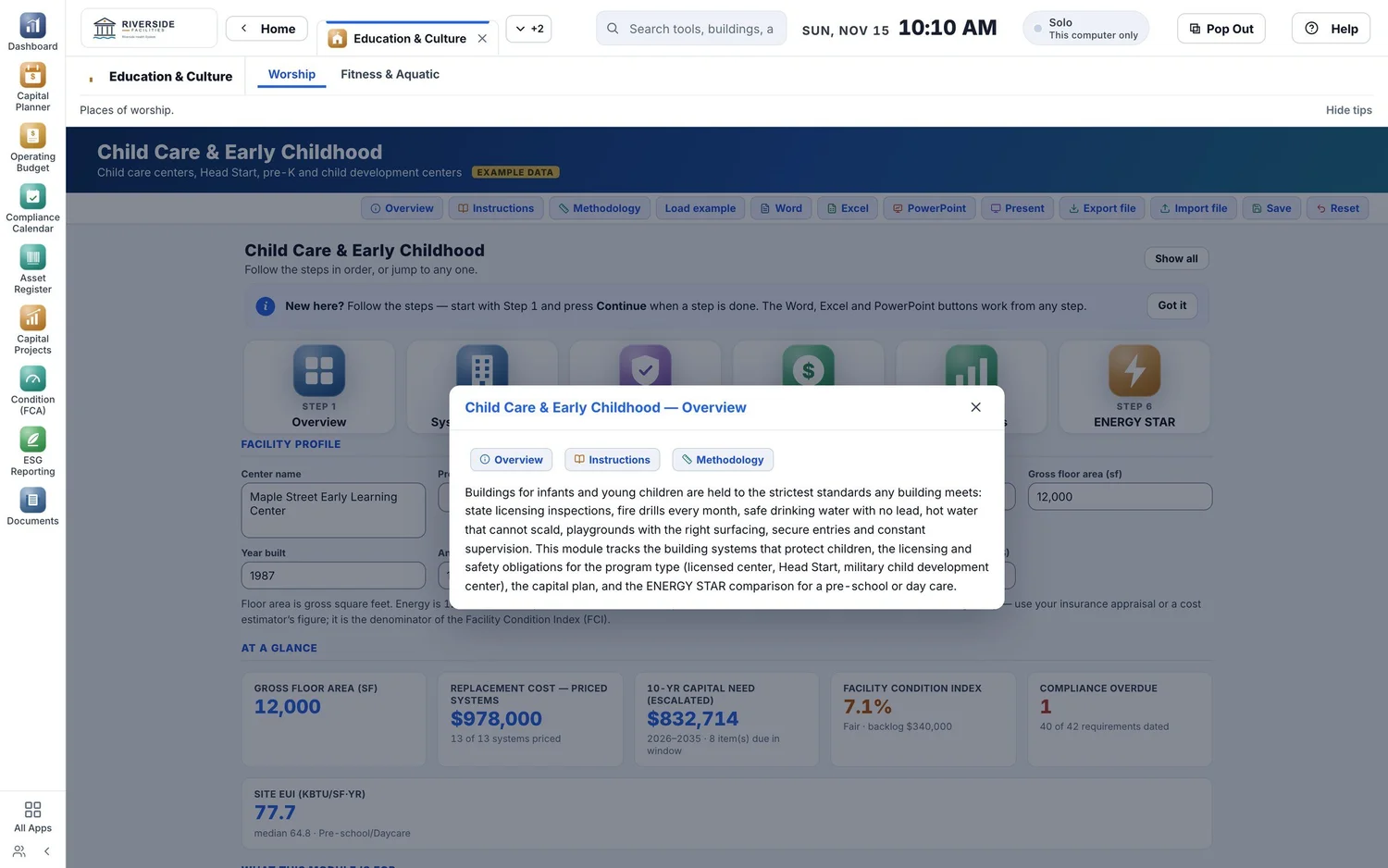
Overview in Child Care & Early Childhood: its scope, why it matters and who uses it.
One Record for Many Centers
An organization running several centers sees every one on the same calendar and capital plan.
Learn MoreShow Less
Seeing every center's backlog side by side lets the organization spend capital where the need is greatest, not center by center as requests arrive.
- Send the capital plan to portfolio capital candidates: dated, priced items move to portfolio planning
- Items missing an install year, life or cost are listed as not sent
- Systems publish to the Asset Register and PM program, tagged to each center
- Compliance dates are kept per building, so each center has its own rows
Frequently Asked Questions
Does it handle Head Start rules?
What about a military child development center?
Are the state rules for every state?
Does Facilities Logix replace the licensing inspection?
Be First When Facilities Logix Opens
Stop chasing building records across spreadsheets and binders. Join the list and we will tell you the day downloads open, with setup guides ready.
Launching early 2027 for Facilities Logix. Nothing to buy today, and no sales calls.
