


A surgery center, a dialysis unit and a veterinary hospital share a parking lot but not a rulebook. The Clinic & Outpatient playbook asks what kind of practice the building houses and sets which obligations apply, then tracks the clinical support systems, the capital plan and the energy comparison for that building.
Obligations by Type of Practice
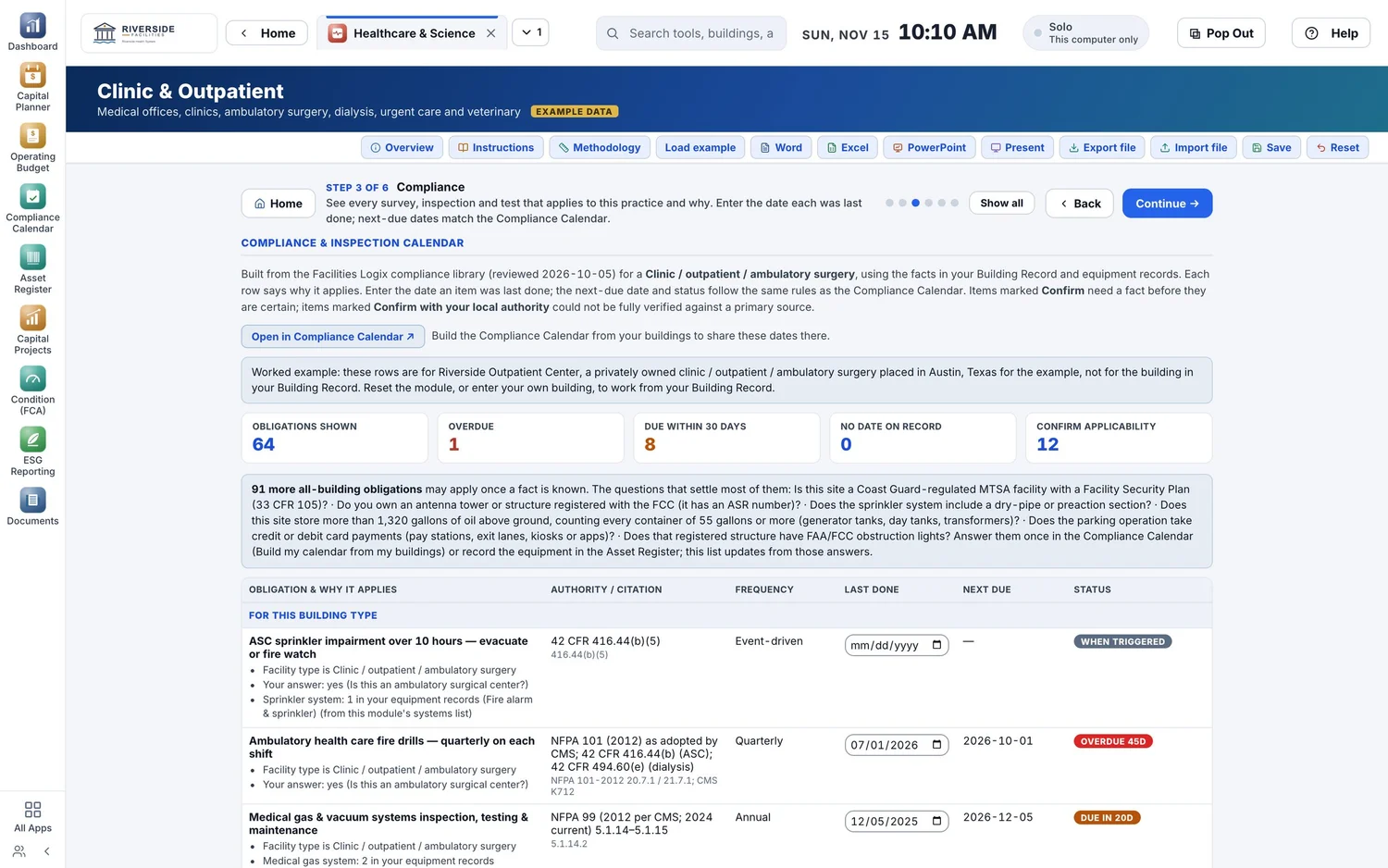
The facility type is passed to the Compliance tab as answers, so a medical office does not get a surgery center's emergency plan and a dialysis center gets its water testing. Each row carries its authority, citation and frequency, with the same dates as the Compliance Calendar.
Ambulatory Surgery Centers
- Emergency preparedness plan, policies, communication plan and training reviewed at least every 2 years (42 CFR 416.54), for centers in the Centers for Medicare & Medicaid Services (CMS) program
- The emergency plan tested at least annually: a full-scale or functional exercise every 2 years and another exercise type in the years between (42 CFR 416.54(d)(2))
- When sprinklers are out of service more than 10 hours: evacuate the affected area or set up a fire watch until service returns (42 CFR 416.44(b)(5))
- Fire drills at least quarterly on each shift, including alarm transmission (NFPA 101, 2012, ambulatory health care; 42 CFR 416.44(b))
Dialysis Centers
- Water and dialysate bacteriology and endotoxin testing at least quarterly (42 CFR 494.40, incorporating ANSI/AAMI RD52), with two carbon tanks in series and the chlorine and chloramine action levels from the rule
- Emergency plan reviewed at least every 2 years, with contact with the local emergency preparedness agency at least annually (42 CFR 494.62)
- Emergency exercises at least annually (42 CFR 494.62(d)(2))
- Fire drills quarterly on each shift (42 CFR 494.60(e) and NFPA 101)
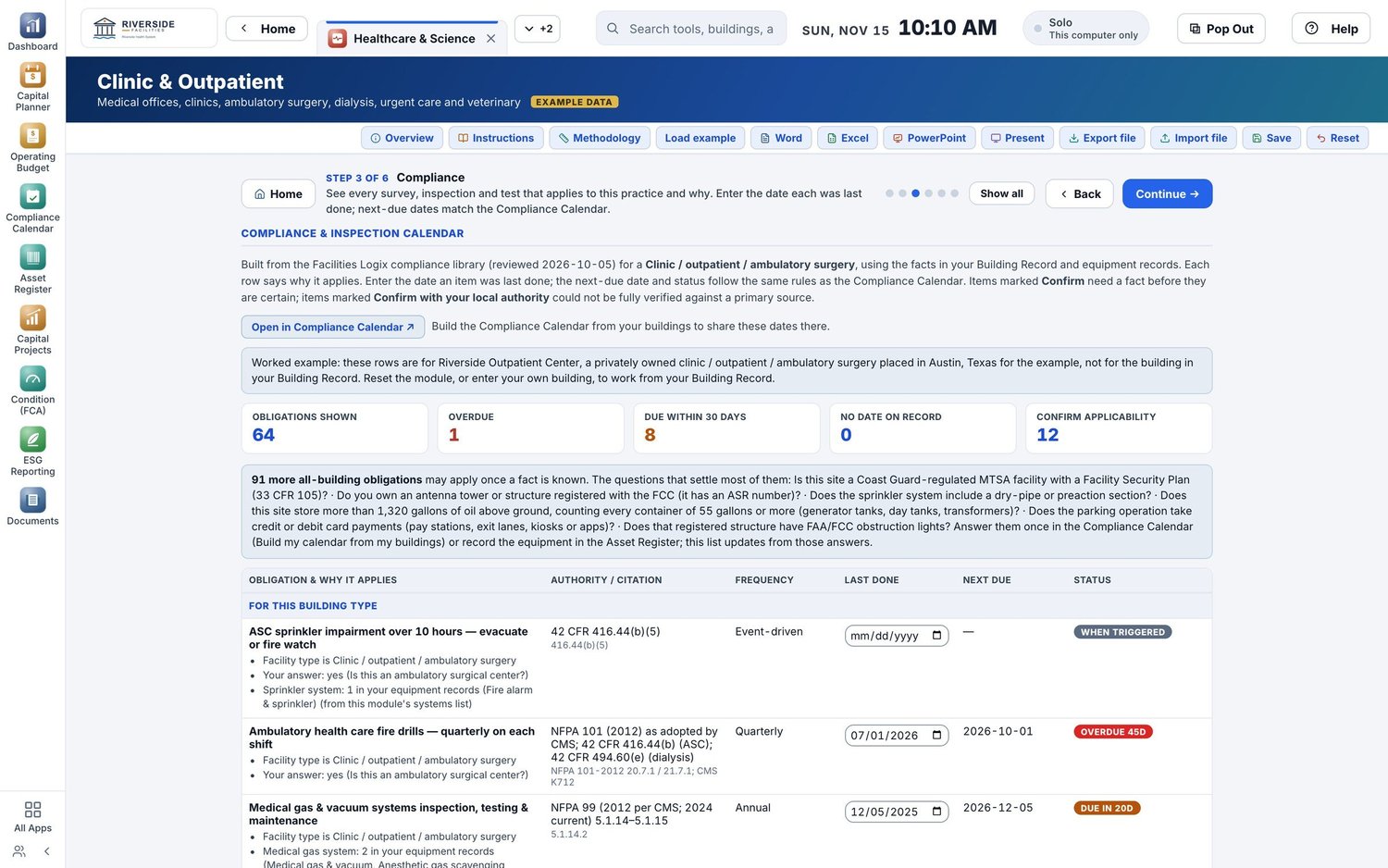
Compliance in Clinic & Outpatient: see every survey, inspection and test that applies to this practice and why. Enter the date each was last done; next-due dates match the Compliance Calendar.
Any Practice That Holds the Item
- Drug Enforcement Administration controlled-substance inventory at least every 2 years (21 CFR 1304.11) and registration renewal every 36 months (21 CFR 1301.13)
- Medical gas and vacuum inspection, testing and maintenance, annual with verification after any work (NFPA 99)
- X-ray equipment registration and performance evaluation under the state radiation control program (for example Texas, at intervals not over one year for medical x-ray and per the state table for dental units)
- Sterile compounding room certification at least every 6 months and after any change (USP General Chapter 797)
- Accreditation Association for Ambulatory Health Care (AAAHC) reaccreditation at the end of its three-year term, for accredited centers
Veterinary Practices
- The state premises permit or registration and board inspection, flagged Confirm because it varies by state
- Controlled-substance and x-ray rows as above
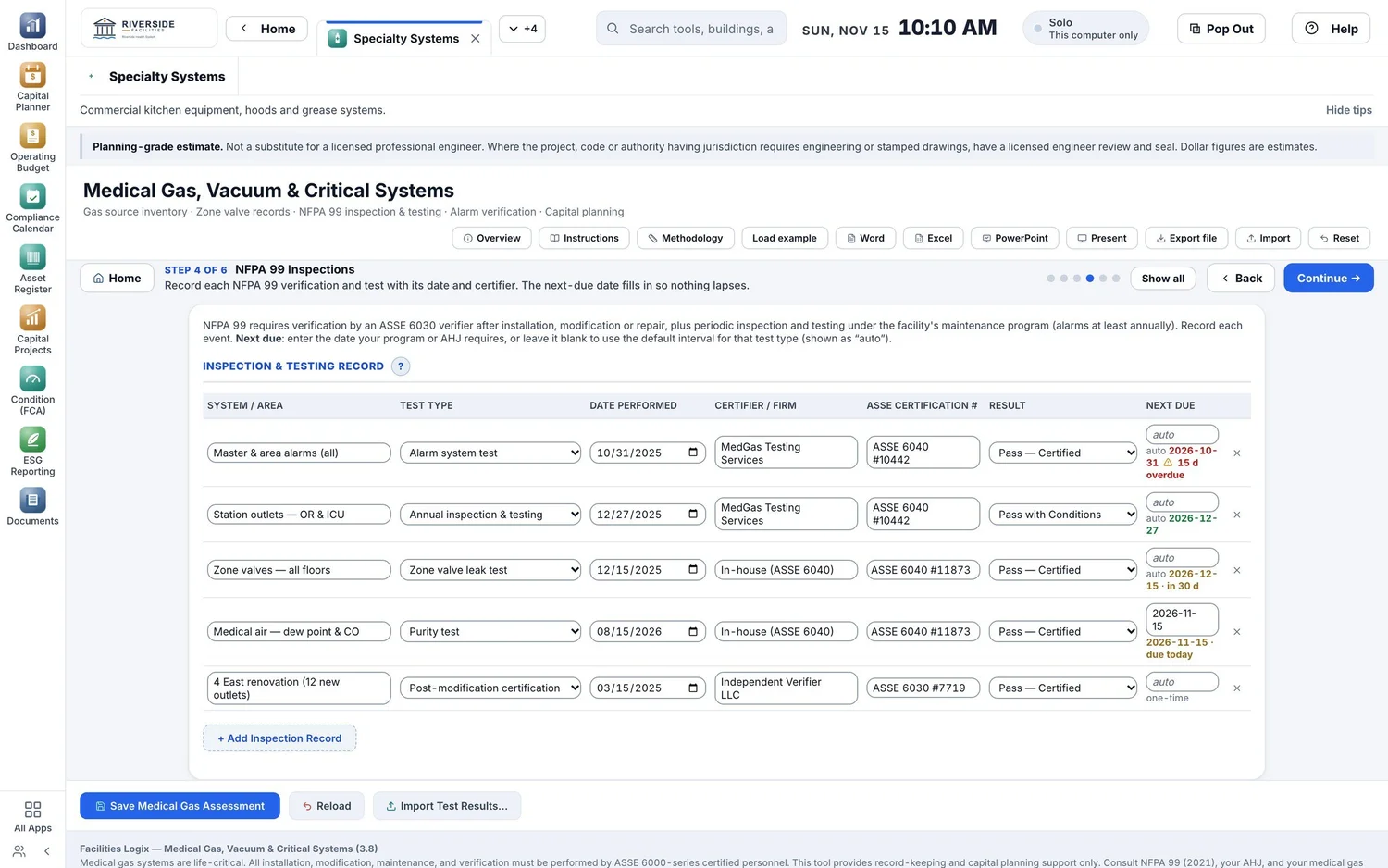
NFPA 99 Inspections in Medical Gas, Vacuum & Critical Systems: record each NFPA 99 verification and test with its date and certifier. The next-due date fills in so nothing lapses.
The Playbook's Own Checklist
- Life Safety Code survey readiness for surgery centers (42 CFR 416.44 and NFPA 101): annual
- Emergency preparedness program review (42 CFR 416.54 / 494.62): biennial
- Medical gas inspection and test (NFPA 99): annual
- Generator inspection and load test (NFPA 110): monthly
- Fire drill each shift (NFPA 101): quarterly
- Controlled-substance inventory (21 CFR 1304.11): biennial
- X-ray registration and inspection (state program): annual
- A starting list your team edits; dates start blank
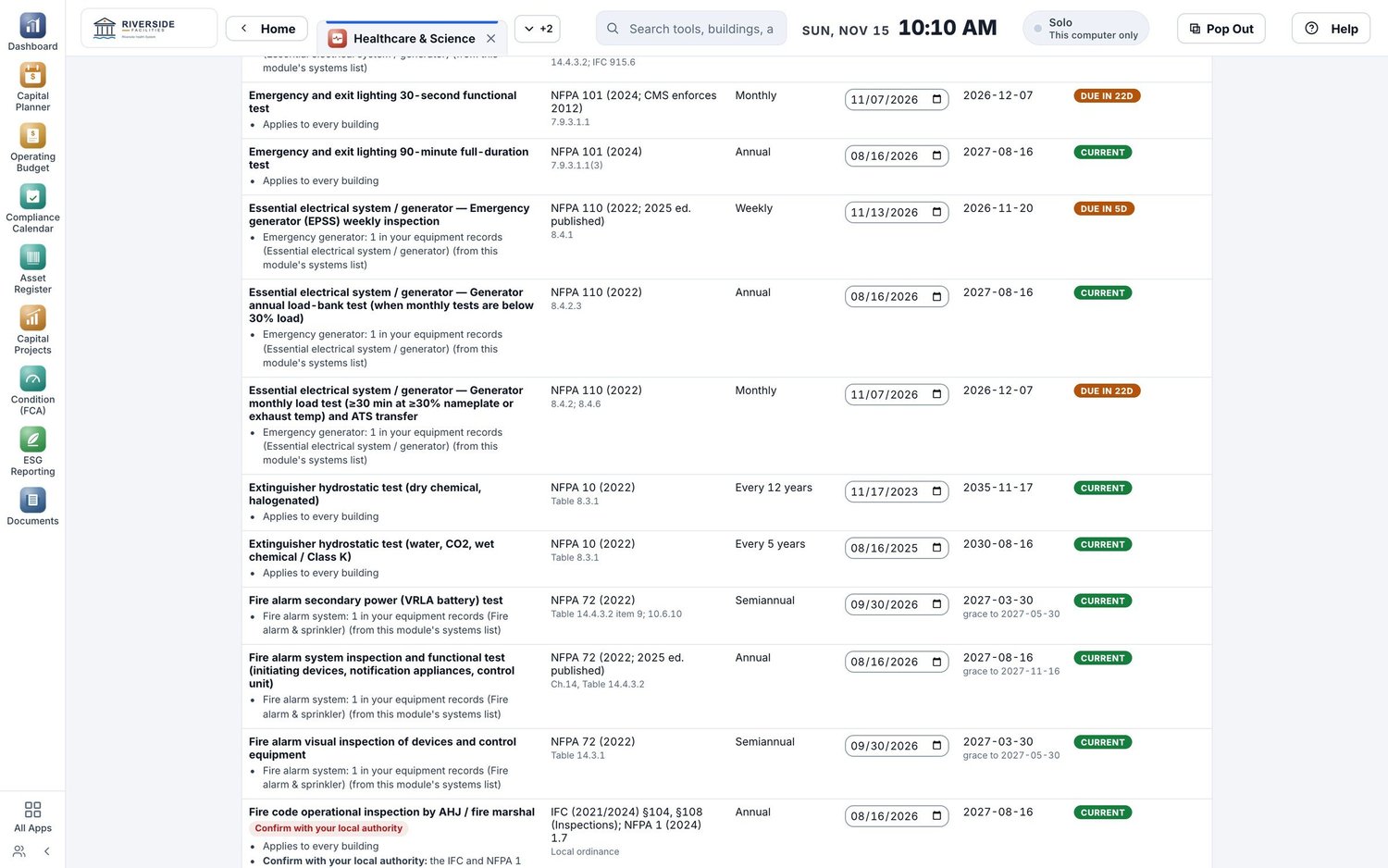
Compliance in Clinic & Outpatient: see every survey, inspection and test that applies to this practice and why. Enter the date each was last done; next-due dates match the Compliance Calendar.
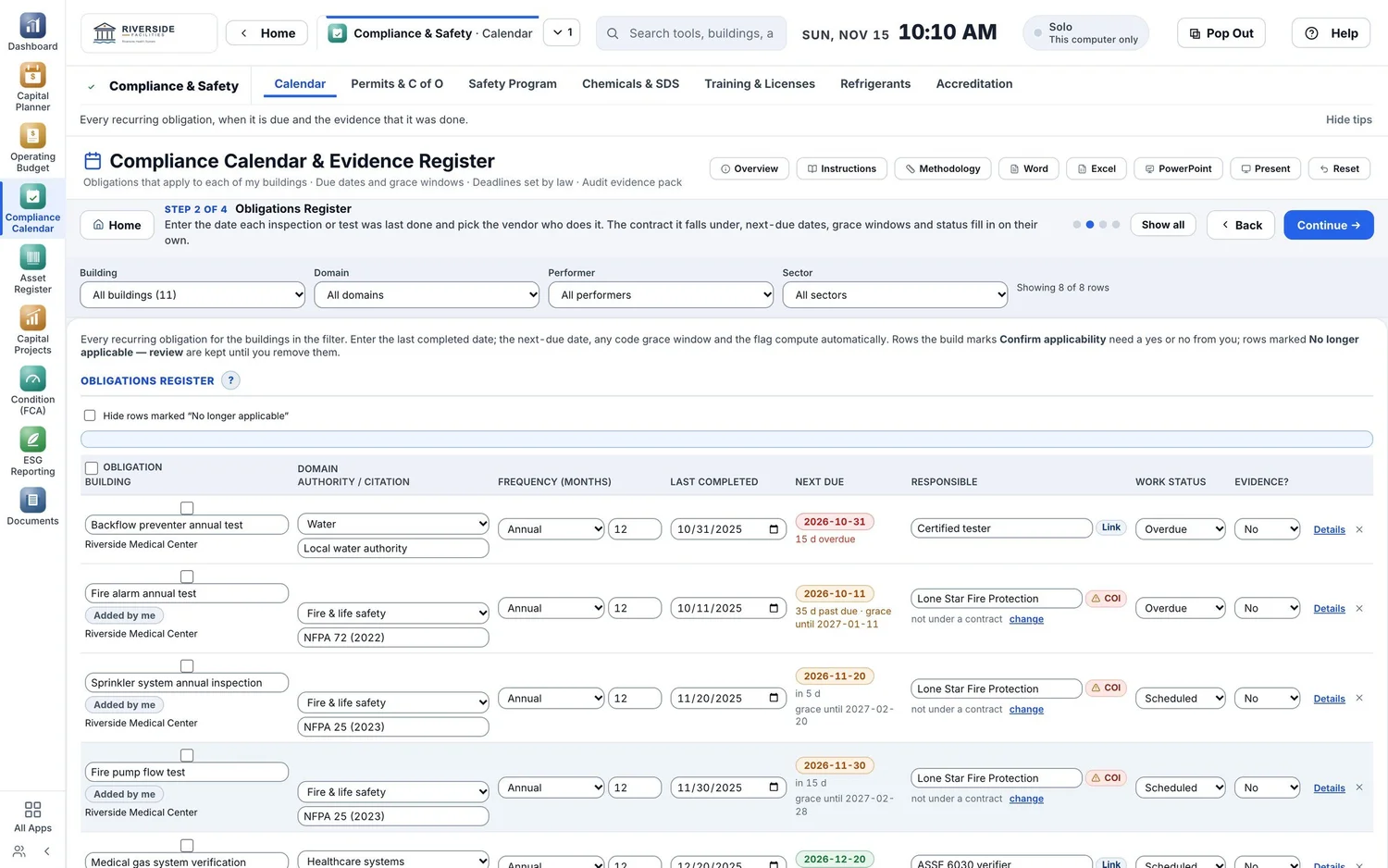
A small practice should not sort through hospital rules, so each obligation explains why it applies to this practice.
Eight Kinds of Practice, Fourteen Systems
Profile
- Medical office building, ambulatory surgery center, urgent care or walk-in clinic, outpatient rehabilitation or physical therapy, dialysis center, imaging center, dental office, veterinary hospital or clinic
- Exam and treatment rooms, operating and procedure rooms, floor area, year built and a year of energy
Systems and Starting PM Cadence
- Procedure-room HVAC for pressure, air changes and humidity (ASHRAE 170): quarterly
- Medical gas and vacuum (NFPA 99): annual
- Essential electrical system and generator: weekly
- Sterile processing washers and sterilizers: monthly
- Dialysis water treatment, reverse osmosis and carbon tanks: monthly
- Imaging equipment and shielding: annual
- Anesthetic gas scavenging: annual
- Nurse call, access control and cameras: quarterly
- Domestic water and Legionella controls: quarterly
- Medication and vaccine refrigeration monitoring: monthly
- Elevators: monthly; fire alarm and sprinkler, roofing and envelope: annual
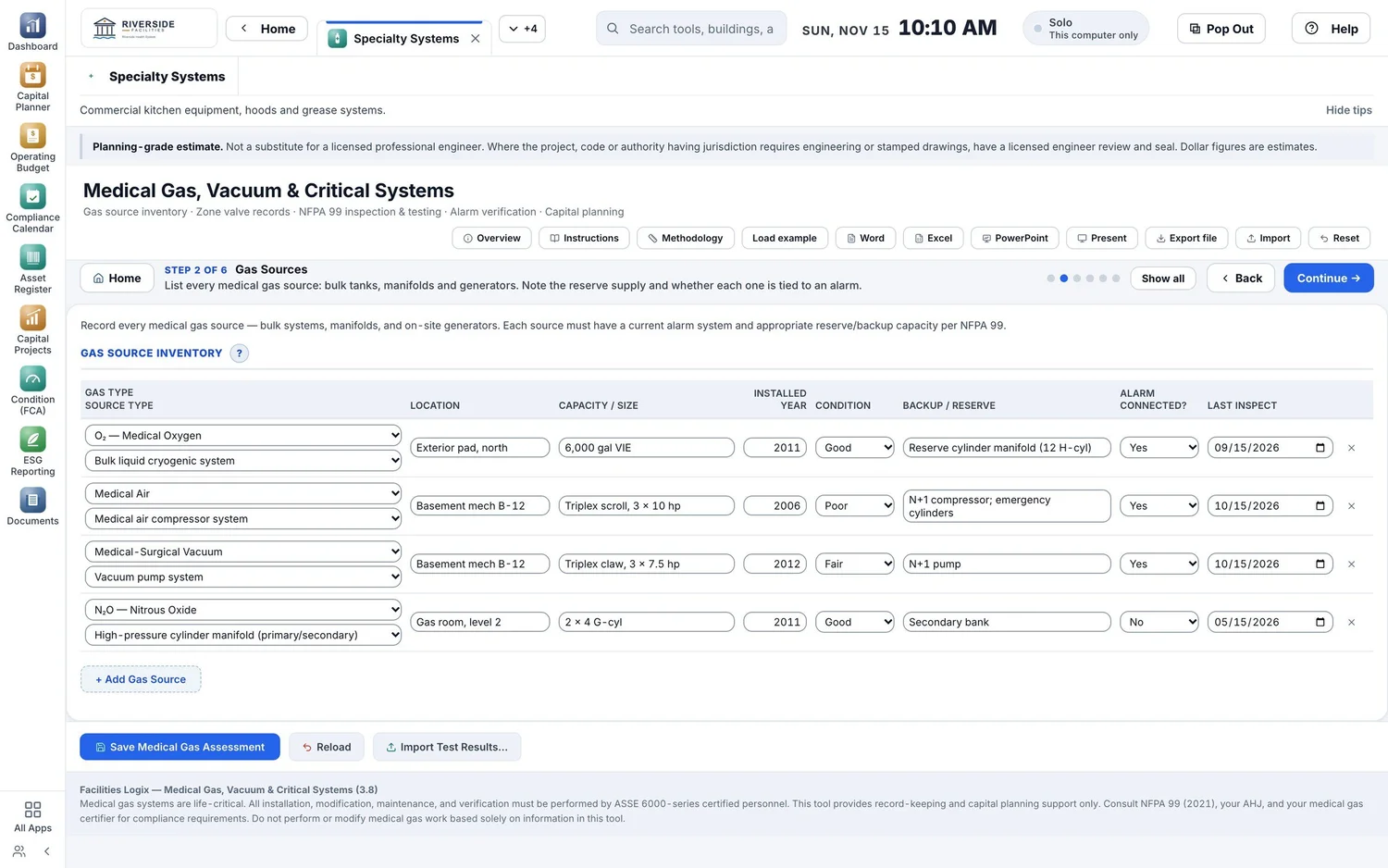
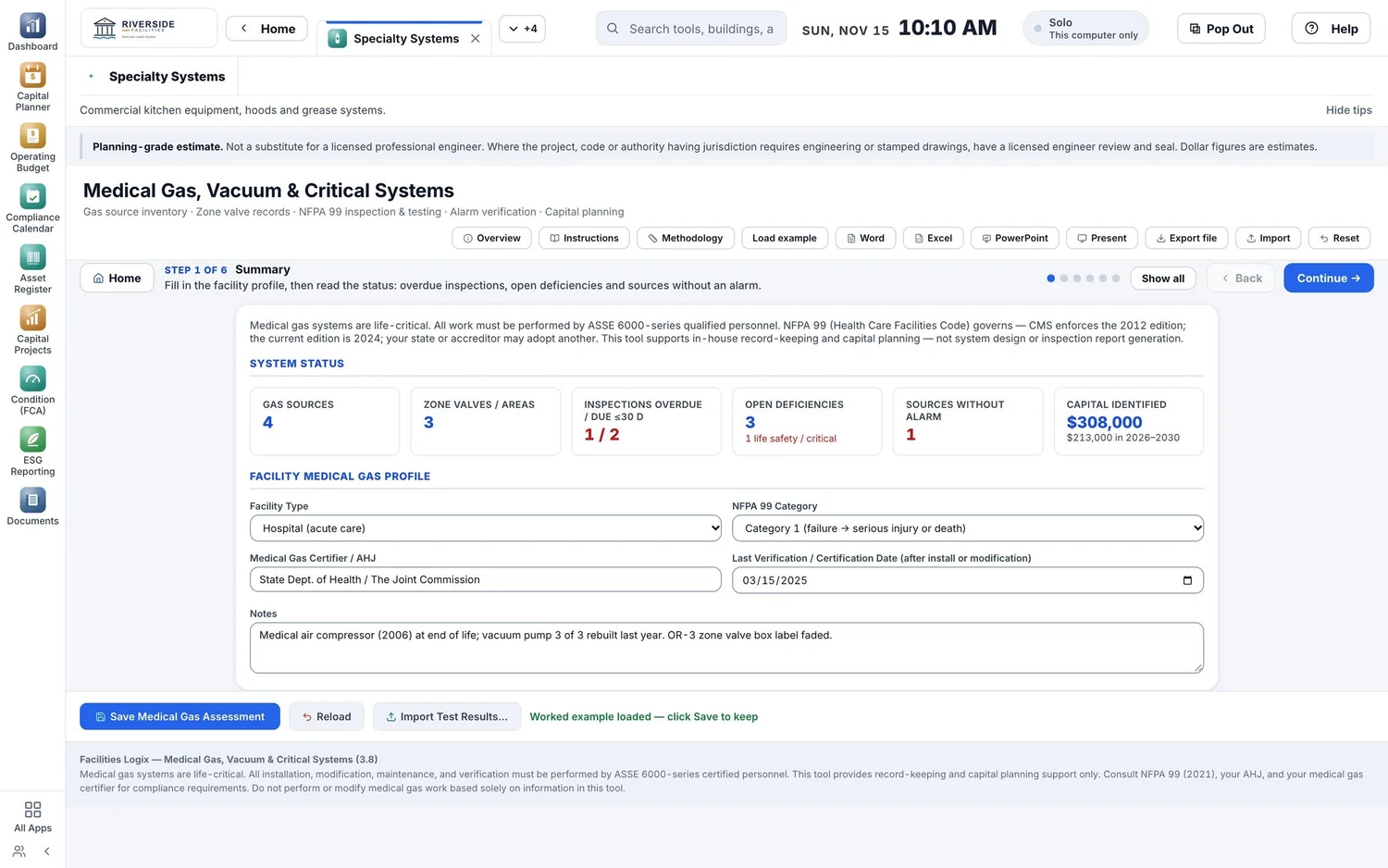
Gas Sources in Medical Gas, Vacuum & Critical Systems: list every medical gas source: bulk tanks, manifolds and generators. Note the reserve supply and whether each one is tied to an alarm.
Capital Lines
- Procedure-room air handlers (20-year life), generators and transfer switches (25), medical gas source equipment (20), sterilizers and washers (15), dialysis reverse osmosis (12), imaging equipment (10), nurse call (15), roof (25), elevator modernization (25)
- The plan shows what comes due and what is already past due
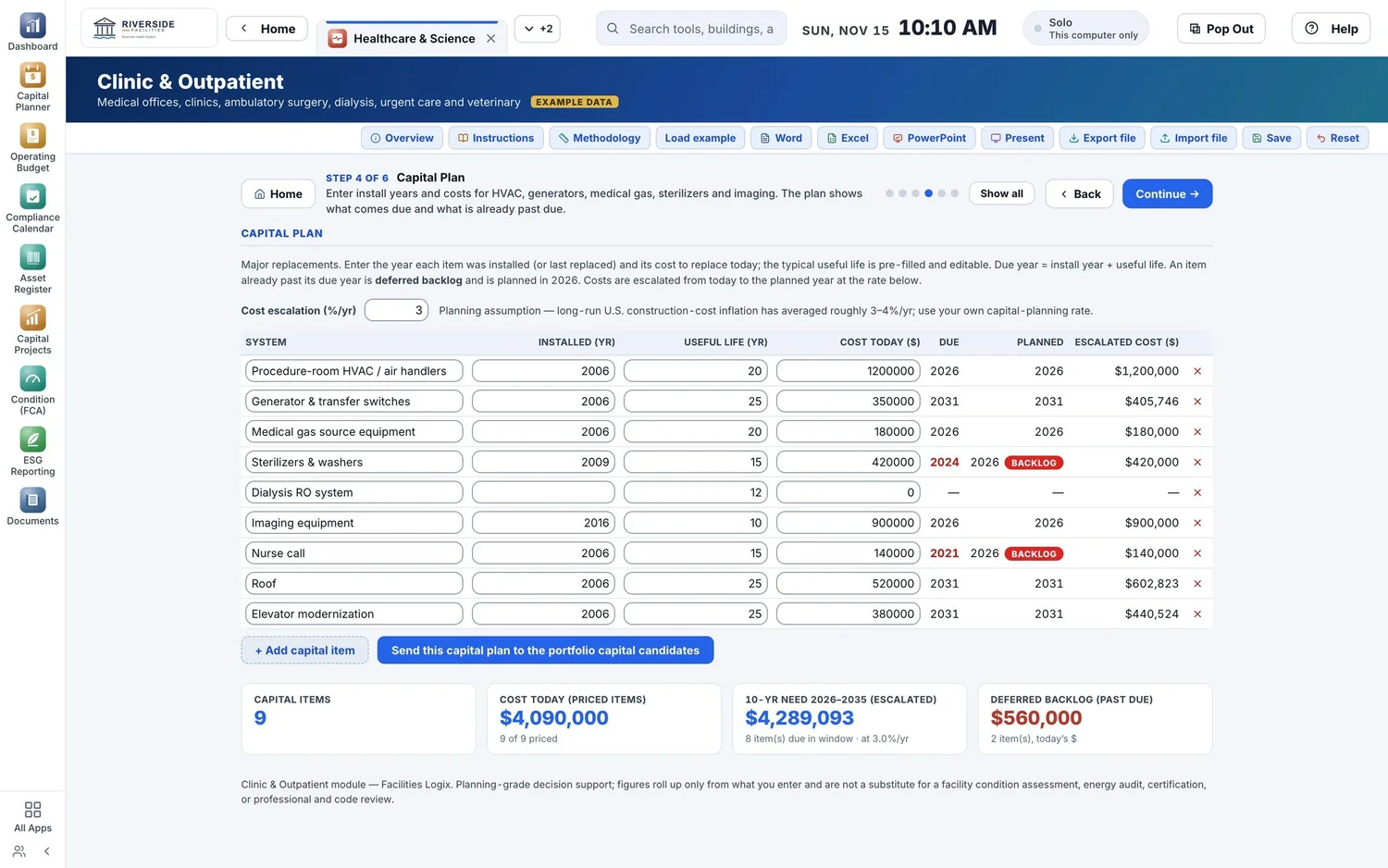
Capital Plan in Clinic & Outpatient: enter install years and costs for HVAC, generators, medical gas, sterilizers and imaging. The plan shows what comes due and what is already past due.
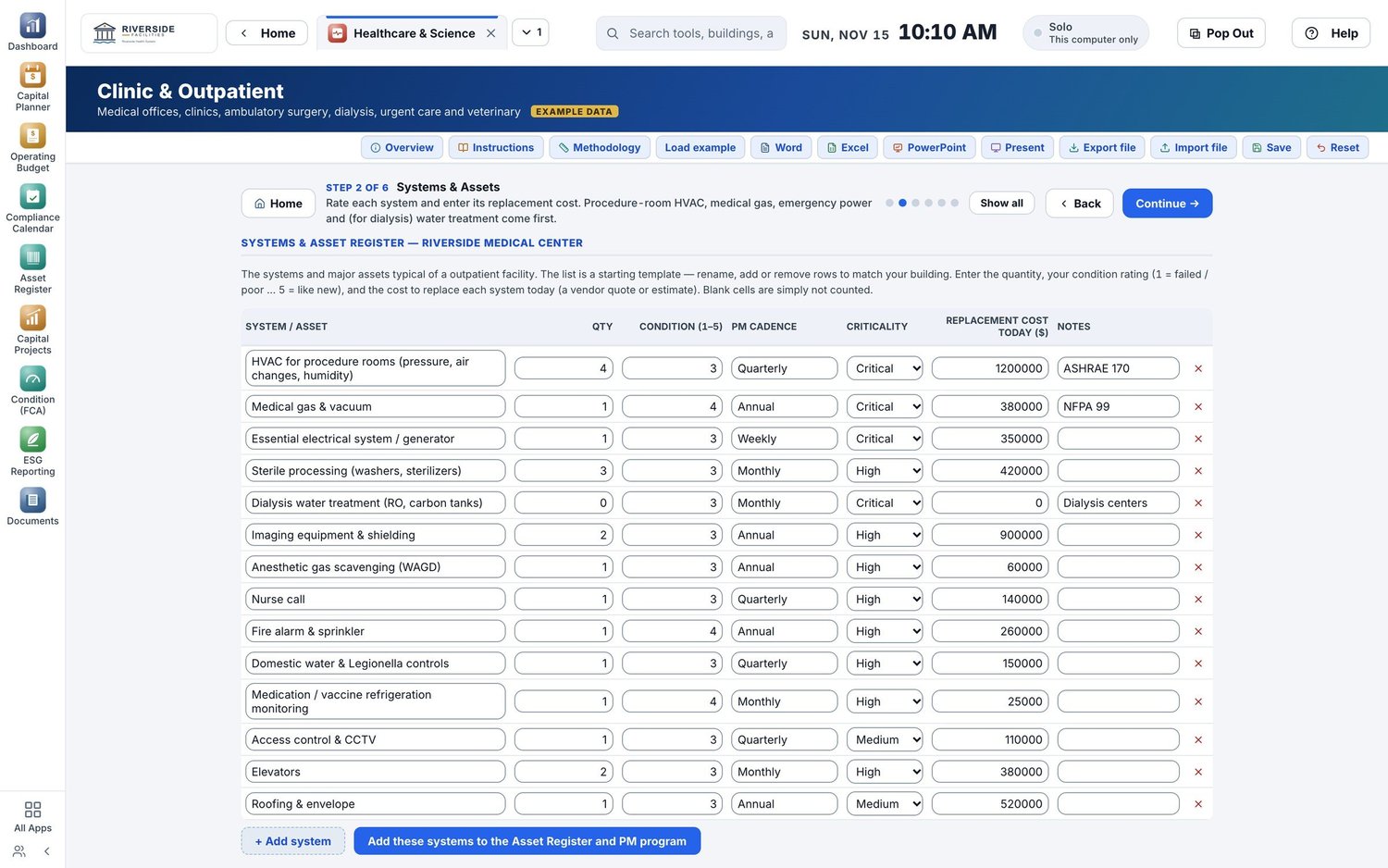
Clinics run medical gas and air systems with a small team, so the playbook starts with the systems that need care.
The Records Behind the Rules
Medical Gas Records
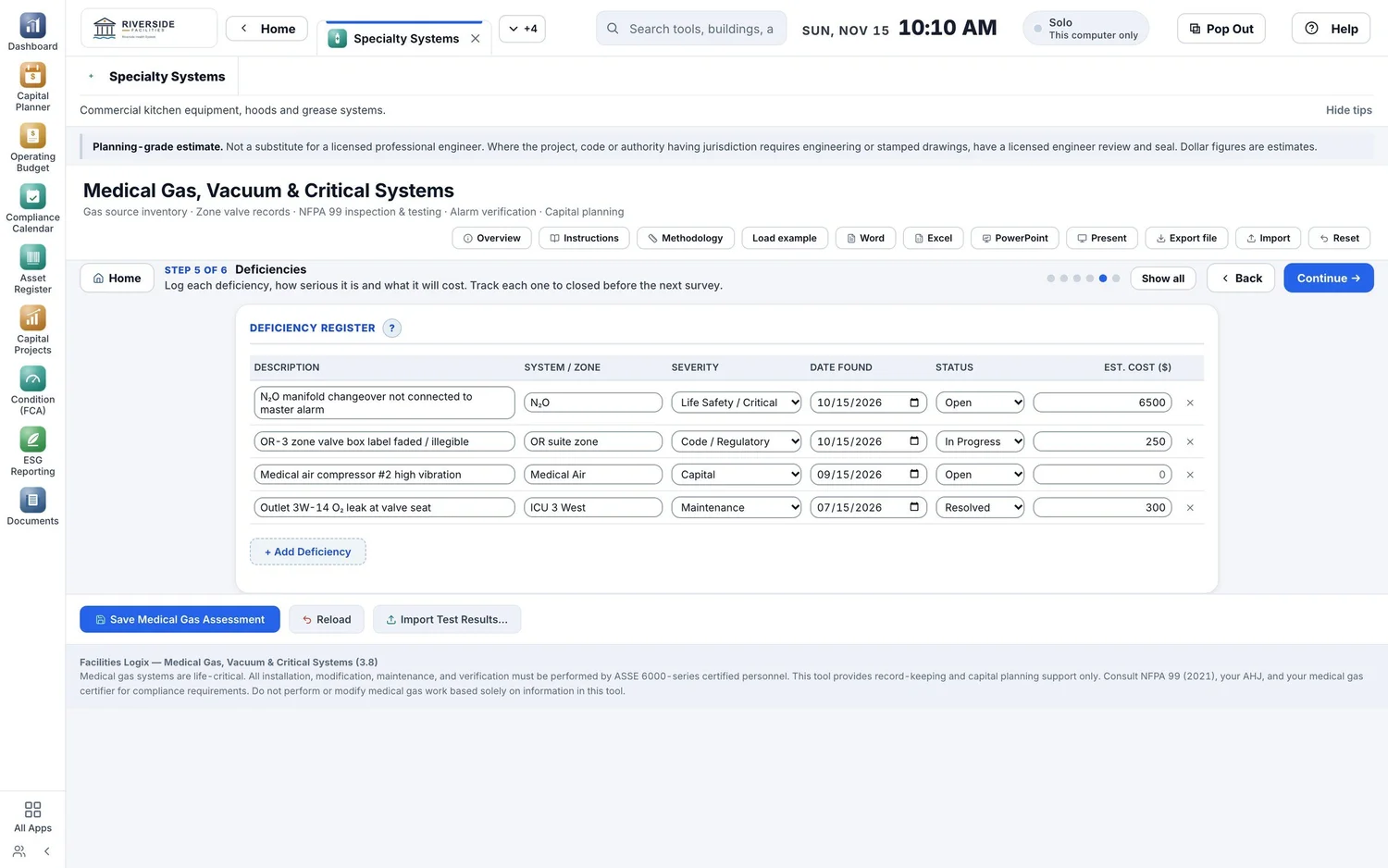
The Medical Gas tool lists surgery centers, medical offices, dental offices and veterinary facilities among its types, with the NFPA 99 risk category (a surgery center may be Category 1 or 2), gas sources, zone valves and the test record with the tester's qualification number.
Learn MoreProcedure and Compounding Rooms
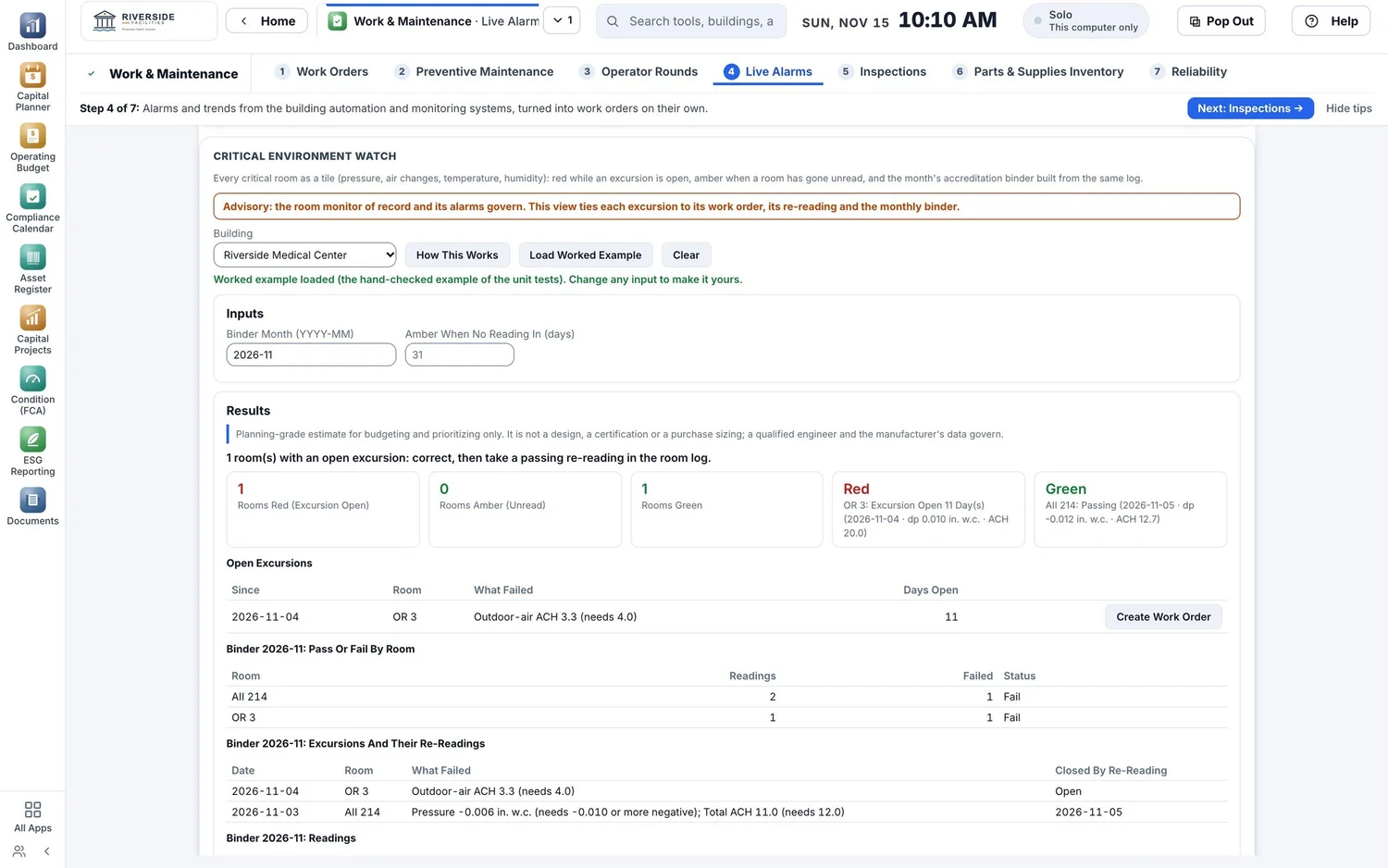
Operating rooms, sterile processing and compounding pharmacy rooms can join the Critical-Room Pressure and Air-Change Log, with pass or fail by month and an excursion work order for each failing reading.
Learn MoreShow Less
A procedure room that loses positive pressure is an infection risk and a survey finding, and catching it early costs a balancing call instead of cancelled cases. The log holds each room to the values in your own design basis.
- Enter required relationship, minimum pressure difference, total and outdoor-air changes per room.
- Air changes are calculated from supply airflow, or exhaust for negative rooms.
- A failing room stays open until a passing re-reading closes it.
- The monthly binder lists every room's pass or fail for the survey file.
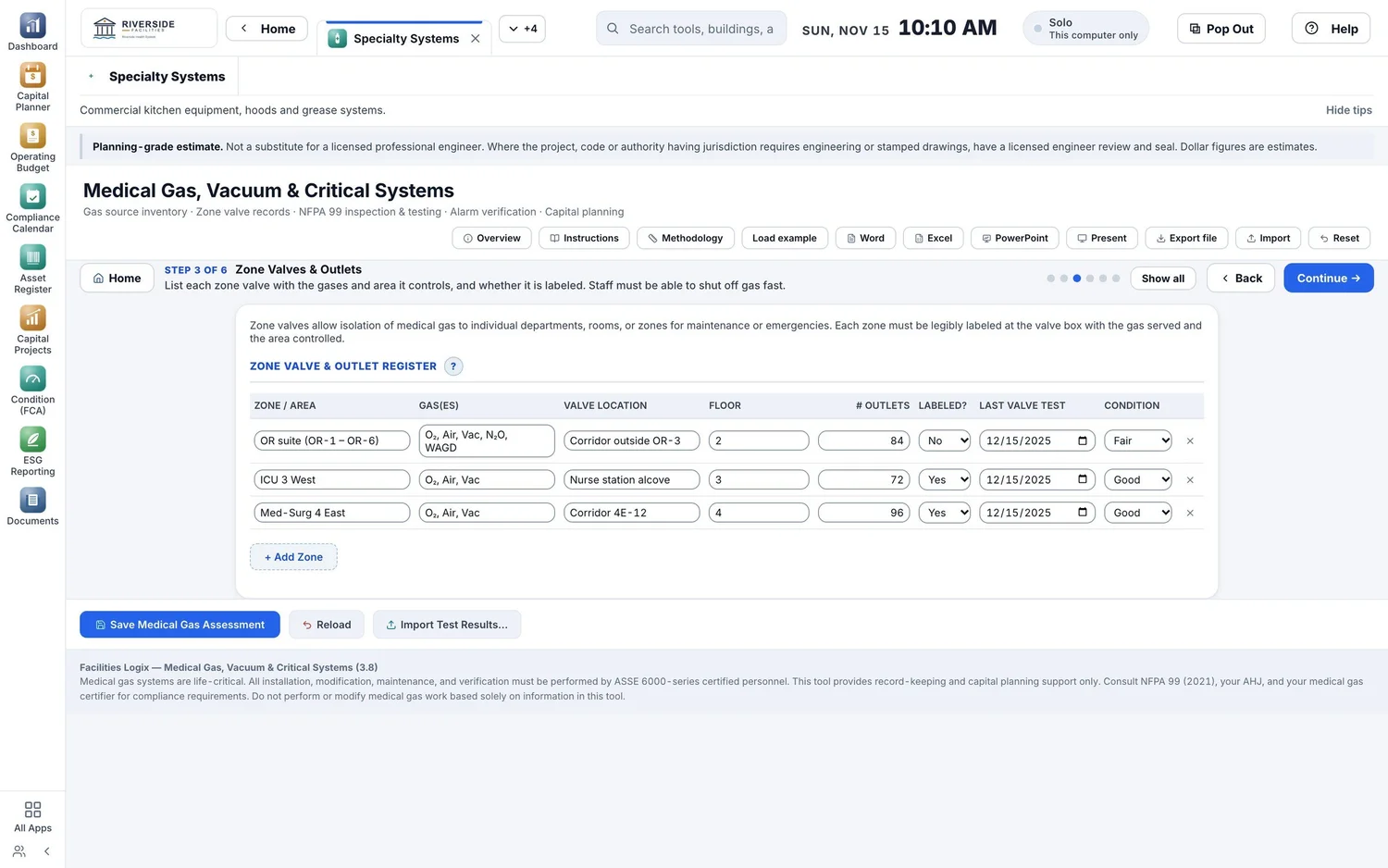
Zone Valves & Outlets in Medical Gas, Vacuum & Critical Systems: list each zone valve with the gases and area it controls, and whether it is labeled. Staff must be able to shut off gas fast.
Refrigerators and Generators
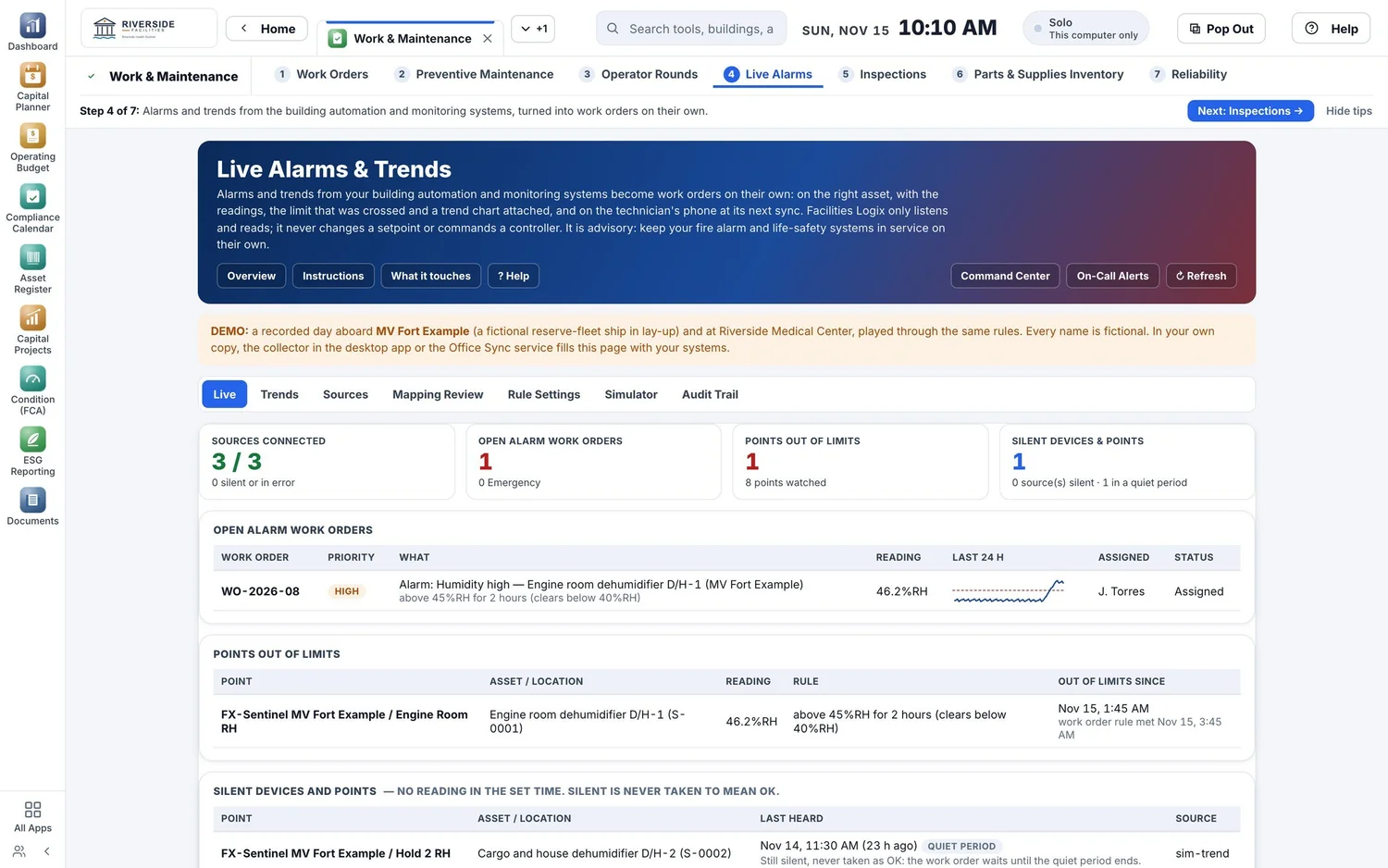
Live Alarms offers starting limits for pharmacy and vaccine refrigerators and freezers (CDC Vaccine Storage and Handling Toolkit) and for generators (NFPA 110), each editable per point.
Learn MoreShow Less
One warm vaccine refrigerator over a weekend can mean discarded stock, and a generator left out of automatic fails when it is needed. Live Alarms turns these readings into work orders before the loss.
- Refrigerators alarm outside 36 to 46 °F after 15 minutes; freezers above +5 °F after 30.
- Door ajar and power loss alarm on their own.
- Generators alarm on not-in-automatic, low fuel (50% to start), low starting battery and high coolant.
- One open work order per asset and condition; repeats are added as notes.
The Hospital Workbook Too
The Healthcare module's facility types include ambulatory surgery center and outpatient clinic, for a center that wants the Environment of Care plans and the utility management plan as well.
Learn More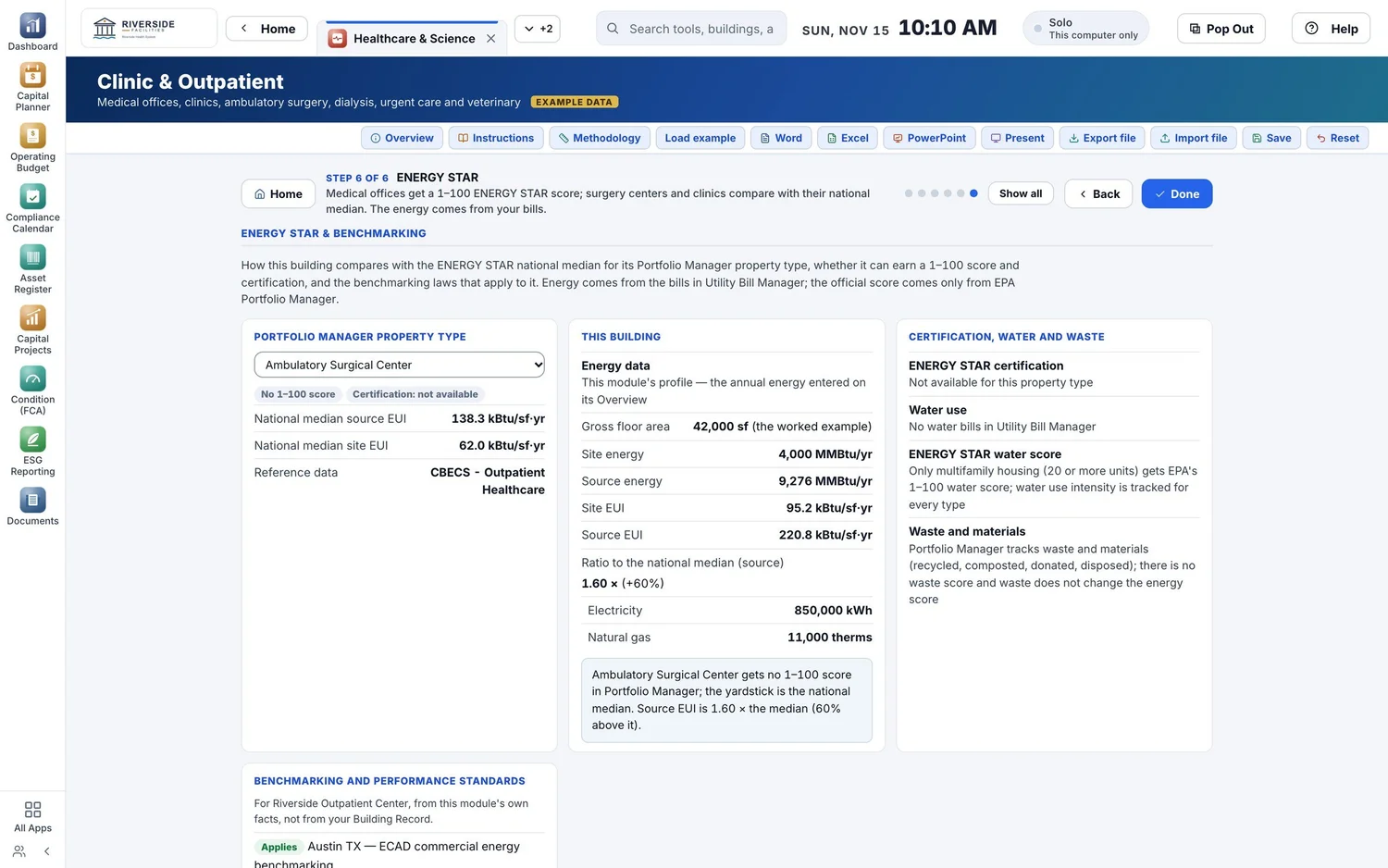
ENERGY STAR in Clinic & Outpatient: medical offices get a 1–100 ENERGY STAR score; surgery centers and clinics compare with their national median. The energy comes from your bills.
Ready for the Surveyor and for Leadership
Compliance Tab
Every survey, inspection and test that applies to this practice and why. Enter the date each was last done; next-due dates match the Compliance Calendar.
Learn MoreReports
Word, Excel and PowerPoint reports carry the systems, the compliance status, the capital plan and the ENERGY STAR section.
Learn MoreShow Less
A practice owner deciding what to fund needs the cost of waiting, not just a list. Each report opens with a funding recommendation built from your own numbers.
- Facility Condition Index, rated Good, Fair or Poor on the NACUBO/APPA scale.
- Ten-year capital need by year, escalated at the rate you set.
- Deferred backlog by system: items already past useful life.
- A compliance chart of overdue, due-soon and current items.
- A SAMPLE watermark marks any report made from the worked example.
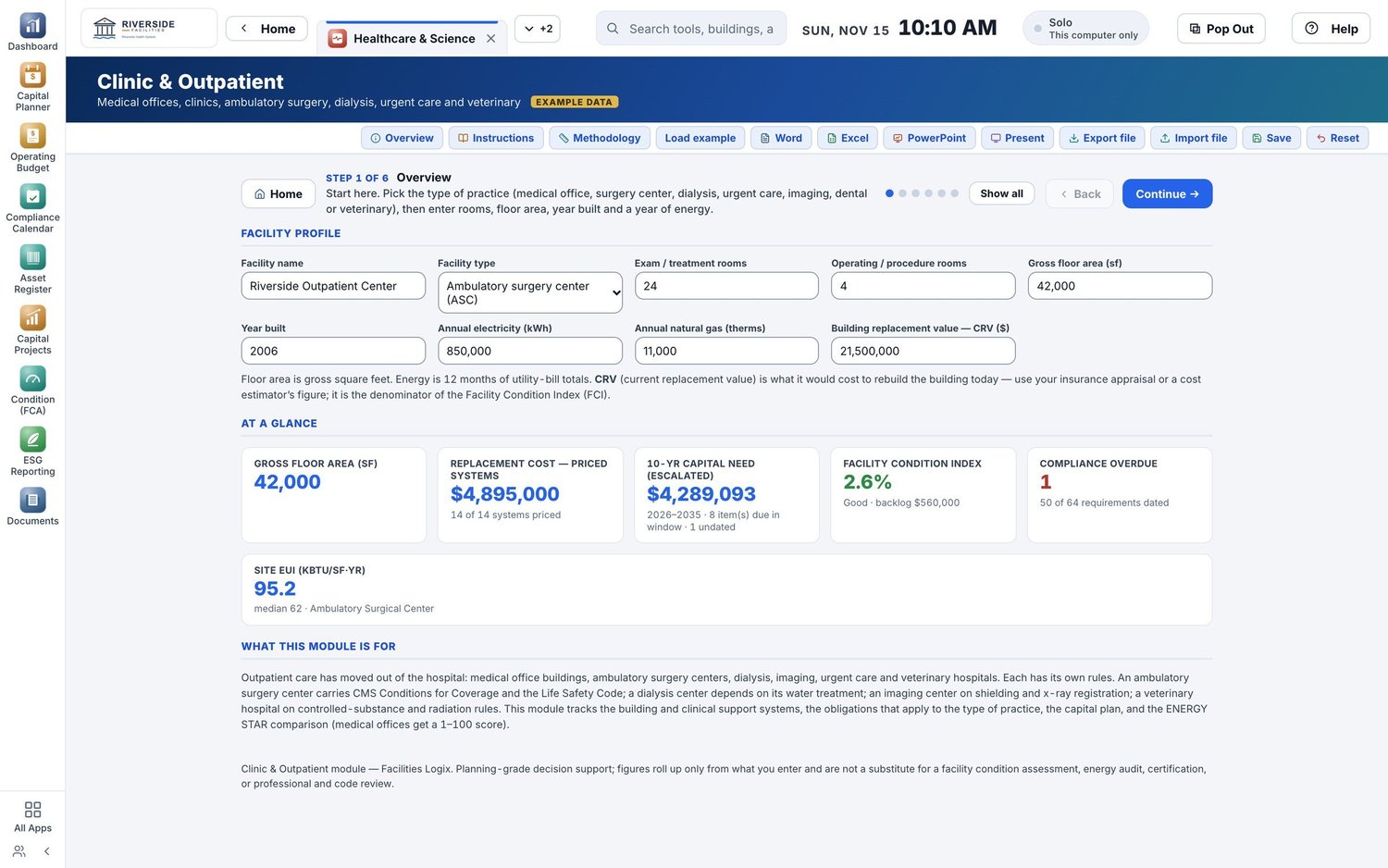
Overview in Clinic & Outpatient: start here. Pick the type of practice (medical office, surgery center, dialysis, urgent care, imaging, dental or veterinary), then enter rooms, floor area, year built and a year of energy.
ENERGY STAR
Medical offices get a 1 to 100 ENERGY STAR score; surgery centers, clinics and veterinary offices compare with their national median. The energy comes from your bills.
Learn MoreShow Less
Energy is one of the few operating costs a practice can cut without touching care, and the comparison shows how much room there is. The type of practice picks the Portfolio Manager property type for you.
- Medical and dental offices: Medical Office, eligible for ENERGY STAR certification.
- Surgery centers: Ambulatory Surgical Center; physical therapy: Outpatient Rehabilitation.
- Urgent care, dialysis and imaging centers: Urgent Care/Clinic/Other Outpatient.
- Veterinary practices: Veterinary Office.
- Water bills show use per square foot against the national median.
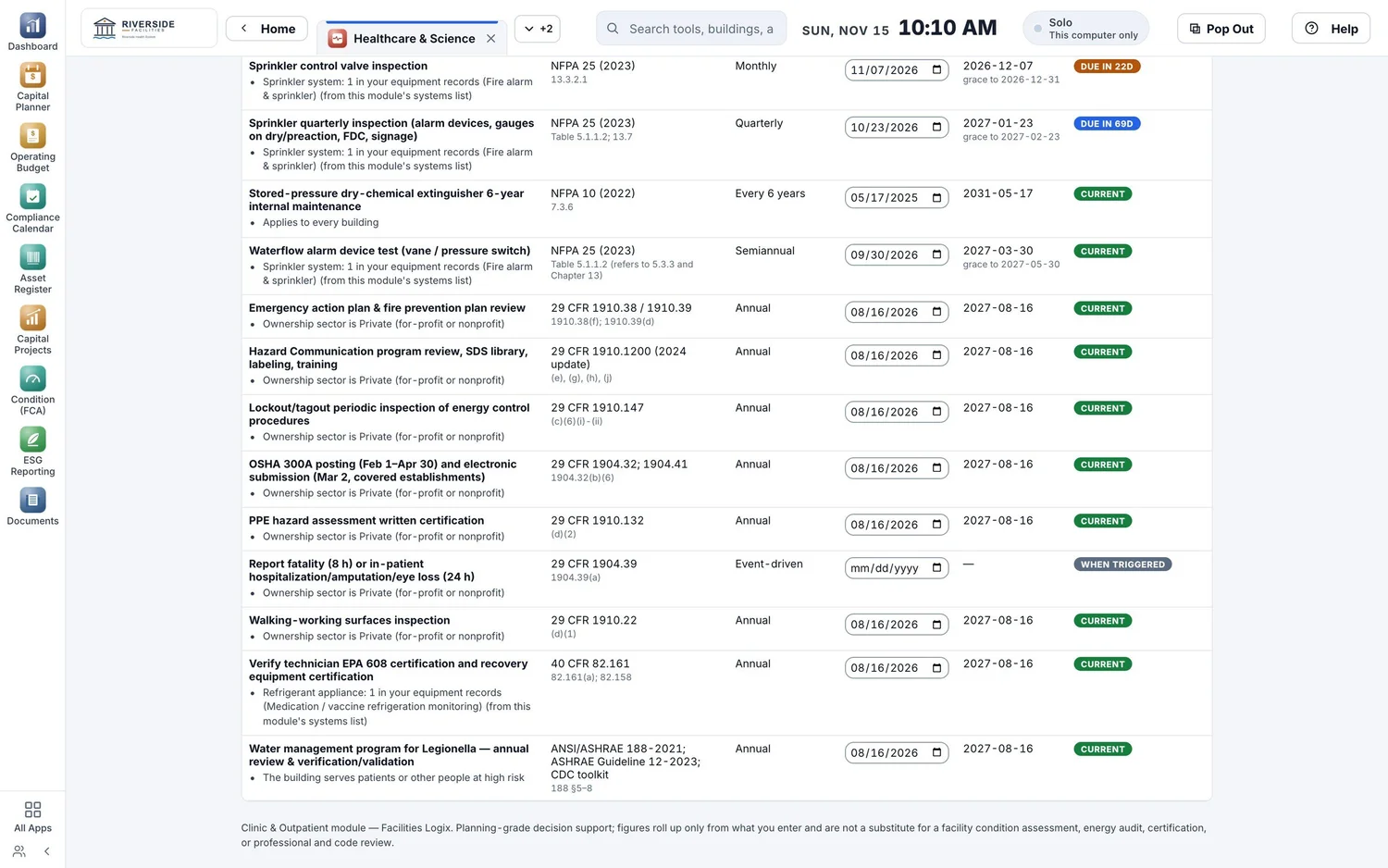
Compliance in Clinic & Outpatient: see every survey, inspection and test that applies to this practice and why. Enter the date each was last done; next-due dates match the Compliance Calendar.
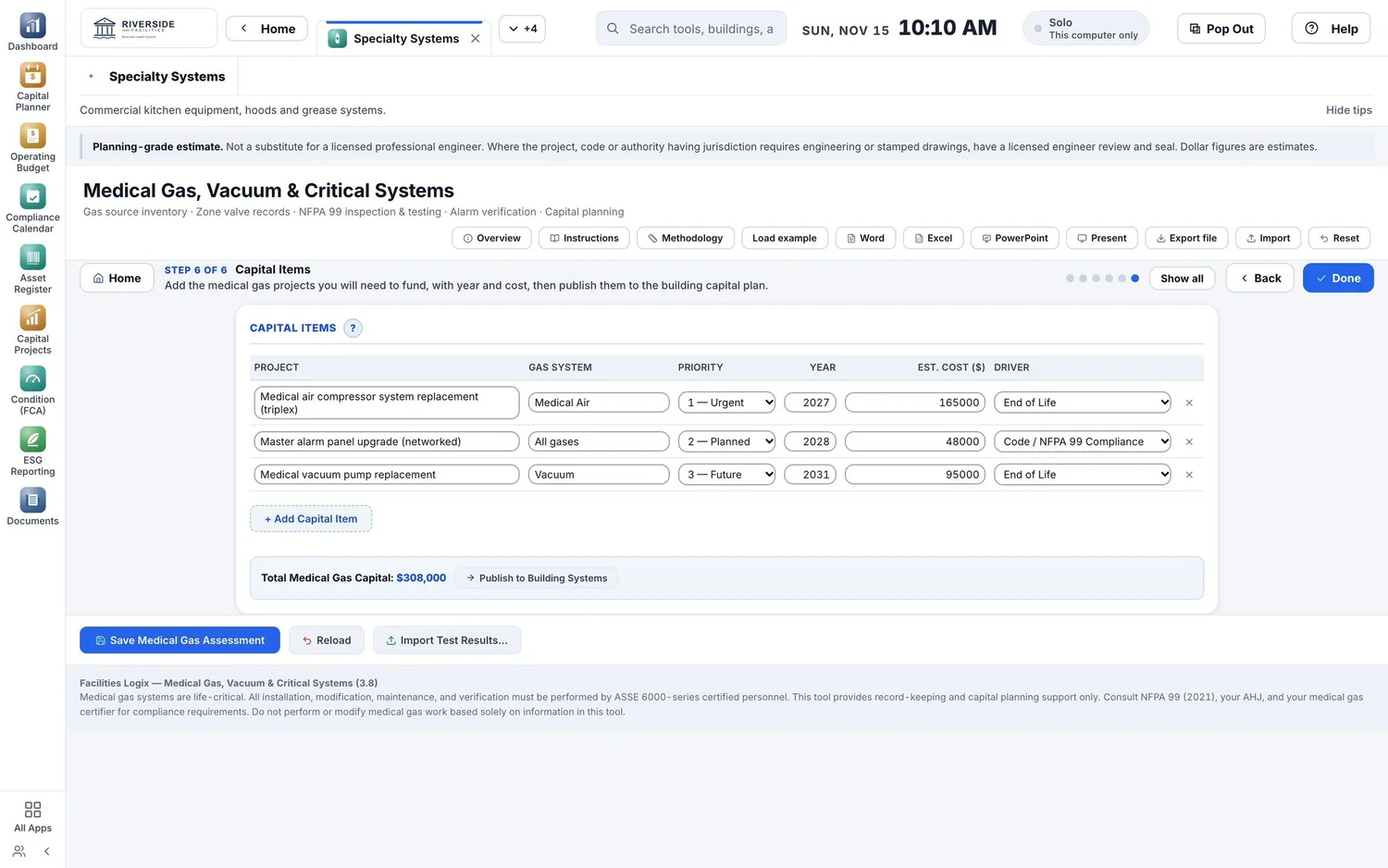
Capital Items in Medical Gas, Vacuum & Critical Systems: add the medical gas projects you will need to fund, with year and cost, then publish them to the building capital plan.
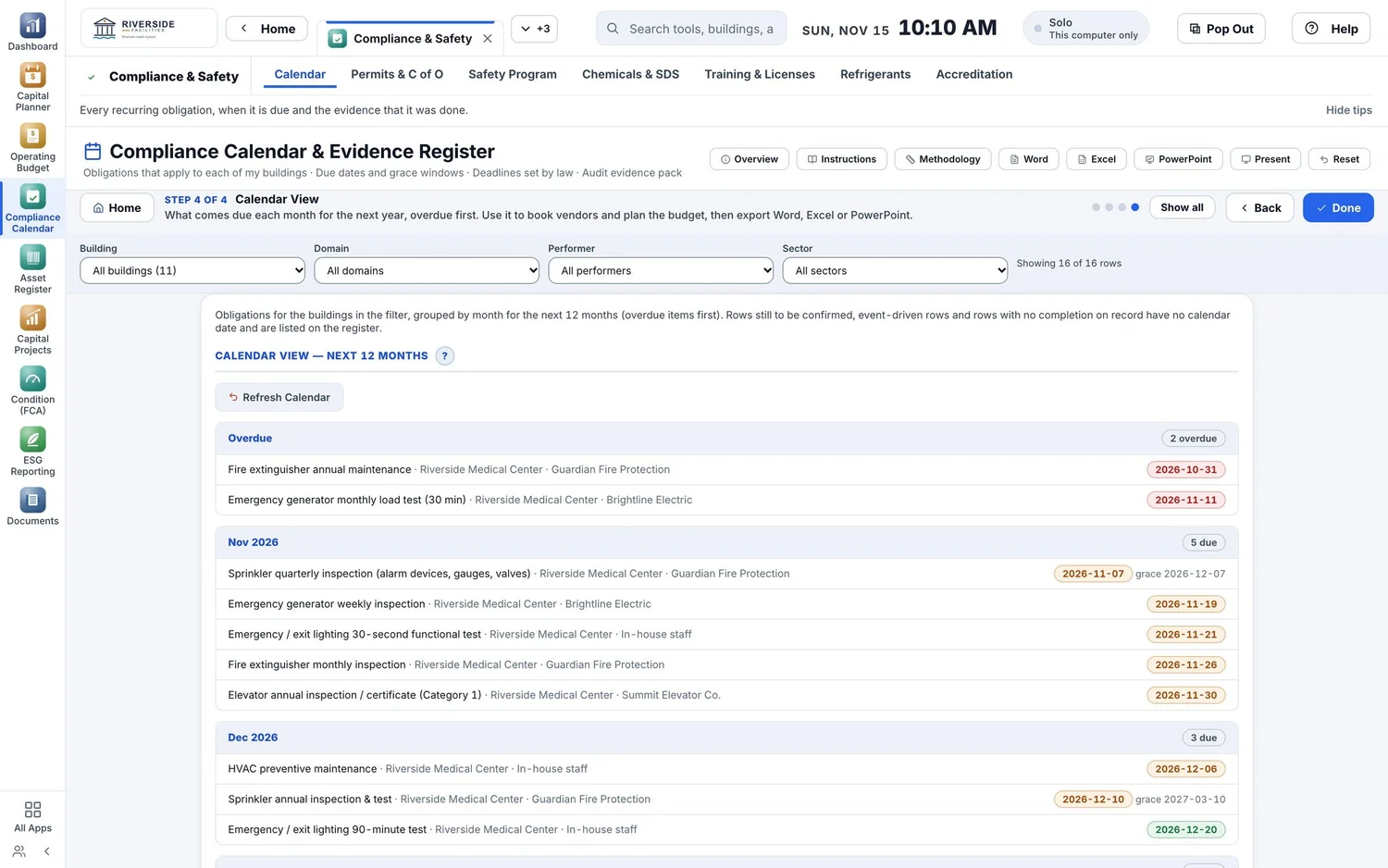
The Yardsticks in the Playbook
Benchmarks
- Procedure room environment: positive pressure, at least 20 total air changes (4 outdoor) per hour and 20 to 60 percent relative humidity in operating rooms (ASHRAE 170), logged and trended
- Survey readiness: no open Life Safety Code or emergency preparedness findings
- Dialysis water quality: water and dialysate tested on the schedule the dialysis rules set, with any failure acted on the same day
- Energy: a 1 to 100 score for medical offices, or the national median for other types
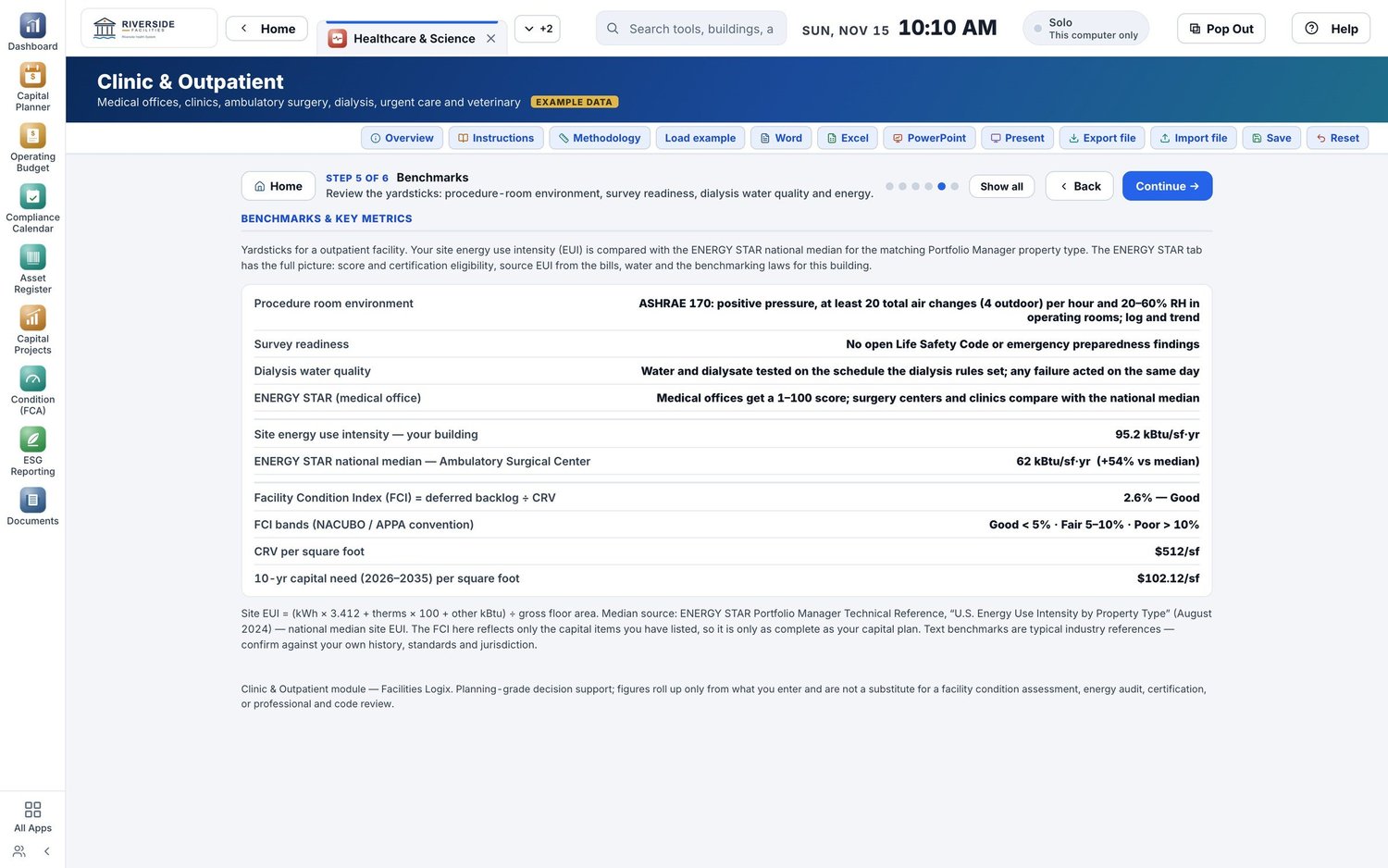
Benchmarks in Clinic & Outpatient: review the yardsticks: procedure-room environment, survey readiness, dialysis water quality and energy.
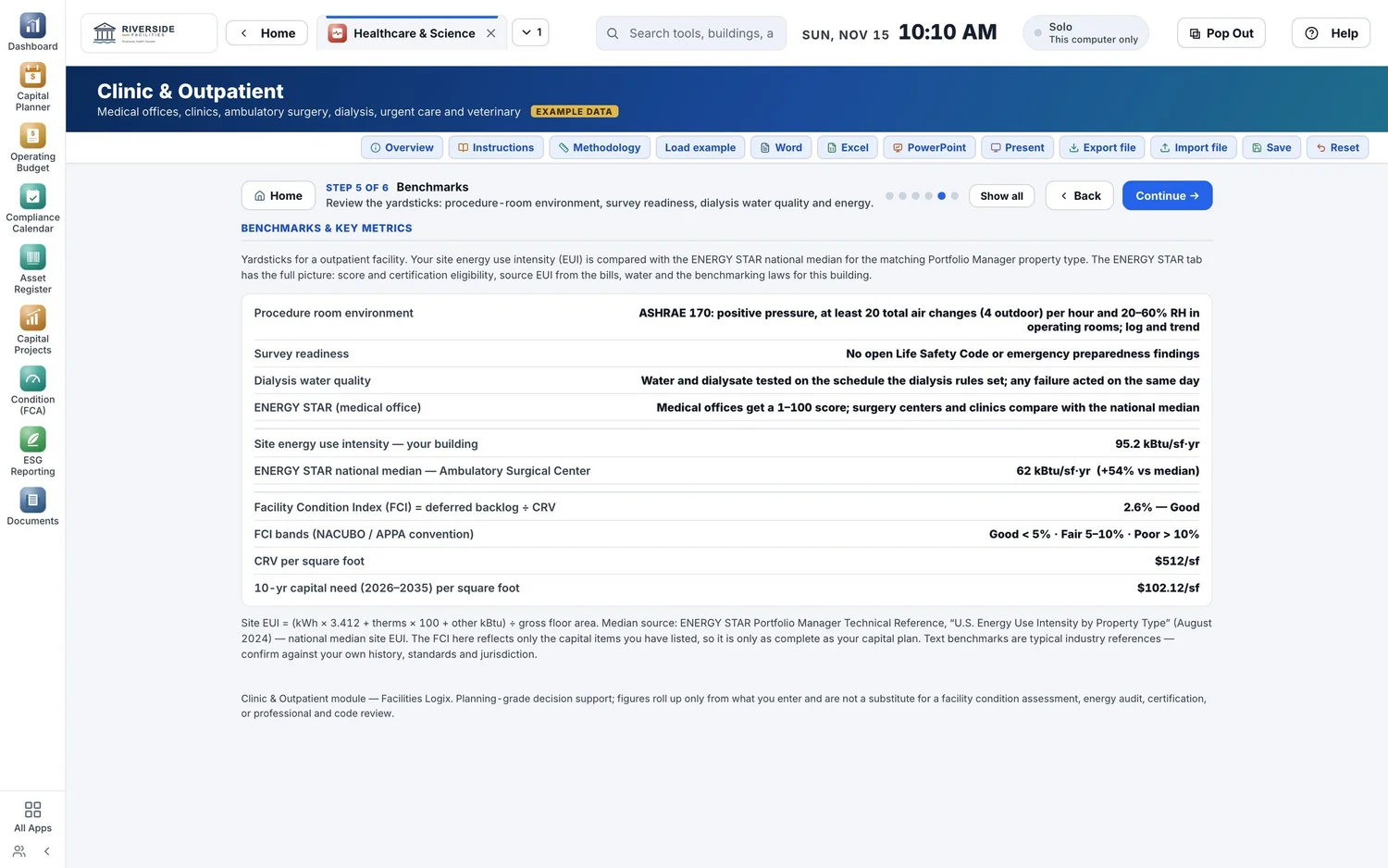
Small practices rarely know how their rooms and energy compare, so the playbook carries clinical yardsticks.
Small Teams, Full Rulebooks
Only the Rules That Apply
The type of practice filters the obligations, so a team is not sorting through hospital rules that do not fit the building.
Learn MoreShow Less
Staff time spent on rules that do not apply is money lost, and a missed rule that does apply becomes a citation. The facility type sets the answers the compliance engine uses.
- The same choice sets the ENERGY STAR property type, so the energy comparison fits the practice too.
- A rule that depends on an unanswered fact shows Confirm Applicability instead of a guess.
- Reports count Confirm Applicability rows apart from overdue and current ones.
- Obligations are applied to the facts in the Building Record; the authority having jurisdiction governs.
Dates in One Place
Drills, emergency plan reviews, water testing, controlled-substance inventories and registrations come due on one calendar instead of in separate files.
Learn MoreShow Less
A lapsed DEA registration or a missed emergency plan review costs far more to fix than to schedule. Each item's next due date comes from its last done date and frequency, the same dates as the Compliance Calendar.
- Due soon means within 30 days, the Compliance Calendar's window.
- NFPA 25 and 72 rows stay current through the code's grace window.
- Month-end dates are handled, so a due date never lands on a day that does not exist.
- Reports count overdue, due-soon and undated items.
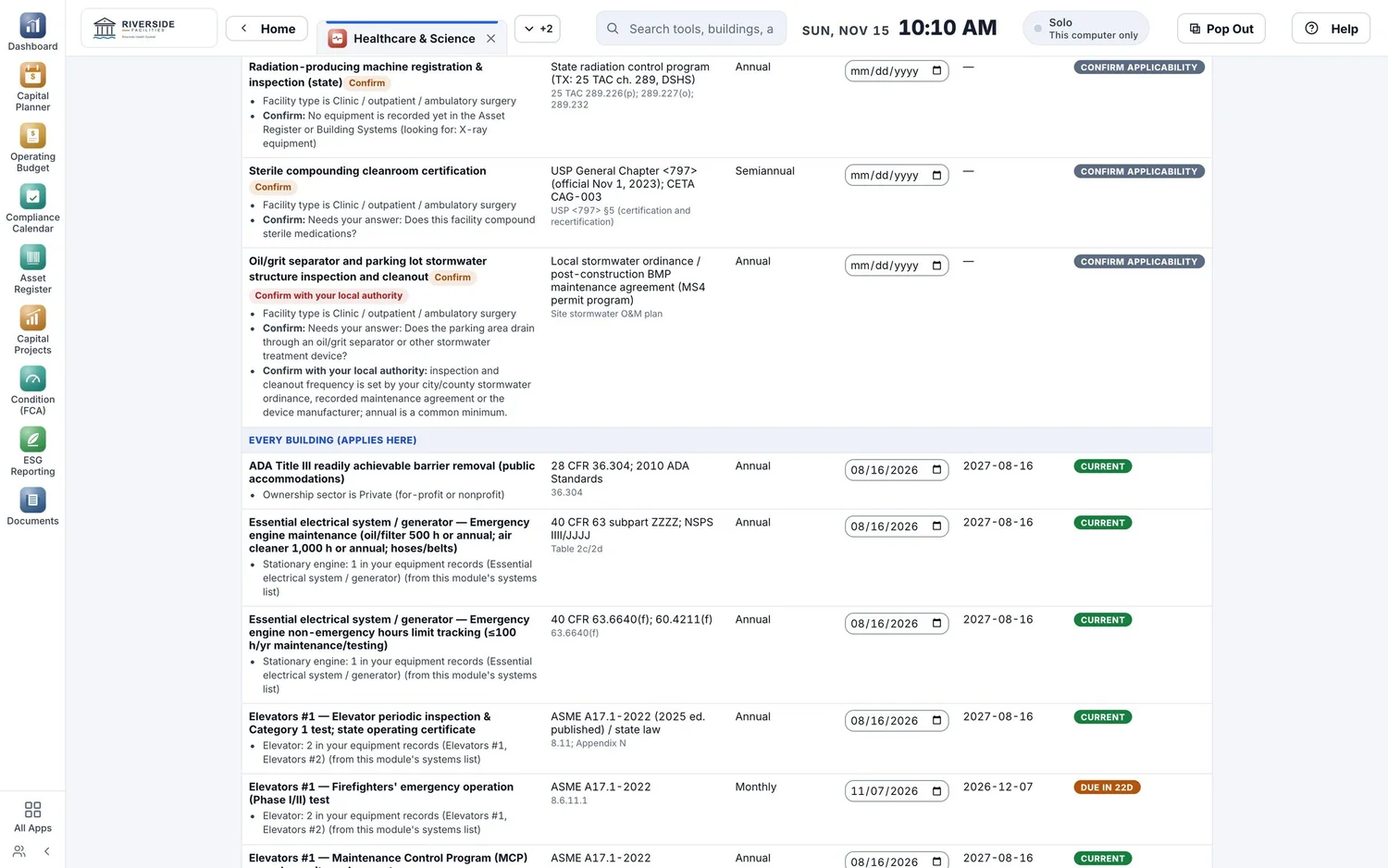
Compliance in Clinic & Outpatient: see every survey, inspection and test that applies to this practice and why. Enter the date each was last done; next-due dates match the Compliance Calendar.
Capital in View
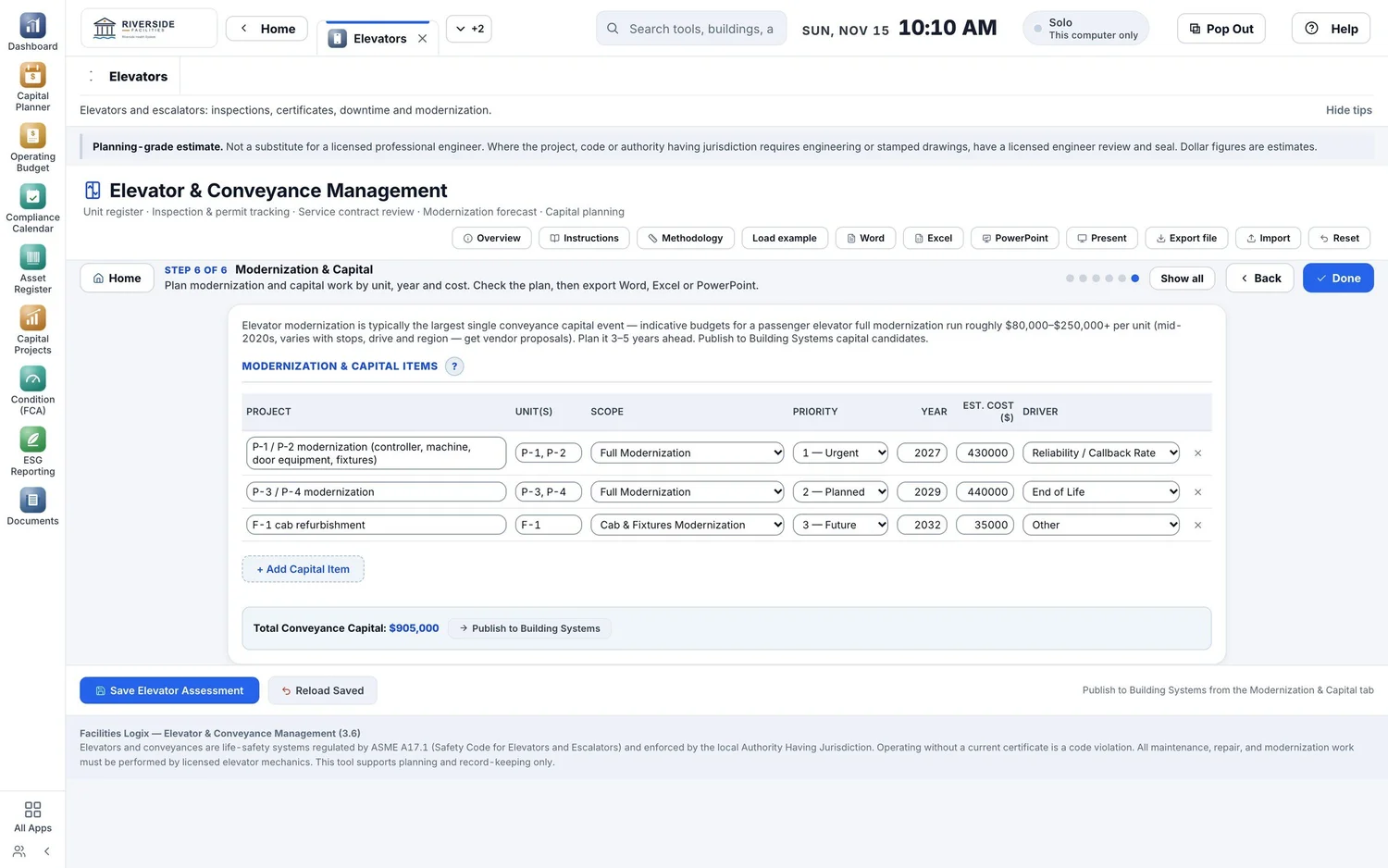
Sterilizers, imaging and procedure-room air handlers show when they come due, so replacements can be planned rather than forced.
Learn More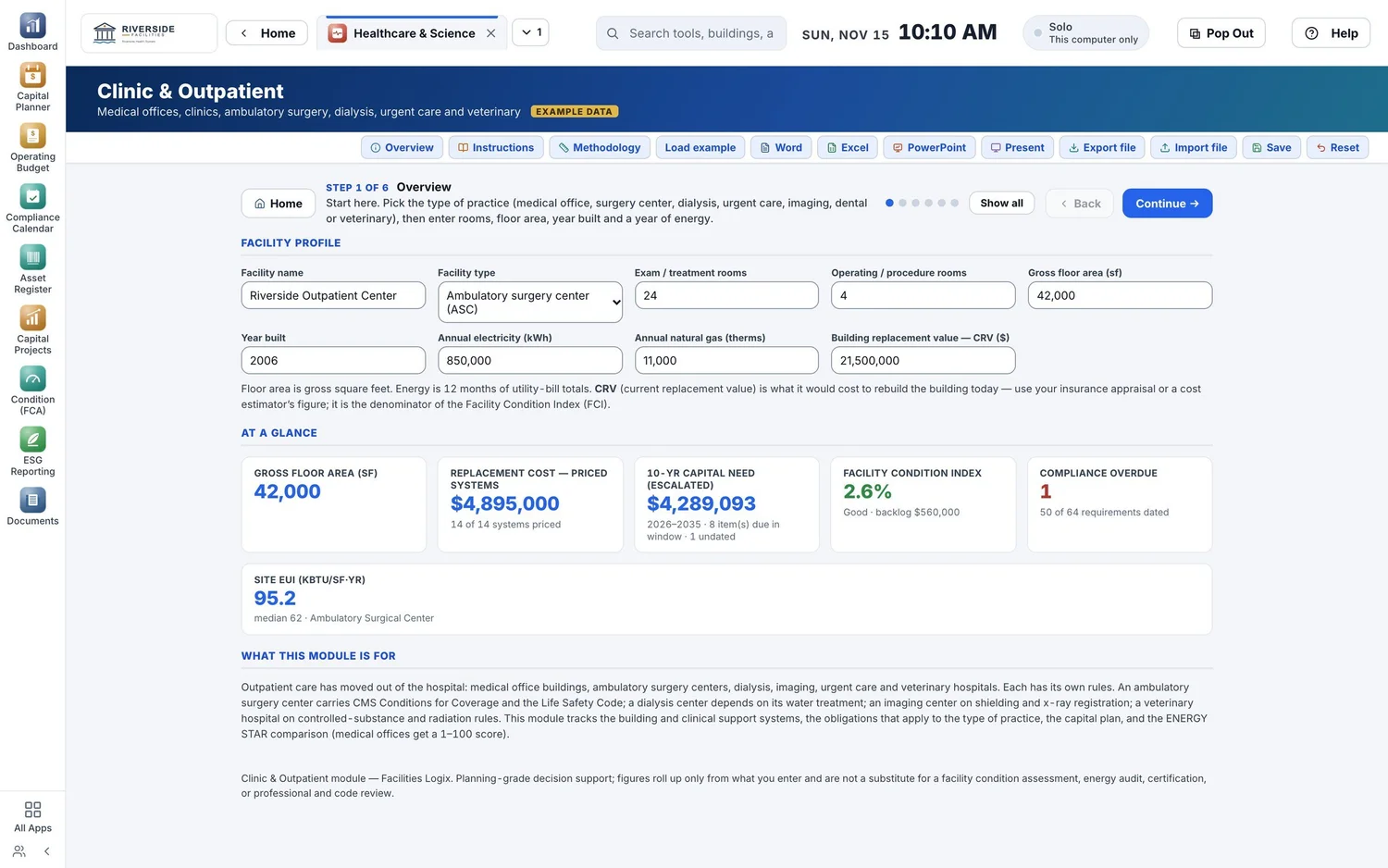
A full rulebook overwhelms a two-person team, so the profile turns on only what this practice needs.
Frequently Asked Questions
Does a medical office get the surgery center rules?
What about state rules for veterinary premises?
Can a practice with sterile compounding track its rooms?
Be First When Facilities Logix Opens
Stop chasing building records across spreadsheets and binders. Join the list and we will tell you the day downloads open, with setup guides ready.
Launching early 2027 for Facilities Logix. Nothing to buy today, and no sales calls.
